THEIR NAMES.
Reading edition
We accuse our short-sighted ancestors, and with reason, for leaving us almost without a church-yard and a market-place; for forming some of our streets nearly without width, and without light. One would think they intended a street without a passage, when they erected Moor-street; and that their successors should light their candles at noon.
Something, however, may be pleaded in excuse, by observing the concourse of people was small, therefore a little room would suffice; and the buildings were low, so that light would be less obstructed: besides, we cannot guess at the future but by the present. As the increase of the town was slow, the modern augmentation could not then be discovered through the dark medium of time; but the prospect into futurity is at this day rather brighter, for we plainly see, and perhaps with more reason, succeeding generations will blame us for neglect. We occupy the power to reform, without the will; why else do we suffer enormities to grow, which will have taken deep root in another age? If utility and beauty can be joined together in the street, why are they ever put asunder? It is easy for Birmingham to be as rapid in her improvement, as in her growth.
The town consists of about 125 streets, some of which acquired their names from a variety of causes, but some from no cause, and others, have not yet acquired a name.
Those of Bull street, Cannon street, London Prentice street, and Bell street, from the signs of their respective names.
Some receive theirs from the proprietors of the land, as Smallbrook street, Freeman street, Colmore street, Slaney street, Weaman street, Bradford street, and Colmore row.
Digbeth, or Ducks Bath, from the Pools for accommodating that animal, was originally Well street, from the many springs in its neighbourhood.
Others derive a name from caprice, as Jamaica row, John, Thomas, and Philip streets.
Some, from a desire of imitating the metropolis, as, Fleet-street, Snow-hill, Ludgate-hill, Cheapside, and Friday-street.
Some again, from local causes, as High-street, from its elevation, St. Martin's-lane, Church-street, Cherry-street, originally an orchard, Chapel-street, Bartholomew-row, Mass-house-lane, Old and New Meeting-streets, Steelhouse-lane, Temple-row and Temple-street, also Pinfold-street, from a pinfold at No. 85, removed in 1752.
Moor-street, anciently Mole-street, from the eminence on one side, or the declivity on the other.
Park-street seems to have acquired its name by being appropriated to the private use of the lord of the manor, and, except at the narrow end next Digbeth, contained only the corner house to the south, entering Shut-lane, No. 82, lately taken down, which was called The Lodge.
Spiceal-street, anciently Mercer-street, from the number of mercers shops; and as the professors of that trade dealt in grocery, it was promiscuously called Spicer-street. The present name is only a corruption of the last.
The spot, now the Old Hinkleys, was a close, till about 1720, in which horses were shown at the fair, then held in Edgbaston-street. It was since a brick-yard, and contained only one hut, in which the brick-maker slept.
The tincture of the smoky shops, with all their black furniture, for weilding gun-barrels, which afterwards appeared on the back of Small-brooke-street, might occasion the original name Inkleys; ink is well known; leys, is of British derivation, and means grazing ground; so that the etymology perhaps is Black pasture.
The Butts; a mark to shoot at, when the bow was the fashionable instrument of war, which the artist of Birmingham knew well how to make, and to use.
Gosta Green (Goose-stead-Green) a name of great antiquity, now in decline; once a track of commons, circumscribed by the Stafford road, now Stafford-street, the roads to Lichfield and Coleshill, now Aston and Coleshill-streets, and extending to Duke-street, the boundary of the manor.
Perhaps, many ages after, it was converted into a farm, and was, within memory, possessed by a person of the name of Tanter, whence, Tanter-street.
Sometimes a street fluctuates between two names, as that of Catharine and Wittal, which at length terminated in favour of the former.
Thus the names of great George and great Charles stood candidates for one of the finest streets in Birmingham, which after a contest of two or three years, was carried in favour of the latter.
Others receive a name from the places to which they direct, as Worcester-street, Edgbaston-street, Dudley-street, Lichfield-street, Aston-street, Stafford-street, Coleshill-street, and Alcester-street.
A John Cooper, the same person who stands in the list of donors in St. Martin's church, and who, I apprehend, lived about two hundred and fifty years ago, at the Talbot, now No. 20, in the High-street, left about four acres of land, between Steelhouse-lane, St. Paul's chapel, and Walmer-lane, to make love-days for the people of Birmingham; hence, Love-day-croft.
Various sounds from the trowel upon the premises, in 1758, produced the name of Love-day-street (corrupted into Lovely-street.)
This croft is part of an estate under the care of Lench's Trust; and, at the time of the bequest, was probably worth no more than ten shillings per annum.
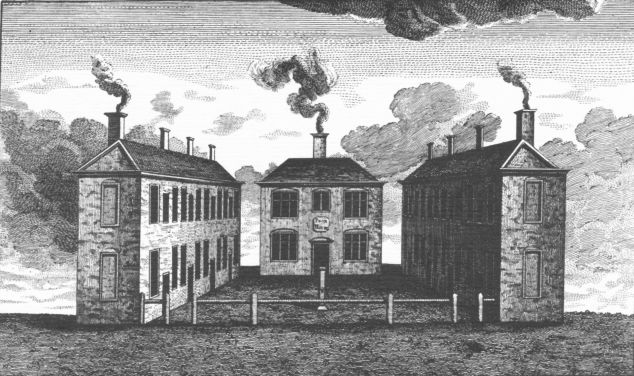
At the top of Walmer-lane, which is the north east corner of this croft, stood about half a dozen old alms-houses, perhaps erected in the beginning of the seventeenth century, then at a considerable distance from the town. These were taken down in 1764, and the present alms-houses, which are thirty-six, erected near the spot, at the expence of the trust, to accommodate the same number of poor widows, who have each a small annual stipend, for the supply of coals.
This John Cooper, for some services rendered to the lord of the manor, obtained three privileges, That of regulating the goodness and price of beer, consequently he stands in the front of the whole liquid race of high tasters; that he should, whenever he pleased, beat a bull in the Bull-ring, whence arises the name; and, that he should be allowed interment in the south porch of St. Martin's church. His memory ought to be transmitted with honor, to posterity, for promoting the harmony of his neighbourhood, but he ought to have been buried in a dunghill, for punishing an innocent animal.--His wife seems to have survived him, who also became a benefactress, is recorded in the same list, and their monument, in antique sculpture, is yet visible in the porch.
The Alms House.