GENERAL HOSPITAL.
Reading edition
Though charity is one of the most amiable qualities of humanity, yet, like Cupid, she ought to be represented blind; or, like Justice, hood-winked. None of the virtues have been so much misapplied; giving to the hungry, is sometimes only another word for giving to the idle. We know of but two ways in which this excellence can exert itself; improving the mind, and nourishing the body. To help him who will not help himself; or, indiscriminately to relieve those that want, is totally to mistake the end; for want is often met with: but to supply those who cannot supply themselves, becomes real charity. Some worthy Christians have taken it into their heads to relieve all, for fear of omitting the right. What should we think of the constable who seizes every person he meets with, for fear of missing the thief? Between the simple words, therefore, of WILL NOT and CANNOT, runs the fine barrier between real and mistaken charity.
This virtue, so strongly inculcated by the christian system, hath, during the last seventeen centuries, appeared in a variety of forms, and some of them have been detrimental to the interest they were meant to serve: Such was the cloister. Man is not born altogether to serve himself, but the community; if he cannot exist without the assistance of others, it follows, that others ought to be assisted by him: but if condemned to obscurity in the cell, he is then fed by the aid of the public, while that public derives none from him.
General Hospital.
Estates have sometimes been devised in trust for particular uses, meant as charities by the giver, but have, in a few years, been diverted out of their original channel to other purposes.
The trust themselves, like so many contending princes, ardently druggie for sovereignty; hence, legacy and discord are intimate companions.
The plantation of many of our English schools sprang up from the will of the dead; but it is observable, that sterility quickly takes place; the establishment of the master being properly secured, supineness enters, and the young scions of learning are retarded in their growth.
It therefore admits a doubt, whether charitable donation is beneficial to the world; nay, the estate itself becomes blasted when bequeathed to public use, for, being the freehold of none, none will improve it: besides, the more dead land, the less scope for industry.
At the reformation, under Queen Elizabeth, charity seemed to take a different appearance: employment was found for the idle; he that was able, was obliged to labour, and the parish was obliged to assist him who could not. Hence the kingdom became replete with workhouses: these are the laudable repositories of distress.
It has already been observed, that three classes of people merit the care of society: forlorn infancy, which is too weak for its own support; old age, which has served the community, without serving itself; and accidental calamity: the two first, fall under the eye of the parish, the last, under the modern institution of the General Hospital.
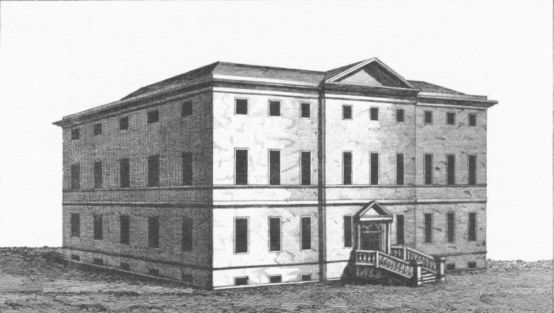
The shell of this plain, but noble edifice, was erected in 1766, upon a situation very unsuitable for its elegant front, in a narrow dirty lane, with an aspect directing up the hill, which should ever be avoided.
The amiable desire of doing good in the inhabitants, seemed to have exceeded their ability; and, to the grief of many, it lay dormant for twelve years. In 1778, the matter was revived with vigor; subscriptions filled apace, and by the next year the hospital was finished, at the expence of 7137l. 10s. Though the benefactions might not amount to this enormous sum, yet they were noble, and truly characteristic of a generous people. The annual subscriptions, as they stood at Michaelmas, 1779, were 901l. 19s. and, at Midsummer, 1780, 932l. 8s. During these nine months, 529 patients were admitted, of which, 303 were cured, 93 relieved, 112 remained on the books, only 5 died, and but one was discharged as incurable; an incontestible proof of the skill of the faculty, which is at least equalled by their humanity, in giving their attendance gratis.
The rules by which this excellent charity is conducted, are worthy of its authors: success hath fully answered expectation, and the building will probably stand for ages, to tell posterity a favourable tale of the present generation.