CLASS.—AVES.—BIRDS.
Reading edition
Sub-Class I.—Palaeognathae.
Ratitae and Tinamidae.
F. 1. Rheidae, Rhea, 3 sp. Nl.
F. 2. Struthionidae, Ostrich, 4 sp.—4(3)E., 1(0)P. (S. Palestine).
ORDER I.—CASUARIIFORMES.
F. 3. DROMAEIDAE (1), EMU, 1 sp. A.
1 1
1 Emu, Dromaius novae-hollandiae, A.
Stat. r. plains 78
See diagram, second largest living bird; f., smaller. Fruits, grass.
F. 4. CASUARIIDAE (1), CASSOWARY, 17 sp. A.
F. 5. Apterygidae, Apteryx, Kiwi, 6 sp. A. (N.Z.).
F. 6. Tinamidae, Tinamous, 69 sp. Nl.
The birds of the second order are well known as "scratchers." They include the domestic fowl, which has been derived from the wild jungle fowl of India, and other fowl, such as the peafowl. Quail are also included here; so are Pheasants. The absence of Pheasants from Australia is more than compensated for by the presence of the Mound-Builders. These marvellous birds, Brush Turkeys and Mallee-Fowl, retain the reptilian characteristic of not sitting on their eggs. Thus the young have never known their parents. The eggs are laid in a huge mound of sand and earth, which contains rotting vegetation. The heat of decomposition in this remarkable natural incubator, is quite sufficient to hatch the eggs. The young are born fully feathered, able to run at once, and able to fly the day they leave the mound. Contrast their stage of development with that of a pigeon born naked, blind, and helpless, and that of a chick born clothed with down and able to run about. There is an interesting connexion between the size of an egg and the state of development of the young bird at birth. The pigeon lays a relatively small egg, so the young pigeon does not develop far in the egg, and requires much maternal care. The hen's egg is larger, and the chick is more fully developed. The Mallee-Hen's egg is enormous, and so the young can develop much further before birth. This bird, unfortunately, is doomed to early extinction, for the fox has discovered the rich store of food in the eggs, and country dwellers have also discovered that they are delicate in flavor, and are good food. It is hoped that the scrubby western end of Kangaroo Island, where foxes are unknown, will prove a suitable sanctuary for them. These birds, which rank among Nature's wonders, are almost confined to the Australian region. One is found in Borneo and the Philippines, while a second is confined to the distant Nicobar Islands. Twenty-six live in Australia and its neighboring islands. One of these has spread across Wallace's line to the small Kangean Island, near Java. The Stubble Quail, a member of the Pheasant family, is nearly identical with the British Quail. Mathews and Campbell make the King Quail a sub-species of the Chinese Quail.
Quail are favorite sporting birds, but when one considers that they are worth about 9d. each as table or game birds, and that sportsmen found at Birregurra, that the crops of Quail were full of crickets, and at Kerang the Quail contained numbers of a species of weevil, it is doubtful if it is wise policy to shoot this insect-eating bird. Although it may be worth a few pence as a table bird; it is worth many shillings as a pest destroyer.
Sub-Class II.—Neognathae.
Carinatae, minus Tinamidae.
ORDER II.—GALLIFORMES.
F. 7. MEGAPODIIDAE (4), Mound-Builders, Scrub-Fowl, Brush Turkey, Megapode, 28 sp.—27(25)A., 3(1)O.
1 1
2* Mallee-Fowl, Lowan, Native Pheasant, Pheasant (e), Leipoa ocellata, N.S.W., V., S.A., W.A.
Stat. r. mallee scrubs 24
Like a small turkey; neck light fawn-gray; back, wings spotted white, black, brown; f., smaller. Seeds, ants.
F. 8. Cracidae, Curassows, Guans, 59 sp.—1(0)Nc., 59(58)Nl.
F. 9. Tetraonidae, Grouse, Capercailly, Ptarmigan, Prairie-Fowl, 45 sp.—1(0)O., 19(16)P., 28(26)Nc.
F. 10. PHASIANIDAE (6), Pheasants, Partridges, Peafowl, Domestic Fowls, 242 sp.—12(10)A., 137(119)O., 47(31)P., 64(58)E.
1 6
3* Stubble Quail (Pectoral), Coturnix pectoralis, A., T. =vt. Eur. Quail.
Nom. c. stubble, grass 6.7
Brown lined white, black; throat dull reddish; breast streaked black; f., less distinctly marked with black. Weed-seeds, insects. Rises with a burr-r-r.
3 7
4* Brown Quail (Swamp, Partridge), Synoicus australis, N.G., A., T. =vt. Eur. Partridge.
Nom. c. grassy flats 6.5
Upper finely-barred gray, black, chestnut; under buffy-gray with zigzag black bars; bill blue, tipped black; eyes orange; f., sim. Seeds, insects. "Bee'e quick."
5 Tasmanian Quail (Silver, Greater-Brown), S. diemenensis, V., T. Like 4, but larger.
Nom. r. occ. thick grass 8.5
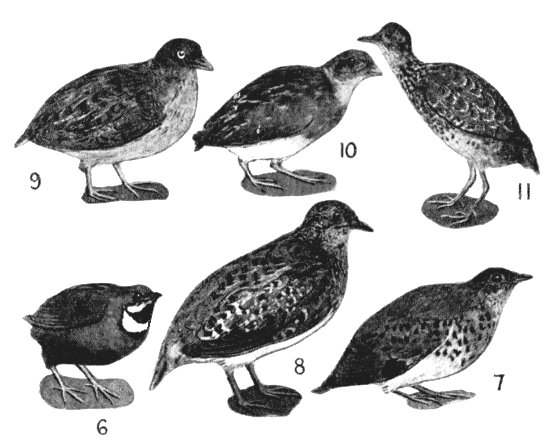
1 4
6* King Quail (Chestnut-bellied, Least, Dwarf, Swamp), Excalfactoria chinensis lineata, Philippines, Sumatra to A. exc. W.A.; sub-species of Chinese Quail.
Nom. r. swamps 4.5
Back dark-brown; breast blue-gray; abdomen chestnut; throat black, white bands conspicuous; 1¼ oz.; f., dark-brown, spotted black; throat whitish; under barred black. Weed-seeds, insects.
F. 11. Numididae, Guinea-Fowls, 23 sp. E.
F. 12. Meleagridae, Turkeys, 5 sp.—4(2)Nc., 3(1)Nl.
F. 13. Odontophoridae, American Quails, Bob-Whites, 72 sp.—18(10)Nc., 62(54)Nl.
Order III. comprises the 26 Bustard Quail and the peculiar Australian Plain Wanderer. Only the last species of this Bustard Quail family, the Australian Plain Wanderer has the hind toe. The females of this order of birds do the fighting.
In Quail, the rule often observed amongst birds that the male is larger and more beautiful than the female may be reversed, for here the female is sometimes larger and the more conspicuously colored. In association with this reversal of color and size, the domestic habits are changed, for, in some species at least, the female sits on the eggs but a very short time; the male then finishes the task of incubating, and brings up and educates the young family. Meantime, the female has found another mate and another clutch of eggs is left to the care of the male.
In birds having both sexes the same color each bird usually does its share of domestic work, sitting on the eggs, feeding the young, etc. Where the male is more brightly colored, he, as a rule, does not sit on the eggs, for he would be visible to a bird of prey sailing overhead, and so would probably be killed and the eggs taken. The great naturalist, Alfred Russel Wallace, thus regards the quiet coloration of most female birds as a protection during the nesting season. The gaudy coloration of many male birds has been explained by Darwin as being due to sexual selection, the female choosing as a mate the most gaily colored or most attractive bird.
Though the sitting bird is usually protectively colored, it was our good fortune, on a Summer School excursion, attended by His Excellency the Governor (Sir Thomas Gibson-Carmichael), a keen Nature-lover, and the Director of Education (Mr. F. Tate), to find the gorgeously-colored male Golden-breasted Whistler (Thickhead) sitting on the eggs in full daylight. It was noted, however, that the open nest was unusually well protected by an overhead bushy branch.
ORDER III.—TURNICIFORMES, HEMIPODES.
F. 14. TURNICIDAE (8), Button (Bustard) Quail, 27 sp.—14(14)A., 9(6)O., 3(0)P., 4(4)E.
7 26
7 Red-Backed Quail (Black-backed, Orange-breasted), Turnix maculosa, Cel., N.G., N.A., E.A., S.A.
Nom. r. marshy 7
Back brown; crown blackish; sides, breast large black spots; abdomen lighter; no hind toe; f., larger. Weed-seeds, insects.
8* Painted Quail (Speckled, Butterfly), Varied Turnix, New Holland Partridge (e), T. varia, A., T.
Nom. r. sandy 8
Upper rufous-brown with buff, black lines; breast, face spotted; no hind toe; f., larger. Weed-seeds, insects.
9 Red-chested Quail (Chestnut-breasted, Yellow), T. pyrrhothorax, A. exc. W.A.
Nom. v.r. marshy 6
Upper dark-brown with buff, black lines; breast sandy-red; abdomen whitish; no hind toe; f., much larger, brighter. Weed-seeds, insects.
10 Little Quail (Dottrel, Swift-flying, Button), T. velox, A.
Nom. c. open plains 5.5
Upper rufous with chestnut, black lines; breast rufous; abdomen white; no hind toe; f., much larger. Weed-seeds, insects.
1 1
11* Plain Wanderer, Turkey Quail, Pedionomus torquatus, A. exc. W.A.
Mig. r. grass, m., 4.8; f., 6.3
Brown; broad black, white spotted collar; light band on wing; breast chestnut; hind toe; m., smaller, paler, faint collar. Weed-seeds, insects.
F. 15. Pteroclididae, Sand-Grouse, Rock-Pigeons (e), 17 sp.—7(2)O., 8(1)P., 12(7)E.
In Order IV. come those well-known birds—the "Cooers," Pigeons and Doves. The Australian region is the great stronghold of these often beautiful birds. It is only in this region that members of each of the five families of living Pigeons are found. Two of the five families are peculiar to the region, and nearly half the kinds of Pigeons known are found here. The finest and largest of all Pigeons are the large Crowned Pigeons of New Guinea. Unfortunately, the heads of these Pigeons are much in demand for millinery. Would that fashionable women knew the cruelty and devastation wrought by such fashions!
Amongst the most beautiful of Pigeons are, as Dr. Newton remarked, the common Bronzewing Pigeons of Australia and Tasmania. The lovely Fruit-Pigeons of East Australian scrubs are, perhaps, the most beautiful of all, so it will readily be seen how fortunate we are with regard to these birds.
The fine large Wonga-Wonga Pigeon is becoming rare. Its flesh is white, so Gould named it Leucosarcia (white flesh). It has been proposed to introduce this bird into Europe to breed for table purposes.
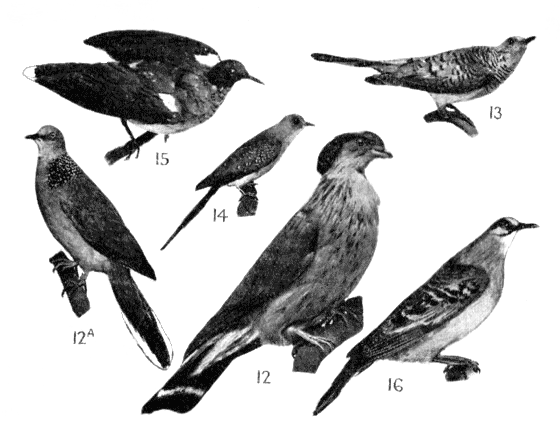
ORDER IV.—COLUMBIFORMES, PIGEONS, DOVES.
F. 16. TRERONIDAE (8), FRUIT-PIGEONS, 228 sp—159(155)A., 60(56)O., 1(1)P., 12(12)E.
2 2
12 Topknot Pigeon, Lopholaimus antarcticus, E.A., T. (acc.) "Quook-quook."
Stat. c. thick brushes 17
"This noble pigeon;" under silvery-gray; upper dark-gray; crest rust-red; eyes orange; f., sim. Native fruits.
F. 17. COLUMBIDAE (2), WOOD-PIGEONS, Passenger-Pigeon, Rock-Dove, 119 sp.—41(40)A., 25(17)O., 18(10)P., 19(17)E., 4(0)Nc., 24(20)Nl.
F. 18. PERISTERIDAE (15), GROUND-PIGEONS, Turtle-Doves, 198 sp.—61(55)A., 21(8)O., 10(1)P., 32(30)E., 10(0)Nc., 86(76)Nl.
1 6
12a Indian Turtle-Dove, Turtur ferrago, Siberia to Ceylon, introduced A.
Mig. c. gardens, cities 13
Back brown; head gray; broad patch side and back of neck black spotted white; breast cinnamon; centre tail feathers blackish, rest tipped white; f., sim. Seeds.
3 5
13 Ground Dove (Peaceful), Doo-doo, Geopelia placida, A. (interior).
Stat. r. grassy 8.7
Upper ashy-brown, barred black; chest, hind-neck gray with black lines; abdomen fawn; side tail feathers tipped white; f., sim. Small seeds. "Doo-doo."
14* Diamond Dove (Little, Turtle), G. cuneata, A. (interior).
Stat. r. grass 8.2
Upper light-brown; crown gray; under light-gray; white spots on wing; side tail tipped white; eye red; f., neck, chest pale brown. Seeds.
1 6
15 Little Green Pigeon, Chalcophaps chrysochlora, Mol., N. Heb., N. Cal., Lord Howe Is., A. exc. S.A., W.A. Melancholy bellowing note.
v.r. dense scrubs 9.5
Rich brown; head, short tail darker; wings much green; shoulder white; f., less brilliant. Fallen berries.
2 2
16* Bronzewing Pigeon (Scrub), Phaps chalcoptera, A., T.
Nom. c. open, forest 13.5
Upper brown marked lighter; cap whitish; line below eye, throat white; breast, back of head vinous; bronze wing; legs red; f., head gray. Seeds, fruits.
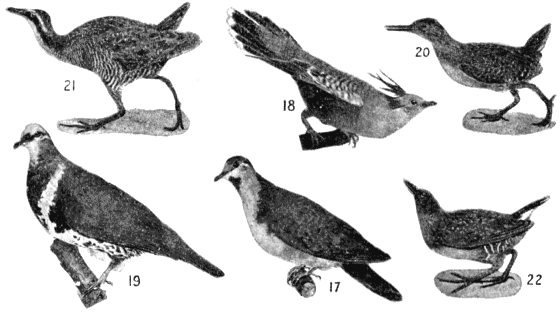
17 Brush Bronzewing Pigeon (Little Bronze), P. elegans, A., T.
Nom. r. sandy 13
Upper chestnut-brown; breast blue-gray; throat, crown chestnut; bronze wings; f., crown gray. Seeds.
1 1
18 Crested Pigeon (Topknot (e), Crested Bronzewing), Ocyphaps lophotes, A. Seeds.
Nom. r. inland plains 13
Upper fawn; crown, under gray; crest black; black bars on wings; tail tipped white; eyes orange; f., sim.
1 1
19 Wonga-Wonga Pigeon, Leucosarcia melanoleuca, E.A. Seeds, fallen fruits.
Stat. r. coast-, (hillside-) brushes 15
Back, breast slaty-gray; wings brown; crown, throat, abdomen white; sides spotted black; f., sim.
F. 19. Gouridae, Crowned Pigeons, 8 sp. A. (N.G.).
F. 20. Didunculidae, Tooth-billed Pigeons, 1 sp. A. (Samoa).
F. 21. Opisthocomidae, Hoactzin, 1 sp. Nl.
The birds of Order V. are amongst the successes in the struggle for existence, for they are found the world over.
The Landrail or Corn-Crake, the Little Crake, Spotted Crake, Moor-Hen, Purple Gallinule, and the lobed-toed Coot, of other countries, are represented by similar birds here.
They are largely swamp-dwellers, and conditions about swamps apparently do not vary much from continent to continent. There is a full supply of vegetable and animal food, and there is good shelter in the thick reed-beds. The smaller members of the family are seldom seen, for they skulk amongst the reeds, and seldom show themselves.
Many of these birds are long-toed, and are beautifully adapted for life about the soft mud and floating vegetation of lagoons and swamps. Though the feet are not webbed, several of these swamp-dwellers swim well. Thus the Little Crake is an expert swimmer and diver.
There is one Australian bird not represented in other countries. This is the handsome, bantam-like Black-tailed Native-Hen. At long intervals the birds appear in thousands, and, being largely vegetable feeders, they have sometimes done considerable damage to crops.
During one such irruption in 1846, the birds invaded the streets of Adelaide. Others invaded the Geraldton district, and even reached Perth in 1886. Northern Victoria was visited in 1909.
Some of the members of this group are known to all; indeed, when you have finished reading this lecture, I expect to have created in your mind an idea that bird study is very simple—that you know at least one of each of the groups of birds. One further advantage of bird study is that so few birds are found in any district. Thus, only 880 birds have ever been recorded from Australia, whereas there are over 9,000 kinds of native flowering plants, not to mention non-flowering plants. In very few districts could a list of 100 different kinds of birds be compiled in one year.
Again, while it is impossible to talk popularly of native plants, because they have no common names, that does not apply to birds, for bird-lovers have given a simple name to each bird. Even children, therefore, can talk definitely and exactly about the different kinds. This is a great advantage. Again, as birds are living, moving, loving, and beautiful animals, they have always been favorite objects of study, and so we know more about them than about any other division of the animal kingdom. Thus you will, I hope, find that you know far more about the subject than you at first thought.
ORDER V.—RALLIFORMES.
F. 22. RALLIDAE (16), RAILS, 204 sp.—68(60)A., 37(18)O., 18(0)P., 37(24)E., 17(7)Nc., 72(65)Nl.
4 17
20 Slate-breasted Rail (Short-toed), Lewin Water-Rail, Eulabeornis (Hypotaenidia) brachypus, A., T., Auckland Is. =vt. Eur. Water-Rail. [~20 Rallus pectoralis.]
Stat. r. rivers, lagoons 8.5
Upper blackish striped olive; wings, flanks, abdomen barred black, white; throat, breast, slate-gray; f., duller.
21* Pectoral Rail, Landrail, E. philippinensis, Malay Arch. to A., N.Z., Pac. Is. =vt. Eur. Corn-Crake (Landrail); f., young sim. Insects, grass.
Mig. c. grassy 10.5
Upper brown spotted white; under finely-barred black; white; sandy-buff bar on chest; light stripe above eye.
4 17
22* Australian Spotted Crake, Water-Crake, Porzana fluminea, A. =vt. Eur. Spotted Crake.
Stat. r. rivers 7
Upper dark-brown, spotted white; abdomen, flanks blackish barred white; breast gray; swims; f., sim. Insects.
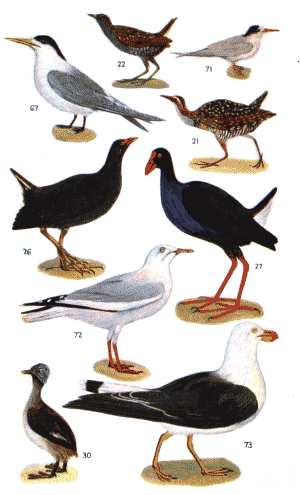
21 Pectoral Rail 22 Australian Spotted Crake 26 Black Moor-Hen 27 Bald Coot 30 Hoary-headed Grebe 67 Crested Tern 71 White-faced Ternlet 72 Silver Gull 73 Pacific Gull
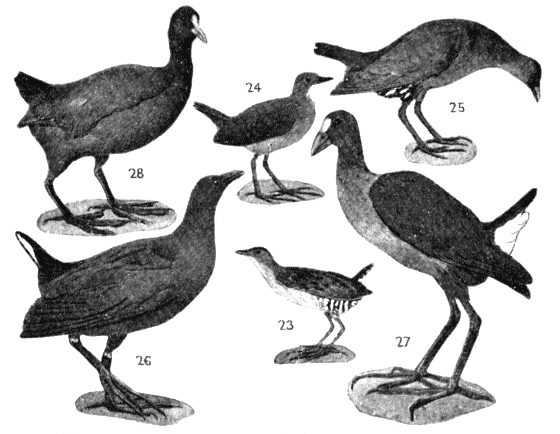
23 Australian Little Crake, P. palustris, A. =vt. Eur. Little Crake.
Stat. r. river, reed-beds 6
Upper rusty-brown; throat, breast gray; crown blackish; flanks, lower-abdomen barred black, white; swims, dives; f., sim. Water-animals.
24 Spotless Crake (Leaden, Tabuan), Swamp-Rail, Little Swamp-Hen, Putoto, P. plumbea, Philippines to A., N. Heb., N. Cal., Fiji, Samoa, Tonga, N.Z., Chatham Is.
Stat. c. reed-beds 6.3
Upper reddish-brown; under dark slate-gray; throat whitish; eyes pink; f., young sim. Water-animals.
2 2
25 Black-tailed Native-Hen, Gallinule (e), Tribonyx ventralis, A.
Mig. flocks, occ. r. lagoons, rivers 15
Upper brown; under bluish-gray; white marks conspicuous on flanks; upper-bill light-green; lower red at base; legs brick-red; runs, seldom flies; f., sim. Water-animals, seeds.
1 8
26* Black Moor-Hen (-Gallinule), Gallinula tenebrosa, N.G., A. =vt. cos. Gallinule.
Stat. c. lagoons, rivers 15
Grayish-black; back deep-brown; under tail white at sides; scarlet garter above knee; base bill, plate on forehead blood-red; no white on flanks; jerks tail; f., smaller. Water-animals, plants.
2 16
27* Bald-Coot, Purple Gallinule, Black-backed Water (Swamp, Macquarie) Hen, Pukeko, Redbill (e), Porphyrio melanonotus, N.G., A., T., Norfolk Is., Lord Howe Is., N.Z. =vt. cos. bird.
Stat. c. lagoons, rivers 17.5
Hind-neck, breast, flanks indigo-blue; back, wings, tail black; under tail white; eyes orange-red; bill, legs red; jerks tail; f., smaller. Insects, vegetable food.
1 13
28 Australian Coot, Dabchick (e), Fulica australis, A., T., =vt. cos. bird.
Stat. c. lakes, bays 14
Sooty-black; bill bluish-gray; eyes red; lobed feet; f., sim. Water-insects, snails.
F. 23. Heliornithidae. Finfoot, 5 sp.—1(1)O., 3(3)E., 1(1)Nl.
In the next Order, the Sixth, there are three Australian birds. They are called Grebes. Bird names often reflect some habit, e.g., Scratchers, Cooers. So Grebes are often called Divers. But the Divers of the ornithologist are Northern Hemisphere birds, placed in the next family (25).
There is a widespread tradition to the effect that Grebes wait for the flash of the cap, and then dive before the bullet can reach them. They are, indeed, remarkably active in the water, but are absurd on land. Their legs are set so far back that it is almost impossible for them to walk. Their toes are not webbed, but are broadly lobed.
The Great Crested Grebe is identical with the British bird, for it is found all through the Eastern Hemisphere.
This is a remarkable distribution, when we consider that the bird, by reason of its very small wings, is a poor flyer, and is almost helpless on land. Such a wide distribution of a creature possessing poor means of locomotion indicates that the animal must have existed for a long time, so that it has been able to gradually extend its range. Thus we conclude it is an ancient form.
ORDER VI.—PODICIPEDIDIFORMES.
F. 24. PODICIPEDIDAE (3), GREBES, 25 sp.—5(2)A., 8(2)O., 6(0)P., 5(1)E., 6(0)Nc., 11(7)Nl.
2 15
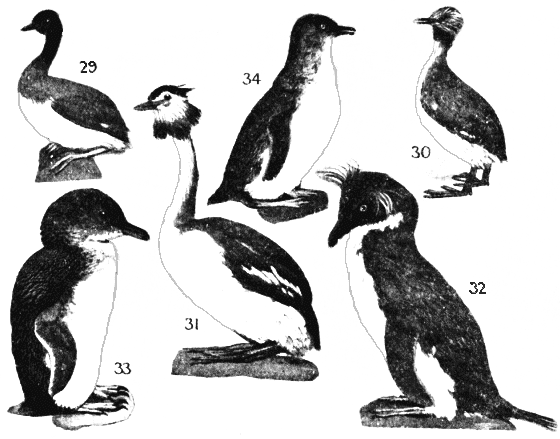
29 Black-throated Grebe (Little), Dabchick (e), White-bellied Diver (e), Podiceps novae-hollandiae, Java, N.G., A., N. Cal., =vt. Eur. Little Grebe.
Stat. c. lagoons 9.5
Upper blackish-brown; white patch on wing; under silvery-gray; throat, side-face black (summer), brown (winter); beautiful fur-like plumage; lobed toes; f., sim. Small fish, snails, insects.
30* Hoary-headed Grebe, Dabchick (e), "Tom Pudding," P. poliocephalus, A., T.
Stat. c. lagoons, river 9.5
Upper brown; wings white patch; under silvery-gray; head short white hair-like plumes (summer); head brown, throat buff (winter); fur-like plumage; lobed toes; f., sim. Small fish, snails, insects.
1 3
31 Great Crested Grebe (Tippet), Loon, Gaunt, Carr Goose, P. cristatus (Lophaethyia cristata, Mathews' Handlist), Eur., N. Asia, Japan, Africa, India to A., T., N.Z.
Stat. r. lakes, rivers 24
Upper brown; under glistening-white; crown black; neck-frill chestnut edged black (summer); face, neck whitish (winter); fur-like plumage; lobed toes; f., sim. Small fish, snails, insects.
F. 25. Colymbidae (Gaviidae), True Divers, Loons, 5 sp.—1(0)O., 5(0)P., 2(0)E., 5(0)Nc.
In the next order come those remarkable birds, Penguins. As so much has been said about Penguins by Lieutenant Shackleton's party, they have caught the popular fancy, and people are much interested in them. Many Australians do not know that three Penguins are found on their own coast. It was one of the sights of the 1910 Summer School at Portsea to sit on the balcony and watch the Penguins chasing their prey in the clear waters in front. Their wings are paddles, being flattened and devoid of quills. The wings are not folded, but are carried hanging awkwardly at the side.
During the interest aroused by Peary's expedition to the North Pole, an illustrated weekly paper published a cartoon, which showed the American Eagle sitting on the North Pole and reading a proclamation to an audience of Penguins. One thing is unfortunate about this—Penguins are unknown in the Northern Hemisphere. Indeed, they support the geographer in his contention that, while the Pacific Ocean is very ancient, the Atlantic Ocean has been formed much more recently, for Penguins are found up the Pacific even to the Galapagos Is. on the Equator, but have not spread into the Atlantic Ocean beyond Tristan da Cunha, at the extreme South.
ORDER VII.—SPHENISCIFORMES.
F. 26. SPHENISCIDAE (3), PENGUINS, 17 sp.—11(7)A., 6(1)E., 9(4)Nl.
1 5
32 Crested Penguin (Tufted, Jackass, Victoria), Penguinus (Catarrhactes) chrysocome, Southern Ocean (circumpolar), V., T., N.Z.
Occ. r. coasts 27
Wing a paddle; upper black; under silvery-white; crest yellow; f., yellow crest feathers shorter. Sea-animals.
2 3
33 Little Penguin (Little Blue), Eudyptula minor, N.S.W., V., S.A., T., N.Z.
Stat. c. coasts 18
Upper light-blue; under glistening-white; wing a paddle; f., sim. Sea-animals, plants.
34 Fairy Penguin, E. undina, V., T., N.Z.
Stat. c. coast 13.5
Like 33, but smaller.
Order VIII. includes the true ocean birds—those wanderers seen far from any land by ocean travellers. Indeed, many of them do not go near land except to breed. Then they usually repair to small lonely islands often with bold precipitous shores.
Ocean birds are readily divisible into four families. The first is made up of the 25 Storm-Petrels; the second of the 75 Petrels, Shearwaters, Fulmars, and Dove-Petrels; the third family comprises only the three small southern Diving-Petrels; while the fourth contains the nineteen noble Albatrosses.
Though Storm-Petrels and Petrels of various kinds may be seen in the Northern Hemisphere, yet the Southern Hemisphere, with its enormous expanse of water, is the headquarters of these birds.
The dainty, tiny Storm-Petrels, fearlessly tripping over the mountain billows in times of great danger to the sailor, were considered birds of ill-omen. Their peculiar flight possibly helped this idea. Gould closely studied them and other ocean birds during his voyages on sailing ships. He describes them as "fluttering over the glassy surface of the ocean during calms with an easy butterfly-like motion of the wings, and buffeting and breasting with equal vigor the crests of the loftiest waves of the storm; at one moment descending into their deep troughs, and, at the next, rising with the utmost alertness to their highest point, apparently from an impulse communicated as much by striking the surface of the water with its webbed feet as by the action of the wings."
This habit of "walking" on the sea is said to be responsible for the name "Petrel," which is associated with Saint Peter, who, of old, walked on the waters. Sailors call them Mother Carey's Chickens.
The largest Australian Storm-Petrel is the Whitefaced Storm-Petrel, whose scientific name, Pelagodroma, means "open sea wanderer." It has been recorded even from the North Atlantic and Britain. Many thousands of these birds still nest on Mud Island, a sandbank just inside Port Phillip Heads. The presence there of a true ocean wanderer is a valuable piece of evidence to support the geographer in his claim that Port Phillip Bay once had a wide opening, which has been almost closed by the drift of sand across its mouth. The Storm-Petrels have probably nested there for many, many centuries. Long may they continue to do so! They hurt no one, and they are a feature of interest to all interested in the flora and fauna of Australia, and to natural history students and Nature-lovers in general.
The Shackleton expedition met the Wilson (Yellow-webbed) Storm-Petrel, in considerable numbers, far south. Two specimens were presented by Lieutenant Shackleton to the National Museum, Melbourne. However, recently our Museum received, through the agency of two schoolboys, a specimen that is valued even more highly, for it is Australian.
The boys, on their way to the Marshaltown State School (Mr. H. B. Williamson, H.T.), found a bird near a fence about nine miles inland. It had evidently been killed by flying into the fence in the dark. Using the Bird-List, the boys discovered that it was a Yellow-webbed Storm-Petrel, a truly pelagic bird, as its name, Oceanites oceanicus indicates. Mr. Williamson, to show that the List was of assistance, even to boys, in identifying birds they had never heard of before, left the bird at the Continuation School, Geelong. Here it was recognized as a valuable specimen, and was at once sent to Mr. Kershaw, curator of the National Museum. It is now in the Australian collection.
The true Petrels are very numerous in kinds and individuals. Darwin thought that the most numerous of birds was a Petrel. One of great interest is the "Mutton-Bird," or Short-tailed Petrel. This romantic bird breeds by the million on Cape Woolamai and other places about Bass Strait.
Just as the mallee farmer is dependent on his annual wheat harvest, so the remarkable colony of people living on Cape Barren Island is entirely dependent on the annual Mutton-Bird harvest. They claim to take about a million and a half birds each year. The number is probably much exaggerated, for Littler, in his valuable Birds of Tasmania, gives the number as 555,000 for 1909, valued at about £4000. Bass and Flinders were glad to replenish their stores with young Mutton-Birds. Flinders calculated that one flock of these birds he met in Bass Strait contained 132,000,000 birds. They lay but one egg, so one would expect the Petrel to be long-lived. We found a closely-similar bird nesting on Mast Head Island, Capricorn Group.
The three southern Diving Petrels, forming the next family, are much smaller than the common Petrels. They are expert divers, and are found mainly in the far South.
The mighty Albatross, with its enormous wing-span of possibly up to 14 feet, is also largely a southern bird. That this bird has spread to the North Pacific Ocean, but has not yet penetrated any distance into the Atlantic, is another piece of evidence as to the age of these two oceans. The Pacific Ocean is a very ancient depression, while the Atlantic is much younger, and has been formed since the lands which border its shores. The Black-browed Albatross, however, was once seen in England. Probably this bird might have been carried north on board ship, and then set free again. Fossil bones of Albatrosses have been found in France and England. Their remarkable power of wheeling round and round a vessel, with no perceptible movement of the wing, has excited much interest and controversy.
Mr. Froude, in his Oceana, has given a vivid description of this flight. The Albatross "wheels in circles round and round and for ever round the ship—now far behind, now sweeping past in a long, rapid curve, like a perfect skater on an untouched field of ice. There is no effort; watch as closely as you will, you rarely or never see a stroke of the mighty pinion. The flight is generally near the water, often close to it. You lose sight of the bird as he disappears in the hollow between the waves, and catch him again as he rises over the crest; but how he rises, and whence comes the propelling force, are to the eye inexplicable; he alters merely the angle at which the wings are inclined...."
Gould considered that many of these birds circumnavigate the globe many times. They follow ships for days together.
Albatrosses are sometimes caught by those on board ship. One means of protection employed by these birds is to discharge a considerable quantity of oily matter at an intruder. This has led sailors to declare that the bird is "seasick." Some claim that this is not done for protection, but is due to fright.
The members of the Australasian Ornithologists' Union, when on a trip in the Manawatu to the Bass Strait Islands found it tantalizing to see the beautiful Shy Albatrosses sitting on their nests on the precipitous granite Albatross Rock, and be unable to land owing to the rough sea that was running. We waited a second and a third day, in the shelter of Chimney Corner, Three Hummocks Island, but finally had to depart with but a distant acquaintance with this fine bird. When they return to nest the succeeding year, the parents drive last year's brood off the island. Does the young live on its fat all through the cold, rough winter, or do the parents return at intervals to feed it? Some recent records by a French party on one of these lonely nesting islands show that in some cases, at least, the parents do feed the young at night during their long wait. The sitting bird is fed by her mate. He opens his mouth, and she inserts her bill, and chooses a dainty for herself.
A Monograph of the Petrels, by F. Du Cane Godman, F.R.S., Pres. British Ornithologists' Union, was consulted for Order VIII.
ORDER VIII.—PROCELLARIIFORMES, TUBINARES, TUBE-NOSED SWIMMERS.
F. 27. PROCELLARIIDAE (5), STORM-PETRELS, MOTHER CAREY'S CHICKENS, 25 sp—10(3)A., 2(0)O., 10(0)P., 7(0)E., 13(4)Nc., 13(3)Nl.
2 3
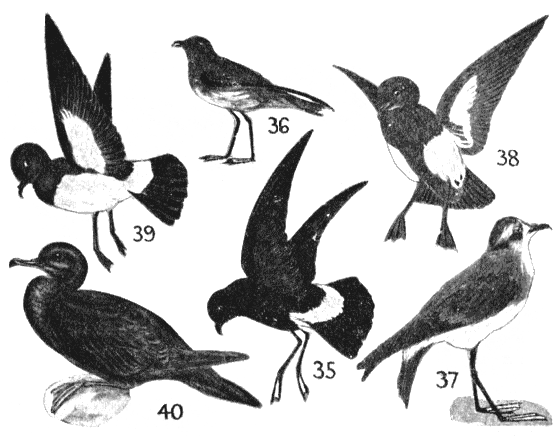
35 Wilson Storm-Petrel (Yellow-webbed, Flat-clawed), Oceanites oceanica, S. Polar regions N. to British Is. (acc), Labrador (acc.), India, A., N.Z.
c. ocean 6.8
Blackish; base tail above below white; legs black; webs yellow; f., sim. Shellfish, small fish, greasy.
36 Gray-backed Storm-Petrel, O. (Garrodia) nereis, S. Oceans, A., T., N.Z.
r. ocean 6.7
Sooty; abdomen, under base tail whitish; bill, feet black; f., sim. Oily substances, shellfish.
1 1
37 White-breasted Storm-Petrel (White-faced), Frigate Petrel, Mother Carey's Chicken, Pelagodroma marina, S. Oceans, N. to Canary Is., U.S. (acc.)
c. Mud. Is. ocean 8
Upper brownish-gray; crown, line under eye, edge of wing, tail black; under, face, throat, line above eye white; bill, feet black; webs yellow; f., sim. Shellfish, oily matters.
2 4
38 Black-bellied Storm-Petrel, Cymodroma (Fregetta) melanogaster, S. Oceans, to N. Atl., A., T.
r. ocean 7.5
Sooty-black; under base tail, flanks white; bill, feet black; f., sim. Sea-animals, oily.
39 White-bellied Storm-Petrel, C. grallaria, S. Oceans to B. of Bengal, Atl. to Cancer, Florida (acc).
r. ocean 7.2
Upper, neck, chest black; under, rump white; bill, feet black; f., sim. Sea-animals, oily.
F. 28. PUFFINIDAE (29), PETRELS, Shearwaters, Fulmars, Prions, 75 sp.—47(16)A., 7(0)O., 24(0)P., 30(2)E., 22(4)Nc., 37(7)Nl.
7 25
40 Wedge-tailed Petrel (Shearwater), Puffinus sphenurus, A. seas.
v.r. ocean 17.5
Sooty-brown; wing blackish; tail black; throat ashy-gray; under dull ashy-brown; bill lead color; legs, feet livid flesh color, dusky on inner side of leg and toe. Like 42, but tail longer; f., sim. Food as for 41.
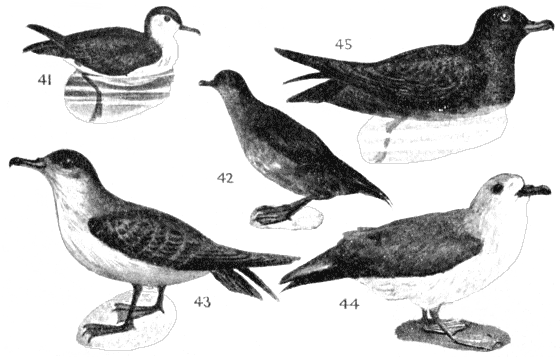
41 Allied Petrel, Gould Shearwater (Little Dusky), P. assimilis, A. and N.Z. Seas, Atl. O. to Madiera Is., Nova Scotia (acc.).
Flocks v.r. ocean 11
Upper, crown, wings, tail sooty-black; side face, under white; side-chest dusky; bill dark horn-colour; legs greenish-yellow; f., sim. Shrimps, shellfish, seaweed.
42 Short-tailed Petrel (Sooty, Bonaparte), Slender-billed Shearwater (U.S.), Seal-Bird, Mutton-Bird (V.), P. brevicaudus (tenuirostris), A., Bass St., T., N.Z. Migrates to Alaska, Japan.
Flocks, c. ocean 14
Sooty-brown; under paler; bill blackish-brown; legs, feet light-grey, black down outer side. Food as 41.
3 3
43 Brown Petrel (Great-Gray), Black-tailed Shearwater (U.S.), Night Hawk (e), Bully, Kuia, Procellaria (Priofinus) cinereus, S.O., California (once).
r. ocean 19.5
Crown, upper dark brownish-gray; under white; under base tail ashy-brown; tail black; feet grayish-flesh color; outer toe brownish-black; dives; f., sim.
1 1
44 Silver-gray Petrel (Fulmar), Slender-billed Fulmar (U.S.), Priocella glacialoides, Bass St., A., T., N.Z., S. Oceans, Pacific to Japan, Alaska.
c. ocean 18
Pearly-gray; tip-wing black; face, under silky-white; f., sim. Dead animals, oil, cuttlefish.
3 3
45 Black Petrel (Fulmar), Taonui, Procellaria (Majaqueus) parkinsoni, A. and N.Z. Seas.
r. ocean 18
Sooty black; f., sim. Food see 41.
9 32
46 Great-winged Petrel (Long-winged, Gray-faced), Æstrelata macroptera, A., N.Z., S. Oceans.
v.r. ocean 15
Dark brown; about bill, throat gray; wing-quills, tail black; bill, feet black; f., sim. Food see 41.
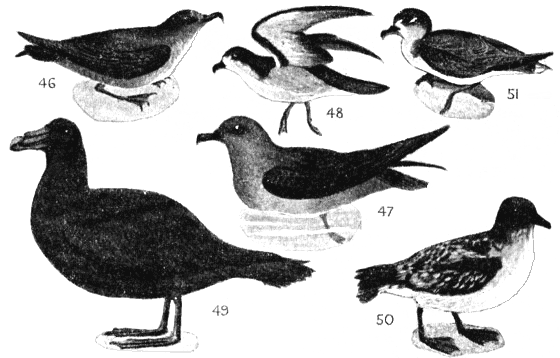
47 Brown-headed Petrel, Solander Fulmar, Æ. solandri, 1 specimen only, Gould, Bass St.
u. ocean 16
Head, wings, tail dark-brown; back slaty-gray, marked dark-brown; bill, legs black.
48 White-winged Petrel, Æ. leucoptera, A., N.Z. to C. Horn, Fiji.
r. ocean 13
Upper dark slaty-gray; forehead, face, under, under wing white; wings blackish-brown; eyes, bill black; legs, half toes and webs fleshy-white; tip toes and webs black; f., sim.
1 1
49 Giant Petrel (Fulmar), Mother Carey's Goose, Nelly, Glutton, Stinkpot, Vulture of the Seas, Macronectes gigantea, S. Oceans up to 30° S. Lat. Oregon (acc).
c. ocean 33
Dark chocolate-brown; bill horn-color; has also a white phase; f., sim. Scavenger, omnivorous.
1 1
50 Cape-Petrel (Pintado, Black and White, Spotted, Pied), Cape-Pigeon (-Fulmar), Daption capensis, A., N.Z., S. Oceans to Brazil, Ceylon, Peru, acc. to California, Maine, England.
Large flocks c. ocean 16.5
Head, hind-neck, upper-back, edge of wing, quills, chin sooty-brown; inner-wing, back white, broadly spotted sooty-brown; under white; bill, feet blackish-brown; f., sim. Food as 41.
5 5
51 Blue Petrel, Prion (Halobaena) coerulea, S. Oceans, A., T., N.Z. to Icepack, Fiji.
c. ocean 11
Forehead, cheeks, throat, centre-chest, under white; upper grayish-blue; outer wing-quills black; tail square, tipped white; bill blackish-brown; f., sim. Cuttlefish, shellfish.
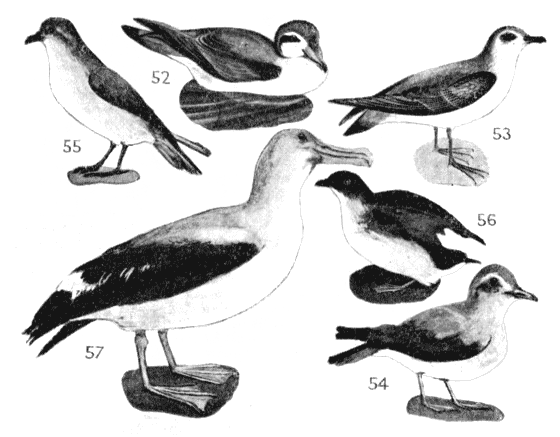
52 Broad-billed Dove-Petrel (Blue-), Whale-Bird, Prion, P. vittatus, S. Oceans.
c. ocean 11.5
Upper delicate blue-gray; head darker than back; edge shoulder, wing, tip-tail black; under, line over eye, white; flanks blue; broad bill blue tipped black; feet light-blue; f., sim. Cuttlefish.
53 Banks Dove-Petrel
(Blue-), Prion, Whiroia,
P. banksi
, S. Oceans, A., T., N.Z.
r. ocean 10
Like 52, but bill narrower and paler blue-gray; expanded wings show black marks like letter W. Food as 54.
54 Dove-Petrel, Dove-like-Petrel (-Prion), Whale-Bird (Snow-), P. desolatus, S. Oceans.
c. ocean 10.5
Like 52, 53, but more delicate; blackish below eye; white stripe above eye; head same as back; bill straighter, more slender; f., smaller. Shellfish, oily substances.
55 Fairy Dove-Petrel (-Prion), Short-billed (Gould) Blue-Petrel, P. brevirostris (ariel), S. Indian O., A., Bass St., Madeira, S. Africa.
v.r. ocean 9.5
Like 52, 53, 54, but bill shorter, stouter; head same as back; white face.
F. 29. PELECANOIDIDAE (1), DIVING PETRELS, 3 sp.—2(0)A., 1(0)E., 3(1)Nl.
1 3
56 Diving-Petrel, Smaller Diving Petrel, Tee-tee, Pelecanoides urinatrix, A., N.Z., Str. of Magellan.
r. sheltered bays 8
Upper black; under white; legs, feet blue; dives; f., sim. Shellfish.
F. 30. DIOMEDEIDAE (10), ALBATROSSES, Mollymawks, 19 sp.—13(3)A., 2(0)O., 5(0)P., 5(1)E., 5(0)Nc., 9(3)Nl.
7 17
57 Wandering Albatross, Man-of-War-Bird, Cape Sheep, Toroa, Diomedea exulans, S. Oceans up to Lat. 30° S.
c. ocean 44
Upper white with fine zigzag brown lines; wing-quills black; tail short, black above; side face, under white; zigzag lines on side of breast; bill whitish; color varies with age; span up to 14 ft.; f., sim. Jelly-fish, shrimps, shellfish.
58 Royal Albatross, D. regia, A., T., N.Z. Seas.
c. ocean 44
Lately separated from 57, because young have white down instead of gray; adult has no zigzag lines; f., sim. Food see 57.
59 Black-browed Albatross (Mollymawk), D. melanophrys, S. Oceans, England (once).
v.c. ocean 32
Head, neck, under, upper base tail white; blackish-gray streak through eye; wings dark brown; back slaty-black; tail dark-gray; bill buff-yellow; f., young sim. Fish.
60 White-capped Albatross, shy Mollymawk, D. (Thalassageron) cauta, A. Seas, Bass St.
c. ocean 31
Back slaty-gray; rump white; wings dark-gray; tail slaty-gray; head, neck, under white; blackish streak through eye; bill horn-color; f., smaller. Fish, barnacles, shrimps.
61 Flat-billed Albatross, (Yellow-nosed (e), Gray-headed), Gould Yellow-nosed Mollymawk, D. chrysostoma (culminata), A., Indian O., Pacific O., Oregon (cas.) G. of St. Lawrence (cas.).
r. ocean 28
Back, wings, tail dark grayish-black; head, neck gray; faint blackish streak through eye; under, rump white; bill black, tip, crest, lower-edge yellow, f., sim. Food see 60.
62 Yellow-nosed Albatross D. chlororhynchus, S. Atl. O., S. Ind. O., A., T.
c. ocean 30
Under, head, neck, rump white; back, wings brownish-black, tail brownish; bill black, crest bright orange-yellow, tip blood-orange; faint dark streak through eye; f., sim. Food see 60.
1 1
63 Sooty Albatross, Phoebetria palpebrata (fuliginosa), S. Oceans, Oregon (cas.), A., N.Z.
c. oceans 29.5
Sooty-brown; white ring almost round eye; bill black; f., sim. Food as 60.
F. 31. Alcidae, Auk, Garefowl, Puffin, Razorbill, Guillemot, Murre, 28 sp.—22(1)P., 27(6)Nc.
The birds of Order IX. are mainly shore birds. There are four chief kinds of these—Terns (Sea-Swallows), including Noddy Terns, Gulls, the remarkable northern Skimmers, which skim along the surface with the lengthened end of the lower mandible in the water, and the bold sea-pirates, Skuas. Fifty-seven Terns and Noddies are found throughout the world. Of these, twenty-one have been recorded from Australian waters.
Being powerful flyers, it is not surprising to find that several of the Australian Terns are really Old-World, and even New-World, forms too. Thus the Whiskered (Marsh) Tern is also British. The Caspian, Gull-billed, and Bridled (Brown-winged) Terns are British and American, while the Sooty Tern is found in all tropical and sub-tropical seas. It is one of the famous birds of the world, for it is the "egg bird" of sailors. It retires in large companies to low scrubby islands to breed. Here it lays a single egg on the bare ground. Sailors, tired of ship's fare, often visit these "rookeries." Gould quotes a record of one party which took 1500 dozen eggs on one small island in Torres Strait. Spanish eggers from Havanah take cargoes, which are disposed of at 25 cents per gallon.
The Wide-Awake Fair, of Ascension Island, is a famous annual event in natural history. A similar scene has been described by Mr. A. W. Milligan, the well-known West Australian ornithologist, on the Houtman Abrolhos Island, west of Western Australia. Here acres of the ground were covered by birds sitting on their nests. The question is, does each find its own nest when it returns to sit? Mr. Milligan settled this in the affirmative by tying a piece of string to a sitting bird and then letting it take flight. It found its own egg, and resumed its work. It is noteworthy that no two of the million eggs are similarly marked, and this puzzling variation in marking probably assists each bird to recognize its own egg.
One of the daintiest of these birds is the Fairy Tern, which was common on Mud Island while the 1909 Summer School was being held. Obedient to the call of the mother bird, which hovered threateningly overhead, the mottled and striped young one squatted on the shelly sand beach while bird-lovers hunted around for the material for a photograph. At length the dark eye revealed the beautifully-protected young bird.
As the camera was being fixed, a different call from the mother caused the young one to run away. Three or four naturalists tried to catch the active little bird, which stopped for a moment and disgorged two whole small fish, with which its mother had evidently but recently fed it. Eventually a good picture was obtained. These Terns nest singly, though others nest in large companies. They obtain fish by diving into the sea. It was interesting, on a Nature-study excursion, to watch the Crested Terns diving frequently into the sea above a shoal of small fish at Sandringham.
We found the Noddies breeding in thousands on Mast Head Island, in the Capricorn Group. They built a small platform of leaves, or seaweed, high or low, on every possible nesting site on the great Pisonia trees. In fact, there is an interesting kind of partnership between the bird and the tree. The fruits of the Pisonia have bands of sticky glands, which adhere to the plumage of the birds. After a time the fruits fall off, possibly on another island, and so this interesting tree is spread throughout these small coral sandbanks and islets. The birds are sometimes so loaded and clogged with these fruits that they are incapable of flight. Surely here is a wonderful partnership between the tree-frequenting Noddy and the forest tree that provides shelter and nesting places for it. It is, indeed, a marvellous method of seed dispersal.
The number of ocean birds breeding on these tiny island-paradises is amazing. Minute Mast Head Island is a place free of all pests—no flies, no mosquitoes, no ticks, no snakes, nor prickly plants, but a deep shady forest of giant Pisonia trees, sometimes covered with creepers and lianas, and fringed with pretty flowering shrubs, fig trees, and long green grass, and surrounded, above spring-tide level, by a fringe of graceful Horse-tail Sheoaks (Casuarinas). We calculated that over 100,000 birds bred annually on this 100-acre sandbank, no point of which rose 10 feet above spring-tide level. The graceful White-capped Noddies already mentioned nested high and low on the trees and shrubs. Petrels in thousands burrowed in the sand under the giant Pisonias, which are so thickly foliaged that not enough light penetrates to enable undergrowth to flourish, so the sand was practically bare in the centre of the island. Reef Herons nested low on spreading branches or interlacing roots. Silver Gulls and Oyster-catchers nested on the ground, within about a yard of the spring-tide mark; Doves, Silver-eyes, Bell-Magpies (Streperas), Caterpillar-eaters, Kingfishers, and other land birds nested in the trees, while the White-bellied Sea-Eagle (almost a fac-simile of the Bald Eagle of America) had his nest overlooking all, on the highest tree on the island. The Frigate Birds were not nesting on Mast Head Island, but they roosted each night in the tall Sheoaks at the water's edge. It was a treat, in the late afternoon, to see these glorious birds winding up their invisible staircase into the vast void of upper air. Gloriously and calmly they sailed up and up, until the merest speck only could be seen. Of corals, turtles, and other marvels we may not speak here. The migrating wading-birds had just reached the island after their long journey from Siberian Tundras. Some were so poor that we caught Sandpipers by hand. Flocks of Turnstone, Golden Plover, Godwits, Curlew, and other wading-birds were there, possibly only resting before continuing their journey to the South. It was indeed a privilege to live on such a spot for nine days and to see Nature in some of her most interesting phases.
The two Australian Seagulls illustrate the "law of representatives" so often referred to by Gould. It is strange how often a closely similar representative of a Northern bird is found in Australia. Thus the big Pacific Gull is the representative of the large Gull of Europe, though its peculiar deepened and orange-colored bill is distinctive. It does not gain its beautiful white and black plumage until it is three or more years old, being brown in the first year, and brown and white in the second year.
The Silver Gull is known to all. Though a dainty-looking bird, it has a bad character. It is worse than any bird of prey for stealing eggs and young birds, for let a gannet or other nesting bird but leave the nest for a moment, and Gulls quickly rob it of its contents. They are scavengers, and eagerly follow a steamer at lunch-time to gather the scraps. An interesting sight of Currie Harbor, King Island, is to see the large company of Seagulls nesting undisturbed on a tiny, bare, rocky islet close to the pier.
It was noted that, whenever the Noddies were disturbed, and rose, protesting loudly, the Gulls immediately gathered and hovered over the trees containing Noddies' nests. Evidently they were looking for unprotected eggs.
Placed in the next family are the seven robber Gulls or sea pirates—Skuas. We read of these birds in the old Royal Readers, but few recognized them when they followed us to the Summer School of 1910. They also followed our afternoon-tea cruise to South Channel fort, and played their usual game of compelling the Seagulls to give up the scraps they had gathered. The Robber Gull, or Skua, of Victoria is, strange to say, identical with the Skua of England. The one that followed the s.s. Lady Loch to the Summer School is better known in England as the Arctic Gull or Richardson Skua. It breeds in the far North, so it is a great traveller.
One interesting fact about these birds is that they show two sets of plumage. Thus, while each bird, as it gets older, usually changes its immature and almost uniform dusky plumage for a white under-surface, an incomplete white collar, and a blackish cap, yet some retain the dusky plumage throughout life. This is a good example of "dimorphism," as it is termed. Usually, instead of picking up their own prey, they watch until some other bird has captured a meal, and then they rapidly pursue it and cause it to disgorge. They do not skim over the waves like Petrels, but show a heavy, labored flight, varied by a short soar. As the two centre tail feathers project beyond the rest, the birds can be readily identified as they follow a steamer for tit-bits.
ORDER IX.—LARIFORMES.
F. 32. LARIDAE (21), TERNS, NODDIES, GULLS, Skimmers, 125 sp.—32(13)A., 35(3)O., 45(1)P., 42(6)E., 43(5)Nc., 46(19)Nl.
2 4
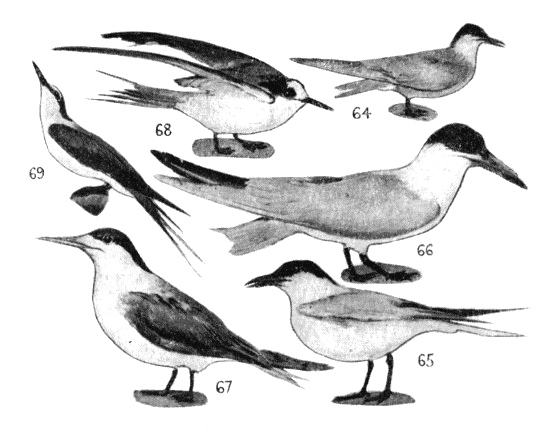
64 Whiskered Tern (Marsh), Hydrochelidon fluviatilis (hybrida), Eur. (Br.) to China, Malay, Afr. to A.
r. swamps (inland) 11
Head black; upper, wings, tail light-gray; face, throat, tail white; chest dark-gray; abdomen black; bill blood-red; winter, head grayish-white; f., sim. Water-insects, small fish.
1 1
65 Gull-billed Tern (Long-legged), Gelochelidon macrotarsa (anglica), cos. [~65-66 Genus Thalasseus.]
r. rivers, swamps inland 17
White; crown, hind-neck black; upper, wing-quills silvery-gray; bill long, stout, black; long legs and feet black; winter head white streaked black; f., sim. Small fish, insects.
1 1
66 Caspian Tern, Taranui, Sterna (Hydroprogne) caspia, cos. exc. S. Amer. [~65-66 Genus Thalasseus.]
c. shore 20.5
Head, hind-neck black; back, wings, tail pale-gray; dark-gray wing-quills; under white; bill scarlet; dives; f., smaller. Fish.
10 37
67* Crested Tern (Swift, Rüppell, Bass-St., Torres-St.), Village Blacksmith, Sterna bergii, Red S., Indian O., to Japan to A., Pac. Is.
v.c. ocean 17
Crown, crest black; forehead, sides and back of neck, under, white; back, wings, tail dark-gray; bill yellow; legs, feet black; f., sim. Fish.
68 White-fronted Tern (Southern), S. striata (frontalis), E.A., T., N.Z.
c. shore 13
Upper delicate-gray; wing-quills grayish-black; forehead, side-neck, under white; bill, about eye, hind-neck black; f., sim. Small fish.
69 Bridled Tern (Brown-winged, Panayan, Smaller-Sooty), S. anaestheta, tropical, sub-tropical seas.
v.c. shore 14.5
Upper light sooty-brown; forehead, line over eye, throat, under white; crown, nape, line from bill past eye black; bill, legs, feet black; like 70, but smaller; back, wings brown; f., sim. Fish.
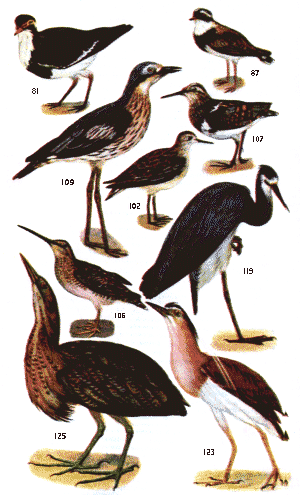
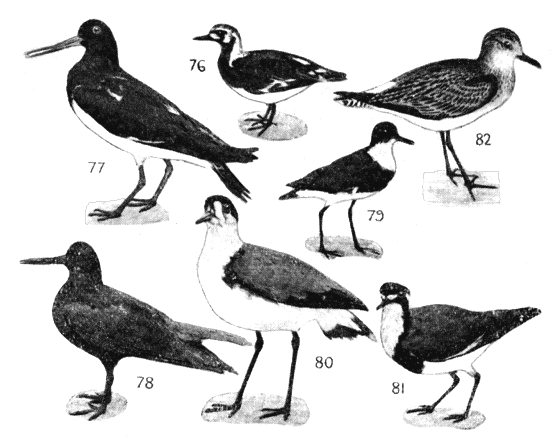
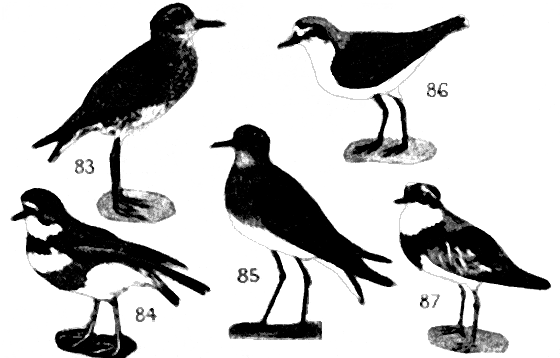
81 Black-breasted Plover 87 Black-fronted Dottrel 102 Sharp-tailed Sandpiper 106 Australian Snipe 107 Australian Painted Snipe 109 Southern Stone-Curlew 119 White-fronted Heron 123 Nankeen Night Heron 125 Australian Bittern
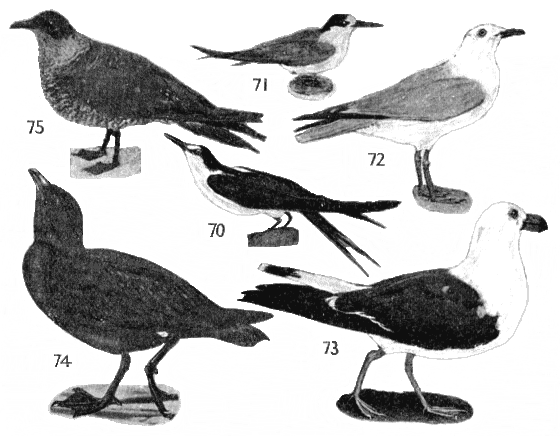
70 Sooty Tern, Wide-awake, Egg-bird, S. fuliginosa (S. fuscata, A.O.U.), tropical, sub-tropical seas, Br. (acc). [~70 Sterna fuscata.]
v.c. shores 17
Upper, crown, wings, line from bill past eye, tail black; forehead, under white; bill, feet black; like 69, but larger, blacker above; f., sim. Fish, squid. "Oo-ee."
71* White-faced Ternlet, Sea-swallow, Little (Fairy) Tern, Taraiti, S. nereis, A., N.Z. =vt. Eur. Little Tern.
c. shore 10.5
Upper silvery-gray; under, rump, tall, forehead white; crown, hind-neck black; bill, feet orange-yellow; f., sim. Small fish.
1 45
72* Silver Gull (Jameson), Seagull, Sea Pigeon, Larus novae-hollandiae, A., T., N. Cal., N.Z. (acc).
Stat. c. shore, inland 17.5
Head, neck, under, rump, tail white; back, wings delicate-gray; wing-tips white and black bars; bill, legs, feet blood-red; eye white; f., sim. Scraps, eggs, omnivorous.
1 1
73* Pacific Gull (Larger), Gabianus pacificus. A., T. =vt. Eur. Greater Black-backed Gull.
Stat. c. shore 25
"This fine gull;" head, neck, under white; tail white barred black; back, wings slaty-black; eye white; legs yellow; deepened bill orange tipped red; f., smaller; young up to 4 years mottled-brown, becoming more like adult each year. Fish, crabs, carrion.
F. 33. STERCORARIIDAE (4), SKUAS, Robber Gulls, Sea Pirates, 7 sp.—4(0)A., 1(0)O., 4(0)P., 3(0)E., 4(0)Nc., 4(1)Nl.
1 4
74 Great Southern Skua, Robber Gull, Port-Egmont-Hen, Sea-Hawk, Hakoakoa, Megalestris antarctica, S. Oceans, A., N.Z. =vt. Eur. Great Skua. [~74 Catharacta.]
Mig. r. shores 23
Upper blackish-brown; under chocolate-brown; wing white patch; centre tail feathers project ½in.; f., sim. Stolen fish, carrion.
2 3
75 Richardson Skua (Arctic), Arctic (Parasite) Gull, Long-tailed Jaeger, Sea-Pirate, Boatswain-Bird, Teaser, Stercorarius crepidatus, cos. [~75 C. parasitica.]
Mig. r. shores 20
Dimorphic (two phases)—1. Dusky upper; blackish cap; narrow whitish collar; under white; brown band on chest; brown band on wing; centre tail feathers project 3ins.; strong bill, claws. 2. Under mottled and barred brown and whitish; follow bay steamers; f., sim. Stolen fish.
The fifty Australian birds included in the important order of Waders are remarkably like such birds found inhabiting other regions of the globe, shore conditions apparently being somewhat similar the world over. It is interesting to note that thirteen of the forty-four Australian members of this family of Plover-like birds are also found in Britain, and that most of the others are direct representatives of closely-related birds found in other Countries. No less than twenty-eight of these birds are merely visitors here, for they breed away in the far North. Many even nest within the Arctic Circle, in Siberia, for it is a rule that a migrating bird nests in the colder of the two countries visited. Strictly, these twenty-eight species are Siberian, or at least northern, forms, and not Australian birds.
Many members of this group undergo a seasonal change of plumage when breeding time comes. As they spend this season in the Northern Hemisphere, we do not see them in their brilliant colors, but in quiet, mottled browns and grays.
Some are "accidental" visitors to Australia. Possibly they find their way here by getting mixed with a company of allied birds on their annual journey south. Thus the Common (British) Sandpiper is a very rare bird here, though it retains its British name—Common Sandpiper. Similarly, other European and American birds have been recorded, and the number of these far-wandering birds recorded from Australia is likely to be still further increased. The stout, short-legged Turnstone is the most cosmopolitan of birds. Breeding in Siberia, so widely does it roam, that it has visited almost every shore in the world, where, true to name, it turns the stones in search of sandhoppers.
The two "Oyster-catchers"—"Redbills"—are representatives of similar birds found almost the world over. Their deepened, flat bill is said to serve as a pick-axe to force open oysters and mussels. We found one or two pairs on almost every shore we visited about Bass Strait, on Eyre Peninsula, and on the Barrier Reef.
The two common Plovers—the Spurwing and Black-breasted—do not migrate, so we see them in brighter colors. Still, though bright when noticed, they are yet wonderfully protected, as they stand quite still. I felt great astonishment on finding that I had driven, near Lake Tyrrell, into the midst of a company of over a thousand Black-breasted Plovers, not noticed until the eye picked out one and then another. It recalled to mind the scene in the Lady of the Lake, when Fitz James found the hillside alive with Roderick Dhu's warriors.
The White-headed Stilt, or Long-legged Plover, is one of five species spread throughout the world. Some people have pretended to pity the Stilt for being one of Nature's misfits, but surely they never saw the bird in a state of nature enjoying life, and gaining an easy living on shallow tidal flats, its long legs being a beautiful adaptation to the environment in which it lives.
The Banded Stilt is a purely Australian bird, and has no representative in other countries. These and some other shore-birds live about tidal flats, and get their food in the soft mud. Their long bill is often flexible, and the tip is sometimes well supplied with nerves, so that it is sensitive. The bird can thus detect, in the soft mud, any animal that would serve for food. It can then open its bill enough to catch the animal without trouble. The Avocet's bill is sharply curved upwards, and is one of the most remarkable of such organs. The Australian Avocet is one species of a cosmopolitan genus.
Some of the Dottrels live on the dry, open plains of the interior; others frequent the beaches and shores.
When a bird of prey appears, these plain-living birds squat quite flat, placing even the head flat on the ground. They thus escape detection, for the protective coloring of these birds and of their eggs is marvellous. The story of how a photograph of a Dottrel's nest was obtained is of value to teachers, for it will remind us that it is not well to neglect the three R's, and that Nature-study alone will not give a complete education. Three bird-lovers spent some time trying to find this nest, while the parent birds flew noisily around. Suspecting at last that the birds' knowledge of numbers was probably deficient, the three hid behind a log. Two then walked away. The birds immediately returned to the nest, and a valuable photograph was the result. A training in Nature-study, valuable as it undoubtedly is, is thus not all of our work.
The Painted Snipe breeds in Australia, but the Australian Snipe breeds in Japan, so it, properly speaking, is not an Australian bird. Think of the journey twice a year! Six of these wading-birds even visit New Zealand each year. How do they find their way there, across a gap of over 1000 miles, without any land whatever? Inherited memory is strong, but how did the first batches find their way? Their annual journey supports the geographer in his surmise that Australia at no very distant date extended very much farther to the east. Indeed, these birds almost certainly follow the old coast of the Australian continent.
Snipe, some Plovers, Dottrels, Curlews (Sea), Whimbrels, Godwits, &c., thus go to the North each year to partake of the abundant banquet of fruits, &c., preserved in the great ice chamber of the North. Numberless flocks of birds follow up the melting ice, and so nest unmolested on the great tundras and plains of Siberia. They wear their bright wedding dress in the far North, and are known here only in the quiet mottled browns and grays. In autumn these birds depart. They travel mostly at night, to avoid Birds of Prey, and so are seldom seen, though they may be heard calling as they pass high overhead. They are occasionally seen with the aid of telescopes as they pass across the face of the moon.
The Pratincole, or Swallow-Plover, is a representative of an Old-World family. Its long wings and long legs denote a rapid runner and a rapid flyer, so that it has little trouble in catching its insect food, either in the air or on the ground.
Our inland Stone-Curlew has a call very similar to that of the sea (true) Curlew, but it has a short, straight bill, instead of a long, arched bill. The proper name of the land Curlew is the Southern Stone-Curlew or Stone-Plover. It is the only Australian bird that seems to have the power of varying the color of its eggs. If the eggs are laid in grass, they are greenish; if amongst ironstone, the eggs are reddish-brown; if on sand, the eggs are tawny; and so on. Other ground-laying birds seem to pick out the soil that matches the color of their eggs, and lay there only. Possibly local races of the Southern Stone-Curlew keep to the one class of country. However, the eggs do match the surroundings, and the birds nest on different kinds of soil and rock.
In Family 42, the only Australian bird is the Australian Bustard, our representative of a widely-spread family, a member of which formerly bred in Great Britain. It is the well-known "Wild Turkey." As it is a good table bird, it is generally shot on sight. This is a mistake, as it is (as Mr. C. French, Government Entomologist, has pointed out) worth many times its table value as an insect destroyer. None of the family has spread to America. As no Bustard occurs in the regions between Australia and India, this bird supplies a good example of what is known to zoo-geographers as "discontinuous distribution." "Discontinuous distribution," as applied to land animals, e.g., marsupials found in America and Australia, ratite birds in South America, South Africa, Australia, and New Zealand, or the tapir, found in Central America and Malaysia, implies a land connexion (not necessarily complete at any one period) to allow of the gradual spread of the animals. Of course, as flying birds can pass easily from one region to another, "discontinuous distribution," as applied to them, cannot have so much importance attached to it as indicating previous land connexions.
ORDER X.—CHARADRIIFORMES.
F. 34. Chionididae, Sheathbills, Kelp-Pigeons, 3 sp.—2(2)E. 1(1)Nl.
F. 35. Thinocorythidae, Seed-Snipe, Seed-Plover, 5 sp. Nl.
F. 36. CHARADRIIDAE (44), Waders, Plover-like Birds, 202 sp.—68(29)A., 75(5)O., 84(2)P., 70(24)E., 65(3)Nc., 74(28)Nl.
1 2
76 Turnstone, Sea-Dottrel, Calico (Beach) Bird, Arenaria interpres, cos. [~76 Morinella interpres.]
Mig. c. shore 8
Winter plumage, mottled brown, black; summer plumage in far north; black and white conspicuous; short bill black; legs, feet, orange; f., duller. Sand-hoppers, shellfish.
2 13
77 Pied Oyster-catcher (White-breasted, Black and white), Seapie, Olive, Redbill, Torea, Haematopus longirostris, Mol., N.G., A., T., N.Z., Chatham Is. =vt. Eur. Oyster-catcher.
Stat. c. shores 19.5
Black; abdomen, rump, base tail above, below white; eyes, bill, legs red; bill 3.75in.; f., sim. Sand-hoppers, shellfish, worms.
78 Black Oyster-catcher (Sooty), Redbill, Toreo-pango, H. fuliginosus, A., T., N.Z.
Stat. c. shores 18
Sooty-black; bill, feet, eye red; f., sim. Shellfish, worms.
1 1
79 Red-kneed Dottrel, Sandpiper (e), Erythrogonys cinctus, A.
Mig. r. muddy river banks 7.5
Head, upper-neck, chest, black; throat, sides of neck, abdomen, under base tail white; back olive-brown; middle tail feathers olive, rest white; thigh, knee pink-red; f., sim. Insects.
2 4
80 Spurwing Plover (Wattled), Alarm-Bird, Lobivanellus lobatus, A., T. [~80 Lobibyx novae hollandiae.]
Stat. c. plains, swamps 14
"One of most beautiful of plovers;" crown black; face, hind-neck, rump, under white; upper brown; tail white tipped black; wattle on face lemon-yellow; spur on shoulder; f., sim. Insects.
1 1
81* Black-breasted Plover (Stubble, Flock, Plain), Zonifer tricolor, A., T.
Stat. v.c. plains 10.5
Upper brown; crown, line on face down to broad band on chest, wing-quills black; line through eye, throat, abdomen white; tail white barred black; spot at base of upper-bill blood-red; f., spot lighter-red. Insects.
1 1
82 Gray Plover (Black-bellied), Gray Sandpiper (e), Maycock, Squatarola helvetica, cos. [~82 Squatarola squatarola.]
Mig. r. muddy shores, rivers 12
Crown, upper, wings, olive-brown mottled white; wing-quills blackish-brown; rump white; tail white barred light olive; face, under white, breast tinged buff; bill, feet blackish; small hind toe; brighter in far North; f., sim. Insects, worms.
1 2
83 Lesser Golden Plover (Pacific, American, Australian, Eastern), Charadrius dominicus, almost cos. [~83-89 Genus Charadrius.]
Mig. flocks, r. plains near sea, rivers 9
Upper, tail dark-brown marked whitish; under mottled buff, brown, white; line over eye, throat whitish; no hind toe; brighter in far north; f., sim. Insects, worms.
4 8
84 Double-banded Dottrel (Banded), Pohowera, Ochthodromus bicinctus, A., T., Norfolk Is., Lord Howe Is., N.Z. [~83-89 Genus Charadrius.]
Mig. c. shores, grass 6.5
Upper brownish-gray; under white; black band on chest; chestnut band on abdomen; forehead white; black line through eye; eyelash scarlet; no hind toe; f., duller. Insects, worms.
85 Oriental Dottrel (Eastern, Asiatic, Mongolian), O. veredus, Mongolia, China to A. [~83-89 Genus Charadrius.]
Mig. v.r. sandy coasts 9.5
Indistinct mottled plumage; upper brown and buff; throat lighter; abdomen white; slender bill dark-brown; legs long, slender; no hind toe; f., sim. Insects, worms.
4 19
86 Red-capped Dottrel, Red-necked Plover, Sandlark, Ægialitis ruficapilla, China to A., T., N.Z. [~83-89 Genus Charadrius.]
Stat. c. shores 6
Crown, hind-neck rust-red; upper, wings pale-brown; wing-quills blackish-brown; centre tail dark-brown, rest white; under, forehead white; f., duller. Shellfish.
87* Black-fronted Dottrel, Æ. melanops, A. [~83-89 Genus Charadrius.]
Stat. r. rivers, pools, lakes 6
Forehead, broad band on chest black; throat, abdomen, stripe over eye, round hind-neck white; eyelash bright-red; "active, elegant bird;" f., sim. Insects, worms.
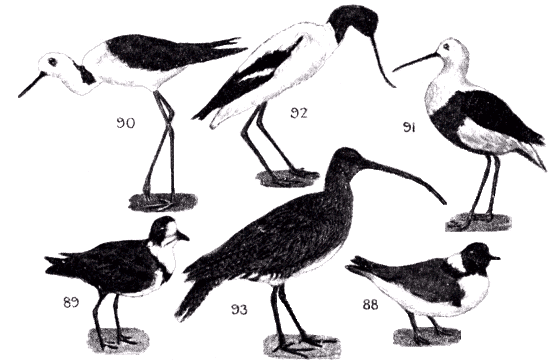
88 Hooded Dottrel, Æ. cucullata, A., T. [~83-89 Genus Charadrius.]
Stat. c. shore 8.3
Head, throat, upper-back black; hind-neck, under white; lower-back light brownish-gray; middle tail feathers black, rest tipped white; scarlet ring round eye; f., crown mottled black, white. Sand-hoppers, worms.
1 1
89 Australian Dottrel, Peltohyas australis, A. =vt. Eur. Common Dottrel. [~83-89 Genus Charadrius.]
Mig. v.r. plains (interior) 8
Upper sandy-buff mottled with dark-brown; black band across top of head from eye to eye; black collar on hind-neck continued as a narrow V across chest; forehead, throat white; m., duller. Insects.
1 7
90 White-headed Stilt (Pied), Longshanks, Stilt-bird, Long-legged Plover, Himantopus leucocephalus, Great Sunda Is., Mol., N.G., A. =vt. Eur. Stilt. [~90 Hypsibates]
Nom. r. swamps, lakes 15
White; hind-neck, back, wings black; long legs pink; f., smaller. Insects, pond-snails.
1 1
91 Banded Stilt, Rottnest Snipe (e), Cladorhynchus leucocephalus, A.
Nom. v.r. shallow lakes 13.5
White; broad chestnut band on breast; wings, centre of abdomen black; long bill black. Plaintive whistle.
1 4
92 Red-necked Avocet, Cobbler, Cobbler's Awl, Painted Lady, Scooper, Recurvirostra novae-hollandiae, A., T., N.Z. =vt. cos. bird.
Nom. r. lakes, tidal bays 15.5
White; head, neck chestnut; wings black; f., sim. Shellfish, insects.
2 9
93 Australian Curlew, Sea-Curlew, Numenius cyanopus, E. Sib., Japan to A. =vt. Eur. Common Curlew.
Mig. c. tidal shores m., 21; f., 24
Arched bill 7in.; mottled brown; f., larger. Crabs, worms.
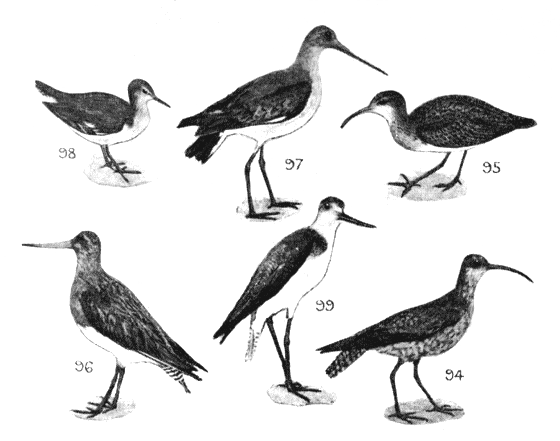
94 Oriental Whimbrel (Australian), Jack-Curlew, Mayfowl, N. variegatus, E. Sib., Japan to A., T. =vt. Eur. Whimbrel.
Mig. r. river, swamp 15
Brown mottled; chin, abdomen white; tail barred brown, white; arched bill 3in.; f., sim. Crabs, shellfish, worms.
1 1
95 Little Whimbrel, Mesoscolopax minutus, E. Sib., Mongolia, Japan to A. [~95 Numenius minutus.]
Mig. v.r. swamps 12
Upper blackish-brown much marked and spotted buff; under, line past eye buff; arched bill 1.7in. Insects, worms.
2 5
96 Barred-rumped Godwit (Pacific), Kuaka, Limosa, novae-zealandiae (lapponica, Am.O.U.), Alaska, California; E. Sib. to A., T., N.Z., Oceania =vt. Eur. Barred-tailed Godwit. [~96 Limosa baueri.]
Mig. c. shores 15
Upper brownish-gray marked whitish; rump, tail barred brown, white; abdomen white; legs brownish-black; broad, indistinct whitish eyebrow; bill long, slightly upturned; f., larger. Shellfish, worms, sand-hoppers.
97 Black-tailed Godwit, L. limosa, Br. Eur., N. Afr., India, E. Sib., Japan to A., Greenland (acc.), may be a distinct species than called L. melanuroides. [~97 L. melanuroides.]
Mig. v.r. shallow lakes 16
Upper grayish-brown; wing white band flying; lower-back blackish-brown; upper base tail white; tail black, white at side at base; neck, breast, flanks grayish-brown; abdomen white; bill long, slightly upturned; f., larger. Insects, pond snails, worms.
1 2
98 Common Sandpiper, Summer Snipe, Tringoides hypoleucus, Eur. (Br.), N. Asia, Afr., Ind., to A. (acc.). [~98 Tringa hypoleuca.]
Mig. u. shores, lakes 8
Upper pale-brown marked darker; wing-quills slightly tipped white; centre tail feathers glossy-brown, side feathers white barred brown; under white; chest marked pale-brown; indistinct pale eyebrow; tail constantly jerked; f., sim. Water-insects, shellfish.
1 1
99 Greenshank, Glottis nebularius, Br., Eastern hemisphere, Florida (acc.). [~99 T. nebularia.]
Mig. r. shores, lakes 14
Face, under, tail white; sides of breast streaked brown; edge of tail barred freckled brown; crown, hind-neck gray; wings dark-brown; upper light-brown; legs deep olive-green; f., sim. Shellfish, worms.
1 1
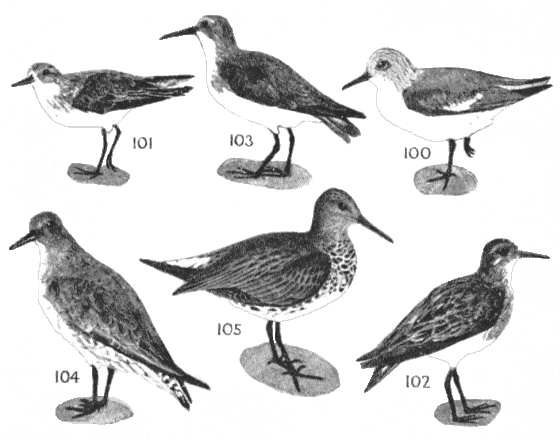
100 Sanderling, Calidris arenaria (leucophoea, Am.O.U.), cos. exc. Pacific Is. [~100 Arenaria leucophaea.]
Mig. v.r. sandy shores, swamps 7.5
Crown, back gray; white band on wing; sides, lower-back white; eyebrow, forehead, face, under white; no hind toe; brighter in far north; f., sim. Sand-hoppers, insects. "Wick."
2 5
101 Eastern Little Stint (Little), Red-necked Sandpiper, Land-snipe, Little Dunlin, Pisobia ruficollis, E. Sib., Jap., China to A., T., N.Z. =vt. Eur. Little Stint. [~101 Erolia ruficollis.]
Mig. flocks c. shores 6.2
Upper ashy-brown mottled darker; wing-quills blackish-brown; centre tail feathers blackish-brown; rest whitish; forehead, under white; faint chestnut band on chest; bill, legs black; brighter in far north; f., sim. Insects, shellfish.
1 5
102* Sharp-tailed Sandpiper (Siberian-, Asiatic-Pectoral), Sharp-tailed Stint, Marsh Sandpiper, Marsh Tringa, Heteropygia aurita, (P. aurita, Am.O.U.), Alaska, E. Sib., Japan, Ind, to A., T., N.Z. [~102 E. aurita.]
Mig. r. coast 8.5
Upper dark-brown marked gray; crown faint rufous; wing-quills dark-brown; face, under whitish, breast brownish; f., smaller. Small water-animals.
1 1
103 Curlew-Sandpiper, Pygmy Curlew, Curlew-Stint, Ancylochilus subarquatus (Erolia ferruginea, Am.O.U.), A., T., N.Z., almost cos. exc. Pac. Is. [~103 E. ferruginea.]
Mig. flocks r. shore 8.5
Upper grayish-brown; eyebrow, rump, under white, chest tinged brown; bill 1.5 in., black, arched; brighter in far north; f., sim. Insects, worms.
2 2
104 Knot, Knot-Snipe, Tringa canutus, almost cos., A., T., N.Z. [~104 Canutus canutus.]
Mig. r. tidal mud flats 9
Upper grayish-brown; under white; flanks, breast barred grayish-brown; upper base tail white barred black; brighter in far north; f., sim. Insects, worms.
105 Eastern Knot (Japanese), Great Sandpiper, T. crassirostris, E. Sib., Jap., Ind. to A. [~105 C. magnus.]
Mig. v.r. shore 11.5
Crown, neck, brownish-gray; back, wings brown; rump white; tail brownish-gray; breast dark-brown marked white; abdomen white; bill olive, 1¾ in.; brighter in far north; f., sim. Insects, worms.
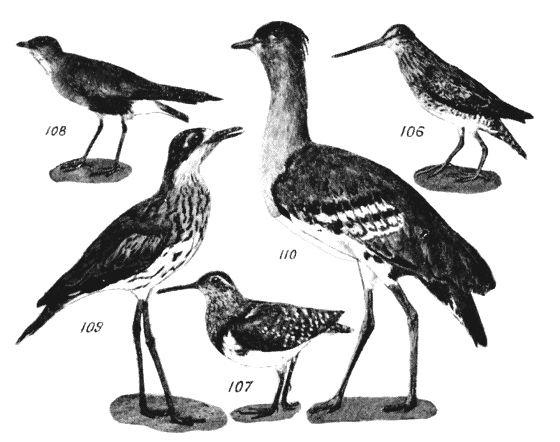
106* Australian Snipe (Japanese, Latham), Jack Snipe, Bleater, Long-bill, Gallinago australis, Jap., Formosa, to A., T., N.Z. =vt. Eur. Snipe.
Mig. c. swamps 9.5
Richly mottled; crown blackish with buff line along centre; face, chin buff; breast, washed reddish-brown; brown bars on flanks; back mottled brownish-black; under wings finely barred black, white; chestnut band on tail; two black lines on face; bill 2.7 in.; f., sim. Insects, worms.
1 3
107* Australian-Painted Snipe, Australian Rhynchaea, Rostratula australis, A.
Mig. v.r. grassy, bush 9.5
Beautiful mottled dotted; crown dark-brown, with buff line; throat, chest dark, chin lighter; wing brown, spotted black, white, buff; abdomen white; long straight bill 1.7 in.; m., duller, smaller. Insects, worms.
F. 37. PARRIDAE (1), PARRA, Jacana, Water-Pheasant, 11 sp.—2(1)A., 3(2)O., 3(3)E., 1(0)Nc., 4(3)Nl.
F. 38. Cursoriidae, Coursers, 15 sp.—3(2)O., 1(0)P., 13(12)E.
F. 39. GLAREOLIDAE (2), PRATINCOLES, Swallow-Plovers, 10 sp.—2(0)A., 4(1)O., 3(0)P., 7(5)E.
1 1
108 Australian Pratincole, Swallow-Plover, Stiltia isabella, Borneo, Java to A., N.Z. =vt. Eur. Pratincole.
Mig. v.r. (interior) rivers, marshes 9.5
Upper, wings, breast light-rufous, throat whitish; abdomen chestnut; base tail above, below white; centre tail black, rest white; bill red, tipped black, swallow-like flight; f., sim. Insects.
F. 40. Dromadidae, Crab-Plover, 1 sp.—1(0)O., 1(0)E.
F. 41. ŒDICNEMIDAE (2), STONE-CURLEWS, Stone-Plovers, Thick-Knees, 13 sp.—2(1)A., 3(1)O., 1(0)P., 7(6)E., 3(3) Nl.
1 1
109* Southern Stone-Curlew (-Plover) Willaroo, Scrub Curlew, Burhinus grallarius, A., T. (acc.).
Stat. c. sandy plains, timber 20.5
Crown, upper dark-gray, marked black; round eye white; throat buff; chest, abdomen whitish, streaked blackish; white patch on wing; legs long; bill short, black; f., sim. Insects, berries. "Wee-lo."
F. 42. OTIDIDAE (1), BUSTARDS, 33 sp.—1(1)A., 7(2)O., 7(2)P., 23(21)E
1 5
110 Australian Bustard, Wild Turkey (e), Eupodotis australis, A. [~110 Choriotis australis.]
Mig. r. plains 48
Crown black; face, neck grayish-white; upper, wings brown; wings spotted black-white; black band on chest; abdomen white; f., smaller. Seeds, grass, lizards, insects.
Australia, fortunately, has one representative of Order XI.—Cranes. This is the Native Companion, the only true Crane found in Australia. These are interesting birds, with their "quadrille parties," "corroborees," and dances. They live chiefly on vermin—insects, lizards, &c. The great Gould said: "Its presence adds greatly to the interest of the scenery." Would that more Australians thought so!
Cranes are amongst the best of flyers. They are said to fly sometimes at a height of from three and a half to five miles, and have been seen to cross lofty mountains in Central Asia without increasing their altitude. Perhaps because of its inappropriate name—Native Companion—some have proposed to regard this bird as the typical Australian bird, but it is not so. In fact, it is our one representative of an almost world-wide group.
ORDER XI.—GRUIFORMES.
F. 43. GRUIDAE (1), CRANES, 19 sp.—1(1)A., 8(2)O., 9(1)P., 7(5)E., 3(0)Nc., 2(0)Nl.
1 3
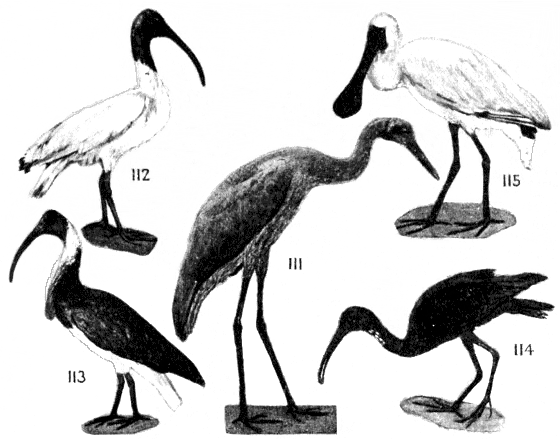
111 Australian Crane, Native Companion, Brolga, Antigone australasiana, A. [~111 Mathewsia rubicunda.]
Nom. r. plains 42
Deep silvery-gray; wing-quills black; naked red patch about face, throat; legs, feet black; f., smaller. Insects, lizards, bulbous roots, seeds.
F. 44. Aramidae, Courlans, Limpkin, 2 sp.—1(0)Nc.,
F. 45. Rhinochetidae, Kagu, 1 sp. A. (N. Cal.).
F. 46. Mesoenatidae, 1 sp. E. (Madagascar).
F. 47. Eurypygidae, Sun-bitterns, 2 sp. Nl.
F. 48. Psophiidae, Trumpeters, 7 sp. Nl.
F. 49. Cariamidae, Seriema, Saria, 2 sp. Nl.
In Order XII. Australia has representatives of the Ibises, Spoonbills, Storks, Herons, Egrets, Night Herons, and Bitterns, so well known in every part of the world.
Amongst the world's birds, few are better known than the Ibis. This bird was so highly prized by the ancient Egyptians as to be considered sacred, and they thought enough of it to embalm it. As Egypt depended on the overflow of the Nile for food supply, and as this overflow was heralded by the arrival of the migratory Ibis from the South, it was natural for the Egyptians to connect the rise of the river with this bird, and thus look for its approach. Again, the Ibis is an insect destroyer, and, as Egypt was subject to plagues of grasshoppers, it undoubtedly rendered as valuable service there as it does here. This is another reason that has been assigned for the esteem in which this valuable bird was held. However, it is now almost unknown in Egypt.
In Australia we have three Ibises. One, the Sacred Ibis, or White Ibis, is practically identical with the Sacred Ibis of Egypt. Our second Ibis is the even more valuable Straw-necked Ibis, which extends its labors to plains and pastures, while the Sacred Ibis is rarely seen except on swampy lands. The Straw-necked Ibis is restricted to Australia. It seems to be increasing in numbers, for I have seen small and large flocks in many parts of the Eastern States recently. It has an insatiable appetite for grasshoppers and other insects. This bird is a valuable asset to Australia, and yet thoughtless farmers used to shoot it. Mr. Le Souëf and Dr. C. Ryan came upon a flock of Ibises breeding in Riverina. They estimated the flock to contain 240,000 birds. They found that each bird shot contained on the average 2000 young grasshoppers. Think of it; 480,000,000 grasshoppers a day! Where are those birds now, when needed to stem a locust plague? We have to pay the price of our folly in destroying valuable birds. A third Ibis is identical with the little Glossy Ibis of Europe.
The six Spoonbills are found throughout the world except in New Zealand and the northern parts of North America. They used to breed in England before man's selfishness and stupidity destroyed them and their nesting-places. They breed at present in the Murray swamps.
The Australian Stork—the Jabiru—does not come to the Southern parts of Australia, but breeds on the Queensland coast. It is a quaint-shaped, though beautifully-colored, bird. Its large, awkward-looking bill has a slight curve upwards.
Now come those beautiful birds, the Egrets. Man's cupidity and selfishness, and woman's desire for ornament, seem to have doomed these birds to total extermination, for the plume trade, which is responsible for some of the "most abominable cruelty practised in the animal world," is a war of extermination. Egrets are shy, and are approachable only in the breeding season. At that time they are, in obedience to parental instincts, brave in defence of their young. It is just then that the plume-hunters visit the rookeries and shoot the parents, leaving the helpless, almost fully-fledged, young to die in the nest, so high overhead. And all for what? Could anyone who has seen the devastated nests, with the famished bodies of the fledglings rotting in the sun, ever take pleasure in Egret plumes decking the head of a sister or wife? Women of refinement and tender heart will refuse to wear the proceeds of human cruelty. Those engaged in the trade resort to the mean trick of calling the plumes "Osprey plumes." Now, the Osprey is a Fish-Hawk, and so possibly of little use to the land-dweller, but these plumes grow on the back and neck of a valuable insect destroyer. The extent of this trade is appalling. At one plume sale, held in London on 4th August, 1909, the breeding plumes of 24,000 birds were offered for sale. Think of it! The slow starvation of 40,000 nestlings, the death of 64,000 birds, to provide the plumes for one day's sale. No, ladies, if you consider you are in need of ornament, wear ostrich plumes and pheasants' feathers, for these do not involve the death of a bird, but rather the reverse, for the greater the demand for these feathers, the more birds will be bred; but spare the Egret.
The Reef Heron is found on beaches from the Bay of Bengal to New Zealand. It has given scientists much trouble, for it has a pure-white form and a dark slaty-gray form. We found and photographed the nests on Mast Head and Heron Islands. This was a prize, for no photograph of a Reef Heron's nest had been published previously. As soon as the falling tide exposed the reef round the island, Reef Herons, Gulls, Plovers, Dottrels, and Terns, went out to have their next meal.
The "Blue Crane" of the country dwellers is the "White-fronted Heron" of the bird-lover. "Fronted" in a bird name refers only to the forehead. Herons are valuable birds to the grazier, farmer, and irrigationist, for, in addition to insects and snails, they eat yabbies (fresh-water crayfish), which bore into the banks and bed of irrigation channels, and so cause much loss of water by soakage.
Distinguished from these birds mainly by its nocturnal habit is the interesting Nankeen Night Heron, our one representative of a practically cosmopolitan genus. Our one Night Heron hides on a leafy bough asleep during the daytime. About dusk he sets off to a swamp.
The Australian Bittern, also our one representative of a cosmopolitan genus, skulks in a bed of reeds. Hence it is seldom seen. Its loud, dismal, booming note probably assisted in the formation of the Bunyip legends of the blacks. I saw more Bitterns in a recent trip down the Brisbane than I ever saw before.
At breeding time these birds assemble in very large companies, and their nesting-places are called heronries or rookeries. The chief rookeries here are in the Riverina, where the great annual overflow of that fine river, the Murray, converts the country into a great series of lakes and swamps. Here water animals live in large numbers, and thousands of birds take advantage of this abundant food supply to nest there in the enormous redgums.
Each bird is the close relative of a similar bird in Europe, so that what is read concerning Herons and Egrets there, applies equally to our members of this widely-distributed family. Eating grasshoppers and other insects in great numbers, they are friends of the farmer and grazier. Destroying yabbies and other burrowing water animals, they are valuable allies of the irrigationist, and it is decidedly bad policy to shoot one.
ORDER XII.—ARDEIFORMES.
F. 50. IBIDIDAE (3), IBISES, 27 sp.—4(2)A., 6(2)O., 3(0)P., 10(8)E., 4(0)Nc., 11(7)Nl.
1 5
112 Australian White Ibis (Black-necked), Sickle-Bill, Ibis molucca, Mol., N.G., A. =vt. Sacred Ibis of Egypt.
Nom. flocks, r. lagoons 30
White; head, upper-neck bare black; back of head and neck barred rose-pink; black bill arched; f., smaller. Insects.
1 1
113 Straw-necked Ibis, Dryweather (Letter) Bird, Farmer's Friend, Carphibis spinicollis, A. T.
Nom. flocks, c. grassy 28
"This beautiful ibis;" head, fore-neck naked black; black bill arched; pointed, straw-colored plumes on neck; breast, upper greenish-purple barred black; abdomen, flanks, tail white; f., smaller. Insects.
1 3
114 Glossy Ibis, Black Curlew (e), Plegadis falcinellus, A., T., N.Z., almost cos. exc. S. Am., Arctic, and Pac. Is. [~114 Egatheus falcinellus.]
Nom. flocks, v.r. swampy 25
Head, neck, breast, back, under rich reddish-chestnut; lower-back, tail dark bronze-green; winter; head, neck streaked white; f., sim. Insects, worms.
F. 51. PLATALEIDAE (2), SPOONBILLS, 6 sp.—2(2)A., 2(0)O., 2(0)P., 2(1)E., 1(0)Nc., 1(0)Nl.
1 4
115 Black-billed Spoonbill (Royal), Platalea regia, A., N.Z.
Nom. r. marshy 29
White; bill, legs, feet black; f., sim. Shellfish, frogs.
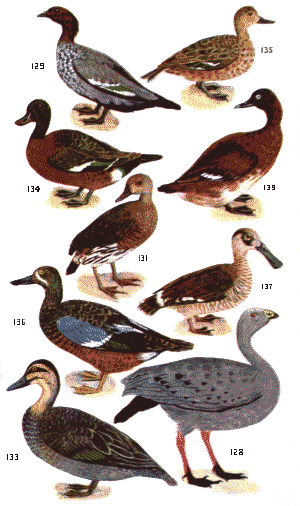
128 Cape Barren Goose 129 Maned Goose 131 Plumed Whistling Duck 133 Black Duck 134 Australian Teal 135 Gray Teal 136 Australian Shoveller 137 Pink-eared Duck 139 White-eyed Duck
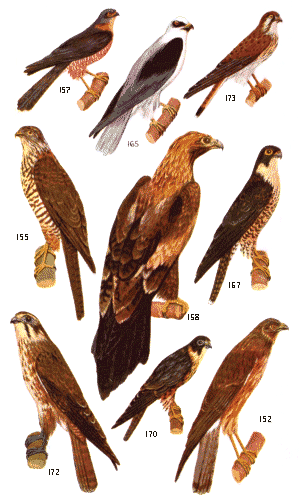
152 Allied Harrier 155 Australian Goshawk 157 Collared Sparrowhawk 158 Wedge-tailed Eagle 165 Black-shouldered Kite 167 Black-cheeked Falcon 170 Little Falcon 172 Brown Hawk 173 Nankeen Kestrel
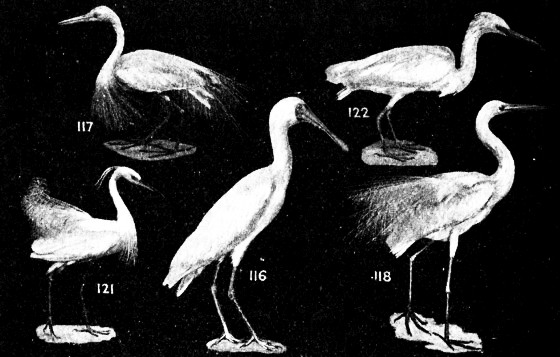
1 1
116 Yellow-billed Spoonbill, Platibis flavipes, A.
Nom. r. swamps 28
White; bill, legs, feet yellow; f., sim. Shellfish, frogs,
F. 52. CICONIIDAE (1), STORK (JABIRU), 19 sp.—2(0)A., 10(6)O., 4(1)P., 8(4)E., 2(0)Nc., 3(1)Nl.
F. 53. Scopidae, Hammer-Head, 1 sp. E.
F. 54. Balaenicipitidae, Shoe-bird, Shoebill, Whaleheaded Stork, 1 sp. E. (Upper White Nile).
F. 55. ARDEIDAE (16), HERONS, 107 sp.—32(16)A., 27(4)O., 21(1)P., 25(14)E., 17(4)Nc., 33(20)Nl.
1 3
117 Plumed Egret, Mesophoyx plumifera, Cel., Mol., N.G., A. [~117 Egretta plumifera.]
Nom. v.r. swamps 24
White; bill yellow; feet, lower legs black, above "knee" yellow; f., sim. Insects.
1 3
118 Australian White Egret (Great), White Crane (e), Herodias timoriensis, Jap., China, Philippines to A., T., N.Z. [~118 E. timoriensis.]
Nom. v.r. lagoons 30
"This noble species;" white; bill beautiful orange; legs above "knee" and line down centre of inner shin dull yellow; rest of shin, feet black; naked space about eye greenish-yellow; f., sim. Fish, frogs, insects.
2 4
119* White-fronted Heron, Blue-Crane (e), Matuku, Notophoyx novae-hollandiae, Cel., Mol., N.G., A., T., N.Z.
Nom. v.c. about water 24
Face, throat white; upper, wings dark-gray; under gray tinged rufous; f., sim. Insects, crabs, yabbies.
120 White-necked Heron (Pacific), White-necked Crane (e), N. pacifica, A., T.
Stat. r. swamps 30
Head, neck, breast, shoulder white; under, wings, tail upper blackish; f., smaller. Frogs, insects.
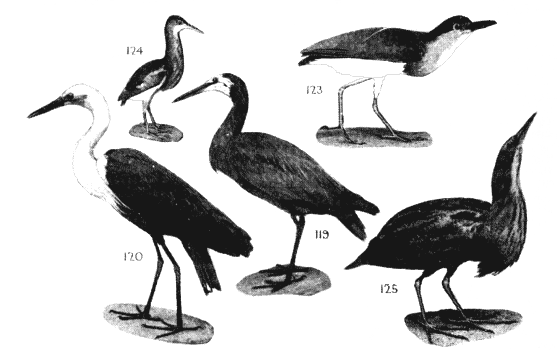
1 2
121 Lesser Egret (Little, Spotless), Garzetta nigripes, Malay to N.G., A. [~121 E. nigripes.]
Nom. r. swamps 22
White; 2 long plumes from nape; feet, legs totally black; bill black; f., sim. Frogs, insects.
1 1
122 Reef Heron (White, Blue, Sacred), Demiegretta sacra, Jap., Ind. to A., T., N.Z. [~122 Demigretta sacra.]
Stat. r. coast 23
Dark slaty-gray; bill yellowish-green; some birds are white; f., sim. Crabs, shellfish.
1 8
123* Nankeen Night Heron, Nankeen Crane (e), Nycticorax caledonicus, Cel., N.G., A., T., N.Z. =vt. Eur. Night Heron. Frogs, insects, yabbies.
Mig. c. swamps 19
Nocturnal; crown, nape black; long white plumes from nape; upper rich chestnut; abdomen white; neck, chest reddish-chestnut; f., sim.; young mottled brown, buff.
2 10
124 Minute Bittern, Kaoriki, Ardetta pusilla, A., N.Z., =vt. Eur. Little Bittern. [~124 Ixobrychus pusillus.]
Stat. v.r. swamps 10
Crown, back, tail greenish-black; under pale-buff; hind-neck, shoulder deep-chestnut; bill, feet yellow; dark line from chin to lower breast; f., smaller; upper brown streaked chestnut; tail black; under white streaked brown. Water-animals.
1 5
125* Australian Bittern (Black-backed), Boomer, Bull-Bird. Matuku-Lurepo, Botaurus poeciloptilus, A. T., N. Cal., N.Z. =vt. Eur. Bittern.
Stat. r. reeds 24
Head, hind-neck, back dark-brown; wings brown marked buff; throat, under creamy-buff streaked dark-brown; bill yellow; f., smaller. Fish, frogs, yabbies, insects.
F. 56. Palamedeidae, Screamers, Unicorn-Bird, 3 sp. Nl.
F. 57. Phoenicopteridae, Flamingoes, 6 sp.—2(0)O., 1(0)P., 2(0)E., 1(0)Nc., 4(3)Nl.
Swans, Geese, and Ducks, the Swimming Birds grouped in Order XIII., are all classified in one family, though there are many sub-families.
At the head of the Australian birds is the Black Swan—that rara avis which, possibly, has done more to advertize Australia than any other Australian animal or plant. A "black" swan was an "impossibility," so this bird was one of the strongest factors in establishing Australia's reputation as a land of paradoxes and contradictions.
The Black Swan is well known outside Australia, as it is common in every park and garden in Europe. Gould feared that it would be exterminated here, but fortunately Australians are now learning to appreciate their own land, and there is no danger of such a calamity.
Eight species of Swans are known to occur all over the world with the exception of New Zealand and Africa.
In the next sub-family there is but one bird—the Semipalmated Goose of Australia. This bird, better known as the Magpie Goose, has its feet but half-webbed, hence its specific name, semipalmata. It is getting rare, though I heard of six near Colac recently.
Again, the only living representative of the next sub-family is the Cape Barren Goose, which is common in city gardens in Adelaide. It is also becoming rare. It is found only in Tasmania, the Bass Strait Islands, and Southern Australia. We visited its nesting place near Flinders Island. It is a very pugnacious bird, so it is difficult to keep with other birds.
After the Goose sub-family comes the group which includes our "Wood Duck," or, as it is called, the Maned Goose, for its bill is goose-like. It is a common bird in Australia. Two allied genera are found in South America and North-east Africa respectively.
In the next sub-family come the domestic Ducks and most of the wild Ducks of Australia. This group is often referred to as the "Freshwater or River Ducks."
First come two kinds of Whistling Ducks—so called on account of their whistling note uttered while flying. These are rare Ducks, one of which is found as far as India; the other is occasionally seen in New Zealand, as well as in Australia. The Sheldrake, or Shieldrake (Mountain Duck) is the largest Australian Duck, and one of the most handsome of the sub-family. It is nowhere very plentiful, though one or more pairs appear in most suitable localities. As it is unfit for the table, it should be spared as an ornament to the landscape.
The Black Duck is very similar to the common wild Duck (Mallard) of England. Our Black Duck does not change color with the season, nor is the male different in color from the female.
The Australian Teal is closely similar to the Teal of Europe. It is a grass feeder, and is a good table bird. The female is very different from the male. It is impossible to distinguish the male Gray Teal from the female Teal when in the free state. Mr. Keartland (ex-President of the Field Naturalist Club, and ornithologist to the Horn and Calvert exploring expeditions) has shown that there is a big difference in weight. The male of the smaller Gray Teal is not brightly colored like the male Chestnut-breasted Teal.
The remarkable Shoveller comes next. It is closely similar to the English Shoveller. Strange that this name was first used for the Spoonbill. The Shovellers are found the world over. The males are very brightly colored in the nesting season.
Unlike most other birds, Swans and Ducks lose the whole of their wing feathers at once when moulting, so that for a short time they cannot fly. As a protection, the gaudy ones acquire a quiet, inconspicuous coloration for a time, so that the male is said to get an "eclipse plumage." Many other birds get a bright dress for the breeding season only, but the male Duck wears his bright dress for the whole year, except in the moulting period. It is then "eclipsed," with the corresponding advantage that he is protected from his many enemies at a time when he is most helpless.
The remarkable Pink-eared Duck has no close relative. It has a small pink spot between the eye and ear, and so is called pink-eyed or pink-eared. It is found only in Australia. The female is similar in color to the male. The name Wigeon, or Widgeon, sometimes applied to this Duck, properly belongs to another of the fresh-water Ducks which is not found in Australia. Hence, this name should not be used for our bird.
Another peculiar Australian Duck is the Freckled Duck. It is a very rare bird. One taken on the ornithologists' excursion to Eyre Peninsula was considered a prize. So far as is known, it does not change color with the season, nor has the male or female the usual bright metallic patch seen on the wing of a Duck.
The "Salt-water Ducks" form the next sub-family. These Ducks, though, are not always true to name, for they are not confined to the salt water. The Victorian representative is the well-known White-eyed Duck, or Hardhead. This Duck was common on the Botanic Gardens Lake, Melbourne, until it was emptied some time ago. Thus, our one "Salt-water Duck" was often seen on fresh water. In the same sub-family come the Eider-Ducks of Iceland and the Logger-head, Racehorse, or Steamer Duck, of Magellan Straits, which is said to lose the power of flight on reaching maturity after the first moult. Thus the life-history tells us that this bird is a degenerate form, and not a primitive flightless form, for it has evidently descended from flying ancestors. It uses its wings to row itself along at great speed.
The ninth sub-family of this group of swimming birds contains two native Ducks. The Blue-billed Duck, the first of these, is "especially adapted for immersion and for obtaining its food from the bottom of the water rather than on its surface." It was thought by Gould to be confined to the coastal lagoons of Western Australia, but it has since been recorded from inland in Victoria, and four specimens have been taken in Tasmania. It remains under the water for a considerable time, and, if hunted, flaps along the surface with its short wings, but hesitates to exercise its "feeble grebe-like flight."
Some writers declare that the large Musk Duck is the most remarkable of the many remarkable birds of Australia. It is the only known species of the genus, and is "singularly different from every other member of the Duck family," as Gould points out. Gould further says that "this extraordinary bird reminds one of the Cormorants. Like many other of these antipodean forms, it must be regarded as an anomaly." The male has a lengthened, stiff, and leather-like appendage under the bill. The female is without this pouch, and is but half the size of the male. A pair is often to be seen on a sheltered bay or on an inland dam, and yet this bird has very feeble powers of flight. It is difficult to cause one to take to flight. Mr. A. J. Campbell summed up an instructive discussion on this point in the columns of The Australasian by concluding that Musk Ducks can fly, though they do so almost entirely at night.
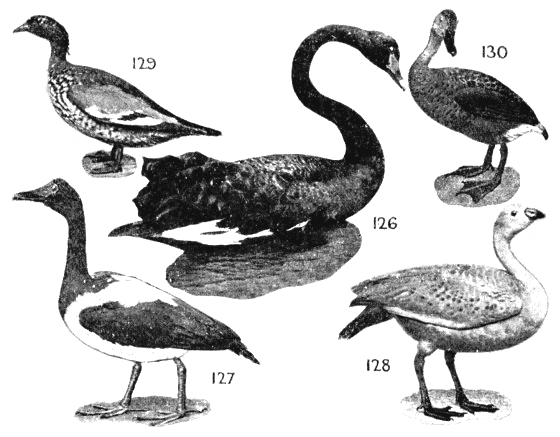
ORDER XIII.—ANSERIFORMES.
F. 58. ANATIDAE (21), SWANS, GEESE, 206 sp.—39(30)A., 50(9)O., 68(10)P., 41(21)E., 56(11)Nc., 70(39)Nl.
1 1
126 Black Swan, Chenopsis atrata, A., T. [~126 Chenopis atrata.]
Stat. c. lakes 40
Black; white on wing; very long neck; f., sim. Plants.
1 1
127 Pied Goose (Magpie, Black and White, Semipalmated), Anseranas semipalmata, A., T.
Stat. v.r. water 32
Head, neck, wings, lower-back, tail, thighs black; rest white; feet half-webbed; f., sim. Grass.
1 1
128* Cape Barren Goose, Cereopsis novae-hollandiae, V., S.A., W.A., T., Bass St. Is.
Stat. v.r. grass, coast 3
Brownish-gray; dark spots on wing; bill black; naked skin round bill lemon-yellow; legs pinkish; toes, webs, streak up front of leg black; pugnacious; f., sim. Grass.
1 1
129* Maned Goose, Wood-Duck (e), Chenonetta jubata, A., T.
Stat. c. water 20
Crown deep-brown; tail, lower-back black; metallic green on wing; breast gray spotted black; hind-neck short black plumes; white patch on wing; bill olive-brown, high, goose-like; f., smaller; duller; breast spotted white. Grass, snails, insects.
2 9
130 Whistling Duck (Tree), Dendrocygna arcuata, Ind., Malay to Cel., Mol., N.G., A., Oceania.
Stat. r. water 17
Crown, upper brownish-black marked lighter; chin whitish; breast deep-buff, spotted black; abdomen chestnut; under base tail white; whistles when flying; f., sim. Water-plants, fish.
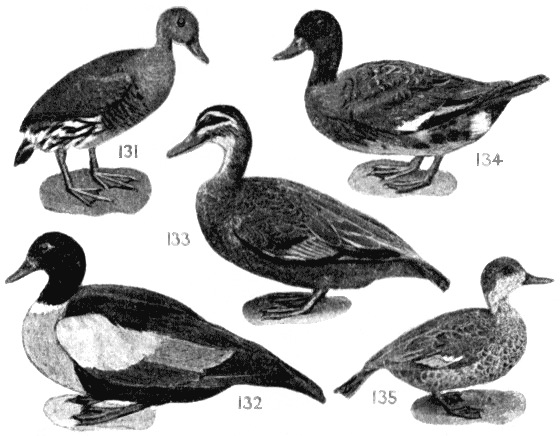
131* Plumed Whistling Duck (Eyton Tree), D. eytoni, A., T., N.Z.
Stat. r. lagoons 16
Upper grayish-brown; rump, tail blackish-brown; lower-breast, flanks chestnut barred black; white, black plumes on flanks; under base tail white; whistles when flying; f., sim. Water-plants, fish.
2 5
132 Australian Sheldrake, Chestnut-colored Shieldrake, Mountain Duck, Casarca tadornoides, N.S.W., V., T., S.A., W.A., N.W.A. =vt. Eur. Sheldrake. [~132 Tadorna tadornoides.]
Stat. r. lagoons 27
Head, neck shining-green; chest, upper-back pale rust-red; white band between green and rust-red; upper, under blackish; tail black; white, green, chestnut on wing; f., smaller, duller. Small fish, shellfish.
1 16
133* Black Duck (Australian Wild, Gray, Brown), Parera, Anas superciliosa, =vt. Eur. Mallard. Sunda Is. to N.G., A., T., N.Z.
Stat. v.c. water 24
Head dark-brown; line above eye, line below eye, throat light-buff; upper, under brown marked lighter; glossy-green patch on wing; bill bluish lead-color; f., sim. Grass, insects, pond-snails.
3 15
134* Australian Teal (Chestnut-breasted, Black, Mountain), Tete, Nettium castaneum, Java, Cel., A., T., N.Z. =vt. Eur. Teal. [~134 Nettion castaneum.]
Stat. c. lagoons 18.5
Head, neck dark bronze-green; upper rich brown; under chestnut; flanks spotted black; white, green patch on expanded wing; quills black; 1 lb. 9 oz.; f., head, neck brown and buffy-white; breast gray, spotted black; 1 lb. 8 oz. Grass.
135* Gray Teal, Wood-Teal, N. gibberifrons, Sunda Is., Cel., N.G., A., T., N.Z.
Stat. c. lagoons 16
Like female of 134, but smaller; neck white; 1 lb. 2 oz.; f., smaller; 1 lb. 1 oz.
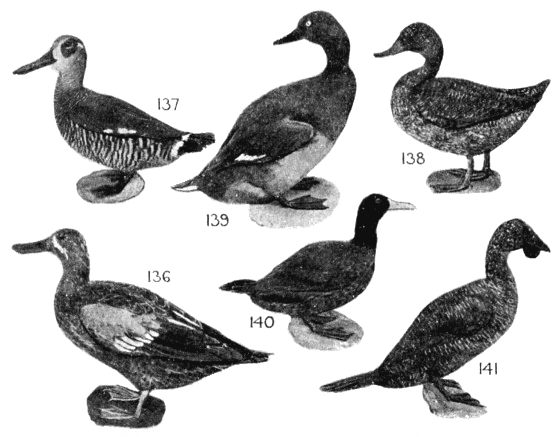
2 4
136* Australian Shoveller, Bluewing, Spoonbill-Duck, Stinker, Kuruwhengi, Spatula rhynchotis, A., T., N.Z., =vt. Eur. Shoveller.
Nom. v.r. freshwater 21.5
Crown brownish-black; white line before eye, side of neck; head, neck gray tinged green; under chestnut-brown mottled black; flanks chestnut banded black; back-feathers blackish edged grayish; blue, white, green on wing; throat black; quills dark-brown; under-wing white; f., duller; head, neck buff marked brown; under mottled brown, buff. Water-plants, shellfish, insects.
1 1
137* Pink-eared Duck (Pink-eyed, Zebra), Widgeon (e), Malacorhynchus membranaceus, A., T.
Nom. v.r. fresh water 17
Under barred brown, white; face, chin white; black round eye; behind eye a spot of rose-pink; back, wings brown; upper base tail whitish; tail dark-brown slightly tipped white; f., smaller. Water-animals.
1 1
138 Freckled Duck (Monkey), Stictonetta naevosa, V., S.A., W.A., T., N.S.W.
v.r. water 17
Dark-brown freckled whitish, under lighter. Small fish, pond-snails.
1 8
139* White-eyed Duck (Purple-headed, White-winged), Hardhead, Brownhead, Barwing, Karakahia, Aythya australis, N.G., A., T., N.Z., =vt. Canvas-back of N. Am. [~139 Nyroca australis.]
c. lagoons, bays 20
Chestnut-brown; white patch on wing; upper abdomen whitish; under tail white; eye white; f., smaller, duller. Pond-snails, insects.
1 7
140 Blue-billed Duck (Spiny-tailed, Stiff-tailed, Diving), Erismatura australis, N.S.W., V., S.A., W.A., T. [~140 Oxyura australis.]
v.r. reedbeds 16
Head, neck black; chest, back, flanks chestnut; tail blackish; bill light-blue; f., bill olive-green; freckled gray-brown; under lighter. Insects, pond-snails, fish.
1 1
141 Musk Duck (Must), Mould Goose (e), Biziura lobata, S.Q., N.S.W., V., S.A., W.A., T.
Stat. c. lagoons, bays 26
Blackish freckled buffy-white; wings small; long stiff tail-feathers; bill, lobe beneath chin greenish-black; dives; f., half-size; duller; no lobe. Frogs, shellfish, shrimps.
There are six families of birds included in Order XIV.—the Totally-webbed Swimmers. All four toes are joined by a web. Ducks have three toes only joined by the web, the hind toe being free. Representatives of the six families are found in Australia. These birds are fishers par excellence.
In the first family come the well-known Cormorants or Shags, birds found in almost every country in the world. Forty-two species are known, of which five occur in Australia.
The large Black Cormorant is the common Black Cormorant of Britain. It has a very extensive range over North America, Greenland, Europe, Africa, Asia, and Australia.
The little Black Cormorant is found in Australia, from the Moluccas to Borneo, and in New Zealand. Indeed, New Zealand is the stronghold of Cormorants, as it possesses many species.
The White-breasted and Pied Cormorants are so closely similar that possibly they will yet prove to be one species. Each is glistening white below, and jet black above. The bill is said to be longer in the Pied Cormorant, and the patch of naked skin near the eye is yellow, whereas, in the White-breasted Cormorant, this patch is said to be blackish or purplish. The Little Cormorant is also black and white. Its throat and upper chest are yellow.
Mr. Mattingley, C.M.Z.S., and others claim that the Cormorant, by feeding its young on yabbies, which, they say, prey on fish eggs, saves many more fish in the young stage than it ever eats in the adult stage, and hence it is really "a friend" of the anglers and fish. One thing is certain—fish were formerly much more abundant, and so were Cormorants. Anglers, collect evidence, and balance good with evil. Cormorants have a long, narrow bill, with a strongly-hooked tip. They are such expert fishers that in China they are much used to catch fish. Some will probably be surprised to learn that this custom formerly held in England, for the "Master of the Cormorants" was once one of the officers of the Royal household.
Some Cormorants nest in company in the Murray swamps, while others retire to a rocky island, such as Storehouse Island, east of Flinders Island, to breed.
These birds are expert swimmers and divers, so that one of the common names for them is "Diver," but the true Divers, as already pointed out, are Northern Hemisphere birds, and are placed in Family 25.
The Darter, or Snake Bird, is practically identical with the Water-Turkey of the United States. Sometimes, when alarmed, it submerges its body, leaving the head and neck exposed. It swims rapidly in this position. Four of these birds are known, and they are spread over America, Africa, Madagascar, Southern Asia, New Guinea, Australia, and New Zealand. The Darter was frequently seen on a recent trip to Enoggera Reservoir, the storage basin for Brisbane. The long, stiletto-like bill is used to impale its prey, while the flexible neck assists the spearing operation.
The next family contains the famous "Boobies" of sailors—the stupid Gannets, or Solan Geese, that were too stupid to escape from danger. Gould says our Gannet out-boobies the Booby, for he landed on a flat rock and secured five specimens by hand before the rest shuffled over the edge of the cliff and took flight. The Australian bird can scarcely be distinguished from its British cousin. It is common in Australian seas, where it can be seen diving for fish or flying swiftly round looking for prey. There is a large Gannet rookery on Cat Island, east of Flinders Island, where probably 4000 pairs of these fine birds nest each year. This was visited by a party of ornithologists in the Manawatu in 1908.