CLASS.—AVES.—BIRDS. (continued 2)
Reading edition
The famous Frigate-Bird we read of in the old school readers was twice taken in Port Phillip Bay. It is the best of flyers, as it can "breakfast on the Senegal (Africa), and dine on the Amazon." The two Frigate-Birds are common in Australian tropical seas. As already mentioned we met the Frigate Bird on Mast Head Island. Its wings are long, the forked tail also is long, but the legs and feet are very small. It is a creature of the air, and gets its living by compelling hard-working sea-birds to disgorge their prey.
The last bird in this varied Order is the Pelican. Our Australian Pelican is one of the largest of its tribe. Its enormous pouch distinguishes it at once. The ten Pelicans are practically world-wide in their distribution. On the trip of the Manawatu last year round the islands of Bass Strait, we visited the Pelicans' nesting-place on Penguin Island. This bird is practically identical with the "Pelican of the wilderness" mentioned in Holy Writ. The Pelican enjoys a reputation for maternal care of her offspring; indeed, she was said to feed the young with her own blood. This was probably due to the fact that one species of Pelican has a blood-red tip to the bill. Young Pelicans have not the long bill or the pouch. Thus this bird illustrates the truth of the statement that each animal in its development climbs its own ancestral tree, or, to say it in another form, each animal in its development recapitulates the life-history of the race. The Pelican has evidently descended from birds that possessed a short bill.
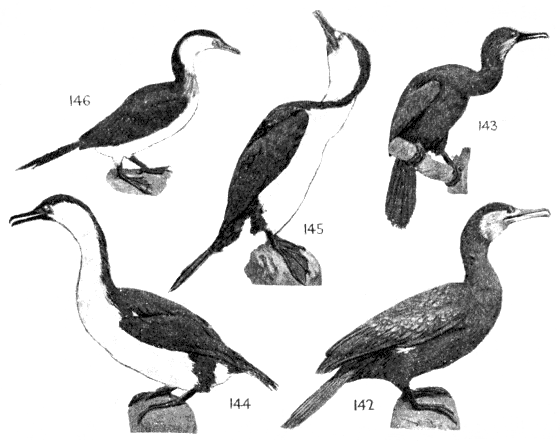
ORDER XIV.—PELICANIFORMES.
F. 59. PHALACROCORACIDAE (5), CORMORANTS, 42 sp.—16(14)A., 6(2)O., 7(3)P., 6(5)E., 10(4)Nc., 9(6)Nl.
5 42
142 Cormorant (Black), Black Shag, Phalacrocorax carbo., A., T., N.Z., cos. exc. S. Am. [~142-146 Genus, Carbo.]
c. lagoons, sea 35
Glossy blackish-green; side of neck, face buffy white; white on thighs; f., sim. Fish.
143 Little Black Cormorant, Shag, P. sulcirostris, Borneo to N.G., A., T., N.Z. [~142-146 Genus, Carbo.]
c. lagoons, rivers 25
Glossy greenish-black, about eye and side of neck lighter; f., sim. Fish, frogs.
144 White-breasted Cormorant, Black and White Shag, Diver (e), P. gouldi, Louisiade Is., A., T. [~142-146 Genus, Carbo.]
Stat. c. shores, rivers 30
Upper greenish-black, under glistening-white; naked skin about eye purple; hooked bill 2in.; f., sim. Fish.
145 Pied Cormorant, Black and White Shag, Diver (e), P. hypoleucus, S.Q., N.S.W., V., S.A., W.A., N.W.A. [~142-146 Genus, Carbo.]
Stat. v.c. bays 30
Like 144, but bare space in front of eye orange, bill 2.7in.; f., sim. Fish.
146 Little Cormorant, Frilled Shag, P. melanoleucus, Sunda Is., Mol., N.G., A., T., N.Z. [~142-146 Genus, Carbo.]
Stat. pairs, r. inlets, rivers 23
Upper black; under white; upper breast chestnut; f., sim. Fish, water-insects.
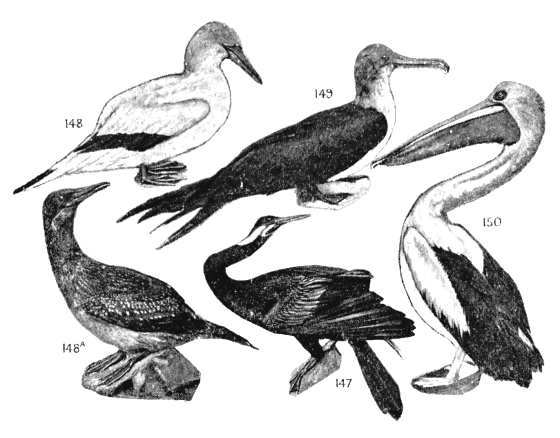
F. 60. PLOTIDAE (1), DARTERS, Water-Turkey, 4 sp.—2(1)A., 1(0)O., 2(0)P., 1(0)E., 1(0)Nc., 1(0)Nl.
1 4
147 Australian Darter, Snake-bird, Diver (e), Shag (e), Plotus (Anhinga) novae-hollandiae, N.G., A., N.Z.
r. lagoons, bays 36
Head, long thin neck, upper, under greenish-black; white patch side of neck; wings spotted whitish; bill straight, sharp; tail long; f., light-brown neck, breast. Fish.
F. 61. SULIDAE (4), GANNETS, Booby, Solan Goose, 11 sp.—4(1)A., 3(0)O., 1(0)P., 3(1)E., 6(l)Nc., 5(2)Nl.
4 11
148 Australian Gannet, Takupu, Sula serrator, A., T., N.Z.
Stat. c. bays 32
White; wing-quills black; head, hind-neck buff; f., sim.; young brown spotted. Fish.
F. 62. FREGATIDAE (2), FRIGATE BIRDS, Man-o'-war-bird, 2 sp.—2(0)A., 2(0)O., 1(0)P., 2(0)E., 1(0)Nc., 2(0)Nl. (Tropical Seas).
2 2
149 Frigate-Bird, Man-o'-war-Bird, Fregata aquila.
Stat. r. ocean 40
Brownish-black; about eyes, pouch on throat deep red; variable in size, color; bill long, hooked; tail forked; wings very long; legs very short; f., browner; breast, flanks whitish. Stolen fish, young turtles.
F. 63. PHAËTHONTIDAE(2), TROPIC BIRDS, Boatswain-Bird, Straw-Tails, 7 sp.—4(1)A., 4(1)O., 4(0)E., 3(0)Nc., 4(0)Nl.
F. 64. PELECANIDAE (1), PELICANS, 10 sp.—1(1)A., 4(1)O., 3(0)P., 3(1)E., 3(0)Nc., 4(1)Nl.
1 10
150 Australian Pelican, Pelecanus conspicillatus, N.G., A., T., N.Z. =vt. cos. bird.
c. lagoons, bays 60
White; wings, tail black; bill pink, pouch yellowish; f., sim. Fish, insects.
F. 65. Cathartidae, Condor, Turkey (American, New World) Vultures, 9 sp.—3(1)Nc., 8(6)Nl. The largest of flying birds.
The well-known Birds of Prey, so keen of eye, so rapid of flight, so fearless in courage, and so matchless in fight, have spread over almost the whole known world. The Eagles of one land are, therefore, much like the Eagles of another. The Harriers of England are practically identical with the Harriers of Australia and New Zealand, and, in fact, of almost any other land. The Falcon, so famous in mediæval times, is practically identical with the Falcon of Australia and Tasmania. The Australian Fish Hawk is the universal Fish Hawk or Osprey, for there is probably but one Osprey, having an almost world-wide range. The naming of these birds, though, has been a stumbling-block to us. To Australians they are all Hawks—even our gigantic and glorious Eagle has been reduced to the ignominious level of an "Eaglehawk," though our male Eagle is the largest male Eagle known, outrivalling, as it does, both the Bald Eagle of America and the Golden Eagle of Europe. A source of confusion, too, has arisen from the introduction of so many of our popular names from America, Thus, the Gum-tree (Eucalypt) is not a Gum, the 'Possum is not the carnivorous Opossum of America, the Goanna is not the equivalent of the vegetarian American Iguana; the "Wild Cat" is not a Cat, nor is the "Native Bear" a Bear, nor even remotely related to one, nor is the Kestrel a Sparrowhawk. It is an American error in popular naming, which has given us the Kestrel as the equivalent of the American Sparrowhawk, while the Sparrowhawk of the ornithologist is the equivalent of the Sparrowhawk of Britain.
In one respect, we are unfortunate in this new land. No mass of association and tradition has yet had time to crystallize about our native animals and plants. Our poets have not been able to sing of our birds for want of names and knowledge. Little has been done beyond the giving and frequent altering of scientific names, and the misapplication of names of animals and plants living in other lands to often totally different animals and plants here, so that confusion has reigned supreme. However, in bird matters, at least, we are on a better footing, for the bird-lovers have provided a common, and in most cases an appropriate, name for each bird.
The American Bobolink and Chickadee are famous birds, chiefly on account of an appropriate name; so is the British Cuckoo, while its even more noisy, more common, and practically identical Australian cousin is still unknown, or rather was until recently. The introduction of Bird Day has already produced gratifying results. We need good descriptive names for our varied and beautiful birds—more children's and poets' names, and less of the deadly formal "Yellow-vented Parrakeet," "Blue-bellied Lorikeet," and "Warty-faced Honeyeater" for some of the most glorious of the world's birds.
The old Order Raptores—birds of prey—included Hawks and Eagles, and Owls. These are now placed in two orders as "Diurnal Birds of Prey"—Hawks, and "Nocturnal Birds of Prey"—Owls. They all seize prey with the very well-developed talons, and not with the bill. Hence they were called Raptores—seizing birds. They use these talons when flying, and do not catch prey in scrub, or very close to the ground, unless in a clear space.
The two Harriers are typically Ground Hawks. The name is said to be derived from the habit these birds are said to possess of harrying birds. They are generally called "Swamp Hawks," and may frequently be seen flying low over bushes, to beat birds out.
The Goshawks—i.e., Goosehawks—possibly received their name by confusion, as possibly a Falcon to hunt Geese was kept in olden days, but probably it was not this bird. Three of these birds are rare. The White Goshawk is a fine bird, and is confined to Australia and Tasmania. The Australian Goshawk is said to be the only troublesome Hawk to the poultry farmer, and he bears a bad name generally. The Lesser Goshawk is a casual visitor in the Eastern States.
The Sparrowhawk of the ornithologist is much feared by small birds. He lurks in ambush, suddenly flashes out upon his prey, and is away with it instantly. The male is one of the smallest of Hawks. It is an almost universal rule in this order of birds that the females are larger, often much larger, than the males, and that there are several changes of plumage before the adult plumage is finally donned, so it is often a matter of difficulty to determine exactly the name of one of these birds.
Eagles are found the world over except in New Zealand. Our Eagle has the honor of being, as already stated, the largest Eagle in the world. It is also of undoubted courage, as its specific name, audax (bold) would lead one to suppose. It is, further, Gould says, of a "far more pleasing and elegant contour" than the Golden Eagle, the "pride and pest of the parish." Whoever heard of an Australian who was proud of his Eagle, though it is something to be proud of? Let our noble bird appear near a house, and there is a rush for a gun. On Eyre Peninsula we found the Eagles fed their young on rabbits, a serious pest in Australia.
The equivalent of our Sea Eagle is the White-headed or Bald Eagle of America, the female of which is the same length as the male of our Eagle, 38 inches. Many of these glorious Sea Eagles were floating, with their peculiar butterfly-like flight, over the Brisbane River, and added much to our enjoyment of a recent bird excursion there. We found one nest on each island in the Capricorn Group. On Mast Head Island the nest was in a tree about 60 feet high. On tiny Erskine Island, where there were no big trees, it was built on the ground, though it had been added to until it is now over 6 feet high. The fully-feathered dark-brown young bird sat on the edge of the nest, and formed a good photographic subject. Eagles were ruthlessly slaughtered in the British Isles. There is a shadow of an excuse there, perhaps, with their game preserves, where rabbits and birds are bred for sporting purposes. These reasons do not exist here. But it is pleasing to find on record that, even there, "Lord Breadalbane, who died in 1862, thought that the spectacle of a soaring Eagle was a fitting adjunct to the grandeur of the Argyllshire mountain scenery, and a good equivalent for the occasional loss of a lamb."
Though the Sea Eagle lives mainly on fish and refuse cast up by the sea, it is pitiful to read that, though this interesting, picturesque, and valuable bird was once common, not one is left on the mainland of Scotland. Could blind, unreasoning slaughter do more? Why kill a harmless bird? But it is not only harmless; it is of distinct value in its sphere in Nature. Hawks altogether are misunderstood and misjudged. It is doubtful if it pays a farmer, aye, even a poultry farmer, to shoot Hawks. They might steal a few chickens, but they do not live on them. They live mainly on rabbits, mice, rats, and insects.
The Whistling Eagle whistles while flying about in the fine large flight-houses of the Adelaide Zoological Gardens. One fine specimen accompanied the Federal trawler Endeavour down Gladstone Harbor, but not far from shore, for it returned when we headed for the open ocean and the fairyland of the Great Barrier Reef.
Kites used to be excessively common about many English towns, where they acted as scavengers. The introduction of the shot-gun has exterminated them. They are world-wide in distribution, so what you read about European Kites will fit Australian Kites. They are, perhaps, the most graceful of flyers, gliding, soaring, hovering, and performing all sorts of aërial evolutions. The toy kites of our childhood were suggested by the flight of these once common birds. Now, alas! they are very rarely seen. Being mainly insectivorous, they are invaluable birds, and we can ill spare them in this country, where insect life is so abnormally prolific.
The Black-breasted Buzzard is the third largest of our Diurnal Birds of Prey. It is a rare visitor in Southern Australia, but in seasons of drought it comes down from Central Australia.
The Falcon, which our ancestors trained for hawking, is almost identical with our Falcon, while our Little Falcon is, for its size, the "boldest and swiftest of all birds of prey," for it has been observed to decapitate a flying Duck with a blow of the edge of its wing. In Brisbane we had the pleasure of spending an interesting afternoon with Mr. J. Bell, who formerly practised falconry with trained Australian Falcons.
The Kestrel of Australia is almost identical with the Kestrel of Europe. You must have noticed with interest its habit of hovering. One incident of the 1909 Ornithologists' Congress will show that, even in the midst of a crowded city like Adelaide, it is possible for scientific work in ornithology to be done. While the Director of Education, Mr. A. Williams, Mr. Le Souëf (ex-Pres., A.O.U.), Mr. A. J. Campbell (Pres., A.O.U.), Mr. Robert Hall (Vice-Pres., A.O.U.), and myself were walking from the Education Office to Grote Street School, a Kestrel was seen on the grass in a small square. The members of the party were astonished to see the Kestrel rise carrying a bird, possibly a Sparrow, in its talons. Now, the interest of this observation is that most of our ornithologists were prepared to state that the Kestrel is entirely insectivorous, and never touches small birds. However, an observation in the heart of Adelaide is of value in this matter of scientific interest. This bird, unfortunately, is generally called the Sparrowhawk, a name which belongs to a much bolder Australian bird of prey (No. 157), which does eat small birds.
Kestrels are very fond of mice, and would, if allowed, spend time protecting the farmer's haystacks, but if a Kestrel comes near the farmhouse the gun is at once produced, and so the farmer loses the services of one of his best friends.
Jeffries and other Nature-lovers have written on the marvellous powers of hovering possessed by these birds. In fact, the Kestrel is frequently called the Windhover. In Australia Kestrels frequently nest in a hollow tree, but do not lay the usual white egg.
The Osprey is another example of bad naming. The word is said to be a corruption of Ossifrage, the "bone-breaker." As it feeds on fish, it has no big bones to break. It is spread from "Alaska to Brazil, Lapland to Natal, Japan to Tasmania, and even out to the Pacific Isles," and it may be the same bird throughout, though Dr. Sharpe has allowed three species in the "Handlist of Birds." "The A.O.U. Check-list of North American Birds, 1910," however, recognizes the North American bird as a sub-species only, so it is possible the Australian bird will be also listed as a sub-species when the Royal Australasian Ornithologists' Union adopts its check-list in Sydney this year. These birds eat living fish, which they catch by plunging into the sea. Occasionally they drive their talons into too big a fish, and, not being able to withdraw them, are drowned.
Flinders, in his journal, wrote about the enormous nests he met on rocky points, and considered they were built by a great "Dinornis."
The Osprey and the White-bellied Sea Eagle, however, build on rocky points if no trees are available, and add to the nest each year. It is interesting to read in the Western Australian Year Book article on birds that the Government has placed an Osprey's nest in the cave district, "under the protection of the Cave Warden." A pleasing interest is growing in Australian nature in its many forms.
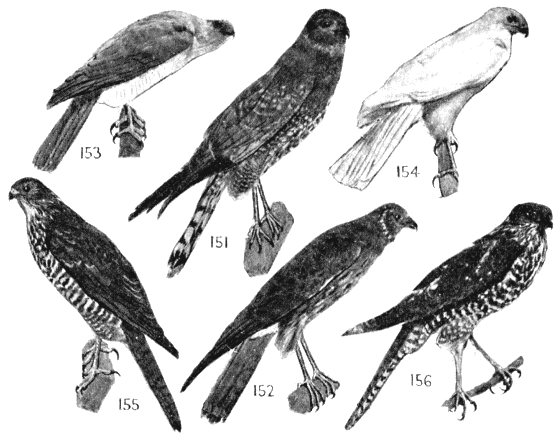
ORDER XV.—ACCIPITRIFORMES, DIURNAL BIRDS OF PREY.
F. 66. Serpentariidae, Secretary-Bird, 2 sp. E.
F. 67. Vulturidae, Vultures, 17 sp.—8(5)O., 6(0)P., 9(5)E.
F. 68. FALCONIDAE (29), HARRIERS, GOSHAWKS, EAGLES, FALCON, etc., 485 sp.—99 (86) A., 106(58)O., 70(19)P., 118(91)E., 53(17)Nc., 144(112)Nl.
2 18
151 Spotted Harrier (Jardine), Spotted Swamp-Hawk, Circus assimilis, Cel. to A., T.
Stat. c. plains 22
Facial disc, hind-neck, back, chest dark-gray; crown rust-red streaked black; shoulders, rest of under rich-chestnut spotted white; tail barred dark-brown, gray; legs long, yellow; m., smaller, duller. Lizards, mice, small snakes, birds.
152* Allied Harrier (Gould), Swamp-Hawk, Kahu, C. gouldi, A., T., N. Cal., Norfolk Is., Lord Howe Is., N.Z., Fiji =vt. Eur. Marsh-Harrier.
Stat. v.c. swampy 20
Upper, head dark-brown; facial disc indistinct brown; under buffy-white streaked and tinged red-brown; upper base tail white; rest tail brownish-gray; f., larger. Reptiles, mice, birds.
5 63
153 Gray Goshawk (New Holland, Gray-backed), Astur clarus (cinereus), A.
v.r. dense brushes 16.5
Upper gray; throat, under white finely barred gray; feet yellow, claws black; f., larger. Reptiles, mice, birds.
154 White Goshawk, A. novae-hollandiae, E.A., S.A., T.
r. timber 16.5
Pure white; m., much smaller. Food as 153.
155* Australian Goshawk, Chicken-Hawk, A. fasciatus (approximans), A., T., Norfolk Is., N. Cal. =vt. Eur. Goshawk.
Stat. c. timber, f., 20; m., 15
Upper dark-brown; shoulder thigh rust-red; tail dark-brown barred black; throat buff; under buff barred brown; f., larger. Food as 153.
156 Lesser Goshawk (Western, Chestnut-colored), A. cruentus, V. (acc.), W.A., N.W.A.
Stat. c. timber 17
Back, wings, tail slaty-brown; chestnut-red, indistinct collar; under barred brown white; chin buffy-white; f., upper brown. Birds, mice, lizards.
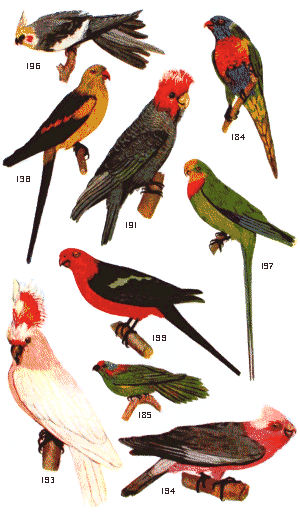
184 Blue Mountain Lorikeet 185 Musk Lorikeet 191 Gang-gang Cockatoo 193 Pink Cockatoo 194 Rose-breasted Cockatoo 196 Cockatoo-Parrot 197 Superb Parrot 198 Black-tailed Parrot 199 King Parrot
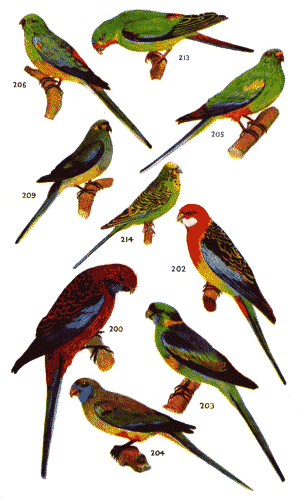
200 Crimson Parrot 202 Rosella 203 Mallee Parrot 204 Blue Bonnet 205 Many-colored Parrot 206 Red-backed Parrot 209 Grass Parrot 213 Swift Parrot 214 Warbling Grass-Parrot
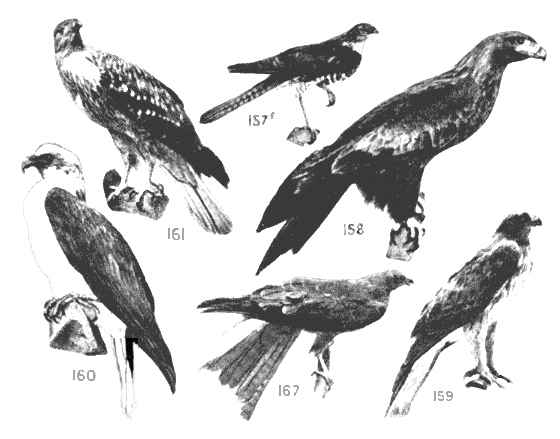
1 42
157* Collared Sparrow-Hawk, Accipiter cirrhocephalus, N.G., A., T. =vt. Eur. Sparrow-Hawk. [~157 Astur cirrhocephalus.]
Stat. r. timber, f., 14; m., 12
Head, upper brownish-gray; tail barred deep-brown; obscure collar reddish-brown; throat, under, thighs rufous barred white; f., much larger. Mice, birds.
1 1
158* Wedge-tailed Eagle, Eaglehawk (e), Uroaëtus audax, A., T. =vt. Eur. Golden Eagle (32in.).
Stat. c. timber, plains 38
"Noble bird;" largest eagle known; upper, under blackish-brown; feathers edged pale-brown; hind-neck golden-brown; f., larger. Rabbits, rats, carrion.
1 4
159 Little Eagle, Eutolmaëtus morphnoides, N.G., A.
r. timber 22
Back of head, under rufous striped black; back, rump, wings brown; tail grayish-brown, barred blackish-brown. Carrion, rats, mice.
1 10
160 White-bellied Sea Eagle, Haliaëtus leucogaster, Ind. Malay to A., T., Oceania =vt. American Bald Eagle.
r. shores 30
"Noble species;" white; wing-quills, base-tail blackish-brown; f., larger; young; head buff; upper wings chocolate-brown; under buffy-brown. Dead fish, shellfish. "Floats like a great butterfly."
2 4
161 Whistling-Eagle (-Hawk), Haliastur sphenurus, A., N. Cal.
Nom. c. swamps, shores 24
Under light sandy-brown streaked white; back, wings brown marked lighter, spotted white; tail ashy-brown; head, neck sandy streaked lighter; f., larger. Caterpillars, mice, rats, floating food.
1 6
162 Allied Kite, Milvus affinis, Sunda Is., Cel. to A. =vt. Eur. Black Kite.
Nom. c. open country 20
Upper glossy brown; wing-quills black; slightly-forked tail brown; under rufous-brown; chest dark lines; f., sim. Scavenger, birds.
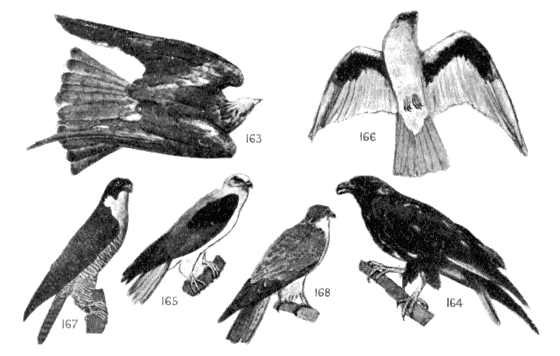
1 1
163 Square-tailed Kite, Lophoictinia isura, A. =vt. Eur. Common Kite.
r. timber, plains 19
Neck, shoulders, under reddish-orange; chest marked black; head streaked black; abdomen, flanks barred lighter; upper blackish-brown; square tail brownish-gray; f., larger. Caterpillars, birds.
1 1
164 Black-breasted Buzzard, Gypoictinia melanosternum, A. (interior).
v.r. timber, plains 23
"Fine species;" crown, face, chest, abdomen black; flanks chestnut; hind-neck light-brown; upper brownish-black; wing-quills white base, rest black; this white patch gives appearance of window in wing when flying; f., larger. Animals.
2 5
165* Australian Black-shouldered Kite, Elanus axillaris, A.
Mig. r. open plains 12.5
Upper delicate-gray; head, under white; jet black shoulder, patch under wing; tail grayish-white; f., sim. Insects, reptiles.
166 Letter-winged Kite, White-breasted Sparrow Hawk (e), E. scriptus, E.A., S.A., W.A.
r. plains (interior) 12.5
Like 165, but more black on under angle of wing gives letter W when wings expanded; f., sim. Insects.
4 37
167* Black-cheeked Falcon, Falco melanogenys, A., T. =vt. Eur. Peregrine Falcon.
Stat. c. plains, coast, rocky 15
Crown, side of head black; upper-breast creamy spotted black; rest of under barred black, reddish-gray; upper, wings, tail dark-gray; tail barred brown, gray; f., larger. Birds.
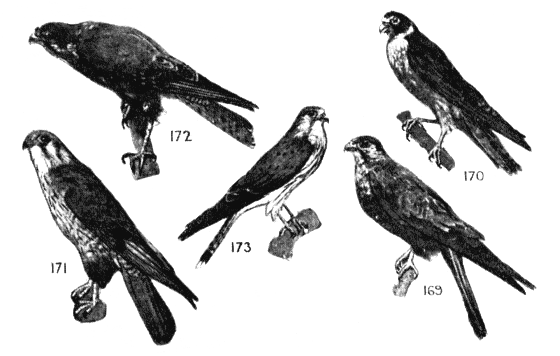
168 Gray Falcon, Blue (Smoke) Hawk, F. hypoleucus, A. =vt. Eur. Gyrfalcon.
v.r. timber, plains f., 17; m., 12
"Rare beautiful falcon;" bluish-white below; grey above; tail barred gray, brown. Birds.
169 Black Falcon, F. subniger, A.
v.r. plains (inland) 17
Dark, sooty-brown, paler below; chin whitish; f., larger.
170* Little Falcon (White-fronted), Duck Hawk (e), Australian Hobby, F. lunulatus, A., T., =vt. Eur. Hobby.
Stat. c. plains f., 13.5; m., 11.5
Forehead white; upper grayish-black; cheeks black; tail barred gray, chestnut; throat buff; chest reddish-buff, striped dark-brown; under, thighs reddish; incomplete whitish collar; f., larger. Birds, insects.
2 3
171 Striped Brown Hawk (Western, Orange-speckled), Hieracidea berigora, A. [~171 Ieracidea berigora.]
v.c. swampy, plains 17
Upper dark-brown; wings spotted reddish; incomplete collar, under buff-white striped dark-brown; throat whitish; naked skin round bill yellow; tail barred dark-brown, gray; f., larger. Caterpillars, insects, birds.
172* Brown Hawk, H. orientalis, A., T. [~172 I. orientalis.]
Stat. v.c. timber 17
Head, upper dark-brown; line over eye, throat buff; under buff spotted rust-brown; tail brown barred rust-red; Skin round bill bluish; f., larger. Food as 171.
1 28
173* Nankeen Kestrel, Windhover, Mosquito Hawk, Sparrowhawk (e), Cerchneis cenchroides, A., T., N.Z. =vt. Eur. Kestrel.
Stat, v.c. timber, plains 11.5
Upper cinnamon-red, spotted black; tail rufous, faintly banded black above, tipped white, then black bar; side neck, throat, abdomen, under tail white; chest buff striped black; f., larger. Insects, mice.
F. 69. PANDIONIDAE (1), OSPREYS, 6 sp.—3(0)A., 5(1)O., 1(0)P., 1(0)E., 1(0)Nc, 1(0)Nl.
1 3
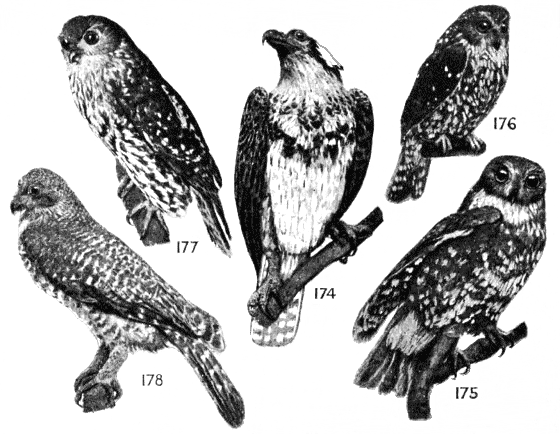
174 White-headed Osprey, Fish Hawk, Pandion leucocephalus, Mol., N.G., A., T. =vt. cos. bird.
Stat. r. shores 23
Crown, hind-neck, throat, abdomen, under tail white; upper dark-brown; chest mottled brown; side-neck dark-brown, marked white; wing-quills black; dives; f., sim. Fish.
Just as the Diurnal Birds of Prey (e.g., Hawks) are closely related to those of the Northern Hemisphere, so are the Nocturnal Birds of Prey (Owls) very closely related to those of the Old World. The different kinds of Owls are so closely similar that there are many disputes as to their classification, and it is not likely that we shall ever be able to recognize in the living, free state all the species recognized by scientists.
Indeed, I was much interested at the Adelaide Museum to see our leading ornithologists fail to pick out the skins of two English Barn Owls when they were placed with three Australian Lesser Masked Owls, and yet ornithologists give our birds such widely-different names that literature is useless to us. These names have seriously hampered the popularization of bird-study in Australia. If ornithologists, with skins in hand, cannot separate them, what is the use of manufacturing species?
As Owls are active late in the afternoon or at night, there has always been a certain amount of mystery regarding them, and, speaking generally, the ordinary observer knows little of them. Two of the Australian birds have forced themselves on our notice to some extent. The Powerful Owl, the largest of our Owls, has alarmed many by means of its blood-curdling screeches heard in quiet forest gullies.
The Boobook Owl, though not often seen, calls "Mopoke," which sounded like "Boobook" to the aboriginal ear, but became "Cuckoo"—the best-loved bird-call of their far-distant home to the ears of the homesick first white residents. And was it not, they asked, what one might expect in a country where Christmas came at the wrong time of the year, where the trees were always green, and shed their bark instead of their leaves—where the leaves grew vertically, instead of horizontally, and so gave no shade—was it not natural that the Cuckoo, a day bird in England, should become a night bird in this land of paradoxes and contradictions? Thus Australia's reputation was added to even by the Boobook Owl.
Confusion was caused, for, when daylight came, and the Frogmouth was seen sitting in the tree, the Frogmouth was supposed to be responsible for the frequent calls of the previous night. However, some reliable observers, notably Mr. C. H. McLennan, "Mallee Bird," and Mr. T. H. Tregellas, claim that the Frogmouth does call "Mopoke'" occasionally, but the Boobook Owl is the bird that is responsible for the frequent "Mopoke" on calm evenings.
The Owls are divided into two families. The members of the first family—the Owls Proper, or Hawk-Owls—have the facial disc almost absent, while in the second family the facial disc is complete. In each, the eyes are directly obliquely forward, and, since they are not capable of much movement, the bird turns its head from side to side. Though mainly nocturnal, Owls are sometimes seen hunting for their prey by day. As they feed mostly on mice, rats, and insects, they are very valuable birds. The feathers are very soft, with a weak central axis, so that no sound is made when flying. They are thus able to approach their prey without giving warning. The Powerful Owl well deserves its name, as it possesses great strength, and is a formidable enemy if wounded. However, Owls are, fortunately, seldom shot at.
Like Hawks, Owls catch their prey with and carry it in their feet, unless the feet are required for climbing. One peculiarity of the feet is that the bird can reverse one toe, so that it can have three toes in front and one behind, like most birds, or two in front and two behind, like Parrots and Cuckoos.
Although not so strong of flight as the Diurnal Birds of Prey (e.g., Hawks), Owls have managed to spread throughout the world, so that they are found even in New Zealand. The different kinds are not easily separated, so most people are satisfied when they have classed a bird as an Owl, though you will probably want to divide them into two groups—the Owls Proper and the Barn Owls.
ORDER XVI—STRIGIFORMES, NOCTURNAL BIRDS OF PREY, OWLS.
F. 70. BUBONIDAE (11) HAWK OWLS, 280 sp.—47(44)A., 88(74)O., 33(17)P., 48(42)E., 34(16)Nc, 75(61)Nl.
11 44
175 Boobook Owl (Cuckoo), Ninox boobook, A.
Stat. v.c. timber 16
Head, upper, wings, tail reddish-brown; under rufous blotched white; facial disc indistinct, grayish-white edged black; f., larger. Insects, mice, birds.
176 Spotted Owl, N. maculata, S.Q., N.S.W., V., S.A., T., King Is.
Stat. r. timber 13
Head, upper brown spotted white; under brown blotched tawny and white; disc indistinct; f., slightly larger. Insects, birds.
177 Winking Owl (Western), N. connivens, A., exc. N.W.A.
Stat. c. brushes, wooded gullies 16
Upper dark-brown spotted white; tail dark-brown barred grayish-white; under mottled brown, white; disc indistinct; f., larger. Insects, birds.
178 Powerful Owl (Eagle), N. strenua, N. Ter., E.A., S.A.
Stat. r. dense gullies 24
Crown, upper brown marked whitish; face, throat, chest whitish streaked brown; rest of under whitish barred brown; f., sim. Birds, quadrupeds.
F. 71. STRIGIDAE (5), BARN OWLS, 26 sp.—13(11)A., 3(1)O., 1(0)P., 4(3)E., 1(1)Nc., 7(7)Nl.
5 26
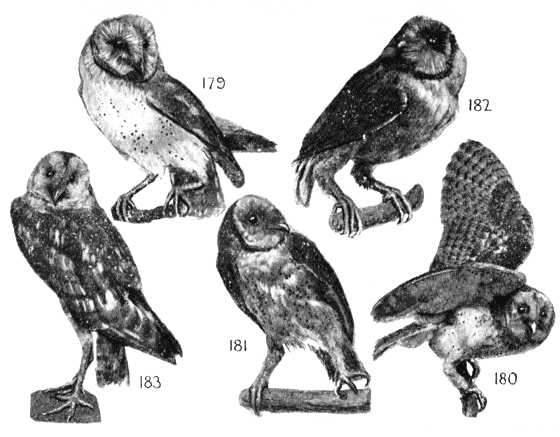
179 Australian Barn Owl (Lesser Masked, Delicate, Screech), Strix delicatula, N.G., A. [~179-183 Genus, Tyto.]
Stat. c. timber 14
Upper beautiful soft light grayish-brown tinged yellow, finely spotted blackish-brown and white; under white, few small brownish spots; disc white edged buff; f., sim. Mice, rats.
180 Masked Owl, S. novae-hollandiae, A. [~179-183 Genus, Tyto.]
Stat. r. forests, rocky 14
Pale buff; head, back wings marked dark-brown, few white spots; under paler, few brown spots; disc purplish-white, edged with deep-brown spots; f., larger. Mice, rats.
181 Chestnut-faced Owl, S. castanops, N.S.W., V., S.A., T. [~179-183 Genus, Tyto.]
Stat. c. brushes, swamps; f., 17; m., 14.5
Disc deep-chestnut edged black; upper rufous-brown marked dark-brown; few small spots on head, shoulders; under deep sandy-brown with blackish spots; f., larger. Mice, rats.
182 Sooty Owl, Dusky Barn Owl, S. tenebricosa, N.G., E.A. [~179-183 Genus, Tyto.]
Stat. v.r. dense brushes; f., 16; m., 13.5
Disc sooty-gray deeper round eyes; upper brownish-black finely spotted white; under brownish-black washed buff, fainter spots; legs mottled brown, white; f., larger. Mice, rats.
183 Grass Owl, S. candida, India, Formosa, China, Philippines to E.A. [~179-183 Genus, Tyto.]
Stat. v.r. grass 14
Disc white or tinged pale-pink; brownish spot before eye; edge disc dark-brown above, buff below; upper dark-brown finely spotted white; under white tinged orange-buff with scattered brown spots; tail whitish barred brown; legs long; f., sim.
While Australia possesses representatives of nearly all the important widely-spread families of birds this favored land also contains many birds that are unknown elsewhere. In addition, there are some groups which are found in other continents, but which reach their highest development here. Conspicuous amongst these are Parrots and Cockatoos. Australians are so accustomed to see these beautiful birds on every country road, and in cages outside their houses, that they do not appreciate their beauty or their interest, for "familiarity breeds contempt," even with bird life.
When one reflects that no figure of a Parrot is found in ancient Egyptian art, and that no Parrot is mentioned in the Bible, then one begins to understand the interest of Europeans in these "spoilt children" of the animal world, the "monkeys of the bird world," and "the cream of the Australian avifauna."
Their tameness, their affection, their entertaining habits, and their remarkable powers of speech, all help to render Parrots the favorites amongst birds. The brilliance of their plumage, their intelligence, and their longevity excite wonder, for Parrots have been known to live 100 years in captivity. Presumably, they would live even longer in a state of nature. Humboldt recorded, as quoted in Newton's "Dictionary of Birds," "that in South America he met with a venerable bird, which remained the sole possessor of a literally dead language, the whole tribe of Indians, Atures by name, who spoke it, having become extinct."
Australians will perhaps be surprised to learn that there are no Parrots or Cockatoos in Europe, and none in Asia, excepting India, none in Africa north of the Tropic of Cancer, and only two in North America, and that one of these is rapidly becoming extinct, and that Africa and India are poor in Parrots. Thus South America and Australasia alone are left as the lands that contain these interesting birds in any number. While South America contains the largest Parrots—the Macaws—all the South American species belong to one family. In the Australian region six families of Parrots are represented. Four of them are confined to the region, while but one species of the fifth family (Cockatoos) is found outside the region.
The Brush-tongued Parrots, or "Lorikeets," are a purely Australian family. Some of these are very common at times in flowering eucalypts, even in the public gardens and streets. The Blue Mountain Parrot, very common at times, is a giant of the family. It has been described as a "noble bird, gorgeously apparelled." Its vernacular name of Blue-bellied Lorikeet has been altered to Blue Mountain Lorikeet. We found these birds nesting in the big sugar-gums bordering Warunda Creek, Eyre Peninsula. They keenly and noisily resented our curiosity, and screeched much as we tried to discover them amongst the green foliage. Though so gaudy, they were picked out with difficulty. This bird was very troublesome in my garden at Bengworden, near the Gippsland Lakes, where, when the apples were about the size of marbles, they tore them to pieces to get the developing "pips." In common with the other members of the family, they have a swift, direct flight, and screech much when flying. The "Green Keets," generally called "Green Leeks," which are so very numerous at times, are often accompanied by two other Lorikeets, the Little and Purple-crowned Lorikeets. These green birds hang, head down, among the eucalyptus leaves, and brush up the honey from the flowers with their brush tongue. They follow the flowering of the eucalypts from district to district, and since the eucalypts flower at irregular intervals, these birds are not so regular in their movements as Swifts, Snipe, Curlews, Cuckoos, and other migratory birds. For this reason the birds may be absent from a district for some years, and then suddenly appear again in great numbers.
Cockatoos are almost confined to the Australian region. This includes the islands north-west of Australia out to Wallace's line, passing between Celebes and the Philippine Islands, Celebes and Borneo, and between the small islands of Lombok and Bali, east of Java. These islands, though but fifteen miles apart, "differ far more from each other in their birds and quadrupeds than do England and Japan. The birds of the one are extremely unlike those of the other." Another authority says that the faunas of Bali and Lombok are more unlike than those of South America and Africa. Bali has Woodpeckers, Barbets, Bulbuls, and Black and White Magpie-Robins, none of which is found in Lombok, where we find Screaming Cockatoos, Friar-birds, and other Honey-eaters, and the strange mound-building Megapodes and numerous other remarkable birds. This narrow strait is over 1000 fathoms in depth, and is probably one of the most ancient and most permanent dividing lines in the world. Instead of being united to Asia, it is probable that Australia has been more recently joined to New Zealand, South America, and South Africa. Only one Cockatoo transgresses Wallace's line to the west, and that is found in the Philippine Islands; evidently it has spread there from the adjacent part of the Australian region.
The sombre, slow-flying Black Cockatoo is the largest of all Cockatoos. It is seen fairly often in small companies, especially on wattles and eucalypts, the wood of which it tears to pieces with its powerful bill to get the insect larvæ feeding there. It is a valuable forest-saving bird.
The Glossy or Leach Black Cockatoo is named after Dr. Leach, who did a great amount of work on Australian animals about 100 years ago. It is a rare bird, and may readily be distinguished by its smaller size and more glossy plumage.
The peculiar gray Gang-gang Cockatoos are common in parts of the forest country. The male is easily recognized by his red head and crest. I occasionally see these interesting birds in the big eucalypt forests of Gippsland. I was surprised to discover that, in South Gippsland, it is generally called the Galah, a name which belongs to quite a different bird (194).
The screeching, fussy White Cockatoo, with its delicate sulphur crest, is well known. Many country dwellers enjoy the privilege of often seeing these snowy-white birds almost covering a dead tree. They are favorites as pets, and live to a good old age. They render good service at times by digging up and eating grasshoppers' eggs, though they do damage to maize and other crops. As they post sentinels, they are difficult birds to approach.
The Pink Cockatoo (Major Mitchell) is unfortunately becoming rare. It was fairly common when I taught in a Mallee school, near where Hopetoun now is. It has been described as "quite the most beautiful of all the Cockatoos, being a harmony of delicate rose-pink and white, with a handsome crest of acuminate feathers barred in crimson, yellow, and white." It does not take kindly to captivity. It nested in the smaller "spouts" of the green "box-trees" in the "box-flats" and swamps about the Goyura School, south of Lake Corrong.
What is more glorious than a mob of Rose-breasted Cockatoos (Galahs), 500 strong, airing their beauties and graces as they take a constitutional before retiring for the night? Probably no other kind of bird shows better company-flying than Galahs; now one sheet of a delicate gray lavender, and the next instant a flash of brilliant salmon-pink, as the whole company turns and wheels, obedient to some command or signal unperceived by us; again, the sun lights up the pale-pink crests and gray backs, as they turn once more and wheel, screeching, to continue their evolutions further afield. It is a sight that lingers in the memory. They are charming pets, and some talk well. Their beauty adds charm to our almost perfectly level great inland plains.
The delicately-colored and friendly Cockatoo Parrot, with its immovable crest, takes a sub-family to itself. It migrates from the North, and, in a dry year, may even reach the South Coast. In 1908 some of these birds reached Colac, in Southern Victoria. They are favorite aviary birds, and thousands have been exported.
In the true Parrot family, Australia is strongly represented by many beautiful birds. The first is the Barraband Parrakeet of Gould, and the Green Leek of some ornithologists. As the name Green Leek is practically in universal use for the Musk Lorikeet (Green Keet) of the ornithologist, it seems desirable to sink an inappropriate name into a synonym, and use the earlier name, Superb Parrot, for it is a beautiful bird. Sad to say, it has become exceedingly rare, though Mr. A. W. Milligan informed me, a few days ago, that he saw six fly into some pines at Black Rock one day this month (January, 1911).
The Rock Pebble, or Smoker, of the country dweller, formally called the Black-tailed Parrot, is a fine bird. His tail, however, is not really black, but is strongly iridescent. He nested in numbers, at the beginning of the nineties, in the dead box-trees in Lake Corrong. After an early tea, we frequently went over to the lake and watched the birds feeding their young. No longer do they inhabit that district, which has been completely cleared and placed under cultivation.
The big King Parrot is a "showy, noble species," and is still common in parts, especially the moist forest districts.
The members of the next group form a sub-family—the Broad-tails—confined to Australia, Tasmania, New Zealand, and the Pacific Islands. Judging by their names, they must be amongst the most beautiful of birds. The best known is the common Rosella, often quoted in European books as one of the most beautiful of birds. Its scientific name is eximius, which means excellent. Indeed, the scientific names of Australian parrots give a good indication of their place amongst the glories of the bird world. The cousin of the Rosella—the large blue-winged and blue-cheeked Crimson Parrot—is well named elegans; a grass parrot is also elegans, then follow splendidus, splendida, and pulchella, while that great ornithologist, Gould, has conferred the honor of pulcherrimus on another Australian parrot. These names, given by scientists, will show Australians in what high esteem these birds, so common with us, are held by observers from other lands.
The Crimson Parrot, previously mentioned, is, I think, becoming common, for I have lately seen it flying about in towns, notably in the Botanic Gardens, Melbourne, the Zoological Gardens, Melbourne, and the school yard at Wangaratta.
The Yellow Parrakeet, with its blue cheeks, is a "harmony in blue and canary yellow, and is an exceedingly lovely bird." It is unfortunately rare.
The next bird is one of our well-known cage pets—the beautiful Ringneck—the Mallee Parrot. It flies ahead of one along the half-chain strip of scrub left on mallee roads, and is a feature of interest.
The next group contains some inland parrots. The "Bulloak," or "Blue Bonnet," is a beautiful bird, and is common on inland plains. It has a brownish-olive back and a gray chest. The bright, blue cheeks, forehead, and shoulder, red abdomen, and light yellow base to tail present a striking appearance. Its vernacular name—Yellow-vented Parrakeet—has now been altered to Blue Bonnet Parrot.
The Many-colored Parrot, with its large yellow shoulder patch, is a glory. It is, indeed, difficult to imagine a more beautiful bird as it flies about in the bright Mallee sunshine. The Red-backed Parrot is the common "Grass Parrot" of country dwellers. Large flocks of these birds are to be seen on the inland plains. The female is much plainer than her gaudy mate. This is unusual amongst parrots; for, as the work of sitting on the eggs is done in a hollow tree under good shelter, there is apparently no reason why the female should be plainer than the male, and in most parrots she is equally pretty.
The brownish female offers a strong contrast to her more brightly coloured mate, which is immediately distinguished by the large red patch on the back. (The Many-colored Parrot has a much smaller red patch on the back, near the base of the tail.)
The seven small Grass-Parrots (Neophemas) are amongst the most beautiful of parrots. These birds have become so rare that the South Australian Government has wisely placed them on the totally-protected list. Bird trappers formerly exported numbers to Europe each year. These rare Parrots are said to be worth about £7 each as cage birds.
We found the rare Rock Parrot nesting in the edges and hollows of a tiny travertine-limestone island (Goat Island) in an inlet at the eastern end of the Great Australian Bight. The eggs were laid on the bare earth, often within two or three feet of high-tide mark. The whole island was less than an acre in extent, and at no point was ten feet above high-tide level. Many similar islands on the Australian coast have not yet been explored ornithologically, so we do not know what matters of interest are awaiting us.
The next bird, the Swift-flying Lorikeet, is a honey feeder, like the first four Parrots (Lorikeets) mentioned. It is often found with them, and was common all the winter, and is common now in a clump of flowering gums outside the Melbourne Cricket Ground. It has given scientists much trouble as to its correct name and position. It can be distinguished from the "Green Keets" by having scarlet under the wings.
The beautiful and affectionate little Budgerigar (Warbling Grass Parrot), or Love Bird, has many names. It is migratory, and sometimes appears in thousands, though it may not be seen again for years. It is a favorite cage bird, and breeds as freely as caged canaries, so it is well-known in Europe.
The last two Parrots are ground birds, which never perch or climb. It was feared that the Ground Parrot was extinct, but it is seen occasionally in the National Park at Wilson's Promontory. The Night Parrot is better called the Western Ground Parrot. It is found amongst the Spinifex (Triodia) scrub of the interior.
Though Parrots are essentially "climbers," having the suitable arrangement of two toes in front and two behind, it is interesting to learn of these two Australian Parrots which cannot perch or climb. The Parrot's foot is of interest, further, in so far as it is used as a hand, and the food is held in it while being eaten. The powerful bill not only serves to reduce its food to powder, but also assists in climbing. It is sometimes amusing to note the "absurd caution," and great deliberation with which a parrot climbs down in his cage to pick up some dainty.
Possessing no less than 76 kinds of Parrots and Cockatoos, Australians should be alive to their privileges as contrasted with the dwellers of northern lands, where Parrots do not live. They should insist on the proper protection of these beautiful and wonderful birds.
ORDER XVII.—PSITTACIFORMES.
F. 72. Nestoridae, Nestor, Kaka, Kea, 4 sp. A. (N.Z.).
F. 73. LORIIDAE (9), BRUSH-TONGUED PARROTS, LORIES, LORIKEETS, 87 sp. A.
3 16
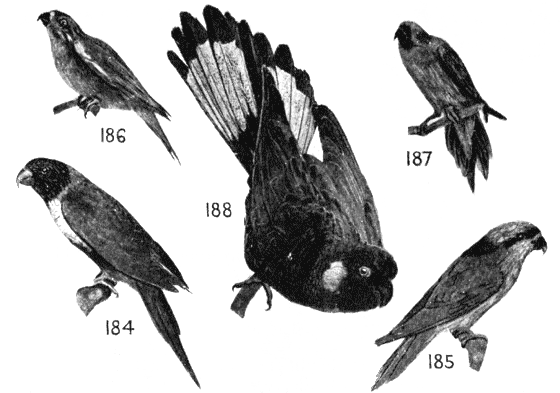
184* Blue Mountain Lorikeet (-Parrot), Rainbow Lory, Blue—bellied (Swainson) Lorikeet, Trichoglossus novae-hollandiae, N.A., E.A., S.A., T.
Nom. flocks c. eucalypts 14
Head, throat, abdomen blue; chest blood-red tinged yellow; back green; bill blood-red; f., sim. Honey. Screech.
3 5
185* Musk Lorikeet, Green Keet, Green Leek (e), Glossopsittacus concinnus, E.A., S.A., T. [~185-187 Genus, Glossopsitta.]
Nom. v.c. flowering eucalypts 8.5
Green; forehead, behind ear red; bill black tipped red; f., sim. Honey. Screech.
186 Purple-crowned Lorikeet, G. porphyrocephalus, N.S.W. V., S.A., W.A. [~185-187 Genus, Glossopsitta.]
Nom. flocks with 185. r. eucalypts 6.5
Green; forehead red, yellow; behind ear fainter red, yellow; crown purple; behind head yellowish-green; shoulder light-blue; under wing crimson; under greenish-gray; flanks, under-tail golden-green; bill black; f., sim. Honey. Screech.
187 Little Lorikeet, Jerryang, G. pusillus, E.A., S.A., T. [~185-187 Genus, Glossopsitta.]
Nom. flocks with 185. c. eucalypts 6.5
Green; face deep-red; hind-neck brown; wings black edged green; tail feathers grass-green, inner webs red at base, yellowish at tip; f., smaller. Honey. Screech.
F. 74. CYCLOPSITTACIDAE (2), Fig-Parrots, 23 sp. A.
F. 75. CACATUIDAE (17), COCKATOOS, 29 sp.—28(28)A., 1(1)O. (Philippine Is.).
7 7
188 Black Cockatoo, Funereal Black Cockatoo, Calyptorhynchus funereus, S.Q., N.S.W., V., S.A., T., King Is.
Small flocks, r. timber 26
Black; ear-patch, under tail yellow; f., sim. Wood-boring larvae. Seeds. "Wy-la."
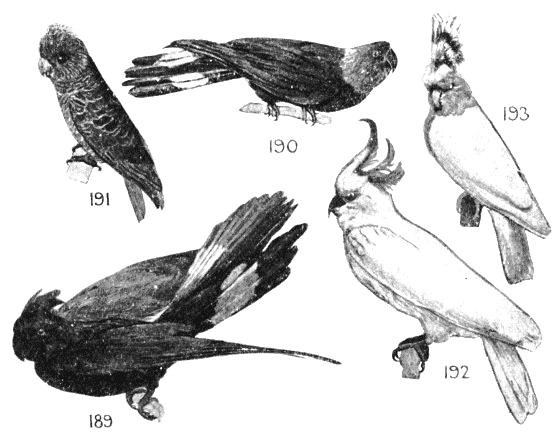
189 Banksian Cockatoo, Banksian Black Cockatoo, C. banksi, E.A., S.A.
r. timber 24
Glossy greenish-black; vermilion-red band on tail; f., yellow side of head, neck. Caterpillars, seeds.
190 Glossy Cockatoo (Leach Black), C. viridis, E.A., S.A.
Small flocks, r. timber 19.5
Glossy greenish-black; deep vermilion-red on tail; f., no vermilion on tail. Sheoak (Casuarina) seeds.
1 1
191* Gang-gang Cockatoo (Red-crowned), Red-crowned Parrot (e), Galah (e), Callocephalum galeatum, S.Q., N.S.W., V., T., King Is. [~191 Genus, Callocephalon.]
v.r. forest 13.5
Head, crest fine scarlet; rest slate-gray barred grayish-green; wings tinged green; under tinged red; f., head, crest gray. Eucalypt seeds.
5 17
192 White Cockatoo (Sulphur-crested), Cacatua galerita, A., T., King Is. [~192-194 Genus, Cacatöes.]
Nom. Flocks, v.c. timber, open plains 20
White; crest, under wing, portion of tail sulphur-yellow; f., sim. Seeds, grain, native bread, bulbous roots, grasshoppers' eggs. Screech.
193* Pink Cockatoo (Leadbeater), Major Mitchell, C. leadbeateri, Int. A. [~192-194 Genus, Cacatöes.]
Nom. r. lofty gums 16
"Most beautiful and elegant" cockatoo; white; forehead, neck, under wing, middle abdomen, base of tail salmon pink becoming deeper under wing; crest crimson, yellow, white; eyes black; f., yellow in crest brighter; eyes reddish-brown. Plaintive cry.
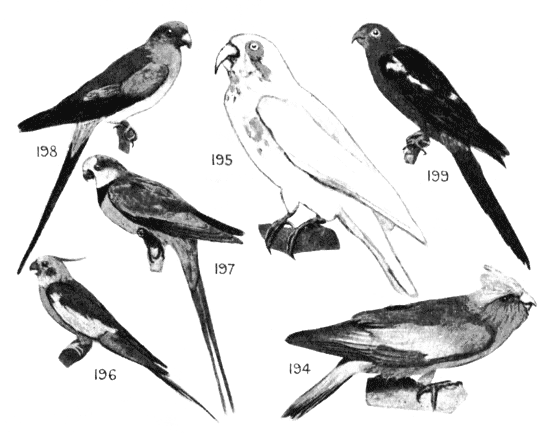
194* Rose-breasted Cockatoo, Galah, Willie-willock, Willock, C. roseicapilla, A., T. (acc). [~192-194 Genus, Cacatöes.]
Nom. large flocks, c. plains 14
Upper gray; under deep rose pink; head pinky-white; "the second most beautiful of cockatoos;" f., sim. Seeds, salt-bush.
2 2
195 Long-billed Cockatoo, Corella, Licmetis nasica, N. Ter., N.S.W., V., S.A. [~195 Licmetis tenuirostris.]
Flocks r. ground 17
White; under wing pale-yellow; under tail bright-yellow; forehead, face scarlet; neck, breast tinged scarlet; naked blue skin round eye; long bill, 1⅝ in.; f., sim. Bulbous roots.
1 1
196* Cockatoo-Parrot, Cockatiel, Quarrion, Calopsittacus novae-hollandiae, A. [~196 Calopsitta novae-hollandiae.]
Mig. flocks, c. plains, timber 12
Forehead, crest lemon-yellow; ear-patch rich reddish-orange in a patch yellow above white below; upper, under gray; white on wings, chest; f., face, crest dull olive-yellow; tail barred brown. Seeds.
F. 76. PSITTACIDAE (47), PARROTS, Macaws, 433 sp.—144(144)A., 49(49)O., 42(42)E., 2(l)Nc., 197(196)Nl.
2 2
197* Superb Parrot (Scarlet-breasted), Green Leek, Barraband Parrakeet, Polytelis barrabandi, S.Q., N.S.W., V., S.A.
Stat. v.r. timber 16
Green; forehead, cheeks, throat rich gamboge-yellow; crescent of scarlet next to yellow on chest; bill yellow; sometimes red on thigh; f., green tinged dull rose on chest; thigh red. Seeds.
198* Black-tailed Parrot, Rock-Pebbler, Rock-Pebble, Smoker, P. melanura, N.S.W., V., S.A., W.A. (interior). [~198 Polytelis anthopeplus.]
Nom. v.r. Box flats, timber 16
Head, neck, greenish-yellow; shoulders, under yellow; upper-back olive; wing-quills, tail iridescent black; some pink on wing; bill scarlet; f., duller. Seeds, honey.
1 9
199* King Parrot (Scarlet and Green, Spud), Blood Rosella, King Lory (e), Aprosmictus cyanopygius, E.A., S.A.
Stat. c. forest 16
"Showy, noble species;" head, neck, under scarlet; back, wings green; rump, base tail rich dark blue; band bright green on wing; bill scarlet; f., head, upper green; throat, chest green tinged red; abdomen scarlet; young male like female for two years. Bulbous roots, seeds.
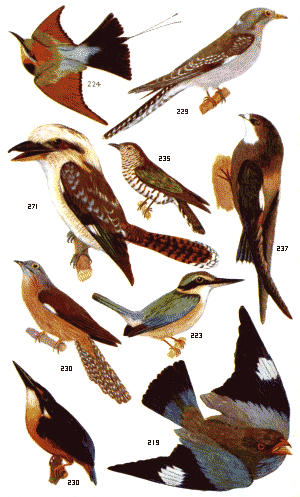
219 Australian Roller 220 Blue Kingfisher 221 Laughing Kingfisher 223 Sacred Kingfisher 224 Australian Bee-eater 227 Spine-tailed Swift 229 Pallid Cuckoo 230 Fan-tailed Cuckoo 235 Bronze Cuckoo
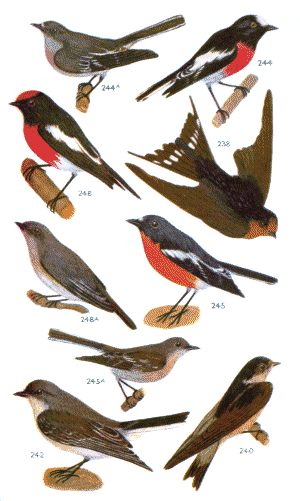
238 Welcome Swallow 240 Tree Martin 242 Brown Flycatcher 244 Scarlet-breasted Robin 244a Scarlet-breasted Robin (Female) 245 Flame-breasted Robin 245a Flame-breasted Robin (Female) 248 Red Capped Robin 248a Red Capped Robin (Female)
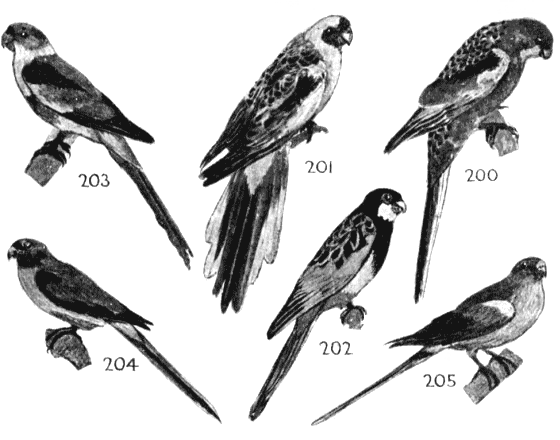
16 16
200* Crimson Parrot, Crimson Rosella, Pennant Parrakeet, Red Lory (e), Mountain Lowry (e), Platycercus elegans, S.Q., N.S.W., V., S.A.
Stat. v.c. timber, open 13.5
Head, neck, under, rump rich deep crimson; feathers of back black, edged crimson; cheeks, shoulders blue; tail tipped pale-blue; f., sim.; young all green at first. Grass, seeds, insects, caterpillars.
201 Yellow Parrot, Yellow Rosella, Murray Smoker (e), Swamp Lory (e), Yellow-rumped Parrakeet, P. flaveolus, N.S.W., V., S.A. (interior).
Stat. v.r. lofty river gums 13.5
"Exceedingly lovely bird, a harmony in blue and canary yellow;" upper under canary-yellow; back feathers black edged pale-yellow; wing blue; tip quills dark-brown; tail tipped light blue and white; forehead crimson; cheeks blue; f., duller. Seeds.
202* Rosella, Rosehill Parrakeet, Nonpareil Parrot, P. eximius, S.Q., N.S.W., V., S.A., T.
Stat. v.c. open timber 12.5
Crown, hind-neck, chest, under base tail scarlet; cheeks white; back feathers black edged rich yellow; rump, upper base tail, lower abdomen pale-green; centre-abdomen yellow; shoulders blue; tail tipped pale blue; f., young sim.
5 5
203* Mallee Parrot (Scrub), Barnard Parrakeet, Ring-neck, Bulla-Bulla, Barnardius barnardi, S.Q., N.S.W., V., S.A. (interior).
Stat. c. mallee scrub, water courses 13
Crown, chest, abdomen, rump rich-green; yellow band on hind-neck; forehead red; back bluish-gray; centre-abdomen orange; wing-quills black; shoulder blue; centre tail feathers green becoming deep iridescent blue at tip; side tail deep blue at base becoming bluish white at tip; bill horn color; f., sim. Seeds.
8 8
204* Blue-Bonnet, Bulloak Parrot, Yellow-vented Parrakeet, Psephotus zanthorrhous, N.S.W., V., S.A., W.A. (inland).
c. mallee-scrub, plains 12.5
Forehead, face blue; crown, upper, chest yellowish-gray; rump, under base tail, abdomen deep yellow, about legs scarlet; edge shoulder, patch on wing blue; wing-quills blackish-brown; f., duller. Seeds.
205* Many-colored Parrot (Varied, Mulga), P. multicolor, N.S.W., V., S.A., W.A., N.W.A. (inland).
Stat. c. plains 12
Head, neck, chest, back green; rump little red; abdomen, thighs scarlet; forehead, shoulder, under base tail yellow; f., brick red patch on shoulder, duller. Grass-seeds.
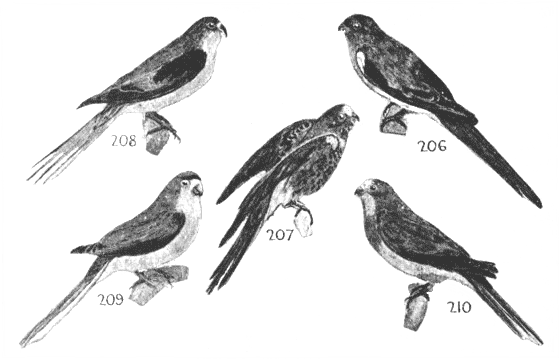
206* Red-backed Parrot (Grass, Red-rumped, Ground), P. haematonotus, S.Q., N.S.W., V., S.A.
Large flocks, v.c. grass 11
Green; lower-back scarlet; tip-shoulder outer wing-quills blue; centre-shoulder, abdomen yellow; f., brownish-olive upper. Seeds.
7 7
207 Bourke Grass-Parrot (Night, Pink-bellied), Neophema bourkei, N.S.W., V., S.A. (interior).
v.r. plains 8.5
Upper olive-brown; under delicate brown tinged pink; forehead, shoulder, flanks, under tail blue; f., forehead not blue. Seeds.
208 Blue-winged Grass-Parrot (Blue-banded), N. venusta, N.S.W., V., S.A., T., King Is. [~208 Neophema chrysostoma.]
Mig. r. open timber 9
Forehead, large patch shoulder deep-blue; crown, neck, back, breast green; face, abdomen light-yellow; tail tipped fine yellow; f., sim. Grass seeds.
209* Grass-Parrot (Elegant Grass), N. elegans, S.Q., N.S.W., V., S.A., W.A.
Mig. r. grass 9
Forehead, patch shoulder, first set off again, and so on. "With their wing-quills blue; about eye rich-yellow; back golden-green; chest green; abdomen, side of tail yellow; f., duller. Seeds. Musical whistle.
210 Orange-breasted Grass-Parrot (Orange-bellied), N. chrysogastra, N.S.W., V., S.A., T.
Mig. r. grass 9
Crown, upper grass-green; forehead blue; cheeks, breast yellowish-green; shoulder, patch on wing deep-blue; abdomen, under base tail yellow; lower abdomen much orange; f., less orange. Seeds. Sharp snapping note.
211 Red-Shouldered Grass-Parrot (Chestnut-shouldered, Beautiful), N. pulchella, S.Q., N.S.W., V., S.A.
Mig. c. timber 8
Cheeks, shoulders rich metallic-blue; crown, hind-neck, upper, flanks bright olive-green; bright patch chestnut-red at insertion of wing; under rich-yellow, tail green tipped yellow; f., sim. Seeds.
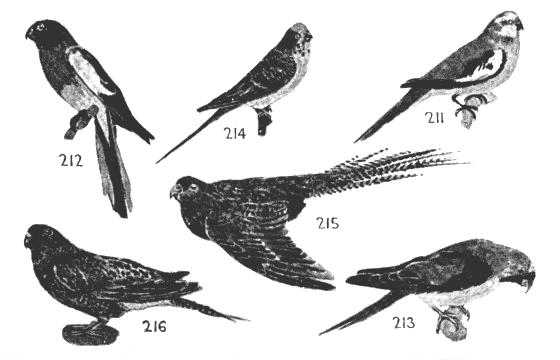
212 Scarlet-chested Grass-Parrot (Orange-throated, Splendid), N. splendida, N.S.W., V., S., W.A.
v.r. scrub 8
Head, neck beautiful deep-blue; shoulder blue; breast scarlet; abdomen light-yellow; upper green; f., duller, breast green. Seeds.
1 1
213* Swift Parrot (Red-shouldered), Swift-flying Lorikeet (e), Euphema discolor, S.Q., N.S.W., V., S.A., T. [~213 Lathamus discolor.]
Mig. r. flowering eucalypts 9.5
Green; forehead, throat, tip-shoulder, base tail above below, under-wing red; crown, edge wing blue; f., smaller, duller. Honey.
1 1
214* Warbling Grass-Parrot (Shell-, Canary-, Zebra-), Betcherrygah, Budgerigar, Love-Bird (Flight-), Melopsittacus undulatus, A. (int.).
Mig. flocks c. timber 7.5
Head, throat yellow; under, rump green; upper green finely barred black; several dark spots on throat; f., smaller. Grass-seeds.
1 2
215 Ground Parrot (Swamp), Pezoporus terrestris, V., S.A. W.A., T., Bass St. Is.
v.r. u. sandy, swampy 13
Green uniformly barred black yellow; forehead scarlet; tail long; never perches; f., sim. Seeds.
1 1
216 Night Parrot (Spinifex), Western Ground Parrakeet, Geopsittacus occidentalis, V., S.A., C.A., W.A., N.W.A.
v.r. u. swampy 10
Like 215, but forehead not red; under base short tail yellow.
F. 77. Stringopidae, Owl-Parrot, 2 sp. A. (N.Z.).
Australia is well represented in Order XVIII.—Picarian Birds. The Tawny Frogmouth is one of "the most peculiar," and is the "ugliest of birds." On account of its wide mouth, it is called the Frogmouth, and on account of the confusion connecting it with the Boobook Owl, which calls "Mopoke," this bird is also called the "Mopoke" (see p. 85). It so closely mimics a broken branch during the day that it is seldom seen, though it is fairly common.
Gould bears eloquent testimony to the value of Australian birds in general, and the Podargus in particular, when he says: "In no other country is there a greater proportion of insectivorous birds, and certainly none in which nocturnal species such as the Podargi are more numerous."
The Australian Roller (Dollar-Bird) has the family beauty, and has a white circular patch on each wing, which shows clearly when the wing is expanded during flight. At the Tallangatta excursion a pair was working even after dusk near the schoolground. Flying from the topmost dead branch, one bird suddenly closed its wings, and cut queer antics in the air. After flying a considerable distance, it returned to its former perch, and the mate set off. On the return of the mate the first set off again, and so on. With their disagreeable, rough "treek treek," and peculiar antics, they are conspicuous birds. It is our one representative of a family most strongly developed in Africa.
While Kingfishers are cosmopolitan (world-wide in distribution), yet the Australian region contains far more of these beautiful birds than any other region. They are famous in legend and story, and we owe to them the expression, "halcyon days" (Gr. alkuon, a Kingfisher).
The great terrestrial Kingfishers, of which Australia has three species—the fourth being confined to New Guinea—are amongst the avine curiosities of Australia. Few birds are more famous than the Laughing Kingfisher (Jackass), first, on account of his gigantic size—hence his specific name, gigas—and, secondly, because of his laugh, which brightens many a gloomy, misty day in lonely country districts. Homesick travellers from foreign lands could only hear evil spirits laughing at their trials and loneliness, but, just as mountains, once thought ugly, are now considered beautiful, so other thoughts are now associated with the laugh of our remarkable Australian Kingfisher.
True to the law of representatives, Australia presents us with a beautiful representative of the Old World family of Bee-eaters. A writer has well said that there are "few so beautiful, and none so graceful." Its scientific name, ornatus, shows that our bird stands well amongst its fellows. One kind occasionally visits England (about thirty records in the last hundred years).
In the same order come the Goatsuckers, or Nightjars, wide-mouthed, swift-flying, insectivorous birds, which have an almost cosmopolitan range, being absent only from New Zealand and the Polynesian Islands. These Owl-like birds have very long wings, thus indicating their rapid flight. They are very valuable insect destroyers, though they are sometimes called "Night Hawks," and are shot by people who foolishly shoot hawks. Many destructive insects fly only at night, and these night-flying birds are a necessity to maintain the balance of Nature.
Swifts are cosmopolitan birds. One Swiftlet is world-famous on account of its saliva-built nest, which is the edible swallows' nest we used to read about. This bird occasionally visits Queensland. Two of the Australian birds breed in Japan. They are essentially creatures of the air; their long, pointed wings, shown much longer than the tail, indicate great speed. Gould said that a Swift might be hawking for insects over Victoria one hour, and over Tasmania the next hour; that is, it can cross Bass Strait in an hour. The spines at the end of the short tail feathers are thought to assist as a prop when the bird settles on a wall or a cliff face. In some Swifts the four toes point forward; this helps also in cliff clinging. Though so common in the upper air, Swifts have not, in Victoria, been recorded as having been seen to alight.
Most birds have hollow bones which are filled with air. It was claimed by those who like to find a use for everything that this was an obvious adaptation for purposes of flight, but when one reflects that, in some of the Ostrich and Emu group, the members of which never fly, the bones are strongly "pneumatic," while in Terns and Swifts, and some other flying birds, the bones are solid, one must hesitate before generalizing even about such an apparently obvious matter. Swifts are in no way related to Swallows, but are close to Humming Birds, which are born with a wide, Swift-like mouth.
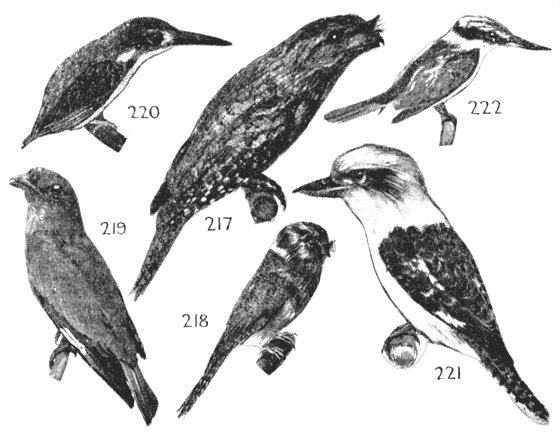
ORDER XVIII.—CORACIIFORMES, PICARIAN BIRDS.
F. 78. Steatornithidae, Oil-Bird, Guacharo, 1 sp. Nl.
F. 79. PODARGIDAE (6), FROGMOUTHS, 32 sp.—20(20)A., 12(12)O.
4 7
217 Tawny Frogmouth (Tawny-shouldered), Mopoke (e), Podargus strigoides, A.T.
Stat. c. open forest 18
Upper brown freckled grayish-white and darker-brown; wings lighter, spotted black and buff; tawny patch on wing; tail tawny-brown barred blackish-brown; wide bill brown; nocturnal; f., sim. Insects. "Oom, oom."
2 13
218 Owlet Nightjar (Little), Banded Goatsucker (e), Moth Owl (e), Ægotheles novae-hollandiae, A., T.
Stat. r. timber 8.5
Blackish-gray; tail faintly banded; obscure collar; short, wide bill; bristles round bill; nocturnal; f., sim. Insects, mosquitoes, moths.
F. 80. Leptosomatidae, Kirombos, Madagascar Rollers, 2 sp. E.
F. 81. CORACIIDAE (1), ROLLERS, 32 sp.—5(5)A., 6(3)O., 3(0)P., 22(21)E.
1 11
219* Australian Roller, Dollar (Star) Bird, Eurystomus pacificus, Cel., Mol., A. exc. S.A., W.A., Lord Howe Is., N.Z.
Mig. r. timber 12
Head, upper dark-brown; inner-wing bluish, outer-wing dark-blue with a silvery-blue patch (dollar); throat dark-blue; eyelash, wide curved bill, feet red; many shades of blue and green; abdomen light-green; f., sim. Insects.
F. 82. ALCEDINIDAE (14), KINGFISHERS, 200 sp.—112(105)A., 52(44)O., 5(0)P., 31(30)E., 3(0)Nc., 11(8)Nl.
3 7
220* Blue Kingfisher (Azure, Water, River), Alcyone azurea, E.A., S.A., T.
Mig. r. water 8
Upper ultramarine-blue; behind ear yellowish-white patch; wings black; throat whitish; under rusty-orange; bill black; f., sim. Fish, insects.
3 4
221* Laughing Kingfisher (Great Brown, Giant), Laughing Jackass, Bushman's (Settler's) Clock, Kookaburra, Dacelo gigas, E.A., S.A.
Stat. v.c. timber 17.5
Upper, line from bill past eye brown; side-head, under whitish; blue, white spots on wing; tail barred brown, black, tipped white; f., sim. Lizards, insects, snakes.
6 71
222 Red-backed Kingfisher (Golden), Halcyon pyrrhopygius, A. (interior).
r. open country 8
Back, rump reddish-brown; collar, under white; crown dull-green streaked white; dark band from bill through eye round back of head; wings, tail bluish; f., sim. Fish, insects.
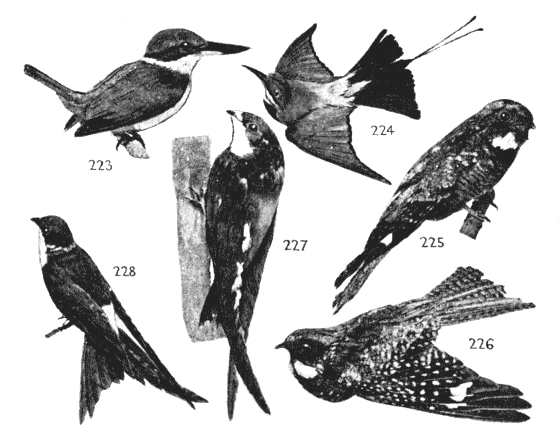
223* Sacred Kingfisher (Wood, Forest, Tree), H. sanctus, Cel., Java to A., T., N. Heb.
Mig. c. timber, near water 8
Head, upper greenish-blue; whitish collar; buffy-white under; bill long black; f., sim. Insects, ants, lizards, fish.
F. 83. Bucerotidae, Hornbills, 71 sp.—4(4)A., 33(33)O., 34(34)E.
F. 84. Upupidae, Hoopoes, 6 sp.—2(1)O., 2(0)P., 4(3)E.
F. 85. Irrisoridae, Wood-Hoopoes, 12 sp. E.
F. 86. MEROPIDAE (1), BEE-EATERS, 41 sp.—5(4)A., 10(6)O., 2(0)P., 30(27)E.
1 21
224* Australian Bee-eater, Rainbow Bird, Sandpiper (e), Kingfisher (e), Spinetail, Pintail, Merops ornatus, Cel., Lesser Sunda Is., Mol., A.
Mig. c. open forests 10
Crown, back, inner-wing brownish-green; wing-quills orange-brown, tipped black; band on throat blackish; line below eye, lower-back blue; throat orange; tail black; two tail feathers longer; curved bill black: f., sim. Insects, very rarely bees.
F. 87. Momotidae, Motmots, 24 sp. Nl.
F. 88. Todidae, Todies, 7 sp. Nl. (West Indies).
F. 89. CAPRIMULGIDAE (3), NIGHTJARS, GOATSUCKERS, 124 sp.—11(8)A., 22(17)O., 10(4)P., 30(26)E., 11(5)Nc., 57(51)Nl.
2 3
225 White-throated Nightjar, Night Hawk (e), Moth (Fern) Owl, Eurostopus albigularis, N.G., E.A., S.A. [~225 Eurostopodus albigularis.]
Stat. r. open forest 13
Upper mottled, striped gray, brown; head darker; wings dark-brown marked gray, spotted buff, with white patch (see figure); white patch side of throat; under buff marked dark-brown; f., sim. Insects. Valuable nocturnal birds.
226 Spotted Nightjar, E. argus., Aru Is., New Ireland, A.
Stat. r. open forest 12
Like 225, but uniform rusty-brown abdomen and under base tail; f., sim. Insects. Valuable, nocturnal.
F. 90. Macropterygidae, Tree-Swifts, 7 sp.—3(3)A., 4(4)O.
F. 91. CYPSELIDAE (4), SWIFTS, 103 sp.—11(7)A., 33(24)O., 9(1)P., 28(22)E., 4(0)Nc., 30(26)Nl.
1 34
227* Spine-tailed Swift, Chaetura caudacuta, Sib., Jap., China, to A., T., N.Z.
Mig. c. upper air 7.5
Throat, forehead, back edge wing, flanks, under base tail white; wings, tail deep shining-green; under, back grayish-brown; short tail ends in spines; f. smaller. Flying insects.
1 25
228 White-rumped Swift (Australian), Cypselus pacificus, E. Sib., Jap., Indo-China to A., T., N.Z. [~228 Apus pacificus.]
Mig. r. upper air 7
Upper brownish-black; rump, throat white; under brown; long forked tail; indistinct collar; f., sim. Flying insects.
Few birds have attracted more notice, or have been more written about, than Cuckoos. To dwellers in lands with a dreary winter, the Cuckoo heralds the spring, so its call is most welcome. Then, too, the mysteries connected with its upbringing have proved of interest to all Nature and bird lovers. Its call, "Cuckoo," aptly described as the "most imitable of bird calls," has also assisted in making the bird a favorite.
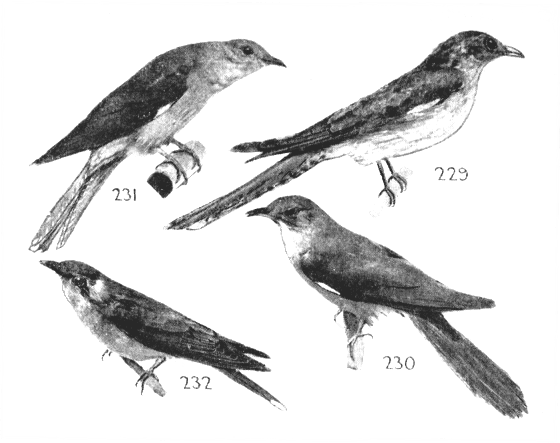
The Pallid Cuckoo belongs to the same genus as the well-known Cuckoo of England. It also resembles that bird in appearance. Its note, however, is quite different. At times it seems to be endeavoring to run up a chromatic scale, so, in some districts, it is called the Scale Bird. At other times, after three running notes, it repeats one note strongly. So persistent is it in calling that it is called in places the Brain-fever Bird. Last September, in Castlemaine, it called all night in the street trees. Few, however, seemed to notice it, and fewer still knew what was uttering the persistent call.
Possibly other birds recognize the Cuckoo as an enemy, or possibly its remarkable superficial resemblance to a Hawk causes birds to chase it. However, in some cases, possibly, the male Cuckoo does not object to being chased. He draws the birds away, while the female Cuckoo quietly places an egg in a convenient nest, and retires unmolested.
The Fan-tailed or Ash-colored Cuckoo is not so conspicuous, as it keeps to more secluded places, and is a solitary bird. Its flight is heavy and labored. It also has a habit of elevating and lowering its tail several times both before and after flight. Its frequent, plaintive, trilling note often reveals its presence, which would otherwise be overlooked.
The Brush Cuckoo is rare. In fact, considerable difficulty was experienced in obtaining a specimen for the photograph above, as there was no named specimen in the National Museum. Thanks to Messrs. Kershaw and French, the difficulty was at last overcome.
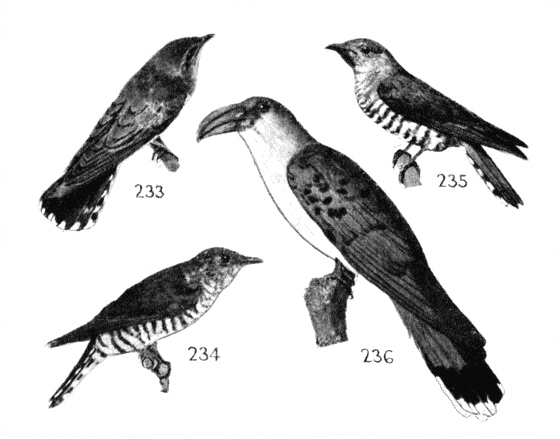
The Bronze Cuckoos are very similar. They will be immediately recognized by the under-surface barred brown and white, and the golden-green or bronze lustre of the dark back. The New Zealand Bronze-Cuckoo migrates from N.E. Australia and New Guinea. Apparently it sometimes migrates down the East Coast, instead of to New Zealand.
The Narrow-billed Bronze Cuckoo has a narrower bill, and the centre tail feathers are brownish-chestnut at the base. While the birds are so similar, their eggs are quite unlike. The Bronze Cuckoo lays a bronze egg, generally in dome-shaped or covered nests. It is sometimes found in Tits' nests. The Narrow-billed Bronze Cuckoo has a red-speckled egg, which is placed often in an open or cup-shaped nest.
The last Cuckoo—the Channel-bill—is one of the largest of Cuckoos. It is a northern bird, which very rarely reaches the southern part of the continent. Its large bill is characteristic. Its tail is large, and often spread out fanwise, thus giving a majestic appearance to the bird. Its call is not pleasing, as it is described by Gould as a "frightful scream," and again as consisting of "awful notes." It lays its eggs sometimes in the nest of a Sparrowhawk (not Kestrel), or in the nest of a Magpie, Bell-Magpie (Strepera), or even of a Crow. It appears with the first flood-waters, and follows the rivers from the Gulf of Carpentaria watershed down to Cooper's Creek and Lake Eyre.
One large Australian Cuckoo builds its own nest, and rears its own young. This bird, however, does not visit Southern Australia.
In addition to the interest of their habits and life history, Cuckoos are amongst the most valuable of insectivorous birds. Few birds will eat the vine caterpillar or hairy caterpillar. The Cuckoos, however, are very fond of these, and so should be encouraged. They do no harm to anything we need.
F. 92. Trochilidae, Humming-Birds, 581 sp.—18 (5) Nc., 576(563)Nl.
F. 93. Coliidae, Mouse-Birds, 14 sp. E.
F. 94. Trogonidae, Trogons, 54 sp.—16(16)O., 4(4)E., 1(0)Nc., 34(33)Nl.
ORDER XIX.—COCCYGES.
F. 95. Musophagidae, Plantain-eaters, Touracos, 35 sp. E.
F. 96. CUCULIDAE (14), CUCKOOS (Cuckows), 202 sp.—61(50)A., 57(42)O., 8(0)P., 55(51)E., 8(0)Nc., 43(35)Nl.
2 11
229* Pallid Cuckoo (Unadorned), Harbinger-of-Spring, Scale (Semitone, Brain-fever, Storm) Bird, Mosquito (Grasshopper) Hawk, Cuculus inornatus, A., T. =vt Eur. Cuckoo. [~229 Cuculus pallidus.]
Mig. v.c. open, timber 12
Upper brown; under gray; tail barred white, brown; eyelash yellow; white at edge wing; wing spotted, marked lighter; f., upper mottled whitish, rufous. Caterpillars, insects. Runs up scale, calls frequently at night.
3 13
230* Fan-tailed Cuckoo, Ash-colored, Cacomantis rufulus (flabelliformis), Aru Is., A., T.
Mig. c. open, timber 10
Head, upper dark slate-gray; under rust-red; throat gray; tail dark toothed with white; white edge of wing; eyelash citron-yellow; f., smaller. Caterpillars, insects. Sad trill often repeated.
231 Square-tailed Cuckoo (Brush), C. flabelliformis (variolosus), Mol., Timor, N.G., A.
Mig. v.r. open timber 9.2
Like 230, but smaller; tail feathers toothed with white on inner web only; f., sim. Insects.
1 1
232 Black-eared Cuckoo, Mesocalius palliolatus, Mol., Aru Is., A. [~232 Misocalius palliolatus.]
Mig. v.r. scrub 7.5
Head, upper, wings glossy olive-brown; shoulder darker; tail olive-brown tipped white; side tail feather five white bars; behind ear a narrow black streak; above this a lighter patch; under pale-brown; f., duller. Insects. Feeble plaintive note.
5 15
233 Narrow-billed Bronze Cuckoo, Chalcococcyx basalis, Mal. Pen., Java, Cel., to A., T.
Mig. c. open, timber 6.2
Upper beautiful bronze-green; under barred brown, white; like 234 but bill narrower; lighter brown head; paler back; outer tail feathers strongly barred blackish-brown, white; centre abdomen not barred; base tail much chestnut; f., duller. Insects, caterpillars.
234 Broad-billed Bronze Cuckoo (New Zealand, Shining), Pipiwharauroa, C. lucidus, E.A., T., N.Z., Chatham Is., Macquarie Is. (acc).
Mig. v.r. open, timber 6.2
Like 233, but outer tail feathers barred white; next feathers barred rufous; forehead freckled with white; crown, hind-neck shining-green; bill broader; f., duller. Insects.
235* Bronze Cuckoo, C. plagosus, A., T., Pac. Is.
Mig. c. open, timber 6.2
Like 233, 234; crown, hind-neck dark violet-brown; very little rufous on tail; f., duller. Insects, caterpillars.
1 1
236 Channel-bill, Giant Cuckoo, Storm (Flood, Rain) Bird, Toucan (e), Hornbill (e), Scythrops novae-hollandiae, Cel., Flores, Mol., A., T. (once).
Mig. r. plains 24
Gray; tail banded black; tipped white barred black, white below; bill very large, light horn-color; red about eye; f., smaller. Insects, berries.
F. 97. Indicatoridae, Honey-Guides, 18 sp.—2(2)O., 16(16)E.
F. 98. Capitonidae, Barbets, 140 sp.—40(40)O., 82(82)E., 18(18)Nl.
F. 99. Rhamphastidae, Toucans, 60 sp. Nl.
F. 100. Galbulidae, Jacamars, 22 sp. Nl.
F. 101. Bucconidae, Puff Birds, 45 sp. Nl.
F. 102. Picidae, Woodpeckers, Piculets, Wrynecks, Flickers, 440 sp.—6(5)A., 124(117)O., 41(33)P., 54(53)E., 44(32)Nc., 197(181)Nl.
F. 103. Eurylaemidae, Broadbills, 16 sp. O. The only family of birds restricted to the Oriental Region.
One of the most interesting birds in the world is the Lyre Bird, whose beautiful tail, alas, often brings early death to its rightful owner. There are three species of these birds, found only in the mountainous parts of South-eastern Australia, and as far as Wide Bay, in Southern Queensland. Two of the species are found in New South Wales and Southern Queensland, while the third is found in Victoria. Though these beautiful birds are supposed to be protected, hundreds of their tails are sold annually in London.
The Lyre Bird is responsible for the statement that Australia possesses "Wrens as large as peacocks," whereas most Wrens are very small. However, the Lyre Bird is not now classed with Wrens. In all its ways, the Lyre Bird is of interest. Its dancing mounds, its large domed nest, containing but one egg, and its remarkable mimicking powers have frequently been written about. Dr. Sharpe has lately placed the Lyre Birds in an Order by themselves—Order XX.
Gould considered the Lyre Bird the most shy of birds, for he spent days in the forest gullies surrounded by them, but though he was entertained by their many and varied calls, he caught no sight of a bird. The wonderful tail is not attained until the male bird is four years old. It is unique, and is the most beautiful tail ornament worn by any bird. Dr. Newton hoped that "so remarkable a form as the Lyre Bird, the nearly sole survivor, apparently, of a very ancient race of beings, will not be allowed to become extinct—its almost certain fate, so far as can be judged—without many more observations of its manners being made, and fuller details of them placed on record." Australians please note. You alone can assist by collecting facts and recording reliable observations. Bird-lovers hope that the Lyre Bird will be successfully established in the National Park, Wilson's Promontory, where some have already been placed, and so be preserved for future generations. Its large, domed nest is usually placed on the ground, and the large single egg (or the young one) is often taken by the fox. Further, its natural haunts—dense forest scrubs—are being rapidly cleared, so that the bird is doomed, except in special sanctuaries.
The Lyre Bird is now generally acknowledged to be the prince of mocking birds. It mimics clearly all bush noises, the chopping of trees, sawing of logs, barking of dogs, clucking of hens, the singing of native birds. Its dancing mounds are interesting. Near one of these mounds, on the Upper Snowy River, in the wild cherry scrub, we observed a nest at a height of about thirty feet from the ground.
Australians! you owe it to mankind in general to see that the protection supposed to be given to the Lyre Bird is a reality. Recently, after passing a lady much bedecked with Bird of Paradise plumes, I thought it was fortunate the Lyre Bird's tail was too large for a lady's hat. Imagine my surprise when, at the next street corner (Collins and Spring Streets), I met a lady with a Lyre Bird's tail stuck through her head-dress. However, I have seen no other tail used for such a purpose.
In America the Audubon Society has done splendid work by disseminating knowledge about American birds, and arousing public interest in the value of birds. There, also, thorough scientific investigation has been made of the value of insect-eating and seed-eating birds. It has been stated, as the result of full research, that one wild pigeon, in whose crop over 7000 weed seeds were found, was as efficacious in destroying weeds as two farm laborers.
It is to be noted that no less an agricultural authority than Professor Gilruth, of the Veterinary School, Melbourne University, has given it as his deliberate opinion that the Australian farmer would find life impossible without the aid of the detested Sparrow as a weed destroyer. This is the judgment of a man whose opinion is worthy of serious consideration.
It is open to serious doubt if it pays commercially to kill indiscriminately any kind of bird found on this continent. It may, of course, happen that one individual bird has learnt where to get an easy food supply at the expense of a farmer or orchardist. Such a bird could be kept away. To kill birds at all times, because of the damage done by a few at a particular time, is foolish.
On the lines of the American Audubon Society, the Gould League of Bird Lovers has recently been established. Just as Audubon was the great father of American ornithology, so "John Gould, the bird man," was the father of Australian ornithology. Hence his name has been associated with this movement to save our birds. The movement is progressing by leaps and bounds.
The Victorian branch has a very large body of members, about 40,000 certificates having already been issued to adults and children. Tasmania has a branch in full operation. In South Australia bird clubs are doing excellent work, especially amongst the young people, and Queensland and New South Wales bird-lovers have taken active steps to develop the movement in their States. A Bird Day, by order of the Minister of Education, Hon. A. A. Billson, and the Director, Mr. F. Tate, was observed in Victorian schools in 1909 and 1910, with gratifying results. Bird-nesting, for the collection of eggs, has practically wholly disappeared from our schools, while at most country schools native birds can be seen nesting on the school grounds, the children keeping observation notes of nesting and feeding habits of the birds as part of their work in Nature-study. What study is of greater economic importance to this wealthy, though occasionally insect-troubled, land?
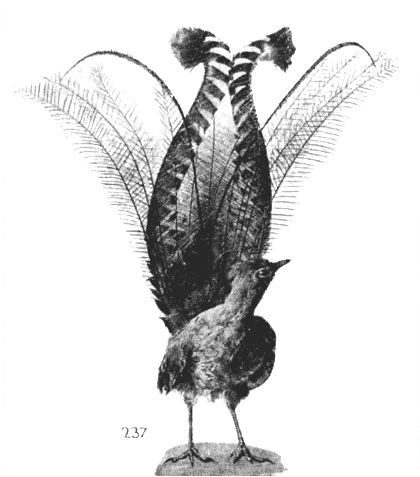
ORDER XX.—MENURIFORMES, LYRE-BIRDS.
F. 104. MENURIDAE (3), LYRE-BIRDS, 3 sp. A. (South-Eastern A.).
3 3
237 Victoria Lyre-Bird, Pheasant (e), Menura victoriae, V.
Stat. r. dense scrubs, m., 36; f., 27
Beautiful lyre tail; f., sooty-brown; all tail feathers fully webbed. Insects, centipedes, snails.
Order XXI.—Perching-Birds—contains 11,500 species, more than three-fifths of the world's 19,000 birds. As Perching-Birds (Passeres) are still undergoing evolution, connecting links still live, so that it is very difficult to divide the Perching Birds into well-defined families. Sharpe has divided them into sixty-one families, but, for several of these, no exact characters that exclude other birds can be assigned, so that some of these, at least, are "not worthy of family rank." However, Sharpe's classification represents the latest thought of scientists on this difficult matter, so it must be adopted here.
This large order of birds is divided into two sub-orders:—
1. Songless Perching-Birds, made up mainly of South American birds, though two families are included that are represented in the Australian region—viz., Pittas (Pittidae) and New Zealand Wrens (Xenicidae).
2. Song-Birds.
Birds of the second division are again divided into two:—A.: Abnormal Song-Birds. B.: Normal Song-Birds.
The first group, Abnormal Song-Birds, comprises only the two remarkable Scrub-Birds (Atrichornithidae) of Australia. One of these inhabits West Australian scrubs only, while the other inhabits East Australian (Richmond River) scrubs only.
The breast bone and the muscles of the voice apparatus are unusual. These birds are about the size of a thrush, and form "one of the most curious ornithological types of the many furnished by that country" (Australia).
So far, no female bird has been examined, and little is known about these remarkable, noisy, scrub-haunting birds.
The remaining forty-eight "families" of birds belong to the Normal Song-Birds. It is interesting to note that Australia contains representatives of twenty-nine families of Song-Birds. Representatives of but nineteen families have been recorded from Britain. The Indian Empire, including Burmah and Ceylon, contains representatives of twenty-two families, North America, also, of twenty-two families, while in South America twenty-three families are represented in this highest division of birds.
Again, while only 89 Song-Birds have been recorded as permanent residents of, or regular visitors to, Britain, almost 500 species of Song-Birds have, so far, been recorded from Australia and Tasmania. Of these, 157 have been recorded from Victoria, and are illustrated in this volume. And yet, we are told, this is a land of songless birds.
Swallows have always attracted much notice, perhaps, because of their airy play when enjoying themselves after their long migration flight. It is very difficult to realize that Cuvier and most scientists of one hundred years ago believed that Swallows hibernated by burying themselves in the mud in the bottom of lakes and pools. It is interesting to note, in Gilbert White's Natural History of Selborne, the growing doubt concerning this belief; but, as it was supported by apparently good authority, he is cautious. Fuller observation shows that there are well-marked lines of migration, so that the European Swallow migrates sometimes even as far as South Africa, and the Swallows of North Asia are said to migrate even to Australia. However, in our winterless clime, migration is not complete, and this year (1910) there was probably little migration of Swallows. As Swallows are such rapid fliers, and spend much of their time on the wing, it is not a matter of surprise to find that they have spread the world over, except to New Zealand, though Tree Swallows are said to reach even that distant land occasionally.
The Australian members of the Swallow family present very different nesting habits. While the Welcome Swallow builds the well-known cup-like mud nest, the rare White-backed Swallow drills a two-inch hole into a bank for two or three feet, and there builds its nest. The Tree Martin (Swallow), on the other hand, makes no nest, but lays its eggs on leaves placed on the rotten wood in the hollow of a tree. The Fairy Martin builds a long, bottle-shaped mud flask, under a bridge, or a ledge, and so is sometimes called the Bottle or Retort Swallow. Wood-Swallows and Swifts do not belong to the Swallow family.
The Flycatcher family is a large one, nearly 700 species being accepted by Dr. Sharpe. More than half of these are restricted to the Australian region.
The Brown Flycatcher is almost as common as the Willie Wagtail (Black and White Fantail). The white feather on each side of the tail is a valuable guide, though the Groundlark also has this. So often does it sit on fence posts looking at the passer-by that it has been called the "Post-Sitter." Its Sydney name, Jacky Winter, is less formal than Brown Flycatcher—a name which is already in use for another bird.
The Robin Redbreast of Britain is regarded with affection by all English children. That feeling has been transferred to the externally slightly similar "Robin Redbreasts" of this country, though they are not at all related to the British Robins. Redbreast is really the name of the English bird, and Robin is perhaps a term of endearment added to the name Redbreast. While the British bird has a rufous breast, the Australian birds have a scarlet breast, and are much handsomer birds. The British Robin is now placed in the Thrush family.
Once given to members of this family, the name Robin has been adopted for related birds that have no red—e.g., the black and white Hooded Robin, and the Tasmanian Dusky Robin. The Shrike Robins belong to the Shrike family, so they need not be mentioned here. The Scrub Robin of the inland dry scrubs belongs to the same family as the Coachwhip Bird and the Babbler.
The Fantails and some, at least, of the Flycatchers proper are known to all. Who does not know and admire the plucky, though fussy Black and White Fantail (Willie Wagtail), as it drives a cat or a dog away from the vicinity of its nest, or as it waits impatiently about the mouth of a grazing cow or horse, or as it expresses its opinion of itself in the melodious "sweet, pretty creature," heard even late on moonlight nights? The friendly White-shafted Fantail is almost as well known, as it flits about a camp or catches flies near some water-course.
At the Summer School, a Fantail spent some time each day in the dining-tent. The beautiful Rufous Fantail is just as tame, but is not quite so common. The nests of the White-shafted and Rufous Fantails are things of beauty. The long wine-glass stem is said by some to serve to drain the water away down from the nest, or as a means of carrying the eye down from the nest itself, so that it is seldom seen, or as a balance, so that the nest is not tilted too far in windy weather.
The Scissors Grinder, or Restless Flycatcher, is very much like a Black and White Fantail, but the throat is white, while that of the Fantail is black. The Grinder is often mentioned in popular books on bird-life, on account of its peculiar scissors-grinding note uttered while hovering in search of insects.
(continued below)
ORDER XXI.—PASSERIFORMES, PERCHING BIRDS.
F. 105. Pteroptochidae, Tapaculos, Tilt-birds, 31 sp. Nl.
F. 106. Conophagidae, Antwrens, 16 sp. Nl.
F. 107. Formicariidae, Ant-thrushes, 348 sp. Nl.
F. 108. Dendrocolaptidae, Wood-hewers, Spinetails, 405 sp. Nl.
F. 109. Tyrannidae, Tyrant-birds, American Flycatchers, Kingbird, Phoebe, 560 sp.—41(9)Nc., 551(519)Nl.
F. 110. Oxyrhamphidae, 3 sp. Nl.
F. 111. Pipridae, Mannikins, 84 sp. Nl.
F. 112. Cotingidae, Cotingas, Chatterers, 145 sp.—1(0)Nc., 145(144)Nl.
F. 113. Phytotomidae, Plant-cutters, 4 sp. Nl.
F. 114. PITTIDAE (4), ANT-THRUSHES, 63 sp.—32(32)A., 30(30)O., 1(1)E.
F. 115. Philepittidae, Wattled Ant-thrushes, 2 sp. E. (Madagascar).
F. 116. Xenicidae, New Zealand Wrens, 4 sp. A. (N.Z.).
F. 117. ATRICHORNITHIDAE (2), SCRUB-BIRDS, 2 sp. A.(N.S.W., W.A.).
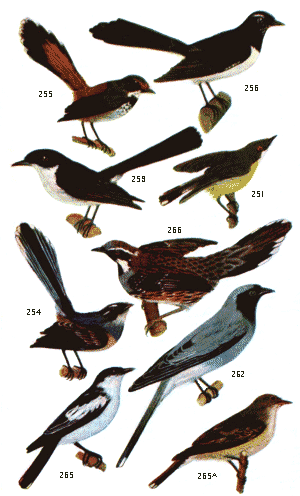
251 White-throated Flyeater 254 White-shafted Fantail 255 Rufous Fantail 256 Black and White Fantail 259 Restless Flycatcher 262 Black-faced Cuckoo-Shrike 265 White-shouldered Caterpillar-eater 265a White-shouldered Caterpillar-eater (F.) 266 Spotted Ground-Bird
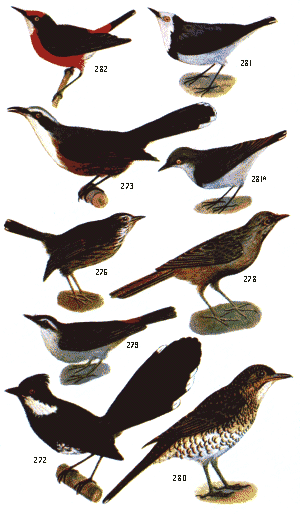
272 Coachwhip Bird 273 Gray-crowned Babbler 276 White browed Field-Wren 278 Brown Song Lark 279 Rufous Song Lark 280 Mountain Thrush 281 White-fronted Chat 281a White-fronted Chat (Female) 282 Crimson-breasted Chat
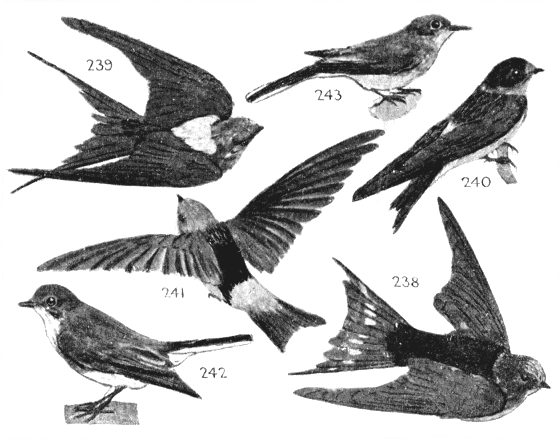
F. 118. HIRUNDINIDAE (6), SWALLOWS, MARTINS, 116 sp.—9(6)A., 25(7)O., 16(2)P., 54(50)E., 10(1)Nc., 34(27)Nl.
3 40
238* Welcome Swallow (House), Chelidon (Hirundo) neoxena, A., T. =vt. Eur. House Swallow.
Mig. c. houses 6.6
Breast, throat, forehead rust-red; abdomen whitish; head, back, rump black; tail forked, a band of whitish spots; f., duller. Flying insects.
1 1
239 White-backed Swallow (Black and White, White-breasted, White-capped), Cheramoeca leucosternum, A., exc. N. Ter. =vt. Eur. Sand-Martin.
Stat. r. inland 5.8
Back, throat, chest white; wings, tail, rump, abdomen black; no rust-red; f., sim. Insects.
2 10
240* Tree Martin, Tree Swallow, Petrochelidon nigricans, Mol., N.G., A., T., Bass St. Is., N.Z. =vt. Eur. Tree Swallow.
Mig. flocks, v.c. timber 5.1
Head, back black; under, rump whitish-gray; indistinct whitish collar; rust-red forehead; f., sim. Flying insects.
241 Fairy Martin, Bottle (Land, Cliff, Retort) Swallow, P. ariel, E.A., S.A., T. (occ).
Mig. c. cliffs, banks 4.7
Head rust-red; black back; rump, under white; tail slightly forked; f., sim. Insects.
F. 119. MUSCICAPIDAE (71), FLYCATCHERS, 690 sp.—354(346)A., 164(148)O., 14(1)P., 155(151)E., 5(2)Nc., 20(17)Nl.
4 11
242* Australian Brown Flycatcher, Jacky Winter, Postboy, Post-sitter, White-tail, Stump-Bird, Spinks, Peter-Peter, Microeca fascinans, E.A., S.A.
Stat. c. open, forest 5.2
Upper pale-brown; side tail white; under lighter; chin, abdomen white; swings tail sideways; f., sim. Insects. Songster.
243 Allied Flycatcher (Lesser Brown), M. assimilis, N.A., V. (acc), W.A. Insects.
Stat. c. open, forest 4.6
Like 242, but smaller; outer tail feathers brown at base.
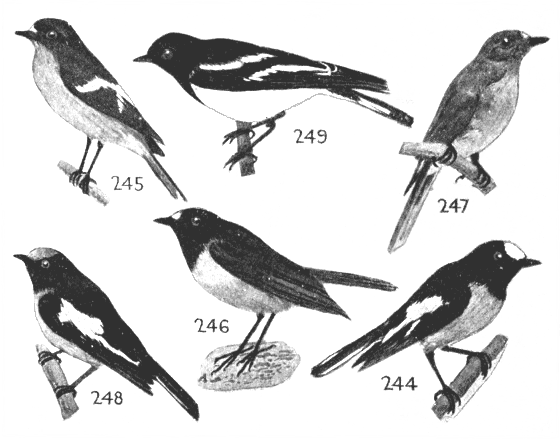
11 17
244* Scarlet-breasted Robin, Petroica leggei, S.Q., N.S.W., V., S.A., W.A., T.
Mig. c. (winter) open, (summer) forest gullies 5.2
Head, throat, upper black; cap white; white bands on wing; breast scarlet; lower-abdomen dull-white; outer-tail white; bill, feet black; f.,* upper, under brown; breast tinged red; white marks on wing. Insects.
245
*
Flame-breasted Robin
,
P. phoenicea
, S.Q., N.S.W., V., S.A., T., Bass St. Is.
Mig. c. (winter) open, (summer) mt.-gullies 5.3
Crown, upper sooty-gray; small white forehead; white on wing; outer-tail white; chin sooty-gray; under scarlet; under base tail white; f.,* under brown; outer-tail white; under reddish-gray. Insects.
246 Pink-breasted Robin, P. rhodinogaster, V., S.A., T., Bass St. Is.
Stat. v.r. deep forest, gullies 5.2
Head, neck, back sooty-black; white spot on forehead; breast, abdomen rose-pink; under base tail white; f., upper brown; buff marks on wing; under gray; under base tail white. Insects. "Tick-tick-tick;" like snapping dead twig.
247 Rose-breasted Robin, P. rosea, E.A. Insects.
Stat. r. dense brushes, gullies 4.5
Crown, throat, upper dark slate-gray; narrow white forehead; chest rich rose-red; under base tail white; outer-tail white; f., forehead buff; upper grayish-brown.
248* Red-capped Robin, Redhead (e), P. goodenovii, S.Q., N.S.W., V., S.A., C.A., W.A.
Nom. r. open inland scrubs 4.7
Crown, breast scarlet; upper, neck black; white stripe on wing; abdomen, under tail white; f.,* dark-brown upper; forehead tinged reddish; throat, breast faintly tinged red. Insects.
249 Hooded Robin (Black and White, Black, Pied), P. bicolor, S.Q., N.S.W., V., S.A., W.A., N.W.A.
Stat. r. open, forest 6.5
Head, upper, throat black; patch on wing, abdomen, under base tail, outer-tail white; f., brownish-gray instead of black. Insects.
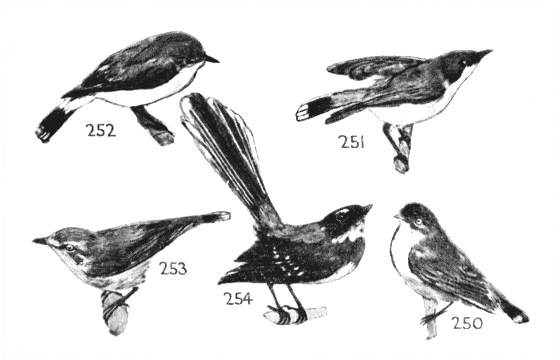
2 2
250 Short-billed Tree-Tit (Sombre), Scrub-Tit, Smicrornis brevirostris, E.A., S.A., W.A.
Stat. c. treetops 3.5
Crown brownish-gray; back olive; behind eye reddish-brown; throat, chest whitish; abdomen citron-yellow; tail brown at base, banded blackish, spotted white at tip; short bill brown; f., sim. Insects. Clear whistle.
16 62
251* White-throated Flyeater, Native Canary (e), Bush-Warbler, Gerygone albigularis, N.A., E.A., N.W.A. Insects. Musician.
Mig. c. tree-tops 4.3
Upper ashy-brown; throat, face white; chest, abdomen greenish-yellow; tail blackish band, white tip; f., sim.
252 Southern Flyeater (Western), White-tailed Bush-Warbler, G. (Pseudogerygone) culicivora, E.A., S.A., C.A., W.A. f. sim. Insects.
v.r. forests, scrubs 4.2
Upper olive-brown; throat, chest light-gray; abdomen white; tail white base; black band, tip spotted white.
253 Brown Flyeater, Brown Bush-Warbler, G. fusca, E.A.
Stat. c. forest, scrubs 3.8
Back, sides reddish-brown; forehead, eyebrow, throat, chest gray; tail black band, tip spotted white; f., sim. Insects. Feeble "What is it? What is it?"
10 99
254* White-shafted Fantail (-Flycatcher, -Flysnapper), Cranky Fan, Devil-Bird, Land-Wagtail (e), Rhipidura albiscapa, E.A., S.A.
Stat. c. open forest 6
Upper, band across chest sooty-black; under buff; stripe over eye, mark behind eye, throat, bars on wing, shafts of tail feathers (except 2 centre feathers) white; outer-tail, tip white; f., sim. Insects. Musical song.
255* Rufous Fantail (-Flycatcher), R. rufifrons, E.A.
Part.-Mig. (winter) open, (summer) gullies, brushes 6.2
Crown, hind-neck brown; forehead, lower-back, base tail rust-red; throat, centre-abdomen white; chest black; flanks, under base tail light fawn; f., smaller. Insects.
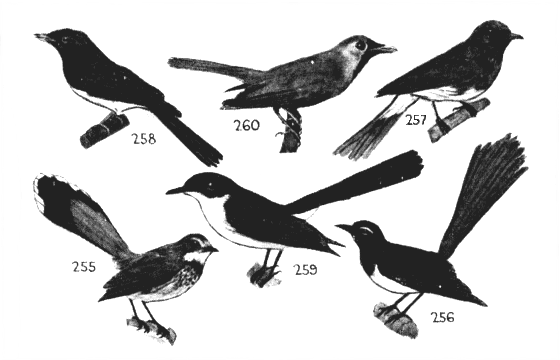
256* Black and White Fantail (-Flycatcher), Shepherd's Companion, Willie Wagtail, Wagtail (e), Frog (Morning) Bird, R. motacilloides (tricolor), Mol., N.G., A. "Sweet pretty little creature."
Stat. v.c. open forest 7.5
Upper, throat, breast black; eyebrow, rest under white; long fan-tail; f., sim. Insects. Often sings at night.
4 29
257 Leaden Flycatcher (-Flysnapper), Frog-Bird, Myiagra rubecula, N.G., A., T.
Mig. r. coast scrubs, gullies 6.5
Upper, wings, tail, breast leaden-gray glossed with green; abdomen, under base tail white; f., throat, breast rust-red. Insects. Squeaking note.
258 Satin Flycatcher (Shining), Satin Sparrow (e), M. nitida, Louisiade Is., E.A., S.A., T.
Mig. r. gullies 6.5
Upper, breast blackish metallic-green; abdomen, under base tail white; f., upper duller; throat, breast rust-red. Insects. Loud piping whistle.
2 2
259* Restless Flycatcher, Scissors Grinder, Grinder, Willie Wagtail (e), Dishwasher (e), Who-are-you? Seisura inquieta, A.
Stat. c. open, scrub 8
Upper shining black; under white; like 256 but throat white; hovers; f., throat, breast buff. Insects. Harsh grinding, "Tu-whee, tu-whee."
2 8
260 Black-faced Flycatcher (Carinated), Monarcha melanopsis, Timor, N.G., N. Ter., E.A.
Stat. r. brushes 6.7
Forehead, face, throat black; upper gray; wings, tail brown; chest gray; abdomen rufous; f., sim. Insects. Loud whistle, "Why-yew, witch-yew."
Order XXI. (continued)
More than half the species of birds making up the family of Caterpillar-eaters are restricted to the Australian region.
The common Black-faced Cuckoo-Shrike has many names. Leatherhead, Blue Pigeon, and Blue Jay are amongst the most common, and all are wrong. The Leatherhead is a Honey-eater, and is better known as the Friar-Bird. The Cuckoo-Shrike is not a Pigeon, but is a perching bird; nor is it a Jay, which is a Northern Hemisphere bird, a member of the Crow family.
The Black-faced Cuckoo-Shrike is partly migratory, being stationary in the northern parts of its range, but migratory in the south. It occasionally reaches New Zealand. These birds undergo many changes of plumage before assuming the adult dress. The Little Cuckoo-Shrike, in particular, has several plumage phases, the throat and neck being black in the young, but gray in the adult. Its Cuckoo-like flight undoubtedly suggested part of the name. When young males are unlike the adult males, they usually resemble the female. Here, however, the adults of both sexes are similar.
The male White-shouldered Caterpillar-eater resembles a Hooded Robin (249). It is supposed to be shy, but at the Tallangatta excursion, two pairs were attending to domestic duties in the school ground and surprised all by their fine musical performances. The male called "Peter, Peter," or some syllabize it "Pretty Joey," and then broke into a trilling song that fully equalled any canary performance I have heard. This was repeated frequently during the day. The female seemed to have a creak in her note, which, however, was musical. The bill is slender in this species.
The Jardine Caterpillar-eater is rare and very shy. It keeps to the topmost branches of lofty trees. The male is dark blue-gray and black, and has a strong bill. The brown female is quite dissimilar, her whitish under surface being crossed with numerous brown arrow-head markings.
The Cuckoo-Shrikes and Caterpillar-eaters are, like the Cuckoos, very fond of caterpillars, and so should receive all the protection we can give them.
(continued below)
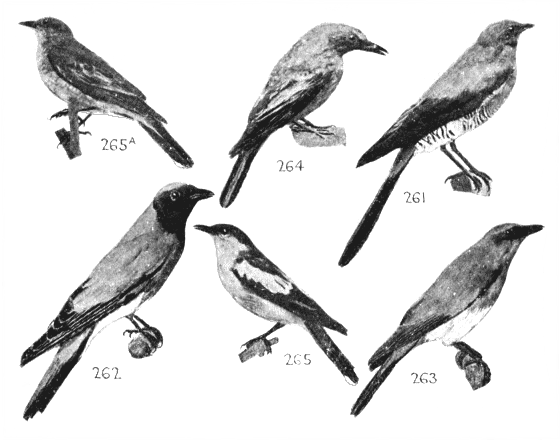
F. 120. CAMPOPHAGIDAE (10), CUCKOO-SHRIKES, Caterpillar-eaters, 186 sp.—104(103)A., 63(61)O., 2(1)P., 19(19)E.
1 1
261 Ground Cuckoo-Shrike, Ground Graucalus, Ground (Long-tailed) Jay (e), Pteropodocys phasianella, Q., N.S.W., V., C.A., W.A. (interior).
Stat. v.r. plains 13
Head, neck, chest, back delicate-gray; abdomen, rump white, many narrow black bars; under base tail white; wings, tail black; side tail tipped white; f., sim. Insects, larvae. Shrill note.
5 34
262* Black-faced Cuckoo-Shrike, Leatherhead (e), Cherry-Hawk (e), Lapwing (e), Summer (Blue) Bird, Blue (Gray) Jay (e), Blue (Mountain) Pigeon (e), Australian Shrike (N.Z.), Coracina robusta (Graucalus melanops), Cel., Mol., N.G., A., N.Z. (acc.).
Part.-Mig. v.c. plains, timber 13
Delicate gray; forehead, face, throat black; wing-quills black edged gray; tail gray base, black centre, tip white; lifts wings after settling; f., sim. Caterpillars, insects, fruit. Purring note.
263 Little Cuckoo-Shrike, Varied Graucalus, Lesser Blue-Jay (e), C. mentalis, E.A.
Stat. r. forest 10.5
Upper dark slate-gray; wing-quills black; tail black tipped white; about eye black; throat, breast gray (adult), under wing, under base tail white; young many changes of color; head, neck black; f., sim. Caterpillars, insects, berries. Soft rolling note.
1 35
264 Jardine Caterpillar-eater (-Campophaga), Edolisoma tenuirostre, N. Ter., E.A.
Stat. r. treetops 10.6
Face black: upper, under, centre-tail deep blue-gray; wing-quills, outer-tail black; f., smaller; upper, wings, tail feathers brown, edged lighter; under creamy-buff with many blackish bars; line over eye buff. Insect larvae. "Kree-kree."
2 25
265* White-shouldered Caterpillar-eater (-Campophaga), Peewee-Lark (e), Lalage tricolor, N.G., A., T.
Mig. c. thick timber 6.5
Crown, hind-neck, upper-back black; shoulders, line on wing white; rest wing black; lower-back gray; tail black outer tipped white; under white; somewhat like 248 but throat white; f.,* upper brown; wing marked light lines; under whitish. Insects. Fine musician, canary-like song.
F. 121. Pycnonotidae, Bulbuls, 257 sp.—7(6)A., 148(145)O., 6(4)P., 99(99)E.
Order XXI. (continued)
The family Timeliidae is an ill-defined one, the members of which are mostly ground birds, or, at least, spend a good deal of time on the ground.
The Spotted and Chestnut-backed Ground-Birds are rare and are very quiet and shy as they run back under the shade of a bush. Thus, they are seldom seen, though they are very beautiful in their richly-spotted plumage. Driving along mallee roads, one sometimes sees these birds make a short, quick run to cover. A good name is required for them. Ground-Bird is not very definite.
The rich brown Pilot Bird rarely flies, but keeps low down in the dense tangles and undergrowths in country like that about Ferntree Gully. It must be patiently waited for, as it is very shy. It, apparently, values its services highly, for it often calls "A-guinea-a-week."
The larger Scrub-Robin which lives only in the interior flies little, but, as shown in the figure, it has long legs, suitable for running. Its color is not the dark-brown suitable for dark scrubs, but is the light-brown which matches the dead mallee twigs lying so thickly on the ground under the scrub. We met the Scrub-Robin on Eyre Peninsula, but it was difficult to get a second look at it. Almost as rare are the closely-similar Chestnut-rumped and Red-rumped Ground-Wrens. Few will see these birds, as they live only in the drier parts.
That interesting bird—the Coachwhip Bird—is far more often heard than seen. Along the densely-scrubbed creeks of Eastern Australia, the interesting whip-crack of this bird is very often heard. An exact representative lives in West Australian scrubs. I was surprised to hear, in several places lately, the Rufous-breasted Whistler (Thickhead) called the Coachwhip Bird. It has been found that both birds take part in the peculiar call which has a loud crack very like that of a whip. This bird dwells in the dense eastern scrubs, and uses its short wings but little for flight. It was seen, however, recently at Sandringham, a few miles from Melbourne.
The Australian Babblers are of interest from all points of view. Their habits are peculiar; their calls are varied and usually pleasant, and their large domed stick nests are common objects along a country road. Usually seen in companies of from four to a dozen, these birds work energetically and systematically. They are entirely insectivorous, and so are of great value economically. They are tame, as I have watched a flock at work in the gardens in the middle of a town such as Dunolly. They occasionally visit orchards and attack the codlin moth pupae. They are said never to squabble, and so are called "Happy Family" or "Happy Jacks." Their names, however, are many. The commonest is, perhaps, "Catbird." There is a "Catbird," a Bower-Bird, in Queensland, so the use of that name should be discouraged. Babblers sometimes make six or seven nests, laying only in one. The others are said to be shelter nests, or possibly play nests.