CLASS.—AVES.—BIRDS. (continued 3)
Reading edition
That pleasing songster—the White-browed Field-Wren—is uniformly streaked with black both above and below. It is fairly common, but is not often seen unless looked for. Dogs will follow the scent of this bird, as they do that of a quail; so it is sometimes called the Stink-Bird by sportsmen.
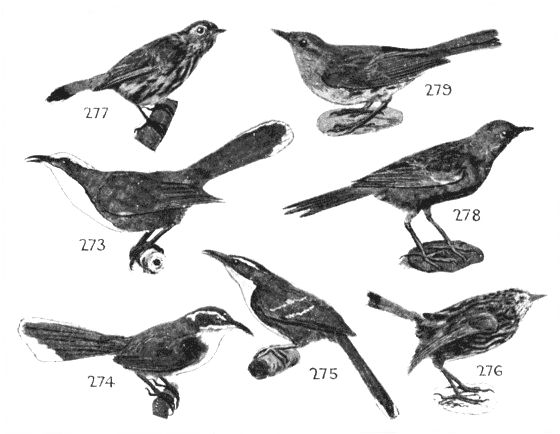
Now we come to two of the four native Skylarks. Who has not, while lying on his back on the grass enjoying a rest in the warm sunshine, felt pleasure at the beautiful song of the Rufous Song-Lark as it soars singing away so high overhead? The British Skylark often receives the credit for the harmony of our four Skylarks. Two belong to this family, and two come later with the Larks and Pipits. One is larger and darker on the breast, hence the name Black-breasted Song-Lark. I saw many of these birds, when examining the glacial deposits at Hallet's Cove, near Adelaide. As there was a continuous chorus of these fine songsters above the crops, the reason for the name Harvest Birds was apparent.
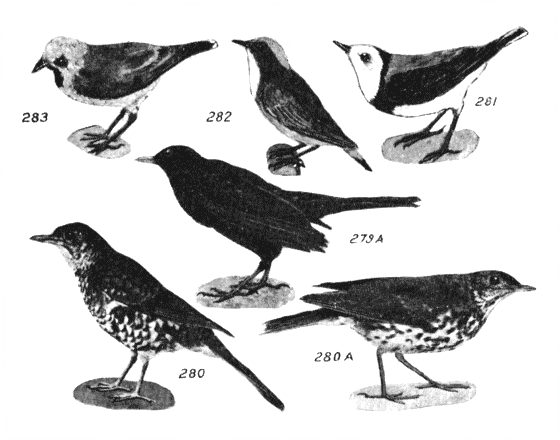
The Thrush family (Turdidae) includes the British Song-Thrush, Blackbird, Nightingale, and many other famous songsters, The Australian Mountain-Thrush is larger and more prettily marked, but is not such a good songster as its European cousin—the Song-Thrush. It, however, has one of its calls closely similar to one of the calls of its more famous relative. It is a quiet, shy bird, though I walked within five feet of one this morning as it was busy digging up worms on the lawn in the Melbourne Botanic Gardens. I left it at work pleased that my presence had caused no feeling of fear in so beautiful and so shy a bird. Its beautiful moss-covered nest is built even so early as July. It flies little, preferring to keep near the dark scrubs, especially the tea-tree scrub along the coast.
The Song-Thrush and Blackbird have been successfully introduced, and they are common in suburban gardens. Their delightful song makes richer the lives of busy city dwellers, though their attentions to soft fruits are not always appreciated. For sweetness and fulness of notes, however, these introduced birds cannot compare with our Harmonious Shrike-Thrush (315), deservedly named harmonica by Latham, a British ornithologist. The call of the latter bird, however, is not so continuous as that of the introduced birds.
The four Australian birds known as Chats take the next sub-family to themselves. The common Chat is known as a "Tang," "Nun," and "Tin-tac." While the White-fronted Chat is very common in the South, the beautiful Crimson-breasted Chat, with its crimson cap and pure white throat, and the Orange-fronted Chat, are found mostly in the dry interior, where they are known as Salt-bush Canaries. A good common name is urgently required for this Australian sub-family of birds. North calls them Nuns; but that name is preoccupied, and is suitable only for one of them. I was much interested last week (January, 1911) to see a male White-fronted Chat feeding a fully-fledged young Bronze Cuckoo. Two female Sparrows were also in attendance, one of which fed the Cuckoo three times while I was observing it. A female Bronze Cuckoo sat for some time by the young one, but did not interfere, or offer to feed it. The Chat returned the fifth time for the purpose of feeding the young Cuckoo, when the passing of a motor-car broke up the party. The young Cuckoo flew across the road and some distance on to a bush, where it resumed its constant wheezing whine. It is unusual to find birds so far apart as a Finch, like the Sparrow and a member of the Thrush family, like the Chat, feeding the one young Cuckoo.
(continued below)
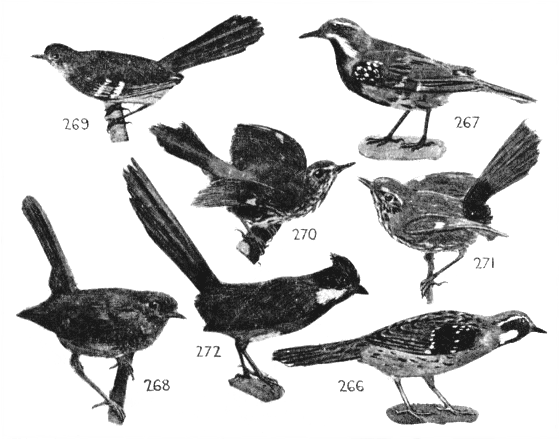
F. 122. TIMELIIDAE (27), BABBLERS, BABBLING-THRUSHES, 590 sp.—65(65)A., 447(443)O., 7(3)P., 75(75)E. (an ill-defined family).
6 6
266* Spotted Ground-Bird (-Thrush, -Dove), Babbling-Thrush, Cinclosoma punctatum, S.Q., N.S.W., V., S.A., T.
Stat. r. scrubby 10.7
Crown, back rufous-brown; back striped black; shoulders steel-black spotted white; throat, narrow chest band steel-black; eyebrow, patches on throat white; breast gray; tail tipped white; f., upper lighter; throat white, rufous patch at side. Insects. Rise with a whirr-r-r. Low piping whistle.
267 Chestnut-backed Ground-Bird (-Thrush), C. castano-notum, W.N.S.W., W.V., S.A., W.A., N.W.A.
Stat. r. plains 9
Upper chestnut-brown; eyebrow, side-throat white; throat, chest black; shoulder black spotted white; tail tipped white; f., duller; throat, chest gray. Insects.
1 1
268 Pilot Bird, Pycnoptilus floccosus, E.N.S.W., E.V.
Stat. v.r. dense scrubby gullies 6.7
Rich dark-brown; throat rufous mottled dusky; f., sim. Insects. "Guinea-a-week."
3 5
269 Scrub-Robin, Drymodes brunneipygius, N.S.W., V., S.A. (interior).
Stat. v.r. mallee, scrub 8
Upper brown; wings brown barred white; tail brown, slightly tipped white; under grayish-brown; long legs; shy, runs; f., smaller. Insects. Monotonous whistle.
2 2
270 Chestnut-rumped Ground-Wren, Red-rumped Scrub-Warbler, Hylacola pyrrhopygia, N.S.W., V., S.A.
Stat. v.r. dry scrubs 5.3
Upper brown; base tail chestnut-red, tip white; eyebrow white; under streaked black, white; f., sim. Agreeable song.
271 Shy Ground-Wren (Red-rumped, Cautious, Rufous-rumped), Shy Scrub-Warbler, H. cauta, V., S.A., W.A.
Stat. v.r. dry scrubs 5.7
Like 270, but small white patch near outer edge of wing; shier; f., sim. Insects.
3 3
272* Coachwhip Bird (Whip, Stockwhip), Psophodes crepitans, E.S.Q., E.N.S.W., E.V.
Stat. c. dense scrubs 10
Dark olive-green; black crest, breast; white side of throat, centre of abdomen, tip-tail; f., smaller, duller. Insects. Loud full note ends in a whip crack.
4 34
273* Gray-crowned Babbler, Chatterer (e), Cackler, Barker, Pine (Cat (e), Dog) Bird, Codlin-Moth-eater, Hopper, Jumper (e), Yahoo, Happy Family, Happy Jack, Twelve Apostles (e), Apostle-Bird (e), Pomatorhinus frivolus (temporalis), E.A., S.A.
Stat. flocks, c. open timber 11
Dark brown; crown light-gray; brow white; throat, breast white; tail tipped white; bill long black, curved; runs; f., sim. Insects. Many peculiar notes, noisy.
274 White-browed Babbler, Go-aways, Stick-Birds, P. superciliosus, A. inland (exc. N. Ter., N.Q.).
Stat. flocks, c. open timber 8
Like 273, but smaller; crown dark-brown; f., sim. Insects. "Most noisy bird I ever observed." (G.) Many notes.
275 Chestnut-crowned Babbler, P. ruficeps, N.S.W., V., S.A. (interior). Insects. Noisy.
Stat. c. timber 8.5
Like 273, 274, but crown, hind-neck chestnut; f., sim.
7 7
276* White-browed Field-Wren, White-lored Reed-Lark, Rush Warbler (e), Stink-Bird, Calamanthus albiloris, N.S.W., V., S.A.
Stat. c. grass, heath 5
Greenish-brown streaked black; face, brow white; throat whitish streaked black; erect tail; shy; f., sim. Insects. Pretty song on bush-top.
277 Field-Wren, Field Reed-Lark, C. campestris, V., S.A., N.W.A.
Stat. v.r. open plains 4.6
Upper ashy-brown streaked dark-brown; upper base tail rufous-brown; side tail tipped white, banded black; forehead rufous streaked dark-brown; eyebrow white; under whitish streaked dark-brown; f., sim. Insects.
2 2
278* Brown Song-Lark (Black-breasted), Australian Skylark, Harvest-Bird, Singing-Lark, Corn-Crake (e), Cincloramphus cruralis, A. exc. C.A.
Mig. c. crops 9
Dark-brown, upper feathers edged lighter; abdomen blackish; f., much smaller; paler; eyebrow, under whitish. Insects. "Fine songster, ranks with the Skylark;" sings flying like Skylark.
279* Rufous Song-Lark (Rufous-tinted), Rufous-rumped Singing-Lark, Skylark, C. rufescens, A.
Mig. c. grass, crops 7.5
Upper brown, feathers edged lighter; upper base tail rufous; brow, throat whitish; under brownish-gray; side face darker; f., smaller; face not dark. Insects. "Amongst the richest and sweetest of Australian bird songs." Sings flying like Skylark.
F. 123. Troglodytidae, Wrens, 255 sp.—2(1)A., 18(17)O., 10(10)P., 43(32)Nc., 194(183)Nl.
F. 124. Cinclidae, Dippers, Water-Ouzels, 19 sp.—5(2)O., 11(8)P., 1(0)Nc., 6(5)Nl.
F. 125. Mimidae, Mocking-Birds, Thrashers, 71 sp.—17(10)Nc., 61(54)Nl.
F. 126. TURDIDAE (8), THRUSHES (Blackbird (Br.), Nightingale, Robin (Br.), Wheatear, Bluebird (Am.), Redstart, Hedge-Sparrow), 588 sp.—48(44)A., 167(117)O., 124(53)P., 192(163)E., 29(14)Nc., 132(118)Nl.
1 114
279a Blackbird, Turdus merula, Eur., N. Afr., Egypt, Syria, Persia, Azores, A. (introduced).
Stat. c. timber 10
Black; bill yellow; f., dark-brown; breast reddish-brown marked darker. Insects, snails, fruit. Songster.
4 13
280* Australian Mountain Thrush (Ground), King Thrush, Turdus (Oreocichla) lunulata, N.S.W., V., S.A.
Stat. c. coastal scrubs, mt. gullies 10.5
Upper brown marked with black half-moons; under white stained buff on breast, flanks, marked with black half-moons; f., sim. Snails, insects, worms.
1 24
280a Song Thrush, T. musicus, Eur., W. Asia, India, A. (introduced).
Stat. c. gardens 9
Upper brown; breast yellowish spotted brown; throat, abdomen white; f., sim. Snails, insects, worms. Famous singer.
5 5
281* White-fronted Chat, Banded Tintac, Tang, Ringlet (e), Clipper, Nun, Dottrel (e), Jenny-Wren (e), Ballyhead, Gar, Ringneck (e), Epthianura albifrons, Bass St. Is., T., A. exc. N. Ter. Insects. Dull metallic "tang."
Mig. v.c. grass 4.5
Forehead, face, under, tip tail white; back gray; band on chest, wings, tail black; f.,* duller, faint band on chest.
282* Crimson-breasted Chat (Tricolored), Saltbush Canary (e), E. tricolor, A. exc. N. Ter.
Mig. r. timber 4.3
Crown, base tail, breast, abdomen scarlet; face, back of head, back dark-brown; tip-tail spotted white; throat, under base tail white; f., duller. Insects.
283 Orange-fronted Chat, Saltbush Canary, E. aurifrons, A. exc. N. Ter.
Nom. r. open plains 4.3
Head, upper base tail, under golden-orange; back brown; tip tail spotted white; chin black; f., duller. Grasshoppers, other insects.
Order XXI. (continued)
The Warbler family, Sylviidae, is a large one, found all through the Eastern Hemisphere. One migratory species crosses Behring Strait each year to summer in Alaska.
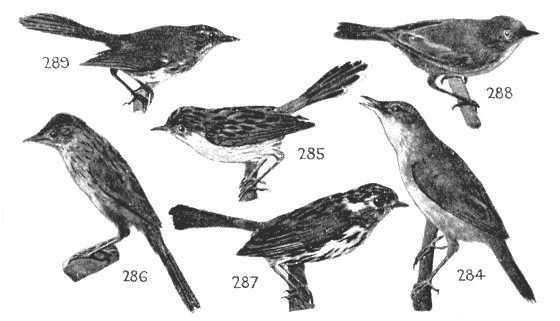
As no less than 79 Australian small birds have been grouped in this family, it is of considerable importance to our bird lovers. At the head of the family, we have an exact representative of the Reed-Warbler of Europe in the delightful plain-brown songster which charms all who frequent river sides. Its song is "louder and more melodious than that of any of its European relations except" the Reed-Warbler. It is a welcome spring visitor, and can be heard on any spring or summer day in the Botanic Gardens, or in any reed bed by stream or lake.
The next bird is the Australian representative of the Fantail-Warblers (Cisticola). These birds are related to the Tailor-Bird.
Much has been written of the Tailor-Bird of India which so cleverly sews leaves together to enclose its nest, but few know we have a bird that does similar work when building its nest. Dr. Sharpe has decided that our bird is identical with an Indian species, so we must take the Indian name—Golden-headed Fantail-Warbler. This bird moults twice a year. At the autumn moult, it obtains a long tail and a streaked crown. The four Australian species described by Gould are now known to be but different forms of the one species which undergoes seasonal change.
Speckled Jack, the Speckled Warbler (Little Field-Wren), is a tame little bird with a pleasing song. Its chocolate-colored egg used to be much valued in the days when schoolboys collected eggs. It walks instead of hopping.
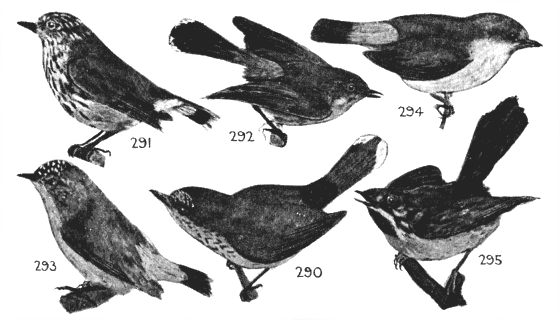
The Yellow-tailed Tit-Warbler (Acanthiza) is a member of an Australian genus, which has been split up into 27 species, all of which, except a New Guinea form, are restricted to Australia. Some are pleasing songsters. The two-storied nest of the Yellow-tail is well known and is peculiar. What is the use of the upper nest—for the male to rest in, to delude the cuckoo, or what?
These birds are not Tits (Paridae). They have been called Thornbills by Mr. A. J. North. The name Tit-Warbler has been adopted by the "names" sub-committee of the Royal Australasian Ornithologists' Union, pending the completion of the Australian Check-List. The common White-browed Scrub-Wren is not a Wren, but is a Warbler. He is the best known of the genus, though even he is seldom seen. His dark-brown color leads one to suspect a dark scrub as his dwelling place. Though common in places, he is seldom noticed, but if you sit down in a quiet scrubby corner, his inquisitiveness will often impel him to run almost over your feet. Some light spots on the shoulder and the white eyebrow will assist you in identifying him. His mouse-like run further assists in identification.
Amongst the glories of the bird world, the Superb-Warbler stands high. His beautiful enamel-blue and black costume, and his cheery, fussy song justify his name. He is generally accompanied by four or five plain-colored mates, and is said to lose his beautiful coat of blue each autumn, but the balance of evidence now seems to be with Mr. Keartland and Dr. Horne, who claim that he gets the permanent beautiful coat late in life (that is, when three or four years old), and does not lose it afterwards, except for a few days at moulting time. But, being so conspicuous, he soon falls a prey to one of his numerous enemies, of whom the small boy with a pea-rifle is probably the worst. I, too frequently, hear of these enemies of their country being caught with three or four of these lovely little birds in their possession. However, Bird Day in the schools did much good, and the next generation of boy will probably have less of the savage in him.
The Emu-Wren, which has tail feathers like Emu feathers, is easily recognized if seen. It is difficult to cause it to fly out of the rushes round a swamp. The Bristle-Birds are Australian, and are fairly common in some dense scrubs.
Grass-Wrens are not Wrens, but are placed in the Warbler family. They are Central Australian birds. They seldom fly, but "progress like a rubber ball" with great swiftness. They are of the light tawny color that so well matches desert sands. It is very difficult to get a second look at one, as it hides in the grass and scrub, and almost refuses to be flushed. Sometimes it nearly allows itself to be walked upon.
Fourteen of the 17 members of the Wood-Swallow family are confined to the Australian region. The White-rumped Wood-Swallow extends from Australia through the islands to the Andaman Islands; another kind is found in India, Ceylon, and Burma. Some kinds are migratory. They appear suddenly in great companies, build a flimsy, careless nest in any spot high or low, and soon have the young on the wing. They are the "Blue-Birds," "Summer-Birds," or "Martins" of our youth. Some of these birds have the remarkable habit of hanging in a cluster similar to a great swarm of bees. Like Honey-eaters, they take honey from the flowering eucalypts. The street trees of Bendigo were alive with these birds in May, 1909. The Sordid Wood-Swallow is partly migratory, and lives in small companies. Most towns in Southern Australia have a company of these birds in the neighborhood. One such company lives in the Domain, near the entrance to the Botanic Gardens, Melbourne.
These tame woodland birds, admirable in their graceful wheeling and floating flight, destroy numbers of destructive insects. Occasionally, a company has discovered that a good food supply can easily be obtained close to a beehive. Thus rarely they do a slight amount of harm, but the balance is overwhelmingly in their favor.
(continued below)
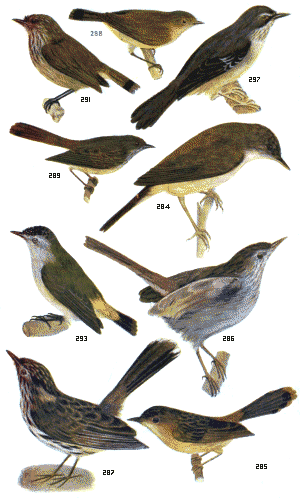
284 Aust. Reed-Warbler 285 Aust. Fantail-Warbler 286 Grass-Bird 287 Speckled Warbler 288 Little Tit-Warbler 289 Brown Tit-Warbler 291 Striated Tit-Warbler 293 Yellow-tailed Tit-Warbler 297 White-browed Scrub-Wren
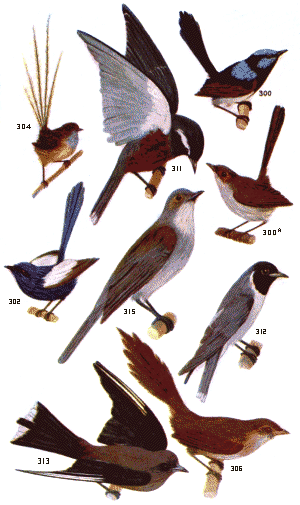
300 Superb-Warbler 300a Superb-Warbler (Female) 302 White-winged Superb-Warbler 304 Emu Wren 306 Bristle Bird 311 White-browed Wood-Swallow 312 Masked Wood-Swallow 313 Wood-Swallow 315 Gray Shrike-Thrush
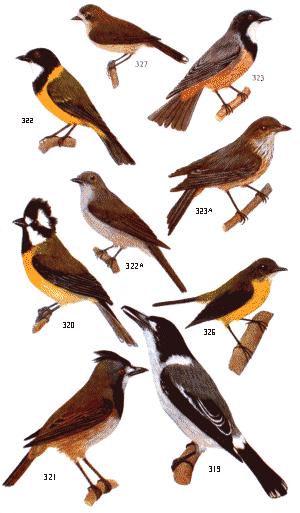
319 Australian Butcher-Bird 320 Yellow-breasted Shrike-Tit 321 Crested Bell-Bird 322 Golden-breasted Whistler 322a Golden-breasted Whistler (Female) 323 Rufous-breasted Whistler 323a Rufous-breasted Whistler (F.) 326 Shrike-Robin 327 Whiteface
F. 127. SYLVIIDAE (79), WARBLERS (Whitethroat, Blackcap (Br.), Chiffchaff), 525 sp.—107(102)A., 137(84)O., 108(22)P., 267(228)E., 1(0)Nc.
2 29
284* Australian Reed-Warbler, Reed-Bird, (Nightingale), Water-Sparrow (e), Acrocephalus australis, Lombok, E.A., S.A., T. =vt. Eur. Reed-Warbler.
Mig. c. reeds 6.2
Brown; head darker; under lighter; throat whitish; bill long, pointed; f., sim. Insects. Rich melodious song.
1 51
285* Golden-headed Fantail-Warbler, Grass-Warbler (Exiled), Corn (Barley) Bird, Cisticola exilis, Ind., Formosa to A. (exc. C.A.), King Is.
Stat. r. grass, crops 3.6
Golden-buff; upper streaked blackish; tail 1.2in., blackish, edged buff; f., crown streaked black. Winter* crown streaked black; throat whitish; tail 1.9in.; f., sim.
3 10
286* Grass-Bird (Little Reed), Marsh-Warbler, Megalurus gramineus, N.S.W., V., S.A., T.
Stat. v.r. tussocks 5.2
Upper brown streaked, lined blackish; throat, chest gray faintly streaked black; tail reddish-brown; f., sim. Insects. "Four or five plaintive notes."
1 1
287* Speckled Warbler, Little Field-Lark (-Wren), Speckled Jack, Blood Tit (e), Jenny-Wren (e), Chthonicola sagittata, E.A., S.A.
Stat. r. grass 5
Under whitish boldly streaked black; head brown faintly streaked white; back brown, feathers edged lighter; tip-tail spotted white; f., sim. Insects. Singer.
26 27
288* Little Tit-Warbler (Yellow), Yellow-breasted Thornbill, Tomtit, Little Tit, Acanthiza nana, S.Q., N.S.W., V., S.A.
Stat. c. trees 3.5
Upper dull olive-green; under yellow; tail grayish-brown, black band; f., sim. Insects. "Tiz, tiz, tiz."
289* Brown Tit-Warbler (Tit), Scrub Thornbill, Dwarf Warbler, A. pusilla, E.A., S.A.
Stat. c. scrub 3.7
Upper, wings brown; tail brown, banded black, slightly tipped white; throat, chest spotted black and white; flanks, abdomen buff; f., sim. Insects. Singer.
290 Red-rumped Tit-Warbler (Tit), Rufous-rumped Thornbill, A. pyrrhopygia, N.S.W., V., S.A. (interior).
Stat. v.r. mallee, scrubs 4
Upper pale olive-brown; forehead blackish-brown, feathers tipped white; throat, chest mottled gray, white; abdomen whitish; upper base tail rufous; tail olive, black band, white tip; f., sim. Insects.
291* Striated Tit-Warbler, Striped Tit, Striped-crowned Thornbill, A. lineata, E.A., S.A.
Stat. c. timber 3.7
Throat, chest whitish streaked black; head brown streaked whitish; back olive-brown; flanks, abdomen yellowish; tail black band; f., sim. Insects. Songster.
292 Chestnut-rumped Tit-Warbler (Thornbill), A. uropygialis, A. exc. C.A., N. Ter.
Stat. r. scrubs, forests 3.6
Upper brown; upper base tail rich reddish-chestnut; tail brownish-black tipped white; under whitish; f., sim.
293* Yellow-tailed Tit-Warbler, Yellow-rumped Thornbill (-Tit), Yellow-tail, Geobasileus, A. chrysorrhoa, E.A., S.A., W.A., T.
Stat. v.c. gardens, timber 3.8
Upper olive-brown; base tail bright-yellow; under yellowish-white; forehead black spotted white; cheeks, throat, line over eye grayish-white; f., sim. Insects. Singer.
294 Buff-tailed Tit-Warbler, Buff-rumped Thornbill (Tit), A. reguloides, E.A., S.A.
Stat. c. open timber 4.3
Upper olive-brown; upper base tail pale yellow; throat, chest white slightly marked brown; forehead feathers tipped lighter; f., sim. Insects. Song.
10 16
295 Redthroat, Red-throated Scrub-Wren, Sericornis brunnea, N.S.W., V., S., C., W.A.
Stat. v.r. scrubs 4.5
Upper dark-brown; tail brownish-black tipped white; throat rufous; under brownish-gray; f., sim. Insects. "Fine song equal to that of any small bird."
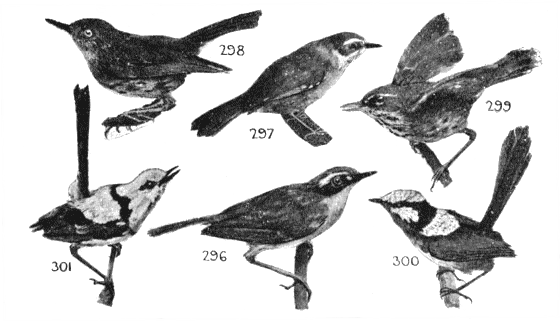
296 Yellow-throated Scrub-Wren, Devil Bird, S. barbata, E.Q., E.N.S.W., E.V.
Stat. r. coastal scrubs 5.5
Crown, upper brown tinged yellow; side of face, round eye, ear black; white line over eye; throat yellow; chest, flanks olive-brown; centre abdomen white; f., smaller; duller. Insects. Pleasing rich note.
297* White-browed Scrub-Wren (White-fronted), S. frontalis, E.A., S.A., Kent Group.
Stat. c. undergrowth 4.5
Upper dark-brown; throat white streaked dusky; brow white; chest, abdomen light-yellow; flanks olive-brown; small distinct white marks on shoulder; f., duller, throat not streaked. Insects. Inward warble.
298 Large-billed Scrub-Wren, S. magnirostris, E.A.
Stat. v.r. tree-tops, coast, gully scrubs 4.7
Brown; rump rufous; about bill tawny; eye, long bill black; legs flesh-color; f., sim. Insects.
299 Spotted Scrub-Wren (Striated), S. maculata, V., S.A., Kangaroo Is., W.A.
Stat. v.r. scrubby 4.5
Upper brown; tail black band tipped white; forehead, side of face black; stripe above, very small patch below eye, marks on edge of wing white; under grayish-white, sometimes washed yellow; throat, chest grayish-white spotted (striated) black; f., duller. Insects.
23 23
300* Superb-Warbler, Blue-Wren (-Bonnet, -Tit, -Cap, -Head), Mormon-Wren, Cocktail, Malurus cyanochlamys, E.A., S.A., Kangaroo Is.
Stat. v.c. gardens 5
Crown, behind ear, upper-back enamel-blue; throat, chest, hind-neck, lower-back black; tail deep-blue; f.,* brown; round eye reddish-brown; under lighter; bill reddish-brown. Insects. "Animated song." "Lovely bird."
301 Black-backed Superb-Warbler (Wren), M. melanonotus, E.A., C.S.A. (inland).
Stat. r. scrubs 4.7
Crown, under, upper-back, upper and under base tail beautiful metallic blue; behind ear verditer-blue; side of face, band on back, faint band across chest black; wing green; tail greenish-blue; f., side of face, round eye reddish-brown; upper brown; under whitish; wings brown; tail green. Insects.
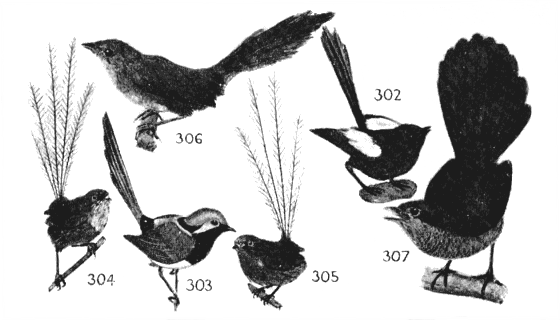
302* White-winged Superb-Warbler (Wren), M. cyanotus (leucopterus), A. (exc. N. Ter.).
r. saltbush, plains 4.8
Above, below deep cobalt-blue; wings white; quills brown; tail dark-blue; f., upper brown, under white tinged brown. Insects.
303 Purple-backed Superb Warbler (Wren), M. assimilis, A.
Stat. v.r. scrubs 5
Crown, side of head, back purplish-blue; throat, chest, band on upper back, rump black; chestnut-red patch inner wing; rest wing brown; abdomen white; tail dark-blue tipped white; f., brown; about eye rich chestnut; under whitish; tail greenish-blue. Insects.
4 4
304* Emu-Wren, Stick-tail, Stipiturus malachurus, S.A., E.A., W.A., f., throat brown. Insects.
Stat. c. tussocks 7
Upper brown streaked rufous; tail feathers long loosely webbed, erect; throat blue; abdomen brown; runs.
305 Mallee Emu-Wren, S. mallee, N.W.V.
Stat. v.r. Spinifex (Triodia) 5
Like 304, but forehead chestnut; throat, chest light purplish-blue; abdomen grayish-brown.
4 4
306* Bristle-Bird, Sphenura brachyptera, N.S.W., E.V., Insects. Rich, varied notes.
Stat. v.r. undergrowth 8.8
Brown; throat, centre-breast lighter; shy; runs; f., sim.
307 Rufous Bristle-Bird (Rufous-headed), S. broadbenti, W.V., S.A. (Otway Ranges to Mt. Lofty).
Stat. v.r. dense scrub 10.5
Rufous-brown; f., sim. Insects.
10 10
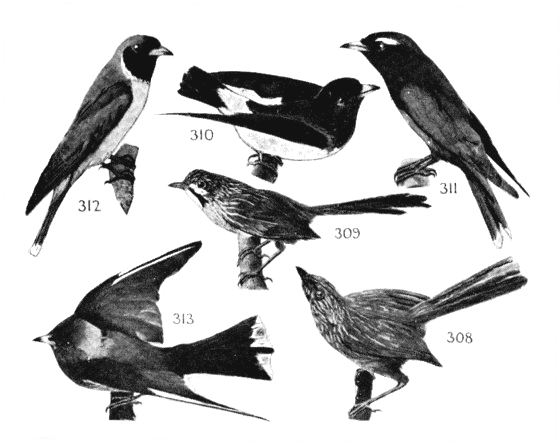
308 Grass-Wren, Amytornis textilis, V., C.A., W.A.
Stat. v.r. plains, dense scrubs 6.2
Upper dark-brown striped white; under paler; flanks rust-red; seldom flies; progresses like a rubber ball; tail erect; f., sim. Insects.
309 Striated Grass-Wren (Black-cheeked), A. striatus, N.S.W., V., C.A., W.A.
Stat. v.r. dense scrubs 6.8
Like 308, but black stripe on cheek; plumage strongly rufous; runs, seldom flies; f., sim. Insects.
F. 128. Vireonidae, Vireos, Greenlets, 112 sp.—24(7)Nc., 105(88)Nl.
F. 129. Ampelidae, Waxwings, Cedar-Bird, 10 sp.—1(0)O., 2(0)P., 3(0)Nc., 7(5)Nl.
F. 130. ARTAMIDAE (12), WOOD-SWALLOWS, Swallow-Shrikes, 17 sp.—15(14)A., 2(1)O., 1(1)E.
9 16
310 White-rumped Wood-Swallow (Swallow-Shrike), Artamus leucogaster, Andaman Is., Mal. Arch., Papuan Is., A.
Mig. r. timber 7.4
Head, neck grayish-black; back brown; tail, wing-quills black; rump, breast, abdomen white; f., sim. Insects. Plaintive note.
311* White-browed Wood-Swallow, Summer-Bird, Martin (e), A. superciliosus, E.A., S.A., N.W.A.
Mig. v.c. timber 8
Slaty-gray; white eyebrow; abdomen rich chestnut; tail tipped white; f., faint white eyebrow. Insects, honey. "Sweet, clear whistling note."
312* Masked Wood-Swallow, Bush (Blue) Martin (e), A. personatus, S.Q., N.S.W., V., S.A., W.A., N.W.A.
Mig. c. timber 8
Dark-gray upper; pure white edge to jet-black throat patch; under gray; tail tipped white; f., duller. Insects.
313* Wood-Swallow (Sordid, Dusky), Jacky-Martin, Martin (e), A. tenebrosus, A., T., Bass St. Is.
Part-Mig. v.c. timber 7.3
Smoky vinous-gray; wing-quills black; white line in edge of wing; tail tipped white; bill blue tipped black; f., sim. Insects.
F. 131. Vangidae, 12 sp. E. (Madagascar).
Order XXI. (continued)
Family 132—Wood-Shrikes—contains two of the best known of Australian birds, for they are to be found about almost every town and city, as well as in the country. The well-known Magpie-Lark has but one close cousin in the world, a New Guinea bird. Its mud nest is familiar to country boys. It is notable that, excepting Swallows, only two other Australian birds build a mud nest. These birds, the Apostle-Bird and the White-winged Chough, are mentioned later. Its dainty, well-kept plumage renders the Magpie-Lark one of the most graceful of birds. Its flight is "unlike that of any bird known to me." (Gould.) "It flies in a straight line, with a heavy, flapping motion of the wings." Its loud call is responsible for the name of Pee-wee, a common name for a European Plover; its black and white coloring for the vernacular name—Magpie-Lark.
This bird is of great value, as it consumes large quantities of pond snails, the necessary host of the early stages of the liver fluke. Exterminate the pond snails, and immediately the liver fluke is completely destroyed, and all future loss from its ravages is saved to the pastoralists. In 1846, fluke caused a loss of £10,000,000 in England alone, so it is a serious pest, and may yet prove a very expensive one to Australia.
This bird's scientific position is disputed. It has been classed with Crows and with Thrushes. Gould placed it by itself. Dr. Sharpe has, however, placed it in the family Prionopidae. Its vocal organs are anomalous, and it may be that its position is not finally settled yet.
Placed by Sharpe in the same family are the Shrike-Thrushes, strictly Australian birds. The glorious "powerful swelling notes" of our common bird caused Latham to bestow the well-deserved name harmonica on it. Yet there are some who talk of Australia as a land of songless birds. This falsehood seems to have had its origin in a note written by Caley, who, about 1825, collected near Sydney, for the Linnean Society of London. As quoted by North, he said, "They (Superb-Warblers) are good songsters, and, I may say, almost the only ones in the colony." Fortunately, the Harmonious Shrike-Thrush is becoming common and tame about school grounds and most towns. It is occasionally to be heard in the Melbourne Botanic Gardens.
Family 134 contains the famous Shrikes, those birds which are said to keep a butcher's shop. Not being "birds of prey," they do not hold their prey in their feet, so they fasten it in the fork of a tree, or on a thorn. Then they proceed to eat it, or leave it until they are hungry. Our Shrike or Butcher-Bird has the same habit.
The Australian Butcher-Bird has a rich, mellow, flute-like note, which is more frequently heard in autumn. Some consider his one of the best of bird-notes. His strongly-hooked bill renders him a terror to small birds, including caged Canaries.
That glorious songster, the Australian Magpie, is placed in this family. These Australian songsters are now divided into five closely-similar species, all possessing the same rich carol. The Tasmanian bird was formerly called the "Organ-Bird." This Australian musician is responsible for the European epigram of "white Crows that sing." These birds are not Crows, nor are they white, but they sing, so that Alfred Russel Wallace has declared that no European songbird can equal them. Gould found it impossible to describe their "carol," and regretted that "his readers could not," as he had done, "listen to the birds in their native wilds." Their early morning carol lives in the memory. The Australian Magpie is not related to the European Magpie, which is a member of the Crow family (164), but is a glorified Butcher-Bird. However, it would be a difficult matter to displace the name magpie for the Australian bird.
In the same family, though in the next sub-family, are some peculiar Australian birds. The two Shrike-Tits are found one in Eastern Australia and the other in Western Australia. Gould said feelingly—he was nipped by one—that "no bird of its size has stronger mandibles." It is to be seen in the Melbourne Botanic Gardens, tearing off bark as it seeks for insects.
The Crested Bell-Bird is restricted to Australia. Being a perfect ventriloquist, it is very difficult to locate it. Some of its notes are bell-like, and have misled those seeking horses. I met it frequently in the Mallee and in the Maryborough and Ararat districts. It often hopped out on to the road on frosty mornings. It is one of Australia's singular and interesting birds.
Those badly-named, but often attractive, songsters—the Thickheads (now called Whistlers)—are placed next. Eighty-eight of these birds are known from the Australian region, though but twenty occur in Australia itself and Tasmania. On account of the difficulty of skinning these birds, they were given the name Pachycephala. It is unfortunate that the literal translation—thick head—was the name used by bird people for these beautiful singers. It is now proposed to change the name to Whistler. Strange to say, we have not heard a good local name for these attractive and often gorgeous birds.
To complete this interesting sub-family, we have the Yellow-breasted Shrike-Robin—a confiding favorite, found in most dark scrubs. Its single, often-repeated, piping note is responsible for its name, Eopsaltria, "Psalm of the Dawn." This delightful forest-dweller frequently perches sideways on a sapling. Six kinds are known from Australia, and two more from adjacent islands.
(continued below)
F. 132. PRIONOPIDAE (11), WOOD-SHRIKES, 95 sp.—55(55)A., 15(15)O., 25(25)E.
1 2
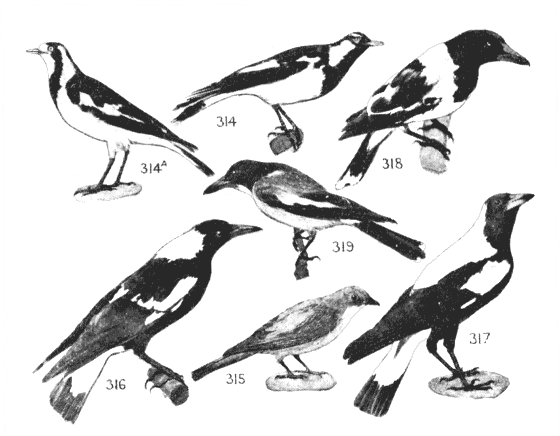
314 Magpie-Lark, Murray (Little) Magpie (e), Mudlark (e), Soldiers, Peewee (e), Peewit (e), Pugwall, Grallina picata, A., T. (acc).
Stat. v.c. (near water) open, timber 10.5
Black and white; slender stilt-like legs; throat white (f.), black (m.); mud nest. Insects, pond-snails. "Pee-wee."
10 10
315* Gray Shrike-Thrush (Harmonious), Gray (Native) Thrush, Pluff, Mourner, Colluricincla harmonica, E.A., S.A.
Stat. c. timber 9.5
Gray; back umber-brown; face whitish; under lighter: f., throat streaked dusky. Insects. Powerful swelling harmonious note.
F. 133. Aerocharidae, 1 sp. E. (Madagascar).
F. 134. LANIIDAE (42), SHRIKES, 313 sp.—134(132)A., 36(22)O., 33(10)P., 140(127)E., 6(6)Nc., 1(1)Nl.
5 5
316 Black-backed Magpie, Piping Crow-Shrike (Varied), Organ (Flute) Bird, Singing White Crow (e), Gymnorhina tibicen, E.A., S.A., W.A.
Stat, v.c. open 17
Black; hind-neck, upper under base tail, patch on wing white; f., grayish instead of white. Insects. "To describe the note of this bird is beyond the power of my pen." (Gould.) "Wonderfully modulated whistle ... unequalled among European birds." (Alfred Russel Wallace).
317 White-backed Magpie (Crow-Shrike), G. leuconota, N.S.W., V., S.A., C.A., W.A.
Stat. v.c. open 18
Upper white, except head, tip-tail, wing-quills black; under black; f., back gray. Insects. Glorious carol, see 316.
8 11
318 Black-throated Butcher-Bird (Crow-Shrike), Cracticus nigrigularis, A. exc. N. Ter.
Stat. v.r. timber 13.5
Head, neck, chest black; hind-neck, centre-wing, rump, under white; tail black, side tipped white; f., sim. Insects, mice. One of the best of songsters, rich notes.
319* Australian Butcher-Bird (Shrike), Collared Crow-Shrike, Derwent (Tasmanian, Whistling) Jackass, Durbaner, C. destructor, E.A., S.A., W.A.
Stat. v.c. timber 11.2
Head, neck black; back gray; side hind-neck, upper base tail, patch on wing white; under grayish-white; f., duller. Insects, mice, birds. Fine song (autumn); rich notes.
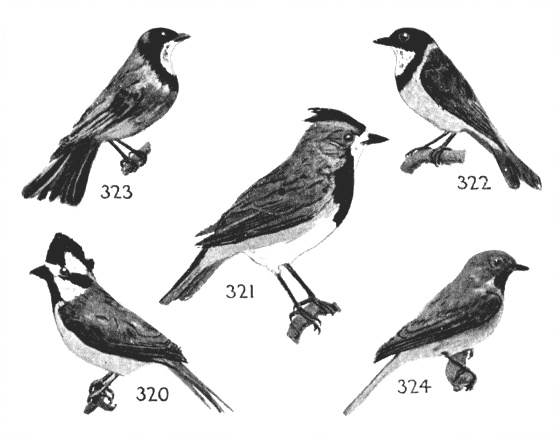
3 3
320* Yellow-breasted Shrike-Tit (Yellow-bellied, Frontal, Crested), Falcon-Shrike, Falcunculus frontatus, E.A., S.A.
Stat. r. timber 7.5
Upper green; crest, throat, line through eye black; patch above eye, patch below eye white; under bright-yellow; strong hooked bill; f., throat green. Insects. Musical notes.
1 1
321* Crested Bell-Bird, Oreoica cristata, A.
Stat. c. timber 9
Upper brown; top of head black, side-head gray; white on face, throat; black from eye to black chest band; abdomen white tinged sandy-buff; f., duller. Caterpillars, insects. Bell notes, ventriloquist.
20 88
322* Golden-breasted Whistler, White-throated Thickhead, Thunder-Bird, Cutthroat, Coachwhip-Bird (e), Pachycephala pectoralis (gutturalis), E.A.
Stat. c. timber 7
Throat white; black head, band on chest; outside black band, under golden-yellow; back olive green; f.,* brown; throat whitish faintly streaked dusky. Caterpillars, insects. Fine songster, many melodious calls; whip-like smack ends one of notes.
323* Rufous-breasted Whistler (Thickhead), Little Thrush, Ring Coachman, Coachwhip-Bird (e), P. rufiventris, E.A., S.A., C.A., W.A.
Stat. c. timber 6.7
Upper gray; throat white; head blackish; black side of neck, band on chest; rest under light rufous-brown; f.,* upper brownish-gray; throat white streaked blackish-brown; rest under buff; breast, sides streaked blackish-brown. Insects, caterpillars, wild berries. Famous songster; whip-like smack at end of one of its calls.
324 Red-throated Whistler, Gilbert Thickhead, P. gilberti, N.S.W., V., S.A., W.A.
Stat. v.r. timber 7.2
Dark-gray; black before eye; throat dull rust-red; under gray; f., no black on face; throat gray. Insects. Clear whistling note.
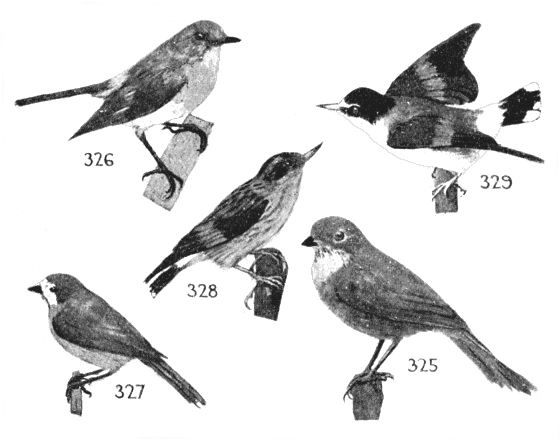
325 Olive Whistler, Olivaceous Thickhead, P. olivacea, N.S.W., V., T., Bass St. Is.
Stat. r. humid scrubs 8
Olive brown; head dark-gray; throat whitish marked brown; faint gray band across chest; under reddish-brown; f., no band on chest. Insects. "Liquid, whistling note."
6 8
326* Yellow-breasted Shrike-Robin, Yellow Robin (e), Wild Canary (e), Eopsaltria australis. N.S.W., V.
Stat. c. timber 5.3
Dark-gray; upper base tail olive-yellow; throat grayish-white; under bright yellow. Tame, perches on side of sapling; f., sim. Insects. Piping note often repeated.
Order XXI. (continued)
In Family 135—Titmice or Tits—Australia has but five representatives—the peculiar Wedgebill, "Kitty-lin-tof," and the four Australian "Whitefaces." The Whiteface is "lively, with sweet chirping notes." Its former scientific name (Xerophila) means "dry lover," for it is found mainly in the drier parts.
The European Tits belong to this family, so it is not desirable to use the name "Tit" for the Australian birds of the genus Acanthiza, for they belong to the Warbler family (Sylviidae), and not to the Tit family (Paridae).
The Nuthatches of the Old World and America are represented by closely-related birds, with somewhat similar habits, in Australia. These run spirally down a tree-trunk, searching every crack or piece of bark. Eight of these birds occur in Australia. Latham called them Nuthatches. It is now proposed to return to this name, as it is used for the British, Indian, and North American birds of this family (Sittidae).
The male Black-capped Nuthatch (Tree-runner) is true to name, but the female has the head and hind-neck black, instead of a black cap only. Nuthatches are not found in Tasmania. Possibly Bass Strait was formed before they reached Southern Victoria. Thus bird-study supports the geographer and ethnologist when they declare that Bass Strait is of comparatively remote formation. As the Tasmanian blacks were ignorant of boats, they evidently reached Tasmania before Bass Strait was formed. They are a more primitive type than the Australian blacks, who were improved by later influxes of more highly-developed Caucasians.
Many country dwellers will not admit that there is no Woodpecker in Australia, but it is a fact, nevertheless. Our so-called "Woodpecker" is the Tree-Creeper. It never chisels mortice-holes in a tree to get out a grub, as the true Woodpecker does. These birds occur all over the continent, and are often to be seen alighting on the side of a tree or fence post and then running up spirally to the top. They soon fly off to another tree, alighting lower than the place they started from. The bright-brown band on the wing is conspicuous as they fly. Their lively notes brighten a country drive.
The White-eye is one of a large genus, for no less than 157 species have been accepted by Dr. Sharpe. However, one of the rarest of these was a Victorian species. It was based on one specimen, a female, taken at Marong, near Bendigo. It was said to be slightly different from the common White-eye. Hence Dr. Horne, of Clifton Hill, one of our most enthusiastic bird-lovers, created a new species, and named it in honor of his niece, Miss Bowie, who is a favorite with all the birds in Dr. Horne's extensive aviaries. White-eyes are found from Africa and Madagascar to India and Japan, and from Australia out past New Zealand.
Our common White-eye is one of the interesting birds of the world at the present time, for it is showing that man is not the only animal with a colonizing instinct. It was unknown in New Zealand until, in 1856, it was first recorded. The Maoris, keen Nature-students, who have a name for every native animal and plant, called it the "Stranger." Its presence has been accounted for by some authorities as being due to the fierce winds that accompanied Black Thursday having blown it over from Australia. However, not satisfied with spreading throughout New Zealand until it is said to be the commonest bird there, it has spread out to Chatham Island, and a flock was reported recently a considerable distance from the coast, apparently looking for fresh fields, or rather islands, to colonize. It is a well-known city dweller. Though it destroys grapes and other soft fruits, it also so completely destroys aphides that it is appropriately called the Blight-Bird. Again, the balance is strongly in its favor, for it is probably but taking fair toll of that which will probably not have reached maturity but for its labors, and the laborer, even if a bird, is worthy of his hire.
A bird's color usually affords it protection from its natural enemies. These are mainly birds of prey flying overhead. Thus, speaking generally, protective coloration applies only to the upper surface, so that a white throat or under surface does not necessarily render a bird conspicuous to its natural enemies.
Again, a bird may be very conspicuous when seen away from its natural surroundings, but the concealment may be perfect under natural conditions. It has been already mentioned that the gorgeous Blue Mountain Lorikeet was very difficult to discern in its native sugar-gums. A tiger is said to be invisible at a distance of ten yards in a jungle; the black stripes being similar to the shadows of the bamboos, and the light bands to the sunlight between the vegetation.
The White-eye and Tree-Creepers just noticed may be considered protectively colored, for they are difficult to see in a tree. Still, the brown patch on the wing of the Tree-Creeper is conspicuous as it flies. Alfred Russel Wallace, the great evolutionist, supplied a good explanation, when he regarded bright wing bands, white rump, and white-tipped tail, as "warning colors." An enemy is, perchance, perceived by a bird. This individual flies away quietly; others see the bright wing patch disappear, and they seek shelter as quickly and quietly as possible. This is often a great advantage, for, in many cases, all reach safety, possibly, before the enemy has seen one of them. If the first bird had given an alarming call, it would have warned the enemy too.
It is noteworthy that these bright markings on the upper surface are, usually, not visible when the bird is at rest. The white wing patch folds in, the white rump is covered, while, in a white-tipped tail, it is usual for the two centre feathers to be plain throughout (see illustrations of species 313 and 329). The tail is folded, and the white tips are covered by the two non-white centre feathers. The introduced Indian Turtle-Dove, common about nearly every city in Australia, shows the spread-out, white-tipped tail splendidly when flying. The bird itself is barely visible if it settles in the shade or on the soil. The Indian Myna, a city bird, has both white wing-patch and white-tipped tail.
This explanation is also applied to other wild animals; thus many Deer have the white patch on the hind quarters. Other Deer, seeing this warning signal displayed in flight, immediately make for safety. Similarly, Wallace has explained the white tail of a Rabbit.
The Skunk also has this white patch on the hind quarters, but here a different explanation is required, for the Skunk does not trouble to run away when a possible enemy appears. The bright color is here regarded as an "advertizing color." The Skunk has other means of protection, and he is labelled dangerous or objectionable, just as our one poisonous Spider is plainly labelled dangerous by means of a red stripe. An inexperienced enemy may rush at the Skunk, but the means of protection enjoyed by it effectively protects it, and the enemy retires.
It is a rule recognized by collectors that conspicuous animals have generally some effective means of protection, and they are best left alone, or at least taken with caution. This is readily understood when it is considered that a young, inexperienced chicken will rush at a brightly-colored caterpillar. He then retires, endeavoring to get rid of the objectionable taste. For the future, he avoids brightly-colored animals. Thus the bright color is an obvious advantage to its possessor, as it saves a dangerous peck. It is also an advantage to its enemies, for it saves them an unpleasant experience. We are told the Parrot is the only bird with a sense of taste, but it seems that the chicken possesses one also.
Still another phase of color is shown by Diamond-Birds, where three species have a yellow spot, a red spot, or an orange spot respectively on the wing. It is also shown by the Red-breasted Robins. One has a white forehead, one a white cap, and the third a red cap. These colored patches are considered to be recognition marks, so that a bird can recognize its mate, or a bird of its own kind, readily and with certainty.
That rarely-seen, but beautiful, bird, the Mistletoe-Swallow, is fairly common. From several points of view, it is of great interest. Ranging from India, through Malaysia, to Australia, it did not reach Tasmania. Possibly Bass Strait was formed before this bird reached Southern Victoria. Interesting, also, is the fact that no mistletoe is found in Tasmania. This bird is closely associated with the mistletoe, for, wherever you find it, you find the mistletoe. It furnishes another example of those interesting partnerships between animals and plants. It is not related to Swallows, but while it sits on a bough, its external form somewhat resembles that of a Swallow. Its nest is one of the most beautiful of all nests—a finely-felted, domed structure, often suspended in a clump of mistletoe. This bird has a long-continued, pretty, animated song, which is seldom heard, for it is low, and, as the bird is high in the tree-tops, it might be inaudible; but the main reason is probably that our ears are not attuned to pick out these fine songs. It is said that Tyndall found the insects on the Alps almost deafening, while his companions heard nothing. So it is with the high-pitched call of a Bat. Have you heard one? Few have.
The Mistletoe-Swallow should be called the Australian Flower-Pecker, for it is our one representative of a large genus, best developed in the Indian Region.
Placed at present in Family 141 with the little Mistletoe-Bird are the Diamond-Birds of Australia, the plumage of our common kind of which is "so variegated and beautiful as to render description impossible."
The Diamond-Birds are restricted to Australia. Though they are found mainly in high tree-tops, whence they prettily and continuously call "wit-e-chu" and "wit-loo," some usually nest in a bank of earth. The bank of a dam, the side of a creek, and the earth suspended on the roots of a fallen tree are favorite places. Some people find the continuous, musical note annoying, and have named the Diamond-Bird the Headache-Bird. Others find it entertaining, and syllabize it as "Sweet Dick," or "Sleep, Baby."
Three of these birds are recognized by a small, bright spot on the side of the wing. In one this spot is said to be red, in another it is orange, and in the third yellow. However, Gould said the young of the Red-tipped had the orange tip, and later investigation seems to be supporting his view, for the Orange-tipped is possibly not a different species, but only a phase of the Red-tipped. One of our bird observers, Mr. F. Wilson, has lately recorded finding the nest of a pair of Pardalotes, of which one was red-tipped and the other orange-tipped. The Yellow-tipped is said to be the commonest bird in Tasmania. These birds are plentifully spotted, "spotted like the pard," hence the name Pardalote, Panther-Bird, or Diamond-Bird.
(continued below)
F. 135. PARIDAE (5), TITMICE, Tits, 206 sp.—5(5)A., 55(48)O., 88(78)P., 32(32)E., 34(28)Nc., 8(5)Nl.
4 4
327* Whiteface, White-faced Titmouse (Squeaker), Aphelocephala (Xerophila) leucopsis, S.Q., N.S.W., V., S.A., C.A., W.A. (interior).
Stat. small flocks, c. plains 4
Upper olive-brown; forehead, face white; under pale-buff; tail tipped white; f., sim. Small seeds. Sweet chirping notes.
F. 136. Chamaeidae, Wren-Tits, 3 sp. Nc. (W.U.S.). The only family of birds restricted to the Nearctic Region.
F. 137. Regulidae, Gold-crested Wren, Fire-crested Wren, Kinglet, 20 sp.—6(5)O., 9(7)P., 1(0)E., 4(2)Nc. 4(2)Nl.
F. 138. SITTIDAE (8), NUTHATCHES, 60 sp.—12(11)A., 21(18)O., 18(16)P., 1(1)E., 10(7)Nc., 3(1)Nl.
8 10
328* Orange-winged Nuthatch (Tree-runner, Bark-pecker), Woodpecker (e), Neositta (Sittella) chrysoptera, E.A., S.A.
Stat. r. open forest 4.5
Head brown; upper gray streaked black; wing dark-brown with rich rufous band; upper base tail white; tail black tipped white; under gray; under base tail white barred brown; bill sharp slightly upturned; f., head darker. Insects. "Chip-chip."
329 Black-capped Nuthatch (Tree-runner, Bark-pecker), Woodpecker (e), N. pileata, N.S.W., V., S.A., C.A., W.A., N.W.A.
Stat. r. open timber 4.7
Grayish-brown; upper base tail white; cap black; quills blackish-brown with rich rufous band; tail black tipped white; forehead, stripe over eye, under white; thighs blackish-brown; f., head, face, hind-neck black. Insects.
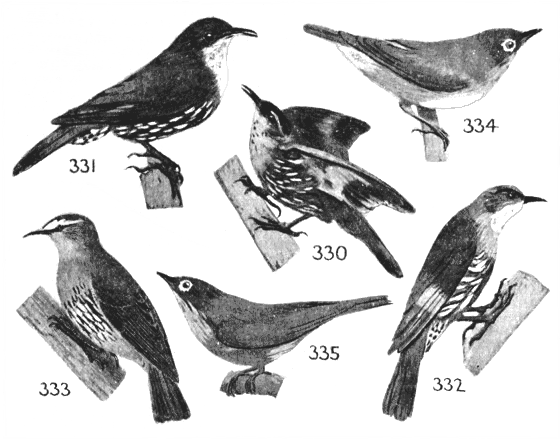
F. 139. CERTHIIDAE (8), CREEPERS, 39 sp.—10(10)A., 13(12)O., 9(8)P., 1(1)E., 5(4)Nc., 3(2)Nl.
9 10
330* Brown Tree-Creeper, Woodpecker (e), Climacteris picumna, E.A., S.A. =vt. Eur. Creeper.
Stat. c. open timber 7.2
Crown blackish-brown; line over eye buff; throat buff with few blackish spots; upper brown; wings banded buff; under grayish-brown; flanks striped white; f., throat chestnut spots. Insects. Sharp piercing cry. Creep up a tree.
331* White-throated Tree-Creeper, Woodpecker (e), C. scandens, S.Q., N.S.W., V., S.A., T.
Stat. c. forest 6.5
Crown sooty-black; back olive-brown; buff band on wing; throat, centre-abdomen white; flanks brownish-black striped white; f., orange spot below ear. Insects. Shrill piping cry. Creeps up.
332 Red-browed Tree-Creeper, C. erythrops, S.Q., N.S.W., V., W.A.
Stat. v.r. rough barked trees 6
Back brown; head blackish-brown; forehead marked dusky-gray; rump, tail gray; buff band on wing; face, stripe above eye rust-red; throat white; under grayish-brown striped white; f., face brighter; throat rust-red, striped white. Insects. Creeps up.
333 White-browed Tree-Creeper, C. superciliosa, Q., N.S.W., V., S.A., C.A., W.A.
Stat. v.r. timber 5.7
Upper brown; wings rich fawn band; broad white stripe over eye; under grayish-brown; abdomen striped white; f., narrow line rust-red above the white eyebrow; tail washed with gray. Insects. Creeps up.
F. 140. ZOSTEROPIDAE (14), WHITE-EYES, Silver-eyes, 171 sp.—83(80)A., 38(34)O., 4(3)P., 50(50)E.
13 157
334* White-eye (Silver, Ring, Glass-), Blight-Bird (Spectacled-), Grape-eater, Silve, Tauhou, Zosterops coerulescens, E.A., S.A., T., N.Z., Chatham Is.
Stat. v.c. open gardens 4.5
Crown, wings, tail olive; back dark-gray; white ring round eye; throat, centre-abdomen, under base tail whitish; flanks chestnut-brown; sometimes throat, side-head yellow; f., sim. Insects, fruit. Pretty lively song.
335 Gray White-eye, Z. bowiae, V. (Marong). One specimen only. Mathews now says it is 334.
Like 334, but gray instead of olive, abdomen darker.
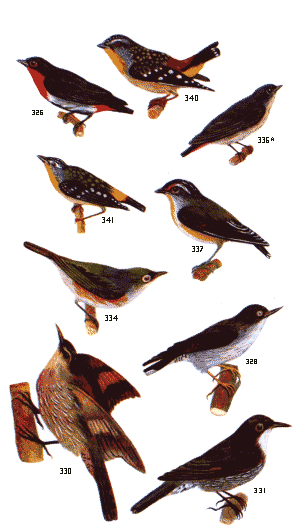
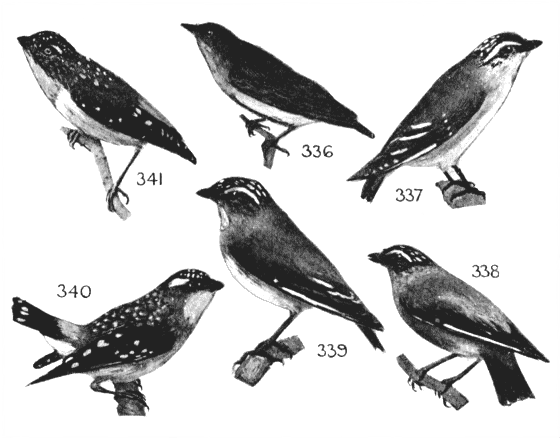
328 Orange-winged Nuthatch 330 Brown Tree-Creeper 331 White-throated Tree-Creeper 334 White-eye 336 Flower-Pecker 336a Flower-Pecker (Female) 337 Red-tipped Diamond-Bird 340 Spotted Diamond-Bird 341 Golden-rumped Diamond-Bird
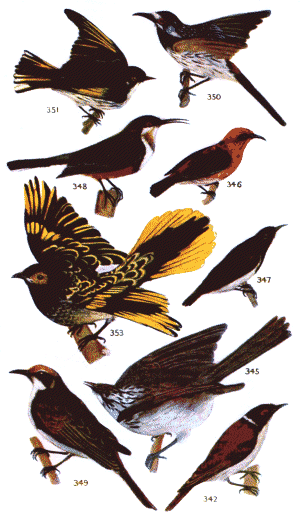
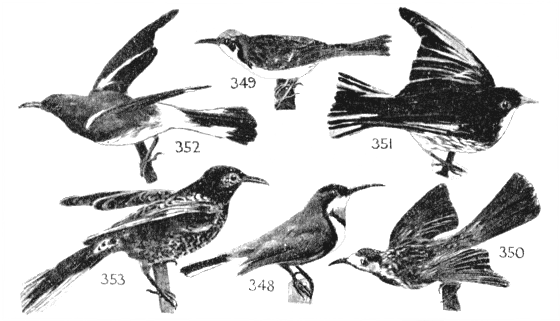
342 White-naped Honey-eater 345 Striped Honey-eater 346 Sanguineous Honey-eater 347 Black Honey-eater 348 Spinebill 351 Painted Honey-eater 349 Tawny-crowned Honey-eater 350 White-fronted Honey-eater 353 Regent Honey-eater
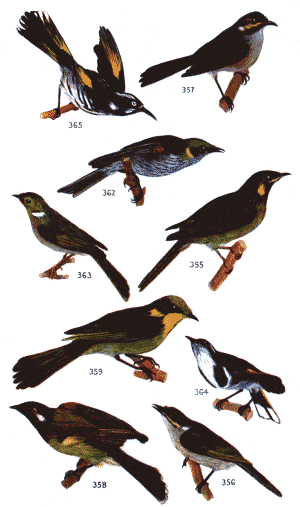
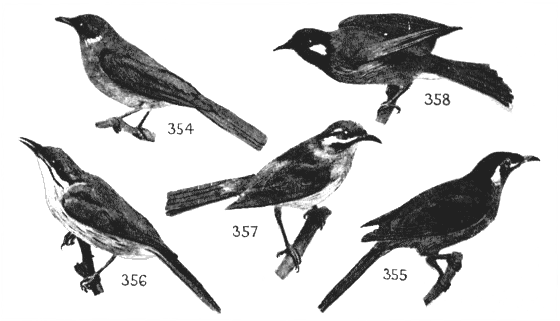
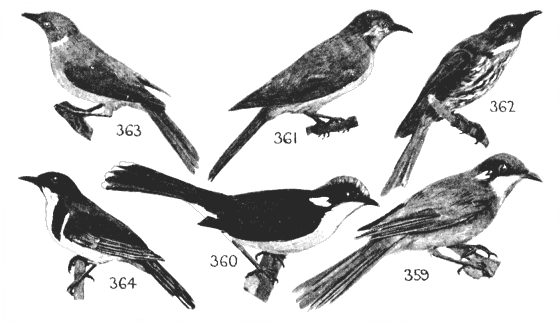
355 Yellow-eared Honey-eater 356 Singing Honey-eater 357 Yellow-faced Honey-eater 358 White-eared Honey-eater 359 Yellow-tufted Honey-eater 362 Yellow-plumed Honey-eater 363 White-plumed Honey-eater 364 Crescent Honey-eater 365 White-bearded Honey-eater
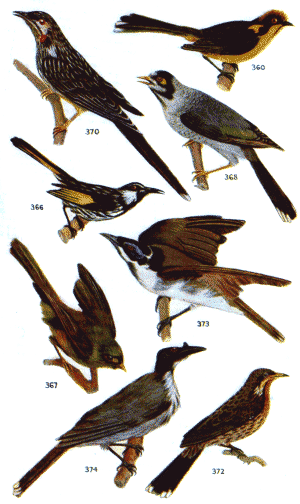
360 Helmeted Honey-eater 366 White-cheeked Honey-eater 367 Bell-Miner 368 Noisy Miner 370 Wattle-Bird 372 Spiny-cheeked Honey-eater 373 Blue-faced Honey-eater 374 Friar-Bird
F. 141. DICAEIDAE (11), FLOWER-PECKERS, 113 sp.—57(57)A., 56(56)O.
1 74
336* Australian Flower-Pecker, Mistletoe-Bird (-Swallow), Dicaeum hirundinaceum, A.
Stat. c. treetops 3.5
Black glossed steel-blue; throat, breast, under base tail scarlet; abdomen white, black patch down centre; flanks dusky; f.,* throat, centre-abdomen buff; under base tail pale scarlet. Honey, pollen, fruits, insects. Pretty, feeble song.
10 10
337* Red-tipped Diamond-Bird (Striated, -Pardalote), Wittychu, Pickwick, Chuck-e-chuc, Pardalotus ornatus, S.Q., N.S.W., V., S.A., W.A.
Stat. c. treetops, scrub 4.2
Crown, wings, tail black spotted, lined white; back gray; rump brown; throat yellow; red spots side of wing, yellow stripe from bill above eye joins white stripe to nape; centre-abdomen white; flanks pale-brown, tinged yellow; f., sim. Insects. "Wit-e-chu."
338 Orange-tipped Diamond-Bird (Ramsay, -Pardalote), P. assimilis, E.A., C.A.
Stat. v.c. treetops, timber 4.3
Like 337, but upper paler; orange spots on wing; as a rule only one feather in the wing edged with white; Gould thought it the young of 337; f., sim. Insects. "Wit-e-chu."
339 Yellow-tipped Diamond-Bird, Allied Pardalote, P. affinis, E.A., S.A., T., Bass St. Is.
Stat. c. timber 4.3
Like 337, 338, but yellow spot on side of wing; head black, striped white; yellow stripe from bill joins white stripe above eye; back grayish-brown; upper base tail olive-brown; tail black, tip spotted white; throat yellow; centre abdomen white; flanks buffy-brown; wings black, tipped white, a few feathers lined white; f., sim. Insects. "Witloo." "Sleep, Baby."
340* Spotted Diamond-Bird (Pardalote), Diamond Dyke (Ground), Ground-Diamond, Diamond Sparrow (e), P. punctatus, T., A. (exc. N.A., C.A.).
Stat. v.c. timber 3.3
Head, wings, tail black, spotted white; white stripe above eye; back grayish-brown, marked buff and black; upper base tail crimson; throat, under base tail rich yellow; abdomen fawn; f., duller; head yellow spots; throat whitish. Insects. "Sleep, Baby," "Sweet Dick."
341* Golden-rumped Diamond-Bird, Yellow-rumped Pardalote, P. xanthopygius, N.S.W., V., S.A., W.A. f., duller. Insects.
Stat. r. timber 3.5
Like 340, but upper base tail golden-yellow; throat, under base tail golden-yellow; rest under buffy-white.
Order XXI. (continued)
The most characteristic family of birds of the Australian region is the Honey-eaters. Flowering eucalypts and other myrtaceous plants, with their honey-bearing flowers and usually inedible fruits, are the characteristic Australian trees; so are these birds, depending so largely on the honey of these brilliant flowers and the insects which visit them, the characteristic Australian birds. The Honey-eaters form a very large family, and are found throughout the Australian region as far as New Zealand and away to the Sandwich Islands, which, zoologically, belong to Australia. Strange it is that only one species should have spread to the west across Wallace's line to the island of Bali. These birds are provided with a brush tongue, which is used in brushing up honey from the flowers. They have usually a long, slender, curved bill, suitable for exploring flowers. Their feet are well developed and strong, for they are used while hanging in all sorts of positions as the flowers are explored. No less than eighty-eight Honey-eaters are found in Australia, but they are often restricted to very limited areas, so that no district would contain many kinds of these birds. Many are well known, though not by the name Honey-eater. Who does not know the harsh note of the Wattle-Bird (Wattled Honey-eater)? Again, who does not often meet the Noisy Miner (Garrulous Honey-eater), a bird that makes such a fuss when a snake appears that he is sometimes called the Snake-Bird? Is there a city boy who does not know the Greenie (White-plumed Honey-eater)? Some of the Honey-eaters are amongst the most beautiful of birds.
The Regent (Warty-faced) Honey-eater is a glory, and is often figured in British books as one of the world's beautiful birds.
The Helmeted Honey-eater is very rare, and is probably confined to the deep forests of Gippsland. It is one of the most splendid of Honey-eaters.
That active city-dweller, the Greenie, is found in almost every large eucalypt that happens to be in flower. It is pugnacious. As it busily brushes honey from the flowers, or catches an insect on the wing, the white ear plume can be seen. Otherwise, it has not conspicuous colors. Its lively call of "chick-oo-wee" adds something to life for the busy city toiler.
Now come the Miners. The Noisy Miner is known to nearly everyone. It is a common visitor to school grounds at lunch time, and is a noisy bird that is little loved by sportsmen, for it persists in alarming all game within reach. A second Miner is famous as the Bell-Bird, better Bell-Miner. The tinkling notes, "like silver bells from a distant shrine," must be heard in a deep fern gully to be appreciated fully. The green birds are seldom seen. Kendall has immortalized this bird in his beautiful poem, "Bell-Birds."
The Wattle-Bird is known to all. It is a pugnacious bird, and has a rough, disagreeable note. It has a small wattle of naked red flesh hanging at the side of the neck, hence the name. The bold, pugnacious Brush Wattle-Bird is not so well known, though its notes are even more remarkable. Both birds to-day are common in the Melbourne Botanic Gardens on the flowering plants in the "Australian" section.
The Spiny-cheeked Honey-eater is said to be a rare bird, but there is probably not a park about Melbourne but has some of these at present, as well as all through the winter. It is somewhat similar in build and habits to the Wattle-Birds, but is an elegant and attractive bird, with many peculiar notes.
The Blue-eye (Blue-faced Honey-eater) is a conspicuous bird in country districts. He is noisy, and is handsomely attired. His nesting habits are peculiar, for he often builds in the deserted nest of a Babbler.
The remarkable Friar-Bird has a naked, dark-blue head, and is an "impudent and daring" bird, that does not hesitate to steal fruit. Its loud call has been variously interpreted as "Four o'clock," "Pimlico," or "Tobacco-box." This bird has a hump on its long curved bill. The Yellow-throated Friar-Bird, when young, has yellow on the end of the throat feathers, and has no hump on the bill. It is a summer visitor to Southern Australia.
The well-known Ground-Lark, or Australian Pipit, is the Australian representative of the cosmopolitan family (147) of Pipits. Even New Zealand has its representative of this family. The Wagtails of Britain and North America belong to this family, whereas the so-called Australian Wagtail is a flycatcher. Like the other members of its family, our Ground-Lark, or Pipit, sometimes sings beautifully as it soars.
The Skylark of Britain comes in the next family (the Alaudidae), which is almost cosmopolitan. This beautiful songster, singing at Heaven's gate, pours forth a flood of melody. The man who has these delightful songsters on open land near his home is indeed fortunate. Australia has its representative of this family—the Bush-Lark, a bird so remarkably like the Australian Pipit in external appearance that it is well-nigh impossible to distinguish them in the field. The Bush-Lark, however, is "shorter, plumper, and has a stouter bill." It further has a peculiar, greatly undulating flight. It mounts up, then sinks, then mounts, and so on alternately, "singing all the time very melodiously, but with a weaker strain than that favorite bird" (the British Skylark).
Four introduced Finches have succeeded in establishing themselves in Southern Australia. The Greenfinch is spreading, though slowly. A specimen was recently sent in from Horsham, in Western Victoria. The Goldfinch, "one of the prettiest birds in Britain," is spreading rapidly. It is often to be seen on thistles, for it destroys their seeds.
The Tree-Sparrow is rare as yet, but the House-Sparrow is already a serious pest, though probably he has not been valued highly enough as a weed destroyer. However, it was a pity early colonists did not take notice of Gould's protests and warnings, for possibly the greatest harm introduced birds do is the displacing of native birds.
(continued below)
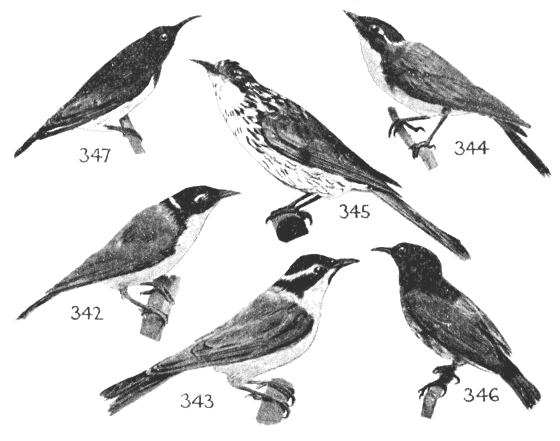
F. 142. NECTARINIIDAE (1), SUN-BIRDS, 234 sp.—36(33)A., 77(74)O., 2(1)P., 123(122)E.
F. 143. Promeropidae, Promerops, 2 sp. E. (S. Afr.)
F. 144. MELIPHAGIDAE (88), HONEY-EATERS, Honey-Suckers (-Birds), 251 sp.—250(250)A., 1(1)O.
11 11
342* White-naped Honey-eater (Lunulated), Blackcap, Melithreptus atricapillus, S.Q., N.S.W., V., S.A., Kent Group.
Stat. v.c. timber 5.5
Upper yellowish-olive; quills brown; head, hind-neck black; narrow white band on nape; under white; naked patch about eye orange-scarlet; f., sim.; young no black cap. Tame. Honey, pollen, insects. Peevish, half-whistling note.
343 Black-chinned Honey-eater (Black-throated), M. gularis, E.A., S.A., W.A.
Stat. r. timber 6.7
Upper olive-yellow; head, nape black; whitish band on nape joins white band up to eye; sides of throat white, centre blackish; chest grayish; sides creamy; centre-abdomen white; naked skin about eye turquoise-blue; f., sim. Honey, insects, seeds. Sweet song.
344 Brown-headed Honey-eater (Short-billed), M. brevirostris, E.A., S.A., W.A.
Stat. r. timber 5.7
Greenish-olive upper; quills brown; head, nape dark-brown; whitish band on nape continued as brownish-white band on head; under creamy; bare skin about eye greenish-blue in winter, dull yellow (delicate flesh-tint) in summer; f., sim. Honey, insects. Rough, rattle-like note.
1 1
345* Striped Honey-eater (Lanceolated), Plectoramphus lanceolatus, E.A., S.A., W.A. (inland).
Stat. r. timber 8.8
Upper grayish-brown, striped blackish-brown; wing-quills brown, edged lighter; throat white; under, upper base tail white; black marks side of neck, flanks. Honey, insects. Cheerful, loud whistle, "Chirp, chirp, cherry, cherry."
6 52
346* Sanguineous Honey-eater (Blood), Humming-Bird (e), Blood-Bird, Myzomela sanguinolenta, E.A. (coastal).
Nom. r. thick bushes, heath 4.3
Head, neck, breast, back, upper base tail rich shining scarlet; side-face, wings, tail black, wings lined lighter; abdomen buff; f., light brown, lighter below. Pollen, honey, insects. Beautiful song.
347* Black Honey-eater, M. nigra, A. exc. N. Ter. (interior).
Mig. v.r. plains 4.4
Black; side abdomen, under base tail white; f., brown; under dull-white; breast marked dark-brown; under base tail white. Insects. Plaintive song.
4 4
348* Spinebill, Spinebill Honey-eater, Humming-Bird (e), Cobbler's Awl, Acanthorhynchus tenuirostris, E.A., S.A., T., Bass St. Is.
Stat. c. Banksias, heath 6.5
Crown, line to crescent on side of chest, wings, tail black; chest white, chestnut-brown patch on throat; back brown; abdomen light chestnut-brown; outer tail tipped white; eye scarlet; f., duller. Insects, honey. Monotonous strong call.
4 12
349* Tawny-crowned Honey-eater (Fulvous-fronted), Gliciphila melanops (fulvifrons), S.Q., N.S.W., V., S.A., W.A., T., Bass St. Is.
Stat. c. sandy, heathy 7
Upper ashy-brown; crown tawny, blackish line from bill past eye down side of breast; buff spot behind ear; throat, abdomen white. Insects, honey. Plaintive notes.
350* White-fronted Honey-eater, G. albifrons, N.S.W., V., S.A., W.A., T. (inland).
Stat. c. dry scrubs 5.7
Upper grayish-brown; crown, throat black; forehead, behind ear white; abdomen white, streaked dark-brown. Insects, honey. "Tink-tink."
1 1
351* Painted Honey-eater, Entomophila picta, N.S.W., V., S.A. (inland).
Stat. v.r. plains 5.5
Upper black; band on wings, side tail yellow; tip tail white; abdomen white, faintly streaked brown; f., smaller. Insects.
1 1
352 Pied Honey-eater, Certhionyx variegatus, N.S.W., V., S.A., C.A., W.A., N.W.A.
Stat. v.r. dry scrubs 6.5
Black and white; head, throat, back, wings, tip-tail black; rest white; f., light-brown upper; under whitish, throat buffy, streaked dark-brown. Pollen, honey, berries.
1 1
353* Regent Honey-eater (Warty-faced), Turkey-Bird (Mock Regent), Flying Coachman, Meliphaga phrygia. S.Q., N.S.W., V., S.A.
Nom. flocks r. eucalypts 9.2
One of the most beautiful of birds; see colored plate; richly contrasted black and yellow; warty patch about eye; pugnacious; f., sim. Ringing "Clink-clank."
27 53
354 Fuscous Honey-eater, Ptilotis fusca, S.Q., N.S.W., V., (exc. dry parts).
Stat. c. open forest 6.2
Grayish-brown, quills dark-brown, edged yellow; a circle blackish feathers round eye; pale yellow ear tufts; under whitish, chest faintly streaked brownish; f., smaller. Insects, honey.
355* Yellow-eared Honey-eater (Lewin), P. chrysotis, E.A.
Stat. c. humid scrubs 9
Upper olive-green, under lighter; large bright yellow ear tufts; gape straw-white; about eye blackish. Insects, honey. Quavering whistling notes.
356* Singing Honey-eater (Large-striped), P. sonora, A. exc. extreme N.
Stat. c. forest, scrub 7.5
Upper brown; black stripe through eye to side of neck; faint yellow band below black stripe; bright yellow ear patch, behind this a small white patch; throat whitish; under gray, faintly streaked blackish; f., sim. Insects, berries. Loud calls.
357* Yellow-faced Honey-eater (Yellow-gaped), Chick-up, Love-Bird (e), P. chrysops, E.A., S.A.
Stat. c. scrub 6.8
Ashy-brown; two black lines along side of face, bright yellow band between these to ear tufts; spot of white behind ear; throat grayish-white; chest ashy-brown; f., sim. Insects, honey. Strong musical call.
358* White-eared Honey-eater, P. leucotis, S.Q., N.S.W., V., S.A., W.A.
Stat. c. scrub, timber 8
Fine, showy bird; upper, abdomen yellowish-olive; head dark-gray; throat, chest black; ear patch pure white: f., smaller. Insects. Loud ringing note.
359
*
Yellow-tufted Honey-eater
(Golden-tufted, Black-faced, Spectacled), Yellow-Whiskers,
P. melanops (auricomis)
, S.Q., N.S.W., V.
Stat. c. eucalypts 7.8
"One of the most beautiful of birds," crown olive-yellow; throat, about ear bright yellow; black from bill, round eye above ear; upper dark-brown; under yellow; f., smaller. Insects, honey. Varied, high-pitched notes.
360* Helmeted Honey-eater, P. cassidix, V.
Stat. r. forest 8.5
"This splendid" Honey-eater; greenish-black; head black; crown, ears, under yellow; tail tipped white; about eye black; f., smaller, paler. Insects.
361 Wattled-cheeked Honey-eater, P. cratitia, V., S.A., W.A.
Stat. r. eucalypts 7
Crown gray; upper olive-green; tail, wings brown; about eye, ear black; narrow yellow line below black; from bill to side of neck naked lilac skin; under olive yellow; f., smaller. Pollen, honey.
362* Yellow-plumed Honey-eater (Graceful), P. novae-hollandiae (ornata), N.S.W., V., S.A., W.A.
c. scrub 6.5
"Elegant bird;" upper olive-brown; under grayish-white, streaked brown; yellow ear-tuft; f., sim. Honey, insects. Loud ringing note.
363* White-plumed Honey-eater, Greenie, Linnet (e), Chickoowee; Ringeye (e), Ringneck (e), Australian Canary (e), P. penicillata, E.A., S.A., W.A.
Stat. v.c. gardens 6.7
Grayish-brown, tinged olive; under light yellowish-brown; long white ear plumes, sometimes not seen until the head is moved; f., smaller. Insects, pollen, honey. Loud ringing notes; "Chick-oo-wee."
5 6
364* Crescent Honey-eater (Horseshoe, Tasmanian), Egypt, Meliornis pyrrhoptera (australasiana), N.S.W., V., S.A., T.
Stat. c. forest, heath 6.2
Upper dusky black; black bar each side of breast; under white; flanks dusky; wings, tail marked golden-yellow; side-tail spotted white; f., dusky-brown, faint yellow on wings and tail. Loud varied calls, "Egypt."
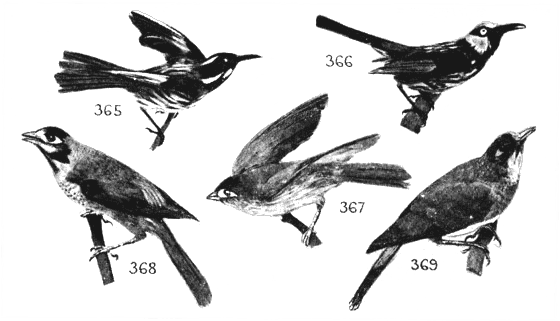
365* White-bearded Honey-eater (New Holland), Yellow Wings, M. novae-hollandiae, S.Q., N.S.W., V., SA., T.
Stat. v.c. scrubby, Banksias 7.2
Blackish-brown, marked white; much yellow on wings; tail black, margined yellow, tipped white; line side of nape, cheeks, behind ear white; f., sim. Insects, honey.
366* White-cheeked Honey-eater, M. nigra (sericea), S.Q., N.S.W., V., W.A.
Stat. r. scrub, undergrowth 7
Like 365, but forehead white; large tuft of white plumes on side of head; tail not tipped white; f., smaller. Insects, honey. Clear double whistling note.
1 1
367* Bell-Miner, Bell-Bird, Manorina melanophrys, E.A. f., sim. Insects. Bell note, "Tink."
Stat. r. dense gullies 7
Olive-green; bright yellow patch between eye and bill; small red patch behind eye; forehead, about eye black.
4 4
368* Noisy Miner, Garrulous Honeyeater, Snake-Bird, Cherry-eater, Soldier, Micky, Squeaker, Myzantha garrula, E.A., S.A., T.
Stat. v.c. open forest 10
Gray; marked whitish on hind-neck, marked dusky-gray chest; crown, about eye, ear, chin black; wing tinged yellow; tail tipped white; legs, bill, skin behind eye bright yellow; f., smaller. Insects, fruit, honey. Noisy.
369 Yellow-throated Miner, M. flavigula, E.A., S.A., C.A. W.A. (inland).
Stat. r. timber 10
Gray; hind-neck marked whitish, chest marked brown; rump, tip tail white; naked space behind eye; forehead, throat, bill, legs yellow; a little olive-yellow on wing, base-tail; f., smaller. Insects, honey.
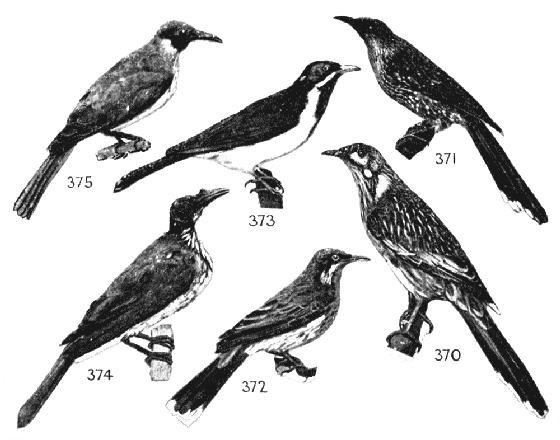
2 2
370* Wattle-Bird, Red Wattle-Bird, Gill-Bird, Wattled Honey-eater, Mutton-Bird (e), Acanthcchaera carunculata, S.Q., N.S.W., V., S.A., W.A.
Stat. c. timber 14.5
Brown streaked, lined white; red wattle ¼in.; whitish below eye, between shoulder and gill; wing quills and tail tipped white; centre abdomen yellow; f., smaller. Insects, honey. "Kwock, kwock;" "Up with the rag." Many curious guttural notes.
2 2
371 Brush Wattle-Bird, Mocking-Bird, Mocker, Cookaycock, Anellobia chrysoptera (mellivora), S.Q., N.S.W., V., S.A., T.
Stat. c. timber 12
Brown, lined white; quills lined, tipped white; tail tipped white; throat whitish; no wattle; f., smaller. Showy, pugnacious, many curious notes.
1 1
372* Spiny-cheeked Honey-eater, Acanthagenys rufigularis, A.
Nom. c. timber, scrub 10
Upper dusky-brown; white spiny feathers, below eye to ear; throat, chest rufous; abdomen whitish, streaked dusky-brown; tail tipped white; f., sim. Insects, honey. Many peculiar loud notes, a plaintive trill.
3 3
373* Blue-faced Honey-eater, Banana-Bird, Blue-eye, Entomyzon cyanotis, E.A., S.A.
Stat. c. timber 12
Attractive, beautiful; upper golden olive-green; head, hind-neck black; throat dusky; line on hind-neck, side throat, under white; about eye blue; f., sim. Insects, honey. Loud monotonous call.
3 8
374* Friar-Bird, Monk, Leatherhead, Four-o'-clock, Pimlico, Poor Soldier, Tropidorhynchus corniculatus, E.A., S.A. Insects.
Nom. c. open forest, orchard 13.2
Head naked, ink-black; knob on bill; brown; tail tipped white; silver-white lanceolate feathers on throat; f., sim. Noisy, "Tobacco-box," "four-o'-clock." Fruit.
2 12
375* Yellow-throated Friar-Bird, Little Leatherhead, Philemon citreigularis, N. Ter., E.A., S.A., N.W.A.
Nom. r. timber 10
Upper brown; under pale brown; throat yellow (young), white (adult); the colored plate shows a young bird; the adult loses yellow on throat, black on face, grayish marks on back, and becomes "one of the plainest of birds"; f., similar to adult male. Insects, berries, honey. "Five-o'-clock."
F. 145. Mniotiltidae, American Warblers, 231 sp.—2(0)P., 80(12)Nc., 219(151)Nl.
F. 146. Drepanididae, Sandwich Island Honeyeaters, 40 sp. A.
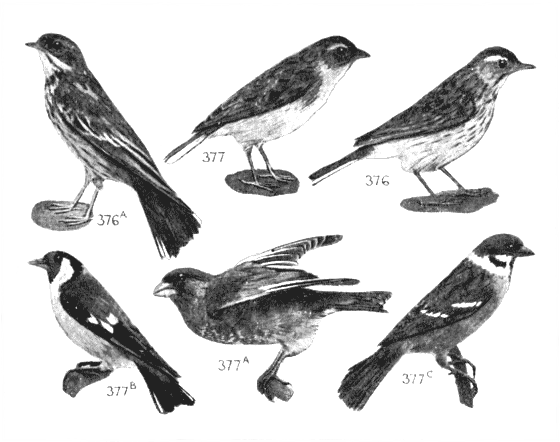
F. 147. MOTACILLIDAE (2), Pipits, Wagtails, 107 sp.—11(6)A., 32(6)O., 53(12)P., 49(32)E., 7(1)Nc., 11(9)Nl.
1 55
376* Australian Pipit, Ground-Lark, Anthus australis, A., T. =vt. Eur. Pipit.
Part-Mig. v.c. grass 7
Upper dark-brown, feathers edged lighter; buff stripe above eye; under white streaked dark-brown; most streaked on chest; outer-tail white; f., sim. Insects, small seeds. Sometimes soars singing melodiously.
F. 148. ALAUDIDAE (4), Larks, Skylark, Horned-Larks, Shore-Larks, 224 sp.—6(6)A., 45(29)O., 69(48)P., 108(99)E., 18(10)Nc., 11(4)Nl.
1 12
376a Skylark, Alauda arvensis, Eur., N. Afr., V. (introduced).
Mig. c. grass 7
Upper warm-brown mottled, streaked darker; stripe over eye lighter; throat, chest brownish-buff, streaked brown; abdomen yellowish-white; f., smaller. Insects, seeds. Sings soaring; famous songster.
4 45
377* Bush-Lark, Horsfield Bush-Lark, Skylark (e), Mirafra horsfieldi, E.A., W.A.
Stat. r. grass 5.3
Like 376, but plumper, shorter; bill stouter, almost finch-like; f., sim. Insects, small seeds. Sings melodiously soaring, also on moonlight nights; "one of our most pleasing songsters."
F. 149. Catamblyrhynchidae, 2 sp. Nl. (Peru).
F. 150. Fringillidae, Finches, Grosbeak, Bullfinch, Bunting, Cardinal (Am.), Crossbill, Chaffinch, Linnet, Redpoll, Canary, 1087 sp.—129(83)O., 202(138)P., 107(96)E., 191(125)Nc., 529(474)Nl.
1 10
377a Greenfinch, Green Linnet, Ligurinus chloris, Europe to Persia, V. (introduced).
Stat. c. fields, gardens 6
Upper olive-green; golden-yellow eyestripe; tail yellow base, black tip; wing dark-brown, lined bright yellow; under greenish-yellow, darker on flanks; f., much duller. Seeds. "One of the prettiest of British songsters."
1 11
377b Goldfinch, Thistle-Finch, Carduelis carduelis, Europe, Canary Is. to Egypt, to Persia, Siberia, V. (introduced).
Stat. v.c. fields 5
Crown black; face, chin red; behind eye, throat, under, upper base tail white; bright yellow on wings; f., sim. Thistle seeds, insects. Loud, sweet song; "twit-it."
2 56
377c Tree-Sparrow (Mountain-), Passer montanus, Eur., N. Asia, A. (introduced).
Stat. r. trees 5.6
Like 377d, but head, nape chestnut; black ear patch in centre of a large white patch; two white bars on side of wing; shier; f., sim. Seeds, insects. Chirps.
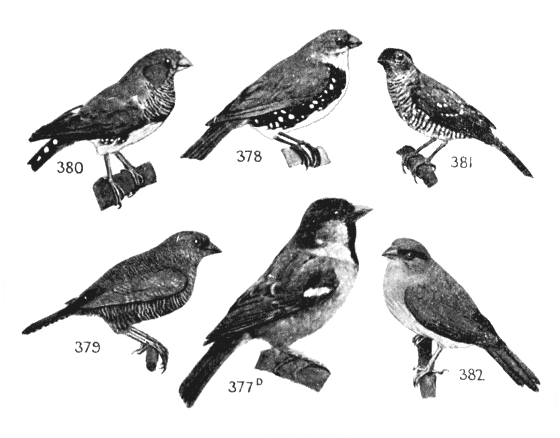
377d House-Sparrow, P. domesticus, Eur., Siberia, A. (introduced).
Stat. v.c. houses 5
Crown, nape bluish-gray; behind eye, side neck broad chestnut band; upper brown; one white bar on wing; cheeks, throat black; under whitish; f., duller; darker below; no black throat. Seeds, insects. Chirps.
F. 151. Coerebidae, Honey-Creepers, 93 sp.—1(0)Nc., 93(92)Nl.
F. 152. Procniatidae, 1 sp. Nl.
F. 153. Tanagridae, Tanagers, 424 sp.—6(0)Nc., 424(418)Nl.
Order XXI. (continued)
Gould placed the Australian Finches in the same family as the Sparrow—the Fringillidae—which includes also the Linnet and the cage Canary. Most writers now put them in with the Weaver-Birds or Weaver Finches (family Ploceidae). Twenty-three Finches have been recorded from Australia. All have the well-known Finch bill, adapted for shelling seeds, and all are seed-eaters, though some occasionally take insects in addition.
The Spotted-sided Finch is true to name, as a glance at the illustration shows. The rare Fire-tail is beautifully and closely banded below, while the Chestnut-eared Finch is banded on the throat and chest. The Plum-headed Finch has a deep crimson forehead, and is banded below.
The Red-browed Finch is often called the "Firetail," for it has the red rump as well as the red brow and bill, but the under surface is not banded. These birds usually build a very large nest, which has been compared to a "stocking hung by the toe, while the eggs are laid in the heel, and entrance is gained through the leg."
The introduced Starling has firmly established itself, and is extending its range rapidly. Incredible numbers gather at lagoon-sides to roost in the reed-beds.
This bird is a favorite with farmers and graziers, but orchardists view its rapid increase with alarm. It is possible, as Mr. C. French, Government Entomologist, has pointed out, that the Starling will yet prove a more expensive pest than the Rabbit.
Starlings, at least, upset the balance of nature, for, by occupying all available nesting sites, early and late, they displace the native birds. Kingfishers, Parrots, and other birds that nest in hollows are thus being driven away from their old haunts.
The Australian Oriole is a member of the family of true Orioles. The Fig-Birds of Queensland towns are closely related. The members of this family are restricted to the Eastern Hemisphere. Our Oriole is an interesting migrant which visits even cities. Its beautiful hanging, cup-shaped nest woven amongst the twigs at the end of a leafy bough is a clever piece of work. Its note is melodious and varied. It often calls "o-ree-ee-o-ole." It is also fond of mimicking other birds.
The Baltimore Oriole, or Golden Robin, is properly not an Oriole, but comes in a related family—the Icteridae—which contains American birds somewhat similar to Orioles. The Australian bird, as shown by the colored illustration, has not the conspicuous golden and black plumage of the European bird.
The Spangled Drongo is the Australian representative of a family of birds spread from Africa, Madagascar, and India up to Japan, and through the islands to Australia. They are a characteristic feature of Indian ornithology, for they are found everywhere in that country. The one Australian bird is a migrant, and seldom reaches Southern Australia. Like other Drongos, it is a glossy black, has a long, forked tail, is a good mimic of other birds' calls, and is also a vicious fighter. It is exceedingly active, and has a disagreeably harsh, cackling, and creaking whistle. It will drive away even hawks and crows.
After the Shining Starlings of Queensland, come the marvellously-beautiful Birds of Paradise—"God's Birds."
These unique birds are found only in New Guinea, Papuan Islands, Molucca Islands, and the rich, tropical coast scrubs of Eastern Australia. One, the Riflebird, is found even down to North-Eastern New South Wales.
The Federal and State Governments are doing excellent work in protecting our beautiful birds, and are giving what seems to be a really efficient protection, so that some of our birds which possess the fatal gift of beauty in an extreme degree will probably survive for some time yet. Collectors as well as plume-hunters should be compelled to keep hands off our exquisite birds.
(continued below)
F. 154. PLOCEIDAE (23), WEAVER-FINCHES, 487 sp.—59(56)A., 41(37)O., 1(0)P., 391(391)E.
1 1
378* Spotted-sided Finch, Diamond-Sparrow (e), Java-Sparrow (e), Stagonopleura guttata, S.Q., N.S.W., V., S.A.
Stat. c. grass 4.6
"Showy, attractive;" crown gray; back, wings brown; rump, bill, eye red; sides, chest-band, tail black; sides spotted white; throat, centre abdomen white; f., sim. Grass-seeds.
2 2
379* Firetailed Finch, Firetail, Zonaeginthus bellus, S.Q., N.S.W., V., S.A., T.
Stat. r. grass 4.6
Upper olive-brown, finely-barred black; under gray, finely-barred black; rump, bill scarlet; about eye black; f., sim. Seeds.
1 2
380* Chestnut-eared Finch (Zebra), Taeniopygia castanotis, A. (interior).
Nom. small flocks, v.r. plains 4.2
Upper brown; rump white; upper base tail black, with three white spots; cheeks chestnut; throat, chest gray, barred black; black band on chest; abdomen white; flanks chestnut, spotted white; feet, bill orange; f., throat, chest gray, fringed brown; abdomen yellowish-brown. Grass-seeds.
1 4
381* Plum-headed Finch (Diadem, Plain-colored), Aidemosyne modesta, S.Q., N.S.W., V., S.A.
Stat. small flocks, r. grass 4.6
Crown deep purple; bill, between eye and bill, spot on chin black; upper brown; wings spotted white; side-tail tipped white; under white barred brown; f., no black on chin. Seeds.
2 2
382* Red-browed Finch (Temporal), Redhead, Redbill (e), Sydney Waxbill, Ægintha temporalis, E.A., S.A.
Stat. small flocks, r. grass 4.5
Bill, patch over eye, rump crimson; crown gray; upper olive-brown; under lighter; f., sim. Seeds.
F. 155. Icteridae, Bobolink, Cowbird, Blackbirds (Am.), Oriole (Am.), Redwing (Am.), 185 sp.—35(15)Nc., 170(150) Nl.
F. 156. Sturnidae, Starlings, Grackles, 60 sp.—2(1)A., 42(28)O., 29(14)P., 2(1)E.
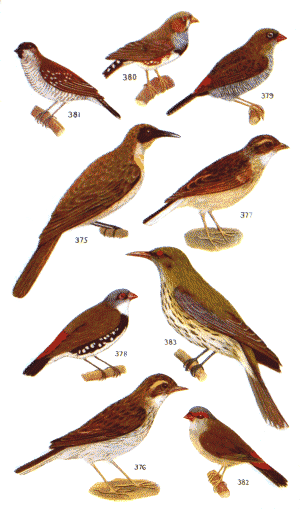
375 Yellow-throated Friar-Bird 376 Australian Pipit 377 Bush-Lark 378 Spotted-Sided Finch 379 Firetailed Finch 380 Chestnut-eared Finch 381 Plum-headed Finch 382 Red-browed Finch 383 Olive-backed Oriole
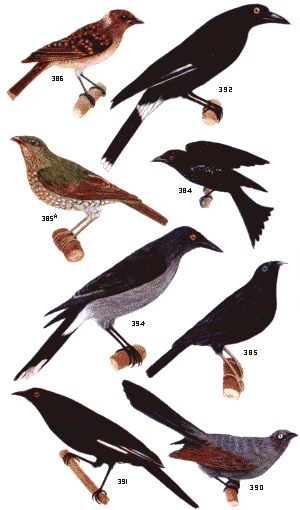
384 Spangled Drongo 385 Satin Bower-Bird 385a Satin Bower-Bird (Female) 386 Spotted Bower-Bird 390 Apostle-Bird 391 White-winged Chough 392 Pied Bell-Magpie 394 Gray Bell-Magpie
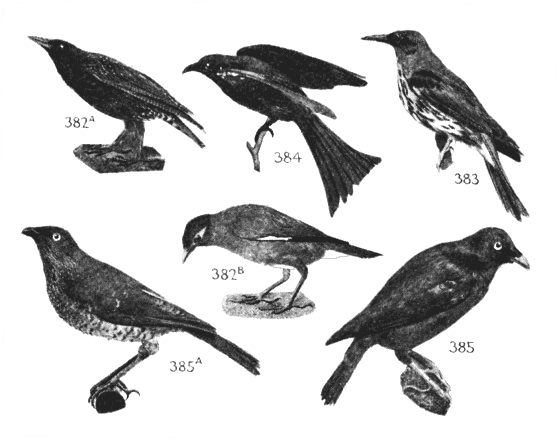
1 23
382a Starling, Sturnus vulgaris, Eur., N. Afr., Asia, A. (introduced).
Nom. v.c. open 8.5
Glossy-black, with metallic reflections; upper feathers tipped buff, under tipped white; light tips lost in summer; bill lemon-yellow summer, blackish winter; f., sim. Insects, caterpillars, fruit. Wheezing, whining notes. Mimic.
1 3
382b Common Myna (Indian, Calcutta), Acridotheres tristis, India, Afghanistan, V. (Introduced).
Stat. v.c. houses 10
Head, neck black; upper brown; under rich vinous-brown; tip-tail, large patch on wing white; about eye, bill, legs yellow; f., sim. Insects, fruit. Many notes.
F. 157. EULABETIDAE (2), SHINING STARLINGS, 139 sp.—51(51)A., 20(20)O., 1(1)P., 67(67)E.
F. 158. Paramythidae, 1 sp. A. (N.G.).
F. 159. Buphagidae, Oxpecker, Rhinoceros-Bird, 2 sp. E.
F. 160. ORIOLIDAE (4), ORIOLES, Fig-Birds, 70 sp.—27(27)A., 29(26)O., 3(0)P., 15(14)E.
1 12
383* Olive-backed Oriole, Green Thrush (e), Mimetes sagittata (Oriolus viridis), E.A., N.W.A.
Stat. r. open forest 11.5
Upper yellowish olive-green; wings, tail brown, tipped white; under whitish, streaked black; bill flesh-red; eyes scarlet; variable in color; f., sim. Insects, fruit. "Or-ree-ee-oale." Mimic.
F. 161. DICRURIDAE (1), DRONGOS, 73 sp.—24(23)A., 39(38)O., 11(11)E.
1 29
384* Spangled Drongo, Drongo-Shrike, King-Crow, Dicruropsis (Chibia, Dicrurus) bracteata, N.G., N. Ter., E.A., N.W.A., T. (acc.).
Nom. r. timber 12.2
Black glossed, spotted green; spotted white under wing; f., sim. Insects. Noisy, harsh peculiar notes.
F. 162. PARADISEIDAE (4), BIRDS OF PARADISE, Rifle-Bird, 70 sp. A.
Order XXI. (continued)
Mr. A. J. North, C.M.B.O.U., the ornithologist of the Australian Museum, Sydney, and one of the greatest of living Australian ornithologists, has declared that "without exception, the bower-building birds of Australia are the most extraordinary and interesting group of birds found in the world."
These wonderful birds construct, apart from their nests, play-houses—structures that "are perfectly anomalous in the architecture of birds." Gould considered the accounts of the "extraordinary habits" of the Bower Birds "as some of the valuable and interesting portions" of his work. Though the bird was known before Gould's time, its "extraordinary habits had never been brought before the scientific world until I (Gould) had the gratification of publishing an account of them after my return from Australia."
This month I had the gratification of seeing the Satin Bower Birds playing about a perfect bower within one chain of a country school, and within one yard of a busy roadside. The birds have quite made friends with the school children. They have helped themselves to the blue flowers from the school garden, pieces of blue paper, and even a blue hair ribbon, besides blue parrot's feathers. These are used to decorate this very interesting playhouse.
Unfortunately, Satin Bower Birds are mainly fruit-eaters, and so will possibly do some damage, but they are amongst the wonders of the world, and it is hoped all will hesitate to shoot them, "for their highly-decorated halls of assembly must be regarded as the most wonderful instances of bird-architecture yet discovered." The male gets his beautiful blue-black coat after he is seven years old.
Many of the schools of South Gippsland can show Satin Bower-Birds regularly in attendance at lunch-time to gather the crusts. We have destroyed their native fruits, and should submit to some slight loss to enable young Australians to become familiar with the "most interesting group of birds" in the world.
(continued below)
F. 163. PTILONORHYNCHIDAE (11), BOWER-BIRDS, Regent-Bird, Cat (Gardener) Bird, 37 sp. A.
1 1
385* Satin Bower-Bird, Satin Bird, Ptilonorhynchus violaceus, E.A.
Stat. r. coast-scrubs, mt.-gullies 12.5
Lustrous blue-black, with black centres to feathers; f.,* upper grayish-green; quills dark-brown; tail golden-brown; under yellow, washed bluish-green, marked blackish-brown; young male up to 3 years sim. to f. Gets fully adult blue-black after 7 years of age. Fruits, berries, insects. Many notes, mimics.
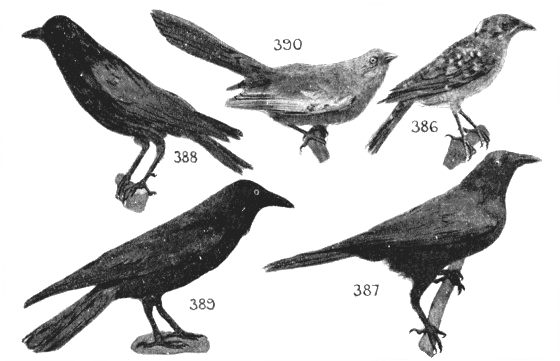
5 6
386* Spotted Bower-Bird, Cabbage-Bird, Chlamydera maculata, E.A, S.A. (inland).
Stat. v.r. dry scrubs 12
Upper dark-brown spotted buff; rose-lilac opalescent plumes on nape; tail tipped buff, white; abdomen pale creamy-buff, flanks barred dusky brown; f., no rose-lilac plumes. Varied, harsh, plaintive notes, mimics.
Order XXI. (continued)
The members of the Crow Family—the Corvidae—were considered the most highly-developed of birds—the most highly organized, so far as structure was concerned, and the most intelligent. However, Sharpe has erected the seven Australian Bell-Magpies (Streperas) into a family which, in his Hand-List of Birds is placed at the top of the bird tree.
In the Crow Family many well-known birds are placed. The Jays, Magpie, Daws, Rooks, and Nutcrackers of Europe are not represented in Australia. The Crows and the Raven, however, are represented by closely-related birds.
It is important to tell the difference between the Australian Crow and the Australian Raven, for, we are told, the Crow is all that is good, while the Raven is the reverse.
The ornithologists say it is easy to tell the difference. Just examine the down, say, on the neck. It is white in the Crow, but dusky in the Raven. Unfortunately, the birds will not always wait to permit an examination of the down.
The eye is often mentioned, but hazel-eyed birds have become white-eyed. However, the Raven has lanceolate feathers on the neck, and a rougher, unmusical voice.
The Raven seems the more common bird, though most people will tell you there are no Ravens in their district.
The Apostle-Bird (Gray Jumper), and the White-winged Chough are two of Australia's "anomalous birds." Both go in flocks, so each has been called the "Twelve Apostles." However, the name has become attached to the Gray Jumper.
The White-winged Chough has no close relative in the world; possibly, the Chough that nests in the cliffs of Cornwall is nearest to it.
The Bell-Magpies (Streperas), perhaps better known as Black or Gray Magpies, are now receiving much notice, because of their position at the head of the bird-world. They are restricted to Australia, Tasmania, and Lord Howe Island. A good name is required for these birds, for, of course, they are not Magpies, though they have a white-tipped tail, and there is usually white in the wing, and about the base of the tail. They are fine, large birds, with a variety of notes.
(continued below)
F. 164. CORVIDAE (5), CROWS, Rook, Raven, Jackdaw, Magpie (Br.), Jay, Nutcracker, Chough, 274 sp.—27(25)A., 73(58)O., 69(53)P., 15(9)E., 43(35)Nc., 73(65)Nl.
3 63
387 Hazel-eyed Crow, Corvus coronoides, A.
Nom. c. open, timber 20
Black glossed with purple; white down; hazel eyes; f., smaller. Insects, carrion, fruit, not lambs.
388 Small-billed Crow, C. bennetti, W.N.S.W., V., S.A. Like 387, but smaller; bill small; eye white; f., sim. Insects, carrion. "Car" repeated.
Stat. v.r. plains 18.5
389 Australian Raven, Crow (e), C. marianae (Corone australis), A., T.
Nom. v.c. plains, timber 20
Black glossed purple; throat feathers lanceolate, tinged green; down dusky-gray; eyes white; f., smaller, lanceolate feathers not so well developed. Locusts, caterpillars, omnivorous, destructive. "Loud, deep Gwar-gwar, varied with shrill, high-sounding Korr-Korr" (North).
1 1
390* Apostle-Bird, Gray Jumper, Twelve Apostles, Struthidea cinerea, N. Ter., E.A., S.A. (inland).
Stat. small flocks, r. open timber 13
Gray; wings brown; bill, legs black; eye white; f., sim. Mud nest. Insects. Incessant chattering.
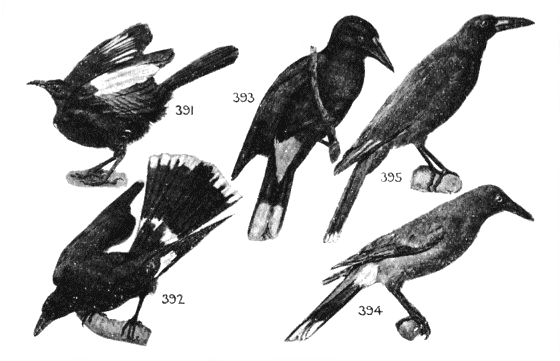
1 1
391* White-winged Chough, Black Magpie (e), Jay (e), Apostle-Bird (e), Corcorax melanorhamphus, E.A., S.A.
Stat. small flocks, c. timber 16
Sooty black, white on wing only; eyes red; f., sim. Mud nest. Insects, fruits, seeds. Low, mournful whistle.
F. 165. STREPERIDAE (7), BELL-MAGPIES, Streperas, Crow-Shrikes, 7 sp. A.
7 7
392* Pied Bell-Magpie (Crow-Shrike), Currawong. Mutton-Bird (e), Strepera graculina, E.A., Lord Howe Is.
Nom. r. timber 18.5
Black; white patch on wing, upper base tail, under base tail, tip tail; eye yellow; f., smaller. Berries, fruit, insects.
393 Black-winged Bell-Magpie (Crow-Shrike), S. melanoptera, V., S.A., Kangaroo Is.
Stat. v.r. scrub 19
Black, white tip tail, under base tail; f., smaller. Insects.
394* Gray Bell-Magpie (Crow-Shrike), Gray Magpie, Rain-Bird, Squeaker, S. versicolor (cuneicaudata), E.A.
Stat. v.c. timber, orchard 19
Gray; white on wing, tip tail, under base tail; eye orange; f., sim. Insects, fruit. Loud, ringing notes. "It's-going-to-rain." "Two and two are four." Cree-e-ling, cree-e-ling.
395 Sooty Bell-Magpie (Crow-Shrike), Black Magpie (e), S. fuliginosa, E.A., S.A., T., Bass St. Is.
Stat. r. timber 18
Sooty black; white in wing, tip tail; eye yellow; big bill black; f., sim. Insects, fruit.
This concludes a necessarily brief outline of the classification of the Birds of Australia, and, incidentally, of the birds of the world, for, while the Emu is one of the most primitive of birds placed right at the foot, the Bell-Magpies (Streperas) are placed at the very summit of the avine tree.
Australians! Realize that you live in a land favored far beyond most as regards birds, and that you have a duty to perform in preserving as many as possible of these unique, interesting, and valuable forms for posterity. Teachers! Your influence is more potent than all the legislation. Bird lovers already freely acknowledge the fundamental change that has come over the schoolboy since the introduction of nature-study, and they look to you with confidence to extend greatly the good work of cultivating an interest and a pride in things Australian, for this interest will eradicate the once almost-universal, but now rapidly-disappearing, desire for slaughter of anything wearing a feather.
If women could be persuaded to come in line with the once destructive schoolboy in this respect, the bird lover and the well-wisher of his country would have further cause for gratification, and our beautiful birds a further enjoyment of a useful, indeed, often a necessary life, one necessary to the welfare of the agriculturist and the pastoralist, as well as of all dwellers in this fair, sunny land of ours.
Australians! Your wonderful Lyre-Birds, your marvellous Bower-Birds, your gorgeous Birds of Paradise, your Mound-Builders, your flute-noted Magpies, your charming Whistlers, your beautiful and intelligent Cockatoos, your glorious Parrots—the pets of the bird world—your Superb-Warblers, your varied, valuable, and attractive Honey-eaters, and your giant Laughing-Kingfisher are here for your enjoyment and appreciation. No other people has your privilege of knowing these birds in their native state. On the other hand, you enjoy most of the privileges of dwellers in other lands, in addition to your own, for "every widely-spread family of birds but two is found in Australia. The only notable absentees are Vultures and Woodpeckers." Be proud of your heritage, and pass it on uninjured. Though that, alas! is not possible, yet you may pass on at least the remnant that still survives the "blessings and advance of civilization."
NOTE.
Having obtained the approximate length of a bird, look for it on the following pages. Compare the bird before you with the half-tone and colored illustrations, and, if necessary, the written description:—
3-5 inches... Pages 14, 121, 123, 124, 131, 133, 142-145, 153, 155, 166, 167, 169, 179.
5-7 inches... " 13, 15, 22, 23, 26, 27, 44, 49, 89, 110, 111, 120-125, 127, 129, 131, 142, 144-146, 151, 152, 155, 168-172, 177, 178.
7-9 inches... " 13, 15, 17, 18, 27, 31, 42, 43, 45, 47-49, 89, 102-107, 109, 125, 129, 131, 145, 147, 150-152, 154, 169-173, 176, 177, 186.
9-11 inches... " 17, 18, 24, 25, 31, 40, 43, 44, 49-51, 61, 102, 103, 107, 109, 127-129, 131-133, 145, 148, 149, 151, 170, 171, 173, 175, 187.
11-13 inches... " 28-30, 34, 43, 46, 49, 80, 82, 83, 93, 101, 102, 105, 107, 109, 130, 149, 175, 187a, 187b, 188a, 188b.
13-15 inches... " 17, 18, 23, 25, 28, 29, 35, 43, 45, 47, 80, 83, 85-88, 91, 92, 100, 101, 103, 107, 126, 127, 149, 174, 175, 188.
15-17 inches... " 18, 23, 28, 29, 45-47, 64, 65, 67, 73, 82, 85, 91, 93, 189.
17-20 inches... " 16, 23, 25, 27, 28, 35, 40, 41, 43, 61, 63, 65, 67, 73, 82, 83, 91, 93, 104, 105, 149, 188, 189.
20-23 inches... " 35, 41, 45, 51, 61, 63, 66, 67, 72, 73, 81, 91, 188.
23-25 inches... " 13, 25, 41, 45, 60, 61, 65, 69, 81, 82, 84, 85, 90, 111.
25-30 inches... " 25, 33, 41, 53, 60, 65, 67, 69, 89, 112.
30-35 inches... " 29, 32, 33, 53, 60, 63, 69, 71, 81.
Over 35 inches... " 12, 31, 32, 51, 52, 62, 68, 70, 71, 81, 112.
INDEX (Colored Plates).
Frontispiece.
2Mallee-Fowl
3Stubble Quail
4Brown Quail
6King Quail
8Painted Quail
11Plain Wanderer
14Diamond Dove
16Bronzewing Pigeon
Page 19
21Pectoral Rail
22Australian Spotted Crake
26Black Moor-Hen
27Bald Coot
30Hoary-headed Grebe
67Crested Tern
71White-faced Ternlet
72Silver Gull
73Pacific Gull
Page 38
81Black-breasted Plover
87Black-fronted Dottrel
102Sharp-tailed Sandpiper
106Australian Snipe
107Australian Painted Snipe
109Southern Stone-Curlew
119White-fronted Heron
123Nankeen Night Heron
125Australian Bittern
Page 55
128Cape Barren Goose
129Maned Goose
131Plumed Whistling Duck
133Black Duck
134Australian Teal
135Gray Teal
136Australian Shoveller
137Pink-eared Duck
139White-eyed Duck
Page 57
152Allied Harrier
155Australian Goshawk
157Collared Sparrowhawk
158Wedge-tailed Eagle
165Black-shouldered Kite
167Black-cheeked Falcon
170Little Falcon
172Brown Hawk
173Nankeen Kestrel
Page 76
184Blue Mountain Lorikeet
185Musk Lorikeet
191Gang-gang Cockatoo
193Pink Cockatoo
194Rose-breasted Cockatoo
196Cockatoo-Parrot
197Superb Parrot
198Black-tailed Parrot
199King Parrot
Page 78
200Crimson Parrot
202Rosella
203Mallee Parrot
204Blue Bonnet
205Many-colored Parrot
206Red-backed Parrot
209Grass-Parrot
213Swift Parrot
214Warbling Grass-Parrot
Page 95
219Australian Roller
220Blue Kingfisher
221Laughing Kingfisher
223Sacred Kingfisher
224Australian Bee-eater
227Spine-tailed Swift
229Pallid Cuckoo
230Fan-tailed Cuckoo
235Bronze Cuckoo
Page 97
238Welcome Swallow
240Tree Martin
242Brown Flycatcher
244Scarlet-breasted Robin
244aScarlet-breasted Robin (Female)
245Flame-breasted Robin
245aFlame-breasted Robin (Female)
248Red Capped Robin
248aRed Capped Robin (Female)
Page 116
251White-throated Flyeater
254White-shafted Fantail
255Rufous Fantail
256Black and White Fantail
259Restless Flycatcher
262Black-faced Cuckoo-Shrike
265White-shouldered Caterpillar-eater
265aWhite-shouldered Caterpillar-eater (Female)
266Spotted Ground-Bird
Page 118
272Coachwhip Bird
273Gray-crowned Babbler
276White-browed Field-Wren
278Brown Song-Lark
279Rufous Song-Lark
280Mountain Thrush
281White-fronted Chat
281aWhite-fronted Chat (Female)
282Crimson-breasted Chat
Page 135
284Australian Reed-Warbler
285Golden-headed Fantail-Warbler
286Grass-Bird
287Speckled Warbler
288Little Tit-Warbler
289Brown Tit-Warbler
291Striated Tit-Warbler
293Yellow-tailed Tit-Warbler
297White-browed Scrub-Wren
Page 137
300Superb-Warbler
300aSuperb-Warbler (Female)
302White-winged Superb-Warbler
304Emu Wren
306Bristle-Bird
311White-browed Wood-Swallow
312Masked Wood-Swallow
313Wood-Swallow
315Gray Shrike-Thrush
Page 139
319Australian Butcher-Bird
320Yellow-breasted Shrike-Tit
321Crested Bell-Bird
322Golden-breasted Whistler
322aGolden-breasted Whistler (Female)
323Rufous-breasted Whistler
323aRufous-breasted Whistler (Female)
326Yellow-breasted Shrike-Robin
327Whiteface
Page 158
328Orange-winged Nuthatch
330Brown Tree-Creeper
331White-throated Tree-Creeper
334White-eye
336Australian Flower-Pecker
336aAustralian Flower-Pecker (Female)
337Red-tipped Diamond Bird
340Spotted Diamond Bird
341Golden-rumped Diamond Bird
Page 160
342White-naped Honey-eater
345Striped Honey-eater
346Sanguineous Honey-eater
347Black Honey-eater
348Spinebill
349Tawny-crowned Honey-eater
350White-fronted Honey-eater
351Painted Honey-eater
353Regent Honey-eater
Page 162
355Yellow-eared Honey-eater
356Singing Honey-eater
357Yellow-faced Honey-eater
358White-eared Honey-eater
359Yellow-tufted Honey-eater
362Yellow-plumed Honey-eater
363White-plumed Honey-eater
364Crescent Honey-eater
365White-bearded Honey-eater
Page 164
360Helmeted Honey-eater
366White-cheeked Honey-eater
367Bell-Miner
368Noisy Miner
370Wattle-Bird
372Spiny-cheeked Honey-eater
373Blue-faced Honey-eater
374Friar-Bird
Page 181
375Yellow-throated Friar-Bird
376Australian Pipit
377Bush-Lark
378Spotted-Sided Finch
379Firetailed Finch
380Chestnut-eared Finch
381Plum-headed Finch
382Red-browed Finch
383Olive-backed Oriole
Page 183
384Spangled Drongo
385Satin Bower-Bird
385aSatin Bower-Bird (Female)
386Spotted Bower-Bird
390Apostle-Bird
391White-winged Chough
392Pied Bell-Magpie
394Gray Bell-Magpie
INDEX (General).
The Ordinary Figures (175) refer to tabular matter and the Italic Figures (141) refer to the lecture.
A | B | C | D | E | F | G | H | I | J | K | L | M | N |O | P | Q | R | S | T | U | V | W | X | Y | Z
Acanthagenys, 175
Acanthiza, 142, 141, 153
Acanthochaera, 174
Acanthorhynchus, 170
Accipiter, 80
Acridotheres, 187
Acrocephalus, 142
Ægialitis, 44, 45
Ægintha, 179
Ægotheles, 104
Aerocharidae, 149
Æstrelata, 28, 29
Aidemosyne, 179
Alarm-Bird, 43
Alauda, 177
Alaudidae, 176, 177
Albatross, 31, 32, 33, 33, 34
Alcedinidae, 105
Alcidae, 33
Alcyone, 105
Ampelidae, 147
Amytornis, 146
Anas, 65
Anatidae, 62
Ancylochilus, 49
Anellobia, 175
Anhinga, 70
Anseranas, 63
Anteater, Spiny, 11
Anthus, 176
Antigone, 52
Ant-thrushes, 113
Antwrens, 113
Aphelocephala, 153
Apostle-Bird, 188, 130, 189, 147, 186
Aprosmictus, 93
Apterygidae, 12
Apteryx, 12, 13
Aramidae, 52
Ardeidae, 60
Ardetta, 61
Arenaria, 42
Artamidae, 147
Artamus, 147
Astur, 73
Atlantic O., 26, 33
Atrichornithidae, 113, 119
Audubon Society, 114
Auk, 33
Aves, 12
Avocet, 45, 47
Aythya, 67
Babbler, 130, 130, 176
Babbling-Thrush, 128
Balaenicipitidae, 60
Bald-Coot, 23
Bali, 91, 168
Ballyhead, 133
Banana-Bird, 175
Barbet, 111, 91
Barker, 130
Bark-pecker, 153
Barley-Bird, 142
Barnardius, 101
Barn Owl, 86, 87, 85
Barwing, 67
Bass St., 154, 165
Bat, 11, 166
Beach-Bird, 42
Bee-eater, 106, 107, 106
Bell-Bird, 151, 151, 174
Bell-Magpie, 189, 12, 39, 185, 186, 187
Bell-Miner, 173, 174
Bird Day, 74, 119, 141
Birds of Paradise, 187, 12, 180, 190
Birds of Prey, 72, 71, 74, 79, 84, 87
Bittern, 61, 59
Biziura, 67
Blackbird, 132, 179, 133, 134
Blackcap, 142, 168
Bleater, 50
Blight-Bird, 155, 156
Blood-Bird, 169
Blood Tit (e), 142
Blue-Bird, 127, 132, 146
Blue-Bonnet, 101, 144, 99
Bluecap, 144
Blue-eye, 175, 176
Blue-Head, 144
Blue Mountain, 88, 90, 156
Blue-Tit, 144
Bluewing, 66
Blue-Wren, 144
Boatswain-Bird, 41, 71
Bobolink, 179, 74
Bob-White, 14
Boobook Owl, 85, 85, 104
Booby, 71, 70
Boomer, 61
Botaurus, 61
Bower-Birds, 187, 188, 12, 185, 190
Brain-fever Bird, 109, 110
Bristle Bird, 145, 141
Broadbill, 111
Broad-tails, 94
Brolga, 52
Brownhead, 67
Brush-Turkey, 13, 15
Bubonidae, 85
Bucconidae, 111
Bucerotidae, 106
Budgerigar, 103, 100
Bulbul, 127, 91
Bulla-Bulla, 101
Bull-Bird, 61
Bullfinch, 177
Bully, 28
Bunting, 177
Bunyip, 59
Buphagidae, 187
Burhinus, 51
Bush-Lark, 177, 177
Bushman's Clock, 105
Bush-Warbler, 124
Bustard, 51, 51, 52
Bustard Quail, 15, 17, 21
Butcher-Bird, 149, 150
Button Quail, 15
Buzzard, 82, 79
Cabbage-Bird, 188
Cacatua, 91
Cacatuidae, 89
Cackler, 130
Cacomantis, 109
Calamanthus, 131
Caley, 149q
Calico-Bird, 42
Calidris, 48
Callocephalum, 91
Calopsittacus, 93
Calyptorhynchus, 89
Campophaga, 127
Campophagidae, 126
Canary, 124, 133, 152, 172, 177, 134, 179
Cape Barren Is., 32
Cape Petrel, 29
Cape Pigeon, 29
Capercailly, 13
Cape Sheep, 31
Capitonidae, 111
Caprimulgidae, 107
Cardinal, 177
Carduelis, 177
Cariamidae, 52
Carinatae, 13, 13, 14
Carphibis, 53
Carr Goose, 25
Casarca, 65
Cassowary, 12, 11, 13
Casuariidae, 12
Catamblyrhynchidae, 177
Catarrhactes, 25
Catbird, 130, 187, 131
Caterpillar-eater, 126, 127, 39, 127, 128
Cathartidae, 71
Cerchneis, 83
Cereopsis, 63
Certhiidae, 154
Certhionyx, 170
Chaetura, 107
Chaffinch, 177
Chalcococcyx, 110
Chalcophaps, 17
Chamaeidae, 153
Channel-bill, 111, 111
Charadriidae, 42
Charadrius, 44
Chat, 133, 134
Chatterer, 113, 130
Chelidon, 120
Chenonetta, 63
Chenopsis, 62
Cheramoeca, 121
Cherry-eater, 173
Cherry-Hawk, 127
Chibia, 187
Chickadee, 74
Chicken-Hawk, 73
Chickoowee, 172
Chick-up, 171
Chiffchaff, 142
Chionididae, 42
Chlamydera, 188
Chough, 189, 147, 186
" (Br.), 188, 186
Chthonicola, 142
Chuck-e-chuc, 167
Ciconiidae, 60
Cinclidae, 132
Cincloramphus, 131
Cinclosoma, 128
Circus, 72
Cisticola, 142, 134
Cladorhynchus, 45
Climacteris, 154
Clipper, 133
Coachwhip-Bird, 129, 151, 130
Cobbler, 45
Cobbler's Awl, 45, 170
Coccyges, 108
Cockatiel, 93
Cockatoo, 89, 91, 88, 89, 91,
Cockatoo-Parrot, 93, 94
Cocktail, 144
Codlin-Moth-eater, 130
Coerebidae, 178
Coliidae, 108
Colluricincla, 149
Coloration— Advertizing, 165 Protective, 21, 156 Recognition, 165 Warning, 156
Columbidae, 17
Colymbidae, 25
Condor, 71
Conophagidae, 113
Cooers, 21, 24
Cookaycock, 175
Coot, 23, 22
Coraciidae, 105
Coracina, 127
Corcorax, 189
Corella, 93
Cormorant, 68, 68
Corn-Bird, 142
Corn-Crake, 18, 131, 22
Corone, 188
Corvidae, 188, 185
Corvus, 188
Cotingas, 113
Cotingidae, 113
Coturnix, 13
Courlan, 52
Courser, 51
Cowbird, 179
Crab-Plover, 51
Cracidae, 13
Cracticus, 149
Crake, 18, 22, 23, 22
Crane, 52, 60, 52, 59
Cranky Fan, 124
Creeper, 154, 154
Crossbill, 177
Crow, 188, 12, 185
" White, 149, 150
Crow-Shrike, 149, 189
Cuckoo, 108-111, 74, 85, 87, 109, 112, 134
Cuckoo-Shrike, 126, 126
Cuculidae, 108
Cuculus, 109
Curassow, 13
Curlew, 45, 39, 49, 50
Curlew, Black, 53
" Pygmy, 49
" -Sandpiper, 49
" -Stint, 49
" Stone, 51, 50
Currawong, 189
Cursoriidae, 51
Cutthroat, 151
Cyclopsittacidae, 89
Cymodroma, 27
Cypselidae, 107
Cypselus, 107
Dabchick, 23, 24, 25
Dacelo, 105
Daption, 29
Darter, 70, 69
Daw, 185
Deer, 165
Demiegretta, 61
Dendrocolaptidae, 113
Dendrocygna, 63
Devil-Bird, 124, 144
Diamond-Bird, 167, 166
Diamond Dyke, 167
Dicaeidae, 166
Dicaeum, 166
Dicruridae, 187
Dicruropsis, 187
Dicrurus, 187
Didunculidae, 18
Dimorphism, 41
Dinornis, 84
Diomedea, 31
Diomedeidae, 31
Dipper, 132
Dishwasher (e), 125
Diver, 24, 25, 69, 70, 24, 69
Diving-Petrel, 31, 32
Dog-Bird, 130
Dollar Bird, 105, 105
Dottrel, 42-45, 133, 48, 59
Dove, 16, 17, 21, 39
Dove-Petrel, 30, 31, 27
Drepanididae, 175
Dromadidae, 51
Dromaeidae, 12
Dromaius, 12
Drongo, 187, 180
Drymodes, 129
Dryweather-Bird, 53
Duck, 63-67, 62-67
Dunlin, Little, 49
Durbaner, 149
Eagle, 81, 72, 74, 79
" Bald (Amer.), 81, 26, 39, 72, 74
" Golden, 81, 72, 74, 79
" Sea, 81, 39, 74, 79, 84
Eaglehawk (e), 81, 72
Echidna, 11
Edolisoma, 127
Egg (size), 16
Egg-Bird, 40, 36
Egret, 60, 61, 54, 59
Egypt, 172, 53
Eider Duck, 65
Elanus, 82
Emu, 12, 11, 13, 15, 109, 187
Emu-Wren, 145, 141
Entomophila, 170
Entomyzon, 175
Eopsaltria, 152, 152
Epthianura, 133
Erismatura, 67
Erolia, 49
Erythrogonys, 43
Eudyptula, 25
Eulabetidae, 187
Euphema, 103
Eupodotis, 51
Eurostopus, 107
Eurylaemidae, 111
Eurypygidae, 52
Eurystomus, 105
Eutolmaëtus, 81
Excalfactoria, 14
Falco, 82
Falcon, 82, 83, 72, 79
Falconidae, 72
Falcon-Shrike, 150
Falcunculus, 150
Fantail, 124, 125, 123
Fantail-Warbler, 142, 134, 141
Farmer's Friend, 53
Fern-Owl, 107
Field-Lark, Little, 142
Field-Wren, 131, 132
Fig-Bird, 187, 180
Fig-Parrot, 89
Finch, 177-179, 178-180, 134
Finfoot, 23
Firetail, 179, 179
Fish Hawk, 84, 59, 72
Flamingoes, 61
Flickers, 111
Flight-Bird, 103
Flood-Bird, 111
Flower-Pecker, 166
Fluke, 148
Flute-Bird, 149
Flycatcher, 113, 121-125, 121-123
Flyeater, 124
Flying Coachman, 170
Flying Phalanger, 11
Flysnapper, 124, 125
Formicariidae, 113
Four-o'clock, 175
Fowl, Domestic, 13, 15
Fregata, 71
Fregatidae, 71
Fregetta, 27
Friar-Bird, 175, 91, 176
Frigate Bird, 71, 39, 70
Fringillidae, 177, 179
Frog-Bird, 125
Frogmouth, 104, 86, 104
Fruit-Pigeon, 16, 21
Fulica, 23
Fulmar, 27, 28, 29, 27
Gabianus, 41
Galah, 91, 92, 92, 93
Galbulidae, 111
Gallinago, 50
Gallinula, 23
Gallinule, 23
" Purple, 23, 22
Gang-gang, 91, 92
Gannet, 71, 70
Gar, 133
Gardener-Bird, 187
Garefowl, 33
Garrodia, 27
Garzetta, 61
Gaunt, 25
Gaviidae, 25
Gelochelidon, 35
Geobasileus, 143
Geopelia, 17
Geopsittacus, 103
Gerygone, 124
Gill-Bird, 174
Glareolidae, 51
Glass-eye, 155
Gliciphila, 170
Glossopsittacus, 89
Glottis, 47
Glutton, 29
Goatsucker, 104, 107, 107
Goaway, 131
Godwit, 47, 39, 49
Golden Robin, 180
Goldfinch, 177, 178
Goose, 62, 63, 67, 62
Goshawk, 72, 73, 74
Gould League, 114
Gouridae, 18
Grackle, 179
Grallina, 148
Grape-eater, 155
Grass-Bird, 142
Grasshopper-Hawk, 109
Grass-Warbler, 142
Grass-Wren, 146, 141
Graucalus, 126, 127
Graucalus, 127
Grebe, 24, 25, 24
Greenfinch, 177, 178
Greenie, 172, 169, 174
Green Keet, 89, 90, 100
Green Leek, 93, 90, 94
Green Leek (e), 89, 94
Greenlet, 147
Greenshank, 47
Grinder, 125, 126
Grosbeak, 177
Ground-Bird, 128, 129
Ground-Diamond, 167
Ground-Dove, 17, 128