AN ARCHITECT'S NOTE-BOOK IN S P A I N (continued 3)
Reading edition
It is on the nature of the stucco itself I think it may be well to offer here a few remarks. It certainly appears to be harder, closer in texture, tougher, and much less absorbent, than gypsum or plaster of Paris, when set in the usual manner. Lime alone, as ordinarily slacked, would not I believe give any such texture, even if it could be manipulated into similar ornamental forms. I believe the Moorish Stucco to be almost if not quite identical with the Indian "Chunam," and that in its turn to be a substance produced much in the same way that the fine Stucco of the Romans was ordinarily wrought by that people. In the native treatment of all of these substances, I believe four peculiarities to have been generally used. Firstly—to employ the finest lime only. Secondly—to mix it with pounded earthen-ware. Thirdly—to beat it thoroughly. Fourthly—to use saccharine substances to retard the setting and keep the mass plastic under the tool.
The present is scarcely a fitting occasion upon which to state in any detail the grounds upon which I have been led to this conclusion, but I have little doubt that any student will be struck by the identity of practice of Roman, Indian, and Moor, who will refer to the practical descriptions of the various modes of the formation of terraces given by Vitruvius, by Captain Phipps, in "The Barrackmaster's Assistant,"[41] and by John Windus, in his "Journey to Mequinez."[42]
I have elsewhere noticed the command the descendants of the Moors seemed to retain over all operations of plaster and lime work throughout Spain, as evidenced by the beauty and elaboration of the Mudejar style in those materials, long after they ceased to be the dominant race in the localities in which they continued to practice their old technical arts.
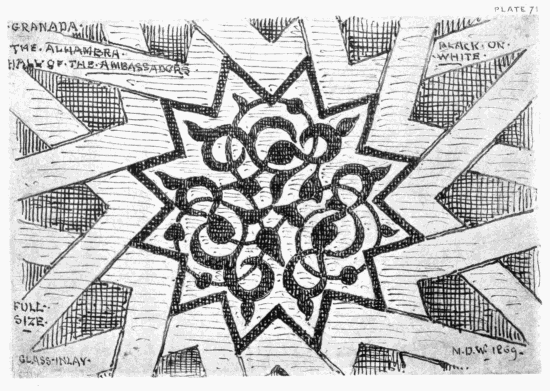
PLATE LXXI.
GRANADA.—THE ALHAMBRA. DETAIL OF GLASS INLAY FROM THE HALL OF THE AMBASSADORS.
THIS little pattern which forms the centre, or eye—the point of departure in fact—of an elaborate geometrical mosaic has been most carefully traced and copied from the original, which yet remains in the centre of the dado on the side of the window on the right of the Sultan's throne in the Hall of the Ambassadors. It may thus be said to occupy an especial post of honour and so to challenge, as it were, curiosity and admiration. Both these a close inspection thoroughly justifies, since in all the history of the manufacture of vitrified substances I know nothing more curious and puzzling. The pattern is in bluish-black on a white ground; and both ground and inlay are made apparently in two separate pieces of glass, and in two only. The most minute inspection shows no joint whatever on the surface of either coloured material; at the same time it establishes the fact that the ground has been made with the whole pattern sunk "en creux," and that the inlay has been made in one piece—practically a specimen of glass lace—and fixed into the cavity of the ground with a very fine calcareous cement, made probably of lime and white of egg. To inlay glass in glass involves little difficulty, if ground and inlay are as it were fused together; but to produce a ground apparently in glass, and to inlay it with so fine a pattern, both "au froid," is a perfect marvel in vitreous manufacture.
The only way in which I can imagine that such an effect could be produced is as follows, but in offering any such explanation I desire to do so with all due deference to practical glass-workers. I believe that two metal-moulds were made, one with the ornament in relief, and the other with the same ornament sunk in intaglio. From each mould, glass reproductions having been made of about equal substances (so as to contract equally in cooling), and, with the exception of a black film in one case, of the same glass, the two reproductions were stuck together firmly by the calcareous cement. The black glass in "cameo" would then be encased within the white glass in "intaglio;" and the pattern would of course be invisible, the two reproductions being firmly stuck together face to face, making apparently one white glass tessera of double the requisite thickness. The back of the cameo side would then have to be ground away, probably at a lapidary's wheel, until the back of the black pattern in cameo should be reached. At the same moment the face of the white intaglio would be exposed; and the tessera, being reduced to its proper thickness for insertion with the rest of the adjoining glass mosaic, would be fit to permanently combine with it; showing an elaborate black pattern held in by calcareous cement, on a white face, exactly as it now appears.
Any such resolution of a difficult technical problem exhibits the Moors to us as excelling in two of their favourite Arts, viz., inlaying and glass manufacture.
For much of their knowledge of both of these arts there is no doubt that the Moors were indebted to the Arabians. The Arabians were in their turn inheritors from the Byzantine Greeks of many of the traditions of manufacturing excellence once practised by the Romans. Amongst these were, no doubt, almost every process of glass-working and mosaic.[43] Considerable doubts exist as to the inheritance by the Greek of the lower empire of the process of inlaying from the Romans, and to their originality in adapting the process to their architecture. The first building in which it appears to have been freely used by the Greeks was the Mosque of Santa Sofia, built by Justinian. For that building he is known to have invoked the assistance of Persian designers and artificers; and from the divergence in the patterns of those inlays from any patterns usual in Roman contemporary work, I am inclined to believe that they represent the foreign element to which I have alluded. A most interesting comparison may be made, by the student, of the patterns from the Aya Sofia given in Salzenburg's great work, with those of the principal of the Cairene Mosques drawn by Mr. James Wild and given in the "Grammar of Ornament."
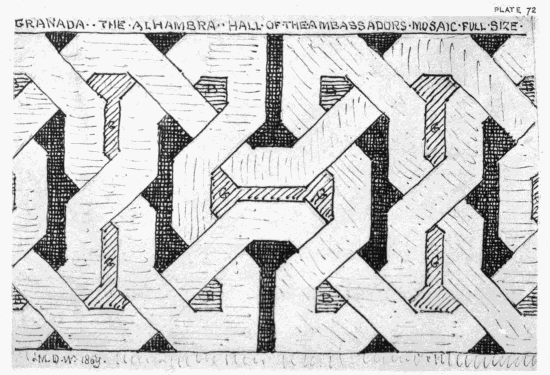
PLATE LXXII.
GRANADA.—THE ALHAMBRA. MOSAIC FROM THE HALL OF THE AMBASSADORS.
IN the description of the last sketch I alluded to the sources whence the Moors derived much of their knowledge of glass-making and mosaic-working. In the specimen now given, the full size of the original, on the opposite page, a considerable advance is shown upon what was usual in the contemporary, "Opus Grecanicum," as executed, either in Italy or in Greece itself. The advance is principally to be seen in this particular, that whereas in the last mentioned work, every complicated pattern is made up out of tesseræ, or glass strips cut into squares, oblongs, triangles, or other simple figures; in the Moorish work, arbitrary shapes of considerable geometrical complexity are given to each separate piece of mosaic. When these tesseræ, so shaped, are brought together, their combination immediately results in the formation of perfect patterns, such as the one now illustrated. Tesseræ of this description were no doubt formed by squeezing plastic clay into metal moulds, and almost perfect identity was obtained between the tesseræ obtained from the same mould. These, after firing, were then apparently covered with coloured vitreous glazes by a subsequent operation.
In illustration of the advantages possessed by the Moors over the Greeks, in working such mosaics as the one I have sketched, it may be noted, that while a Greek would have required one hundred and nineteen separate pieces to make up what is shown, the Moor wanted only forty-nine. Moreover, instead of having to chip every one of the one hundred and nineteen pieces to a definite size and shape, and then to place them slowly so as to ensure the truth of his angles of forty-five and twenty-two and a half degrees, as the Greek or Italian had, the Moor had only to place one of his forty-nine pieces with precision; and, provided he never took any of the eleven patterns, of which his repeats are composed, out of their right turn, his mosaic would work itself with scarcely any other attention on his part. Another source of anxiety was saved to him; viz., constant heedfulness as to the working of the interlacement of his lines—i. e., their running, as it were, under and over one another. The result, in this particular, is far clearer and more effective in the Moorish, than according to the Greco-Italian method; since, while in the former there are no joints which do not help to define an interlacement, according to the latter, the joints occurring on the line of mitre of every angle become confused with the joints which express interlacement. A comparison of the Sicilian, with the Alhambrese, geometrical mosaics, would show in a moment the superiority of the last mentioned method.
No people, except perhaps the Chinese, have ever equalled the Moors in devising patterns of most complicated appearance, in which colours were, as it were, counterchanged by combining tiles, or tesseræ, of similar geometrical forms, but made in different tints or tones.
Beautiful examples are given in profusion in the works of Mr. Owen Jones, M. Girault de Prangey, Herr Hessemer, M. Coste and many others.
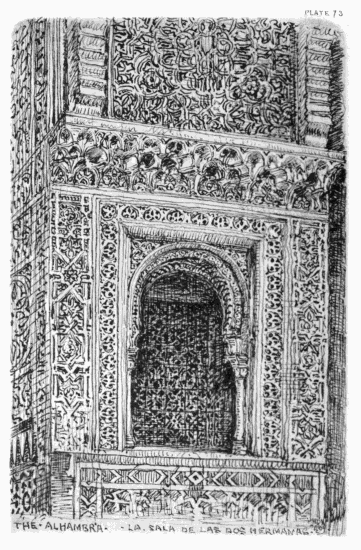
PLATE LXXIII.
GRANADA.—THE ALHAMBRA. NICHE IN LA SALA DE LAS DOS HERMANAS.
THAT the Moors themselves were fully conscious that in creating the Alhambra they were creating types of beauty for all generations, would be clearly manifest from the inscriptions of the Hall of the two Sisters, (from which our illustration is taken), even if every other of the hundreds of inscriptions the building contains in other apartments were destroyed.
"I am the garden, and every morning do I appear decked out in beauty. Look attentively at my elegance, and thou wilt reap the benefit of a commentary on decoration."
"Indeed, we never saw a palace more lofty than this in its exterior, or more brilliantly decorated in its interior; or having more extensive apartments—markets they are, where those provided with money are paid in beauty, and where the judge of elegance is perpetually sitting to pronounce sentence."
"Here is the wonderful cupola, at sight of whose beautiful proportions, all other cupolas vanish and disappear."
Such inscriptions are not all of them of this hyperbolic stamp, since some of them serve to record the names of illustrious founders, and to explain the uses of various parts of the structure. To an inscription of this kind we are indebted for an accurate knowledge of the uses of such niches as the one represented in my sketch. Many travellers and writers had supposed that their purpose had been to hold the slippers of the visitors, but this theory was entirely dispelled, when M. Pasqual de Gayangos read the inscription of the left niche of the Hall de las dos Hermanas.
"Praise to God! With my ornaments and tiara[44] I surpass beauty itself, nay the luminaries in the Zodiac out of envy descend to me.
"The water vase within me, they say, is like a devout man standing towards the Kiblah of the Mihrab,[45] ready to begin his prayers."
The idea that these niches were used to hold water-bottles is further strengthened, as Mr. Owen Jones has justly remarked, by the existence of the mosaic linings amid the plaster work by which they were surrounded; as well as by the white marble slabs which serve for their base or floor. The wall and pier dados, which extend from these marble slabs to the beautiful Azulejos floor, are all made in elegant mosaic. Above the niche in the sketch appears the ingenious pendentive impost from which spring the great arches carried by the piers, with the characteristic ingrailed fringe work which was almost always retained even, as we see at Seville, in the latest Renaissance Mudejar work.
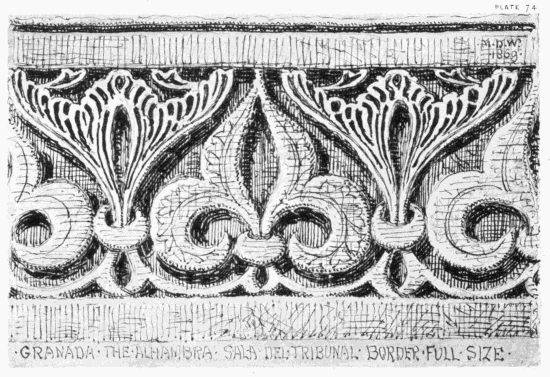
PLATE LXXIV.
GRANADA.—THE ALHAMBRA. STUCCO DETAIL FROM THE SALA DEL TRIBUNAL.
THE correctness of this sketch, as to dimension at least, has been ensured by the mode in which it was obtained, viz., by gently pressing a piece of paper against the surface of the piece of ornament (so as to obtain a slight impression of its outline,) then marking it faintly with pencil, pressing it out again quite flat, and finishing it in ink on the spot. It may be looked upon, therefore, as giving, as nearly as is possible on a plane surface, an accurate transcript of the elegant ornament from the Sala del Tribunal selected for illustration. My reason for this selection was, chiefly because I desired to show the minute scale and extreme delicacy of much of the decoration in relief with which the walls of the principal apartments of the Alhambra are covered. It was partly also because this particular specimen retained faint tracing lines drawn, most likely with a silver or lead point, and a free hand, upon the flat surfaces of certain parts of the ornament in relief. These served as guide lines for the yet more delicate labour of the painter, who carried the subdivision of parts, by means of the application of contrasting colours and gilding, into yet more microscopic superficial enrichment.
As this is the last illustration I have to offer of the Alhambra, it may be well to direct the reader's attention briefly to the general system upon which such Art as the Moors practised, and most dearly loved, was based. Those who would know "all about it," must give themselves diligently to a study of all Owen Jones' works; from the ponderous "Alhambra," with its magnificent illustrations, to the little guide to the "Alhambra Courts of the Crystal Palace," not forgetting to test his theory by his practice in the beautiful reproductions of Moorish Art he has created for their edification at Sydenham. In the pages of the smaller volume they will find the system epitomised simply and delightfully in nine propositions under the following heads.
First, to decorate construction, never to construct decoration.
Second, to let all lines grow out of each other in gradual undulations—always so as to conduce to repose.
Third, to care first for general forms and then for harmonious subdivisions and fillings.
Fourth, to balance straight, inclined, and curved forms so as to produce harmony and repose by contrast.
Fifth, to let all lines flow out of a parent stem, traceable throughout its course.
Sixth, either radially (as in nature with the human hand or in a chestnut leaf.).
Seventh, or tangentially,—as stems from branches.
Eighth, to avoid the simpler curves and use only those of a higher order.
Ninth, to treat all ornament conventionally, i.e., not in direct imitation of Nature, but in a mode of imitation subordinated to the architectural conditions of the surface or form to be ornamented.
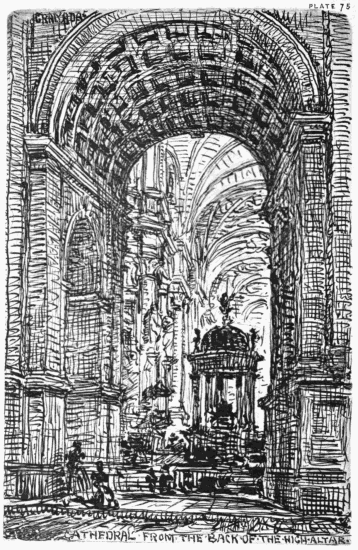
PLATE LXXV.
GRANADA. VIEW OF THE CATHEDRAL FROM THE BACK OF THE HIGH ALTAR
IT is always interesting to watch the first rays of light which dissipate clouds of darkness or prejudice; and this, by the aid of the annals of the early printing press, we are enabled to do (with comparative certainty as to chronology) in the case of the dawn of the revival of classical architecture in every country of Europe except Italy. In that favoured land, the sacred fire of Roman tradition was never quite extinguished, and in its great cities the renascent flame was already lambent, and gaining strength, before Sweynheim and Pannarz started their celebrated press at Subiaco.
The first edition of the ten books of Vitruvius printed by G. Herolt at Rome, circa 1486, was immediately followed by the edition of Florence, under the editorship of Leon Baptista Alberti, bearing the imprint of the previous year. At least two other editions were exhausted in Italy before the close of the century, and succeeded by many more previous to the middle, of the sixteenth century.
Alberti's own admirable writings on Architecture and the other Fine Arts moved all Italy, giving a thoroughly practical direction to the lessons somewhat obscurely inculated by Vitruvius; whose writings, without Alberti's comments, would have been of little practical use in countries in which ample remains of classical art were not at hand for reference and study.
The first French edition of the text of Vitruvius is of 1523; the first German is of 1543. The first French translation dates from 1547; the first German from 1548, published at Nuremburg. It was "volgarizzato" in Italy from 1521.
The Latin text was translated into Spanish by Miguel de Urrea and printed after his death at Alcala de Heñares in 1587. Its publication had however been long preceded in Spain by the digest of the views of Vitruvius under the tide of "las Medidas del Romano o Vitruvio," published by Diego de Sagredo in 1526. Sagredo had no doubt been stimulated to such studies, (as Alberti had previously been) by his admiration of the vestiges of Roman architectural greatness, still abounding on the soil of his native land.
What oral tradition could teach previous to the publication of these texts in Spain, no doubt the architect of the Cathedral of Granada, Diego de Siloe, had learnt from his father, Gil, the even more celebrated Sculptor of Burgos; whose monuments to Don Juan II., his Queen, Donna Isabel, and the Infante Don Alonso, and whose "Retablo" in the Cartuja of Miraflores in the outskirts of that city, have never been surpassed in tasteful elaboration.[46] From whatever source Diego de Siloe may have obtained his knowledge, certain it is that he must share with Alonso Covarrubbias, the honour of having been the earliest revivers of classical architecture in Spain: not in its details only as had been attempted by the early Plateresque architects, but in its structural proportions and in its symmetrical arrangements of great leading features. The following is the account of the construction of this Cathedral given by Amirola.[47]
"It was begun," he says, "on the 15th of March, 1529, and consists of three naves, the principal of which terminates in the choir after the Gothic manner. It is four hundred and twenty-five feet (Spanish) long, and two hundred and forty-nine wide. The order is Corinthian, but defective in its true proportions, since the principal nave is only forty-five feet wide, its height is one hundred and twenty." It would profit us but little to follow Amirola through his straight-laced criticisms on a design the beauty of which he was unable to apprehend; and it may be well to take a larger and juster view of its merits. The following which, I heartily endorse, is the verdict of a far better judge.[48] "Looking at its plan only, this is certainly one of the finest churches in Europe. It would be difficult to point out any other in which the central aisle leads up to the dome, so well proportioned to its dimensions, and to the dignity of the high altar which stands under it, or one where the side aisles have a purpose and a meaning so perfectly appropriate to the situation, and where the centre aisle has also its functions as perfectly marked out and so well understood. All this being so, it is puzzling to know how it has been so neglected."
My sketch has been taken from the "Ambulatory" at the back of, and surrounding, the choir. Its dimensions, as will be at once apparent, are enormous. The arches, which separate the choir from the ambulatory, and through one of which in my sketch the high altar is seen, are of very great interest. They form the earliest examples I have ever seen (out of Italy) of artificial perspectives, "guocchi di prospettiva." The arches next to the choir are narrower and lower than those next to the ambulatory; the distance between the two, owing to the necessities of supporting and distributing the weights of the vast cupola, being very considerable. The two archways are connected by falling lines of impost mouldings and converging lines of coffering. The consequence is that, as appears in the sketch, the archways, which really occupy only about five and twenty feet in depth, look at least double that dimension.
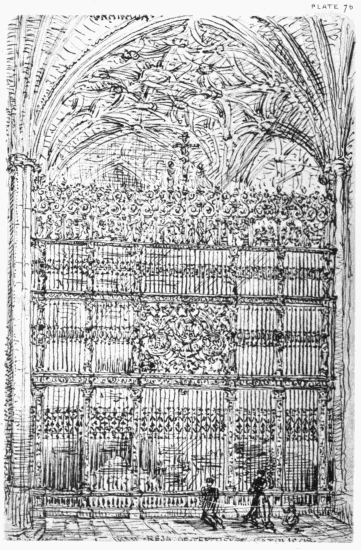
PLATE LXXVI.
GRANADA. THE REJA OF THE REYES CATOLICOS.
I WAS tempted to sketch this magnificent screen for four reasons:—
Firstly, because it is, I believe, entirely of iron, which most of the Spanish Rejas are not.
Secondly, because it is, I also believe, the earliest specimen of anything like equal importance in Spain.
Thirdly, because of its historical interest in enclosing the tombs of "the Catholic Sovereigns" on the spot before which the greatness of their lives had been achieved.
Fourthly, because I considered it to be the best in design of all I saw.
It is by no means the richest, but it appeared to me to be arranged upon the justest principles. Its chief merits, as compared with many others, I considered to be as follows:—
Firstly, its transparency. One of the most important qualities any such screen should possess, is that of due subordination to the great architectural features of the locality in which it is placed. Where ornament is spread all over the surface of a screen, or where the main lines wander about in capricious directions, the eye is arrested by the metal work as a plane surface; and if not actually stopped by it, is at least led off in wayward directions, and fails to pass beyond it. In this case, the rectangularity of the whole gives great repose; the plain vertical bars almost disappear; while the splendidly ornamented portions of the screen seem as if suspended in mid air, and in no wise injure the effect of the architecture,[49] or diminish the apparent space of the locality they decorate.
Secondly, its stability without heaviness. The subdivision of the whole surface into regular compartments allows of a concentration of strength in the skeleton lines, and gives great constructional stiffness without too much formality.
Thirdly, its propriety of design. Its author has simply, as it were, asserted the principle of "serve God and honour the King;" instead of, as is usual, "look at me, and see what a fine fellow I am." At the summit of his design he has represented the Crucifixion; immediately beneath, the leading incidents of Gospel history, making conspicuous (in compliment no doubt to the triumph of the Church in the entry into Granada of his sovereigns), Christ's entry into Jerusalem. As the central object, not much less than twenty feet square, he has grouped in masterly style the full heraldic insignia of those whose remains are deposited in the chapel beyond. The lower portion of his design has evidently been intended simply to give stability to the upper part, and to close the access to the magnificent marble and alabaster monuments of Ferdinand and Isabella, and of Philip of Burgundy and "Juana la Loca," without interfering with the facilities for seeing them of those who might gain access to the Antechapel, but be refused it to the Mausoleum itself.
The name of the admirable artist, "el Maestre Bartholomé," who wrought this Reja in the year 1522, is inscribed upon it, near to the keyhole of the great central gates.
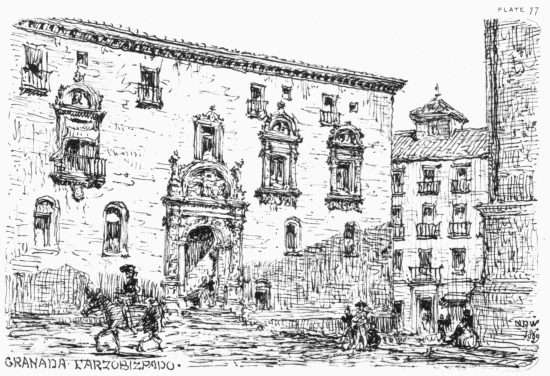
PLATE LXXVII.
GRANADA. VIEW OF THE ARZOBISPADO.
A CAREFUL contrast of this stately old mansion in which, if not the hand, at least the influence of the architect, Henrique de Egas, (son of Anequin de Egas de Bruselas, so greatly patronized by the celebrated Cardinal Mendoza,) may be clearly traced, with the great Palace of Charles V., ascribed to the artist Machuca, (both at Granada,) may afford a useful lesson to the architectural student. In the earliest of the two monuments—the Arzobispado—a window of which I now offer a slight sketch, the florid Plateresque style, as exemplified by the celebrated Hospedal de la Santa Cruz, at Toledo, (Sketches 44, 45, 46) is at once recalled to the memory. In the latest, we find a marked sympathy with the symmetrical style of the then fashionable Italian architects. The Circular Cortile of Vignola's masterpiece at Caprarola, is exceeded in dimension, and indeed in dignity of style, by the vast round Patio of the Palace of Charles V., with which it is probably nearly contemporary.
Such sober architecture, though enriched by the chisel of sculptors who, like Berruguete, had been ardent admirers of Florentine and Roman models, was the form of Plateresque which, intervening between the first form of Renaissance, founded on French and Burgundian models, and the austere Italian of Herrera, found special favour in the eyes of the most judicious critics in Spain.
How far the best designers of Spain, amongst whom must certainly be reckoned Juan de Arfe y Villafañe, acknowledged their dependence upon the great Italian masters for all they considered most excellent in style, may be gathered from the curious account of the development of good art in his time[50] that he gives in his celebrated Treatise on Sculpture and Architecture. After dwelling upon what he curiously enough calls the "obra moderna," with which the great cathedrals of Spain had been, as he considers, built, he observes, "This barbarous work, having arrived at its end, its disuse having commenced in our times, gave place to the ancient styles of the Greeks and Romans. Although this style of work had been revived at an earlier period in Italy by the diligence and study of Bramante, Master of the Works of St. Peter's at Rome, Baldassare Perruzzi and Leon Baptista Alberti, celebrated architects, it also began to flourish in Spain through the industry of the excellent Alonso de Covarrubbias, Master of the Works of the Cathedral at Toledo, and of the Royal Palace, father of the most famous doctor, Don Diego Covarrubbias, President of the Supreme Council of his Majesty and Bishop of Segovia, and of Diego Siloe, Master of the Works of the Cathedral and Palace of Granada. These masters began to use this kind of work in many places wherever they built, although always with some admixture of the modern work (Gothic or early Plateresque) which they could never entirely forget."
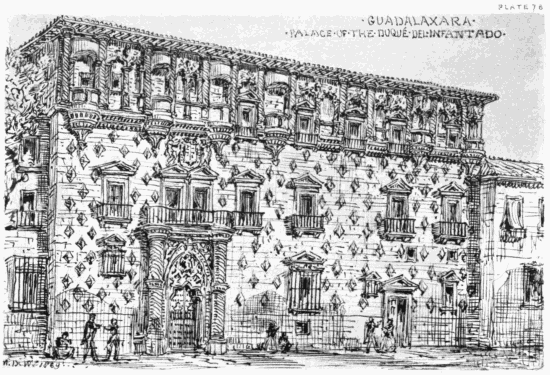
PLATE LXXVIII.
GUADALAXARA. PALACIO DE LOS DUQUES DEL INFANTADO.
THIS is unquestionably one of the most important of the Palaces of the ancient nobility left in Spain, worthy of the renown of the Mendozas, long Seigneurs of Guadalaxara. In spite of its present picturesque aspect, however, architecturally speaking, it is a strange jumble of incongruities; and offers but a ghost of the beauty it must have possessed upon its first construction towards the end of the fifteenth century from 1461 onwards. Splendour it must have possessed in perfection at the date at which it excited warm admiration in the breast of the captive sovereign, Francis I. of France, who was here magnificently entertained by the then Duque del Infantado. The top story with its remains of continuous arcading and balconies, the walls, the splendid doorway, and above all the Patio, with the exception probably of the top cornice and the Doric columns of the ground-floor arcade, all belong to the original construction. These remains afford sufficient indication of what has been destroyed to make way for Italian decoration and barbarous repair, to enable the practised eye to see the whole as it once existed; before a vulgar desire for novelty, and especially for foreign novelty induced the desecration of the integrity of the design. One might have fancied that every true Spaniard would have regarded this palace almost as a holy place, from its having received the last breath of the great Cardinal Mendoza—the "Rex tertius," whom Felipe Vigarny, or some other dextrous sculptor, portrayed in the carvings of the Cathedral at Granada,[51] riding with Ferdinand and Isabella, and receiving the keys of the Alhambra from the hands of the unfortunate "Boabdil el Chico."
The interior of this Palace is fully as rich and remarkable as the exterior. The Patio which is about eighty feet long by fifty-six wide, (about two-thirds of the size of the court-yards of the Royal Exchange and the India Office), is surrounded by arcades of two stories, each about twenty feet in height. Both series of arches are of a Gothic and fantastic form, with spandrels filled in on the lower story with lions, and on the upper with winged griffins. Between each arch are columns, surmounted with armorial bearings, eagles, and grouped finials. The whole, if coarsely, is very spiritedly carved, and produces a stately and simple, though rich effect. The saloons are large and lofty, with remains of beautiful half Moorish ceilings, and much effective Italian fresco decoration of good colour and enriched with harmonious Arabesque ornament.
The state of this once splendid structure is unfortunately as dilapidated as the national finances. What more can or need be said? Everything going to pieces for want of that "stitch in time," which nowhere, and in nothing, in Spain, seems ever likely "to save nine."
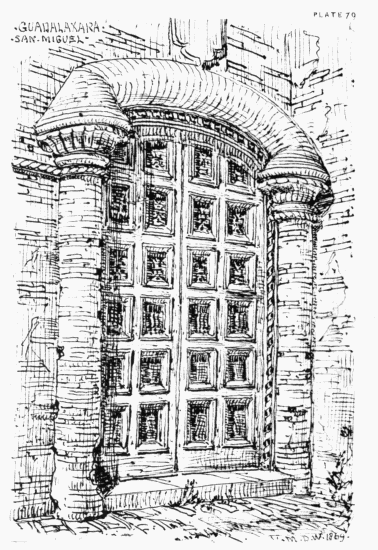
PLATE LXXIX.
GUADALAXARA. DOORWAY OF THE MONASTERY OF SAN MIGUEL.
IN and about Guadalaxara may be found many indications of the traditional preservation, long after the expulsion of the Moors, not only from New Castille, but from Spain generally as well, of their excellence in the technical arts, amongst which brick-making, combining, and laying were conspicuous. Hence, especially throughout the two Castilles, Aragon, and Andalucia, the common method of using brick-work is peculiarly Oriental and effective. The entrance doorway to the Monastery of San Miguel, which forms the subject of our seventy-ninth sketch, illustrates this mixture; as well it may, since traces are yet to be found of the structure having been originally a mosque converted, probably, shortly before the year 1500 to Christian uses. The round instead of square buttresses, with conical terminations, the segmental arch, with its ponderous archivolt, the great strength and almost heaviness given by the regular rectangular setting out of the woodwork—and a coarseness and yet spirit in the execution of carving, are marked features of Aragonese style; the echoes of which may not unfrequently be met with at Naples, especially in the entrance gateways to many an old house. I well remember being puzzled by several of those which I sketched there, and which appeared to me to differ from ordinary contemporary Italian architecture in other localities. I subsequently recognized similar features in Palermo, and elsewhere in Sicily.
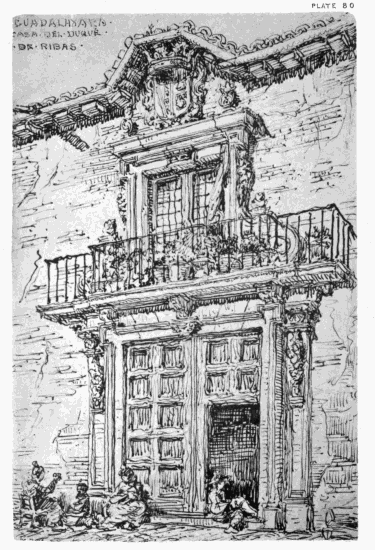
PLATE LXXX.
GUADALAXARA. CASA DEL DUQUÉ DE RIBAS.
THE traveller who takes his seat for an hour or so before some old portal of a Spanish provincial mansion, garnished with heraldic insignia, proclaiming the rank, if not the dignity, of the possible owner, can scarcely fail to be struck by the usual incongruity between the assumption of the structure, and the modesty, not to say meanness, of those who pass in and out of it generally at long intervals. The sketcher's operations naturally, after a little while, attract the attention of some few, and "their name is legion" throughout Spain, of those who have nothing to do; or who, at any rate, do nothing, but wander lazily but restlessly up and down to while away the time. After a compliment or two, and probably a request that the spectators will not stand exactly between the artist and the object he may be drawing, an inquiry very generally follows as to "whose house that may be?" If the answer extends beyond the usual "Quien sabe Caballero?" it may chance to be "del Señor Duqué," or "del Señor Marques," something or other, or at any rate of a "Señor somebody," "somebody," "somebody." To the next inquiry, as to where the Hidalgo, if he be such, may be? the usual answer will be "Madrid" or "Paris," or at any rate the "chef-lieu" of the Province. The next demand may likely enough be, "Who lives there then, now?" If the answer is not the usual "No puedo decir a Usted," it may possibly be, "El Señor Administrador," the Steward, or "Algunos Pobres," or "Don Manoel, the shoemaker," or "Don Juan, the carpenter."
Where the nobility live, if they are not all absentees, it seems very difficult to find out; and hence it is that instead of ladies and gentlemen, and liveried servants, who pass in and out of these grand looking "portone," the sketcher usually sees only extremely picturesque poverty. Sometimes this presents itself in the shape of a ragged girl or two, carrying antique-shaped earthen water-jars, sometimes an old woman with a heap of long-haired unkempt children sitting down to spin, or reel off yarn, or lolling against the wall, distaff in hand; and sometimes, possibly, two or three boys or young men assemble, who, after smoking out some cigarrilos or stumps of cigars, coil themselves up on the threshold, and go off into a comatose condition closely resembling sleep.
Such were my experiences whilst trying to gain some local information as to the mansion of the very noble, the Duqué de Ribas at Guadalaxara.
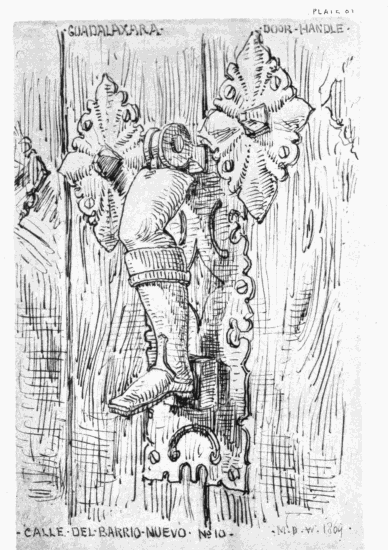
PLATE LXXXI.
GUADALAXARA. DOOR HANDLE FROM THE CALLE DEL BARRIO NUEVO.
THE outskirts of Guadalaxara are very picturesque, and the traveller who wanders about in quest of beauty, old or new, cannot fail to be rewarded; not only by glimpses of scenery, but by the discovery of many quaint little fragments of art which have escaped the attention of the many despoiling locusts—native as well as foreign—who have done their best at different times to "devour the land." Of such, a specimen is given in the "knowing" little knocker, or door-handle illustrated in my eighty-first sketch. It is no doubt a joke on the part of some cunning smith, of the last century, mindful of the still greater cunning of his handicraft, traditions of which may have descended to him, from the days when the armourers of Spain rivalled those of Milan and Augsburg.
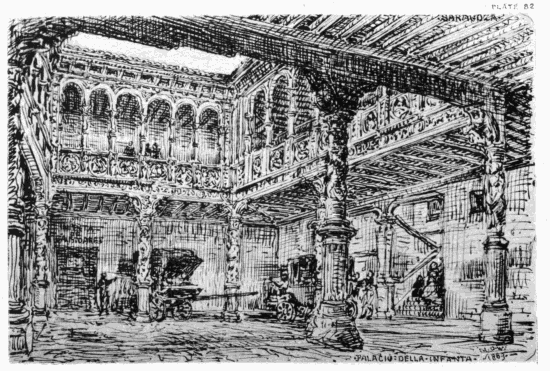
PLATE LXXXII.
SARAGOSSA. VIEW OF THE PATIO OF THE PALACIO DE LA INFANTA.
PONZ speaks with great complacency of the sumptuousness of the houses of Saragossa—particularly those with columns, (such as that of the Marques de Monistol) and those the Patios of which are adorned with sculptures—"such costly and sumptuous works," he says, "as no one undertakes now a days." Amongst these he particularises the house which forms the subject of the present sketch. Before his time it appears to have belonged to the Citizen Gabriel Zaporta, "muy distinguido y rico," as Ponz calls him. From him it was bought by the widow of a certain Don Gabriel Franco. At the close of the last century it was the home of the Infante Don Luis, (uncle of Charles IV. of Spain), a Cardinal and Archbishop of Toledo! who married "La Vallabriga," earning exile to Saragossa for his pains. She lived here with him, and procured for the house its popular and best known name, la Casa de la Infanta. Their eldest daughter was bestowed, as an Infanta of Spain, upon the detestable Godoy—"Prince of Peace,"—the recognised lover of her first cousin by marriage, the Queen, wife of Charles IV., thus crowning a double mésalliance.
"On the ground floor," says Ponz,[52] "of the Patio are twelve arches supported on columns wrought with a thousand fancies, as are those also of the first floor. On the lower floor of this house is a painter's studio. Both floors are enriched with medallions representing kings, fanciful foliage, and infinite labour in cornices, mouldings, &c." Similar elaboration, now much defaced, is to be seen in the staircase with vaulting, and handrail with medallions recalling those of the first floor.
Amongst the most important palaces, next to the house of Zaporta or de la Infanta, and that of the Marques de Monistol, were those known as the "Castel-Florit," which belonged in Ponz's time to the Count Aranda—and another the property of the Duqué de Hijar. The "Casa de Comercio" which forms the subject of my eighty-fifth sketch was less important as to quantity, but more important as to quality, than those last mentioned appear to have been. As a general rule, the Saragossan houses appear very large but coarsely treated as to detail, even in the richest, such as those with showy windows behind the Seminario, in the Plazuela de San Carlos.
My sketch sufficiently shows the "base uses" to which the truly palatial Casa de Zaporta, or de la Infanta, has "come at last." It is well that as many as possible of the rising generation of art-students should see it, for it is not likely that any of it will be left for their children.
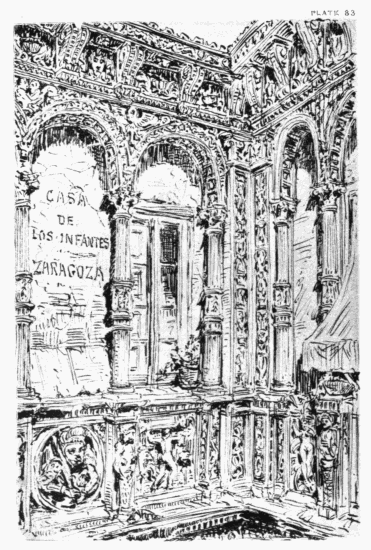
PLATE LXXXIII.
SARAGOSSA. DETAIL OF THE ARCADING OF THE FIRST FLOOR OF THE CASA DE LA INFANTA.
THIS sketch gives to an enlarged scale some of the architectural features represented in little in the preceding sketch. Many of the arches which were once open in a beautiful arcading are now closed up in lath and plaster; with a heartless indifference to everything else than getting as much room as possible to let to the poor lodgers who swarm in this once splendid Palace. The whitewash brush goes recklessly over any surfaces with which it is brought into contact at the command of sanitary inspectors, who enforce perfunctory cleansings from time to time of at least the "outside of the platter." As I sat sketching and "poking about" for some hours in this apparent "rabbit warren" of a house, I could not but become conscious that the Arragonese had by no means lost their old character for devotion, not to say bigotry. "Our Lady of the pillar," the tutelary of Saragossa in spite of all alleged pilferings from her shrine, seemed still at a premium in popular estimation; and casts of her in the poorest plaster were multiplied even in the poorest tenements. In fact, this seemed to be the very place for meeting with the truly Spanish couple of the lower middle class, so well sketched by the German Fischer in his travels at the close of the last century. "I cannot conclude this letter," says he, "without saying a word or two of my hosts. Both the man and his wife are originals not to be met with but in Catholic countries; both bigots to excess, but each in a different way. In the husband, this disposition has assumed a silent and gloomy cast of character, while in his wife it bears all the symptoms of tenderness. The husband has filled the whole house, and especially his own apartment, with images of saints, resembling an entire collection of the little Augsburg toys so well known in Germany. In fulfilment of a vow, he mutters his prayers three times a day before these idols, an occupation which daily employs two full hours. He also imposes on himself very painful mortifications, talks very little, reads gloomy books, and remains whole hours with his eyes shut, so that he is on the high road to become either a madman or a saint. The wife's fanaticism is much more social, and her pious imaginations bear the stamp of the mildness and softness of her sex. She has got herself received a "slave of the Holy Trinity" (esclava de la Santissima Trinidad), of which she has obtained a certificate in form from her confessor, and in consequence of which she is bound every day to decorate a large picture with flowers and tapers, to repeat a certain number of prayers before it, and to pay a certain sum weekly to her confessor, an agent of the Trinity; yet all this does not seem to her sufficient for salvation, and she has besides an image of the Holy Virgin, which she very punctually supplies with all the necessary habiliments, both for day and night, besides tapers, flowers and all that can contribute to ornament the happy idol.
"This devout esclava is a little woman very affable and complaisant, whose religious sentiments do not at all interfere with other terrestrial feelings, while her impassive husband seems to have arrived at all the spirituality of the blessed."
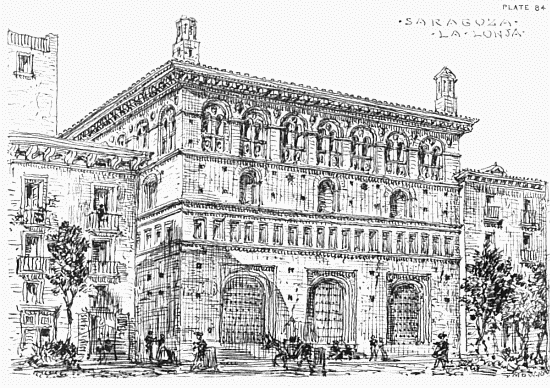
PLATE LXXXIV.
SARAGOSSA. EXTERIOR OF THE EXCHANGE.
THERE is something about the exterior of this fine building essentially Florentine in style. The bold overhanging and crowning cornice, the Ricardi-Palace kind of windows, the simplicity of the Mezzanine, and indeed the introduction of a Mezzanine at all, associated with the severity of the rectangular structure, massive in a noble simplicity, rather recall the work of the grand masters of Tuscan Architecture at the end of the fifteenth century, than any styles, Plateresque or Greco-Roman, one recognises as peculiarly Spanish.
The name of the architect appears to have been lost, but there is no question as to the date of its erection, which is given by an inscription which runs beneath a cornice in the interior, and states that it was completed in "1551, reynando Donya Jona y Don Carlos su hijo."
The "Lonjas," or Exchanges, of Spain, constitute an important and interesting class of buildings, dating, from mediæval times in the most commercial of the towns on the seaboard, and from the Renaissance period in those of the interior. The term Lonja, originally only implied a "long place" or platform, the sort of spot in a town on which merchants would meet, as on "the flags" at Liverpool. In process of time the Lonjas came to be covered in, and converted into handsome "Exchanges." The earliest structure of this class is, or rather was, at Barcelona. All the fine old building of 1383, Mr. Street tells us, has "been completely destroyed, with the one exception of its grand Hall, which still does service as of old. This consists of three naves, divided by lofty and slender columns, which carry stilted semi-circular arches. The ceiling is flat ... and the dimensions about one hundred feet by seventy-five." The "Casa Lonja" of Valencia, which Mr. Street has also fully illustrated[53] is one of the prettiest of the late Gothic buildings in Spain. It was erected between 1482 and the close of the fifteenth century. The next important Lonja in point of date was the Saragossan of 1551. The last was that of Seville built by Herrera between 1585 and 1598, and certainly one of his best works. It was avowedly built in rivalry with Gresham's Royal Exchange—completed in 1571.
To the interior of the fine building under notice I could not obtain access, and have therefore to trust to Ponz's description of it. "It forms," he says, "a splendid saloon with an internal double gallery of Doric columns and arches, to the number of fifty." Within it are erected an altar to, and statue of, the guardian angel, in fact the building had its Lararium. Ponz mentions, further, many paintings. These appear no longer to exist, since all I could learn by personal inquiry on the spot was that the place, having long been used as a carpenter's shop and warehouse was now absolutely empty and unused. I fear therefore that the "Angelo Custode" has had too much to do, and has broken down under his task.
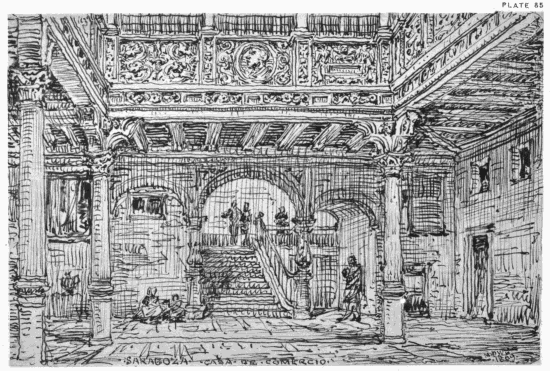
PLATE LXXXV.
SARAGOSSA. PATIO OF THE CASA DE COMERCIO.
THIS house, originally a Gothic one, in some of its earliest details, still acknowledges its allegiance to the noble family of the Torrellas, its founders. Their arms, with a lion, and the three little towers which pun heraldically upon their name, as charges, still exist upon a Gothic escutcheon over one of the doorways. The house is locally stated, I know not on what authority, to have been occupied, and altered by a company of Genoese merchants, whence, no doubt, its popular name "de Comercio." It is situated in the Calle de Sant' Jago, and is now the property of the Marquis de Ayerve.
Although retaining the usual Saragossan bracket-capitals and "Anillos," in the shape of quasi bases and dies or pedestals united, the symmetry of the plan and the regularity of the cinque-cento ornament and Arabesque of the panels and pilasters certainly bear out the tradition of the Genoese occupation and alteration of an original mediæval structure early in the sixteenth century.
At that time, and for nearly a couple of centuries afterwards, the bulk of the commercial transactions of Spain were administered by foreigners, principally at first Italians, and subsequently Flemings and Frenchmen. The expulsion of the Moors, the persecutions of the Jews, and the pouring in of American silver opened up a splendid field in Spain, during this period, for the trafficking talents of people endowed with greater activity and commercial genius than the Spaniards themselves possessed. Their function was to despise trade, and use, but detest, the foreigners, whose aptitude for work supplied the wants engendered by one of their besetting sins—laziness. "Ociedad, raiz de los vicios, y sepulchro de las virtudes," as Marcos Obregon exclaims. "En quatro cosas," he continues, "gasta la vida el ocioso, en dormir sin tiempo, en comer sin sagon, en solicitar quietas, en murmurar de todos."[54]
The following are the Countess d'Aulnois' comments on the effects of the mixed jealousy and laziness of the Spaniards in her time—the latter part of the seventeenth century.
"All strangers," she says, "what services soever they may have done, the Spaniards ought to fear them, they considering themselves and interests only, in such a manner that the Italians and Flemings, that are this king's subjects, are used no more favourably than if born under another master. If they pretend to imployments, either at Court or in the armies, they are told they are not natural Spaniards who engross all, as well to keep up the glory of the nation, as out of diffidence of others, whom they in a manner declare incapable of all trust because not born in Spain; this country, nevertheless, abounds in strangers, but they are only artificers and mercenaries invited by gain, and that meddle with nothing but their peddling traffick. It is thought that there are above forty thousand French in Madrid, who, wearing the Spanish habit, and calling themselves Burgundinians, Walloons and Lorraines, keep up commerce and manufacture; it concerns them to conceal their country, for if it be discovered, they are obliged to pay a daily Pole-money of about a penny to the town, and, any bad success happening to the publick, appearing in the streets, are liable to a thousand insolencies, even to blows.
"They that know what number of strangers are in this town, report, that would they undertake it, they might make themselves masters, and drive out the Spaniards."
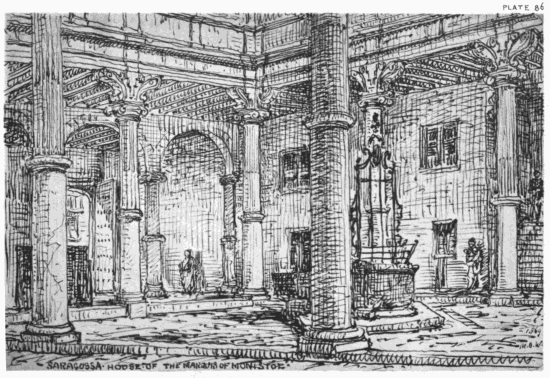
PLATE LXXXVI.
SARAGOSSA. PATIO OF THE HOUSE OF THE MARQUIS OF MONISTOL.
THE great dimensions of this house, and its massive strength and solidity are no bad emblems of the old sturdiness, wealth, and pride of the Aragonese nobility, whose Plateresque architecture "differed" as Mr. O'Shea justly remarks, "in many points from its countertype the Seville Moro-Italian, or strictly Andalusian style, applied to private dwellings." Although apparently far ruder in execution than either of the other two houses I sketched—that of the Infanta and that known as de Comercio—in the same city, I have little doubt that this is of considerably later date. The florid Spanish Plateresque of the former, and the cinque-cento carving of the latter, took precedence of the more regular Greco-Roman architecture aimed at by the architect of the house now under notice. The retention of the bracket capital in lieu of either arches or a lengthened column, and of the "anillo" or ring dividing the shaft into two heights, illustrate the way in which local habits interfered with the adoption of the rigid rules prescribed by the writers on architecture, and practised by contemporary architects, of the Herrera type.
Considering the terrible "fortunes of war," to which Saragossa has been exposed, and its frightful hand to hand fighting in the heart of the city, it is only wonderful that so much of the past should still linger within the lines of defence. If the ruinous sieges have left Saragossa poorer than they found her, they certainly do not appear to have left her weaker or less fierce. She struck me as being poorer and prouder than any other city I visited in Spain. At the same time, both men and women show a hardy activity and lively inclination to pugnacity I did not see elsewhere. The only answer I got from a Madrileño to my question as to "why the Saragossans did not work?" was, that "they preferred fighting," adding that "while they would look hard at a peseta before they would undertake even a trifling job for it, they would at any time do a good day's fighting for one half of that coin."
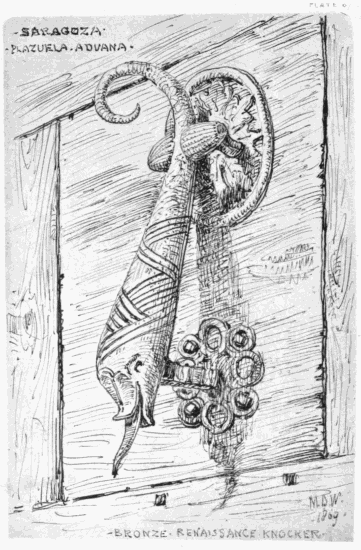
PLATE LXXXVII.
SARAGOSSA. BRONZE RENAISSANCE KNOCKER OF A HOUSE IN THE PLAZUELA ADUANA.
THE quaint little animal, or rather conventionalised notion of an animal, which I found in an out of the way "Plazuela," or "little place," of Saragossa, doing duty as a knocker, furnishes a good illustration of the ready dexterity in his craft of the old Spanish smith and brazier. Of splendid bronze work (in spite of the intrinsic value of the material which has no doubt led to the fusion of thousands of treasures of Art all over the Peninsula) Spain yet possesses invaluable treasures. Amongst these the most salient which occur to my memory as single pieces, are the magnificent eleven gilt life-size portrait statues of the greatest of the Spanish Royal Family from Charles V. to Philip II. with which Pompeio Leoni decorated the "Entierros Reales" of the Escorial—and the same sculptor's still finer statues of the celebrated prime minister and favourite, the Duqué de Lerma, and his Duqueza, founders of the Convent of San Pablo, at Valladolid, whence they have been transferred to the museum of that city. As semi-architectural, semi-sculpturesque works in bronze, occasionally with an admixture of iron upon a large scale, of course the most important and abundant are the late Rejas, or metal screens, of the great Spanish churches and cathedrals. Of these, ample notices are given by both Ford and O'Shea—authorities, at once so excellent, and so readily accessible, as to render unnecessary any more on my part than a passing reference to them.
Another form in which copper and bronze have been well and plentifully used by the Spaniards is in the shape of coverings and strengthenings to doors. In this guise the models have been mainly derived from the Moors whose doors may generally, whether in wood or metal, be regarded as perfection itself, for beauty, strength, and fitness for the circumstances under which they have been used. The Spaniards (at Toledo Cathedral for example) have produced many admirable doors in which, by the judicious strengthening of the joiner's work with embossed and occasionally perforated bronze plates, they have combined strength with moderate substance, and the appearance of great richness with fairly simple and not costly labour.
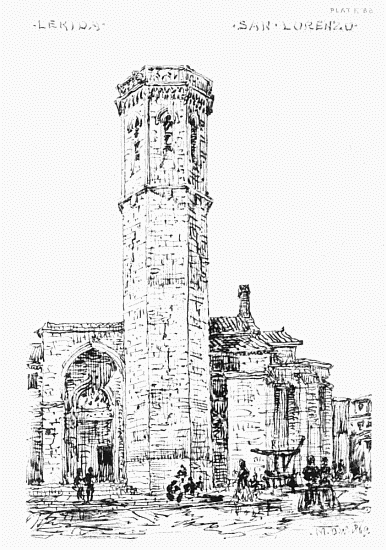
PLATE LXXXVIII.
LERIDA. TOWER OF THE CHURCH OF SAN LORENZO.
THE interest of every other building in Lerida altogether pales before that of its noble, but now much desecrated Cathedral. Its ancient glories may be well studied in Mr. Street's pages, but its present humiliation can only be appreciated upon the spot. Toiling up from the city through streets and open platforms on the hill-side, thronged with soldiers, gipsies, beggars, and ragged boys innumerable, the traveller at last arrives, not at a church, but at a monster-barrack. In lieu of a sacristan he has to engage the services of a corporal as Cicerone, and with the consent of, I am bound to say, an exceedingly polite Spanish officer, he is free to examine, at his leisure, a Cathedral which, as Mr. Street says, "is in itself worth the journey from England." Its construction, and that of its splendid cloister, occupied almost the whole of the thirteenth century, and the vastness and regularity of its plan, its solid and perfect execution, and the just proportion of its structural and ornamental details certainly, to my mind, justify the praise bestowed upon them by that accomplished architect.
It was sad to see such a building cut about by the insertion of floors and partitions, and to hear the piquant, not to say ribald, jokes, "refranes, seguidillas" and songs of the soldiers, echoing from vaulting which once rang only with peals from the organ, and chants and hymns from the priests and people.
As my stay was bound to be short in Lerida, and I remembered that Mr. Street had done full justice to the Cathedral, I looked elsewhere for a subject for my note-book, and found it in the picturesque tower of the Church of San Lorenzo, given by my eighty-eighth sketch.
The legend runs that this Church, and that of San Juan, were originally mosques; and that after the taking of the city from the Moors in 1149, they were applied to Christian uses. I am inclined to think this probable, although the detail is not anywhere Mahommedan, so far as the darkness of the interior would allow me to form any opinion. The great thickness of the walls, the mode of lighting, the form and proportions of the entrance archways (shown in my sketch) and the materials and mode of building of the base of the tower all seem to favour the supposition of an original Moorish construction. The octagonal form of tower is a favourite feature of this district, and occurs on a grand scale in the old Cathedral. The upper portion, at least, of this tower of San Lorenzo, may probably date from early in the fifteenth century.
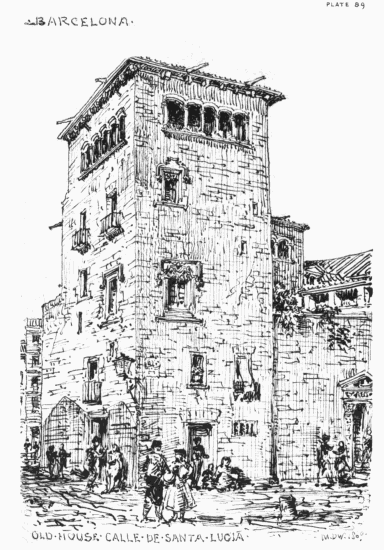
PLATE LXXXIX.
BARCELONA. OLD HOUSE IN THE CALLE DE SANTA LUCIA.
AS Prescott[55] observes, "The City of Barcelona, which originally gave its name to the county of which it was the capital, was distinguished from a very early period by ample municipal privileges. After the union with Aragon in the twelfth century, the monarchs of the latter kingdom extended towards it the same liberal legislation; so that by the thirteenth, Barcelona had reached a degree of commercial prosperity rivalling that of any of the Italian Republics. She divided with them the lucrative commerce with Alexandria; and her port thronged with foreigners from every nation, became a principal emporium in the Mediterranean for the spices, drugs, perfumes, and other rich commodities of the East, whence they were diffused over the interior of Spain and the European Continent."
Amongst its other merits was that of having established in 1401 the first bank of Exchange and deposit in Europe—as well as of having compiled the first written code amongst the Moderns of Maritime law. Her great merchants were "magnificos" ennobled, not degraded as in Castile, by connection with trade.
The long civil war which began in 1462 and ended with the surrender of the city to King Juan in 1472 was the first great check the city received in its splendid career of prosperity.
The house I have sketched was doubtless well adapted to such troublous times, affording comparative safety on its lower floors and comparative air and comfort as its occupants mounted higher and higher. It was probably built shortly after the middle of the fifteenth century, revealing here and there traces of a French mason's handicraft. It follows the type, not of the merchant's, but of the cavalier's house. Such towers, half residence, half fortress, were, especially in the south of Europe, far more numerous than one may now be justified in supposing; and the more frequently Italian street views in pictures and illuminated manuscripts are studied, the more natural and usual appears what we now fancy to be strange and rare. With the introduction of Renaissance architecture, the character of these quasi-mediæval structures changed altogether.
Navagiero[56] writing of the condition of Barcelona in 1524, says that "the houses are good and commodious, built of stone and not of earth, as are those of the rest of Catalogna. Although lying on the sea it has no port, but an arsenal, in which many galleys were wont to be constructed, now there are none. Bread and wine are scarce, but of every kind of fruit there is abundance. The cause is said to be that the land is stripped of men through the war with King John on account of his son Don Carlos."
Depopulated the city may have been, and its commerce may, no doubt, have suffered in consequence, but the Catalonian character was energetic, and the city still preserved much of its previously accumulated wealth. Merchants too have a knack of prospering in troublous times, especially those who thrive on profits upon imports. Hence we still find merchants' houses of great comfort, although evidently constructed during the evil days of Barcelona. Of one of these I furnish (in my ninety-sixth sketch) a good example, offering an interesting theme for comparison with the sketch now given.
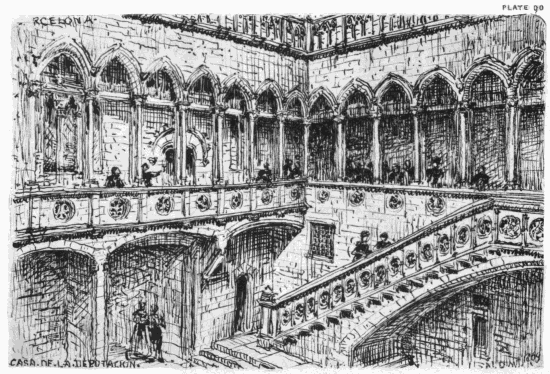
PLATE XC.
BARCELONA. PATIO OF THE CASA DE LA DIPUTACION.
WITHIN the ancient "Palacio de la Diputacion" is preserved the elaborate late Gothic Chapel of St. George (protector of Catalonia) with a small but highly wrought entrance from the arcading on the first floor of the Patio de la Audiencia, represented in my sketch. This Patio is so called because its arcades, in which habitually sit many lawyers, and saunter many clients, lead to the Courts of Justice, in which causes are tried. The existence of this Chapel has, for ages, given a sort of prescriptive right to the public to invade the Patio, the Chapel, and its precincts, upon St. George's day. Of the gay scene which then takes place Parcerisa[57] has given an animated lithograph, showing the very different aspect it then wears to any it habitually presents.
Under any circumstances, however, its architecture, which is bold, even to the verge of rashness, gives it a permanent interest. It is a subject for wonder, that any structure in which the main supports of a heavy third story appear so insignificant as do the little marble columns (about two inches in diameter only) of the first floor of this Patio should have existed from mediæval days to our times. The truth, no doubt, is that the main weight of the walls of the top story, and of the roof, is carried by means of massive beams, acting as cantilevers, back to the walls which form the internal faces of the arcades, a device not quite maintaining that beautiful "lamp of truth" we are taught to look for in all mediæval designs. The users of the arcades have lately procured the building up of many of the arches, leaving windows to light the arcades. I have taken the liberty of omitting all of these but one, as I was desirous of showing, not what the lawyers have done, but what the original architects devised, no doubt as a "tour de force."
I was told upon the spot that this building up of the arches, the supports of which certainly appeared to my eye far too fragile for beauty, was a matter not of choice but of necessity.
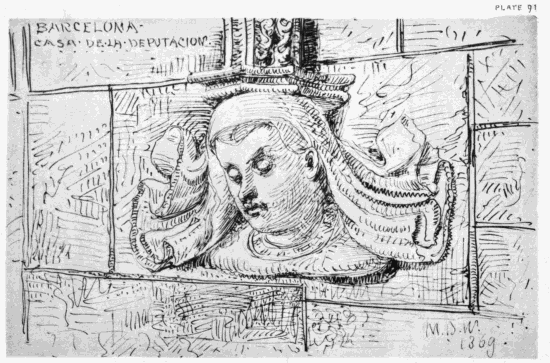
PLATE XCI.
BARCELONA. DETAIL FROM THE CASA DE LA DIPUTACION.
IF Catalonian architecture differs from ordinary Spanish, and it is quite manifest from my sketch that it does in detail, as I have already shown that it does in system, the character of the Catalonian men and women differs even more markedly from that of the Spanish. While one of the latter in his laziness, as Marcos Obregon says, "ni come con gusto, ni duerme con quietud, ni descansa con reposo," the former, on the contrary, eat with appetite, sleep with tranquillity, and throw off their cares healthily in rest. The latter, in fact, chew but scarcely digest the bread of idleness, while the former thrive on that of industry. As a natural consequence, there is no love lost between the two races. The Castilian regards as mean and debasing the cultivation of the very mechanical arts, excellence in which the Catalonian well knows to be the source, not only of wealth, but of power and honour as well. To Barcelona belongs the credit of having been one of the first cities in the world, out of France, to establish gratuitous schools of design in which poor youths were taught specially to design for manufactures. Both Laborde and Whittaker[58] testify to the extent and excellence of these schools at the end of the last century and beginning of the present. The latter, writing in 1803, says, "we visited the Academy of Arts instituted in the Palace of Commerce, and supported in the most magnificent manner by the merchants of Barcelona. We were conducted through a long suite of apartments, in which seven hundred boys were employed in copying and designing; some of them, who display superior talents, are sent to Rome, and to the Academy of St. Fernando at Madrid; the others are employed in different ways by the merchants and manufacturers. The rooms are large and commodious, and are furnished with casts of celebrated statues and every proper apparatus. We observed a few drawings of considerable merit, produced by the scholars; but the grand picture before us of liberality and industry, amply rewarded our visit; and was the more striking to us, for having of late been continually accustomed to lament the traces of neglect and decay, so visibly impressed on every similar institution in the impoverished cities of Italy."
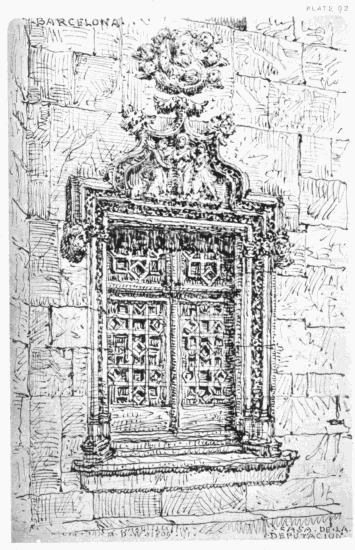
PLATE XCII.
BARCELONA. WINDOW FROM THE CASA DE LA DIPUTACION.
THIS quaint and very late specimen of Gothic, although Ecclesiastical enough in its sculpture, is purely domestic in its architecture. The latter is in its character rather French or Burgundian than Spanish, while the former was, I have little doubt, the work of a native of the Peninsula. So far as I could see, no preparation had ever been made for glazing this window, and the wooden shutters, both in their form and mode of joinery, were rather Moorish than Spanish. No one can be surprised at such symptoms of internationality, in works executed at a sea-port like Barcelona—in which the Arts, like the prevalent language, may have had a "lingua franca" of cosmopolitan freedom from prejudice. In most of such Gothic work, and indeed in every kind of building in Spain, however fantastic and not unfrequently over intricate the detail may be, we scarcely ever observe any flimsiness, or want of due substance in the constructional parts. In this matter the Spanish architects merit, for attention to the erection of permanent structures in all their styles, the praise bestowed by Mr. Street upon those mainly who wrought in the mediæval ones. Of those last, the Spanish critics, who have been sometimes accused of overduly estimating what they call Greco-Roman architecture, early showed what I regard as a fair appreciation. Antonio Ponz, for instance, in the last century certainly praised Berruguete, Covarrubbias, and even Herrera in very glowing terms, but I know few writers who have better expressed an opinion as to the fitness of the mediæval styles, and especially the old Spanish system of the sturdiest construction, for ecclesiastical purposes.
Of this "Arquitectura Gótica," he says,[59] "nadie puede con razón decir, que falta en la majestad y el decoro: al contrario parece inventada para dárselo á los Templos, y casas del Señor. Los mas insignes Arquitectos han confessado su solidez, y han tenido mucho que admirar en el capricho de sus adornos, y en la prolixidad con que están acabadas todas sus partes. Muchos países de Europa se precian de sus monumentos, y en España los hay magnificos, como son la Catedral de Burgos, la de Sevilla, Valencia, y otras."
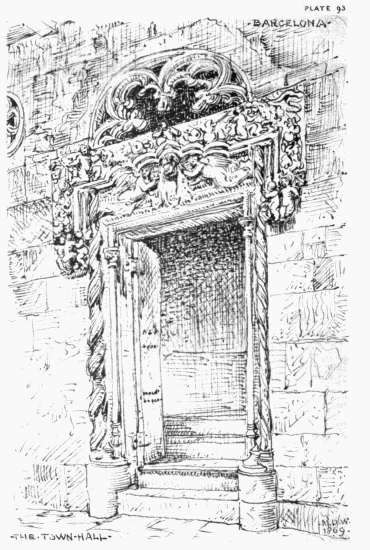
PLATE XCIII.
BARCELONA. DOORWAY IN THE TOWN HALL.
THE mission to Spain of the Count de Laborde on the part of the French Government at the moment when Napoleon I. thought he had the whole country within his grasp, was essentially economic in its object. Hence his accounts of, and investigations into, its past, present and future capabilities for trade are of far greater value than his topographical and archæological investigations, most of which are founded on the writings of Ponz and other well known authorities. While Spain was at the height of its prosperity, Seville and subsequently Cadiz commanded the South American trade, but Barcelona remained as it had been from a very early date, the great maritime means of communication and interchange of commodities between Spain and the rest of Europe. The business transactions carried on at its Lonja, or Bourse, and its Town Hall were very extensive, and these buildings were of commensurate importance. Our present sketch represents an internal doorway of the last named building, and the cosmopolitan character of its architecture, of probably the commencement of the sixteenth century, will be manifest at a glance. The following is Laborde's[60] epitome of the history of that great foreign trade of which Barcelona once shared with Valencia and Almeria almost a complete monopoly.
"The state of Spanish manufactures, in the fifteenth and sixteenth century, will form a tolerably accurate clue to that of commerce at the same period. The latter was then in a most flourishing condition, and its ramifications extended to all parts of Europe. The cities of Medina del Campo, Rio Seco, Burgos, Segovia, Toledo, Cuenca, Granada, Almeria, Cordova, Jaen, Seville, Barcelona, Valencia, Ciudad Real, and Sant' Jago, carried on a very extensive commerce. Almeria, Valencia and Barcelona pushed their commercial concerns into Syria, Egypt, Barbary, and the Archipelago. These cities were equally important, in a mercantile view, with the Hanseatic towns. Barcelona had a very great foreign trade; after the commencement of the fourteenth century; under the Kings of Aragon it equipped and maintained armed ships for the defence of the Catalonian coast and the protection of its trade. It established factories in the extreme parts of Europe and Asia, as far as the river Tanais; kept a consul, who represented the city, and who was presented to Tamerlane the Great in the year 1397, when he returned in triumph from his military expedition into Muscovy and the Kipzac, a country lying east and west of the Caspian Sea and the river Volga.
"Spain at that period had a large navy, and its shipping trade was immense. If the account of Thomé Cano in his 'Arte de construir Naves' be admitted, it possessed a thousand merchant vessels at a time when the European marine was far less extensive than it is at present."
To return for a moment to the picturesque doorway I have sketched. Its sculpture, which in execution is very good of its kind, is as completely Renaissance in character as its architecture is still Gothic; it in fact corresponds to Mudejar work, with this difference, that the admixture with the Gothic in this case is Plateresque, while in the Mudejar work it is Moorish.
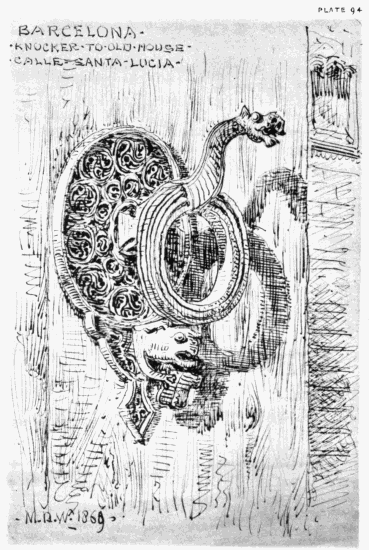
PLATE XCIV.
BARCELONA. KNOCKER OF AN OLD HOUSE IN THE CALLE SANTA LUCIA.
IN the vicinity of the old church of Sta. Lucia yet exist at Barcelona several interesting stone houses of the fifteenth century. Upon the doors of these are to be still found specimens of excellent iron work of the same period. It is not however to be supposed that the Barcelonese possessed any very special gifts in this line, since evidences of almost equal dexterity are to be found scattered over the whole extent of the Peninsula. In the north and south alike, the "Rejas," or vast screens, sometimes of iron only, sometimes of brass and bronze, and sometimes of mixed metals, are yet to be found of great importance and interest. The most famous of the "Rejeros," as they were called, or makers of Rejas, were Francesco de Salamanca who flourished in 1533; Christobal Andino of 1540; Francesco de Vilalpando of 1561; and Juan Bautista Celma of 1600. Because these men's names have become "household words" amongst all students of Spanish Art, it should not be forgotten that great men "to fortune and to fame unknown" lived before those whose good deeds and works encountered fitting record. By some of these were executed many of the various admirable specimens of metal work commented upon in terms of high praise by Ford, Street, O'Shea and other writers. The finest metal worker who really startled his contemporaries by the beauty and splendour of his workmanship, its "elaboracion y prolixedad," was the celebrated Henrique de Arfé, gold and silversmith of Leon, founder of a family which for several generations supplied artist-workmen in the precious metals whose fame rests upon the same platform as that of Cellini and Caradosso di Milano. His principal works were, according to the account given to us of them by his grandson Juan, in the "Varia Commensuracion," the custodias (or "ciboria" for holding the sanctified wafer) of the Cathedrals of Leon, Cordova, Toledo, and Sahagun. Of crosses, paxes, censers, pixes, feretories, candelabra, monstrances, lamps, &c., he scattered specimens broadcast throughout Spain. In all of them he showed, as his descendant declared, "El valor de su ingenio raro, con mayor efecto que puede escribirse."
As the present is the last occasion on which, in this volume at least, I may have to speak of mediæval metal work, and especially iron work, I may be allowed to allude very briefly to the two principal tools by which it was worked, viz.: the hammer and the pliers. In England and in France the first was used in preference at least to the last; while in Germany, Burgundy and the Low Countries, the last was specially affected, and by its means foliage, both natural and conventional, was rendered with great skill, facility and taste. The Spaniards, as is proved by the present sketch, and that which follows it, were at an early period dexterous in the use of both tools; uniting the massive style engendered by the predominant use of the hammer with the more florid and fanciful manner springing out of the light and convoluted forms created by a more liberal use of the pliers.
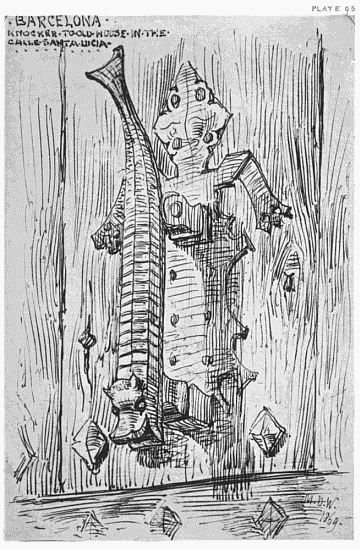
PLATE XCV.
BARCELONA. KNOCKER TO AN OLD HOUSE IN THE CALLE SANTA LUCIA.
IN this fanciful little object we meet with another illustration of the spirit of humour as well as of dexterity in their craft, manifested in abundance by the excellent old ironworkers of Spain. Still good as the blacksmiths unquestionably were, the triumphs of Spanish metal working were chiefly embodied in the precious metals. It is rather in the cabinets of connoisseurs than in the churches of the country that specimens should be sought for to justify the splendid reputation those artist-workmen enjoyed in the palmy days of the Spanish Court and Church. Everywhere the traveller comes now only upon exhausted treasuries and emptied sacristies. Even since the days of Ford's inimitable handbook the spoiler has been rampant, and of the custodias and virus, the "blandones" and "portapaces" in which he delighted, so far as my perquisitions extended, scarcely a vestige was to be met with. Even since my sketches were made, the contents of the treasury of "Nuestra Señora del Pilar" have been brought to the hammer; and the pressure of other engagements alone prevented my return to Saragossa empowered to secure a share of those artistic curiosities for our National collection.
No doubt many beautiful specimens of Gothic precious metal work once adorned the principal mediæval ecclesiastical structures of Spain, but it was not till a later date that the most important and famous works, other than those already noticed (by Henrique de Arfé,) were produced. A brief notice of some of these from the pen of a contemporary may not be altogether uninteresting.
"Although Renaissance architecture was introduced in Spain in a fully developed form before the middle of the sixteenth century, it was never thoroughly understood and adopted, we are told by Juan de Arphe y Villafañe,[61] in ecclesiastical plate, 'until my father, Antonio de Arfé, began to use it in the Custodia of Santiago in Galicia and in that of Medina de Rioseco, and in the portable shrine of Leon.'
"In all his work he evidenced an imperfect knowledge of good style, introducing fanciful columns of irregular proportions according to his own fancy. Juan Alvarez, who was a native of Salamanca, died in the prime of his life in the service of Don Carlos of Austria. For this reason he left no evidence of his rare talent in any public performance. Alonso Beceril obtained reputation in his turn on account of having made in his studio the Custodia of Cuenca. This work secured the approbation of every artist in Spain who at that time was really learned in Art. Juan de Orna was an excellent plate-worker in Burgos. Juan Rinz,[62] a disciple of my grandfather, made the Custodias of Jaen, Baza, and that of San Pablo of Seville. He was the first who used the lathe for forming plate in Spain; he set the fashion for the principal pieces of silver services for the table, and instructed workmen throughout Andalusia. All the above artists, and others, began to give elegant shapes to the principal objects made in silver and gold for the use of the church, each one improving in symmetry and general excellence upon the works of his predecessors until those types became established which I am now about to describe."
Juan de Arphe proceeds, after complimenting Philip II. on his majestic works at the Escorial, to give the forms and proportions of the five orders, and their application to every variety of silversmith's work, recognised as suitable for employment in sacred offices and ecclesiastical rites and ceremonies in his time.
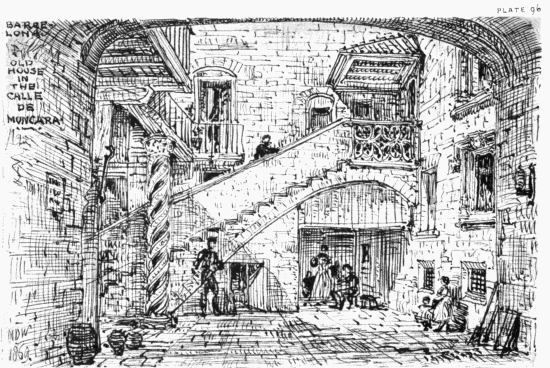
PLATE XCVI.
BARCELONA. COURTYARD OF AN OLD HOUSE IN THE CALLE DE MONCARA.
IN noticing my ninety-first sketch I took occasion to comment on the difference which existed between Spanish and Catalonian architecture, and Spanish and Catalonian character. Both are pressed upon one's attention in looking over a house which, like the one I have sketched in the Calle de Moncara at Barcelona, appears to have been the comfortable home of a well-to-do merchant, with roomy stores and warehouses on the ground floor facing the entrance, domestic offices to the left, and counting-house and living rooms on the first floor, with bedrooms above. As is becoming in the house of one welcoming alike buyer and seller, we find a total absence of that almost Asiatic privacy which the Spaniards generally, and especially the Andalusians, appear in their homes to have adopted from Moorish models. Under the old Counts of Barcelona the architecture of the city had no doubt been mainly French. After the annexation of the city to the crown of Aragon, the architecture became tinctured with detail corresponding with much yet to be seen at Saragossa and elsewhere in Aragon, and finally after the consolidation of the whole monarchy by the marriage of Ferdinand and Isabella, and the expulsion of the Moors, Barcelonese architecture fell under the Plateresque revival and the subsequent Greco-Roman mania which affected all Spain. The date of erection of the house of which I now give a sketch, appears to have brought it under the second of these two sets of conditions. In the twisted column, its cap and base, and some other features, we may recognise the Aragonese style, while in the staircase and some of the windows there is to be traced, I consider, a decided French influence.
In spite of legislative assimilation, the Catalonians have never been able to cordially adopt a Spanish nationality. They have never warmly responded to the caresses of their monarchs. Even as late as 1802, when Charles IV. paid a visit to Barcelona with the infamous Godoy, and a retinue like an army, and drew some eighty thousand strangers to the city, a visitor in the following year records that "the Catalans felt a generous pride in observing that no accident or quarrel occurred on that occasion, and no life was lost, notwithstanding the enmity subsisting between them and the Spaniards."[63] Whittaker further illustrates this mutual jealousy and spiteful feeling by the following characteristic anecdote:—"This enmity," he says, "is carried to such a height that when it was proposed to strike a medal in honour of the King's visit, the Academy of Arts of St. Fernando, at Madrid, were requested to superintend the execution; but this body, actuated by a most illiberal and unworthy spirit, endeavoured to excuse themselves, and made every possible delay, which so enraged the Catalans, that they withdrew the business from their hands, and trusted it to their own academy. The medal was produced in a month, and remains a record rather of their loyal zeal, than of their ability in the fine arts."
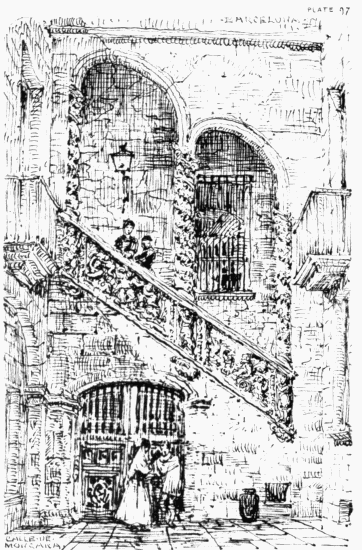
PLATE XCVII.
BARCELONA. STAIRCASE OF AN OLD HOUSE IN THE CALLE DE MONCARA.
I AM induced to give this one little specimen of what the Spaniards call "Churriguerismo" for these reasons: 1stly, because it is a prettier example than usual of the style practised early in the eighteenth century by the fashionable José Churriguerra—the William Kent of Spanish architecture; 2ndly, because it affords a good specimen of the comfortable house of a rich Barcelonese merchant of the last century; and 3rdly, on account of the singular arrangement of the jointing of the masonry, which converts the apparently double arch into very little else than one tolerably stable spanning of the whole space.
In describing my eighty-fifth sketch I alluded to the fact that the trade of Spain gradually fell into the hands mainly of foreigners, and especially at first of the Genoese, the difference between them and the native Spanish merchant being that while the former were crafty, industrious and dishonest, the latter were stupid and lazy, but (except in the matter of smuggling) strictly honest. Plenty of witness is borne by different writers to both facts. Quevedo, for instance, abounds in hits at the Genoese and other Italians. "Give an Italian to the Devil," he says in his "El Alguazil Endemoniado," "and the old gentleman won't try to take him, for an Italian would take away the Devil himself."[64] Elsewhere in the same satire he cautions his readers telling them that they are bound to know "that in Spain the mysteries of the accounts of the Genoese are disastrous for the millions that come from the Indies, and that the cannons of their pens are batteries for purses. There are no incomes which, if they once get into the strokes of their pens, and the inkholders of their inkstands, escape without drowning."[65]
The poco-curante honesty of the Spaniard on the other hand, (the "poco-curanteeism" at least an inheritance from the East,) kept business in his hands which, but for his reliability, ought according to every recognised law of probability in trade, to have left him before it did. Laborde, a writer by no means inclined to take too favourable a view of the national character, confesses that "Spanish probity is proverbial, and that it conspicuously shines in commercial relations. Good faith and punctuality are generally prevalent among merchants, the instances of deception, negligence, fraudulent dealing and non-fulfilment of engagements, so general in the trading world, being unknown to and not practised amongst them." As an illustration, Laborde mentions some coined silver sent home in the year 1654, which was paid away by the Spanish merchants, and was subsequently discovered to have been debased. Not only were the Spanish merchants eager to make good the loss to those who had dealt with them, but having discovered the culprit they obtained his conviction, and the wretched man was publicly burnt alive. In spite of honesty, however, trade and commerce will not thrive in any country in which they are looked upon as degrading. A Catalonian might work, since he was but half a Spaniard. A Castilian, however, was quite willing to pay any one who would work for him, and as with his increase of wealth his wants became more and more artificial and luxurious, the swarms of foreigners he harboured about him to do his bidding, increased to an unprecedented extent. The Countess D'Aulnois gives a capital account of the state of things in this respect in her time (circâ 1679).
"Spain," she says,[66] "cannot well be without commerce with France, not only on the frontiers of Biscai and Arragon, where it hath been almost ever permitted, but through the whole country where it is prohibited, for Provence hath ever had correspondencies in the kingdom of Valentia, by its necessity of the others commodities; and for the same reason Britaign, Normandy, and other parts on the ocean have continually sent theirs to Cadiz and Bilbo. I speak not of corn and stuffs of all sorts brought from that country, but even of ironwork and swords; by which it appears a mistake to think that in these dayes the best come of Spain. No more being now made at Toledo, few but forrain are used, unless a very small quantity that come from Biscai, which are excessively dear.
"It is, moreover, hard to imagine how much Spain suffers for want of manufactures. So few artificers remain in its towns, that native commodities are carried abroad to be wrought in forrain countries. Wools and silks are transported raw, and being spun and weaved in England, France, and Holland, return thither at dear rates. The land itself is not tilled by the people it feeds. In seed time, harvest, and vintage, husbandmen come from Bearn and other parts of France, who get a great deal of money by sowing and reaping their corn, and dressing and cutting their vines. Carpenters and masons are (for the most part) also strangers, who will be paid treble what they can get in their own country. In Madrid there is hardly a waterbearer that is not a foreigner, such are also the greatest part of shoomakers and taylors, and it is believed the third of these come only to get a little money and afterwards return home; but none thrive so much as architects, masons, and carpenters. Almost every house hath wooden windows (here being no glass), and a balcony jutting into the street."
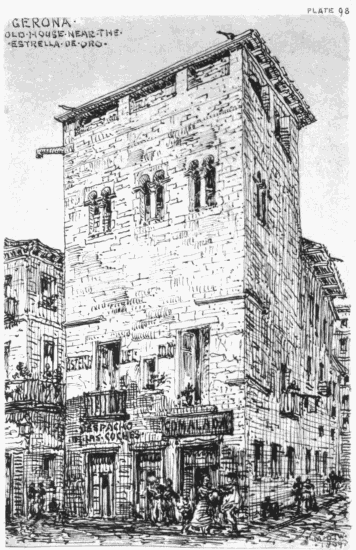
PLATE XCVIII.
GERONA. OLD HOUSE NEAR THE ESTRELLA DE ORO.
IF my last sketch illustrated the regular rich merchant's house of the eighteenth century—symbol of peace and plenty, police and protection—the kind of residence I now submit to the reader's attention is cast in quite a different key. It is essentially a fighter's house, the only kind of structure in which (before the use of gunpowder) a family could hold its own for months of foreign siege or protracted street fighting. Gerona has always been, as we shall have occasion to recognize in examining its fine old walls, almost a frontier city, struggled for repeatedly by Christian and by Moor. The house I have sketched is one of the earliest and most complete of its class I have ever seen, the lower half alone having been materially altered from its original construction. It dates in all probability from the middle of the twelfth century, and yet stands strong and stalwart in a quarter of the city in which very little of anything not comparatively of yesterday meets the wandering visitor's eye. On comparing this sketch with that from a house at Barcelona (No. 96) erected at least three hundred years later, it will be found that the type furnished by the earliest in date had changed but little in the interval. Hence we may fairly infer that the conditions of insecurity affecting domestic life had scarcely varied in Catalonia during the whole of that term. In fact, it was not until the invention of printing spread abroad the elements of education, and brought about changes in social systems, that men began to dream of peace and security ensured by other preservatives from danger than heavy armour and fortress-like houses.
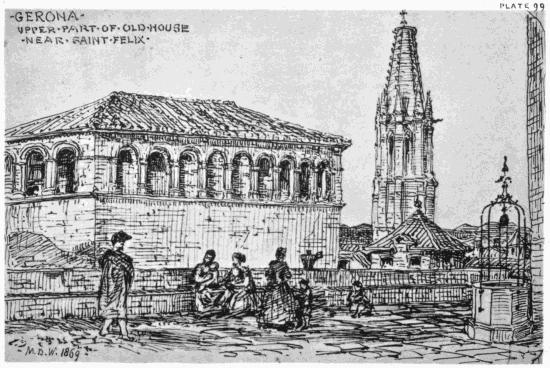
PLATE XCIX.
GERONA. UPPER PART OF OLD HOUSE AND SPIRE OF THE CHURCH OF SAN FELIU.
THE west front of the Cathedral at Gerona stands at the top of a noble flight of eighty-six steps, and these ascended, platforms are reached on the west and south of the splendid pile from which fine views over the city and its environs are obtained. The sketch now under notice was taken from the southern platform, the wall enclosing which upon the west cuts off something like thirty feet in height of the fine old house which forms the principal object in the sketch. Its uppermost story, with its continuous arcade, has a symmetrical and agreeable effect, and appears to have been the only portion of the building really suitable for habitation according to modern views as to the value of abundant light and air. On the right is seen the cathedral well, the waters of which have no doubt alike served for the bodily and spiritual ablutions of Mahommedan and Christian, since cathedral, mosque, and then again cathedral, have existed in turn upon the same site from the days of Charlemagne to the present time. During the Moorish occupation in the eighth century the Christians were permitted to worship in the original church of San Feliu (Felix) the truncated spire of the successor to which appears in my sketch between the old house, and the south-west angle of the cathedral, shown on the extreme right. The present church, dedicated to San Feliu, dates probably from the early part of the fourteenth century. Its history has been clearly traced by Mr. Street from a comparison of the building with the particulars given and documents quoted in the "España Sagrada." "The steeple is said to have been finished in 1392. Pedro Zacoma having acted as architect as late as A.D. 1376." It was struck by lightning in the year 1581, and has remained ever since shorn of its fair proportions, as we now see it.
San Feliu, as he is popularly called, was an early Spanish Christian, deacon to San Narciso, the Martyr, Protector and "Generalissimo" of the See of Gerona.
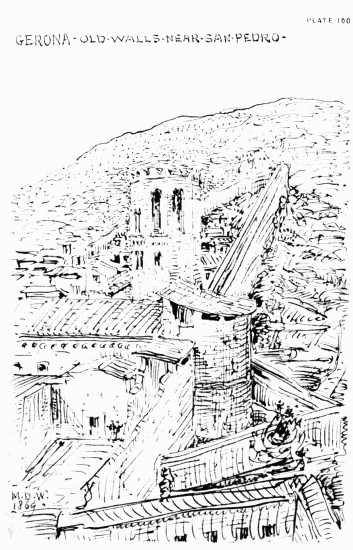
PLATE C.
GERONA. OLD WALLS NEAR THE MONASTERY OF SAN PEDRO.
FROM the date at least on which Charlemagne captured Gerona from the Moors, it has been a victim to the horrors of war; manned through all history, and under every circumstance of siege and occupation, by men and women of the sternest courage and determination it has been held with the utmost tenacity, as really even more than Figueras (the actual frontier town), the key to the easiest line of advance from France into Spain. Hence the strength and interest of its fine old walls, which in spite of every ancient and modern vicissitude, still retain more curious features of middle age defence than, to the best of my belief, any other city of Spain, with the exception of Avila. As will be seen from my sketch, the apse of the fine old Romanesque church of San Pedro, which actually forms a bulwark, has been raised so as to bring it into practical fighting order; and the covered galleries for marksmen, with bow and cross bow, matchlock and firelock, still extend from it to the north and to the south in easily to be recognised, and still fairly complete, galleries of well-sheltered communication. The present aspect of the north of Gerona forms a fair pendant to the description Charles Didier gives of its sister fortress to the side of France, Figueras. He says, "Tout a un air d'abandon et de désolation; les casernes sont magnifiques, mais désertes; les casemates spacieuses, mais vides; les longues herbes de la solitude croissent partout, et la seule partie des bâtiments qui soit aujourd'hui de première nécessité, l'infirmerie, n'est point terminée; les pierres à moitié taillées jonchent le sol et sont couvertes de mousse. J'errai longtemps seul dans ce silencieux désert sans rencontrer personne; de loin en loin seulement, j'apercevais quelque sentinelle perdue à la pointe d'une demi-lune et nonchalamment appuyée contre les canons et les mortiers; de gros rats rongeaient en paix les affuts; ils se sont si bien emparés du lieu, que mon approche les dérangeait à peine; je n'avais pas fait trois pas, qu'ils se remettaient à l'œuvre. Voilà sous quels traits l'Espagne apparaît au voyageur qui vient de France, triste et frappante image d'une chute sans exemple et d'une misère sans terme."[67]
One would have preferred receiving from any other than a Frenchman so dreary a picture of the desolation mainly wrought by Frenchmen. Returning to Gerona, to which Didier's description applies (as I have already stated) nearly as well as to Figueras, in sight of which he may have written it, we shall find Mr. Street no less strongly impressed than I was with what Spain owes to France in the matter. "All this havoc and ruin is owing," he says, "like so much that one sees in Spain, to the action of the French troops during the Peninsular War." It is however but just to the French to add that the Spaniards are not, like them, endowed with wonderful recuperative energy.