JOHN CORBIN
Reading edition
AUTHOR OF "SCHOOLBOY LIFE IN ENGLAND"
WITH ILLUSTRATIONS

BOSTON AND NEW YORK HOUGHTON, MIFFLIN AND COMPANY The Riverside Press, Cambridge 1903
COPYRIGHT, 1902, BY JOHN CORBIN ALL RIGHTS RESERVED
Published May, 1902
TO A. F. C.
PREFACE
By a curious coincidence, the day on which the last proof of this book was sent to the printer saw the publication of the will of the late Cecil Rhodes, providing that each of the United States is forever to be represented at Oxford by two carefully selected undergraduate students. That the plan will result in any speedy realization of the ideals of the great exponent of English power in the new worlds is perhaps not to be expected. For the future of American education, on the other hand, few things could be more fortunate. Native and independent as our national genius has always been, and seems likely to remain, it has always been highly assimilative. In the past, we have received much needed aliment from the German universities. For the present, the elements of which we have most need may best, as I think, be assimilated from England.
Whether or not Americans at Oxford become imbued with Mr. Rhodes's conceptions as to the destiny of the English peoples, they can scarcely fail to observe that Oxford affords to its undergraduates a very sensibly ordered and invigorating life, a very sensibly ordered and invigorating education. This, as I have endeavored to point out in the following pages, our American universities do not now afford, nor are they likely to afford it until the social and the educational systems are more perfectly organized than they have ever been, or seem likely to be, under the dominance of German ideals. If, however, the new Oxford-trained Americans should ever become an important factor in our university life, the future is bright with hope. We have assimilated, or are assimilating, the best spirit of German education; and if we were to make a similar draft on the best educational spirit in England, our universities would become far superior as regards their organization and ideals, and probably also as regards what they accomplish, to any in Europe. The purpose and result of an introduction of English methods would of course not be to imitate foreign custom, but to give fuller scope to our native character, so that if the American educational ideals in the end approximate the English more closely than they do at present, such a result would be merely incidental to the fact that the two countries have at bottom much the same social character and instincts. If Mr. Rhodes's dream is to be realized, it will probably be in some such tardy and roundabout but admirably vital manner as this.
At a superficial glance the testator's intention seems to have been to send the students to Oxford directly from American schools. Such a course, it seems to me, could only work harm. Even if the educational and residential facilities afforded at Oxford were on the whole superior to those of American universities, which they are not, the difference could not compensate the student for the loss of his American university course with all it means in forming lifelong friendships among his countrymen and in assimilating the national spirit. If, however, the Oxford scholarships were awarded to recent graduates of American universities, the greatest advantage might result. The student might then modify his native training so as to complete it and make it more effective. Now the wording of the testament requires only that the American scholars shall "commence residence as undergraduates." This they will be able to do whatever their previous training, and in fact this is what Americans at Oxford have always done in the past. The most valuable A.B. leaves the field of human knowledge far from exhausted; and the methods of instruction and of examining at Oxford are so different from anything we know that it has even proved worth while for the American to repeat at Oxford the same studies he took in America. The executors of the will should be most vigorously urged to select the scholars from the graduates of American universities.
The parts of this book that treat most intimately of Oxford life were written while in residence in Balliol College some six years ago. Most of the rest was written quite recently in London. Much of the matter in the following pages has appeared in "Harper's Weekly," "The Bachelor of Arts," "The Forum," and "The Atlantic Monthly." It has all been carefully revised and rearranged, and much new matter added. Each chapter has gained, as I hope, by being brought into its natural relation with the other chapters; and the ideas that have informed the whole are for the first time adequately stated.
CONTENTS
CHAP. PAGE
Introductory 1
I. THE UNIVERSITY AND THE COLLEGE
I. The University of Colleges 7
II. The Oxford Freshman 10
III. A Day in an Oxford College 17
IV. Dinner in Hall 21
V. Evening 28
VI. The Mind of the College 37
VII. Club Life in the College 52
VIII. Social Life in the University 62
IX. The College and the University 74
II. OXFORD OUT OF DOORS
I. Slacking on the Isis and the Cherwell 81
II. As seen from an Oxford Tub 96
III. A Little Scrimmage with English Rugby 116
IV. Track and Field Athletics 132
V. English and American Sportsmanship 145
III. THE COLLEGE AS AN EDUCATIONAL FORCE
I. The Passman 159
II. The Honor Schools 171
III. The Tutor 178
IV. Reading for Examinations 184
V. The Examination 190
VI. Oxford Qualities and their Defects 193
VII. The University and Reform 200
VIII. The University and the People 206
IV. THE HISTORY OF THE UNIVERSITY AND THE COLLEGE
I. The University before the College 215
II. The Mediæval Hall 221
III. The College System 223
IV. The Golden Age of the Mediæval Hall 231
V. The Origin of the Modern Undergraduate 236
VI. The Insignificance of the Modern University 239
VII. The College in America 245
V. THE PROBLEMS OF THE AMERICAN UNIVERSITY
I. The Social and Athletic Problem 255
II. The Administrative Problem 272
III. The Educational Problem 281
IV. The American Hall 301
APPENDIX
I. Athletic Training in England 313
II. Climate and International Athletics 316
III. An Oxford Final Honor School 319
LIST OF ILLUSTRATIONS
PAGE
Tea on the Lawn at the Oxford Union (page 63) Frontispiece
The Hall Staircase, Christ Church 22
Magdalen Tower from the Bridge 30
A Racing Punt and Punter 84
Iffley Lock and Mill 90
The Full Costume of an Eightsman 100
The College Barges: Tubbing in November Floods 106
The Last Day of the Bumping Races of the Summer Eights (1895) 112
An English Rugby Line-up 120
Throwing in the Ball 124
New College Cloisters, Bell Tower, and Chapel 224
New College Gardens—showing the Mediæval Wall of Oxford 228
AN AMERICAN AT OXFORD
The great German historian of the United States, H. E. Von Holst, declares[1] that, "in the sense attached to the word by Europeans, ... there is in the United States as yet not a single university;" institutions like Johns Hopkins and Harvard he characterizes as "hybrids of college and university." In his survey of European usage, one suspects that Professor Von Holst failed to look beyond Germany. The so-called universities of England, for example, are mere aggregations of colleges; they have not even enough of the modern scientific spirit to qualify as hybrids, having consciously and persistently refused to adopt continental standards. The higher institutions of America belong historically to the English type; they have only recently imported the scientific spirit. To the great world of graduates and undergraduates they are colleges, and should as far as possible be kept so.
Yet there is reason enough for calling them hybrids. In the teaching bodies of all of them the German, or so-called university, spirit is very strong, and is slowly possessing the more advanced of our recent graduates and undergraduates. Let us be duly grateful. The first result of this spirit is an extraordinary quickening and diffusion of the modern ideal of scholarship, a devotion to pure science amounting almost to a passion. As to the second result, we may or may not have cause to be grateful. Our most prominent educational leaders have striven consciously to make over our universities on the German plan. We are in the midst of a struggle between old and new forces, and at present the alien element has apparently the upper hand. The social ideal, which only a few years ago was virtually the same in England and America, has already been powerfully modified; and the concrete embodiment of the new scientific spirit, the so-called elective system, has transformed the peculiar educational institution of our Anglo-Saxon people.
We have gone so far forward that it is possible to gain an excellent perspective on what we are leaving behind. In the ensuing pages I propose to present as plainly as I may the English university of colleges. I shall not hesitate to give its social life all the prominence it has in fact, devoting much space even to athletic sports. The peculiarity of the English ideal of education is that it aims to develop the moral and social virtues, no less than the mental—to train up boys to be men among men. Only by understanding this is it possible to sympathize with the system of instruction, its peculiar excellences, and its almost incredible defects. In the end I hope we shall see more clearly what our colleges have inherited from the parent institutions, and shall be able to judge how far the system of collegiate education expresses the genius of English and American people.
At the present juncture of political forces in America this consideration has a special importance. The success with which we exert our influence upon distant peoples will depend upon what manner of young men we train up to carry it among them. If the graduates of German institutions are prepared to establish their civilization in the imperial colonies, the fact has not yet been shown. The colleges of England have manned the British Empire.
I
THE UNIVERSITY AND THE COLLEGE
I
THE UNIVERSITY OF COLLEGES
One of the familiar sights at Oxford is the American traveler who stops over on his way from Liverpool to London, and, wandering up among the walls of the twenty colleges from the Great Western Station, asks the first undergraduate he meets which building is the university. When an Oxford man is first asked this, he is pretty sure to answer that there isn't any university; but as the answer is taken as a rudeness, he soon finds it more agreeable to direct inquirers to one of the three or four single buildings, scattered hither and yon among the ubiquitous colleges, in which the few functions of the university are performed. A traveler from our middle West, where "universities" often consist of a single building, might easily set forth for London with the firm idea that the Ashmolean Museum or the Bodleian Library is Oxford University.
To the undergraduate the university is an abstract institution that at most examines him two or three times, "ploughs" him, or graduates him. He becomes a member of it by being admitted into one of the colleges. To be sure, he matriculates also as a student of the university; but the ceremony is important mainly as a survival from the historic past, and is memorable to him perhaps because it takes place beneath the beautiful mediæval roof of the Divinity School; perhaps because he receives from the Vice-Chancellor a copy of the university statutes, written in mediæval Latin, which it is to be his chief delight to break. Except when he is in for "schools," as the examinations are called, the university fades beyond his horizon. If he says he is "reading" at Oxford, he has the city in mind. He is more likely to describe himself as "up at" Magdalen, Balliol, or elsewhere. This English idea that a university is a mere multiplication of colleges is so firmly fixed that the very word is defined as "a collection of institutions of learning at a common centre." In the daily life of the undergraduate, in his religious observances, and in regulating his studies, the college is supreme.
To an American the English college is not at first sight a wholly pleasing object. It has walls that one would take to be insurmountable if they were not crowned with shards of bottles mortared into the coping; and it has gates that seem capable of resisting a siege until one notices that they are reinforced by a cheval-de-frise, or a row of bent spikes like those that keep the bears in their dens at the Zoo. Professor Von Holst would certainly regard it as a hybrid between a mediæval cloister and a nursery; and one easily imagines him producing no end of evidence from its history and traditions to show that it is so. Like so many English institutions, its outward and visible signs belong to the manners of forgotten ages, even while it is charged with a vigorous and very modern life. A closer view of it, I hope, will show that in spite of the barnacles of the past that cling to it—and in some measure, too, because of them—it is the expression of a very high ideal of undergraduate convenience and freedom.
II
THE OXFORD FRESHMAN
When a freshman comes up to his college, he is received at the mediæval gate by a very modern porter, who lifts boxes and bags from the hansom in a most obliging manner, and is presently shown to his cloistral chambers by a friendly and urbane butler or steward. To accommodate the newcomers in the more populous colleges, a measure is resorted to so revolutionary that it shocks all American ideas of academic propriety. Enough seniors—fourth and third year men—are turned out of college to make room for the freshmen. The assumption is that the upper classmen have had every opportunity to profit by the life of the college, and are prepared to flock by themselves in the town. Little communities of four or five fellows who have proved congenial live together in "diggings"—that is, in some townsman's house—hard by the college gate. This arrangement makes possible closer and more intimate relationship among them than would otherwise be likely; and after three years of the very free life within those sharded walls, a cloistered year outside is usually more than advisable, in view of the final examination. It cannot be said that they leave college without regret; but I never heard a word of complaint, and it is tacitly admitted that on the whole they profit by the arrangement.
The more substantial furnishings in the rooms are usually permanent, belonging to the college: each successive occupant is charged for interest on the investment and for depreciation by wear. Thus the furniture is far more comfortable than in an American college room and costs the occupant less. Bed and table linen, cutlery, and a few of the more personal furnishings the student brings himself. If one neglects to bring them, as I confess I did through ignorance, the deficiency is supplied by the scout, a dignitary in the employ of the college, who stands in somewhat more than the place of a servant and less than that of a parent to half a dozen fellows whose rooms are adjacent. The scout levies on the man above for sheets, on the man below for knives and forks, and on the man across the staircase for table linen. There is no call for shame on the one part or resentment on the other, for is not the scout the representative of the hospitality of the college? "When you have time, sir," he says kindly, "you will order your own linen and cutlery." How high a state of civilization is implied in this manner of receiving a freshman can be appreciated only by those who have arrived friendless at an American university.
The scout is in effect a porter, "goody," and eating-club waiter rolled into one. He has frequently a liberal dash of the don, which he has acquired by extended residence at the university; for among all the shifting generations of undergraduates, only he and the don are permanent. When he reaches middle age he wears a beard if he chooses, and then he is usually taken for a don by the casual visitor. There is no harm in this; the scout plays the part con amore, and his long breeding enables him to sustain it to a marvel. Yet for the most part the scout belongs with the world of undergraduates. He has his social clubs and his musical societies; he runs, plays cricket, and rows, and, finally, he meets the Cambridge scout in the inter-varsity matches. His pay the scout receives in part from the college, but mostly from the students, who give him two to four pounds a term each, according to his deserts. All broken bread, meat, and wine are his perquisites, and tradition allows him to "bag" a fair amount of tea, coffee, and sugar. Out of all this he makes a sumptuous living. I knew only one exception, and that was when four out of six men on a certain scout's staircase happened to be vegetarians, and five teetotalers. The poor fellow was in extremities for meat and in desperation for drink. There was only one more pitiable sight in college, and that was the sole student on the staircase who ate meat and drank wine; the scout bagged food and drink from him ceaselessly. At the end of one term the student left a half dozen bottles of sherry, which he had merely tasted, in his sideboard; and when he came back it was gone. "Where's my sherry, Betts?" he asked. "Sherry, sir? you ain't got no sherry." "But I left six bottles; you had no right to more than the one that was broken." "Yes, sir; but when I had taken that, sir, the 'arf dozen was broke." According to Oxford traditions the student had no recourse; and be it set down to his praise, he never blamed the scout. He bemoaned the fate that bound them together in suffering, and vented his spleen on total abstinence and vegetarianism. It may be supposed that the scout's antiquity and importance makes him a bad servant; in the land of the free I fear that it would; but at Oxford nothing could be more unlikely. The only mark that distinguishes the scout from any other class of waiters is that his attentions to your comfort are carried off with greater ease and dignity. It may be true that he is president of the Oxford Society of College Servants—the Bones or the Hasty Pudding of the scouts; that he stroked the scouts' eight in the townie's bumping races, during the long vac, and afterward rowed against the scouts' eight from Cambridge; that he captained the scouts' cricket eleven; that in consequence he is a "double blue" and wears the Oxford 'varsity color on his hat with no less pride than any other "blue." Yet he is all the more bound, out of consideration for his own dignity, to show you every respect and attention.
After the scout, the hosts of the college are the dons. As soon as the freshman is settled in his rooms, or sometimes even before, his tutor meets him and arranges for a formal presentation to the dean and master. All three are apt to show their interest in a freshman by advising him as to trying for the athletic teams, joining the college clubs and societies, and in a word as to all the concerns of undergraduate life except his studies—these come later. If a man has any particular gift, athletic or otherwise, the tutor introduces him to the men he should know, or, when this is not feasible, gives a word to the upper classmen, who take the matter into their own hands. If a freshman has no especial gift, the tutor is quite as sure to say the proper word to the fellows who have most talent for drawing out newcomers.
In the first weeks of a freshman's residence he finds sundry pasteboards tucked beneath his door: the upper classman's call is never more than the formal dropping of a card. The freshman is expected to return these calls at once, and is debarred by a happy custom from leaving his card if he does not find his man. He goes again and again until he does find him. By direct introduction from the tutor or by this formality of calling, the freshman soon meets half a dozen upper classmen, generally second-year men, and in due time he receives little notes like this:—
Dear Smith,—Come to my rooms if you can to breakfast with Brown and me on Wednesday at 8.30.
Yours sincerely, A. Robinson.
At table the freshman finds other freshmen whose interests are presumably similar to his own.
No one supposes for a moment that all this is done out of simple human kindness. The freshman breakfast is a conventional institution for gathering together the unlicked cubs, so that the local influences may take hold of them. The reputation of the college in general demands that it keep up a name for hospitality; and in particular the clubs and athletic teams find it of advantage to get the run of all available new material. The freshman breakfast is nothing in the world but a variation of the "running" that is given newcomers in those American colleges where fraternity life is strong, and might even be regarded as a more civilized form of the rushes and cane sprees and even hazings that used to serve with us to introduce newcomers to their seniors. Many second-year breakfasts are perfunctory enough; the host has a truly British air of saying that since for better or for worse he is destined to look upon your face and abide by your deeds, he is willing to make the best of it. If you prove a "bounder," you are soon enough dropped. "I shall soon be a second-year man," I once heard a freshman remark, "and then I can ask freshmen to breakfast, too, and cut them afterward." The point is that every fellow is thrown in the way of meeting the men of his year. If one is neglected in the end, he has no reason to feel that it is the fault of the college. As a result of this machinery for initiating newcomers, a man usually ceases to be a freshman after a single term (two months) of residence; and it is always assumed that he does.
III
A DAY IN AN OXFORD COLLEGE
When a freshman is once established in college, his life falls into a pleasantly varied routine. The day is ushered in by the scout, who bustles into the bedroom, throws aside the curtain, pours out the bath, and shouts, "Half past seven, sir," in a tone that makes it impossible to forget that chapel—or if one chooses, roll-call—comes at eight. Unless one keeps his six chapels or "rollers" a week, he is promptly "hauled" before the dean, who perhaps "gates" him. To be gated is to be forbidden to pass the college gate after dark, and fined a shilling for each night of confinement. To an American all this brings recollections of the paternal roof, where tardiness at breakfast meant, perhaps, the loss of dessert, and bedtime an hour earlier. I remember once, when out of training, deliberately cutting chapel to see with what mien the good dean performed his nursery duties. His calm was unruffled, his dignity unsullied. I soon came to find that the rules about rising were bowed to and indeed respected by all concerned, even while they were broken. They are distinctly more lax than those the fellows have been accustomed to in the public schools, and they are conceded to be for the best welfare of the college.
Breakfast comes soon after chapel, or roll-call. If a man has "kept a dirty roller," that is, has reported in pyjamas, ulster, and boots, and has turned in again, the scout puts the breakfast before the fire on a trestle built of shovel, poker, and tongs, where it remains edible until noon. If a man has a breakfast party on, the scout makes sure that he is stirring in season, and, hurrying through the other rooms on the staircase, is presently on hand for as long as he may be wanted. The usual Oxford breakfast is a single course, which not infrequently consists of some one of the excellent English pork products, with an egg or kidneys. There may be two courses, in which case the first is of the no less excellent fresh fish. There are no vegetables. The breakfast is ended with toast and jam or marmalade. When one has fellows in to breakfast,—and the Oxford custom of rooming alone instead of chumming makes such hospitality frequent,—his usual meal is increased by a course, say, of chicken. In any case it leads to a morning cigarette, for tobacco aids digestion, and helps fill the hour or so after meals which an Englishman gives to relaxation.
At ten o'clock the breakfast may be interrupted for a moment by the exit of some one bent on attending a lecture, though one apologizes for such an act as if it were scarcely good form. An appointment with one's tutor is a more legitimate excuse for leaving; but even this is always an occasion for an apology, in behalf of the tutor of course, for one is certainly not himself responsible. If a quorum is left, they manage to sit comfortably by the fire, smoking and chatting in spite of lectures and tutors, until by mutual consent they scatter to glance at the "Times" and the "Sportsman" in the common-room, or even to get in a bit of reading.
Luncheon often consists of bread and cheese and jam from the buttery, with perhaps a half pint of bitter beer; but it may, like the breakfast, come from the college kitchen. In any case it is very light, for almost immediately after it everybody scatters to field and track and river for the exercise that the English climate makes necessary and the sport that the English temperament demands.
By four o'clock every one is back in college tubbed and dressed for tea, which a man serves himself in his rooms to as many fellows as he has been able to gather in on field or river. If he is eager to hear of the games he has not been able to witness, he goes to the junior common-room or to his club, where he is sure to find a dozen or so of kindred spirits representing every sport of importance. In this way he hears the minutest details of the games of the day from the players themselves; and before nightfall—such is the influence of tea—those bits of gossip which in America are known chiefly among members of a team have ramified the college. Thus the function of the "bleachers" on an American field is performed with a vengeance by the easy-chairs before a common-room fire; and a man had better be kicked off the team by an American captain than have his shortcomings served up with common-room tea.
The two hours between tea and dinner may be, and usually are, spent in reading.
IV
DINNER IN HALL
At seven o'clock the college bell rings, and in two minutes the fellows have thrown on their gowns and are seated at table, where the scouts are in readiness to serve them. As a rule a man may sit wherever he chooses; this is one of the admirable arrangements for breaking up such cliques as inevitably form in a college. But in point of fact a man usually ends by sitting in some certain quarter of the hall, where from day to day he finds much the same set of fellows. Thus all the advantages of friendly intercourse are attained without any real exclusiveness. This may seem a small point; but an hour a day becomes an item in four years, especially if it is the hour when men are most disposed to be companionable.
The English College hall is a miniature of Memorial Hall at Harvard, of which it is the prototype. It has the same sombrely beautiful roof, the same richness of stained glass. It has also the same memorable and impressive canvases, though the worthies they portray are likely to be the princes and prelates of Holbein instead of the soldiers, merchants, and divines of Copley and Gilbert Stuart. The tables are of antique oak, with the shadow of centuries in its grain, and the college plate bears the names and date of the Restoration. To an American the mugs he drinks his beer from seem old enough, but the Englishman finds them aggressively new. They are not, however, without endearing associations, for the mugs that preceded them were last used to drink a health to King Charles, and were then stamped into coin to buy food and drink for his soldiers. The one or two colleges that, for Puritan principles or thrift, or both, refused to give up their old plate, are not overproud of showing it.
Across the end of the hall is a platform for high table, at which the dons assemble as soon as the undergraduates are well seated. On Sunday night they come out in full force, and from the time the first one enters until the last is seated, the undergraduates rattle and bang the tables, until it seems as if the glass must splinter. When, as often happens, a distinguished graduate comes up,—the Speaker of the Commons to Balliol, or the Prime Minister to Christ Church,—the enthusiasm has usually to be stopped by a gesture from the master or the dean.
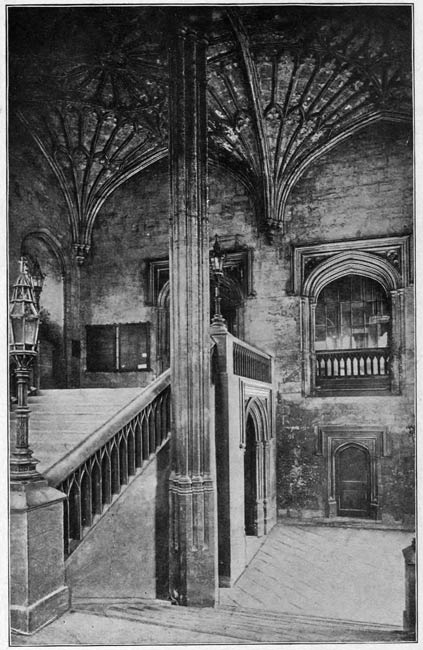
THE HALL STAIRCASE, CHRIST CHURCH
The dons at high table, like the British peers, mingle judicial with legislative functions. All disputes about sconces are referred to them, and their decrees are absolute. A sconce is a penalty for a breach of good manners at table, and is an institution that can be traced far back into the Middle Ages. The offenses that are sconcible may be summarized as punning, swearing, talking shop, and coming to hall after high table is in session. Take, for instance, the case of a certain oarsman who found the dinner forms rather too rigid after his first day on sliding seats. By way of comforting himself, he remarked that the Lord giveth and the Lord taketh away. Who is to decide whether he is guilty of profanity? The master, of course, and his assembled court of dons. The remark and the attendant circumstances are written on the back of an order-slip by the senior scholar present, and a scout is dispatched with it. Imagine, then, the master presenting this question to the dons: Is it profanity to refer by means of a quotation from Scripture to the cuticle one loses in a college boat? Suppose the dons decree that it is. The culprit has the alternative of paying a shilling to the college library, or ordering a tun of bitter beer. If he decides for beer, a second alternative confronts him: he may drink it down in one uninterrupted draft, or he may kiss the cup and send it circling the table. If he tries to floor the sconce and fails, he has to order more beer for the table; but if he succeeds, the man who sconced him has to pay the shot and order a second tun for the table. I never knew but one man to down a sconce. He did it between soup and fish, and for the rest of the evening was as drunk as ever was the Restoration lord who presented the silver tankard to the college.
After hall the dons go to the senior common-room for the sweet and port. At Trinity they have one room for the sweet and another for port. The students, meanwhile, in certain of the colleges, may go for dessert to the college store; that is to say, to a room beneath the hall, where the fancy groceries of the college stock are displayed for sale. There are oranges from Florida and Tangiers, dainty maiden blush apples from New England, figs and dates from the Levant, prunes and prunelles from Italy, candied apricots from France, and the superb English hothouse grapes, more luscious than Silenus ever crushed against his palate. There are sweets, cigarettes, and cigars. All are spread upon the tables like a Venetian painting of abundance; but at either end of the room stand two Oxford scouts, with account-books in their hands. A fellow takes a Tangerine and, with a tap-room gesture, tilts to the scout as if to say, "Here's looking toward you, landlord;" or, "I drink to your bonny blue eyes." But he is not confronted by a publican or barmaid; only a grave underling of the college bursar, who silently records "Brown, orange, 2d.," and looks up to catch the next item. Two other fellows are flipping for cigars, and the second scout is gravely watching their faces to see which way the coin has fallen, recording the outcome without a sign. Some one asks, "How much are chocolate creams, Higgins?" "Three ha'pence for four, sir," is the answer, and the student urges three neighbors to share his penny'orth. The scout records, "Jones, c. c. 1½d."
The minuteness of this bookkeeping is characteristic. The weekly battels (bills) always bear a charge of twopence for "salt, etc.;" and once, when I had not ordered anything during an entire day, there was an unspecified charge of a penny in the breakfast column. I asked the butler what it meant. He looked at me horrified. "Why, sir, that is to keep your name on the books." No penny, I suppose, ever filled an office of greater responsibility, and I still can shudder at so narrow an escape. I asked if such elaborate bookkeeping was not very expensive. In America, I said, we should lump the charges and devote the saving to hiring a better chef. He explained that it had always been so managed; that the chef was thought very good, sir; and that by itemizing charges the young gentlemen who wished were enabled to live more cheaply. Obviously, when it costs a penny merely to keep your name on the books, there is need to economize.
After a quarter of an hour in the store the fellows drop off by twos and threes to read, or to take coffee in some one's room. With the coffee a glass of port is usually taken. Almost all the fellows have spirits and wines, which are sold by the college as freely as any other commodity. If a man wishes a cup served in his room, he has only to say so to his scout. If one waits long enough in the store, he is almost certain to be asked to coffee and wine. The would-be host circulates the room tapping the elect on the shoulder and speaking a quiet word, as they select Bones men at Yale. If half a dozen men are left in the store uninvited, one of them is apt to rise to the occasion and invite the lot. It scarcely matters how unpopular a fellow may be. The willingness to loaf is the touch of nature that makes all men kin.
After coffee more men fall off to their books; but the faithful are likely to spend the evening talking or playing cards—bridge, loo, napp, and whist, with the German importation of skat and the American importation of poker. In one college I knew, there was a nomadic roulette wheel that wandered from room to room pursued by the shadow of the dean, but seldom failed of an evening to gather its flock about it.
V
EVENING
In the evening, when the season permits, the fellows sit out of doors after dinner, smoking and playing bowls. There is no place in which the spring comes more sweetly than in an Oxford garden. The high walls are at once a trap for the first warm rays of the sun and a barrier against the winds of March. The daffodils and crocuses spring up with joy as the gardener bids; and the apple and cherry trees coddle against the warm north walls, spreading out their early buds gratefully to the mild English sun. For long, quiet hours after dinner they flaunt their beauty to the fellows smoking, and breathe their sweetness to the fellows playing bowls. "No man," exclaims the American visitor, "could live four years in these gardens of delight and not be made gentler and nobler!" Perhaps! though not altogether in the way the visitor imagines. When the flush of summer is on, the loiterers loll on the lawn full length; and as they watch the insects crawl among the grass they make bets on them, just as the gravest and most reverend seniors have been known to do in America.
In the windows overlooking the quadrangle are boxes of brilliant flowers, above which the smoke of a pipe comes curling out. At Harvard some fellows have geraniums in their windows, but only the very rich; and when they began the custom an ancient graduate wrote one of those communications to the "Crimson," saying that if men put unmanly boxes of flowers in the window, how can they expect to beat Yale? Flower boxes, no sand. At Oxford they manage things so that anybody may have flower boxes; and their associations are by no means unmanly. This is the way they do it. In the early summer a gardener's wagon from the country draws up by the college gate, and the driver cries, "Flowers! Flowers for a pair of old bags, sir." Bags is of course the fitting term for English trousers—which don't fit; and I should like to inform that ancient graduate that the window boxes of Oxford suggest the very badge of manhood.
As long as the English twilight lingers, the men will sit and talk and sing to the mandolin; and I have heard of fellows sitting and talking all night, not turning in until the porter appeared to take their names at roll-call. On the eve of May day it is quite the custom to sit out, for at dawn one may go to see the pretty ceremony of heralding the May on Magdalen Tower. The Magdalen choir boys—the sweetest songsters in all Oxford—mount to the top of that most beautiful of Gothic towers, and, standing among the pinnacles,—pinnacles afire with the spirituality of the Middle Ages, that warms all the senses with purity and beauty,—those boys, I say, on that tower and among those pinnacles, open their mouths and sing a Latin song to greet the May. Meantime, the fellows who have come out to listen in the street below make catcalls and blow fish horns. The song above is the survival of a Romish, perhaps a Druidical, custom; the racket below is the survival of a Puritan protest. That is Oxford in symbol! Its dignity and mellowness are not so much a matter of flowering gardens and crumbling walls as of the traditions of the centuries in which the whole life of the place has deep sources; and the noblest of its institutions are fringed with survivals that run riot in the grotesque.
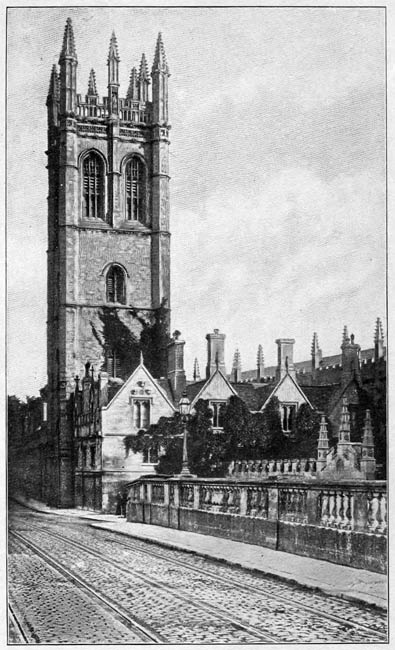
MAGDALEN TOWER FROM THE BRIDGE
If a man intends to spend the evening out of college, he has to make a dash before nine o'clock; for love or for money the porter may not let an inmate out after nine. One man I knew was able to escape by guile. He had a brother in Trinity whom he very much resembled, and whenever he wanted to go out, he would tilt his mortarboard forward, wrap his gown high about his neck, as it is usually worn of an evening, and bidding the porter a polite good-night, say, "Charge me to my brother, Hancock, if you please." The charge is the inconsiderable sum of one penny, and is the penalty of having a late guest. Having profited by my experience with the similar charge for keeping my name on the college books, I never asked its why and wherefore. Both are no doubt survivals of some mediæval custom, the authority of which no college employee—or don, for the matter of that—would question. Such matters interest the Oxford man quite as little as the question how he comes by a tonsil or a vermiform appendix. They are there, and he makes the best of them.
If a fellow leaves college for an evening, it is for a foregathering at some other college, or to go to the theatre. As a rule he wears a cloth cap. A "billycock" or "bowler," as the pot hat is called, is as thoroughly frowned on now in English colleges as it was with us a dozen years ago. As for the mortarboard and gown, undergraduate opinion rather requires that they be left behind. This is largely, no doubt, because they are required by law to be worn. So far as the undergraduates are concerned, every operative statute of the university, with the exception of those relating to matriculation and graduation, refers to conduct in the streets after nightfall, and almost without exception they are honored in the breach. This is out of disregard for the Vice-Chancellor of the university, who is familiarly called the Vice, because he serves as a warning to others for the practice of virtue. The Vice makes his power felt in characteristically dark and tortuous ways. His factors are two proctors, college dons in daytime, but skulkers after nightfall, each of whom has his bulldogs, that is, scouts employed literally to spy upon the students. If these catch you without cap or gown, they cause you to be proctorized or "progged," as it is called, which involves a matter of five shillings or so. As a rule there is little danger of progging, but my first term fell in evil days. For some reason or other the chest of the university showed a deficit of sundry pounds, shillings, and pence; and as it had long ceased to need or receive regular bequests,—the finance of the institution being in the hands of the colleges,—a crisis was at hand. A more serious problem had doubtless never arisen since the great question was solved of keeping undergraduates' names on the books. The expedient of the Vice-Chancellor was to summon the proctors, and bid them charge their bulldogs to prog all freshmen caught at night without cap and gown. The deficit in the university chest was made up at five shillings a head.
One of the Vice-Chancellor's rules is that no undergraduate shall enter an Oxford "pub." Now the only restaurant in town, Queen's, is run in conjunction with a pub, and was once the favorite resort of all who were bent on breaking the monotony of an English Sunday. The Vice-Chancellor resolved to destroy this den of Sabbath-breaking, and the undergraduates resolved no less firmly to defend their stronghold. The result was a hand-to-hand fight with the bulldogs, which ended so triumphantly for the undergraduates that a dozen or more of them were sent down. In the articles of the peace that followed, it was stipulated, I was told, that so long as the restaurant was closed Sunday afternoons and nights, it should never suffer from the visit of proctor or bulldog. As a result, Queen's is a great scene of undergraduate foregatherings. The dinners are good enough and reasonably cheap; and as most excellent champagne is to be had at twelve shillings the bottle, the diners are not unlikely to get back to college a trifle buffy, in the Oxford phrase.
By an interesting survival of mediæval custom, the Vice-Chancellor has supreme power over the morals of the town, and any citizen who transgresses his laws is visited with summary punishment. For a tradesman or publican to assist in breaking university rules means outlawry and ruin, and for certain offenses a citizen may be punished by imprisonment. Over the Oxford theatre the Vice-Chancellor's power is absolute. In my time he was much more solicitous that the undergraduate be kept from knowledge of the omnipresent woman with a past than that dramatic art should flourish, and forbade the town to more than one excellent play of the modern school of comedy that had been seen and discussed in London by the younger sisters of the undergraduates. The woman with a present is virtually absent.
Time was when no Oxford play was quite successful unless the undergraduates assisted at its first night, though in a way very different from that which the term denotes in France. The assistance was of the kind so generously rendered in New York and Boston on the evening of an athletic contest. Even to-day, just for tradition's sake, the undergraduates sometimes make a row. A lot of B. N. C. men, as the clanny sons of Brazenose College call themselves, may insist that an opera stop while the troupe listen to one of their own excellent vocal performances; and I once saw a great sprinter, not unknown to Yale men, rise from his seat, face the audience, and, pointing with his thumb over his shoulder at the soubrette, announce impressively, "Do you know, I rather like that girl!" The show is usually over just before eleven, and then occurs an amusing, if unseemly, scramble to get back to college before the hour strikes. A man who stays out after ten is fined threepence; after eleven the fine is sixpence. When all is said, why shouldn't one sprint for threepence?
If you stay out of college after midnight, the dean makes a star chamber offense of it, fines you a "quid" or two, and like as not sends you down. This sounds a trifle worse than it is; for if you must be away, your absence can usually be arranged for. If you find yourself in the streets after twelve, you may rap on some friend's bedroom window and tell him of your plight through the iron grating. He will then spend the first half of the night in your bed and wash his hands in your bowl. With such evidence as this to support him, the scout is not apt, if sufficiently retained, to report a suspected absence. I have even known fellows to make their arrangements in advance and spend the night in town; but the ruse has its dangers, and the penalty is to be sent down for good and all.
It is owing to such regulations as these that life in the English college has the name of being cloistral. Just how cloistral it is in spirit no one can know who has not taken part in a rag in the quad; and this is impossible to an outsider, for at midnight all visitors are required to leave, under a heavy penalty to their host.
VI
THE MIND OF THE COLLEGE
Any jubilation is a rag; but the most interesting kind, though perhaps the least frequent, takes the direction of what we call hazing. It is seldom, however, as hazing has come to be with us, a wanton outbreak. It is a deliberate expression of public opinion, and is carried on sedately by the leading men of the college. The more I saw of it, the more deeply I came to respect it as an institution.
In its simplest if rarest form it merely consists in smashing up a man's room. The only affair of this kind which I saw took place in the owner's absence; and when I animadverted on the fact, I was assured that it would have turned out much worse for the man's feelings if he had been present. He was a strapping big Rugbeian, who had come up with a "reputter," or reputation, as a football player, and had insisted on trying first off for the 'varsity fifteen. He had promptly been given the hoof for being slow and lazy, and when he condescended to try for the college fifteen, his services were speedily dispensed with for the same reason. As he still carried his head high, it was necessary to bring his shortcomings home to him in an unmistakable manner. Brutal as I thought the proceeding, and shameful to grown men, it did him good. He became a hard-working and lowly minded athlete, and prospered. I am not prepared to say that the effect in this particular instance did not justify the means.
A series of judicial raggings was much more edifying. Having pulled their culprit out of bed after midnight, the upper classmen set him upon his window-seat in pyjamas, and with great solemnity appointed a judge, a counsel for the prosecution, and a counsel for the defense. Of the charges against him only one or two struck home, and even these were so mingled with the nonsense of the proceedings that their sting was more or less blunted. The man had been given over to his books to the neglect of his personal appearance. It was charged that in pretending to know his subjunctives he was ministering to the vanity of the dean, who had written a Latin grammar, and that by displaying familiarity with Hegel he was boot-licking the master, who was a recently imported Scotch philosopher. Then the vital question was raised as to the culprit's personal habits. Heaven defend him now from his legal defender! It was urged that as he was a student of Literæ Humaniores, he might be excused from an acquaintance with the scientific commodity known as H2O: one might ignore anything, in fact, if only one were interested in Literæ Humaniores. By such means as this the face of the college is kept bright and shining.
Here is a round robin, addressed to the best of fellows, a member of the 'varsity shooting team and golf team. He was a Scotchman by birth and by profession, and even his schoolboy days at Eton had not divested him of a Highland gait.
"Whereas, Thomas Rankeillor, Gent, of the University of Oxford, has, by means of his large feet, uncouth gait, and his unwieldy brogues, wantonly and with malice destroyed, mutilated, and otherwise injured the putting greens, tees, and golf course generally, the property of the Oxford University Golf Club, whereof he is a member, and
"Whereas, 2, The said Thomas Rankeillor, etc., has by these large feet, uncouth gait, and unwieldy brogues aforesaid, raised embankments, groins, and other bunkers, hazards, and impediments, formed unnecessary roads, farm roads, bridle paths, and other roads, on the putting greens, tees, and golf course generally, aforesaid; excavated sundry and diverse reservoirs, tanks, ponds, conduits, sewers, channels, and other runnels, needlessly irrigating the putting greens, tees, and golf course generally aforesaid, and
"Whereas, 3, The said Thomas Rankeillor, etc., has by those large feet, uncouth gait, and unwieldy brogues aforesaid, caused landslips, thus demolishing all natural hills, bunkers, and other excrescences, and all artificial hillocks, mounds, hedges, and other hazards,
"Hereby we, the circumsigned, do request, petition, and otherwise entreat the aforesaid
"Thomas Rankeillor, Gent, of the University of Oxford, to alter, transform, and otherwise modify his uncouth gait, carriage, and general mode of progression; to buy, purchase, or otherwise acquire boots, shoes, and all other understandings of reasonable size, weight, and material; and finally that he do cease from this time forward to wear, use, or in any way carry the aforesaid brogues.
"Given forth this the 17th day of March, 1896."
At times rougher means are employed. At Brazenose there happened to be two men by the same name, let us say, of Gaylor, one of whom had made himself agreeable to the college, while the other had decidedly not. One midnight a party of roisterers hauled the unpopular Gaylor out of his study, pulled off his bags, and dragged him by the heels a lap or two about the quad. This form of discipline has since been practiced in other colleges, and is called debagging. The popular Gaylor was ever afterward distinguished by the name of Asher, because, according to the Book of Judges, Asher abode in his breaches.
Not dissimilar correctives may be employed, in extreme need, against those mightiest in authority. A favorite device is to screw the oak of an objectionable don. Mr. Andrew Lang, himself formerly a don at Merton, reports a conversation—can it have been a personal experience?—between a don standing inside a newly screwed oak and his scout, who was tendering sympathy from the staircase. "What am I to do?" cried the don. "Mr. Muff, sir," suggested the scout, "when 'e's screwed up, sir, 'e sends for the blacksmith." At Christ Church, "The House," as it is familiarly called, much more direct and personal methods have been employed. Not many years ago a censor (whose office is that of the dean at other colleges) stirred up unusual ill-will among his wards. They pulled him from his bed, dragged him into Tom Quad,—Wolsey's Quad,—and threw him bodily among the venerable carp of the Mercury Pond. Then they gathered about in a circle, and, when he raised his head above the surface, thrust him under with their walking-sticks. Something like forty of them were sent down for this, and the censor went traveling for his health.
The memory of this episode was still green when the Duke of Marlborough gave a coming of age ball at Blenheim Palace, and invited over literally hundreds of his Oxford friends. In other colleges the undergraduates were permitted to leave Oxford for the night, but at the House the censor stipulated that they be within the gates, as usual, by midnight. This would have meant a break-neck drive of eight miles after about fifteen minutes at the ball, and was far more exasperating to the young Britons than a straightforward refusal. That evening the dons sported their oaks, and carefully bolted themselves within. The night passed in so deep a silence that, for all they knew, the ghost of Wolsey might have been stalking in his cherished quadrangle, the glory of building which the Eighth Henry so unfeelingly appropriated. As morning dawned, the common-room gossips will tell you, the dons crawled furtively out of bed, and shot their bolts to find whether they had need of the blacksmith. Not a screw had been driven. The morning showed why. On the stately walls of Tom Quad was painted "Damn the Dons!" and again in capital letters, "Damn the Dons!" and a third time, in larger capitals, "Damn the Dons!" There were other inscriptions, less fit to relate; and stretching along one whole side of the quad, in huge characters, the finely antithetical sentence: "God bless the Duke of Marlborough." The doors of the dean's residence were smeared with red paint; and against a marble statue of the late Dean Liddell, the Greek lexicographer, a bottle of green ink had been smashed. Two hundred workmen, summoned from a neighboring building, labored two days with rice-root brushes and fuller's earth, but with so little effect that certain of the stones had to be replaced in the walls, and endless scrubbings failed to overcome the affinity between the ink and the literary Liddell. The marble statue has been replaced by one of plaster.
Compared with the usual Oxford rag, the upsetting of Professor Silliman's statue in the Yale campus by means of a lasso dwindles into insignificance, and the painting of 'varsity stockings on John Harvard, which so scandalized the undergraduates that they repaired the damage by voluntary subscriptions, might be regarded as an act of filial piety.
The more I learned of Oxford motives, the less anxious I was to censure the system of ragging. In an article I wrote after only a few months' stay, I spoke of it as boyish and undignified; and most Americans, I feel sure, would likewise hold up the hand of public horror. Yet I cannot be wholly thankful that we are not as they. To the undergraduates, ragging is a survival of the excellently efficient system of discipline in the public schools, where the older boys have charge of the manners and morals of the younger; and historically, like public school discipline, it is an inheritance from the prehistoric past. In the Middle Ages it was apparently the custom to hold the victim's nose literally to the grindstone. In the schools, to be sure, the Sixth Form take their duties with great sobriety of conscience—which is not altogether the case in college; but the difference of spirit is perhaps justifiable. For a properly authorized committee of big schoolboys to chastise a youngster who has transgressed is not unnatural, and the system that provides for it has proved successful for five centuries; but for men to adopt the same attitude towards a fellow only a year or two their junior would be preposterous. Horseplay is a necessary part of the game. The end in both is the same: it is to bring each individual under the influence of the traditions and standards of the institution of which he has elected to be a part. Just as the system of breakfasting freshmen is by no means as altruistic as it at first appears, the practice of ragging is by no means as brutal. It is as if the college said: We have admitted you and welcomed you, opening up the way to every avenue of enjoyment and profit, and it is for our common good, sir, that you be told of your shortcomings. The most diligent and distinguished scholar is not unlikely to be most in need of a pointed lesson in personal decorum; and the man who was not Asher may be thankful all his life for the bad quarter of an hour that taught him the difference between those who do and those who do not abide in their breaches.
With regard to the dons, a similar case might be made. Any one who assumes an authority over grown men that is so nearly absolute should be held to strict honesty and justice of dealing. So far as I could learn, the Christ Church dons who were so severely dealt with were both unjust and insincere, and I came to sympathize in some measure with the undergraduates at the House, who were half humorously inclined to regard the forty outcasts as martyrs.
This is not to argue that all American hazing is justifiable. In many cases, especially of late years, it has been as silly and brutal as the most puritanical moralists have declared. To steal the Louisburg Cross from above the door of the Harvard Library was vandalism if you wish—it was certainly a very stupid proceeding; and to celebrate a really notable athletic victory by mutilating the pedestal of the statue of John Harvard was not only stupid, but unworthy of a true sportsman. How much better to make an end with painting 'varsity stockings on the dear old boy's bronze legs, and leave the goody to wash them off next day. What I wish to point out is that where there is vigorous public spirit, it may be more efficiently expressed by hazing than by a very nor'easter of Puritan morality.
A tradition of the late master of Balliol, Jowett, the great humanist, would seem to show that he held some such opinion. It was his custom in his declining years to walk after breakfast in the garden quad, and whenever there were evidences of a rag, even to the extent of broken windows, he would say cheerily to his fidus Achates, "Ah, Hardie, the mind of the college is still vigorous; it has been expressing itself." The best possible justification of the cloistral restrictions of English college life is the facility with which the mind of the college expresses itself. It is by no means fantastic to hint that the decline of well-considered hazing in American colleges has come step by step with the breaking up of the bonds of hospitality and comradeship that used to make them well-organized social communities.
I have not come to this philosophy without deep experience. On one occasion after Hall, I was flown with such insolence against college restrictions that the cheval-de-frise above the back gate seemed an affront to a freeborn American. Though the porter's gate was still open, it was imperatively necessary to scale that roller of iron spikes. I was no sooner astride of it than a mob of townspeople gathered without, and among them a palsied beggar, who bellowed out that he would hextricate me for 'arf a crown, sir. I have seldom been in a less gratifying position; and when I had clambered back into college, I ruefully recalled the explanation my tutor had given me of the iron spikes and bottle shards,—an explanation that at the time had shaken my sides with laughter at British absurdity. My tutor had said that if the fellows were allowed to rag each other in the open streets and smash the townspeople's windows, the matter would be sure to get into the papers and set the uninitiated parent against the universities. In effect, the iron spikes and the stumps of bottles are admirable, not so much because they keep the undergraduate in, as because they keep the public out; and since the public includes all people who wish to hextricate you for 'arf a crown, sir, my mind was in a way to be reduced to that British state of illogic in which I regarded only the effect.
As a last resort I carefully sounded the undergraduates as to whether they would find use for greater liberty. They were not only content with their lot, but would, I found, resent any loosening of the restrictions. To give them the liberty of London at night or even of Oxford, they argued, would tend to break up the college as a social organization and thus to weaken it athletically; for at Oxford they understand what we sometimes do not, that a successful cultivation of sports goes hand in hand with good comradeship and mutual loyalty.
The only question remaining was of the actual moral results of the semi-cloistral life. Such outbreaks of public opinion as I have described are at the worst exceptional; they are the last resort of outraged patience. The affair at Christ Church is unexampled in modern times. Many a man of the better sort goes through his four years at the university without either experiencing or witnessing undergraduate violence. As for drinking, in spite of the fact that wine and spirits are sold to undergraduates by the college at any and all times and in any and all quantities, there seemed to be less excessive indulgence than, for instance, at Harvard or at Yale. And the fact that what there was took place for the most part within the college walls was in many respects most fortunate. When fellows are turned loose for their jubilations amid the vices of a city, as is usually the case with us, the consequences to their general morality are sometimes the most hideous. In an English college the men to whom immorality seems inevitable—and such are to be found in all communities—have recourse to London. But as their expeditions take place in daylight and cold blood, and are, except at great risk, cut short when the last evening train leaves Paddington shortly after dinner, it is not possible to carry them off with that dazzling air of the man of the world that in America lures so many silly freshmen into dissipations for which they have no natural inclination. This little liberty is apparently of great value. The cloistral vice, which seems inevitable in the English public schools, is robbed of any shadow of palliation. A fellow who continues it is thought puerile, if nothing worse. When it exists, it is more likely to be the result of the intimate study of the ancient classics, and is then even more looked down upon by the robust Briton as effeminate or decadent. The subject, usually difficult or impossible to investigate, happened to be on the surface at the time of my residence because of the sensational trial of an Oxford graduate in London. I was satisfied that the general body of undergraduates was quite free of contamination. On the whole, I should say that the restrictions of college life in England are far less dangerous than the absolute freedom of life in an American college. Under our system a few men profit greatly; they leave college experienced in the ways of the world and at the same time thoroughly masters of themselves. But it is a strong man—perhaps a blasphemous one—that would ask to be led into temptation. The best system of college residence, I take it, is that which develops thoroughly and spontaneously the normal social instincts, and at the same time leaves men free moral agents. In a rightly constituted fellow, in fact, the normal social life constitutes the only real freedom. Those frowning college walls, which we are disposed to regard as instruments of pedagogical tyranny, are the means of nourishing the normal social life, and are thus in effect the bulwarks of a freer system than is known to American universities.
VII
CLUB LIFE IN THE COLLEGE
As a place for the general purposes of residence—eating and sleeping, work and play—the English college is clearly quite as well organized and equipped as any of the societies, clubs, or fraternities of an American university. And whereas these are in their very nature small and exclusive, the college is ample in size and is consciously and effectively inclusive; the very fact of living in it insures a well-ordered life and abundant opportunity for making friends. Yet within this democratic college one finds all sorts of clubs and societies, except those whose main purpose is residential, and these are obviously not necessary.
By far the larger proportion of the clubs are formed to promote the recognized undergraduate activities. No college is without athletic and debating clubs, and there are musical and literary clubs almost everywhere. Membership in all of them is little more than a formal expression of the fact that a man desires to row, play cricket or football, to debate, read Shakespeare, or play the fiddle. Yet they are all conducted with a degree of social amenity that to an American is as surprising as it is delightful.
The only distinctively social feature of the athletic clubs is the wine, which is given to celebrate the close of a successful season. A boating wine I remember was held in a severe and sombre old hall, built before Columbus sailed the ocean blue. It was presided over by a knot of the dons, ancient oarsmen, whose hearts were still in the sport. They sat on the dais, like the family of a baron of the Middle Ages, while the undergraduates sat about the tables like faithful retainers. All the sportsmen of the college were invited, and everybody made as much noise as he could, especially one of the boating men, who went to the piano and banged out a song of triumph he had written, while we all tumbled into the chorus. One of the fellows—I have always taken it as a compliment to my presence—improvised a cheer after the manner not unknown in America, which was given with much friendly laughter. "Quite jolly, isn't it!" he remarked, with the pride of authorship, "and almost as striking as your cry of 'Quack, quack, quack!'" He had heard the Yale men give their adaptation of the frog chorus at the athletic games between Oxford and Yale. About midnight the college butler passed a loving cup of mulled wine of a spicy smoothness to fill your veins with liquid joy. The recipe, I was told, had been handed down by the butlers of the college since the fourteenth century, being older than the hall in which we were drinking. I have no doubt it was the cordial Chaucer calls Ypocras, which seems to have brought joy to his warm old heart. After the loving cup had gone about, the fellows cleared away the tables and danced a stag. At this stage of the game the dons discreetly faded away, and the wine resolved itself into a good-natured rag in the quad that was ended only by daylight and the dean. I have seen many feasts to celebrate athletic victory and the breaking of training, but none as homelike and pleasant all through as the wine of an Oxford college.
The debating clubs have of necessity a distinct social element, for where there is much talk, food and drink will always be found; and with the social element there is apt to be some little exclusiveness. In Balliol there are three debating clubs, and they are of course in some sense rivals. Like the fraternities in an American college, they look over the freshmen each year pretty closely; and the freshmen in turn weigh the clubs. One freshman gave his verdict as follows: "The fellows in A are dull, and bathe; the fellows in B are clever, and sometimes bathe; the fellows in C are supposed to be clever." The saying is not altogether a pleasant one, but will serve to indicate the range of selection of members. In spite of social distinctions, few fellows need be excluded who care to debate or are clubable in spirit. As a system, the clubs are inclusive rather than exclusive.
Each club convenes at regular intervals, usually in the rooms of such members as volunteer to be hosts. The hour of meeting is directly after dinner, and while the men gather and settle down to the business of the evening, coffee, port, and tobacco are provided out of the club treasury. The debates are supposed to be carried on according to the strictest parliamentary law, and the man who transgresses is subject to a sharp rebuff. On one occasion, when the question of paying members of Parliament was up, one speaker gravely argued that the United States Senate was filled with politicians who were attracted by the salary. Though I had already spoken, I got up to protest. The chairman sat me down with the greatest severity—amid a broad and general smile. I had neglected, I suppose, the parliamentary remark that I arose to a point of fact. A member's redress in such instances is to rag the president at the time when, according to custom, interpellations are in order; and as a rule he avails himself of this opportunity without mercy. On one occasion, a fellow got up in the strictest parliamentary manner and asked the president—a famous shot on the moors—whether it was true, as reported, that on the occasion when he lately fell over a fence three wrens and a chipping sparrow fell out of his game-bag. Such ragging as the chair administers and receives may not aid greatly in rational debate, but it certainly has its value as a preparation for the shifts and formalities of parliamentary life. It is the first duty of a chairman, even the president of the Oxford Union, to meet his ragging with cheerfulness and a ready reply, and the first duty of all debaters is to be interesting as well as convincing. In American college debating there is little of such humor and none of such levity. The speakers are drafted to sustain or to oppose a position, often without much reference to their convictions, and are supposed to do so to the uttermost. The training is no doubt a good one, for life is largely partisan; but a man's success in the world depends almost as much on his tact and good sense as on his strenuosity.
The Englishman's advantage in address is sometimes offset by deficiencies of information. In a debate on Home Rule, one argument ran somewhat as follows: It is asserted that the Irish are irresponsible and lacking in the sense of administrative justice. To refute this statement, I have only to point to America, to the great metropolis of New York. There, as is well known, politics are exclusively in the hands of Irish citizens, who, denied the right of self-government—as the American colonies were denied similar freedom, I need scarcely point out with what disastrous results to the empire—the Irish immigrants in America, I say, are evincing their true genius for statesmanship in their splendid organization known as Tammany Hall.
In the better clubs, the debates are often well prepared and cogent. I remember with particular gratitude a discussion as to whether the English love of comfort was not an evidence of softening morals. The discussion was opened with a paper by a young Scotchman of family and fortune. More than any other man I met he had realized the sweetness and pleasantness of Oxford, and all the delights of the senses and of the mind that surround the fellows there; and the result of it was, as it has so often been with such men, a craving for the extreme opposite of all he had known, for moral earnestness and austerity. What right, he questioned, had one to buy a book which, with ever so little more effort, he might read in the Bodleian, while all the poor of England are uneducated? And was it manly or in any way proper to spend so much time and interest on things that are merely agreeable? The sense of the meeting seemed to be that comfort in daily life is an evil only when it becomes an end in itself, a self-indulgence; and that a certain amount of it is necessary to fortify one for the most strenuous and earnest work in the world. I think that debate made us realize, as we never could have realized without it, to what serious end England makes the ways of her young men so pleasant; yet the more deeply I lived into the life of the university, the more deeply I questioned, as the young Scotchman did, whether the line between the amenities and the austerities was not somewhat laxly drawn.
The only purely social club, and therefore the only really exclusive one, is the wine club. In Balliol there is a college rule against wine clubs, which seems to be due partly to a feeling against social exclusiveness, and partly perhaps to a distrust of purely convivial gatherings. The purpose of a wine club was served quite as well, however, by an organization that was ostensibly for debating. The notices of meetings were usually a parody of the notices of the meetings of genuine debating clubs, and the chief business of the secretary was to concoct them in pleasing variety. For instance, it would be Resolved, that this House looks with disfavor upon the gradual introduction of a continental sabbath into England; or Resolved, that this House looks with marked disfavor upon the assumption that total abstinence is a form of intemperance. On the evening when the House was defending total abstinence, our host's furniture and tea-things suffered some damage, and as I was in training, I found it advisable to leave early. As I slipped out, the president of the club, a young nobleman, who was himself at the time in training for the 'varsity trial eights, called me back and said with marked sobriety that he had just thought of something. "You are in for the mile run, aren't you? And in America you have always run the half. Well, then, if you find the distance too long for you, just don't mind at all about the first part of the race, but when you get to the last part, run as you run a half mile. Do it in two minutes, and you can't help beating 'em." He bade me good-night with a grave and authoritative shake of the hand. If he recalled his happy thought next morning, he was unable to avail himself of it, for I grieve to say that in the 'varsity trial race, which came only a few days later, he missed his blue by going badly to pieces on the finish.
The meeting at which this occurred was exceptional. For the most part the fellows were moderate enough, and at times I suspected the wine club of being dull. Certainly, we had no such fun as at the more general jubilations—a rag in the quad or a boating wine. I doubt if any one would have cared so very much to belong to the club if it had not afforded the only badge of social distinction in college, and if this had not happened to be an unusually pretty hatband. However successful a wine club may be, moreover, it is of far less consequence than similar clubs in America. In the first place, since there are one or more of them in each of the twenty colleges, the number of men who belong to them is far greater relatively, which of course means far less exclusion. In the second place, and this is more important, the fellows who do not belong are still able to enjoy the life which is common to all members of the college. In general, the social walls of Oxford are like the material ones. Far from being the means of undue exclusion and of the suppression of public feeling, they are the live tissues in which the vital functions of the place are performed.
Until well along in the nineteenth century, this life in the college was about the only life; but of late years the university has begun to feel its unity more strongly, and in social and intellectual life, as in athletics, it has become for the first time since the Middle Ages an organic whole.
VIII
SOCIAL LIFE IN THE UNIVERSITY
The first formal organization of the life of the university was, as its name records, the Oxford Union, an institution of peculiar interest to Americans because our universities, though starting from a point diametrically opposite, have arrived at a state of social disorganization no less pronounced than that which the Union was intended to remedy. Harvard, which has progressed farthest along the path of social expansion and disintegration, has already made a conscious effort to imitate the Union. The adamantine spirit of Yale is shaken by the problems of the Sophomore societies; and it will not be many decades before other universities will be in a similar predicament. It will not be amiss, therefore, to consider what the Oxford Union has been and is. If Americans have not clearly understood it even when attempting to imitate it, one should at least remember that it would not be easy for an Oxford man to explain it thoroughly.
The Union was founded in 1823, and was primarily for debating. In fact, it was the only university debating society. Its members were carefully selected for their ability in discoursing on the questions of the day. In its debates Gladstone, Lord Rosebery, the Marquis of Salisbury, and countless other English statesmen of recent times got their first parliamentary training. Its present fame in England is largely based upon this fact; but its character has been metamorphosed. Early in its history it developed social features; and though it was still exclusive in membership, little by little men of all kinds were taken in. At this stage of its development, the Union was not unlike those vast political clubs in London in which any and all principles are subordinated to the kitchen and the wine cellar. The debates, though still of first-rate quality, became more and more an incident; the club was chiefly remarkable as the epitome of all the best elements of Oxford life. The library was filled with men reading or working at special hobbies; the reading and smoking rooms were crowded; the lawn was daily thronged with undergraduates gossiping over a cup of tea; the telegram board, the shrine of embryo politicians watching for the results from a general election, was apt to be profaned by sporting men scanning it for the winners of the Derby or the Ascot. In a word, the Union held the elect of Oxford, intellectual, social, and sporting. This is the Union remembered by the older graduates, and except for a single feature, namely, that it was still exclusive, this is the Union that has inspired the projectors of the Harvard Union.
The Oxford man of the later day knows all too well that this Union is no more. Some years ago, responding to a democratic impulse that has been very strong of late at Oxford, the Union threw down all barriers; virtually any man nowadays may join it, and its members number well beyond a thousand. The result is not a social millennium. The very feature of inclusiveness that is to be most prominent in the Union at Harvard destroyed the character of the Oxford Union as a representative body. To the casual observer it still looks much as it did a dozen years ago; but its glory has departed. In any real sense of the word it is a Union no more. The men who used to give it character are to be found in smaller clubs, very much like the clubs of an American university.
The small university debating clubs are the Russell, the Palmerston, the Canning, and the Chatham, each of which stands for some special stripe of political thought, and each of which has a special color which—sure sign of the pride of exclusiveness—it wears in hatbands. The clubs meet periodically—often weekly—in the rooms of members. Sometimes a paper is read which is followed by an informal discussion; but the usual exercise is a formal debate. Time was when the best debates came off at the Union, and writers of leading articles in London papers even now look to it as a political weather-vane. The debates there are still earnest and sometimes brilliant, and to have presided over them is a distinction of value in after life; but as far as I could gather, their prestige is falling before the smaller debating clubs. The main interest at the Union appeared to centre in the interpellation of the president, which is carried on much as in the House of Commons, though with this difference, that, following the immemorial custom, it is turned into ragging. When this is over, the major part of the audience clears out to the smoking and reading rooms. In the smaller clubs the exercises are not only serious, but—in spite of the preliminary ragging, which no function at Oxford may flourish without—they are taken seriously. The clubs really include the best forensic ability of Oxford. At the end of each year they give dinners, at which new and old members gather, while some prominent politician from Westminster holds forth on the question of the hour. In a word, these clubs, collectively, are what the Union once was—the training school of British statesmen.
The university social clubs are of a newness that shocks even an American; but it would not be quite just to account for the fact by regarding them as mere offshoots, like the debating clubs, of a parent Union. Until the nineteenth century, there really was no university at Oxford, at least in modern times. The colleges were quite independent of one another socially and in athletics, and each of them provided all the necessary instruction for its members. The social clubs which now admit members from the university at large began life as wine clubs of separate colleges, and even to-day the influence of the parent college is apt to predominate. The noteworthy fact is that in proportion as the social prestige of the Union has declined, these college wine clubs, like the small debating clubs, have gained character and prestige.
The oldest of these is the Bullingdon, which is not quite as old, I gathered, as the Institute of 1770 at Harvard, and, considered as a university organization, it is of course much younger. It was originally the Christ Church wine club, and to-day it is dominated by the sporting element of Christ Church, which is the most aristocratic of Oxford colleges. In former years, it is said, the club had kennels at Bullingdon, and held periodic hunts there; and it is still largely composed of hunting men. To-day it justifies its name mainly by having an annual dinner beneath the heavy rafters of a mediæval barn at Bullingdon. On these, as on other state occasions, the members wear a distinctive costume—no doubt a tradition from the time when men generally wore colors—which consists of a blue evening coat with white facings and brass buttons, a canary waistcoat, and a blue tie. This uniform is no doubt found in more aristocratic wardrobes than any other Oxford trophy. The influence of the Bullingdon is indirectly to discourage athletics, which it regards as unaristocratic and incompatible with conviviality; so that Christ Church, though the largest of Oxford colleges and one of the wealthiest, is of secondary importance in sports. For this reason the Bullingdon has suffered a partial eclipse, for the middle-class spirit which is invading Oxford has given athletic sports the precedence over hunting, while expensive living and mere social exclusiveness are less the vogue. By a curious analogy, one of the oldest and most exclusive of the clubs at Harvard is similarly out of sympathy with the athletic spirit.
Another old and prominent college wine club that has come to elect members from without is the Phœnix of Brazenose, the uniform of which is perhaps more beautiful than the Bullingdon uniform, consisting of a peculiar dark wine-colored coat, brass buttons, and a light buff waistcoat. In general, the college wine clubs are more or less taking on a university character. The Annandale Club of Balliol, for instance, has frequent guests from outside, and often elects them to membership out of compliment. At the formal wines the members have the privilege of inviting outside guests.
The most popular and representative Oxford club is Vincent's, which owes its prominence to the fact that it expresses the enthusiasm of modern Oxford for athletics. It was founded only a third of a century ago, but it must be remembered that inter-varsity boat races did not become usual until 1839, nor a fixture until 1856; that the first inter-varsity athletic meeting came in 1864, and the first inter-varsity football game as late as 1873. Vincent's was originally composed largely of men from University College, which was at that time a leader in sports; but later it elected many men from Brazenose, then in the ascendant. When Brazenose became more prominent in athletics, it gained a controlling influence in Vincent's; and when it declined, as it lately did, the leadership passed on. The name Vincent's came from a printer's shop, above which the club had its rooms. Any second year man is eligible; in fact, until a few years ago, freshmen were often taken in. The limit of members is ninety, but as the club is always a dozen or so short of this, no good fellow is excluded for lack of a place. When a man is proposed, his name is written in a book, in which space is left for friends in the club to write their names in approval. After this, elections are in the hands of a committee. Like all Oxford clubs, Vincent's will always, I suppose, lean towards men of some special college or group of colleges; yet it is careful to elect all clubable blues, and, in point of fact, is representative of the university at large, as, for instance, the Hasty Pudding Club at Harvard, or the senior societies at Yale, to which, on the whole, it most nearly corresponds.
The most democratic, as well as one of the most recent of the more purely social clubs, is the Gridiron. It is a dining rather than a social club, and one may invite to his board as many guests who are not members as he chooses. Any good fellow is eligible, though here, again, a man in one of the less known colleges might fail to get in from lack of acquaintances on the election committee.
The Union has long lost prestige before this development of small exclusive clubs. Politically, socially, and even in that most essential department, the kitchen, it holds a second place. If you ask men of the kind that used to give it its character why they never go there, they will tell you, in the most considerate phrase, how the pressure of other undergraduate affairs is so great that they have not yet found time; and this is quite true. They may add that next year they intend to make the time, for they believe that one should know all kinds of men at Oxford; and they are quite sincere. But next year they are more preoccupied than ever. If Oxford is united socially, it is not because of the Oxford Union.
In addition to the clubs which are mainly social, there is the usual variety of special organizations. These, as a rule, are of recent growth. The Musical Union has frequent meetings for practice, and gives at least one concert a year. The Dramatic Society, the O.U.D.S., as it is popularly called, will be seen to be a very portentous organization. In America, college men give comic operas and burlesques, usually writing both the book and the music themselves; and when they do, there is apt to be a Donnybrook Fair for vulnerable heads in the faculty. So well is musical nonsense adapted to the calibre of the undergraduate mind that college plays sometimes find their way to the professional stage, and to no small general favor. At Oxford the Vice-Chancellor, who is a law to himself and to the university, has decreed that there shall be no fun and nonsense. If the absurdities of donnishness are all too fair a mark for the undergraduate wit, the Vice-Chancellor has found a very serviceable scapegoat. He permits the undergraduates to present the plays of Shakespeare. Surely Shakespeare can stand the racket. The aim of the O.U.D.S. seems to be to get as many blues as possible into the cast of a Shakespearean production, with the idea, perhaps, of giving Oxford its full money's worth. I remember well the sensation made by the most famous of all university athletes,—a "quadruple blue," who played on four university teams, was captain of three of them, and held one world's record. The play was "The Merchant of Venice," and the athlete in question was the swarthy Prince of Morocco. Upon opening the golden casket his powers of elocution rose to unexpected heights. Fellows went again and again to hear him cry, "O hell! what have we here?" In one way, however, the performances of the O.U.D.S. are really noteworthy. Not even the crudest acting can entirely disguise the influences of birth and environment; and few Shakespearean actors have as fine a natural carriage as those companies of trained athletes. For the first time, perhaps, on any stage, the ancient Roman honor more or less appeared in Antonio, and there were really two gentlemen in Verona. For this reason—or, what is more likely, merely because the plays are given by Oxford men—the leading dramatic critics of London run up every year for the O.U.D.S. performance, and talk learnedly about it in their dignified periodicals. Both the musical and the dramatic societies have an increasing social element, and the dramatic society has a house of its own.
Of at least one association I happened upon, I know of no American parallel. One Sunday afternoon, a lot of fellows who had been lunching each other in academic peace were routed from college by a Salvation Army gathering that was sending up the discordant notes of puritanical piety just outside the walls. In the street near by we came upon a quiet party of undergraduates in cap and gown. They were standing in a circle, at the foot of the Martyr's Memorial, and were alternately singing hymns and exhorting the townspeople who gathered about. Their faces were earnest and simple, their attitude erect. If they were conscious of doing an unusual thing, they did not show it. I don't remember that they moved any of us to repent the pleasantness of our ways, but I know that they filled the most careless of us with a very definite admiration. One of the fellows said that he thought them mighty plucky, and that they had the stuff at least out of which sportsmen are made. The phrase is peculiarly British, but in the undergraduate vernacular there is no higher epithet of praise. In America there are slumming societies and total abstinence leagues; but I never knew any body of men who had the courage to stand up in the highway and preach their gospel to passers-by.
IX
THE COLLEGE AND THE UNIVERSITY
The distinctive feature of the social organization of Oxford life is said to be the colleges. Fifty years ago the remark held good, but to-day it requires an extension. The distinctive feature is the duality of the social organization: a man who enters fully into undergraduate affairs takes part both in the life of the college and in the life of the university. The life of the college, in so far as it is wholesome, is open to all newcomers; it is so organized as to exert powerfully upon them the force of its best influences and traditions, and is thus in the highest degree inclusive. The life of the university, in so far as it is vigorous, is in the main open only to those who bring to it special gifts and abilities, and is therefore necessarily exclusive. In college, one freely enjoys all that is fundamental in the life of a young man—a pleasant place to sleep in and to dine in, pleasant fellows with whom to work and to play. In the university, one finds scope for his special capacities in conviviality or in things of the mind. More than any other institution, the English university thus mirrors the conditions of social life in the world at large, in which one is primarily a member of his family, and takes part in the life of the outside community in proportion as his abilities lead him.
The happiest thing about all this is that it affords the freest possible interplay of social forces. As soon as a newcomer gains distinction, as he does at once if he has the capacity, he is noticed by the leading men of the college, and is thus in a way to be taken into the life of the university. From the college breakfast it is only a step to the Gridiron, from the college eight to Vincent's, and from the debating society to the Chatham or the Canning. These, like all undergraduate clubs, are in yearly need of new members, and the older men in college are only too glad to urge the just claims of the younger for good-fellowship sake, and for the general credit of their institution.