JOHN CORBIN (continued 2)
Reading edition
Even when a fellow has received all the university has to offer, he is still amenable to the duality of Oxford life. In American institutions, in proportion as a man is happily clubbed, he is by the very nature of the social organization withdrawn from his college mates; but at Oxford he still dines in Hall, holds forth at the college debating society, plays on the college teams, and, until his final year, he lives within the college walls. First, last, and always his general life is bound up with that of the college.
The prominent men thus become a medium by which every undergraduate is brought in touch with the life of the university. The news of the athletic world is reported at Vincent's over afternoon tea; and at dinner time the men who have discussed it there relate it to their mates in the halls of a dozen colleges. A celebrated debater brings the news of the Union or of the smaller clubs; and whatever a man's affiliations in the university, he can scarcely help bringing the report of them back with him. In an incredibly short time all undergraduate news, and the judgments upon it of those best qualified to judge, ramify the college; and men who seldom stir beyond its walls are brought closely in touch with the innermost spirit of the university life. Here, again, those forbidding walls make possible a freedom of social interplay which is unknown in America. The real union of Oxford, social, athletic, and intellectual, is quite apart from the so-called Oxford Union; it results from the nice adjustment between the general residential life of the colleges and the specialized activities of the university.
The immediate effect of this union is the humble one of making the present life of the undergraduate convenient and enjoyable; but its ultimate effect is a matter of no little importance. Every undergraduate, in proportion to his susceptibilities and capacities, comes under the influence of the social and intellectual traditions of Oxford, which are the traditions of centuries of the best English life. In Canada and Australia, South Africa and India, you will find the old Oxonian wearing the hatband, perhaps faded and weather-stained, that at Oxford denoted the thing he was most proud to stand for; and wherever you find him, you will find also the manners and standards of the university, which are quite as definite a part of him, though perhaps less conspicuous. Without a large body of men animated by such traditions, it is no exaggeration to say that it would not have been possible to build up the British empire. If the people of the United States are to bear creditably the responsibilities to civilization that have lately fallen to them, or have been assumed, there is urgent need for institutions that shall similarly impose upon our young men the best traditions and influences of American life.
II
OXFORD OUT OF DOORS
I
SLACKING ON THE ISIS AND THE CHERWELL
The dual development of college and university, with all its organic coördinations, exists also in the sports of Oxford. The root and trunk of the athletic spirit lies in the colleges, though its highest development is found in university teams. To an American, this athletic life of the college will be found of especial interest, for it is the basis of the peculiar wholesomeness and moderation of Oxford sports. If the English take their pleasures sadly, as they have been charged with doing ever since Froissart hit upon the happy phrase, they are not so black a pot but that they are able to call us blacker; in the light of international contests, they have marveled at the intensity with which our sportsmen pursue the main chance. The difference here has a far deeper interest than the critic of boating or track athletics often realizes. Like the songs of a nation, its sports have a definite relation to its welfare: one is tempted to say, let me rule the games of my countrymen and who will may frame their laws. At least, I hope to be pardoned if I speak with some particularity of the out-of-door life, and neglect the lofty theme of inter-varsity contests for the humbler pursuits of the common or garden undergraduate.
The origin of the boating spirit is no doubt what the Oxonian calls slacking, for one has to learn to paddle in a boat before he can row to advantage; and in point of fact the bumping races are supposed to have originated among parties of slackers returning at evening from up the river. If I were to try to define what a slacker is, I suppose you could answer that all Oxford men are slackers; but there are depths beneath depths of far niente. The true slacker avoids the worry and excitement of breakfast parties and three-day cricket matches, and conserves his energies by floating and smoking for hours at a time in his favorite craft on the Isis and the Cherwell—or "Char," as the university insists on calling it. He is a day-dreamer of day-dreamers; and despised as he is by the more strenuous Oxford men, who yet stand in fear of the fascination of his vices, he is as restful a figure to an American as a negro basking on a cotton-wharf, and as appealing as a beggar steeped in Italian sunlight. Merely to think of his uninterrupted calm and his insatiable appetite for doing nothing is a rest to occidental nerves; and though one may never be a roustabout and loaf on a cotton-wharf, one may at any time go to Oxford and play through a summer's day at slacking.
Before you come out, you must make the acquaintance of the O.U.H.S.—that is, the University Humane Society. In the winter, when there is skating, the Humane Society man stands by the danger spot with a life-buoy and a rope; and in the summer, when the streams swarm with pleasure-craft, he wanders everywhere, pulling slackers out of the Isis and the Char. In view of the fact that, metaphorically speaking at least, you can shake hands with your neighbors across either of these streams, the Humane Society man is not without his humors.
You may get yourself a tub or a working-boat or a wherry, a rob-roy or a dinghy, for every craft that floats is known on the Thames; but the favorite craft are the Canadian canoe and the punt. The canoe you will be familiar with, but your ideas of a punt are probably derived from a farm-built craft you have poled about American duck-marshes—which bears about the same relationship to this slender, half-decked cedar beauty that a canal-boat bears to a racing-shell.
During your first perilous lessons in punting, you will probably be in apprehension of ducking your mentor, who is lounging among the cushions in the bow. But you cannot upset the punt any more than you can discompose the Englishman; the punt simply upsets you without seeming to be aware of it. And when you crawl dripping up the bank, consoled only by the fact that the Humane Society man was not at hand with his boat-hook to pull you out by the seat of the trousers, your mentor will gravely explain how you made your mistake. Instead of bracing your feet firmly on the bottom and pushing with the pole, you were leaning on the pole and pushing with your feet. When the pole stuck in the clay bottom, of course it pulled you out of the boat.
Steering is a matter of long practice. When you want to throw the bow to the left, you have only to pry the stern over to the right as you are pulling the pole out of the water. To throw the bow to the right, ground the pole a foot or so wide of the boat, and then lean over and pull the boat up to it. That is not so easy, but you will learn the wrist motion in time. When all this comes like second nature, you will feel that you have become a part of the punt, or rather that the punt has taken life and become a part of you.
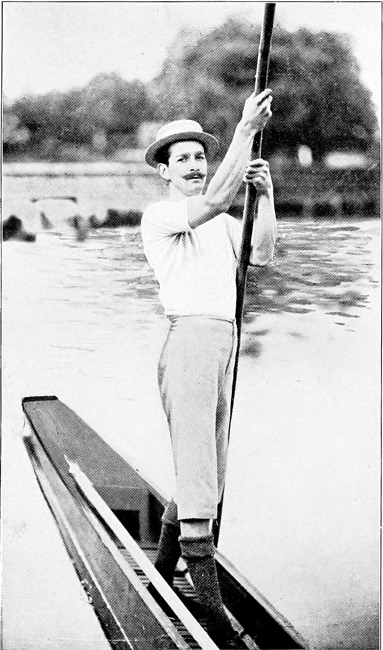
A RACING PUNT AND PUNTER
A particular beauty of punting is that, more than any other sport, it brings you into personal contact, so to speak, with the landscape. In a few days you will know every inch of the bottom of the Char, some of it perhaps by more intimate experience than you desire. Over there, on the outer curve of the bend, the longest pole will not touch bottom. Fight shy of that place. Just beyond here, in the narrows, the water is so shallow that you can get the whole length of your body into every sweep. As for the shrubbery on the bank, you will soon learn these hawthorns, if only to avoid barging into them. And the Magdalen chestnut, which spreads its shade so beautifully above the water just beyond, becomes quite familiar when its low-reaching branches have once caught the top of your pole and torn it from your hands.
The slackers you see tied up to the bank on both sides of the Char are always here after luncheon. An hour later their craft will be as thick as money-bugs on the water, and the joys of the slackers will be at height. You won't, as a rule, detect happiness in their faces, but it is always obvious in the name of the craft. One man calls his canoe "Vix Satis," which is the mark the university examining board uses to signify that a man's examination paper is a failure. Another has "P.T.O." on his bows—the "Please Turn Over" which an Englishman places at the bottom of a card where we say "Over." Still another calls his canoe the "Non-conformist Conscience"—which, as you are expected to remark, is very easily upset. All this makes the slacker even happier than if he were so un-English as to smile his pleasure, for he has a joke ready-made on his bow, where there is no risk of any one's not seeing it.
These pollard willows that line the bank are not expected to delight your eye at first sight, but as you see them day after day, they grow on you like the beauty of the bull-terrier pup that looks at you over the gunwale of the boat tied beneath them. They have been topped to make their roots strike deeper and wider into the soil, so that when the freshets come in the spring the banks will stand firm. The idea came some centuries ago from Holland, but has been so thoroughly Englished that the university, and, indeed, all England, would scarcely be itself without its pollard willows. And though the trees are not in themselves graceful, they make a large part of the beauty of the river scenery. The sun is never so golden as up there among their quivering leaves, and no shadow is so deep as that in the water at their feet.
The bar of foam ahead of us is the overflow from the lasher—that is to say, from the still water above the weir. The word "lasher" is obsolete almost everywhere else in England, and even to the Oxford mind it describes the lashing overflow rather than the lache or slack water above. When we "shoot the lasher," as the phrase goes, you will get a hint as to why the obsolete term still clings to this weir. Those fellows beyond who have tied up three deep to the bank are waiting to see us get ducked; but it is just as easy to shoot the lasher as to upset in it; and with that swarm of slackers watching, it makes a difference which you do. We have only to get up a fair pace and run into it on a diagonal. The lashing torrent will catch our bows, but we shall be half over before it sweeps them quite around; and then it will catch the stern in turn, and whirl the bow back into the proper direction. A sudden lurching of the bow, the roaring of a torrent beneath, a dash of spray—and we are in still water again.
In order to reach the inn at Marston by four we must pole on. If we were true slackers, to be sure, we should have brought a spirit lamp and a basket of tea, and tied up in the first convenient nook on the bank; but these are heights of slacking to which the novice cannot aspire. Just beyond here we shall have to give the Thames Conservancy man threepence to roll the punt around a weir. If there were ladies with us, we should have to let them walk a quarter of a mile on shore, for just above is Parson's Pleasure, the university bathing-hole; and these men, who would not let the Yale and the Cornell athletes appear in sleeveless "zephyrs," plunge into a frequented waterway without any zephyrs at all.
Above Parson's Pleasure we emerge from Mesopotamia—as the pretty river bottom is called in which the Char divides into several channels—and come in sight of the 'varsity cricket-ground. There is a game on against a picked eleven from the Marylebone Club; and every few minutes, if we waited, we might see the statuesque figures in white flannel suddenly dash after a ball or trot back and forth between the wickets. Few slackers have had energy to get beyond this point; and as we pole among the meadows, the cuckoo's homely voice emphasizes the solitude, singing the same two notes it sang to Shakespeare—and to Chaucer before him, for the matter of that.
At Marston, having ordered tea of the red-cheeked housewife, it is well to ask the innkeeper for credit. He is a Parisian, whose sociological principles, it is said, were the cause of his venturing across the Channel—in Paris, a man will even go as far as that for his opinions; and while his cheery English spouse, attended by troops of his red-cheeked boys, brings out the thin buttered bread, he will revile you. What business have you to ask an honest yeoman to lend you money? If he were to go down to Oxford and ask the first gentleman he met to lend him half a crown to feed his starving family, should he get it? Should he? And what right have you to come to his house—his home!—and demand food at his board? You are a gentleman; but what is a gentleman? A gentleman is the dregs of the idleness of centuries! Then he will declaim about his plans for the renovation of the world. All this time his well-fed wife has been pouring out the tea and slicing the Genoa cake; and now, with a smile of reassurance, she takes our names and college. But the innkeeper's eloquence does not flag, and it will not until you tell him with decision that you have had enough. This you are loath to do, for he has furnished you with a new ideal of happiness. The cotton-wharf negro sometimes wants leisure, the repose of the cricketer is at times rudely broken in upon, and even the slacker is liable to his ducking; but to stand up boldly against the evils of the world and to picture the new Utopia while your wife averts all practical consequences, this is otium cum dignitate.
This journey up the Char, though all-popular with the undergraduate, is not the only one worth taking. We might have gone down the Isis to the Iffley Mill and the sleepy little Norman church near by. This would have taken us through the thick of the college crews training for the summer eights. But the rules of the river are so complicated that no man on earth who has not given them long hours of study can understand them; and if an eight ran into us, we should be fined a quid or two—one quid for a college eight, and two for the 'varsity. Below Iffley, indeed, there is as much clear punting as you could desire, and here you are in the full current of Thames pleasure-boats. The towing-path skirts the water, so that when you are tired of punting you can get out and tow your craft. The stretch of river here I hold memorable as the scene of the only bit of dalliance I ever witnessed in this most sentimental of environments. A young man and a young woman had tied the painter of their punt to the middle of a paddle, and shoulder by shoulder were loitering along the river-side. Twenty yards behind, three other men and a baffled chaperon were steering the punt clear of the bank, and boring one another.
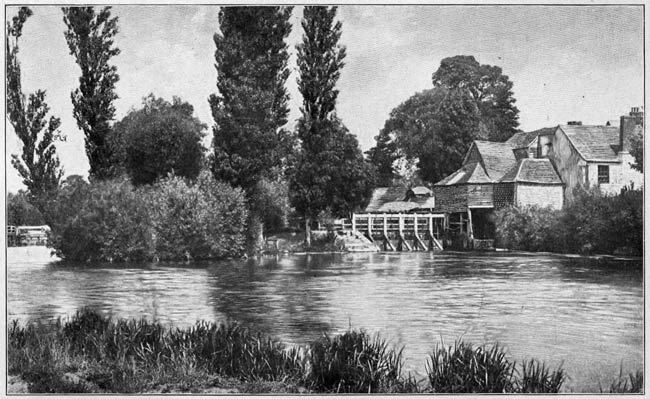
IFFLEY LOCK AND MILL
The best trip on the Isis is into the backwaters. These are a mesh of tiny streams that break free from the main current above Oxford and lose themselves in the broad bottom-lands. The islands they form were chosen in the Dark Ages as the sites of religious houses; for not only was the land fertile, but the network of deep, if tiny, streams afforded defense from the heathen, while the main channel of the Thames afforded communication with the Christian world. The ruins of these, or of subsequent monasteries, remain to-day brooding over a few Tudor cottages and hamlets, with a mill and a bakery and an inn or two to sustain life in the occasional undergraduate who lazes by in his canoe.
The most interesting of these ruins is Wytham. The phrase is exact, for the entire hamlet was built from a venerable religious house shortly after the dissolution of the monasteries. You can imagine the size of Wytham. If you don't watch very closely as you paddle up the sedgy backwater, you will miss it entirely, and that would be a pity, for its rude masonry, thatched roofs, and rustic garden fronts seem instinct with the atmosphere of Tudor England. The very tea roses, nodding languidly over the garden wall, smell, or seem to smell, as subtly sweet as if they had been pressed for ages between the leaves of a mediæval romance.
I am not quite sure that they do, though, for these ancient hamlets have strange ways of pulling the wool—a true golden fleece, to be sure—over American eyes. Once at twilight I heard a knot of strolling country men and women crooning a tune which was so strangely familiar that I immediately set it down as a village version of one of the noble melodies of that golden age when English feeling found its natural vent in song. As it drew nearer, I suddenly recognized it. It was a far-away version of "Mammy's Little Alabama Coon."
I have still faith, though, in a certain mediæval barmaid I chanced upon in the backwaters. The circumstances of our meeting were peculiar. As I drifted along one Sunday, perched on an after-thwart of the canoe, the current swept me toward a willow that leaned over the water, and I put up my hand to fend off. I chanced to be laughing to myself at the time at the thought of a fellow who, only the day before at the lasher, had tried to do the same thing. The lasher was forcing his punt against the willow on the opposite bank, whereupon, to my heart's delight, he lazily tried to fend it off with his arms. The punt refused to be fended off, and he stooped with an amusing effect of deliberation plump into the water. He was hauled out by the O.U.H.S. man hard by.
I was interrupted in these pleasant reminiscences by the roaring of waters about my ears, mingled with a boorish guffaw from one of the fellows behind me.... But I started to tell about the mediæval barmaid. Making my way to a bakehouse up the stream, I hung my coat and trousers before the fire on a long baker's pole, and put my shoes inside the oven on a dough tray. My companion of the horse-laugh hung my shirt on a blossoming almond-tree, and then left for the lunch hamper. He had scarcely gone when I heard the rustle of skirts at the door. "What do you want?" I cried. "I want my dinner," was the friendly reply. It was the barmaid of a neighboring public house, in her Sunday frock.
When she saw me she smiled, but maintained a dignity of port that—I insist upon it—was instinct with the simple and primitive modesty of the Middle Ages. It was the modesty of the people before whom Adam in the Chester mystery play was required by the stage directions to "stand nakyd and not be ashamyd." My barmaid advised me to take off my stockings and hang them up before the fire. The advice I admit came as a shock, but on reflection I saw that it was capital. For one happy moment I lived in the broad, wholesome atmosphere of the Middle Ages. It was like a breath from Chaucer's England.
Then the baker rushed into the room, in a cutaway Sunday coat of the latest style. He had baked for an Oxford college so long that he had become infected with the squeamish leaven of the nineteenth century. He called the girl a huzzy, and, taking her by the shoulder, hustled her into the garden, and then passed her plum pudding out to her gingerly through a crack in the door. He covered me with apologies and a bath-robe; but I did not mind either, for as the barmaid ran back to the inn she was laughing what I still insist upon believing to have been the simple joyous laughter of the Middle Ages.
But we must hurry to get back to college in time for dinner. And even at that we shall have to stop here at Magdalen bridge and give a street boy sixpence to take the punt the rest of the way. We land at the foot of the tower just as the late afternoon sun is gilding its exquisite pinnacles, and the chimes in its belfry are playing the prelude to the hour of seven. It is a melody worth all the Char and the Isis, with all their weirs and their willows. Other mediæval chimes fill you with a delicious sorrow for the past; but when they cease, and the great bell tolls out the hour, you think only of the death of time. It leaves you sadly beneath the tower, in the musty cellarage. But the melody that the Magdalen chimes utter is full of the fervid faith, the aspirations, of our fathers. It lifts you among the gilded pinnacles, or perhaps ever so little above them.
II
AS SEEN FROM AN OXFORD TUB
To the true slacker, the college barges that line the Isis are an object of aversion, for into them sooner or later every fellow who loves the water finds his way, and then there is an end of slacking. Each of the barges is a grammar school of oarsmanship, where all available men are taught everything, from what thickness of leather to wear on the heels of their boating-shoes to the rhythm in rowing by which alone an eight can realize its full speed; and from the barges issues a navy of boats and boating-men more than ten times as large as that of an American university. When Mr. R. C. Lehmann arrived at Cambridge to coach the Harvard crew, he was lost in admiration of the Charles River and the Back Bay, and in amazement at the absence of boats on them. At either Yale or Harvard it would be easy to give space to both of the fleets that now swarm on the slender Isis and threadlike Cam. We have water enough—as a Congressman once remarked of our fighting navy—it is only the boats that are lacking. The lesson we have to learn of our English cousins is not so much a matter of reach and swing, outrigger and blades, as a generous and wholesome interest in boating for the sake of the boat and of the water; and it is less apparent in an Oxford 'varsity eight than in the humblest tub of the humblest college.
The first suggestion that I should go out to be tubbed came from the gray-bearded dean of the college, who happened at the time to be taking me to the master for formal presentation. I told him that I had tried for my class crew, and that three days on the water had convinced the coach that I was useless. He fell a pace behind, looked me over, and said that I might at least try. As this was his only advice, I did not forget it; and when my tutor, before advising me as to my studies, also urged me to row, I gave the matter some serious thought.
I found subsequently that every afternoon, between luncheon and tea, the college was virtually deserted for field, track, and river; and it dawned upon me that unless I joined the general exodus I should temporarily become a hermit. Still, my earlier unhappy experience in rowing was full in mind, and I set out for the barge humble in spirit, and prepared to be cursed roundly for three days, and "kicked out," or, as they say in Oxford, "given the hoof," on the fourth.
Few memories could be so unhappy, however, as to resist the beauty of the banks of the Isis. At New Haven, the first impression an oarsman gets is said to be an odor so unwelcome that it is not to be endeared even by four years of the good-fellowship and companionship of a Yale crew. At Harvard, the Charles—"Our Charles," as Longfellow spoke of it in a poem to Lowell—too often presents aspects which it would be sacrilege to dwell on. What the "royal-towered Thame" and "Camus, reverend sire," may have been in the classic days of English poetry it is perhaps safest not to inquire; suffice it that to-day they are—and especially the Thames—all that the uninitiated imagine "our Charles." Nowhere does the sun stream more cheerfully through the moist gray English clouds; nowhere is the grass more green, the ivy more luxuriant, and the pollard willows and slender elms and poplars more dense in foliage. And every building, from the thatched farm-cottage in Christ Church meadow to the Norman church at Iffley, is, as it were, more native and more a part of creation than the grass and trees. The English oarsman, it is true, cannot be as conscious of all this as an American visitor. Yet the love of outdoors, which has been at work for centuries in beautifying the English landscape, is not the least part of the British sporting instinct. Where an American might loiter in contemplation of these woods, fields, and streams, an Englishman shoots, hunts, crickets, and rows in them.
When you enter the barge on the river, you feel keenly the contrast with the bare, chill boathouses of the American universities. On the centre tables are volumes of photographs of the crews and races of former years; the latest sporting papers are scattered on chairs and seats; and in one corner is a writing-table, with note-paper stamped "Balliol Barge, Oxford." There is a shelf or two of bound "Punches," and several shelves of books—"Innocents Abroad" and "Indian Summer," beside "Three Men in a Boat" and "The Dolly Dialogues." On the walls are strange and occult charts of the bumping races from the year one—which, if I remember rightly, is 1837. At the far end of the room is a sea-coal fire, above which shines the prow of a shell in which the college twice won the Ladies' Plate at Henley.
The dressing-room of the barge is sacred to the members of the eight, who at the present season are engaged in tubbing the freshmen in the hope of finding a new oar or two. At the appointed hour they appear, in eightsman blazers if it is fair, or in sou'westers if it is not—sad to relate, it usually is not—and each chooses a couple of men and leads them out to the float. Meanwhile, with the rest of the candidates—freshmen, and others who in past years have failed of a place in the torpids—you lounge on easy-chairs and seats, reading or chatting, until your own turn comes to be tubbed. It is all quiet like a club, except that the men are in full athletic dress.
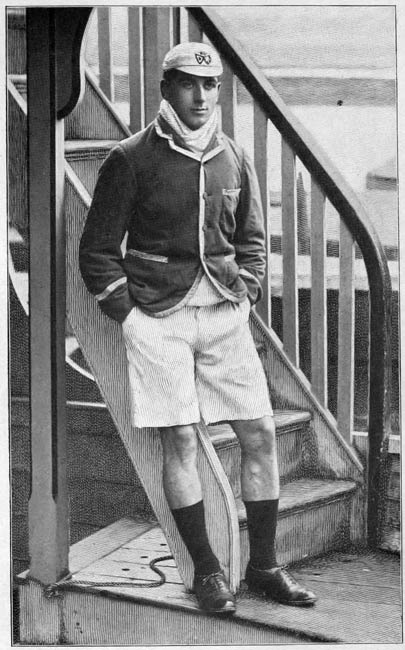
THE FULL COSTUME OF AN EIGHTSMAN
The athletic costume is elaborate, and has been worn for a generation—since top-hats and trousers were abandoned, in fact—in more or less its present form. It consists of a cotton zephyr, flannel shorts flapping about the knees, and socks, or in winter Scotch hose gartered above the calves. The sweater, which, in cold weather, is worn on the river, has a deep V neck, supplemented when the oarsman is not in action by a soft woolen scarf or cloud. Over all are worn a flannel blazer and cap embroidered with the arms of the college. This uniform, with trifling variations, is used in all sports on field and river, and it is infinitely more necessary, in undergraduate opinion, than the academic cap and gown which the rules of the university require to be worn after dark. This seemingly elaborate dress is in effect the most sensible in the world, and is the best expression I know of the cheerful and familiar way in which an Englishman goes about his sports. Reduced to its lowest terms, it is no more than is required by comfort and decency. With the addition of sweater, scarf, blazer, and cap, it is presentable in social conversation—indeed, in the streets of the city. It is in consequence of this that an afternoon in the barge is—except for the two tubbings on the river—so much like one spent in a club.
In America an oarsman wears socks and trunks which are apt to be the briefest possible. If he wears a shirt at all, it is often a mere ribbon bounding the three enormous apertures through which he thrusts his neck and shoulders. Before going on the river he is likely to shiver, in spite of the collar of his sweater; and after he comes in, his first thought is necessarily of donning street clothes. There is, in consequence, practically no sociability in rowing until the crews are selected and sent to the training-table. A disciple of Sartor Resartus would be very likely to conclude that, until American rowing adapts itself to the English costume, it must continue to be—except for the fortunate few—the bare, unkindly sport it has always been.
All this time I have had you seated in an armchair beside the sea-coal fire. Now an eightsman comes into the barge with two deep-breathing freshmen, and nods us to follow him to the boat the three have just quitted. On a chair by the door as we go out are several pads, consisting of a rubber cloth faced with wool. These are spongeo pilenes, or so I was told, which in English are known as Pontius Pilates—or Pontiuses for short. The eightsman will advise you to take a Pontius to protect your white flannel shorts from the water on the seat; for there is always a shower threatening, unless indeed it is raining. Every one knows, however, including the eightsman, that the wool is a no less important part of the Pontius than the rubber: it will save you many painful impressions of the dinner form in hall.
We are already on the river, and pair-oars, fours, and eights are swarming about us. "Come forward," cries our coach, "ready—paddle!" and we take our place in the procession of craft that move in one another's wake down the narrow river. The coach talks pleasantly to us from time to time, and in the course of an afternoon we get a pretty good idea of what the English stroke consists in.
The sun bursts through the pearl-gray clouds, and glows in golden ponds on the dense verdure of grass and trees. "Eyes in the boat," shouts the stern voice of conscience; but the coach says, "See, fellows. Here's a 'varsity trial eight. Watch them row, and you will see what the stroke looks like. Those fellows in red caps belong to the Leander."
Their backs are certainly not all flat, and to an American eye the crew presents a ragged appearance as a whole; but a second glance shows that every back swings in one piece from the hips, and that the apparent raggedness is due to the fact that the men on the bow side swing in one line, while those on the stroke side swing in another parallel line. They sway together with absolute rhythm and ease, and the boat is set on a rigidly even keel. Our coach looks them over critically, especially his three college-mates, one of whom at least he hopes will be chosen for the 'varsity eight. No doubt he aimed at a blue himself two years ago, when he came up; but blues are not for every man, even of those who row well and strongly. He watches them until they are indistinguishable amid the myriad craft in the distance. "It's jolly fine weather," he concludes pleasantly, with a familiar glance at the sky, which you are at liberty to follow. "Come forward. Ready—paddle!" We are presently in the barge again with the other fellows. A repetition of this experience after half an hour ends the day's work.
When I tried for the freshman crew in America, I was put with seven other unfortunates into a huge clinker barge, in charge of the sophomore coxswain. On the first day I was told to mind the angle on my oar. On the second day I was told to keep my eyes in the boat, damn me! On the third day, the sophomore coxswain wrought himself into a fury, and swore at me for not keeping the proper angle. When I glanced out at my blade he yelled, "Damn you, eyes in the boat!" This upset me so that I forgot thereafter to keep a flat back at the finish of the stroke. When we touched the float he jumped out, looked at my back, brought his boot against it sharply, and told me that there was no use in trying to row unless I could hold a flat back and swing my body between my knees. That night I sat on a dictionary with my feet against the footboard and tried to follow these injunctions, until my back seemed torn into fillets, but it would not come flat. I never went down to the river again, and it was two years before I summoned courage to try another sport. The bullyragging sophomore coxswain I came to know very well in later years, and found him as courteous and good-hearted as any man. To this day, if I mention our first meeting, he looks shy, and says he doesn't remember it. He says that the flat back is a discarded fetish in Harvard boating circles, that even before the advent of Mr. Lehmann cursing and kicking were largely abandoned; and moreover (fortissimo) that the freshman crew he helped to curse and kick into shape was the only one in ten years that won.
After a fortnight's tubbing in pair-oars, the better candidates are tubbed daily in fours, and the autumn races are on the horizon. At the end of another week the boats are finally made up, and the crews settle down to the task of "getting together." Each of the fours has at least one seasoned oarsman to steady it, and is coached from the coxswain's seat by a member of the college eight. Sometimes, if the November floods are not too high, the coach runs or bicycles along the towing-path, where he can see the stroke in profile. If a coach swears at his men, there is sure to have been provocation. His favorite figure of speech is sarcasm. At the end of a heart-breaking burst he will say, "Now, men, get ready to row," or, "I say, fellows, wake up; can't you make a difference?" The remark of one coach is now a tradition—"All but four of you men are rowing badly, and they're rowing damned badly!" This convention of sarcasm is by no means old. One of the notable personages in Eights' Week is a little man who is pointed out to you as the Last of the Swearing Coaches. Tempora mutantur. Perhaps my friend the ex-coxswain is in line for a similar distinction.
When the fours are once settled in their tubs, the stroke begins to go much better, and the daily paddle is extended so as to be a real test of strength and endurance for the new men, and for the man from the torpid a brisk practice spin. Even at this stage very few of the new men are "given the hoof;" the patience of the coachers is monumental.
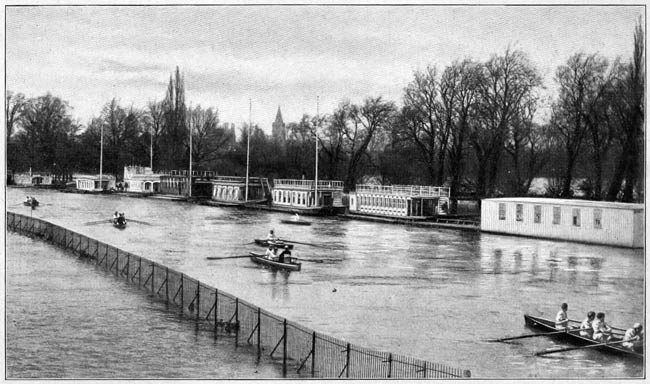
THE COLLEGE BARGES: TUBBING IN NOVEMBER FLOODS
The tubbing season is brought to an end with a race between the fours. Where there are half a dozen fours in training, two heats of three boats each are rowed the first day, and the finals between the best two crews on the following day. The method of conducting these races is characteristic of boating on the Isis and the Cam. As the river is too narrow to row abreast, the crews start a definite distance apart, and row to three flags a mile or so up the river, which are exactly as far apart as the boats were at starting. At each of these flags an eightsman is stationed. In the races I saw they flourished huge dueling pistols, and when the appropriate crew passed the flag, the appropriate man let off his pistol. The crew that is first welcomed with a pistol-shot wins. These races are less exciting than the bumping races; yet they have a picturesque quality of their own, and they settle the question of superiority with much less rowing. The members of the winning four get each a pretty enough prize to remember the race by, and the torpidsman at stroke holds the "Junior fours cup" for the year.
The crowning event of the season of tubbing is a wine, to which are invited all boating-men in college, and the representative athletes in other sports. In Balliol it is called the "Morrison wine," as the races are called "Morrison fours," in honor of an old Balliol man, a 'varsity oar and coach, who established the fund for the prizes. The most curious thing about this affair is that it is not given, as it would be in America, at the expense of the college, or even of the men who have been tubbed, but at the expense of those who are finally chosen to row in the races.
To my untutored mind the hospitality of English boating seemed a pure generosity. It made me uncomfortable at first, with the sense that I could never repay it; but I soon got over this, and basked in it as in the sun. The eightsmen devote their afternoons to coaching you because there are seats to be filled in the torpid and in the eight; they speak decently because they find that in the long run decency is more effective; and they hold the wine because they wish to honor the sport in which they have chosen to stake their reputations as athletes. In a word, where in America we row by all that is self-sacrificing and loyal, in England the welfare of boating is made to depend upon its attractiveness as a recreation and a sport; if it were not enjoyable to the normal man, nothing could force fellows into it.
The relationship of the autumn tubbing and its incidental sociability to the welfare of the sport in the college and in the university seems remote enough to the American mind, for out of the score of fellows who are tubbed only three or four, on an average, go farther in the sport. Yet it is typical of the whole; and it will help us in following the English boating season. Throughout the year there are two converging currents of activity in boating. On the one hand, the tubs in the autumn term develop men for the torpids, which come on during the winter term; and the torpids develop men for the summer eights. On the other hand, the 'varsity trials in the autumn term develop men for the 'varsity eight, which trains and races in the winter term; and the 'varsity oarsmen, like the men who have prospered in tubs and torpids, end the season in the eights of their respective colleges. The goal of both the novice and the veteran is thus the college eight.
The torpid is, so to speak, the understudy to the college eight. In order to give full swing to the new men, no member of the eight of the year before is allowed to row in it; and the leading colleges man two torpids—sometimes even three. The training here is much more serious than in the tubs; wine, spirits, and tobacco are out of order. The races, which are conducted like the celebrated May Eights, are rowed in midwinter—in the second of the three Oxford terms—under leaden skies, and sometimes with snow piled up along the towing-path. On the barges, instead of the crowds of ladies, gayly dressed and bent on a week of social enjoyment, one finds knots of loyal partisans who are keen on the afternoon's sport. The towing-path, too, is not so crowded as in May Week; but nothing could surpass the din of pistols and rattles and shouting that accompanies the races. If the men in the torpid do not learn how to row the stroke to the finish under the excitement of a race, it is not for the lack of coaching and experience. When the torpids break training, there are many ceremonies to signalize the return to the flesh-pots: one hardly realizes that the weeks of sport and comradeship have all gone to the filling of a place or two in the college eight.
All this time, while the tubs and torpids have been training up new men, the 'Varsity Boat Club, whose home is on the shore of the Isis opposite the row of college barges, has also, so to speak, been doing its tubbing. The new men for the 'varsity are chiefly those who have come to the front in the May Eights of the previous year—oars of two or three seasons' standing; though occasionally men are taken directly from the Eton eight, which enters yearly for the Ladies' Plate at Henley. The new men will number ten or a dozen; and early in the autumn they are taken out in tubs. They are soon joined by as many of last year's blues as are left in Oxford. The lot is divided into two eights, as evenly matched as possible, which are coached separately. These are called the Trial Eights, or 'Varsity Trials. To "get one's trials" is no mean honor. It is the sine qua non of membership to the Leander—admittedly the foremost boating club of the world. Toward the end of the first term there is a race of two and a half miles between the two trial eights at Moulsford, where the Thames is wide enough to permit the two boats to race abreast. Of the men who row in the trials the best ten or a dozen are selected to train for the 'varsity during the winter term.
Of the training of the 'varsity eight it is not necessary to speak here at length. The signal fact is that the men are so well schooled in the stroke, and so accustomed to racing, that a season of eight weeks at Oxford and at Putney is enough to fit them to go over the four miles and a quarter between Putney and Mortlake with the best possible results. The race takes place in March, just after the close of the winter term.
The series of races I have mentioned gives some idea of the scheme and scope of English boating, but it is by no means exhaustive. The strength of the boating spirit gives rise to no end of casual and incidental races. Chief among these are the coxswainless fours, which take place about the middle of the autumn term, while the trials are on the river. The crews are from the four or five chief boating colleges, and are made up largely from the men in the 'varsity trials. The races have no relation that I could discover to the 'varsity race; the only point is to find which college has the best four, and it is characteristic that merely for the sport of it the training of the 'varsity trials is interrupted.
After the 'varsity race the members of the crew rest during what remains of the Easter vacation, and then take their places in the boats of their respective colleges. Here they are joined by the other trials men, the remaining members of last year's college eight, and the two or three men who have come up from the torpids. Now begins the liveliest season in boating. Every afternoon the river is clogged with eights rowing to Iffley or to Sandford, and the towing-path swarms with enthusiasts. The course in the May bumping races is a mile and a quarter long—the same as the course of the torpids—and the crews race over it every day for a week, with the exception of an intervening Sunday, each going up a place or down a place in the procession daily according as it bumps or is bumped. These races, from the point of view of the expert oarsman, are far less important than the 'varsity race; yet socially they are far more prominent, and the enthusiasm they arouse among the undergraduates is incomparable. The vitality of Oxford is in the colleges: the university organizations are the flowers of a very sturdy root and branch.
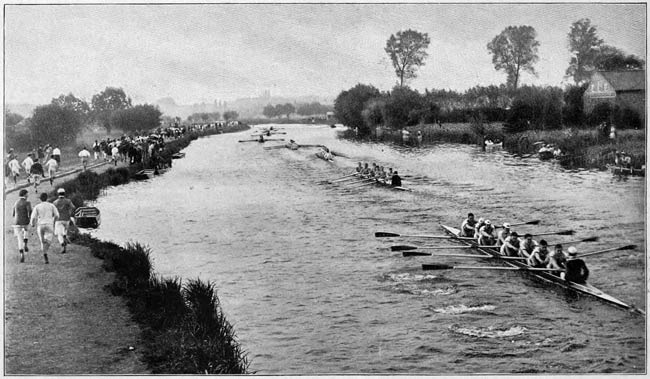
THE LAST DAY OF THE BUMPING RACES OF THE SUMMER EIGHTS (1895)
The difference between American and English boating is that we lack the root and branches of the college system. In a university of from three to four thousand men there are, in addition to the 'varsity crew, four class crews and perhaps a few scratch crews. In England, each of the score of colleges, numbering on an average something like one hundred and fifty men apiece, mans innumerable fours, one or more eight-oared torpids, and the college eight. A simple calculation will show that with us one man in fifty to seventy goes in for the sport, while in England the proportion is one man in five to seven.
The difference in spirit is as great as the difference in numbers. In America, the sole idea in athletics, as is proclaimed again and again, is to beat the rival team. No concession is made to the comfort or wholesomeness of the sport; men are induced to train by the excellent if somewhat grandiose sentiment that they owe it to the university to make every possible sacrifice of personal pleasure. Our class crews, which have long ceased to represent any real class rivalry, are maintained mainly in the hope of producing 'varsity material. The result of these two systems is curiously at variance with the intention. At Oxford, where rowing is very pleasant indeed, and where for the greater part of the year the main interest centres in college crews, the 'varsity reaches a high degree of perfection, and the oarsmen, without quite being aware of the fact, represent their university very creditably; while at Yale, and until recently at Harvard, the subsidiary crews have been comparative failures in producing material, and the 'varsity is in consequence somewhat in the position of an exotic, being kept alive merely by the stimulus of inter-varsity rivalry.
The recent improvement at Harvard is due to Mr. Rudolph C. Lehmann, the celebrated Cambridge and Leander oar who coached the Harvard crews of 1897 and 1898, in the sportsmanlike endeavor to stimulate a broader and more expert interest in boating. His failure to bring either of the crews to victory, which to so many of us signified the utter failure of his mission, has had more than a sufficient compensation in the fact that he established at Harvard something like the English boating system. Anything strictly similar to the torpids and eights is of course out of the question, because we have no social basis such as the colleges afford for rivalry in boating; but the lack of colleges has in a measure been remedied by creating a factitious rivalry between improvised boating clubs, and the system of torpids and eights has been crudely imitated in the so-called graded crews. A season of preliminary racing has thus been established, on the basis of which the candidates for the 'varsity crew are now selected, so that instead of the nine months of slogging in the tank and on the river, in which the more nervous and highly organized candidates were likely to succumb and the stolid men to find a place in the boat, the eight is made up as at Oxford of those who have shown to best advantage in a series of spirited races. Crude as the new Harvard system is as compared with the English system, it has already created a true boating spirit, and has trained a large body of men in the established stroke, placing the sport at Harvard on a sounder basis than at any other American university. It has thus been of infinitely more advantage, by the potentiality of an example, than any number of victories at New London. To realize the full benefit of the system of graded crews and preliminary races, it is only necessary to supersede the arbitrary and meaningless division into clubs by organizations after the manner of English colleges which shall represent something definite in the general life of the university.
III
A LITTLE SCRIMMAGE WITH ENGLISH RUGBY
The relationship between the colleges and the university exists in a greater or less degree in all sports. There is a series of matches among the leading colleges in cricket, and a "cup tie" in Association football. These sports are almost as popular as rowing, and have many excellences which it would be pleasant to point out and profitable perhaps to emulate; but it seems best to concentrate attention on the sports which are best understood in America, such as Rugby football and athletics. The workings of the college system may be most clearly seen in them, and the spirit of English sportsmanship most sympathetically appreciated.
The rivalry between the Association and the Rugby games has made English football players quite unexpectedly sensitive to comparisons. I had scarcely set foot upon a Rugby field when I was confronted with the inevitable question as to English Rugby and American. I replied that from a hasty judgment the English game seemed haphazard and inconsequent. "We don't kill one another, if that's what you mean by 'inconsequent,'" my companion replied; and I soon found that a report that two players had been killed in the Thanksgiving Day match of the year before had never been contradicted in England. "That is the sport," my friend continued, "which Caspar Whitney says, in his 'Sporting Pilgrimage,' has improved English Rugby off the face of the earth!"
The many striking differences between English and American Rugby arise out of the features of our game known as "possession of the ball" and "interference." In the early days of the American game, many of the most sacred English traditions were unknown, and the wording of the English rules proved in practice so far from explicit that it was not possible to discover what it meant, much less to enforce the rules.
One of the traditions favored a certain comparative mildness of demeanor. The American players, on the contrary, favored a campaign of personal assault for which the general rules of the English scrummage lent marked facilities. It soon became necessary in America to line the men up in loose order facing each other, and to forbid violent personal contact until the actual running with the ball should begin. This clearly made it necessary that the sides should in turn put the ball in play, and consequently should alternately have possession of it. Under this arrangement, each side is in turn organized on the offensive and the defensive.
The upshot of this was that the forwards, who in the parent English game have only an incidental connection with the running of the backs, become a part of each successive play, opening up the way for the progress of the ball. According to the English code, this made our forwards off-side, so that the rule had to be changed to fit the new practice. It then appeared that if the forwards could play ahead of the ball, the backs could do so too; and here you have the second great American feature. The result of "possession" of the ball and "interference" is an elaborate and almost military code of tactics unknown in the English game.
In the course of time I had unusual facilities for observing English Rugby. During the Morrison wine which ended the season of tubbing on the river, the captain of the Balliol fifteen threw his arms about me, and besought me to play on the team. He had not a single three-quarters, he said, who could get out of his own way running. I pleaded an attack of rheumatism and ignorance of the game. He said it did not matter. "And I'm half blind," I added. "So am I," he interrupted, "but we'll both be all right in the morning." I said I referred to the fact that I was very near-sighted; but he took all excuses as a sign of resentment because he had failed to invite me to breakfast in my freshman term; he appeared to think it his duty to breakfast all possible candidates. Such are the courtesies of an English captain, and such are the informalities of English training.
The next morning the captain wrote me that there was a match on against Merton, and asked me to come out a quarter of an hour before the rest for a little coaching. A quarter of an hour to learn to play football! In spite of the captain's predictions of the night before, I was not so sure that he was yet "all right;" so I went out to the porter's lodge and scanned the bulletin board. My name stared me in the face. I had scarcely time to take luncheon and don a pair of football shorts.
The practice my coach gave me consisted in running the length of the field three or four times, passing the ball back and forth as we went. His instructions with regard to the game were equally simple. To keep in proper position I had only to watch my Merton vis-à-vis and take a place symmetrical with his. When the enemy heeled the ball out of the "scrummage" to their quarter-back, putting us for the moment on the defensive, I was to watch my man, and, if the ball was passed to him, to tackle him. If he passed it before I could tackle him I was still to follow him, leaving the man who took the ball to be watched by my neighbor, in order that I might be on hand if my man received it again. An American back, when his side is on the defensive, is expected to keep his eye on his vis-à-vis while the ball is being snapped back; but his main duty is to follow the ball. An English back under similar circumstances is expected only to follow his man. If our side happened to heel out the ball from the scrum and one of our three-quarters began to run with it, we were on the offensive, and the other three-quarters and I were to follow at his heels, so that when he was about to be tackled—"collared," the English say—he could pass it on to us. There is, as I have said, no such thing as combined "interference" among the backs. A player who gets between the man with the ball and the enemy's goal is rankly off-side. It is not to be understood that the captain coached all this information into me. I had to buttonhole him and pump it out word by word. Coaching of any sort is all but unknown on English football fields. What there is of the game is learned at school—or in the nursery!
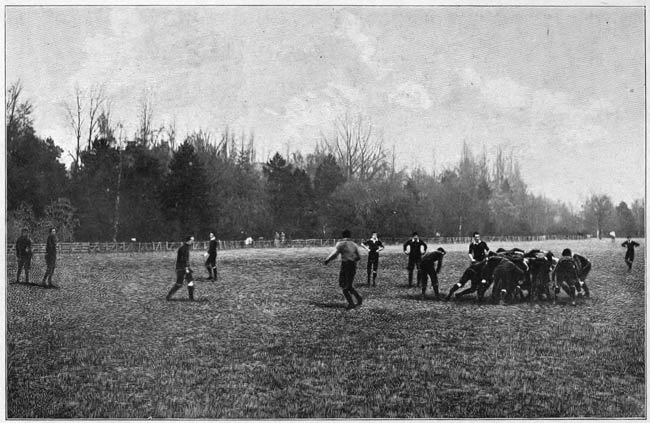
AN ENGLISH RUGBY LINE-UP To the left of the scrum, two half backs and six three-quarter backs face each other in pairs
When the opposing teams scattered over the field for the kick-off, I noticed with satisfaction that there was not a spectator on the grounds to embarrass me. It is so in almost all English college games—the fellows are more than likely to have sports of their own on, and anyway, what is the use in hanging round the fields where other fellows are having all the fun?
On the kick-off, luckily, the ball did not come to my corner of the field, for I could scarcely have seen it, much less caught it. Our side returned the kick and the "scrum" formed. The nine forwards gathered compactly in a semi-ellipse, bent their bodies together in a horizontal plane, with their heads carefully tucked beneath the mass, and leaned against the opposing mass of forwards, who were similarly placed. When the two scrums were thoroughly compacted, the umpire tossed the ball on the ground beneath the opposing sets of legs, whereupon both sides began to struggle. The scrum in action looks like a huge tortoise with a score of legs at each end, which by some unaccountable freak of nature are struggling to walk in opposite directions. The sight is certainly awe-inspiring, and it was several days before I realized that it masked no abstrusely working tactics; there is little, if anything, in it beyond the obvious grunting and shoving.
The backs faced each other in pairs ranged out on the side of the scrum that afforded the broader field for running. The legs in the Balliol scrum pushed harder and the bodies squirmed to more advantage, for our men had presently got the ball among their feet. They failed to hold it there, however, and it popped out into a half-back's hands. He passed it quickly to one of my companions at three-quarters, who dodged his man and ran toward the corner of the field. I followed, and just as the full-back collared him he passed the ball to me. Before I had taken three rheumatic strides I had two men hanging at my back; but when they brought me down, the ball was just beyond the line. The audience arose as one man—to wit, the referee, who had been squatting on the side lines—and shouted, "Played. Well played!" I had achieved universal fame. During the rest of the game the Balliol scrum, which was a very respectable affair of its kind, kept the ball to itself, while we backs cooled our heels.
A few days later, in a game against Jesus, the scrums were more evenly matched, and the ball was heeled out oftener. I soon found that my eyes were not sharp enough to follow quick passing; and when, just before half-time, a punt came in my direction, I was horrified to see the ball multiply until it looked like a flock of balloons. As luck had it, I singled out the wrong balloon to catch. Jesus fell on the ball just as it bounced over the goal-line. In the second half the captain put one of the forwards in my place, and put me in the scrum.
The play here was more lively, though scarcely more complex or difficult. Each forward stuck his head beneath the shoulders of the two men in front of him, grasped their waists, and then heaved, until, when the ball popped out of the scrum, the word came to dissolve. There were absolutely no regular positions; the man who was in the front centre of one scrummage might be in the outskirts of the next. On some teams, I found, by inquiry, a definite order is agreed on, but this is regarded as of doubtful advantage.
When the umpire or a half-back tosses the ball into the scrummage, there are, at an ultimate analysis, four things that can happen. First, the two sides may struggle back and forth, carrying the ball on the ground at their feet; this play is called a "pack." Second, the stronger side may cleave the weaker, and run down the field, dribbling the ball yard by yard as they go, until either side picks it up for a run, or else drops on it and cries "down." Third, one side may be able to "screw the scrum," a manœuvre which almost rises to the altitude of a "play." The captain shouts "Right!" or perhaps "Left!" and then his forwards push diagonally, instead of directly, against their opponents. The result is very like what we used to call a revolving wedge, except that, since the ball is carried on the ground, the play eventuates, when successful, in a scattering rush of forwards down the field, dribbling the ball at their feet, just as when the scrum has been cloven. The fourth possibility is that the side that gets the ball amongst its eighteen legs allows it to ooze out behind, or, if its backs are worthy of confidence, purposely heels it out. Thereupon results the play I have already described: one of the half-backs pounces upon it and passes it deftly to the three-quarters, who run with it down the field, if necessary passing it back and forth. In plays which involve passing or dribbling, English teams sometimes reach a very high degree of skill: few sights on the football field are more inspiring than to see a "combination" of players rush in open formation among their opponents, shifting the ball from one to another with such rapidity and accuracy as to elude all attempts to arrest it. As a whole, the game of the forwards is much more fun than that of the backs, though decidedly less attractive in the eyes of the spectators—a consideration of slight importance on an English field!
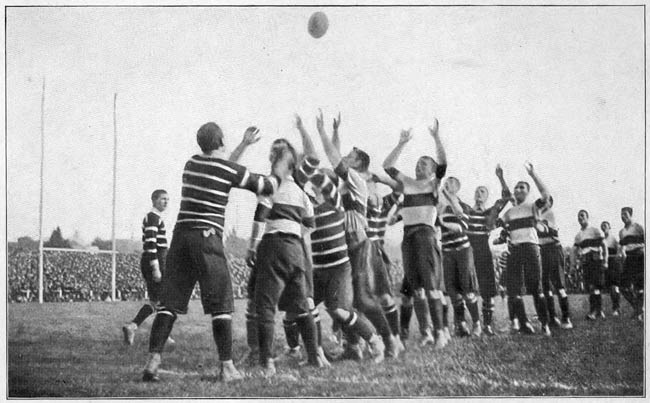
THROWING IN THE BALL
Just as I began to get warmed to my new work I smashed my nose against the head of a Balliol man who was dodging back into the push. The captain told me that I need not finish the game; but as it is against the English rules to substitute players and we were still far from sure of winning, I kept to my grunting and shoving. At the end of the game the captain very politely gave me the hoof. This was just what I expected and deserved; but I was surprised to find that the fellows had objected to my playing the game through with a bloody nose. They would have preferred not to be bled upon.
This regard for pleasantness and convenience, which to an American is odd enough, is characteristic even of 'varsity football. The slenderness of the preliminary training of a 'varsity fifteen is incredible to any American who has not witnessed it. To sift the candidates there is a freshman match and a senior match, with perhaps one or two "squashes"—that is to say, informal games—besides. And even these tests are largely a matter of form. Men are selected chiefly on their public school reputations or in consequence of good work on a college fifteen. The process of developing players, so familiar to us, is unknown. There is no coaching of any kind, as we understand the word. When a man has learned the game at his public school or in his college, he has learned it for all time, though he will, of course, improve by playing for the university. The need of concentrated practice is greatly lessened by the fact that the soft English winter allows as long a season of play as is desired. The team plays a game or two a week against the great club teams of England—Blackheath, Richmond, London Scottish, Cardiff, Newport, and Huddersfield—with perhaps a bit of informal kicking and punting between times. When the weather is too bad, it lays off entirely.
All this does not conduce to the strenuousness of spirit Americans throw into their sports. In an inter-varsity match I saw the Oxford team which was fifty per cent. better allow itself to be shoved all over the field: it kept the game a tie only by the rarest good fortune. It transpired later that the gayeties of Brighton, whither the team had gone to put the finishing touches on its training, had been too much for it. In an American university such laxity would be thought the lowest depth of unmanliness, but I could not see that any one at Oxford really resented it; at most it was a subject for mild sarcasm. You can't expect a team to be in the push everywhere!
This lack of thorough preparation is even more characteristic of the international teams—England, Ireland, Scotland, and Wales—that yearly play for the championship of Great Britain. They are chosen from the most brilliant players in the leading clubs, and local jealousy makes the task of choosing most delicate. The temptation is to take a man or two impartially from each of the great fifteens. As the international teams take little or no practice as a whole, the tendency in the great games is to neglect the finer arts of dribbling and passing in combination—the arts for which each player was severally chosen—and revert to the primitive grunting and shoving. In the great games, accordingly, the team which is man for man inferior as regards the fine points may prevail by sheer strength, so that the result is liable to be most unsatisfactory. Some years ago, owing to local jealousy, the Welsh international had to be chosen mainly from a single club—with the result that it won the championship; and in 1901 the canny Scotch team won by intentionally selecting its members, in spite of local jealousy, on the score of their familiarity with one another's play.
The very rules under which the game is played are calculated to moderate the struggle. As a result of the rule against substituting, to which I have referred, any extreme of hard play in the practice games, such as lays off dozens of good American players yearly, is not likely to be encouraged. Of course good men "crock," as they call it; but where an injury is practically certain to disqualify a man from the inter-varsity match, the football limp and the football patch can scarcely be regarded as the final grace of athletic manhood. Willful brutality is all but unknown; the seriousness of being disqualified abets the normal English inclination to play the game like a person of sense and good feeling. The physical effect of the sport is to make men erect, lithe, and sound. And the effect on the nervous system is similar. The worried, drawn features of the American player on the eve of a great contest are unknown. An Englishman could not understand how it has happened that American players have been given sulphonal during the last nights of training. English Rugby is first of all a sport, an exercise that brings manly powers into play; as Hamlet would say, the play's the thing. It is eminently an enjoyable pastime, pleasant to watch, and more pleasant to take part in.
That our American game is past hoping for on the score of playability is by no means certain. As the historical critics of literature are fond of saying, a period of rapid development is always marked by flagrant excesses, and the development of modern American football has been of astonishing rapidity. Quite often the game of one season has been radically different from the games of all preceding seasons. This cannot continue always, for the number of possible variations is obviously limited, and when the limit is reached American Rugby will be, like English Rugby, the same old game year in and year out. Everybody, from the youngest prep. to the oldest grad., will know it and love it.
The two vital points in which our game differs from the English—"possession of the ball" and "interference"—are both the occasion of vigorous handling of one's opponents. When an American player is tackled, he seldom dares to pass the ball for fear of losing possession of it, so that our rule is to tackle low and hard, in order to stop the ball sharply, and if possible to jar it out of the runner's grasp. In England, it is still fair play to grab a man by the ankle. This is partly because of the softness of the moist thick English turf; but more largely because, as passing is the rule, the tackler in nine cases out of ten aims at the ball. The result is that a man is seldom slammed to the earth as he would be in our game. It is this fact that enables the English player to go bare-kneed.
The danger from interference in the American game is also considerable. When a man is blocked off, he is liable to be thrown violently upon the far from tender bosom of our November mother-earth. Any one familiar with the practice of an American eleven will remember the constant cry of the coaches: "Knock your man on the ground! Put him out of the play!" It has been truly enough said that the American game has exaggerated the most dangerous features of the two English games—the tackling of English Rugby and the "charging" or body-checking of the Association game.
Yet this is only a partial statement of the case. These elements of possession of the ball and interference have raised our game incalculably above the English game as a martial contest. Whereas English Rugby has as yet advanced very little beyond its first principles of grunting and shoving, the American game has always been supreme as a school and a test of courage; and it has always tended, albeit with some excesses, toward an incomparably high degree of skill and strategy. Since American football is still in a state of transition, it is only fair to judge the two games by the norm to which they are severally tending. The Englishman has on the whole subordinated the elements of skill in combination to the pleasantness of the sport, while the American has somewhat sacrificed the playability of the game to his insatiate struggle for success and his inexhaustible ingenuity in achieving it. More than any other sport, Rugby football indicates the divergent lines along which the two nations are developing. By preferring either game a man expresses his preference for one side of the Atlantic over the other.
IV
TRACK AND FIELD ATHLETICS
In track and field athletics, the pleasantness and informality of English methods of training reach a climax. In America we place the welfare of our teams in the hands of a professional trainer, who, through his aide-de-camp, the undergraduate captain, is apt to make the pursuit of victory pretty much a business. Every autumn newcomers are publicly informed that it is their duty to the university to train for the freshman scratch games. At Oxford, I was surprised to find, there was not only no call for candidates, but no trainer to whom to apply for aid. The nearest approach to it was the groundsman at the Iffley Running Grounds, a retired professional who stoked the boilers for the baths, rolled the cinder-path, and occasionally acted as "starter." As his "professional" reputation as a trainer was not at stake in the fortunes of the Oxford team, his attitude was humbly advisory. The president of the Athletic Club never came near the grounds, being busy with rowing on a 'varsity trial eight, and later with playing Association football for the university. To one accustomed to train not only for the glory of his alma mater but for the reputation of his trainer, the situation was uninspiring.
As I might have expected, the impetus to train came from the college. I was rescued from a fit of depression by a college-mate, a German, who wanted some one to train with. At school he had run three miles in remarkable time; but later, when an officer in the German army, his horse had rolled over him at the finish of a steeple-chase, and the accident had knocked out his heart; so he was going to try to sprint. I advised him against all training, and the groundsman shook his head. Yet he was set upon showing the Englishmen in Balliol that a German could be a sportsman. This was no idle talk, as I found later, when he fainted in the bath after a fast hundred, and failed by no one knows how little of coming to. We were soon joined by a third Balliol man, a young Greek poet, whose name is familiar to all who are abreast of the latest literary movement at Athens. He was taking up with athletics because of his interest in the revival of the ancient glories of Greece. When I asked him what distance suited him best—whether he was a sprinter or a runner—he answered with the sweet reasonableness of the Hellenic nature that any distance would suit him that suited me. A motlier trio than we, I suppose, never scratched a cinder-path. Yet the fellows in our college seemed almost as interested as they were amused; and we soon found that even so learned a place as Balliol would have been glad to bolster its self-esteem by furnishing its quota of "running blues." What was lacking in the way of stimulus from the university was more than made up for by the spontaneous interest of the fellows in college.
The rudimentary form of athletics is in meetings held by the separate colleges. These occur throughout the athletic season, namely, the autumn term and the winter term; and as hard on to a score of colleges give them, they come off pretty often. The prizes are sums of money placed with the Oxford jeweler, to be spent in his shop as the winners see fit. In America, the four classes, which are the only sources of athletic life independent of the university, are so moribund socially that it never occurs to them to get out on the track for a day's sport. It is true that we sometimes hold inter-class games, but the management of these is in the hands of the university; they are inspired solely by a very conscious attempt to develop new men, and to furnish the old ones with practice in racing. The vitality of the athletic spirits in the English colleges is witnessed by the fact that an Oxford college frequently meets a fit rival at Cambridge in a set of dual games just for the fun of it.
The only bond between the numerous college meetings and the university sports is a single event in each, called a strangers' race, which is open to all comers. The purpose of these races is precisely that of our inter-class meetings—to give all promising athletes practice in competition. As the two prizes in each strangers' race average five pounds and thirty shillings respectively, the races are pretty efficient. Though the "blues" sometimes compete—Cross made his record of 1m. 54 2⁄5s. for the half mile in one of them—they generally abandon them to the new men of promise. While the president and the "blues" generally are rowing and playing football, the colleges thus automatically develop new material for the team.
The climax of the athletic meetings of the autumn term is the freshman sports, held on two days, with a day's interval. The friends of the various contestants make up a far larger audience than one finds at similar sports in America; and a brass band plays while the races are on. The whole thing is decidedly inspiring; and for the first time one is brought face to face with the fact that there are inter-varsity games in store.
When the winter term opens, bleak and rainy, the strangers' races bring out more upper classmen. By and by the "blues" themselves appear in sweater, muffler, and blazer, and "paddle" about the track to supple their muscles and regain disused racing strides. At the end of a fortnight I noticed a middle-aged gentleman with whom the prominent athletes conferred before and after each day's work. I soon found that he was Mr. C. N. Jackson, a don of Hertford College, who should always be remembered as the first hurdler to finish in even time. It is he who—save the mark—takes the place of our American trainers. At one of our large American universities about this time, as I afterwards learned, a very different scene was enacting. The trainer and the captain called a mass-meeting and collected a band of Mott Haven champions of the past to exhort the University to struggle free from athletic disgrace. Though the inter-varsity games were nearly four months in the future—instead of six or seven weeks as at Oxford—those ancient athletes aroused such enthusiasm that 268 men undertook the three months of indoor training. To one used to such exhortations, the Oxford indifference was as chilling as the weather we were all training in. Mr. Jackson seemed never to notice me; and how could I address him when he had not even asked me to save the university from disgrace? I was forced to the unheroic expedient of presenting a card of introduction. To my surprise, I found that he had been carefully watching my work from day to day, but had not felt justified in giving advice until I asked for it.
Even during the final period of training, everything happened so pleasantly and naturally that I had none of the nervous qualms common among American athletes. At first I thought I missed the early morning walks our teams take daily, the companionship and jollity of the training-table, and the sense that the team was making a common sacrifice for an important end. Yet here, too, the college made up in a large measure for what I failed to find in the university. One of our eightsmen was training with a scrub four that was to row a crew of schoolboys at Winchester; and we had a little course of training of our own. Every morning we walked out for our dip to Parson's Pleasure, and breakfasted afterward beneath an ancient ivied window in the common room. In the pleasantness and quiet of those sunlit mornings, I began to realize that our training-table mirth, which is sometimes so boisterous, is in part at least due to intense excitement and overwrought nerves. And the notion of self-sacrifice, which appeals to us so deeply, seemed absurd where we were all training for the pleasure and wholesomeness of sport, and for the sake of a ribbon of blue.
The interest the university took in our welfare became made manifest when the "first strings" were sent off to Brighton for the change in climate which all English teams require before great games. Some of the rest of us, who had nowhere else to go, went with them, but most of the men went home to train. The second string in the three miles stayed up at Oxford for commemoration, and joined us after three consecutive nights of dancing. He said that he found he needed staying up work.
Every morning at Brighton the president made the round of our quarter of the hotel shortly before eight o'clock, and spoiled our waking naps to rout us out for our morning's walk, which included a plunge into the Channel. For breakfast, as indeed for all our meals, we had ordinary English fare, with the difference only that it was more abundant.
On alternate days our training consisted in cross-country walks of ten or a dozen miles. Our favorite paths led along the chalk cliffs, and commanded a lordly view of the Channel. Sometimes, for the sake of variety, we went by train to the Devil's Dyke and tramped back over the downs, now crossing golf-links and now skirting cornfields ablaze with poppies. All this walking filled our lungs with the Brighton air, and by keeping our minds off our races, prevented worry. Sprinters and distance men walked together, though the sprinters usually turned back a mile or two before the rest. The rate prescribed was three and a half miles an hour; but our spirits rose so high that we had trouble in keeping it below five.[2]
The training dinners furnished the really memorable hours of the day. A half-pint of "Burton bitter" was a necessity, and a pint merely rations. If one preferred, he might drink Burgundy ad lib., or Scotch and soda. After trials there was champagne. When I told the fellows that in America our relaxation consists in ice-cream for Sunday dinner, they set me down as a humorist. After dinner, instead of coffee and tobacco, we used to go out to the West Pier, which was a miniature Coney Island, and amuse ourselves with the various attractions. The favorite diversion was seeing the Beautiful Living Lady Cremated. The attraction was the showman, who used to give an elaborate oration in Lancashire brogue. Every word of it was funny, but especially the closing sentence: "The Greeks 'ad a ancient custom of porun' a liebation on the cinders of the departud, which custom, gentlemen, we omits." We used to laugh so heartily at this that the showman would join in, and even the beautiful living lady would snicker companionably, as she crawled away beneath the stage. If the reader is unable to see the fun of it, there is no help for him—except, perhaps, an English training dinner.
The rest of the evenings we used to spend in strolling about among the crowd, breathing the salt air, and listening to the music. We did not lack companionship, for the Oxford and Cambridge cricket elevens were at Brighton, and the entire Cambridge athletic team. Many of the cricketers, and not a few of the Cambridge athletes—whom the Oxford men called "Cantabs," and sometimes even "Tabs"—paraded the place puffing bulldog pipes. The outward relationship between the rival teams was simply that of man to man. If one knew a Cambridge man he joined him, and introduced the fellows he happened to be walking with. One day the Cambridge president talked frankly about training, urging us to take long walks, and inviting us to go with his men. The only reason we did not go was that our day for walking happened to be different from theirs.
The days on which we did our track work we spent largely in London, at the Queen's Club grounds, in order to get a general sense of the track and of the conditions under which the sports were to take place. Sometimes, however, we ran at Preston Park, on the outskirts of Brighton.
On the day of the inter-varsity meeting, our team came together as a whole for the first time in the dressing-rooms of the Queen's Club. The fellows dropped in one by one, in frock coats, top hats, and with a general holiday air. The Oxford broad-jumper, who was the best man at the event in England, had been so busy playing cricket all season, and smoking his pipe with the other cricketers on the pier at Brighton, that he had not had time even to send to Oxford for his jumping-shoes. In borrowing a pair he explained that unless a fellow undertook the fag of thorough training, he could jump better without any practice. Our weight-thrower, a freshman, had surprised himself two days previously by making better puts than either of the Cambridge men had ever done; but as nobody had ever thought it worth while to coach him, he did not know how he had done it, and was naturally afraid he couldn't do it again. He showed that he was a freshman by appearing to care whether or not he did his best; but even his imagination failed to grasp the fact that the team which won was to have the privilege of meeting Yale in America. As it turned out, if either of these men had taken his event, Oxford, instead of Cambridge, would have met Yale.
As I went out to start in my race, the question of half-sleeves which Englishmen require in all athletic contests was settled in my mind. The numberless seasonable gowns in the stands and the innumerable top hats ranged on all sides about the course made me feel as if I were at a lawn party rather than at an athletic meeting. I suffered as a girl suffers at her first evening party, or rather as one suffers in those terrible dreams where one faces the problem of maintaining his dignity in company while clad in a smile or so. Waiving the question of half-sleeves, I should have consented to run in pyjamas.
In the race I had an experience which raised a question or two that still offer food for reflection. As my best distance—a half mile—was not included in the inter-varsity program, I ran in the mile as second string. There was a strong wind and the pace was pretty hot, even for the best of us, namely, the Cambridge first string, who had won the race the year before in 4 min. 19 4⁄5 sec.,—the fastest mile ever run in university games. As the English score in athletic games, only first places count, and on the second of the three laps I found myself debating whether it is not unnecessarily strenuous to force a desperate finish where the only question is how far a man can keep in front of the tail end. Several of the fellows had already dropped out in the quietest and most matter of fact manner; and as we were finishing the lap against the wind, I became a convert to the English code of sportsmanship.
As the bunch drew away from me and turned into the easy going of the sheltered stretch, I was filled with envy of them, and with uncontrollable disgust at myself, the like of which I had never felt when beaten, however badly, after making a fair struggle. And when I saw them finishing against the hurricane, striding as if they were running upstairs, I felt the heroism of a desperate finish as I had never done before. It did not help matters when I realized that it was the last race I was ever to run.
At the Sports' dinner that night at the Holborn Restaurant, I pocketed some of my disgust. The occasion was so happy that I remember wishing we might have something like it after our meetings at home, for good-fellowship chastens the pride of winning and gives dignity to honest defeat. There was homage for the victors and humorous sympathy for the vanquished. Light blue and dark blue applauded and poked fun at each other impartially. Sir Richard Webster, Q. C., now Lord Chief Justice, himself an old blue, presided at the dinner, and explained how it was that the performances of his day were really not to be sneezed at; and the young blues, receiving their prizes, looked happy and said nothing. After dinner, we divided into squads and went to the Empire Theatre of Varieties, Cantab locking arms with Oxonian. By supper time, at St. James', I was almost cheerful again.
Yet the disgust of having quitted that race has never left me. The spirit of English sportsmanship will always seem to me very gracious and charming. As a nation, I think we can never be too thankful for the lesson our kinspeople have to teach us in sportsmanly moderation and in chivalry toward an opponent. But every man must draw his own line between the amenities of life and the austerities; and I know one American who hopes never again to quit a contest, even a contest in sport, until he has had the humble satisfaction of doing his best.
V
ENGLISH AND AMERICAN SPORTSMANSHIP
The prevalence of out-of-door sports in England, and the amenity of the English sporting spirit, may be laid, I think, primarily, to the influence of climate. Through the long, temperate summer, all nature conspires to entice a man out of doors, while in America sunstroke is imminent. All day long the village greens in England are thronged with boys playing cricket in many-colored blazers, while every stream is dotted with boats of all sorts and descriptions; and in the evenings, long after the quick American twilight has shut down on the heated earth, the English horizon gives light for the recreations of those who have labored all day. In the winter the result is the same, though the cause is very different. Stupefying exhalations rise from the damp earth, and the livelong twilight that does for day forces a man back for good cheer upon mere animal spirits. In the English summer no normal man could resist the beckoning of the fields and the river. In the winter it is sweat, man, or die.
It is perhaps because of the incessant call to be out of doors that Englishmen care so little to have their houses properly tempered. At my first dinner with the dons of my college, the company assembled about a huge sea-coal fire. On a rough calculation the coal it consumed, if used in one of our steam-heaters, would have heated the entire college to incandescence. As it was, its only effect seemed to be to draw an icy blast across our ankles from mediæval doors and windows that swept the fire bodily up the chimney, and left us shivering. One of the dons explained that an open fire has two supreme advantages: it is the most cheerful thing in life, and it insures thorough ventilation. I agreed with him heartily, warming one ankle in my palms, but demurred that in an American winter heat was as necessary as cheerfulness and ventilation. "But if one wears thick woolens," he replied, "the cold and draught are quite endurable. When you get too cold reading, put on your great-coat." I asked him what he did when he went out of doors. "I take off my great-coat. It is much warmer there, especially if one walks briskly." Some days later, when I went to dine with my tutor, my hostess apologized for the chill of the drawing-room. "It will presently be much warmer," she added; "I have always noticed that when you have sat in a room awhile, it gets warm from the heat of your bodies." She proved to be right. But when we went into the dining-room, we found it like a barn. She smiled with repeated reassurances. Again she proved right; but we had hardly tempered the frost when we had to shift again to the drawing-room, which by this time again required, so to speak, to be acclimated. Meanwhile my tutor, who was of a jocular turn of mind, diverted our thoughts from our suffering by ragging me about American steam heat, and forced me, to his infinite delight, to admit that we aim to keep our rooms warmed to sixty-eight degrees Fahrenheit. Needless to say, this don was an athlete. As the winter wore away, I repeatedly saw him in Balliol hockey squashes, chasing the ball about with the agility of a terrier pup. At nightfall, no doubt, he returned to his wife and family prepared to heat any room in the house to the required temperature. Heaven forbid that I should resent the opprobrium Englishmen heap upon our steam heat! I merely wish to point out that the English have failed as signally as we, though for the opposite reason, in making their houses habitable in the winter, and that an Englishman is forced into athletics to resist the deadly stupefaction of a Bœotian climate, and to keep his house warm.
In a sportsman it would be most ungracious to inveigh against English weather. The very qualities one instinctively curses make possible the full and varied development of outdoor games, which Americans admire without stint. Our football teams do day labor to get fit, and then, after a game or so, the sport is nipped in the bud. To teach our oarsmen the rudiments of the stroke we resort to months of the galley-slavery of tank-rowing. Our track athletes begin their season in the dead of winter with the dreary monotony of wooden dumb-bells and pulley-weights, while the baseball men are learning to slide for bases in the cage. In England the gymnasium is happily unknown. Winter and summer alike the sportsman lives beneath the skies, and the sports are so diverse and so widely cultivated that any man, whatever his mental or physical capacity, finds suitable exercise that is also recreation.
It is because of this universality of athletic sports that English training is briefer and less severe. The American makes, and is forced to make, a long and tedious business of getting fit, whereas an Englishman has merely to exercise and sleep a trifle more than usual, and this only for a brief period. Our oarsmen work daily from January to July, about six months, or did so before Mr. Lehmann brought English ideas among us; the English 'varsity crews row together nine or ten weeks. Our football players slog daily for six or seven weeks; English teams seldom or never "practice," and play at most two matches a week. Our track athletes are in training at frequent intervals throughout the college year, and are often at the training-table six weeks; in England six weeks is the maximum period of training, and the men as a rule are given only three days a week of exercise on the cinder-track. To an American training is an abnormal condition; to an Englishman it is the consummation of the normal.
The moderation of English training is powerfully abetted by a peculiarity of the climate. The very dullness and depression that make exercise imperative also make it impossible to sustain much of it. The clear, bright American sky—the sky that renders it difficult for us to take the same delight in Italy as an Englishman takes, and leads us to prefer Ruskin's descriptions to the reality—cheers the American athlete; and the crispness of the atmosphere and its extreme variability keeps his nerves alert. An English athlete would go hopelessly stale on work that would scarcely key an American up to his highest pitch.