JOHN CORBIN (continued 3)
Reading edition
The effect of these differences on the temperament of the athlete is marked. The crispness and variety of our climate foster nervous vitality at the expense of physical vitality, while the equability of the English climate has the opposite effect. In all contests that require sustained effort—distance running and cross-country running, for example—we are in general far behind; while during the comparatively few years in which we have practiced athletic sports we have shown, on the whole, vastly superior form in all contests depending upon nervous energy—sprinting, hurdling, jumping, and weight-throwing.
Because of these differences of climate and of temperament, no rigid comparisons can be made between English and American training; but it is probably true that English athletes tend to train too little. Mr. Horan, the president of the Cambridge team that ran against Yale at New Haven, said as much after a very careful study of American methods; but he was not convinced that our thoroughness is quite worth while. The law of diminishing returns, he said, applies to training as to other things, so that, after a certain point, very little is gained even for a great sacrifice of convenience and pleasantness. Our American athletes are twice as rigid in denying the spirit for an advantage, Mr. Horan admitted, of enough to win by.
The remark is worth recording: it strikes the note of difference between English and American sportsmanship. After making all allowances for the conditions here and abroad that are merely accidental, one vital difference remains. For better or for worse, a sport is a sport to an Englishman, and whatever tends to make it anything else is not encouraged; as far as possible it is made pleasant, socially and physically. Contests are arranged without what American undergraduates call diplomacy; and they come off without jockeying. It is very seldom that an Englishman forgets that he is a man first and an athlete afterwards. Yet admirable as this quality is, it has its defects, at least to the transatlantic mind. Even more, perhaps, than others, Englishmen relish the joy of eating their hearts at the end of a contest, but they have no taste for the careful preparation that alone enables a man to fight out a finish to the best advantage. It is no doubt true, as the Duke of Wellington said, that the battle of Waterloo was won on the playing-fields of England; but for any inconsiderable sum I would agree to furnish a similar saying as to why the generals in South Africa ran into ambush after ambush.
In America, sportsmanship is almost a religion. Fellows mortify the flesh for months and leave no means untried that may help to bring honor to their college; or if they don't, public opinion brings swift and sure retribution. It is true that this leads to excesses. Rivalries are so strong that undergraduates have been known to be more than politic in arranging matches with each other. So the graduate steps in to moderate the ardor of emulation, and often ends by keeping alive ancient animosities long after they would have been forgotten in the vanishing generations of undergraduates. The Harvard eleven wants to play the usual football game; but it is not allowed to, because a committee of graduates sees fit to snub Yale; the athletic team wants to accept a challenge from Oxford and Cambridge, but it is not allowed to because Pennsylvania, which is not challenged, has a better team, and it is the policy of the university (which has an eye to its graduate schools) to ingratiate sister institutions. In a word, the undergraduates are left to manage their studies while the faculty manages their pastimes.
When a contest is finally on, excesses are rampant. Of occasional brutalities too much has perhaps been said; but more serious errors are unreproved. There is a tradition that it is the duty of all non-athletes to inspire the 'varsity teams by cheering the play from the side lines; and from time to time one reads leading articles in the college papers exhorting men to back the teams. The spectator is thus given an important part in every contest, and after a 'varsity match he is praised or blamed, together with the members of the team, according to his deserts. Yale may outplay Harvard, but if Harvard sufficiently out-cheers Yale she wins, and to the rooters belong the praise. In baseball games especially, a season's championship is not infrequently decided by the fact that the partisans of one side are more numerous, or for other reasons make more noise. These are serious excesses, and are worthy of the pen of the robustest reformer; but after all has been said they are incidents, and in the slow course of time are probably disappearing.
The signal fact is that our young men do what they do with the diligence of enthusiasm, and with the devotion that inspires the highest courage. It is not unknown that, in the bitterness of failure, American athletes have burst into tears. When our English cousins hear of this they are apt to smile, and doubtless the practice is not altogether to be commended; but in the length and breadth of a man's experience there are only two or three things one would wish so humbly as the devotion that makes it possible. Such earnestness is the quintessence of Americanism, and is probably to be traced to the signal fact that in the struggle of life we all start with a fighting chance of coming out on top. Whatever the game, so long as it is treated as a game, nothing could be as wholesome as the spirit that tends to make our young men play it for all it is worth, to do everything that can be done to secure victory with personal honor. In later years, when these men stand for the honor of the larger alma mater, on the field of battle or in the routine of administration, it is not likely that they will altogether forget the virtues of their youth.
The superiority of English sportsmanship arises, not from the spirit of the men, but from the breadth of the development of the sports, and this, climate aside, is the result of the division of the university into colleges. The average college of only a hundred and fifty men maintains two football teams—a Rugby fifteen and an Association eleven—an eight and two torpids, a cricket eleven, and a hockey eleven. Each college has also a set of athletic games yearly. If we add the men who play golf, lawn and court tennis, rackets and fives, who swim, box, wrestle, and who shoot on the ranges of the gun club, the total of men schooled in competition reaches eighty to one hundred. A simple calculation will show that when so many are exercising daily, few are left for spectators. Not a bench is prepared, nor even a plank laid on the spongy English turf, to stand between the hanger-on and pneumonia. A man's place is in the field of strife; to take part in athletic contests is almost as much a matter of course as to bathe. Of late years there has been a tendency in England to believe that the vigor of undergraduates—and of all Englishmen, for the matter of that—is in decadence. As regards their cultivation of sports at least, the reverse is true. Contests are more numerous now than ever, and are probably more earnestly waged. What is called English decadence is in reality the increasing superiority of England's rivals.
Quite aside from the physical and moral benefit to the men engaged, this multiplication of contests has a striking effect in lessening the importance of winning or losing any particular one of them. It is more powerful than any other factor in keeping English sports free from the excesses that have so often characterized our sports. From time to time a voice is raised in America as of a prophet of despair demanding the abolition of inter-university contests. As yet the contests have not been abolished, and do not seem likely to be. Might it not be argued without impertinence that the best means of doing away with the excesses in question is not to have fewer contests, but more of them? If our universities were divided into residential units, corresponding roughly to the English colleges, the excesses in particular contests could scarcely fail to be mitigated; and what is perhaps of still higher importance, the great body of non-athletes would be brought directly under the influence of all those strong and fine traditions of undergraduate life which centre in the spirit of sportsmanship.
Note. For a discussion of the influences of climate in international athletics, see Appendix II.
III
THE COLLEGE AS AN EDUCATIONAL FORCE
I
THE PASSMAN
In the educational life of Oxford, as in the social and athletic life, the distinctive feature, at least to the American mind, is the duality of organization in consequence of which an undergraduate is amenable first to his college and then to the university: the college teaches and the university examines. In America, so far as the undergraduate is concerned, the college and the university are identical: the instructor in each course of lectures is also the examiner. It follows from this that whereas in America the degree is awarded on the basis of many separate examinations—one in each of the sixteen or more "courses" which are necessary for the degree—in England it is awarded on the basis of a single examination. For three or four years the college tutor labors with his pupil, and the result of his labors is gauged by an examination, set and judged by the university. This system is characteristic of both Cambridge and Oxford, and for that matter, of all English education; and the details of its organization present many striking contrasts to American educational methods.
Sir Isaac Newton's happy thought of having a big hole in his door for the cat and a little hole for the kitten must have first been held up to ridicule by an American. In England, the land of classes, it could hardly fail of full sympathy. In America there is but one hole of exit, though men differ in their proportions as they go out through it. In England there are passmen and classmen.
To say that the passman is the kitten would not be altogether precise. He is rather a distinct species of undergraduate. More than that, he is the historic species, tracing his origin quite without break to the primal undergraduate of the Middle Ages. He is a tradition from the time when the fund of liberal knowledge was so small that the university undertook to serve it all up in a pint-pot to whoever might apply. The pint-pot still exists at Oxford; and though the increasing knowledge of nine centuries long ago overflowed its brim, the passman still holds it forth trustfully to his tutor. The tutor patiently mingles in it an elixir compounded of as many educational simples as possible, and then the passman presents it to the examiners, who smile and dub him Bachelor of Arts. After three years, if he is alive and pays the sum of twelve pounds, they dub him Master.
The system for granting the pass degree is, in its broader outlines, the same as for all degrees. In the first examination—that for matriculation—it is identical for passmen and classmen. This examination is called "responsions," and is, like its name, of mediæval origin. It is the equivalent of the American entrance examination; but by one of the many paradoxes of Oxford life it was for centuries required to be taken after the pupil had been admitted into residence in one of the colleges. In the early Middle Ages the lack of preparatory schools made it necessary first to catch your undergraduate. It was not until the nineteenth century that a man could take an equivalent test before coming up, for example at a public school; but it is now fast becoming the rule to do so; and it is probable that all colleges will soon require an entrance examination. In this way two or three terms more of a student's residence are devoted to preparation for the two later and severer university tests.
The subjects required for matriculation are easy enough, according to our standards. Candidates offer: (1) The whole of arithmetic, and either (a) elementary algebra as far as simple equations involving two unknown quantities, or (b) the first two books of Euclid; (2) Greek and Latin grammar, Latin prose composition, and prepared translation from one Greek and one Latin book. The passages for prepared translation are selected from six possible Greek authors and five possible Latin authors. The influence of English colonial expansion is evident in the fact that candidates who are not "European British subjects" may by special permission offer classical Sanskrit, Arabic, or Pali as a substitute for either Greek or Latin: the dark-skinned Orientals, who are so familiar a part of Oxford life, are not denied the right to study the classics of their native tongues. Thus the election of subjects is a well-recognized part of responsions, though the scope of the election does not extend to science and the modern languages.
Once installed in the college and matriculated in the university, both passman and honor man are examined twice and twice only. The first public examination, more familiarly called "moderations," or "mods," takes place in the middle of an undergraduate's course. Here the passmen have only a single subject in common with the men seeking honors, namely, the examination in Holy Scripture, or the Rudiments of Faith and Religion, more familiarly called "Divinners," which is to say Divinities. The subject of the examination is the gospels of St. Luke and St. John in the Greek text; and either the Acts of the Apostles or the two books of Kings in the Revised Version. As in all Oxford examinations, cram-books abound containing a reprint of the questions put in recent examinations; and, as many of these questions recur from year to year, the student of Holy Scripture is advised to master them. A cram-book which came to my notice is entitled "The Undergraduate's Guide to the Rudiments of Faith and Religion," and contains, among other items of useful information: tables of the ten plagues; of the halting-places during the journey in the wilderness; of the twelve apostles; and of the seven deacons. The book recommends that the kings of Judah and Israel, the journeys of St. Paul, and the Thirty-nine Articles shall be committed to memory. The obviously pious author of this guide to the rudiments of these important accomplishments speaks thus cheerfully in his preface: "The compiler feels assured that if candidates will but follow the plan he has suggested, no candidate of even ordinary ability need have the least fear of failure." According to report, it is perhaps not so easy to acquire the rudiments of faith and religion. In a paper set some years ago, as one of the examiners informed me, a new and unexpected question was put: "Name the prophets and discriminate between the major and the minor." One astute passman wrote: "Far be it from me to make discriminations between these wise and holy men. The kings of Judah and Israel are as follows." Unless a man passes the examination, he has to take it again, and the fee to the examiner is one guinea. "This time I go through," exclaimed an often ploughed passman. "I need these guineas for cigars." Those who are not "European British subjects" may substitute certain sacred works in Sanskrit, Arabic, or Pali; and those who object for conscientious scruples to a study of the Bible may substitute the Phædo of Plato; but the sagacious undergraduate knows that if he does this he must have no conscientious scruples against harder work.
In America there is no such examination, so far as I know. At Harvard an elective course in the history and literature of the Jews is given by the Semitic department; and if this does not insure success in acquiring the rudiments of faith and religion, it was, on one occasion at least, the means of redoubling the attendance at chapel. Just before the final examination, it transpired that the professor in charge of the course was conducting morning service, and was giving five minute summaries of Jewish history. For ten days the front pews were crowded with waistcoats of unwonted brilliance; the so-called sports who had taken the course as a snap were glad to grind it up under the very best auspices.
Let me not be misunderstood. In the long run, the English undergraduates no doubt add greatly to their chances of spiritual edification. At the very least they gain a considerable knowledge of one of the great monuments of the world's literature. In America the Bible is much less read in families than in England, so that it would seem much more important to prescribe a course in Biblical history and literature. At one time Professor Child gave a course in Spenser and the English Bible, and is said to have been moved at times when reading before his classes to a truly Elizabethan access of tears. Some years before the great master died, he gave up the course in despair at the Biblical ignorance of his pupils. The usual Harvard undergraduate cannot name five of the prophets, with or without discrimination, or be certain of five of the kings of Judah. As I write this, I am painfully uncertain as to whether there were as many as five.
But to return to our muttons. The remaining subjects for pass moderations are: (1) Portions of three classic authors, two Greek and one Latin, or two Latin and one Greek. The passages of each author to be studied are prescribed, but the candidate may elect, with certain slight limitations, from eight Greek and eight Latin authors "of the best age." As in the case of responsions and Holy Scripture, Sanskrit, Arabic, or Pali may be substituted for either Greek or Latin. The examination covers not only grammar and literature, but any question arising out of the text. Besides these are required: (2) Latin prose composition; (3) sight translation of Greek and Latin; and (4) either logic or the elements of geometry and algebra.
The final pass examination allows a considerable range of election. Three general subjects must be offered. At least one of these must be chosen from the following: Greek, Latin, Sanskrit, Persian, German, and French. If a candidate wishes, he may choose two of his three subjects in ancient language, literature, and history, or in modern language, literature, history, and economics. The remaining one or two subjects may be chosen from a dozen courses ranging through the elements of mathematics, natural science, law, and theology. This range of choice is very different from that in America, in that a student is not permitted freely to elect subjects without reference to one another. For the pass degree, no considerable originality or grasp of the subject is necessary, any more than for an undistinguished degree in an American college; but the body of necessary facts is pretty sure to be well ordered, if not digested. The idea of grouping electives is the fundamental difference between English and American education. In the case of the honor man it will be seen to be of chief importance.
In order to take the Oxford degree, it is further necessary to be in residence three years, and a man may reside four years before going up for his final examination. The period of study—or loafing—may be broken in various ways; and it is characteristic that though a man may anticipate his time and take his last examination before the last term of his third year, he is required to reside at the university, studies or no studies, until the minimum residence is completed. Nothing could indicate more clearly the importance which is attached to the merely social side of university life.
It is, in fact, as a social being that the passman usually shines. You may know him most often from the fact that you sight him in the High by a waistcoat of many colors. At night he is apt to evade the statutes as to academicals; but if he wears his gown, he wraps it about his neck as if it were a muffler, and tilts his mortar-board at all angles. He is the genius of the fox terrier and the bulldog pipe; he rides to the hounds, and is apt in evading the vice-chancellor's regulations as to tandems and four-in-hands. Or perhaps he sits comfortably in his rooms discoursing lightly of the impious philosophies that are the studies of the classman, and writes Horatian verse for the "Isis" and the "Oxford Magazine." He does anything, in fact, that is well-bred, amusing, and not too strenuous. Curiously enough, it sometimes happens that he does sufficient reading on his own account to give him no little real culture. Of late there has been a reaction in favor of the pass school as affording a far better general education.
If the passman loiters through the three or four years, it is mainly the fault—or the virtue—of the public school he comes from. Of late the best public schools have had so strong and admirable an influence that boys have often been kept in them by their parents until they reach the age limit, generally nineteen. By this time they have anticipated most of the studies required for a pass degree in the university, and find little or nothing to do when they go up but to evade their tutors and to "reside." It is by this means, as the satirist long ago explained, that Oxford has become an institution of such great learning. Every freshman brings to it a little knowledge and no graduate takes any away.
There is reason in all this. In the first place, as I have said, the passman is the historical undergraduate, and little short of a convulsion could disestablish him—that is the best of British reasons. Moreover, to be scrupulously just, the passman knows quite as much as the American student who barely takes a degree by cramming a few hours with a venal tutor before each of his many examinations, and perhaps more than the larger proportion of German students who confine their serious interests to the duel and the Kneipe, and never graduate. And then, the Oxonian argues amiably, if it were not for the pass schools, the majority of the passmen would not come to Oxford at all, and would spend their impressionable period in some place of much less amenity. Clearly, they learn all that is necessary for a gentleman to know, and are perhaps kept from a great deal that is dangerous to young fellows with money and leisure. It means much to the aristocracy and nobility of England that, whatever their ambitions and capacities, they are encouraged by the pursuit of a not too elusive A.B. to stay four years in the university. Even the ambitious student profits by the arrangement. Wherever his future may lie, in the public service, in law, medicine, or even the church, it is of advantage to know men of birth and position—of far greater advantage, from the common sensible English point of view, than to have been educated in an atmosphere of studious enthusiasm and exact scholarship.
II
THE HONOR SCHOOLS
The modern extension of the world's knowledge, with the corresponding advance in educational requirements, which are perhaps the most signal results of the nineteenth century, could not fail to exert a powerful influence on all university teaching. In the United States, the monument to its influence is the elective system. In England, it is the honor schools. Both countries felt the inadequacy of the antique pint-pot of learning. The democratic New World has not dreamed of making a sharp distinction between the indifferent and the ambitious. Under the lead of the scientific spirit of the German universities, it has placed the noblest branches of human knowledge on a par with the least twig of science. With characteristic conservatism England kept the old pint-pot for the unscholarly, to whom its contents are still of value, though extending its scope to suit the changing spirit of the age; and for those who felt the new ambitions it made new pint-pots, each one of which should contain the essence gathered from a separate field of learning. The new pint-pots are the honor schools, and the children of the new ambition are the honor men.
The honor schools of Oxford are eight in number. Here again the English conservatism is evident. The oldest of them, literæ humaniores, which was at first the only honor school, has for its subject-matter a thorough view of classical language, literature, and thought. It is an édition de luxe of the old pass school. Because of the nobility of its proportions, it is familiarly called "greats," and it justifies its name by enrolling almost half of all Oxford candidates for the honor degree. An overwhelming majority of famous Oxford graduates have taken their degree in "greats." The other schools are sometimes known as the minor schools. Mathematics was originally a part of the school in literæ humaniores, but was soon made into a separate school. Since then schools have been established in six new subjects—natural science, jurisprudence, modern history, theology, Oriental studies, and English. Under our elective system, a student continues through his four years, choosing each year at random, or as the fates decree, this, that, or the other brief "course." Under the honor system a man decides sooner or later which one of the several branches he most desires, and sets out to master it.
An Oxford man's decision may be made at the outset; but far the larger number of men defer the choice. They do this by reading for moderations, for pass moderations as well as honor mods may be followed by an honor school at finals. The subject-matter for honor mods is, roughly speaking, the same as for pass mods—the classics and kindred studies; but the field covered is considerably more extended, and to take a high class the student is required to exhibit in his examination papers no little grasp of the subjects as a whole, and if possible to develop his own individuality in the process. Having done with moderations, an honor man is forced to choose a final school. The logical sequence of honor mods is literæ humaniores; but one may choose instead modern history, theology, Oriental studies, or English.
The men who commit themselves to a choice at the outset are those who go in for science or jurisprudence. These men begin by reading for a form of moderations known as science preliminaries or jurisprudence preliminaries.
The exact sequence of examinations is fixed only by common sense. The school of history is open to those who have taken pass mods, and even to those who have taken the jurisprudence preliminary, though mods is usually preferred in order to give a man the use of the necessary languages. If a science man's chief work is to be in astronomy or physics, which require some mathematics, he may take the mathematical mods, and devote only the second half of his course to science.
Even after a man has chosen his subject and begun to work on it with his tutor, there is considerable range of election. As classical mods are supposed to cover all the subjects essential to polite education, election is mainly a question as to the ancient authors read. If a man knows what final school he is to enter, he may choose his authors accordingly. Thus, a history man chooses the ancient historians; a man who intends to enter the school in English literature, the ancient poets and dramatists. In addition to such authors, all candidates for classical mods choose, according to their future needs, one of four subjects: the history of classical literature, comparative classical philology, classical archæology, and logic. The preliminary examinations in natural science and in jurisprudence are concerned with a general view of the field, and thus do not admit of much variation, whatever the branch to be pursued later; and the same is true of mathematical moderations. A man who chooses any one of these three honor schools has made the great choice of bidding good-by to the classics.
In the final schools the range of choice is greater than at moderations, and is greater in some schools than in others. Literæ humaniores offers the least scope for election. The reason is that the subject-matter is a synthetic view of the classic world entire. Still, in so vast a field, a student perforce selects, laying emphasis on those aspects of the ancient world which he considers (or which he expects the examining board to consider) of most interest and importance. It has been objected even at Oxford that such a course of study gives a student little or no training in exact scholarship. The examination statutes accordingly give a choice of one among no less than forty special subjects, the original sources of which a man may thresh out anew in the hope of adding his iota to the field of science; and, on six months' notice, a student may, under approval, select a subject of his own. The unimportance of this part of the "greats" curriculum is evident in the fact that it is recommended, not required.
The history school requires the student to cover the constitutional and political history of England entire, political science and economy, with economic history, constitutional law, and political and descriptive geography. It also requires a special subject "carefully studied with reference to the original authorities," and a period of general history. If a student does not aim at a first or second class at graduation, he may omit certain parts of all this. In any case, he has to choose from the general history of the modern world one special period for a more detailed examination. In the school of natural science, the student, after filling in the broad outlines of the subject for his preliminary, must choose for his final examination one of the following seven subjects: physics, chemistry, animal physiology, zoölogy, botany, geology, and astronomy. Besides the written examination, a "practical" examination of three hours is required to show the student's ability at laboratory work. These three honor schools are the most important, and may be regarded as representative. After a man has taken one honor degree, for example, in literæ humaniores, he may take another, for example, in modern history. He then becomes a double honor man, and if he has got a first class in both schools, he is a "double first."
In America, the election of studies goes by fragmentary subjects, and the degree is awarded for passing some four such subjects a year, the whole number being as disconnected, even chaotic, as the student pleases or as chance decrees. In England, the degree is granted for final proficiency in a coherent and well-balanced course of study; but within this not unreasonable limit there is the utmost freedom of election. The student first chooses what honor school he shall pursue, and then chooses the general lines along which he shall pursue it.
III
THE TUTOR
In preparing for his two "public examinations," the pupil is solely in the hands of a college tutor. Any familiar account of the Oxford don is apt to make him appear to the American, and especially to the German mind, a sufficiently humble person. His first duty is the very unprofessional one of making newcomers welcome. He invites his pupils to breakfast and to dinner, and introduces them to their fellows so that they shall enter easily into the life of the college; he tells them to go in for one or another of the various undergraduate activities. As a teacher, moreover, his position is strikingly similar to that of the venal tutors in our universities, who amiably keep lame ducks from halting, and temper the frost of the examination period to gilded grasshoppers. It is all this that makes the American scholar so apt to smile at the tutor, and the German, perhaps, to sniff. The tutor is not easily put down. If he replies with anything more than a British silence, it is to say that after all education cannot be quite dissociated from a man's life among his fellows. And then there is the best of all English reasons why the tutor should think well of his vocation: it is approved by custom and tradition. Newman, Pusey, Jowett, Pater, Stubbs, Lang, and many such were tutors, and they thought it well worth while to spend the better part of each day with their pupils.
Homely as are the primary duties of the tutor, it is none the less necessary that certain information should be imparted. The shadow of the examiners looms across the path twice in the three or four years of an undergraduate's life. There is no dodging it: in order to get a degree, certain papers must be written and well written. Here is where the real dignity of the tutor resides, the attribute that distinguishes him from all German and American teachers. He is responsible to the college that his pupils shall acquit themselves well before the examiners,—that the reputation of the college shall be maintained. By the same token, the examiners are responsible to the university that its degrees shall be justly awarded, so that the course of education in England is a struggle of tutor against examiner. In Germany and in America, an instructor is expected to be a master of his subject; he may be or may not be—and usually is not—a teacher. In England, a tutor may be a scholar, and often is not. His success is measured first and foremost by the excellence of the papers his pupils write. Is Donkin of Balliol a good tutor? Well, rather, he has got more firsts than any don in Oxford; by which is meant of course that his pupils have got the firsts. A college is rated partly by its number of blues and partly by its number of firsts. For a tutor to lead his pupils to success is as sacred a duty as for an athletic undergraduate to play for the university. The leisurely, not to say loafing, tutor of eighteenth-century tradition has been reformed out of existence. If the modern tutor fails of any high attainment as a scholar, it is mainly because he is required to be a very lively, strenuous, and efficient leader of youth.
The means by which the tutor conducts his charges in the narrow path to success in the schools are characteristic. The secret lies in gaining the good-will of the pupil. Thus any breakfasts, luncheons, and dinners that the hospitable tutor gives to his pupils while they are learning the ways of the place are bread cast upon the waters in a very literal sense. For a decent fellow to neglect the just wishes of a teacher to whom he is indebted is easy enough on occasions; but systematically to shirk a genuine debt of gratitude without losing caste with one's self requires supreme ingenuity. If you don't want to get into the clutches of your tutor, don't take the least chance of getting to like him. This is the soundest advice ever given by the wary upper classman. It has not been ordained by nature that the soul of the teacher is sib to the soul of the taught, but clearly, by exercising the humanities, the irrepressible conflict may be kept within bounds.
Sometimes harsher measures are necessary. Then a man is sent up to the Head of the college, which is not at all a promotion. One fellow used to tell a story of how Jowett, the quondam master of Balliol, chastised him. When he reported, the Master was writing, and merely paused to say: "Sit down, Mr. Barnes, you are working with Mr. Donkin, are you not?" The culprit said he was, and sat down. Jowett wrote on, page after page, while the undergraduate fidgeted. Finally Jowett looked up and remarked: "Mr. Donkin says you are not. Good-morning." After that the undergraduate was more inclined to work with Mr. Donkin.
For graver offenses a man is imprisoned within the paradise behind the college walls—"gated," the term is. One fellow I knew—a third year man who roomed out of college—was obliged to lodge in the rooms of the dean, Mr. J. L. Strachan Davidson. The two turned out excellent friends. No one could be altogether objectionable, the undergraduate explained, whose whiskey and tobacco were as good as the dean's. In extreme cases a man may be sent down, but if this happens, he must either have the most unfortunate of dispositions, or the skin of a rhinoceros against tact and kindness.
It is by similar means that the don maintains his intellectual ascendency. Nothing is more foreign to Oxford than an assumption of pedagogic authority. Mr. Hilaire Belloc, who is now not unknown in London as a man of letters, used to tell of a memorable encounter with Jowett. Mr. Belloc was holding forth in his vein of excellent enthusiasm with regard to his countrymen. For a long time Jowett listened with courteously qualified assent, but finally said: "Mr. Belloc, do you know the inscription which is said to stand above the gate to Hell?" Mr. Belloc was ready with the familiar line from Dante. "No, Mr. Belloc, Ici on parle français." The oratory of even a president of the Oxford Union broke down in laughter. Under such a system a mutual confidence increases day by day between teacher and taught, which may end in a comradeship more intimate than that between father and son.
Our universities are fast adopting the German or pseudo-German idea that an advanced education consists merely in mastering the subject one may choose to pursue. The point of departure is the "course." If we gain the acquaintance of Lowell or Longfellow, Agassiz, Child, or Norton, we have to thank our lucky stars. In England, the social relationship is the basis of the system of instruction.
IV
READING FOR EXAMINATIONS
How easy is the course of Oxford discipline on the whole is evident in the regulations as to the times for taking the examinations. The earliest date when a man may go up for moderations is his fifth term after matriculation. As there are four terms a year, this earliest date falls at the outset of his second year. For a passman there is apparently no time beyond which it is forbidden to take mods, or finals either. An honor man may repeat his attempts at mods until eight terms are gone—two full and pleasant years; that is, he may take mods in any of three terms—almost an entire year. For finals he may go up as early as his eleventh term, and as late as his sixteenth—giving a latitude of more than a year. If he wishes to take a final examination in a second subject, he may do so up to his twentieth term. Clearly, the pupil's work is done without pressure other than the personal influence of the tutor. When an American student fails to pass his examinations on the hour, he is disclassed and put on probation, the penalty of which is that he cannot play on any of the athletic teams. On this point, at least, the Oxford system of discipline is not the less childish of the two.
As to the nature of the work done, it is aptly expressed in the Oxford term, "reading." The aim is not merely to acquire facts. From week to week the tutor is apt to meet his pupils, and especially the less forward ones, in familiar conversation, often over a cup of tea and a cigarette. He listens to the report of what the pupil has lately been reading, asks questions to see how thoroughly he has comprehended it, and advises him as to what to read next. When there are several pupils present, the conference becomes general, and thus of greater advantage to all. In the discussions that arise, opposing views are balanced, phrases are struck out and fixed in mind, and the sum of the pupil's knowledge is given order and consistency. The best tutors consciously aim at such a result, for it makes all the difference between a brilliant and a dull examination paper, and the examiners highly value this difference.
The staple of tutorial instruction is lectures. In the old days the colleges were mutually exclusive units, each doing the entire work of instruction for its pupils. This arrangement was obviously wasteful, in that it presupposed a complete and adequate teaching force in each of the twenty colleges. Latterly, a system of "intercollegiate lectures" has been devised, under which a tutor lectures only on his best subjects and welcomes pupils from other colleges. These intercollegiate tutorial lectures are quite like lecture courses at an American college, except that they are not used as a means of police regulation. Attendance is not compulsory, and there are no examinations. A man issues from the walls of his college for booty, and comes back with what he thinks he can profit by.
The importance of the university examinations is thus proportionate to their rarity. The examiners are chosen from the best available members of the teaching force of the university; they are paid a very considerable salary, and the term of service is of considerable length. The preparation for the examination, at least as regards honor men, has a significance impossible under our system. Matters of fact are regarded mainly as determining whether a man shall or shall not get his degree; the class he receives—there are four classes—depends on his grasp of facts and upon the aptitude of his way of writing. No man can get either a first or a second class whose knowledge has not been assimilated into his vitals, and who has not attained in some considerable degree the art of expression in language.
One of the incidents of reading is a set of examinations set by the colleges severally. They take place three times a year, at the end of each term, and are called collections—apparently from the fact that at this time certain college fees used to be collected from the students. The papers are set by the dons, and as is the case with all tutorial exercises, the results have nothing at all to do with the class a man receives in the public examinations—mods and finals. I was surprised to find that it was rather the rule to crib; and my inquiries disclosed a very characteristic state of affairs. One man, who was as honorable in all respects as most fellows, related how he had been caught cribbing. His tutor took the crib and examined it carefully. "Quite right," he said. "In fact, excellent. Don't be at any pains to conceal it. By the finals, of course, you will have to carry all these things in your head; at present, all we want to know is how well you can write an examination paper." The emphasis as to the necessity of knowing how to write was quite as genuine as the sarcasm. These examinations have a further interest to Americans. They are probably a debased survival of examinations which in centuries past were a police regulation to test a student's diligence, and thus had some such relation to a degree as our hour examinations, midyears, and finals. In other words, they suggest a future utility for our present midyears and finals, if ever a genuine honor examination is made requisite for an American honor degree.
For the greater part of his course, an undergraduate's reading is by no means portentous. It was Dr. Johnson, if I am not mistaken, whose aim was "five good hours a day." At Oxford, this is the maximum which even a solid reading man requires of himself. During term time most men do much less, for here is another of the endlessly diverting Oxford paradoxes: passman and classman alike aim to do most of their reading in vacations. As usual, a kernel of common sense may be found. If the climate of England is as little favorable to a strenuous intellectual life as it is to strenuous athleticisms, the climate of Oxford is the climate of England to the nth power. A man's intellectual machinery works better at home in the country. And even as the necessity of relaxation is greater at Oxford, so is the chance of having fun and of making good friends—of growing used to the ways of the world of men. The months at the university are the heyday of life. The home friends and the home sports are the same yesterday and forever. The university clearly recognizes all this. It rigidly requires a man to reside at Oxford a certain definite time before graduation; but how and when he studies and is examined, it leaves to his own free choice. A man reads enough at Oxford to keep in the current of tutorial instruction, and to get on the trail of the books to be wrestled with in vacation.
V
THE EXAMINATION
When mods and finals approach, the tune is altered. Weeks and months together the fellows dig and dig, morning, noon, and night. All sport and recreation is now regarded only as sustaining the vital forces for the ordeal. Sometimes, in despair at the distractions of Oxford life, knots of fellow sufferers form reading parties, gain permission to take a house together in the country, and draw up a code of terrible penalties against the man who suggests a turn at whist, the forbidden cup, or a trip to town. From the simplest tutorial cram-book to the profoundest available monograph, no page is left unturned. And this is only half. The motto of Squeers is altered. When a man knows a thing, he goes and writes it. Passages apt for quotation are learned by rote; phrases are polished until they are luminous; periods are premeditated; paragraphs and sections prevised. An apt epigram turns up in talk or in reading—the wary student jots it down, polishes it to a point, and keeps it in ambush to dart it at this or that possible question. One man I knew was electrified with Chaucer's description of the Sergeant of the Law,—
No wher so bisy a man as he ther nas, And yet he semed bisier than he was;—
and fell into despair because he could not think of any historical personage in his subject-matter to whom it might aptly apply. On the other hand, there was Alfred the Great, whose character was sure to be asked for. Did I know any line of Chaucer that would hit off Alfred the Great? So unusual to quote Chaucer.
All this sort of thing has, of course, its limits. In the last days of preparation, the brains are few that do not reel under their weight of sudden knowledge; the minds are rare that are not dazzled by their own unaccustomed brilliance. The superlatively trained athlete knocks off for a day or two before an important contest—and perhaps has a dash at the flesh-pots by way of relaxing tension from the snapping point. So does the over-read examinee. He goes home to his sisters and his aunts, and to all the soothing wholesomeness of English country life.
And then that terrible week of incessant examinations! All the facts and any degree of style will fail to save a man unless he has every resource ready at command. No athletic contest, perhaps no battle, could be a severer test of courage. Life does not depend upon the examination, but a living may. In America, degrees are more and more despised; but in England, it still pays to disarrange the alphabet at the end of one's name, or to let it be known to a prospective employer that one is a first-class honor man. The nature of the young graduate's employment and his salary too have a pretty close correspondence with his class at graduation. If he can add a blue to a first, the world is his oyster. The magnitude of the issue makes the examinee—or breaks him. Brilliant and laborious students too often come off with a bare third, and happy audacity has as often brought the careless a first. It may seem that the ordeal is unnecessarily severe; but even here the reason may be found, if it be only granted that the aim of a university is to turn out capable men. The honor examination requires some knowledge, more address, and most of all pluck—pluck or be plucked, as the Cambridge phrase is; and these things in this order are what count in the life of the British Empire.
VI
OXFORD QUALITIES AND THEIR DEFECTS
Under the German-American system, the main end is scholarly training. Our graduates are apt to have the Socratic virtue of knowing how little they know—and perhaps not much besides. Even for the scholar this knowledge is not all. Though the English undergraduate is not taught to read manuscripts and decipher inscriptions—to trace out knowledge in its sources—the examination system gives him the breadth of view and mental grasp which are the only safe foundations of scholarship. If he contributes to science, he usually does so after he has left the university. The qualities which then distinguish him are rare among scholars—sound common sense and catholicity of judgment. Such qualities, for instance, enabled an Oxford classical first to recognize Schliemann's greatness while yet the German universities could only see that he was not an orthodox researcher according to their standards. If a man were bent on obtaining the best possible scholarly training, he probably could not do better than to take an English B. A. and then a German or an American Ph.D. As for the world of deeds and of men, the knowledge which is power is that which is combined with address and pluck; and the English system seems based on practical sense, in that it lays chief stress on producing this rare combination.
To attribute to the honor schools the success with which Englishmen have solved the problems of civic government and colonial administration would be to ignore a multitude of contributory causes; but the honor schools are highly characteristic of the English system, and are responsible for no small part of its success. A striking illustration of this may be seen in the part which the periodical press plays in public affairs. In America, nothing is rarer than a writer who combines broad information with the power of clear and convincing expression. The editor of any serious American publication will bear me out in the observation that, notwithstanding the multitude of topics of the deepest and most vital interest, it is difficult to find any one to treat them adequately; and any reader can satisfy himself on this point by comparing the best of our periodicals with the leading English reviews. Now the writing of a review article requires nothing more nor less than the writing of a first-class examination paper, even to the element of pluck; for to marshal the full forces of the mind in the pressure of public life or of journalism requires self-command in a very high degree. The same thing is as obvious in the daily papers. The world is filled with English newspaper men who combine with reportorial training the power of treating a subject briefly and tellingly in its broadest relations.
The public advantage of this was not long ago very aptly exemplified. When our late war suddenly brought us face to face with the fact that our national destiny had encountered the destinies of the great nations of the world, the most thoughtful people were those who felt most doubt and uncertainty; the more one considered, the less could one say just what he thought. At that crisis a very clear note was sounded. The London correspondents of our papers—Englishmen, and for the most part honor men—presented the issue to us from British and imperialistic point of view with a vigor and conviction that had immediate effect, as we all remember, and gave the larger part of the nation a new view of the crisis, and a new name for it. It was not until weeks later that our own most thoughtful writers as a body perceived the essential difference between our position and that of Great Britain, and we have scarcely yet discarded the word "imperialism." The knowledge, address, and pluck—or shall we call it audacity?—of the English correspondents enabled them to make a stroke of state policy. This is only one of many citable instances.
To the robustious intelligence of the honor man, it must be admitted, the finer enthusiasm of scientific culture is likely to be a sealed book. The whole system of education is against it. Even if a student is possessed by the zeal for research, few tutors, in their pursuit of firsts, scruple to discourage it. "That is an extremely interesting point, but it will not count for schools." One student in a discussion with his tutor quoted a novel opinion of Schwegler's, and was confuted with the remark, "Yes, but that is the German view." It is this tutor who is reported to have remarked: "What I like about my subject is that when you know it you know it, and there's an end of it." His subject was that tangle of falsehood and misconception called history. It must, of course, be remembered in extenuation that with all his social and tutorial duties, the don is very hard worked. And considering the pressure of the necessary preparation for schools, the temptation to shun the byways is very great.
The examining board for each school is elected by the entire faculty of that school from its own members; and though it is scarcely possible for an unscrupulous examiner to frame the questions to suit his own pupils, there is nothing to prevent the tutor from framing his pupils' knowledge to meet the presumptive demands of the examiners. "We shall have to pay particular attention to Scottish history, for Scotus is on the board, and that is his hobby." In the school of literæ humaniores, no one expects either pupil or tutor to go far into textual criticism, philology, or archæology. These branches are considered only as regards their results. In history, a special subject has to be studied with reference to its original sources, but its relative importance is small, and a student is discouraged from spending much time on it. Stubbs's "Select Charters" are the only original documents required, and even with regard to these all conclusions are cut and dried.
To be sure there is a science school, but few men elect it, and it is in distinctly bad odor. In the slang of the university it is known as "stinks," and its laboratories as "stink shops." One must admit that its unpopularity is deserved. As it is impossible that each of the twenty colleges should have complete apparatus, the laboratories are maintained by the university, and not well maintained, for the wealth of Oxford is mainly in the coffers of the colleges. The whole end of laboratory work at Oxford is to prepare the student for a "practical examination" of some three hours. The Linacre professor has made many strenuous efforts, and has delivered much pointed criticism, but he has not yet been able to place the school on a modern or a rational basis. In his nostrils, perhaps, more than those of the university, the school of science is unsavory.
Many subjects of the highest practical importance are entirely ignored. No advanced instruction is offered in modern languages and literatures except English, and the school in English is only six years old and very small. No one of the technical branches that are coming to be so prominent a part of American university life is as yet recognized.
The Oxford honor first knows what he knows and sometimes he knows more. Few things are as distressing as the sciolism of a second-rate English editor of a classic. The mint sauce quite forgets that it is not Lamb. The English minor reviewer exhibits the pride of intellect in its purest form. The don perhaps intensifies these amiable foibles. There is an epigram current in Oxford which the summer guide will tell you Jowett wrote to celebrate his own attainments:—
Here I am, my name is Jowett; I am the master of Balliol College. All there is to know, I know it. What I know not is not knowledge.
This is clearly a satire written against Jowett, and it would be more clearly a legitimate satire if aimed at the generality of dons.
VII
THE UNIVERSITY AND REFORM
This tale of Oxford shortcomings is no news to the English radical. The regeneration of the university has long been advocated. On the one hand, the reformers have tried to make it possible, as it was in the Middle Ages, to live and study at Oxford without being attached to any of the colleges; on the other, they have tried to bring into the educational system such modern subjects and methods of study as are cultivated in Germany, where the new branches have been so admirably grafted on the mediæval trunk. In general it must be said that Oxford is becoming more democratic and even more studious; but the advance has come in spite of the constitution of the university. All studied attempts at reform have proved almost ludicrously futile.
In order to combat the monopoly of the colleges, and to build up a body of more serious students without their walls, a new order of "unattached" students was created. The experiment has no doubt been interesting, but it cannot be said that it has revived the glorious democracy and the intellectual enthusiasm of the mediæval university. Few things could be lonelier, or more profitless intellectually, than the lot of the unattached students. Excluded by the force of circumstances from the life of the colleges, they have no more real life of their own than the socially unaffiliated in American universities. They have been forced to imitate the organization of the colleges. They lunch and dine one another as best they can, hold yearly a set of athletic games, and place a boat in the college bumping races. They have thus come to be precisely like any of the colleges, except that they have none of the felicities, social or intellectual, that come from life within walls.
From time to time the introduction of new honor schools is proposed to keep pace with modern learning. A long-standing agitation in favor of a school in modern languages was compromised by the founding of the school in English; but it is not yet downed, and before the century is over may yet rise to smite conservatism. Coupled with this there is an ever-increasing desire to cultivate research. As yet these agitations have had about as much effect as the kindred agitation that led to the rehabilitation of the unattached student.
The Bodleian Library is a treasure chest of the rarest of old books and of unexplored documents; but nothing in the Bod counts for schools, and so the shadow of an undergraduate darkens the door only when he is showing off the university to his sisters—and to other fellows'. When I applied for permission to read, the fact that I wore a commoner's gown, as I was required to by statute while reading there, almost excluded me. If I had been after knowledge useful in the schools, no doubt I should have been obliged to consult a choice collection of well-approved books across the way in the camera of the Radcliffe. In America, a serious student is welcome to range in the stack, and to take such books as he needs to his own rooms. Some few researchers come to the Bodleian from the world without to spend halcyon days beneath the brave old timber roof of Duke Humphrey's Library; but any one used to the freedom of books in America would find very little encouragement to do so. The librarian is probably an eminently serviceable man according to the traditions of the Bodleian; but there are times when he appears to be a grudging autocrat intrenched behind antique rules and regulations. In the Middle Ages it was the custom to chain the books to the shelves, as one may still observe in the quaint old library of Merton College. The modern method at the Bodleian would seem to be a refinement on the custom. And what is not known about the Bodleian in the Bodleian would fill a library almost as large. In the picture gallery hangs a Van Dyck portrait of William Herbert, Earl of Pembroke, a former chancellor of the university, a nephew of Sir Philip Sydney, son of Mary, Countess of Pembroke, and the once reputed patron to whom Shakespeare addressed the first series of his sonnets. The librarian did not know how or when the portrait came into the possession of the University, or whether it was an original; and not being required to know by statute, he did not care to find out, and did not find out.
The crowning absurdity of the educational system is the professors, and here is an Oxford paradox as yet unredeemed by a glimmering of reason. When I wanted assistance as to a thesis on which I was working, my tutor referred me to the Regius Professor of Modern History, who he thought would be more likely than any one else to know about the sources of Elizabethan literature.
Few as are the professors, they are all too many for the needs of Oxford. They are learned and ardent scholars, many of them with a full measure of German training in addition to Oxford culture. But in proportion as they are wise and able they are lifted out of the life of the university. They lecture, to be sure, in the schools; and now and then an undergraduate evades his tutor long enough to hear them. Several young women may be found at their feet—students from Somerville and Lady Margaret. When the subject and the lecturer are popular, residents of the town drop in. But as regards the great mass of undergraduates, wisdom crieth in the streets. The professors are as effectually shelved as ever their learned books will be when the twentieth century is dust. "The university, it is true," Mr. Brodrick admits in his "History of Oxford," "has yet to harmonize many conflicting elements which mar the symmetry of its institutions."
This torpor in which the university lies is no mere matter of accident. I quote from Mr. Gladstone's Romanes Lecture, delivered in 1892:—
"The chief dangers before the English universities are probably two: one that in [cultivating?] research, considered as apart from their teaching office, they should relax and consequently dwindle [as teachers?]; the other that, under pressure from without, they should lean, if ever so little, to that theory of education, which would have it to construct machines of so many horse power rather than to form character, and to rear into true excellence the marvelous creature we call man; which gloats upon success in life, instead of studying to secure that the man shall ever be greater than his work, and never bounded by it, but that his eye shall boldly run—
Along the line of limitless desire."
Few will question the necessity of rising above the sphere of mere science and commercialism; but many will question whether the way to rise is not rather by mastering the genius of the century than by ignoring it. It is scarcely too much to say that the greatest intellectual movement of the nineteenth century, though largely the work of English scientists, has left no mark on Oxford education. If, as Professor Von Holst asserts, the American universities are hybrids, Oxford and Cambridge cannot be called universities at all.
VIII
THE UNIVERSITY AND THE PEOPLE
As a result of the narrowness of the scope of Oxford teaching, the university has no relation to the industrial life of the people—a grave shortcoming in a nation which is not unwilling to be known as a nation of shopkeepers. The wail of the British tradesman is not unfamiliar. Wares "made in Germany" undersell English wares that used to command the market; and being often made of a cheaper grade to suit the demands of purchasers, the phrase "made in Germany" is clearly indicative of fraudulent intention.
Certain instances are exceptionally galling. Aniline dyes were first manufactured from the residuum of coal tar in Great Britain. But enterprising Germany, which has coal-fields of its own, sent apprentices to England who learned the manufacture, and then by means of the chemistry taught in the German universities, revolutionized the process, and discovered how to extract new colors from the coal tar, so that now the bulk of aniline dyes are made in Germany. Obviously, the German chemist is a perfidious person. The Yankee is shrewd and well taught in the technical professions. He makes new and quite unexampled tools, and machinery of all sorts. It takes the Briton some years to be sure that these are not iniquitous—a Yankee trick; but in the end he adopts them. Even then, to the Briton's surprise, the Yankee competes successfully. A commission (no German spy) is sent to America to find out why, and on its return gleefully reports that the Yankee works his tools at a ruinous rate, driving them so hard that in a decade it will be necessary to reëquip his plant entire. At the end of the decade, the conservative Englishman's tools are as good as if they had been kept in cotton batting; but by this time the Yankee has invented newer and more economical devices, and when he reëquips his plant with them he is able to undersell the English producer even more signally. The honest British manufacturer sells his old tools to an unsuspecting brother in trade and adopts the new ones. The Yankee machinist is obviously as perfidious as the German chemist. The upper middle classes in England realize that the destinies of Great Britain and America run together, and they are very hospitable to Americans, but the industrial population hate us scarcely less than they hate the Germans.
All this is, of course, not directly chargeable to the English universities: but the fact remains that in Germany and in America the educational system is the most powerful ally of industry. Here again the English radical is on his guard. From time to time, in letters to the daily papers or political speeches before industrial audiences, the case is very clearly stated. In a recent epistolary agitation in "The Times" it was shown that whereas American and German business men learn foreign languages, Englishmen attempt to sell their wares by means of interpreters, and do not even have their pamphlets and prospectuses translated. Admitting the facts, one gentleman gravely urged that if only the English would stick out the fight, their language would soon be the business language of the world. If it is the conscious purpose of the nation to make it so, it might be of advantage to spell the language as it has been pronounced in the centuries since Chaucer; already with some such purpose the Germans are adopting Roman characters. But at least it will be many decades before English is the Volapük of business, and meantime England is losing ground. From the point of view of the mere outsider, it would seem of little moment to England what language is used, if the profits of the business transacted accrue to Russian, German, and American corporations.
It has even been strongly urged that commercial and technical subjects be taught in the universities. Cambridge and the University of Glasgow have already a fund with this in view; and the new Midland University at Birmingham, of which Mr. Joseph Chamberlain is chancellor, is to be mainly devoted to commercial science and engineering. It cannot be foretold that the ancient universities will hold their own against the modern. In a speech at Birmingham (January 17, 1901), Mr. Chamberlain said: "Finance is the crux of the situation. Upon our finance depends entirely the extent to which we shall be able to develop this new experiment. With us, in fact, money is the root of all good. I am very glad to say that the promises of donations which, when I last addressed you, amounted to £330,000, have risen since then to an estimated amount of about £410,000.... Now £410,000 is a large sum. I heard the other day that the University of Cambridge, which has for some time past been appealing for further assistance, has only up to the present time received £60,000. I most deeply regret that their fund is not larger, and I regret also that ours is so small." Oxford has apparently not entered the new competition even in a half-hearted manner. For centuries it has been the resort of the nobility and aristocracy, the "governing classes," and though the spirit of the age has so far invaded it as to have been in Mr. Gladstone's eyes its chief danger, the university has as yet only the slenderest connection with the industrial life of the nation.
The virtues of the Oxford educational system, like those of the social and athletic life, are pretty clearly traceable in the main to the division of the university into colleges; at least, it is hard to see how anything other than this could have suggested the idea of having one body to teach the student and another to examine him. And they have a strong family likeness one to another, the concrete result being a highly sturdy and effective character. But the educational system differs from the social and athletic system in that the defects of its qualities are the more vigorous. As far as these defects result from the educational system, they are chargeable not so much to the preponderance of the colleges as to the torpor of the university; and they are powerfully abetted by the Oxford tradition as to the nature and function of a liberal education. This has not always been the case at Oxford. To understand the situation more clearly, it is necessary to review in brief the origin and the growth of the colleges, and the extinction of the mediæval university. This will throw further light on Oxford's social history. We shall thus be better able to judge how and to what extent the college system offers a solution for the correction of our American instruction.
IV
THE HISTORY OF THE UNIVERSITY AND THE COLLEGE
I
THE UNIVERSITY BEFORE THE COLLEGE
In the beginning was the university. The colleges were as unimportant as the university is now. If it be admitted that the university exists to-day, they were less important; for there were no colleges. The origin of the university was probably due to a migration of students in 1167 from the then world-famous University of Paris. The first definite mention of a studium generale at Oxford, or assembly of masters of the different faculties, dates from 1185, when Giraldus Cambrensis, as he himself relates, read his new work, "Topographia Hibernia," before the citizens and scholars of the town, and entertained in his hostel "all the doctors of the different faculties."
At this time, and for many centuries afterward, Oxford, like other mediæval universities, was a guild, and was not unlike the trade guilds of the time. Its object was to train and give titles to those who dealt in the arts and professions. The master tanner was trained by his guild to make leather, and he made it; the master of arts was trained by the university to teach, and he taught. He was required to rent rooms in the university schools, for a year and even two, and to show that he deserved his title of master by lecturing in them, and conducting "disputations." The masters lived directly from the contributions of their hearers, their means varying with the popularity of their lectures; and the students were mainly poor clerks, who sought degrees for their money value.
The lectures were mere dictations from manuscript, necessitated by the lack of accessible texts. The students copied the lectures verbatim for future study. The instruction in arts covered the entire field of secular knowledge, the "seven arts," the trivium (grammar, rhetoric, and logic or dialectic), and the quadrivium (music, arithmetic, geometry, and astronomy). The lectures were the main and often the only means of imparting knowledge. The disputations were scholastic arguments—debates—on some set question, and were conducted by the masters. They were the practical application of what the student had learned from the lectures, and were the chief means of intellectual training. Besides attending lectures and disputing, the candidate for the degree had to pass an examination; but the great test of his acquirement seems to have been the skill with which he used his knowledge in debate. Thus the formal disputations occupied very much the same place as the modern written examinations, and they must have required very much the same rare combination of knowledge, address, and pluck. All learning was in a pint-pot; but it was a very serviceable pint-pot.
The university education did not make a man above the work of the world: it made him an engine of so many horse power to perform it. It brought him benefices in that great sphere of activity, the mediæval Church, and important posts in that other sphere of mediæval statecraft, which was so often identified with the Church. If the clerk was above the carpenter, it was not because he came from a different station in life, for he often did not: it was because his work was more important. And he was far above the carpenter. It was a strenuous, glorious life, and the man of intelligence and training found his level, which is the highest. The kings and the nobility were warriors, and may have affected to despise education; but they were far from despising educated men. The machinery of state was organized and controlled by clerks from the university. If the scientific and mechanical professions had existed then, there is no doubt that they would not have been despised as to-day, but would have had full recognition.
Socially, the university was chaos. In the absence of colleges, all the students lived with the townsmen in "chamberdekyns," which appear to be etymologically and historically the forbears of the "diggings" to which the fourth year man now retreats when he has been routed from college by incoming freshmen and by the necessity of reading for his final examination. But such discipline as is now exerted over out-of-college students was undreamed of. In his interesting and profoundly scholarly history of the universities of the Middle Ages, the Rev. Hastings Rashdall gives a vivid picture of mediæval student life, which was pretty much the same in all the universities of Europe. Boys went up to the university at as early an age as thirteen, and the average freshman could not have been older than fifteen; yet they were allowed almost absolute liberty. Drunkenness was rarely treated as a university offense; and for introducing suspicious women into his rooms, it was only on being repeatedly caught that an undergraduate was disciplined. At the University of Ingolstadt, a student who had killed another in a drunken quarrel had his scholastic effects and garments confiscated by the university. He may have been warned to be good in future, but he was not expelled. "It is satisfactory to add," Rashdall continues, "that at Prague, a Master of Arts, believed to have assisted in cutting the throat of a Friar Bishop, was actually expelled." The body of undergraduates was "an undisciplined student-horde." Hende Nicholas, in Chaucer's "Miller's Tale," is, it must be admitted, a lively and adventuring youth; but he might have been much livelier without being untrue to student life in chamberdekyns.
The townspeople seem to have been the not unnatural fathers of the tradesmen and landlords of modern Oxford; and the likeness is well borne out in the matter of charges. But where to-day a man sometimes tries amiably to beat down the landlord's prices, the way of the Middle Ages was to beat down the landlord. As the student was in many cases of the same station in life as the townsman, he naturally failed to command the servility with which the modern undergraduate is regarded. Both sides used to gird on their armor, and meet in battles that began in bloodshed and often ended in death. Pages of Rashdall's history are filled with accounts of savage encounters between town and gown, which are of importance historically as showing the steps by which the university achieved the anomalous legal dominance over the city which it still in some measure retains. For our present purpose, it is enough to note that mediæval Oxford was unruly, very. "Fighting," says Rashdall, "was perpetually going on in the streets of Oxford.... There is probably not a single yard of ground in any part of the classic High Street that lies between St. Martin's and St. Mary's [almost a quarter of a mile] which has not at one time or other been stained with human blood. There are historic battlefields on which less has been spilt."
As if this were not enough, there were civil feuds. In the Middle Ages, sectional differences were more obvious and more important than now; and the first subdivision of the universities, both in England and on the Continent, was by "nations." At Oxford there were two nations; and if, when the north countryman rubbed elbows with the south countryman, he was offended by his silken gown and soft vowels, he rapped him across the pate. Hence more strife and bloodshed. Amid all this disorder there was a full measure of mediæval want and misery. At best, the student of moderate means led a precarious life; and poor students, shivering, homeless, and starved, lived by the still reputable art of the beggar. Something had to be done.
II
THE MEDIÆVAL HALL
The mediæval spirit of organization, which resulted in so many noble and deathless institutions, was not slow in exerting itself against the social chaos of the university. Out of chaos grew the halls, and out of the halls the colleges. The first permanent organizations of student life were small, and had their origin in the immediate wants of the individual. To gain the economy of coöperation and the safety of numbers, the students at Oxford, as at Paris and elsewhere, began to live in separate small colonies under one roof. These were called aulæ or halls. They were no less interesting in themselves than for the fact that they were the germ out of which the Oxford college system grew.
At first the halls appear to have been mere chance associations. Each had a principal who managed its affairs; but the principal had no official status, and might even be an undergraduate. The halls correspond roughly to the fraternities of American college life. Their internal rule was absolutely democratic. The students lived together by mutual consent under laws of their own framing, and under a principal of their own electing. They were quite without fear or favor of the university. The principal's duties were to lease the hall, to be a sort of over-steward of it, and to lead in enforcing the self-imposed rules of the community. His term of office, like his election, depended on the good-will of his fellows; if he made himself disliked, they were quite at liberty to take up residence elsewhere. In the thirteenth century there was really no such thing as university discipline. The men who lived in the halls came and went as they pleased, and were as free as their contemporary in chamberdekyns to loiter, quarrel, and carouse. Chaucer's "Reeve's Tale" gives us a glimpse into "Soler Halle at Cantebregge," from which it would appear that the members were quite as loose and free as Hende Nicholas, their Oxford contemporary. But the liberty was an organized liberty. In contrast with the chaos of the life of the students in chamberdekyns, the early halls must have been brave places to work and to play in, and one might wish that a fuller record had been left of the life in them. It was their fate to be obscured by the greater splendor and permanence of the colleges to which they paved the way.
III
THE COLLEGE SYSTEM
The English college, roughly speaking, is a mediæval hall supported by a permanent fund which the socii or fellows administer. The first fund for the support of scholars was bequeathed in 1243, but it can scarcely be regarded as marking the first college, for it provided for two scholars only, and these lived where they pleased. In 1249 William of Durham bequeathed a fund for the support of ten or more masters of arts. At first these also lived apart; it was only in 1280, after the type of the English college had been fixed, that they were formed into the body now known as University College. The first organized community at Oxford was founded by Sir John de Balliol some little time before 1266; but the allowances to the scholars, as was the case in colleges of the University of Paris, after which it was doubtless modeled, were not from a permanent fund, being paid annually by the founder. Balliol cannot therefore be regarded as the first characteristic English college. It was not until 1282 that Sir John's widow, Dervorguilla, adopted the new English idea by making the endowment of the "House of Balliol" permanent, and placing it under the management of the fellows.
The real founder of the English college was Walter de Merton. In 1264 Walter provided by endowment for the permanent maintenance of twenty scholars, who were to live together in a hall as a community; and in 1274 he drew up the statutes which fix the type of the earliest English college. The principal of Merton was not, like the principal of a mediæval hall, the temporary head of a chance community, but a permanent head with established power; and he had to manage, not the periodic contributions of free associates, but a landed estate held in permanent trust. He was called "warden," a title which the head of Merton retains to this day. This idea of a body supported in a permanent residence by a permanent fund is perhaps of monastic origin, and was accompanied by certain features of brotherhood rule. The scholars lived a life of order and seclusion which was in striking contrast to the life of the students in chamberdekyns, and even of those in the halls. But with the monastic order they had also the monastic democracy, so that in one way the government of the college was strikingly similar to that of the halls. Vacancies in the community were filled by coöptation, and the warden was elected by the thirteen senior fellows from their own number. Though partly monastic in constitution, the Hall of Merton was not properly a religious body. The fellows took no vows, and seem rather to have been expected to enter lay callings. This College of Merton was the result of a gradual development of the hall along monastic lines—a lay brotherhood of students. It was destined to work a revolution in English university life and in English university teaching. The constitutions of University and Balliol were, as I have indicated, remodeled on the lines of Merton; and other colleges were founded as follows: Exeter, 1314; Oriel, 1324; Queens, 1341; and Canterbury, now extinct, 1362, most of which were profoundly influenced by the constitution of Merton.
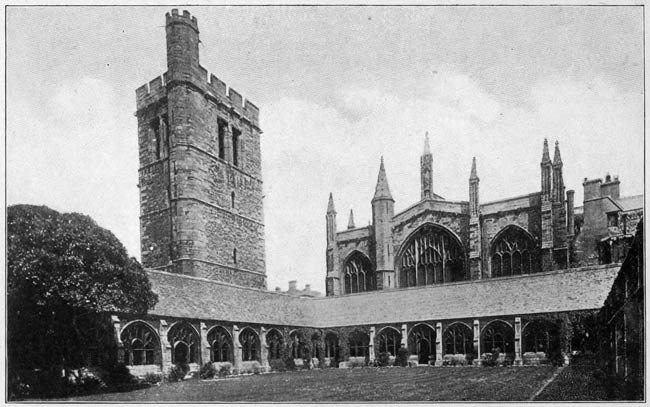
NEW COLLEGE CLOISTERS, BELL TOWER, AND CHAPEL
It was at first no part of the duty of the elders (socii, or, as Chaucer calls them, felawes) to teach the younger. The scholars of the college received the regular mediæval education in the university. But even in Merton the germ of tutorial instruction was present. Twelve "parvuli" who were not old enough, or sufficiently used to the Latin tongue, to profit by the lectures and disputations of the university, lived in or near the colleges and were taught by a grammar master; and it appears that even the older scholars might, "without blushing," consult this grammar master on matters that "pertained to his faculty." In his relation to these older students the grammar master may be regarded as the precursor of the system of tutorial instruction.
The first college to develop regular undergraduate instruction within its walls was "S. Marie College of Winchester in Oxford," founded in 1379, by William of Wykeham. "S. Marie's" brought in so many innovations that it came to be called "New College," a title which, incongruously enough, it has retained for more than five hundred years. Wykeham's first innovation was to place the grammar master, for the greater good of his pupils, at the head of a "college" of seventy boys at Winchester, thus outlining the English system of public schools. New College was accordingly able to exclude all who had not attained the ripe age of fifteen. The effect of this innovation on the college was peculiar. When the boys came up from Winchester, they appear to have been farther advanced than most of the undergraduates attending lectures and disputes in the university schools; in any case, Wykeham arranged that the older fellows should supplement the university teaching by private tuition within the college. Little by little the New College type succeeded that of Merton. Magdalen College, founded in 1448, carried the tutorial system to its logical end by endowing lectureships in theology, metaphysics, and natural philosophy. The older colleges—those of the Merton type—little by little followed this new example, so that by the end of the Middle Ages it was possible for a student to receive his entire instruction within the walls of his college. In Wolsey's splendid foundation, Cardinal College (1522), now styled Christ Church, there was a still more ample endowment for professorships. At first the college instruction was regarded as supplementary to the university teaching, though it soon became far more important. The masters of the university continued to read lectures on the recognized subjects, living as of old on fees from those who chose to listen; but they were clearly unable to compete with the endowed tutors and professors of the colleges. By the beginning of the fifteenth century, the mediæval teaching master was disappearing. The only real teaching in arts—by all odds the most popular branch of study at Oxford—was given within the colleges and halls.
The discipline of the earlier colleges was much severer than that of to-day, but the difference is one of degree rather than of kind. The lectures in schools began at six, instead of nine; and at any hour it was forbidden to leave the college except on a studious errand. When attending out-of-college lectures, all scholars were required to go and come in a body; and in one set of statutes even a chaplain was forbidden to leave the gates, except to go to lectures or to the library, without taking at least one companion, who, in the antique phrase of the statute, was to be a "witness of his honest conversation." There were only two meals a day, dinner at ten and supper at five. Breakfast, now the great rallying-point of Oxford hospitality, was the invention of a more luxurious age. Of athletics there was none, or next to none. The only licensed hilarities were certain so-called "honest jokes," with which the tutors were in at least one case required to regale their pupils after dinner, and a "potation" which was permitted after supper, perhaps as an offset to the "honest jokes."
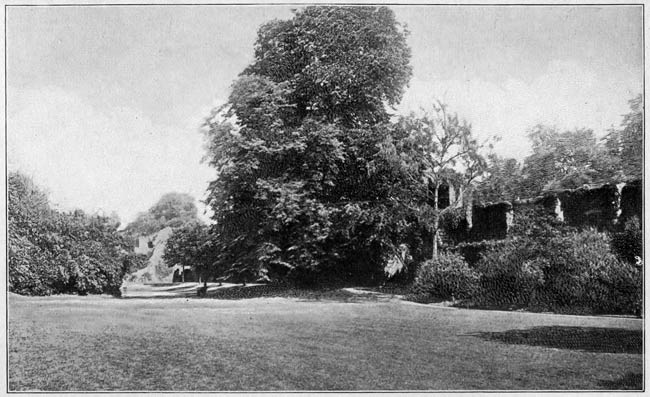
NEW COLLEGE GARDENS Showing the mediæval wall of Oxford
The severity of these regulations is mainly explainable in the fact that the inmates of the colleges were fed, clothed, and housed out of the endowment, and might thus be reasonably expected to give a good account of themselves. Furthermore, they were most of them mere boys. A statute dating as late as 1527 requires that "scholars" shall be at least twelve years old. At fourteen or fifteen a scholar might become a fellow. The average age of "determining" as bachelor of arts was little if at all over seventeen. At nineteen, the age at which the modern Oxonian comes up from the public schools, the mediæval student might, if he were clever, be a master of arts, lecturing and disputing in schools for the benefit of the bachelors and scholars of the university.
The modern Oxonian delights to tell visiting friends that he is forbidden by statute to play marbles on the steps of the Bodleian, and to roll hoop in the High; but if a mediæval master of arts were to "come up" to-day, he would be amused, not that so many rules framed for his boyish pupils of old should be applied to grown men, but that the men so obviously require a check to juvenile exuberance. Yet this much has been gained, that the outgrown restrictions of college life have kept Oxford wholesomely young. The survivals of the monastic system meanwhile have kept it wholesomely democratic.
After the colleges reached their full development, the extinction of the mediæval university as an institution for teaching was largely a matter of form. The quietus was given in 1569. The Earl of Leicester, then chancellor, ordered that the government should be in the hands of the chancellor, doctors, proctors, and the heads of the colleges and halls. In 1636 (the year of the founding of the first American college) the statutes of the university were revised and codified by Archbishop Laud; the sole authority was placed in the hands of an oligarchy composed of the leading dons of the colleges. The government was limited to the vice-chancellor, the proctors, and the heads of houses, and the vice-chancellor and the proctors were elected in sequence by each of the colleges from its own members. The teaching of the university was now legally as well as actually in the hands of the college tutors, and the examination was in the hands of a board chosen by the colleges. University lectures were still delivered in the schools by the regent masters, but they had ceased to play any important part in Oxford education.
IV
THE GOLDEN AGE OF THE MEDIÆVAL HALL
Like the colleges, the halls meanwhile tended gradually towards an organized community life. The starting-point was a regulation that the principal should give the university security for the rent of the house. The logical result of this was that the principal became the representative of the university, and the hall one of its recognized institutions. The advantage of living in separate communities meantime had become so clearly evident that by the middle of the fifteenth century chamberdekyns were abolished. All students not living in a college were required to live in a hall. It was thus that the halls lost some of their democratic independence. At this period in their development they may be roughly compared to such modern American halls as Claverly at Harvard, where the residents govern their own affairs in the main, admitting newcomers only by vote, but are all alike subject to the authority of a resident university proctor. The analogy is by no means close, for the principal of the mediæval hall was not so much a resident policeman as the actual head of the community.
As the colleges developed tutorial instruction, the halls followed suit; the local administrator became responsible not only for the social régime, but for the tuition of the undergraduates. The halls thus differed from the college mainly in that they had no corporate existence such as is necessary to an endowed institution. The mediæval hall was now in its golden age; it was a well-conceived instrument for all the purposes of residence and of education. It is especially to be noted that the régime of the community was still in the main democratic. Though the head was appointed by the university, he had to be accepted by vote of the undergraduates, a provision that was still observed, at least in one instance, until the close of the nineteenth century.
The discipline of the halls of the fifteenth century, severe though it was by comparison with that of the earliest halls, was far less severe than the discipline in the colleges. It was quite as much as the university could accomplish, according to Rashdall, "to prevent students expelled from one hall being welcomed at another, to prevent the masters themselves condoning or sharing the worst excesses of their pupils, to compel fairly regular attendance at lectures and other university or college exercises, to require all students to return home by curfew at 8 or 9 p.m., to get the outer doors of the pedagogy locked till morning, and to insist on the presence of a regent throughout the night." When the early habits of the community generally are remembered, it will be evident that these regulations still allowed a vast deal of liberty, or rather of license. Boys of fifteen or sixteen living in the very centre of large and densely populated towns were in general perfectly free to roam about the streets up to the hour at which all respectable citizens were accustomed, if not actually compelled by town statutes, to retire to bed.
The halls were reduced in number by the wars of the Roses and by a period of intellectual stagnation that followed, but they still numbered seventy-one, as against eighteen colleges (including those maintained by monasteries, which disappeared with the Reformation); and the number of their students is estimated at seven hundred, as against three hundred in the colleges. In the light of subsequent development it seems probable that it would have been far better for the university if the halls had remained the characteristic subdivision. Their fate was decided not by any inherent superiority on the part of the colleges, but by the force of corporate wealth.
Even in the fifteenth century, the halls were tending to pass into the possession of the colleges, and later events made the tendency a fact. "As stars lose their light when the sun ariseth," says an ancient Cambridge worthy, "so all these hostels decayed by degrees when endowed colleges began to appear." The Reformation, and a recurrent pestilence, "the sweating sickness," a kind of inflammatory rheumatism due apparently to the unwholesome situation of the university, resulted in a sharp falling off in the number of students. The colleges lived on, however thinned their ranks, by virtue of the endowments; but the halls disappeared with the students who had frequented them. In 1526 it was recorded that sixteen had lately been abandoned. When the numbers of the university swelled again under Elizabeth, the increase found place partly in the few halls that were left, but mainly in the colleges. In 1602 there were only eight halls, and these were all mere dependencies of separate colleges. "Singulæ singulis a colegiis pendent," as a contemporary expresses it. Only one of these, St. Edmund Hall, now retains even a show of the old democratic independence, and this has lately been brought into closer subjection to Queen's College. Socially as well as educationally, the mediæval university faded before the organization and endowment of the colleges. The life of Oxford was concentrated in a dozen or more separate institutions, and so thoroughly concentrated that there was little association, intellectual or social, between any two of them.