Volume 1 — CHAPTER XXXII
Reading edition
Two men killed; consequent regulations The Britannia hired to proceed to England Report of the natives The Francis arrives from Norfolk Island Public works Deaths A criminal court assembled A settler executed for murder The Susan sails A civil court held An American ship arrives from Boston A long-boat lost Deaths Weather A temporary church opened at Parramatta Appointments The Supply sails for Norfolk Island and the Cape Account of stock Land in cultivation, and numbers in the colony A murder committed Britannia sails for England General observations
July.] Among the many evils that were daily seen flowing from that state of dissipation which had found its way into the different settlements, we had to regret that two men lost their lives by the hand of violence. On Tuesday the 4th of this month, John Smith, a seaman belonging to the Indispensable, was shot at Sydney in the house of Mr. Daniel Payne, the master boat-builder, by a convict-servant of his; and on the same day, at the Hawkesbury, David Lane was shot by his master, John Fenlow, a settler at that place. The latter of these unfortunate men lived but a few hours; Smith the seaman was taken to the hospital, where he languished until the 9th, and then died. Fenlow and the convict were taken into custody, and would have been immediately brought to trial; but, through the carelessness of one of the watchmen, Fenlow found means, though incumbered with heavy irons, to escape from the cells, and was not retaken until the latter end of the month, when some natives discovered him lurking near his own grounds at the river, and, giving information, he was easily apprehended and secured.
These transactions were productive of some internal regulations which had long been wanting. Several settlers, with whose conduct the governor had had but too much cause to be displeased, were at length deprived of all assistance from government, and left to the exercise of their own abilities, pursuant to a notice which they received to that effect in the last month. Several other settlers also, who had been victualled from the public stores long beyond the period allowed them by the crown, were struck off from the victualling books. All persons off the stores, who of course did not labour for government, were ordered forthwith to appear at Sydney, in order to their being mustered and examined relative to their respective terms of transportation; when certificates were to be given to such as were regularly discharged from the commissary's books, and the settlers were directed not to employ any but such as could produce this certificate. Frequent visits were directed to be made by the magistrates, for the purpose of settling such differences as might arise among the settlers and other persons; and the governor signified his determination of inspecting their conduct himself from time to time, and of punishing such as were proved to afford shelter or employment to the thieves and vagabonds who ran to the river and other districts from this town and Parramatta.
These regulations being made known as publicly and generally as was possible, in order that none might plead ignorance, the town of Sydney was shortly filled with people from the different settlements, who came to the judge-advocate for certificates of their having served their respective sentences. Among these were many who had run away from public labour before their time had expired; some who had escaped from confinement with crimes yet unpunished hanging over their heads; and some who, being for life, appeared by names different from those by which they were commonly known in the settlement. By the activity of the watchmen, and a minute investigation of the necessary books and papers, they were in general detected in the imposition, and were immediately sent to hard labour in the town and jail gangs.
To the latter of these gangs additions were every day making; scarcely a day or a night passed but some enormity was committed or attempted either on the property or persons of individuals. Two notorious characters, Luke Normington and Richard Elliott, were detected on the night of the 13th in a very suspicious situation in the commissary's stock-yard, which was well filled at the time with sheep and other stock. These were sent to the jail-gang, in company with one Sharpless, a convict, who, after marrying a woman that was a perfect antidote to desire, pretended to be jealous, and gave her such a dreadful beating, that her life was for some time in danger.
Stock of all denominations was at this time fast increasing in the different districts. An officer of the New South Wales corps, having obtained the governor's sanction for his quitting the colony in one of the ships now preparing for the Cape of Good Hope, sold to government a flock of goats, consisting of about one hundred animals, for £490 10s. This was a valuable acquisition, and promises of stock to several deserving settlers were now performed.
The Britannia, being now cleared of the cargo she brought from Bengal on government account, was fitting again for sea, when Mr. Raven, the master, proffered her to the governor for the purpose of going direct to England, if his excellency should have any occasion to employ her in such a voyage. There were at this time several soldiers in the New South Wales corps wholly unfit for service; the governor had for some time intended to send home Mr. Clark, a superintendant of convicts, whose engagement with the crown had expired; and James Thorp, a person who had been sent out with a salary of £105 per annum. as a master millwright, but who was at this time unemployed in the settlement. To ease government at once of these expences, the governor thought it adviseable to charter the Britannia, for the purpose of taking home such invalids and passengers as might be ordered, at the rate of fifteen shillings per ton per month; the charter to be in force on the first day of the ensuing month.
The public stores were opened during this month at Parramatta and the river for receiving Indian corn; which was taken in at five shillings per bushel for this season; but it was generally supposed, that there would not be occasion to give that price for it again.
Fresh pork was at this time purchased by the commissary at one shilling per pound, and issued as a ration, in the proportion of two pounds of fresh for one of salt meat.
It having been represented to the governor, that several people in the town of Sydney employed themselves in building boats for sale, and without obtaining any permission, a liberty which had crept into the settlement in opposition to all former orders and regulations on that head; and as it was well known that, notwithstanding the great convenience which must attend the having boats for various uses in this extensive harbour, many abuses were carried on through their means; it was ordered, that no boat whatever, of any size or description, should be built until applicationhad been made to the governor, and permission in writing obtained, either signed by the governor for the time being, or by some person properly authorised by him. It was also ordered, that all boats at that time in the possession of individuals should be forthwith taken to the master boat-builder, where a number was to be cut on the stern, and a register of such number was to be kept by the provost-marshal. All boats found without a number were to be liable to seizure.
The natives appeared less troublesome lately than they had been for some time past. The people of a fishing-boat, which had been cast on shore in some bad weather near Port Stephens, met with some of these people, who without much entreaty, or any hope of reward, readily put them into a path from thence to Broken Bay, and conducted them the greatest part of the way. During their little journey, these friendly people made them understand, that they had seen a white woman among some natives to the northward. On their reporting this at Sydney, this unfortunate female was conjectured to be Mary Morgan, a prisoner, who it was now said had failed in her attempt to get on board the Resolution store-ship, which sailed from hence in 1794. There was indeed a woman, one Ann Smith, who ran away a few days after our sitting down in this place, and whose fate was not exactly ascertaineds; if she could have survived the hardships and wretchedness of such a life as must have been hers during so many years residence among the natives of New Holland, how much information must it have been in her power to afford! But humanity shuddered at the idea of purchasing it at so dear a price.
Toward the latter end of the month, there not remaining any more flour in the store than what was necessarily reserved for the use of his Majesty's ships Reliance and Supply to carry them to the Cape of Good Hope, nine pounds of wheat were added to the allowance of that article (three pounds) served to the civil, military, and free people.
A court of civil judicature was held on the 27th and 28th, when several debts were sworn to, and writs taken out.
In the night of the 29th, the Francis schooner returned from Norfolk Island, having been absent five weeks and three days. From her we learned, that the criminal court of judicature had been assembled, and one man, a convict, had suffered death, being convicted of a most daring burglary, which he and two others his accomplices effected with some circumstances of cruelty. The accomplices were sentenced to hard labour on Phillip Island for a certain term of years.
It was observed that the gangs at this place employed in different public works were seldom to be seen in the afternoon. On inquiry, it appeared that, notwithstanding the orders which had been given for the regulation of the public labour, the superintendants had taken it upon themselves to task the working people in such manner as they thought proper, and upon no other authority than their own will. By this abuse the work of government was almost wholly neglected, and the time of the labourers applied to the use of private individuals.
To remedy this evil, the governor repeated the order in which the hours of public labour were pointed out, and informed the superintendants and overseers, that if they should be known to take the liberty of applying to any other use or purpose the time designed to be employed for the public, they would be instantly dismissed from their employments, as persons who could not be depended upon; and they might rest assured, that any one, who had been proved unworthy the trust he had placed in him, would never be restored to a situation of which he was so little tenacious.
During this month died Mr. Henry Brewer, the provost-marshal of the territory, at the age of fifty-seven years. He came out with Governor Phillip as his clerk, and on our landing was appointed to act as provost-marshal in the room of the person appointed by the crown, Mr. Alexander, who never came out. Mr. Brewer afterwards received his Majesty's commission appointing him to the vacancy. There also died Andrew Fishburn, a private in the New South Wales corps, but formerly belonging to the marine detachment serving in this country, who had been very useful as a carpenter in the settlement; a soldier, who came out in the Cornwallis; one male convict, who died suddenly; one unfortunate man, John Williams, who was crushed to death by the wheel of a timber-carriage going over his head; and the settler's servant who was killed at the Hawkesbury; beside the seaman belonging to the Indispensable who was shot.
August.] A court of criminal judicature was assembled early in the month for the trial of several offenders who were at that time in confinement under different charges.
Four prisoners were tried for a burglary in the house of William Miller, but acquitted through a defect in evidence. David Lloyd was tried for the wilful murder of John Smith, the seaman belonging to the ship Indispensable. It appeared, that the seaman had repaired in a state of intoxication to the house of Mr. Payne, for the express purpose of taking from a female convict, (then living as a servant at Mr. Payne's, and with whom he, the seaman, had cohabited during the passage) some clothes which he had given her. A riot, the natural consequence of such a proceeding, ensued; and the prisoner endeavoured to make it appear that he had been compelled in his own defence to fire the pistol which caused the death of the seaman. The court admitted that the prisoner had not any of that malice in his heart against the deceased which is necessary to constitute the crime of murder, and therefore acquitted him of that charge; but found him guilty of manslaughter, and sentenced him to receive six hundred lashes. John Fenlow was tried for the wilful murder of his servant, David Lane. This charge was fully made out, and the prisoner received sentence to die. Matthew Farrel, who (with Richard Sutton, the Newgate Bully) assaulted the watch on the night of the 17th of March last, having in the course of that contest received a wound on the temple which proved incurable, and occasioned his death some time after, the watchmen were now brought forward to account for the death of the deceased. This they did very satisfactorily, and were discharged. Four vagabonds, who had repeatedly broken out of prison, and run away from the jall-gang, were tried as incorrigible rogues, and being found guilty, were sentenced to three years hard labour at Norfolk Island; and one man was tried for a rape, but acquitted. Fenlow, being tried on the Saturday, was executed on the following Monday. His body being delivered to the surgeons for dissection pursuant to his sentence, a stone was found in his gall bladder, of the size of a lark's egg. This unhappy man was remarkable for an extreme irascibility of temper: might it not have been occasioned by the torment that such a substance must produce in so irritable a situation? He however, the night before his execution, confessed that the murder which he committed was premeditated. Notwithstanding which, he had, the day before he was tried, prepared an opening through the brick wall of his cell, purposing, if it had not been discovered in time, to have availed himself of it to escape after his trial. It could scarcely be supposed, that among the description of people of which the lower class was formed in this place, any would have been found sufficiently curious to have attended the surgeons on such an occasion; but they had no sooner signified that the body was ready for inspection, than the hospital was filled with people, men, women, and children, to the number of several hundreds; none of whom appeared moved with pity for his fate, or in the least degree admonished by the sad spectacle before their eyes.
On Monday the 8th the snow Susan sailed on her voyage to Canton. Two women, Sarah Nitchell and Elizabeth Robinson, and a few men, were allowed to quit the colony in this vessel.
His Royal Highness the Prince of Wales's birthday was duly distinguished by us on the 12th of this month. Such days had never been neglected by the colonists of New South Wales.
A civil court was again held on the day following, when several persons who had been arrested by writs issued from the last court were brought up; many of whom, being settlers, gave assignments on their coming crops of wheat for the different sums in which they were indebted. Several other debts were sworn to, and writs issued. Had those defendants who were thus suffered to give assignments on their crops then in the ground been thrown into prison at the suit of the different plaintiffs, their ruin would have been certain, and the debt would have remained unsatisfied. This method was tried, as being something more beneficial to both parties; but they were in general of such a thoughtless worthless description, that even this indulgence might induce them to be, if possible, more worthless and thoughtless than before, as, to use their own expression, they had now 'to work for a dead horse.'
On the 23rd (the signal for a sail having been made at the South Head, the day before), there anchored in the stream, just without the two points of Sydney Cove, the ship Grand Turk, from Boston, after a passage of five months from that port. She had been twenty-three days from Van Dieman's Land, meeting with a current, during several days, that set her each day twenty-one miles either to the SE or NE. We found on board as supercargo, Mr. McGee, who was here before in the Halcyon with Mr. Benjamin Page. He brought news from Europe as late as January last, by which we learned that the war still raged. Mr. McGee had on board for sale, spirits, tobacco, wine, soap, iron, linseed oil, broadcloth, etc., etc., for this market, Manilla, and Canton. The tobacco (eighteen hogsheads) were immediately bought for one shilling and three half-pence per pound, and government purchased some of his spirits at seven shillings per gallon.
During this month a long-boat belonging to his Majesty's ship Reliance, which had been sent to Botany Bay in July to procure fish, was given up for lost, with five or six seamen. They were known to have quitted Botany Bay, and, not having been heard of for some weeks, were conjectured to have taken the boat away to the northward, where, being without compass or provisions, except the few fish they had caught, it was more than probable they had perished.
The jail-gang at this time, notwithstanding the examples which had been made, consisted of upwards of twenty-five persons; and many of the female prisoners were found to be every whit as infamous as the men.
One settler was executed this month, and one soldier lost his life by a tree falling on him at the Hawkesbury.
The first and middle parts of the month were wet. The branch of the harbour named Duck River was so swollen as to overflow its banks, which were very steep.
September.] A temporary church, formed out of the materials of two old huts, was opened at Parramatta by the Rev. Mr. Marsden on the first Sunday in this month. Decent places of worship were now to be seen at the two principal settlements. At the time when we were visited by the Spanish ships Mr. Johnson preached wherever he could find a shady spot. The priest belonging to the commodore's ship, observing that we had not any church built, lifted up his eyes with astonishment, and declared, that had the place been settled by his nation, a house for God would have been erected before any house for man.
The ships being now on the point of sailing, the Britannia for England, and the Relianc and Supply for the Cape of Good Hope, the following appointments were notified in the public orders: viz Captain George Johnston, of the New South Wales corps, was appointed aid-de-camp to the governor. The Rev. Mr. Johnson and William Balmain Esq were nominated the acting magistrates in the district of the town of Sydney. Mr. James Williamson (a gentleman who came from England with the governor) was to do the duty of commissary in the absence of Mr. Palmer, who was returning to England on leave. Mr. Thomas Smyth was appointed provost-marshal, in the room of Mr. Henry Brewer, by warrant bearing date the day after his decease. Mr. Thomas Moore, carpenter of the ship Britannia, was appointed master boat-builder in the room of Mr. Daniel Payne. William Stephenson was placed under the commissary as a store-keeper, in the room of Mr. Thomas Smyth; and George Barrington, whose conduct, still uniform and upright, recommended him to the notice of the governor, was, after receiving an absolute pardon under the seal of the territory, appointed a superintendant of convicts, with a salary of fifty pounds per annum, in the room of Mr. Thomas Clark, returning to England.*
[* Mr. Richard Atkins had some time before been nominated by the secretary of state to do the duty of judge-advocate, whenever Captain Collins should return to England.]
On the 20th, his Majesty's ship Supply sailed for Norfolk Island and the Cape of Good Hope, having on board part of the military relief intended for that settlement, and part of a thousand bushels of wheat which had been written for from thence.
On the following day the ships Indispensable and Grand Turk sailed for Canton. The American had not succeeded in his speculation so well as he had expected; the market was over-stocked with goods, and by the governor's regulations he was compelled to take away, with many other articles, his ground-tier full of spirits, which he hoped to have sold here.
The invalids and passengers who were returning to England in the Britannia being embarked, that ship, the Reliance, and the Francis schooner, hauled out of the cove preparatory to their departure.
As a proof that stock was not falling in its value, Mr. Palmer, the commissary, sold two Cape cows and one steer for £189 sterling. The stock in the colony at this time was of considerable extent and value, as will appear by the following account of it, which was taken for the purpose of being transmitted to government:
ACCOUNT OF LIVE STOCK IN THE POSSESSION OF GOVERNMENT AND THE CIVIL AND MILITARY OFFICERS OF THE SETTLEMENT, ON THE 1ST OF SEPTEMBER 1796 ----------------------------------------------------------------------- To whom Mares Cows Bulls Oxen Sheep Goats Hogs belonging and and and Horses Cow-calves Bull-calves ----------------------------------------------------------------------- To government 14 67 37 46 191 111 59 Officers civil and military 43 34 37 6 1310 1176 889 ----------------------------------------------------------------------- Total of government and officers 57 101 74 52 1501 1287 948 To settlers - - - - 30 140 921 ----------------------------------------------------------------------- General total 57 101 74 52 1531 1427 1869 -----------------------------------------------------------------------
The wild cattle to the westward of the river Nepean were not included in this account.
All kinds of poultry were numerous.
The following account of the land in cultivation was taken at the same time: ----------------------------------------------------------------------- To whom belonging Land in Observations Cultivation (Acres) ----------------------------------------------------------------------- To government 1700 (By our weakness in public labourers, (and wanting many necessary buildings, (the land cleared by government was (unemployed this year. Officers civil and military 1172 (About four fifths of which were at (this time sown with wheat. Total of government and officers 2872 To settlers 2547 {Of which much timber was cut down {but not burnt off. General total 5419
It was satisfactory to those gentlemen who were now about to quit the colony to reflect that they left it not only with a prospect of plenty before it, but with stores and granaries abundantly filled at the time. Of these, the judge-advocate and the commissary, who had been in the settlement from its establishment, had witnessed periods of distress and difficulty; but they had the gratification of seeing them fairly surmounted, and the probability of their ever recurring thrown to a very great distance. In the houses of individuals were to be found most of the comforts, and not a few of the luxuries of life. For these the island was indebted to the communications it had had with India, and other parts of the world; and the former years of famine, toil, and difficulty, were now exchanged for years of plenty, ease, and pleasure.
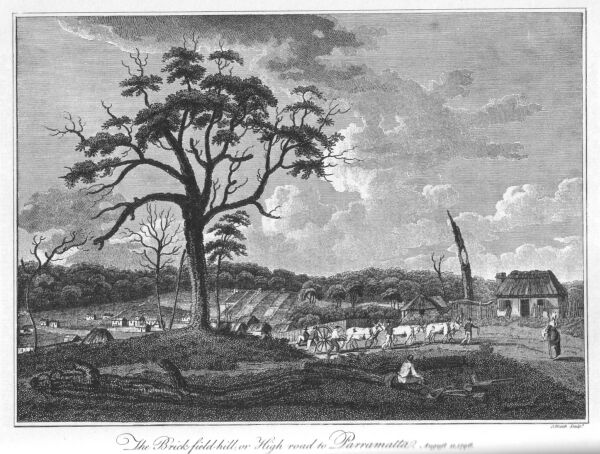
The Brick Field, or High Road to Parramatta.
The following state of the settlement was made up to the 31st of last month:
SALT PROVISIONS AND GRAIN IN STORE. Quality To last at the established ration Weeks Days Beef 31 1 Pork 44 6 Total of salt meat 76 0 (75 weeks + 7 days) Peas 22 - Wheat 29 1 Maize 41 4 Sugar 4 - To consume this quantity of food, there were victualled at Sydney 2219 persons At Parramatta 965 At the Hawkesbury 454 Making a total of 3638
There were 321 people off the public stores, which, added to the 3638 who were victualled, gave a general total of 3959 persons in the different settlements, of all descriptions and ages; not including those at Norfolk Island, in which settlement were 119 persons; to which add 3959 persons in New South Wales; there will be found 4848 persons under the British government in New South Wales and its dependencies.
A few days previous to the sailing of the ships, information was received of a most inhuman murder having been perpetrated on the body of ---- Williams, a settler's wife, at the district of the Ponds. A female neighbour of their's was accused by an accomplice of having committed this diabolical act, for the purpose of enriching herself with the property which she knew this unfortunate woman had in the house. She was immediately apprehended, and search made for the property which had been taken away. Some of this was found, and there was little doubt but the avenging arm of Justice would soon fall upon the head of the murderer.
On the 29th his Majesty's ship Reliance, the Britannia hired transport, and the Francis schooner, sailed from Port Jackson. They were all to touch at Norfolk Island, whence the ships were to proceed to the Cape of Good Hope, and the schooner was to return to New South Wales. The Britannia's call at Norfolk Island was for the purpose of taking on board lieutenant-governor King, who, from a long state of ill health, had found himself compelled to apply to Governor Hunter for leave to return to England, to which the governor had consented.
On board of the Reliance were the commissary, the remainder of the military relief, and such part of the thousand bushels of wheat as the Supply did not receive. In the transport were Captain Paterson; Lieutenants Abbott and Clephan; one sergeant and seventeen privates (invalids) of the New South Wales corps, with their wives and children; the judge-advocate of the settlement, who was charged with dispatches from the governor; Mr. Leeds, an assistant-surgeon; Thomas Clark, late a superintendant of convicts; James Thorp, the master millwright; and several other persons, male and female, who had been allowed a passage to England by the governor.
The following were the prices of various articles, as they were sold at Sydney about the time the ships sailed, viz
Stock Groceries ----- --------- Cows £80 Hyson tea per lb £1 4s Horses £90 Coffee, ditto, 2s Sheep £7 10s Sugar (soft), ditto, 1s Goats £4 Soap, ditto, 2s Turkeys £1 1s Virginia leaf-tobacco, ditto, 5s Geese £1 1s Brazil roll, ditto, 7s Fowls, full grown, 5s Black pepper, ditto, 4s Ducks 5s Ginger, ditto, 3s Fresh pork per lb 1s 3d Pipes per gross £1 10s Mutton 2s WINE AND SPIRITS Goat per lb 1s 6d Red port per bottle 5s Kangaroo 6d Madeira, per bottle, 4s Barley, per bushel, 10s Cape wine, ditto, 3s Peas, ditto, 7s Rum, ditto, 5s Maize, ditto, 5s Gin, ditto, 6s Ditto ground, ditto, 5s Porter, ditto, 2s Cheese per lb 3s Beer made at Sydney 1s 6d Butter, ditto, 3s INDIA GOODS White-wine vinegar per gallon 6s Long cloth per yard from 3s to 6s Fish 2½d Callicoes, ditto, from 1s 6d to 2s 6d Eggs per dozen 2s Muslins, ditto, from 7s to 12s Salted pork per lb 1s Nankeen per piece 10s Salted beef, ditto, 8d Coarse printed callicoes, ditto, £1 5s Potatoes per cwt 12s Silk handkerchiefs, ditto, 12s Ditto per lb 3d ENGLISH GOODS Flour, ditto, 7½d Black hats from 15s to £2 Wheat-meal, sifted, 4½d Shoes per pair from 9s to 13s Ditto, unsifted, 3½d Cotton Stockings from 6s to 12s Wheat per bushel 12s Writing paper per quire 6s
The beer mentioned in the preceding account as being made at Sydney was brewed from Indian corn, properly malted, and bittered with the leaves and stalks of the love-apple, (Lycopersicum, a species of Solarium) or, as it was more commonly called in the settlement, the Cape gooseberry. Mr. Boston found this succeeded so well, that he erected at some expense a building proper for the business, and was, when the ships sailed, engaged in brewing beer from the abovementioned materials, and in making soap.
At this time the following prices were demanded and paid for labour and work done at Sydney and the different settlements, viz. £. s. d.
A carpenter for a day's work 0 5 0 A labourer for a day's work 0 3 0 For clearing an acre of ground 3 0 0 For breaking up an acre of ground 1 0 0 For threshing a bushel of wheat 0 1 6 For reaping an acre of wheat 0 10 0 For felling an acre of timber 0 17 0 The price of ground was from 12s to £1 an acre For making a pair of men's shoes 0 3 6 For making a pair of women's shoes 0 3 0 For making a coat 0 6 0 For making a gown 0 5 0
For washing, three-pence for each article was paid; and the person who washed found soap, etc. If a woman was hired, she had one shilling and six-pence for the day, and her meals.
It must here be remarked, that the mechanic and the labourer were generally contented to be paid the above prices in such articles as they or their families stood in need of, the values of which had not as yet been regulated by any other authority, or guided by any other rule, than the will of the purchaser.
The want at this time of several public buildings in the settlement has already been mentioned. To this want must be added, as absolutely necessary to the well-being and comfort of the settlers and the prosperity of the colony in general, that of a public store, to be opened on a plan, though not exactly the same, yet as liberal as that of the island of St Helena, where the East India Company issue to their own servants European and Indian goods, at ten per cent advance on the prime cost. Considering our immense distance from England, a greater advance would be necessary; and the settlers and others would be well satisfied, and think it equally liberal, to pay fifty per cent on the prime cost of all goods brought from England; for at present they pay never less than one hundred, and frequently one thousand per cent on what they have occasion to purchase. It may be supposed that government would not choose to open an account, and be concerned in the retail of goods; but any individual would find it to his interest to do this, particularly if assisted by government in the freight; and the inhabitants would gladly prefer the manufactures of their own country to the sweepings of the Indian bazars.
The great want of men in the colony must be supplied as soon as a peace shall take place; but the want of respectable settlers may, perhaps, be longer felt; by these are meant men of property, with whom the gentlemen of the colony could associate, and who should be thoroughly experienced in the business of agriculture. Should such men ever arrive, the administration of justice might assume a less military appearance, and the trial by jury, ever dear and most congenial to Englishmen, be seen in New South Wales.
That we had not a thorough knowledge of the coast from Van Dieman's Land as far as Botany Bay, though to be regretted, was not to be wondered at. As a survey of the coast cannot very conveniently be made by any of the ships belonging to the settlement, it must be the business of government to provide proper vessels and persons for this service; and it is to be hoped that we shall not be much longer without a knowledge of the various ports, harbours, and rivers, and of the soil and productions of the country to the southward of the principal settlement.
The Account of the English Colony of New South Wales must here be closed for a time, the writer being embarked in the Britannia on his return to England. On reviewing the pages he has written, the question involuntarily arises in his mind, In what other colony under the British government has a narrator of its annals had such circumstances to record? No other colony was ever established under such circumstances. He has, it is true, occasionally had the gratification of recording the return of principle in some, whose want of that ingredient, so necessary to society, had sent them thither; but it has oftener been his task to show the predilection for immorality, perseverance in dissipation, and inveterate propensity to vice, which prevailed in many others. The difficulty under such disadvantages of establishing the blessings of a regular and civil government must have occurred to every well-informed mind that has reflected on our situation. The duties of a governor, of a judge-advocate, and of other magistrates and civil officers, could not be compared with those in other countries. From the disposition to crimes and the incorrigible characters of the major part of the colonists, an odium was, from the first, illiberally thrown upon the settlement; and the word 'Botany Bay' became a term of reproach that was indiscriminately cast on every one who resided in New South Wales. But let the reproach light on those who have used it as such. These pages were written to demonstrate, that the bread of government has not been eaten in idleness by its different officers; and that if the honour of having deserved well of one's country be attainable by sacrificing good name, domestic comforts, and dearest connections in her service, the officers of this settlement have justly merited that distinction.
CONCLUSION:
COMPRISING
Particulars of the BRITANNIA'S VOYAGE to ENGLAND; with Remarks on the STATE of NORFOLK ISLAND, and some Account of NEW ZEALAND.
The Britannia sailed from Port Jackson, in company with his Majesty's ship Reliance and the Francis colonial schooner, on the 29th of September.
On the 4th of October, we had Ball Pyramid off Lord Howe's Island distant about five leagues, and were from that day until the 15th, owing to light and contrary winds, before we reached Norfolk Island; where we found his Majesty's ship Supply, which had been there several days. On the following morning we had communication with the shore.
The interval between the 16th and 23rd was occupied in receiving on board the Britannia Lieutenant-governor King and his family, who were returning to England. On the 25th the colonial schooner, which had attended for that purpose, received Captain King's letters to Governor Hunter, and the three ships made sail from the island.
During the time we were there, the weather fortunately proved extremely favourable for communicating with the shore, and large quantities of stock and grain were received on board, in addition to what we brought from Port Jackson, and sufficient for a much longer passage than we had any reason to expect in the run to the Cape of Good Hope.
With the following Particulars of the State of NORFOLK ISLAND to the time when the ships left it, the Writer has been favoured by LIEUTENANT-GOVERNOR KING.
COURT OF JUDICATURE
A court of criminal judicature existed there similar to that in New South Wales, differing only in being composed of five instead of seven members. No civil court, however, had been established.
NUMBER OF INHABITANTS
The civil department consisted of a lieutenant-governor, a deputy judge-advocate, a deputy provost-marshal, and deputy commissary; a surgeon, a store-keeper, and four subordinate officers.
The military consisted of a company of the New South Wales corps.
The settlers were, four seamen who belonged to his Majesty's ship Sirius; fifteen marines who were discharged at the relief of that detachment; fifty-two settlers from among those whose respective terms of transportation had expired; three officers, and others who held ground by grant or lease, or had purchased allotments from settlers; fourteen from those whose terms of transportation were unexpired, but who held allotments exceeding five acres. The whole number (exclusive of the officers), with their families, was about two hundred and forty.
One hundred and forty-nine men, and sixty-three women, whose terms of sentence had expired, supported themselves by hiring ground from settlers, working for individuals, or at their different callings, (some few were employed as overseers) and labouring for the public; for which they were clothed and fed from the stores, and received such other encouragement as their behaviour merited. The number of this class, with their women and children, was about one hundred and thirty.
MALE CONVICTS
The numbers of these who remained under the sentence of the law were as follow:
For life 36 From 10 to 5 years 10 From 5 to 3 4 From 3 to 1 26 From 1 year to 6 months 60 --- Total 136
of which number fifty-seven were assigned to settlers and others, on condition of being maintained by them; the rest were occupied as hereafter stated; from which it will be obvious, that no progress in cultivation for the crown could be made, as not more than thirty men were employed in cultivating ground for the public advantage, and even these were much interrupted by incidental work, and by attending the artificers in carrying on the different buildings which were indispensable.
STATE OF CULTIVATION
The island contains about eleven thousand acres of ground. In the level parts where the earth cannot be washed away by the heavy rains, the soil varies from a rich brown mould to a light red earth, without any intermixture of sand. These are again varied by some extensive pieces of light black mould and fine gravel, which are found to produce the best wheat. The rains which fall during the winter months wash the mould from the sides of the steep hills into the bottoms, leaving a grey marly substance, which will not admit of cultivation in that state. This, however, is the case only among the very steep hills that are cleared of timber, and have been four or five years in cultivation. Those of an easy ascent preserve their depth of soil, and many of them have borne six successive crops of wheat. From the quantity of soil thus washed away from the sides of the steep hills into the bottom (some of which were only a water-way between the hills), there were level spots of ground covered to a great depth with the richest mould. Of the eleven thousand acres of ground in this island, there are not two hundred that might not be cultivated to the greatest advantage, if cleared of timber, and allowed a sufficiency of labourers, of cattle, and of ploughs.
APPROPRIATION OF THE LAND
The ground cleared of timber for the public use, and that marked out for the settlers lots, comprised one half of the island, and was distributed in the following manner:
Acres Number cleared of of Acres Timber Ground allotted to settlers on grant or lease 3,239 920 Ground allotted to officers by grant, lease, or permission 132 132 Ground allotted to individuals of different descriptions 100 100 Ground reserved for government, and contiguous to the above allotments 1,400 - Ground cleared of timber, and occupied for the public benefit 376 376 ----- ----- Total quantity of ground occupied as above 5,247 1,528 Supposed contents of the island, about 11,000 Supposed quantity of ground unoccupied, about 5,753 Supposed quantity of ground not cleared of timber 9,472
Most of the ground cleared of timber was under cultivation in 1793 and 1794, and produced above thirty-four thousand bushels of grain; but, from the sudden and effectual check given to private industry during the year 1794, and the great proportion of the labourers working for their own support and other ways disposed of, not more than a third of the government-ground, and a fifth of the ground belonging to individuals, was in any state of cultivation during the last year. That portion of the ground thus neglected became over-run with rank and strong weeds, which formed a great cover to the numerous rats; beside that the injury done to the soil by the growth of these weeds was very much to be deplored. The humane attention, however, shown to the wants of the industrious individual by Governor Hunter, in directing the maize bills to be paid, it was hoped would not only relieve many deserving people, but also revive that industrious disposition which the settlers had in general manifested.
The small number of convicts at public work, and the labour necessary for preparing the ground to receive wheat, did not admit of more than one hundred acres of wheat, and eighteen of maize being sown last year for the crown; the produce of which had been abundant; but the quantity was much reduced by the weeds that grew with it, and from an attack by lightning when in blossom.
Cultivation was confined to maize, wheat, potatoes, and other garden-vegetables. The heat of the climate, occasional droughts, and blighting winds, rendered wheat an uncertain crop; nor could it be averaged at more than eighteen bushels an acre, though some had yielded twenty-five.
Owing to the quick and constant growth of rank weeds few individuals could sow more wheat than was necessary to mix with their maize, which hitherto had rarely exceeded five acres each family. Some few indeed among the settlers, who were remarkably industrious, or who had greater advantages than others, had generally from five to eleven acres in wheat; but the number of these was very small.
The harvests of maize were constant, certain, and plentiful; and two crops were generally procured in twelve months. The produce of one crop might be averaged at forty-five bushels per acre, and many had yielded from seventy to eighty.
By the statement before given it appears, that there were five thousand two hundred and forty-seven acres occupied; of which only one thousand five hundred and twenty-eight were cleared of timber: that there also remained five thousand seven hundred and fifty-three neither occupied nor cleared, making in the whole nine thousand four hundred and seventy-two acres not cleared of timber. If six thousand of the nine thousand four hundred and seventy-two acres not cleared could be put under cultivation in addition to the one thousand five hundred and twenty-eight already cleared of timber, its produce at one crop only, and allowing no more than thirty bushels of maize to the acre, would be two hundred and twenty-five thousand eight hundred and forty bushels of grain; and even this might be doubled, if, as before said, there were labourers to procure a second crop.
The remaining three thousand four hundred and seventy-two acres might be reserved for fuel, building-timber, and other purposes.
From these data some calculation may be made of the number of people that the island might be made to maintain.
The following is a statement of the stock belonging to government and individuals on the 18th October 1796:
To whom belonging Male---Female---Male and Female Cattle ------ Government 3 3 Individuals - - Horses ------ Government - - Individuals 1 2 Asses ----- Government 2 4 Individuals 0 0 Sheep ----- Government 22 Individuals 148 Goats ----- Government 55 Individuals 328 Swine ----- Government 710 Individuals 4125 Poultry very great abundance -------
Exclusive of the above stock, five hundred and ninety-two thousand four hundred and eighty pounds of swine's flesh and mutton had been expended on the island and exported from it; all which were produced from the following quantity received from November 1791 to October 1796.
Cattle Horses Asses Sheep Goats Swine (Male/Female) M F M F M F M F M F M F Total received 1 2 1 1 1 3 2 21 2 11 4 157
When the settlers were informed that payment for the maize lodged in the stores in January 1794 could not be made until orders were received from England, and that no more grain could be received, but that the purchase of fresh pork would be continued, the course of their industry became changed, though raising grain still continued necessary for rearing their stock.
On most part of the nine thousand four hundred and seventy-two acres not cleared of timber the trees and underwood were covered with succulent herbage, which, with the fern and other soft roots, afford the best food for swine. Several individuals had taken advantage of this convenience, by inclosing from ten to one hundred acres of the uncleared parts, into which they turned their swine, whereof many had from twenty to one hundred and fifty, that required nothing more than a sufficiency of maize to accustom them to their owner's call.
Another resource of animal food was on Phillip Island, which abounded with the best feed for swine. On it were at least three hundred and seventeen swine belonging to government, which were unconfined, and required no other attendance than the being called together occasionally by a man who resided there with his family. But those which were first sent, and their progeny, were so wild, that it was not thought an easy matter to take them. Several large hogs and boars had been brought from thence which had weighed, when fattened, from one hundred and eighty to three hundred and six pounds.
Salting pork in the cool months had been successfully tried; but it would not answer in the summer. It was intended that the swine belonging to government which could be killed during the winter should be salted down, as a sufficiency of salt was making to answer that purpose.
From these resources it might fairly be presumed, that if no unforeseen mortality should attack the stock, the settlers and other individuals would be able to continue supplying the stores with half the ration of animal food, and that government in the course of twelve months might furnish the other half. And farther, that if the industry of the settlers and other individuals were encouraged by their overplus grain and animal food being purchased at a fair price, the produce of the grounds cleared would be more than sufficient for the maintenance of the present inhabitants, three hundred and thirty-seven of whom supported themselves without any expense to the crown: and this might be further secured, if cattle and sheep could be sent there, as the former were much wanted for labour, and the latter for a change of food; for it is certain that sheep breed there as well as in any part of the world, and have not as yet been subject to the distempers common to that kind of stock. The Bengal ewes yean twice in the thirteen months, and have commonly two, often three, and sometimes four lambs at a yeaning; and these have increased so much, by being crossed with the Cape ram, that a lamb six weeks old is now as large as one of the old ewes.
The goats too are extremely prolific, and generally breed thrice in the year, having commonly from two to four kids at a time.
Any number of sheep and goats, and a large quantity of cattle might be bred here, as the cleared ground affords the best of pasture for those species of stock. But it will be a long time before the present stock will be of much use, unless more are sent thither.
The want of artificers of all descriptions, and the scarcity of labourers at public work, much retarded the construction of a number of necessary buildings. The island possessed the best of stone, lime, and timber; but, unfortunately, there never had been but one mason (a marine settler) on the island.
At Cascade Bay a great advantage had been obtained in the construction of a very strong wharf, one hundred and twenty-six feet long, which connects the shore with the landing rock. At the end of it is a swinging crane and capstern, by which boats are loaded and unloaded with the heaviest articles; and in bad weather are hoisted up with perfect safety.
Near this wharf, a large storehouse, and barracks for the guard, are built. One of the great advantages attending this work is, that no risk need be run by ships keeping in Sydney Bay, as the landing is generally good at Cascade Bay, when it becomes in the least degree hazardous at the former place. And here it may be noticed, that no casualty by boats had happened since the lieutenant-governor's arrival in 1791.
The utility of a well-constructed water-mill is sufficiently obvious. From an addition of three feet to the height of the dam, it ground twenty bushels of wheat daily; which had removed the great inconvenience of every man being obliged to grind his own ration before it could be dressed. The abundance of mill-stones, and the quantity of wood fit for millwrights' work, with the convenient situation of the different streams, will admit of any number of water-mills being erected.
Two well-finished wind-mills had also been erected by settlers, which answered extremely well.
Not more than ten settlers had been able to erect dwellings better than log-huts, which are neither warm nor durable. Better, indeed. could hardly be expected, when it was considered how much their labour and attention must have been employed in raising food for their families, and in procuring such articles of accommodation as they needed. Many, however, of this as well as of other descriptions were building comfortable framed and weather-boarded habitations at their own expense.
Of schools there were two, viz one for young children, who were instructed by a woman of good character; and the other kept by a man, who taught reading, writing, and arithmetic, for which he was well qualified, and was very attentive. A third institution on a permanent footing was added, for the reception of such orphan female children as had lost or been deserted by their parents. Most of these were of such an age as to require a strict hand and careful eye over them. Unfortunately they, as well as the other children, were destitute of every article of clothing, except such as the store afforded, which was by no means calculated for children in that warm climate. By the application of fines imposed for breaches of the peace, etc. and a subscription raised among the officers, the orphan children had for some time past been clothed, and about twenty-eight pounds remained to be applied in the same manner.
HOURS OF LABOUR
To explain this article, it will be necessary to state the different descriptions that compose the inhabitants; to do which in a perspicuous form the following classification has been adopted:
Class Description Numbers By whom supported --------------------------------------------------------------------- 1st Civil and military 83 government 2nd Settlers, by grant or lease, and freemen who are under-tenants to the settler 104 labour Freemen who are hired by the year, etc or who hire themselves out daily 138 ditto Convicts who are taken off the stores by officers, etc 5 ditto 3rd Ditto assigned to officers, etc 67 government 4th Ditto employed as overseers, artificers, watchmen, etc for the public benefit, many of whom are invalids 106 ditto Ditto cultivating ground for the public use, and other incidental work 30 ditto Total males 533 5th Women belonging to civil and military, and at public labour 40 ditto Ditto, who belong to the second class of men 125 labour 6th Children belonging to the first and fourth classes 116 government Ditto to the second and third classes 73 labour Total females and children 354
From the foregoing statement it appears, that not more than one hundred and thirty-six men, composing the fourth class, are employed in carrying on public work, of which number only twenty-eight can be employed (when other works of public necessity do not intervene) in raising grain, etc. without expense to the crown, for the first, third, fourth, and a part of the fifth and sixth classes; making together four hundred and forty-two persons.
Those of the fourth class who labour as carpenters, sawyers, blacksmiths, etc. work from daylight till eight o'clock; from nine till noon; and from two in the afternoon till sun-set; and as long as they do their work properly, they have Fridays and Saturdays to themselves, which they employ in working at their grounds, or in building, etc. for settlers and others who can employ them. As those works are in fact of a private nature, although in the end they become more or less of public utility, the artificers are indulged with the use of government-tools and such materials as can be spared.
Those employed in cultivation, and other incidental labour, for the public benefit, work at all seasons from daylight until one o'clock, which is found much more advisable than dispersing them at the hours for meals, and collecting them again to resume their labour. As very few of this description have any persons to dress their meal, or grind their maize, they have by this management a great part of the day at their own disposal; and from the 21st of September to the 21st of February no public work is done on Saturdays. Those of this description who are industrious employ a great part of their leisure time in cultivating pieces of ground for their own use, or labouring for others.
The second and a part of the fifth and sixth classes, making together three hundred and thirty-one persons, support themselves by the produce of their labour without expense to the crown; as the clothing with which they and the settlers are occasionally furnished from the stores is paid for in grain or stock.
ORDINARY PRICE OF LABOUR
To a convict taken off the stores by an officer or settler, from £5 to £5 per annurn To a freeman hired by the year, victualled and clothed, from £10 to £12 per annum. A day's work for a labourer, with victuals, is 3s; without, 5s Cutting down and burning off an acre of wood, £2 Cutting down and burning off an acre of weeds, £1 10s Threshing one bushel of wheat, 10lbs.; equal to 1s 8d.
Other works are in proportion. The mode of payment for labour is various, and depends entirely on the employer's circumstances; but it is in general made by what arises from the grain or fresh pork put into the stores by settlers, etc.; sometimes (but very rarely) in cash; and often by equal labour, or by produce, which is rated as underneath.
And, in order to prevent disputes respecting the payment, these agreements, as well as all others, are entered in a book kept by a person for that purpose, and properly witnessed.
AVERAGE PRICES OF PROVISIONS RAISED ON THE ISLAND, EITHER FOR SALE, FOR BARTER, OR IN PAYMENT FOR LABOUR. Plentiful Articles. Fresh pork 6d per lb Pickled ditto 8d Wheat from 7s 6d to 10s per bushel Maize from 1s 6d to 5s Potatoes from 1s to 3s 6d per cwt Full-grown fowls from 6d to 1s each Ditto ducks 10d to 1s 3d each Ditto turkeys 7s 6d each Scarce Articles. Geese 10s each Female goats £8 each Goats' flesh or mutton to government 9d per lb Ditto to individuals 1s 6d ditto
NB When the latter is taken into the stores for the sick, it is issued as five pounds of mutton for seven pounds of salt beef stopped in the stores; by which method government does not pay more than six-pence per pound as for fresh pork.
ACCOUNT OF GRAIN RAISED BY THOSE EMPLOYED IN CULTIVATING GROUND FOR THE PUBLIC USE; AND THAT RAISED BY OFFICERS, SETTLERS, AND OTHERS, ON NORFOLK ISLAND, FROM THE 6TH OF MARCH 1788 (WHEN IT WAS FIRST SETTLED) TO OCTOBER 1796.
Year By whom Quantity Bushels of maize raised of maize and wheat purchased and wheat from individuals in bushels for the public use From March 1788 to May 1789 government 46 individuals 10 May 1789 to May 1790 government 450 individuals 50 The lieutenant-governor was absent this year From May 1791 to May 1792 government 1688 individuals 391 40 May 1792 to May 1793 government 4549 individuals 6900 3610½ May 1793 to May 1794 government 6000 individuals 28,676 11,688 May 1794 to May 1795 government 3300 individuals 14,000 none. May 1795 to May 1796 government 1803 individuals 11,500 389
ACCOUNT OF BIRTHS AND DEATHS FROM NOVEMBER 12TH, 1791, TO SEPTEMBER 31st, 1796.
Births ====== Civil 10 Military 3 Convicts 178 Total 191 Civil 1 Military 4 Convicts 94 Children 38 Total 137 From 1 month to 2 years 38 have died 2 years to 18 2 18 to 30 36 30 to 45 30 45 to 65 31 --- Total 137 Teething 23 have died Dysentery 45 Cholera morbus 1, obstipation 1 2 Fevers 7, consumptions 8 15 Debility 22 Lues venerea 5 Dropsy 3, putrid sore throat 1 4 Convulsions and epilepsy 4 Surfeit 2, scalded 1, abscess and canker 2 5 Eruptions, scald head, and mortifications 3 Iliac passion 1 Shot 1, casualties 2, executed 1, suicide 2 6 Ophthalmia 2 --- Total 137
STATE OF THE FLAX MANUFACTORY
Not more than nine men and nine women can be employed in preparing and manufacturing the flax, which barely keeps them in practice. There is only one loom on the island, and the slay or reed is designed for coarse canvas; nor do they possess a single tool required by flax-dressers or weavers, beyond the poor substitutes which they are obliged to fabricate themselves. If there were introduced proper slays or reeds, brushes, and other articles indispensably necessary for flax-dressing and weaving, with more people to work the flax and a greater number of weavers, this island would soon require very little assistance in clothing the convicts; but, for the want of these necessary articles, the only cloth that can be made is a canvas something finer than No 7, which is thought to be equally strong and durable as that made from European flax.
This useful plant needs no cultivation. An experiment has been made to cultivate it, and answered extremely well; but the produce was not so much superior to that growing in a natural state as to make it advisable to bestow any pains on its culture.
Before the arrival of the two New Zealanders in May 1793, no effectual progress had been made in its manufacture; nor was it without much entreaty that our visitors were induced to furnish the information we required. And indeed, as this work is principally performed by the women in New Zealand, our friends were by no means competent to give us the fullest instructions. Sufficient, however, was obtained from them to improve upon. Since that time those women that could be spared from other work, not exceeding from six to twelve, had been employed in preparing the flax; and a flax-dresser, weaver, and three other assistants, in manufacturing it into canvas, rope, etc.
When the leaves are gathered, the hard stalk running through the centre is taken out with the thumb-nail; and the red edges of the leaf are also stripped off. The two parts are then separated in the middle, making four slips of about three-quarters of an inch wide, and the length of from eighteen inches to three or four feet. These slips are cut across the centre with a muscle-shell, but not so deep as to separate the fibres, which is the flax. The slips thus prepared are held in the left hand, with the thumb resting on the upper part of the slip just above the cut. The muscle-shell held in the right hand is placed on the upper part just below the cut, with the thumb resting on the upper part. The shell is drawn to the end of the slip, which separates the vegetable covering from the flaxen filaments. The slip is then trimmed, and the same operation is performed on the remaining part, which leaves the flax entire. If it be designed for fishing-lines, or other coarse work, nothing more is done to it; but if intended for cloth, it is twisted and beaten for a considerable time in a clear stream of water; and when dried, twisted into such threads as the work requires. It has been before observed, that the New Zealand instructors were not very conversant in the mode of preparing the flax; but on what was learnt from them it was our business to improve. Instead of working it as soon as gathered, our people found it work better for being placed in a heap in a close room for five days or a week, after which it became softer and pleasanter to work. They also found it easier, and more expeditious, to scrape the vegetable covering from the fibres, which is done with three strokes of a knife. It is then twisted, and put into a tub of water, where it remains until the day's work is finished. The day following it is washed and beaten in a running stream. When sufficiently beaten it is dried, and needs no other preparation, until it is hackled and spun into yarn for weaving.
The numbers employed at this work were as follow:
Invalids gathering the flax 3 men Preparing it 7 women Beating and washing it 3 who are invalids Flax-dresser 1 Spinners 2 women Weaver and assistant 2 men -- Total 18
by whose weekly labour sixteen yards of canvas of the size of No 7 was made. It is to be remarked, that the women, and most of the men, could be employed at no other work; and that the labour of manuring and cultivating the ground; the loss of other crops; the many processes used in manufacturing the European hemp, and the accidents to which it is liable during its growth, are all, by using this flax, avoided, as it needs no cultivation, and grows in sufficient abundance on all the cliffs of the island (where nothing else will grow) to give constant employment to five hundred people. Indeed, should it be thought an object, any quantity of canvas, rope, or linen, might be made there, provided there were men and women, weavers, flax-dressers, spinners, and rope-makers, with the necessary tools; but destitute as our people were of these aids, all that could be done was to keep in employ the few that could be spared from other essential work. If a machine could be constructed to separate the vegetable covering from the flaxen filaments, any quantity of this useful article might be prepared with great expedition.
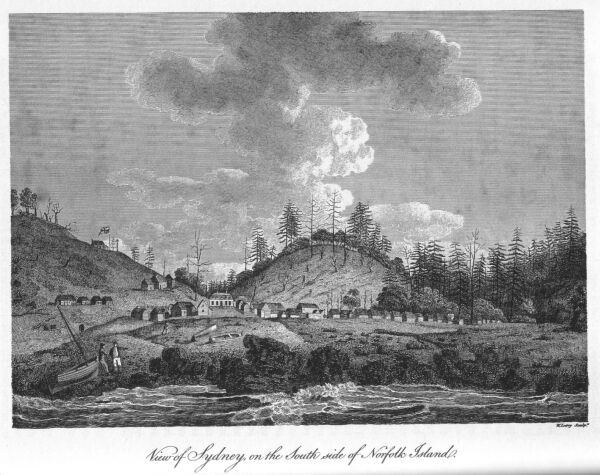
View of Sydney in Norfolk Island.
The New Zealanders mentioned in the preceding account of the Flax Manufactory at Norfolk Island, remained, as has been already shown, six months at that settlement. As they resided at the Lieutenant-governor's, and under his constant observation some information respecting New Zealand, and its inhabitants, was procured, which was obligingly communicated by Governor King, in substance as follows:
Hoo-doo Co-co-ty To-wa-ma-how-ey is about twenty-four years of age; five feet eight inches high; of an athletic make; his features like those of an European, and very interesting. He is of the district of Teer-a-witte, which, by the chart of Too-gee the other New Zealander, is a district of the same name, but does not lie so far to the southward as the part of Ea-hei-no-mawe, called Teer-a-witte by Captain Cook; for we are certain that Too-gee's residence is about the Bay of Islands; and they both agree that the distance between their dwellings is only two days journey by land, and one day by water.* That part called by Captain Cook Teer-a-witte is at a very considerable distance from the Bay of Islands.
[* Since the return of the Fancy from New Zealand, it appears that Too-gee's residence is at Doubtless Bay, in which place the Fancy anchored, and Too-gee with his wife went on board; but he said that he would not return to Norfolk Island until Lieutenant-governor King came to fetch him. Two lads, at Too-gee's recommendation, were going thither; but as they became sea-sick were set on shore again. Hoo-doo's residence must be between the Bay of Islands and Doubtless Bay, according to the information given by Too-gee to the master of the Fancy.]
Hoo-doo is nearly related to Po-vo-reek, who is the principal chief of Teer-a-witte. He had two wives and one child, about whose safety he seemed very apprehensive; and almost every evening at the close of the day, he, as well as Too-gee, lamented their separation in a sort of half-crying and half-singing, expressive of grief, and which was at times very affecting.
Too-gee Te-ter-re-nu-e Warri-pe-do is of-the same age as Hoo-doo; but about three inches shorter; he is stout and well made, and like Hoo-doo of an olive complexion, with strong black hair. Both are tattooed on the hips. Too-gee's features are rather handsome and interesting; his nose is aquinine, and he has good teeth. He is a native of the district of Ho-do-doe, (which is in Doubtless Bay,) of which district Too-gee's father is the Etang-a-roah, or chief priest; and to that office the son succeeds on his father's death. Beside his father, who is a very old man, he has left a wife and child; about all of whom he is very anxious and uneasy, as well as about the chief, (Moo-de-wy,) whom he represents as a very worthy character. Too-gee has a decided preference to Hoo-doo both in disposition and manners; although the latter is not wanting in a certain degree of good-nature, but he can at times be very much of the savage. Hoo-doo, like a true patriot, thinks there is no country, people, nor customs, equal to his own; on which account he is much less curious as to what he sees about him than his companion Too-gee, who has the happy art of insinuating himself into every person's esteem. Except at times, when he is lamenting the absence of his family and friends, he is cheerful, often facetious, and very intelligent. And were it not for the different disposition of Hoo-doo, the most favourable opinion might be formed of the New Zealanders in general. It is not, however, meant to be said, that if Too-gee were not present, an indifferent opinion would have been formed of Hoo-doo; on the contrary, the manners and disposition of the latter are far more pleasing than could have been expected to be found in a native of that country.
At the time they were taken from New Zealand, Too-gee was on a visit to Hoo-doo; and the mode of their capture was thus related by them*: The Daedalus appeared in sight of Hoo-doo's habitation in the afternoon, and was seen the next morning, but at a great distance from the main land. Although she was near two islands which are inhabited, and which Toogee in his chart calls Ko-mootu-Kowa, and Opan-a-ke, curiosity, and the hopes of getting some iron, induced Povoreek the chief, Too-gee, and Hoo-doo, with his brother, one of his wives, and the priest, to launch their canoes. They went first to the largest of the two islands, where they were joined by Tee-ah-wor-rack, the chief of the island, by Komootookowa, who is Hoo-doo's father-in-law, and by the son of that chief who governs the smaller island, called Opan-a-ke. They were some time about the ship before the canoe in which were Too-gee and Hoo-doo ventured alongside, when a number of iron tools and other articles were given into the canoe. The agent, Lieutenant Hanson, (of whose kindness they speak in the highest terms,) invited and pressed them to go on board, with which Too-gee and Hoo-doo were anxious to comply immediately, but were prevented by the persuasion of their countrymen. At length they went on board, and, according to their own expression, they were blinded by the curious things they saw. Lieutenant Hanson prevailed on them to go below, where they ate some meat. At this time the ship made sail. One of them saw the canoes astern; and when they perceived that the ship was leaving them, they both became frantic with grief, and broke the cabin windows with an intention of leaping overboard, but were prevented. While those in the canoes remained within hearing, they advised Povereek to make the best of his way home, for fear that he also should be taken.
[* This account has since been corroborated by Lieutenant Hanson.]
For some time after their arrival at Norfolk Island they were very sullen, and as anxiously avoided giving any information respecting the flax, as our people were desirous of obtaining it. The apprehension of being obliged to work at it was afterwards found to have been a principal reason for their not complying so readily as was expected. By kind treatment, however, and indulgence in their own inclinations, they soon began to be more sociable. They were then given to understand the situation and short distance of New Zealand from Norfolk Island, and were assured that as soon as they had taught our women 'emou-ka ea-ra-ka-ke,' (i.e. to work the flax), they should be sent home again. On this promise they readily consented to give all the information they possessed, and which turned out to be very little. This operation was found to be among them the peculiar province of the women; and as Hoo-doo was a warrior, and Too-gee a priest, they gave the governor to understand that dressing of flax never made any part of their studies.
When they began to understand each other, Too-gee was not only very inquisitive respecting England, etc. (the situation of which, as well as that of New Zealand, Norfolk Island, and Port Jackson, he well knew how to find by means of a coloured general chart); but was also very communicative respecting his own country. Perceiving he was not thoroughly understood, he delineated a sketch of New Zealand with chalk on the floor of a room set apart for that purpose. From a comparison which Governor King made with Captain Cook's plan of those islands, a sufficient similitude to the form of the northern island was discoverable to render this attempt an object of curiosity; and Too-gee was persuaded to describe his delineation on paper. This being done with a pencil, corrections and additions were occasionally made by him, in the course of different conversations; and the names of districts and other remarks were written from his information during the six months he remained there. According to Too-gee's chart and information, Ea-hei-no-maue, the place of his residence, and the northern island of New Zealand, is divided into eight districts governed by their respective chiefs, and others who are subordinate to them. The largest of those districts is T'Souduckey, the inhabitants of which are in a constant state of warfare with the other tribes, in which they are sometimes joined by the people of Moo-doo When-u-a, Tettua Whoo-doo, and Wangaroa; but these tribes are oftener united with those of Choke-han-ga, Teer-a-witte, and Ho-do-doe against T'Souduckey (the bounds of which district Governor King inclines to think is from about Captain Cook's Mount Egmont, to Cape Runaway). They are not, however, without long intervals of peace, at which times they visit, and carry on a traffic for flax and the green talc-stone, of which latter they make axes and ornaments. Toogee obstinately denied that the whole of the New Zealanders were cannibals*; it was not without much difficulty that he could be persuaded to enter on the subject, or to pay the least attention to it; and whenever an inquiry was made, he expressed the greatest horror at the idea. A few weeks after, he was brought to own, that all the inhabitants of Poo-nam-moo (i.e. the southern island) and those of T'Souduckey ate the enemies whom they took in battle, which Hoo-Doo corroborated, for his father was killed and eaten by the T'Souduckey people. 'Notwithstanding the general probity of our visitors, particularly Too-gee, (says Captain King,) I am inclined to think that horrible banquet is general through both islands.'
[* During the Fancy's stay in the river Thames, they had many and almost daily proofs of Too-gee's want of veracity on this head.]
Too-gee described a large fresh-water river on the west side of Ea-hei-no-maue; but he said it was a bar river, and not navigable for larger vessels than the war canoes. The river, and the district around it, is called Cho-ke-han-ga. The chief, whose name is To-ko-ha, lives about half-way up on the north side of the river. The country he stated to be covered with pine-trees of an immense size. Captain King says, that he made Too-gee observe, that Captain Cook did not in his voyage notice any river on the west side, although he coasted along very near the shore. On this Too-gee asked with much earnestness, if Captain Cook had seen an island covered with birds. Gannet Island being pointed out, he immediately fixed on Albatross Point as the situation of the river, which Captain Cook's account seems to favour, who says, 'On the north side of this point (Albatross) the shore forms a bay, in which there appears to be anchorage and shelter for shipping.' Governor King on this subject remarks as follows:
The probable situation of this river (if there be one) being thus far ascertained, leads me to suppose, that the district of T'Souduckey extends from Cape Runaway on the east side, to Cape Egmont on the west, and is bounded by Cook's Strait on the south side, which is nearly one half of the northern island. Of the river Thames I could not obtain any satisfactory account; but I have great reason to suppose, that the river he has marked in the district of Wonga-ro-ah is the Thames. Toogee's residence appears to be on the north side of the Bay of Islands, in the district called by him Ho-do-do, which he says contains about a thousand fighting men, and is subject to the following chiefs; i.e. Te-wy-te-wye, Wy-to-ah, Moo-de-wye, Wa-way, To-mo-co-mo-co, Pock-a-roo, and Tee-koo-ra, the latter of whom is the principal chief's son. The subordinate distinctions of persons at New Zealand are as follow: (We are told, that the inferior classes are perfectly subordinate to their superiors; and such I suppose to be the case by the great deference always paid by Too-gee to Hoo-doo.)
Etang-a-teda Eti-ket-ti-ca, a principal chief, or man in very great authority. His superior consequence is signified by a repetition of the word eti-ket-ti-ca. This title appears hereditary.
Etanga-roah, or E-ta-hon-ga, a priest, whose authority in many cases is equal, and in some superior to the etiketica.
Etanga-teda Epo-di, a subordinate chief or gentleman.
Ta-ha-ne Emo-ki, a labouring man.'
Respecting the customs and manners of these people, the governor favoured the writer with the following particulars:
The New Zealanders inter their dead; they also believe that the third day after the interment the heart separates itself from the corpse; and that this separation is announced by a gentle breeze of wind, which gives warning of its approach to an inferior Ea-tooa (or dinity) that hovers over the grave, and who carries it to the clouds. In his chart Too-gee has marked an imaginary road which goes the lengthways of Ea-hei-no-maue, viz from Cook's Strait to the North Cape, which Too-gee calls Terry-inga. While the soul is received by the good Ea-tooa, an evil spirit is also in readiness to carry the impure part of the corpse to the above road, along which it is carried to Terry-inga, whence it is precipitated into the sea.
Suicide is very common among the New Zealanders, and this they often commit by hanging themselves on the slightest occasions; thus a woman who has been beaten by her husband will perhaps hang herself immediately. In this mode of putting an end to their existence, both our visitors seemed to be perfect adepts, having often threatened to hang themselves, and sometimes made very serious promises of putting it into execution if they were not sent to their own country. As these threats, however, were used in their gloomy moments, they were soon laughed out of them.
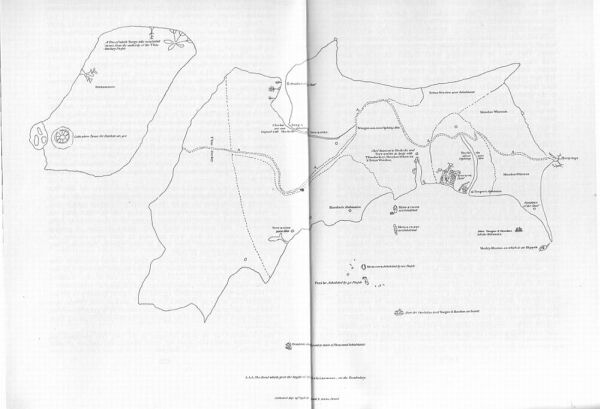
Facsimile of a chart of New Zealand, drawn by Too-gee.
It could not be discovered that they have any other division of time than the revolution of the moon, until the number amounted to one hundred, which they term "Ta-iee E-tow," i.e. one Etow or hundred moons; and it is thus they count their age, and calculate all other events.
Hoo-doo and Too-gee both agreed that a great quantity of manufactured flax might be obtained for trifles*, such as axes, chisels, etc., and said, that in most places the flax grows naturally in great quantities; in other parts it is cultivated by separating the roots, and planting them out, three in one hole, at the distance of a foot from each other. They give a decided preference to the flax-plant that grows here, both for quantity and size.
[* This circumstance all the people belonging to the Fancy fully confirmed; for during the three months that vessel lay in the Thames, they replaced all their running-rigging by ropes made of the flax-plant.]
It may be expected (says Governor King) that after a six months acquaintance between us and the two New Zealanders, we should not be ignorant of each other's language. Myself and some of the officers (who were so kind as to communicate the observations they obtained from our visitors) could make our ideas known, and tolerably well understood by them. They too, by intermixing what English words they knew with what we knew of their language, could make themselves sufficiently understood by us. During the time they were with us I did not possess any account of Captain Cook's voyages; but since their departure, I find from his first voyage, that it has great similitude to the general language spoken in those seas. The vocabulary which I have appended to these memoranda was collected by myself and the surgeon, and is, I believe, very correct, particularly the numerals. Much other information was given us by our two friends; but as it may be liable to great errors, I forbear repeating it.
It has been already said*[Footnote refers to Page 347 of the book, but there was no reference to this subject on that page. Ed.], that Governor King went himself to New Zealand to return Hoo-doo and Too-gee to their country and friends. The following are the governor's remarks on his voyage thither:
Having rounded the north cape of New Zealand on the 12th of November 1793, the fourth day after leaving Norfolk, we saw a number of houses and a small hippah on an island which lies off the north cape, and called by Too-gee, Moo-de Moo-too. Soon after we opened a very considerable hippah or fortified place, situated on a high round hill, just within the cape, whence six large canoes were seen coming toward the ship. As soon as they came within hail, Too-gee was known by those in the canoes, which were soon increased to seven, with upwards of twenty men in each. They came alongside without any intreaty, and those who came on board were much rejoiced to meet with Too-gee whose first and earnest inquiries were after his family and chief. On those heads he received the most satisfactory intelligence from a woman, who, as he informed us, was a near relation of his mother. His father and chief were still inconsolable for his loss; the latter (whom Too-gee always mentioned in the most respectful manner) had been about a fortnight past on a visit to the chief of the hippah above mentioned, where he remained four days; and Te-wy-te-wye, the principal chief of Too-gee's district, was daily expected. With this information he was much pleased. It was remarked, that although there were upward of a hundred New Zealanders on board and alongside, yet Too-gee confined his caresses and conversation to his mother's relation, and one or two chiefs, who were distinguished by the marks (a-mo-ko) on their faces, and by the respectful behaviour which was shown them by the emokis (i.e. the working men who paddled the canoes, and who at times were beaten most unmercifully by the chiefs. To those who by Too-gee's account were epodis (subaltern chiefs), and well known to him, I gave some chissels, hand-axes, and other articles equally acceptable. A traffic soon commenced. Pieces of old iron hoop were given in exchange for abundance of manufactured flax, cloth, patoo-patoos, spears, talc ornaments, paddles, fish-hooks, and lines. At seven in the evening they left us, and we made sail with a light breeze at west, intending to run for the Bay of Islands (which we understood was Too-gee's residence,) and from which we were twenty-four leagues distant. At nine o'clock a canoe with four men came alongside, and jumped on board without any fear. The master of the Britannia being desirous to obtain their canoe, the bargain was soon concluded (with Too-gee's assistance) much to the satisfaction of the proprietors, who did not discover the least reluctance at sleeping on board, and being carried to a distance from their homes. Our new guests very satisfactorily corroborated all the circumstances that Too-gee had heard before. After supper Too-gee and Hoo-doo asked the strangers for the news of their country since they had been taken away. This was complied with by the four strangers, who began a song, in which each of them took a part, sometimes using fierce and savage gestures, and at other times sinking their voices, according to the different passages or events that they were relating. Hoo-doo, who was paying great attention to the subject of their song, suddenly burst into tears, occasioned by an account which they were giving of the T'Souduckey tribe having made an irruption on Teer-a-witte (Hoo doo's district) and killed the chief's son with thirty warriors. He was too much affected to hear more; but retired into a corner of the cabin, where he gave vent to his grief, which was only interrupted by his threats of revenge.
Owing to calm weather, little progress was made during the night. At daylight on the 13th, a number of canoes were seen coming from the hippah; in the largest of which was thirty-six men and a chief, who was standing up making signals with great earnestness. On his coming alongside, Too-gee recognised the chief to be Ko-to-ko-ke, who is the etiketica, or principal chief of the hippah whence the boats had come the preceding evening. The old chief, who appeared to be about seventy years of age, had not a visible feature, the whole of his face being tatooed with spiral lines. At his coming on board he embraced Too-gee with great affection; Too-gee then introduced me to him; and after the ceremony of 'ehong-i,' i.e. joining noses, he took off his ah-a-how, or mantle, and put it on my shoulders. In return I gave him a mantle made of green baize, and decorated with broad arrows. Soon after seven, other canoes, with upwards of twenty men and women in each, came alongside. At Too-gee's desire the poop was 'eta-boo,' i.e. all access to it by any others than the old chief forbidden. Not long before Ko-to-ko-ke came on board, I asked Too-gee and Hoo-doo if they would return to Norfolk Island or land at Moo-dee When-u-a in case the calm continued, or the wind came from the southward, of which there was some appearance. Too-gee was much averse to either. His reason for not returning to Norfolk was the natural wish to see his family and chief, nor did he like the idea of being landed at Moo-dee When-u-a, as, notwithstanding what he had heard respecting the good understanding there was between his district and that of Moo-dee When-u-a, the information might turn out to be not strictly true. Nothing more was said about it; and it was my intention to land them nearer to their homes, if it could be done in the course of the day, although it was then a perfect calm. Soon after the chief came on board they told me with tears of joy that they wished to go with Ko-toko-ke, who had fully confirmed all they had heard before, and had promised to take them the next morning to Too-gee's residence, where they would arrive by night. To wait the event of the calm, or the wind coming from the northward, might have detained the ship some days longer. Could I have reached in four days from leaving Norfolk the place where Too-gee lived, I certainly should have landed him there; but that not being the case (as this was the fifth day) I did not consider myself justifiable in detaining the ship longer than was absolutely necessary to land them in a place of safety, and from which they might get to their homes.
Notwithstanding the information Too-gee had received, and the confidence he placed in the chief, I felt much anxiety about our two friends, and expressed to Too-gee my apprehensions that what he had heard might be an invention of Ko-to-ko-ke's and his people to get them and their effects into their power. I added, that as the ship could not be detained longer, I would rather take them back than leave them in the hands of suspicious people. To this Too-gee replied with an honest confidence, that 'etiketica no eteka,' i.e. a chief never deceives. I then took the chief into the cabin, and explained to him, assisted by Too-gee (who was present with Hoo-doo), how much I was interested in their getting to Ho-do-do; and added, that in two or three moons I should return to Ho-do-do, and if I found Too-gee and Hoo-doo were safe arrived with their effects, I would then return to Moo-dee When-u-a and make him some very considerable presents, in addition to those which I should now give him and his people for their trouble in conducting our two friends to their residence. I had so much reason to be convinced of the old man's sincerity, that I considered it injurious to threaten him with punishment for failing in his engagement. The only answer Ko-to-ko-ke made was, by putting both his hands to the sides of my head (making me perform the same ceremony) and joining our noses; in which position we remained three minutes, the old chief muttering what I did not understand. After this he went through the same ceremony with our two friends, which ended with a dance, when the two latter joined noses with me, and said that Ko-to-ko-ke was now become their father, and would in person conduct them to Ho-do-doe.* While I was preparing what I meant to give them, Too-gee (who I am now convinced was a priest) had made a circle of the New Zealanders round him, in the centre of which was the old chief, and recounted what he had seen during his absence. At many passages they gave a shout of admiration. On his telling them, that it was only three days sail from Norfolk to Moo-doo When-u-a, whether his veracity was doubted, or that he was not contented with the assertion alone, I cannot tell, but with much presence of mind he ran upon the poop, and brought a cabbage, which he informed them was cut five days ago in my garden. This convincing proof produced a general shout of surprise.
[* Which was very faithfully performed.]
Every thing being now arranged, and ready for their departure, our two friends requested that Ko-to-ko-ke might see the soldiers exercise and fire. To this I could have no objection, as the request came from them; but I took that opportunity of explaining to the chief (with Toogee's help) that he might see, by our treatment of him and his two countrymen, that it was our wish and intention to be good neighbours and friends with all Ea-hei-no-mau-e; that these weapons were never used but when we were injured, which I hoped would never happen; and that no other consideration than the satisfying of his curiosity could induce me to show what those instruments were intended for.
About one hundred and fifty of the New Zealanders were seated on the larboard side of the deck, and the detachment paraded on the opposite side. After going through the manual, and firing three volleys, two great guns were fired, one loaded with a single ball, and the other with grape-shot, which surprised them greatly, as I made the chief observe the distance at which the shot fell from the ship. The wind had now the appearance of coming from the southward; and as that wind throws a great surf on the shore, they were anxious to get away. Too-gee and Hoo-doo took an affectionate leave of every person on board, and made me remember my promise of visiting them again, when they would return to Norfolk Island with their families. The venerable chief, after having taken great pains to pronounce my name, and made me well acquainted with his, got into his canoe and left us. On putting off from the ship, they were saluted with three cheers, which they returned as well as they could, by Toogee's directions. It was now seven in the morning of the 13th: at nine a breeze came from the north, with which we stood to the eastward. After a passage of five days from New Zealand (having had light winds) and ten days absence from Norfolk Island, I landed at three o'clock in the afternoon of the 18th.
The little intercourse that I had with the New Zealanders (as I was only eighteen hours off that island, twelve of which were in the night) does not enable me to say much respecting them, or to form any decisive opinion of them, as much of their friendly behaviour in this slight interview might be owing to our connexion with Too-gee and Hoo-doo, and their being with us. These two worthy savages (if the term may be allowed) will, I am confident, ever retain the most grateful remembrance of the kindnesses they received on Norfolk Island; and if the greater part of the countrymen have but a small portion of the amiable disposition of Too-gee and Hoo-doo, they certainly are a people between whom and the English colonists a good understanding may with common prudence and precaution be cultivated. I regret very much that the service on which the Britannia was ordered did not permit me to detain her longer; as in a few days, with the help of our two friends, much useful information might have been obtained respecting the quantity of manufactured flax that might be procured, which I think would be of high importance if better known. The great quantity that was procured in exchange for small pieces of iron hoop is a proof, that an abundance of this valuable article is manufactured among them.
The articles that I gave Too-gee and Hoo-doo consisted of hand-axes; a small assortment of carpenters' tools, six spades, some hoes, with a few knives, scissors, and razors; two bushels of maize, one of wheat, two of peas, and a quantity of garden feeds; ten young sows, and two boars, which Too-gee and the chief faithfully promised should be preserved for breeding, a promise which I am inclined to think they will strictly observe.*
[* The first place the Fancy made at New Zealand was Doubtless Bay, which the master describes as a very dangerous place for a vessel to go into, and still worse to lie at, as it is open to the easterly winds. On their coming to an anchor, which was not till late in the evening (in December 1795), several canoes came round the vessel, but did not venture alongside until Too-gee was inquired for, when the New Zealanders exclaimed 'My-ty Governor King! My-ty Too-gee! My-ty Hoo-doo!' Some went on board, and others put in to shore, returning soon after with Too-gee and his wife. He had not forgotten his English, at least the more common expressions. He informed Captain Dell, that he had one pig remaining alive, and some peas growing; but what became of the rest of his stock he did not say. As Doubtless Bay was found a bad place to remain in, the Fancy endeavoured to get out, but was obliged to return, when the two lads who wished to see Norfolk Island, being sea-sick, left her.]
A SHORT VOCABULARY OF THE NEW ZEALAND LANGUAGE
NEW ZEALAND ENGLISH ----------- ------- E-ha-ha Fire E-when-ua Earth, or ground E-wy Water E-mu-da Flame of thefire E-dou-ma-te Summer E-ho-ho-tou-ke Winter E-ma-ran-gi North E-sow-how-oo-doo South E-ton-ga East E-te-hu West E-te-te-do To see E-don-go To hear E-do-rni-do-mi To feel E-hon-gi To smell E-mei-te To taste He-te-te-show or Ye-te-de-how New moon E-po-po-e-e-nue Full moon E-de-de-ke Last quarter of the moon E-ma-ra-ma The moon E-da Sun E-pu-ta Sun-rise E-a-wa-tere Noon E-a-hi-au, or E-po Sunset E-wha-tu Star Ye-rew-a-new-a Rainbow E-Ma-tan-gee Wind E-bu-a Rain E-ue-da Lightning E-wet-e-te-cla Thunder Em-ma-ha-ne Hot Ma-ka-ree-dee Cold E-ko-how Fog E-po-ka-ka Dew E-paw-ha Smoke E-mo-an-na Salt water or the sea E-a-o The day E-po The night E-co-pec-ce To freeze, or ice E-wha-tu Snow In-an-hal Yesterday N'A-goo-nal To-day A-po-po To-morrow A-ta-hy-da Day after to-morrow A-wa-ka Day following A-wa-ke-ett ue Four days hence E-hon-gi The ceremony of joining noses as a salute Yen-gang The head He'-ho-do-ho-do The hair of the head Eta-din-ga The ear Etoude-Eta-din-ga Deaf E-da-ha The Forehead Ca-no-wei or E-ca-no-che The eye E-pu-di E'Ca-no-wei Blind Pa-pa-reen-gi The cheek Ec-Eee-shu The nose E-cou-wye The beard E-ka-ke The neck Po-co-fee-fee or Edinga-ringa The arm E-dal-ee The breast He-ooo (lengthened out) The nipple E-pee-too The navel Eu-wa The thigh E-tu-di-po-na or Ewa-wye The leg E-mata-ka-ra The fingers E-coro-E-te Finger-nails He-i-a-dar-re The skin Ing-oo-too The lips E-wa-ha The mouth In-ni-show The teeth Ecoro-coro The throat E-pa-ro The hand E-co-pu The belly E-to-to Blood E-tu-di-po-na Knees E-da-pa-ra-pa The feet E-too-o-ra The back E-cu-mo The backside E-kau-wal The chin E-ki The mouth E-u-de The penis E-ai The vulva E-tek-ke To copulate E-ma-mi To go to make water E-tu-tal To go to stool Pa-ke-da Bald-headed E-sha-pu Pregnant E-ko-ki A cripple E-ka-ta To laugh E-tan-ge To cry E-too-ha To spit E-co-we-ra To breathe E-ma-my To groan E-sha, (sounded expressive of the action) To sigh Te-zee-ou-wa, (sounded expressive of) Sneezing*
[* A compliment is paid by the New Zealanders when one of the company sneezes, by repeating the following lines: 'Tee-zee, Tee-zee, Pa-way, Pa-way, wa-cou-te-ma-he co-to-ko-eee, drawn out very long. 'Tu-tu-ro a-te na tan-ga-ta kiti-po, Tu-tu-ra ma-hie na-ta-na-ta kit-eao Tee-zee, Tee-zee, etc.' as in the first line. All which means wishes for health from night to morning, and that no bones may be broken by the shock of sneezing.]
E-co-show To hiccough E-mo-a To sleep E-ta-ko-te To lie down to sleep E-a-ra To rise from sleep E-kow-hae-ra To yawn E-to-u To break wind E-ku-pa To belch E-du-a-ke To puke E-da-hee Fat Eet pronounced as Eat Lean E-o-ra In health E-mat-tee means also death Sick E-pi Handsome, also clean E-ke-no Ugly, also dirty E-ni-a-ymi Pain in general In-ni-shou E-to-on-ga Tooth-ache E-hu-de Head-ache E-de-ka-ra-ka An itching E-huf-fe Love He-de-de Hatred, or being dissatisfied He-ma-ta-kd Fear E-ka-tou Joy E-ko-ko-pe Shame E-kow-wa Loathing E-wa-ra-wa-ra An error or mistake E-ko-cut A cut E-mo-to A blow E-hou-dang-e To faint He-kye To eat E-e-nue To drink E-matta-he-a-kye Hungry Ka-ke Satisfied E-i-ra To walk E-o-mu To run E-da-re To jump E-ka-ou To swim E-tu-ta-ke To meet any one Ke-o-ro-mi To make haste E-no-ho To sit down E-tu Standing up E-mo-ki To work Ka-ko-p-1 To shut a door Eu-wa-ke To open E-de-ding-ee To sell E-o-mi To give or reach Wha-ka-de-de I'll give you Z'Shocke-e-mai Ditto E-wa-k-a-tu To plant E-o-hoo-tee To pluck up E-da-fe To tie or bind E-wa-wat-te Untie E-ma-ca To throw away E-te-te-do To look or observe E-ko-re To break any thing, as a plate E-what-te To break any thing, as a stick E-hi-yi To tear, as paper Car-co-ree To pull down or destroy, as a building, ship, etc E-ko-cout To cut Ing-ha-roo To see or look for E-hu-na To hide Ea-ke-tere To find E-ke-no To stain or dirty any thing E-moo-roo To clean Eo-roo-ee To wash E-yhang-a To build a house or boat E-ka-wa Ill-tasted, bitter He-i-de-mal! Come here! Sey-ede or E-i-ra To go E-ko-re-roo To converse Pat-too pat-too To beat, also the name of a principal weapon E-te-ka To tell a lie E-po-no To tell truth E-wa-ka A canoe E-shoo To paddle a canoe E-1-ka A fish E-a-ho To catch a fish E-wa-du A fish-hook made of wood E-ma-ka A fishing-line E-nue Big, large E-mo-ro-ee-te Small My-ty Good Mack-row-a Bad Ki-e-dow Fit to eat E-whan-na To kick E-ha-ka To dance E-wy-ette To sing E-wa-du To dream E-ta-po-ke To drown E-ka-ya To steal E-ta-ro-na To hang one's self E-ee-ta I understand Na? Do you mean this? Ha ya-ha What is this? Ko-ai Who is this? An-ga There Pah-hee A ship, or very large canoe E-whar-re A house E-ta-o A spear E-da-kow A tree, or piece of wood E-ma-ta A sharp stone with which they cut their hair Pas-aa-te-ra A stone E-ko-ha-tue A rock E-ho-ne Sand-beach E-a-wha A harbour E-pa-pa A board E-to-ki An axe E-whow A chissel, nail, or iron E-va-te-to-ka A door E-pu-ki A hill E-poo-poo Shells E-wak-e-te-ca Ear-rings Etu-pu The flax plant when growing E-mu-ka The flax when dressed E-mu-ka Yera-ka-kee The operation of drawing the flax from the plant Eka-ka-how Cloth wove from the flax A-mo-ko The marks on their face and different parts of their bodies To-ko-hal-ya? How many? E-ma-ha A great many, speaking of things Ka-ta-puk-e-mai A great many, speaking of people Yen-ge-enge, (and sounded hard) Tired Eto-ho-ro-ha A whale E-he-nue Whale oil, or any other fat Emata-to-too-roo Thick E-da-ede-hi Thin E-do-aw High or tall, and long E-po-to Short E-wa-nue Wide E-wa-ete Narrow E-ti-ma-ha Heavy E-ma-ma Light E-de-ding-e Full E-ma-din-ge Empty E-ma-row Hard Ing-now-a-rey Soft E-ka-ra-de A dog E-kere A rat E-manu A bird E-wy-you Milk E-whairo Red E-ema White E-man-goe All dark colours Ka-de-da Green Ka-nap-pa Blue Ta-ah-ne-a sounded long A man Wha-hel-ne A woman E-co-ro-wa-ke An old man E-du-a-hel-ne An old woman E-Ta-ma-ree-kee A young man E-Ta-ma-hei-ne A young woman Ta-ma-i-ete A male child E-co-tero An infant Ma-tu-a-Ta-a-ne Father Ma-tu-a-wa-hei-ne Mother Tu-a-hel-ne Sister Tu-a-Can-na Elder brother Tei-ne Younger brother E-mi-yan-ga Twins Pah-pah Children call their father Hah-ty-yee Children call their mother