Volume 1 — CHAPTER XXXII (continued 2)
Reading edition
E seems to be used as the article, pronounced as in the English. A is always sounded long, as in the French.
NUMERALS Ta-hie One Du-o Two Too-roo Three Wha Four Dee-mah Five 0-no Six Whee-too Seven Wha-roo Eight E-wha Nine Ng-a-hu-du Ten Ca-te-cow signifies One Ten Ma-ta-hie Eleven Ma-duo Twelve, and so on, the numeral being preceded by Ma, until nineteen (Ma-Ew-ha) then . . . Ca-te-cow, Ca, du-o Twenty Ca-te-cow, Ca, Too-roo Thirty Ca-te-cow, Ca, Wha Forty and so on to . . . Ca-te-cow, Ca, E-wha Ninety Kah-row A hundred Carow, Ca, Ta-hie One hundred Carow, Ca, Du-o Two hundred and so on to nine hundred Kom-ma-roo A thousand Com-ma-no, Ca, Tahie One thousand Com-ma-no, Ca-du-o Two thousand and so on to nine thousand. Ca-tee-nee Ten thousand which appearsto be the extent of their numerals.
{Thus far Lieutenant-Governor King.}
From the 25th of October, the day on which the ships made sail from Norfolk Island, till the 31st of the same month, nothing material occurred. On that day Mr. Raven stated to Captain Waterhouse, the commander of the Reliance, the necessity there was for the Britannia's making the best of her way to England; and as he thought she sailed rather better than that ship, he requested permission to part company, which Captain Waterhouse not objecting to, we separated and made sail from them.
On the 5th of November we passed an island named by Lieutenant Watts (who first saw it in the Lady Penrhyn transport) Macauley Island.
Sunday the 6th was passed in examining an island, which Mr. Raven was decidedly of opinion had never been seen before. It was situated in the latitude of 29 degrees 15 minutes and longitude of 181 degrees 56 minutes E. We found the land high, and it appeared to be well covered with wood. On the south-west side of it is a bay in which, from the colour of the water, Mr. Raven thought there was good anchorage; but at this time there was too much surf breaking on the beach to render it prudent to send a boat in. The aspect on this side of the island was romantic and inviting; but on the other side the shore was bold, and in many parts rugged and bare. The whole appeared to consist, like Norfolk Island, of hills and dales. We conjectured that there was fresh water in the bay on the south-west side. The knowledge of the existence of this island can be of no other importance, than to cause navigators sailing in that route to keep a good look-out, particularly in the night-time, as many straggling rocks lie off the north side.
From the circumstance of its being seen on a Sunday it obtained the name of Sunday island.
Leaving this, we proceeded toward Cape Horn; but it was not till the 16th of December that we saw the southern part of the vast continent of America. Mr. Raven intended to have made the Jasons, and touched at Falkland's Islands in the hope of procuring some information respecting the Cape of Good Hope; but, after passing Cape Horn, and finding the wind hang to the northward, he altered his course for the Island of St Helena, or the Cape of Good Hope, as circumstances might direct.
On the 21st, in latitude 51 degrees 56 minutes S and longitude 306 degrees 25 minutes E to our great surprise, we fell in with and joined our companions the Reliance and Supply. We found that, by keeping nearer to the north end of New Zealand than we had done, they had met with more favourable winds. We now proceeded together toward the Cape of Good Hope.
On the 23rd, being about the latitude of 50 degrees S we fell in with several islands of ice; which, however, we cleared without any accident, and stood more to the northward. Mr. Raven was of opinion, that ice would always be found in or about those latitudes, and recommended that all ships, after passing Cape Horn, should keep more to the northward than we did.
On the 9th ofJanuary we crossed the three hundred and sixtieth degree of east longitude. Our weather now was much too moderate; for it was not till the 15th of January that we saw the coast of Africa. Some necessary precautions were taken by the king's ship on coming in with it; and, finding every thing as we wished, on the next day we completed our long voyage of sixteen weeks from Port Jackson by anchoring safely in Table Bay.
Here, almost the whole of our ship's company having been pressed, or voluntarily entered into the king's service, and with difficulty getting some necessary repairs done to the ship, we were compelled most reluctantly to remain for eight weeks. The place was very unhealthy, and lodging and every article of comfort extravagantly high.
A few days before we sailed, the ship Ganges, commanded by Mr. Patrickson, arrived with convicts from Cork. She sailed from Ireland with another ship, the Britannia, having on board a similar cargo; but the master, intending to touch at Rio de Janeiro, had parted company with the Ganges off Palma. We learned by the Ganges, that two storeships, the Sylph and Prince of Wales, had sailed in June last for New South Wales. Much as Governor Hunter wanted labourers, the provisions would be more welcome to him than the Irish convicts, who had hitherto always created more trouble than any other.
Before we sailed we had the satisfaction of seeing seventy head of very fine young Cape cattle purchased by Mr. Palmer, the commissary for the colony, to be sent thither in the Reliance and Supply; the latter of which ships sailed with her proportion a few days before we left Table Bay. These ships would return well stored with useful articles for the settlement, and comforts for every officer in it.
We left the Cape on the 16th of March, and arrived at the pleasant island of St Helena on the 26th of the same month. Here we remained till the 17th of April, having waited some time for a convoy, and sailed at last without any, in company with the ship Brothers, a South-Sea whaler, who was returning loaded.
During our stay at St Helena we made several excursions into the interior part of the island. A visit from the French was daily expected; but we saw with pleasure preparations made for their reception that caused every one to treat the probability of their coming as an event more to be wished for than dreaded. From the hospitality of Governor Brooke and his family, and the pleasant society of this place, we felt a regret at leaving the island, which nothing but the prospect of soon reaching our own happy shores alleviated.
Every one now was anxious for the successful termination of the passage before us. On the 27th of April we crossed the equator in the longitude of 19 degrees 02 minutes W. On the 4th of May we spoke the ship Elizabeth, (an American,) Isaac Stone master. They had only been twenty-eight days from Dover, and gave us the first intelligence we received of the victory obtained by our fleet under Earl St. Vincent over that of the Spaniards.
On the 7th of June we spoke a schooner under American colours, the Federal George of Duxbury from Bourdeaux, bound to Boston. The master informed, us that the channel was full of the enemy's cruisers, who were looking out for our West-India fleet, then expected home. Though we felt persuaded that our cruisers would counteract their designs, Mr. Raven determined, from this information, and from the wind having long hung to the eastward, to stand to the northward. From this time to the 18th our weather was very unfavourable, and our wind mostly contrary. On the 18th we saw the rock laid down in the charts by the name of Isle Rokal, being then in the latitude of 57 degrees 51 minutes N and longitude 13 degrees 56 minutes W. The rock then bore N 23 degrees distant eight miles and a half. Our foul wind continued many days; but on the 23rd we found ourselves off Innishone on the north part of Ireland. Here a man came off, who, to our inquiries respecting the progress of the war, answered, that he knew nothing about war, except that the strongest party always got the better of the weakest, thus uttering a truth in the midst of the profoundest ignorance. We now determined to steer for Liverpool, at which port, after much anxiety, we arrived in safety on the 27th.
On the 29th the judge-advocate delivered at the Duke of Portland's office the dispatches with which he was charged.
He now learned, that previous to his arrival in London there had sailed for New South Wales, exclusive of the ships Sylph and Prince of Wales, Ganges and Britannia, the Lady Shore transport, having on board two male and sixty-six female convicts. On the 6th of last November the Barwell sailed, having on board Mr. Dore, the present judge-advocate of that territory, and two hundred and ninety-eight male convicts. The Britannia, a ship belonging to the house of Enderby and Co. sailed on the 17th of last February with ninety-six female convicts on board. This ship went out with orders to try the whale-fishery on the coast of New South Wales for one season. If this should succeed, the settlement and the public at large will owe much to the spirited exertions of the house of Enderby to promote a beneficial commerce from that country.
The king's ships on that station being ill calculated for the services expected from them, having on board expensive complements of men and officers, and consequently but little room for cattle; and being beside so defective and impaired by time as to be unsafe to navigate much longer; two others have been provided, newer and more capable of rendering service to the colony. One of them, the Buffalo, commanded by Mr. William Raven, late master of the Britannia, is on the point of sailing, and is to take cattle to New South Wales from the Cape of Good Hope. The other is named the Porpoise, and has the same service to perform. A ship, called the Minerva, is also proceeding to Cork to take in a number of Irish convicts.
Letters have been received from New South Wales, dated about six weeks after the author sailed from that colony. Governor Hunter had received by the Sylph and Prince of Wales storeships two thousand six hundred and fifty casks of salted provisions. Several persons had been tried by the court of criminal judicature for robbing the public stores, and had been found guilty. One man had been executed for murder, and his body hung in chains on Rock Island, a small spot at the mouth of Sydney Cove, and by which every boat and ship coming into the cove must necessarily pass. The governor was on the point of visiting Portland Head, some high land on the banks of the Hawkesbury, where he purposed establishing a settlement.
Had that river and its fertile banks been discovered before the establishment at Sydney Cove had proceeded too far to remove it, how eligible a place would it have been for the principal settlement! A navigable river possesses many advantages that are unknown in other situations. Much benefit, however, was to be derived from this even as an inferior settlement. Its extreme fertility would always insure a certain supply of grain; and the settlers on its banks must produce a quantity equal to the consumption of the civil and Military, and of their own families; and thus, while rendering a service to the state, they might in time become opulent farmers. Yet our pity is excited, when it is considered, that they are of so unworthy a description as has clearly been made appear in the preceding narrative. That a river justly termed the Nile of New South Wales should fall into such hands is to be lamented. In process of time, however, their productive farms will have yielded them all that they aspire to, and may then fall into the possession of persons who will look beyond the mere gratification of the moment, and cause the settlements in New South Wales to stand as high in the public estimation as any colonies in his Majesty's dominions.
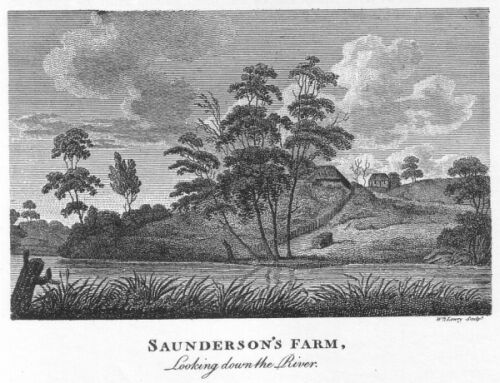
Saunderson's Farm.
APPENDICES
GENERAL REMARKS
The reader of the preceding narrative will have seen, that after many untoward occurrences, and a considerable lapse of time, that friendly intercourse with the natives which had been so earnestly desired was at length established; and having never been materially interrupted, these remote islanders have been shown living in considerable numbers among us without fear or restraint; acquiring our language; readily falling in with our manners and customs; enjoying the comforts of our clothing, and relishing the variety of our food. We saw them die in our houses, and the places of the deceased instantly filled by others, who observed nothing in the fate of their predecessors to deter them from living with us, and placing that entire confidence in us which it was our interest and our pleasure to cultivate. They have been always allowed so far to be their own masters, that we never, or but rarely, interrupted them in any of their designs, judging that by suffering them to live with us as they were accustomed to do before we came among them, we should sooner attain a knowledge of their manners and customs, than by waiting till we had acquired a competent skill in their language to converse with them. On this principle, when they assembled to dance or to fight before our houses, we never dispersed, but freely attended their meetings. To them this attention of ours appeared to be agreeable and useful; for those who happened to be wounded in their contests instantly looked out for one of our surgeons, and displayed entire confidence in his skill, and great bravery in the firmness with which they bore the knife and the probe.
By slow degrees we began mutually to be pleased with, and to understand each other. Language, indeed, is out of the question; for at the time of writing this (September 1796) nothing but a barbarous mixture of English with the Port Jackson dialect is spoken by either party; and it must be added, that even in this the natives have the advantage, comprehending, with much greater aptness than we can pretend to, every thing they hear us say. From a pretty close observation, however, assisted by the use of the barbarous dialect just mentioned, the following particulars respecting the natives of New South Wales have been collected.
APPENDIX 1--GOVERNMENT AND RELIGION
GOVERNMENT
We found the natives about Botany Bay, Port Jackson, and Broken Bay, living in that state of nature which must have been common to all men previous to their uniting in society, and acknowledging but one authority. These people are distributed into families, the head or senior of which exacts compliance from the rest. In our early intercourse with them (and indeed at a much later period, on our meeting with families to whom we were unknown) we were always accosted by the person who appeared to be the eldest of the party, while the women, youths, and children, were kept at a distance. The word which in their language signifies father was applied to their old men; and when, after some time, and by close observation, they perceived the authority with which Governor Phillip commanded, and the obedience which he exacted, they bestowed on him the distinguishing appellation of (Be-anna) or Father. This title being conferred solely on him (although they perceived the authority of masters over their servants) places the true sense of the word beyond a doubt, and proves, that to those among them who enjoyed that distinction belonged the authority of a chief.
When any of these came into the town, we have been immediately informed of their arrival, and they have been pointed out to our notice in a whisper, and with an eagerness of manner which, while it drew our attention, impressed us with an idea that we were looking at persons to whom some consequence was attached even among the savages of New Holland. Another acceptation of the word Be-anna, however, soon became evident; for we observed it to be frequently applied by children to men who we knew had not any children of their own. On inquiry we were informed, that in case a father should die, the nearest of kin, or some deputed friend, would take the care of his children; and for this reason those children styled them Be-anna, though in the lifetime of their natural parent. This Bennillong (the native who was some time in England) confirmed to us at the death of his first wife, by consigning the care of his infant daughter Dil-boong (who at the time of her mother's decease was at the breast) to his friend Governor Phillip, telling him that he was to become the Be-anna or Father of his little girl. Here, if the reader pauses for a moment to consider the difference between the general conduct of our baptismal sponsors (to whose duties this custom bears much resemblance) and the humane practice of these uncivilised people, will not the comparison suffuse his cheek with something like shame, at seeing the enlightened Christian so distanced in the race of humanity by the untutored savage, who has hitherto been the object of his pity and contempt? But sorry am I to recollect, and as a faithful narrator to be impelled to relate, one particular in their customs that is wholly irreconcilable with the humane duties which they have prescribed to themselves in the above instance; duties which relate only to those children who, in the event of losing the mother, could live without her immediate aid. A far different lot is reservea ror such as are at triat time at the breast, or in a state ot absolute helplessness, as will be seen hereafter.
We have mentioned their being divided into families. Each family has a particular place of residence, from which is derived its distinguishing name. This is formed by adding the monosyllable Gal to the name of the place: thus the southern shore of Botany Bay is called Gwea, and the people who inhabit it style themselves Gweagal. Those who live on the north shore of Port Jackson are called Cam-mer-ray-gal, that part of the harbour being distinguished from others by the name of Cam-mer-ray. Of this last family or tribe we have heard Bennillong and other natives speak (before we knew them ourselves) as of a very powerful people, who could oblige them to attend wherever and whenever they directed. We afterwards found them to be by far the most numerous tribe of any within our knowledge. It so happened, that they were also the most robust and muscular, and that among them were several of the people styled Car-rah-dy and Car-rah-di-gang, of which extraordinary personages we shall have to speak particularly, under the article Superstition.
To the tribe of Cam-mer-ray also belonged the exclusive and extraordinary privilege of exacting a tooth from the natives of other tribes inhabiting the sea-coast, or of all such as were within their authority. The exercise of this privilege places these people in a particular point of view; and there is no doubt of their decided superiority over all the tribes with whom we were acquainted. Many contests or decisions of honour (for such there are among them) have been delayed until the arrival of these people; and when they came, it was impossible not to observe the superiority and influence which their numbers and their muscular appearance gave them over the other tribes.
These are all the traces that could ever be discovered among them of government or subordination; and we may imagine the deference which is paid to the tribe of Cam-mer-ray to be derived wholly from their superiority of numbers; but this superiority they may have maintained for a length of time before we knew them; and indeed the privilege of demanding a tooth from the young men of other families must have been of long standing, and coeval with the obedience which was paid to them: hence their superiority partakes something of the nature of a constituted authority; an authority which has the sanction of custom to plead for its continuance.
RELIGION
It has been asserted by an eminent divine*, that no country has yet been discovered where some trace of religion was not to be found. From every observation and inquiry I could make among these people, from the first to the last of my acquaintance with them, I can safely pronounce them an exception to this opinion. I am certain that they do not worship either sun, moon, or star; that, however necessary fire may be to them, it is not an object of adoration; neither have they respect for any particular beast, bird, or fish. I never could discover any object, either substantial or imaginary, that impelled them to the commissioin of good actions, or deterred them from the perpetration of what we deem crimes. There indeed existed among them some idea of a future state, but not connected in any wise with religion; for it had no influence whatever on their lives and actions. On their being often questioned as to what became of them after their decease, some answered that they went either on or beyond the great water; but by far the greater number signified, that they went to the clouds. Conversing with Bennillong after his return from England, where he had obtained much knowledge of our customs and manners, I wished to learn what were his ideas of the place from which his countrymen came, and led him to the subject by observing, that all the white men here came from England. I then asked him where the black men (or Eora) came from? He hesitated; did they come from any island? His answer was, that he knew of none: they came from the clouds (alluding perhaps to the aborigines of the country); and when they died, they returned to the clouds (Boo-row-e). He wished to make me understand that they ascended in the shape of little children, first hovering in the tops and in the branches of trees; and mentioned something about their eating, in that state, their favourite food, little fishes.
[* Blair's Sermons, vol i Sermon I]
If this idea of the immortality of the soul should excite a smile, is it more extraordinary than the belief which obtains among some of us, that at the last day the various disjointed bones of men shall find out each its proper owner, and be re-united? The savage here treads close upon the footsteps of the Christian.
The natives who inhabit the harbour to the northward, called by us Port Stephens, believed that five white men who were cast away among them (as has been before shown) had formerly been their countrymen, and took one of them to the grave where, he told him, the body he at that time occupied had been interred. If this account, given us by men who may well be supposed to deal in the marvellous, can be depended upon, how much more ignorant are the natives of Port Stephens, who live only thirty leagues to the northward of us, than the natives of and about Port Jackson!
The young people who resided in our houses were very desirous of going to church on Sundays, but knew not for what purpose we attended. I have often seen them take a book, and with much success imitate the clergyman in his manner (for better and readier mimics can no where be found), laughing and enjoying the applause which they received.
I remember to have seen in a newspaper or pamphlet an account of a native throwing himself in the way of a man who was about to shoot a crow; and the person who wrote the account drew an inference, that the bird was an object of worship: but I can with confidence affirm, that so far from dreading to see a crow killed, they are very fond of eating it, and take the following particular method to ensnare that bird: a native will stretch himself on a rock as if asleep in the sun, holding a piece of fish in his open hand; the bird, be it hawk or crow, seeing the prey, and not observing any motion in the native, pounces on the fish, and, in the instant of seizing it, is caught by the native, who soon throws him on the fire and makes a meal of him.
That they have ideas of a distinction between good and bad is evident from their having terms in their language significant of these qualities. Thus, the sting-ray was (wee-re) bad; it was a fish of which they never ate. The patta-go-rang or kangaroo was (bood-yer-re) good, and they ate it whenever they were fortunate enough to kill one of these animals.
To exalt these people at all above the brute creation, it is necessary to show that they had the gift of reason, and that they knew the distinction between right and wrong, as well as between what food was good and what was bad. Of these latter qualities their senses informed them; but the knowledge of right and wrong could only proceed from reason. It is true, they had no distinction in terms for these qualities--wee-re and bood-yer-re alike implying what was good and bad, and right and wrong. Instances however were not wanting of their using them to describe the sensations of the mind as well as of the senses; thus their enemies were wee-re; their friends bood-yer-re. On our speaking of cannibalism, they expressed great horror at the mention, and said it was wee-re. On seeing any of our people punished or reproved for ill-treating them, they expressed their approbation, and said it was bood-yer-re, it was right. Midnight murders, though frequently practised among them whenever passion or revenge were uppermost, they reprobated; but applauded acts of kindness and generosity, for of both these they were capable. A man who would not stand to have a spear thrown at him, but ran away, was a coward,jee-run, and wee-re. But their knowledge of the difference between right and wrong certainly never extended beyond their existence in this world; not leading them to believe that the practice of either had any relation to their future state; this was manifest from their idea of quitting this world, or rather of entering the next, in the form of little children, under which form they would re-appear in this.
APPENDIX II-STATURE AND APPEARANCE
We observed but few men or women among them who could be said to be tall, and still fewer who were well made. I once saw a dwarf, a female, who, when she stood upright, measured about four feet two inches. None of her limbs were disproportioned, nor were the features of her face unpleasant; she had a child at her back, and we were told came from the south shore of Botany Bay. I thought the other natives seemed to make her an object of their merriment. In general, indeed almost universally, the limbs of these people were small; of most of them the arms, legs, and thighs were thin. This, no doubt, is owing to the poorness of their living, which is chiefly on fish; otherwise the fineness of the climate, co-operating with the exercise which they take, might have rendered them more muscular. Those who live on the sea-coast depend entirely on fish for their sustenance; while the few who dwell in the woods subsist on such animals as they can catch. The very great labour necessary for taking these animals, and the scantiness of the supply, keep the wood natives in as poor a condition as their brethren on the coast. It has been remarked, that the natives who have been met with in the woods had longer arms and legs than those who lived about us. This might proceed from their being compelled to climb the trees after honey and the small animals which resort to them, such as the flying squirrel and opossum, which they effect by cutting with their stone hatchets notches in the bark of the tree of a sufficient depth and size to receive the ball of the great toe. The first notch being cut, the toe is placed in it; and while the left arm embraces the tree, a second is cut at a convenient distance to receive the other foot. By this method they ascend very quick, always cutting with the right hand and clinging with the left, resting the whole weight of the body on the ball of either foot.
In an excursion to the westward with a party, we passed a tree (of the kind named by us the white gum, the bark of which is soft) that we judged to be about one hundred and thirty feet in height, and which had been notched by the natives at least eighty feet, before they attained the first branch where it was likely they could meet with any reward for so much toil.
The features of many of these people were far from unpleasing, particularly of the women: in general, the black bushy beards of the men, and the bone or reed which they thrust through the cartilage of the nose, tended to give them a disgusting appearance; but in the women, that feminine delicacy which is to be found among white people was to be traced even upon their sable cheeks; and though entire strangers to the comforts and conveniencies of clothing, yet they sought with a native modesty to conceal by attitude what the want of covering would otherwise have revealed. They have often brought to my recollection, "The bending statue which enchants the world," though it must be owned that the resemblance consisted solely in the position.
Both women and men use the disgusting practice of rubbing fish-oil into their skins; but they are compelled to this as a guard against the effects of the air and of mosquitoes, and flies; some of which are large, and bite or sting with much severity. But the oil, together with the perspiration from their bodies, produces, in hot weather, a most horrible stench. I have seen some with the entrails of fish frying in the burning sun upon their heads, until the oil ran down over their foreheads. A remarkable instance once came under my observation of the early use which they make of this curious unguent. Happening to be at Camp Cove at a time when these people were much pressed with hunger, we found in a miserable hut a poor wretched half-starved native and two children. The man was nearly reduced to a skeleton, but the children were in better condition. We gave them some salted beef and pork, and some bread, but this they would not touch. The eldest of the children was a female; and a piece of fat meat being given to her, she, instead of eating it instantly as we expected, squeezed it between her fingers until she had nearly pressed all the fat to a liquid; with this she oiled over her face two or three times, and then gave it to the other, a boy about two years of age, to do the like. Our wonder was naturally excited at seeing such knowledge in children so young. To their hair, by means of the yellow gum, they fasten the front teeth of the kangaroo, and the jaw-bones of large fish, human teeth, pieces of wood, feathers of birds, the tail of the dog, and certain bones taken out of the head of a fish, not unlike human teeth. The natives who inhabit the south shore of Botany Bay divide the hair into small parcels, each of which they mat together with gum, and form them into lengths like the thrums of a mop. On particular occasions they ornament themselves with red and white clay, using the former when preparing to fight, the latter for the more peaceful amusement of dancing. The fashion of these ornaments was left to each person's taste; and some, when decorated in their best manner, looked perfectly horrible. Nothing could appear more terrible than a black and dismal face, with a large white circle drawn round each eye. In general waved lines were marked down each arm, thigh, and leg; and in some the cheeks were daubed; and lines drawn over each rib, presented to the beholder a truly spectre-like figure. Previous either to a dance or a combat, we always found them busily employed in this necessary preliminary; and it must be observed, that when other liquid could not be readily procured, they moistened the clay with their own saliva. Both sexes are ornamented with scars upon the breast, arms, and back, which are cut with broken pieces of the shell they use at the end of the throwing stick. By keeping open these incisions, the flesh grows up between the sides of the wound, and after a time, skinning over, forms a large wale or seam. I have seen instances where these scars have been cut to resemble the feet of animals; and such boys as underwent the operation while they lived with us, appeared to be proud of the ornament, and to despise the pain which they must have endured. The operation is performed when they are young, and until they advance in years the scars look large and full; but on some of their old men I have been scarcely able to discern them. As a principal ornament, the men, on particular occasions, thrust a bone or reed through the septum nasi, the hole through which is bored when they are young. Some boys who went away from us for a few days, returned dignified with this strange ornament, having, in the mean time, had the operation performed upon them; they appeared to be from twelve to fifteen years of age. The bone that they wear is the small bone in the leg of the kangaroo, one end of which is sharpened to a point. I have seen several women who had their noses perforated in this extraordinary manner.
The women are, besides, early subjected to an uncommon mutilation of the two first joints of the little finger of the left hand. The operation is performed when they are very young, and is done with a hair, or some other slight ligature. This being tied round at the joint, the flesh soon swells, and in a few days, the circulation being destroyed, the finger mortifies and drops off. I never saw but one instance where the finger was taken off from the right hand, and that was occasioned by the mistake of the mother. Before we knew them, we took it to be their marriage ceremony; but on seeing their mutilated children we were convinced of our mistake; and at last learned, that these joints of the little finger were supposed to be in the way when they wound their fishing lines over the hand. On our expressing a disgust of the appearance, they always applauded it, and said it was very good. They name it Mal-gun; and among the many women whom I saw, but very few had this finger perfect. On my pointing these out to those who were so distinguished, they appeared to look at and speak of them with some degree of contempt.
The men too were not without their mutilation. Most of those who lived on the sea-coast we found to want the right front tooth; some, whom we met in the interior part of the country, had not been subjected to the authority of the tribe of Cam-mer-ray-gal; but a particular account of the ceremonies used on this occasion will be given under the article Customs and Manners.
I noticed but few deformities of person among them; once or twice I have seen on the sand the print of inverted feet. Round shoulders or humpbacked people I never saw. Some who were lame, and assisted themselves with sticks, have been met with; but their lameness might proceed from spear wounds, or by accident from fire; for never were women so inattentive to their young as these. We often heard of children being injured by fire, while the mother lay fast asleep beside them, these people being extremely difficult to awaken when once asleep. A very fine little girl, belonging to a man well known and much beloved among us, of the name of Cole-be, had two of its toes burnt Off, and the sinews of the leg contracted in one night, by rolling into a fire out of its mother's arms, while they both lay asleep.
Their sight is peculiarly fine, indeed their existence very often depends upon the accuracy of it; for a short-sighted man (a misfortune unknown to them, and not yet introduced by fashion, nor relieved by the use of a glass) would never be able to defend himself from their spears, which are thrown with amazing force and velocity. I have noticed two or three men with specks on one eye, and once at Broken Bay saw in a canoe an old man who was perfectly blind. He was accompanied by a youth who paddled his canoe, and who, to my great surprise, sat behind him in it. This may, however, be in conformity to the idea of respect which is always paid to old age.
The colour of these people is not uniform. We have seen some who, even when cleansed from the smoke and filth which were always to be found on their persons, were nearly as black as the African negro; while others have exhibited only a copper or Malay colour. The natural covering of their heads is not wool as in most other black people, but hair; this particular may be remembered in the two natives who were in this country, Bennillong and Yem-mer-ra-wan-nie. The former, on his return, by having some attention paid to his dress while in London, was found to have very long black hair. Black indeed was the general colour of the hair, though I have seen some of a reddish cast; but being unaccompanied by any perceptible difference of complexion, it was perhaps more the effect of some outward cause than its natural appearance.
Their noses are flat, nostrils wide, eyes much sunk in the head, and covered with thick eyebrows; in addition to which, they wear tied round the head, a net the breadth of the forehead, made of the fur of the opussum, which, when wishing to see very clearly, I have observed them draw over the eyebrows, thereby contracting the light. Their lips are thick, and the mouth extravagantly wide; but when opened discovering two rows of white, even, and sound teeth. Many had very prominent jaws; and there was one man who, but for the gift of speech, might very well have passed for an orangoutang. He was remarkably hairy; his arms appeared of an uncommon length; in his gait he was not perfectly upright; and in his whole manner seemed to have more of the brute and less of the human species about him than any of his countrymen. Those who have been in that country will, from this outline of him, recollect old We-rahng.
APPENDIX III--HABITATIONS
Their habitations are as rude as imagination can conceive. The hut of the woodman is made of the bark of a single tree, bent in the middle, and placed on its two ends on the ground, affording shelter to only one miserable tenant. These they never carry about with them; for where we found the hut, we constantly found the tree from which it had been taken withered and dead. On the sea-coast the huts were larger, formed of pieces of bark from several trees put together in the form of an oven with an entrance, and large enough to hold six or eight people. Their fire was always at the mouth of the hut, rather within than without; and the interior was in general the nastiest smoke-dried place that could be conceived. Their unserviceable canoes were commonly broken up and applied to this use. Beside these bark huts, they made use of excavations in the rock; and as the situations of these were various, they could always choose them out of the reach of wind and rain. At the mouths of these excavations we noticed a luxuriancy of soil; and on turning up the ground, found it rich with shells and other manure. These proved a valuable resource to us, and many loads of shells were burnt into lime, while the other parts were wheeled into our gardens.
When in the woods I seldom met with a hut, but at the mouth of it was found an ant's nest, the dwelling of a tribe of insects about an inch in length, armed with a pair of forceps and a sting, which they applied, as many found to their cost, with a severity equal to a wound made by a knife. We conjectured, that these vermin had been drawn together by the bones and fragments of a venison feast, which had been left by the hunter.
In their huts and in their caves they lie down indiscriminately mixed, men, women, and children together; and appear to possess under them much the same enjoyment as may be supposed to be found by the brute beast in his den, shelter from the weather, and, if not disturbed by external enemies, the comfort of sleep.
The extreme soundness with which they sleep invites jealousy, or revenge for other wrongs, to arm the hand of the assassin. Several instances of this kind occurred during our acquaintance with them, one of which was too remarkable to pass unnoticed: Yel-lo-way, a native, who seemed endowed with more urbanity than the rest of our friends, having possessed himself (though not, as I could learn, by unfair means) of Noo-roo-ing the wife of Wat-te-wal, another native well known among us, was one night murdered in his sleep by this man, who could not brook the decided preference given by Noo-roo-ing to his rival. This murder he several months after repaid in his own person, his life being taken by Cole-be, one of Yel-lo-way's friends, who stole upon him in the night, and put him to death while asleep. It was remarkable, that Cole-be found an infant lying in his arms, whom he first removed, before he drove the fatal spear into the father; he afterwards brought the child with him into the town. Yel-lo-way was so much esteemed among us, that no one was sorry he had been so revenged.
Being themselves sensible of the danger they ran in the night, they eagerly besought us to give them puppies of our spaniel and terrier breeds; which we did; and not a family was without one or more of these little watch-dogs, which they considered as invaluable guardians during the night; and were pleased when they found them readily devour the only regular food they had to give them, fish.
APPENDIX IV--MODE OF LIVING
The natives on the sea-coast are those with whom we happened to be the most acquainted. Fish is their chief support. Men, women, and children are employed in procuring them; but the means used are different according to the sex; the males always killing them with the fiz-gig, while the females use the hook and line. The fiz-gig is made of the wattle; has a joint in it, fastened by gum; is from fifteen to twenty feet in length, and armed with four barbed prongs; the barb being a piece of bone secured by gum. To each of these prongs they give a particular name; but I never could discover any sensible reason for the distinction.
The lines used by the women are made by themselves of the bark of a small tree which they find in the neighbourhood. Their hooks are made of the mother-of-pearl oyster, which they rub on a stone until it assumes the shape they want. It must be remarked, that these hooks are not barbed; they nevertheless catch fish with them with great facility.
While fishing, the women generally sing; and I have often seen them in their canoes chewing muscles or cockles, or boiled fish, which they spit into the water as a bait. In these canoes, they always carry a small fire laid upon sea-weed or sand; wherewith, when desirous of eating, they find a ready material for dressing their meal. This fire accounted for an appearance which we noticed in many of the women about the small of the back. We at first thought it must have been the effect of stripes; but the situation of them was questionable, and led us to make inquiry, when we found it to be the effect of the fires in the canoes.
In addition to fish, they indulge themselves with a delicacy which I have seen them eager to procure. In the body of the dwarf gum tree are several large worms and grubs, which they speedily divest of antennae, legs, etc. and, to our wonder and disgust, devour. A servant of mine, an European, has often joined them in eating this luxury; and has assured me, that it was sweeter than any marrow he had ever tasted; and the natives themselves appeared to find a peculiar relish in it.
The woods, exclusive of the animals which they occasionally find in their neighbourhood, afford them but little sustenance; a few berries, the yam and fern-root, the flowers of the different banksia, and at times some honey, make up the whole vegetable catalogue.
The natives who live in the woods and on the margins of rivers are compelled to seek a different subsistence, and are driven to a harder exercise of their abilities to procure it. This is evinced in the hazard and toll with which they ascend the tallest trees after the opossum and flying squirrel. At the foot of Richmond Hill, I once found several places constructed expressly for the purpose of ensnaring animals or birds. These were wide enough at the entrance to admit a person without much difficulty; but tapering away gradually from the entrance to the end, and terminating in a small wickered grate. It was between forty and fifty feet in length; on each side the earth was thrown up; and the whole was constructed of weeds, rushes, and brambles: but so well secured, that an animal once within it could not possibly liberate itself. We supposed that the prey, be it beast or bird, was hunted and driven into this toil; and concluded, from finding one of them destroyed by fire, that they force it to the grated end, where it is soon killed by their spears. In one I saw a common rat, and in another the feathers of a quail.
By the sides of lagoons I have met with holes which, on examining, were found excavated for some space, and their mouths so covered over with grass, that a bird or beast stepping on it would inevitably fall in, and from its depth be unable to escape.
In an excursion to the Hawkesbury, we fell in with a native and his child on the banks of one of the creeks of that noble river. We had Cole-be with us, who endeavoured, but in vain, to bring him to a conference; he launched his canoe, and got away as expeditiously as he could, leaving behind him a specimen of his food and the delicacy of his stomach; a piece of water-soaked wood (part of the branch of a tree) full of holes, the lodgment of a large worm, named by them cah-bro, and which they extract and eat; but nothing could be more offensive than the smell of both the worm and its habitation. There is a tribe of natives dwelling inland, who, from the circumstance of their eating these loathsome worms, are named Cah-bro-gal.
They resort at a certain season of the year (the month of April) to the lagoons, where they subsist on eels which they procure by laying hollow pieces of timber into the water, into which the eels creep, and are easily taken.
These wood natives also make a paste formed of the fern-root and the large and small ant bruised together; in the season they also add the eggs of this insect.
APPENDIX V--COURTSHIP AND MARRIAGE
How will the refined ear of gallantry be wounded at reading an account of the courtship of these people! I have said that there was a delicacy visible in the manners of the females. Is it not shocking then to think that the prelude to love in this country should be violence? Yet such it is, and of the most brutal nature of these unfortunate victims of lust and cruelty (I can call them by no better name) are, I believe, always selected from the women of a tribe different from that of the males (for they ought not to be dignified with the title of men) and with whom they are at enmity. Secrecy is necessarily observed, and the poor wretch is stolen upon in the absence of her protectors; being first stupified with blows, inflicted with clubs or wooden swords, on the head, back, and shoulders, every one of which is followed by a stream of blood, she is dragged through the woods by one arm, with a perseverance and violence that one might suppose would displace it from its socket; the lover, or rather the ravisher, is regardless of the stones or broken pieces of trees which may lie in his route, being anxious only to convey his prize in safety to his own party, where a scene ensues too shocking to relate. This outrage is not resented by the relations of the female, who only retaliate by a similar outrage when they find it in their power. This is so constantly the practice among them, that even the children make it a game or exercise; and I have often, on hearing the cries of the girls with whom they were playing, ran out of my house, thinking some murder was committed, but have found the whole party laughing at my mistake.
The women thus ravished become their wives, are incorporated into the tribe to which the husband belongs, and but seldom quit him for another.
Many of the men with whom we were acquainted did not confine themselves to one woman. Bennillong, previous to his visit to England, was possessed of two wives (if wives they may be called), both living with him and attending on him wherever he went. One named Ba-rang-a-roo, who was of the tribe of Cam-mer-ray (Bennillong himself was a Wahn-gal), lived with him at the time he was seized and brought a captive to the settlemerit with Cole-be; and before her death he had brought off from Botany Bay, by the violence before described, Go-roo-bar-roo-bool-lo, the daughter of an old man named Met-ty, a native of that district; and she continued with him until his departure for England. We were told, on the banks of the Hawkesbury, that all the men there, and inland, had two wives. Cole-be, Bennillong's friend, had two female companions; and we found, indeed, more instances of plurality of wives than of monogamy. I do not recollect ever noticing children by both; and observed, that in general, as might be expected, the two women were always jealous of and quarrelling with each other. I have heard them say, that the first wife claimed a priority of attachment and exclusive right to the conjugal embrace; while the second or latter choice was compelled to be the slave and drudge of both.
Chastity was a virtue in which they certainly did not pride themselves; at least, we knew women who, for a loaf of bread, a blanket, or a shirt, gave up any claim to it, when either was offered by a white man; and many white men were found who held out the temptation. Several girls, who were protected in the settlement, had not any objection to passing the night on board of ships, though some had learned shame enough (for shame was not naturally inherent in them) to conceal, on their landing, the spoils they had procured during their stay. They had also discovered that we thought it shameful to be seen naked; and I have observed many of them extremely reserved and delicate in this respect when before us; but when in the presence of only their own people, perfectly indifferent about their appearance.
APPENDIX VI--CUSTOMS AND MANNERS
During the time of parturition these people suffer none but females to be present. War-re-weer, Bennillong's sister, being taken in labour in the town, an opportunity offered of observing them in that critical juncture, of which some of our women, who were favourites with the girl, were desired to avail themselves; and from them we learned, that during her labour one female, Boo-roong, was employed in pouring cold water from time to time on the abdomen, while another, tying one end of a small line round War-re-weer's neck, with the other end rubbed her own lips until they bled. She derived no actual assistance from those who were about her, the child coming into the world by the sole efforts of nature; neither did any one receive it from her; but, having let it drop, one of our women divided the umbilical cord; after which, she retired to a small hole which had been prepared for her, over which she sat until the after-birth took place. The person who cut the navel-string washed the child, which she readily permitted, though Boo-roong and the other natives objected to it. She appeared much exhausted, and, being faint, fell across a fire that was in the place, but without receiving any injury.
I saw Bennillong's wife a few hours after she had been delivered of a child. To my great surprise she was walking about alone, and picking up sticks to mend her fire. The infant, whose skin appeared to have a reddish cast, was lying in a piece of soft bark on the ground, the umbilical cord depending about three inches from the navel. I remained with her for some time, during which she was endeavouring to get it off, to effect which she made use of the small bone of the leg of the kangaroo, round the point of which Bennillong had rolled some punk, so that it looked not unlike the button of a foil. She held it every now and then to the fire, then applied and pressed it to the navel until it cooled. This was persevered in, till the mother thought the cord sufficiently deadened, and then with a shell she separated it.*
[* I here find in my papers a note, that for some offence Bennillong had severely beaten this woman in the morning, a short time before she was delivered.]
The infant thus produced is by the mother carried about for some days on a piece of soft bark; and, as soon as it acquires strength enough, is removed to her shoulders, where it sits with its little legs across her neck; and, taught by necessity, soon catches hold of her hair to preserve itself from falling.
The reddish cast of the skin soon gives place to the natural hue, a change that is much assisted by the smoke and dirt in which, from the moment of their existence, these children are nurtured. The parents begin early to decorate them after the custom of the country. As soon as the hair of the head can be taken hold of, fish-bones and the teeth of animals are fastened to it with gum. White clay ornaments their little limbs; and the females suffer the extraordinary amputation which they term mal-gun before they have quitted their seat on their mother's shoulders.
In about a month or six weeks the child receives its name. This is generally taken from some of the objects constantly before their eyes, such as a bird, a beast, or a fish, and is given without any ceremony. Thus Bennillong's child Dilboong was so named after a small bird, which we often heard in low wet grounds and in copses. An elderly woman who occasionally visited us was named Mau-ber-ry, the term by which they distinguish the gurnet from other fish. Bennillong told me, his name was that of a large fish, but one that I never saw taken. Bal-loo-der-ry signified the fish named by us the leathern-jacket; and there were two girls in the town named Pat-ye-ga-rang, a corruption of Pat-ta-go-rang, the name of the large grey kangaroo. Other instances might be adduced; but these are sufficient to show the prevalence of the custom.
At an early age the females wear round the waist a small line made of the twisted hair of the opossum, from the centre of which depend a few small uneven lines from two to five inches long, made of the same materials. This they term bar-rin, and wear it until they are grown into women and are attached to men.
The union of the sexes takes place at an earlier period than is usual in colder regions. We have known several instances of very young girls having been much and shamefully abused by the males.
From their earliest infancy the boys are accustomed to throwing the spear, and to the habit of defending themselves from it. They begin by throwing reeds at each other, and are soon very expert. They also, from the time when they can run, until prompted by manhood to realize their sports, amuse themselves with stealing the females, and treat them at this time very little worse than they do then.
Among their juvenile exercises I observed that of throwing up a ball, and passing it from one to another. They also provide themselves with small sticks, and range themselves in a row, when the one at the upper end rolls a ball or any other round substance along the front of his companions, every one of whom endeavours to strike it as it passes. This is a favourite exercise with them, and of course they excel at it.
Between the ages of eight and sixteen, the males and females undergo the operation which they term Gnah-noong, viz that of having the septum nasi bored, to receive a bone or reed, which among them is deemed a great ornament, though I have seen many whose articulation was thereby rendered very imperfect. Between the same years also the males receive the qualifications which are given to them by losing one of the front teeth. This ceremony occurred twice during my residence in New South Wales; and in the second operation I was fortunate enough to attend them during the whole of the time, attended by a person well qualified to make drawings of every particular circumstance that occurred. A remarkable coincidence of time was noticed as to the season in which it took place. It was first performed in the beginning of the month of February 1791; and exactly at the same period in the year 1795 the second operation occurred. As they have not any idea of numbers beyond three, and of course have no regular computation of time, this can only be ascribed to chance, particularly as the season could not have much share in their choice, February being one of the hot months.
On the 25th of January 1795 we found that the natives were assembling in numbers for the purpose of performing this ceremony. Several youths well known among us, never having submitted to the operation, were now to be made men. Pe-mul-wy, a wood native, and many strangers, came in; but the principals in the operation not being arrived from Cam-mer-ray, the intermediate nights were to be passed in dancing. Among them we observed one man painted white to the middle, his beard and eye-brows excepted, and all together a frightful object. Others were distinguished by large white circles round the eyes, which rendered them as terrific as can well be imagined. It was not until the 2nd of February that the party was complete. In the evening of that day the people from Cam-mer-ray arrived, among whom were those who were to perform the operation, all of whom appeared to have been impatiently expected by the other natives. They were painted after the manner of the country, were mostly provided with shields, and all armed with clubs, spears, and throwing sticks. The place selected for this extraordinary exhibition was at the head of Farm Cove, where a space had been for some days prepared by clearing it of grass, stumps, etc.; it was of an oval figure, the dimensions of it 27 feet by 18, and was named Yoo-lahng.
When we arrived at the spot, we found the party from the north shore armed, and standing at one end of it; at the other we saw a party consisting of the boys who were to be given up for the purpose of losing each a tooth, and their several friends who accompanied them.
They then began the ceremony. The armed party advanced from their end of the Yoo-lahng with a song or rather a shout peculiar to this occasion, clattering their shields and spears, and raising a dust with their feet that nearly obscured the objects around them. On reaching the farther end of the Yoo-lahng, where the children were placed, one of the party stepped from the crowd, and seizing his victim returned with him to his party, who received him with a shout louder than usual, placing him in the midst, where he seemed defended by a grove of spears from any attempts that his friends might make to rescue him. In this manner the whole were taken out, to the number of fifteen; among them appeared Ca-ru-ey, a youth of about sixteen or seventeen years of age, and a young man, a stranger to us, of about twenty-three.
The number being collected that were to undergo the operation, they were seated at the upper end of the Yoo-lahng, each holding down the head; his hands clasped, and his legs crossed under him. In this position, awkward and painful as it must have been, we understood they were to remain all night; and, in short, that until the ceremony was concluded, they were neither to look up nor take any refreshment whatsoever.
The carrahdis now began some of their mystical rites. One of them suddenly fell upon the ground, and throwing himself into a variety of attitudes, accompanied with every gesticulation that could be extorted by pain, appeared to be at length delivered of a bone, which was to be used in the ensuing ceremony. He was during this apparently painful process encircled by a crowd of natives, who danced around him, singing vociferously, while one or more beat him on the back until the bone was produced, and he was thereby freed from his pain.
He had no sooner risen from the ground exhausted, drooping, and bathed in sweat, than another threw himself down with similar gesticulations, who went through the same ceremonies, and ended also with the production of a bone, with which he had taken care to provide himself, and to conceal it in a girdle which he wore.
We were told, that by these mummeries (for they were in fact nothing else) the boys were assured that the ensuing operation would be attended with scarcely any pain, and that the more these carrahdis suffered, the less would be felt by them.
It being now perfectly dark, we quitted the place, with an invitation to return early in the morning, and a promise of much entertainment from the ensuing ceremony. We left the boys sitting silent, and in the position before described, in which we were told they were to remain until morning.
On repairing to the place soon after daylight, we found the natives sleeping in small detached parties; and it was not until the sun had shown himself that any of them began to stir. We observed that the people from the north shore slept by themselves, and the boys, though we heard they were not to be moved, were lying also by themselves at some little distance from the Yoo-lahng. Towards this, soon after sunrise, the carrahdis and their party advanced in quick movement, one after the other, shouting as they entered, and running twice or thrice round it. The boys were then brought to the Yoo-lahng, hanging their heads and clasping their hands. On their being seated in this manner, the ceremonies began, the principal performers in which appeared to be about twenty in number, and all of the tribe of Cammeray.
The exhibitions now performed were numerous and various; but all of them in their tendency pointed toward the boys, and had some allusion to the principal act of the day, which was to be the concluding scene of it. The ceremony will be found pretty accurately represented in the annexed Engravings.
No. 1 Represents the young men, fifteen in number, seated at the head of the Yoo-lahng, while those who were to be the operators paraded several times round it, running upon their hands and feet, and imitating the dogs of the country. Their dress was adapted to this purpose; the wooden sword, stuck in the hinder part of the girdle which they wore round the waist, did not, when they were crawling on all fours, look much unlike the tail of a dog curled over his back. Every time they passed the place where the boys were seated, they threw up the sand and dust on them with their hands and their feet. During this ceremony the boys sat perfectly still and silent, never once moving themselves from the position in which they were placed, nor seeming in the least to notice the ridiculous appearance of the carrahdis and their associates.
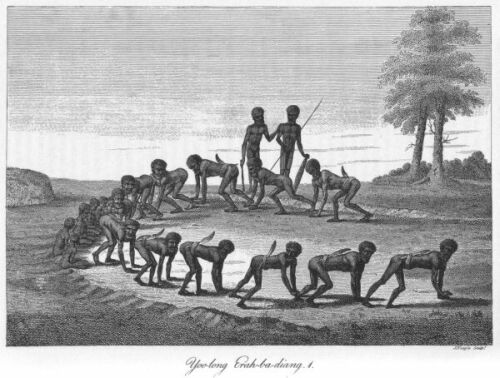
Yoo-long Erah-ba-diang, No. 1
We understood that by this ceremony power over the dog was given to them, and that it endowed them with whatever good or beneficial qualities that animal might possess.
The dogs of this country are of the jackal species; they never bark; are of two colours, the one red with some white about it; the other quite black. They have an invincible predilection for poultry, which the severest beatings could never repress. Some of them are very handsome.
No. 2 Represents the young men seated as before. The first figure in the plate is a stout robust native, carrying on his shoulders a pat-ta-go-rang or kangaroo made of grass; the second is carrying a load of brush-wood. The other figures, seated about, are singing, and beating time to the steps of the two loaded men, who appeared as if they were almost unable to move under the weight of the burthen which they carried on their shoulders. Halting every now and then, and limping, they at last deposited their load at the feet of the young men, and retired from the Yoo-lahng as if they were excessively fatigued by what they had done. It must be noticed, that the man who carried the brush-wood had thrust one or two flowering shrubs through the septum nasi. He exhibited an extraordinary appearance in this scene.
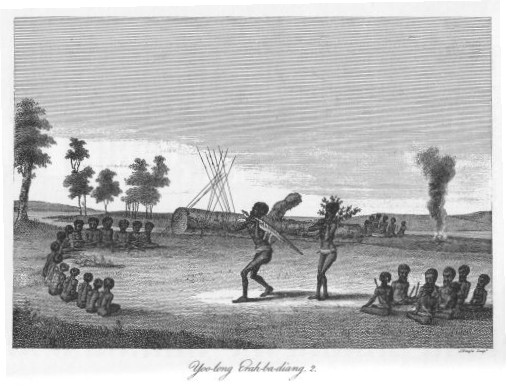
Yoo-long Erah-ba-diang, No. 2
By this offering of the dead kangaroo was meant the power that was now given them of killing that animal; the brush-wood might represent its haunt.
No. 3 The boys were left seated at the Yoo-lahng for about half an hour; during which the actors went down into a valley near the place, where they fitted themselves with long tails made of grass, which they fastened to the hinder part of their girdles, instead of the sword, which was laid aside during the scene. Being equipped, they put themselves in motion as a herd of kangaroos, now jumping along, then lying down and scratching themselves, as those animals do when basking in the sun. One man beat time to them with a club on a shield, while two others armed, attended them all the way, pretending to steal upon them unobserved and spear them.
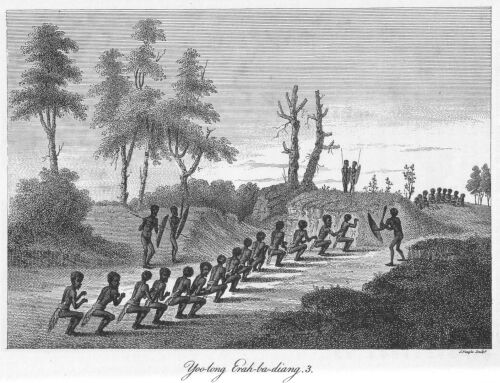
Yoo-long Erah-ba-diang, No. 3
This was emblematical of one of their future exercises, the hunting of the kangaroo.
The scene was altogether whimsical and curious; the valley where they equipped themselves was very romantic, and the occasion extraordinary and perfectly novel.
No. 4 On the arrival of this curious party at the Yoo-lahng, it passed by the boys, as the herd of Kangaroo, and then quickly divesting themselves of their artificial tails, each man caught up a boy, and, placing him on his shoulders, carried him off in triumph toward the last scene of this extraordinary exhibition.
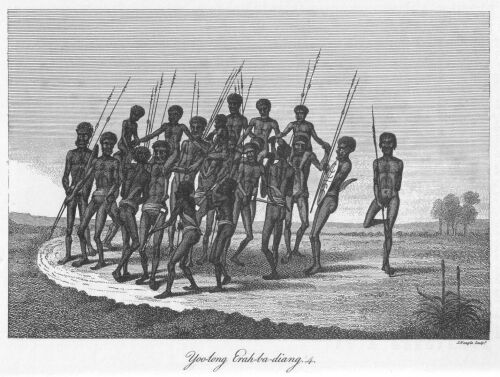
Yoo-long Erah-ba-diang, No. 4
It must be remarked, that the friends and relations of the young people by no means interfered, nor attempted to molest the north shore natives in the execution of their business.
No. 5 After walking a short distance, the boys were let down from the shoulders of the men, and placed in a cluster, standing with their heads inclined on their breasts, and their hands clasped together. Some of the party disappeared for above ten minutes to arrange the figure of the next scene. I was not admitted to witness this business, about which they appeared to observe a greater degree of mystery and preparation than I had noticed in either of the preceding ceremonies. We were at length desired to come forward, when we found the figures as placed in the plate No. 5.
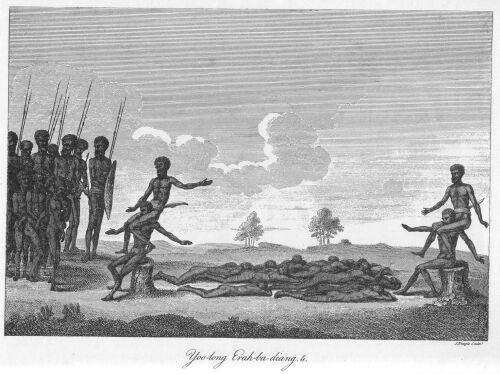
Yoo-long Erah-ba-diang, No. 5
The group on the left are the boys and those who attended them; fronting them were seen two men, one seated on the stump of a tree bearing another man on his shoulders, both with their arms extended: behind these were seen a number of bodies lying with their faces toward the ground, as close to each other as they could lie, and at the foot of another stump of a tree, on which were placed two other figures in the same position as the preceding.
As the boys and their attendants approached the first of these figures, the men who formed it began to move themselves from side to side, lolling out their tongues, and staring as wide and horribly with their eyes as they could open them. After this mummery had continued some minutes, the men separated for them to pass, and the boys were now led over the bodies lying on the ground. These immediately began to move, writhing as if in agony, and uttering a mournful dismal sound, like very distant thunder. Having passed over these bodies, the boys were placed before the second figures, who went through the same series of grimaces as those who were seated on the former stump; after which the whole moved forward.
A particular name, boo-roo-moo-roong, was given to this scene; but of its import I could learn very little. I made much inquiry; but could never obtain any other answer, than that it was very good; that the boys would now become brave men; that they would see well, and fight well.
No. 6 At a little distance from the preceding scene the whole party halted; the boys were seated by each other, while opposite to them were drawn up in a half circle the other party, now armed with the spear and the shield. In the centre of this party, with his face toward them, stood Boo-der-ro, the native who had throughout taken the principal part in the business. He held his shield in one hand, and a club in the other, with which he gave them, as it were, the time for their exercise. Striking the shield with the club, at every third stroke the whole party poised and presented their spears at him, pointing them inwards, and touching the centre of his shield.
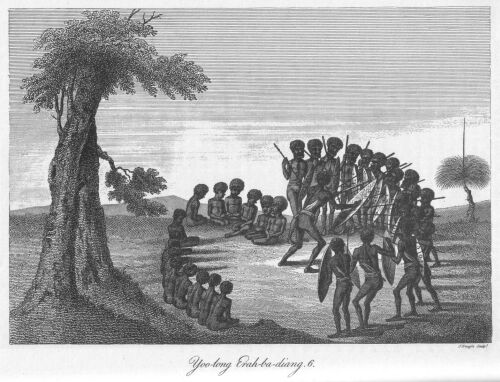
Yoo-long Erah-ba-diang, No. 6
This concluded the ceremonies previous to the operation; and it appeared significant of an exercise which was to form the principal business of their lives, the use of the spear.
No. 7 They now commenced their preparations for striking out the tooth. The first subject they took out was a boy of about ten years of age: he was seated on the shoulders of another native who sat on the grass, as appears in this Plate.
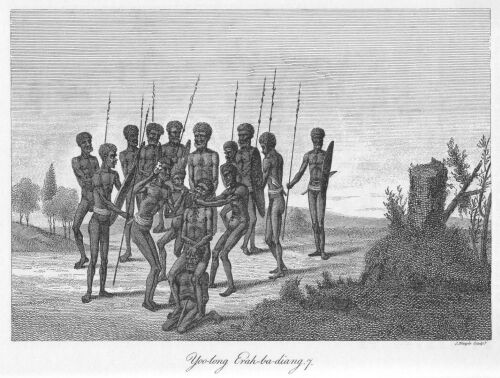
Yoo-long Erah-ba-diang, No. 7
The bone was now produced which had been pretended to be taken from the stomach of the native the preceding evening; this, being made very sharp and fine at one end, was used for lancing the gum, and but for some such precaution it would have been impossible to have got out the tooth without breaking the jaw-bone. A throwing-stick was now to be cut about eight or ten inches from the end; and to effect this, much ceremony was used. The stick was laid upon a tree, and three attempts to hit it were made before it was struck. The wood being very hard, and the instrument a bad tomahawk, it took several blows to divide it; but three feints were constantly made before each stroke. When the gum was properly prepared, the operation began; the smallest end of the stick was applied as high up on the tooth as the gum would admit of, while the operator stood ready with a large stone apparently to drive the tooth down the throat of his patient. Here their attention to the number three was again manifest; no stroke was actually made until the operator had thrice attempted to hit the throwing-stick. They were full ten minutes about this first operation, the tooth being, unfortunately for the boy, fixed very firm in the gum. It was at last forced out, and the sufferer was taken away to a little distance, where the gum was closed by his friends, who now equipped him in the style he was to appear in for some days. A girdle was tied round his waist, in which was stuck a wooden sword; a ligature was put round his head, in which were stuck slips of the grass-gum tree, which, being white, had a curious and not unpleasing effect. The left hand was to be placed over the mouth, which was to be kept shut; he was on no account to speak; and for that day he was not to eat.
In like manner were all the others treated, except one, a pretty boy about eight or nine years of age, who, after suffering his gum to be lanced, could not endure the pain of more than one blow with the stone, and breaking from them made his escape.
During the whole of the operation the assistants made the most hideous noise in the ears of the patients*, sufficient to distract their attention, and to drown any cries they could possibly have uttered; but they made it a point of honour to bear the pain without a murmur.
[* Crying e-wah e-wah, ga-ga ga-ga, repeatedly.]
Some other peculiarities, however, were observed. The blood that issued from the lacerated gum was not wiped away, but suffered to run down the breast, and fall upon the head of the man on whose shoulders the patient sat, and whose name was added to his. I saw them several days afterwards, with the blood dried upon the breast. They were also termed Ke-bar-ra, a name which has reference in its construction to the singular instrument used on this occasion, Ke-bah in their language signifying a rock or stone. I heard them several months after address each other by this significant name.
No. 8 This Plate represents the young men arranged and sitting upon the trunk of a tree, as they appeared in the evening after the operation was over. The man is Cole-be, who is applying a broiled fish to his relation Nan-bar-ray's gum, which had suffered from the stroke more than any of the others.
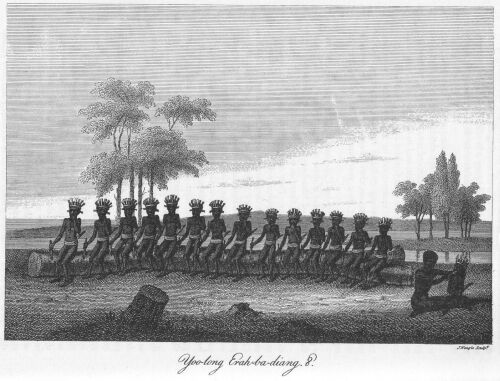
Yoo-long Erah-ba-diang, No. 8.
Suddenly, on a signal being given, they all started up, and rushed into the town, driving before them men, women, and children, who were glad to get out of their way. They were now received into the class of men; were privileged to wield the spear and the club, and to oppose their persons in combat. They might now also seize such females as they chose for wives.
All this, however, must be understood to import, that by having submitted to the operation, having endured the pain of it without a murmur, and having lost a front tooth, they received a qualification which they were to exercise whenever their years and their strength should be equal to it.
Bennillong's sister, and Da-ring-ha, Cole-be's wife, hearing me express a great desire to be possessed of some of these teeth, procured three of them for me, one of which was that of Nan-bar-ray, Cole-be's relation.
I found that they had fastened them to pieces of small line, and were wearing them round their necks. They were given to me with much secrecy and great dread of being observed, and with an injunction that I should never let it be known that they had made me such a present, as the Cam-mer-ray tribe, to whom they were to be given, would not fail to punish them for it; and they added that they should tell them the teeth were lost. Nan-bar-ray's tooth Da-ring-ha wished me to give to Mr. White, the principal surgeon of the settlement, with whom the boy had lived from his being brought into it, in the year 1789, to Mr. White's departure; thus with gratitude remembering, after the lapse of some years, the attention which that gentleman had shown to her relative.
Having remained with them while the operation was performed on three or four of the boys, I went into town, and returned after sun-set, when I found the whole equipped and seated on the trunk of the tree, as described in the Plate. It was then that I received the three teeth, and was conjured by the women to leave the place, as they did not know what might ensue. In fact, I observed the natives arming themselves; much confusion and hurry was visible among them; the savage appeared to be predominating; perhaps the blood they had drawn, and which was still wet on the heads and breasts of many of them, began to make them fierce; and, when I was on the point of retiring, the signal was given, which animated the boys to the first exercise of the spirit which the business of the day had infused into them, (for I have no doubt that their young bosoms were warmed by the different ceremonies which they had witnessed, of which they had indeed been something more than mere spectators, and which they knew had been exhibited wholly on their account,) and they rushed into the town in the manner before described, every where as they passed along setting the grass on fire.
On showing the teeth to our medical gentleman there, and to others since my return to England, they all declared that they could not have been better extracted, had the proper instrument been used, instead of the stone and piece of wood.
On a view of all these circumstances, I certainly should not consider this ceremony in any other light than as a tribute, were I not obliged to hesitate, by observing that all the people of Cam-mer-ray, which were those who exacted the tooth, were themselves proofs that they had submitted to the operation. I never saw one among them who had not lost the front tooth. I well recollect Bennillong, in the early period of our acquaintance with him and his language, telling us, as we then thought, that a man of the name of Cam-mer-ra-gal wore all the teeth about his neck. But we afterwards found that this term was only the distinguishing title of the tribe which performed the ceremonies incident to the operation. Bennillong at other times told us, that his own tooth was bour-bil-liey pe-mul, buried in the earth, and that others were thrown into the sea. It is certain, however, that my female friends, who gave me the teeth, were very anxious that the gift should not come to the knowledge of the men of Cam-mer-ray, and repeatedly said that they were intended for them.
In alluding to this ceremony, whether by pointing to the vacancy occasioned by the lost tooth, or by adverting to any of the curious scenes exhibited on the occasion, the words Yoo-lahng erah-ba-diahng were always used; but to denote the loss of any other tooth the word bool-bag-ga was applied. The term Yoo-lahng erah-ba-diahng must therefore be considered as applying solely to this extraordinary occasion; it appears to be compounded of the name given to the spot where the principal scenes take place, and of the most material qualification that is derived from the whole ceremony, that of throwing the spear. I conceive this to be the import of the word erah-ba-diahng, erah being a part of the verb to throw, erah, throw you, erailley, throwing.
Being thus entered on 'the valued file,' they quickly assume the consequence due to the distinction, and as soon as possible bring their faculties into action. The procuring of food really seems to be but a secondary business with them; the management of the spear and the shield, dexterity in throwing the various clubs they have in use among them, agility in either attacking or defending, and a display of the constancy with which they endure pain, appearing to rank first among their concerns in life. The females too are accustomed to bear on their heads the traces of the superiority of the males, with which they dignify them almost as soon as they find strength in the arm to imprint the mark. We have seen some of these unfortunate beings with more scars upon their shorn heads, cut in every direction, than could be well distinguished or counted. The condition of these women is so wretched, that I have often, on seeing a female child borne on its mother's shoulders, anticipated the miseries to which it was born, and thought it would be a mercy to destroy it. Notwithstanding, however, that they are the mere slaves of the men, I have generally found, in tracing the causes of their quarrels, that the women were at the head of them, though in some cases remotely. They mingled in all the contests of the men; and one of these, that was in the beginning attended with some ceremony, was opened by a woman:
We had been told for some days of their making great preparations for a fight, and gladly heard that they had chosen a clear spot near the town for the purpose. The contending parties consisted of most of our Sydney acquaintance, and some natives from the south shore of Botany Bay, among whom was Gome-boak, already mentioned in Chapter XXVIII ["About the latter end of the month . . ."]. We repaired to the spot an hour before sun-set, and found them seated opposite each other on a level piece of ground between two hills. As a prelude to the business, we observed our friends, after having waited some time, stand up, and each man stooping down, take water in the hollow of his hand (the place just before them being wet) which he drank. An elderly woman with a cloak on her shoulders (made of opossum skins very neatly sewn together) and provided with a club, then advanced from the opposite side, and, uttering much abusive language at the time, ran up to Cole-be, who was on the right, and gave him what I should have considered a severe blow on the head, which with seeming contempt he held out to her for the purpose. She went through the same ceremony with the rest, who made no resistance, until she came up to Ye-ra-ni-be, a very fine boy, who stood on the left. He, not admiring the blows that his companions received, which were followed by blood, struggled with her, and had he not been very active, I believe she would have stabbed him with his own spear, which she wrested from him. The men now advanced, and gave us many opportunities of witnessing the strength and dexterity with which they threw their spears, and the quickness of sight which was requisite to guard against them. The contest lasted until dark, when throwing the spear could no longer be accounted fair, and they beat each other with clubs, until they left off by mutual consent. In this part of the contest many severe wounds were given, and much blood was drawn from the heads of each party; but nothing material happened while they had light enough to guard against the spear.
In the exercise of this weapon they are very expert. I have seen them strike with certainty at the distance of seventy measured yards. They are thrown with great force, and where they are barbed are very formidable instruments. The wo-mer-ra, or throwing-stick, is always made use of on such occasions. This is a stick about three feet long, with a hook at one end (and a shell at the other, secured by gum), to receive which there is a small hole at the head of the spear. Both are held in the right hand. the fingers of which are placed, two above the throwing-stick, and two between it and the spear, at about the distance of two feet from the hook. After poising it for some time, and measuring with the eye the distance from the object to be thrown at, the spear is discharged, the throwing-stick remaining in the hand. Of these instruments there are two kinds; the one, named Wo-mer-ra, is armed with the shell of a clam, which they term Kah-dien, and which they use for the same purposes that we employ a knife. The other, which they name Wig-goon, has a hook, but no shell, and is rounded at the end. With this they dig the fern-root and yam out of the earth, and it is formed of heavy wood, while the wo-mer-ra is only part of a wattle split. They have several varieties of spears, every difference in them being distinguished by a name. Some are only pointed; others have one or more barbs, either shaped from the solid piece of wood of which the spear is made, or fastened on with gum; and some are armed with pieces of broken oyster-shell for four or five inches from the point, and secured by gum. All these barbed spears are dangerous, from the difficulty of extracting them. Of shields they have but two sorts. One, named E-lee-mong, is cut from the bark of the gum tree, and is not so capable of resisting the spear as the Ar-rah-gong, which is formed of solid wood, and hardened by fire. This shield is not so much in use as the e-lee-mong, as I imagine from its greater weight, and perhaps also from the superior difficulty they meet with in procuring it. Of clubs they use several sorts, some of which are of very large dimensions. They have one, the head of which is flat, with a sharp point in the centre. The flat part is painted with red and white stripes from the centre, and does not look unlike what they term it, Gnal-lung-ul-la, the name given by them to a mushroom. They have yet another instrument, which they call Ta-war-rang. It is about three feet long, is narrow, but has three sides, in one of which is the handle, hollowed by fire. The other sides are rudely carved with curved and waved lines, and it is made use of in dancing, being struck upon for this purpose with a club. An instrument very common among them must not be omitted in this account of their weapons of hostility, for such, I fear, some of our miserable straggling convicts have found it to their cost, though it generally is applied to more peaceful purposes. This is the Mo-go*, or stone-hatchet. The stone is found in the shallows at the upper part of the Hawkesbury, and a handle being fixed round the head of it with gum, the under part is brought by friction to an edge fine enough to divide the bark of such trees as they take their canoes or hunters huts from, and even the shields which are cut from the body of the tree itself. There is no doubt of their readily applying this as a weapon, when no other offers to their necessities.
[* A representation of this and other instruments is given in Plate 11.]
It must be observed, that the principal tribes have their peculiar weapons. Most of us had made collections of their spears, throwing-sticks, etc. as opportunities occurred; and on showing them to our Sydney friends, they have told us that such a one was used by the people who lived to the southward of Botany Bay; that another belonged to the tribe of Cam-mer-ray. The spear of the wood tribes, Be-dia-gal, Tu-ga-gal, and Boo-roo-bir-rong-gal, were known from being armed with bits of stone, instead of broken oyster-shells. The lines worn round the waist by the men belonged to a peculiar tribe, and came into the hands of others either by gift or plunder. The nets used by the people of the coast for carrying their fish, lines, etc differed in the mesh from those used by the wood natives; and they extend this peculiarity even to their dances, their songs, and their dialect.
Among other customs which these people invariably practise, is one that is highly deserving of notice, as it carries with it some idea of retributive justice.
The shedding of blood is always followed by punishment, the party offending being compelled to expose his person to the spears of all who choose to throw at him; for in these punishments the ties of consanguinity or friendship are of no avail. On the death of a person, whether male or female, old or young, the friends of the deceased must be punished, as if the death were occasioned by their neglect. This is sometimes carried farther than there seems occasion for, or than can be reconcilable with humanity.
After the murder of Yel-lo-way by Wat-te-wall his widow Noo-roo-ing being obliged, according to the custom of her country, to avenge her husband's death on some of the relations of the murderer, meeting with a little girl named Go-nang-goo-lie, who was some way related to Wat-te-wal, walked with her and two other girls to a retired place, where with a club and a pointed stone they beat her so cruelly, that she was brought into the town almost dead. In the head were six or seven deep incisions, and one ear was divided to the bone, which, from the nature of the instrument with which they beat her, was much injured. This poor child was in a very dangerous way, and died in a few days afterwards. The natives to whom this circumstance was mentioned expressed little or no concern at it, but seemed to think it right, necessary, and inevitable; and we understood that whenever women have occasion for this sanguinary revenge, they never exercise it but on their own sex, not daring to strike a male. Noo-roo-ing, perceiving that her treatment of Go-nang-goo-lie did not meet our approbation, denied having beaten her, and said it was the other girls; but such men as we conversed with on the subject assured us it was Noo-roo-ing, and added, that she had done no more than what custom obliged her to. The little victim of her revenge was, from her quiet tractable manners, much beloved in the town; and what is a singular trait of the inhumanity of this proceeding, she had every day since Yel-loway's death requested that Noo-roo-ing might be fed at the officer's hut, where she herself resided. Savage indeed must be the custom and the feelings which could arm the hand against this child's life! Her death was not avenged, perhaps because they considered it as an expiatory sacrifice.
Wat-te-wal, who committed the crime for which this little girl suffered so cruelly, escaped unhurt from the spears of Bennillong, Cole-be, and several other natives, and was afterwards received by them as usual, and actually lived with this very woman for some time, till he was killed in the night by Cole-be, as before related.
This Wat-te-wal was in great union with Bennillong, who twice denied his having committed offences which he knew would forfeit our favour. In this last instance Bennillong betrayed more duplicity than we had given him credit for. On asking him with some earnestness if Wat-te-wal had killed Yel-loway, he assured us with much confidence that it was not Wat-te-wal who had killed him, but We-re-mur-rah. Little did we suspect that our friend had availed himself of a circumstance which he knew we were unacquainted with, that Wat-te-wal had more than one name. By giving us the second, he saved his friend, and knew that he could at all times boldly maintain that he had not concealed his name from us, We-re-murrah being as much his name as Wat-te-wal, though we had never known him by it. On apprising him some time afterwards, that we had discovered his artifice, and that it was a meanness we did not expect from him, he only laughed and went away.
The violent death of Yel-lo-way we have seen followed by a cruel proceeding, which terminated in the death of the murderer's relation, Go-nang-goolie. I shall now show what followed where the person died a natural death.
Bone-da, a very fine youth, who lived at my house for several months, died of a cold, which, settling in his face, terminated in a mortification of his upper and lower jaws, and carried him off. We were told that some blood must be spilt on this occasion; but six weeks elapsed before we heard of any thing having happened in consequence of his decease. About that time having passed, however, we heard that a large party of natives belonging to different tribes, being assembled at Pan-ner-rong* (or, as it is named with us, Rose Bay), the spot which they had often chosen for shedding blood, after dancing and feasting over-night, early in the morning, Mo-roo-ber-ra, the brother, and Cole-be, another relation of Bone-da, seized upon a lad named Tar-ra-bil-long, and with a club each gave him a wound in his head, which laid the skull bare. Dar-ring-ha, the sister of Bone-da, had her share in the bloody rite, and pushed at the unoffending boy with a doo-ull or short spear. He was brought into the town and placed at the hospital, and, though the surgeon pronounced from the nature of his wounds that his recovery was rather doubtful, he was seen walking about the day following. On being spoke to about the business, he said he did not weep or cry out like a boy, but like a man cried Ki-yah when they struck him; that the persons who treated him in this unfriendly manner were no longer his enemies, but would eat or drink or sit with him as friends