Volume 1 — CHAPTER XXXII (continued 3)
Reading edition
[* Pan-ner-rong in the language of the country signifies Blood.]
Three or four days after this, Go-roo-bine, a grey-headed man, apparently upwards of sixty years of age, who was related to Bone-da, came in with a severe wound on the back part of his head, given him on account of the boy's decease; neither youth nor old age appearing to be exempted from those sanguinary customs.
When Ba-rang-a-roo, Bennillong's wife, died, several spears were thrown by the men at each other, by which many were wounded; and Bennillong had a severe contest with Wil-le-mer-ring, whom he wounded in the thigh. He had sent for him as a car-rah-dy to attend her when she was ill; but he either could not or would not obey the summons. Bennillong had chosen the time for celebrating these funeral games in honour of his deceased wife when a whale feast had assembled a large number of natives together, among whom were several people from the northward, who spoke a dialect very different to that with which we were acquainted.
Some officers happening once to be present in the lower part of the harbour when a child died, perceived the men immediately retire, and throw their spears at one another with much apparent anger, while the females began their usual lamentations.
When Dil-boong, Bennillong's infant child, died, several spears were thrown, and Bennillong, at the decease of her mother, said repeatedly, that he should not be satisfied until he had sacrificed some one to her manes.
Ye-ra-ni-be Go-ru-ey having beaten a young woman, the wife of another man, and she having some time after exchanged a perilous and troublesome life for the repose and quiet of the grave, a contest ensued some days after, on account of her decease, between Bennillong and Go-ru-ey, and between the husband and Go-ru-ey, by both of whom he was wounded. Bennillong drove a spear into his knee, and the husband another into his left buttock. This wound he must have received by failing to catch the spear on his shield, and turning his body to let it pass beside him; other spears were thrown, but he alone appeared to be the victim of the day. Signifying a wish to have his wounds dressed by the surgeon, he was in the evening actually brought up to the hospital by the very man who had wounded him.
The bay named Pan-ner-rong was the scene of this extraordinary transaction.
Not a long time before I left the country, I witnessed another contest among them, which was attended with some degree of ceremony. The circumstance was this. A native of the Botany Bay district, named Collindiun, having taken off by force Go-roo-boo-roo-bal-lo, the former wife of Bennillong, but now the wife of Car-ru-ey, and carried her up the harbour, Car-ru-ey with his relation Cole-be, in revenge, stole upon this Collindiun one night while he lay asleep, and each fixed a spear in him. The wounds, though deep and severe, yet did not prove mortal, and on his recovery he demanded satisfaction. He came accompanied by a large party of natives from the south shore of Botany Bay, and rather reluctantly, for he had wished the business to be decided there, rather than among Car-ru-ey's friends, as many of his associates in arms were entire strangers to us. Thirsting after revenge, however, he was prevailed with to meet him on his own ground, and the Yoo-lahng formerly used for a different purpose was the place of rendezvous.
At night they all danced, that is to say, both parties, but not mixed together; one side waiting until the other had concluded their dance. In the manner of dancing, of announcing themselves as ready to begin, and also in their song, there was an evident difference.
Our friends appeared to have some apprehension of the event not proving favourable to them; for perceiving an officer there with a gun, Car-ru-ey strenuously urged him, if any thing should happen to him, to shoot the Botany Bay black fellows. The women, to induce us to comply with his request, told us that some of the opposite party had said they would kill Car-ru-ey. Some other guns making their appearance, the strangers were alarmed and uneasy, until assured that they were intended merely for our own security.
The time for this business was just after ten in the forenoon. We found Car-ru-ey and Cole-be seated at one end of the Yoo-lahng, each armed with a spear and throwing-stick, and provided with a shield. Here they were obliged to sit until some one of their opponents got up; they also then arose and put themselves en garde. Some of the spears which were thrown at them they picked up and threw back; and others they returned with extraordinary violence.
The affair was over before two o'clock; and, what was remarkable, we did not hear of any person being wounded. We understood, however, that this circumstance was to produce another meeting.
In this as in all the contests I ever witnessed among them, the point of honour was rigidly observed. But spears were not the only instruments of warfare on these occasions. They had also to combat with words, in which the women sometimes bore a part. During this latter engagement I have seen them, when any very offensive word met their ears, suddenly place themselves in the attitude of throwing the spear, and at times let it drop on the ground without discharging; and others threw it with all their strength; but always scrupulously observing the situation of the person opposed, and never throwing at him until he covered himself with his shield. The most unaccountable trait in this business was, the party thrown at providing his enemy with weapons; for they have been repeatedly seen, when a spear has flown harmless beyond them, to pick it up and fling it carelessly back to their adversary. This might proceed from contempt, or from there being a scarcity of spears; and I have thought that when, instead of flinging it carelessly back, they have thrown it with much violence, it was because it had been thrown at them with a greater visible degree of malevolence than the others.
This rigid attention to the point of honour, when fairly opposed to each other, is difficult to reconcile with their treacherous and midnight murders.
Their mode of retaliating an insult or injury was extraordinary. Children, if when at play they received a blow or a push, resented it by a blow or a push of equal force to that which they felt. This retaliating spirit appeared also among the men, of a remarkable instance of which several of us were witnesses. A native of the name of Bur-ro-wan-nie had some time before been beaten by two natives of the tribe of Gwe-a, at the head of Botany Bay. One of these being fixed on, he was in return to be beaten by Bur-ro-wan-nie. For this purpose a large party attended over-night at the head of the stream near the settlement to dance; at which exercise they continued from nine till past twelve o'clock. The man who was to be beaten danced with the rest until they ceased, and then laid himself down among them to sleep. Early in the morning, while he was yet on the ground, and apparently asleep at the foot of a tree, Cole-be and Bur-ro-wan-me, armed each with a spear and a club, rushed upon him from among some trees. Cole-be made a push at him with his spear, but did not touch him, while the other, Bur-ro-wan-me, struck him with his club two severe blows on the hinder part of the head. The noise they made, if he was alseep, awaked him; and when he was struck, he was on his legs. He was perfectly unarmed, and hung his head in silence while Cole-be and his companion talked to him. No more blows were given, and Bennillong, who was present, wiped the blood from the wounds with some grass. As a proof that Bur-ro-wan-nie was satisfied with the redress he had taken, we saw him afterwards walking in the town with the object of his resentment, who, on being asked, said Bur-ro-ween-nie was good; and during the whole of the day, wheresoever he was seen, there also was this poor wretch with his breast and back covered with dried blood; for, according to the constant practice of his countrymen, he had not washed it off. In the evening I saw him with a ligature fastened very tight round his head, which certainly required something to alleviate the pain it must have endured.
In some of these contests they have been seen on the field of battle attended by a person who appeared to be the friend of both parties. In a single combat which Mo-roo-ber-ra had with Bennillong, they were attended by Cole-be, who took a position on one side about half-way between them, armed with a spear and throwing-stick, but unprovided with a shield. This I saw he frequently shook, and talked a great deal, but never threw it. While in this situation he was styled Ca-bah-my.
I had long wished to be a witness of a family party, in which I hoped and expected to see them divested of that restraint which perhaps they might put on in our houses. I was one day gratified in this wish when I little expected it. Having strolled down to the Point named Too-bow-gu-lie, I saw the sister and the young wife of Bennillong coming round the Point in the new canoe which the husband had cut in his last excursion to Parramatta. They had been out to procure fish, and were keeping time with their paddles, responsive to the words of a song, in which they joined with much good humour and harmony. They were almost immediately joined by Bennillong, who had his sister's child on his shoulders. The canoe was hauled on shore, and what fish they had caught the women brought up. I observed that the women seated themselves at some little distance from Bennillong, and then the group was thus disposed of--the husband was seated on a rock, preparing to dress and eat the fish he had just received. On the same rock lay his pretty sister War-re-weer asleep in the sun, with a new born infant in her arms; and at some little distance were seated, rather below him, his other sister and his wife, the wife opening and eating some rock-oysters, and the sister suckling her child, Kah-dier-rang, whom she had taken from Bennillong. I cannot omit mentioning the unaffected simplicity of the wife: immediately on her stepping out of her canoe, she gave way to the pressure of a certain necessity, without betraying any of that reserve which would have led another at least behind the adjoining bush. She blushed not, for the cheek of Go-roo-bar-roo-bool-lo was the cheek of rude nature, and not made for blushes. I remained with them till the whole party fell asleep.
They have great difficulty in procuring fire, and are therefore seldom seen without it. Bennillong, or some other native, once showed me the process of procuring it. It is attended with infinite labour, and is performed by fixing the pointed end of a cylindrical piece of wood into a hollow made in a plane: the operator twirling the round piece swiftly between both his hands, sliding them up and down until fatigued, at which time he is relieved by another of his companions, who are all seated for this purpose in a circle, and each one takes his turn until fire is procured.
Most of their instruments are ornamented with rude carved-work, effected with a piece of broken shell, and on the rocks I have seen various figures of fish, clubs, swords, animals, and even branches of trees, not contemptibly represented.
APPENDIX VII--SUPERSTITION
Like all other children of ignorance, these people are the slaves of superstition.
I think I may term the car-rah-dy their high priest of superstition. The share they had in the tooth-drawing scenes was not the only instance, that induced me to suppose this. When Cole-be accompanied Governor Phillip to the banks of the Hawkesbury, he met with a car-rah-dy, Yel-lo-mun-dy, who, with much gesticulation and mummery, pretended to extract the barbs of two spears from his side, which never had been left there, or, if they had, required rather the aid of the knife than the incantations of Yel-lo-mun-dy to extract them; but his patient was satisfied with the car-rah-dy's efforts to serve him, and thought himself perfectly relieved.
During the time that Boo-roong lived at the clergyman's house she paid occasional visits to the lower part of the harbour. From one of these she returned extremely ill. On questioning her as to the cause, for none was apparent, she told us that the women of Cam-mer-ray had made water in a path which they knew she was to cross, and it had made her ill. These women were inimical to her, as she belonged to the Botany Bay district. On her intimating to them that she found herself ill, they told her triumphantly what they had done. Not recovering, though bled in the arm by Mr. White, she underwent an extraordinary and superstitious operation, where the operator suffers more than the patient. She was seated on the ground, with one of the lines worn by the men passed round her head once, taking care to fix the knot in the centre of her forehead; the remainder of the line was taken by another girl, who sat at a small distance from her, and with the end of it fretted her lips until they bled very copiously; Boo-roong imagining all the time that the blood came from her head, and passed along the line until it ran into the girl's mouth, whence it was spit into a small vessel which she had beside her, half filled with water, and into which she occasionally dipped the end of the line. This operation they term be-an-ny, and is the peculiar province of the women.
Another curious instance of their superstition occurred among some of our people belonging to a boat that was lying wind-bound in the lower part of the harbour. They had procured some shell-fish, and during the night were preparing to roast them, when they were observed by one of the natives, who shook his head and exclaimed, that the wind for which they were waiting would not rise if they roasted the fish. His argument not preventing the sailors from enjoying their treat, and the wind actually proving foul, they, in their turn, gave an instance of superstition by abusing the native, and attributing to him the foul wind which detained them. On questioning Ye-ra-ni-be respecting this circumstance, he assured me that the natives never broil fish by night.
In a reach of the Hawkesbury, about midway up some high land, stands a rock which in its form is not unlike a sentry-box. Respecting this rock, they have a superstitious tradition, that while some natives were one day feasting under it, some of the company whistling, it happened to fall from a great height, and crushed the whole party under its weight. For this reason they make it an invariable rule never to whistle under a rock.
Among their other superstitions was one which might be naturally expected from their ignorance, a belief in spirits.
Of this belief we had at different times several accounts. Bennillong, during his first acquaintance with us, described an apparition as advancing to a person with an uncommon noise, and seizing hold of him by the throat. It came slowly along with its body bent, and the hands held together in a line with the face, moving on till it seized the party it meant to visit. We were told by him and others, and that after we understood each other, that by sleeping at the grave of a deceased person, they would, from what happened to them there, be freed from all future apprehensions respecting apparitions; for during that awful sleep the spirit of the deceased would visit them, seize them by the throat, and, opening them, take out their bowels, which they would replace and close up the wound. We understood that very few chose to encounter the darkness of the night, the solemnity of the grave, and the visitation of the spirit of the deceased; but that such as were so hardy became immediately car-rah-dys, and that all those who exercised that profession had gone through this ceremony.
It is very certain, that even in the day-time they were strangely unwilling to pass a grave; but I believe that their tale of being seized by the throat by a ghost was nothing more than their having felt the effects of what we term the night-mare during an uneasy sleep.
To the shooting of a star they attach a degree of importance; and I once, on an occasion of this kind, saw the girl Boo-roong greatly agitated, and prophesying much evil to befal all the white men and their habitations.
Of thunder and lightning they are also much afraid; but have an ideal that by chanting some particular words, and breathing hard, they can dispel it. Instances of this have been seen.
APPENDIX VIII--DISEASES
Their living chiefly on fish (I speak of those whom we found on the sea coast) produces a disorder which greatly resembles the itch; they term it Djee-ball djee-ball; and at one time, about the year 1791, there was not one of the natives, man, woman, nor child, that came near us, but was covered with it. It raged violently among them, and some became very loathsome objects.
The venereal disease also had got among them; but I fear our people have to answer for that; for though I believe none of our women had connection with then, yet there is no doubt but that several of the black women had not scrupled to connect themselves with the white men. Of the certainty of this an extraordinary instance occurred. A native woman had a child by one of our people. On its coming into the world she perceived a difference in its colour; for which not knowing how to account, she endeavoured to supply by art what she found deficient in nature, and actually held the poor babe, repeatedly, over the smoke of her fire, and rubbed its little body with ashes and dirt, to restore it to the hue with which her other children had been born. Her husband appeared as fond of it as if it had borne the undoubted sign of being his own, at least so far as complexion could ascertain to whom it belonged. Whether the mother had made use of any address on the occasion, I never learned.
It was by no means ascertained whether the lues venerea had been among them before they knew us, or whether our people had to answer for having introduced that devouring plague. Thus far is certain, however, that they gave it a name, Goo-bah-rong; a circumstance that seems rather to imply a pre-knowledge of its dreadful effects.
In the year 1789 they were visited by a disorder which raged among them with all the appearance and virulence of the small-pox. The number that it swept off, by their own accounts, was incredible. At that time a native was living with us; and on our taking him down to the harbour to look for his former companions, those who witnessed his expression and agony can never forget either. He looked anxiously around him in the different coves we visited; not a vestige on the sand was to be found of human foot; the excavations in the rocks were filled with the putrid bodies of those who had fallen victims to the disorder; not a living person was any where to be met with. It seemed as if, flying from the contagion, they had left the dead to bury the dead. He lifted up his hands and eyes in silent agony for some time; at last he exclaimed, 'All dead! all dead!' and then hung his head in mournful silence, which he preserved during the remainder of our excursion. Some days after he learned that the few of his companions who survived had fled up the harbour to avoid the pestilence that so dreadfully raged. His fate has been already mentioned. He fell a victim to his own humanity when Boo-roong, Nan-bar-ray, and others were brought into the town covered with the eruptions of the disorder. On visiting Broken Bay, we found that it had not confined its effects to Port Jackson, for in many places our path was covered with skeletons, and the same spectacles were to be met with in the hollows of most of the rocks of that harbour.
Notwithstanding the town of Sydney was at this time filled with children, many of whom visited the natives that were ill of this disorder, not one of them caught it, though a North-American Indian, a sailor belonging to Captain Ball's vessel, the Supply, sickened of it and died.
To this disorder they also gave a name, Gal-gal-la; and that it was the small-pox there was scarcely a doubt; for the person seized with it was affected exactly as Europeans are who have that disorder; and on many that had recovered from it we saw the traces, in some the ravages of it on the face.
As a proof of the numbers of those miserable people who were carried off by this disorder, Bennillong told us, that his friend Cole-be's tribe being reduced by its effects to three persons, Cole-be, the boy Nan-bar-ray, and some one else, they found themselves compelled to unite with some other tribe, not only for their personal protection, but to prevent the extinction of their tribe. Whether this incorporation ever took place I cannot say; I only know that the natives themselves, when distinguishing between this man and another of the same name at Botany Bay, always styled him Cad-i Cole-be; Cad-i being the name of his district; and Cole-be, when he came into the field some time after, appeared to be attended by several very fine boys who kept close by his side, and were of his party.
Whenever they feel a pain, they fasten a tight ligature round the part, thereby stopping the circulation, and easing the part immediately affected. I have before mentioned the quickness with which they recovered from wounds; but I have even known them get the better in a short time of a fractured skull. That their skulls should be fractured will be no wonder, when it is recollected that the club seems to be applied alone to the head. The women who are struck with this weapon always fall to the ground; but this seldom happens to the men though the blows are generally more severe.
APPENDIX IX--PROPERTY
Their spears and shields, their clubs and lines, etc are their own property; they are manufactured by themselves, and are the whole of their personal estate. But, strange as it may appear, they have also their real estates. Bennillong, both before he went to England and since his return, often assured me, that the island Me-mel (called by us Goat Island) close by Sydney Cove was his own property; that it was his father's, and that he should give it to By-gone, his particular friend and companion. To this little spot he appeared much attached; and we have often seen him and his wife Ba-rang-a-roo feasting and enjoying themselves on it. He told us of other people who possessed this kind of hereditary property, which they retained undisturbed.
APPENDIX X--DISPOSITIONS
From the different circumstances that have been related of these people in the foregoing account, a general idea of their character and disposition may be gathered. They are revengeful, jealous, courageous, and cunning. I have never considered their stealing on each other in the night for the purposes of murder as a want of bravery, but have looked on it rather as the effect of the diabolical spirit of revenge, which thus sought to make surer of its object than it could have done if only opposed man to man in the field. Their conduct when thus opposed, the constancy with which they endured pain, and the alacrity with which they accepted a summons to the fight, are surely proofs of their not wanting courage. They disclaim all idea of any superiority that is not personal; and I remember when Bennillong had a shield, made of tin and covered with leather, presented to him by Governor Phillip, he took it with him down the harbour, whence he returned without it, telling us that he had lost it; but in fact it had been taken from him by the people of the north shore district and destroyed; it being deemed unfair to cover himself with such a guard.
They might have been honest before we came among them, not having much to covet from one another; but from us they often stole such things as we would not give them. While they pilfered what could gratify their appetites, it was not to be wondered at; but I have seen them steal articles of which they could not possibly know the use. Mr. White once being in the midst of a crowd of natives in the lower part of the harbour, one of them saw a small case of instruments in his pocket, which, watching an opportunity, he slyly stole, and ran away with; but, being observed, he was pursued and made to restore his prize. We were very little acquainted with them at this time, and therefore the native could not have known the contents of the case. Could he have been watched to his retreat, I have no doubt but he would have been seen to lay the case on his head, as an ornament, the place to which at first every thing we gave them was usually consigned.
That they are not strangers to the occasional practice of falsehood, is apparent from the words truth and falsehood being found in their language; but, independent of this, we had many proofs of their being adepts in the arts of evasion and lying; and I have seen them, when we have expressed doubts of some of their tales, assure us with much earnestness of the truth of their assertions; and when speaking to us of other natives they have as anxiously wished us to believe that they had told us lies.
Their talent for mimicry is very great. It was a favourite diversion with the children to imitate the peculiarities in any one's gait, and they would go through it with the happiest success.
They are susceptible of friendship, and capable of feeling sorrow; but this latter sensation they are not in the habit of encouraging long. When Ba-loo-der-ry, a very fine lad who died among us, was buried, I saw the tears streaming silently down the sable cheek of his father Mau-go-ran; but in a little time they were dried, and the old man's countenance indicated nothing but the lapse of many years which had passed over his head.
With attention and kind treatment, they certainly might be made a very serviceable people. I have seen them employed in a boat as usefully as any white person; and the settlers have found some among them, who would go out with their stock, and carefully bring home the right numbers, though they have not any knowledge of numeration beyond three or four.
Their acquaintance with astronomy is limited to the names of the sun and moon, some few stars, the Magellanic clouds, and the milky way. Of the circular form of the earth they have not the smallest idea, but imagine that the sun returns over their heads during the night to the quarter whence he begins his course in the morning.
As they never make provision for the morrow, except at a whale-feast, they always eat as long as they have any thing left to eat, and when satisfied, stretch themselves out in the sun to sleep, where they remain until hunger or some other cause calls them again into action. I have at times observed a great degree of indolence in their dispositions, which I have frequently seen the men indulge at the expence of the weaker vessel the women, who have been forced to sit in their canoe, exposed to the fervour of the mid-day sun, hour after hour, chanting their little song, and inviting the fish beneath them to take their bait; for without a sufficient quantity to make a meal for their tyrants, who were lying asleep at their ease, they would meet but a rude reception on their landing.
APPENDIX XI--FUNERAL CEREMONIES
The first peculiarity noticeable in their funeral ceremonies is the disposal of their dead; their young people they consign to the grave; those who have passed the middle age are burnt. Bennillong burnt the body of his first wife Ba-rang-a-roo, who, I suppose, was at the time of her decease turned fifty. I have attended them on both occasions. The interment of Ba-loo-der-ry was accompanied with many curious ceremonies. From being one day in apparent perfect health, he was brought in the next extremely ill, and attended by Bennillong, whom we found singing over him, and making use of those means which ignorance and superstition pointed out to him to recover his health. Ba-loo-der-ry lay extended on the ground, appearing to be in much pain. Bennillong applied his mouth to those parts of his patient's body which he thought were affected, breathing strongly on them, and singing: at times he waved over him some boughs dipped in water, holding one in each hand, and seemed to treat him with much attention and friendship. On the following morning he was visited by a car-rah-dy, who came express from the north shore. This man threw himself into various distortions, applied his mouth to different parts of his patient's body, and at length, after appearing to labour much, and to be in great pain, spit out a piece of a bone about an inch and a half long (which he had previously procured). Here the farce ended, and Ba-loo-der-ry's friends took the car-rah-dy with them and entertained him with such fare as they had to give him. He was at this time at our hospital; during the night his fever increased, and his friends, thinking he would be better with them, put him into a canoe, intending to take him to the north shore; but he died as they were carrying him over. This was immediately notified to us by a violent clamour among the women and children; and Bennillong soon after coming into the town, it was agreed upon between him and the governor that the body should be buried in the governor's garden.
In the afternoon it was brought over in a canoe, and deposited in a hut at the bottom of the garden, several natives attending, and the women and children lamenting and howling most dismally. The body was wrapped up in the jacket which he usually wore, and some pieces of blanketting tied round it with bines. The men were all armed, and, without any provocation, two of them had a contest with clubs; at the same time a few blows passed between some of the women. Boo-roong had her head cut by Go-roo-ber-ra, the mother of the deceased. Spears were also thrown, but evidently as part of a ceremony, and not with an intention of doing injury to any one. At the request of Bennillong, a blanket was laid over the corpse, and Cole-be his friend sat by the body all night, nor could he be prevailed on to quit it.
They remained rather silent till about one in the morning, when the women began to cry, and continued for some time. At daylight Bennillong brought his canoe to the place, and cutting it to a proper length, the body was placed in it, with a spear, a fiz-gig, a throwing-stick, and a line which Ba-loo-derry had worn round his waist. Some time was taken up in adjusting all this business, during which the men were silent, but the women, boys, and children uttered the most dismal lamentations. The father stood alone and unemployed, a silent observer of all that was doing about his deceased son, and a perfect picture of deep and unaffected sorrow. Every thing being ready, the men and boys all assisted in lifting the canoe with the body from the ground, and placing it on the heads of two natives, Collins and Yow-war-re. Some of the assistants had tufts of grass in their hands, which they waved backwards and forwards under the canoe, while it was lifting from the ground, as if they were exorcising some evil spirit. As soon as it was fixed on the heads of the bearers, they set off, preceded by Bennillong and another man, Wat-te-wal, both walking with a quick step towards the point of the cove where Bennillong's hut stood. Mau-go-ran, the father, attended them armed with his spear and throwing-stick, while Bennillong and Wat-te-wal had nothing in their hands but tufts of grass, which as they went they waved about, sometimes turning and facing the corpse, at others waving their tufts of grass among the bushes. When they fronted the corpse, the head of which was carried foremost, the bearers made a motion with their heads from side to side, as if endeavouring to avoid the people who fronted them. After proceeding thus to some little distance, Wat-te-wal turned aside from the path, and went up to a bush, into which he seemed to look very narrowly, as if searching for something that he could not find, and waving about the tufts of grass which he had in either hand. After this fruitless search, they all turned back, and went on in a somewhat quicker pace than before. On their drawing near the spot where the women and children were sitting with the other men, the father threw two spears towards, but (evidently intentionally) short of them. Here Bennillong took his infant child, Dil-boong in his arms, and held it up to the corpse, the bearers endeavouring to avoid it as before described. Be-dia Be-dia, the reputed brother of the deceased, a very fine boy of about five years of age, was then called for, but came forward very reluctantly, and was presented in the same manner as the other child. After this they proceeded to the grave which had been prepared in the governor's garden. Twice they changed the bearer who walked the foremost, but his friend Collins carried him the whole of the way. At the grave some delay took place, for unfortunately it was found not to be long enough; but after some time, it being completed according to their wishes, Yel-lo-way levelled the bottom with his hands and feet, and then strewed some grass in it, after which he stretched himself at his length in it, first on his back, and then on his right side. Bennillong had earnestly requested that some drums might be ordered to attend, which was granted, and two or three marches were beat while the grave was preparing; Bennillong highly approving, and pointing at the time first to the deceased and then to the skies, as if there was some connexion between them at that moment. When the grave was ready, the men to the number of five or six got in with the body, but being still somewhat too short, the ends of the canoe were cut, in doing which the bines were loosened and the corpse exposed to view. It appeared to be in a very putrid state. Every thing was however adjusted, and the grave was filled in by the natives and some of our people.
On laying the body in the grave, great care was taken so to place it, that the sun might look at it as he passed, Bennillong and Cole-be taking their observations for that purpose, and cutting down every shrub that could at all obstruct the view. He was placed on his right side with his head to the NW.
The native Yow-war-re appeared to have much to do in this ceremony. When the grave was covered in, and laid up round, he collected several branches of shrubs, and placed them in a half circle on the south side of the grave, extending them from the foot to the head of it. He also laid grass and boughs on the top of it, and crowned the whole with a large log of wood. This log appeared to be placed there for some particular purpose; for having fixed it he strewed some grass over it, and then laid himself on it at his length for some minutes, with his face towards the sky. Every rite being performed, the party retired, some of the men first speaking in a menacing tone to the women, and telling Boo-roong not to eat any fish nor meat that day. We understood that at night two of the men were to sleep at the grave, but I have reason to think that they did not. Cole-be and Wat-te-wal were painted red and white over the breast and shoulders, and on this occasion were distinguished by the title of Moo-by; and we learned from them that while so distinguished they were to be very sparing in their meals.
They enjoined us on no account to mention the name of the deceased, a custom they rigidly attended to themselves whenever any one died; and in pursuance of this custom, Nan-bar-ray, one of whose names was Ba-loo-der-ry, had actually relinquished that, and obtained another name.
The ceremony of sleeping at the grave of the deceased, we knew, was observed by Bennillong after the death of his little child Dil-boong, he and two or three other natives passing the night in the governor's garden, not very far from the spot where it was buried.
Such were the ceremonies attendant on the interment of Ba-loo-derry. When Ba-rang-a-roo Da-ring-ha, Bennillong's wife, died, he determined at once to burn her, and requested Governor Phillip, Mr. White, and myself, to attend him. He was accompanied by his own sister Car-rang-ar-rang, Collins, Ca-ru-ey, Yem-mer-ra-wan-nie, and one or two other women.
Collins prepared the spot whereon the pile was to be constructed, by excavating the ground with a stick, to the depth of three or four inches, and on this part so turned up were first placed small sticks and light brushwood; larger pieces were then laid on each side of these; and so on till the pile might be about three feet in height, the ends and sides of which were thus formed of large dry wood, while the middle of it consisted of small twigs and branches, broken for the purpose and thrown together. When wood enough had been procured, some grass was spread over the pile, and the corpse, covered with an old blanket, was borne to it by the men, and placed on it with the head to the northward. A basket with the fishing apparatus and other small furniture of the deceased was placed by her side; and, Bennillong having laid some large logs of wood over the body, the pile was lighted by one of the party. Being constructed of dry wood, it was quickly all in a flame, and Bennillong himself pointed out to us a black smoke, which proceeded from the centre of the pile where the body lay, and signified that the fire had reached it.
We left the spot long before the last billet was consumed, and Bennillong appeared during the day more cheerful than we had expected, and spoke about finding a nurse from among the white women to suckle his child.
The following day he invited us to see him rake the ashes of his wife together, and we accompanied him to the spot, unattended by any of his own people. He preceded us in a sort of solemn silence, speaking to no one until he had paid Ba-rang-a-roo the last duties of a husband. In his hand he had the spear with which he meant to punish the car-rah-dy Wil-le-me-ring for non-attendance on his wife when she was ill, with the end of which he raked the calcined bones and ashes together in a heap. Then, laying the spear upon the ground, he formed with a piece of bark a tumulus that would have done credit to a well-practised grave-digger, carefully laying the earth round, smoothing every little unevenness, and paying a scrupulous attention to the exact proportion of its form. On each side the tumulus he placed a log of wood, and on the top of it deposited the piece of bark with which he had so carefully effected its construction. When all was done he asked us 'if it was good,' and appeared pleased when we assured him that it was.
His deportment on this occasion was solemn and manly; an expressive silence marked his conduct throughout the scene; in fact we attended him as silently, and with close observation. He did not suffer any thing to divert him from the business he had in hand, nor did he seem to be in the least desirous to have it quickly dispatched, but paid this last rite with an attention that did honour to his feelings as a man, as it seemed the result of an heartfelt affection for the object of it, of whose person nothing now remained but a piece or two of calcined bone. When his melancholy work was ended, he stood for a few minutes with his hands folded over his bosom, and his eye fixed upon his labours in the attitude of a man in profound thought. Perhaps in that small interval of time many ideas presented themselves to his imagination. His hands had just completed the last service he could render to a woman who, no doubt, had been useful to him; one to whom he was certainly attached (of many instances of which we had at different times been witness) and one who had left him a living pledge of some moments at least of endearment. Perhaps under the heap which his hands had raised, and on which his eyes were fixed, his imagination traced the form of her whom he might formerly have fought for, and whom he now was never to behold again. Perhaps when turning from the grave of his deceased companion, he directed all his thoughts to the preservation of the little one she had left him; and when he quitted the spot his anxiety might be directed to the child, in the idea that he might one day see his Ba-rang-aroo revive in his little motherless Dil-boong.
Cole-be's wife, who bore the same names as the deceased, lost them both on this occasion, and was called by every one Bo-rahng-al-le-on. This peculiarity was also observed by them with respect to a little girl of ours, of whom Ba-rang-a-roo was so fond as to call her always by her own name. On her decease she too was styled Bo-rahng-al-le-on.
Cole-be's wife, the namesake of the Ba-rang-a-roo I have just mentioned, did not survive her many months. She died of a consumption, brought on by suckling a little girl who was at her breast when she died. This circumstance led to the knowledge of a curious but horrid custom which obtains among these people. The mother died in the town, and when she was taken to the grave her corpse was carried to the door of every hut and house she had been accustomed to enter during the latter days of her illness, the bearers presenting her with the same ceremonies as were used at the funeral of Ba-loo-der-ry, when the little girl Dil-boong and the boy Be-dia were placed before his corpse.
When the body was placed in the grave, the bye-standers were amazed to see the father himself place the living child in it with the mother. Having laid the child down, he threw upon it a large stone, and the grave was instantly filled in by the other natives. The whole business was so momentary, that our people had not time or presence of mind sufficient to prevent it; and on speaking about it to Cole-be, be, so far from thinking it inhuman, justified the extraordinary act by assuring us that as no woman could be found to nurse the child it must die a much worse death than that to which he had put it. As a similar circumstance occurred a short time after, we have every reason to suppose the custom always prevails among them; and this may in some degree account for the thinness of population which has been observed among the natives of the country.*
[* Cole-be's child was about four or five months old, and seemed to have partaken of its mother's illness. I think it could not have lived.]
I have said that these women were namesakes. Bennillong's wife was called Ba-rang-a-roo Daring-ha; Cole-be's, Daring-ha Ba-rang-a-roo. A peculiarity in their language occurs to me in this place. The males of the same name call each other Da-me-li, the women call each other Da-me-li-ghen.
I have mentioned their taking particular names on certain occasions. The mutual friend who attends them to the field is styled Ca-bah-my; the persons who at their funerals are painted red and white, are named Moo-by; the namesake of a deceased person, if a male, is styled Bo-rahng; if a woman, Bo-rahn-gal-le-on. When Nor-roo-ing came into the town to acquaint us with the death of Yel-lo-way, she was perfectly a dismal sorrowing figure. She had covered herself entirely with ashes, was named while she continued so Go-lahng, and refused all kinds of sustenance.
The annexed Plate represents the burning of the corpse of a native who was killed by a limb of a tree falling on him. He was brought to the spot with all the preceding ceremonies. His head was laid to the northward, and in his hands were deposited his spear and his throwing-stick. His ashes were afterwards raked together, and a tumulus erected over them, similar to that which Bennillong had raised over his wife.
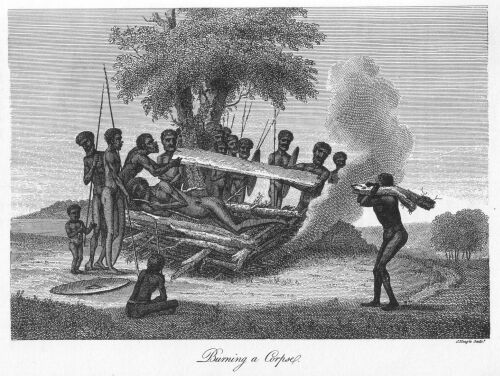
Ceremony of burning a corpse.
APPENDIX XII--LANGUAGE
In giving an account of an unwritten language many difficulties occur. For things cognizable by the external senses, names may be easily procured; but not so for those which depend on action, or address themselves only to the mind: for instance, a spear was an object both visible and tangible, and a name for it was easily obtained; but the use of it went through a number of variations and inflexions, which it was extremely difficult to ascertain; indeed I never could, with any degree of certainty fix the infinitive mood of any one of their verbs. The following sketch is therefore very limited, though, as far as it does proceed, the reader may be assured of its accuracy.
Their language is extremely grateful to the ear, being in many instances expressive and sonorous. It certainly has no analogy with any other known language (at least so far as my knowledge of any other language extends), one or two instances excepted, which will be noticed in the specimen. The dialect spoken by the natives at Sydney not only differs entirely from that left us by Captain Cook of the people with whom he had intercourse to the northward (about Endeavour river) but also from that spoken by those natives who lived at Port Stephens, and to the southward of Botany Bay (about Adventure Bay), as well as on the banks of the Hawkesbury. We often heard, that people from the northward had been met with, who could not be exactly understood by our friends; but this is not so wonderful as that people living at the distance of only fifty or sixty miles should call the sun and moon by different names; such, however, was the fact. In an excursion to the banks of the Hawkesbury, accompanied by two Sydney natives, we first discovered this difference; but our companions conversed with the river natives without any apparent difficulty, each understanding or comprehending the other.
We have often remarked a sensible difference on hearing the same word sounded by two people; and, in fact, they have been observed sometimes to differ from themselves, substituting often the letter b for p, and g for c, and vice versa. In their alphabet they have neither s nor v; and some of their letters would require a new character to ascertain them precisely.
What follows is offered only as a specimen, not as a perfect vocabulary of their language.
NEW SOUTH WALES ENGLISH --------------- ------- NAMES CHIEFLY OF OBJECTS OF SENSE Co-ing The sun Yen-na-dah The moon Bir-rong A star Mo-loo-mo-long The Pleiades War-re-wull The Milky Way Ca-ra-go-ro A cloud Boo-do-en-ong general name Cal-gal-le-on The Magellanic the greater clouds Gnar-rang-al-le-on the lesser Tu-ru-p A star falling Co-ing bi-bo-ba Sun-rising Bour-ra The sky Co-ing bur-re-goo-lah Sun-setting Gnoo-wing Night Carn-mar-roo Tar-re-ber-re Day Gwe-yong Fire Cad-jee Smoke Gil-le A spark Per-mul Earth Ta-go-ra Cold Yoo-roo-ga Heat Men-nie-no-long Dew Pan-na, and Wal-lan Rain Ba-do Water Chi-a-ra Name Car-rig-er-rang The sea Go-nie A hut Now-ey A canoe Beng-al-le A basket Car-rah-jun A fishing-line Gnam-mul A sinker [A small stone to sink the line] Bur-ra A hook Ke-ba A stone or rock Bwo-mar A grave Bow-wan A shadow Ma-hn A ghost Wir-roong Scars on the back Cong-ar-ray Scars on the breast jee-run A coward Can-ning A cave Me-diong A sore [On noticing a hole in any part of our dress they term it Me-diong] Ya-goo-na To-day Bo-ra-ne Yesterday Par-ry-boo-go To-morrow Mul-lin-ow-ool In the morning Jen-ni-be Laughter Boo-roo-wang An island [This word they applied to our ships] Gno-rang A place E-ring A valley Boo-do A torch made of reeds Mi-yal A stranger [This word has reference to sight; Mi, the eye.] Ar-rung-a A calm Moo-roo-bin Woman's milk Ew-ing Truth Ca-bahn An egg Yab-bun Instrumental music Yoo-long or Cleared ground for public ceremonies Yoo-lahng ADJECTIVES Bood-jer-re Good Wee-re Bad Mur-ray Great Gnar-rang Small Coo-rar-re Long Too-mur-ro Short Go-jy Rotten Go-jay-by Bin-nice Pregnant Par-rat-ber-ri Empty Bo-ruck Full Pe-mul-gine Dirty Bar-gat Afraid Frightened Ba-diel Ill Moo-la Sick Boo-row-a Above or upward Cad-i Below or under Bar-bug-gi Lost War-rang-i Right Doo-room-i Left Goo-lar-ra Angry Yu-ro-ra Passionate Wo-gul, and Wo-cul One Yoo-blow-re, and Boo-la Two Brew-y Three Mur-ray-too-lo A great many Gnal-le-a Both Moo-jel Red Ta-bo-a White Gna-na Black Bool-gi-ga Green Moo-ton-ore Lame Yu-roo, and Yu-roo-gur-ra Hungry Mo-rem-me Yes Beall No Mar-rey Wet PARTS OF THE HUMAN BODY Ca-ber-ra Head Gnul-lo Forehead Mi Eye Yin-ner-ry Eye-brow No-gro, or No-gur-ro Nose Kar-ga Mouth Wil-ling Lips Da-ra Teeth Tal-lang Tongue Wal-lo Chin Go-ray Ear Cad-le-ar Neck Cad-le-ang Na-bung Breast or Nipple Yar-rin Beard [This they often singe, and describe it as a painful operation] De-war-ra Hair [This is commonly full of vermin, which I have seen them eat, and change from one soil (sic) to another.] Bar-rong Belly Go-rook Knee Dar-ra Leg Ma-no-e Foot Tam-mir-ra Hand Ber-rll-le Fingers Car-rung-un Nail Bib-be Ribs Ba-rongle Vein Pa-di-el Flesh or lean Bog-gay, or Pog-gay Fat Tar-rang Arm 0-nur Elbow Wy-o-man-no Thumb Dar-ra-gal-lic Fore-finger Ba-roo-gal-lie Middle or ring'd Wel-leng-al-lie Little finger CONSANGUINITY Eo-ra The name common for the natives Mu-la A man Din A woman Din-al-le-ong Women [One of the few instances I could ever discover of a plural or dual number] Gin-al-le-ong Be-an-na; this they shorten to Be-an and Be-a, and when in pain, they exclaim Be-a-ri A father Wy-an-na, and Mother Wy-ang Go-mang Grandfather Ba-bun-na Brother Ma-mun-na Sister Go-roong A child We-row-ey A female child Wong-er-ra A male ditto Na-bung-ay wui-dal-liez Infant at the breast [Compounded of Na-bung its breast, and Wai-dal-liez relating to drinking] Bore-goo-roo Child eight months old Guy-a-nay-yong An old man Mau-gohn A wife Mau-gohn-nal-ly A temporary ditto Go-rah-gal-long A handsome man Go-rah-gal-long- al-le-ong A handsome woman Ma-lin, Nurkine, Mud-gin Gnar-ra-mat-ta A relation [To these I never could affix precise meanings] Cow-ul Male of animals We ring Female of ditto Do-roon A son Do-roon-e-nang A daughter Go-mul A term of friendship Cam-mar-rade, Terms of affection used by girls and Ca-mong-al-lay SPEARS AND OTHER INSTRUMENTS Goong-un A spear with four barbs cut in the wood, which they do not throw, but strike with hand to hand Noo-ro Ca-my A spear with one barb, fastened on Ca-my A spear with two barbs--This word is used for spear in general Bil-larr A spear with one barb, cut from the wood Wal-lang-al-le-ong A spear armed with pieces of shell Can-na-diul A spear armed with stones Ghe-rub-bine A spear without a barb Doci-ull A short spear No-roo-gal Ca-my Holes made by a shield E-lec-mong A shield made of bark Ar-ra-gong A shield cut out from the solid wood Moo-ting Cal-larr Fizgigs Car-rab-ba Prong of the moo-ting Dam-moo-ne Prong of the cal-larr. Woo-dah, Names of clubs. Can-na-tal-ling, Doo-win-null, Can-ni-cull, Car-ru-wang, Wo-mur-rang. Gnal-lung-ul-la, Tar-ril-ber-re, Mo-go, Stone hatchet. We-bat, Handle of ditto. Wo-mer-ra, Throwing-stick PRONOUNS, ADVERBS, AND MODE OF ADDRESS Gni-a, I, or myself Gnee-ne, You. Gnee-ne-de, Yours. Dan-nai, Mine. Dar-ring-al, His. Gna-ni, Whose. Wan, Where. De, There. Diam, Here. Diam o waw? Where are you? Diam o diam o, Here I am. Gnalm Chiara, gnahn? What is your name? Bir-rong, Appertaining. WINDS Bow-wan, North. Bal-gay-al-lang, South. Boo-roo-wee, East. Bain-mar-ray, West. Doo-loo-gal, North-west. Yare-ba-lahng, South-west. Go-me-mah, North-east. Gwar-ra, A high wind INFLEXIONS OF THE VERBS. Gnia-na, Sighing. Bwo-me, Breathing. Dere-rign-ang, Sneezing. Car-re-nar-re-bil-le, Coughing. Yen-no-ra, Walking. Yen-mow, I will walk or go. Yenn, Go or walk. Yen-ma-nia, We will walk or go. Yen-wor-ro, He is gone. Yen-nim-me, You are going. Yen-nool, Relating to walking. Yen-noong, Yen-nore-yen, Yen-nang-allea, Let us both walk. AI-locy, Stay. Wo-roo-wo-roo, Go away. War-re-war-re, Pat-ta-diow, I have eaten. Pat-td-die-mi, You have eaten. Pat-ty, He has eaten. Pat-ta-bow, I will eat. Pat-td-baw-me, You will eat, or will you eat? Pat-ta-ne, They eat. Wul-da-diow, I have drank. Wul-da-dic-mi, You have drank. Nwya jee-ming-a, Give me. Py-yay, Killed. Jung-ara py-yay, Killed by dogs. Par-rat-ben-ni-diow I have emptied. Py-ya-bow, I will strike or beat. Py-yee, He did beat. E-ra-bow, I will throw. E-ra, Throw you. E-rail-leiz, Throwing. Mahn-me-diow. I have taken it. Mahn-iow, Shall I, or I shall take. Goo-ra, Sunk. Ton-ga-bil-lie, Did cry. Wau-me, Scolding or abusing. Wau-me-bow I will scold or abuse Wau-me-diow I have scolded or abused Wau-me-diang-ha They have scolded or abused Nang-er-ra He sleeps Nang-a Nang-a-bow I will sleep Nang-a-diow I have slept Nang-a-diem-me You have slept Nang-a-bau-me? Will you sleep? Go-ro-da He snores Gna-na le-ma She or he breathes Al-lo-wan He lives or remains Al-lo-wah Stay here, or sit down Wal-loo-me-yen-wal-loo? Where are you going? War-re-me-war-re Where have you been? Gna-diow You have seen Gna-diem-me I have seen Gna-bow I will see Gna See Era-mad-jow-in-nia Forced from him Car-rah-ma Stealing Wor-ga-wee-na He whistles, or whistling Goo-lar-ra py-yel-la Snarling with anger Man-nie mong-alla Surprised Yare-ba Tired Pe-to-e Sought for Man-nie mal-lee He was startled Nwya-bow-in-nia I will give you Wan-ye-wan-yi He lies Ma-row-e He creeps Bang-a-ja-bun He did paddle Noy-ga Howling as a dog Toll Biting Co-e, Cow-e Cwoi, Cow-ana Come here Wad-be Swimming Bo-gay Diving Ta-yo-ra, Me-diang-a Severely cold. Me-diang-a is compounded of Me-diong, a sore Mul-la-ra Married. Compounded of Mulla, a man BEASTS Jung-o Common name Pat-a-go-rang A large grey kang-oo-roo Bag-gar-ray Small red ditto Wal-li-bah Black ditto Tein-go Din-go Wor-re-gal Dog Boo-roo-min Grey vulpine opossum Go-ra-go-ro Red ditto Wob-bin Flying squirrel Ga-ni-mong Kang-oo-roo rat Wee-ree-a-min Large fox rat Wee-ree-am-by Bo-gul Rat or mouse Me-rea-gine Spotted rat BIRDS Ma-ray-ong Emu Go-ree-all A parrot Mul-go A black swan Car-rang-a bo mur-ray A pelican. When they see this bird over their heads, they sing the following words: Yoo-rong-i A ivild duck. Goad-gang, A wild pigeon Wir-gan Bird named by us the Friar Gnoo-roo-me ta-twa-natwa na-twa--Gno-roo me ta-twa na-twa, na-twa, tar-ra wow, tar-ra wow*
[* On seeing a shoal of porpoises, they sing while the fish is above water, Note-le-bre la-la, No-te-le-bre la-la, until it goes down, when they sing the words No-tee, No-tee, until it rises again]
Go-gan-ne-gine the Laughing jack-Ass Po-book Musquito hawk Wau-gan Crow Jam-mul jam-mul Common hawk Gare-a-way White cockatoo Ca-rate Black ditto Ur-win-ner-ri-wing Curlew INSECTS, REPTILES Mar-rae-gong A spider Mi-a-nong A fly Go-ma-go-ma A beetle Gil-be-nong A grasshopper Bur-roo-die-ra A butterfly Go-na-long Caterpillar Can-nar-ray Centipede Calm Snake Po-boo-nang A black ant
PECULIARITIES OF LANGUAGE
To the men when fishing they apply the word Mah-ni; to the women, Mahn.
They make some distinction in another instance when speaking of crying, they say the men Tong-i; the women Tong-e.
The following difference of dialect was observed between the natives at the Hawkesbury and at Sydney.
COAST INLAND ENGLISH Ca-ber-ra Co-co Head De-war-ra Ke-war-ra Hair Gnul-lo Nar-ran Forehead Mi Me Eye Go-ray Ben-ne Ear Cad-lian Gang-a Neck Ba-rong Ben-di Belly Moo-nur-ro Boom-boong Navel Boong Bay-ley Buttocks Yen-na-dah Dil-luck Moon Co-ing Con-do-in Sun Go-ra Go-ri-ba Hail Go-gen-ne-gine Go-con-de Laughing jack-ass
WORDS OF A SONG
Mdng-en-ny-wau-yen-go-nah, bar-ri-boo-lah, bar-re-mah. This they begin at the top of their voices, and continue as long as they can in one breath, sinking to the lowest note, and then rising again to the highest. The words are the names of deceased persons.
E-i-ah wan-ge-wah, chian-go, wan-de-go. The words of another song, sung in the same manner as the preceding, and of the same meaning.
I met with only two or three words which bore a resemblance to any other language.
The middle head of Port Jackson is named Ca-ba Ca-ba--in Portuguese Caba signifies a head. Cam-ma-rade, a term of affection used among girls, has a strong resemblance to the French word Cammerade; and may not some similitude be traced between the word E-lee-mong, a shield, and the word Telamon, the name given to the greater Ajax, on account of his being lord of the seven-fold shield? How these words came into their language must be a mystery till we have a more intimate knowledge of it than I can pretend to.
I could have enlarged very much the foregoing account of the natives of New South Wales; but, both in describing their customs and in detailing their language, I have chosen to mention only those facts about which, after much attention and inquiry, I could satisfy my own mind. That they are ignorant savages cannot be disputed; but I hope they do not in the foregoing pages appear to be wholly incapable of becoming one day civilized and useful members of society.
POSTSCRIPT
Since the preceding account was printed, letters have been received from New South Wales of as late date as the 20th of August 1797. By these it appears, that his Majesty's ship Reliance, in her passage from the Cape of Good Hope to Port Jackson, met with uncommon bad weather, which kept her out eleven weeks and one day. About the latitude of 41 degrees S and 77 degrees E longitude, the sea suddenly became violently agitated, and at last broke on board the ship, staving a boat which was over the stern, and doing considerable damage to the ship. Captain Waterhouse, however, landed safely thirty-nine head of black cattle, three mares, and near sixty sheep.
Information was also received through the same channel, that a ship called the Sydney Cove had been fitted out for Port Jackson from Bengal; but springing a leak at sea, she was run ashore on the southernmost part of the coast of New Holland: seventeen of the crew attempted to get to Port Jackson in their long-boat, but were driven on shore, and lost their boat. They then attempted to reach it by land, in which hazardous undertaking only three of them succeeded, the other either dying on the route or being killed by the natives. They were eighty days in performing this journey, and reported that in their way they had found great quantities of coal. This was afterwards confirmed by the surgeon of the Reliance, who went down to the wreck, and brought specimens of it back with him, having found immense strata of this useful article. Some part of the cargo was got on shore and housed where the ship was stranded.
When these letters left the colony, it continued in as flourishing a state as when the Britannia sailed. May it continue to prosper!