Amy in Acadia (continued 5)
Reading edition
"Yes, when you wear the bag around your neck; but if you leave it carelessly lying about, you'll have only yourself to blame if you lose it."
"Thank you, Mrs. Redmond," responded Martine; "after this I will see that it is put away."
Martine had received Mrs. Redmond's words so well that the latter was more than ever impressed with the young girl's amiability, and she wondered that between her and Priscilla there could still exist any antagonism.
There was no evidence, however, of anything but good feeling when the four set out for their drive to King's College. Amy had told them that they were to drive also near the grounds of the old home of that Judge Haliburton whose other home they had seen at Annapolis, explaining:
"Some persons call him 'the father of Canadian literature,' because his 'Sam Slick' and his history were almost the first books written in Canada to attract the attention of people outside."
King's College, in a certain way, offered rather less than the girls had expected, though its chief college building was an imposing structure, with great columns in front. The grounds were extensive, and the gently rolling lawns suggested an English landscape.
"King's is an old college for this part of the world," said Mrs. Redmond, "and though I cannot remember all I have heard about it, various old forms and ceremonies are kept up here, I believe, and commencement is always very interesting."
"It isn't as old as Harvard, is it?" asked Martine.
"What a question!" interposed Priscilla. "No college is as old as Harvard—at least, in this country. Just see how small this is, too!"
"Yet you ought to be especially interested in King's College, Priscilla," said Mrs. Redmond, gently, "for it was founded by exiled Loyalists almost immediately after the Revolution. Indeed, plans for the college were made in New York even before the close of the war, when it was seen that large numbers of educated men and women would probably have to bring up their children in a new country, where it would take time to establish even ordinary day schools."
"After the Revolution! That seems young compared with Harvard. But come, let us see what there is in this ancient-looking library. The driver says it's the only building open to visitors now," said Amy, who had been leading the way.
There were some entertaining books and portraits in the old library, and after lingering over them a little while, the girls prepared to return to the town. They took a last look at the old college before the carriage drove away.
"Its surroundings are beautiful," exclaimed Amy, "but it doesn't compare with Wellesley;" and before her eyes rose a picture of the College Beautiful, with its lake, its hills and groves, and its many fine buildings.
"I'm very glad, however," she added, "that we came here, for I have got a certain impression from King's College that is quite worth having."
"So say we all of us," added Martine. And thus in an amiable frame of mind the party returned to their boarding-house, pleased with their sightseeing. Although none of the girls would admit that they were tired, Mrs. Redmond suggested that all go to bed early.
"I'll agree," responded Martine, "if you'll come up first to my room."
Martine's room was large and pleasant, and even for so short a stay she had thought it worth while to give it a few homelike touches. Photographs of her parents and of one or two of her friends in ornamental frames were on the mantelpiece, and over the mantelpiece itself she had draped a soft foreign scarf. Her silver toilet articles occupied the top of the bureau; for in spite of Priscilla's disapproval, or perhaps because of it, she now carried these things in her suit case. Slight though these little touches were, Martine had contrived to relieve the room of its purely boarding-house aspect.
The house itself was plain, and both inside and out had a certain aspect of flimsiness. This had been accounted for by some one who had told Mrs. Redmond that it had been put up very hastily, immediately after the recent fire. It had been built for a boarding-house and pretended to be nothing else. It was airy and clean, but neither its landlady nor the other boarders attracted the travellers sufficiently to incline them to stay downstairs in the general sitting-room; so the three girls and Mrs. Redmond sat and chatted in Martine's room, enjoying the box of chocolates that she had opened for their especial pleasure.
"They ought to be good," she said, when Mrs. Redmond praised them. "They came from Halifax;" and she glanced mischievously at Priscilla.
"From Halifax?" repeated Amy. "I suppose that's where most shopkeepers in Windsor get their goods."
"Halifax by way of Windsor."
"No, no," retorted Martine, "not by way of Windsor at all; they came to me by mail. You know I went down to the post-office the last moment before we left Wolfville."
The others made no comment, but Priscilla and Amy exchanged glances, and Priscilla's seemed to say:
"I told you so."
Before, however, anything could be said, Martine rushed to her bureau.
"I received a letter, too, at the same time," she cried, "and except for these chocolates I never should have thought of it again."
Lifting the cover of the candy box, she took from it a large square envelope, which for safe keeping, perhaps, she had placed under the lace paper that lined it.
"What next?" thought Amy. "If the letter is from either Fritz or Taps, I wonder if she'll venture to read it."
Then Martine, with the utmost unconcern, opened the envelope, saying as she did so:
"It's from Mrs. Blair; you know she's a cousin of mamma's, and she often gives me good advice; I suppose this letter is full of it. That's one reason I left it to read on the train. I knew it would keep till then; and, after all, I entirely forgot it."
"Mrs. Blair would feel complimented," interposed Amy.
"Oh, she knows me; I never hide my feelings."
"Do you ever try?"
"Yes, my dear Mrs. Redmond; I've never dared let you know just how much I care for you."
Thus effectually silenced, Mrs. Redmond waited for Martine to read her letter.
"You ought to like Mrs. Blair," said Amy, for Martine still held the opened envelope in her hand without attempting to read its contents.
"Why?"
"Because she has style, Martine, and you generally put that before everything else; but read your letter, I would like to hear where they are, for I am always interested in Edith's doings."
"Yes, yes," yet Martine did not take the letter from the envelope; "but people need something besides style. I get so out of patience with Mrs. Blair when she and mamma are together. She always has the air of disapproving of mamma for having married a western man. She makes me think of the New Yorker who said to a Chicago woman, 'How can you bear to live so far away?' 'Away? From what?' asked the other. And the New Yorker couldn't say a word."
"But that isn't like Mrs. Blair, for she always has a word ready for everything. Do read your letter, Martine," continued Amy.
So Martine glanced hastily over the pages, making comments as she read.
"Oh, it's a kind of duty letter. She wants me to think it a great privilege that you have allowed me to travel with you this summer. She seems to have an especially high regard for you, Priscilla. I won't flatter you by reading what she says. Oh, yes, and she wants to give me some bad news. She has seen mamma at Carlsbad and thinks her looking very miserable. Well, that's about all, except that she wishes Edith cared more for Europe."
"Yes," interposed Amy, "Edith was very anxious to go West this summer with Philip and Pamela; they're having a fine trip over the Canadian Rockies."
Martine evidently was not listening to Amy. Her face wore an expression of great bewilderment, and then, with an exclamation of surprise she thrust the letter into Amy's hand:
"Read it," she cried; "isn't it extraordinary?" and she pointed to the signature. "'Audrey Balfour Blair!' Did you know that was her name?"
"Why, I'm not sure," responded Amy. "I never had a letter from Mrs. Blair."
"Nor I," responded Martine, "though Edith often writes to me."
"That's why Balfour and Audrey seem so familiar to me," added Priscilla, whose family were on rather intimate terms with Mrs. Blair.
"I never heard even mamma speak of Mrs. Blair by her first name," continued Martine. "Of course I must have known that it was Audrey, but I had never noticed the Balfour before."
"Well, if Balfour is a family name of Mrs. Blair's it must be of your mother's also; or at least it probably is."
"In that case," said Martine, "then Balfour and I may be cousins."
"I wish that Eunice and I were cousins." Priscilla's wistful tone was in contrast to the brighter one in which Martine had spoken.
"What's in a name?" continued the latter. "I dare say it's only the merest happening that these names are alike."
"I was going to suggest," commented Mrs. Redmond, "that it might be wiser not to build your hopes too high, although I'll admit that there may be some connection between the two families."
"What pleases me the most," said Martine, "is to think of Mrs. Blair's disgust when she hears that her family names belong also to people in Nova Scotia."
"And one of them a grocer's clerk," added Amy, whereupon Martine colored deeply.
"Balfour's just as good as Philip Blair, and he won't have to leave college without taking his degree." Then, as if ashamed of her petulance, she added: "To find out how things really are I suppose that after this I'll have to take an interest in genealogy. Mrs. Blair belongs to the Colonial Dames and offered to have mamma's name put through, and I think she would have consented to this if I hadn't laughed so at the idea. I dare say the Dames are different from the Daughters. I hope so at any rate, for the Daughters are always waving their ancestors in one another's faces, especially at their meetings, which I am told are like real battles."
"Oh, no," protested Mrs. Redmond, "not always. I've been at some that were very pleasant."
"Well, before long," concluded Martine, "you'll find me climbing family trees in a way that will make you dizzy; in fact, I feel a little giddy, as the English say, at the very prospect of having—Eunice for a cousin. Indeed, I believe I'll not sleep a wink to-night in my effort to settle the question."
CHAPTER XX
fire and flame
Long after the others had left her Martine sat alone. She was restless and wide-awake, and any one looking at her would have seen that her face was far less cheerful than usual. Her thoughts, indeed, were disturbed, and one or two tears fell as she held her mother's portrait before her and looked earnestly into the deep blue eyes.
The portrait was a miniature, painted in the days when her mother was almost as young in appearance as Martine herself, though in fact she had been married for several years. The young girl especially valued it because she could remember perfectly when her mother had been very like the lady in the picture, and also because this miniature had not been copied. It was too valuable a thing for Martine to carry with her when travelling.
Mrs. Blair's letter, with its mention of her mother's poor health, had stirred her deeply. She had concealed her feelings in the presence of Mrs. Redmond and the girls; or rather, for the moment she had been more impressed by the suggestion that came to her, through Mrs. Blair's signature, of a connection between her family and the Airtons. Now, however, she began to dwell on the significance of the news from Carlsbad, and the conclusion was hard to set aside that her mother's condition was even worse than her father's brief letters had given her to understand. Putting away the miniature with a sigh, she drew the last two letters from the portfolio, reading and re-reading them in a vain effort to decide whether her father had written briefly merely to conceal his feelings.
"It's strange that men always write so little in a letter. Though papa would always rather telegraph than write, still, when he does write, I do think that he might say something. Now if it were mamma, why, she would tell me everything;" and upon this, with the knowledge that it might be long before her mother could write to her, Martine burst into tears. As she tossed the letters aside Martine threw herself on her bed, and then—
How long she had lain there she did not know, although rising with a start, she realized that she had fallen asleep, and almost as quickly she perceived a strong smell of smoke in the room.
Opening her door, she turned toward the ell where Mrs. Redmond and the two girls had their rooms. The smell of smoke was stronger there, and in the darkness some one brushed against her, crying, "The house must be on fire." With a leap Martine reached the top floor where her friends were. Mrs. Redmond's door opened to her knock, and then she rapped loudly on the door of the room that Amy and Priscilla occupied together.
"Fire, fire!" she called, and in a moment Mrs. Redmond's voice was added to hers.
"Open the door, Amy; don't wait to dress. Come, come, don't you understand? The house is on fire."
"Yes, yes, we are dressing."
"Unlock the door; I can help bring out some of your things."
The hall was thick with smoke. Mrs. Redmond and Martine knew that the fire was near. Amy's voice was heard from the room—or was it Amy?—speaking almost in terror, "I cannot open the door; I have mislaid the key."
"Why did you take it from the lock? Oh, Amy!"
Mrs. Redmond uttered no further reproof now. It was a time for action. "Martine," she cried, "we must go for help." But Martine made no reply. Already she was far on her way downstairs. All the people in the house were now evidently aware of the fire. Doors were slamming, and she heard steps and voices ahead of her. In spite of her difficulty in making her way through the thick smoke, Martine soon found herself near the broad front door. Here two or three men were standing.
"Please help me quickly," cried Martine, breathlessly; "my friends are in a room in the wing, and cannot open the door. Come, I will show you."
Leading the way, Martine was soon at Amy's door again. She could see no one, for there were no lights in the hall, but she recognized Mrs. Redmond's voice.
"I found a pair of large scissors in my valise; perhaps with them the lock can be pried open."
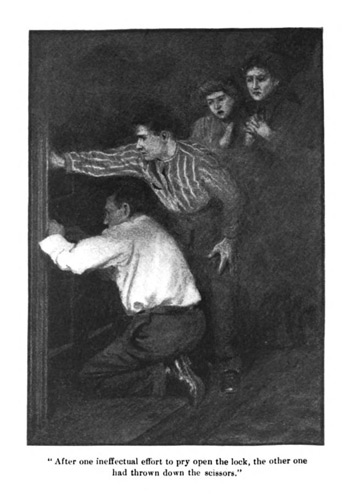
One of the men who had come with Martine was already pounding on the panels of the door to learn where it could most easily be broken in. After one ineffectual effort to pry open the lock, the other one had thrown down the scissors that Mrs. Redmond had handed him. Both of these things had occupied seconds rather than minutes,—seconds that seemed hours to Martine and Mrs. Redmond,—and then, before further violence had been done to the door, there was a click, a turn of the lock, and Amy and Priscilla stood before the four others. Their appearance showed that they had indeed dressed hastily, but they made no apologies as they hurried on.
When they reached the street Mrs. Redmond drew a breath of relief. "Oh, Amy," she cried, "how could you be so careless?"
"I took the key from the door absent-mindedly, and had set my travelling-bag on it. I'm thankful enough that I found it, for the door might have been hard to break in."
"Look, look!" cried Priscilla, excitedly. "We are out none too soon."
As she spoke flames were bursting from the wing of the house that they had so lately left, and men and women were pouring in and out of the main building, removing furniture, pictures, and clothes.
"Let me count you," cried Mrs. Redmond. "I am not sure—"
"It's Martine, mamma,—she is not with us. Where did she go?"
"Perhaps she has gone back to her room for her things. She had left everything behind when she came to rouse us."
"Impossible! She would not be so foolish. The fire is close to her room. Here are the engines. Why were they so long in coming?"
"Where is Martine? We must find her."
"No, no, Amy," and Mrs. Redmond laid her hand on her daughter's arm.
"But, mother, if she had not called us—"
"Yes, if she had not called us we might be in there now. She did not think of herself, and now she has gone to her room for some of her things."
"Her diamond perhaps;" and then, as if ashamed of her words, Priscilla added, "But I can help Amy, Mrs. Redmond. You cannot hurry as we must."
As Mrs. Redmond watched Amy and Priscilla running into the house she wished she had gone with them. Uncertainty was harder to bear than any effort she might have made. Her suspense, however, was not long, for to her relief she heard Amy's voice.
"Here's Martine, mamma. We had barely time to reach her. Look, look!"
This latter exclamation was called forth by the rapid spread of the flames. It was a beautiful sight—beautiful yet terrible to those who so lately had been within the walls that now seemed to be melting in the heat. Yet even as they gazed Martine began to laugh hysterically. "You look so—so queer—Priss—Prissie," she cried, and again she laughed. The light from the fire enabled them to see one another plainly, and as the others glanced at Priscilla they saw a black streak across her forehead that altogether changed her expression.
"It's a case where the pot can't call the kettle black," rejoined Amy; "your own complexion is not milk-white at the present moment, Martine."
"You are the only one who has her hair properly arranged, Miss Amy. Even your mother has a hasty coiffure, and no collar. Oh, Mrs. Redmond!" and again Martine laughed nervously.
"It matters less how we look than how we feel. I wish that you, like Priscilla, had brought your coat, though I fear there is only one hat among us."
"What a noise the engine makes! Can't we get away soon?"
"I hope so. If we only had a man with us we could send him off for a carriage. Even Fritz would be useful now."
From her mother's tone Amy could not judge whether or not she was in earnest, though in truth the same thought had come to her.
"After all," cried Martine, holding up her watch, "it is not half-past eleven. I had begun to think that to-morrow had come. The flames are not so bright. I believe that the fire is dying down. It started in so well that I almost hoped that we'd see the house in ashes."
"Oh, Martine!"
"But nearly all the furniture has been saved, and the house is probably insured, and—"
"You are shivering, Martine. Come, we must make our way through the crowd. Even if we have to walk down to the large hotel near the station, that will be better than staying here."
So they made their way through the crowd. Heaps of household goods and pieces of furniture were scattered over the lawn, and even on the sidewalk in front. The engine was still hissing, flames were still darting from back and sides of the house that had so lately sheltered them.
Hardly had the four reached the street when a man's voice called, "Stop, ladies, for a moment." As they halted, the man, whose outline they could barely distinguish, overtook them. "You are the American ladies whose doors I tried to break open a little while ago. I would have helped you further, but I had to return immediately to my sister, who has been ill, and who is now in a neighbor's house. I have been anxious about you, for you are strangers. Have you plans, or will you permit me to make a suggestion?"
"We shall be only too happy to hear your suggestion, Mr.—"
"Taunton," quickly rejoined the stranger, as Mrs. Redmond paused, adding, "I would suggest that you come with me to the house where I have taken my sister, and I may say that I have been asked to bring you back with me. The house is large, and you can all get a good night's rest."
It is needless to say that Mr. Taunton's invitation was gratefully accepted, and soon the four found themselves in a warm room, where a hospitable little hostess bustled about, offering them tea, and bread and butter, though after all it wasn't a meal-time.
"She's very good," murmured Martine to Amy, "not to mention how queer we look. For my own part, I haven't dared look a mirror in the face, though there are two in the room. How much has happened in the last hour!—for it is only a little more than an hour since we knew of the fire; that is, since I smelled smoke."
"I hope that it wasn't long enough for you and Priscilla to catch cold. We shall never forget how chilly the air of an August midnight can be."
"Oh, I am all right," responded Martine. And then, as if to disprove her own words, she sneezed violently.
"Why did you go back to your room, Martine? It was a dangerous thing to do. You brought nothing out with you but that little bag."
"Oh, I had barely time to get that. The room was so hot and smoky that I quite lost my head, yet I got what I especially went for;" and she opened the little bag and drew from it a small velvet case.
"Your diamond!" cried Amy. "Ah, Martine, how foolish to have had it with you!"
"No, Amy, not my diamond pin;" and snapping a spring she disclosed the miniature of her mother.
"That is more to me than ten diamond pins. I had barely time to snatch it from the bureau and pick up this bag."
"Then you left the pin behind!"
"No, child, no; it is safely hung around my neck. But one of my rings was on the cushion, and it will delight Priscilla's heart to know that I did not save a single brush or silver-topped bottle. It will be rather hard for papa, for he'll have to replace them all next Christmas. But I do wish that I had my hat and my suit case. Until we overtake our trunks at Halifax we can't make ourselves perfectly respectable."
"But still," rejoined Amy, "I am thankful that we have a place where we can sleep to-night—and mamma is beckoning us, so let us follow."
It was nine o'clock, and the sun was streaming brightly through their windows before Mrs. Redmond and the girls left their rooms next morning. All but Priscilla had slept well, but the latter had tossed about all night, with her thoughts dwelling more on Martine even than on the exciting events of the fire. Clearly Martine had acted very generously in the efforts she had made to awaken the others. She had had ample time to save all her own possessions, yet quite neglectful of herself, her one thought had been for others. If Priscilla was sometimes harsh in her criticisms, she at least wished to be fair. After her night of confused thoughts, it was not strange, perhaps, that Priscilla awoke heavy-eyed and dull, thus causing Mrs. Redmond to wonder whether this one experience might not undo all the good accomplished during their weeks in Acadia.
Martine was still inclined to sneeze, but she laughed when caught in the act.
"It sounds like hay fever, doesn't it? I have never had a fashionable ailment before, and if it is hay fever, why, I am in the part of the world where patients are often sent, and my recovery will be rapid."
After breakfast Mr. Taunton, their new acquaintance, offered to help Mrs. Redmond in any way that she might suggest. "You may wish your luggage or your tickets attended to—or, or your shopping," he concluded. "My sister and I saved both our trunks, and she is resting so comfortably this morning that I can put myself at your service."
"I do not wonder that you speak of shopping. We could hardly go even as far as the station without buying a few necessary things. If we could have a carriage in about an hour we could do some errands. We are going to Halifax by the afternoon train."
"You have lost more than most of the other boarders, in proportion to what you had in the house," continued Mr. Taunton. "Our late landlady is the heaviest loser, but she is a cheerful little body, and consoles herself with the thought that she is well insured."
"Don't forget to pay our board bill, mamma; it just occurred to me that we left so unexpectedly that we forgot even to mention it to her," interrupted Amy.
Mr. Taunton laughed heartily at her suggestion, and then began an earnest plea for his own city, St. John, in contrast with Halifax.
"If you can visit but one, St. John is the better worth seeing. We come to Nova Scotia occasionally to rest, but St. John is wide-awake, and its churches and public buildings will compare favorably with any in the United States. Then you have heard of our wonderful reversible falls, that flow with the tide one way and with the river the other, and the beautiful Kennebecasis—"
"You would make a good tourist agent," interrupted their amiable hostess, Mrs. Andrews, entering the room at this moment. "But if I should begin to paint the charms of the Citadel, and old St. Paul's, and the Northwest Arm, and—"
Mr. Taunton laughed. "It's a feud as old as the hills, this rivalry between St. John and Halifax, and a stranger can settle the matter for himself only by seeing both places; but if you must give up either, I honestly believe that you can best spare Halifax."
Before Mrs. Andrews could protest, a violent ringing of the doorbell called her from the room. A second later she returned to the sitting-room, followed by two young men.
In an instant half a dozen tongues were loudly exclaiming, "Why, Fritz, how in the world did you find us?" Mrs. Redmond held the hand of one of the new-comers while she looked affectionately up into his face; Amy, drawing back a little, appeared far from displeased at this sudden appearance; and Martine,—Priscilla could hardly believe her eyes,—yes, Martine had certainly thrown her arms around the neck of Fritz's companion, who was no other than the Freshman "Taps," of whom Priscilla had had a passing glimpse on the Yarmouth boat.
While Priscilla gasped in amazement Mrs. Redmond and Amy could not conceal their surprise at Martine's demonstrativeness. But they had not to wait long for the explanation, which Martine herself saw was due them.
"There, there, Lucian, don't be too affectionate until I explain—"
"Explain what?" asked the so-called "Taps."
"Wait, listen;" and slipping her arm through that of Fritz's friend, Martine turned with a bow toward Mrs. Redmond.
"Let me introduce to you and Amy and Priscilla, as well as to the rest of the company, my brother, Lucian Stratford, otherwise 'Taps.' There, Lucian, don't say a word. Let me explain how it was. Of course at first we didn't mean to make any secret of it, but Lucian and I thought it would be fun to see whether you could tell whether we were brother and sister, and he made Fritz—I mean Mr. Tomkins—promise not to tell you. It seemed rather funny that you hadn't heard. Then when Amy was so sniffy—excuse me, Amy—about having boys in the party, why, I had to promise not to tell. It was hard at first, but I got interested in keeping it up when I found that Priscilla was so suspicious."
Priscilla, coloring, looked more and more uncomfortable, Mrs. Redmond was slowly grasping the situation, and only Amy appeared to be angry.
"It's like you, Fritz," she exclaimed, "to go out of your way to play a practical joke on me, but I did expect something better from Martine."
Martine's face grew serious.
"I can't see that the joke affects you, particularly, Miss Amy Redmond!" rejoined Fritz. "To be sure, you have had various accidents that might not have happened had we been with you to protect you, but as to knowing that 'Taps' was Martine Stratford's brother, why, you could have found that out for yourself, or at any rate I should have told you only too gladly had you given me a chance. But when you banished me so completely—"
"Come, come, children, no quarrelling. We won't banish you again, Fritz, and if you feel like going on with us we shall be only too happy to have your company. Your coming now is certainly most opportune. You can do so much to help us; we have shopping—But first let me introduce you to Mr. Taunton, who has been so kind to us, and to Mrs. Andrews, our hostess, and to the others."
After the introductions Fritz explained why they had come to Windsor.
"Halifax may be slow, but it is reached by telegraph, and the daily papers contain some news, so when I saw the headlines 'Fire at Windsor,' I naturally read the whole thing, for, according to the schedule which Lucian had from his sister, you were due here yesterday, or the day before, and we had even thought of running up to meet you."
"Though we decided it would be better sport to take you by surprise at Halifax," interposed Lucian.
"Yes, and when we read that some American ladies had barely escaped with their clothes—"
"Not all of their clothes," murmured Martine.
"We thought," continued Fritz, "that we'd risk it by rushing up here."
"So we bolted our breakfast," interposed Taps, "and made the 'Yankee' and—"
"We poked among the ruins," added Fritz," and when we didn't find any remains, we asked a few questions of some others who were poking there."
"And here we are," concluded Taps, "and from this on I'm going to keep my eye on Martine. You didn't set the fire, did you, sister?"
"There, Lucian, if you tease like that you'll be banished."
"No more banishment for either of us," cried Fritz, boldly. "You've all had accidents enough to show you the need of adequate protection."
"Perhaps you could have prevented the fire," said Amy, with some sarcasm.
"I could have prevented your staying at any house but the most fire-proof hotel in the town, and that I believe is still standing."
"What did you save?" asked Lucian, in an effort to turn the conversation.
"Oh, my mother's picture," said Martine, softly. And then, as if afraid of seeming sentimental, "But I lost an emerald ring and all my silver brushes, and a pair of slippers, and one of my gloves, and a dozen postage stamps."
"Stop, stop, Martine."
"Well, I saved my best stock, and Mrs. Redmond saved her umbrella, and we—"
"Are all clothed and in our right minds, excepting you, Martine, who seem in danger of losing yours," interrupted Amy. "I believe that carriage at the door is the one that Mr. Taunton telephoned for; so, if we are going to Halifax to-day, it is surely time to start on our shopping expedition."
Acting on this suggestion, Priscilla and Martine helped Amy gather together their few remaining possessions, while Mrs. Redmond discussed her plans with Fritz.
When at last the moment came for the few words of farewell, Mrs. Redmond and the girls felt that in bidding good-bye to Mrs. Andrews and the Tauntons they were parting with friends whom they had known for weeks instead of hours.
Mrs. Redmond and the girls drove to the station, where Fritz and Lucian met them after a brisk walk down town.
"Fritz," said Amy, as the two stood together in the hotel sitting-room, "I have a confession to make."
"Open confession is good for the soul, so out with it at once, fair lady."
"It is simply this: I am really glad that you are here to take charge of things. Even in travelling mamma, you know, hates to attend to practical details. Now of course we have got on very well, barring one or two little things."
"Fires and such." There was a mischievous twinkle in Fritz's eye.
"Oh, well, even that might have been worse; so now, until we reach Halifax, I do wish that you would take charge of everything."
"With pleasure," responded Fritz. "Especially will I see that you do not mislay your keys. But you look tired, Amy. Come, sit down."
Whereupon Amy sank wearily upon a sofa, only too glad that for the present her responsibility was shifted to some one else.
There was a funny side, however, to the zeal displayed by Fritz and Lucian. They insisted, with an emphasis that no one dared oppose, that the girls and Mrs. Redmond should rest quietly while they went out to shop.
"My dear boys," Mrs. Redmond had protested, "there is hardly a thing that we shall really need before we reach Halifax. In the parlor cars we shall be unnoticed and perfectly comfortable, and after we have opened our trunks we can tell what we most require."
"Oh, Mrs. Redmond, there must be some errands for us to do. Can't you trust us?"
Lucian's face was so expressive of disappointment that Mrs. Redmond was glad that she had made out a small list.
"Of course there are some things—and we are ever so much obliged to you and Fritz for your willingness to do errands."
"You see," continued Lucian, confidentially, and dropping his voice that his sister might not overhear him, "I didn't ask Martine what she needed. That would have started her off to suggest no end of things,—you know what girls are. I can tell pretty well what she ought to have, so we'll just slip off before she can say anything."
Fritz had condescended to accept a few suggestions from Amy, and the two boys rushed off in high spirits. An hour later, when they returned, their arms filled with packages, followed by a grinning hotel boy who was dragging a large parcel, Mrs. Redmond lifted her hands in amazement.
"Two hats!" she exclaimed, in still greater surprise as they undid the strings of the larger package, "but only one was really needed. Martine left hers behind, but Amy—"
"Now, Mrs. Redmond," said Fritz, "perhaps you didn't observe Amy's. Why, some one must have turned the hose on it; the flowers were all bedraggled, and the ribbon—Mrs. Redmond, surely you must have noticed its condition. But these are so pretty that I couldn't let Lucian be the only one to buy a hat."
"It's certainly very thoughtful in you, Fritz, but still my list—"
"Oh, we've got everything that was on the list, only these little extras were just to amuse ourselves."
"Six stocks! you extravagant boy!" Martine, arriving on the scene, had opened one of her brother's parcels.
"Six stocks!" he repeated. "Why, that's only one and a half apiece!"
"And gloves; well, we could have waited until we reached Halifax. They are probably better there. I wish I had thought to speak of shirt waists," continued Martine. "This is hardly respectable."
"Oh, I thought of that, too," replied Lucian; "at least, I remembered you hadn't a coat, so I supposed some sort of a wrap would do. Coats have to be kind of tailor-made and fitted, don't they?" While he spoke Lucian was undoing the largest package, from which he drew out a Scotch shawl of brown and yellow plaid.
"There, that's the thing!" he exclaimed with pride. "It looks as if it had come straight from Edinburgh. You can throw it over your shoulders instead of a coat."
"Oh, Lucian," cried Martine, "you can't expect me to wrap myself up like that, especially on a warm August afternoon!"
"Why shouldn't it be all right travelling?" asked Lucian, with less elation. "You wouldn't have to think about the fit."
But when he saw that all the others were laughing at him, he walked off toward the window, murmuring what sounded like "There's no pleasing some people."
"Come back, come back," cried Martine, as he turned away; "the shawl will be very useful if we go yachting at Halifax, and no one but you would have thought of these delicious boxes of chocolates. We all thank you very, very much; see, there's a box for you and Priscilla, Amy, as well as for me."
Lucian's face brightened under his sister's praise, while Amy and Priscilla thanked him for their chocolates.
"You were dreadfully worried, weren't you, Prissie," said Martine, mischievously, "over the chocolates that I offered you last evening? But though Lucian was the giver in that case, perhaps you will enjoy these better, knowing where they came from."
"Shall I put this magazine in your bag?" asked Priscilla, hoping thus to divert Martine from further teasing.
"Certainly," replied Martine. "Let Lucian help you with the catch. It is hard to open."
"The magazines are Fritz's contribution," explained Lucian, as he worked with the spring of Martine's bag. "There's one for each of the party. But hello, what's this? Did you think of digging a grave, or anything of that kind, sister, when you brought this along? It's a strange thing to have saved from a fire;" and before Martine could protest Lucian had withdrawn his hand from the bag in which he had been fumbling, and before the gaze of the whole party held up a queerly shaped little trowel.
"I didn't ask you to meddle with things in my bag," cried Martine, excitedly, after the manner of sisters.
"Well, what's the matter with the little spade?" asked Lucian, looking from one to the other.
No one replied as Amy snatched it from his hand. In fact, Amy was the only one to recognize it as the Acadian relic that Balfour Airton had given to Martine.
CHAPTER XXI
old chebucto
So slightly had the travellers really suffered from the fire that they soon recovered from the effects of that exciting night, yet they were glad enough to reach Halifax and open their trunks.
"It seems better than luck that we sent these trunks ahead to Halifax. If they had been burned—"
"We should have had great fun shopping, my dear Miss Amy Redmond," responded Martine; "as it is, we shall just have to pretend that we need things when we see any startling bargains in the shop-windows."
"If you should try to replace what you have lost you could keep yourself busy for a day or two," rejoined Amy.
"No, thank you. The things that I lost I can wait for until Christmas. I have bought some inexpensive brushes, plain enough for Priscilla to approve; but at Christmas—well, perhaps I can persuade papa to get tortoise-shell, or something more elaborate than the simple silver set that melted away at Windsor."
In this way Martine always turned aside the sympathy that the others tried to offer her for her losses.
Fritz and Lucian had taken the travellers to the small Halifax hotel, where they themselves had been staying for two or three days before their sudden flight to Windsor. It was a cheerful, homelike place, and in its little garden the girls spent more or less time resting after the exertions of their later days in Acadia.
The fire and the events immediately following it had seemed to bring Martine and Priscilla more closely together,—at least, for the time their lack of sympathy was less plainly evident.
One day the two were sitting in the garden.
"I almost wish we had been a week longer in Acadia," Priscilla said.
"Why, we are in Acadia still!" rejoined Martine. "Don't speak of Acadia as so far away."
"Oh," responded Priscilla, "perhaps all Nova Scotia is Acadia; but really, when we use the word we mean where the French settled. Halifax is thoroughly English. On that account I do prefer it, though Acadia was certainly interesting."
"Thanks!" said Martine, "but I am going to prove that Halifax also was settled by the French. Amy laughed at me yesterday when I tried to prove my case. But listen; it was Amy herself who told me that no one had thought seriously of making a settlement here until D'Anville's fleet took refuge here after their defeat near Louisbourg. The ships were safe enough, but the men died by hundreds, and were buried on the beach. Well, after they had gone away, some sort of a petition was sent from Boston to England, asking that a settlement and fortifications be established to prevent the French from coming into Chebucto again and interfering with New England ships. The English thought this a good plan, because the Acadians at Annapolis and other places would be kept down if there was a strong town on the coast. So, you see, if it hadn't been for the French, Halifax might never have been settled. Have I proved my case?"
Priscilla shook her head. She could not quite tell whether Martine was in fun or in earnest.
"It seems to me that if Massachusetts men suggested the plan to England, you could just as easily say that Boston men settled Halifax."
"That's just what 'Taps'—I beg his pardon—Lucian said when I explained my theory to him. But then, he can't be expected to share my feelings about the Acadians,—at least, not yet,—although on the whole he is pretty sensible, isn't he?"
Priscilla found it difficult to answer this question directly, so, to conceal her embarrassment, she propounded another question.
"Why do they call your brother 'Taps'?" she asked abruptly.
"For no reason whatever, that I could ever see. But you know how boys insist on nicknaming one another. Mamma just hates it; and, if you notice, I always say 'Lucian.'"
"'Lucian' is such a good name," said Priscilla.
"Yes, and don't you think that Lucian himself is a dear?"
"I like him very much," responded Priscilla, simply. She would hardly have applied Martine's term to him, but she had found Lucian helpful and entertaining during their three or four days in Halifax.
"I believe," continued Martine, "that I might have told you something about Lucian before, except that I thought you might be prejudiced."
"Prejudiced!"
"Yes, a month ago you were much narrower-minded than you are now, and of course you and Amy had heard that Fritz Tomkins had charge of a Freshman who had been in rather bad company last year; and so if you had heard that it was Lucian before you had seen him, why, you might have had the queerest notions about him."
"You have the funniest way of putting things;" and Priscilla smiled again.
"Well, really," continued Martine, "there was nothing wrong with Lucian, only he is rather too good natured, and papa might as well give him a smaller allowance. But I heard Fritz Tomkins telling Mrs. Redmond that Lucian had kept a very good standing last year, but he wanted to break off with one or two men who were not going just the right way, and they wanted him to go to Paris and Vienna, and the only way was to plan some other kind of a trip. But there's really no harm in Lucian."
"Oh, no," said Priscilla, "I am sure of that; he has such a good face. It is curious that, with his blond hair and blue eyes, he still reminds me of you, and you are almost a brunette."
As Priscilla paused for a moment, the latch of the iron gate clicked sharply, and as a step sounded on the flagged walk, Martine rose quickly to her feet.
"Why, Mr. Knight!" she exclaimed, and in a moment Priscilla, too, was welcoming the new-comer.
"But we thought you in New Brunswick!"
"So I was a day or two ago. Certain business has brought me now to Halifax, and it is rather singular that we should be staying at the same hotel. I saw your names on the book this morning, and wondered if I should see you before my departure."
Mr. Knight's manner was so unaffected that Martine at once reproached herself inwardly for having imagined that he had run away from Wolfville to escape Mrs. Redmond's party.
"I am to be here only a day or two," he continued, "but if there's anything I can do—"
"In the way of rescuing," interrupted Martine.
"Oh, please," he protested, "don't mention that; it was so slight."
"You know," continued Priscilla, "we've been rescued once more,—at least I have been, for really it was Martine who was the rescuer." And then, when the young man seemed mystified by their words, the two had to tell him the story of the Windsor fire, of which, it seemed, he had not heard.
After Mr. Knight had congratulated them on their escape and condoled with them on their losses, he said:
"In case I have no other chance, I must tell you that my chief regret in leaving Wolfville so unexpectedly was the fact that I had no chance to show you through Acadia College, or tell you much about it. I know that that was one of the things Balfour had in mind when he wrote to me that I should present Acadia College in the best possible light."
"Oh, indeed," responded Martine, with a slight touch of impatience, "we have heard quantities about it,—that it offers the same advantages to women as to men; that a great many distinguished college men in the 'States,' as you say down here, were graduates of Acadia; that it has a lovely situation, and plenty of time to grow," she concluded suddenly, for, after all, though truce had been declared, Martine could not resist the opportunity of teasing Mr. Knight.
"I saw Balfour Airton," continued Mr. Knight, apparently undisturbed, "when at Annapolis the other day, and he is to be one of the distinguished graduates of Acadia."
"Did he say so?" Martine did not try to conceal her genuine surprise.
"Oh, no; Balfour thinks of nothing now but hard work, and he's likely to have his share of it the next few years."
A little later Mr. Knight excused himself for leaving the two, on the plea of letters to write, and during the two remaining days of his stay they saw little of him.
"He's afraid that he may have to rescue us again," Martine confided to Amy, though secretly she was a little piqued by his indifference. Fritz and Lucian, however, pronounced Mr. Knight a brick, and spent one afternoon with him in a long tramp to a place called Herring Cove, the description of which filled the girls with envy.
During their whole stay in Halifax, however, the boys went off on few excursions by themselves.
"You have been left too long to your own devices," Fritz would say, solemnly shaking his head, "and the punishment for your rash deeds is that you are now to be forever in our care and protection. Until you are safely back in Boston I hardly dare let you out of my sight, for fear of fire and flood."
"Do you consider this sail-boat especially safe just because you are in it?" asked Priscilla. "If my mother could behold us now she would think us in the greatest danger. In spite of spending all her summers at the edge of the sea, she is always afraid of a sail-boat."
"But I would rather run some risk than miss this sail around the Northwest Arm. In fact I wouldn't have missed it for the world;" and Amy glanced gratefully in Fritz's direction, for it was he who had planned this particular excursion, and had gained Mrs. Redmond's rather reluctant consent. "This narrow arm of the sea is so picturesque," she continued, "with its wooded shores, and the harbor is so interesting with its islands and its shipping."
"Just like any harbor," cried Martine.
"Oh, I don't know. One has a sense of its greatness here. No wonder even the Micmacs called it Chebucto, which I believe is a word of theirs for 'Great harbor.'"
"Please, Amy, this is a pleasure trip with no instruction. You mustn't tell us the size of the dry dock, nor the number of guns mounted on George's Island or on York Redoubt, or on any other of the harbor fortifications."
"Nor the time of day," retorted Amy, looking at her watch, "though all the same, Captain Fritz, it is time to turn about, for I absolutely promised that we'd be at home by five o'clock."
"Your word is law," responded Fritz.
"Tell me a little history," urged Lucian; but Amy refused to do anything but enjoy the sail, and Martine, looking at her closely, wondered if she had taken her words as criticism.
"There's one bit of harbor history that I shall speak of," said Lucian, as they turned homeward. "No, Martine, you needn't try to stop me. Everybody remembers Captain Lawrence and his 'don't give up the ship.' Well, do you know that he died here in Halifax? The 'Shannon' brought the 'Chesapeake' as a prize into this very harbor where we are now sailing. It was the first Sunday in June, 1813, and the town was in the greatest excitement. The news of their coming went quickly through the town, and every one who could get hold of a small boat pushed out to see the ships. The men were swabbing the decks, and the scuppers ran red with blood."
"Don't, Lucian," cried Martine.
"Oh, but this is history, and the kind you should remember. The 'Shannon' had set out from Halifax but a short time before, and when the two ships met in Boston Harbor they fought a fierce duel. The 'Shannon' had less than a hundred in killed and wounded, and the 'Chesapeake' nearly two hundred, all in about twenty minutes; so no wonder it's called one of the bloodiest fights on record. The ships must have been a sight to the quiet Haligonians. Then," continued Lucian, "Captain Lawrence and Lieutenant Ludlow were buried with high honors in the old English burying-ground here, and there was a great procession from the King's Wharf, with the coffins covered with our flags, and six British post captains bearing the pall."
"You'll have to visit the grave, Amy," said Martine, mischievously.
"Can't be done. An American brig with a flag of truce came for the bodies in August, and they were carried back to their native country."
"How in the world did you remember so much?" asked Martine. "I never realized before that you took an interest in history."
"This is the result," retorted Lucian, "of travelling with an intelligent companion," and he pointed to Fritz.
"No, I didn't do it; don't blame me," rejoined Fritz. "He ran across a history yesterday, or book of annals, or something of that kind, and naturally the mention of the 'Chesapeake' and the 'Shannon' interested him."
"Enough said—in excuse," replied Martine, while Priscilla added, "I wonder if we shall visit Melville Island before we go. You know that is where they kept the American prisoners during that war. I had a great-grand uncle who was taken prisoner, and I've always remembered that he was at Melville Island, Halifax. My mother has his diary."
"Why, that is interesting," said Amy. "Perhaps it may sound like wishing ill to my forebears, but I'd even be willing to have had a relative or two imprisoned here, just for the sake of having a closer association with Halifax."
"That's a very silly remark, Miss Amy Redmond," cried Fritz, disapprovingly.
"Yes," added Martine; "I might as well wish that some of my French ancestors had been among the exiled Acadians, so that I could take a deeper interest in Clare. Not that I need a deeper interest—but that reminds me," and she turned to her brother. "It's strange, Lucian, that I hadn't thought to tell you before, but I believe I've found some new relations in Nova Scotia; at least, I hope so. Do you know whether we had any Tories in our family?"
"Tories! I should hope not," and Lucian's voice rang with patriotism.
"Oh, they are all dead now, so don't excite yourself. But two things equal to the same thing are sometimes equal to each other. We are certainly cousins of Mrs. Blair's. You'll admit that?"
"Yes, worse luck to it," grumbled Lucian. "She is such a—such a—"
"You mean so conventional," interposed Martine, sedately; "but that's very proper for a Bostonian. Well, Mrs. Blair's name is Audrey Balfour Blair."
"Why not?" asked Lucian.
"Well, we met a girl this summer whose grandmother's name was Audrey Balfour, and what I want to know is—are we related to her?"
"To the grandmother?" exclaimed Lucian. "How in the world should I know? and if we are, what's the difference? Probably the old lady's dead by this time. Most grandmothers are."
"Oh, Lucian, do be serious."
"You'd better be serious yourself—say, look out for the boom, or you'll lose your head as well as your temper."
"I haven't lost my temper. There, I'm glad we're putting in for shore now, if Lucian is going to be so disagreeable."
Thus the conversation drifted from Audrey Balfour, and for the present Martine's question was unanswered.
This afternoon was only one of several that they spent on the water, and when the conditions were favorable, sometimes Amy, sometimes Martine, had a chance to show her skill as skipper, while the boys approved or made suggestions, and Mrs. Redmond and Priscilla sat back, trying not to show the timidity that they felt.
On shore as well as at sea they found much to occupy them, and as conditions for picture-taking happened for the time to be particularly favorable, each one added largely to her own collection of photographs. Each of the girls had a camera with her; but at first Priscilla had been the only one really zealous for photography.
When they visited the Citadel Lucian and Fritz had managed to intimidate them by telling them of the fearful fate that might be theirs should their cameras be seen in its neighborhood; so the cameras were hidden until the girls were far from what Martine called "the sacred precincts," until, indeed, the sight of a redcoat on Barrington Street, standing where the sun illuminated his whole figure, caused her to shout in delight:
"There, my camera, quick, Lucian. Here's my chance to catch one of those crazy little caps. How do they manage to make them stay on one ear? Quick, before he moves, or sees us," and then the click of a spring showed that she had accomplished her aim.
* * * * *
One dull afternoon Amy and Priscilla, wandering about, found their way into the Parliament building, and after admiring the stately old portraits in the rooms of the historical society, spent an hour or two over some of the old books and papers in the archives. This was especially gratifying to Priscilla, because she was thus able to satisfy her curiosity about the exiled Loyalists. Their sufferings seemed all the more real when written out in detail in these old manuscript volumes, and as she read, she sighed. The sigh was not wholly for the miseries of the past. That very morning she had received a letter from Eunice that had set her thinking.
"I am so glad [wrote Eunice] that you like Halifax. But it does seem strange, doesn't it, that I have never been there—in the capital of our Province? Sometimes it seems as if I should never go anywhere, though Balfour says that he will send me to college, that I can depend on that. But that will be only to Acadia, and I shall have to wait so long, until he has a law practice—and when will that be? Besides, he thinks now that he may have to stay out of college a year, if not give it up altogether. It's the mortgage on the house. There's some kind of trouble about it, and Balfour is determined not to let it go. It would just break mother's heart. But I oughtn't to make this a complaining letter, when one of the pleasantest things this summer—or any summer—has been my acquaintance with you,—and the others, too, of course, though I didn't know them so well. Please give them my love, but the most for yourself.
"Your affectionate "Eunice."
Now Eunice was really so fond of Priscilla that nothing was farther from her thoughts than to make her friend unhappy. Yet such was Priscilla's sympathy for her Annapolis friend that the remembrance of the letter made her feel sad, even as she sat with Amy in the old library.
"If papa had only lived," she thought, "I could have asked him to do something, but now,—why, Eunice herself would be surprised to know how little pocket money I have. Not that Eunice wants anything, but it would be so delightful to pay off that mortgage, and then make sure that Balfour could get through college, and then see him put Eunice through college, and then perhaps she could come up and take post-graduate work with me at Radcliffe." Then, amused at the rapidity with which her thoughts were running away with her, for Priscilla had not yet passed her own finals for college, she laughed aloud. Unexpectedly the clouds had been chased away.
"Priscilla," said Amy, "I am delighted to hear you laugh. You have been altogether too quiet to-day. Surely you are not homesick again."
"Oh, no, not homesick, only thinking."
"Tell me then, so that I may laugh too,—unless it's a secret."
"Oh, no, it's hardly worth mentioning; besides, it has ended in a foolish wish—if only I had money like Martine!"
"Martine cares little for money," responded Amy, with some sharpness. This was not the first time that she had thought Priscilla too ready to criticise Martine.
"I know that. She is surely very generous, only it would be so easy to do things for others if one had as much money as she has."
"I know what you think, Priscilla; but still Martine's way of spending money is not altogether extravagance. She has had more in her hands than most girls we know, and rich Chicagoans are fonder of spending than hoarding. It's in the air. Martine does not care for money in itself, but for what money buys."
"But she surely throws it around without getting full value."
"That's a matter of temperament."
"Yes," but Priscilla's voice sounded as if she were not sure of this. To herself, indeed, she was saying, "It is strange that Martine has not talked of making plans for Yvonne. Ah, if I had as much in my power I certainly wouldn't let Eunice worry about mortgages and going to college and all that kind of thing."
"Priscilla, Priscilla, wake up," cried Amy, a moment later. "Look at the citadel. It's hard to realize that this is the greatest fortress in America, and that only a few generations ago it was nothing but a stockade, a defence against the Indians."
"A few generations ago!" repeated Priscilla. "Why, it must be—"
"A bare hundred and fifty years, my dear child, since the English ships with their two or three thousand settlers came sailing into the harbor."
"A bare hundred and fifty years," echoed Priscilla, "and yet that is rather a long time, and Halifax isn't a large city yet."
Before Amy could reply she felt her arm seized from behind. Turning about, she found herself face to face with Martine, who held a letter in her disengaged hand. Priscilla, not hearing the steps, had walked on a little before she discovered that Amy was not with her. But a moment later she too faced about, and, as her eye fell on Martine, she could not help seeing that the latter was holding her finger on her lips with a warning glance at Amy, as if between the two there was some secret understanding.
CHAPTER XXII
finding cousins
In the end it had been much better for Priscilla if she had at once retraced her steps. Instead, while Amy still had her back to her, while Martine stood with her finger on her lips, Priscilla, with a rapid step that was almost a stride, walked farther away from them. Turning first one corner and then another, she indulged herself in her unreasonable annoyance with Amy and Martine. For a minute or two she continued to walk briskly, wondering all the time if the others would catch up with her. At length, when her curiosity overcame her pride, she did turn around, only to discover that her friends were nowhere in sight.
"I shouldn't think Amy would have acted so," she said to herself. "Of course I can't expect much from Martine, but Amy is different."
Yet if any one else had put the question to Priscilla she would have found it hard to say wherein Martine was at fault. It was only that in that fleeting glance she had gained the impression that the two were trying to hold some secret from her.
Priscilla had not walked very far when another turn brought her in front of a small wooden building that reminded her at once of a child's toy.
"Is it a school, or a church?" she wondered, and she glanced up at the little steeple.
"Hello, Miss Denman;" and Priscilla, lowering her gaze from the steeple, saw in front of her Martine's brother, Lucian Stratford.
"I didn't expect to see you here by yourself," continued Lucian. "I thought that you girls were off somewhere together."
"We were," replied Priscilla, "but I just thought I would—do a little sightseeing alone."
"Well, I don't blame you," rejoined Lucian; "it's sometimes so hard to get Martine to take an interest in things. It used to be just so in Europe. We could never depend on her, so I don't blame you for keeping by yourself."
Priscilla made no reply. She really had no explanation.
"This is a funny little church, isn't it?" continued Lucian. "Fritz and I were over here the other day. Some one had told him about it. It's a little Dutch church, and almost as old as the city itself. It was built for the Lutherans, for in the beginning there were a lot of German settlers here in Halifax."
"Thank you," said Priscilla. "You are as good as a guide-book; one never expects a boy to take an interest in such things."
"I can't say that I do generally, only you remember that foggy afternoon when you girls were all so busy writing letters? Well, Fritz and I got tired of staying indoors browsing over books, so we started out. We went down to the great dry dock—though I don't suppose that you girls would care for that,—and we had a chance to go into old St. Paul's,—that's about as old as the city too, and makes you think of one of the queer, dingy London churches. It has any number of interesting tablets and memorials, and we planned to take you girls there before we go, and then walking about we just chanced on this little toy building. But I've got a suggestion for to-day," concluded Lucian. "You see, it's Saturday, and one of the market days, so if you'd like to go, I'd be happy to take you down there. What do you say?"
"Why, yes, of course I'd like it. You are very kind to think of it." Priscilla remembered that Amy had spoken of going to the market, and for a moment she regretted her absence.
Lucian Stratford, however, proved a surprisingly agreeable guide, and even before they had reached the Green Market Priscilla was quite ashamed of the little prejudice that she had once held against him.
"It's an old custom," Lucian explained, as the two stood in the middle of the street, "for the country people to drive in with their produce."
The market was in Post Office Square, and almost every foot of space was occupied by some man or woman with something to sell. Indians, negroes, country people—it was a motley crowd and well worth seeing. The Indians for the most part sat on the sidewalk, bent over their wares, though here and there one or two leaned back against a building.
"We saw Indians like these at Bear River," said Priscilla, "only a little better dressed,—perhaps because it was a holiday. But these baskets are the best I've seen this summer."
Baskets and sweet grass were the stock in trade of these Indians, and some of the baskets were of odd designs and really artistic shapes.
"Do you really like them?" asked Lucian, and almost in the next breath he had laid three or four of the prettiest in Priscilla's arms.
"For Martine?" asked Priscilla.
"No, no, for you,—if you'll take them. There, let me carry them. I did not mean to load you down. Only I thought I might see something else."
"Oh, nothing more now, thank you. You are very kind, but these are really almost too much, and I can carry them myself—"
An old negro at this moment crossed their path, swinging a cane. They realized his nearness only when a sudden flourish of the stick sent Priscilla's baskets flying into the street. The negro, apologizing profusely, hastened to help Lucian collect the baskets, and Priscilla was pleased that Lucian showed no anger at the man's carelessness. Instead, he began an animated conversation with the old fellow, and returned to Priscilla's side smiling broadly.
"The old man has been praising his son's wife's vegetables so warmly that we'll just have to go over there to see them. She is the fat darkey sitting in that cart yonder, and I hope we'll get off without buying her out."
The next moment Lucian was laughing and chaffering with the old negro's son's wife, and Priscilla gasped as she saw him pointing out turnips, carrots, and even summer squashes. She did not know him well enough to protest, and she only wondered how he meant to get the things home.
"They're all mine," he called to Priscilla, as she waited for him a short distance from the cart. Then he leaned over toward the old man and said something, and the negro hobbled off, smiling. In a moment he returned with a large pail, into which his son's wife heaped Lucian's purchases.
"There," said Lucian, as he returned to Priscilla's side, "won't Mrs. Redmond and the others stare when they behold this load?" and he lifted the pail that Priscilla might the more readily admire its contents.
"But you don't intend to carry it through the streets?" There was a question in Priscilla's tone. Lucian glanced at her curiously. He had just been thinking how companionable she was, and now this Plymouth girl was going to show herself as narrow and conventional as others.
"I needn't carry it," he responded. "Perhaps Sambo here—is your name Sambo?"
"No, sir, my name's Mr. Malachai Robertson."
"Oh, excuse me, Sambo—I mean, Mr. Malachai Robertson—could you find me a good smart boy to carry this pail?"
Malachai looked at his stick—symbol of dignity—then at the young man, but at the same time he probably reflected that a fair fee was in sight; so he straightened himself up, reached over toward the pail, and with an "I'll carry it, sah," fell into line behind Lucian and Priscilla. Before the two, however, were quite ready to turn homeward, they lingered to watch the shoppers patronizing the Green Market, and buying supplies of vegetables and fruit.
"I only wish that Mrs. Redmond had come. It will be too bad if she misses it altogether—and Amy; the sun has come out so bright that she ought to be here to photograph some of these groups of colored people."
"Oh, the chance is that you will all be here in Halifax next Wednesday morning. The Market is here twice a week," responded Lucian. "Just now I suppose we ought to be turning home, as they are horribly prompt about meals at The Mayflower."
As the two walked up Hollis Street Priscilla noticed that some whom they met looked at them curiously. But only after she herself had thrown a backward glance over her shoulder did she realize the cause, for straight behind Lucian stalked Malachai, flourishing his cane after the fashion of a drum-major with his baton, while with the other hand he supported on his shoulder the pail of vegetables, balancing it with such a nicety that the carrots and squash and the large bunch of radishes kept their place on the top, though to the casual observer they seemed on the point of falling to the ground.
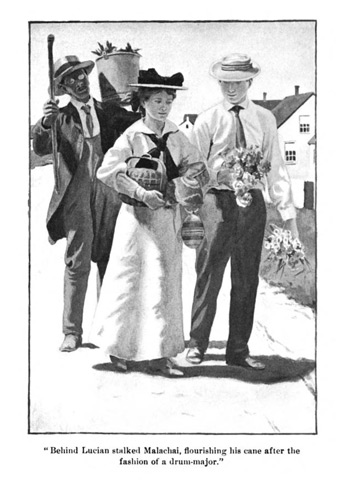
Had Priscilla been able to see herself she would have discovered that she, too, added to the gaiety of the group, for her baskets were even more brilliant in coloring than the vegetables, and as she had to carry them in her arms they made a rather startling display. Lucian had offered to take her load, but she had waved him away.
"No, a boy always finds it much harder to manage clumsy packages. These are not heavy; it's merely that they look awkward."
So Lucian had contented himself with buying three or four bouquets of the brightest flowers,—dahlias and garden asters chiefly,—and with both hands thus filled he made the procession more brilliant.
When they reached the house none of their party happened to be in sight, so, at Lucian's suggestions, Priscilla left her baskets on the sitting-room table while she went upstairs to find Mrs. Redmond. Amy's room adjoined her mother's, and as Priscilla stood there at Mrs. Redmond's half-open door the sound of voices in the inner room floated out to her. For a moment she stood there listening, quite unconscious that she was eavesdropping, until a sentence in Martine's clear voice came to her.
"She certainly is a terrible trial, narrow minded and priggish, and I don't wonder, Amy, that you dislike her."
When Priscilla grasped this sentence in its entirety she turned about instantly.
"Did you find them? Are they coming down?" asked Lucian, cheerfully, as she rejoined him.
"I—I didn't; that is, I'm not sure," stammered Priscilla. "If you don't mind, I'll leave the baskets here. Perhaps you would give them to the others;" and before Lucian could stop her she had run upstairs again.
At the dinner-table Lucian looked anxiously at Priscilla. When she thought that no one was observing her, he caught her wiping away a surreptitious drop of moisture. What could be the matter? Lucian racked his brains to decide if by any mischance he had in word or act offended Priscilla; but his conscience reassured him. He could not recall anything that might have annoyed her. On the contrary, up to the moment of their return to the house they had got along swimmingly—the latter phrase was his way of putting it.
"There's no accounting for girls," he said to himself. "I've known Martine to get dreadfully excited about nothing; but Priscilla Denman seemed such a sensible girl that I don't quite understand what the trouble is."
Before dinner had ended, however, Lucian decided that whatever it was that had disturbed Priscilla she did not blame him; for she turned to him with the utmost friendliness when he made some allusion to their morning walk, and between them they soon had the others at table laughing at their account of Malachai and the Green Market.
"I hope you paid the old man well for his trouble," said Martine; "for it probably was a great favor on his part to walk up Hollis Street toting a pail."
"Probably he paid him too well," rejoined Fritz, "unless he has changed his habits within the week. On our way from Yarmouth I tried to make Lucian see how demoralizing it would be to the natives to introduce the habit of tipping here."
"Oh, but one ought to pay for benefits received," said Lucian, "and I really do try to be prudent."
When dinner was over Lucian noticed that, as they left the room, Priscilla seemed to be trying to avoid Martine. She hardly replied to some question that the latter addressed her, and he saw other evidences that Priscilla did not care to speak to her.
After dinner Martine ran up to her brother.
"Oh, Lucian," she cried, "here's the most exciting letter from papa! I can't tell you all that's in it now, for it must be kept secret a little longer. But aren't you glad that mamma is better? I know you had a letter from her this morning. To think they'll be home in September! Oh, Lucian, I'd like to hug you, I'm so happy!"
"Please, please, not now," begged Lucian; "we couldn't explain to people that I'm your brother;" and he pointed to several passers-by on the sidewalk just outside the garden.
"Then sit here with me in this little arbor. I have several questions, and this is the first good chance I've had. Did you ever hear the name 'Balfour' in our family—in mother's family, I mean?"
Lucian shook his head. "'Balfour'?" he repeated. "I've certainly heard the name somewhere—lately, too, I should think."
"Yes, of course, dear stupid. Balfour Airton; that's the nice boy we met at Annapolis. Mr. Knight's friend, you know, the one we've talked about."
"Oh, yes, of course; do you mean to ask if he is in our family? Strange I never heard of it."
"There, listen, Lucian; this is what I mean. Mrs. Blair is mother's cousin, and her name, you know, is Audrey Balfour Blair."
"Has she a first name, and one so frivolous as 'Audrey'? How did that happen?"
"That's just what I wish to know. I thought that perhaps you would remember whether her name was Balfour before her marriage."
For a few minutes Lucian seemed lost in reflection, then looking up he exclaimed,—
"Yes, Martine, I am sure; Mrs. Blair's name was not 'Balfour,' it was 'Tuck.' I once met a brother of hers. He was visiting Chicago. But, I'll tell you what—I am pretty sure that her grandmother was a Balfour. That's where the relationship to mamma comes in. You know that her grandmother was a Balfour, and that's what makes them cousins; their grandmothers were sisters."
"Why, Lucian," cried Martine, jumping to her feet in her excitement, "that's just what I wanted to know. I don't care anything about Mrs. Blair's grandmother, but if there's a Balfour in mamma's family, don't you see how splendid it would be?"
"Can't say that I do," responded Lucian; "but if it pleases you, it's probably all right." Lucian had often said confidentially to his friends that the ways of girls were past finding out, and he did not except his sister from the general rule.
"Oh, but can't you see, Lucian, that if I could prove that Balfour Airton is a cousin to Mrs. Blair, and if mamma is a cousin of Mrs. Blair's, which—"
"Which she is, without doubt," said Lucian.
"Why, then, don't you see—"
"Oh, yes, I see," cried Lucian. "Why, then, you would be cousin to Balfour Airton and his sister. Well, perhaps there's no harm in that, if it pleases you; but what is there in it for me? I might not like either of your prodigies, and so I am not ready to be made a cousin to people I have never seen."
Yet a good-humored twinkle in Lucian's eye seemed to say, "If I would I could tell you something that would please you mightily—and perhaps I will."
Now Martine, understanding her brother pretty well, saw that he was really more sympathetic than he professed to be, so she wisely decided to wait until he was quite reedy to tell her what she wished to know; and to change the subject she pulled a letter from her pocket.
"If you hadn't had a letter from mamma by the same mail I would show this to you," she said. "It's the most delightful letter papa has ever written me, though I won't tell why—at least not just now," and she waved the closely written sheet rather tantalizingly before him.
"Oh, ho, child, you cannot tease me at this late day; and besides, I know why you try. Put your letter away, little sister; I can wait until you choose to read it to me. But I know what you want, and I am willing to gratify your curiosity. Yes, there was an Audrey Balfour in mother's family; but you may be less interested in her when I tell you about her. She was a Tory."
Lucian uttered the last word with all the scorn of one who has studied American history built on the most thoroughgoing anti-British basis.
"Oh, that's nothing," responded Martine; "at least, Priscilla would call it nothing. Each of us likes both Acadians and Tories, though I am supposed to care only for Acadians, and Priscilla for Tories. But how do you happen to know about this Audrey Balfour?"
"Through the Colonial Dames, my dear. You see, mamma had to have some papers filled out last spring. It was while you were at school, and she asked me to get a genealogist to copy certain things for her. Well, I found that mother's great-grandfather was a Tory, who was driven from his home and went to England or to Canada to live. One or two of his elder children were married before the Revolution, and their husbands were on the patriot side. One of these was Audrey, who was the grandmother of Mrs. Blair; another was our great-grandmother Edmonds. She was Martha Balfour."
"I see," interrupted Martine. "Our great-grandmother! Then it isn't so strange that I didn't remember the Balfour in our family; it is so far away. I think it's just wonderful that you remember it."
"Oh, it only happened so because I had had to have it looked up. I had the whole line typewritten for my own benefit, and I looked at it several times this year. I noticed the Tory Thomas and Audrey especially, and I wondered if they would effect my eligibility to a patriotic society that I am anxious to join. But I believe that I am all right because I am the loyal descendant of a Tory ancestor."
"Dear me!" cried Martine, when Lucian had finished this long speech. "You really sound quite learned! I believe that college has done you some good after all."
"After all! If you look up my record you'll find that I took all the history last year that Harvard allows a Freshman, and it's because I have a bent that way that I can remember these things."
"Well, Lucian, you've proved yourself a brick. I hope Priscilla won't object to this. Sometimes she is a little jealous—but there, don't repeat it—perhaps jealous is not just the word; but somehow, she doesn't always approve of me."
"She's fighting rather shy of you to-day," responded Lucian, "and I can't help wondering what you've been up to. Miss Denman doesn't seem to me an unreasonable girl. She and I had a fine time to-day at the market. I'm afraid that you have been teasing her, Martine."
But Martine continued to insist that her conscience was quite clear, so far as Priscilla was concerned, and that Lucian must imagine any traces of ill-feeling.
Nevertheless, she could but observe that Priscilla seemed to be avoiding her; for, in the afternoon, when Amy and Fritz went off on their bicycles for a spin through the Park, Priscilla declined Martine's invitation to go with her and Lucian to the Public Gardens to hear the band play.
"I have letters to write," she said, "and—well, on the whole, I really can't go."
"Very well," rejoined Martine, rather shortly, as she left Priscilla's room to report to Lucian that her invitation had been so scorned.
"You must have done something to offend her; think it over carefully, Martine, and then confess," urged Lucian. Priscilla had made so good an impression on him that he was unable to consider her wholly in the wrong.
CHAPTER XXIII
good-bye to halifax
Lucian's well-meant advice shared the fate of most advice volunteered by brothers. Martine, unconscious of offence, had no intention of apologizing to Priscilla for things she had not done. Instead, she began to feel annoyed with the latter for her unfairness; for certainly, Priscilla, in giving Lucian the impression that he had received, must have been unfair.
"But if she has been unfair," said Martine, "she can just wait for my news. It's too bad, for when I first read papa's letter it seemed as if I could hardly wait to go downstairs to tell the others."
Now Martine, though impulsive, was not naturally vindictive, and it would have been almost impossible for her to keep her secret from Amy and Priscilla had she not, immediately after reading her letter, confided its contents to Mrs. Redmond. Somebody knew; and in the course of two or three hours that they all passed together on Saturday evening, Martine more than once changed her seat to have a whispered word or two with Amy's mother.
On Sunday they all set out for the Garrison Church. "We make almost as imposing an array as the troops themselves," said Amy.
"Perhaps we might if we were stretched out in single file. Since the boys joined us we are really a regiment; but Halifax people are so used to seeing strangers that I am afraid that they won't take any special notice of us," responded Martine.
"I should hope they wouldn't. How well we should have to behave if we felt that all eyes were upon us," replied Amy.
After service they pushed their way through the crowd waiting outside the churchyard to see the troops form in line.
"It doesn't seem quite the thing on Sunday, does it?" murmured Priscilla to Amy; whereat Martine, laughing loudly, cried:
"But surely it is better for the soldiers to turn out to church in a body than to sit in their barracks moping."
"Soldiers moping!" and Fritz laughed.
"Perhaps it isn't the soldiers, but the people crowding to stare at them, who take away the Sunday feeling," continued Priscilla.
"That's just what we are doing ourselves," retorted Martine, "and I don't feel very wicked."
"Come, come, children, don't quarrel," cried Lucian. "You are both probably right, and both probably wrong."
Neither girl replied, for the troops in their brilliant uniforms were beginning their homeward march to the inspiring music of a fine band.
As they walked homeward Martine, slipping her arm through Amy's, drew her one side.
"Tell me," she said, "and please don't let the others hear or they will laugh—is Halifax the capital of Canada?"
"No, my dear, it—"
"There, I thought it couldn't be; I knew it must be Montreal. But I asked Priscilla why that old gray building was called Government House, and she said because Halifax was the capital. I never expect Priscilla to make a mistake;" and there was a slight touch of sarcasm in Martine's tone.
"She was not wholly wrong," rejoined Amy, "for Halifax is the capital of Nova Scotia. Canada itself is composed of several provinces, of which Nova Scotia is one. The provinces are united under a general government with Ottawa the capital—not Montreal—as you suggested. All the provinces send representatives to the Parliament that assembles every year at Ottawa."
"Oh, I see—like our States and Washington."
"Yes, the general plan of government is much the same, and each province has its own Parliament. Priscilla and I were in the Parliament building here the other day. It is really a State House."
"I've noticed the Parliament building, but what is the Government House?"
"Oh, that is the residence of the Governor of Nova Scotia. His real title is Lieutenant-Governor, because all Canada has a Governor-General, who lives at Ottawa."
Both girls had been so interested in this little conversation that unconsciously they had lagged, and the others were now far ahead of them.
"Martine," said Amy, "as we have a few minutes alone now, do let me influence you to make up with Priscilla—not that any little misunderstanding is wholly your fault, but it is so much harder for Priscilla to give in than it is for you."
"But honestly, I haven't said or done a thing to offend her,—at least, not a thing that I know of, though of course for a day or two I have seen that she was trying to be particularly stiff with me."
"Well, then I wouldn't notice her stiffness. Just act as if you were the best friends in the world, and things will soon straighten themselves out."
"That certainly would be the most agreeable way, and to please you, Miss Amy Redmond, I will follow your advice. Besides, I have something very exciting to tell you and Priscilla, and I really cannot wait longer than this afternoon."
"Hurry, young ladies, hurry, hurry!"
It was Lucian calling to them. He had turned to meet them.
"What kept you so long, Martine? What have you been doing?"
"Nothing, only talking."
"Oh, that accounts for it. When once Martine begins to talk in earnest, she takes no heed of time."
Martine replied lightly to her brother's badinage, and the three reached the house in great spirits. With Amy's caution before her Martine avoided collision with Priscilla during the dinner hour. After dinner, while they were all sitting together in the little arbor,—Mrs. Redmond as well as the girls,—Martine drew a letter from her pocket.
"Listen," she cried; "I have something to read you—no, I can tell it better in my own words, although it is nearly all in papa's letter. So listen, Amy; it's for you,—and it's for you, Priscilla, as well as for me."
"And for me, too?" asked Lucian, trying to throw great expression into his voice.
"No, no, of course not. Mrs. Redmond knows, and she thinks it fine, so listen. In the first place, papa feels much obliged to every one for keeping me contented. You know I tried to make a fuss when they wouldn't take me to Europe, and he says that it's a splendid thing for me to get so interested in history. This is what he says:—
"'When you get back to Chicago you'll find that there's a lot of history there that is worth studying—not entirely about the great fire, and part of the history of Illinois is French.' I never knew that before," interpolated Martine. Then she continued to read, "'Your mother and I think that you owe much to the young ladies who are with you, as well as to Mrs. Redmond, to whom I am also writing this mail. We are much gratified by what you write about the various young people in whom you are interested. Although I cannot promise, without knowing more about her, to launch your special protégée, Yvonne, on a prima donna's career, it seems right that you should be helped to do something for her, so I am enclosing a check for three hundred dollars.'"
Amy started; Priscilla gazed in astonishment.
"'This,'" Martine continued to read, "'is to be divided into three parts. Your third is for Yvonne; a second third is for Miss Amy to use as she sees fit for the little French boy—I forget his name; and though you haven't said so, I am sure that Miss Priscilla hasn't been behind her friends in adopting somebody. Perhaps I ought to have sent more, but it will do for a beginning, and I shall be glad to hear that the money does some good.'"
"There's more about mamma's getting better and coming home soon, that I needn't read. But isn't it splendid? You can't think how hard it was for me to keep it to myself a whole day."
Upon this there was a small Babel for a second or two, until, after a moment of silence, Priscilla, in words that showed some slight hesitation, spoke,—
"I must thank you, Martine, as much as your father. You must have made him think very pleasantly of us all. But I wonder if I ought to keep the money?"
"No, my dear Puritan Prissie, you mustn't keep it. It's for you to give away as quickly as you can to your protégée, and we all know who that is."
"Yes," added Mrs. Redmond; "you need have no hesitation in using it for Eunice. Mr. Stratford has written me fully on the subject. He says that this summer has cost him so much less than Martine's vacations usually cost, that his gift is only a part of what he has saved."
"He hasn't heard yet about the Windsor fire," murmured Martine, "or he might feel differently, though the silver and the jewelry will be a Christmas matter," she concluded hastily. "Shall I send all the money at once to Yvonne, Mrs. Redmond?"
"Oh, no, my dear; we must talk things over and make careful plans for Yvonne and Pierre. A little money will go a good way with both of them."
"Oh, of course, Mrs. Redmond, whatever you say will be the thing. That isn't slang is it, Miss Amy Redmond? There's a pained expression at the corners of your mouth; but never mind, you can't deny that I've improved this summer—to beat the band;" and with this shot Martine, darting forward, laid her hand on Amy's arm.
"As an impartial judge I can say that you all have improved this summer,—at least, speaking for the three girls," said Mrs. Redmond. "Although I haven't commented on it, it has pleased me greatly to observe the rounding off of several sharp corners."
"'Speaking for the three girls,'" quoted Fritz,—"but where do we two come in? Didn't we banish ourselves when we were bid, and keep out of sight, until we heard that you had been almost destroyed by fire? Our improvement has been quite remarkable, though I don't see any one paying premiums to us; and if we had protégés whom we wished to protect we'd have to go deep into our own pockets for the wherewithal."
"Yes," added Lucian, "I was thinking of that myself. It's a good thing that we haven't found any one to be interested in."
"Oh, but you have, Lucian; at least, I have found some one for you. Don't you remember our new cousins, the Airtons? How stupid! I haven't told any one else." And hereupon, without further delay, Martine plunged into an account of the discovery that she thought that she had made—that Eunice Airton and her brother were cousins in the third or fourth degree to her and Lucian.
"I feel as if we ought to wait until we can make sure, but Lucian says that he can put his hand on the papers when he returns to Cambridge—and at any rate mamma will know. I'm awfully sorry, Prissie dear, that they are not your cousins too; but perhaps we can find a link somewhere back among the Mayflowers—just large enough to join you and Eunice."
Priscilla, not knowing what to reply to Martine's fun, wisely chose the golden mean of silence. If Martine had not said "Prissie" she might have thought her wholly in earnest.
"But oh, dear," reflected Priscilla, "I do wish that Eunice had turned out to be my cousin instead of Martine's. It doesn't seem fair that she should have everything." This thought, however, had hardly shaped itself, when Priscilla put it far from her. Martine had certainly been generous, and Priscilla, if narrow in some ways, meant never to be unjust.
Martine, however, had other things than Priscilla's attitude on her mind.
"So you see, Lucian," she concluded, "there is some one for you to help,—not that Balfour Airton wishes any one to do anything for him,—but if he's a cousin, you'd naturally want to help him save his time for study in the summer holidays."
"I study so diligently myself in the summer," commented Lucian, "that I'd be a fine one to lay down the law to my new cousin! No, poor fellow, if I have anything to do with him, I'll certainly not advise him to lay himself out on summer study."
"Oh, Lucian! If I didn't know that you'd take an interest in Balfour, I'd try to persuade you; but just think how Mrs. Blair will feel!"
"Mrs. Blair! What in the world has she to do with—anything?" concluded Amy, vaguely.
"Why, if Eunice and Balfour are our cousins, then they are her cousins, and as she doesn't like people who work, it will be great fun to tell her about Balfour, for probably he'll get through college much better than Philip did—"
"My dear Martine, did Mrs. Blair ever harm you?"
"No, except to say that what a pity it is that I am not at all like Edith."
"There! Eunice Airton reminds me of Edith; that's the resemblance that puzzled me;" and Amy seemed pleased with her discovery.
"Oh, if they're at all alike, I won't object to this Eunice as a cousin, for Edith isn't half bad, and—"
Lucian's speech was cut short by the appearance on the scene of the little buttons of the hotel, who happened to know Lucian rather better than the rest of the party.
"If you please, sir," he said, "here's a telegram for one of the ladies, and I don't know which is which, though her name—it seems to be Mrs. Redmond," and he handed an envelope to Lucian.
In an instant Mrs. Redmond had read the despatch, while Amy asked anxiously, "Is it anything serious, mamma?"
"No, no, my child, far from it. I told you there was a probability that certain business would call me home a little earlier than we had planned. Well, the summons has come, and I ought to start to-morrow."
"Oh, I am so glad!" exclaimed Priscilla, with an expression of real delight.
"Why, I thought that you were enjoying yourself."
"Yes, Mrs. Redmond, so I am, but I shall be so happy to see mamma again, and the children. I had a letter from the twins yesterday, and they miss me dreadfully."
"Shall we go home through Clare? Shall we have a chance to see Yvonne?"