Amy in Acadia (continued 4)
Reading edition
But if Amy only suspected Martine's feelings, she had no difficulty in deciding how Priscilla felt. She and Eunice had formed a most romantic attachment for each other, and made no effort to hide the tears that fell freely as they bade good-bye at the station. At the final parting each threw her arms around the other's neck, and the bystanders tried not to laugh when Eunice in her emotion knocked off Priscilla's hat and entangled the cord of her eyeglasses in Priscilla's belt. But the bystanders, if amused, were sympathetic, consisting as they did chiefly of Dr. and Mrs. Gray, Balfour, and Mrs. Airton, and one or two other friends whom the travellers had met during their weeks in Annapolis.
"Your tears, my dear Eunice," said Dr. Gray, "exactly express the feelings of all the rest of us; and while we wish you, Mrs. Redmond, a safe journey, it is perhaps not too selfish to hope that you and the young ladies may look back to Annapolis as the brightest spot on the map of your travels."
"Indeed, we shall," said Mrs. Redmond, cordially, "and—"
"All aboard!" called the conductor; "Good-bye," shouted Balfour; "Write soon," sighed Eunice.
"Come back next summer," cried Dr. Gray.
"Perhaps sooner," responded Amy, and with a puff and a shriek the "Flying Bluenose" glided off toward the real land of Evangeline.
CHAPTER XV
with prejudice
"Priscilla," said Amy, as they finished breakfast on their first morning at Wolfville, "you are no longer homesick."
"Did I say I was homesick?"
"Perhaps not in words, though you have looked it a great many times. But I noticed a change during our last week in Annapolis; you have seemed perfectly cheerful ever since."
"Oh, I'm sorry," responded the over-conscientious Priscilla, "if I seemed less than cheerful before; it was really very wrong in me, for you and your mother have been so kind, and Martine is so very—" here she hesitated for a moment—"so very lively."
Amy smiled at Priscilla's earnestness.
"To most persons you would have seemed perfectly cheerful, but little things have shown me that your heart was not wholly with us."
"That was only because I had never before been altogether away from my family. But if there has been any change lately, it has been on account of Eunice. She seems to me the most sensible person I have ever known, and I hope that she can carry out her plan of going to college. If papa had lived I could have done something for her, but now I can't make any promises for the future, because mamma says that we shall have to be very careful about spending for a few years."
"I'm glad, however," responded Amy, "that you have this interest in Eunice, even if you cannot do all that you would like to do for her; it is rather curious that each of us should have found a protégé in the course of our travels; Yvonne, Pierre, and Eunice, each one so unlike the others, and yet all of them rather interesting."
"Martine, of course, can accomplish the most," and Priscilla sighed. "I imagine that her father and mother never say 'no' to her."
"Money isn't everything," replied Amy, "and you and I can do more or less for Eunice and Pierre in spite of the fact that time and thought are the most we can give. I have often noticed that the person who has a real interest in the welfare of some one else can really accomplish things in better ways than by spending money."
"Balfour wouldn't let any one spend much money on Eunice; he is so very independent, and wishes always to stand on his own feet. I never saw any one just like him."
"I agree with you, Priscilla, and I feel that we owe much to him for all he did for us in Annapolis; besides, he has given mother one or two letters to people in Wolfville, so that I fancy we shall be somewhat indebted to him here."
A few moments later Amy, in her little bedroom, reread a letter received from Fritz that morning. Its tone was so cheerful that it ought to have had an exhilarating effect on her; on the contrary, she was now less happy than before she received it. Fritz and his friend had already reached Chester on the east coast, and he wrote most enthusiastically of the charms of this little watering-place. Not one word of regret did he utter now over his separation from Mrs. Redmond's party. His time was apparently fully occupied with boating and driving excursions and other pleasures of the conventional summer resort. One sentence only, at the end, suggested that he had not forgotten what he had previously said to Amy.
"I am surprised that you have travelled so comfortably, with not a single accident to interfere with your pleasure; but if anything disagreeable should happen, then perhaps you will wish that you had some stronger person to help you out of your difficulty."
With a sigh Amy laid the letter in her bureau drawer, and as she did so her eye fell on an envelope addressed to Martine. Evidently she had picked it up with her own letters when she had brought them upstairs. The envelope was empty and hardly worth returning, but as she took it to drop into the waste basket, she looked, as one will, at the postmark. To her surprise, it was the same, "Chester," as on her own letter from Fritz. Then her mind flew back to the morning at Yarmouth, when she thought she had seen Martine wheeling down the side street with an unknown youth. The inference was now plain—in some way Martine had made the acquaintance of Fritz's friend, and was keeping up a correspondence with him. There was nothing very wrong in this in itself, except that it implied on Martine's part a certain amount of deception. "Taps," as Fritz called him, might have been a perfectly desirable friend for all the girls, and Fritz himself might have introduced him to Martine. She had had no opportunity to meet him on the boat. Yet even had he been an old friend of hers, there seemed to be no reason why she should not speak frankly about him. The discovery of this envelope reconciled Amy completely to Fritz's banishment. It was just as well that he and his friend had been sent off by themselves.
As to Martine, Amy decided that at present it was hardly well to speak to her of the letter, or even mention it to Mrs. Redmond. But for the rest of the day she was less cordial than usual toward Martine, and the young girl felt the change.
When Amy returned to the piazza, where she had left the others, she found only her mother and Martine. In a moment Priscilla joined them, looking bright and happy, and with unusual color in her fair cheeks.
"I've been down the street," she said, "and the town is so attractive that you must all come with me on an exploring tour; I can't tell why, but I feel more at home here than in most places. Wolfville seems less English than Annapolis; in fact, it is more like one of our own New England towns."
"That, I dare say," rejoined Mrs. Redmond, "is partly because it is a college town, but more likely because it was settled by Americans. I have an idea that hardly a Loyalist came here after the Revolution."
"Settled by Americans?" cried Martine. "Wasn't this all French country through here?"
"Yes—once—my dear. You remember, however, that after the French were deported, their lands were granted to colonists from New England. Those who came to this part of Nova Scotia were chiefly from Connecticut, and Wolfville is named for a well-known family of these colonists, named De Wolfe."
"Then this isn't Grand Pré?"
"Oh, no; there is still a Grand Pré two or three miles to the west, with relics and memories without end, of Evangeline and Basil."
"Let us go there, then, as soon as we can," cried Martine.
"Not yet, my dear. We would better first see something nearer at hand; Mr. Knight, Balfour's friend, has offered to drive us to Grand Pré this afternoon, and if this suits you all, I will send him a reply at once."
The three girls, agreeing that they should enjoy the afternoon drive, fell in with Mrs. Redmond's suggestion for a morning walk.
"I have been advised," said Mrs. Redmond, "to take a road behind the college, leading to the top of the ridge, where we can get a fine view of the Gaspereau Valley."
Though it was a steep hill, the view from the summit repaid them by its surpassing beauty. The deep valley, bordered with trees of varying shades of green, the blue river flowing between, and toward its mouths winding in and out among the marshes, formed a scene long to be remembered.
"If we could see to the very mouth," said Mrs. Redmond, "and bring our imagination into full play, we could picture the poor Acadians gathered in forlorn groups waiting to be dragged away to the English transports. Their pleasant homes were found all along the sides of this valley, as well as at Grand Pré. Undoubtedly it is Longfellow's poem that has given the latter place its greater prominence."
Some distance along the ridge the four Americans continued to walk, until they reached a point from which they had a wider view; then for the first time their eyes fell on the clear waters of Minas Basin. On its farther shore rose a high, red bluff.
"Bluff," at least, was what Martine called it, but Priscilla, repeating her words, exclaimed:
"No, no, it's a mountain; it must be."
Mrs. Redmond smiled at the emphasis that each girl threw into her words.
"My dear children," she exclaimed, "I should think that you'd at once know Blomidon; surely you must often have seen it pictured. Blomidon, you remember, was the home of Glooscap, the deity of the Micmacs, and Minas Basin was his beaver pond. Poets and painters have been inspired by Blomidon, and I imagine, Martine, that you and I will even make some attempt to reproduce its beauty."
"Ah," sighed Martine, "but we could never give the effect of that light and shade on the side of the mountain, for it really is a mountain, as Priscilla says; and there's something quite wonderful in that deep red that stands out so between the sky and the water."
"From Grand Pré we'll have an even better view, I'm told, of Blomidon. You are so fond of jewels, Martine, that you'll be tempted to cross the Basin to hunt for amethysts."
"That reminds me," said Amy, "of something I read the other day; when De Monts visited the Basin, he called Blomidon, 'Cap d'Or.' Among the amethysts that he found on an island near by was one of extraordinary size, which he took back to France and presented to the King and Queen, who had it set among the crown jewels."
"We cannot linger here much longer," said Mrs. Redmond; "if we take this lower road, it will probably bring us into the business section, and then we can walk back home, along the main street."
When they had done their errands and were perhaps half-way home, Mrs. Redmond, who was ahead, looked back for a moment.
"Here, Amy, is something especially for you."
Amy hurried on and found herself at the entrance of a little graveyard.
"Oh, mamma, you are laughing at me."
There was a suspicious smile on Mrs. Redmond's lips as she said:
"Every one, my dear child, knows your penchant for old graveyards, and this one is so bright and cheerful that you might have missed it had I not called your attention to it."
Following Mrs. Redmond and Amy, the others entered the enclosure. It was, as Mrs. Redmond had said, "bright and cheerful," with neatly kept walks, and a little fountain playing in the centre. Evidently it was no longer a place of burial. Many of the stones were more than a hundred years old, and marked the resting-place of the first Connecticut settlers.
"How far away they were," said Amy, "from their real home. After all, in spite of the rich dyke-lands given them here, I wonder if many of them did not regret the homes they had left."
"That reminds me," said Priscilla, "of some lines I copied from a poem the other day; Eunice had the book," and she turned over the leaves of her note-book.
"Read them, please," said Mrs. Redmond. So Priscilla began rather timidly, "The poem is 'The Resettlement of Acadia,' but I copied only parts of it," and then she read with expression:
"'But the simple Norman peasant-folk shall till the land no more, For the vessels from Connecticut have anchored by the shore, And many a sturdy Puritan, his mind with Scripture stored, Rejoices he has found at last "the garden of the Lord."
* * * * *
They come as Puritans, but who shall say their hearts are blind To the subtle charms of nature, and the love of humankind?
* * * * *
And tears fall fast from many an eye, long time unused to weep, For o'er the fields lay whitening the bones of cow and sheep.'"
"I know that you'll think me frightfully stupid," was Martine's comment, as Priscilla finished reading. "That is delightful poetry, but it isn't clear in my mind who the Connecticut Puritans were. Were they exiles, too, like the Acadians and the Loyalists?"
"Only by their own will. But you are not stupid in failing to understand about the resettling of Acadia. Many Nova Scotians know very little about it. After the French had been deported in 1755, this fertile Province would have been of little service to England without inhabitants. The simplest way to repeople the land was to attract colonists from the older colonies. So Governor Lawrence sent a proclamation to Massachusetts, Rhode Island, and Connecticut, stating the terms on which the Government would grant land to settlers. As a result three separate groups of settlers were formed. The Massachusetts families came to Annapolis; the Rhode Islanders to the country North of Grand Pré, where there is now a Newport; and the Connecticut settlers, as Priscilla has just read, to Grand Pré. These people were of the highest character. Many of them had considerable property of their own, and they came down here in the spirit that took so many sturdy New Englanders West a generation or two ago."
"Thank you, Mrs. Redmond; I am glad to know that they didn't drive the French out."
"Oh, no, many of them had undoubtedly seen the fertility of Nova Scotia during the long French and Indian Wars, in which they had fought; the richness of the country was pretty well understood. But they themselves had nothing to do with deporting the Acadians. Dr. Gray explained all this at Annapolis. But come, girls! You can copy these inscriptions some other day, Priscilla. We must rest a little now, if we expect to enjoy the afternoon."
When Mr. Knight called for them that afternoon the girls were surprised at his appearance. Mrs. Redmond had forgotten to say that he was an extremely young man, whose youth seemed all the greater because he tried to assume the manners and aspect of a much older person. He had been graduated from Acadia College a few years before, the youngest of his class by more than a year. He was now a teacher in the neighboring school that fitted boys for Acadia, and on this account perhaps felt the need of maintaining a dignity of demeanor that should make them forget his youth.
His friendship for Balfour and his sincere admiration of the whole Airton family ought to have saved him from Martine's ridicule. But from the moment that her eye took in the details of his costume,—his high-standing collar, his round-headed walking-stick, his monocle, and his hair neatly parted in the middle (though this was hardly a detail of costume), she was convulsed with laughter. The carriage that Mr. Knight had brought was two-seated, but each seat was wide enough for three, and the pair of horses looked capable of travelling many miles without fatigue.
Martine and Priscilla begged for the front seat with the driver, and Mr. Knight, accordingly, sat on the back seat with Amy and Mrs. Redmond.
The party was soon outside the more closely built streets, on a broad road that for the time offered little outlook. Mr. Knight, with the evident intention of doing his full duty by Balfour's friend kept up a monologue whose steady current afforded great amusement to Martine.
"Talk of babbling brooks," she murmured; "did you ever hear anything like it?" and she gave Priscilla's arm a gentle pinch that made her squirm.
"He's taking any amount of trouble to make history clear," rejoined Priscilla, who, as usual, was not ready to accept Martine's point of view.
"Yes, but he's beginning at the wrong end. We know all about Champlain, and De Monts, and the Scotch Fort, and all that; what we want is how the Acadians were treated at Grand Pré, and where—"
"Oh, he'll get there."
"Yes, if we give him time. But I am going to make him change the subject." So, leaning back, Martine turned to Mr. Knight, "You are a great friend of Mr. Airton's, I believe."
"Oh, yes, indeed; that is—but of course you know—well, Mr. Airton is—ah, not exactly a contemporary of mine—that is, he is—I am older."
Mr. Knight, as he spoke, grew rather red in the face. There seemed to be no excuse for his embarrassment, except the one that Mrs. Redmond gave later, that he regarded Martine's question and her way of putting it much in the light of a question from an enfant terrible.
Realizing, however, that he had not said just the right thing, the poor young man next began to stammer in his effort to explain himself.
"Balfour certainly is a great friend of mine, and one of the finest boys I know."
This ought to have been sufficient to please even the critical Martine, and had Mr. Knight not used the word "boy" she might have been quite content. As it was, this word happened to irritate her, and she responded in a tone that disturbed Amy:
"Oh, did you say that Mr. Airton is younger than you? Isn't he considerably taller?"
If Mr. Knight's face had been red before, it now became almost a deep, deep crimson. Amy, rejoicing that her mother's seat was so far from Martine's that she had not heard this remark, resolved at the earliest opportunity to have a word alone with Martine.
The opportunity, however, did not come for some time, and meanwhile Mr. Knight talked enthusiastically of the apple crops of Cornwallis, and of the fortune that any man might gather who would deal intelligently with the Gravenstein.
"The Cornwallis Valley," he said, "is one of the finest farming regions in the world. You will see what I mean when you go to the Look-off, as you will while you are here. But now—"
"Oh, is this an old French church?" asked Martine, excitedly, as they approached an ancient wooden structure half hidden by Lombardy poplars.
If Mr. Knight heard her, he did not reply, but he jumped to the ground, even before the driver had fairly pulled up his horses, and then, when the carriage came to a full stop, offered to assist Mrs. Redmond to the ground.
"This," he began, "is sometimes incorrectly called an Acadian church."
"Does he mean to snub me?" whispered Martine to Priscilla.
"Yet it is merely an old Scotch church," continued Mr. Knight, "built about a hundred years ago. A service is held here two or three times a year, but the building receives no great care, and, as you can see, even some of its windows have been broken by mischievous boys."
"Such as Balfour Airton?" suggested Martine. But Mr. Knight took no notice of her flippant criticism of his previous remark about Balfour.
"It is like a New England meeting-house," said Amy, with a tinge of disappointment, as they looked inside the old building, noting its high pews, and sounding-board, and unadorned walls. Then, as she saw Martine standing apart from the others, she remembered the words that she had meant to say to her. So, drawing near, she took the young girl's hand in hers. Martine looked up at her with a smile.
"I know that you have a scolding tucked away somewhere, but I just won't let you give it to me. It won't do me the least little bit of good, and you wouldn't waste even a scolding, would you?"
"Oh, Martine, you are incorrigible; you surely realize that you need at least a reproof. Mother would give it to you if she had heard."
"Mrs. Redmond is too sensible to overhear disagreeable things."
"Very well, Martine; but tell me honestly, wouldn't you prefer to sit with mamma? She always has a soothing effect on you."
"That would bring me beside Mr. Knight. No, thanks. Surely, Amy, you realize how ridiculous he is, talking in that patronizing way of Balfour, who is a whole head taller than he."
"You forget, my dear child, that if he were not a great friend of Balfour's we should not have had the pleasure of his escort this afternoon. He is certainly most kind in taking all this trouble."
"I'll admit that he is very kind, though I dare say that we could have found our way around without him. But he is ridiculous, isn't he, with his walking-stick, and his English accent in an out-of-the-way place like this?"
"As Wolfville has always been his home, Mr. Knight probably feels that he has the right to a walking-stick or an English accent. If he had a French accent you would perhaps make greater allowances for him. But for the sake of peace, if you don't object, I'll have Priscilla change places with you. If you overhear anything you dislike, you may vent your anger on me. I do not wish Priscilla to be a victim."
"A victim! She doesn't realize that she is a victim now. Just look at her. She is hanging on every word that Mr. Knight utters—and it's all on account of his English accent."
CHAPTER XVI
evangeline's country
"I will admit that what he is saying is perfectly true."
"And absolutely necessary, Martine, to our understanding properly this land of Evangeline."
"But he needn't talk so conceitedly, as if he were the only one in the world who knows that there was no real Basil, nor Gabriel, and that Evangeline herself was somebody else. Why, even in Chicago, where we are farther away from Acadia than you are in Massachusetts, we know that. But just listen,"—and as Martine and Amy stood there in silence a few feet from the willows, they heard Mr. Knight's rather shrill voice saying:
"I am aware that you Americans have mapped out almost every inch of Grand Pré, and that you can point out the site of Basil's smithy, and Gabriel's house, and the old church, although as a matter of fact only the last is at all certain. It is quite natural that you should accept your Longfellow as real history, but—"
Here Martine could restrain herself no longer. Stepping forward she faced Mr. Knight, who stopped talking in his surprise at her sudden appearance from the background; and in a clear voice she began to recite:
"'with a summons sonorous Sounded the bell from its tower, and over the meadows a drum beat. Thronged erelong was the church with men. Without, in the churchyard, Waited the women. They stood by the graves, and hung on the headstones Garlands of autumn-leaves and evergreens fresh from the forest. Then came the guard from the ships, and marching proudly among them Entered the sacred portal. With loud and dissonant clangor Echoed the sound of their brazen drums from ceiling and casement.'
Isn't that history," she asked gravely, "as well as Longfellow?"
"Why, yes, in a general way," responded Mr. Knight, with an amused smile. "As to details, why, I am not quite so sure, though I can assure you I have no intention of questioning Mr. Longfellow's accuracy. Far from it. His picture of the deportation is wonderfully complete."
"Yet you were criticising him."
"Oh, no, only the tendency of some tourists to connect everything in the neighborhood of Grand Pré with something mentioned by Longfellow."
"But if it makes the place more interesting," began Martine.
"Oh, certainly, that is one of the uses of poetry, and really, Miss Stratford, I intended no criticism of 'Evangeline,' only—" and again that smile of amusement—"you will pardon me when I say that these are not Evangeline's willows, as some call them, except in the poetic sense."
"They are very picturesque," said Amy, in an effort to turn the conversation. "Until I came to Nova Scotia I had never thought of willows as so strong and sturdy. In fact, I had in mind only the weeping variety."
The line of willows, a dozen or so beside the rail fence, with two or three cows grazing in their shade, formed a picture so tempting that Priscilla turned her camera upon it, and with a wave of her hand pointed to something beyond. In a minute or two Mrs. Redmond and Amy were beside her, with Mr. Knight and Martine but a step behind.
"Shall you object if we call this Evangeline's well?" asked Martine, with a touch of scorn in her voice.
"Ah, call it what you please, Miss Stratford. It is certainly an old French well. Evangeline may have drunk from it."
"Is it quite safe to drink from an old well?"
"Oh, mamma, you are not usually so anxious."
"I can assure you, Mrs. Redmond, that this is pure water. The wall was built a few years ago, and you will find the water deliciously cold. This well, by the way, is probably near the site of the priest's house;" and involuntarily he glanced toward Martine.
"Oh," she rejoined, as if in answer to his glance, "I thought that there was no priest—except in the poem."
"Ah, surely there had been a priest, though not Father Felician; and indeed at the time of the deportation the priest was away from Grand Pré, a prisoner at Halifax, and so he could not exhort the people. But these are mere matters of detail. Undoubtedly we are now standing very near the site of the church."
"I wonder if the bells are hidden in the earth like those we heard of at Annapolis," and Amy turned to Martine with a smile, hoping to divert her from quizzing Mr. Knight.
"Ah, the bells!" exclaimed the offending young man. "There is a story—if you should care for it."
"By all means," replied Mrs. Redmond; and under the embarrassing gaze of four pairs of eyes Mr. Knight told his tale.
"It isn't a remarkable story in any way, only they say that when the Acadians saw that they were prisoners, some of them managed to take down the bell and wall it up in one of the vaults under the church, while the church treasure was put in the other. Years afterwards, in the days of the English settlers, a strange vessel was seen in the Basin one night. People who passed this way thought they heard queer noises during the night, and in the morning the ground near the site of the old church was disturbed. Some people said that in the night they had heard a bell ringing. That night there came a terrible storm, and soon bits of wreckage drifted in that must have come from the strange vessel. In this way every one believed that the theft had been avenged—if the strangers stole the bell and the treasure. It is only fair to say," continued Mr. Knight, "that some believe that the bell was taken by returning Acadians who wished to set it up in an Acadian chapel on the Gaspé coast. At any rate, there are people still living who have heard their parents say that at certain times they can hear the distant ringing of this Grand Pré bell."
"How weird!" cried Martine. "Are there any more stories like that? I love them."
"Oh, there are some others connected with buried treasures, but an evil fate was usually supposed to attend those who grew suddenly rich by unearthing Acadian treasure; and there are tales of ghostly fires on St. John's eve; and other stories used to trouble me very much when I was small and had to pass lonely places in the night."
"Oho," thought Martine, though she said nothing, "then it is as I thought; he is easily scared."
"At the time of the deportation," said Mr. Knight, as they took their places again in the carriage, "the water came much nearer the village. Since the days of the Acadians thousands of acres of dyke-lands have been reclaimed. When the Connecticut settlers came they found many dykes broken, through which the sea was rolling in, and they might have had a hard time repairing them if they had not found a few Acadians still left in the country, who had managed to escape the English and were lurking in the neighborhood of their old homes."
"That reminds me," said Priscilla; "who were the Acadians, that is, where did they come from in the first place? I have never thought of this before."
"Why, Priscilla, they were—" then Amy stopped, not feeling quite sure of her ground.
"Oh, they were French, from—" and Martine could get no farther.
"Of course they were French, but why did they know so much about dykes and such things?"
When no one else seemed inclined to answer the question, Mr. Knight undertook to reply.
"The Acadians of Grand Pré, like the Acadians of Annapolis, were nearly all descended from a group of peasants from Rochelle, Pictou, and Saintonge, who came out with D'Aunay and Razilly about 1630. They came from a region of marshes, and they brought with them the art of building dykes. The aboiteaux that they built were marvels, and before you go we must try to show you one of the dykes at low tide, when all the wonderful method of building will be displayed. Pierre Terriau, by the way, was the name of the first Acadian to settle in the Grand Pré region. He came to the shores of the Habitant in 1671. Others soon joined him. The people at Minas were so shut off from Port Royal that they grew very independent. Indeed, this desire to escape the close observation of those at the Fort was what sent Acadians from Port Royal to this new region. In time there were three parishes in Minas,—St. Joseph, St. Charles, and Grand Pré,—and the people were like one great family, constantly inter-marrying, and always ready to help one another.
"'Neither locks had they to their doors, nor bars to their windows; But their dwellings were open as day and the hearts of the owners; There the richest was poor, and the poorest lived in abundance,'
as your Longfellow says;" and Martine, had she been inclined, might have taken this as an apology for the disrespect she had imagined cast on her poet a little earlier.
But there was no time now to discuss either Longfellow or the Acadians. Before the party stretched the broad dyke-lands, where already many farmers were cutting hay, while here and there were mammoth haystacks.
Priscilla snapped her camera at a hay wagon with a larger load than any she had ever seen, drawn by two of the heaviest, sleekest oxen; Amy made a few notes in her diary; Mrs. Redmond sighed for her palette and sketch-book; and Martine exclaimed loudly on the richness of color, the vivid green of the marshes, the unclouded blue of the sky, and the richer blue of the water, with a glimpse here and there of reddish shores, and above all Blomidon, the magnificent, showing up in the distance, like a veritable giant.
"Have you seen all that you care to see at Grand Pré?" asked Mr. Knight, politely, with a "Here, driver, draw up for a last look at Blomidon before we turn toward Avonport."
"How dark it looks now!" exclaimed Amy, pointing to the promontory.
"That is because the sun no longer shines on it," replied Mr. Knight "Listen to one of our poets:
"'This is that black bastion, based in surge, Pregnant with agate and with amethyst, Whose foot the tides of storied Minas scourge, Whose top austere withdraws into its mist.
* * * * *
"'Yonder, across these reeling fields of foam, Came the sad threat of the avenging ships. What profit now to know if just the doom, Though harsh. The streaming eyes, the praying lips, The shadow of inextinguishable pain, The poet's deathless music, these remain.'"
"Have we seen all that we can see?" interrupted Martine, untouched by the poetical tribute to her Acadians. She was determined to show no appreciation of anything said by Mr. Knight.
"Have we seen all that we can see?" repeated Martine, adding with some sharpness, "I thought that there would be much more."
"Well, I am sure—" and Mr. Knight hesitated, "I am sorry—but there isn't so very much—you know all the Acadian houses were burnt, and it's just a modern village—the old Covenanter Church is perhaps the oldest thing—and you've seen the old well and the willows and the things that we point out to Americans."
"There it is!" thought Martine, "that same patronizing tone when he speaks of Americans."
"Oh, there is one thing," continued the unhappy young man, conscious now, as at all times, of Martine's disapproval, "I should have shown you the little ridge near the station where Colonel Noble and one of his soldiers were buried, after that terrible fight in 1747. You remember the French had only seven killed to the one hundred English who were slaughtered."
"That was a cowardly attack," said Amy, warmly.
"But it was the real French, and not the Acadians, who were responsible," interposed Martine.
"Yet the Acadians helped—at least as guides."
"This pleasant country has certainly witnessed a great deal of tragedy." Mrs. Redmond's voice was that of the peacemaker.
"Yet through it all Blomidon has remained there calm and placid." Up to this time Priscilla had had little to say.
"But Glooscap, the deity of the Micmacs," responded Mrs. Redmond,—"you remember that after the white men came to Minas, displeased with their teachings, he fled away, and has never been seen since.
"'You can see yourself Five Islands Glooscap flung at him that day, When from Blomidon to Sharp he tore the Beaver's dam away. Cleared the channel, and the waters thundered out into the Bay. Here he left us—see the orchards, red and gold in every tree! All the land from Gaspereau to Portapique and Cheverie, All the garden lands of Minas and a passage out to sea.'"
"Why, mamma, I never heard you quote poetry—at such length."
"Perhaps you thought that I couldn't, but this is a Canadian poet, and later you must read more of the myths grouped around Glooscap."
"Oh, I know that Blomidon was his home, and Minas his beaver-pond, and Spencer Island used to be his kettle that he tipped upside down when he deserted Acadia, and two rocks there in the Bay were once his dogs that he turned to stone at the same time. He never was cruel, never grew old, and was never to die, and so I suppose that the Indians are looking constantly for him to come back and restore their own to them."
"As to that," said the serious Mr. Knight, "the Indians in Nova Scotia are much better off than in the days of Glooscap. They may sit side by side with white children in almost all the schools of the country. Many of them live on land of their own, and raise live stock—though unluckily they prefer ponies to heifers, and in every way the government is fitting them for the full responsibilities of citizenship."
"Oh, dear," sighed Martine, laying her hand on Amy's and leaning forward so that those on the back seat might not hear. "What a regular schoolmaster he is! He is more improving even than you, Miss Amy Redmond. But listen—how much more appreciative is our dear Priscilla."
In spite of herself Amy could but smile as Priscilla's gentle voice came to her. "Thank you, Mr. Knight; the present condition of the Indians interests me very much, and I have made a note of what you have said to report at one of our Indian Aid Association meetings when I return home," whereat the driver of their vehicle laughed, chuckled, and shook his head.
"I'd like to show her some specimen Micmacs," he said to Martine, "that come round here oftener than once in a while, and have some distance to travel before they are fully fitted for the responsibilities of citizenship."
"Now, ladies, a last look at Blomidon," cried Mr. Knight, as the carriage took a sharp turn, and then, after one long, backward look, they pressed on and drove westward toward Avonport.
"Dear Prissie," said Martine, when at last they stood on the broad beach, "you have been a very good girl to-day." Priscilla, reddening at her words, made no reply.
"Yes, you have been very good," continued Martine, "and when Mr. Knight recalls this afternoon he will remember with pleasure the close attention that you have given to his every word."
"Oh, Martine, how absurd you are; I never heard you talk so pompously before."
"This is the effect of a few hours spent with an eloquent guide, philosopher, and friend. Poor Amy is under the spell now; he seems to be teaching her geology."
Looking in the direction of the spot where they had left Mrs. Redmond and Amy, Priscilla saw that Mr. Knight was pointing at the stones with his walking-stick, as if they were diagrams on a blackboard.
"He is probably explaining the rock formation," said Priscilla, solemnly. "My guidebook says that the region has great geological interest."
"Then let us go off by ourselves somewhere, for if he gets the chance he will try to teach us all he knows, and really, I could not stand any more instruction to-day. Come, Prissie."
At first Priscilla hesitated.
"Do come; we'll have such a good chance to study those rocks and crags by ourselves."
"I'd rather wait for the others, but still—"
"That's a good girl;" and, half dragging Priscilla by the arm, Martine set off rapidly toward the bold cliffs that promised them more entertainment than they had had that afternoon.
"There are sure to be shells," said Martine, "and perhaps curious seaweeds in some of the little pools. The tide is so high that undoubtedly there are many strange things washed up here."
Martine was correct in her surmises, and for half an hour the two felt like explorers as they picked their way from stone to stone, filling their hands with trophies.
"Isn't it fun?" cried Martine. "I feel as if we were quite alone in the world. We can just enjoy ourselves without thinking of history or geology, or anything else."
"I wonder if the others will be worried," said Priscilla, who herself was not quite sure that she enjoyed this sensation of being quite alone in the world, with nobody near but Martine.
"Of course they won't be worried. We shall be back before they even miss us. Besides, I'd like to worry Mr. Knight."
Priscilla looked at her watch. "I think that we ought to return now; we have been gone more than half an hour."
"Oh, not yet—but listen; some one is calling. It is Mr. Knight. 'Young ladies, young ladies,'" and Martine mimicked the tones that now were borne quite clearly to their ears. "I just won't have him find us, and lead us back as if we were two children who had done something that we shouldn't; let us hide behind these rocks until he passes."
Somewhat against her will Priscilla allowed herself to be led into a rocky nook where a jutting ledge hid them effectually from any passer-by.
So Mr. Knight, walking along the cliffs above them, even had he peered down to the lower level, could hardly have seen them. His "Young ladies, young ladies, we're starting home now," grew feebler and feebler, and when Martine had assured herself that he was really a safe distance away, she came out from her hiding-place with a cry of "Danger past."
"We mustn't stay here too long," remonstrated Priscilla; "Mrs. Redmond will be worried."
"I am perfectly willing to go now," replied Martine, "since Mr. Knight won't lead me by the nose. We had a hard climb to this grotto, but it will be much easier going down."
Hardly had Martine spoken when Priscilla, who was a few steps ahead of her, turned back with a cry of alarm.
"Look, Martine; what shall we do?"
Stepping up beside her friend, Martine too exclaimed in surprise.
"Do you suppose it will come any higher? I have heard of the rapid rise of the tide, but this has just rushed in."
Even in that first quick glance both girls realized that they were in a critical position. In going up to the "grotto," as Martine called it, they had taken no notice of tide-water marks, such as both of them might have observed. The rocky arms by which they had ascended were now covered by water, and an incoming wave dashed over Priscilla's feet as they stood there, uncertain what to do.
"Will it come all the way in? We shall be drenched if it does."
"No," said Martine, turning about and inspecting the nook where they had been standing when they heard Mr. Knight's voice.
"You can see that if the last high tide had come in lately as far as that little hollow, there would be some water there now. Instead, it is perfectly dry. You can prove that for yourself."
"Yes, yes, you are right; by standing back here we can at least keep dry, but oh, dear, when shall we get out?"
"Probably not until Mr. Knight rescues us," replied Martine, cheerfully, "and even he will hardly come to our relief until low tide, which is probably some hours away."
Whatever the real danger, Priscilla and Martine saw at once that they were in a very disagreeable predicament. The little niche in which alone they could have a dry footing on three sides had steep walls, whose height at the lowest was surely twenty feet. Martine scanned the sides carefully, but the stone surface was perfectly smooth. Nowhere was there a projection that offered the least foothold. It was in no way possible for either girl to climb to the top. Toward them flowed the advancing tide. It had entirely cut them off from the path by which they had reached the grotto, and though it might not be dangerously deep at every point of the beach and rocks that it now covered, neither girl had courage to venture into the water.
Martine indeed had proposed to wade as far as it seemed safe, and then, if necessary, swim to some point where she might get a footing.
"No, no," Priscilla had remonstrated, "you might in some way miss the others, and if you had to wait around for some time in your wet clothes you would be really worse off than you are now—and besides, I should hate to be left here all alone."
"It might be a waste of energy," replied Martine, "for surely the tide cannot come up to this little hollow; so it is only a question of time when we shall get out of this. But it does seem to me that so unusually clever a person as that Mr. Knight thinks himself might have found us before this."
"You aren't quite fair, Martine, for he certainly was just above us here, calling with all his might. I dare say that he even looked over the edge. You hid yourself so completely, and made me hide too, so that when he looked he could not see us. He must think that we went in exactly the opposite direction, and he and the others are probably a mile away now, searching for us."
"I do not care how much bother Mr. Knight has, but I do regret putting Mrs. Redmond and Amy to such trouble. Why did you come with me, Priscilla? If you had refused we shouldn't have got into this scrape."
"Oh, Martine, when you fairly dragged me here! Surely you are unjust."
Martine knew that she was unjust but like many persons who realize their own foolishness, she experienced a certain relief for the present in blaming some one else.
"It will be hours," she grumbled, "before the tide will be low enough to let us out for it is still coming in, and we shall be kept here for some time after it turns."
"If we get out before dark I shall be thankful. It will be terribly disagreeable to find ourselves alone here in the dark."
"Oh, it won't be as bad as that!" Martine's voice became suddenly cheerful. Self-reproach had taken hold of her. What if Priscilla should really suffer from this escapade? As if in answer to her thoughts, Priscilla coughed once or twice.
"There it is," thought Martine; "Priscilla is away for her health, and I may undo all the good of the summer. It will be a great disappointment to Mrs. Redmond, as well as to Priscilla's mother. They both expected so much from this trip." Which reflections showed that Martine was certainly not a villain of the deepest dye. Had she been hardened in perversity she could not so soon have reached a state of repentance.
But repentance without works avails little, and when Priscilla coughed for a fourth time Martine became quite feverish with anxiety.
Two large clouds in the distance seemed to her to indicate a coming storm. Wretched enough would their condition be if they should be caught by a heavy rain while they were in this exposed position.
CHAPTER XVII
safe again
Time passes slowly when one has nothing to do, and although the fact that their situation was equally disagreeable to both should have drawn Martine and Priscilla closely together, they now found even less than usual to talk about. Yet strangely enough, without blaming the other each was heaping mental reproaches on herself,—Martine saw her own folly in running away from the others, and Priscilla was conscious that she had been too easily led.
"We might help time pass by reciting poetry," said Martine.
"Or discussing history," rejoined Priscilla.
"This might be a good time to settle the respective merits of the Loyalists and the Acadians."
"With the tide coming in so fast I should hardly dare get into a discussion; there'd be no one to help pull us in if we fell out. But listen, isn't that some one calling?"
"I believe it is, although the sound doesn't come from above. Don't you hear it?"
"Yes, I do; it's some one calling 'halloo, halloo.' Perhaps—"
"Yes, it may be some one searching for us."
Any doubts that Martine may have had were soon removed by the sight of a small dory gliding into their field of vision some distance below them. There were two men in the dory, both hatless and in their shirt-sleeves. In an instant both girls were on their feet, waving their handkerchiefs. In the same instant the men in the boat caught sight of them, and one of them lifted his oar and flourished it two or three times in the air.
"How will they get here?" asked Martine.
"Oh, probably the water isn't very deep; they can push up part way, and then wade."
"If they can wade, we might have ventured."
"It would not have been safe for us. See, they are pushing the boat up all the way."
The water, indeed, was deep enough to let the boat come up into the hollow—now filled with water—between the two arms of rock, whereby the two girls had climbed to their present position. While the boat was still some distance away Priscilla and Martine had recognized the immaculate Mr. Knight as the man who was steering. Mr. Knight, however, was immaculate no longer; he was hatless and coatless, his hair somewhat tumbled, and his face very red from the unwonted exertion.
From the moment of recognizing him until the moment when the side of the boat grazed the ledge was a very short time indeed.
"We thought we'd find you somewhere near here; at least, we hoped so," said Mr. Knight, looking from one girl to the other as if to decide which was the real culprit. "But how in the world did you get here?"
"Walked," replied Martine, laconically; "hadn't time to swim."
"But if you walked why didn't I see you when I looked an hour or two ago? I remember standing above this particular place and calling. Perhaps you weren't here then."
Martine said nothing. If it should be necessary to confess she could attend to this later. At present she had enough to think about.
"Is Mrs. Redmond worried?" asked Priscilla, anxiously.
"Yes and no," replied Mr. Knight, "though she'll be glad enough to see you."
"Must we go in the boat?" Priscilla spoke as if she dreaded the experiment, and she added, "It looks so very wobbly."
"Oh, that boat, she's as steady as a setting hen," exclaimed Mr. Knight's companion. "Just you look out, though, and don't wet your feet."
"I'll go first, Priscilla, and if I survive, why, then you can follow."
But before Martine had attempted to take her place Mr. Knight turned to Priscilla, "Of course, if you would rather not go in the dory we could wait here until the tide ebbs. I could stay with you while Mr. Sands rows back to report to Mrs. Redmond. But the boat is perfectly safe, I can assure you."
"Of course it is perfectly safe," exclaimed Martine, angrily; "I never heard such a silly idea." But whether she meant to apply "silly" to Priscilla's timidity or to Mr. Knight's suggestion she did not deign to explain, and the young man, after one curious glance in her direction, did not address her again.
It was but the work of a minute or two to get the girls aboard the dory, and soon they were at a landing-place from which they could reach Mrs. Redmond and Amy.
"You ain't the first people that's got caught in that way on the rocks," said Mr. Sands as they rowed along, "only generally it's some romantic couple that rather likes to stay there till the tide goes out. But your ma was afraid that if you was there you might try to wade, and so catch your death of cold, and besides, she wasn't sure you were anywhere, as long as Mr. Knight couldn't find you; so when they all seemed so concerned the only thing was to haul out the dory, though it wouldn't have hurt you a mite if you'd had to stay."
"I would as soon have stayed," said Martine, coldly; "it was a good view, and I rather enjoyed sitting there in that little grotto."
"Grotto," Mr. Sands laughed loudly, and Martine fancied that a smile flickered at the corners of Mr. Knight's lips. "Grotto," repeated Mr. Sands. "Well, I never heard that name used before in these parts. I thought a grotto was foreign, but you've said something now that I won't forget. Here, Mr. Knight, you help the young ladies out, while I steady the boat," and in a second the two girls were running up the beach, where Mrs. Redmond and Amy greeted them with open arms.
It was now after sunset, and all were hungry and cold. In aspect they were wholly unlike the party that had set out from Wolfville that afternoon. All seemed quiet and subdued,—Martine and Priscilla, because they had really been more fatigued by their little adventure than at the time they had realized; Mrs. Redmond and Amy, because they had been most anxious at the prolonged absence of the girls, and Mr. Knight—well, perhaps inwardly he was blaming "those Americans" for giving him much more trouble than was his due. Whatever his thoughts, however, he made no criticism, and any perturbation that he may have felt was shown only by his silence.
What was most to the point, however, the horses and the driver were in good spirits, and set out for Wolfville at a fine rate. While the others had been looking and waiting, man and beast had had food and drink, and this accounted for their energy.
"Grotto," cried Mr. Sands, as the party drove away, "well, that does beat all."
Once on the way back to Wolfville they stopped before a house, after Mr. Knight had had a word with the driver. Then the young man, excusing himself, went within, returning soon with a small package. This he opened after he had resumed his seat, and distributed to each of the party a bread and butter sandwich and two or three cookies. "I might have brought more," he explained, "but it would be a pity to take away all your appetite for your supper at Wolfville."
The sandwiches and the cakes seemed to promote conversation, and in the remaining half hour the party was as bright and cheerful as a party of young persons ought to be after a summer excursion. When they reached the house Mr. Knight declined the invitation that Mrs. Redmond gave him to stay to tea, though he promised to call on her the next day.
"While we are in Wolfville," said Mrs. Redmond, as he turned away, "we may not be able to show you how thoroughly we enjoyed the delightful afternoon you have given us, but if you come to Boston we will do our best to make a return."
"I can assure you that the pleasure has been altogether on my side," responded Mr. Knight.
"And I can assure you," added Martine, who had now fully recovered her spirits, "that Priscilla was an unwilling accomplice of mine this afternoon, and that you were very good to rescue me as well as her—everything considered."
"Oh, but I can assure you," began Mr. Knight, "that I didn't mean—that is, I—" and here realizing that the more he tried to say the more he might blunder, the poor young man backed down the steps with a polite bow and a single "good-night."
"Priscilla," said Amy, that evening, as she handed the former her mail, "here's a funny little package for you, half open at one end, and a letter directed in the same handwriting. Excuse my noticing that the letter is post-marked 'Meteghan.'"
"Why shouldn't you?" responded Priscilla. "We all have acquired the habit of looking at one another's post-marks."
"Open the parcel," cried Amy; "I'm curious to see what it is." Priscilla glanced at Martine, who was deep in a letter from one of her boarding-school friends. Then she cut the string, and, loosening the paper, handed the package to Amy while she glanced over the Meteghan letter.
"Why, it looks like Yvonne's lace," cried Amy, and at the word "Yvonne" Martine joined the group.
"Why, it is Yvonne's lace," she exclaimed. "How did you get it?"
"I sent for some," replied Priscilla. "I thought that it might help her if I should buy it. I could not buy much, but it has pleased her to sell it. Read her letter."
Tears came into Martine's eyes as she read the simple letter of thanks that seemed to come straight from the heart of the little French girl. "She remembers us all, though she doesn't spell the names just right, and she sends the best love of Uncle Alexandre, Uncle Placide, and aunts Mathilde and Marie. Well, we must have made an impression." Then, after glancing at the letter a second time, Martine continued: "But you are a brick, Priscilla. How did you happen to think of sending for the lace? I had forgotten all about it, though I was anxious to help Yvonne."
"She writes a good letter, considering that she sees so dimly;" and Amy called Martine's attention to the clear, round hand. "The convent sisters have certainly done a great deal for the child."
When all had admired the strip of lace, Priscilla folded it up neatly and laid it with her letters. She was relieved that Martine had not taken offence at her writing for it. Though Priscilla had not intended this to be a silent reproof to Martine, it had somewhat this effect, for too frequently in Martine's life "out of sight" meant "out of mind," and though she had no desire to break the promises that she had made so freely when in Meteghan, still, but for Priscilla's reminder she might have been long in keeping them. At the same time it is but fair to say that already without Priscilla's knowledge she had taken steps toward carrying out the larger plan that she had conceived regarding Yvonne's future.
"Mamma," said Amy, after she had shown Mrs. Redmond Yvonne's letter, "I have just had a letter from Julia."
"Ah, that is delightful," said Mrs. Redmond. "I am always so pleased to hear from Julia."
Julia Bourne, the cousin of Amy's friend Brenda,—Mrs. Weston—was little older than Amy or the other girls in Brenda's group. Julia, on being graduated from Radcliffe, had decided to spend most of her time and a fair share of her income on a Domestic Science School for girls.
The experiment carried on in the Mansion, a stately West End house belonging to her former teacher, Miss South, during its two years of existence, had proved most successful. The work at the Mansion had been in the nature of social settlement work, and Amy, with little money to give, had been glad to enroll herself as a voluntary teacher.
But for the Nova Scotia trip Amy would have been one of Julia's assistants this very summer at Happy Hill. Often, indeed, in the course of her travels she had thought of the work going on there, and had indulged in a little self-reproach that she should be spending her own holidays in idleness. Most persons, even those inclined to be critical, would have said that Amy had really enough work on her hands in the five or six hours of tutoring that she tried to give Priscilla every week.
Yet even granting that her time was not sufficiently occupied, there is a kind of idleness that in the end is more beneficial to the individual than any amount of work. Although Amy had not been in danger, perhaps, of breaking down during the past season, still, Mrs. Redmond realized that she had been working up to the limit of her strength, and she had planned the Nova Scotia trip in such a way that Amy should be unable to withstand going. That Amy would need all her strength for her senior year at Wellesley had been Mrs. Redmond's strongest plea. Every day of this summer had been a proof to Amy of her mother's wisdom.
"Of course we miss you [wrote Julia], and I am glad to say that no one else can exactly take your place. But I honestly believe that in a certain way you can do almost as much good in Acadia as here; for it will be a great thing to inspire Priscilla with more confidence in herself, and tone down Martine a little.
"Here at Happy Hill we have two or three of the girls who were at the Mansion its first year. We have been able, I am glad to say, to imbue them with some sense of responsibility. Each of them in turn is called housekeeper for a week, and although things are not really altogether in her hands, the effect on her is really the same, and we older people merely act as a check to prevent matters from going too far out of line.
"It is very amusing to see these older girls take charge of the younger, and instruct them in all the details of country life. They have some gardening to do, and they make butter and cheese, and each one is shown how to drive, and is permitted at intervals to drive down to the village. Then they have open-air gymnastics in addition to the very considerable amount of exercise that goes with their housework, and they have just enough study from books every day to prevent their growing altogether rusty.
"Mr. and Mrs. Elton—it doesn't seem quite natural yet to speak of Miss South as Mrs. Elton—are now, I suppose, in Norway. They sent the girls a box of unmounted photographs last week, showing the most picturesque scenery in Greece and Italy, where they were in the early spring. Nora is to be with me part of the summer, and Anstiss Rowe, as perhaps you know, is giving all her time to Happy Hill. Brenda undoubtedly keeps you informed about affairs at Rockley. She is perfectly happy, and altogether different from the Brenda of a year ago.
"When your Acadia days are over, I hope that you will have a week to spare for Happy Hill before Wellesley opens again. With my best regards to your mother and the girls,
"Julia."
When Amy had finished this letter Mrs. Redmond glanced through it.
"I should like to go up to Happy Hill for at least a week," said Amy.
"It is altogether probable that you can. We shall be at home by the first of September. Why, what has become of Martine?"
Amy looked toward the chair where Martine had been sitting a few minutes before. It was certainly empty.
"I'll run up to her room;" and, suiting her action to her word, in a moment Amy was knocking at Martine's door.
In answer to a feeble "Come in" she entered, only to find Martine lying face downward on the bed.
"Why, what is the matter, child?" she asked, affectionately stroking Martine's hair.
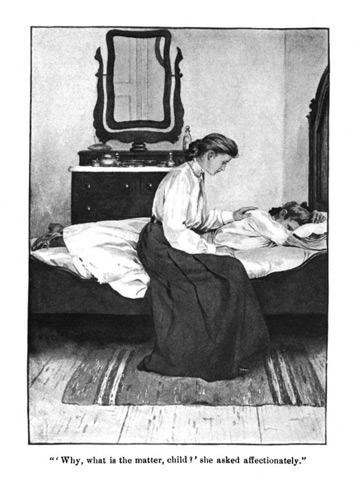
"Oh, nothing," came in muffled tones from the prostrate Martine, "only this has been such a long day."
"You are tired," responded Amy, "and probably you were more excited than you realized when you and Priscilla were lost."
"We weren't lost"—Martine threw considerable spirit into her voice,—"I knew just where we were."
"But we did not—" Amy, though amused, tried not to show her amusement—"we were rather alarmed, so really my mother and I ought to be the persons to collapse. Come, Martine, even if you are tired, you must cheer up, and go to bed."
"It isn't because I'm tired," and Martine's tears flowed afresh, "but I thought that to-night there would be a letter from my mother. There must be a mail in, and I have counted up the time from New York. There ought to be a letter to-night. I am sure that she's worse."
"Nonsense, child. Probably she does not feel quite well enough to write, and your father has overlooked the mail. You know how apt men are to forget."
So Amy tried to pacify Martine, and at last succeeded in getting her to look at things more cheerfully. She had never before seen Martine in low spirits, and she felt quite sure that fatigue, even more than disappointment, had caused the tears.
"I will admit," she said, "that this has been a trying day, beginning with—"
"Beginning with Mr. Knight,"—and now Martine was smiling. "Wasn't he funny, with his 'you Americans,' as if we were some strange species?"
"But in the end don't you think that Mr. Knight did pretty well? I think that he more than redeemed himself by his kindness."
"Well, as he is a friend of Balfour Airton's I suppose that I ought not to criticise him. There, don't shake your head, Amy. Yes, I do think that he was very kind—in the end. But the day has been fearfully long. We ought not to have taken that walk this morning."
When at last Martine went to bed Amy sat beside her until she fell asleep. There was a strange mingling of childishness and womanliness in this little Chicagoan to which Amy could not accustom herself. Her worldly wisdom and grown-up air of womanliness were quite as hard to understand as the extreme childishness in which she sometimes indulged. The more equable Priscilla was much easier to comprehend, and yet Amy was not altogether sure that Priscilla, under stress of circumstances, would be the easier to manage.
CHAPTER XVIII
the right and the wrong of it
"For my own part," said Martine, "I am just as firmly on the side of the Acadians as ever. They may have been stupid about the oath, and probably they were too easily influenced by Le Loutre, but they had been handed from England to France and from France to England so often that I don't see how they could consider themselves English when really they were French."
"You must have had Irish ancestors as well as French," said Amy, with a laugh. "Your remark sounds almost like a bull."
"Well, I mean to take the bull by the horns," replied Martine; "you can blame any one else for the deportation, but not the poor Acadians. They certainly did not in the least know who they were. But I am glad," she concluded, "that you have taken so much trouble to explain it all to me, Miss Amy Redmond, for I have never before understood why the English were so cruel."
"It is surely a fact"—Amy spoke decidedly—"that the English Government would have preferred to keep the Acadians their subjects. They needed them to supply provisions, and to man their garrisons. With their knowledge of woodcraft, and of the Indians, the Acadians would have been invaluable on the English side."
"But you couldn't expect them to fight against the French, who were their own flesh and blood!" and Martine cast a glance of reproach at her friend.
"That, of course, was the chief point in the dispute. The Acadians claimed to be neutrals, when really they were sending their produce to Louisbourg, or to the French in other places, to help them continue their war with the English. Yet they expected the protection of the English when in trouble, and they always had it, although their only tax was the tithe that they spent for the support of their own church."
Amy and Martine were sitting on the broad sands of Evangeline's beach, looking toward Blomidon, and waiting for Priscilla, who had strolled some distance away. They had driven over from Wolfville in the omnibus, and were to have an hour or two at the edge of the Basin before they need return. In the midst of the discussion Priscilla rejoined them.
"More Acadians!" she cried with a smile. "Let me ask you a favor—"
"To say no more about them?"
"No, not that. When we leave the neighborhood of Wolfville we shall think of other things; so, once for all I, for one, should be glad to have the whole story straightened out. We know what happened after the expulsion, for we've been at Clare, and we know about the earliest French; we heard all that at Annapolis. But now, my dear Miss Amy Redmond, you have been looking into this thing thoroughly, and if—"
"Yes," urged Martine, "if you'll please tell us what happened in the years between, it will save our reading, and you will make it much clearer to us than any book."
"Down with your flattery," rejoined Amy; "yet as there's no time like the present, I will tell the story briefly. We might as well pass over the various transfers of Acadia from France to England, and from England to France, before 1710. But the conquest of Annapolis by General Nicholson in that year gave Acadia finally to England. The change of Government was confirmed by the treaty of Utrecht in 1713, and all Acadians who did not wish to be subject to England were given time to leave. Those who remained were required to take an oath of fidelity to King George, and England on her part agreed to let them exercise their own religion under their own priests. In spite of these arrangements many of these simple-minded Acadians still considered themselves subjects of the King of France, even up to the time of the expulsion. Perhaps the priests encouraged them in this and delayed their taking the oath of allegiance. By 1730, however, nearly all had signed the oath, and if war had not broken out later between France and England there might have been no further trouble. But when it was found that many of the Acadians, instead of remaining neutral, were joining with French and Indians in attacks on the English, Lord Cornwallis, the Governor at Halifax, required them to take the oath again. This was necessary because a new generation had grown up who had been encouraged by the priests and politicians in enmity to England. Most of them would not take the new oath, because it required them to defend Acadia against the enemies of England, and this, they said, would oblige them to fight against the French, their kinsmen. In 1751 there was a large immigration of Acadians to Île St. Jean, then in the hands of the French. These exiles suffered much, but they were encouraged to hope that when France reconquered Acadia they could go back to their deserted homes.
"Cornwallis continued firm, and at last the Acadians were informed that all who would not take the oath must leave Nova Scotia. In the very beginning deputies from the Acadian villages had gone to Halifax to say that it would be impossible to take the oath and ask permission to dispose of their farms and leave the country."
"Why didn't they go? It would have been so much better in the end."
"It is hard to say, Martine. Friends of the Acadians claim that the English put all kinds of obstacles in their way, first refusing them transportation in English vessels, then preventing their buying rigging at Louisbourg for vessels of their own. But, as I have said, more than a thousand did eventually pass over to the Île St. Jean, and some of these took part in the defence of Beauséjour."
"Well, they were surely very conscientious," said Martine, "for they knew that by taking the oath and becoming British subjects they could live in comfort on their farms. It was very brave in them to choose poverty and exile."
"It might seem braver, if behind it all they had not had the feeling that the time was near when the French would drive the British from Nova Scotia and so restore them to their own."
"It was all that Le Loutre, I suppose," commented Priscilla; "he was responsible for so much."
"Whether he was really as bad as some represent him would be hard to say; but this missionary to the Micmacs had great influence, and it was all used against the English. We pity the Acadians, but we ought to pity the innocent English settlers on the outskirts of Halifax, and at other places, who were tortured and murdered by the Indians whom Le Loutre and other French had stirred up. Now, to keep to our story without making it too long, the Acadians dallied and dallied. They did not take the oath of allegiance, and they did not seem to be preparing to leave the country. At last Lieutenant-Governor Lawrence gave them only a short time to decide.
"Well, the French and Indian War continued, and the English were generally more successful than the French. At last Beauséjour was captured, chiefly by the help of a body of troops commanded by Colonel Winslow. These men were New Englanders,—sturdy, conscientious men from country towns, a large number of whom had been farmers and small tradesmen.
"Beauséjour fell the middle of June, and it may interest you, Priscilla, to know that Le Loutre, rather than fall into the hands of the English, fled to Quebec, where he was coldly received. Later he went to France, and died in obscurity.
"In July, 1755, a memorial was sent to Lieutenant-Governor Lawrence, signed by twenty-five leading Acadians, on the subject of the oath, and requesting the return of their guns that the Government had obliged them to give up on account of their sympathy with the French. When Governor Lawrence sent for the signers to come to Halifax, fifteen appeared before them. He pointed out the insincerity of their memorial, and when he desired them to sign the oath they flatly refused. Finally, on the twenty-eighth of July, these deputies and others from Annapolis appeared before the Governor and Council, and although warned that the consequences would be serious, they declined to take any oath differing from that taken under Governor Phillips; that is, they were unwilling to bear arms for the English against the French."
"That, I must say, seems noble to me, since they knew what risks they were running," cried Martine.
"That is to an extent a matter of opinion. But their refusal decided Governor Lawrence what to do. He immediately wrote to Colonel Monckton that enough transports had been ordered up the Bay for the Acadians, and that he must remove them. He was told that all the property of the Acadians was now forfeited to the Crown, and that they would be allowed to take on board ship only their money and their household goods."
"It is a wonder he left them anything," said Martine, sarcastically.
"He wasn't absolutely heartless, and he gave careful directions for provisioning the transports for their long journey."
"I am sorry that it was a New Englander who had to carry out these cruel orders," said Priscilla.
"Yes, it fell on Lieutenant-Colonel Winslow, and a detachment of those New England troops that had fought at Beauséjour to attend to the deportation at Grand Pré. It was Tuesday, the second of September, when he ordered all the male inhabitants from ten years upwards to assemble on the following Friday in the church at Grand Pré, to hear what his Majesty had to say to them. Then—but really I think one gets the story better from Longfellow. It is from this point that we have our sympathies so deeply touched, and we are willing to forget that the simple-minded Acadians had brought much of their trouble on themselves."
"It doesn't make their sufferings less, even if they were to blame," interposed Martine.
"That is true. They may have been less peaceable and amiable than they have been represented by the poet, and their homes and their ways of living may have been less—less—"
"Æsthetic," suggested Priscilla, with a smile.
"Well, æsthetic, then. But all this does not alter the fact that they deserved the greatest pity. Many of them, indeed, honestly believed that they were still the subjects of Louis XV, and that to take the oath required by the English would be a great crime."
"What they needed was a really good and disinterested man to advise them; some one like Paul Mascarene, who was partly French, and yet could get the English point of view," said Priscilla. "Some way I can't feel that the English were altogether disinterested—although," she concluded hastily, "I am more on the English side than the French,—and I am very sorry that it was a man of Plymouth descent who carried away the Acadians from Grand Pré."
This, in view of Priscilla's previous prejudice against the Acadians, was really a very liberal statement, as the others realized.
"It should console you, then, to remember that Colonel Winslow was simply a soldier acting under orders, and we have no reason to think that he used needless cruelty. 'It hurts me to hear their weeping and wailing,' he said in his journal, and this shows that he had a tender heart."
"But I can't see why families were separated, and why all these Acadians couldn't have been sent up to Upper Canada to the other French;" and Martine sighed deeply.
"You forget that France and England were still at war, and to have put so many able-bodied men at the service of France would indeed have been madness. Governor Lawrence explained all this in letters to the governors of the different colonies to whom he sent the Acadians. They were sent to as many different colonies as possible, and broken up into small groups, so that they could not unite in any plan for return."
"I suppose that Governor Lawrence thought it better for them to become public charges,—people who had always been perfectly independent."
"Oh, well, there is a bright side. Many of them never lost hope for a minute, and even those who went to the French West Indies soon began to plan to get back to Acadia. In the end, after the Peace, they began to take the oath, and receive their new grants of land, and since then England has had no more devoted subjects—as we saw for ourselves in Clare."
"All the same," said Martine, "this must be a haunted region around here, and I can tell you I should hate to walk through Grand Pré alone after dark, or even drive through."
"Speaking of haunted regions," said Priscilla, "though I don't know why I think of him just now, what do you suppose has happened to Mr. Knight? No one has seen him since our adventure."
"We haven't seen him," responded Amy, "but I sincerely hope that he is in the land of the living. I must have forgotten to tell you that mamma had a letter from him the day after our drive, telling us that he had been suddenly called to New Brunswick, and expressing his regret that probably he should not see us again."
"That must have been a great relief to him," murmured Martine, "that call to New Brunswick. Otherwise he might have had to see us again."
"Oh, he expressed great regret at having to go without doing so."
"That was kind in him, even if it wasn't quite sincere. It is my own opinion that he went away on purpose. He couldn't bear to see us again when he remembered how his hair was tumbled—not a sign of the parting—and his cuffs wet. But we remember, don't we, and I hardly blame him for running away."
"Martine, my dear child, you are very absurd. No man could possibly be so vain."
"Especially, my dear Miss Amy Redmond, one whose business is the instruction of youth," rejoined Martine, flippantly.
"I had a letter from Eunice this morning," interposed Priscilla, "and she said that Balfour had had a letter from Mr. Knight, who thanked him for the introduction he had given him to us. She said that he had written about our trip to Grand Pré, and was surprised to find Americans so much interested in Acadian history."
"That is all very well. People always write that way after a letter of introduction; they feel that they must. You cannot persuade me that Mr. Knight had any other reason for running to New Brunswick except to avoid us."
"Perhaps he wished to escape our thanks for the rescue."
"Rescue!" Martine's tone was scornful enough. "We weren't in the least little bit of danger."
"We weren't exactly comfortable," responded Priscilla. "I was thankful enough, I can tell you, when Mr. Knight and the dory came in sight. Why, we might have had to stay there for hours."
"Oh, no; there would have been some way. The tide goes out as rapidly as it flows in."
"Well, leaving out individuals, who certainly have been very kind to us," interposed Amy, "considering that in their hearts many of them think of us as 'those Yankees,' Wolfville has been fairly worth while."
"Yes," replied Martine, "though I haven't been able to paint Blomidon, I have captured the Grand Pré willows. The subject may be trite, but I've managed to give it a touch of individuality by adding a tree or two and lopping off a branch or so, here and there, and this will set some persons guessing as to what my view is."
"Oh, Martine!"
"But the artistic reputation of the party is kept up by your mother's sketches. That one of the marshes is simply perfect. No one who had not seen the colors could believe that nature up here in the north is so brilliant. The water is so blue,—and she has caught it exactly,—and the bright red of the shore at low tide, and the vivid green of the dyke grass, varied here and there with clumps of yellow—"
"Stop, stop; you make me fairly dizzy."
"But it's a true picture, isn't it? and your mother has reproduced it to perfection, and if she doesn't sell it before Christmas I shall get papa to buy it for me."
So the three friends sat and chatted on this their last afternoon in Evangeline's land, half regretting that the time was near when they must bid good-bye to Acadia.
Though they had not tried to do all the things possible for the tourist, they had gone to the Look-off, the highest part of the Blomidon ridge, and from this spot had had a magnificent view of the Annapolis and Cornwallis valleys, and the six rivers flowing into Minas, and the hundreds of fertile farms and the picturesque seaports lying almost at their feet; and they had made also several side trips.
Priscilla had slaked her thirst for information by setting down in her note-books many facts about the productiveness of the region, and declared that in future if she should meet a boy anxious to become a farmer she would send him to Nova Scotia rather than to the unknown West.
"Ah, but there's no government land for him to take up here, and farms don't go for a song. Every inch is cultivated," rejoined Amy.
Thus at last, when Amy with her mother and her friends were ready to leave Wolfville and Grand Pré and their neighborhood, their minds were filled not only with the history of Acadia and the memories of the past, but with pictures of the present that seemed likely to be lasting.
Mrs. Redmond, moreover, in balancing her accounts,—not a reckoning of money, but of something more precious—counted as the greatest gain the improvement in health made by Priscilla and the improvement in disposition made by Martine.
Priscilla's gain was easily recognized. Even she herself could see it when she looked in the glass, and she was daily growing more and more conscious of it. But Martine's gain,—perhaps she herself did not realize it. Perhaps she had not known in the beginning how much she needed improving. Yet Mrs. Redmond, realizing it, had observed with pleasure that Martine was not nearly as self-willed, was not nearly as ready to ridicule the foibles of others as at the beginning of the trip. Just as the angles of Priscilla's disposition were rounding off to a certain degree, so Martine was much less likely than formerly to fly off in a tangent. Although it could hardly be said that the two girls understood each other perfectly, it was yet the fact that wishes collided far less often than in the past. When Priscilla yielded, she did so with a smaller show of helpless resignation than had been her wont, and Martine no longer thought it clever to laugh at every suggestion made by Priscilla.
As to Amy, her mother saw with pleasure that to her the summer had been one of real refreshment. If she had been absolutely idle she could not have been half as happy as now, with the sense of responsibility that was hers in having the care, or at least the partial care, of Martine and Priscilla; moreover the trip itself, opening as it did to her a country of which previously she had known so little, was in every way a delight to her. It had shown to her a world of history and poetry with which she had not been familiar, even though she had known something about it, and this in itself was worth much to her.
CHAPTER XIX
a discovery
"I almost wish," said Amy to her mother, as their train was speeding away from Wolfville, "that we were going direct to Halifax."
"That is a concession," responded Mrs. Redmond, with a smile, "for if you had been less anxious to see Windsor we should have passed on without stopping there. Perhaps even yet it is not too late to change our plans."
"Oh, no; I am just as anxious as ever to visit King's College, and Martine and Priscilla, if not enthusiastic, still feel pleased at the prospect of seeing one more town before we reach Halifax. I've had to use some persuasion to get them to take this point of view, and it would be very foolish indeed for me to be the one to change plans now."
A moment later Martine and Priscilla, who had been looking from the window on the opposite side of the car, returned to their seats.
"Would you care to give up Windsor now?" asked Mrs. Redmond.
"No, indeed; since I realized that Windsor is the old Piziquid of the Acadians I have been crazy to see it, for I read a story the other day whose scene was laid there; and besides, I've heard that Windsor has one of the queerest harbors in the world, with water in it hardly two or three hours a day, and only red mud the rest of the time."
"That's nothing very new," interrupted Priscilla; "we've seen enough of that kind of thing already in Nova Scotia."
"Oh, but the difference is that the harbor of Windsor is so large that they say it is very amusing to see so many great vessels stranded in it I'm quite reconciled now to spending a day or two there; it's only Priscilla who objects, Mrs. Redmond."
"I don't really object" responded Priscilla, "but I'm afraid we won't have all the time we need at Halifax."
"After all, we shall not be limited in our stay there. Unless those letters that I expect insist on my return at once I shall be quite willing to stay away until after the first of September."
"Who is it then, besides Priscilla, who wishes to cut Windsor?"
"No one but me, Martine," returned Amy; "and this is only because I have a little feeling that I can't explain that we might better go through directly to Halifax. It's the kind of feeling that leads people sometimes to give up a particular train from fear that some accident will befall it."
"Ugh!" and Martine held up her hands in protest. "I never knew before, Miss Amy Redmond, that you could be superstitious, for that's what 'having feelings' amounts to."
"Well, at least I'm strong-minded enough to disregard these premonitions. In my heart of hearts I believe that we shall not only escape from Windsor alive, but enjoy our stay there thoroughly."
Not so very long after leaving Wolfville the travellers were within sight of Windsor. They had passed through beautiful farming regions with occasional glimpses of river and marsh; and there across a stretch of yellowish water they caught sight of the town which the Indians had so correctly named Piziquid, "the meeting of the waters." This first glimpse showed a town built up on the sides of leafy hills and stretching down to the water, bordered with many wharves, at which lay three-masted schooners and craft of every size.
Their rooms had been engaged at one of the smaller hotels. It was delightfully situated on a side street, and within seemed pleasant and homelike. Already their bags had been taken to the rooms assigned them, and Martine and Priscilla lingered a moment to speak to the landlady's little daughter, a child of five or six, who was playing in the hall.
"How red her cheeks are! I must kiss her;" and Martine bent down to suit the action to the word. But the little girl was coquettish, and, slipping away, stood at some distance, staring at the strange young ladies. Priscilla looked sharply at the child.
"I wouldn't kiss her," she remonstrated. "Her cheeks are flushed; they are almost feverish. I believe she's not well."
"Nonsense," rejoined Martine, with a laugh. "Every one down here has red cheeks;" and she took a few steps forward in pursuit of the child.
Priscilla laid her hand on her arm "No, no, she looks just as my little sister did after she had scarlet fever; promise me you won't kiss her."
"I don't see why you should care," said Martine; "but you seem so in earnest that for once I'll do what you wish."
At this moment Mrs. Redmond approached the girls, in company with the landlady, who had been showing her her room. She, too, looked keenly at the little child.
"Is this your little girl?" she asked her companion.
"Yes, my only child."
"Is she,—is she quite well?"
The woman hesitated for a moment.
"She has been sick, but she's almost well," she replied.
"What was the matter with her?" asked Mrs. Redmond, pleasantly.
"She has had scarlet fever, but—"
"Girls," said Mrs. Redmond, "have your bags brought from your rooms."
Then she turned to the landlady.
"I can understand now why you can offer us a choice of so many rooms; the fever, I suppose, drove your guests away. I'm sorry, but we, too, must look farther."
In a few moments the four had called a carriage and were on their way to seek a new abode. Martine saw the ridiculous side of the whole affair and made the others laugh at her account of the way Priscilla had saved her from the fatal kiss.
"It is no laughing matter," protested Mrs. Redmond; "the child was evidently in that condition when the disease is particularly contagious, even though she herself is not especially ill. I shall have to watch you all very carefully, and shall be thankful enough if you do not suffer from this exposure."
"There, Amy," cried Priscilla, "the worst is over; your premonitions are justified, and another time we won't laugh at your superstition. Though you hadn't scarlet fever in mind, this was the danger which we were to pass through."
"I hope that the worst really is over, but it is rather curious that this particular incident should have happened here after what I said."
Under the guidance of their driver the party soon found a boarding-place in a large wooden house, attractively situated on a hill.
On the morning after their arrival Mrs. Redmond advised the girls to make the most of their time.
"I'm told that we can visit the college and return in time to take the afternoon train for Halifax, but perhaps it will be as well to do things a little more at our leisure and go on to-morrow."
"Oh, far better," said Martine; "it would be so tiresome to go on to-day; besides—" and here she stopped as if she had almost disclosed something that she should not speak about.
Soon after breakfast Martine and Amy strolled off to the grass-grown ramparts of Fort Edward, the defence that had been built by the English against the French when Acadia came into their possession. An old blockhouse was the most interesting thing to be seen from the Fort; interesting at least from the historical point of view.
"What makes Windsor seem so very new?" asked Martine. "Every one speaks of it as such an old town, and it seems to be full of new brick buildings that look as if they'd been finished hardly a week."
"It's the fire," replied Amy. "The greater part of Windsor was destroyed by fire a year or two ago. It used to be much prettier, they say, with its old wooden buildings and tree-lined streets. The trees and the old-fashioned dwellings have all been swept away,—at least in this part of the city. When we go to King's College this afternoon we shall see what is left of the older section."
"Martine," said Mrs. Redmond, when the two returned, "I'm sorry to have to reprove you."
"If any one is to reprove me you are the one, Mrs. Redmond, whom I should prefer to administer the reproof; but what is the trouble now? Am I in danger of catching anything new?"
"No, my child, but see!"
Mrs. Redmond held up before Martine a small chamois bag.
"Oh, dear, did I really leave it lying about?"
"Yes, Martine, and had any one else found it you might have been put to considerable trouble to recover your rings."
Taking the little bag from Mrs. Redmond's hands, Martine emptied its contents on a table. There they were,—not only the four beautiful rings, but the diamond star that her father had given her the preceding Christmas. Ever since Priscilla had expressed her contempt for those who wore expensive jewelry while travelling, Martine had carried her rings in the little bag in which she kept the star and one or two other valuable pins.
"It seems to me," said Mrs. Redmond, "that it would have been wiser to leave these valuable things in Boston."
"But I always have them with me, and nothing has ever happened."
Mrs. Redmond hesitated as to what she should say. Although she was Martine's temporary guardian, she believed that it was not her place to instruct the young girl on points that would naturally come within the observation of her parents. If they had established no rules regarding the times when she should or should not wear jewelry, it was hardly the duty of another to interfere. Yet she saw that a word or two now might prevent further complications while she and Martine were travelling together.
"It is true," she said, "that people must judge for themselves when they shall and when they shall not wear jewels. But your rings, I can see, are all valuable, especially the emerald, and it is so easy to mislay such things when dressing, or when leaving a boarding-house, that if I were you I would put them safely away."
Though she did not express it, her real thought was that in travelling there is seldom an occasion when a young girl needs to wear jewelry.
"Thank you, Mrs. Redmond," said Martine, pleasantly. "I am truly sorry that I brought these things with me, although at home I always wear my rings without thinking about them. The diamond star I thought might be worn if we were invited to a party or a reception while away, but I see now that it would not be the thing for me to wear it at all this summer. In fact, when papa gave it to me he said that he did not expect me to wear it often until I was eighteen, but I thought I would like to have it with me, and it seemed safe enough in this bag."