Amy in Acadia (continued 2)
Reading edition
"We must at least see Madame Bourque at the hotel. A message was sent her last night, asking her to reserve rooms for us, and perhaps she can help us out of our difficulty," said Mrs. Redmond.
To the great surprise of all, the Hotel Paris, when they reached it, proved to be but a small dwelling-house, larger than its neighbors, but even smaller than the inn at Meteghan, for which "hotel" seemed a misnomer. As the four sat in the little parlor, Madame Bourque, a dignified and even elegant appearing woman, in her black gown and black couvre-chef, tried to make them feel comfortable.
"Ah, but the death, it makes no difference," she said, after assuring Mrs. Redmond that the rooms were in readiness. "It is my sister who has been long sick, and was glad to go. Indeed I am sorry that you heard of it, for the funeral will be before you wake in the morning, and had I thought it would disturb Madame, why, we might indeed have had it to-day."
"Business before pleasure," whispered Martine to Amy, who was trying valiantly to keep from smiling,—a difficult task, indeed, for any of the four.
As they seemed to have no choice in the matter, the girls agreed with Mrs. Redmond that they could hardly do better than take possession of the large, pleasant rooms that Madame Bourque showed them.
In the early morning, a gray morning, before the others were awake, Amy looked from the window. A sad little procession was setting out from the door. The plain deal coffin was in an open wagon. Behind it were a dozen shabby carriages, with mourners, men and women. They were to drive to the churchyard at Point à l'Église, three miles away. She did not waken the others, but she watched the little procession until it was out of sight.
CHAPTER VI
pierre and point à l'église
"Ah, why should she wish to see you, the American young lady? You have much conceit, Pierre."
The words were French, the voice was Madame Bourque's, and Amy, quickly translating what she overheard, perceived that Madame Bourque was throwing obstacles in the way of the little boy's seeing her.
"Madame Bourque," she cried, stepping out into the hall, "I asked him to come to see me. It is as he says."
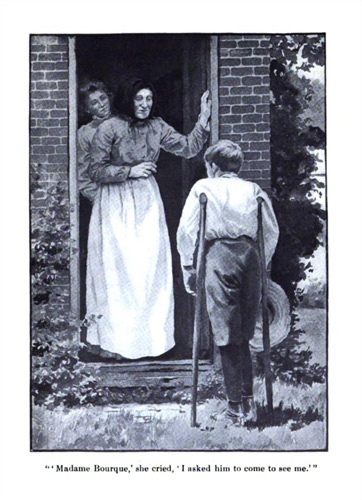
"Oh, then excuse me, Mademoiselle. I did not understand. I did not know that you had seen Pierre."
"Ah, yes, he helped me find my way last evening. He may come in, may he not?"
"Ah, surely, since you wish it. Pierre talks much, and I have known those whom he tired. But enter, Pierre, since you have been invited."
Then Pierre followed Amy into the little sitting-room, where Priscilla and Martine were already seated near an open fire; for the gray and damp early morning had introduced a foggy day, and at present sightseeing was out of the question. Priscilla had been writing letters, Amy had been reading a history of the Acadians, and Martine, before Pierre's arrival, had been looking through "Evangeline."
"Pierre," Amy asked, not knowing just what to say to the old-fashioned boy, "do you care for 'Evangeline'?"
"Surely, yes," he replied, his face lighting up. "Your Longfellow has sympathy for the Acadians. A lady who stayed here last summer lent me his poems, but best I understand the 'Evangeline.'
"'Fair was she to behold, that maiden of seventeen summers. Black were her eyes as the berry that grows on the thorn by the wayside, Black, yet how softly they gleamed beneath the brown shade of her tresses!'"
Pierre recited with much expression.
"Ah," he continued, "I can say much of that beautiful poem, and indeed it makes me weep to think how they were treated, those poor Acadians, my ancestors. The English were most cruel."
"Amy," half-whispered Martine, "my history is a little rusty, so please tell me if the Acadians were driven out from Little Brook."
"No, my dear, Little Brook was founded by some who made their way back from exile. Pierre," she added in a louder tone, "you are so interested in your people, can you tell us about those who founded Little Brook?"
"Yes, Pierre can tell you all the story," interposed Madame Bourque, who had entered the room to put wood on the fire. "He knows it all from his grandmother, and he remembers."
Pierre, thus commended, flushed even more deeply than he had when Amy made her request; but he remained silent until she spoke again.
"Perhaps it is not everything that you would wish to hear," he said, "that I shall tell; but my grandmother told me that it was all forest in Clare when the Acadians were driven from their homes by the cruel English. There were no farms here then, and so Petit Ruisseau has no sad memories of poor people driven from their homes. But you know that Acadians from Annapolis and Grand Pré and other places farther north were carried off to the English settlements that are now the States, and were treated like beggars; for they had no money, and spoke but a strange tongue. Fathers were separated from children, and brothers and sisters were not often in the same ship. But all were strong in their hearts, and determined to come back to their beautiful Acadia. Some began to come back before the Peace, and walked all the way—hundreds and hundreds of miles—from Boston and New York, until they reached the coast of the Bay. When the war was over, and there was a great Peace, many, many more came, and walked all the way around from New Brunswick to Nova Scotia to find their homes again."
"But I thought that all their houses were burned and that they had no homes to return to."
"That is true; but some knew not this, and even those who had seen the fires from the ships did not believe that everything of theirs was destroyed. So they were very sad when they could find no signs of their old homes, and saw that everything belonged to the English settlers. It was a great crime, sending them away, oh, so many; I am proud my great-great-grandparents were exiles and my great-grandmother was born in Salem; so perhaps I am half Yankee; that's why I speak some English."
At that moment Madame Bourque took part in the conversation. "Ah, it is terrible to think of their sufferings, people of such worth,—it is the crime of history. Just think of Belliveau; you tell about him, Pierre."
"Oh, he was very brave, and the first exile to land in Clare. He and his wife came across the bay in a little boat, bringing their baby too, and they landed safely on the shore that you can see from the window. They had a terrible passage—and to think to-day that some people fear to cross the bay to St. John, even in a steamboat! At first they did have nothing, but they cut wood, and soon other Acadians joined them who had walked all the way around on land."
"Pierre," interposed Amy, "you describe things very well; what do you intend to be when you grow up?"
A shadow crossed Pierre's face. "I should like to be a sailor, and then a great captain, but I am not strong enough, and I shall never grow big; so I think I may be a teacher, and that is why I take trouble to speak and write English."
"You should be here," interrupted Madame Bourque, whose mind still dwelt on the Acadians, "on the fifteenth of August; that is the day of the return from exile that all the people in Clare celebrate."
"We shall hardly be in this part of the country then, Madame Bourque," responded Amy, "but we shall try to know all we can about the early Acadians before we leave Little Brook. But, Pierre," added Amy, "you haven't told us all that you know, have you? Haven't you some stories that your mother or grandmother has told you?"
"One about the cane I like much."
"Then tell it to us."
"Well, there was one of our family, a great-grand-uncle, I think, who lived down near Cape Sable before the exile; one time he was very kind to a shipwrecked captain and took him into his house and gave him clothes and food; then when my relative was driven from home they took him to Boston, and he had to wander about, begging his bread, for he could not speak English. And then he and his three sons with him were put in jail; then the captain whom he had been kind to heard that these Frenchmen were in jail, and, remembering the kindness he had had, went to visit the prisoners. How surprised he was to find his old acquaintance who had helped him after the shipwreck! My relative was glad to see him too. Then the captain went to the governor and told him about the kind Frenchman who was in jail, and the governor said to bring him before him and perhaps he would pardon him. As my relative had no clothes fit to wear before the governor, the captain bought him a beautiful suit and a cane with a large head. Then the governor, when he saw my grandfather, pardoned him and his three sons, and they stayed in Boston several years, until the Peace, when they all came back to Nova Scotia. I know this story is true, because I have seen the cane, which one of my cousins owns in Pubnico."
"Do you think that is true?" whispered Priscilla to Martine.
"Oh, true enough; it certainly is not very exciting. It has been handed down so long that the point is evidently lost."
Pierre, once started, continued to tell many stories of the hardships borne by the early Acadians, beside which the tale of Evangeline seemed almost cheerful.
"Now, Priscilla," said Martine, when Pierre paused, "you must admit that the English don't show themselves in a very good light compared with the Acadians. Did you ever hear of such cruelty?"
"There must have been some cause for it," rejoined Priscilla, stoutly; "we have heard only one side thus far. Perhaps the Acadians themselves were a little in the wrong."
"They certainly were not perfect," interposed Amy, taking part in the discussion, "as you will admit when you have read their history more carefully. We have not time to go into things more fully now, and I have thought that Grand Pré would be the best place for our study of the causes leading to the exile. It's putting the cart before the horse to talk too much of the effects before we know the causes."
Had Pierre exactly understood Amy he might have entered into a discussion with her, but for the moment he had run to the front door to admit Madame Bourque's little daughters, whom he had seen entering the yard. When he was again in the room Madame Bourque once more joined the group.
"How does it happen, Madame Bourque," asked Martine, mischievously, "that your hotel is the Hotel Paris? You should have named it 'Acadia' or 'Evangeline,' or something like that."
"Ah," responded Madame Bourque, "it is that my husband is a Frenchman, from Paris, and I like my children not to forget that. Some day, when they grow up, they shall go to Paris."
"Have Acadians any real love for France?" asked Amy. "It is certainly a long, long time since their ancestors left it."
"Yes, indeed," replied Madame Bourque, "just as the Englishman always loves England, or the Irishman Ireland; they are still strangers in a strange land, though they must call the English Queen their queen," she concluded sentimentally. "Some Acadians go back to France to study, and some French boys come out to the college at Church Point, and one of them—ah, it is so romantic!—married an Acadienne a few years ago."
"Oh, tell us about it," exclaimed Martine; "I love anything romantic."
"Well, then," said Madame Bourque, "there was such a pretty girl at Church Point in the convent, and this youth was sent by his parents to study at the College of St. Anne. He fell in love with the pretty girl and would marry her, and oh, his father and mother they felt so bad, for they thought Acadians were something like Indians; and so they hurried out to Nova Scotia, and when they saw the girl they fell in love with her too, and knew she was no savage, and say their son can marry her. But the girl would not leave her people, and as the son would not give up the girl, the parents decided to come to Acadia to live, for he was an only son and they were rich. So they have bought much land up beyond Weymouth, and they call it New France. They have a great mill where they cut timber, and a railroad of their own twenty miles long, by which they send it to the sea, and good houses and electric lights—all on account of a pretty Acadienne."
"That's just the kind of story I like," cried Martine. "I suppose history is just as true, but someway I have more interest in things that are happening to-day."
Madame Bourque now left the room to make arrangements for the early dinner. She had foretold that the fog would lift before noon, and accordingly Priscilla, looking out the window, was not surprised to catch a fleeting glimpse of the sun through an opening in the veil of mist.
"We'll take your word that the sun will shine," exclaimed Amy, "and I'll run upstairs and ask mamma if she will drive this afternoon. I imagine that the most there is to be seen is at Church Point, and the sooner we go there the better."
Madame Bourque, when asked, promised to have two carriages ready early in the afternoon, for Amy had not only invited Pierre to dinner, but intended to take him to drive with her.
"Mamma," said Amy, as she gave her mother an account of the morning, "you will find Madame Bourque very amusing. She evidently believes the Acadians to be the salt of the earth; but though I sympathize with their sufferings, I do not believe they were quite the superior beings that she paints them."
"It might be unkind," replied Mrs. Redmond, "to suggest that this is part of her stock in trade; the more remarkable she can represent the old Acadians to have been, the more interested will her guests be in the places associated with them. They were a good, honest people."
"But they were peasants, were they not, mamma? You would think to hear her talk that they were very near nobility."
"Oh, among the Acadians of to-day are doubtless many descendants of men of good family in France. Indeed, some of them can claim for ancestors Charles de la Tour and Baron D'Entremont; but the peasant blood is in the ascendant, and the strain of nobility must be very slight."
At the dinner-table Pierre won Mrs. Redmond's heart by the gentleness of his manner, and she told Martine that Amy's protégé would be a close rival of hers.
"No, indeed," replied Martine; "no one can rival Yvonne. Just think of her voice and her little curls and her pink cheeks."
"I'll admit that Pierre lacks these characteristics, though all in all they would hardly enhance his value. From what Amy says, however, I should judge that Pierre, even if he has neither curls nor pink cheeks, has a voice that is very effective when he uses it in telling stories."
Fearing that Pierre might overhear these personalities, Mrs. Redmond changed the conversation. "Amy," she said in a somewhat louder voice, "where do you suppose Fritz is now?"
"Oh, if Pubnico is as fascinatingly French as he expected it to be, he is probably there still. I doubt if he will be better entertained than we have been."
"I almost wish he were with us," rejoined Mrs. Redmond, "for he is always a fund of entertainment in himself; I have thought of him many times this dull morning, and I hope that we shall find a letter from him awaiting us at Digby."
If Amy agreed with her mother, she did not so express herself at this moment; yet if the truth were known, it must be said that more than once since their parting at Yarmouth she had regretted that she had not at least given Fritz a chance to join their party.
When the carriages came to the door in the afternoon Amy recognized them as having formed part of the funeral procession; they were shabby, with hard seats, and the horses, as well as the vehicles, looked as if they had seen better days. It was arranged that Amy and Pierre should go in the small carriage, as Madame Bourque's husband assured them that the horse was perfectly safe for a lady to drive. "Ah, he could not run away!"
"I should think not," said Amy. "If he manages to carry us even the three miles to Church Point I shall be surprised; he seems so dispirited that I imagine the funeral has made more impression on him than on Madame Bourque herself."
Mrs. Redmond, Priscilla, and Martine were in the second carriage, and Madame Bourque was the driver.
Amy noticed in gardens and windows fewer hollyhocks, oleanders, and other bright flowers than she had seen at Meteghan. The houses, too, were painted in less bright colors, and the village street had a less stirring appearance.
Pierre was a good cicerone; he pointed out near the edge of the sea the spot where the first of the returning exiles had landed. He also showed Amy a little one-story house on a slight elevation, said to be the oldest in the town, and to date but little later than the landing.
"It is hard," he said in his precise way, "to imagine that it was all forest here in those first years, since now there is hardly a tree in sight except the fruit trees in the orchards. The first comers had large grants of land from the government; thus the English tried to make up for the wrong they had done."
"But the farms are very small now," ventured Amy. "The yards are so close together."
"Ah, yes, that is it; each father had many children and divided his land among his sons, and as every one wanted his house to be on the village street, they have kept it up, cutting it up into long narrow strips, some of them running back one or two miles; and away at the end of the strips there are still forests that are worth money."
Some time before they reached Church Point, the lighthouse and the college buildings were seen in imposing outline in the distance.
Their horse justified Amy's forebodings, and when they overtook Madame Bourque and her party the latter were standing near a monument before the large building that Pierre had said was the College of St. Anne. Amy, though undisturbed by Martine's gibes at the slowness of her steed, was glad enough to get out of the carriage. Both horses were left in charge of a boy whom Madame Bourque knew, while the sight-seers started to walk to the shrines of the Acadians—for by this term did Madame Bourque describe the burying-ground and site of the early houses.
"It is not a long walk," the voluble Frenchwoman had explained, "unless you go out to the lighthouse, for which we have not time to-day."
Priscilla lingered behind the others to copy the inscription on the monument. It was in honor of the Abbé Sigogne, to whom the Acadians of Clare owe more than to any other one person.
Priscilla, reading the inscription, wondered why she had never before heard of this man, who evidently had been so much to his own people. Acadia is not far from Massachusetts, and yet already she realized that this was a corner of the world of which she knew far too little. Amy, however, could tell her what she wished to know, and she hurried on to join the others, who were now far ahead.
"Amy," she cried, overtaking her friend, "tell me something about the Abbé Sigogne; I am ashamed to say that I never heard of him before."
Pierre glanced at the American girl with an expression of absolute amazement at her ignorance.
"There is so much to tell," said Amy, "that it would be too long a story for the time that we have now; yet as we walk along I can give you a little idea of his work. He was a French priest of good family, who barely escaped losing his head during the French Revolution. After fleeing from France he lived a few years in England. When he heard that the poor Acadians of Clare were without a clergyman, he decided to go to them, and from that time he made their lot his. This was in 1799, about thirty years after their return from exile, and though they had cleared the forest and built houses, they had made little progress in other ways; they were without schools and almost without religion, but the good Abbé built them a church, established schools, and made frequent visits to all the little settlements along St. Mary's Bay, often travelling along the coast in a small, open boat. He taught them many things besides religion. He made them firm in their allegiance to Great Britain, and when he died, in 1844, he was bitterly mourned by all who knew him, whether English or French."
When Amy and Priscilla and Pierre caught up with the others, they were in a large field, looking at a spot of ground on which Madame Bourque said had stood the very first house at Point à l'Église, built after the exile. Near by was a little old graveyard, where the first generation of returning exiles had been buried. Only a few graves were marked, and these with rough stones without inscriptions. A rude arch of whalebone formed the entrance to this little enclosure. It was not very far from the point of land on which stood the lighthouse, near which, along the edge of the sea, a file of black-coated priests was walking. Though they were indistinctly seen in the distance, their large caps and flapping surtouts gave them a picturesque appearance.
A strange structure like a shrine of open slats decorated with spruce boughs attracted Martine's attention, and she insisted on making a sketch of it.
"It is a repository," explained Pierre, politely, "where the priest stands, as a station for the procession, on festival days."
When they returned to the College of St. Anne, Madame Bourque grew more and more eloquent.
"Is it not wonderful," she said, "that all this great building is restored since the fire of two years ago? You will come inside, ladies, and see how pleasant the rooms are."
"I will stay outside," replied Priscilla, "and watch the horses," she concluded rather lamely.
"Nonsense," began Amy, but looking at Priscilla, she saw that the young girl was in earnest, and so insisted no further.
"Amy," whispered Priscilla, as her friend drew near her, "I was sorry afterwards that I went into the convent yesterday, and so I would much rather not go into a priest's house."
"I had no idea that you would be so narrow," rejoined Amy.
"I don't mean to be narrow," responded Priscilla, "but I really don't feel like going inside."
So Priscilla sat down on the grass near the monument and all the others went inside the main building of the College of St. Anne. Not very long afterwards Mrs. Redmond came out again, with her sketch-book in her hand. "I thought it a good time now to make a sketch of the church. I have seen many other schools like this one, for, after all, it's only a boys' boarding-school. The girls enjoy practising their French with the Eudist Father, who is taking them about, and it will probably be some time before they are ready to leave. I think you make a mistake, Priscilla, in not joining them."
"It isn't a very old building," said Priscilla, implying that this was sufficient reason for her staying away from the party.
"It is certainly not very old," rejoined Mrs. Redmond; "the college has been established less than ten years. It is a great thing to have founded it here in the midst of the Acadians, and it has made the boys of Clare much more ambitious."
"What good is a college education to them?" asked Priscilla; "fishing and farming seem to be their chief occupations."
"This is really only a preparatory school," replied Mrs. Redmond, "and the boys who are going into the Church or into the professions enter other colleges in Canada or in France. The Father told us with pride of the high standing of some of the graduates in their work in other colleges."
"If I do not care for the college," said Priscilla, "I love this church of Abbé Sigogne's; it makes me think of a New England meeting-house, with its white walls and steeple."
Mrs. Redmond's sketch was hardly finished when the others came out from the college. Madame Bourque was in her most talkative mood, as she led them across the road into the white church. This time Priscilla went with them and looked with some interest at the paintings on the wall, and the sacred emblems, and the tablet inscribed to the memory of Abbé Sigogne.
Martine, it must be admitted, found something amusing even in this church, for inside the gallery where the choir boys sat were many pictures of little boats, and even of full-rigged ships scratched in deeply with a penknife, presumably by the fingers of mischievous young singers.
Pierre, who happened to be with Martine when she made this discovery, did not laugh with her, but shaking his head solemnly, said, "Ah, those pictures show what really fills the heart of the Acadian boy."
Madame Bourque was disappointed that her party of Americans did not care to visit the girls' school near by, but the hour was late, and the tired-looking horses were not likely to make speed on the way home.
"We have really seen so much," said Mrs. Redmond, "that we shall need to think it all over before seeing more, and you have been so good a guide that in our one visit to Church Point we have learned as much as most persons do in two."
"We have learned a great deal," murmured Priscilla to Amy, "but I always feel that Madame Bourque paints the Acadians as much more remarkable than they are. But I should like to have seen Father Sigogne baptizing Indian pappooses; they say that he used to wipe their faces with his gown to find a spot where he could kiss them."
"Yes, and Madame Bourque says that there are people still living who can remember great crowds of Indians filing through the woods to Church Point that they might receive Abbé Sigogne's blessing on St Anne's Day."
CHAPTER VII
digby days
On the way back to Little Brook Amy had a good chance to talk with little Pierre about his hopes and ambitions. She found that he was extremely fond of reading, and it was almost impossible for him to get books such as a boy loves to read. About half a mile from Madame Bourque's, Pierre pointed out a small cottage which he said was his home.
"My mother will be there now," he said, "and I hope you will come in with me to see her. She does not speak so very good English," he added apologetically, "but she can understand it."
Though Madame Robichaud greeted Amy warmly and thanked her for her kindness to Pierre, there was something pathetic in her manner and appearance. She was a tall, thin woman, with a delicate, pale face that was made all the paler by her plain black gown and the couvre-chef that covered her hair. Her husband, Pierre explained, was lost at sea when Pierre was five years old, and since that time she had supported them both wholly by her own labor.
Madame Robichaud showed Amy with great pride some drawings nailed to the wall that Pierre himself had made,—simple drawings of ships and houses that showed draughtsmanship rather than imagination. These suggested to Amy that Pierre had a talent that might be cultivated to greater advantage than his ambition for school-teaching.
She and Pierre parted reluctantly, and Madame Robichaud promised that the little boy should be at the hotel in the morning before Amy left Little Brook.
All the travellers slept soundly that night despite the huge feather-beds that Madame Bourque had provided, as she thought, for their comfort.
In the morning they wrote their names in her visitors' book, on whose pages were inscribed the names of a number of Americans, some of them fairly well known, who at one time or another had been guests at the Hotel Paris. Pierre arrived very soon after breakfast with a great bunch of hollyhocks or passe-rose for Amy. He had evidently taken a great fancy to his new friend.
"She is more beautiful even than my school-teacher," he had said to Madame Bourque; a compliment which the latter repeated as of especial value, because hitherto Pierre had considered his teacher the model of womanly perfection.
"Martine," said Mrs. Redmond, before the carriage arrived, "have you written to Yvonne?"
"Oh, no; I meant to, but now I'll wait till we reach Digby."
"I fear that Yvonne will be disappointed. She probably expected a letter to-day."
"I know it; I am ashamed of myself."
Martine's tone was penitent, but no one who knew Martine ever expected her to do promptly what she had promised. It was always a little easier to put off things to another day. Priscilla looked at her scornfully, as if to say "How fickle!"
When at last they were ready to start, all felt sad at parting with Madame Bourque and her family, for in two days they had come to seem almost like old friends. The two little Bourque girls, as the carriage drove off, looked with astonishment at the dollar bill that Mrs. Redmond had put in the hands of the elder to divide with her younger sister.
Pierre walked on a little way with Amy before she mounted her wheel, and on saying good-bye at last he knew that the American lady would really send him the books that she had promised.
Their train to Digby was not the famous "Flying Bluenose," but a local that made no pretence of hurrying; it instead gave them ample opportunity to study the scenery from the windows.
When at last they reached Digby, they were warm and dust-covered, and glad enough, too, when they found carriages waiting for them at the station.
"It's nothing but a summer resort, this Digby that we have heard so much about," complained Martine, as they drove along the main street. "Just look at those boys in golf suits, and that crowd carrying shawls and wraps as if bound for a sailboat. Why, the town doesn't even look English. It makes me think of Blue Harbor in Maine, where we spent one summer."
"I noticed a great deal of Philadelphia accent while we were waiting for our trunks at the station."
"Oh, don't mention it," replied Martine; "Philadelphians flock everywhere, and they are so cliquey that they just spoil a place for me, though I'll admit that they know a good thing when they see it."
"Be careful, Martine," cautioned Amy; "no more slang than you can help on this trip."
"'On this trip!' If that isn't slang I'd like to know what is."
"No matter now; here's the hotel; mail first and rooms afterwards."
In an instant Amy had hurried to the hotel office, returning to the others with a bundle of letters, which she gave to Priscilla to distribute while she went ahead with her mother to look at the rooms they had engaged. The hotel was like most small summer hotels, and in spite of their pleasant remembrance of Clare, Mrs. Redmond and the girls had to admit that it was more comfortable than the little French houses.
"'Pubnico!' why, of course;" here Amy stopped as she held the letter in her hand, turning it over once or twice as people will before opening a letter.
"Of course; don't hesitate to tell us that it's from Fritz. It would be very strange indeed if he had not written," cried Martine, mischievously.
"'Pubnico,'" said Priscilla, as if the word had just penetrated her brain; "why, there were two letters with that postmark, were there not?"
"Oh, no, only one," replied Amy, promptly, "and, as Martine surmises, it was from Fritz."
But while Amy was speaking Priscilla looked sharply at Martine, and Martine, as if uncomfortable under her gaze, suddenly left the room.
After dinner, as they all sat on the piazza, "Amy," said Mrs. Redmond, "you haven't told us yet how Fritz is enjoying his journey."
"Oh, he thinks he has found the only French in Nova Scotia. He describes their dress and their houses and their great fat oxen, and speaks of the misfortunes of the exiled Acadians as if he were an original discoverer. How foolish he will feel when he finds that what he has seen is old news to us, for his description reads just like a description of Clare."
"Only I'll warrant that he didn't find any Madame Bourque," and Priscilla smiled.
"No, nor an Yvonne," added Martine.
"Not to speak of Pierre," concluded Amy.
"My letter from home," said Priscilla, "mentions that this was the hottest week of the season. Just think, only yesterday we were half frozen driving home in the fog from Church Point."
After breakfast, on their second morning at Digby, Mrs. Redmond and the girls walked the whole length of the tree-lined main street. As Martine had surmised, they had indeed arrived at a regulation summer resort. The holiday spirit prevailed on all sides; every one was going somewhere, or had just been somewhere, on pleasure bent.
In spite of her professed prejudice against Philadelphians, Martine almost fell into the arms of a former schoolmate from the Quaker City, who rushed out to greet her from the garden of a small hotel near the top of the hill.
"Isn't the view fine, and the air just perfect? I'm so glad you're here; there's something to do every hour of the day, and we shall be so glad to have you join us, you and your friends." And she glanced dubiously at Priscilla's mourning dress and serious face.
"Thank you, but I can't make plans just now. There are four in our party; the other two have walked ahead. We arrived only on Saturday, and yesterday was so rainy that we stayed indoors until evening, when we all went to church. Until we really have our bearings I don't think that I can make any plans. But you must come to see us. There, I haven't introduced you to Priscilla; you must excuse me. Priscilla, the Rose of Plymouth, let me introduce you to Peggy Pratt from the quiet city of Philadelphia."
"You are the same old Martine," cried Peggy, as they turned away, while Priscilla, reddening, added as the two walked on, "Oh, Martine, how silly you can be!"
Amy was delighted with everything that they saw in the course of that morning walk, from the beautiful view of the Basin, surrounded by hills that looked mountains, to the little fish-houses, the quintessence of neatness, in front of which quantities of cod were drying. As to the Basin, when she said she felt as though she had seen it before, Mrs. Redmond reminded her that it resembled closely the harbor of Santiago, with which she was familiar through pictures.
"Ah, yes," rejoined Amy, "and that little opening into the Bay of Fundy that they call 'The Gut' is like the passage where Hobson tried to sink the Merrimac."
"It isn't such a very little passage; somebody told me that it is nearly a mile wide; it was there that the ships of De Monts entered the Basin in 1604, when they discovered Acadia," Mrs. Redmond added.
"Sixteen hundred and four!" cried Martine. "Oh, dear, we're going backwards in our history. It was seventeen hundred and something when the Acadians were expelled, and I shall never be able to remember earlier dates."
"At present we may put dates aside. For a day or two we can merely enjoy ourselves."
"I hope we are coming to some English history," said Priscilla; "I am tired of the French. I always supposed Nova Scotia was a British province, but this whole week we have heard very little about the English."
"I tell you what we'll do, Priscilla," cried Amy; "while mamma and Martine sit here to make a sketch of something or other, you and I can set out in search of some English history. Undoubtedly there's an historic house or two to discover. That's the kind of thing I never let escape me."
At first it seemed as if Amy's search would be unsuccessful. One person after another whom she asked said that there were no historic houses in Digby.
"There's an old shop over across the way," one added, "the frame of which, they say, was brought out from England; I'll point it out to you, though it doesn't look very old."
This last statement was true enough, for the old house had been reshingled and reclapboarded and repainted, so that it retained hardly a vestige of antiquity in its appearance. To compensate Amy for her disappointment, the obliging native made a suggestion that in the end proved valuable.
"What you ought to do is to see Mrs. Sally Tatem; her house isn't much to look at, but it's old enough, and she knows more about the history of Digby than any one else here."
"Where does she live?"
"Oh, just a little way up that street and round the next corner and up the hill and you will see a little cottage at the end of the lane; just knock at the door, and if she's at home she'll be very obliging."
So Amy and Priscilla went "up the street and round the next corner and up the hill," and at "the end of the lane" they saw a small white cottage almost covered with vines. Amy's knock brought to the door a little old lady with silvery hair and a tiny ruffled cap, wearing a gray gown and, most important of all, a pleasant smile. The hesitation that Amy had felt in explaining the object of their visit disappeared under the old lady's greeting.
"Dear child, come right in; I'll tell you all the Digby history I know; but it isn't so very much."
As Amy sat down in the little sitting-room, she could not help looking about, and she was quick to recognize that the two chairs were Chippendale.
"They were brought by my grandfather," said Mrs. Tatem, noting the direction of Amy's glance. "He was a captain in the Queen's Rangers; you know many Americans were on the King's side in the Revolution."
A look of surprise crossed Priscilla's face, but she did not venture to raise a question.
"Yes," responded Amy, "I know about the Loyalists."
"Well, my grandfather was a farmer in Westchester County, rich and prosperous, but he would not take arms against the King. A friend and neighbor of his was tarred and feathered, and he was in some danger himself. So he went into the war, and when it was over he couldn't stay in New York. With other Loyalists he came down here. Of course it was very hard for him to have all his property taken away, but his wife was brave and she was willing to suffer."
"Who sent them away?" asked Priscilla, eagerly.
"Why, the Yankees,—the Americans, I mean," said Mrs. Tatem.
"The Patriots," whispered Priscilla.
"Yes, yes," interposed Amy.
"But," continued Priscilla, "I didn't know that there were two sides to the story." And as she said this the old lady smiled.
"We have no bitterness now. I ought not to have said 'Yankees.' I have many friends in the States, but it was hard for my mother and aunts to have to grow up in the wilderness. I used to hear my aunt talk. She was an older daughter."
"But how did they live here in those days?"
"Oh, the King gave a large grant of land and provisions for three years and some building material. Many who came to settle would not stay, and it was harder for those who did remain. There was no church even, for a long time, until good Mr. Viets came; he did everything for the white settlers, and even held a school for the Blacks."
"The Blacks?"
"Oh, yes; you see many people brought their slaves with them."
"Southerners?"
"No, New Yorkers. Many Northern people had slaves in those days. I know that my grandfather had two, but when he died he left them their freedom in his will. Out at the Joggins' there are still living many descendants of these slaves, and of the Black Pioneers, a regiment of Blacks that fought on the English side in the war."
"What you've told us is almost as romantic as the French Revolution," said Priscilla.
"Maybe so," replied the old lady, hesitatingly, "though things probably did not seem romantic to the first settlers here; but perhaps it's just as well that our lot was cast in this healthy climate. I hear there's a great deal of sickness in New York, and it's a great big city where people care only for money. I'm sorry our young people go off so much to the States; they could all make a comfortable living if they would only stay at home."
Amy could not refrain from admiring the china and all the daintiness of the little house, plain and unpretending though it was. But the most interesting thing of all was the old lady with her charming manner and fund of history.
"I've heard my mother say," she remarked before they went, "that the first name of Digby was Conway, and it was only after Admiral Digby had been here that it was named in his honor."
"Why didn't the French settle Digby?" asked Priscilla; "they seem to be everywhere else in Nova Scotia."
"Probably because there are no marshes; they were attracted by the dyke lands at Annapolis and Grand Pré."
The girls bade good-bye to Mrs. Tatem with real regret. Before she returned to the hotel Amy wandered by herself in a little old churchyard where lay many of the first settlers, and as she looked at the weather-beaten stones she saw that many of those who lay buried there were natives of New York or its neighborhood; closing her eyes for a moment to shut out the present, she pictured to herself what life in the wilderness must have been to these refugees who had suffered everything in a losing cause.
That afternoon Martine's friend, Peggy, from Philadelphia, invited them all to join a sailing party; though at first disinclined to go, Amy at last accepted the invitation. It was a delightful afternoon, with wind and sea in their favor, and the charm of the surrounding scenery was increased by a delicate mist that hovered over the North Mountain, as a reminder of the Bay of Fundy outside.
For some reason this sail around Digby reminded Amy of some of her excursions in Marblehead Harbor, especially of a certain day on the "Balloon," and this in spite of the fact that the "Mary Jane" in no way compared in equipment with Philip's yacht. No picture of Marblehead could of course be complete unless Fritz were in it, and almost to her annoyance Amy now found Fritz occupying a large corner of her mind. Nevertheless, she was interested in all that was going on around her, and once or twice lent a hand to the skipper, when a sudden change of wind occasioned a quick shifting of the sails. Then the Bluenose skipper complimented the Yankee girl on her skill in handling the ropes, and Martine and Priscilla and Peggy expressed their astonishment that she should know so much about a boat.
For almost the first time since their departure from Boston Priscilla was now in good spirits; she had overcome her original homesickness, and her letters from Plymouth had been so cheerful that she was almost ready to find enjoyment in the new scenes and faces. Between her and Martine there was less intimacy than between her and Amy. Mrs. Redmond was sorry to see that, for some reason, Priscilla lacked confidence in Martine. This was to be accounted for, perhaps, by the fact that the two girls were so unlike in temperament and education. Though reserved in speech, Priscilla was uncompromisingly accurate in statement; Martine, on the other hand, while apparently unreserved, occasionally lacked frankness. No one could accuse her of being untruthful, and yet her exaggerations and her occasional concealments were a constant annoyance to the literal Priscilla.
On the second day of their stay at Digby, Martine had written a long letter to Yvonne, and at the same time had sent her a roll of new music, which she had happened to find in a Digby shop.
"If I knew just how long we should be here, I really think I would send for Yvonne to spend a week with us."
"We shall not be here a week," rejoined Mrs. Redmond, "and I am afraid that Yvonne would rather handicap us if we tried to have her travel farther."
On their last morning at Digby, Amy and Martine had a parting walk around the wharf. The wharf had been a source of much amusement to Martine, and she had sketched it at high tide when it looked just like any other wharf, and at low tide when it rose high above the water, its sides covered with seaweed and barnacles. Indeed the vagaries of the Bay of Fundy tides were an endless amusement to the party, exposing, as they did, long, long stretches of reddish mud, and apparently casting up all kinds of craft high and dry on the land.
"Now, around by the fish-houses," cried Martine; "how I shall miss the cod which we meet here at every turn! Fish flakes, in my mind, will always be the emblem of Digby. Priscilla says that she has seen more on Cape Cod, but I can hardly believe her. It's strange that no one has given us a Digby chicken since we came here. Any one would suppose that the Digby chicken is the only fish that grows here; yet really and truly we haven't seen one, have we, since our arrival? For it's the cod that's everywhere, and it's funny to think that they send so much codfish to the West Indies. People there must be thirsty enough without having cod sent to tantalize them."
On their way back to the hotel they did an errand in a corner shop. The clerk addressed them in rather broken English, and in answer to Amy's question said that he was a descendant of an Acadian exile. He told them one or two anecdotes, and when he had to turn to other customers Amy waited until they were served, hoping to hear more from him.
"That negro," he explained, as a tall Black went out of the shop, "is a descendant of one of the slaves of the Revolution."
"Was that other man a negro, too, who went out with him?"
"Oh, no, he's an Indian from the Bear River Reservation. If you go that way, you must be sure to visit it."
"I hope that we are going there, for I hear that Bear River is a beautiful place. Though I am not particularly anxious to see the Micmac on his native heath, it certainly is interesting to have met representatives of the four race elements in this little shop," said Amy, as they turned away.
"Four race elements?" asked Martine, not quite understanding her.
"Yes, of Nova Scotia Loyalists, Acadians, Indians, and negroes. To be sure Pre-Loyalists would be more representative than negroes—but the former did not settle Digby."
"Let's go up on Cannon Hill for a last look. Your mother just loves it. We have made some fine sketches of those crooked apple-trees and that old house."
"And the cannon? They are certainly unlike any others you will come across."
"I have photographed the cannon," replied Martine, with dignity, "and if I had time, I might sketch them."
"I love it here," cried Martine, as they stood on the hill. "One gets such a splendid view of the entrance to the Basin,—I can't bring myself to say Gut. When I stand here, I just close my eyes, and then fancy how these steep shores must have looked to the Frenchmen, Champlain and the others, who came sailing in through the passage that June morning so long ago. Then when I open my eyes I can actually see them out there—and if I were a poet, like you, Amy, I would write something worth while."
"I a poet! what nonsense! What put that into your head?"
"As if I didn't know all about you, Miss Amy Redmond," and Martine quoted a line or two of verse that brought the color to Amy's cheeks.
"That isn't poetry," she said with a smile. "But you are in a mood that shows me we ought to go home."
CHAPTER VIII
two adventures
"Oh dear," sighed Priscilla three hours later, as she strapped her valise, "I believe I'd rather stay in one place all summer than move so often. I shall miss the pier and the barnacles. When we came in from the boat at low tide the other day, it seemed like one of the caverns of fairyland—so dark and mysterious."
"Yes, and you'll miss the codfish, too. Amy and I have been going through the missing agony this morning. But I have a fish story that will please you, Puritan Prissie. Though curing codfish is a leading occupation here six days of the week, on Sunday that man is fined who even sticks a pitchfork into a helpless cod—except,—and here I am afraid that this covers a quantity,—that if there has been a week of wet weather, if Sunday is sunny, then the gentle codfish may be turned over. This is merely a humane provision for the comfort of the cod, who otherwise would become unduly weary lying so long on one side."
"We shall become unduly weary waiting for you," cried Amy, who had entered the room during the latter part of Martine's speech. "I hope that you are both ready, for it is almost train time."
"All aboard then," cried Martine. "If my hat is on straight, nothing need delay us. Let me help you with your valise, Priscilla. My luggage has gone on."
When they reached the station Mrs. Redmond and her party found that after all they had some time to spare. At five minutes past the hour they took their seats. "Standard time, Halifax time, hotel time, local time," hummed Martine. "I wonder which we're starting by."
Presently the conductor walked along the station platform to the little waiting-room, and from the open window they heard him speak to some one inside.
"Have you made up your minds yet, ladies, about going?" he asked in a polite tone.
"Oh, gracious, yes," exclaimed a shrill voice. "We were waiting for the bell;" and two elderly women hurried toward the train with their knitting in their hands. Amy had noticed them busily knitting there, in a corner, when she passed. It seemed, by the conductor's subsequent explanation, that knowing they were uncertain whether to go by that train or the next, he had patiently waited for them to decide.
Bear River was one of the places where Mrs. Redmond had planned to stay. After a short railroad journey that included a passage over some wonderful bridges, beyond which was a great extent of water, and after a drive of five or six miles, they found themselves gazing down at picturesque Bear River. The beautiful town sloped to a broad stream, its white houses and spires half hidden by trees.
"It reminds me of Switzerland," cried Martine.
"It's a dream," exclaimed Priscilla.
"I don't believe Fritz has seen anything more beautiful," added Amy.
"It deserves a more beautiful name," said Mrs. Redmond.
"But, really, mamma, it's named for Imbert, the explorer, and the name doesn't seem so bad when we think of that."
Their day in Bear River proved to be a gala day of the town. They had arrived at the height of the Cherry Carnival, and games and boat-races and other festivities had been arranged as part of the celebration. The girls were up very early that first morning, and soon after breakfast Martine was out with her camera, taking snapshots in every direction. A fat old squaw in a red jersey pretended to be afraid of the kodak, and turned her head; but there was a grin on her face as she looked around, which Martine quickly caught. Another squaw, also fat, with a little pappoose in her arms and another clinging to her skirts, begged Martine to take her.
"Where you live?" asked Martine, as if talking to a child.
"Up there," pointing vaguely in the distance.
"Where?"
"Reservation; you come see."
Martine was interested.
"Is it far?"
"Oh, no."
"What's your name?" asked Martine.
"Marie Brown. You find my house."
Though the name didn't seem to fit the Indian, Martine was glad that it was one that she could remember; for all in a moment she had made up her mind to visit the Reservation.
During the morning, while she watched the sports and chatted with the bystanders and ate dozens and dozens of the famous Bear River cherries, Martine said nothing to the others of her intention of visiting the Reservation. It would be easy enough to borrow Amy's bicycle and say that she did not care to drive with the others.
Everything happened as she planned.
"Bear River is so hilly," said Mrs. Redmond, "that you will hardly wheel very far. But yet it's a quiet little place, and there is no risk in your doing some sight-seeing by yourself."
Martine soon found herself on a road leading toward the Micmac Reservation; she had asked her way once or twice, and felt lonely as houses and shops were left behind; but though she was going in the direction of the Reservation, she saw nothing to remind her of Indians.
"Where are the wigwams? Surely with so many Indians around there must be wigwams somewhere."
Martine looked about anxiously at trees, bushes, and at one or two small wooden houses. She had been riding for half an hour, and she felt that she had not taken the wrong way. There was nothing to do but to inquire at one of the little houses. As she approached it, she realized that it was an Indian dwelling; three pappooses were playing in front of it, and a tall, thin squaw, in a purple calico gown, came out to the door as she entered the gate.
"Marie Brown," said the woman; "oh, that far away. Too far for you; you better go home; it's late."
Martine knew that this was intended as advice, not as discourtesy, but Martine was not fond of advice, and she decided that if she could not see Marie Brown she would visit the chapel, of which she had heard some one speak at dinner that day.
When she asked the way, the woman drew her one side to an open space behind the house, where, on a hill that did not look too remote, she saw a small, square building with a cross on top for a steeple; so after a little conversation with the squaw about her people and their way of living, Martine pushed on toward the hill. She soon found that she must leave her bicycle behind, as there was no good road and the path was steep, and finding a spot that was screened by bushes, she left her wheel there; so on she went on foot until she had come to the enclosure, in the centre of which stood the Micmac Chapel.
Seen at close range, it looked like a toy church, built plainly of wood, absolutely simple and bare on the outside. Martine raised herself on a ledge of wood so that she could look in through the windows. There was something almost pathetic in the tawdry attempts at decoration—the little altar draped with old lace curtains and gold lace and some faded flowers. On top there was a silver cross within a white canopy, and a small altar with a canopy in the corner. Walking around the graveyard, Martine noticed that there were French names on almost all the stones.
Suddenly she was disturbed by the barking of a dog, and, following the direction of the sound, she saw a house on a hill high above the chapel. The dog was running up and down in front of the house, and barking loudly, as if he detected the presence of a stranger near the church. Martine remembered that the Indian woman in the cabin below had spoken of the chief's house near the church, but this did not reassure her. Perhaps the chief, himself, would object to the presence of a young American girl, and she began to wonder how she should make her peace with him if he should interfere; she was less afraid of the possible chief, however, than of the very real dog, whose barking still continued. To leave the enclosure by the way she had come would bring her out in full view of the creature. To avoid this, therefore, with some difficulty she climbed a fence at the other side, believing that she was going straight in the direction of the bicycle. But alas for her miscalculations! She was in a tangled thicket of shrubbery; she tore her dress and scratched her ankles, and she could not get back to the bicycle nor even find the cabin from which she had been directed to the chapel.
When at last she reached the broad road, she sat down disconsolately by the side of a fence.
"Why was I so foolish as to borrow Amy's bicycle?" Had it been her own wheel, so reckless was Martine's disposition, she would have left it behind without a qualm. Yet though it was quite possible for her to buy a new one for Amy, it did not seem quite right to return to the hotel without it. While she was pondering, without seeing any way out of the difficulty, she heard a shrill voice crying,—
"Hi, lady, hi!"
Turning about, she saw the tall, thin Indian woman in the purple gown walking down the hill and guiding the bicycle beside her.
"Why, how did you know I was here?" asked Martine, after she had thanked her profusely.
"Oh, I could see the way you start from the chapel, and I thought you not find your wheel, so I thought I bring him."
Martine, thanking the woman warmly, gave her all the silver that she happened to have in her purse,—not a very large sum from her point of view, but magnificent from that of the Indian.
The squaw then walked with her down the hill and into the village, saying that young ladies should not go so far alone. As they walked, Martine asked several questions about Indian life, and was told that, in the summer, many were away selling baskets or fishing; they would be coming back soon, she said, and even as she spoke Martine looked toward the river on which two canoes were gliding, each containing two or three Indians and their numerous belongings.
"They are coming back for St. Anne's Day," said the woman; "great time then at the chapel."
They had not gone very far together when, turning a corner, the two came suddenly on Priscilla and Amy.
"Oh, Martine," cried the latter, "where have you been? We have had our tea, and mother is so worried about you."
"I hope it was a good tea and that you saved me some," rejoined Martine; "for now that you mention it, though I hadn't thought of it before, I realize that I'm half starved."
"But where have you been?"
"Oh, I've been a kind of babe in the woods, only there weren't any berries for me to feed on, and all that I have to show for my adventure are these tears in my gown."
"Good-bye, ladies," said the Indian woman, while Martine was talking, "and I thank you much," she concluded, holding out her hand to Martine.
In a moment she had disappeared.
"Is that another protégée?" asked Priscilla, a little sharply.
Martine did not answer. She had already plunged into a lively account of her afternoon, omitting nothing, not even her own carelessness in relation to the bicycle.
At the hotel Mrs. Redmond spoke to Martine more seriously about the danger in expeditions by herself. "I had no idea that you thought of doing anything beyond wheeling around the town," she said; "and if you had met any real mishap, it would have been very hard for Amy and me, in whose care your father and mother put you."
So Martine promised that in the future she would be less thoughtless. "Although to be honest," she added, "my thoughts are so apt to come afterwards that it is almost dangerous to promise anything."
That evening, in the little hotel parlor, when Martine narrated her adventure, an old gentleman who was a permanent boarder there told her many anecdotes of the Micmacs.
"In the early days, as you know, they were very friendly to the French. They were early baptized and became Roman Catholics, and as they began to be civilized, they liked to be known by French names, and many married with the French. The Canadian Government is very good to them, and provides for them on reservations or encourages them to own land for themselves. The children all go to school, some in reservation schools, and some attend the ordinary day schools with white children. While some of them still prefer to live by hunting, fishing, and Indian handicrafts, others work in mills and on railroads; and, on the whole, they compare well with the lower class of white citizens, for they are citizens with certain voting rights."
"I thought they'd be more picturesque and like real savages," said Martine. "I was so disappointed. There's something attractive in the name 'Micmac,' and I supposed that at least they'd live in wigwams."
"Considering the way in which you rushed in among them," interposed Mrs. Redmond, "I should think you would be glad that you met only tame Indians to-day."
"Very tame," rejoined Martine. "Only a tall, thin Indian woman in a purple calico gown."
"There are certainly not many of the original red men left in Nova Scotia," said Mr. Dolph, the gentleman who had been talking to them. "There are some collections of their legends that are interesting to read, and the names of many Nova Scotia places are of Indian origin."
"Oh, yes," said Amy; "I came across some lines to-day that I copied," and she began to recite:
"'The memory of the Red Man, How can it pass away? While their names of music linger, On each mount and stream and bay? While Musquodoboit's waters Roll sparkling to the main, While falls the laughing sunbeam On Chegoggin's fields of grain?'"
The next morning, when they were ready to leave Bear River, Amy decided to wheel rather than drive to the station. It was hardly five miles, over a main road, and she felt that she needed exercise.
"Keep us in sight, Amy."
"Oh, yes, if I don't pass you," she replied.
But Amy at first lagged behind,—there were so many lovely points of view, and she stopped several times to enjoy them to the utmost. What a curious effect, to look down on the river, or rather to look down from a hill, and see a ship apparently moored among trees! Of course the explanation was that the beautiful Bear River lay in a narrow valley, surrounded by hills that descended sharply to its very margin, with trees so close together on its banks as to produce the strange effect that Amy had noted.
The carriage was out of sight when Amy finally pushed on. Shortly she realized that pedalling required great effort. At first she ascribed her difficulty to the hills, but a slight grating of the wheel made her look at her tires, and, to her dismay, she found a small puncture. What should she do? She glanced at her watch, and was surprised to see how much time she had lost. One or two wagons had already passed her on their way to the train, and she regretted that she had not called for help. It might have been ignominious—it certainly would have been more discreet—to make her appearance at the station carried in a wagon rather than to lose her train altogether, as now appeared probable. She stopped a boy whom she met walking toward her.
"How far is it to the station?" she asked.
"Only a little way," he replied, after the fashion of boys, and she pushed on hopefully. She heard wheels in the distance, and made up her mind to humiliate herself to the extent of asking the new-comer to assist her; but when the vehicle came in sight it proved to be a narrow, one-seated buggy, and its three passengers seemed more than enough for it. A little farther on she heard an ominous whistle. The train was nearing the station. She felt indignant.
"Why should this particular train be on time on this particular day? Nova Scotia trains are not noted for hurrying."
Now she was walking and dragging her bicycle along. She met a number of persons who evidently had left the train at the Bear River station and were walking up to their homes. Then she heard the engine whistle again as the signal for starting on, and she knew that it was useless to go down to the station itself. She stood still for a moment, half paralyzed. Of course there was no special danger; her mother and the others might go on to Annapolis without her, and she could return to Bear River for the night; but it was all very mortifying. Then a sudden thought came to her; in fact, it had occurred to her when she first discovered the punctured wheel.
"If Fritz were with me, he would have found some way of mending the puncture; in fact, one man is almost necessary on an excursion." That was what Fritz himself had said to her.
She recalled his very words, and the remark with which he had ended,—"Then you'll remember me."
But there was no time for reflection now. The train was coming slowly along the bridges; Amy could see the smoke from the engine. Between her and the track lay an open space—a slight decline from the point where she stood on the road—covered with long grass and bushes. A quick impulse urged her on; at the worst she could only fail; Nova Scotia conductors were very obliging, and there was more than half a chance that she might succeed. She lifted her bicycle across her arm, managed to climb over the low fence, and was pushing her way down the hill as the train drew near. A man, probably the conductor, was standing on the platform of a car; she waved her hand violently. The train seemed to move more slowly; a man thrust his head out of the engine cab; he, too, had seen her. She was now not far from the track; the train stood still; the conductor leaped down from his post, plunged into the shrubbery, relieved her of her wheel, and she followed him without a word; then one or two passengers pulled her on board the train, the signal was given, and the engine started on.
"Lucky it wasn't a flying express," said one of the passengers.
"I guess they wouldn't do that in the States," said another.
Red-faced and crestfallen, Amy found herself a moment later in the bosom of her family.
"A punctured tire," she began.
"Yes, yes; don't try to talk."
Amy sat still.
Martine fanned her.
Priscilla brought her a glass of water.
Her mother asked for no explanation.
The passengers stared at her; the majority as if amused, though. One or two talked as if they thought their rights had been infringed.
"We were sorry," Mrs. Redmond said later, "to go without you, but it was better for you to be left than for the rest of us to lose the train; we knew you could go back to Bear River, and we could have telegraphed you what to do; we knew you would be equal to the occasion."
"So I was."
"Well, we hardly expected you to stop a train."
"Oh, the train stopped me."
"'All's well that ends well'"
Later in the day Martine came over to sit beside Amy.
"I'm afraid, Amy, that I may have punctured your tire yesterday; the road to the chapel was so very stony."
"Tires are bound to be punctured," replied Amy, "and if this hadn't happened when it did, I shouldn't have had the fun of stopping a train."
CHAPTER IX
old port royal
At Annapolis, the old Port Royal, Amy and her party were to stay longer than at any other place. They had engaged rooms at a pleasant house where there were no other boarders, and when they had unpacked their trunks, began to feel as if they were really away for the summer.
"We have a fine view of the river," said Mrs. Redmond to Martine the morning after their arrival, as they looked from the windows of her room, which was at the rear of the house.
"River!" sniffed Martine; "I see nothing but red mud and green marshes; I wonder where the water is."
"You won't ask that question at high tide; you'll find water enough to float a small vessel," she replied, "and if you look a little beyond our immediate neighborhood, you can see the whole Basin, and far, far away there in the distance, I suppose, that land is Digby. I am going out to sketch immediately after breakfast; I've seen several photographs of the old fort, and I have special reasons for wishing to make a sketch of it; and you, Martine, will get plenty of inspiration for your water-colors."
Amy was in her element at Annapolis. She had already given some time to the history of the old town, and anticipated great pleasure in retracing the steps of the brave Frenchmen who had made it famous.
"More French history!" Priscilla exclaimed, when Amy began to talk about De Monts and Poutrincourt; "when shall we hear about the English?" and Priscilla, with a wry face, continued, "I'm so tired of the French."
"All in good time," responded Amy; "but now we must take things in due order and not skip about as we did. Let us go with the others into the port to-day, and while they are sketching I'll talk a little about its history."
So it was that, while Mrs. Redmond and Martine were making sketches of the sally-port and old officers' quarters, Amy, seated near them, played the part of historian and guide.
"This fort, you know, is from Vauban's plans, with four bastions and connecting curtains."
"Do you suppose there's a moat?" interrupted Priscilla; "it looks as if there should be one here."
"There used to be a wet ditch in the eighteenth century, and I suppose that was much the same thing, though it's dry now."
"Oh, I can tell you something more entertaining than that," interposed Martine. "They used to have logs on the top of the parapet ready to roll down on the heads of assailants. But tell me, Amy, I've forgotten; did Champlain build this fort?"
"My dear Martine, where is your history? Vauban and Champlain; oh, no. Champlain's fort is six miles down the river, opposite Goat Island."
"Then who first built this fort?"
"Probably D'Aunay first planned it, and it was improved by Brouillan and Subercase. You must remember that it has suffered twenty attacks and ten regular sieges. There's little good in talking about it until you know the history of the times better."
"Oh, dear," murmured Martine, "of course I knew this was to be an improving trip, and yet I do think it's hard to have to learn history in the summer."
"I'm afraid there's no escape for it," said Amy; "the fog is rolling in, and this afternoon I will tell you once for all certain things that will give you great interest in Annapolis during your stay here."
So, undisturbed by further historical information during the morning, Martine, under Mrs. Redmond's direction, completed her sketch of the officers' quarters within the fort,—a quaint old building, with its thirty-six chimneys and thirty-six fireplaces, every one of which had probably been needed in the long and cold winters of old Acadia.
As Amy had prophesied, the afternoon was foggy, and she felt little compunction in insisting that Martine as well as Priscilla should join her before her open fire while she talked to them of Port Royal history.
"Although some French," she said, "may have visited Acadia as early as 1504, our starting point is 1604, when De Monts, who was a nobleman of the Court of Henry Fourth, and Champlain, and Poutrincourt, and Pontgravé came out on a voyage of exploration. Poutrincourt seems to have been the one most anxious to make a permanent settlement here. Champlain was the geographer and map-maker of the expedition, and was also on the search for ores. The grant of the land known as Acadia had been given by Henry Fourth to De Monts. He, as well as Pontgravé had been on a previous expedition to the New World. At first they were delighted with Acadia. They saw fine opportunities for fur-trading as well as for a permanent settlement. But after visiting the shores of the Annapolis Basin, they made a mistake by going farther south to the St. Croix River, and they spent their first winter on an island some distance from its mouth. This proved a bad thing, for the climate was severe and many of the colonists died; so when the weather permitted they went back to the neighborhood of Port Royal and set up their houses and built a small fort on Goat Island.
"They found the Indians everywhere very friendly, especially the old chief, Membertou, who was said to be nearly one hundred years old.
"When their buildings were finished, De Monts sailed back for France, knowing that he could be spared until after the harvests were gathered. Pontgravé was left in charge of the colony in his absence, assisted by Champlain and Champdore. When the spring of 1606 came and De Monts had not returned, the colonists were alarmed. They needed the supplies that he had promised to bring them, and they were afraid that something had happened to him. So, late in July, Pontgravé started off to see if he could not find some fishing-vessel to take them all back to France.
"In the meantime, De Monts in France had had trouble in getting people to interest themselves in the Port Royal Colony. But Poutrincourt, who had returned with him, proved his best friend, and helped in fitting out a vessel called the 'Jonas,' and promised to return to Acadia with De Monts, and take his family with him, to establish a permanent colony.
"With them came Lescarbot, an advocate of Paris, who afterwards wrote a full account of his residence in Acadia, from which we learn many interesting details that, but for him, we would not know. Pontgravé fell in with a shallop from De Monts' vessel and all returned to Port Royal. De Monts wasn't perfectly satisfied with Port Royal for a permanent settlement, and he persuaded Poutrincourt to make a journey farther south to find a better place; but this expedition ended badly, and Poutrincourt returned, convinced that he could be better off at Port Royal than anywhere else in the New World.
"Unluckily, the merchants in France who had supplied money for this trading colony sent word that they had decided to give it up. Without money with which to trade, the colony could not prosper, and so the majority of the colonists decided to go back to France. Poutrincourt, however, was determined to come back, and he took home with him specimens of grain grown in Acadia, and various animal, vegetable, and mineral products, to show the King what could be raised in Acadia. The King encouraged him to go back, and ratified the grant of land that De Monts had given him.
"So Poutrincourt returned to Acadia, and it is greatly to the credit of the Indians he had left in charge that all the buildings were unharmed. A new crop of grain, planted by the Indians, was growing finely, and Membertou and savages welcomed him very cordially.
"The King had given him a grant of money to be used for the Church and he brought with him a Jesuit priest, who baptized the savages by wholesale.
"In the summer of 1610, Poutrincourt sent his son, Biencourt, back to France to report the conversion of the savages and the general prosperity of the colony. Things in France were not going to be very favorable now for Poutrincourt. When Biencourt arrived in Paris, it was not long after the assassination of Henry Fourth. The Jesuits were now anxious to get control of Acadia, and, to make a long story short, Madame De Guercheville obtained a grant from the King of the very land that De Monts had granted to Poutrincourt; Biencourt had to take certain Jesuits back with him to Acadia; and there was much dissension in the little colony. But what really proved its downfall was an attack made in 1613 by the Virginian Argall, who killed and captured many of the inhabitants and burnt all the buildings to the ground. Poutrincourt made no effort to re-establish Port Royal, but Biencourt, his son, remained in the woods, living, with a few companions, the life of an Indian."
"Oh, yes, it was he, was it not," said Priscilla, "who was the friend of Charles La Tour down at Fort St. Louis?"
"The very man," replied Amy. "I often think that if Biencourt had left a record of his wanderings we should have something very interesting. He and his father made a good fight for New France, but circumstances were too strong for them."
"Thank you," said Priscilla. "I understand better than I did before how the French happened to settle Port Royal."
"Why," asked Martine, "did that Virginian—Argall, I think you called him—wish to interfere with the French? Jamestown had been settled only six years when he came up here and attacked Port Royal, and there wasn't any Plymouth, then, Priscilla."
"He had no real right to interfere, but the English, even then, claimed the whole coast of North America, basing their claims on the discoveries of the Cabots; Argall himself, however, is considered little more than a pirate, and no Englishman justifies his destruction of the prosperous and peaceful colony at Port Royal.
"The next settlement here was under the auspices of Sir William Alexander, a friend of James the First. You remember that he made La Tour a Baronet of Nova Scotia. He had great plans, and his colony was near Goat Island. I am told that some people here in Annapolis still speak about the Scotch fort, some trace of which is yet to be seen.
"War between France and England finally put an end to Sir William Alexander's colony, and it was Charles La Tour who did more than any one else to make Acadia of some importance to France. He claimed that Biencourt, Poutrincourt's son, when he died in 1623, had left all his claims to Acadia to him, including the position of Governor."
"Amy," said Martine, yawning slightly, "this is all very interesting, but unless I have time to digest it I shall forget it entirely. Let us put history aside until another day and see if we cannot find something more amusing."
"I'm going downstairs for a moment," said Priscilla; "I have an idea the mail has come."
In a moment she returned with a handful of letters.
"Boston, Plymouth, two from Shelburne—where's that? I suppose that I may look at the postmarks?"
"Give, give," cried Martine, and Priscilla put a couple in her hand.
"Only one for me," said Amy, "and it's from Fritz; he's at Shelburne. Did you have one too, mamma?"
"No," replied Mrs. Redmond, who had just entered the room.
"Oh, I thought there were two Shelburne postmarks."
Priscilla noticed Martine's heightened color, and an idea that had come to her at Yarmouth now returned. As it was a matter in which she had no real right to meddle, she said nothing.
"What does Fritz say?" asked Mrs. Redmond, turning to Amy.
"That he's having the time of his life, that he and Taps have found the best fishing in the world, and like Nova Scotia so much that they may bring a party of their own here next summer. What he writes about the French of Pubnico sounds exactly like Meteghan and Church Point, so I'll skip all that; Shelburne seems more romantic, and I almost wish it had lain in our path. He says it has one of the finest harbors he ever saw, but I will read you a little in his own words.
"'Shelburne, my dear Amy, is like the ghost of a city, to one who has imagination. It was planned to be the chief city of Nova Scotia, and there is something rather tragic in looking at the broad streets that were meant for a larger city. Hardly one of the fine old houses remains. They say that twelve thousand Loyalists came here just after the Revolution, and most of them were rich and influential. The frames of large houses were brought and set up here; people tried to live as they would in a great city, with servants and every luxury. With such a great harbor they expected to have a great seaport; but the trouble was, there was nothing in the country back of them. There was no farming land, and no farmers to supply produce for the ships in the harbor to carry away in exchange for other goods. After a while people found they had used up the money they had brought with them from New York and other places. Then those who could left Shelburne. Some went away leaving their houses fully furnished, and they never came back. They went to Halifax, to Annapolis, or even back to New York and Boston after the bitter feeling over the war had gone down.
"'If you were here, Amy, you'd find plenty of material for poems in Shelburne, especially on moonlight nights like last night, when Taps and I wandered up and down the broad streets, trying to imagine what Shelburne must have been in the days of its greatness. I hope that you and the others are enjoying yourselves as much as you expected to, without me or any other masculine disturber of the peace. I haven't a doubt that your mother thinks we've been pretty badly treated. She always was an unusually sensible woman, and we'd have been useful to carry your bags, if nothing more; however, mark my words, before your journey is over you will sigh for me more than once, and the day will come when you'll really need me.'"
"He thinks enough of himself, doesn't he?" said Martine.
"Oh, he's not really conceited," replied Amy, "and I dare say that he would liven us up a little; but on the whole things are best as they are."
"Aren't you quieter than usual, Martine?" asked Amy that evening.
"Well, I had a letter from papa to-day," she said, "and he says that mamma is really very ill, and that they may have to stay abroad all summer. I have just written him about Yvonne; but of course it will be some time before I can get an answer."
"What do you want him to do?" asked Amy,—"to let you adopt her? She's almost as tall as you are."
"Well, I'm not sure what I want, but I know that if Yvonne should have her voice cultivated she'd be a great prima donna, and what a feather in my cap to have been her discoverer!"
"I fear that your father would need more than your opinion to enable him to decide a matter like that. In fact, only an expert musician could make a safe prophecy about Yvonne."
"Well, at least, I hope that he will consent to letting her go to Boston to study next winter. We could find a doctor to help her eyesight."
"Why not ask your father to invest in Alexander's gold mine?" asked Amy, with a smile; "then he could do everything for Yvonne himself."
"That isn't the point. I've really taken a great fancy to Yvonne, and I want to have her near me. Have you written to Pierre yet?"
"Oh, yes; I went out this morning and bought him a copy of Longfellow. He had never owned one himself, and was anxious to have it. I have asked him to write us so that we shall get the letter at Grand Pré."
"It's time Priscilla had a protégée," said Martine, "though she doesn't seem the kind of person to adopt anything very warmly except her own opinions."
This was a rather sharp remark for Martine to make, and it convinced Amy of something that she had tried to doubt—that the two girls were really rather far apart, "and both such charming girls," she said to herself.
Martine's letters with the Pubnico and Shelburne postmarks had given Priscilla considerable concern. Though not a meddler, she yet saw Martine's lack of frankness about those letters. Priscilla knew that neither was in the handwriting of Fritz Tomkins, and she was sure that they were written by the Freshman with him whom she knew only by the name of "Taps." She was now quite convinced, also, that it really was Martine whom Amy had seen wheeling through the streets of Yarmouth with this same youth. That it was no concern of hers she realized perfectly; and yet, she wondered if it might not be her duty to tell Mrs. Redmond what she knew. Priscilla was over-conscientious; she was always more ready to disclose her own faults than to conceal them,—to disclose, at least, faults that she herself recognized. She did not altogether realize that a certain form of censoriousness was growing upon her; that she was too much inclined to measure all people by her own standard.
Thus many little things that Martine did quite innocently and naturally seemed to Priscilla bits of affectation. Martine's hand was ever in her pocket. When it was a question of buying books or fruit or some other little thing for the traveller, Martine always managed to pay for it, and Priscilla thought that her readiness to do this came from a desire to display the size of her allowance. Priscilla herself, on the other hand, had to be careful about little expenses, and while their present trip called for no great expenditure, she hated to be obliged so often to thank Martine for small luxuries. Then, too, Martine had an extravagant way of talking that disturbed the serious Priscilla. She could not say that she had ever found Martine in a real untruth. Still, Martine's way was not her way, and instead of drawing nearer together as the journey progressed, the two girls were farther apart.
Martine, on her part, thought Priscilla rather old-fashioned, but accounted for the seriousness of her dress and her manner by the fact that she was still in mourning for her father, who had died of fever contracted in Cuba at the beginning of the late war.
Perhaps it was because she realized that her prejudices were a little unreasonable, that Priscilla hesitated about speaking to Amy or Mrs. Redmond regarding the suspicious postmarks.
The long "historical disquisition," as Martine called it, that Amy had given them on their first day at Annapolis, was not immediately followed by another. Their mornings were spent in sketching in the neighborhood, and their afternoons in driving. One day they crossed the Grandville Ferry and went down to the old fort near Goat Island. But though they all professed to see slight traces of the earthworks, it required imagination rather than eyesight to discern even a slight trace of Poutrincourt's fort.
"It's one of the ironies of history," said Amy, "that tradition should speak of this as a Scotch fort, for the Scotch were here so short a time before the French were again in power."
"What became of the Scotch?" asked Priscilla.
"It is supposed that most of them went back home, and that the few who stayed intermarried with the conquering French. Sir William Alexander and his Baronets of Nova Scotia made little impression on Acadia."
"Amy," said Martine, "of all the people you've told us about the most interesting to me is young Biencourt, wandering about in the woods and living like an Indian; I even dreamt about him the other night. How did he happen to escape when Argall destroyed the fort?"
"Oh, he and some of his companions were up there where Annapolis now is, working in their grain fields; you know they had a mill up there, and rich fields of grain. The fort itself was not in a good location,—at least for farming. It is said that Argall and the other Virginians were not aware of the existence of the mill and the fields, and when they had destroyed the fort, thought that there was nothing left for the French."
"You may be pretty sure," said Martine, "they wouldn't have let anything escape if they'd known; the English are always greedy."
"They are not a bit worse than the French," retorted Priscilla. "Just think how cruel the French were during the Reign of Terror."
"Oh, that's an entirely different kind of thing; the French are never half as anxious to grab other people's land as the English are."
"There, there," interposed Amy, "I'll have to be a Board of International Arbitration; in other words, let us have peace. There's one thing," she continued, "I feel as if young Biencourt kept alive the love of the French for Port Royal. Charles La Tour was himself only a boy like Biencourt when he first came to the New World. The King had certainly given Poutrincourt rights in Acadia, and he had passed them on to his son. Poutrincourt was killed at the Siege of Marye in 1610, scarcely three years before Argall's destruction of Port Royal."
CHAPTER X
explorations
"How very gay your attire, Martine! Do you think of paying afternoon visits?"
"No, my dear Amy, I do not, because I know no one to visit; but I'm tired of cloth skirts and a shirt-waist, and I thought I would like to see how it would feel to wear something decent."
Martine's gown was a pale blue voile, made up over a bright blue lining, with a delicate white insertion on the waist; her hat, a blue chip, trimmed with white flowers, and she carried a parasol to match.
"Is your gown quite suitable for a walk on a dusty road?"
"Perhaps it isn't," responded Martine, "but sometimes one must live up to her feelings, and this is how I feel to-day,—like wearing my very best; besides, this is nothing remarkable, this dress, but it happens to be the best I have with me."
"Very well," and Amy sighed; "it's no use to argue with you, and as soon as Priscilla comes downstairs we'll set off."
When Priscilla appeared, she, like Amy, had a short cloth skirt and shirt-waist, but she made no comment on the elegance of Martine's appearance.
There was one thing rather incongruous in Martine's aspect,—she carried a small shovel, which looked as if it had never been used; such, indeed, was the case, and as she brandished it she said cheerfully, "I hope we shall go somewhere where we can dig. I hear there's any amount of hidden treasure around Annapolis, and I am anxious to get some of it for myself."
The girls walked a good while before they saw anything likely to reward an amateur antiquarian. Then, in a field quite outside the town, Martine's sharp eyes saw something that interested her. In a moment she was over the fence, with the others following.
"There," she said excitedly, "you see these very old, gnarled apple-trees and this clump of willows; I'm perfectly sure that this used to be an Acadian farm."
"That's a safe guess," rejoined Amy, "for all the land about here was once in the hands of the Acadians."
"Yes, but I think from this little mound and that hollow beside it that there was a house on this very spot. I noticed what Dr. Gray said when he was talking to your mother last evening, and that was what decided me to do some digging for myself."
"In a blue voile dress," responded Amy, in a tone of disapproval. "Ah, Martine, you are so absurd!"
Even while Amy was speaking Martine had begun to dig,—aimlessly, of course, although in a few minutes she had made a fairly large hole. When her shovel struck something hard she was delighted, but, digging deeper, she brought up only a piece of broken brick. Undiscouraged, she dug one side of the first hole, and presently she held out to Amy what at first puzzled them both. It looked like a mere bit of rusty iron, but later they decided that it was probably part of an old lock.
"Which I shall label 'Exhibit No. 1' in my museum of curiosities," said Martine.
"Let me see what I can do," cried Amy; "you must be tired."
So Martine surrendered her shovel, and in a quarter of an hour Amy brought up an old bottle, not at all remarkable in shape, but very valuable from Martine's point of view, because it was undoubtedly an Acadian trophy.
Priscilla contented herself with some slips from an ancient willow-tree.
"It is not the best time of year for making cuttings," she said, "but these French willows cling to life as closely as the proverbial cat. I heard of a man who had a walking-stick cut from a willow-tree. It looked as hard and dry as a bone, but one day he happened to stick it in the ground near a spring and forgot all about it. Some time afterwards, when he passed, the walking-stick was sending out little shoots, and in time it became a full-fledged willow-tree."