Front matter
Reading edition
AMERICAN SCENERY;
OR,
LAND, LAKE, AND RIVER
ILLUSTRATIONS OF TRANSATLANTIC NATURE.
FROM DRAWINGS BY W. H. BARTLETT,
ENGRAVED IN THE FIRST STYLE OF THE ART,
BY
R. WALLIS, J. COUSEN, WILLMORE, BRANDARD, ADLARD, RICHARDSON, &c.
THE LITERARY DEPARTMENT
BY N. P. WILLIS, ESQ.
AUTHOR OF “PENCILLINGS BY THE WAY”, “INKLINGS OF ADVENTURE” ETC.
VOL. II.
LONDON:
GEORGE VIRTUE, 26, IVY LANE.
MDCCCXL.
LONDON:—RICHARD CLAY, PRINTER,
BREAD STREET HILL.
CONTENTS AND LIST OF ENGRAVINGS
TO VOLUME II.
Ch.Page
1The Catterskill Falls, from below1
2The Catterskill Falls, from above the Ravine2
3Winter Scene on the Catterskills4
4Rogers’ Slide, Lake George7
5The Gothic Church, Newhaven9
6Niagara Falls from the top of the Ladder on the American side11
7Saw-Mill at Centre Harbour, Lake Winnipiseogee12
8Little Falls, on the Mohawk14
9Bridge at Norwich, Connecticut16
10Undercliff, near Cold Spring18
11Boston, and Bunker Hill, from the East23
12Mount Jefferson, from Mount Washington25
13Mount Tom, and the Connecticut River27
14The Silver Cascade, in the Notch of the White Mountains29
15View of New York, from Weehawken30
16The President’s House from the River32
17View on the Susquehanna, at Liverpool34
18Desert Rock Light-house, Maine36
19Washington’s House, Mount Vernon38
20Village of Little Falls, Mohawk River40
21Harper’s Ferry, from the Blue Ridge42
22Barhydt’s Lake, near Saratoga43
23Fairmount Gardens, Philadelphia45
24Sing-Sing Prison, and Tappan Sea47
25Washington, from the President’s House49
26View of Baltimore51
27The Exchange and Girard’s Bank, Philadelphia53
28Principal Front of the Capitol, Washington55
29The Narrows, Lake George57
30Natural Bridge, Virginia59
31View of the Passaic Falls61
32View of Northumberland, on the Susquehanna63
33Pulpit Rock, White Mountains65
34View of Hudson City, and the Catskill Mountains67
35Scene among the Highlands on Lake George69
36Schuylkill Water Works, Philadelphia71
37The United States Bank, Philadelphia73
38Brock’s Monument, from the American Side75
39Village of Catskill77
40View from Gowanus’ Heights, Brooklyn79
41View on the Susquehanna, above Owago81
42Bridge at Glens Fall, on the Hudson84
43View from Mount Ida, near Troy85
44View from Glenmary Lawn, on the Owago87
45View near Anthony’s Nose, Hudson Highlands90
46Washington’s Monument, Baltimore92
47East Port, and Passamaquoddy Bay94
48Cemetery of Mount Auburn97
49Northampton, Massachusetts98
50Chapel of our Lady of Coldspring100
51The Mountain House, on the Catskills102
52Faneuil Hall, from the Water104
AMERICAN SCENERY.
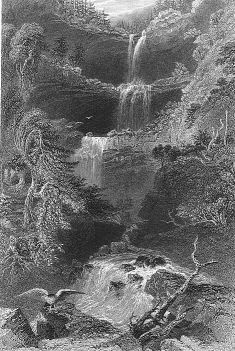
The Catterskill Falls, from below.
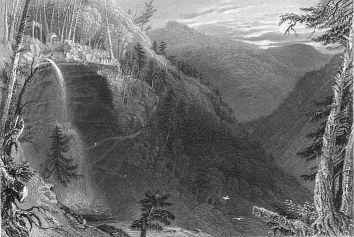
THE CATTERSKILL FALLS.
(FROM ABOVE THE RAVINE)
From the precipice whence our first view of this Fall is taken, the descent is steep and slippery to the very brink of the torrent, which it is necessary to cross on the wild blocks which lie scattered in its rocky bed. From thence, literally buried in forest foliage, the tourist will enjoy a very different, but, perhaps, more striking and picturesque view than the other. The stream, at a vast height above him, is seen leaping from ledge to ledge—sometimes lost, sometimes sparkling in sunshine, till it courses impetuously beneath the rock on which he is seated, and is lost in the deep unbroken obscurity of the forest. The rocky ledges above, worn by time, have the appearance of deep caverns, and beautifully relieve the fall of the light and silvery stream. In the winter, the vast icicles which are suspended from the ledges of rock, and shine like pillars against the deep obscurity of the caverns behind, afford a most romantic spectacle, one which has afforded a subject to Bryant for one of the most imaginative of his poems.
THE CATTERSKILL FALLS.
“Midst greens and shades the Catterskill leaps
From cliffs where the wood-flower clings;
All summer he moistens his verdant steeps
With the sweet light spray of the mountain springs;
And he shakes the woods on the mountain side,
When they drip with the rains of autumn-tide.
“But when, in the forest bare and old,
The blast of December calls,
He builds, in the starlight clear and cold,
A palace of ice where his torrent falls,
With turret, and arch, and fretwork fair,
And pillars blue as the summer air.
“For whom are those glorious chambers wrought,
In the cold and cloudless night?
Is there neither spirit nor motion of thought
In forms so lovely and hues so bright?
Hear what the grey-haired woodmen tell
Of this wild stream, and its rocky dell.
“ ’Twas hither a youth of dreamy mood,
A hundred winters ago,
Had wandered over the mighty wood,
When the panther’s track was fresh on the snow;
And keen were the winds that came to stir
The long dark boughs of the hemlock fir.
“Too gentle of mien he seemed, and fair,
For a child of those rugged steeps;
His home lay low in the valley, where
The kingly Hudson rolls to the deeps;
But he wore the hunter’s frock that day,
And a slender gun on his shoulder lay.
“And here he paused, and against the trunk
Of a tall grey linden leant,
When the broad clear orb of the sun had sunk
From his path in the frosty firmament,
And over the round dark edge of the hill
A cold green light was quivering still.
“And the crescent moon, high over the green,
From a sky of crimson shone,
On that icy palace, whose towers were seen
To sparkle as if with stars of their own;
While the water fell, with a hollow sound,
’Twixt the glistening pillars ranged around.
“Is that a being of life, that moves
Where the crystal battlements rise?
A maiden, watching the moon she loves,
At the twilight hour, with pensive eyes?
Was that a garment which seemed to gleam
Betwixt the eye and the falling stream?
“ ‘Tis only the torrent tumbling o’er,
In the midst of those glassy walls,
Gushing, and plunging, and beating the floor
Of the rocky basin in which it falls:
'Tis only the torrent—but why that start?
Why gazes the youth with a throbbing heart?
“He thinks no more of his home afar,
Where his sire and sister wait;
He heeds no longer how star after star
Looks forth on the night, as the hour grows late.
He heeds not the snow-wreath, lifted and cast
From a thousand boughs, by the rising blast.
“His thoughts are alone of those who dwell
In the halls of frost and snow,
Who pass where the crystal domes upswell
From the alabaster floors below,
Where the frost-trees bourgeon with leaf and spray,
And frost-gems scatter a silvery day.
“ ‘And oh that those glorious haunts were mine!’
He speaks, and throughout the glen
Their shadows swim in the faint moonshine,
And take a ghastly likeness of men,
As if the slain by the wintry storms
Came forth to the air in their earthly forms.
“There pass the chasers of seal and whale,
With their weapons quaint and grim,
And bands of warriors in glimmering mail,
And herdsmen and hunters huge of limb—
There are naked arms, with bow and spear,
And furry gauntlets the carbine rear.
“There are mothers—and oh, how sadly their eyes
On their children’s white brows rest!
There are youthful lovers—the maiden lies
In a seeming sleep on the chosen breast;
There are fair wan women with moon-struck air,
The snow-stars flecking their long loose hair.
“They eye him not as they pass along,
But his hair stands up with dread,
When he feels that he moves with that phantom throng,
Till those icy turrets are over his head,
And the torrent’s roar, as they enter, seems
Like a drowsy murmur heard in dreams.
“The glittering threshold is scarcely passed,
When there gathers and wraps him round
A thick white twilight, sullen and vast,
In which there is neither form nor sound;
The phantoms, the glory, vanish all,
With the dying voice of the waterfall.
“Slow passes the darkness of that trance,
And the youth now faintly sees
Huge shadows and gushes of light that dance
On a rugged ceiling of unhewn trees,
And walls where the skins of beasts are hung,
And rifles glitter on antlers strung.
“On a couch of shaggy skins he lies;
As he strives to raise his head,
Hard-featured woodmen, with kindly eyes
Come round him and smooth his furry bed,
And bid him rest, for the evening star
Is scarcely set, and the day is for.
“They had found at eve the dreaming one,
By the base of that icy steep,
When over his stiffening limbs begun
The deadly slumber of frost to creep;
And they cherished the pale and breathless form,
Till the stagnant blood ran free and warm.”—Bryant.
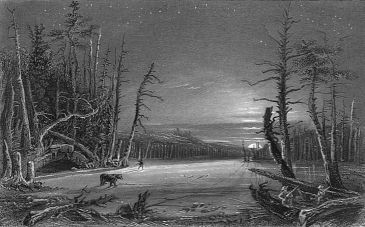
WINTER SCENE ON THE CATTERSKILLS.
The great proportion of evergreen trees, shrubs, and creepers, in the American mountains, make the winter scenery less dreary than would be at first imagined; but even the nakedness of the deciduous trees is not long observable. The first snow clothes them in a dress so feathery and graceful, that, like a change in the costume of beauty, it seems lovelier than the one put off; and the constant renewal of its freshness and delicacy goes on with a variety and novelty which is scarce dreamed of by those who see snow only in cities, or in countries where it is rare.
The roads, in so mountainous a region as the Catterskills, are in winter not only difficult, but dangerous. The following extracts from a sleigh ride in a more level part of the country, will serve to give an idea of it. “As we got farther on, the new snow became deeper. The occasional farm-houses were almost wholly buried, the black chimney alone appearing above the ridgy drifts; while the tops of the doors and windows lay below the level of the trodden road, from which a descending passage was cut to the threshold, like the entrance to a cave in the earth. The fences were quite invisible. The fruit-trees looked diminished to shrubberies of snow-flowers, their trunks buried under the visible surface, and their branches loaded with the still falling flakes, till they bent beneath the burden. Nothing was abroad, for nothing could stir out of the road without danger of being lost; and we dreaded to meet even a single sleigh, lest, in turning out, the horses should ’slump’ beyond their depth in the untrodden drifts. The poor animals began to labour severely, and sank at every step over their knees in the clogging and wool-like substance; and the long and cumbrous sleigh rose and fell in the deep pits like a boat in a heavy sea. It seemed impossible to get on. Twice we brought up with a terrible plunge, and stood suddenly still; for the runners had struck in too deep for the strength of the horses; and with the snow-shovels, which formed a part of the furniture of the vehicle, we dug them from their concrete beds. Our progress at last was reduced to scarce a mile in the hour, and we began to have apprehensions that our team would give out between the post-houses. Fortunately it was still warm, for the numbness of cold would have paralyzed our already flagging exertions.
“We had reached the summit of a long hill with the greatest difficulty. The poor beasts stood panting and reeking with sweat; the runners of the sleigh were clogged with hard cakes of snow, and the air was close and dispiriting. We came to a standstill, with the vehicle lying over almost on its side; and I stepped out to speak to the driver and look forward. It was a discouraging prospect; a long deep valley lay before us, closed at the distance of a couple of miles by another steep hill, through a cleft in the top of which lay our way. We could not even distinguish the line of the road between. Our disheartened animals stood at this moment buried to their breasts; and to get forward, without rearing at every step, seemed impossible. The driver sat on his box, looking uneasily down into the valley. It was one undulating ocean of snow—not a sign of a human habitation to be seen—and even the trees indistinguishable from the general mass by their whitened and overladen branches. The storm had ceased, but the usual sharp cold that succeeds a warm fall of snow had not yet lightened the clamminess of the new-fallen flakes, and they clung around the foot like clay, rendering every step a toil.”
“We heaved out of the pit into which the sleigh had settled, and for the first mile it was down hill, and we got on with comparative ease. The sky was by this time almost bare, a dark slaty mass of clouds alone settling on the horizon in the quarter of the wind; while the sun, as powerless as moonlight, poured with dazzling splendour on the snow; and the gusts came keen and bitter across the sparkling waste, rimming the nostrils as if with bands of steel, and penetrating to the innermost nerve with their pungent iciness. No protection seemed of any avail. The whole surface of the body ached as if it were laid against a slab of ice. The throat closed instinctively, and contracted its unpleasant respiration. The body and limbs drew irresistibly together, to economize, like a hedge-hog, the exposed surface. The hands and feet felt transmuted to lead; and across the forehead, below the pressure of the cap, there was a binding and oppressive ache, as if a bar of frosty iron had been let into the skull. The mind, meantime, seemed freezing up; unwillingness to stir, and inability to think of any thing but the cold, becoming every instant more decided.
“From the bend of the valley our difficulties became more serious. The drifts often lay across the road like a wall, some feet above the heads of the horses; and we had dug through one or two, and had been once upset, and often near it, before we came to the steepest part of the ascent. The horses had by this time begun to feel the excitement of the rum given them by the driver at the last halt, and bounded on through the snow with continuous leaps, jerking the sleigh after them with a violence that threatened momently to break the traces. The steam from their bodies froze instantly, and covered them with a coat like hoar-frost; and spite of their heat, and the unnatural and violent exertions they were making, it was evident, by the pricking of their ears, and the sudden crouch of the body when a stronger blast swept over, that the cold struck through even their hot and intoxicated blood.
“We toiled up, leap after leap; and it seemed miraculous to me that the now infuriated animals did not burst a blood-vessel, or crack a sinew, with every one of those terrible springs. The sleigh plunged on after them, stopping dead and short at every other moment, and reeling over the heavy drifts like a boat in a surging sea. A finer crystallization had meanwhile taken place upon the surface of the moist snow; and the powdered particles flew almost insensibly on the blasts of wind, filling the eyes and hair, and cutting the skin with a sensation like the touch of needle-points. The driver, and his maddened but almost exhausted team, were blinded by the glittering and whirling eddies; the cold grew intenser every moment, the forward motion gradually less and less; and when, with the very last effort apparently, we reached a spot on the summit of the hill, which from its exposed situation had been kept bare by the wind, the patient and persevering whip brought his horses to a stand, and despaired, for the first time, of his prospects of getting on.”
The description, which is too long to extract entire, details still severer difficulties; after which the writer and driver mounted on the leaders, and arrived, nearly dead with cold, at the tavern. Such cold as is described here, however, is what is called “an old-fashioned spell,” and occurs now but seldom.
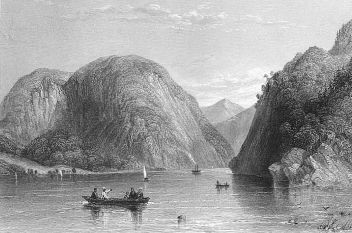
ROGERS'S SLIDE, LAKE GEORGE.
This is an almost perpendicular precipice of great height, abutting directly upon the romantic waters of Lake George, and remarkable for the escape of an American officer, Major Rogers, who, pursued closely by a party of Indians when the lake was frozen over, descended this bluff, and escaped upon the ice. To look at it, the feat seems incredible; and so thought the pursuing Indians, who, arriving at the brow of the precipice, and not seeing his body at the bottom, attributed his disappearance to supernatural agency.
Much as we are in the habit of extolling the athletic make and superior physical qualities of the Indians of our country, the early annals prove the superiority in strength, and even in address, which was their strong point, to have been oftenest on the side of the white settlers. There are two or three very stirring examples in the annals of a small town in New Hampshire:—
“Early in the morning of the 23d April, Ephraim Dorman left the fort to search for his cow. He went northwardly, along the borders of what was then a hideous and almost impervious swamp, lying east of the fort, until he arrived near to the place where the turnpike now is. Looking into the swamp, he perceived several Indians lurking in the bushes. He immediately gave the alarm, by crying, “Indians! Indians!” and ran towards the fort. Two, who were concealed in the bushes between him and the fort, sprang forward, aimed their pieces at him, and fired; but neither hit him. They then, throwing away their arms, advanced towards him: one he knocked down by a blow, which deprived him of his senses; the other he seized, and being a strong man, an able wrestler, tried his strength and skill in his favourite mode of ‘trip and twitch.’ He tore his antagonist’s blanket from his shoulders, leaving him nearly naked. He then seized him by the arms and body, but, as he was painted and greased, he slipped from his grasp. After a short struggle, Dorman quitted him, ran towards the fort, and reached it in safety.
“Mrs. Clark was at a barn, near the Todd-house, about fifty rods distant. Leaving it, she espied an Indian near her, who threw away his gun, and advanced to make her prisoner. She gathered her clothes around her waist, and started for the fort. The Indian pursued: the woman, animated by cheers from her friends, out-ran her pursuer, who skulked back for his gun. Nathan Blake was at his barn, near where his son’s house now stands. Hearing the cry of Indians, and presuming his barn would be burnt, he determined that his cattle should not be burnt with it. Throwing open his stable door, he let them loose, and presuming his retreat to the fort was cut off, went out at a back door, intending to place himself in ambush at the only place where the river could be crossed. He had gone but a few steps, when he was hailed by a party of Indians, concealed in a shop between him and the street. Looking back, he perceived several guns pointed at him, and at this instant several Indians started up from their places of concealment near him; upon which, feeling himself in their power, he gave himself up. He was then conducted to Lucbee, and thence to an Indian village, several miles north of that place, called Conissadawga. He was a strong, athletic man, and possessed many qualities which procured him the respect of the savages. He could run with great speed; and in all the trials to which he was put, (and they were many and severe,) he beat every antagonist.
“Not long after his arrival at the village, the tribe lost a chief by sickness. As soon as his decease was made known, the women repaired to his wigwam, and with tears, sobs, and clamorous lamentations, mourned his death. The funeral ceremonies performed, the men sought Blake, dressed him in the Indian costume, and invested him with all the authority and privileges of the deceased, as one of the chiefs of the tribe, and as husband of the widow. In the family to which he now stood in the relation of father, there were, as he had often remarked, several daughters of uncommon beauty. Yet notwithstanding this good fortune, he still had difficulties to encounter. The tribe was divided into two parties, his friends and his enemies. The former consisted of the great mass of the tribe, who respected him for qualities to which they had not equal pretensions; the latter, of those who were envious of his success, and had been worsted in their contests with him. These, to humble his pride, sent far into the northern wilderness, and procured a celebrated Indian runner, to run against him. At the time assigned, the whole tribe assembled to witness the race; and a Frenchman, from Quebec, happened to be present. Perceiving the excitement among them, he advised Blake to permit himself to be beaten, intimating that fatal consequences might ensue if he did not. The race was run; and Blake, as advised by the Frenchman, permitted his antagonist to reach the goal a moment before he did. He persisted, however, after his return from captivity, in declaring that he might have beaten him, if he had tried. The event of the race restored harmony to the tribe, and Blake was permitted to live in peace.”
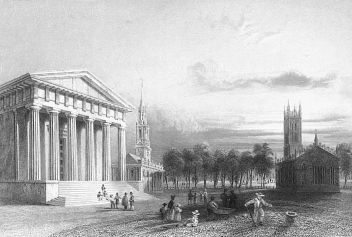
THE GOTHIC CHURCH, NEW HAVEN.
The area occupied by the town of New Haven is estimated to be six times as great as that of a European town with the same number of inhabitants. It was originally laid out in parallelograms, and the houses are built upon the outer sides of the squares, with large gardens meeting in the centre. Almost every house stands separate, and surrounded by shrubbery and verdure; and it is the great peculiarity of the town, that all its streets are planted with rows of elms, grown at this day to remarkable size and luxuriance. It has the appearance of a town roofed in with leaves; and it is commonly said, that, but for the spires, a bird flying over would scarce be aware of its existence. Nothing could be more beautiful than the effect of this in the streets; for, standing where any of the principal avenues cross at right angles, four embowered aisles extend away as far as the eye can follow, formed of the straight stems and graceful branches of the drooping elm, the most elegant and noble of the trees of our country. The roads below are kept moist and cool with the roof overhead; the side-walks, between the trees and the rural dwellings, are broad and shady; the small gardens in front of most of the houses are bright with flowering shrubs; and the whole scene, though in the midst of a city, breathes of nature.
The style of domestic architecture in New Haven favours the rural character of the town. Built, as was remarked before, in the midst of a garden, each house looks like what would be termed in England a cottage, or, in streets where a more ambitious style prevails, like the sort of white villa common at watering places. The green Venetian blind is universal; the broad, open hall extends through the house, showing the gay alley of a garden in the rear; and, living in the midst of a primitive and friendly community, the inhabitants sit at their low windows along the street, or promenade, without fear of rude observation, on the shady pavement before their dwellings, preserving for the place altogether that look of out-of-doors life and gaiety which, with less elegance, distinguishes Naples and other cities of southern Europe. The prettiest of English rural towns have a general resemblance to it.
In the centre of New Haven were originally laid out two open squares, divided by a street kept sacred from private buildings. The upper green is a beautiful slope, edged with the long line of the college edifices. Between the two squares stand three churches, at equal distances; two of the common order of architecture for places of public worship in this country (immense brick buildings, with tall white spires); and a third, which is presented in the drawing, a Gothic episcopal church, of singular purity and beauty. Behind and before it, spread away the verdant carpets of the two enclosed “greens;” above its turret and windows hang the drooping fans of elms, half disclosing and half concealing its pointed architecture; and to its door, from every direction, tend aisles of lofty trees, overhanging the paths with shadow, as if the first thought of the primitive settlers had been to create visible avenues to the house of God. There is scarce a more beautiful place of worship, take it all in all, in the whole of Christendom.
The trees in the magnificent avenue in front of these churches were planted by a single individual, the Hon. James Hillhouse. His example decided the character of the town, for it was followed in every street. To the enterprise of the same public-spirited gentleman, New Haven owes one of the most beautiful cemeteries in the world. The square in the rear of the churches was formerly, according to the English custom, used as a churchyard, and encumbered with graves, which soon threatened to overrun its limits. Mr. Hillhouse, some years since, purchased a field in the western skirt of the town, laid it out and planted it, and subsequently removed to it all the tombstones and remains from the Green; among them the headstone of the regicide Goffe. It is now one of the most beautiful of burial-places. The monuments are of white marble, or of a very rich verd antique found in the neighbourhood; and the natural elegance of the place has induced a taste and elegance into these monuments for the dead, found in no other spot of the same character.
The interior of the episcopal church is purely Gothic, and esteemed in the best taste. The material of the exterior is a brownish trap-rock from the neighbouring mountains, which, from its colour, resembles a very weather-beaten and time-worn stone, and gives a look of antiquity to the edifice. The cornices and abutments are of what a distinguished writer on the subject calls a sprightly freestone.
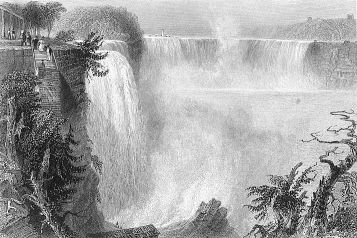
NIAGARA FALLS,
(FROM THE TOP OF THE LADDER ON THE AMERICAN SIDE.)
This is often the first near and general view of the Falls, and it is well calculated to produce the most astonishing impression on any one suddenly introduced to it. Supposing him to have arrived from Lockport, by a tedious progress through the forests, the visitor is conducted through a beautiful wood, presenting scenery of the softest character. But, with the roar of the cataract in his ear, he hurries rapidly through, till he stands on the very verge of the Fall, at the point where its mighty waters descend in one solemn unbroken mass into a gulf of spray, rising in clouds from the tortured waves beneath, and driven about by the gusts, till sometimes the whole river beneath, and the opposite shores, are momentarily concealed. As this misty curtain is withdrawn, the whole scene is disclosed. Beyond the American fall, which is immediately before him, and the wooded steeps of Goat Island, he sees the sublime curve of the Horse-shoe Fall; from below the centre of which, where the greatest mass of water descends, arises a tall and beautiful column of silvery vapour far into the sky.
At this spot is the entrance of the long covered ladder by which the descent to the ferry is accomplished. At an opening in it, half way down the precipice, people usually stop (in spite of their hurry, and that absorbing matter, the care of their baggage) to enjoy the only view, perhaps, which brings them near to the falling column in the midst of its descent. It is, indeed, “horribly beautiful.” No one has better described the effect sometimes produced on the mind at Niagara, than Basil Hall.
“On Sunday night, the 8th of July, we returned to the Falls, and walked down to the Table Rock, to view them by moonlight. Our expectations, as may be supposed, were high, but the sight was more impressive than we had expected. It possessed, it is true, what may be called a more sober kind of interest than that belonging to the wild scene behind the sheet of water above described. I may mention one curious effect:—it seemed to the imagination not impossible that the Fall might swell up, and grasp us in its vortex. The actual presence of any very powerful moving object is often more or less remotely connected with a feeling that its direction may be changed; and when the slightest variation would evidently prove fatal, a feeling of awe is easily excited. At all events, as I gazed upon the cataract, it more than once appeared to increase in its volume, and to be accelerated in its velocity, till my heated fancy became strained, alarmed, and so much over-crowded with new and old images,—all exaggerated; and in spite of the conviction that the whole was nonsense, I felt obliged to draw back from the edge of the rock; and it required a little reflection, and some resolution, to advance again to the brink.
“During the delightful period that the Falls formed our head-quarters, we made various excursions to several interesting objects in the neighbourhood. Of these, the most amusing were, a trip to Buffalo, a flourishing American town at the eastern end of Lake Erie, where the great New York canal commences; and a visit to the Welland canal, which joins Lake Erie with Lake Ontario.”
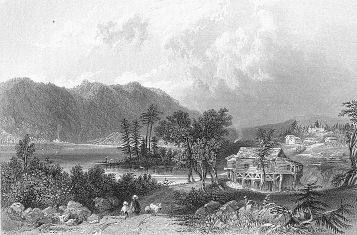
SAW-MILL AT CENTRE HARBOUR,
LAKE WINIPISEOGEE.
In the early records of the first settlement of Keene, in this state, on the river Asduelot, (in the Indian language, a collection of many waters,) is an account of some of their difficulties; among which was the establishment of a saw-mill. “A vote was passed,” says the record, “offering one hundred acres of middling good land, and twenty-five pounds, to any person or persons who would engage to build a saw-mill, and saw boards for the proprietors at twenty shillings per thousand.” The next year “another meeting was appointed at the house lot of Joseph Fisher, but was adjourned to the house of Nathan Blake, the first erected in the township.” A committee was here appointed, “to agree with a man to build a great mill, and they were authorized to offer not exceeding forty pounds encouragement therefor.” These early annals are highly interesting, and we cannot better associate drawings of scenes of cultivated life at the present day, than by portraying some of the steps by which the comfort and civilization of the state have been attained.
“No person,” says the record, “had hitherto attempted to remain through the winter on the township. Those who came in the summer to clear their lands, brought their provisions with them, and erected temporary huts to shelter them from the weather. In the summer of 1736, at least one house was erected; and three persons, Nathan Blake, Seth Heaton, and William Smeed, (the two first from Wrentham, and the last from Deerfield,) made preparations to pass the winter in the wilderness. Their house was at the lower end of the street. Blake had a pair of oxen and a horse, and Heaton a horse. For the support of these, they collected grass in the open spots; and in the first part of the winter they employed them in drawing logs to the saw-mill, which had just been completed. Blake’s horse fell through the ice of Beaver-brook, and was drowned. In the beginning of February their own provisions were exhausted, and, to obtain a supply of meal, Heaton was despatched to Northfield. There were a few families at Winchester, but none able to furnish what was wanted. Heaton procured a quantity of meal; but before he left Northfield, the snow began to fall; and when, on his return, he arrived at Winchester, it was uncommonly deep, and covered by a sharp crust. He was told ‘that he might as well expect to die in Northfield and rise again in Upper Ashnelot, as ride thither on horseback.’ Recollecting the friends he had left there, he nevertheless determined to make the attempt; but had proceeded only a short distance when he found that it would be impossible to succeed. He then returned, and directed his course towards Wrentham. Blake and Smeed, hearing nothing from Heaton, gave the oxen free access to the hay, left Ashnelot, and, on snow-shoes, proceeded either to Deerfield or Wrentham. Anxious for their oxen, they returned early in the spring. They found them near the Branch, south-east of Carpenter’s, much emaciated, but feeding upon twigs and such grass as was bare. The oxen recognised their owner, and exhibited such pleasure at the meeting as drew tears from his eyes.
“About this time, John Andrews came from Boxford to settle in Upper Ashnelot. He sent back Ephraim Donnan and Joseph Ellis with a team of eight oxen and a horse, to bring up his furniture. The route they came, which was probably then the best, if not the only one, led through Concord, Worcester, Brookfield, Belchertown, Hadley, Hatfield, Deerfield, Northfield, Winchester, Swanzey, and on the banks of the Ashnelot, to the house lots. When they passed through Swanzey, it rained hard, and they did not reach the station until night. As it continued to rain, was very dark, and as the water, which already covered the meadows, rose rapidly, they, apprehensive of being drowned, unyoked their oxen, chained their cart to a tree, and hastened to the settlement, then a mile distant. As soon as day-light appeared, the next morning, a boat was despatched in search of the cattle and furniture; when, passing over Bullard’s Island, a man cried to them for help. It was Mark Ferry, the hermit. Wearied with the noise and bustle of the settlement, he had retired to a cave, which he had dug into the bank of the river, where he constantly resided. The water had now driven him from his dwelling, and compelled him to seek refuge on a stump, where he then sat, with a calf in his arms, over which he had drawn a shirt. The boatman answered, “we must take care of the neat cattle first,” and passed on. They soon came to the cart, which was afloat. Proceeding further, and guided by the sound of the bells, which the cattle as usual wore, they found them on several little hillocks—some with only their heads out of water. They forced them into the water, and guided them, swimming, to high land, where they left them until the flood subsided. Hearing cries for help below them, they proceeded to Crissen’s House, in the borders of Swanzey, to the chamber and to the top of which the family had been driven. These they took off, and, on their return home, took Ferry and his calf into the canoe. This, which was known by the name of Andrew’s flood, was the highest ever known in the township. The water came within a few feet of the street north of Captain Blake’s old house.”
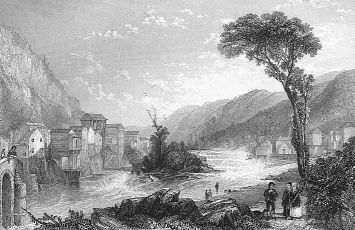
THE LITTLE FALLS ON THE MOHAWK.
The cavities worn in the rocks about these Falls, afford great matter of speculation to the geologist. The rock is gneiss, and these circular pots are worn evidently by the attrition stones kept in agitation by the current of a river. The astonishing part of it is, that these cavities are, some of them, more than a hundred feet above the present level of the Mohawk, proving that river to have been thus much higher in former times, and of course a lake, whose waters must have extended far and wide over the broad interval above. The narrow passage which it makes through the hills just below, shut in by perpendicular precipices on each side, would be sufficient to have made the theory probable without the assistance of these appearances.
These cavities are very numerous, and the largest are about eight feet deep, and fifteen in diameter. The rocks exhibit evidences of having been washed by water still higher. There are analogous traces of lakes on the Connecticut and Hudson rivers, which break through the mountains in a similar manner, the first between Mount Tom and Mount Holyoke, and the latter at the Highlands; but the depth and number of these rock-worn cavities are peculiar to Little Falls.
In approaching this part of the Mohawk from the east, the stranger is first delighted with the bold abutments on the river of two dark precipices, whose summits are laden with foliage, and which rise so abruptly from the undulating banks of the Mohawk, that they seem designed as barriers to the pass. The river glides between, darkened by their shadow; and close under the face of one precipice shoots the rail-car, while as close under the opposing one glides the silent passage-boat of the canal. Emerging to the sunshine beyond, the river spreads out in its thousand windings, as if rejoicing in the space of which it is so soon to be deprived, and in a moment or two (if you are travelling by steam) your course is arrested amid the foaming and busy scenery of the Falls, the picturesque and the hideous, the wildly beautiful and the merely useful, so huddled together that the artist who would draw either the architecture or the scenery by itself, would scarce find a bit large enough for a vignette.
Alluring as the picturesque and fertile valley of the Mohawk must have been, it was not till after the revolution that it was sought by white men with a view to settle. For some years after the war, it was still the beaver country of the aborigines, or the place of their wigwams; and the country round about, now stocked with villages, and without a red-face to be seen, was a hunting-ground, in which ranged bears, foxes, wolves, deer, and other game, the Indians themselves calling it couxsachraga, or the dismal wilderness. The town of Mohawk, where the tribe dwelt up to the year 1780, is but thirty-six miles west of Albany.
General Sir William Johnson lived not many miles below Little Falls, and from this spot to Canada Creek a tract of fourteen miles was given to him on his marriage with a Mohawk girl, by King Hendricks, the faithful Indian ally of the whites. It is a curious fact, that, during the war of the revolution, a son of Sir William Johnson, in the English service in Canada, made an incursion at the head of a party of hostile Indians on the very lands once owned by his father.
The Mohawks contended very fiercely for the honour of original descent. The Iroquois, who were more powerful, they considered as interlopers; and, in the following tradition, give the basis of their pedigree:—
“Before man existed, there were three great and good spirits; of whom one was superior to the other two, and is emphatically called the Great and Good Spirit. At a certain time, this exalted being said to one of the others, ‘Make a man!’ He obeyed; and taking chalk, formed a paste of it, and moulding it into the human shape, infused into it the animating principle and brought it to the Great Spirit. He, after surveying it, said, ‘It is too white!’
“He then directed the other to make a trial of his skill. Accordingly, taking charcoal, he pursued the same process, and brought the result to the Great Spirit; who, after surveying it, said, ‘It is too black!’
“Then said the Great Spirit, ‘I will now try myself.’ And, taking red earth, he formed a human being in the same manner, surveyed it and said, ‘This is a proper man!’ ”
It is possible that this is traditionary, but it is more probable that it was invented after the arrival of whites, and the introduction of blacks into the country, neither of which races the Indians had before seen.
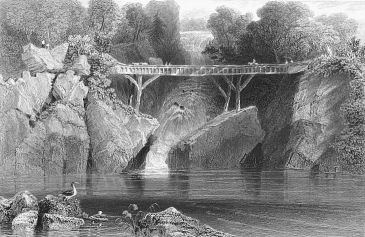
BRIDGE AT NORWICH, CONNECTICUT.
Two Indian rivers, the Shetucket and Yautick, unite at this place to form the Thames, and in the fork of the junction lies the picturesque and prosperous town of Norwich. From the hilly nature of the ground, the buildings have a remarkably fine appearance, the streets rising one above the other, and the style of the houses denoting taste and opulence. In the rear of the hill on which the town stands is a level plain, on which are laid out several handsome streets, planted with avenues of trees. The prospects are extensive and various; and, altogether, there are few towns in the world which have so many advantages and attractions.
The Thames is navigable for large vessels as high as Norwich, and its trade with the West Indies was once considerable. That has declined, and the capital of the inhabitants is now invested principally in manufactories, for which the fine water-power of the neighbourhood furnishes peculiar facilities. As a birth-place of distinguished individuals, Norwich has produced Mrs. Sigourney, the sweetest of American poetesses; and it stands upon the natal ground and possessions of the celebrated Uncas, chief of the Mohegans. The burial-place of the kings of this warlike tribe is still to be seen here.
No spot could have been selected with more felicity than that on which Uncas formerly lived. It is a high point of land, commanding a noble and extensive view of the Thames, here a large river, and of the country on both sides. It was, therefore, well fitted for the discovery of an enemy’s approach, and furnished every convenience to hostile excursions. At the same time, it bordered on a never-failing supply of provisions, furnished by the scale and shell-fish, with which both the river and the neighbouring ocean have ever been richly stored.
Uncas was originally a petty sachem; a Pequod by birth; a subject and a tributary to Sassacus. When the English made war upon the Pequods, Uncas was unfriendly to this chieftain, and would have quarrelled with him, had he not been kept in awe by the talents and prowess of this formidable warrior. Of the English he appears to have entertained, from the first, a very respectful opinion; and, when he saw them determined upon a war with his master, concluded to unite his forces and his fortune with theirs. His dread of Sassacus was, however, so great, that when Captain Mason marched against the Pequods, he did not believe him to be serious in his professed design of attacking that terrible nation, nor did he even engage in the conflict, until after Mason and his little band of heroes had stormed the Pequod fortress.
Upon the death of Sassacus, Uncas became the sachem of the remaining Pequods, as well as of the Mohegans. In this character he claimed, perhaps rightfully enough, as there was no other acknowledged heir, all the territory which had been possessed by that tribe. This tract included almost the whole of the eastern division of Connecticut, from the middle of the Syno range. He understood his own interest too well to quarrel with the English, and had a sufficient share of cunning to support his claims with very plausible reasons. They were, therefore, very generally allowed.
From this time he became the most formidable, and altogether the most prosperous Indian chieftain in Southern New England. Over his subjects he exercised a more efficacious and unresisted government than perhaps was ever exercised by any other sachem. Nor was his control confined to them; but extended, in a considerable degree, to several of the tribes on the western side of the Connecticut. To his enemies he became scarcely less formidable than Sassacus had been before him. At the head of four or five hundred men, he met Miantonomoh, a brave and sagacious chief of the Narrhagansetts, coming to attack him with twice the number; and, after having in vain challenged him to single combat, defeated his army, took him prisoner, and put him to death. On this occasion he cut a piece of flesh from his shoulder, roasted and eat it, and, with the true spirit of a savage, declared that it was the sweetest meat which he had ever tasted in his life.
The avarice, ambition, and restlessness of this man, frequently embroiled him with his neighbours, and were sometimes troublesome to his English allies. The natives considered them as the friends of Uncas, and implicated them more or less in his mischievous conduct. When he found the English resentful, and himself severely censured, he made such submissions, promises, and presents as he thought necessary to restore their good-will, and secure his future peace. But he was not indebted for these advantages to his address alone. On several occasions he rendered them real and important assistance; and to their interests he adhered faithfully and uniformly. No Indian among the New England tribes, except Massasait, exhibited an equally steady attachment to the Colonists, or so regular an adherence to his engagements. Hence he enjoyed their public friendship, and the good-will of individuals among them, until the day of his death.
Uncas died at an advanced age, in his own house, and left his power and his property to his children. Onecho, his eldest son, commanded a party of Mohegans in a war which the English carried on against the Narrhagansetts in 1676. The family, however, soon declined in their importance by the general declension of their tribe, and the sale of their property to the English. Some years since, a man, descended from Uncas, came from North Carolina, or Tennessee, where he was settled, and obtained permission of the Connecticut legislature to sell his patrimonial share in this tract. This man had received a military commission from the British government; and it is said, was well dressed, well informed, sensible, and gentlemanly in his deportment. He was probably the only respectable descendant of Uncas then living.
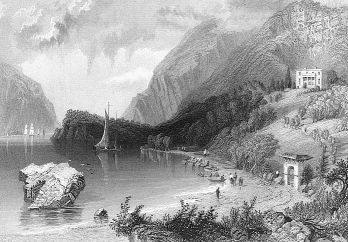
UNDERCLIFF, NEAR COLD-SPRING,
THE SEAT OF GENERAL MORRIS.
The pen of the poet and the pencil of the artist have so frequently united to record the grandeur and sublimity of the Hudson, and with such graphic fidelity, that little of interest remains unsaid or unsketched. But when every point of its bold and beautiful scenery might be made the subject of a picture, and every incident of its past history the theme of a poem, it requires no great research to discover new and prominent objects of attraction. Perhaps there is no portion of this beautiful river which partakes more of the picturesque, or combines more of the wild and wonderful, than the vicinity of the present View; and when time shall touch the history of the present with the wand of tradition, and past events shall live in the memory of the future as legends, romance will never revel in a more bewitching region. Fiction shall then fling its imaginative veil over the things we have seen—covering, but not concealing them—and, in the plenitude of poetic genius, people the drama of futurity with a thousand exquisite creations, clothed in the venerated garb of antiquity.
Undercliff, the mansion of General George P. Morris, which forms the principal object in the engraving, is situated upon an elevated plateau, rising from the eastern shore of the river; and the selection of such a commanding and beautiful position at once decides the taste of its intellectual proprietor. In the rear of the villa, cultivation has placed her fruit and forest trees with a profuse hand, and fertilized the fields with a variety of vegetable products. The extent of the grounds is abruptly terminated by the base of a rocky mountain, that rises nearly perpendicular to its summit, and affords in winter a secure shelter from the bleak blasts of the north. In front, a circle of greensward is refreshed by a fountain in the centre, gushing from a Grecian vase, and encircled by ornamental shrubbery; from thence a gravelled walk winds down a gentle declivity to a second plateau, and again descends to the entrance of the carriage road, which leads upwards along the left slope of the hill, through a noble forest, the growth of many years, until suddenly emerging from its sombre shades, the visitor beholds the mansion before him in the bright blaze of day. A few openings in the wood afford an opportunity to catch a glimpse of the water, sparkling with reflected light; and the immediate transition from shadow to sunshine is peculiarly pleasing.
Although the sunny prospects from the villa, of the giant mountains in their eternal verdure—the noble stream, when frequent gusts ruffle its surface into a thousand waves—the cluster of white cottages collected into the distant village, are glorious; it is only by the lovely light of the moon, when nature is in repose, that their magic influence is fully felt. We were fortunate in having an opportunity to contemplate the scene at such an hour: the moon had risen from a mass of clouds which formed a line across the sky so level that fancy saw her ascending from the dark sea, and her silvery light lay softened on the landscape; silence was over all, save where the dipping of a distant oar was echoed from the deep shadows of the rocks. Sometimes the white sail of a sloop would steal into sight from the deep gloom, like some shrouded spirit gliding from the confines of a giant’s cavern, and recalled the expressive lines by Moore:—
“The stream is like a silvery lake,
And o’er its face each vessel glides
Gently, as if it feared to wake
The slumber of the silent tides.”
In the view of Undercliff, the artist has been peculiarly happy in producing an effect at once brilliant and chaste. The broken foreground is agreeably relieved by the sparkling transparency of the water: the receding figures on the shore are judiciously introduced to mark the perspective. The projecting bluff in the middle distance is thrown into shadow, and stands out in fine contrast from the light horizon, while the lights upon the solitary rock, the entrance gate, the mansion, and the vessels, produce the effect of a setting sun; and the whole subject is treated with masterly skill. We only regret that art has not power to convey the kindly hospitalities hourly exercised in the interior of the mansion.
To enumerate the matchless and minute beauties of Undercliff, would occupy more space than the limits of our descriptive pages will permit. Its superiority, however, may be summed up in one expressive sentence, to which it is justly entitled, and which has been conceded to it by common consent—“The Gem of the Hudson River.” To the belles-lettres reader the “Gem” will acquire additional value by reflecting the light of literature: it is the home of a fine poet, and graceful prose writer. General Morris has been for many years the editor of the “New York Mirror,” a weekly journal, which circulates more extensively among the élite than any other periodical in the country. The typographic neatness of its execution, the talent of its original contributions, and the elegance of its embellishments, have placed upon it a permanent seal of popularity, and seem to have given a tone to taste, and a refinement to fashion.
General Morris has recently published a volume of lyrical effusions, called “The Deserted Bride, and other Poems.” Many of them have been written among the fairy beauties of Undercliff, and under the inspiration of that true poetic feeling which such enchanting scenes are so likely to elicit. Where so many gems of genius enrich a work, it becomes difficult to decide upon that most worthy of selection. It is not our province or intention to review the volume, but we cannot resist the inclination to make a few extracts, because they seem as beautiful accessories to the subject, and create an added interest in the engraving. Where scenes are so replete with the poetry of nature, they are best illustrated by the poetry of numbers; but we were particularly delighted with the following lines, addressed to his young daughter. The natural simplicity of the subject is well expressed by the purity of its poetic images, and breathes the refinement of paternal affection.
IDA.
“Where Hudson’s wave, o’er silvery sands,
Winds through the hills afar,
Old Cro’nest like a monarch stands,
Crowned with a single star:
And there, amid the billowy swells
Of rock-ribbed, cloud-capt earth,
My fair and gentle Ida dwells,
A nymph of mountain birth.
“The snow-curl that the cliff receives,
The diamonds of the showers,
Spring’s tender blossoms, buds and leaves,
The sisterhood of flowers:
Morn’s early beam, eve’s balmy breeze,
Her purity define;
But Ida’s dearer far than these,
To this fond breast of mine.
“My heart is on the hills. The shades
Of night are on my brow:
Ye pleasant haunts and silent glades,
My soul is with you now!
I bless the star-crowned islands where
My Ida’s footsteps roam:
Oh for a falcon’s wing to bear
Me onward to my home!”—Morris.
General Morris is not less successful in the lighter and livelier freaks of poetic fancy, as we hope to prove by a quotation from “The New York Mirror,” in which the moral of the lines is not their least merit. The melodies of the various birds which roost among the wild recesses of the rocks, or haunt the mountain forest, or sweep along the waters, are sent forth hourly in sounds of “unwritten music.” But the cry “most musical, most melancholy,” comes at the twilight hour from the clear throat of the whip-poor-will, at intervals, through the summer’s night: nor is it ever heard or seen by day; it may be called the sad unknown. The words, “whip-poor-will,” are divided into three shrill, distinct notes, and express the sounds as perfectly as if uttered by the human voice. The poetry annexed, is equally expressive of the melancholy mystery which seems to mark the mourning burden of its lonely song.
TO THE WHIP-POOR-WILL.
“Why dost thou come at set of sun,
Those pensive words to say?
Why whip poor Will?—What has he done?
And who is Will, I pray?
“Why come from you leaf-shaded hill,
A suppliant at my door?—
Why ask of me to whip poor Will?
And is Will really poor?
“If poverty’s his crime, let mirth
From out his heart be driven:
That is the deadliest sin on earth,
And never is forgiven!
“Art Will himself?—It must be so—
I learn it from thy moan,
For none can feel another’s woe
As deeply as his own.
“Yet wherefore strain thy tiny throat,
While other birds repose?
What means thy melancholy note?
The mystery disclose.
“Still ‘whip-poor-will!’—Art thou a sprite,
From unknown regions sent
To wander in the gloom of night,
And ask for punishment?
“Is thine a conscience sore beset
With guilt—or, what is worse,
Hast thou to meet writs, duns, and debt—
No money in thy purse?
“If this be thy hard fate indeed,
Ah well may’st thou repine:
The sympathy I give, I need—
The poet’s doom is thine.
“Art thou a lover, Will?—Hast proved
The fairest can deceive?
Thine is the lot of all who’ve loved
Since Adam wedded Eve.
“Hast trusted in a friend, and seen
No friend was he in need?
A common error—men still lean
Upon as frail a reed.
“Hast thou, in seeking wealth or fame,
A crown of brambles won?
O’er all the earth ’tis just the same
With every mother’s son!
“Hast found the world a Babel wide,
Where man to mammon stoops?
Where flourish arrogance and pride,
While modest merit droops?
“What, none of these?—Then, whence thy pain,
To guess it who’s the skill?
Pray have the kindness to explain
Why I should whip poor Will?
“Dost merely ask thy just desert?
What, not another word?—
Back to the woods again, unhurt—
I will not harm thee, bird!
“But treat thee kindly—for my nerves,
Like thine, have penance done;
Treat every man as he deserves—
Who shall ’scape whipping?’—None.
“Farewell, poor Will—not valueless
This lesson by thee given:
‘Keep thine own counsel, and confess
Thyself alone to heaven!’ ”—Morris.
We cannot close our description without one more extract from the delightful volume before us.
THE OAK.
“Woodman, spare that tree!
Touch not a single bough!
In youth it sheltered me,
And I’ll protect it now.
’Twas my forefather’s hand
That placed it near his cot;
There, woodman, let it stand,
Thy axe shall harm it not!
“That old familiar tree,
Whose glory and renown
Are spread o’er land and sea,
And wouldst thou hack it down?
Woodman, forbear thy stroke!
Cut not its earth-bound ties;
Oh spare that aged oak,
Now towering to the skies!
“When but an idle boy
I sought its grateful shade;
In all their gushing joy
Here, too, my sisters played.
My mother kissed me here;
My father pressed my hand—
Forgive this foolish tear,
But let that old oak stand!
“My heart-strings round thee cling,
Close as thy bark, old friend!
Here shall the wild-bird sing,
And still thy branches bend.
Old tree! the storm still brave!
And, woodman, leave the spot;
While I’ve a hand to save,
Thy axe shall harm it not.”—Morris.
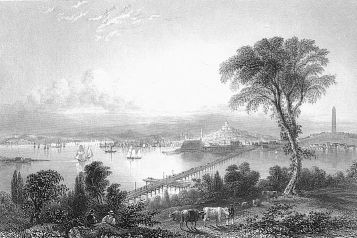
BOSTON, AND BUNKER HILL,
(FROM THE EAST.)
This view is taken from a long cape, sometimes cut off by water overflowing the marshes, and called William’s Island. Five or six years ago, it was a thinly cultivated and neglected spot, scarce known, except to adventurous boys, who pulled across from the city wharfs, and to the one or two farmers who inhabited it. Now, with the suddenness which attends speculation in our country, it is grown suddenly into a consequential suburb, with a showy hotel and steam ferry, and citizens and strangers resort to it to eat French dinners, and pass the hot weeks of the summer.
Boston, from this point of view, is very picturesque. The town rises gradually from the water’s edge to the height surmounted by the State House, whose lofty cupola brings to a point all the ascending lines of the picture; Dorchester Heights rise gracefully on the left limit of the bay, and Bunker-Hill, famous in American story, breaks the horizon on the right. In the centre lie the forest of shipping, and the fine ranges of commercial buildings on the water side; and, turning from this view, the harbour, with its many small islands, stretches away behind to the sea, tracked by steamers, and sprinkled by craft of every size and nation. Like every other bay in the world, that of Boston has been compared to Naples; but it has neither its violet sky, nor its volcano, yet it may be mentioned in the same day.
Close under the eye of the spectator here, lies that part of the town formerly the fashionable quarter, but now very much what Red Lion Square, and its precincts, are to London. There is still existing (or there was, some six or eight years since,) the house of Governor Hutchinson, of which the mouldings were brought from London, and in which the drawing-room panels were portraits of his family, in their youth. This is still a very roomy and well-built, and must once have been a rather luxurious house. We are apt to fancy that our strait-laced ancestors from England lived parsimoniously, and denied themselves the elegances of modern luxury; but antiquarian researches exhibit a different state of things. “In the principal houses,” says the discourse of a learned gentleman on this subject, “there was a great hall, ornamented with pictures and a great lantern, and a velvet cushion in the window-seat which looked into the garden. On either side was a great parlour, a little parlour, or study. These were furnished with great looking-glasses, Turkey carpets, window curtains and valance, pictures, and a map, a brass clock, red leather-back chairs, and a great pair of brass andirons. The chambers were well supplied with feather beds, warming-pans, and every other article that would now be thought necessary for comfort or display. The pantry was well filled with substantial fare and dainties—prunes, marmalade, and Madeira wine. Silver tankards, wine-cups, and other articles of plate, were not uncommon; and the kitchen was completely stocked with pewter, iron, and copper utensils. Very many families employed servants, and in one we see a Scotch boy valued among the property, and invoiced at 14l.”
In the matter of dress, our grandames seem to have pushed the ruling passion of the sex even through the rigid crust of Puritanism. In a tract, called the “Simple Cobler of Agawam,” some righteous round-head thus expresses his indignation at their fashions:—
“Methinks it should break the hearts of Englishmen to see so many goodly Englishwomen imprisoned in French cages, peering out of their hood-holes for some men of mercy to help them with a little wit, and nobody relieves them. We have about five or six of them in our colony; if I see any of them accidentally, I cannot cleanse my phansie of them for a month after.
“It is a more common than convenient saying, that ‘nine taylors make a man:’ it were well if nineteen could make a woman to her mind. If taylors were men, indeed, well furnished but with mere moral principles, they would disdain to be led about like asses by such mymick marmosets. It is a most unworthy thing for men that have bones in them, to spend their lives in making fiddle-cases for women’s phansies.
“It is known more than enough that I am neither niggard nor cynic to the true bravery of the true gentry. I am not much offended if I see a trimme far trimmer than she that wears it; but when I hear a nugiperous gentle dame inquire what dress the queen is in, with egge to be in it in all haste, whatever it be, I look to her as the very gizzard of a trifle, the product of a quarter of a cypher, the epitome of nothing, fitter to be kickt, if she were of a kickable substance, than either honoured, or humoured.”
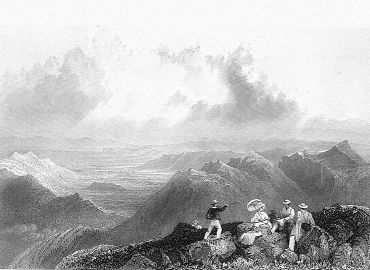
MOUNT JEFFERSON,
(FROM MOUNT WASHINGTON.)
In looking in this direction from the elevated summit of Mount Washington, the eye drops upon a region of climate entirely different from that on its south-eastern side. The towns of Lancaster and Jefferson, though something north of the White Mountains, enjoy a benign, tranquil atmosphere, such as is not known for two or three hundred miles farther south, and with the beauty of the scenery and the number of water-courses, it is a little Arcadia in the bosom of the north. The peculiar climate felt here, is owing to the proximity of the White Mountains, which form a wall of thirty miles from north to south, either checking entirely the easterly winds, or elevating them into a region far above the surface. The westerly winds, again, impinging against the mountains, (but in an elevated part,) are arrested, leaving the towns below in the same tranquillity as is felt by a person coming near a large building in a high wind.
The snow rarely lies permanently here until after the tenth or fifteenth of December, and generally leaves it about the middle of March: at this time the earth is usually free from frost. A stick forced through the snow in the month of February enters the earth without difficulty, the snow falling so early as to prevent the frost from penetrating to any depth, and dissolving the little which had previously existed. Hence the pastures become suddenly green, and cattle are safely turned into them in the middle of April; the time of pasturage is, therefore, as long here as in Connecticut. In this manner that tedious period, known as the breaking up of the frost, is here chiefly prevented; and the warm season is annually lengthened, so far as the purposes of gardening and agriculture are concerned, about a month every year.
There is a broad tract running across the State at this point, embracing both sides of the mountains, which is generally called Upper Coos. What the meaning of this term is, would be difficult to say; but Dwight supposes, from its application to places where there are remarkable alluvial intervals, and where there are no distinguishing objects, except a peculiar winding of rivers, that one or the other of these must be denoted by the term.
In the year 1776, a farmer planted himself on the richest and most beautiful of these lands, a large share of which he left to his descendants. Valuable as his acquisition has since become, however, his first step required uncommon enterprise, industry, and perseverance. His separation from society may be understood from the fact, that, for several years after he came here to live, he carried all his corn one hundred and twenty-four miles to be ground. There was not a single road in the neighbourhood. All his communication with the world was either through the wilderness, or down the channel of the Connecticut; and this he was obliged to enter at the distance of twenty miles from his house. When any member of his family was ill, he had neither physician nor nurse, nor other medicine than his own limited stock.
Rains and snows, in this part of the country almost universally come from the western side of the heavens, and chiefly from the north-west. Snow falls here in a singular manner. A light fleecy shower descends frequently for a few minutes in the morning, when the sky becomes perfectly clear, and the day perfectly fine. In this manner it has been known to fall thirty successive days, and yet to cover the ground scarcely to the depth of six inches. By this gradual accumulation, it has sometimes arisen in the forests to the height of thirty inches; commonly it has not exceeded eighteen. Travelling in the winter, therefore, is easy and pleasant in this neighbourhood, and the weather generally delightful.
The imperfect state of settlements in a country still comparatively new, prevents many persons from forming just views of the splendour of the scenery. In a landscape of any great extent, the proportion of wild forest throws a gloom over the whole, and the eye, accustomed to the haunts of man, demands instinctively a more smiling scene of cultivation and habitation. In a more limited view, the appearance of girdled trees, of drowned woods, burnt or fallen stumps, rough enclosures, and stony land, are blemishes which an unaccustomed eye can with difficulty overcome. It requires the prospective glance of an American to see the form of nature, which is now in dishabille, restored to her neat drapery, glowing with vegetation, and decked with flowers. The outline of her fair proportions is enough for him; and so that is beautiful, as in this country it almost every where is, he can finish the portrait to his fancy, and make a flowery Tempe of a prostrate wilderness.
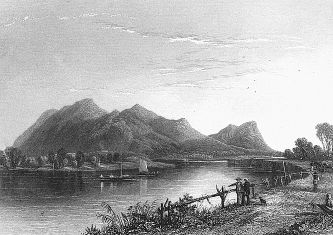
MOUNT TOM, AND CONNECTICUT RIVER.
This fine mountain rises nobly from the fertile Interval of the Connecticut, giving a character of boldness and majesty to scenery that were else merely soft and lovely. The river at this point broke down the barrier that evidently at one time held it back from the sea; and the broad lands that were then left bare by the liberated waters, were destined to form a strip of verdure and fertility, extending the whole length of New England.
The expansions of the Valley of the Connecticut on either side of Mount Tom, are landscapes of great beauty. The word interval, which describes the wide-spreading meadows extending from the banks of the river in these expansions, has a peculiar use in America, and seems to define a formation of alluvial land not seen to the same extent in other countries. In the Southern States the same description of land is called a flat, or a bottom. They are formed by the deposit of particles of soil brought down into the main river by its tributaries, or by occasional streams created by the melting of the snow, or heavy rains. A shoal is first formed, which, as it accumulates, rises gradually above the ordinary surface, while the stream itself, if it flows like the Connecticut through a soft soil, is continually deepening its bed, and leaving these newly-formed banks out of the reach of accidental floods.
The existence of some cause to check the current, is absolutely necessary to the formation of intervals. Wherever such cause is found, intervals are found proportioned to the room furnished on the side of the stream for their formation, and the lightness of the soil about the tributary streams. These causes exist on the Connecticut in falls and points of land, and in the narrowness of the channel at particular parts shut in by mountains.
These lands are subject to many changes. Every new obliquity of the current wears away some part of the Interval, against which its force is directed. In the progress of such changes, the inhabitants of the Connecticut have already seen large tracts gradually removed from one side to the other. The former channel in the mean time has been filled up, so as, in many instances, to leave no trace of its existence, and a new one has been made through the solid ground.
The soil of the intervals is, of course, of the richest quality: there is, however, a material difference in their fertility. The parts which are lowest are commonly the best, as being the most frequently overflowed, and therefore most enriched by the successive deposits of slime. Of these parts, that division which is farthest down the river is the most productive, as consisting of finer particles, and being more plentifully covered with this manure. In the spring, these grounds are regularly overflowed. In the months of March and April, the snows, which in the northern parts of New England are usually deep, and the rains, which at this time of the year are generally copious, raise the river from fifteen to twenty feet, and extend the breadth of its waters in some places a mile and a half, or two miles. Almost all the slime conveyed down the current at this season is deposited on these lands; for here, principally, the water becomes quiescent, and permits the earthy particles to subside. This deposit is a rich manure. The lands dressed with it are preserved in their full strength, and being regularly enriched by the hand of nature, cannot but be highly valuable.
The form of these lands is naturally beautiful. A river passing through them becomes almost, of course, winding. The border is necessarily curved, from the evenness of the impression of the river on a soft soil; and the edge is fringed with shrubs. A great part of them are formed into meadows, which are more profitable, and, at the same time, more agreeable to the eye than any other mode of culture. The magnificent elms, for which this country is remarkable, stand singly in the fields; while orchards and groves serve to break the uniformity. As they are seldom enclosed for miles together, there is a look also of extent and wildness about them, as if they produced their vegetation, “ploughed only by the sunbeams,” like a paradise spontaneously verdant and fertile.
Valuable as these intervals on the Connecticut have become, they were bought cheaply enough by the first proprietors. One of the first settlers of the neighbourhood of Mount Tom, was a tailor, who, for a trifling consideration, purchased a tract on the river, forming a square of three miles on a side. A carpenter came to settle in the valley, and having constructed a rude wheelbarrow, the tailor offered him for it, either a suit of clothes, or the whole of his land! He accepted the latter, and became the possessor of one of the finest farms on the bank of the Connecticut.
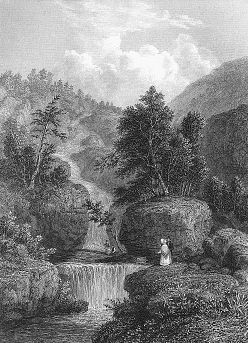
SILVER CASCADE,
IN THE NOTCH OF THE WHITE MOUNTAINS.
For a mountainous region, usually fertile in such accidents of nature, the neighbourhood of the “White Hills” has few waterfalls; of those that are met with in the “Notch,” the Silver Cascade is by far the most beautiful; but to be seen to advantage it should be visited after heavy rains. The stream is scanty, but its course from among the deep forest, whence its springs issue into the light, is one of singular beauty. Buried beneath the lofty precipices of the gorge, after ascending towards the Pulpit Rock, by the side of the turbulent torrent of the Saco, the ear is suddenly saluted by soft dashings of this sweetest of cascades; and a glance upwards reveals its silver streams issuing from the loftiest crests of the mountain, and leaping from crag to crag, or spread in a broad thin sheet of liquid light over the edge of some projecting ledge, till it reaches the road, across which it passes, forming a still and transparent pool immediately beneath, before it joins the Saco in the depths of the gorge. It is a beautiful vision in the midst of the wildest and most dreary scenery; and its sudden appearance—for nothing of it is seen till the tourist is immediately under it—is a moment of deep delight to him from the suddenness of the contrast. The lover of nature loves to linger among the wild beauties of this region; and some of the finest ideas of the American painters have been gleaned amongst its solitudes. We believe that the engraving, from a painting by Doughty, will be very interesting to our subscribers.
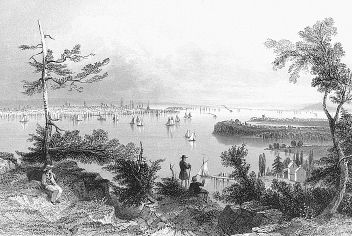
VIEW OF NEW YORK, FROM WEEHAWKEN.
Weehawken is slighted by the traveller ascending to the bolder and brighter glories of the Highlands above; and few visit it except—
“The prisoner to the city’s pent-up air,”
who, making a blest holiday of a summer’s afternoon, crosses thither to set his foot on the green grass, and mount the rocks for a view of our new-sprung Babylon and its waters. There is no part of “the country” which “God made” so blest in its offices of freshening the spirit, and giving health to the blood, as the rural suburb of a metropolis. The free breath drawn there, the green herb looked on before it is trodden down, the tree beautiful simply for the freedom of its leaves from the dust of the street, the humblest bird or the meanest butterfly, are dispensers of happiness in another measure than falls elsewhere to their lot. Most such humble ministers of large blessings have their virtue for “its own reward;” but it has fallen to the lot of Weehawken to find a minstrel, and no mean one, among those for whose happiness and consolation it seems made to bloom. A merchant-poet, whose “works” stand on shelves in Wall Street, but whose rhymes for pastime live in literature, and in the hearts of his countrymen, thus glorifies his suburban Tempe:—
“Weehawken! in thy mountain scenery yet,
All we adore of Nature in her wild
And frolic hour of infancy, is met,
And never has a summer morning smiled
Upon a lovelier scene than the full eye
Of the enthusiast revels on—when high
“Amid thy forest-solitudes he climbs
O’er crags that proudly tower above the deep,
And knows that sense of danger, which sublimes
The breathless moment—when his daring step
Is on the verge o the cliff, and he can hear
The low dash of the wave with startled ear,
“Like the death music of his coming doom,
And clings to the green turf with desperate force,
As the heart clings to life; and when resume
The currents in his veins their wonted course
There lingers a deep feeling, like the moan
Of wearied ocean when the storm is gone.
“In such an hour he turns, and on his view
Ocean, and earth, and heaven, burst before him;
Clouds slumbering at his feet, and the clear blue
Of summer’s sky in beauty bending o’er him;
The city bright below; and far away
Sparkling in light, his own romantic bay.
“Tall spire, and glittering roof, and battlement,
And banners floating in the sunny air,
And white sails o’er the calm blue waters bent,
Green isle, and circling shore, are blended there
In wild reality. When life is old,
And many a scene forgot, the heart will hold
“Its memory of this; nor lives there one
Whose infant breath was drawn, or boyhood’s days
Of happiness were passed beneath that sun,
That in his manhood’s prime can calmly gaze
Upon that bay, or on that mountain stand,
Nor feel the prouder of his native land.”[1]
Weehawken is the “Chalk Farm” of New York, and a small spot enclosed by rocks, and open to observation only from the river, is celebrated as having been the ground on which Hamilton fought his fatal duel with Aaron Burr. A small obelisk was erected on the spot, by the St. Andrew’s Society, to the memory of Hamilton, but it has been removed. His body was interred in the churchyard of Trinity, in Broadway, where his monument now stands.
It is to be regretted that the fashion of visiting Haboken and Weehawken has yielded to an impression among the “fashionable” that it is a vulgar resort. This willingness to relinquish an agreeable promenade because it is enjoyed as well by the poorer classes of society, is one of those superfine ideas which we imitate from our English ancestors, and in which the more philosophic continentals are so superior to us. What enlivens the Tuileries and St. Cloud at Paris, the Monte-Pincio at Rome, the Volksgarten at Vienna, and the Corso and Villa Reale at Naples, but the presence of innumerable “vulgarians?” They are considered there like the chorus in a pantomime, as producing all the back-ground effect as necessary to the ensemble. The place would be nothing—would be desolate, without them; yet in England and America it is enough to vulgarize any—the most agreeable resort, to find it frequented by the “people!”
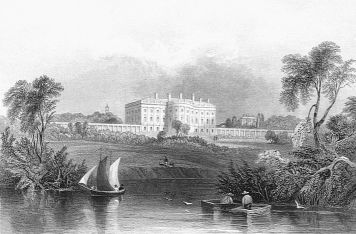
PRESIDENT’S HOUSE,
(FROM THE RIVER.)
The residence of the Chief Magistrate of the United States resembles the country-seat of an English nobleman, in its architecture and size; but it is to be regretted that the parallel ceases when we come to the grounds. By itself it is a commodious and creditable building, serving its purpose without too much state for a republican country, yet likely, as long as the country exists without primogeniture and rank, to be sufficiently superior to all other dwelling-houses to mark it as the residence of the nation’s ruler.
The President’s House stands near the centre of an area of some twenty acres, occupying a very advantageous elevation, open to the view of the Potomac, and about forty-four feet above high water, and possessing from its balcony one of the loveliest prospects in our country—the junction of the two branches of the Potomac which border the district, and the swelling and varied shores beyond of the States of Maryland and Virginia. The building is one hundred and seventy feet front, and eighty-six deep, and is built of white freestone, with Ionic pilasters, comprehending two lofty stories, with a stone balustrade. The north front is ornamented with a portico, sustained by four Ionic columns, with three columns of projection—the outer intercolumniation affording a shelter for carriages to drive under. The garden-front on the river (presented in the drawing) is varied by what is called a rusticated basement-story, in the Ionic style, and by a semi-circular projecting colonnade of six columns, with two spacious and airy flights of steps leading to a balustrade on the level of the principal story.
The interior of the President’s House is well disposed, and possesses one superb reception-room, and two oval drawing-rooms, (one in each story,) of very beautiful proportions. The other rooms are not remarkable; and there is an inequality in the furniture of the whole house, (owing to the unwillingness and piecemeal manner with which Congress votes any monies for its decoration,) which destroys its effect as a comfortable dwelling. The oval rooms are carpeted with Gobelin tapestry, worked with the national emblems; and are altogether in a more consistent style than the other parts of the house. It is to be hoped that Congress will not always consider the furniture of the President’s House as the scape-goat of all sumptuary and aristocratic sins, and that we shall soon be able to introduce strangers, not only to a comfortable and well-appointed, but to a properly-served and neatly-kept, presidential mansion.
At the present moment (the last month of General Jackson’s administration) the venerable President is confined to his room, and occupies a small chamber in the second story, near the centre of the house, on the front presented in the drawing. In a visit made to him by the writer a few days since, he was sitting at a table by the side of his bed, with a loose dressing-gown drawn over his black coat, and a sheet of half-written paper before him. He rose, with the pen in his hand, to receive a lady from another country, whose introduction to him was the principal object of the visit, and entered into conversation with that grace and dignified ease which mark his manners so peculiarly. He spoke of his approaching retirement, and the route he should pursue to reach the Hermitage, (his seat in Tennessee,) and expressed a strong wish to avoid all publicity in his movements, and to be suffered to pass tranquilly to his retreat. General Jackson is much changed since a reception given to the writer six years ago. He was then thin and spare, but stood erect and firm, and had a look of iron vigour—the effect, perhaps, of his military attitude, and the martial expression of face which belongs to him. He has since lost several of his front teeth, and though the bold and full under lip still looks as if it could hold up the world on its firm arch, it is the mouth of an old man, and in any other face would convey an idea of decrepitude. The fire still burns in the old warrior’s eye, however, and his straight and abundant white hair, which has been suffered to grow untrimmed during his illness, adds to the stern energy which is never wanting even to his most quiet expression. Peace and veneration go with him to his retirement!
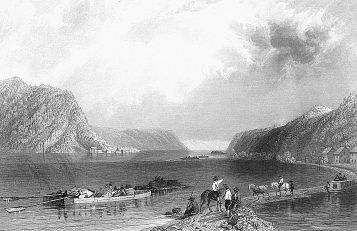
VIEW ON THE SUSQUEHANNA, AT LIVERPOOL.
The musical Indian name of this lovely river, spite of the canals, rail-roads, and county towns, that have supplanted the wild forest, and the rude wigwam in its valley, recalls irresistibly to the fancy the associations of aboriginal life, and the swift but bloody transit from an Indian hunting-ground to European civilization. In the county-town of Liverpool may be found, at this day, all the transcendental marks of national refinement—such as milliners who get the fashions from Paris, farmers who drink champagne, lawyers who dream of the presidency, and young ladies who read Shelley and Chateaubriand; but it is only forty-five or fifty years ago that the Susquehanna and the head waters of the Ohio were ranged by the warlike Shawanee; and there was scarce a white man’s house west of Wyoming which had not been the scene, to a greater or less extent, of the barbarities we now find it so difficult to realize.
Among the authentic records of this region of country is a story of the captivity and escape of two children, which seems to me one of the most curious, and shows at the same time of what stuff the early settlers of these borders were made.
The names of these boys were John and Henry Johnson, the former thirteen years of age, the latter eleven. They had been rambling in the woods at a short distance from home, and getting tired, sat down to rest upon a log. After sitting a few minutes, two Indians approached, whom they took for whites, till they were too close upon them to admit of escape, and they were made prisoners. The sun set after they had followed their captors for an hour, and the Indians kindled a fire, and sharing with them their roasted meat and parched corn, lay down to sleep, each with one of the boys folded in his arms.
Henry, the youngest, had abandoned himself to his grief as they travelled on over the hills, but the elder kept a stout heart, and encouraged him with the hope of yet eluding the vigilance of the savages. The practice of terrifying children by threats of the red man with his tomahawk and scalping-knife had filled the mind of the younger, however, and he was only pacified when fatigue made the coarse food welcome, and the heat of the fire and the accustomed hour for repose overcame him with sleep. He lay down with the red arms of the savage around him, and was soon lost in the deep slumbers of childhood.
John, too, lay down, and pretended to sleep; and in a few minutes, the Indian, who had locked him in his arms, relaxed his hold. He disengaged himself softly and walked to the fire; and to try the soundness of their sleep, he stirred the half-burnt faggots, and rekindled the blaze. Not a limb stirred, and not a breathing was interrupted. He gently pulled his brother and awoke him, and they both stood by the fire, with their captors sleeping soundly at their feet. “I think,” said John, smiling, “we may go home now.” “They will catch us again,” said the younger, despairingly. “Then, before we go, we’ll kill them,” said the other.
The Indians had one gun, which rested against a tree, with their tomahawks on the ground beside it. John reflected a moment, and then, getting a rest for the gun upon a decayed log near the head of one of the savages, he cocked it, took aim at the ear of the sleeping man, and then calling to Henry, placed his hand on the trigger. Ordering him to pull without moving the gun when he gave him a sign, he took the tomahawk, and stood astride the Indian in whose arms he had been encircled. At the given signal he struck, and the gun was discharged. The blow of the tomahawk descended on the back of his victim’s neck, and he attempted to rise; but the bold boy repeated his blows, while the younger one cried out, “Lay on!—I’ve done for this one!” and both the savages were, in the next moment, lying motionless before them. The discharge of the gun had carried away the jaw of the other, and stunned him.
They started on their way back, taking with them the gun and tomahawk as trophies, and arrived at home just before day-break. The neighbours had all been in search for them, and when they told their tale, it was at first disbelieved. John, however, had hung up his hat as a mark to find the place, and led them back the way he had come, where they found the tomahawked Indian lying in his blood. The other had disappeared, but was tracked to a short distance, where, as the chronicle quietly expresses it, “they agreed to leave him, as he must die at any rate.”
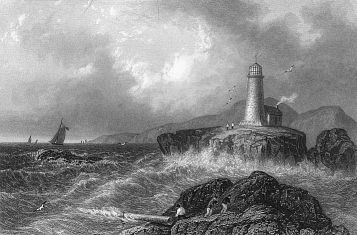
DESERT ROCK LIGHTHOUSE, AND MOUNTAIN.
Very much the same sort of incredulity with which one reads a traveller’s account of the deliciousness of the Russian summer comes over him, (malgré all the information to the contrary,) when it is proposed to him to admire any thing so near the cradle of the east wind as Penobscot River. We know, indeed, that spring visits that region of the world—as far, at least, as the British boundary line. We could be made, upon reflection, to presume that the grass grows, and the sun shines there—the farmers are warm in haying-time, and the flowers come to maturity in season for the bees to provide against winter; but, in point of fact, when Penobscot River is mentioned, we shudder at our remembrance of the acrid blasts that have swept over us from that quarter, and image the scenery forth-drest in the drapery so well described by the captain of the Penobscot whaler—a fog so thick, that having driven his jack-knife into it on the eve of sailing for the Pacific, he found it sticking in the same spot on his return from a three years’ cruise.
There is beautiful scenery in Maine, however; and Mr. Doughty, from one of whose pictures the accompanying drawing was taken, made a tour in search of it, and filled a portfolio with sketches which (the most of them) might belong to any Tempo for their summer look. They were taken from the neighbourhood of Desert Rock, and within view of Mount Desert, (shown in the drawing,) though the names of their neighbours sound unpromising.
Such spots as this are expected, like the knife-grinder, to have a story to tell, and this, unlike the knife-grinder, answers to expectation. The Light-house in the foreground stands upon a rock, about twelve miles from land; and near it lies a low reef, hidden at high tides, with a channel between it and the loftier rock. Some years before the erection of the Light-house, a homeward-bound vessel ran upon the breakers in a storm, and went to pieces. The storm having just commenced, and the sea not running as yet very high, several of the crew succeeded in getting upon the rock, where they found a partial shelter under a projecting shelf to leeward. The storm increased in violence, and after three days of unintermitted fury, during which they had seen no friendly sail even in the distance, the miserable survivors, perishing with hunger, abandoned themselves to despair. On the fourth night, they were crowded together in their narrow place of shelter, their eyes fixed on the black darkness covering the sea, when a vivid flash of lightning revealed to them a large ship careering straight for the rock, and apparently in complete ignorance of the danger. In the same instant all was black again, and they waited in the most breathless agony for the shock. A minute elapsed, and simultaneously, with a gleam that made the whole sea as bright as day, the ship appeared on the crest of a mountain-wave bounding over the reef, and with one cry from the man at the helm, as he discovered the rock before him, she launched into the channel on the breaking wave, and they heard her no more. They spoke of her to each other as lost, and betook themselves again to their silent despair. The tempest stilled toward morning, and the sun rose clear, and till noon again they bore the gnawings of despairing hunger, and watched the desolate sea in vain for a passing sail. Soon after noon a boat suddenly pulled into the channel between the rocks, friendly voices hailed the exhausted mariners, and with daring humanity they were successfully taken off. The ship they had seen in the night was lying-to not far from the opposite side of the rock, and they were soon on board of her, where, with proper treatment, they recovered from their exhaustion, and arrived safe in port. The pilot had seen them by the same gleam which revealed to him his danger, and after being saved by the recoil of the wave, which threw the ship into the current of the channel between the reefs, he lay-to till morning, when finding the vessel had drifted far south of the rock, he returned upon her course, and with the first abatement of the waves, manned his boat for the dangerous service he succeeded in.
Successful as Mr. Doughty is in sketches of this description, his forte lies in scenery of a softer and inland character—in the lonely forest-brook, the misty wood-lake, the still river, the heart of the quiet wilderness. In painting these features of Nature, he has (in his peculiar style) no rivals among American painters—perhaps none in England. His landscapes can scarcely be appreciated by those who have not seen the untouched and graceful wilderness of America; but of travellers who have, they touch the heart and fill the memory afresh. He is a most sweet and accomplished artist; and when the time comes for America to be proud of her painters, Doughty will be remembered among the first.
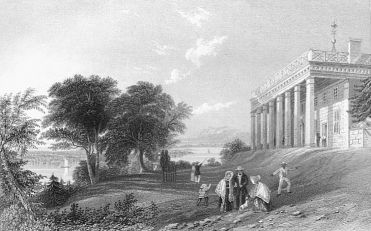
WASHINGTON’S HOUSE, AT MOUNT VERNON.
The house erected on this consecrated spot is of wood, cut in imitation of freestone. The centre part was built by Lawrence Washington, brother to the General. The wings were added by General Washington. It is named after Admiral Vernon, in whose expedition the former served. The house is two stories high, and ninety-six feet in length, with a portico fronting the river, extending the whole length of the house, surmounted with a cupola. The grounds are in the same state as left by General Washington.
The house contains on the ground floor, six rooms, and a spacious passage: four of these are of the ordinary size. At the north-east is a large room, with a handsomely sculptured ceiling, which contains a marble mantel-piece, sent to General Washington from Italy, and a very fine organ, on which instrument Mrs. Washington was an accomplished performer. The room at the south-east end of the house is used as a family dining-room, and contains busts of Necker, Paul Jones, and General Washington; also a handsome library, fitted in the wall, with glass cases. The books were chiefly collected by General Washington.
The house fronts north-west, the rear looking to the river. In front of the house is a lawn, containing five or six acres of ground, with a serpentine walk around it, fringed with shrubbery, and planted with poplars. On each side of the lawn stands a garden; the one on the right is a flower-garden, and contains two green-houses, (one built by General Washington, the other by Judge Washington,) a hothouse, and a pinery. It is laid out in handsome walks, with boxwood borders, remarkable for their beauty. It contains also a quantity of fig-trees, producing excellent fruit. The other is a kitchen-garden, containing only fruit and vegetables.
About two hundred yards from the house, in a southerly direction, stands a summer-house, on the edge of the river-bank, which is here lofty and sloping, and clothed with wood to the water’s edge. The summer-house commands a fine prospect of the river and the Maryland shore; also of the White House, at a distance of five or six miles down the river, where an engagement took place with the British vessels which ascended the river during the last war.
The estate, as owned by Judge Washington, consisted of between three and four thousand acres, since divided between his nephews. The timber of the woods, in which the fallow deer once abounded, is composed of white and black oak, with dog-wood, hickory, ash, cedar, &c. The soil is thin and rather poor, cultivated chiefly in Indian corn, rye, barley, &c. There are two fisheries on the place, where shad and herring are caught in large quantities. Mount Vernon is healthy during all the year except the autumn, when bilious fevers and agues prevail.
A distinguished writer visited Mount Vernon some years since, and gave a more particular account of the grounds than is to be found elsewhere. “We were conducted,” he says, “over long gravel walks, bordered with box, which is arranged and trimmed into the most fanciful figures, and which, at the age of twenty years and upwards, still possesses the vigour and freshness of youth. At the extremity of these extensive alleys and pleasure-grounds, ornamented with fruit-trees and shrubbery, and clothed in perennial verdure, stands two hot-houses, and as many green-houses, situated in the sunniest part of the garden, and shielded from the northern winds by a long range of wooden buildings for the accommodation of servants. From the air of a frosty December morning, we were suddenly introduced into the tropical climate of these spacious houses, where we long sauntered among groves of the coffee-tree, lemons and oranges, all in full bearing, regaling our senses with the flowers and odours of spring.