Front matter (continued 3)
Reading edition
The British formed again in an hour or two, and were reinforced by several hundred Indians from Chippeway, and other regiments of their own from other posts. Attempting to re-embark and retreat before a force so much superior, the boats were found insufficient, and the American regiments, after fighting nearly twelve hours, surrendered prisoners of war, to the number of seven hundred.
On the burial of General Brock the succeeding day, the batteries on the American side fired during the ceremony, as a tribute of respect to a gallant soldier.
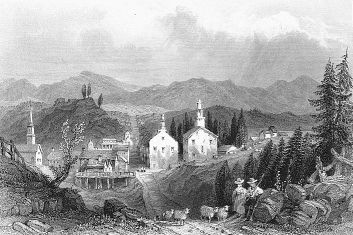
VILLAGE OF CATSKILL, HUDSON RIVER.
Catskill is more known as the landing-place for travellers bound to the mountains above, than for any remarkable events in its own history, or any singular beauties in itself. It is a thrifty little village, in which the most prosperous vocations are those of inn-keeper and stage-proprietor, and, during the summer months, these two crafts at Catskill entertain and transport to the hotel on the mountain half the population of the United States—more or less. The crowded steamers stop at the landing on their way up and down; and a busier scene than is presented on the wharf twice in the day, for a minute and a half, could not easily be found.
I have often thought in passing, of the contrast between these numerous advents and the landing of Hendrick Hudson on this very spot, in his voyage of discovery up the river. He found here, he says, “a very loving people, and a very old man,” by whom he and his crew were very kindly entertained. From the first step of a white man’s foot on the soil to the crowded rush of passengers from a steam-boat—from a savage wilderness to the height of civilization and science, it is but a little more than two hundred years of rapid history. Compare the old Indian canoe in which Hudson went from his vessel to the land, with a steamer carrying on its deck near a thousand souls; compare the untutored population which then swarmed upon the shore to the cultivated and refined crowds who come and go in thousands on the same spot, and the contrast is as astonishing as the extinction of the aboriginal race is melancholy.
It is surprising how few details connected with the races that inhabited the older settlements of our country are reached even by the researches of Historical Societies. The materials for the future poets and historians of America, are, in this department, singularly meagre, though it might almost be supposed that the very tracks of the retreating tribes might at this early day be still visible on the soil. Wherever any particulars of the intercourse between the first settlers and the Indians are preserved, they are highly curious, and often very diverting. In a book on the settlements of this country, written by Capt. Nathaniel Uring, who visited it in 1709, there is an amusing story connected with the history of one of the forts, built, by permission of the Indians, to secure the settlers against sudden incursion.
“It happened one day,” says the Captain, relating the story as it was told him by the Governor, “as the carpenter was cutting down a large timber-tree for the use of the fort, that great numbers of Indians stood round it, gazing, and admiring the wonderful dexterity of the carpenter, and greatly surprised at the manner of cutting it; having, before the arrival of the Europeans, never seen an axe, or any such like tools. The carpenter, perceiving the tree ready to fall, gave notice to the Indians by language or signs to keep out of its reach when it fell; but either for want of understanding the carpenter, or by carelessness of the Indians, a branch of the tree, in its fall, struck one of them, and killed him; upon which they raised a great cry. The carpenter, seeing them much out of humour at the accident, made his escape into the fort; and soon after, the Indians gathered together in great numbers about it, and demanded justice of the Europeans for the death of their brother, and desired to have the man who was the occasion of his being killed, that they might execute him, and revenge their brother’s death. The governor endeavoured to excuse the carpenter, by representing to them that he was not to blame, and told them that if their brother had observed the notice given him by the carpenter, he had not been hurt; but that answer would not satisfy the Indians; they increased their numbers about the fort, and nothing less than the execution of the carpenter would content them.
“The Europeans endeavoured to spin out the time by treaty, and thought to appease them by presents, hoping those, and time together, might make them easy; but finding that would not do, and not being able longer to defend themselves against such numbers as besieged them, they consulted how to give the Indians satisfaction.
“The carpenter being a useful man, they considered that they could not spare him without the greatest inconvenience; but seeing there was an absolute necessity of doing something, they found out an expedient, which was this:—there was in the fort an old weaver who had been bed-rid a long time; they concluded to hang up the weaver, and make the Indians believe it was the carpenter.
“Having come to this resolution, the governor let the Indians know, that, since nothing else would satisfy them, though their demand was unjust, yet, to show them how ready they were to live in amity and friendship with them, that in the morning they should see the carpenter hanging upon a certain tree in their view.
“In the night they carried the poor old weaver and hanged him in the room of the carpenter, which gave full satisfaction to the Indians, and they were again good friends.”
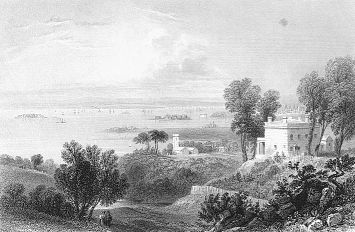
VIEW FROM GOWAN’S HEIGHTS, BROOKLYN.
The Bay of New York and Staten Island, are, from this elevated point of view, laid out beautifully beneath the eye, but the picturesque interest of the spot yields to the historic. Directly below these heights was fought the battle so disastrous to the revolutionary forces, between the detachments commanded by Sullivan and Putnam, and the English army, under Generals Howe and Clinton. As the defence of Long Island was intimately connected with that of New York, Washington had stationed a brigade at Brooklyn; and an extensive camp had been marked out and fortified, fronting the main land of Long Island, and stretching quite across the peninsula occupied by the village of Brooklyn. When the movements of General Howe threatened an immediate attack on this position, Major-General Putnam was directed to take the command, with a reinforcement of six regiments; and the day previous to the action Washington passed entirely at Brooklyn, inspecting the works, and encouraging the soldiers.
The Hessians, under General De Heister, composed the centre of the British army at Flatbush. Major-General Grant commanded the left wing, which extended to the coast, and the greater part of the forces under General Clinton. Earl Percy and Lord Cornwallis turned short to the right, and approached the opposite coast of Flatland.
On the night previous to the action, General Clinton was successful in seizing a pass through the heights, leading into the level country between them and Brooklyn. Before this movement was completed, General Grant advanced along the coast, at the head of the left wing, with ten pieces of cannon. As his first object was to draw the attention of the Americans from their left, he moved slowly, skirmishing as he advanced, with the light parties stationed on that road.
This movement was soon communicated to General Putnam, who reinforced the parties which had been advanced in front; and as General Grant continued to gain ground, still stronger detachments were employed in this service. About three in the morning, Brigadier-General Lord Stirling was directed to meet the enemy, with the two nearest regiments, on the road leading from the Narrows. Major-General Sullivan, who commanded all the troops without the lines, advanced at the head of a strong detachment on the road leading directly to Flatbush; while another detachment occupied the heights between that place and Bedford.
About the break of day, Lord Stirling reached the summit of the hills, where he was joined by the troops which had been already engaged, and were retiring slowly before the enemy, who almost immediately appeared in sight. A warm cannonade was commenced on both sides, which continued for several hours; and some sharp but not very close skirmishing took place between the infantry. Lord Stirling being anxious only to defend the pass he guarded, could not descend in force from the heights; and General Grant did not wish to drive him from them until that part of the plan which had been entrusted to Sir Henry Clinton should be executed.
About half-past eight, the British right having then reached Bedford, in the rear of Sullivan’s left, General De Heister ordered Colonel Donop’s corps to advance to the attack of the hill, following himself with the centre of the army. The approach of Clinton was now discovered by the American left, which immediately endeavoured to regain the camp at Brooklyn. While retiring from the woods by regiments, they encountered the front of the British. About the same time the Hessians advanced from Flatbush, against that part of the detachment which occupied the direct road to Brooklyn. Here General Sullivan commanded in person; but he found it difficult to keep his troops together long enough to sustain the first attack. The firing heard towards Bedford had disclosed the alarming fact that the British had turned their left flank, and were getting completely into their rear. Perceiving at once the full danger of their situation, they sought to escape it by regaining the camp with the utmost possible celerity. The sudden rout of this party enabled De Heister to detach a part of his force against those who were engaged near Bedford. In that quarter, too, the Americans were broken, and driven back into the woods; and the front of the column led by General Clinton continuing to move forward, intercepted and engaged those who were retreating along the direct road from Flatbush. Thus attacked both in front and rear, and alternately driven by the British on the Hessians, and by the Hessians back again on the British, a succession of skirmishes took place in the woods, in the course of which, some part of the corps forced their way through the enemy and regained the lines of Brooklyn, and several individuals saved themselves under cover of the woods; but a great proportion of the detachment was killed, or taken. The fugitives were pursued up to the American works; and such is represented to have been the ardour of the British soldiers, that it required the authority of their cautious commander to prevent an immediate assault.
The fire towards Brooklyn gave the first intimation to the American right that the enemy had gained their rear. Lord Stirling perceived the danger, and that he could only escape it by retreating instantly across the creek. After one other gallant attempt, however, upon a British corps under Lord Cornwallis, the brave men he commanded were no longer able to make opposition, and those who survived were, with their general, made prisoners of war.
The British army were masters of the field, but before morning, Washington had won one of his brightest military laurels in the safe withdrawal, unperceived by the enemy, of his defeated and dispirited troops to the opposite shore of New York.
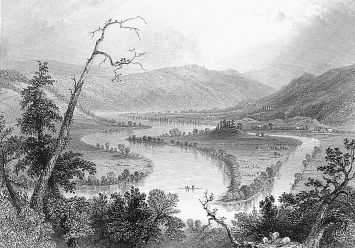
VIEW ON THE SUSQUEHANNA,
(above owago, or at grand island.)
The spectator in this view looks up the Susquehanna, with the river behind as well as before him; for the mountain on which he stands is almost encircled by the bend with which it turns downward to Owago. It is, perhaps, the best view that could be taken to express the etymology of its name, (Crooked River,) besides being one of singular beauty. I regretted only when the artist was there, that the rafts and arks with which the river is for a great part of the year enlivened, were, from the low state of the water, entirely wanting. The wild navigation of these crafts gives the Susquehanna a picturesque character, which, to do it pictorial justice, should not be omitted in the drawing. Perhaps the amends may be.
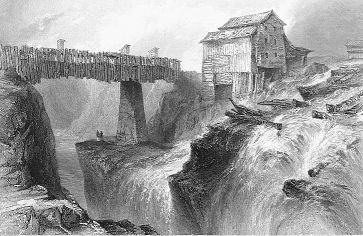
BRIDGE AT GLEN’S-FALLS, ON THE HUDSON.
Few of our readers who will not consider this subject as one of the most picturesque in our collection, and yet many of them we fear have passed over the bridge in our View unconscious of the proximity of so extraordinary a scene as the Falls of the Hudson at this spot.
This was, at least, our own case when first visiting Lake George, from Saratoga; and we would counsel every one to steal a few moments, even if travelling by the stage, to descend from the covered bridge to the rocky bed of the river. Miss Martineau observes—“We were all astonished at the splendour of Glen’s Falls. The full, though narrow Hudson, rushes along amidst enormous masses of rock, and leaps sixty feet down the chasms and precipices which occur in the passage, sweeping between dark banks of shelving rocks below, its current speckled with foam. The noise is so tremendous, that I cannot conceive how people can fix their dwellings in the immediate neighbourhood. There is a long bridge over the roaring floods, which vibrates incessantly; and clusters of saw-mills deform the scene. There is stone-cutting as well as planking done at these mills. The fine black marble of the place is cut into slabs, and sent down to New York to be polished. It was the busiest scene that I saw near any water-power in America.”
Her description is excellent, but, as regards the mills, we cannot agree with her; they certainly add much to the picturesque effect of the scene.
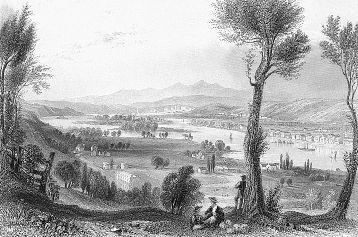
VIEW FROM MOUNT IDA,
NEAR TROY, NEW YORK.
The scenery in this neighbourhood is exceedingly beautiful. The junction of the Mohawk and Hudson, the Falls of the Cohocs, the gay and elegant town of Troy, Albany in the distance, and a foreground of the finest mixture of the elements of landscape, compose a gratification to the eye equalled by few other spots in this country. “Think,” says one of our noblest and best writers, speaking of a similar scene—“think of the country for which the Indians fought! Who can blame them? As the river chieftains, the lords of the waterfalls and the mountains, ranged this lovely valley, can it be wondered at that they beheld with bitterness the forest disappearing beneath the settler’s axe—the fishing-place disturbed by his saw-mills? Can we not fancy the feelings with which some strong-minded savage, who should have ascended the summit of the mountain in company with a friendly settler, contemplating the progress already made by the white man, and marking the gigantic strides with which he was advancing into the wilderness, should fold his arms and say, ‘White man, there is eternal war between me and thee! I quit not the land of my fathers but with my life! In those woods where I bent my youthful bow, I will still hunt the deer; over yonder waters I will still glide unrestrained in my bark canoe. By those dashing waterfalls I will still lay up my winter’s food; on these fertile meadows I will still plant my corn. Stranger, the land is mine! I understand not these paper rights; I gave not my consent when, as thou sayest, those broad regions were purchased for a few baubles of my fathers. They could sell what was theirs; they could sell no more. How could my father sell that which the Great Spirit sent me into the world to live upon? They knew not what they did. The stranger came, a timid suppliant, few and feeble, and asked to lie down on the red man’s bear-skin, and warm himself at the red man’s fire, and have a little piece of land to raise corn for his women and children; and now he is become strong, and mighty, and bold, and spreads out his parchment over the whole, and says, ‘It is mine.’ Stranger, there is not room for us both. The Great Spirit has not made us to live together. There is poison in the white man’s cup; the white man’s dog barks at the red man’s heels. If I should leave the land of my fathers, whither shall I fly? Shall I go to the south, and dwell among the groves of the Pequots? Shall I wander to the west? the fierce Mohawk—the man-eater—is my foe. Shall I fly to the east?—the great water is before me. No, stranger, here have I lived, and here will I die! and if here thou abidest, there is eternal war between me and thee! Thou hast taught me thy arts of destruction, for that alone I thank thee; and now take heed to thy steps; the red man is thy foe. When thou goest forth by day, my bullet shall whistle by thee; when thou liest down at night, my knife is at thy throat. The noon-day sun shall not discover thy enemy, and the darkness of midnight shall not protect thy rest. Thou shalt plant in terror, and I will reap in blood! thou shalt sow the earth with corn, and I will strew it with ashes! thou shalt go forth with the sickle, and I will follow after with the scalping-knife! thou shalt build, and I will burn, till the white man or the Indian shall cease from the land. Go thy way for this time in safety, but remember, stranger, there is eternal war between me and thee!’ ”
As the same writer afterwards observes, however, the Pilgrim Fathers “purchased the land of those who claimed it, and paid for it—often, more than once. They purchased it for a consideration, trifling to the European, but valuable to the Indian. There is no overreaching in giving but little for that which, in the hands of the original proprietors, is worth nothing.”
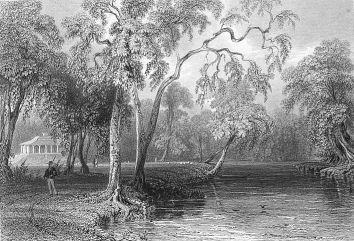
VIEW FROM GLENMARY LAWN,
THE RESIDENCE OF N. P. WILLIS.
(AT THE JUNCTION OF THE OWAGA AND SUSQUEHANNA.)
The Owaga here is scarce a quarter of a mile from its junction with the Susquehanna, and the lawn of Glenmary is the western limit of the star of interval land formed by the union of two broad valleys. The river here is a secluded stream, shadowed originally with dark forest trees, and running deep and still. The farm of Glenmary, part of which is presented in the drawing, was once an Indian burial-place—warrant enough for its possessing the highest rural beauty. The plough has turned up many skeletons in the fields above, and a small museum of Indian weapons and domestic implements was collected by the gentleman from whom the land was bought by the writer. Off to the left of the drawing, (too far off to be brought into the sketch,) a bright and brawling brook comes leaping down from the hills, and passing by the cottage door crosses the meadow to pay tribute to the Owaga; and back from the meadow, by broad and easy terraces, the land rises to the summit of a mountain ridge, crowned with primeval and gigantic forest trees. Having possessed the reader thus of the principal features of the spot, I may be excused for filling a page from an epistle to a friend, descriptive of the artist’s visit, to Glenmary.
“This is not a very prompt answer to your last, my dear doctor, for I intended to have taken my brains to you bodily, and replied to all your ‘whether-or-noes’ over a broiled oyster at Downing’s. Perhaps I may bring this in my pocket. A brace of ramblers, brothers of my own, detained me for a while, but are flitting to-day; and Bartlett has been here a week, to whom, more particularly, I wish to do the honours of the scenery. We have climbed every hill-top that has the happiness of looking down on the Owaga and Susquehanna, and he agrees with me that a more lovely and habitable valley has never sat to him for its picture. Fortunately, on the day of his arrival, the dust of a six-weeks’ drought was washed from its face, and, barring the wilt that precedes Autumn, the hill-sides were in holiday green, and looked their fairest. He has enriched his portfolio with four or five delicious sketches, and if there were gratitude or sense of renown in trees and hills, they would have nodded their tops to the two of us. It is not every valley and pine-tree that finds painter and historian, but these are as insensible as beauty and greatness were ever to the claims of their trumpeters.
“How long since was it that I wrote to you of Bartlett’s visit to Constantinople? Not more than four or five weeks, it seems to me; and yet here he is, on his return from a professional trip to Canada, with all its best scenery snug in his portmanteau! He steamed to Turkey and back, and steamed again to America, and will be once more in England in some twenty days—having visited and sketched the two extremities of the civilized world. Why, I might farm it on the Susquehanna, and keep my town-house in Constantinople, (with money.) It seemed odd to me to turn over a drawing-book, and find on one leaf a freshly pencilled sketch of a mosque, and on the next a view of Glenmary—my turnip-field in the foreground. And then the man himself—pulling a Turkish para and a Yankee shin-plaster from his pocket with the same pinch—shuffling to breakfast in my abri on the Susquehanna, in a pair of peaked slippers of Constantinople, that smell as freshly of the bazaar as if they were bought yesterday—waking up with “pekke! pekke! my good fellow!” when William brings him his boots—and never seeing a blood-red maple (just turned with the frost), without fancying it the sanguine flag of the Bosphorus or the bright jacket of a Greek! All this unsettles me strangely. The phantasmagoria of my days of vagabondage flit before my eyes again. This, ‘By-the-by, do you remember, in Smyrna?’ and, ‘The view you recollect from the Seraglio!’ and such like slip-slop of travellers, heard within reach of my corn and pumpkins, affects me like the mad poet’s proposition,
‘To twitch the rainbow from the sky,
And splice both ends together.’
“I have amused my artist friend since he has been here, with an entertainment not quite as expensive as the Holly Lodge fireworks, but quite as beautiful—the burning of log-heaps. Instead of gossipping over the tea-table these long and chilly evenings, the three or four young men who have been staying with us, were very content to tramp into the woods, with a bundle of straw and a match-box; and they have been initiated into the mysteries of ‘picking and piling,’ to the considerable improvement of the glebe of Glenmary. Shelly says,
‘Men scarcely know how beautiful fire is,’
and I am inclined to think that there are varieties of glory in its phenomena which would make it worth even your metropolitan while to come to the west and ‘burn fallow.’ At this season of the year—after the autumn droughts, that is to say—the whole country here is covered with a thin smoke, stealing up from the fires on every hill, in the depths of the woods, and on the banks of the river; and what with the graceful smoke-wreaths by day, and the blazing heavens all around the horizon by night, it adds much to the variety, and I think, more to the beauty of our western October. It edifies the traveller who has bought wood by the pound in Paris, or stiffened for the want of it in the disforested Orient, to stand off a rifle-shot from a crackling wood, and toast himself by a thousand cords burnt for the riddance. What experience I have had of these holocausts on my own land, has not diminished the sense of waste and wealth with which I first watched them. Paddy’s dream of ‘rolling in a bin of gould guineas,’ could scarcely have seemed more luxurious.
“Bartlett and I, and the rest of us, in our small way, burnt up enough, I dare say, to have made a comfortable drawing-room of Hyde Park in January, and the effects of the white light upon the trees above and around were glorious. But our fires were piles of logs and brush—small beer of course to the conflagration of a forest. I have seen one that was like the Thousand Columns of Constantinople, ignited to a red heat, and covered with carbuncles and tongues of flame. It was a temple of fire—the floor living coals—the roof a heaving drapery of crimson—the aisles held up by blazing and innumerable pillars, and sometimes swept by the wind till they stood in still and naked redness, while the eye could see far into their depths, and again covered and wreathed and laved in ever-changing billows of flame. We want an American Tempesta or ‘Savage Rosa’ to ‘wreak’ such pictures on canvass; and perhaps the first step to it would be the painting of the foliage of an American Autumn.”
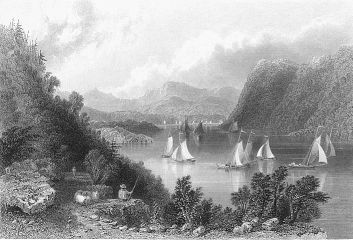
VIEW NEAR ANTHONY’S NOSE,
HUDSON HIGHLANDS.
This mountain, “known to fame,” serves as a landmark to the industrious craft plying upon the Hudson, and thus fulfils a more useful destiny than is commonly awarded to spots bright in story. It stands amid a host of interesting localities, marked with the events of the Revolution, and has witnessed, with less damage than other noses, many a conflict by land and water.
On the opposite side of the river from the base of the mountain, lie the two forts Montgomery and Clinton, taken by the British in October, 1777. The commander-in-chief at New York was prompted to this expedition by two objects: to destroy a quantity of military stores which the Americans had collected in this neighbourhood, and to make a diversion in favour of General Burgoyne. For these purposes Sir Henry Clinton embarked between three and four thousand troops at New York, and sailed with them up the Hudson. On the 5th of October they landed at Verplank’s Point, a few miles below the entrance to the Highlands. The next morning, a part of the force landed on Stony Point, which projects into the river on the western side, just below the mountains; hence they marched into the rear of the fortresses.
General Putnam commanded at that time in this quarter. He had one thousand continental troops, a part of which only were effective, and a small body of militia. He believed the principal design of the enemy to be the destruction of the stores; and when he was informed of their main purpose, it was too late for him to resist with success. He supposed that they were aiming at Fort Independence, and directed his attention to its defence; the heavy firing on the other side of the river gave him the first decisive information of their real intentions. Mr. Clinton, at that time governor of the state, placed himself at this post on the first notice that he received of the enemy’s advancing. Having made the best disposition for the defence of the forts, he despatched an express to General Putnam to acquaint him with his situation; but when it reached his head quarters, that officer and General Parsons were reconnoitring the position of the enemy on the east side of the river.
Lieut.-Col. Campbell, in the mean time, proceeded with nine hundred men by a circuitous march to the rear of Fort Montgomery; while Sir Henry Clinton, with Generals Vaughan and Tryon, moved onwards towards Fort Clinton. Both fortresses were attacked at once, between four and five in the afternoon: they were defended with great resolution. This will be readily admitted, when it is remembered that the whole garrison consisted of but six hundred men. The conflict was carried on till dark, when the British had obtained absolute possession, and such of the Americans as were not killed or wounded had made their escape. The loss of the two garrisons amounted to about two hundred and fifty. Among the killed on the enemy’s side was Lieut.-Col. Campbell.
It has been thought that an addition of five or six hundred men to these garrisons would have saved the works; the correctness of this opinion may be doubted. Fifteen hundred soldiers would have been barely sufficient completely to man Fort Montgomery alone. The works themselves were imperfect, and the ground was probably chosen rather for the defence of the river, than because it was itself defensible.
Governor Clinton and his brother, General James Clinton, escaped after the enemy had possession of the forts; the former by crossing the river. The latter had been wounded in the thigh by a bayonet.
On the 8th, the English forces proceeded to the eastern side, where they found Fort Independence evacuated. A party then burnt the continental village, as it was called, a temporary settlement raised up by the war for the accommodation of the army. Here had been gathered a considerable number of those artisans, whose labours are particularly necessary for military purposes; and a considerable quantity of military stores. They then removed a chain which was stretched across the river at Fort Montgomery, and advancing up the river, removed another which was extended from Fort Constitution to the opposite shore at West Point. General Vaughan then advanced still further up the Hudson, and on the 13th reached the town of Kingston, which he burnt. On the 17th, took place the surrender of Burgoyne, and he returned down the Hudson with his fleet to New York.
Count Grabouski, a Polish nobleman, was killed in the assault on Fort Clinton, while acting as aid-de-camp to the British commander. He was buried on the spot, but his grave is now undiscoverable.
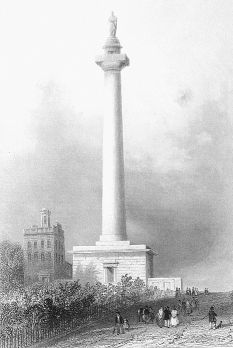
WASHINGTON’S MONUMENT AT BALTIMORE.
This fine monument stands at the end of a long street, forming an ascending perspective; and as its base crowns the summit of a considerable hill, it is fully relieved against the sky, and shows very nobly. The square which immediately surrounds it is newly divided into building-lots, and is becoming the “west end” of Baltimore. The Monument and the handsome buildings which are going up around are a mutual improvement of appearance.
The design of this monument was conceived in 1809, when a company obtained leave of the legislature to raise 100,000 dollars for the purpose by a lottery. By the year 1815, funds sufficient to authorize the commencement of the work had been raised, and a plan had been furnished by Mr. Robert Mills. On the 4th of July, the corner stone was laid upon ground presented by Col. John E. Howard. The monument is a Doric column upon a square base, surmounted by a pedestal, upon which is placed a colossal statue of Washington. The base is fifty feet square, and is elevated twenty feet; the column, to the feet of the statue, is one hundred and sixty feet, and the statue is thirteen feet in height. The statue is the work of Causici, an Italian, and represents Washington at the instant when he resigned his commission after the Revolution.
There were three periods in Washington’s life, and either of the two first would alone have placed him in the highest roll of the names of great men. The close of his military life (here represented) terminated the first period. His civil career in the presidency terminated the second; and here all comparison between Washington and any other man that ever lived ceases entirely. With a fame as complete as his, on his second retirement to Mount Vernon, a sincere and ardent wish to pass the remainder of his days in peaceful seclusion, and domestic ties and attachments of the strongest character; with all this around him, to come out once more from his tent of glory, and at his country’s call to expose his bright name again to the hazards of failure, and to the eagerness of human envy and misconstruction,—this seems to me the sublimest moment of the life of Washington.
“You know, Sir,” he says in his letter to the President, accepting the office of commander-in-chief of the army, “what calculations I had made relative to the probable course of events on my retiring from office, and the determination with which I had consoled myself of closing the remnant of my days in my present peaceful abode. You will, therefore, be at no loss to conceive and appreciate the sensations I must have experienced to bring my mind to any conclusion that would pledge me, at so late a period of life, to leave scenes I sincerely love to enter upon the boundless field of public action, incessant trouble, and high responsibility.”
It is singular how all the contemporaneous judgments of Washington’s character unite in ascribing the difficulty of drawing his portrait to the unity, harmony, and perfectability of his character. Chastellux says very forcibly, “If you are presented with medals of Cæsar, of Trajan, or Alexander, on examining their features you will still be led to ask, what was their stature and the form of their persons; but if you discover in a heap of ruins the head or a limb of the Apollo, be not curious about the other parts, but rest assured that they were all conformable to those of a god. Let not this impression be attributed to enthusiasm. I wish only to express the impression that Washington has left on my mind: the idea of a perfect whole, that cannot be the produce of enthusiasm, which rather would reject it, since the effect of proportion is to diminish the idea of greatness.”
In a funereal eulogy pronounced by Mr. Ware at Hingham, occurs nearly the same sentiment.
“The image of this great man is not like that of most others who have shone with distinguished lustre in the annals of the world. It is not composed of some bright spots surrounded with dark shades, so as to dazzle without enlightening the beholder. His character is not an assemblage of great talents by the side of great defects, and splendid virtues contaminated by their vicinity to atrocious vices: he shone with a clear and steady lustre, which, if it seldom appeared with flashes of splendour to dazzle and astonish, was yet never mingled with shades, nor intercepted by clouds. The circumstance which seems to distinguish his name from that of all others, is not the pre-eminence of any one talent or virtue, but a unity of character resulting from the perfect combination and exact balancing of all those great and good qualities, which enter into the character of one who is to possess public esteem, guide public opinion, and command universal respect and confidence.”
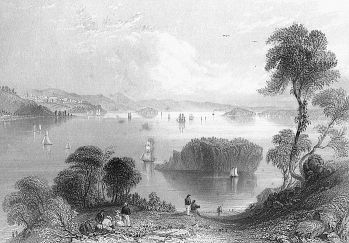
EAST PORT, AND PASSAMAQUODDY BAY.
The people of this beautiful State are just now enduring a double share of the evils of border location, having not only the ill-directed “sympathy” with the insurrectionists of Canada to repress, but the excitement of the newly-vexed question of boundary. As this last subject is one little understood, perhaps the history of the negotiations on the subject may not be unacceptable to the readers of the American Scenery.
“In their endeavours to bring about the settlement of another contested point, the two governments were less successful than they had been with respect to the commercial intercourse between America and the West India Island. This point related to the fixing the north-eastern boundary of the United States.
“By the treaty of 1783, which recognised their independence, it was declared that the eastern boundary of the United States, dividing them from Nova Scotia, should be ‘a line to be drawn along the middle of the river St. Croix, from its mouth in the bay of Fundy to its source, and from its source, directly north, to the highlands, which divide the rivers that fall into the Atlantic Ocean from those which fall into the river St. Lawrence.’ The northern line, separating Canada from the New States, was to commence ‘from the north-west angle of Nova Scotia; viz. that angle which is formed by a line drawn due north from the source of the St. Croix river to the highlands, along the said highlands, which divide those rivers that, empty themselves into the river St. Lawrence from those which fall into the Atlantic Ocean, to the north-westernmost head of Connecticut river; thence, descending along that river to the forty-fifth degree of latitude, thence due west on that latitude, until it strikes the river Iroquois or Cataruguy, thence along the middle of the said river into Lake Ontario,’ &c.
“Being for the most part marked out by mathematical, or by well-known natural lines, the frontier between the head of the Connecticut and Lake Ontario afforded but little ground for dispute. But such was not the case with the boundary from the head of the Connecticut to the sea. Untrodden, except perhaps by the foot of the hunter, all the northern division of the country between the Bay of Fundy and the St. Lawrence then consisted of a dense forest, scattered over with mountains and lakes, and intersected by streams of considerable magnitude. No survey of it appears ever to have been made, and the British ministers were, consequently, ignorant of its topographical features. Yet, even under these circumstances, they can scarcely be excused for having admitted such a vague description of the future limits, since, without much difficulty, sufficient information might have been obtained to prevent this defect. Their negligence gave birth to a controversy, which, after the expiration of half a century, yet remains undecided. Only a few years elapsed before a doubt arose respecting the river which was meant under the name of St. Croix; the Americans insisting that the St. John was the river which was intended. By the treaty of 1794, it was arranged that this point should be left to the decision of a joint commission. In 1798, the commission decided that the extreme source of the northern branch of the Scoodic river was the source of the St. Croix designated in the treaty; and a monument was erected there, to indicate the spot whence the line was to be drawn to the north. Thus far the question was satisfactorily set at rest. Not such, however, was the result of the subsequent proceedings. For some years, no further steps appear to have been taken by either of the governments. While the territory in question continued to be a wilderness, there was not much temptation to discuss its limits; but when the new state of Maine, and the British province of New Brunswick, began to extend their settlements into the interior, the case was materially altered. The line of demarcation claimed by the Americans would not only include an area of ten thousand square miles, but would entirely cut off all direct communication between New Brunswick and Lower Canada. From the source of the Scoodic river, they prolonged the line northward, as far as a chain of mountains distant less than thirty miles from the St. Lawrence; which chain, they contended, formed the highlands specified in the treaty of 1783.
“The British, on the contrary, maintained that the north-west angle of Nova Scotia was at Mars Hill, about forty miles from the source of the Scoodic; and that the northern frontier of Maine ought to pass from thence to the westward over a range of hills which lie at the sources of the Penobscot, Kennebec, and Androscoggin. Neither party would recede from its pretensions. In the treaty of Ghent, in 1814, it was agreed that two commissioners should be appointed to make surveys and settle the boundary. If they coincided in opinion, their decision was to be final; but if they disagreed, some friendly sovereign, or state, was to be chosen as umpire, and from his judgment there was to be no appeal.
“Affairs remained in this state till 1827, when the commissioners being unable to agree, and some disputes as to questions of jurisdiction having rendered it desirable to bring the frontier controversy to an issue, a convention was concluded between the British and American government, by which it was arranged that the king of the Netherlands should be requested to act as arbitrator. To this request his majesty assented; and their statements and surveys were accordingly laid before him. The award of the sovereign umpire was not delivered till the 10th of January, 1831. It was not calculated to satisfy either of the claimants. Considering the pretensions of the two powers to be equally balanced, it proceeded to lay down new limits, upon principles of mutual convenience. The British frontier was to commence at the spot where the line drawn due north from the source of the Scoodic intersects the St. John, and was to pass up the latter river and the St. Francis, to the highlands which run parallel with the St. Lawrence. Though this award assigned to the Americans seven-eighths of the district which was contended for by Great Britain, yet, as it gave a direct communication between New Brunswick and Lower Canada, it was accepted by the British government. The United States was not so yielding. The award was immediately protested against by the American ministers at the Hague, on the ground of the arbiter having exceeded his authority. The State of Maine also entered its protest, and denied the right of the federal government to cede any portion of the litigated territory. The matter was finally brought before the senate by the President, and that body decided that the umpire having gone beyond his powers, his award was not binding; and that a new negotiation must be opened with Great Britain. Since that period, however, no steps have been taken to accomplish an arrangement.”
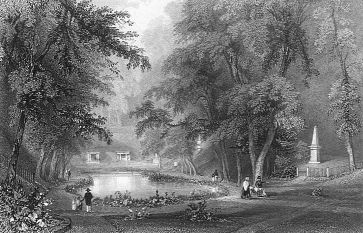
CEMETERY OF MOUNT AUBURN.
This picturesque and beautiful burial-place occupies a grove, formerly an academic and sylvan retreat for the students of Harvard College, near by. It is about five miles from Boston, and presents naturally a most agreeable mixture of hill, valley, and water, forming altogether the beau-ideal of a site for the purpose to which it is at present devoted.
If we are not mistaken, the people of the United States owe the most creditable and delicate taste, newly awakened throughout the country on the subject of sepulture, to one of their most distinguished poets, the Rev. John Pierpoint, author of the “Airs of Palestine.” By his exertions, mainly, a society was formed for the purchase, appropriation, and improvement, of the beautiful spot represented in the drawing; and, at present, most of the wealthier citizens of the capital of New England are possessors of verdant and flowery enclosures, which are ornamented even more tastefully than the celebrated cemeteries of Père la Chaise. In doing away thus with the neglectfulness and dreariness of the outer aspect of the grave, death, it seems to us, is divested of half its terrors, while a refined and salutary feeling is awakened in the bosoms of the living.
The example of this cemetery has been followed in other cities; and at Philadelphia, particularly, there is a most sweet spot selected upon the banks of the Schuylkill, and appropriated to this purpose. The refinement has spread all over the country; and in a few years, probably, the burial of the dead will be associated in the minds of the people of the United States only with sylvan repose, and the sacred loveliness of consecrated natural beauty.
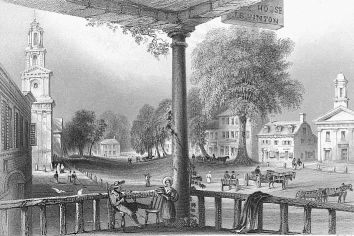
NORTHAMPTON, MASSACHUSETTS.
It is recorded of the first settlers of Northampton, that in the tenth year of their establishment in the wilderness, in 1663, they paid for the support of a clergyman one hundred and twenty pounds sterling. According to the change in the value of money, and the circumstances of the persons who formed the congregation, this sum was equal to at least six times the amount of the present valuation. In this one fact is to be found a leaven which has pervaded the town ever since, preserving for its inhabitants the rigid morality, the religious feeling, and almost the stern manners of the Puritan pilgrims.
The inflexible justice practised among such men had its effect on the Indians among whom they settled; and Northampton, in consequence, was one of the last towns affected by the general hostilities of Philip’s war.
In their first purchases, they secured no less their own rights than the rights of the natives; and the latter were always considered as having a right to dwell and hunt in the lands they had sold. In the year 1664, they requested leave of the settlers to build themselves a fort within the town; and leave was granted on the following conditions:—
“That the Indians do not work, game, or carry burdens within the town on the Sabbath; nor powow here, or anywhere else;
“Nor get liquor, nor cider, nor get drunk;
“Nor admit Indians from without the town;
“Nor break down the fences of the inhabitants;
“Nor let cattle or swine upon their fields; but go over a stile at one place;
“Nor admit among them the murderers, Calawane, Wuttowhan, and Pacquallant;
“Nor hunt, nor kill cattle, sheep, or swine, with their dogs.”
There is in these conditions an attention to the sobriety and morality of the Indians, which has been very seldom regarded in compacts with this injured race. The consequence was, a perpetual peace between them and the Indians of their immediate neighbourhood. On the breaking out of Philip’s war, however, they became liable to incursions from other tribes, and especially from the Canadians, French, and Indians. They fortified their “meeting-house;” and in every cluster of houses, one was fortified and pierced with holes for the discharge of muskets. The whole town was then enclosed with a palisado set up in a trench, and a guard of fifty persons perpetually kept.
It is scarcely possible to convey, to a mind that has not reflected on the subject, a fair idea of the difficulties, hazards, and horrors, that beset the first adventurers for religious liberty in New England. Beside all the usual evils of pioneering—the separation from friends, the hardships, the privations, the loss of all communication with the civilized world, these settlers had to encounter the most diabolical warfare recorded in history.
“The first announcement of an Indian war,” says a diffuse writer on this subject, “is its terrible commencement. In the hour of security and sleep, when your deadly enemies are supposed to be friends, quietly fishing and hunting—when they are believed to be far off, and thoughtless of you and yours, your sleep is suddenly broken by the war-whoop, your house and village set on fire, your family and friends butchered, and yourself escape only to be carried into captivity, and wrung with every species of torture. If you go out to the fields, you may be shot down by an unseen enemy in the woods, or return in the evening and find your house consumed to ashes, and your family carried into captivity.”
During the last part of what is called Philip’s war, to the Indians’ treachery, cruelty, and cunning, was added the instigation, the sustenance, and the wealth of the civilized French. A price was paid for English scalps; European officers planned and assisted to execute schemes of devastation and slaughter; and, in short, nothing was wanting to develop, in its fullest ferocity, the Indian’s love of blood.
It is curious to reflect how wide and immortal would have been the fame of the king of the Wampanoags, had he succeeded, (as he came very near doing,) in exterminating the Whites, and restoring the land of his forefathers to his subjects and children. The experiment of settlement would scarcely have been soon repeated; and, perhaps, to this day, the Indian, confident in his tried strength, would have possessed and defended the lands from which he has so utterly disappeared; while the name of Philip would justly have been associated with those of Gustavus Vasa, and Alfred of England. The difference between him and these great lights of history, is, that he failed.
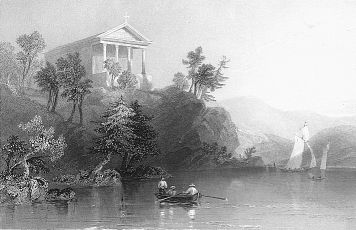
CHAPEL OF “OUR LADY OF COLD SPRING.”
The Hudson bends out from Crow-Nest into a small bay; and, in the lap of the crescent thus formed, lies snug and sheltered, the little village of Cold Spring. It is not much of a place for its buildings, history, or business; but it has its squire and post-master, its politics and scandal, and a long disappointed ambition to become a regular landing-place for the steamers. Then there are cabals between the rival ferrymen, on which the inhabitants divide; the vote for the president, on which they agree (for Van Buren); and the usual religious sects, with the usual schisms. The Presbyterians and Methodists, as usual, worship in very ugly churches; and the Catholics, as usual, in a very picturesque and beautiful one. (Vide the Drawing.)
It is a pity (picturesquely speaking) that the boatmen on the river are not Catholics; it would be so pretty to see them shorten sail off Our Lady of Cold Spring, and uncover for an Ave-Maria. This little chapel, so exquisitely situated on the bluff overlooking the river, reminds me of a hermit’s oratory and cross which is perched similarly in the shelter of a cliff on the desolate coast of Sparta. I was on board a frigate, gliding slowly up the Ægean, and clinging to the shore for a land-wind, when I descried the white cross at a distance of about half a mile, strongly relieved against the dark rock in its rear. As we approached, the small crypt and altar became visible; and, at the moment the ship passed, a tall monk, with a snow-white beard, stepped forth like an apparition upon the cliffs, and spread out his arms to bless us. In the midst of the intense solitude of the Ægean, with not a human dwelling to be seen on the whole coast from Moron to Napoli, the effect of this silent benediction was almost supernatural. He remained for five minutes in this attitude, his long cowl motionless in the still air, and his head slowly turning to the ship as she drew fast round the little promontory on her course. I would suggest to Our Lady of Cold Spring, that a niche under the portico of her pretty chapel, with a cross to be seen from the river by day, and a lamp by night, would make at least a catholic impression on the passer by, though we are not all children of St. Peter.
Half way between the mountain and our Lady’s shrine, stands, on a superb natural platform, the romantic estate of Undercliff, the seat of Colonel Morris. Just above it rises the abrupt and heavily wooded mountain, from which it derives its name; a thick grove hides it from the village at its foot; and, from the portico of the mansion, extend views in three directions unparalleled for varied and surprising beauty. A road, running between high-water mark and the park gate, skirts the river in eccentric windings for five or six miles; the brows of the hills descending to the Hudson in the west and north, are nobly wooded and threaded with circuitous paths, and all around lies the most romantic scenery of the most romantic river in the world.
The only fault of the views from West Point, is, that West Point itself is lost as a feature in the landscape. The traveller feels the same drawback which troubled the waiting-maid when taken to drive by the footman in her mistress’s chariot—“How I wish I could stand by the road side and see myself go by!” From Undercliff, which is directly opposite, and about at the same elevation, the superb terrace of the Military School is seen to the greatest advantage. The white barracks of Camptown, the long range of edifices which skirt the esplanade, the ruins half way up the mountain of old Fort Putnam, and the waving line of wood and valley extending to Mr. Cozzen’s estate of “Stoney Lonesome,” form a noble feature in the view from Undercliff.
I had forgotten that Cold Spring “plucks a glory on its head” from being honoured with the frequent visits of Washington Irving, Halleck, and other lesser stars in the literary firmament; when these first lights above the horizon shall have set, (Hesperus-like—first and brightest!) there will linger about this little village—by that time, perhaps, arrived at the dignity of a landing-place—many a tale of the days when Geoffrey Crayon talked in his gentle way with the ferryman who brought him to Cold Spring; or the now plethoric post-master, who, in his character of librarian to the village, enjoyed the friendship of Irving and Halleck, and received from their own hands the “authors’ copies,” since curiously preserved in the execrable print and binding then prevalent in America. Perhaps even old Lipsey the ferryman, and his rival Andrews, will come in for their slice of immortality, little as they dream now, pulling close in for the counter-current under our Lady’s skirts, of working at that slow oar for posthumous reputation.
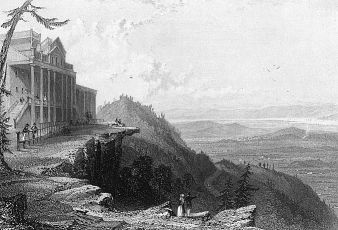
VIEW FROM THE MOUNTAIN HOUSE, CATSKILL.
In the following masterly description, by Miss Martineau, is said all, and the best that can be said, of the glorious view from the Mountain-House at Catskill.
“After tea, I went out upon the platform in front of the house, having been warned not to go too near the edge, so as to fall an unmeasured depth into the forest below. I sat upon the edge as a security against stepping over unawares. The stars were bright overhead, and had conquered half the sky, giving promise of what we ardently desired, a fine morrow. Over the other half, the mass of thunder-clouds was, I supposed, heaped together; for I could at first discern nothing of the champaign which I knew must be stretched below. Suddenly, and from that moment incessantly, gushes of red lightning poured out from the cloudy canopy, revealing, not merely the horizon, but the course of the river, in all its windings through the valley. This thread of river, thus illuminated, looked like a flash of lightning caught by some strong hand and laid along in the valley.
“All the principal features of the landscape might, no doubt, have been discerned by this sulphureous light; but my whole attention was absorbed by the river, which seemed to come out of the darkness, like an apparition, at the summons of my impatient will. It could be borne only for a short time—this dazzling, bewildering alternation of glare and blackness, of vast reality and nothingness. I was soon glad to draw back from the precipice, and seek the candle-light within.
“The next day was Sunday. I shall never forget, if I live to a hundred, how the world lay at our feet one Sunday morning. I rose very early, and looked abroad from my window, two stories above the platform. A dense fog, exactly level with my eyes, as it appeared, roofed in the whole plain of the earth—a dusky firmament, in which the stars had hidden themselves for the day. Such is the account which an antediluvian spectator would probably have given of it. This solid firmament had spaces in it, however, through which gushes of sun-light were poured, lighting up the spires of white churches, and clusters of farm-buildings, too small to be otherwise distinguished; and especially the river, with its sloops, floating like motes in the sun-beam. The firmament rose and melted, or parted off into the likeness of snowy sky-mountains, and left the cool Sabbath to brood brightly over the land. What human interest sanctifies a bird’s-eye view! I suppose this is its peculiar charm; for its charm is found to deepen in proportion to the growth of mind. To an infant, a champaign of a hundred miles is not so much as a yard square of gay carpet. To the rustic, it is less bewitching than a paddock with two cows. To the philosopher, what is it not? As he casts his eye over its glittering towns, its scattered hamlets, its secluded homes, its mountain ranges, church spires, and untrodden forests, it is a picture of life; an epitome of the human universe; the complete volume of moral philosophy for which he has sought in vain in all libraries. On the left horizon, are the green mountains of Vermont; and at the right extremity sparkles the Atlantic. Beneath lies the forest where the deer are hiding, and the birds rejoicing in song. Beyond the river, he sees spread the rich plains of Connecticut; there, where a blue expanse lies beyond the triple range of hills, are the churches of religious Massachusetts sending up their sabbath-psalms—praise which he is too high to hear, while God is not. The fields and waters seem to him to-day no more truly property than the skies which shine down upon them; and to think how some below are busying their thoughts this Sabbath-day about how they shall hedge in another field, or multiply their flocks on yonder meadows, gives him a taste of the same pity which Jesus felt in his solitude, when his followers were contending about which should be greatest. It seems strange to him now that man should call any thing his but the power which is in him, and which can create somewhat more vast and beautiful than all that this horizon encloses. Here he gains the conviction, to be never again shaken, that all that is real is ideal; that the joys and sorrows of men do not spring up out of the ground, or fly abroad on the wings of the wind, or come showered down from the sky; that good cannot be hedged in, nor evil barred out; even that light does not reach the spirit through the eye alone, nor wisdom through the medium of sound or silence only. He becomes of one mind with the spiritual Berkeley, that the face of nature itself, the very picture of woods, and streams, and meadows, is a hieroglyphic writing in the spirit itself, of which the retina is no interpreter. The proof is just below him, (at least, it came under my eye,) in the lady (not American) who, after glancing over the landscape, brings her chair into the piazza, and turning her back to the champaign, and her face to the wooden walls of the hotel, begins the study, this Sunday morning, of her lap-full of newspapers. What a sermon is thus preached to him at this moment from a very hackneyed text! To him that hath much—that hath the eye, and ear, and wealth, of the spirit, shall more be given—even a replenishing of this spiritual life from that which, to others, is formless and dumb; while, from him that hath little, who trusts in that which lies about him rather than in that which lives within him, shall be taken away, by natural decline, the power of perceiving and enjoying what is within his own domain. To him who is already enriched with large divine and human revelations, this scene is, for all its stillness, musical with divine and human speech; while one who has been deafened by the din of worldly affairs can hear nothing in this mountain solitude.”
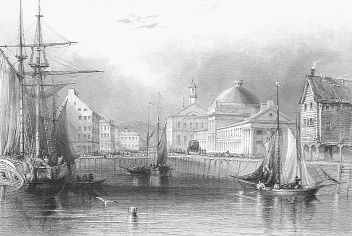
FANEUIL HALL,
FROM THE WATER.
Two noble streets, and a market, perhaps the finest in the world, have been projected in front of the old Faneuil Hall, which stood a very few years ago close to the water’s edge. The new land was made, and the plan carried into effect during the mayoralty of Josiah Quincy, Esq., to whose enterprise and sagacity the city is indebted for these great improvements.
Faneuil Hall, which in the view from the water stands in the rear of these fine structures of granite, is the dearest spot connected with American freedom. It was used as a town-hall in the time of the Revolution; and within its walls arose the first murmur, which, stirred by the daring eloquence of Adams and Otis, terminated in the Declaration of Independence. The name by which it is best known, is, “the Cradle of Liberty.”
In the year 1740, Peter Faneuil (a Huguenot) made an offer to build, at his own expense, “an edifice on the town’s land in Dock Square, to be improved for a hall and market, for the sole use, benefit, and advantage of the town, provided that the town would authorize it, and lay the same under such proper regulations as should be thought necessary, and support the same constantly for said use.” A vote of thanks was immediately passed to Mr. Faneuil, the work was commenced, and two years afterwards, “Mr. Samuel Ruggles, who was employed in building said house, waited on the select-men, by order of P. Faneuil, Esq., and delivered them the key of said house.” A meeting was then held in the hall, and a motion was made that the thanks of the town be given to Peter Faneuil, Esq., for his generous benefaction of the Market-House to the town; and resolutions were drawn up and passed to that effect. A large committee of the first citizens waited on him, “and, in the name of the town, rendered their most hearty thanks for so bountiful a gift, with their prayers that this and other expressions of his bounty and charity might be abundantly recompensed with the divine blessing.”
Another vote was then passed unanimously, “that, in testimony of the town’s gratitude to Peter Faneuil, Esq., and to perpetuate his memory, the hall over the market-place be named Faneuil Hall, and at all times hereafter be called by that name.” And as a further testimony of respect, it was voted “that Mr. Faneuil’s picture be drawn at full length, at the expense of the town, and placed in the hall; and the select-men were charged with the commission, which was accordingly executed.”
“The building was of brick, two stories in height, and measured one hundred feet by forty. It was esteemed one of the best pieces of workmanship, and an ornament to the town. The hall would contain one thousand persons; there were convenient apartments for the officers of the town, besides a room for the naval office, and a notary public.”
Mr. Faneuil did not long live to enjoy the gratitude of his townsmen. He died suddenly, a year after the completion of the building. His funeral oration, delivered by Mr. John Lovell, Master of the Grammar School, was the first specimen of eloquence uttered in the “Cradle of Liberty.” It was, in some of its sentiments, very unlike the orations which followed, and far from prophetic.
“What now remains,” he concludes, “but my ardent wishes (in which I know you will all concur with me) that this hall may be ever sacred to the interests of truth, of justice, of loyalty, and honour. May no private views nor party broils ever enter within these walls; but may the same public spirit that glowed in the breast of the generous founder influence all your debates, that society may reap the benefit of them.
“May liberty always spread its joyful wings over this place—liberty, that opens men’s hearts to beneficence, and gives the relish to those who enjoy the effects of it; and may loyalty to a king, under whom we enjoy this liberty, ever remain our character—a character always justly due to this land, and of which our enemies have in vain attempted to rob us.”
The family of Faneuil had been more than fifty years in America, and had fled from persecution in France to find a refuge in the wilderness. The Faneuil arms were subsequently placed in the hall, elegantly carved and gilt.
Eight or nine years after the erection of Faneuil Hall, it took fire from a neighbouring conflagration, and was nearly burnt to the ground. It was on one of the coldest nights of January, and the water froze so rapidly, that it was impossible to work the engines. The walls were left standing, and it was rebuilt and enlarged soon after.
Just against the end of Faneuil Hall, in a broad dock, now filled up and built upon, used to lie a cluster of oyster-boats, that were half house, half vessel, floating oyster-shops—in short, of the most canonical rudeness and simplicity. It was as necessary to go to them to eat oysters in perfection, as it is to go to Blackwall for white-bait; and no true gourmand pretended to have elsewhere found the relish. They are gone, alas! and with the old hulks are gone the amphibious venders—the rude, high-booted, superannuated oyster-openers, dressing, for years after they had given up the vocation, just as if they were embarking for the mud-bank, and talking in the same hoarse tone as if their words were meant to struggle, as of yore, with a nor’wester. So flee away before the advances of improvement all that reminded us of other days; and it is by this resolute plucking up of old associations, and resolute modernizing and improving, even upon the most sacred habits and usages of our forefathers, that this new nation keeps its unchecked headway, with neither rooted superstition nor cherished prejudice to restrain it. When it ceases to be so, we shall have the age of poetry; but adieu, then, to the age of improvement!
THE END.
PRINTED BY RICHARD CLAY, BREAD-STREET-HILL.