Front matter (continued 2)
Reading edition
“One of the hot-houses is appropriated entirely to rearing the pine-apple, long rows of which we saw in a flourishing and luxuriant condition. Many bushels of lemons and oranges, of every variety, are annually grown, which, besides furnishing the family with a supply of these fruits at all seasons, are distributed as delicacies to their friends, or used to administer to the comfort of their neighbours in cases of sickness. The coffee-plant thrives well, yields abundantly, and, in quality, is said to be equal to the best Mocha. The branches under which we walked were laden with the fruit, fast advancing to maturity. Among the more rare plants we saw the night-blowing cereas, the guava, aloes of a gigantic growth, the West India plantain, the sweet cassia in bloom, the prickly pear, and many others.
“At every step in these pleasure-grounds, the thought occurred that the illustrious projector is no more. In passing the house, the chamber in which he died was pointed out to us; and imagination, aided by these memorials, soon presented the scene in such distinct and vivid colours, that we seemed almost to follow his remains to the grave.”
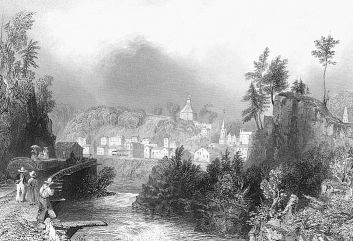
VILLAGE OF LITTLE FALLS, MOHAWK RIVER.
This thriving town sits above the north bank of the Mohawk, amid some of the most exquisite scenery of the world. The falls afford great facilities for manufactures of all kinds, and the Erie canal and rail-road both pass through it, up the Valley of the Mohawk, making it altogether the busiest spot, as it is the loveliest on the great route westward. It is impossible to conquer the wildness of the scenery here, however; and spite of mills and aqueducts, and smoking steam-engines, the soul of the banished Mohawk might return and haunt with comfort the bold precipices and impassive rocks that frown down upon his ancient abode, and still find the water untamed, and the mountains beautiful.
Of the small relics of Indian history that exist, there is a scrap which proves the supremacy of the Mohawk over even the far-off tribes of Connecticut. In the year 1656, a Podunk Indian, named Weaseapano, murdered a Sachem, who lived near Mattabeseck, (now Middletown.) Seaquassin, the existing Sachem of his tribe, complained of the outrage to the magistracy of Connecticut, and said that the Podunk Indians entertained the murderer, and protected him from the merited punishment. Seaquassin, at the same time, engaged Uncas in his cause, who also complained that Tontonimo enticed away many of his men, and protected an Indian who had murdered a Mohegan. Upon these complaints, the magistrates summoned the parties before them. Seaquassin and Uncas, after observing that the murderer was a mean fellow, and that the man murdered was a great Sachem, insisted that ten men, friends of Weaseapano, should be delivered up to be put to death, as a satisfaction for the crime. Tontonimo insisted that the satisfaction demanded was excessive; particularly as the murdered Sachem had killed Weaseapano’s uncle. The governor endeavoured to convince the complainants that the demand was excessive, observing that the English, in cases of murder, punished only the principal, and such as were accessary to the crime.
Tontonimo then proposed to make satisfaction by the payment of wampum, but it was refused. They fell, however, in their demands from ten men to six. The proposition was rejected by Tontonimo. The magistrates then urged him to deliver up the murderer: this he promised to do. But while the subject was in agitation, he privately withdrew from the court with the rest of the Podunk Sachems, and retired to the fortress belonging to his nation. Both the magistrates and the complainants were offended at this behaviour of Tontonimo. However, the magistrates appointed a committee to persuade the Indians to continue at peace with each other. At their solicitation, Uncas at length consented to accept the murderer, and promised to be satisfied if he should be delivered up; but the Podunk Indians told the English that they could not comply with this condition, because the friends of Weaseapano were numerous and powerful, and would not agree to the proposal.
The governor then addressed them in form, urging them to continue in peace, and endeavouring to persuade the complainants to accept of wampum. This they again refused, and withdrew; after it had been agreed on all hands that the English should not take any part in the controversy, and after the Indians had promised that they would not injure the persons or possessions of the English on either side the river.
Soon after, Uncas assembled an army for the purpose of avenging his wrongs; but being met near Hoccanum river by an equal number of the Podunks, and considering the issue of a battle as doubtful, he prudently retired, after having sent a message to Tontonimo, in which he declared, that if the Podunk Sachem persisted in withholding the murderer from justice, he would send to the Mohawks to come and destroy both him and his people.
Not long after, the crafty Mohegan accomplished his purpose in the following manner. He sent a trusty warrior, furnished with some Mohawk weapons, to Podunk, directing him to set fire in the night to a house near the fort, and then to leave the weapons on the ground in the vicinity, and immediately return. The warrior executed his commission. When the Podunks came in the morning to examine the ruins they found the weapons, and knowing them to belong to the Mohawks, were so alarmed with the apprehension that Uncas was about to execute his threat, that they delivered up the murderer, and sued for peace.
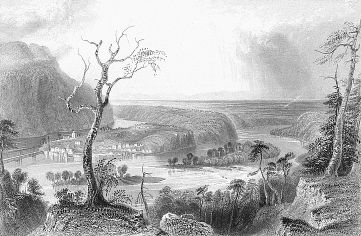
HARPER’S FERRY,
(FROM THE BLUE RIDGE.)
The scenery at Harper’s Ferry is, perhaps, the most singularly picturesque in America. The Views already given display its beauties, as seen from below. To attain that given in the present number, it was necessary to climb the Blue Ridge, by a narrow winding path, immediately above the bank of the Potomac. The view from this lofty summit amply repays the fatigue incurred by its ascent. The junction of the two rivers is immediately beneath the spectator’s feet; and his delighted eye resting first upon the beautiful and thriving village of Harper’s Ferry, wanders over the wide and woody plains, extending to the Alleghany mountains. President Jefferson, who has given the name to a beautiful rock immediately above the village, has left a powerful description of the scenery of Harper’s Ferry, which we shall give to our readers.
“The passage of the Potomac through the Blue Ridge, is, perhaps, one of the most stupendous scenes in nature. You stand on a very high point of land; on your right comes up the Shenandoah, having ranged along the foot of the mountain a hundred miles to seek a vent. On your left approaches the Potomac, in quest of a passage also; in the moment of their junction, they rush together against the mountain, rend it asunder, and pass off to the sea. The first glance of this scene hurries our senses into the opinion that this earth has been created in time; that the mountains were formed first, that the rivers began to flow afterwards, that in this place particularly they have been dammed up by the Blue Ridge of mountains, and have formed an ocean which filled the whole valley; that, continuing to rise, they have at length broken over at this spot, and have torn the mountain down from its summit to its base. The piles of rock on each hand, but particularly on the Shenandoah—the evident marks of their disrupture and avulsion from their beds by the most powerful agents of nature, corroborate the impression. But the distant finishing which nature has given to the picture, is of a very different character; it is a true contrast to the foreground; it is as placid and delightful as that is wild and tremendous; for the mountain being cloven asunder, she presents to your eye, through the cleft, a small catch of smooth blue horizon, at an infinite distance in the plain country, inviting you, as it were, from the riot and tumult roaring around, to pass through the breach and participate of the calm below. Here the eye ultimately composes itself; and that way, too, the road happens actually to lead. You cross the Potomac above the junction, pass along its side through the base of the mountain for three miles, its terrible precipices hanging in fragments over you, and, within about twenty miles, reach Fredericktown, and the fine country round that. This scene is worth a voyage across the Atlantic; yet here, as in the neighbourhood of the Natural Bridge, are people who have passed their lives within half a dozen miles, and have never been to survey these monuments of a war between rivers and mountains, which must have shaken the earth itself to its centre.”
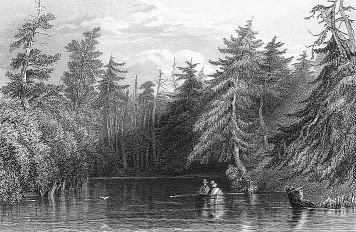
BARHYDT’S LAKE, NEAR SARATOGA.
I drove to Barhydt’s Lake, with the accomplished artist whose name is at the bottom of the drawing, on one of the finest days of early September. With a pair of crop ponies, whose going, simply, we acknowledged we had never seen beaten on the smooth roads of England, and a day over our heads of the most inspiriting freshness, we dashed through the pine woods of Saratoga in a light waggon, and pulled up at Barhydt’s door in twenty minutes from leaving the Springs.
The old man sat under his Dutch stoup, smoking his pipe, and suffered us to tie our ponies to his fence without stirring; and in answer to our inquiries if there was a boat on the lake, simply nodded an assent, and pointed to the water’s edge. Whether this indifference to strangers is indolence merely, or whether Herr Barhydt does not choose to be considered an inn-keeper, no one is enough in his secrets to divine. He will give you a dram, or cook you a dinner of trout, and seems not only indifferent whether you like his fish or his liquor, but quite as indifferent whether and what you pay him. In his way, Herr Barhydt is kind and courteous.
We descended to the lake, and after pulling up to the upper extremity where the view is taken, we returned to partake of the old Dutchman’s hospitality, and have a little conversation with him. Among other things, we asked him if he was aware that he had been put in a book.
“I’ve hearn tell on’t,” said he; “a Mr. Wilkins, or Watkins, has writ something about me, but I don’t know why. I never did him no harm as I know on.”
We had not the book to show the injured old gentleman his picture, but as it happens to lie by us now, and really contains a very literal description of the spot, we will copy out the extract:—
“Herr Barhydt is an old Dutch settler, who, till the mineral springs of Saratoga were discovered some four miles from his door, was buried in the depth of a forest unknown to all but the prowling Indian. The sky is supported above him, (or looks to be,) by a wilderness of straight columnar pine-shafts, gigantic in girth, and with no foliage except at the top, where they branch out like round tables spread for a banquet in the clouds. A small ear-shaped lake, sunk as deep into the earth as the firs shoot above it, and clear and unbroken as a mirror, save the pearl-spots of the thousand lotuses holding up their cups to the blue eye of heaven, sleeps beneath his window; and around him in the forest, lies, still unbroken, the elastic and brown carpet of the faded pine-tassels, deposited in yearly layers since the continent first rose from the flood, and rotted a foot beneath the surface to a rich mould that would fatten the Symplegades to a flower-garden. With his black tarn well stocked with trout, his bit of a farm in the clearing near by, and an old Dutch Bible, Herr Barhydt lived a life of Dutch musing, talked Dutch to his geese and chickens, sung Dutch psalms to the echoes of the mighty forest, and, except on his far-between visits to Albany, which grew rarer and rarer as the old Dutch inhabitants dropped faster away, saw never a white human face from one maple-blossoming to another.
“A roving mineralogist tasted the waters of Saratoga, and, like the work of a lath-and-plaster Aladdin, up sprung a thriving village around the fountain’s lip; and hotels, tin-tumblers, and apothecaries, multiplied in the usual proportion to each other, but out of all precedent with every thing else for rapidity. Libraries, newspapers, churches, livery-stables, and lawyers, followed in their train; and it was soon established, from the plains of Abraham to the Savannahs of Alabama, that no person of fashionable taste or broken constitution could exist through the months of July and August without a visit to the chalybeate springs and populous village of Saratoga. It contained seven thousand inhabitants before Herr Barhydt, living in his forest seclusion only four miles off, became aware of its existence. A pair of loons, philandering about the forest on horseback, popped in upon him one June morning, and thenceforth there was no rest for the soul of the Dutchman. Everybody rode down to eat his trout, and make love in the dark shades of his mirrored lagoon; and, at last, in self-defence, he added a room or two to his shanty, enclosed his cabbage-garden, and set a price on his trout dinners. The traveller, now-a-days, who has not dined at Barhydt’s, with his own champagne cold from the tarn, and the white-headed old settler ‘gargling’ Dutch about the house in his maniform vocation of cook, ostler, and waiter, may as well not have seen Niagara.”
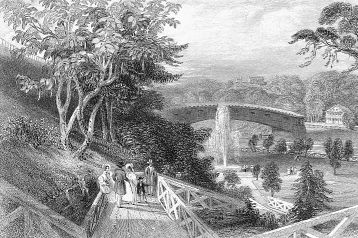
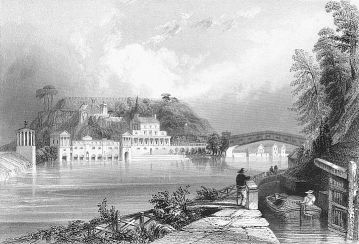
FAIR MOUNT GARDENS, PHILADELPHIA.
The walks here, though not extensive, are delightful, from the views they command over the Schuylkill. In the early days of William Penn, this side of the river was covered by a thick wood; and so late as Franklin’s time, (who “frequented it,” says the annalist, “with his companions, Osborne, Watson, and Ralph,”) the banks afforded a secluded and rural retreat, much resorted to by swimmers. The name of Schuylkill, given it by the Dutch, is said to express “Hidden River,” as its mouth is not visible in ascending the Delaware. The Indians called it by a name, meaning “The Mother;” and a small branch of the Schuylkill, higher up, called “Maiden Creek,” was named by them, Ontelaunee, meaning “the little daughter of a great mother.”
The Schuylkill and Delaware, in former days, were the scenes of feats in swimming and skaiting, which are not emulated in these graver times. The colonial annals record the achievements of George Tyson, a fat broker, weighing one hundred and ninety pounds; and “Governor Mifflin, and Joe Claypoole,” descend on the page of history as the best skaiters of Pennsylvania. The annalist enters on this theme with great unction. “During the old-fashioned winters, when about New-year’s day every one expected to see or hear of an ox-roast on the river, upon the thick-ribbed ice, which, without causing much alarm among the thousands moving in all directions upon its surface, would crack and rend itself by its own weight without separating, in sounds like thunder, among the then multitudinous throngs of promenaders, sliders, and skaiters, visible all about the river, as far as the eye could reach. Of the many varieties of skaiters of all colours and sizes mingled together, and darting about here and there, upward and downward, mingled and convolved, a few were at all times discernible as being decidedly superior to the rest for dexterity, power, and grace; namely, Governor Mifflin, Joe Claypoole, and others, not forgetting, by the way, a black Othello, who, from his apparent muscle and powerful movement, might have sprung, as did the noble Moor, from “men of royal size.” In swiftness he had no competitor; he outstripped the wind; the play of his elbows in alternate movement with his low-gutter skaites, while darting forward and uttering occasionally a wild scream peculiar to the African race while in active exertion of body, was very imposing in appearance and effect. Of the gentlemen skaiters before enumerated, George Heyl took the lead in graceful skaiting, and in superior dexterity in cutting figures and High Dutch within a limited space of ice. On a larger field of glass he might be seen moving about elegantly, and at perfect ease, in curve lines, with folded arms, being dressed in a red coat, as was the fashion, and buckskin tights, his bright broad skaites in an occasional turn flashing upon the eye. Then, again, to be pursued by others, he might be seen suddenly changing to the back and heel-forward movement, offering them his hand, and, at the same time, eluding their grasp by his dexterous and instantaneous deviations to the right and left, leaving them to their hard work of striking out after him with all their might and main.”
Among the recorded amusements of Philadelphia, however, the “Meschianza” is the most remarkable. This was a tilt and tournament, with other entertainments, given to Sir William Howe, by the officers of his army, on quitting his command to return to England. The company were embarked on the Delaware, in a grand regatta of three divisions; and with a band of music to each, and an outer line of barges to keep off the crowd of the uninvited, they proceeded to the neighbouring country-seat of Mr. Wharton. The tilting-ground was a lawn of one hundred and fifty yards on each side, lined with troops, and faced with several pavilions; and in front of each sat seven young ladies, dressed in Turkish costume, and wearing on their turbans the prizes for the victors. At the sound of a trumpet, “seven white knights, habited in white and red silk, and mounted on grey chargers, richly caparisoned,” made their appearance, followed by seven esquires, and a herald in his robe. After saluting the ladies, the herald proclaimed their challenge in the name of the “Knights of the blended Rose.” At the third repetition of the challenge, a black herald made his appearance, and accepted the challenge in the name of the “Knights of the Burning Mountain.” Immediately after entered the black knights, with tunics representing a mountain in flames, and the motto, “I burn for ever;” and the tournament began. They fought with spears, pistols, and swords, and the contest was long and desperate; but whether the white or black knights had the victory is not recorded.
After the tilt, the company ascended a flight of steps to a banqueting-room, and after the banquet, a ball-room was flung open, “decked with eighty-five mirrors, festoons of flowers, and a light and elegant style of painting.” Four drawing-rooms on the same floor contained sideboards with refreshments. The knights and their ladies opened the ball, and at twelve o’clock followed fireworks, and a supper, which was spread in a saloon of two hundred and ten by forty feet, ornamented with fifty-six large pier glasses, and containing alcoves with side-tables. There were one hundred branch lights, eighteen lustres, three hundred wax tapers on the supper tables, four hundred and thirty covers, and twelve hundred dishes. They were waited on by a great number of black slaves in oriental dresses, with silver collars and bracelets.
The queen of the “Meschianza,” concludes the annalist, with a remark which contains a moral, “was a once beautiful Mrs. L——, now blind and fast waning from the things that be.”
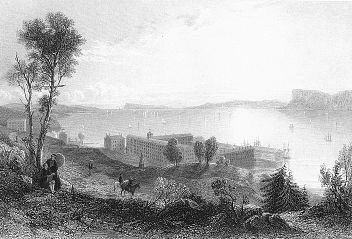
SING-SING PRISON, AND TAPPAN SEA.
An American prison is not often a picturesque object, and, till late years, it suggested to the mind of the philanthropist only painful reflections upon the abuses and thwarted ends of penitentiary discipline. To the persevering humanity of Louis Dwight, and to the liberal association that sustained him, we owe the change in these institutions which enables us to look on them without pain and disgust as places of repentance and reformation, rather than as schools for vice, and abodes of neglect and idleness. It is a creditable thing to our country to have led the way in these salutary changes; and there are many who have felt their patriotism more flattered by the visits of persons from Europe sent out by their governments to study our systems of prison discipline, than by many an event sounded through the trumpet of national glory.
The Tappan Sea spreads its broad waters at this part of the Hudson, looking, like all scenes of pure natural beauty, as if it was made for a world in which there could neither exist crime nor pain. Yet there stands a vast and crowded prison on its shores to remind us of the first—and for the latter, who ever entered upon these waters without a recollection of poor André? It may be doubted whether in the history of our country the fate of an individual has ever excited more sympathy than his. The rare accomplishments which he possessed, the natural elegance of his mind, the unfitness of his open character for the degrading circumstances under which he was taken, and his mild constancy at the approach of his melancholy fate, endear him, without respect to party, to the memories of all who read his story. André was taken on the eastern shore of the river at Tarrytown, and executed on the opposite side, at Tappan.
The story of Captain Hale has been regarded as parallel to that of Major André. This young officer had received a university education, and had but recently taken his degree when the war of the revolution commenced. He possessed genius, taste, ardour, was a distinguished scholar, and to all this was added, in an eminent degree, the winning address and native grace of a gentleman. No young man of his years put forth a finer promise of usefulness and celebrity.
Upon the first news of the battle of Lexington, he obtained a commission in the army, and marched with his company to Cambridge, where his promptness, activity, and assiduous attention to discipline, were early observed. After considerable service, the theatre of action was changed, and the army was removed to the southward. The battle of Long Island was fought, and the American forces were drawn together in the city of New York. At this moment it became extremely important for Washington to know the situation of the British army on the heights of Brooklyn, its numbers, and the indications as to its future movements. Having expressed a wish to this effect, Colonel Knowlton called together the younger officers, stated to them the wish of the General, and left it to their reflections, without naming any individual for the service. The undertaking was particularly hazardous; but it was immediately determined upon by Hale, who resisted all opposition on the part of his friends, and crossed over the river to the enemy’s ground. His disguise was well contrived, and he had obtained all necessary information, when he was arrested in the boat by which he was attempting to return. He was taken before the British commander, was condemned as a spy, and hanged the following morning. The circumstances of his death, however, were widely different from those of André. The Provost-marshal was a refugee, and behaved towards him in the most unfeeling manner, refusing him the attendance of a clergyman, and the use of a Bible in his last moments, and destroying the letters he had written to his mother and friends. In the midst of these barbarities Hale was collected and calm. To the last he displayed his native elevation of soul, and his dignity of deportment.
“But,” says a distinguished writer of biography, “whatever may have been the parallel between these two individuals while living, it ceased with their death. A monument was raised and consecrated to the memory of André by the bounty of a grateful sovereign. His ashes have been removed from their obscure resting-place, transported across the ocean, and deposited with the remains of the illustrious dead in Westminster Abbey. Where is the memento of the virtues, the patriotic sacrifice, the early fate of Hale?”
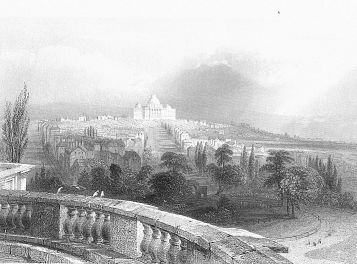
WASHINGTON,
(FROM THE PRESIDENT’S HOUSE.)
Distance lends more enchantment to a view of Washington than to most other views. Covering a good deal of ground, possessing two or three very fine points in itself, and lying in the centre of a superb outer circle of scenery, it has all the qualities which a draftsman could desire for his sketch. Thus much was seen or anticipated by the sagacious eye of the great patriot whose name it bears. Every one knows, however, that the location of the President’s House was the result of after speculation, or rather the result of a dispute between the owners of estates, two miles distant from each other, each desirous of locating all the public buildings on his own land, but who, like children quarrelling for a sugar-toy, pulled the subject of dispute in two. The Capitol was already placed on one elevation, and the President’s House carried off two miles to another. The consequence is, that the town itself, which, being a merely legislative metropolis, could never be very large, stretches and straddles between these two distant points, trying in vain to grow into compactness, and form the continuous and close-built street of a city.
The common sagacity acquired by travel is of little use to the stranger arriving for the first time in Washington. Visiting it during the session of Congress, he thinks himself very safe in requesting to be set down at the hotel nearest the Capitol, presuming, naturally, that this must be the great centre of convenience, as well as of interest. He accordingly takes a pigeon-hole at Gadsby’s Hotel, a vast white wooden caravanserai, accommodating many hundreds of people; and on the first day, walks half a mile to the Capitol, and wonders why the deuce the hotel was not built on some of the waste lots immediately at the foot of the hill. In a day or two, however, the secretaries and diplomatists begin to call on him, and the party-giving inhabitants shower upon him the “small rain” of pink billets. He sets apart a day for returning his visits; and, inquiring the addresses of his friends, is told that it is impossible to direct him, but the hackney coachmen all know. He calls a carriage, and the first thing is a drive of two miles directly away from the Capitol. He passes the President’s House, and getting off the Macadamized road, begins to pitch and plunge through miry lanes and waste lots, passing occasionally a house which lacks nothing of being in the country but trees, garden, and fences. It looks as if it had rained naked brick houses upon an open plain, and every man had made a street with reference to his own front door. The much shaken and more bewildered victim consumes his morning and his temper, and has made by dinner-time but six out of forty calls, all imperatively due, and all to be traced through the same irregular and ill-defined geography. He pays a price for his hackney coach which would keep a chariot and two posters for twice the time in London, and the next day moves into the disjointed settlement on the other side of President’s Square, abandons the Capitol, except on great occasions, and makes all visits by proxy that are not for a dance, or a dinner.
Malgré all these inconveniences, however, Washington is by much the most agreeable place in the United States for winter society. The great deficiency in all our cities, the company of highly cultivated and superior men, is here supplied. Female society, in any city or village, is seldom wanting in interest or cultivation; for women refine and elevate themselves with or without the advantages of metropolitan intercourse. But the men of our cities, devoted usually to one engrossing and depressing pursuit, have little time and less inclination to form themselves for intellectual intercourse. The ordeal through which a legislator must have come who finds himself at Washington, however, implies force of character at least, and oftenest, high talent; while the leaders and principal opposers of the ruling party, are, more necessarily than in any other country, men of exalted abilities and great experience of men and the world. The smaller lines which define polished society in May Fair, and the Faubourg St. Germain, may be wanting, but the stamen and spirit of high and cultivated intercourse, such as may well please the most fastidious, is seen in all the society in which the stranger would mingle during the session.
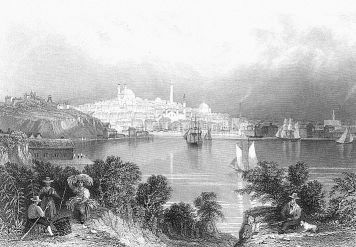
VIEW OF BALTIMORE.
The hospitable and wealthy metropolis of Maryland owes its location to the principle, that “second thoughts are best.” The two brothers of Lord Baltimore, one of whom, Leonard Calvert, had been appointed governor of the province, landed with his two hundred colonists on the north side of the Potomac, and there founded the town of St. Mary’s, the intended capital of Maryland. Little remains of St. Mary’s now, though it enjoyed its prospective honours for several years; and, as the historian says, “the worthy burghers cleared the adjacent lands, lived at peace with their Indian neighbours, and dozed away life, amid their tobacco-fields, with a comfortable and satisfactory sense of their own mark and importance.” The principal event in its history, is an attack upon it by a certain Captain Ingle, who, in the course of a rebellion, seized upon the public records, and drove the governor over the Potomac into Virginia.
The first settler within the limits of the present capital, was a Mr. Gorsuch, who, twenty-eight years after the founding of St. Mary’s, patented some land on Whetstone Point, the present review-ground for the Baltimore militia. Among the earliest who followed, was Charles Carroll, of Carrollton, whose descendant and namesake signed the Declaration of Independence. It is recorded that Charles and Daniel Carroll sold the sixty most eligible acres in the town for forty shillings an acre, which the commissioners paid for in tobacco, at a penny a pound. It was then surrounded with a board-fence, with two gates for carriages, and one for foot passengers; and “provision was made to keep this notable rampart in repair.” Thus Baltimore grew and prospered, till at this day it is one of the most enlightened and agreeable capitals of the United States, the third in size, and with a population rising eighty thousand. A humorous antiquarian gives the following sketchy account of it in one of its phases.
“It was a treat to see this little Baltimore town just at the termination of the war of Independence—so conceited, bustling, and débonair—growing up like a saucy chubby boy, with his dumpling cheeks and short grinning face, fat and mischievous, and bursting, incontinently, out of his clothes in spite of all the allowance of tucks and broad selvages. Market Street had shot, like a Nuremberg snake out of its toy-box, as far as Congress Hall, with its line of low-browed, hipped-roofed, wooden houses, in disorderly array, standing forward and back, after the manner of a regiment of militia, with many an interval between the files;—some of these structures were painted blue and white, and some yellow; and here and there sprang up a more magnificent mansion of brick, with windows like a multiplication table, and great wastes of wall between the stories, with occasional court-yards before them, and reverential locust-trees, under whose shade bevies of truant school-boys, ragged little negroes, and grotesque chimney-sweeps, shyed coppers, and disported themselves at marbles.
“This avenue was enlivened with apparitions of grave matrons and stirring damsels, moving erect in stately transit, like the wooden and pasteboard figures of a puppet-show; our present grandmothers, arrayed in gorgeous brocade and taffeta, luxuriantly displayed over hoops, with comely bodices, laced around that ancient piece of armour, the stay, disclosing most perilous waists; and with sleeves that clung to the arm as far as the elbow, where they took a graceful leave, in ruffles that stood off like the feathers of a bantam. And such faces as they bore along with them!—so rosy, so spirited, and sharp!—with the hair all drawn back over a cushion, until it lifted the eyebrows, giving an amazingly fierce and supercilious tone to the countenance, and falling in cataracts upon the shoulders. Then they stepped away with such a mincing gait, in shoes of many colours, with formidable points to the toes, and high and tottering heels, fancifully cut in wood; their tower-built hats garnished with tall feathers that waved aristocratically backward at each step, as if they took a pride in the slow paces of the wearer.
“In the train of these goodly groups came the beaux and gallants, who upheld the chivalry of the age; cavaliers of the old school, full of starch and powder, most of them the iron gentlemen of the revolution, with leather faces—old campaigners, renowned for long stories, fresh from the camp, with their military erectness and daredevil swagger; proper roystering blades, who had just got out of the harness, and began to affect the manners of civil life. Who but they!—jolly fellows, fiery, and loud!—with stern glances of the eye, and a brisk turn of the head, and a swashbuckler strut of defiance, like game cocks; all in three-cornered hats and wigs, and light-coloured coats, with narrow capes and marvellous long backs, with the pockets on each hip, and small-clothes that hardly reached the knee; and striped stockings, with great buckles in their shoes, and their long steel chains that hung conceitedly, half way to the knee, with seals in the shape of a sounding board to a pulpit. And they walked with such a stir, striking their canes so hard upon the pavement, as to make the little town ring again. I defy all modern coxcombry to produce any thing like it. There was such a relish about it—and particularly when one of these weather-beaten gallants accosted a lady in the street, with a bow that required a whole side pavement to make it in, with the scrape of his foot, and his cane thrust with a flourish under his left arm till it projected behind, along with his cue, like the pallisades of a chevaux-de-frize; and nothing could be more piquant than the lady, as she reciprocated the salutation with a curtsey that seemed to carry her into the earth, with her chin bridled to her breast—and such a volume of dignity!”
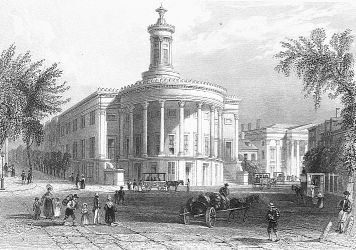
VIEW OF THE EXCHANGE AND GIRARD’S BANK,
PHILADELPHIA.
The most accomplished architect of the United States, William Strickland, Esq., is a citizen of Philadelphia; and to his excellent taste is the city in a great measure indebted for its superiority over the other capitals of our country in the architecture of public buildings. The view seen in the drawing is taken from Third Street, in the business-part of the city, and presents the rear of the Exchange, a new structure by Mr. Strickland, and the façade of a much older building, a chaste and beautiful specimen of the Corinthian order, occupied many years by the United States Bank. It has since been appropriated to the uses of a bank, of which the entire capital was furnished by Stephen Girard, the wealthiest citizen of Philadelphia, lately deceased. The Exchange (of which a minute description is given in another part of the work) is a copy of the choragic monument at Athens, commonly called the Lantern of Demosthenes.
Philadelphia is, and ever has been, fortunate in her citizens; and it may be said with truth that there is not a metropolis in the world where the effects of a liberal and enterprising public spirit are so clearly manifest. This is particularly true of all that ministers to the comfort of the inhabitant—such as excellence of markets, abundance of water, cleanliness of streets, baths, public conveyances, &c. The wooden, or block pavement, common in Russia, is now under experiment in the principal street, and promises to add another to the luxuries of the city; and among the later instances of liberal and refined taste, is the purchase by the city of a beautiful estate on the banks of the Schuylkill, and its appropriation to the purposes of a cemetery. It occupies very high ground, of an uneven surface, plentifully shaded with venerable trees, and is already, perhaps, the most lovely burial-place in the world, after the Necropolis of Scutari.
Philadelphia is the favourite residence of foreigners among us; and though, in all its features, unlike foreign capitals, it possesses more than all other cities of the United States, the advantage of highly educated and refined society. I speak here of that which is constant and resident; as Washington, during the Session of Congress, and Boston, during one or two of the hot months, become in turn the focus of the foreign and floating society of the country. Perhaps the climate of Philadelphia may have had its effect in making it the home of those accustomed to the equable temperatures of the continent; for Boston, nine months of the year, is uninhabitable from its acrid winds and clammy cold; and Washington, on the other hand, is unhealthy during a considerable part of the summer. New York, though the metropolis of the country, is more a place of transit than residence, to those not engaged in its business or commerce—a result partly of the unhealthfulness of its water and the effluvia of its streets, but partly, too, of the unsettled and shifting character of its society.
The commercial prospects of Philadelphia have brightened lately with the success of Atlantic steam navigation. Hitherto the delay in getting up the Delaware to a city so far from the sea, has made competition with New York in the sailing-packet lines impossible; but with vessels independent of winds and tides, the difficulty is obviated, and the enterprise of her merchants is already at work—companies formed and capital advanced for building steam-ships—and Philadelphia promises fair to vie with New York as a grand commercial emporium. The vast internal improvements of Pennsylvania, which have gone on nobly for the last few years, will now have double value, and aptly meet the wants of the new accession of trade.
It has always been a subject of regret that the noble design of William Penn to extend a broad pier along the Delaware, the length of the city, was never carried into effect: it is the one objection to the admirable arrangement of Philadelphia. It is to be hoped that, in the new need for wharf-room, the liberal spirit of the merchants will remember the wish of the great founder, and remove the unsightly edifices which now crowd into the river. With a man like Mr. Biddle in the municipality, no good or great change need be despaired of.
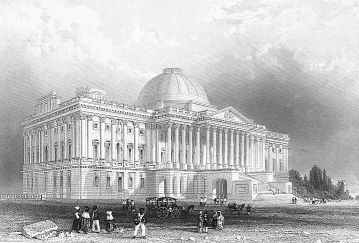
VIEW OF THE PRINCIPAL FRONT OF THE
CAPITOL AT WASHINGTON.
The Capitol presents a very noble appearance, as the spectator advances to it in the point of view taken by the artist; and from what is shown of the proportions and size of the building, a very imposing effect is produced. Its height, the ascending terraces, the monument and its fountain, the grand balustrade of freestone which protects the offices below, and the distinct object which it forms, standing alone on its lofty site, combine to make up the impression of grandeur, in which its architectural defects are lost or forgotten.
The waste lands which lie at the foot of Capitol Hill might be marshes in the centre of a wilderness for any trace of cultivation about them; but they are appropriated for a botanical garden, when Congress shall find time to order its arrangement and cultivation. This, however, and other features of desolation which belong to so thinly settled a metropolis, are said, by the defenders of Washington’s foresight, to answer one of his chief ends, in the location of the Capitol far from any commercial centre—that to prevent intimidation or interference from the people, the legislative capital should be thinly peopled, and in the power exclusively of the legislators themselves. The district of Columbia, accordingly, which was presented and set apart to the General Congress, by the different states, has a sort of civic government, of which the President of the United States held, in the first instance, the office of Mayor, and by its distance from the sea, and the natural independence of its position, it is impossible it should ever become a commercial or a thickly populated mart.
In a little volume written by a descendant of Washington, an account is given of the first survey of the Potomac, by the great patriot, with reference to the navigation above tide-water.
“The canoe, or pirogue,” says the author, “in which General Washington and a party of friends first made the survey of the Potomac, was hollowed out of a large poplar tree, on the estate of Colonel Johnson, of Frederick county, Maryland. This humble bark was placed upon a waggon, hauled to the margin of the Monocacy river, launched into the stream, and there received its honoured freight. The General was accompanied by Governor Johnson, one of the first commissioners for the location of the city of Washington, and several other gentlemen. At nightfall, it was usual for the party to land and seek quarters of some of the planters, or farmers, who lived near the banks of the river, in all the pride and comfort of old-fashioned kindliness and hospitality. Putting up for a night at a respectable farmer’s, the General and the two Johnsons were shown into a room, having but two beds. ‘Come, gentlemen!’ said Washington, ‘who will be my bedfellow?’ Both declined. Colonel Johnson often afterwards declared, that greatly as he should have felt honoured by such intimacy, the awe and reverence with which the chief had—inspired him, even in their daily and unreserved intercourse, would have made the liberty seem little short of profanation.
“While the party were exploring in the vicinity of Harper’s Ferry, news arrived of the burning at the stake of Colonel Crawford, by the Indians at Sandusky. Washington became excited to tears at hearing the recital, for Crawford had been one of the companions of his early life, and had often been his rival in athletic exercises. The unfortunate man was brave as a lion, and had served with great distinction in the war of the revolution. Tears soon gave way to indignation, and Washington, pointing to a lofty rock which juts over the stream, at its remarkable passage through the mountain, exclaimed, with a voice tremulous from feeling, ‘By Heaven, were I the sole judge of these Indians, it would be slight retaliation to hurl every spectator of his death from that height into the abyss.’ ”
To the reader who venerates the name of the great Patriot, no anecdote, however trifling, told in connexion with the monuments of his greatness, can be unappropriate or uninteresting.
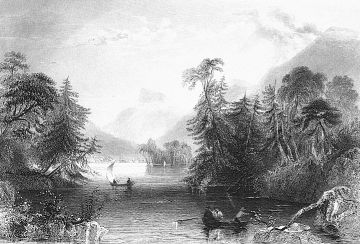
THE NARROWS, LAKE GEORGE.
Between some of its beautiful islands, and between the islands and the main, Lake George assumes the character of calm river scenery. From the undisturbed state of the vegetation on the shore, however, and the absence of the deposit left by the freshets, to which running streams are liable, the scenery is lovelier than that of most rivers, and differs from them, as the shores of the tideless Mediterranean differ from those of the disturbed Atlantic. There is scarce one of these beautiful islands that has not some association or legend of interest, and this story is recorded of Diamond Island, the one most visited and admired:—A party of pleasure had been visiting the island on a little sailing excursion, and having lingered longer upon that beautiful spot than they were conscious of, as night drew on, concluded to encamp for the night,—it being already too late to return to the fort. “From the shore where we lay hid,” said Cane, “it was easy to watch their motions; and perceiving their defenceless situation, as soon as it was dark we set off for the island, where we found them asleep by their fire, and discharged our guns among them. Several were killed, among whom was one woman, who had a sucking child, which was not hurt. This we put to the breast of its dead mother, and so we left it. But Major Hopkins was only wounded, his thigh-bone being broken; he started from his sleep to a rising posture, when I struck him,” said Barney Cane, “with the butt of my gun, on the side of his head; he fell over, but caught on one hand; I then knocked him the other way, when he caught with the other hand; a third blow, and I laid him dead. These were all scalped except the infant. In the morning, a party from the fort went and brought away the dead, together with one they found alive, although he was scalped, and the babe, which was hanging and sobbing at the bosom of its lifeless mother.”
Even this tale of barbarity to a mother, yields in horror to the sufferings of Massy Harbisson, from whose journal of captivity, take for example the following passages;—“The Indians, when they had flogged me away along with them, took my oldest boy, a lad of about five years of age, along with them, for he was still at the door by my side. My middle little boy, who was about three years of age, had by this time obtained a situation by the fire in the house, and was crying bitterly to me not to go, and making bitter complaints of the depredations of the savages.
“But these monsters were not willing to let the child remain behind them; they took him by the hand to drag him along with them, but he was so very unwilling to go, and made such a noise by crying, that they took him up by the feet, and dashed his brains out against the threshold of the door. They then scalped and stabbed him, and left him for dead. When I witnessed this inhuman butchery of my own child, I gave a most indescribable and terrific scream, and felt a dimness come over my eyes next to blindness, and my senses were nearly gone. The savage then gave me a blow across my head and face, and brought me to my sight and recollection again. During the whole of this agonizing scene, I kept my infant in my arms.
“As soon as their murder was effected, they marched me along to the top of the bank, about forty or sixty rods, and there they stopped and divided the plunder they had taken from our house; and here I counted their number, and found them to be thirty-two, two of whom were white men, painted as Indians.
“Here I beheld another hard scene, for as soon as we had landed, my little boy, who was still mourning and lamenting about his little brother, and who complained that he was injured by the fall in descending the bank, was murdered.
“One of the Indians ordered me along, probably that I should not see the horrid deed about to be perpetrated. The other then took his tomahawk from his side, and with this instrument of death killed and scalped him. When I beheld this second scene of inhuman butchery, I fell to the ground senseless, with my infant in my arms, it being under, and its little hands in the hair of my head. How long I remained in this state of insensibility, I know not.
“The first thing I remember was my raising my head from the ground, and my feeling myself exceedingly overcome with sleep. I cast my eyes around, and saw the scalp of my dear little boy, fresh bleeding from his head, in the hand of one of the savages, and sunk down to the earth again, upon my infant child. The first thing I remember after witnessing this spectacle of woe, was the severe blows I was receiving from the hands of the savages, though at this time I was unconscious of the injury I was sustaining. After a severe castigation, they assisted me in getting up, and supported me when up.
“In the morning one of them left us, to watch the trail or path we had come, to see if any white people were pursuing us. During the absence of the Indian, who was the one that claimed me, the other, who remained with me, and who was the murderer of my last boy, took from his bosom his scalp, and prepared a hoop, and stretched the scalp upon it. Those mothers who have not seen the like done by one of the scalps of their own children, (and few, if any, ever had so much misery to endure,) will be able to form but faint ideas of the feelings which then harrowed up my soul!”
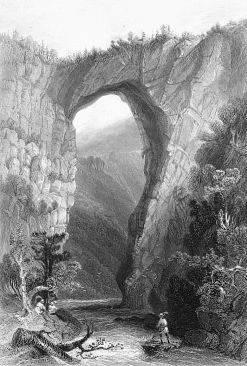
THE NATURAL BRIDGE, VIRGINIA.
The description of Jefferson first attracted the attention of travellers to this remarkable spot, unequalled probably in the world. Of recent descriptions the best is that by Miss Martineau, which is so characteristic and interesting, that we can add nothing to it.
“At a mile from the bridge, the road turns off through a wood. While the stage rolled and jolted along the extremely bad road, Mr. L—— and I went prying about the whole area of the wood, poking our horses’ noses into every thicket, and between any two pieces of rock, that we might be sure not to miss our object; the driver smiling after us, whenever he could spare attention from his own not very easy task, of getting his charge along. With all my attention, I could see no precipice, and was concluding to follow the road without any more vagaries, when Mr. L——, who was a little in advance, waived his whip, as he stood beside his horse, and said, ‘Here is the bridge!’ I then perceived that we were nearly over it, the piled rocks on either hand forming a barrier, which prevents a careless eye from perceiving the ravine which it spans. I turned to the side of the road, and rose in my stirrup to look over; but I found it would not do. I went on to the inn, deposited my horses and returned on foot to the bridge.
“With all my efforts, I could not look down steadily into what seemed the bottomless abyss of foliage and shadow. From every point of the bridge I tried, and all in vain. I was heated and extremely hungry, and much vexed at my own weakness. The only way was to go down and look up; though where the bottom could be, was past my imagining, the view from the top seeming to be of foliage below foliage for ever.
“The way to the glen is through a field opposite the inn, and down a steep, rough, rocky path, which leads under the bridge, and a few yards beyond it. I think the finest view of all is from this path, just before reaching the bridge. The irregular arch of rock, spanning a chasm of one hundred and sixty feet in height, and from sixty to ninety in width, is exquisitely tinted with every shade of grey and brown; while trees encroach from the sides, and overhang from the top; between which and the arch there is an additional depth of fifty-six feet. It was now early in July; the trees were in their brightest and thickest foliage; and the tall beeches under the arch contrasted their verdure with the grey rock, and received the gilding of the sunshine, as it slanted into the ravine, glittering in the drip from the arch, and in the splashing and tumbling waters of Cedar Creek, which ran by our feet. Swallows were flying about under the arch. What others of their tribe can boast of such a home?
“We crossed and re-crossed the creek on stepping-stones, searching out every spot to which any tradition belonged. Under the arch, thirty feet from the water, the lower part of the letters G. W. may be seen, carved in the rock. When Washington was a young man, he climbed up hither, to leave this record of his visit. There are other inscriptions, of the same kind; and above them a board, on which are painted the names of two persons, who have thought it worth while thus to immortalize their feat of climbing highest. But their glory was but transient, after all. They have been outstripped by a traveller, whose achievement will probably never be rivalled; for he would not have accomplished it, if he could by any means have declined the task. Never was a wonderful deed more involuntarily performed. There is no disparagement to the gentleman in saying this: it is only absolving him from the charge of foolhardiness.
“This young man, named Blacklock, accompanied by two friends, visited the Natural Bridge; and, being seized with the ambition appropriate to the place, of writing his name highest, climbed the rock opposite to the part selected by Washington, and carved his initials. Others have perhaps seen what Mr. Blacklock had overlooked—that it was a place easy to ascend, but from which it is impossible to come down. He was forty feet or more from the path; his footing was precarious; he was weary with holding on, while carving his name, and his head began to swim when he saw the impossibility of getting down again. He called to his companions that his only chance was to climb up upon the bridge, without hesitation or delay. They saw this, and with anguish agreed between themselves that the chance was a very bare one. They cheered him, and advised him to look neither up nor down. On he went, slanting upwards from under the arch, creeping round a projection, on which no foothold is visible from below, and then disappearing in a recess filled up with foliage. Long and long they waited, watching for motion, and listening for crashing among the trees. He must have been now one hundred and fifty feet above them. At length their eyes were so strained that they could see no more; and they had almost lost all hope. There was little doubt that he had fallen while behind the trees, where his body would never be found. They went up to try the chance of looking for him from above. They found him lying insensible on the bridge. He could just remember reaching the top, when he immediately fainted. One would like to know whether the accident left him a coward, in respect of climbing, or whether it strengthened his confidence in his nerves.”
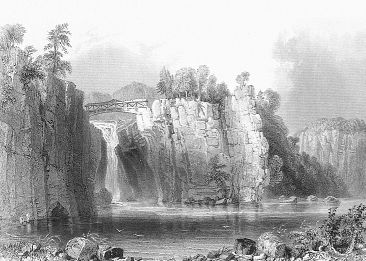
VIEW OF THE PASSAIC FALLS.
A description of these beautiful Falls having been given in another page of the work, it may be worth while to step a little aside from the immediate subject of the drawing, in search of historic incident. The annals of New Jersey present nothing more interesting than the military operations of Washington, within its border; and among these stands conspicuous the battle at Monmouth Court House. On the news of the alliance between America and France, the British Government ordered its forces to be concentrated at New York. The royal army, in consequence, evacuated Philadelphia, and took up their march through New Jersey, where Washington resolved to hazard a battle. “The British army,” says the historian, “marched in two divisions,—the van commanded by General Knyphausen, and the rear by Lord Cornwallis; but the British commander-in-chief, judging that the design of the American General was to make an attempt on his baggage, put it under the care of General Knyphausen, that the rear division, consisting of the flower of the British army, might be ready to act with vigour. This arrangement being made, General Knyphausen’s division marched, in pursuance of orders, at break of day, on the 28th of June; but the other division, under Lord Cornwallis, attended by the Commander-in-chief, did not move until eight, that it might not press too closely on the baggage. General Lee appeared on the heights of Freehold, soon after the British had left them; and, following them into the plain, made dispositions for intercepting their covering party in the rear. While he was advancing to the front of a wood, adjoining the plain, to reconnoitre the enemy in person, Sir Henry Clinton was marching back his whole rear division, to attack the Americans. Lee now perceived that he had mistaken the force which formed the rear of the British; but he still proposed to engage on that ground. While both armies were preparing for action, General Scott, mistaking an oblique march of an American column for a retreat, left his position, and repassed a morass in his rear. Lee, dissatisfied with the ground on which the army was drawn up, did not correct the error of Scott, but directed the whole detachment to repass the morass, and regain the heights. During this retrograde movement, the rear of the army, which at the first firing had thrown off their packs, and advanced rapidly to the support of the front, approached the scene of action; and General Washington, riding forward, met the advanced corps, to his extreme mortification and astonishment, retiring before the enemy. On coming up to Lee, he spoke to him in terms of disapprobation; but, though warm, he lost not for a moment that self-command, than which, at so critical a moment, nothing could be more essential to the command of others. He instantly ordered Colonel Stewart’s and Lieutenant-Colonel Ramsay’s battalions to form on a piece of ground, which he judged suitable for giving a check to the enemy; and, having directed General Lee to take proper measures with the residue of his force to stop the British columns on that ground, he rode back himself to arrange the rear division of the army. His orders were executed with firmness. A sharp conflict ensued; and though Lee was forced from the ground on which he had been placed, he brought off his troops in good order, and was then directed to form in the rear of Englishtown. The check which he had given to the enemy procured time to make a disposition of the left wing, and second line of the American army, in the wood, and on the eminence to which Lee was retreating. Lord Stirling, who commanded the left wing, placed some cannon on the eminence, which, with the cooperation of some parties of infantry, effectually stopped the advance of the British in that quarter. The enemy attempted to turn the left flank of the Americans, but were repulsed. They also made a movement to the right, but were there repelled by General Greene, who had taken a very advantageous position. Wayne, advancing with a body of troops, kept up so severe and well-directed a fire, that the British soon gave way, and took the position which Lee had before occupied, where the action commenced immediately after the arrival of General Washington. Here the British line was formed on very strong ground. Both flanks were secured by the woods and morasses, and their front could only be reached through a narrow pass. The day had been intensely hot, and the troops were greatly fatigued; yet General Washington resolved to renew the engagement. He ordered Brigadier-General Poor, with his own and the Carolina brigade, to gain the enemy’s right flank, while Woodford, with his brigade, should turn their left. The artillery was ordered at the same time to advance and play on them in front. These orders were promptly obeyed; but there were so many impediments to be overcome, that before the attack could be commenced, it was nearly dark. It was therefore thought most advisable to postpone further operations until morning; and the troops lay on their arms in the field of battle. General Washington, who had been exceedingly active through the day, and entirely regardless of personal danger, reposed himself at night in his cloak, under a tree, in the midst of his soldiers. His intention of renewing the battle was frustrated. The British troops marched about midnight, in such profound silence, that the most advanced posts, and those very near, knew nothing of their departure until morning.”
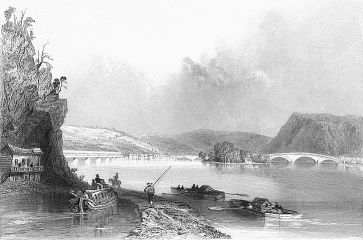
NORTHUMBERLAND, ON THE SUSQUEHANNA.
(AT THE JUNCTION OF THE EAST AND WEST BRANCHES.)
The comfort and prosperity of the towns on this and other central rivers, in the middle states, have been dearly bought by the sacrifices of the pioneers, who went in advance of civilization, and over whose graves the grass is hardly yet matted with time. It is necessary to look back constantly to the recent date of the chronicles of those border contests, to realize that centuries have not elapsed since these flourishing fields were contended for, hand to hand, by the white and the red man.
It was only in 1778, that the increasing inroads on the settlements in this part of the country compelled many of the inhabitants to abandon their farms, and congregate at the rude forts scattered along the frontier, where they could resist, to more advantage, the dangers which threatened them. An exciting tale is recorded of a contest between an old man and two Indians, under the following circumstances.
David Morgan, the hero of the story, was upwards of sixty years of age. He owned a small farm about a mile from one of the forts; and on the day of the adventure, not feeling very well, he had sent his son and daughter to feed the cattle, at the deserted barn, and had gone to bed, in the fort. As he slept, he dreamed that he saw his children making towards him, scalped. The fancy was so vivid, that he started from his sleep, and, finding they had not returned, took his gun, and walked out rapidly to find them. He reached the farm in great agitation, but the children were there, and he sat down on a log to recover his composure. He had not sat long, before two Indians came out of the house, and made towards his son and daughter, who were at a little distance, preparing the ground for melons. Fearing to alarm them too much, and thus deprive them of the power of escaping, he kept his seat; and, in his usual tone of voice, apprised them of their danger, and told them to run towards the fort. The savages raised a terrific cry, and started in pursuit: but the old man showing himself at the same instant, they took to the shelter of the trees. Morgan then attempted to follow his children; but in a minute or too, finding that the savages gained upon him, he turned to fire. They instantly sprang behind trees, and the old man did the same, taking aim at one of the Indians, whose refuge, a small sapling, did not entirely cover his body. As he was on the point of firing, the savage felt his exposure, and dropped behind a prostrate log, close at his feet. The next instant the reserved shot took effect, beneath the log, and the Indian rolled over, stabbing himself twice in the breast.
Having disposed of one of his foes, Morgan abandoned the shelter of his tree, and took to flight. The Indian pursued, and the race was continued about sixty yards, when, looking over his shoulder, the old man saw the gun raised, within a few paces of him. He sprang aside, and the ball whizzed harmlessly by. It was now a more equal contest; and Morgan struck at the Indian with his gun, receiving at the same instant a blow from a tomahawk, which severed one of the fingers from his left hand. They closed immediately, and the Indian was thrown; but overturned the old man, with a powerful effort; and, sitting on his breast, uttered his yell of victory, and felt for his knife. A woman’s apron, which he had stolen from the farm-house, and tied around his waist, embarrassed him; and Morgan seized one of his hands between his teeth, and, getting hold, himself, of the handle of the knife, drew it so sharply through the Indian’s fingers, as to wound him severely. In the struggle, they regained their feet, and still retaining his hold on the fingers in his mouth, Morgan gave him a stab, which decided the contest. The savage fell, and, afraid that others of the tribe might be lurking near, the exhausted old man made the best of his way to the fort.
A party immediately went out to the spot where the struggle had taken place, but the fallen Indian was not to be seen. They tracked him by his blood to a fallen tree, where he was endeavouring to stanch his wounds with the stolen apron. On their approaching him, he affected to smile, and endeavoured to conciliate them, crying out, in his broken English, “How do, broder? how do, broder?” There was little mercy in store for him, however. To the shame of our white race, it is recorded that “they tomahawked and scalped him: and afterwards flaying both him and his companion, they converted their skins into saddle-seats and pouches!”
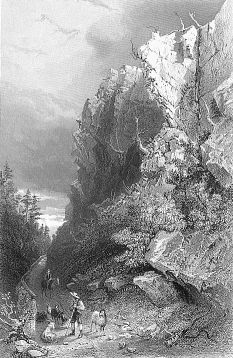
PULPIT ROCK, WHITE MOUNTAINS.
The name given to this fine fragment of the White Mountains, indicates very fairly the favourite vein of association in the minds of the first Puritan settlers of New Hampshire; but it looks as much like a pulpit as many other rocks in the bold scenery of New England, of which we know at least a dozen by the same name. Settled by the same class of stern religionists as Massachusetts, New Hampshire has not upon its history the same blot of fanaticism. The tragical era of persecution for witchcraft in Massachusetts had no corresponding abomination in New Hampshire. The two or three cases on record are rather amusing—particularly that inserted in the historical collections, under the title of “The Complaint of Susan Trimmings, of Little Harbour, Piscatagua.” The complaint and evidence were as follows:—
“On Lord’s-day, 30th of March, at night, going home with Goodwife Barton, she separated from her at the freshet next her house. On her return, between Goodman Evens’s and Robert Davis’s, she heard a rustling in the woods, which she at first thought was occasioned by swine; and presently after, there did appear to her a woman, whom she apprehended to be old Goodwife Walford. She asked me where my consort was; I answered, I had none. She said, thy consort is at home by this time: lend me a pound of cotton. I told her I had but two pounds in the house, and I would not spare any to my mother. She said I had better have done it; that my sorrow was great already, and it should be greater; for I was going a great journey, but should never come there. She then left me; and I was struck as with a clap of fire on the back, and she vanished towards the water-side, in my apprehension, in the shape of a cat. She had on her head a white linen hood tied under her chin, and her waistcoat and petticoat were red, with an old green apron, and a black hat upon her head.”—Taken upon oath, 18th April, 1656.
“Her husband (Oliver) says, she came home in a sad condition. She passed by me with her child in her arms, laid the child on the bed, sat down on the chest, and leaned upon her elbow. Three times I asked her how she did. She could not speak. I took her in my arms and held her up, and repeated the question. She forced breath, and something stopped in her throat as if it would have stopped her breath. I unlaced her clothes, and soon she spake and said, ‘Lord, have mercy upon me, this wicked woman will kill me.’ I asked her what woman? she said, Goodwife Walford. I tried to persuade her it was only her weakness. She told me no; and related as above, that her back was as a flame of fire, and her lower parts were as it were numb, and without feeling. I pinched her, and she felt not. She continued that night, and the day and night following, very ill, and is still bad of her limbs, and complains still daily of it.
“A witness deposed, June 1656, that he was at Goodman Walford’s, 30th March, 1656, at the time mentioned by Mrs. Trimmings, and that Goodwife Walford was at home till quite dark, as well as she ever was in her life.
“Nicholas Rowe testified that Jane Walford, shortly after she was accused, came to the deponent in bed in the evening, and put her hand upon his breast, so that he could not speak, and was in great pain till the next day. By the light of the fire in the next room it appeared to be Goody Walford, but she did not speak. She repeated her visit about a week after, and did as before, but said nothing.
“Eliza Barton deposed that she saw Susannah Trimmings at the time she was ill, and her face was coloured and spotted with several colours. She told the deponent the story, who replied, that it was nothing but her fantasy; her eyes looked as if they had been scalded.
“John Puddington deposed that three years since, Goodwife Walford came to his mother’s. She said that her own husband called her an old witch; and when she came to her cattle, her husband would bid her begone, for she did overlook the cattle; which is as much as to say, in our country, bewitching.
“Agnes Puddington deposes, that, on the 11th of April, 1656, the wife of W. Evens came to her house, and lay there all night; and a little after sun-set, the deponent saw a yellowish cat; and Mrs. E. said she was followed by a cat wherever she went. John came and saw a cat in the garden—took down his gun to shoot her; the cat got up on a tree, and the gun would not take fire, and afterwards would not stand cocked. She afterwards saw three cats; the yellow one vanished away on a plain ground; she could not tell which way they went.
“John Puddington testifies to the same effect.
“Three other deponents say they heard Eliza, the wife of Nicholas Rowe, say, that there were three men witches at Strawberry Bank; one was Thomas Lurpin, who was drowned; another, old Hans; and the third should be ‘nameless,’ because he should be blameless. Goodwife Walford was bound over to the next Court.
“Court of Associates, June, 1656.
“Jane Walford being brought to this court upon suspicion of being a witch, is to continue bound until the next court, to be responsive.
“This complaint was probably dropped at the next term. Goodwife Walford brought an action of slander in the County Court, 22d of March, 1669, against one Robert Coutch, and laid her damages at one thousand pounds.
“Declaration in an action of slander for saying that the said Jane was a witch, and he could prove her one, which is greatly to her damage.
“Verdict for plaintiff, Walford, five pounds, and costs of court.”
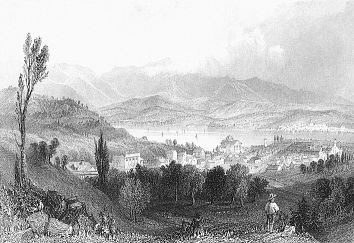
VIEW OF HUDSON, AND THE CATSKILL MOUNTAINS.
A wedge-shaped promontory, or bluff, pushes forward to the river at this spot; and on its summit, which widens into a noble plain, stands the city of Hudson. The business of the place is chiefly done in a simple street, which runs at eight angles from the river. Its growth at first was remarkably rapid; but the resources of the surrounding country were found inadequate to second its prosperity, and its trade has accordingly been nearly stationary for a number of years. The enterprise of the citizens, however, has found a new source of wealth in the whale fishery.
It is supposed that the Halve-Mane, the vessel in which the great discoverer made his first passage up the Hudson, reached no farther than two leagues above the city which bears his name, and that the remainder of the exploring voyage was made in the shallop. His reception here was in the highest degree hospitable. “He went on shore in one of their canoes, with an old Indian, who was the chief of forty men, and seventeen women; these he saw in a house made of the bark of trees, exceedingly smooth and well-finished within and without. He found a great quantity of Indian corn and beans, enough of which were drying near the house to have loaded three ships, besides what was growing on the fields. On coming to the house, two mats were spread to sit on, eatables were brought in, in red bowls, well made; and two men were sent off with bows and arrows, who soon returned with two pigeons. They also killed a fat dog, and skinned it with shells. They expected their visitors would remain during the night, but the latter determined to return on board. The natives were exceedingly kind and good-tempered; for when they discovered Hudson’s determination to proceed on board, they, imagining it proceeded from fear of their bows and arrows, broke them to pieces, and threw them into the fire.”
On his return down the river, Hudson stopped again for four days opposite the site of the future city. The historical collections give a very particular account of every day’s movements in this interesting voyage. “On the report of those whom he had sent to explore the river,” says the historian, “Hudson found that it would be useless to proceed with his ship any farther, or to delay his return. He had passed several days in a profitable traffic, and a friendly intercourse with the natives; among whom were probably those from each side of the river—the Mahicanni, as well as the Mohawks. At noon of the 23d of September, he therefore went down six miles to a shoal: having but little wind, the tide laid his ship on the bar until the flood came, when she crossed it, and was anchored for the night.
“The next day, after proceeding seven or eight leagues, she grounded on a bank of ooze in the middle of the river, where she was detained till the ensuing morning, when the flood, at ten o’clock, enabled Hudson to anchor her in deep water. Thus the ship once more was interrupted in her passage opposite the spot where a city now commemorates the name of Hudson.
“Here he remained, by reason of adverse winds, four days. On the day of his arrival, ‘they went on land and gathered good store of chestnuts;’ but whether on the east or west side of the river, is not mentioned. But the day following they went on land, ‘to walk on the west side of the river, and found good ground for corn, and other garden herbs, with good store of goodly oaks and walnut-trees, and chestnut-trees, yew-trees, and trees of sweet wood, in great abundance, and great store of slate for houses, and other good stones.’ Nothing is said of any inhabitants while they were thus visiting the site, which is now that of the village of Athens, opposite Hudson. But, next morning (26th), after the carpenter, mate, and four of the company, had gone on shore to cut wood, while the vessel lay at anchor, two canoes came up the river from the place where they first found ‘loving people,’ (Catskill landing,) and in one of them was the old chief whom Hudson had caused to be made intoxicated at Albany. He had followed our strange visitors thirty miles, to the base of the Catskill mountains, with the double view of again testifying to Hudson the sincerity of his friendship, and of gratifying the love of the marvellous, by relating his own adventures to the mountaineers, and drawing them from their retreat to witness the floating phenomenon. The old chief now introduced with him ‘an old man, who brought more stropes of beads, and gave them to our master, and showed him all the country thereabout, as though it were at his command!’ They tarried, greatly pleased with the unaccountable curiosities they discovered on board. Hudson ‘made the two old men dine with him, and the old man’s wife; for they brought two old women, and two young maidens of the age of sixteen or seventeen years with them, who behaved themselves very modestly.’
“After dinner, and upon exchange of presents, the guests retired, inviting Hudson by signs to come down to them; for the ship was within two leagues of the place where they dwelt.”
The concluding circumstances of this interesting return down the Hudson, will accompany another view in the series.
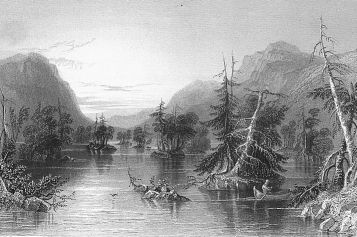
SCENE AMONG THE HIGHLANDS,
ON LAKE GEORGE.
Having dwelt upon the scenery of this celebrated Lake in other pages of this work, let us glance here at the events which took place upon its borders during the war between the French and the British colonies, in 1755.
The Baron de Dieskau had arrived from France, in company with De Vaudreuil, Governor General of Canada, bringing with him three thousand regular troops, destined to make war on the English colonies. Landing at Quebec, his first instructions were to reduce Osnego, but intelligence reaching the Governor that a considerable force was collecting at Lake Sacrament (now Lake George) with the probable intention of invading Canada, Baron Dieskau changed his route, and proceeded up Lake Champlain.
The provincial army was commanded by Colonel, afterwards Sir William, Johnson; and it was in alliance with a considerable body of Indians, under the command of the celebrated chief Hendrick, the great Mohawk Sachem. In Johnson’s official report he is called “a valiant warrior, and a faithful friend.”
After a fruitless attempt to surprise and take Fort Edward, Dieskau advanced toward the head of Lake George. On the first intimation of his approach, a council of war was called by Colonel Johnson, and it was determined that a party should go out to meet him. The number of men fixed upon was mentioned by Johnson to Hendrick. The Sachem replied, “If they are to fight, they are too few; if they are to be killed, they are too many.” The number was accordingly increased. General Johnson, also, proposed to divide them into three parties. Hendrick took three sticks, and putting them together, said to him, “Put these together, and you cannot break them; take them one by one, and you will break them easily.” The hint succeeded, and Hendrick’s sticks probably saved the whole army from destruction.
The detached party consisted of twelve hundred, commanded by Colonel Williams. He met the enemy about four miles from Lake George. Dieskau had been informed of his approach by scouts, and arranged his men on both sides of the road in a half-moon, to receive him. The whole country was a forest, and Williams impetuously marched directly into the hollow. At the same instant, a tremendous fire was opened on him in front, and on both his flanks; and Johnson and Hendrick fell among the heaps of the slain, the latter displaying the highest courage and valour. His death was embittered by the disgrace of receiving the mortal wound in his back, and his last breath was spent in lamenting it.
The overpowered detachment fell back in good order upon the entrenchments, and the enemy advanced to the position of General Johnson, which was upon the shore of Lake George. They began the engagement by firing in platoons upon the centre, but did little injury. After an hour or two of manœuvering and skirmishing, the English leaped over their breast-works, and charged upon the enemy. They broke, and fled in every direction; and Dieskau was found by a soldier, resting on a stump, with scarcely an attendant. As he was feeling for his watch to give it to the soldier, the man, thinking he was feeling for a pistol, discharged his musket through his hips. He was carried into camp in a blanket by eight men, with the greatest care and tenderness, but in extreme agony. For some reason or other, the flying enemy was not pursued, and few were taken prisoners. They had fought with great bravery, and had kept the field till one-third of their number was cut down—a thousand being left dead on the field.
On their retreat, the French army was met by a party of provincial militia, amounting in all to a hundred and fifty men. With the loss of only six men, (among whom was the second in command, Captain M’Ginnes,) this small body of men succeeded in driving the French from their ground, and possessing themselves of all the ammunition and baggage of the flying army. His Majesty was so well pleased with the result of this battle, that he created General Johnson a baronet, and Parliament voted him a present of 5000l.
The Sachem Hendrick had lived a life of unsullied bravery, and died fighting gallantly. He was at this time from sixty to seventy years of age. His head was covered with white locks, and, what is uncommon among Indians, he was corpulent. Immediately before the march, he mounted a rock and addressed his people. He had a voice of great depth and power, and could be heard distinctly half a mile. His eloquence is represented as fiery and impressive to a degree, unusual even among this nation of orators. It is said, that when his death was announced to his son, the young chief gave a single groan; but immediately recovered himself, and striking his hand on his breast, rose with great dignity and said, his father was still alive in his son’s bosom.
Dieskau was conveyed from Albany to New York, and thence to England, where he soon after died.
SCHUYLKILL WATER-WORKS, AT PHILADELPHIA.
The Water-works of Philadelphia rank among the most noble public undertakings of the world. The paucity of water in the city first set to work the sagacious mind of Dr. Franklin, who, by will, bequeathed a portion of a long accumulated legacy to bring a greater supply of this necessary element from Wissahiccon Creek. This was found, after a while, to be insufficient; and a plan was proposed, and carried into operation, to form a reservoir on the east bank of the Schuylkill, from which water was to be thrown by a steam-engine into a tunnel, conveyed to a central position, and raised by a second engine to a higher reservoir, which supplied all the pipes in the city. An experience of ten years satisfied the corporation that a sufficient supply could not be obtained by this method. The steam-engines were liable to frequent accidents, and the derangement of one stopped the supply of the whole city. After several other futile experiments, the present extensive yet simple water-works were proposed, and three hundred and fifty thousand dollars voted at once by the city corporation for the commencement of the undertaking.
The Schuylkill opposite Philadelphia, is about nine hundred feet in breadth. It is subject to sudden freshets, (an American word, unknown in this use in England, and meaning an overflow of a river current,) but its average depth is thirty feet at high water. It was necessary to back the river up about six miles; and a dam was then created by cribs and masonry, running diagonally across, with several ingenious contrivances to prevent damage by ice and spring freshets. A overfall of one thousand two hundred and four feet, forming a beautiful feature of the scenery, is thus created, and a water-power upon the wheels sufficient to raise eleven millions of gallons in twenty-four hours. The reservoirs, elevated above the top of the highest house in the city, crown the ornamental hill which overhangs the river at this place; and water can thus be conveyed to every quarter of Philadelphia, and made to spring, as if by a magic touch, in the highest chamber of the inhabitant. It is of a deliciously soft and pleasant quality; and those who are habituated to wash in the “city of brotherly love,” are spoiled for the less agreeable lavations afforded by other towns in America.
Fair Mount is a beautiful spot; and standing, as it does, just on the skirt of the town, it serves the additional use of a place of pleasant and healthful public resort. The buildings containing the pump-rooms have considerable pretensions to architecture; and the façades and galleries extend along the river, forming a showy object from every point of view, but from the absence of any grand design in the whole, failing of a general fine effect, and presenting what a Londoner would call rather a teagardenish appearance. Steps and terraces conduct to the reservoirs, and thence the view over the ornamented grounds of the country seats opposite, and of a very picturesque and uneven country beyond, is exceedingly attractive. Below, the court of the principal building is laid out with gravel walks, and ornamented with fountains and flowering trees; and within the edifice there is a public drawing-room, of neat design and furniture; while in another wing are elegant refreshment-rooms—and, in short, all the appliances and means of a place of public amusement.
It may as well be remarked here, that this last advantage is less improved in America than it would be in any other country. The Water-works of Fair Mount, though within fifteen minutes’ walk of every citizen’s dwelling in Philadelphia, are (comparatively to its capacities) unfrequented. In several visits made to them in fine weather, we scarce saw more than three or four persons in the grounds; and those seemed looking for other company, more than enjoying the refreshing fountains and lovely prospects around them. As a people, we have no habit of amusement in America. Business and repose are the only two states of existence we know. How far Europeans have the better of us in this respect—how much our morals improve, or our health suffers, from the distaste for places of public relaxation and resort, are questions the political economists have not yet condescended to settle.
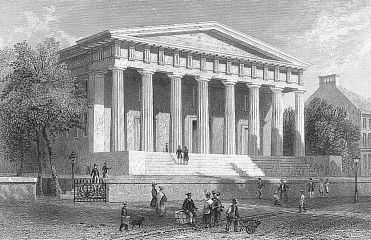
VIEW OF THE UNITED STATES BANK,
PHILADELPHIA.
This is one of those chaste and beautiful buildings which have given the public architecture of Philadelphia a superiority over that of every other city of our country. It needs but that its fair marble should be weather-fretted and stained, to express perfectly to the eye the model of one of the most graceful temples of antiquity. The severe simplicity of taste which breathes through this Greek model, however, is not adapted to private buildings; and in a certain kind of simplicity, or rather of want of ornament, lies the fault found by every eye in the domestic architecture of this city. The chess-board regularity of the streets, so embarrassing to a stranger, as well as tiresome to the gaze, require a more varied, if not a more ornate style. The hundreds of houses that resemble each other in every distinguishable particular, occasion a bewilderment and fatigue to the unaccustomed eye, which a citizen of Philadelphia can scarcely comprehend.
The uniformity and plainness which William Penn has bequeathed in such an abiding legacy to Philadelphia, however, is seen but by a faint penumbra in the dress of the inhabitants, or in their equipages, style of living, and costliness of furniture and entertainment. A faint shadow of original simplicity there still certainly exists, visible through all the departures from the spirit of Quakerism; and it is a leaven of taste and elegance in the ferment of luxury which has given Philadelphia emphatically a character for refinement. A more delightful temper and tone of society, a more enjoyable state of the exercise and mode of hospitality, or a more comfortable metropolis to live in, certainly does not exist this side the water. A European would prefer Philadelphia to every other residence in the United States.
Is it possible to realize, that, on the site of this refined capital, only a hundred and fifty years ago, lived a people in such strong contrast to the above, (save only in hospitality,) as are described by William Penn in the following terms!—
“The natives I shall consider in their persons, language, manners, religion, and government, with my sense of their original. For their persons, they are generally tall, straight, well-built, and of singular proportion; they tread strong and clever, and mostly walk with a lofty chin. Of complexion, black, but by design, as the gypsies in England: they grease themselves with bear’s fat, clarified; and using no defence against sun or weather, their skins must needs be swarthy. Their eye is little and black, not unlike a straight-looked Jew. The thick lip and flat nose, so frequent with the East Indians and Blacks, are not common to them; many of them have fine Roman noses.
“Their language is lofty, yet narrow; but like the Hebrew, in signification full. Like short-hand in writing, one word serveth in the place of three, and the rest are supplied by the understanding of the hearer; imperfect in their tenses, wanting in their moods, participles, adverbs, conjunctions, and interjections.
“Of their customs and manners there is much to be said: I will begin with children. So soon as they are born, they wash them in water; and while very young, and in cold weather, they plunge them in the rivers, to harden and embolden them. The children will go very young—at nine months, commonly: if boys, they go a fishing till ripe for the woods, which is about fifteen; then they hunt, and after having given some proofs of their manhood by a good return of skins, they may marry; else it is a shame to think of a wife. The girls stay with their mothers, and help to hoe the ground, plant corn, and carry burdens: and they do well to use them to that young, which they must do when they are old; for the wives are the true servants of the husbands, otherwise the men are very affectionate to them.
“When the young women are fit for marriage, they wear something upon their heads for an advertisement, but so as their faces are hardly to be seen but when they please. The age they marry at, if women, is about thirteen and fourteen; if men, seventeen and eighteen; they are rarely elder.
“Their houses are mats, or barks of trees, set on poles, in the fashion of an English barn, but out of the power of the winds, for they are hardly higher than a man: they lie on reeds, or grass. In travel, they lodge in the woods, about a great fire, with the mantle of duffils they wear by day wrapt about them, and a few boughs stuck round them.
“Their diet is maize, or Indian corn, divers ways prepared; sometimes roasted in the ashes; sometimes beaten and boiled with water, which they call homine; they also make cakes not unpleasant to eat. They have likewise several sorts of beans and peas that are good nourishment; and the woods and rivers are their larder.”
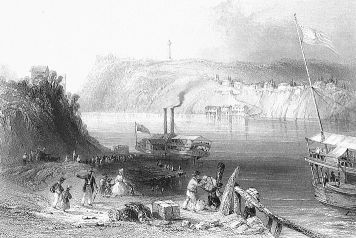
BROCK’S MONUMENT
FROM THE AMERICAN SIDE.
Lewiston is seldom seen to advantage by the traveller, who, in his eagerness to reach Niagara, if going thither, or in the fulness of his recollections, if returning, pays it very little attention. The village itself is as dull and indifferent-looking a place as one would chance to see; but it stands at the outlet of Niagara river into Lake Ontario, and its neighbourhood on all sides is picturesque and beautiful.
Across the river, on the heights of Queenstown, stands the Monument of General Brock, who died fighting very gallantly on this spot. A slight resumer of the hard-fought battle of Queenstown, which was creditable to the courage and spirit of both countries, will be in place accompanying this view.
The American forces on the Niagara river consisted of about five thousand eight hundred men, under the command of Colonel Van Rensselaer. Eighteen hundred of these were at Black Rock, twenty-eight miles distant, and the remainder at Fort Niagara, under the General’s personal command. Several skirmishes on the St. Lawrence had resulted in favour of the Americans, and the forces at Lewiston were very anxious to have an opportunity for action.
Directly opposite to the camp, on the other side of the river, lay Queenstown, strongly fortified, and garrisoned by a large force, waiting the orders of General Brock, then in Michigan. It was supposed that preparations were making for a general attack on the frontier. The possession of this place was considered very important to the Americans, as it was the port for all the merchandise of the country above, and a depôt of public stores for the line of English posts on Niagara and Detroit rivers. It has besides, an excellent harbour, and good anchorage.
An attack on Queenstown was projected for the night of the 11th of October. It failed, however, in consequence of a tremendous storm, and of the loss of a boat containing all the oars for the ferriage. Better arrangements were completed by the night of the 12th, and on the morning of the 13th, three hundred regular troops, and three hundred militia, were ready at dawn of day to cross to the attack.
The river here is one sheet of violent eddies, and the boating very difficult and laborious. A battery, mounting two eighteen-pounders and two sixes, protected the embarkation, and the boats put off. The enemy had been apprised of these preparations, and a brisk fire of musquetry immediately opened along the shore, on the Canada side, which, from the slow progress of the boats, did great execution. One of the boats was hit by a grape shot, which threw the pilot and oarsmen into such confusion, that they were carried down by the stream and obliged to return, and two others dropped below the landing, and fell into the hands of the enemy. Colonel Van Rensselaer, however, succeeded in landing with about a hundred men, under a tremendous fire, and immediately ascended the precipitous bank of the river. Before reaching the summit, he received four balls, and two of his officers were killed, and three wounded. Retiring under the shelter of the bank, Colonel Van Rensselaer had still sufficient strength to give the order for storming the fort; and about sixty men, commanded by Captain Ogilvie, seconded by Captain Wool, who was previously wounded, mounted the rocks on the right of the fort, gave three cheers, and with three desperate charges obtained entire possession; they then carried the heights, and spiked the cannon.
Reinforcements had by this time crossed the river, and the Americans formed on the heights, under the command of Colonel Christie. General Brock, who was on his way to Queenstown, having been met by an express, arrived with a reinforcement of regulars from Fort George, and immediately led his men into the rear of the captured battery. Captain Wool detached one hundred and sixty men to meet him, but the detachment was driven back. It was reinforced once more, and driven again to the brow of the precipice overhanging the river. An American officer at this time, despairing of the attempt, was about raising a white handkerchief on a bayonet, when Captain Wool tore it off, and ordered the men once more to charge. At this moment, Colonel Christie came up with a reinforcement, and repeating Captain Wool’s orders, the American force, amounting then to about three hundred, pushed forward and entirely routed the British 49th, who were aided by the 41st, and who had hitherto been called the Egyptian Invincibles. General Brock was attempting to rally these two regiments, when he received three balls, and died almost immediately.