LIST OF MAPS (continued 5)
Reading edition
General Grant's success was in no small measure due to his dogged perseverance. While his army was laying siege to Vicksburg a Confederate woman, at whose door he stopped to ask a drink of water, inquired whether he expected ever to capture Vicksburg. "Certainly," he replied. "But when?" was her next question. Quickly came the answer: "I cannot tell exactly when I shall take the town, but I mean to stay here till I do, if it takes me thirty years."
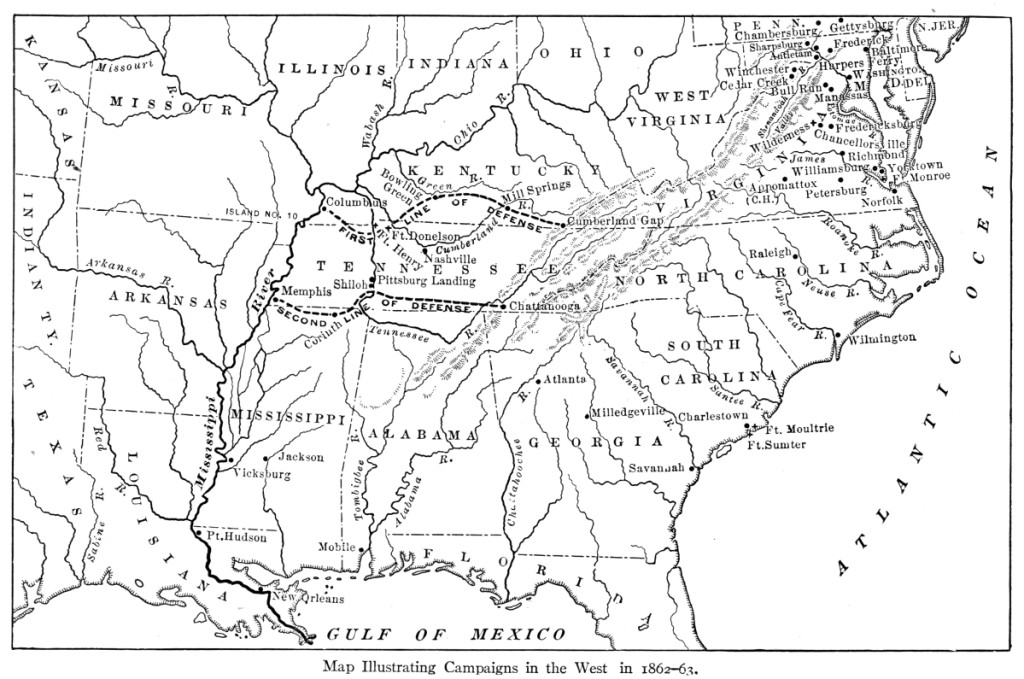
Map Illustrating Campaigns in the West in 1862-63.
General Grant having by his effective campaign won the confidence of the people, President Lincoln in 1864 made him lieutenant-general, thus placing him in command of all the Northern forces. In presenting the new commission, Lincoln addressed General Grant in these words: "As the country herein trusts you, so, under God, it will sustain you." General Grant made answer: "I feel the full weight of the responsibilities now devolving upon me; and I know that if they are met, it will be due to those armies, and above all, to the favor of that Providence which leads both nations and men."
Early in May, 1864, Grant entered upon his final campaign in Virginia, and while he marched with his army "On to Richmond," General Sherman, in Georgia, pushed with his army "On to Atlanta" and "On to the sea." Both generals were able, and both had able opponents. Grant crossed the Rapidan and entered the Wilderness, where Lee's army contested every foot of his advance. In the terrible fighting that followed Grant's losses were severe, but, with "bull-dog grit," to use Lincoln's phrase, he pressed on, writing to the President his stubborn resolve, "I propose to fight it out on this line if it takes all summer."
It did take all summer and more, for Grant found it impossible to capture Richmond by attacking it from the northern side. He therefore transferred his army across the James River, and attacked the city from the south; but at the end of the summer Lee still held out.
Nor did Lee relinquish his position until April 2, 1865, when he was compelled to retreat toward the west. Grant pursued him closely for a week, during which Lee's troops suffered great privation, living mainly on parched corn and the young shoots of trees. Aware that the Southern cause was hopeless, the distinguished leader of the Confederate armies, after a most brilliant retreat, decided that the time had come to give up the struggle.
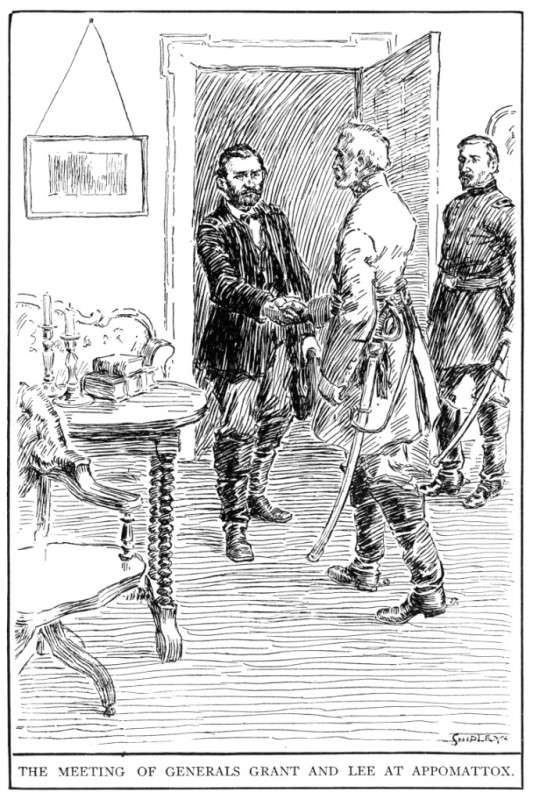
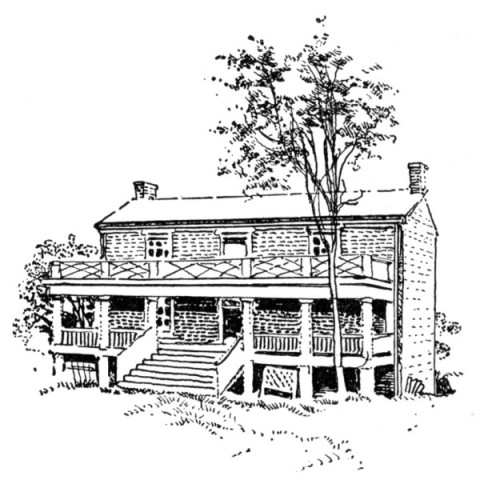
While suffering from a severe sick headache, General Grant received a note from Lee saying that the latter was now willing to consider terms of surrender. It was a remarkable occasion when the two eminent generals met on that Sunday morning, in what is known as the McLean house, standing in the little village of Appomattox Court House. Grant writes in his "Personal Memoirs": "I was without a sword, as I usually was when on horseback on the field, and wore a soldier's blouse for a coat, with the shoulder-straps of my rank to indicate to the army who I was.... General Lee was dressed in a full uniform which was entirely new, and was wearing a sword of considerable value—very likely the sword which had been presented by the State of Virginia.... In my rough travelling suit, the uniform of a private with the straps of a lieutenant-general, I must have contrasted very strangely with a man so handsomely dressed, six feet high and of faultless form.
THE MEETING OF GENERALS GRANT AND LEE AT APPOMATTOX.
The McLean House
The result of the interview was the surrender of General Lee with his entire army of 26,000 men. General Grant at this time gave striking evidence of his great kindness of heart and fine delicacy of feeling. He issued orders that all the Confederates who owned horses and mules should be allowed to take them home. "They will need them for the spring ploughing," he said. He spared the vanquished troops the humiliation of marching out and stacking their arms in token of surrender, and even stopped the firing of salutes by his men. Never, indeed, did General Grant appear more truly great than on the occasion of Lee's surrender. Thus ended the military career of the greatest general that the North produced during the Civil War.
While in the army he seemed to have marvellous powers of endurance. He said of himself: "Whether I slept on the ground or in a tent, whether I slept one hour or ten in the twenty-four, whether I had one meal, or three or none, made no difference. I could lie down and sleep in the rain without caring."
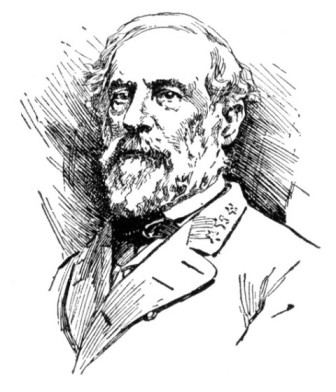
General R. E. Lee.
His appearance did not indicate his robust health. He was only five feet eight inches tall, round-shouldered, and not military in bearing or walk. He had brown hair, blue eyes, and a musical voice. He was of a sunny disposition and singularly pure soul, never having been known in all his life to speak an unclean word or tell an objectionable story. Quiet and simple in manner, he never became excited even in the heat of battle, but always kept himself cool and collected, ready for the severest ordeal that he might have to face.
It need hardly be said that at the close of the war he had a warm place in the hearts of his countrymen. Wherever he went people flocked to see him. But like Washington and Jefferson, he found speech-making most difficult. At one time, in the presence of friends, General Grant's young son Jesse, mounted a haystack and said, "I'll show you how papa makes a speech. 'Ladies and Gentlemen, I am very glad to see you: I thank you very much. Good-night.'" All present were greatly amused except Grant, who was much embarrassed, feeling that his little son's effort verged too closely upon the truth.
Grant was elected President of the United States in 1868, and served two terms. Upon retiring from the Presidency he made a tour around the world, and was everywhere received by rulers and people alike with great honor and distinction.
During his last days he suffered much from an incurable disease, which became a worse enemy than he had ever found on the field of battle. After nine months' of struggle he died at Mount McGregor, near Saratoga, on July 23, 1885. His body was laid to rest in Riverside Park, on the Hudson, where in 1897 a magnificent monument was erected to his memory. Like Lincoln and Washington, he will ever live in the hearts of his countrymen.
REVIEW OUTLINE
Young Ulysses S. Grant fond of farm work. An instance of his "bull-dog grit." Grant goes to West Point. His bravery in the Mexican War. He tries farming and business. The beginning of the Civil War. The battle of Pittsburg Landing. General Grant captures Vicksburg. General Lee's surrender. General Grant's kindness and delicacy of feeling. His personality. His tour around the world; his last days.
TO THE PUPIL
1. Tell as much as you can about the boyhood of Grant.
2. What can you say of his record in the Mexican War?
3. Give an account of his capture of Vicksburg.
4. Picture the scene of the interview which took place when Lee surrendered.
5. What can you tell about Grant's personality? About his ability as a speech-maker?
6. What traits in Grant's character do you admire?
CHAPTER XXVI Some Leaders and Heroes in the War with Spain in 1676
[1898-1899]
Thus far we have directed our attention to the prominent events in American history centring about certain leaders and heroes. In so doing we have in every chapter given emphasis to the achievements of some one man. But in all these cases there were many other men that received no mention by name, and yet their co-operation was necessary to the success of the leader in working out his plans.
This is no doubt true of all times and countries, but it is eminently true of our own country, whose history is full of striking instances of individual heroism and devotion to the flag. We shall find no better example of patriotic daring than in the late war with Spain—a war which exhibited to us and to the world the strong and manly qualities of American life and character. It seems fitting, therefore, that we should in this closing chapter briefly consider a few of the recent events that help us to understand what manner of people we have come to be, and what we are able to accomplish in time of earnest endeavor.
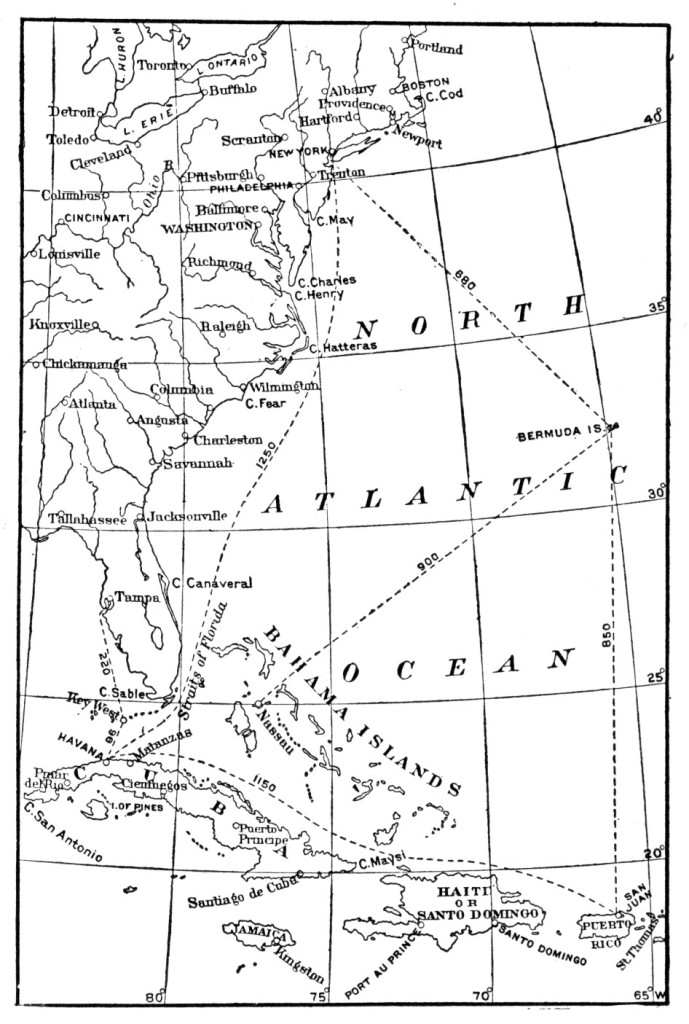
The United States Coast and the West Indies.
Distances are given in geographical or sea miles, sixty miles in a degree of latitude.
From the very beginning of her dominion in Cuba, Spain ruled the people there with extreme cruelty and oppression. Again and again did the Cubans, driven to desperation by unjust treatment, rise in rebellion, without success. But in 1895 they organized an uprising that Spain strove in vain to put down. In the last extremity of her power, she sent over as governor-general a man who tried to starve the Cubans into submission. A large part of the population lived in the country, and furnished the Cuban troops with food and recruits. The Spanish commander's brutal method was to drive these country people into the towns and cities, burning their homes, and destroying everything that might be of use to feed and support the fighting Cubans. But the Cubans were determined to win their independence or die in the attempt.
The Wreck of the Maine.
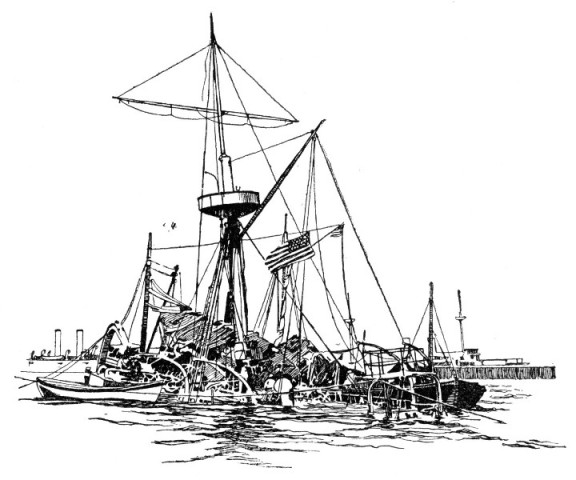
As the war continued, and this inhuman policy of starvation grew more brutal, the horror and indignation of the United States were aroused. Our Government tried to induce Spain to stop her barbarous methods, but while the attempt was still in progress an event took place which greatly embittered the feeling of Americans against Spain. On the night of February 15, 1898, one of our battle-ships, the Maine, was blown up in the harbor of Havana, and 266 of our sailors were killed. Many believed that this awful deed was the work of Spanish officials; and this conviction deepened when a careful investigation was made by a court of naval inquiry. In all parts of this country the excitement of the people increased until they were ready to go to war with Spain if she would not change her policy toward Cuba.
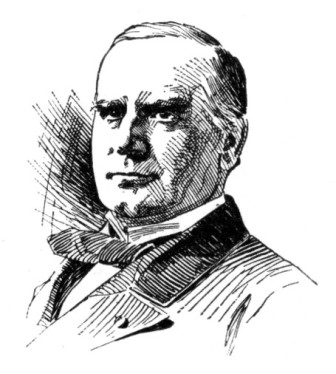
But Spain was so stubborn that President McKinley, after trying in every possible way to prevent hostilities, was obliged to say in a message that "the war in Cuba must stop"; and on April 25, 1898, Congress took the momentous step of declaring war.
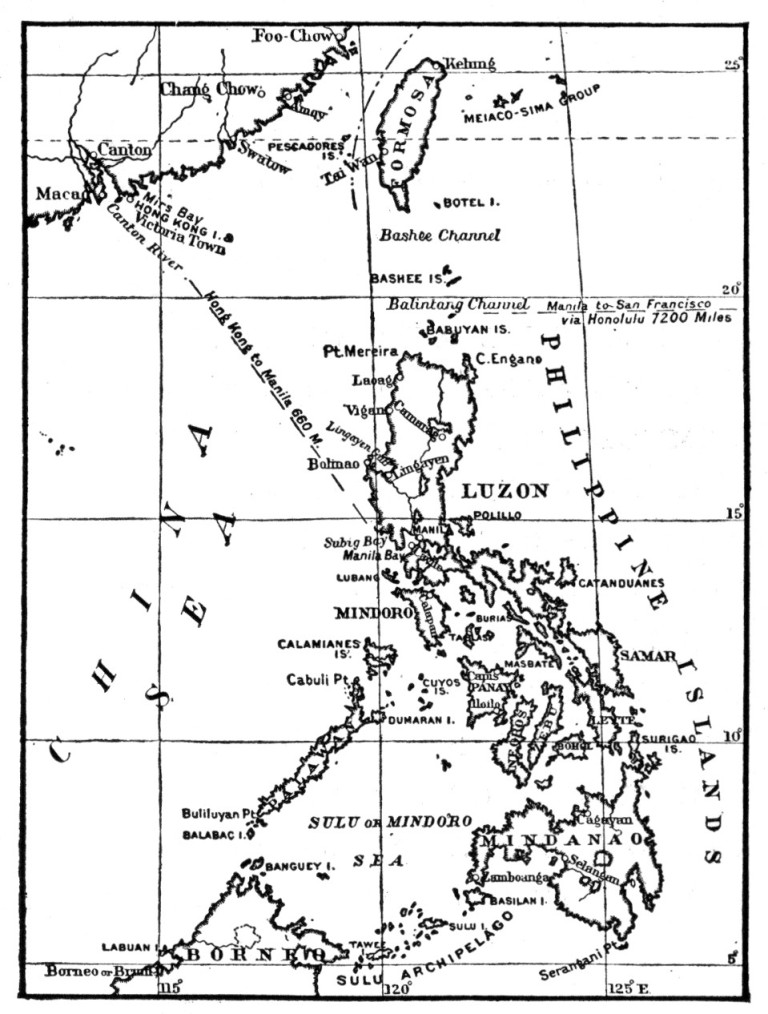
Our Secretary of the Navy, Mr. Long, lost no time in sending a despatch to Commodore Dewey,—who was in command of an American fleet of six war-vessels at Hong-Kong,—directing him to proceed at once to the Philippine Islands and capture or destroy the Spanish fleet stationed there.
Admiral Dewey.
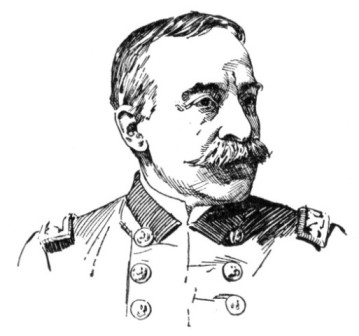
Two days later Commodore Dewey's fleet was steaming southward toward Manila Bay, in search of the Spanish squadron of ten war-vessels and two torpedo-boats. It was extremely important that these ships of war should be captured or destroyed before they could make their way to our Pacific coast and attack American cities.
On the night preceding May 1st our fleet entered Manila Bay. The supreme moment in the life of Commodore Dewey, now in his sixty-second year, had come. He was 7,000 miles from home and in hostile waters. Without even a pilot to guide his fleet as it moved slowly but boldly into the bay, he knew well that he might be going into a death-trap. Two torpedoes exploded just in front of the flag-ship Olympia, which was in the lead, but the fearless commander did not swerve from his course.
Drawn up at the entrance of Bakor Bay, not far from Manila, was the Spanish fleet, protected on either side by strong shore batteries. When about three miles distant Commodore Dewey quietly said to the captain of the Olympia, "If you are ready, Gridley, you may fire." Spanish shells had already filled the air all about the American fleet, but as the Spanish gunnery was exceedingly poor it did little serious damage. During the battle the American fleet steamed forward in single file, the Olympia in the lead. After going for some distance toward Manila the ships swung round and returned, firing terrible broadsides into the Spanish fleet as they passed. Five times they followed the course in this way, each time drawing nearer to the enemy's position, and each time pouring in a more furious and deadly fire.
President McKinley
At seven o'clock the Spanish flagship dashed boldly out, as if with the purpose of running down the Olympia. But the American war-vessels concentrated their fire upon her so that she had to turn back. As she was swinging around, the Olympia hurled a shell which raked her deck, killing or wounding her captain and sixty of her sailors. About this time two Spanish torpedo-boats darted out toward the American fleet, and one of them, with the evident purpose of blowing her up, headed for the Olympia. But a well-aimed shell exploded upon the deck of the torpedo-boat, and sank it to the bottom of the sea.
At the end of two hours, it being plain that the Spanish fleet was nearly done for, Commodore Dewey decided to give his tired men a rest. He therefore withdrew his fleet from the scene of battle, and gave his brave sailors some breakfast. Three hours later he renewed the fight, which ended with the destruction of the entire Spanish fleet. Although 1,200 Spaniards were killed or wounded, not one American was killed and only eight were wounded. None of Dewey's war-vessels received serious injury. The battle was a brilliant exhibition of superb training and seamanship on the part of the American sailors, whose rapid and accurate handling of the guns was marvellous.
The people were electrified with joy when the news of the glorious achievement in Manila Bay was cabled to America. On May 9th, Congress voted that ten thousand dollars ($10,000) should be spent in securing a sword for Commodore Dewey and medals for all his men, and President McKinley promptly appointed him a rear-admiral. Before the middle of August an army of 15,000 troops, under General Merritt, was sent to Manila to unite with the fleet under Admiral Dewey in capturing the city. Manila surrendered on August 13th.
With the destruction of the Spanish fleet at Manila, within a week after Congress declared war, all danger of attack from Spanish war-vessels upon our Pacific coast was at an end. But there was grave fear that the Spanish fleet under Admiral Cervera might attack the large and wealthy cities upon our Atlantic coast. Shortly after the war began, this fleet was reported to have left the Cape Verde Islands and to have directed its course toward Cuban waters.
"Escolta," Manila's Main Street.
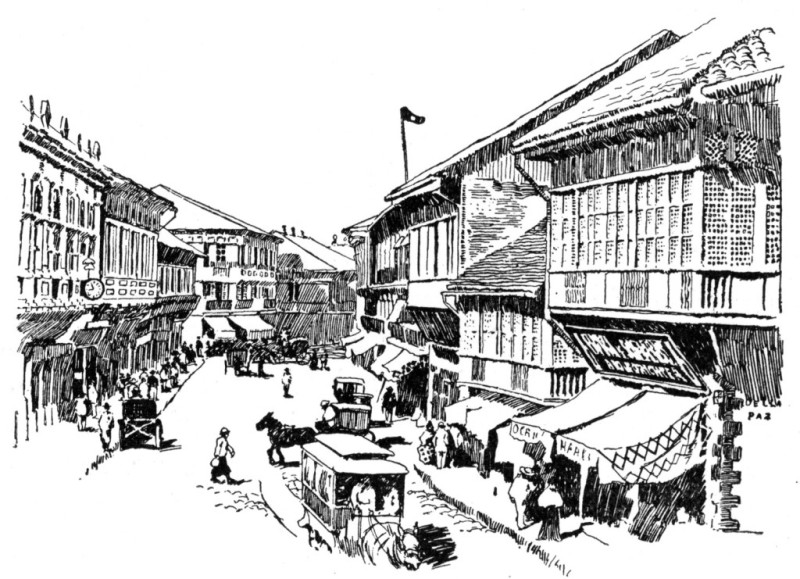
At once Americans began to put serious questions which nobody could answer. "Where is Cervera going?" they asked. "Will he try to break the blockade which an American fleet under Admiral Sampson is keeping up on the northern coast of Cuba? Will he try to intercept and destroy the battle-ship Oregon?[12] Or, will he bring havoc and destruction upon us by sailing straight for some great Atlantic seaport?" Americans looked anxious and worried as they considered these questions.
But the uncertainty did not long continue, for soon it was learned by cable that Cervera had stopped at Martinique, and later at a small island off the coast of Venezuela, whence he had speedily steamed northward toward Cuba. We now know that he went to Santiago harbor, which he thought would prove a good hiding-place while his fleet took on board coal and other supplies. Shortly after Cervera's arrival at Santiago an American fleet under Commodore Schley discovered him, and blockaded the harbor in order to prevent his escape. It was extremely important to keep him "bottled up" there until an American army might come down and capture Santiago and the Spanish army which held the place. This capture accomplished, Cervera would have to fight either in the harbor or out on the open sea. But there was still some anxiety lest he might on some dark, stormy night manage to steal out and make his escape.
One reason why Cervera went into the Santiago harbor was that the entrance was very narrow and well protected by headlands surmounted by batteries. At its narrowest place, the channel was not much more than a hundred yards wide. If, therefore, the American war-vessels should attempt to enter the harbor they would have to enter in single file, and the foremost one would possibly be blown up by the Spanish torpedoes, many of which were planted in the channel. The sinking of a single vessel in the channel would block the way for all the rest.
With these facts in mind Admiral Sampson planned to obstruct the entrance to Santiago harbor to prevent the Spanish fleet from getting out. Lieutenant Hobson, a young man of twenty-eight, worked out the plan of sinking the collier Merrimac across the channel; and to him the important task of carrying it out was assigned. Torpedoes were so arranged on the sides of the Merrimac that their explosion would shatter her bottom and sink her in the channel.
There was serious difficulty in selecting the small number of brave, cool-headed men who were to accompany Lieutenant Hobson in this perilous enterprise, for several hundred American sailors were eager to go, even though they knew that in so doing they were running serious risk of capture or death. But such was the heroic temper of the American sailors that many of them begged for an opportunity of rendering this loyal service.
On the night appointed for the daring feat, the Merrimac did not get well started before the morning light began to appear in the eastern sky, so that Admiral Sampson recalled the expedition.
After a long, nervous day of waiting, the next morning, June 3d, the Merrimac started off a second time. The vessel moved stealthily forward with its eager, silent crew, but before the place of sinking could be reached the Spaniards discovered her. Suddenly from the forts and the war-vessels in the harbor a storm of shot and shell beat in pitiless fury about the Merrimac. But she pressed forward. When the moment came for her to be swung across the channel Hobson found that the rudder of the ship had been shot away, so that she could not be swung about according to the plan. He therefore had to be content with sinking her along instead of across the channel.
When the torpedoes exploded and she went down, her crew of eight men, struggling for life in the seething waters, managed to reach a float which they had brought with them on the deck of the collier. To this float they clung, hanging on with their hands, for they dared not expose their bodies as targets to Spanish soldiers on land or to Spanish sailors in the launches that were trying to find out what had happened. For some hours Hobson and his men remained in this uncomfortable position, shivering with the cold. At length Hobson hailed an approaching launch to which he swam. He was pulled in by an elderly man, with the exclamation, "You are brave fellows." This was Admiral Cervera, who treated the prisoners, Lieutenant Hobson and his crew, with great kindness. With the rest of the world he admired the courageous spirit of the "brave fellows" who had given so much in the service of their country.
During the remainder of June, the American fleet kept watch at the harbor entrance. Before the end of the month an American army of 15,000 men was ready to advance through a tropical forest upon the Spanish defences outside of Santiago. On July 1st the Americans made a vigorous attack upon these outworks, and won a glorious victory.
It looked to Cervera as if he might be compelled to surrender his fleet without striking a blow. Although he was likely to suffer defeat in a battle, there was nothing to gain by remaining in the harbor. So he decided to dash boldly out, in a desperate effort to escape. When at about half-past nine of that quiet Sunday morning (July 3d) the foremost Spanish war-vessel was seen heading at full speed out of the harbor, the American sailors sent up a shout, "The Spanish fleet is coming out!" and leaped forward to their places at the guns. As at Manila, the battle was one-sided. The superior seamanship and gunnery of the Americans enabled them quickly to win a victory as brilliant as that won by Dewey and his men. Every Spanish vessel was destroyed, 600 Spaniards were killed, and 1,300 captured. Not one American ship was seriously injured, while but one American was killed and one badly wounded. About the middle of July Santiago and a Spanish army of 22,000 men surrendered to the Americans.
Although this ended the serious fighting of the war, the treaty of peace was not ratified by the United States Senate until February 6, 1899. In accordance with this treaty Spain gave up Cuba and ceded Porto Rico to the United States; and she also ceded to us the Philippine Islands, in return for which we agreed to pay her $20,000,000.
But some of the most striking results of the war with Spain received no mention in the terms of the treaty. From the beginning of the struggle, Spain doubtless hoped that one or more of the Great Powers of Europe might intervene in her behalf. Some of them, with ill-concealed dislike for the United States, were quite ready to interfere in Spain's interests. But England refused to take any part in the movement. Her friendly attitude toward us in this struggle has done much to bring the two countries into closer sympathy with each other. A reflection of this good-will toward England was especially evident at the time of Queen Victoria's death in January, 1901.
Portion of the Coast of China and the Philippine Islands.
But, after all, one of the most striking results of the war with Spain has been the bringing of the various sections of our own country into closer sympathy and union. It is safe to say that never before have the North, the South, the East, and the West felt so closely bound together in thought and feeling. Let us hope that with noble ideals of the high destiny that awaits us, we shall go forward to greater achievements than we have yet known in our history.
REVIEW OUTLINE
Spain's cruel rule in Cuba. The blowing up of the battle-ship Maine. Commodore Dewey heads his fleet for the Philippines. The dangerous enterprise. The glorious victory. Serious Questions About Admiral Cervera's Plans. His fleet "bottled Up." The daring feat of Lieutenant Hobson and his men. The destruction of Cervera's fleet. The treaty of peace. Friendly relations between our country and England. Closer sympathy and union of the North, the South, The East, and the West.
TO THE PUPIL
1. What is a hero? Whom do you most admire of all the heroes you have read about in this book?
2. Why did Commodore Dewey go with his fleet to the Philippines?
3. Imagine yourself with him, and give an account of the battle.
4. What did Lieutenant Hobson and his men do? Impersonating Hobson, give an account of the daring feat.
5. What caused the war with Spain? What were its most striking results?
6. What do you admire in the character of Admiral Dewey? What, in the American sailors in the war with Spain?
7. What do the following dates signify: 1492, 1607, 1620, 1775-1783, 1861-1865, 1898?