LIST OF MAPS (continued 3)
Reading edition
At length Patrick Henry arose, his face pale and his voice trembling with deep emotion. Soon his stooping figure became erect. His eyes flashed fire. His voice rang out like a trumpet. As he continued, men leaned forward in breathless interest, thrilled by his magical words:
"We must fight! I repeat it, sir, we must fight! An appeal to arms and to the God of Hosts is all that is left us! They tell us, sir, that we are weak; unable to cope with so formidable an adversary. But when shall we be stronger? Will it be the next week, or the next year? Will it be when we are totally disarmed, and when a British guard shall be stationed in every house? Shall we gather strength by irresolution and inaction? Shall we acquire the means of effectual resistance by lying supinely on our backs and hugging the delusive phantom of hope, until our enemies shall have bound us hand and foot? Sir, we are not weak, if we make a proper use of the means which the God of nature hath placed in our power.... There is no retreat, but in submission and slavery! Our chains are forged! Their clanking may be heard on the plains of Boston! The war is inevitable—and let it come! I repeat it, sir, let it come!
"It is in vain, sir, to extenuate the matter. Gentlemen may cry peace, peace—but there is no peace. The war is actually begun! The next gale that sweeps from the North will bring to our ears the clash of resounding arms! Our brethren are already in the field! Why stand we here idle? What is it that gentlemen wish? What would they have? Is life so dear, or peace so sweet, as to be purchased at the price of chains and slavery? Forbid it, Almighty God! I know not what course others may take; but as for me, give me liberty, or give me death!"
This wonderful speech made a deep impression not only in Virginia but throughout the colonies. The next month the war began at Lexington and Concord. A little later Patrick Henry was made commander-in-chief of the Virginia forces, and later still was elected Governor of Virginia.
At the age of fifty-eight he retired to an estate in Charlotte County, called "Red Hill," where he lived a simple and beautiful life. He died in 1799. His influence in arousing the people of Virginia and of the other colonies to a sense of their rights as freemen cannot easily be measured. Without doubt his impassioned oratory played a most important part in shaping the course of events which resulted in the Revolutionary War.
REVIEW OUTLINE
The American Revolution. George the Third's plan to tax the colonies in support of a standing army. The Stamp Act. The colonists object to the Stamp Act; "No taxation without representation." George the Third's desire for personal power. Fondness of Patrick Henry for out-door sports. He fails as a storekeeper. Patrick Henry as a lawyer. His personal appearance. His great speech opposing the Stamp Act. English opposition to taxing the Americans without their consent. Repeal of the Stamp Act. Patrick Henry's defiant speech in St. John's Church. His influence and later life.
TO THE PUPIL
1. What was the Stamp Act and what was its purpose? Why did the colonists object to it?
2. Describe George the Third. What did his mother mean when she said to him, "George, be King"?
3. What was his personal appearance when he went to Williamsburg to attend the session of the House of Burgesses?
4. How did William Pitt feel about American taxation?
5. Can you form a mental picture of Patrick Henry as he made his great speech in St. John's Church? Do you not think it would be profitable for you to memorize this speech? At any rate, you might well learn to read it so as to bring out its meaning.
Samuel Adams.
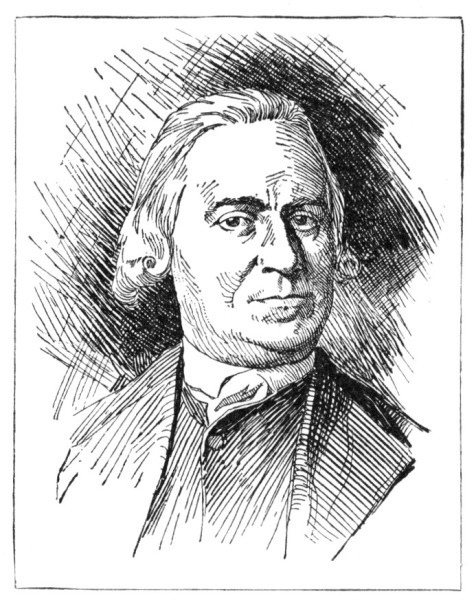
CHAPTER XIII Samuel Adams and the Boston Tea Party
[1722-1803]
We have just seen how the people of Virginia, under the leadership of Patrick Henry, arose against King George's pet measure, the Stamp Act. But the Virginians were not alone in the feeling of opposition to the English King. Just as brave and liberty-loving were the Massachusetts people, with Samuel Adams as their leader.
He was born in Boston in 1722. His father was a well-to-do man, who filled a large place in the community. Of Samuel Adams's boyhood we know little, but as far as we can learn he was a studious, in-door sort of lad, with little fondness for sport of any kind. His father wished him to be a clergyman, but he preferred to study law. Since, however, his mother did not approve, he gave that up for a business life, eventually joining his father in the malt business.
When the excitement over the Stamp Act began, Samuel Adams was forty-two years old. He was of medium size, with gray hair and keen gray eyes. Although his hands were tremulous, as if with age, his health was vigorous. Like Patrick Henry, he had but little aptitude for business. So we need not be surprised to learn that in time he lost about all the property his father had left him.
In fact, Samuel Adams soon gave up all kinds of private business, devoting his time and strength to public life. As a result he and his family had to live on the very small salary which he received as clerk of the Assembly of Massachusetts. Poor as he was, however, no man could be more upright. The British tried to buy him, but found him the very soul of honor. In what way he gave expression to his interest in the public welfare can be briefly told.
As we have already seen, King George, much against his will, had to submit to the repeal of the Stamp Act by Parliament. But he was not satisfied. He could never carry out his selfish scheme of personal government in England and in America if he allowed the stubborn colonists to have their way in this matter.
In 1767, therefore, through his tool, Townshend, Parliament levied new port duties on a few articles, including glass, lead, paper, and tea. These new taxes were hateful to the colonists because they were levied by Parliament, and because the money thus raised was to be used to their disadvantage in various ways: For example, some of it was to pay for maintaining in America a small English army. This army, the colonists believed, the King would use to compel them to do as he willed.
The opposition to the new taxes was just as bitter as it had been against the Stamp Act. Samuel Adams felt that only slaves would submit to such high-handed oppression. He urged the people of Boston and Massachusetts to join in refusing to import any goods from England as long as the new taxes were imposed by Parliament. They did so agree, and thus inflicted great injury upon English merchants, as they had done two or three years before.
Of course these merchants suffered heavy losses, and again begged for a repeal. But the dull-witted King could not understand the Americans. Thus far he had not been able to coerce them; he now made a shrewd attempt to outwit them.
Influenced by him, Parliament took off all the new taxes except the one on tea. "There must be one tax to keep the right to tax," he said. If he could only succeed in getting the Americans to submit to paying any tax—no matter how small—that Parliament might levy, he would carry his point. He therefore urged not only the removal of all taxes except the one on tea, but also made arrangements whereby Americans could buy their taxed tea cheaper than it could be bought in England and cheaper even than they could smuggle it from Holland, as they had been doing. No doubt the King had great faith in this foolish scheme. "Of course," he argued, "the Americans will buy their tea where they can buy it cheapest, and then we will have them in a trap." But this was a huge blunder, as we shall now see.
The East India Company arranged to ship cargoes of tea to Boston, New York, Philadelphia, and Charleston. When the tea arrived, the people in New York and Philadelphia refused to let it land, and in Charleston they stored it in damp cellars, where it spoiled. But in Boston, where the Tory Governor, Hutchinson, was determined to fight a hard battle for the King, there was a most exciting time. The result was the famous "Boston Tea Party."
It was a quiet Sunday morning, on the 28th of November, 1773, when the Darmouth, one of the three tea-ships on the way to Boston, sailed into the harbor.[10] The people were attending service in the various churches. "The Darmouth is in!" spread like wildfire, and soon the streets were astir with people, Sunday though it was, in old Puritan Boston.
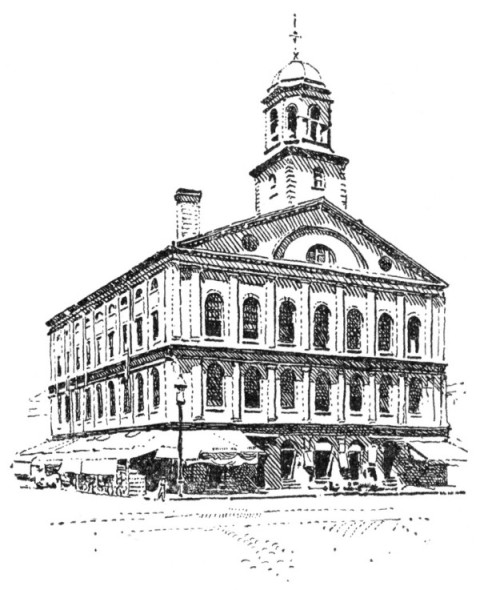
Fearing that the tea might be landed, the committee of correspondence quickly got together and secured a promise from Benjamin Rotch, the owner of the Darmouth, that the tea should not be landed before Tuesday. On Monday morning an immense town meeting was held in Faneuil Hall, the "Cradle of Liberty." Five thousand men were present. But Faneuil Hall proving too small, the crowd had to make its way to the Old South Church. In addressing the meeting Samuel Adams asked, "Is it the firm resolution of this body that the tea shall not only he sent back, but that no duty shall be paid thereon?" With a great shout the men answered "Yes."
Faneuil Hall, Boston.
Samuel Adams and the people of Boston and the surrounding towns were determined that the tea should not be landed. Governor Hutchinson was equally determined that it should be. The advantage was with the Governor, for according to law the vessels could not return to England with the tea unless they got a clearance from the collector of customs or a pass from himself.
But neither the collector of customs nor Governor Hutchinson would yield an inch. For nineteen days the struggle continued, growing daily more bitter. With a stubborn purpose to prevent the landing of the tea even if they had to fight, the Boston people appointed men, armed with muskets and bayonets, some to watch the tea-ships by day and some by night. Six couriers were to be ready to mount their horses, which they kept saddled and bridled, and speed into the country to give the alarm to the people. Sentinels were stationed in the church-belfries to ring the bells, and beacon-fires were ready to be lighted on the surrounding hilltops.
The Old South Church, Boston.
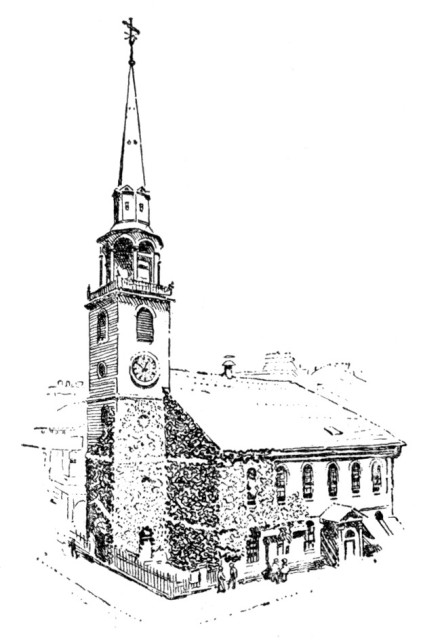
The morning of December 16th had come. If the tea should remain in the harbor until the morrow—the twentieth day—the revenue officer would be empowered by law to land it by force. Men, talking angrily and shaking their fists with excitement, were thronging into the streets of Boston from surrounding towns. By ten o'clock over 7,000 had assembled in the Old South Church and in the streets outside.
They were waiting for the coming of Benjamin Rotch, who had gone to see if the collector would give him a clearance. Rotch came in and told the angry crowd that the collector refused to give the clearance. The people told him that he must get a pass from the Governor. Fearing for his personal safety, the poor man started out to find Governor Hutchinson who had purposely retired to his country home at Milton. Then the meeting adjourned for the morning.
At three o'clock a great throng of eager men again crowded into the Old South Church and the streets outside to wait for the return of Rotch. It was a critical moment. "If the Governor refuses to give the pass, shall the revenue officer be allowed to seize the tea and land it to-morrow morning?" Many anxious faces showed that men were asking themselves this momentous question.
But while, in deep suspense, the meeting waited and deliberated, John Rowe said, "Who knows how tea will mingle with salt water?" A whirlwind of applause swept through the assembly and the masses outside the church. As daylight deepened into darkness, candles were lighted. Shortly after six Benjamin Rotch entered the church and, with pale face, said, "The Governor refuses to give a pass." An angry murmur arose, but the crowd soon became silent, when Samuel Adams arose and said, "This meeting can do nothing more to save the country."
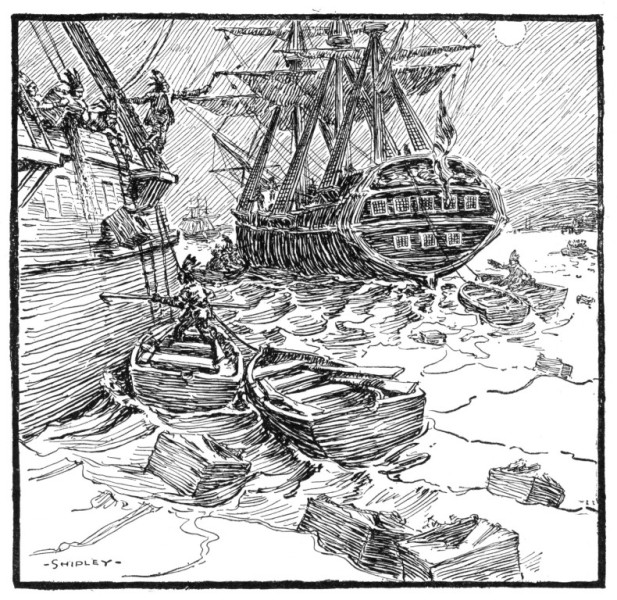
This was plainly a concerted signal. In an instant a war-whoop sounded, and forty or fifty "Mohawks," or men dressed as Indians, who were waiting outside, dashed past the door and down Milk Street toward Griffin's Wharf, where the tea-ships were lying at anchor. It was bright moonlight, and everything could be plainly seen. Many men stood on shore and watched the "Mohawks" as they broke open 342 chests, and poured the tea into the harbor. There was no confusion. All was done in perfect order.
The "Boston Tea Party," of which Samuel Adams was the prime mover, was a long step toward the Revolution. Samuel Adams was at this time almost or quite alone in his desire for Independence, and he has well been called the "Father of the Revolution." But his influence for the good of America continued far beyond the time of the "Boston Tea Party." Up to the last his patriotism was earnest and sincere. He died in 1803, at the age of eighty-one years. Not as an orator, like Patrick Henry, but as a man of action, like Lincoln and Washington, had he a powerful influence over men. His was truly a life of distinguished service to his country.
The "Boston Tea Party."
REVIEW OUTLINE
The feeling of Massachusetts people. Samuel Adams in business and in public life. A man to be trusted. King George's new scheme of taxation. Bitter opposition to the new taxes. The King's shrewd attempt to outwit the Americans. Taxed tea arrives in America. A huge town meeting. A Bitter Struggle with Governor Hutchinson over the Tea. Over 7,000 excited men in the Old South Church. The Governor refuses to give Rotch a pass. The "Mohawks" and the "Tea Party"; Admiral Montague. Samuel Adams the "Father of the Revolution."
TO THE PUPIL
1. What were King George's new taxes? What was their three-fold purpose?
2. Why were all the taxes repealed except the one on tea? In what way did the King try to entrap the Americans?
3. Tell about the bitter struggle over landing the tea.
4. Can you form mental pictures of the following: The throng of excited men in and about the Old South Church, awaiting the return of Benjamin Rotch; and the party of "Mohawks" on their way down Milk Street to the harbor?
5. What was the great work of Samuel Adams? What do you admire in his character? Compare him with Patrick Henry. Have you definite pictures of the personal appearance of these men?
Paul Revere.
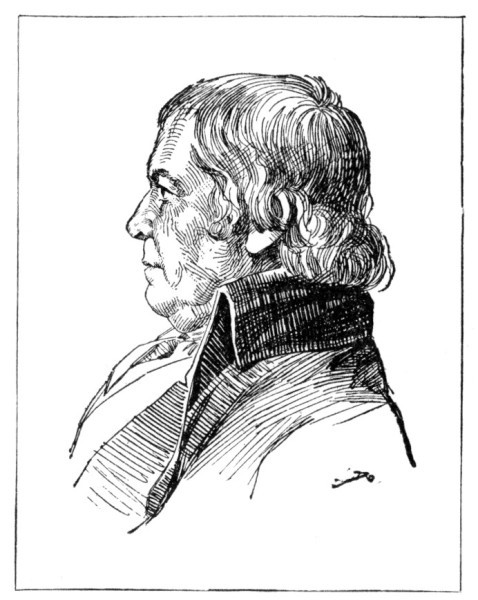
CHAPTER XIV Paul Revere and the Battle of Concord and Lexington
[1735-1818]
After the "Boston Tea Party," affairs became more serious than ever in Massachusetts. As a punishment to the rebellious colonists for daring to oppose their royal master, the English authorities closed the port of Boston to all trade, and made General Gage military governor of Massachusetts.
One of the first acts of the new Governor was to dismiss the Colonial Assembly, thus depriving the people of their right to make laws, and subjecting them wholly to the will of the King. The colonists felt this to be an outrage upon free government, and immediately organized a new governing body which they called a Provincial Congress. With John Hancock as its president and Samuel Adams as its leading spirit, this congress began at once to make rapid preparations for war. It called for an army of 20,000 men who were to be ready, at a minute's notice, to march to any point of danger. These first soldiers of the Revolution, thus hastily mustered, were called "minute-men."
Meanwhile General Gage, who was in command of 3,000 British troops in Boston, had received orders from England to seize John Hancock and Samuel Adams as traitors. General Gage knew that Hancock and Adams were staying for a while with a friend in Lexington. He had learned also through his spies that the minute-men had collected some cannon and military stores in Concord, eighteen miles from Boston. The British General planned, therefore, to send a body of troops to arrest the two leaders at Lexington, and then to push on and destroy the stores at Concord.
Although he acted with the greatest secrecy, he was not alert enough to keep his plans from the watchful minute-men. Gage's failure was brought about by one of these minute-men, Paul Revere, whose famous "midnight ride" was one of the exciting episodes of the Revolution.
Paul Revere was born in Boston, in 1735, in what is now called the north end of the town. He followed his father's trade, and became a goldsmith. To this occupation he added copper-plate engraving, and not only produced prints of many current events, but engraved plates for money issued by the Provincial Congress of Massachusetts.
He had taken an active part in the "Boston Tea Party," and in 1774, with about thirty other young patriots, formed a society to spy out the British plans. Always on the watch, these young men at once made known any suspicious movement to such leaders as Samuel Adams, John Hancock, and Dr. Joseph Warren.
On the evening of April 18, 1775, Revere and his friends reported to Dr. Warren certain unusual movements of troops and boats, and their belief that General Gage was about to carry out his plan of capturing Adams and Hancock and of destroying the military stores at Concord.
Paul Revere's Ride.
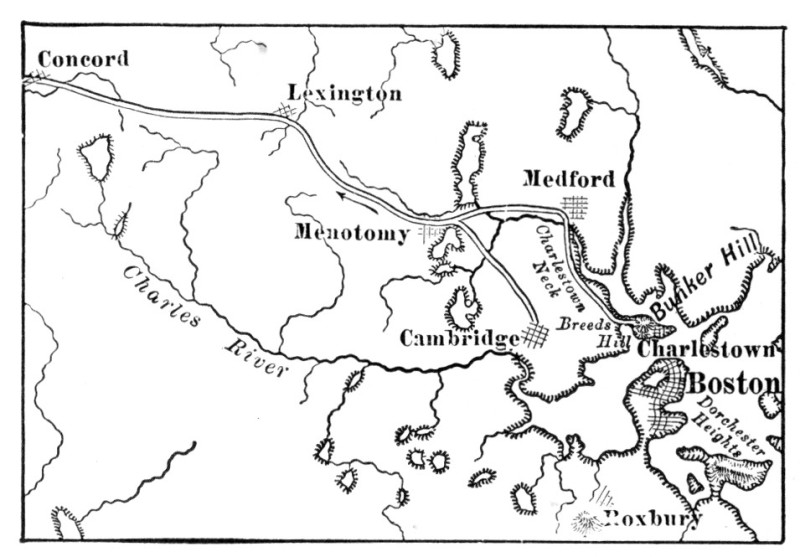
Dr. Warren quickly summoned William Dawes and Paul Revere, and despatched them on horseback to Lexington and Concord, to give the alarm. He sent them by different routes, hoping that one at least might escape capture by British patrols, with whom Gage had carefully guarded all the roads leading from Boston.
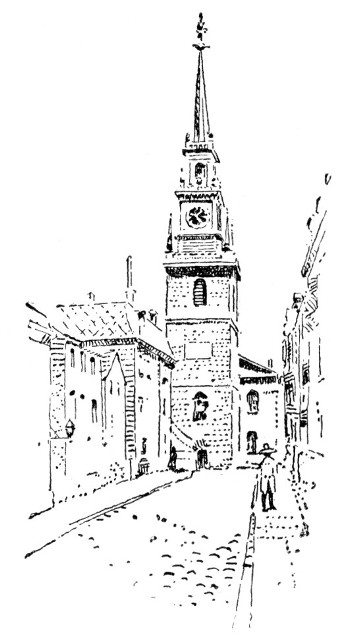
Dawes was soon making his way across Boston Neck, while Paul Revere went home and put on his riding suit for his long night-ride. Then, leaving orders for a lantern-signal to be hung in the belfry of the Old North Church, to indicate by which route the British forces were advancing, "one if by land and two if by sea," he rowed across the Charles River, passing near the British war-vessels lying at anchor.
On the opposite bank he soon got ready a fleet horse. There he stood, bridle in hand, watching to catch sight of the signal lights. At eleven o'clock two lights gleamed out from the belfry, and told him that the British troops were crossing the Charles River on their march through Cambridge.
The Old North Church.
Leaping into his saddle he sped like the wind toward Lexington. Suddenly two British officers sprang out to capture him; but quickly turning his horse, he dashed into a side path, and soon outdistanced his pursuers. Ten minutes later he arrived at Medford.
Then at every house along the road, he stopped and shouted, "Up and arm! Up and arm! The regulars are out! The regulars are out!"
When he reached Lexington it was just midnight. Eight minute-men, guarding the house where Adams and Hancock were sleeping, warned him not to disturb the household by making so much noise. "Noise!" cried Paul Revere. "You'll have noise enough before long. The regulars are out!"
William Dawes soon joined Paul Revere, and after a few minutes spent in taking refreshments they rode off together toward Concord accompanied by Dr. Prescott. About half way there they met some mounted British officers, who called to them to halt. Prescott managed to escape by making his horse leap a stone wall, and rode in hot haste toward Concord, which he reached in safety; but Paul Revere and William Dawes both fell into the hands of the British.
In the meantime, the British troops, numbering 800 men, under Lieutenant-Colonel Smith, were on their way to Lexington. But they had not gone far before they were made aware, by the ringing of church-bells, the firing of signal guns, the beating of drums, and the gleaming of beacon-fires from the surrounding hilltops, that the minute-men knew of their movements. Colonel Smith, disturbed by these signs of threatening storm, sent Major Pitcairn ahead with a picked body of light infantry, in the hope that they might reach Lexington before the town could be aroused. He then sent back to Boston for reinforcements.
The British commander had reason to be disturbed, for the alarm-signals were calling to arms thousands of patriots ready to die for their rights. Hastily wakened from sleep, men snatched their old muskets from over the door and, bidding a hurried good-by to wife and children, started for the meeting-places long since agreed upon.
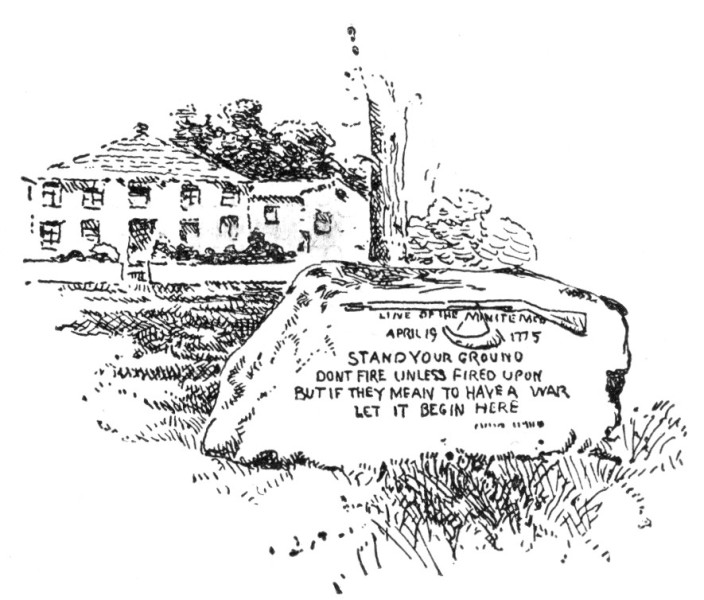
Just as the sun was rising, Major Pitcairn marched into Lexington, where he found forty or fifty minute-men ready to dispute his advance. "Disperse, ye rebels: disperse!" he cried. But they would not disperse. Pitcairn ordered his men to fire, and eighteen of the minute-men fell dead or wounded, before the remainder sullenly retired to wait for a hand in the struggle later in the day.
Before the arrival of Pitcairn the British officers who had captured Revere and Dawes returned with them to Lexington, where, commanding Revere to dismount, they let him go. Running off at full speed to the house where Samuel Adams and John Hancock were staying, he recounted what had happened, and then guided them across the fields to a place of safety at Woburn. On their way they heard the guns firing on Lexington Common, and the sound stirred the soul of Adams, who exclaimed with enthusiasm, "Oh, what a glorious morning is this!"
Stone in Front of the Harrington House, Lexington, Marking the Line of the Minute-Men.
From Lexington, Colonel Smith hastened to Concord, arriving there at seven o'clock in the morning, about six hours after Dr. Prescott had given the alarm. The British could not find the military stores, most of which the people of Concord had hidden, but they cut down the liberty pole, set fire to the court-house, spiked a few cannon, and emptied some barrels of flour.
About 200 of them stood guard at the North Bridge, while a body of minute-men gathered on a hill beyond. When the minute-men had increased to 400 they advanced upon the British, and brought on a fight which resulted in loss of life on each side. Then continuing their advance they crossed the bridge, and forced the British to withdraw into the town.
By noon Colonel Smith could see that by reason of the ever-increasing body of minute-men, swarming into Concord from every direction, it would be unwise to delay his return to Boston. His men had marched eighteen miles with little or no food for fourteen hours, and were tired and hungry.
But when the British started back on their return march, the minute-men followed and began a deadly attack. It was an irregular fight. The minute-men, trained to woodland warfare, slipped from tree to tree, shot down the tired British soldiers, and then retreated only to return and repeat the annoying attack. The wooded country through which they marched favored this kind of fighting.
But even in the open country every stone wall and hill, every house and barn, seemed to the exhausted British troops to bristle with the guns of minute-men. The retreating army pushed wearily forward, fighting as bravely as possible, but on the verge of confusion and panic.
When they reached Lexington Common, at two o'clock, they met 1,200 fresh troops under Lord Percy, whose timely arrival saved the entire force from capture. The dismayed British troops, half-dead with exhaustion, entered the square Lord Percy had formed for their protection, and fell upon the ground, "with their tongues hanging out of their mouths like those of dogs after a chase."
THE RETREAT OF THE BRITISH FROM THE CONCORD.
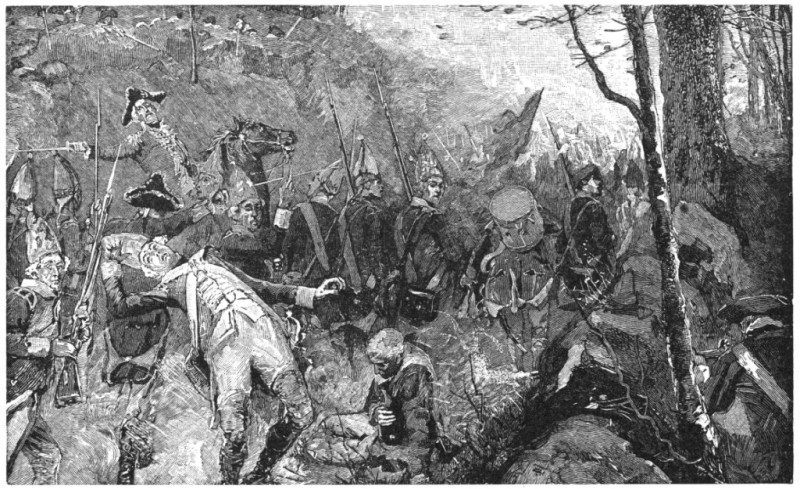
After resting for an hour, the British again took up their march to Boston. The minute-men, increasing in numbers every moment, kept up the same kind of running attack that they had made upon the British between Concord and Lexington. A British officer, in speaking of the minute-men, said, "they seemed to have dropped from the clouds." The condition of the British soldiers was pitiable until, late in the day, they got under the protection of the guns of the war-vessels in Boston Harbor.
The British had failed. They had been driven back, almost in a panic, to Boston, with a loss of nearly 300 men. The Americans had not lost 100. It was a great day for the patriots, for they had not only defeated the regular troops, but they had tested their own strength and given fresh inspiration to their cause. Farmers, mechanics, men in all walks of life, now flocked to the army. Within a few days the Americans, 16,000 strong, were surrounding the British in Boston.
The Americans, eager to drive them out of Boston, threw up breastworks on Bunker Hill, which overlooked the town. But the next day—June 17th—after they had twice driven the redcoats down the hill—they had to retreat because their powder had given out. This was the battle of Bunker Hill, in which the British lost in killed and wounded 1,000 men; the Americans, 450.
Although Paul Revere took part in no important battle, he was active in the patriot cause, and became lieutenant-colonel of a Boston regiment of artillery. After the war he returned to his old business, and established a foundry in which church-bells and bronze cannon were cast. He died in Boston in 1818, eighty-three years of age, held in high esteem by his countrymen.
REVIEW OUTLINE
Punishment for the "Boston Tea Party." The Provincial Congress and the "minute-men." Paul Revere and other patriotic young men spy out the British plans. Paul Revere starts on his "midnight ride." He spreads the alarm. Signs of the threatening storm. The fight at Lexington. Paul Revere acts as guide to Adams and Hancock. The British at Concord; the fight at the North Bridge. The British retreat from Concord to Lexington. Lord Percy's timely arrival. The British driven back to Boston. Paul Revere after the Revolution.
TO THE PUPIL
1. What were Gage's secret plans, and how did Paul Revere and his band of patriots try to thwart them?
2. Draw a map, locating Boston, Medford, Lexington, and Concord.
3. Impersonating Paul Revere, write an account of the famous "midnight ride."
4. Imagine yourself as a boy living in Concord at the time of the battle, and tell your experiences.
5. Describe the retreat of the British.
6. When did this battle take place?
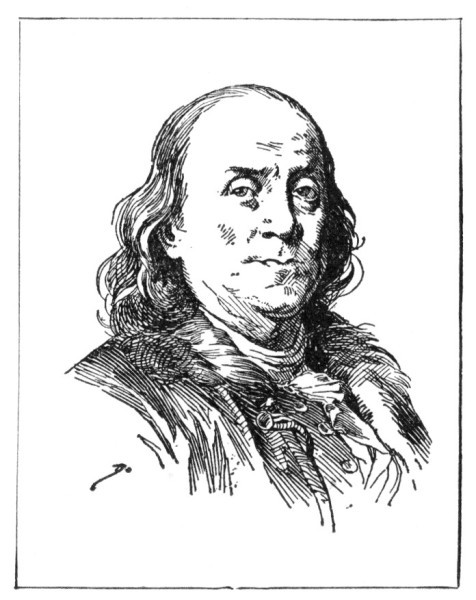
Benjamin Franklin.
CHAPTER XV Benjamin Franklin and Aid from France
[1706-1790]
American independence, the beginnings of which we have just been considering, was accomplished after a long struggle. Many brave men fought on the battle-field, and many who never shouldered a musket or drew a sword exerted a powerful influence for the good of the patriot cause. One of these men was Benjamin Franklin.
He was born in Boston in 1706, the fifteenth child in a family of seventeen children. His father was a candle-maker and soap-boiler. Intending to make a clergyman of Benjamin, he sent him, at eight years of age, to a grammar-school, with the purpose of fitting him for college. The boy made rapid progress, but before the end of his first school-year his father took him out on account of the expense, and put him into a school where he would learn more practical subjects, such as writing and arithmetic. The last study proved very difficult for him.
Two years later, at the age of ten, he had to go into his father's shop. Here he spent his time in cutting wicks for the candles, filling the moulds with tallow, selling soap in the shop, and acting the part of errand-boy.
Many times he had watched the vessels sailing in and out of Boston Harbor, and often in imagination had gone with them on their journeys. Now he longed to become a sailor, and, quitting the drudgery of the candle-shop, to roam out over the sea in search of more interesting life. But his father wisely refused to let him go. His fondness for the sea, however, took him frequently to the water, and he learned to swim like a fish and to row and sail boats with great skill. In these sports, as in others, he became a leader among his playmates.
With all his dislike for the business of candle-making and soap-boiling, and with all his fondness for play, he was faithful in doing everything that his father's business required. His industry, together with his liking for good books and his keen desire for knowledge, went far toward supplying the lack of school-training. He spent most of his leisure in reading, and devoted his savings to collecting a small library.
His father, noting his bookish habits, decided to apprentice Benjamin to his older brother, James, a printer in Boston. Benjamin was to serve until he was twenty-one and to receive no wages until the last year. In this position he was able to see more of books, and made good use of his opportunities. Often he would read, far into the night, a borrowed book that had to be returned in the morning. He also wrote some verses and peddled them about the streets, until his father discouraged him by ridiculing his efforts.
About this time, in order to get money for books, he told his brother that he would be willing to board himself on half the money the board had been costing. To this his brother agreed, and Benjamin lived on a very meagre diet. Remaining in the printing-office at noon, he ate such a simple lunch as a biscuit or slice of bread and a bunch or two of raisins. As a meal like this required but little time, young Franklin could spend most of the noon hour in reading. By living thus he easily saved half of what his brother allowed him, and at once spent his savings in books.
This youth was never idle, because he put a high value upon time; he was never wasteful of money, because he knew the easiest way to make money was to save what he had. These were qualities which helped Benjamin Franklin to get on in the world.
But during this period of his life he had great hardships to bear, for his brother was a stern taskmaster, and was so hot-tempered that he would sometimes beat Benjamin cruelly. No doubt the young apprentice was sometimes at fault. Be that as it may, the two brothers had so many disagreements that Benjamin determined to run away and seek his fortune elsewhere.
Having sold some of his books to get a little money, at the age of seventeen, he secured a passage on board a sloop for New York. Upon his arrival, friendless and almost penniless, he began to visit the printing-offices in search of work. But failing to find any, and being told that he would be more likely to succeed in Philadelphia, he decided to go to that city.
Franklin's Journey from New York to Philadelphia.
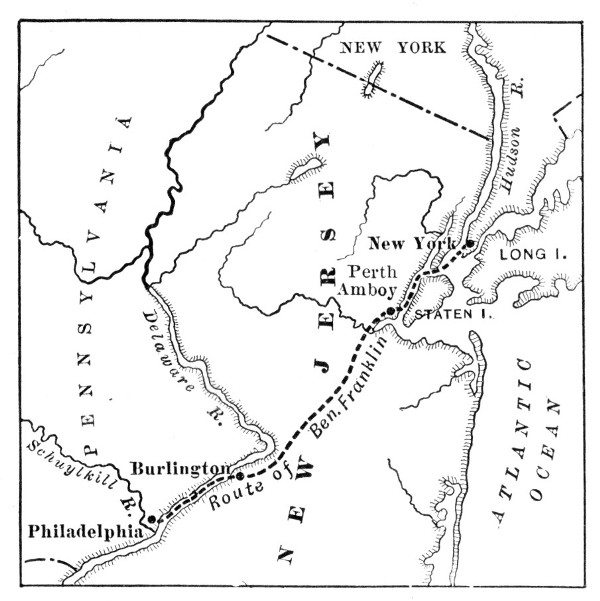
To-day, the journey from New York to Philadelphia, a distance of ninety miles, can be made in two hours. But, of course, in Franklin's time there were no railroads, and it was a more difficult undertaking.
He first had to go by a sail-boat from New York to Amboy, on the New Jersey coast. On the way a storm came up, which tore the sails and drove the boat to the Long Island shore. All night Franklin lay in the hold, while the waves dashed angrily over the boat. At length, after thirty hours, during which he was without food or water, he was landed at Amboy.
As he had no money to spare for coach hire, he started to walk, along rough country roads, the fifty miles across New Jersey to Burlington. For over two days he trudged along in a downpour of rain. At the end of his first day's journey he was so wet and mud-spattered, and had such an appearance of neglect, that on reaching an inn, there was talk of arresting him for a runaway servant.
Having arrived at Burlington, he was still twenty miles from Philadelphia, and boarded a boat for the remainder of his journey. As there was no wind, the passengers had to take turns at the oars, and in this way they continued down the Delaware until midnight. Then fearing they might pass the town in the darkness—streets not being lighted in those days—they landed, made a fire out of some fence-rails, and waited for morning.
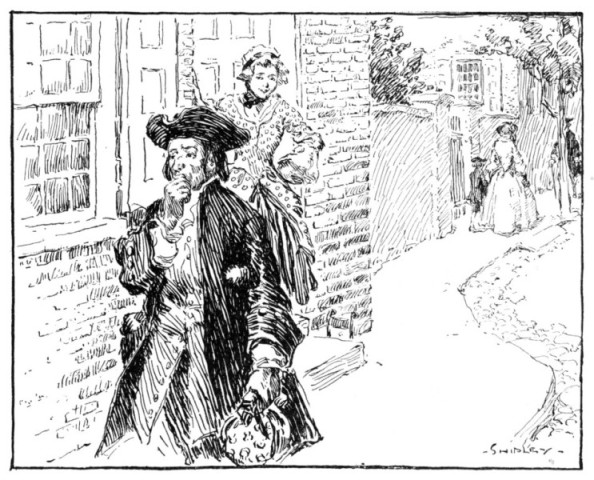
The next day, which was Sunday, they reached Philadelphia, and young Franklin, poorly clad and travel-soiled, with only a little money in his pocket, was making his way alone through the streets of Philadelphia. But he was cheerful and full of hope. His health was strong, and he was hungry for his breakfast. Going to a baker's shop he bought three large rolls, and, his pockets being already stuffed with shirts and stockings, he tucked one roll under each arm, and walked up Market Street eating the third. His ludicrous appearance afforded much amusement to a certain Deborah Read, who stood at the door of her father's house as he passed by. Little did she think that this strange-looking fellow would one day become the greatest man in Philadelphia and even in Pennsylvania. Little did she think that one day, not many years after that morning she would become his wife. Both these things came to pass.
Having eaten as much as he wished, he continued up the street, giving the two other rolls to a woman and a child who had come on the boat with him.
In a short time he found work with one of the two master-printers in Philadelphia. One day, while at work in the printing-office, he received a call from Sir William Keith, Governor of Pennsylvania. Governor Keith's attention had been directed to this seventeen-year-old youth by Franklin's brother-in-law, and he called on this occasion to urge him to start a printing-press of his own.
Franklin in the Streets of Philadelphia.
When Franklin said he had not the money to buy a printing-press and type, the Governor offered to write a letter for Franklin to take to his father in Boston, asking him to furnish the loan. The following spring Franklin took the letter to his father, but the father refused to lend him the money.
Upon Franklin's return to Philadelphia Governor Keith advised him to go to England to select the printing-press and other things necessary for the business outfit, promising to provide funds. Franklin took him at his word, and sailed for London, expecting to secure the money upon his arrival there. But the faithless Governor failed to keep his word, and Franklin was again stranded in a strange city.
Without friends and without money he once more found work in a printing-office, where he remained during the two years of his stay in London. Here, in his manliness and strength, he was very different from the printers with whom he worked. They spent much of their money in beer-drinking, and when Franklin refused to drink with them, they made fun of him, by calling him a water-American. But the young man who had lived upon a simple diet in order to buy books was not disturbed by such taunts.
After two years he returned to Philadelphia, where, four years later, he married Miss Read. In the meantime he had set up in the printing business for himself, but in so doing had to carry a heavy debt. He worked early and late to pay it off, sometimes making his own ink and casting his own type. He would also at times go with a wheel-barrow to bring to the printing-office the paper he needed.
His wife assisted him by selling stationery in his shop as well as by saving in the household, where the furnishings and food were very simple. Franklin's usual breakfast was milk and bread, which he ate out of a wooden porringer with a pewter spoon. In time, when their money was more plentiful, his wife gave him a China bowl and a silver spoon. On observing how hard Franklin worked, people said, "There is a man who will surely succeed. Let us help him."
In all these years of struggle Franklin was cheerful and light-hearted. This was no doubt largely owing to his natural disposition, but in part also to his healthful reading habits, which took him into a world outside of himself. No matter where he was or what the stress of his business, he found time to read and improve himself. He also adopted rules of conduct, some of which, in substance, are: Be temperate; speak honestly; be orderly about your work; do not waste anything; never be idle; when you decide to do anything, do it with a brave heart.
Some of the wisest things Franklin ever said appeared in his Almanac, which he called "Poor Richard's Almanac." Beginning when he was twenty-six years of age, he published it yearly for twenty-five years, building up a very large circulation. It contained many homely maxims, which are as good to-day as they were in Franklin's time. Here are a few of them:
"God helps them that help themselves." "Early to bed and early to rise, Makes a man healthy, wealthy, and wise." "There are no gains without pains." "One to-day is worth two to-morrows." "Little strokes fell great oaks." "Keep thy shop, and thy shop will keep thee."
Franklin always had a deep interest in the public welfare. He started a subscription library in Philadelphia and established an academy, which finally grew into the University of Pennsylvania. Having a decidedly practical turn of mind, he had great influence in organizing a better police force and a better fire department. He invented the Franklin stove, which soon became popular because it was so much better than the open fireplace. But the most wonderful thing he ever did was proving that lightning was the same thing as electricity.
Before he made this discovery, men of science had learned how to store up electricity in what is called a Leyden jar. But Franklin wished to find out something about the lightning which flashed across the clouds during a thunder-storm. Therefore, making a kite out of silk and fastening to it a small iron rod, he attached to the kite and to the iron rod a string made of hemp.
One day when a thunder-cloud was coming up he went out with his little son and took his stand under a shelter in the open field. At one end of the hempen string was fastened an iron key, and to this was tied a silken string, which Franklin held in his hand. As electricity will not run through silk, by using this silken string he protected himself against the electric current.
Franklin Experimenting with Electricity.
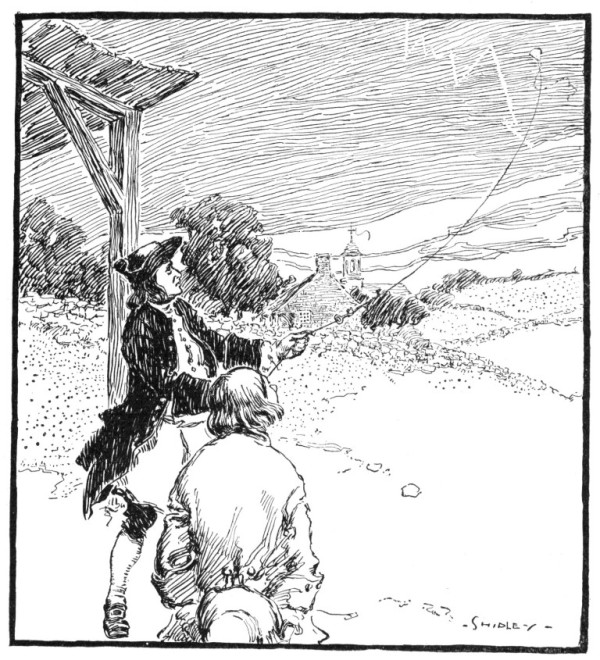
When the kite rose high into the air, Franklin watched intently to see what might follow. After a while the fibres of the hempen string began to move, and then, putting his knuckles near the key, Franklin drew forth sparks of electricity. He was delighted, for he had proved that the lightning in the clouds was the same thing as the electricity that men of science could make with machines.
It was a great discovery and made Benjamin Franklin famous. From some of the leading universities of Europe he received the title of Doctor, and he was now recognized as one of the great men of the world.
Franklin rendered his country distinguished public services, only a few of which we can here mention. More than twenty years before the outbreak of the Revolution, he perceived that the principal source of weakness among the colonies was their lack of union. With this great weakness in mind, Franklin proposed, in 1754, at a time when the French were threatening to cut off the English from the Ohio Valley, his famous "Plan of Union." Although it failed, it prepared the colonies for union in the struggle against King George and the English Parliament.
Ten years after proposing the "Plan of Union" Franklin was sent to England, at the time of the agitation over the Stamp Act, to make a strenuous effort to prevent its passage. He was unsuccessful in accomplishing his mission, but later did much toward securing the repeal of the Stamp Act.
Returning from England two weeks after the battle of Lexington and Concord, he immediately took a prominent part in the Revolution. He was one of the five appointed as a committee to write the Declaration of Independence, and during the discussion over that remarkable State paper, it was he that said, "Yes, we must indeed all hang together, or assuredly we shall all hang separately."
Lafayette Offering His Services to Franklin
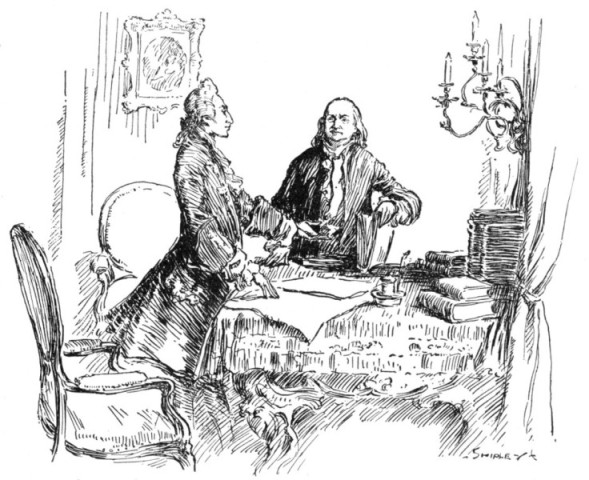
After the signing of the Declaration of Independence on July 4, 1776, he was sent to France to secure aid for the American cause. The French people gave him a cordial reception. There were feasts and parades in his honor, crowds followed him on the streets, and his pictures were everywhere displayed. The simplicity and directness of this white-haired man of seventy years charmed the French people, and won for him a warm place in their hearts. On one of the great occasions a very beautiful woman was appointed to place a crown of laurel upon his white locks, "and to give the old man two kisses on his cheeks." All this was a sincere expression of admiration and esteem. He did very much to secure from France the aid which that country gave to us. He indeed rendered to his country services[11] whose value may well be compared with those of Washington.
Franklin left France in 1785, after having ably represented his country for ten years. All France was sorry to have him leave. Since it was hard for him to endure the motion of a carriage, the King sent one of the Queen's litters in which he was carried to the coast. He also bore with him a portrait of the King of France "framed in a double circle of four hundred and eight diamonds."
Although in his last years he had to endure much idleness and pain, yet he was uniformly patient and cheerful, loving life to the end. He died in 1790, at the age of eighty-four, one of the greatest of American statesmen and heroes.
REVIEW OUTLINE
Franklin's school-life. Benjamin in his father's shop. His fondness for the sea. Bookish habits. Franklin boards himself. He runs away from home. His journey from New York to Philadelphia. In a printing-office again. His manliness. In business for himself. Economy and simplicity in living. "Poor Richard's Almanac." Franklin's public spirit. His great discovery. Franklin the statesman. His "plan of Union." Franklin in France. His last years.
TO THE PUPIL
1. Give an account of Franklin's bookish habits, and of his experiences on the journey from Boston to Philadelphia, when he ran away from home.
2. How do you explain the success in life of this poor boy? In making your explanation think of all his strong traits of character and of all his good habits.
3. What simple ways of living did Franklin adopt when he was trying hard to pay his debts?
4. Memorize the "Rules of Conduct" and the six homely maxims.
5. Tell about Franklin's experiment with the kite. What great discovery did he make at this time?
6. What did Franklin have to do with the following: the Stamp Act; the Declaration of Independence; securing aid from France?
7. How was he treated by the French people and their King?
George Washington.
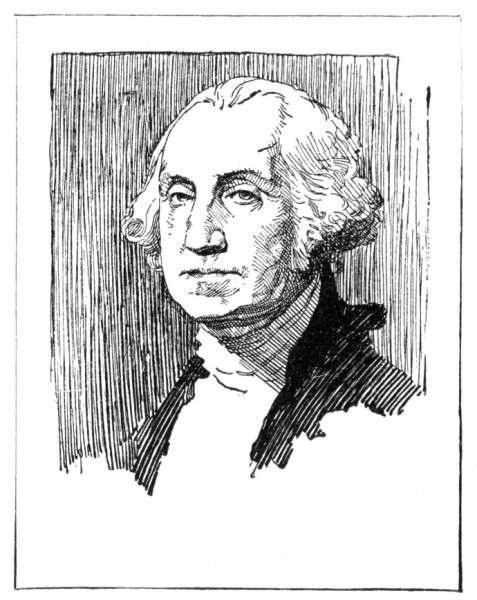
CHAPTER XVI George Washington the Virginia Planter and the Revolutionary Soldier
[1732-1799]
We left George Washington at Mount Vernon, his extensive plantation on the Virginia bank of the Potomac River. After his marriage with Mrs. Custis, who had large property of her own, Washington became a man of much wealth. He was at one time one of the largest landholders in America. As a manager of all this property, he had much to do. Let us delay our story a little to get a glimpse of the life led by him and other Virginia planters of his time.
The plantations were scattered along the rivers, sometimes many miles apart, with densely wooded stretches of land lying between. Each planter had his own wharf whence vessels, once a year, carried away his tobacco to England, and brought back in exchange whatever manufactured goods he required.
Nearly all his needs could be supplied at his wharf or on his plantation. His slaves included not only workers in large tobacco-fields, but such skilled workmen as millers, weavers, tailors, wheelwrights, coopers, shoemakers, and carpenters. Washington said to his overseers, "Buy nothing that you can make within yourselves." Indeed, each plantation was a little world in itself. Hence towns containing shops with goods and supplies of various kinds did not spring up much in Virginia.
The mansion of the planter, built of brick or wood and having at either end a huge chimney, was two stories high, with a large veranda outside and a wide hall-way inside. Near by were the storehouses, barns, workshops, and slave quarters. These last consisted of simple wooden cabins surrounded by gardens, where the negroes raised such things as vegetables and water-melons for their own use. In fact, the mansion and all the buildings clustered about it looked like a village. Here we could have seen, at all hours of the day, swarms of negro children playing happily together.
The planter spent most of his time in the open air, with his dogs and his horses. Washington gave to his horses rather fanciful names, such as Ajax, Blueskin, Valiant, and Magnolia, and to his dogs, Vulcan, Sweetlips, Ringwood, Forrester, and Rockwood. Out-door recreations included fishing, shooting, and horse-racing.
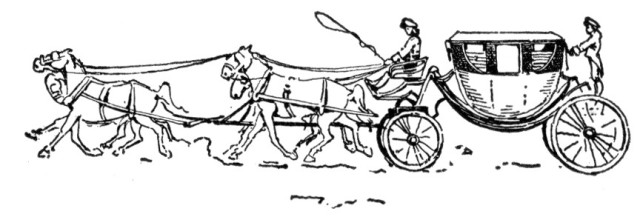
Washington's Coach.
Although life on the plantation was without luxury, there was everywhere a plain and homely abundance. Visitors were sure to meet a cordial welcome. It was no uncommon thing for a planter to entertain an entire family for weeks, and then to pay a similar visit in return with his own family. Social life absorbed much of Washington's time at Mount Vernon, where visitors were nearly always present. The planter, often living many miles away from any other human habitation, was only too glad to have a traveller spend the night with him and give news of the outside world. Such a visit was somewhat like the coming of the newspaper into our homes to-day.
A Stage Coach of the Eighteenth Century.
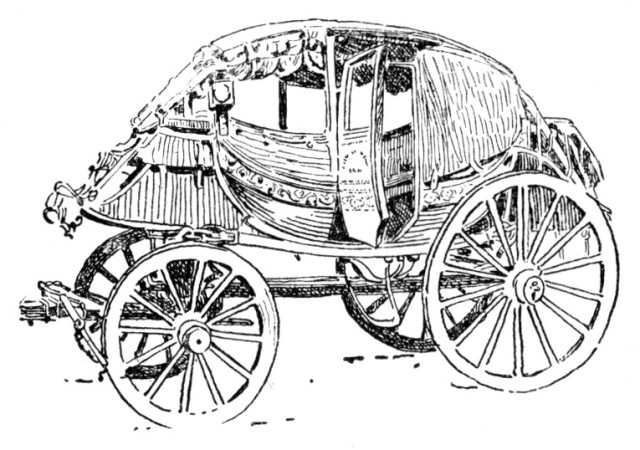
We must remember that travelling was no such simple and easy matter then as it is now. As the planters in Virginia usually lived on the banks of one of the many rivers, the simplest method of travel was by boat, up or down stream. There were cross-country roads, but these at best were rough, and sometimes full of roots and stumps. Often they were nothing more than forest paths. In trying to follow such roads the traveller at times lost his way and occasionally had to spend a night in the woods. But with even such makeshifts for roads, the planter had his lumbering old coach to which, on state occasions, he harnessed six horses and drove in great style.
Washington was in full sympathy with this life, and threw himself heartily into the work of managing his immense property. He lived up to his favorite motto, "If you want a thing done, do it yourself." He kept his own books, and looked with exactness after the smallest details.
He was indeed one of the most methodical of men, and thus accomplished a marvellous amount of work. By habit an early riser, he was often up before daylight in winter. On such occasions he kindled his own fire and read or worked by the light of a candle. At seven in summer and at eight in winter he sat down to a simple breakfast, consisting of two cups of tea, and hoe-cakes made of Indian meal. After breakfast he rode on horseback over his plantation to look after his slaves, often spending much of the day in the saddle superintending the work. At two he ate dinner, early in the evening he took tea, and at nine o'clock went to bed.
As he did not spare himself, he expected faithful service from everyone. But to his many slaves he was a kind master, and he took good care of the sick or feeble. It may be a comfort to some of us to learn that Washington was fonder of active life than of reading books, for which he never seemed to get much time. But he was even less fond of public speaking. Like some other great men, he found it difficult to stand up before a body of people and make a speech. After his term of service in the French and Indian War he was elected to the House of Burgesses, where he received a vote of thanks for his brave military services. Rising to reply, Washington stood blushing and stammering, without being able to say a word. The Speaker, equal to the occasion, said with much grace, "Sit down, Mr. Washington, your modesty equals your valor, and that surpasses the power of any language to express."
While for many years after the close of the Last French War this modest, home-loving man was living the life of a high-bred Virginia gentleman, the exciting events which finally brought on the Revolution were stirring men's souls to heroic action. It was natural, in these trying days, that his countrymen should look for guidance and inspiration to George Washington, who had been so conspicuous a leader in the Last French War.
He represented Virginia at the first meeting of the Continental Congress in 1774, going to Philadelphia in company with Patrick Henry and others. He was also a delegate from his colony at the second meeting of the Continental Congress in May, 1775. On being elected by this body Commander-in-Chief of the American army, he at once thanked the members for the election, and added, "I do not think myself equal to the command I am honored with." He also refused to receive any salary for his services, but said he would keep an account of the expenses he might incur, in order that these might be paid back to him.
On the 21st of June Washington set out on horseback from Philadelphia, in company with a small body of horsemen, to take command of the American army around Boston. Not long after starting they met a messenger bringing in haste the news of the Battle of Bunker Hill. Washington eagerly asked, "Did the Americans stand the fire of the regular troops?" "Yes," was the proud answer. "Then," cried Washington, gladly, "the liberties of the country are safe!"
Three days later, about four o'clock on Sunday afternoon, he reached New York, where he met with a royal welcome. Riding in an open carriage drawn by two white horses, he passed through the streets, escorted by nine companies of soldiers on foot. Along the route the people, old and young, received him with enthusiasm. At New Haven the Yale College students came out in a body, keeping step to the music of a band of which Noah Webster, the future lexicographer, then a freshman, was the leader. On July 2d, after arriving at the camp in Cambridge, Washington received an equally enthusiastic welcome from the soldiers.
Next day General Washington rode out on horseback and, under the famous elm still standing near Harvard University, drew his sword and took command of the American army. He was then forty-three years old, with a tall, manly form and a noble face. He was good to look at as he sat there, a perfect picture of manly strength and dignity, wearing an epaulet on each shoulder, a broad band of blue silk across his breast, and a three-cornered hat with the cockade of liberty in it.
Now came the labor of getting his troops into good condition for fighting battles, for his army was one only in name. These untrained men were brave and willing, but without muskets and without powder, they were in no condition for making war on a well-equipped enemy.
Moreover, the army had no cannon, without which it could not hope to succeed in an attack upon the British troops in Boston. By using severe measures, however, Washington soon brought about much better discipline. But with no powder and no cannon, he had to let the autumn and the winter slip by before making any effort to drive the British army out of Boston. When cannon and other supplies were at last brought down from Ticonderoga on sledges drawn by oxen, the alert American General fortified Dorchester Heights, which overlooked the city, and forced the English commander to sail away with all his army.
Washington believed that the next movement of the British would be to get control of the Hudson River and the Middle States. So he went promptly to New York in order to defend it against attack. But still his army was weak in numbers as well as in provisions, equipment, and training.
Washington had only about 18,000 men to meet General Howe, who soon arrived off Staten Island with a large fleet and 30,000 men. Not knowing where the British General would strike first, Washington had to be on his guard at many points. He had to prepare a defence of a line of twenty miles. He also built, on opposite sides of the Hudson River just above New York, Forts Lee and Washington.
Map Illustrating the Battle of Long Island.
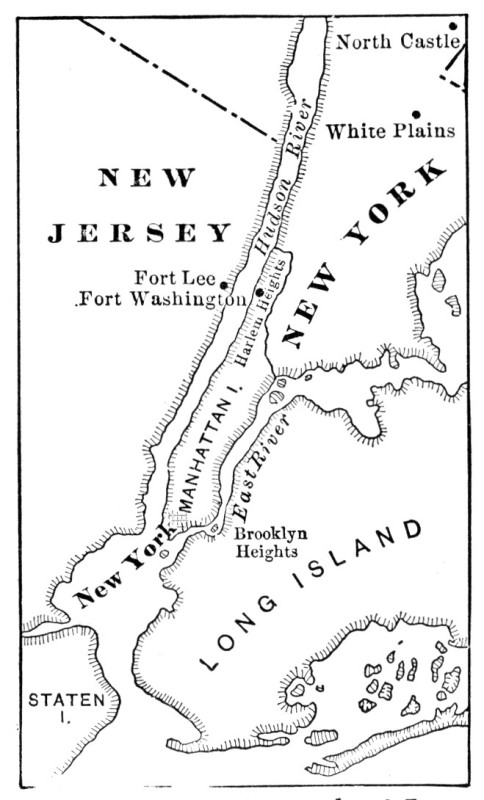
When Brooklyn Heights, on Long Island, had been fortified, General Putnam went with half the army to occupy them. On August 27th General Howe, with something like 20,000 men, attacked a part of these forces and defeated them. If he had continued the battle by marching at once against the remainder, he might have captured all that part of Washington's army under Putnam's command. He might, also, have captured Washington himself, who, during the heat of the battle, had crossed over to Long Island.
If Howe had done this, he might have ended the war at one stroke. But his men had fought hard at the end of a long night-march and needed rest. Besides, he thought it would be easy enough to capture the Americans without undue haste. For how could they escape? Soon the British vessels would sail up and get between them and New York, when, of course, escape for Washington and his men would be impossible. This all seemed so clear to the easy-going General Howe that he gave his tired men a rest after the battle on the 27th. On the 28th a heavy rain fell, and on the 29th a dense fog covered the island.
But before midday of the 29th some American officers riding down toward the shore, noticed an unusual stir in the British fleet. Boats were going to and fro, as if carrying orders. "Very likely," said these officers to Washington, "the English vessels are to sail up between New York and Long Island, to cut off our retreat." As that was also Washington's opinion, he secured all the boats he could find for the purpose of trying to make an escape during the night.
It was a desperate undertaking. There were 10,000 men, and the width of the river at the point of crossing was nearly a mile. It would seem hardly possible that such a movement could, in a single night, be made without discovery by the British troops, who were lying in camp but a short distance away. The night must have been a long and anxious one for Washington, who stayed at his post of duty on the Long Island shore until the last boat of the retreating army had pushed off. The escape was a brilliant achievement and saved the American cause.
But this was only the beginning of Washington's troubles in this memorable year, 1776. As the British now occupied Brooklyn Heights, which overlooked New York, the Americans could not hold that place, and in a short time they had to withdraw, fighting stubbornly as they slowly retreated. Washington crossed over to the Jersey side of the Hudson, and left General Charles Lee with half the army at North Castle. The British captured Forts Lee and Washington, with 3,000 men, inflicting a severe loss upon the American cause. The outlook was gloomy, but more trying events were to follow.
In order to prevent the British from capturing Philadelphia, Washington put his army between them and that city. The British began to move upon him. Needing every soldier that he could get, he sent orders to General Lee to join him. Lee refused to move. Again and again Washington urged Lee to come to his aid. Each time Lee disobeyed. We now know that he was a traitor, secretly hoping that Washington might fail in order that he himself, who was second in command, might become Commander-in-Chief of the American army.
Lee's disobedience placed Washington in a critical position. In order to save his army from capture, Washington had to retreat once more, this time across New Jersey toward Philadelphia. As the British army, in every way superior to Washington's, was close upon the Americans, it was a race for life. Sometimes the rear-guard of the Americans was just leaving a burning bridge when the van of the British army could be seen approaching. But by burning bridges and destroying food supplies intended for the British, Washington so delayed them that they were nineteen days in marching about sixty miles.
Nevertheless the situation for the Americans was still desperate. To make matters worse, Washington saw his army gradually melting away by desertion. When he reached the Delaware River it numbered barely 3,000 men.
WASHINGTON'S RETREAT THROUGH NEW JERSEY.
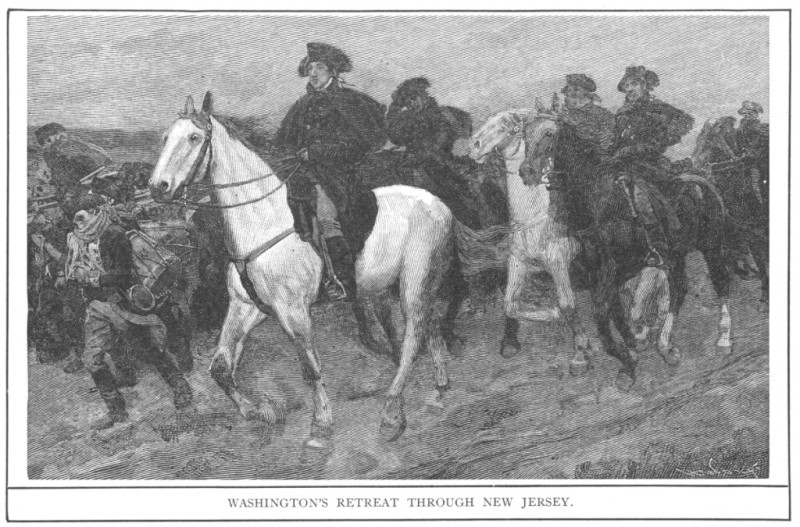
Having collected boats for seventy miles along the Delaware, Washington succeeded in safely crossing it a little above Trenton, on December 8th. As the British had no boats, they were obliged to wait until the river should freeze, when they intended to cross in triumph and make an easy capture of Philadelphia.
To most people, in England and in America alike, the early downfall of the American cause seemed certain. General Cornwallis—who in May of this year had joined the British army in America—was so sure that the war would soon come to an end, that he had already packed some of his luggage and sent it aboard ship, with the intention of returning to England at an early day.
But Washington had no thought of giving up the struggle. Far from being disheartened, he confronted the gloomy outlook with all his energy and courage. Fearless and full of faith in the patriot cause, he watched with vigilance for an opportunity to turn suddenly upon his over-confident enemy and strike a heavy blow.
Map Illustrating the Struggle for the Hudson River and the Middle States.
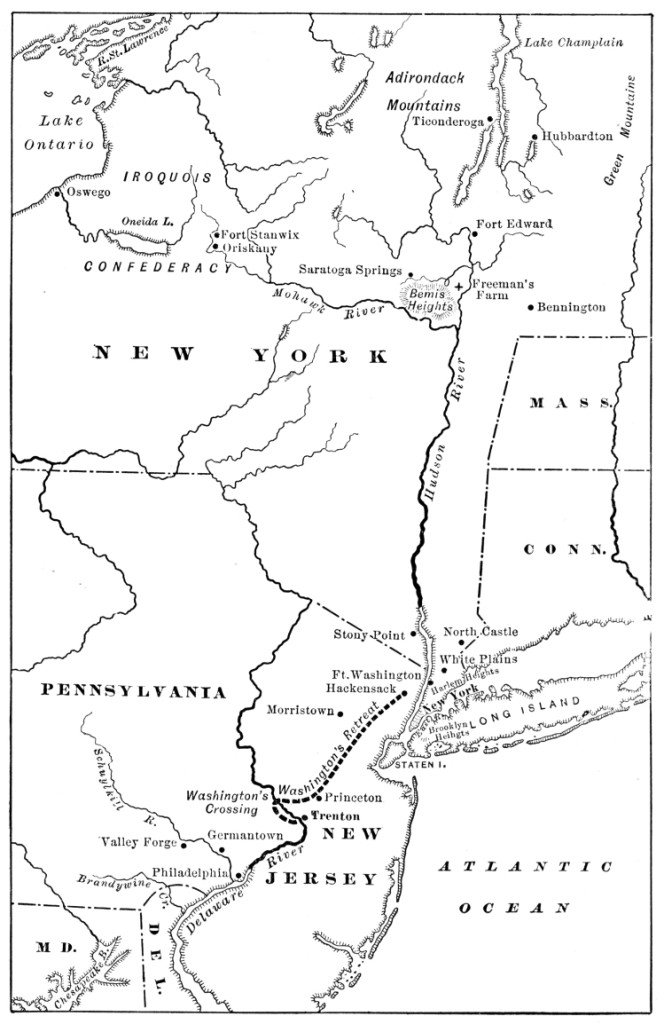
Such an opportunity shortly came to him. The British General had carelessly separated his army into several divisions and scattered them at various points in New Jersey. One of these divisions, consisting of Hessians, was stationed at Trenton. Washington's quick eye noted this blunder of the British General, and he resolved to take advantage of it by attacking the Hessians at Trenton on Christmas night. Having been re-enforced, he now had an army of 6,000 and was therefore in a better condition to risk a battle. With 2,400 picked men he got ready to cross the Delaware River at a point nine miles above Trenton. There was snow on the ground, and the weather was bitterly cold. As the soldiers marched to the place of crossing, some of them with feet almost bare left bloody footprints along the route.
At sunset the troops began to cross. It was a terrible night for such an undertaking. Angry gusts of wind, and great blocks of ice swept along by the swift current, threatened every moment to dash in pieces the frail boats. From the Trenton side of the river, General Knox, who had been sent ahead by Washington, loudly shouted to let the struggling boatmen know where to land. Ten hours were consumed in the crossing. Much longer must the time have seemed to Washington, as he stood in the midst of the wild storm, his heart full of mingled anxiety and hope.
It was not until four o'clock in the morning that the troops were ready to march upon Trenton, nine miles away. As they advanced, a fearful storm of snow and sleet beat upon the already weary men. But they pushed forward, and surprised the Hessians at Trenton soon after sunrise, easily capturing them after a short struggle.
Washington had brought hope to every patriot heart. The British were amazed at the daring feat, and Cornwallis decided to make a longer stay in America. He soon advanced with a superior force against Washington, and at nightfall, January 2, 1777, took his stand on the farther side of a small creek. "At last," said Cornwallis, "we have run down the old fox, and we will bag him in the morning."
But Washington was too sly a fox for Cornwallis to bag. During the night he led his army around Cornwallis's camp, and pushing on to Princeton defeated the rear-guard, which had not yet joined the main body. He then retired in safety to his winter quarters among the hills about Morristown. During this fateful campaign Washington had handled his army in a masterly way. He had begun with defeat and had ended with victory.
In 1777 the British planned to get control of the Hudson River, and thus cut off New England from the other States. In this way they hoped so to weaken the Americans as to make their defeat easy. Burgoyne was to march from Canada, by way of Lake Champlain and Fort Edward, to Albany, where he was to meet not only a small force of British under St. Leger from the Mohawk Valley, but also the main army of 18,000 men, under General Howe, which was expected to sail up the Hudson from New York. The British believed that this plan would be easily carried out and would soon bring the war to a close.
WINTER AT VALLEY FORGE. The Relief.
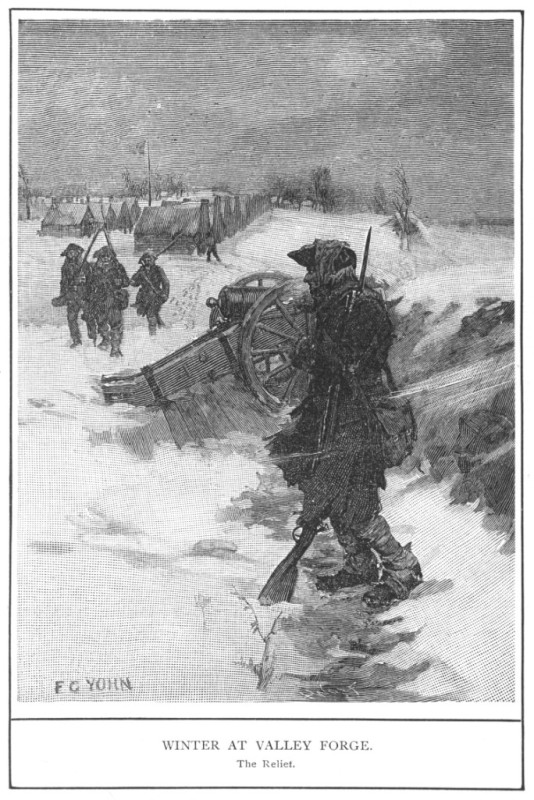
And this might have happened if General Howe had not failed to do his part. Instead of going up to meet and help Burgoyne, however, he tried first to march across New Jersey and capture Philadelphia. But when he reached Morristown, he found Washington in a stronghold where he dared not attack him. As Washington would not come out and risk an encounter in the open field, and as Howe was unwilling to continue his advance with the American army threatening his rear, he returned to New York. Still desirous of reaching Philadelphia, however, he sailed a little later, with his army, to Chesapeake Bay. The voyage took him two months.
When at length he advanced toward Philadelphia, he found Washington ready to dispute his progress at Brandywine Creek. There a battle was fought, resulting in the defeat of the Americans. But Washington handled his army with such skill that Howe spent two weeks in reaching Philadelphia, only twenty-six miles away.
When Howe arrived at the city he found out that it was too late to send aid to Burgoyne, who was now in desperate straits. Washington had spoiled the English plan, and Burgoyne, failing to get the much-needed help from Howe, had to surrender at Saratoga (October 17, 1777) his entire army of 6,000 regular troops. This was a great blow to England, and resulted in a treaty between France and America. After this treaty, France sent over both land and naval forces, which were of much service to the American cause.
At the close of 1777 Washington retired to a strong position among the hills at Valley Forge, on the Schuylkill River, about twenty miles northwest of Philadelphia. Here his army spent a winter of terrible suffering. Most of the soldiers were in rags, only a few had bed-clothing, and many had not even straw to lie upon at night. Nearly 3,000 were barefoot. More than this, they were often for days at a time without bread. It makes one heartsick to read about the sufferings of these patriotic men during this miserable winter. But despite all the bitter trials of these distressing times, Washington never lost faith in the final success of the American cause.
A beautiful story is told of this masterful man at Valley Forge. When "Friend Potts" was near the camp one day, he heard an earnest voice. On approaching he saw Washington on his knees, his cheeks wet with tears, praying to God for help and guidance. When the farmer returned to his home he said to his wife: "George Washington will succeed! George Washington will succeed! The Americans will secure their independence!" "What makes thee think so, Isaac?" inquired his wife. "I have heard him pray, Hannah, out in the woods to-day, and the Lord will surely hear his prayer. He will, Hannah; thee may rest assured He will."
We may pass over without comment here the events between the winter at Valley Forge and the Yorktown campaign, which resulted in the surrender of Cornwallis with all his army. Even when not engaged in fighting battles, Washington was the soul of the American cause, which could scarcely have succeeded without his inspiring leadership. But there is yet one more military event—the hemming in of Cornwallis at Yorktown,—for us to notice briefly before we take leave of Washington.
When at the close of his fighting with General Greene in the South, Cornwallis marched northward to Yorktown, Washington, with an army of French and American troops, was encamped on the Hudson River. He was waiting for the coming of a French fleet to New York. On its arrival he expected to attack the British army there by land, while the fleet attacked it by sea.
Upon hearing that the French fleet was on its way to the Chesapeake, Washington thought out a brilliant scheme. This was to march his army as quickly and as secretly as possible to Yorktown, a distance of 400 miles, there to join Lafayette and to co-operate with the French fleet in the capture of Cornwallis. The scheme succeeded so well that Cornwallis surrendered his entire army of 8,000 men on October 19, 1781.
This was the last battle of the war, although the treaty of peace was not signed until 1783. By that treaty the Americans won their independence from England. The country which they could now call their own extended from Canada to Florida, and from the Atlantic Ocean to the Mississippi River.
Washington, tired of war, was glad to become a Virginia planter once more. But he was not permitted to live in quiet. After his retirement from the army his home became, as he himself said, a well-resorted tavern. Two years after the close of the Revolution he wrote in his diary: "Dined with only Mrs. Washington, which I believe is the first instance of it since my retirement from public life."
When, on the formation of the Constitution of the United States, the American people looked about for a President, all eyes naturally turned to George Washington. He was elected without opposition and was inaugurated at New York, then the capital of the United States, on April 30, 1789.
Washington's Home—Mount Vernon.
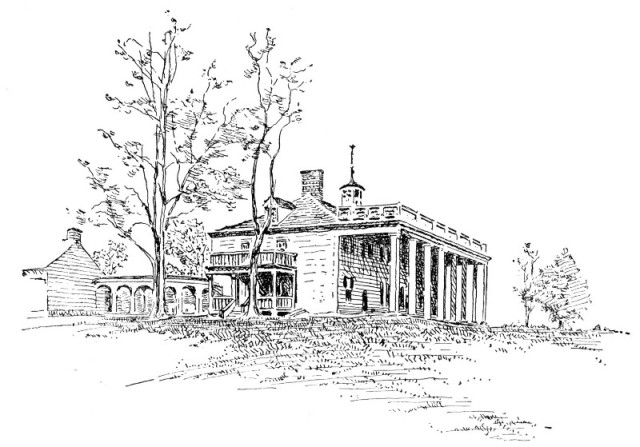
His life as President was one of dignity and elegance. It was his custom to pay no calls and accept no invitations, but between three and four o'clock on every Tuesday afternoon he held a public reception. On such occasions he appeared in court-dress, with powdered hair, yellow gloves in his hand, a long sword in a scabbard of white polished leather at his side, and a cocked hat under his arm. Standing with his right hand behind him, he bowed formally as each guest was presented to him.
After serving two terms as President with great success he again retired in 1797 to private life at Mount Vernon. Here he died on December 14, 1799, at the age of sixty-seven, loved and honored by the American people.
REVIEW OUTLINE
Washington at Mount Vernon. The plantation in Virginia. The planter's mansion and its surroundings. Virginia hospitality. Modes of travel. Washington's working habits. Appointed commander-in-chief of the American troops. General Washington and his army. The British driven from Boston. Washington goes to New York. Battle of Long Island. Washington's escape from Long Island. The traitor Lee disobeys Washington. Washington retreats across New Jersey. A gloomy outlook. A terrible night followed by a glorious victory. The British plans in 1777. General Howe fails to do his part. Burgoyne's surrender; aid from France. Washington at Valley Forge. The surrender of Cornwallis; treaty of peace. Washington as president.
TO THE PUPIL
1. By all means make constant use of your map.
2. Write on the following topics: the plantation, the planter's mansion, Virginia hospitality, modes of travel.
3. What was Washington's favorite motto? What were his working habits?
4. Describe Washington at the time when he took command of the army. What was the condition of this army?
5. Tell about Washington's troubles and his retreat across New Jersey?
6. Imagine yourself one of Washington's soldiers on the night of the march against the Hessians at Trenton, and relate your experiences. Try to form vivid pictures before you tell the story.
7. What were the British plans for 1777, and in what way did General Howe blunder in carrying out his part?
8. Describe the sufferings of the soldiers at Valley Forge.
9. Give a short account of Washington.
10. What were the leading causes of the Revolution? Its most striking result?
Nathaniel Greene.
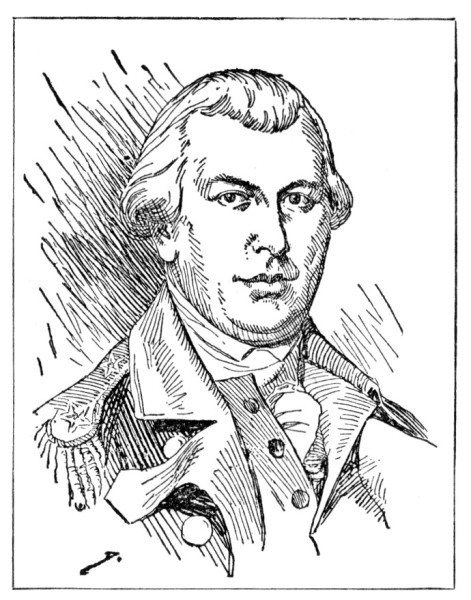
CHAPTER XVII Nathaniel Greene, the Hero of the South, and Francis Marion, the "Swamp Fox"
[1742-1786]
We have rapidly glanced at the course of the Revolution so far as Washington was concerned in it. But we should fail to understand the connection of events were we to pass over without mention the work of the brilliant general, Nathaniel Greene, who by common consent is regarded as a military leader second to Washington alone.
As already noted, the first fighting in the Revolution was in New England. Failing there, the British generals vainly tried to get control of the Hudson River and the Middle States.
Their attention was now turned to the South, where there were many Tories who would give material support to the King's forces. George the Third had great hopes of conquering all the Southern States, and holding them at the end of the struggle as English territory, even though the Americans should succeed in keeping possession of New England and the Middle States.
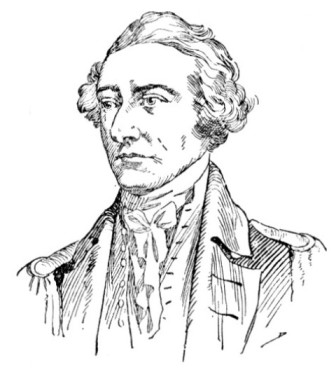
Beginning in Georgia in 1778, the British captured Savannah, but not until 1780 did they undertake the serious business of conquering the South. In May of that year General Lincoln, the American commander of the Southern army, surrendered his entire force at Charleston, and in the following August, General Gates, at the head of a second American army, suffered a crushing defeat in the battle of Camden. The outlook for the patriot cause appeared dark. One thing was certain. An able military leader must take charge of the Americans, or the British would soon overcome all opposition. Washington had great faith in General Greene's ability, and without hesitation selected him for this important task.
Nathaniel Greene was born in Warwick, R. I., in 1742. His father, a Quaker preacher on Sundays and a blacksmith and miller on week days, brought up his son in the strictest Quaker principles, and trained him to work in the field, in the mill, and at the forge. Nathaniel was robust and athletic, a leader in outdoor sports. From an early age he was studious in his habits, and in his manhood, when the troubles with England seemed to threaten war, he eagerly turned his attention to the study of military tactics.
Map Showing the War in the South.
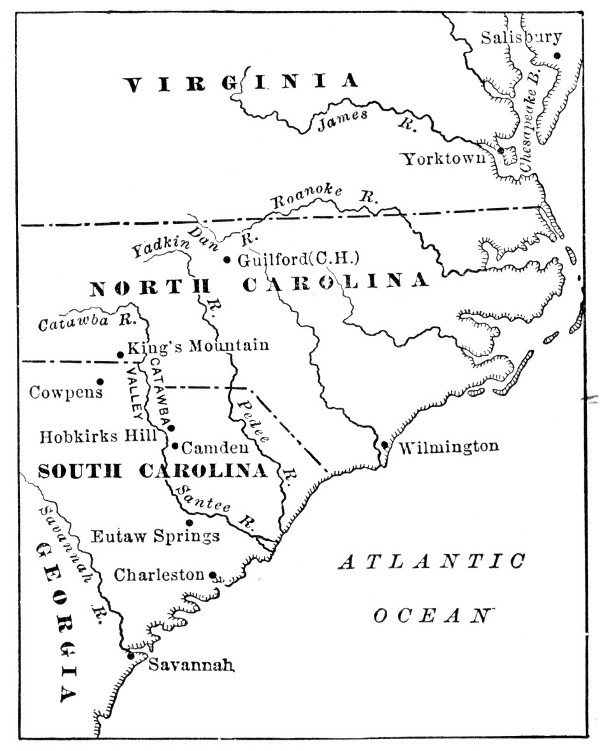
In 1774 Greene took an active part in organizing, in Rhode Island, a military company called the Kentish Guards, in which he at once enrolled himself as a private. In order to procure a musket it was necessary for him to make a trip to Boston where, in his Quaker costume of drab-colored clothes and broad brimmed hat, he was a picturesque and interested observer of the British regulars taking their customary drill. On his return he brought with him not only a musket, which he concealed under some straw in his wagon, but also a British deserter to drill his company.
On the news of the battle of Bunker Hill a brigade of three regiments was raised in Rhode Island, and Greene was placed at its head with the rank of brigadier-general. With this brigade he at once marched to Boston, and when Washington arrived to take command of the American troops, General Greene had the honor of welcoming him in behalf of the army.
At this time Greene was thirty-three years old, six feet tall, with a strong, vigorous body and a frank, intelligent face. He speedily won the friendship and confidence of Washington, who afterward placed him in positions of great responsibility. Throughout the entire war General Greene was actively engaged, and in all his campaigns he showed remarkable energy and promptness. It was natural that a general so able should be sought in 1780 as commander of the American army in the South.
When General Greene reached the Carolinas (December 2, 1780), he found the army in a forlorn condition. There was but one blanket for every three soldiers, and there were not enough provisions in camp to last three days. The men were disheartened because they had suffered defeat, rebellious because they were unpaid, and sick because they were unfed. They camped in rude huts made of fence rails, corn-stalks, and brushwood.
But by his masterly way of doing things Greene soon inspired the confidence of officers and soldiers alike. A story is told that well illustrates the faith his men had in their general. Once he saw a bare-footed sentry and said to him, "How you must suffer from cold!" "I do not complain," the sentry answered, not aware that he was addressing his commander. "I know I should fare well if our general could procure supplies."
Not long after taking command of the army he sent General Morgan with 900 picked men toward the mountains in the Carolinas to threaten the British posts there, while he himself, with the remainder of the army, took a position nearer the coast on the Pedee River. General Cornwallis, in command of the British army in the South, detached Tarleton to march against Morgan. Early on the morning of January 17, 1781, after a hard night march, Tarleton, over-confident of success, attacked Morgan at Cowpens. But the Americans repelled the attack with vigor and won a brilliant victory. The British lost 230 killed and wounded and 600 prisoners, almost their entire force.
Lord Cornwallis.
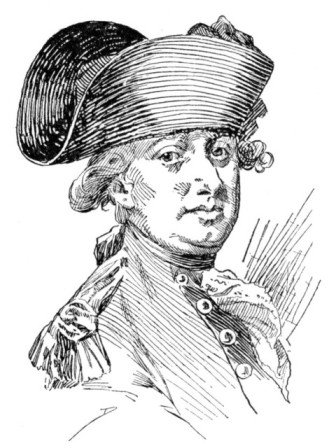
Cornwallis was deeply chagrined, for he had expected that Tarleton would crush the American force. He now planned to march rapidly across the country and defeat Morgan before Greene's army could unite with him. But Morgan, feeling certain that Cornwallis would make a strenuous effort to overwhelm him and rescue the 600 prisoners, marched with all possible speed in a northeasterly direction, with the purpose of crossing the Catawba River before Cornwallis could overtake him.
Moreover, when Greene heard the glorious news of the American victory, he knew that there was great danger that Morgan's force would fall into the hands of Cornwallis. He therefore planned not only to prevent such a catastrophe, but also to lead Cornwallis far away from his base of supplies at Wilmington on the coast, to a place where his own force united with Morgan's might fight a winning battle.
With these plans in mind, having ordered General Huger to march rapidly with the army in a northerly direction, Greene himself, with a small guard, swiftly rode a distance of 150 miles across the rough country to Morgan's army. On the last day of January he reached it in the Catawba Valley, and began to direct its movements.
In the meantime Cornwallis, with desperate energy, was pressing in pursuit. For the next ten days it was a race for life, with the odds in favor of Cornwallis. But Greene was exceedingly alert and masterful. The Catawba had been safely crossed, but Cornwallis might overtake the Americans before they could cross the Yadkin. To make all possible provision for a speedy crossing, Greene sent men ahead to see that boats should be collected on this river, ready for use when he should need them. He also had the fore-thought to carry with his army boats mounted on wheels. When crossing a river these boats would carry the wheels, and in advancing across the country the wheels would carry the boats.
Having taken these precautions, Greene sent Morgan forward toward Salisbury, while he himself waited for a force of militia that was to guard fords on the Catawba in order to delay Cornwallis. But while waiting he heard that the militia had been scattered. When this unfortunate news reached him, he started upon a solitary ride through the heavy mud and drenching rain in search of Morgan's force. When Greene alighted at the Salisbury Inn, which had been turned into a hospital for the soldiers, the army physician greeted him, asking how he was. "Fatigued, hungry, alone, and penniless," he answered. The landlady, Mrs. Elizabeth Steele, on hearing the reply, brought out two bags of money, the savings of many a hard day's labor. She said, "Take these, you will need them, and I can do without them."
In this famous retreat of 200 miles through the Carolinas the Americans forded three rivers, whose waters, swollen by recent rains soon after the Americans had crossed, checked the British in their pursuit. Greene crossed the last of these rivers, the Dan, with the two parts of his army now united, just in time to escape Cornwallis.
General Francis Marion.
In all this time of trial and uncertainty General Greene received valuable aid from partisan leaders in the South. One of the most noted of these was Francis Marion, who was born near Georgetown, S.C., in 1732. Although as a child, he was extremely delicate, he grew strong after his twelfth year. In his mature years he was short and slight in frame, but strong and hardy in constitution.
When the British began to swarm into South Carolina he raised and drilled a company of his neighbors and friends known as "Marion's Brigade." These men, without uniforms, without tents, and without pay, were among the bravest and best of the Revolutionary soldiers. Old saws beaten at the country forge furnished them with sabres, and pewter mugs and dishes supplied material for bullets. The diet of these men was simple. Marion, their leader, usually ate hominy and potatoes, and drank water flavored with a little vinegar.
The story is told that one day a British officer entered the camp with a flag of truce. After the conference, Marion, with his usual delicate courtesy, invited him to dinner. We may imagine the officer's surprise when, seated at a log used for a table, they were served to a dinner consisting of roasted sweet potatoes handed to them on pieces of bark. The British officer was still more surprised to learn that at times Marion's men were not fortunate enough to have even potatoes.
"Marion's Brigade" of farmers and hunters seldom numbered more than seventy, and often less than twenty. With this very small force he annoyed the British beyond measure by rescuing prisoners and by capturing supply-trains, foraging parties, and outposts. One day a scout brought in the report that a party of ninety British with 200 prisoners were on the march for Charleston. Waiting for the darkness to conceal his movements, Marion with thirty men sallied out, swooped down upon the British camp, captured, the entire force, and rescued all the American prisoners.
It was the custom of Marion's men when hard pressed by a superior force to scatter, each one for himself, and, dashing headlong into the dense, dark swamps, to meet again at the well-known hiding-place. Even while the British were in search of them they sometimes darted out just as suddenly as they had disappeared, and surprised another British party near at hand. Well did Marion deserve the name of "Swamp Fox," given him by the British.
Marion and His Men Swooping Down on a British Camp.
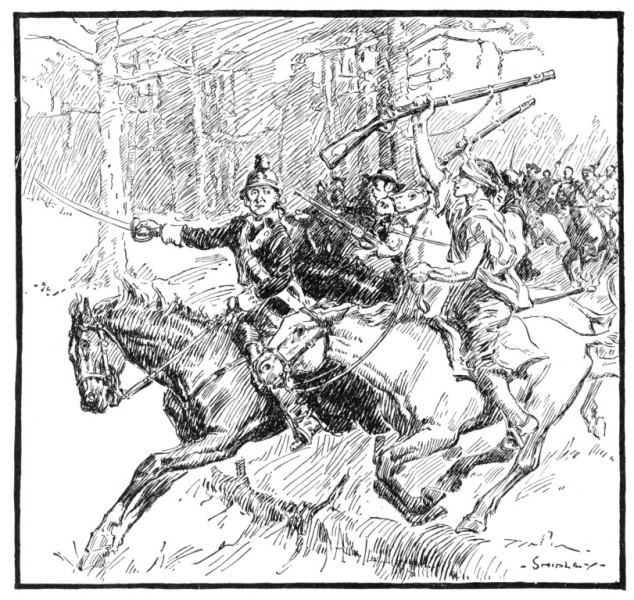
With the aid of such partisan leaders, and by the skilful handling of his army, Greene was more than a match for Cornwallis. On receiving reinforcements from Virginia Greene turned upon his enemy at Guilford Court House, N. C., where he fought a losing battle. But although defeated, he so crippled the British army that Cornwallis was obliged to retreat to the coast to get supplies for his half-famished men before marching northward into Virginia. In this long and trying campaign Greene had completely outwitted Cornwallis.
At the close of the war, as he passed through Philadelphia on his way home, the people received him with great enthusiasm. In 1785 he moved with his family to a plantation which the State of Georgia had given him. Here he lived in quiet and happiness less than a year, when he died of sunstroke at the age of forty-four. His comrade, Wayne, who was with him at the time of his death, said of him: "He was great as a soldier, great as a citizen, immaculate as a friend.... I have seen a great and good man die."
REVIEW OUTLINE
The British attempt to get control in the south. Dark outlook for the Americans. Young Greene a leader in out-door sports. Greene made brigadier-general. He takes command in the South. General Greene and his army. The battle of Cowpens. Greene's plans. His alertness and foresight. A famous retreat. Partisan leaders. Francis Marion and his men. Marion's methods: the "Swamp Fox." Greene outwits Cornwallis. General Greene after the war.
TO THE PUPIL
1. Why did the British wish to get control of the South?
2. How did Greene look? What do you admire in his character?
3. What was the condition of his army when he took command of it in the South?
4. What was the "race for life"? How did it result?
5. Describe Francis Marion and tell all you can about his habits.
6. Tell the story of Marion and the British officer.
7. What were Marion's methods of annoying the British?
8. Are you constantly trying to form mental pictures as you read?
Daniel Boone.
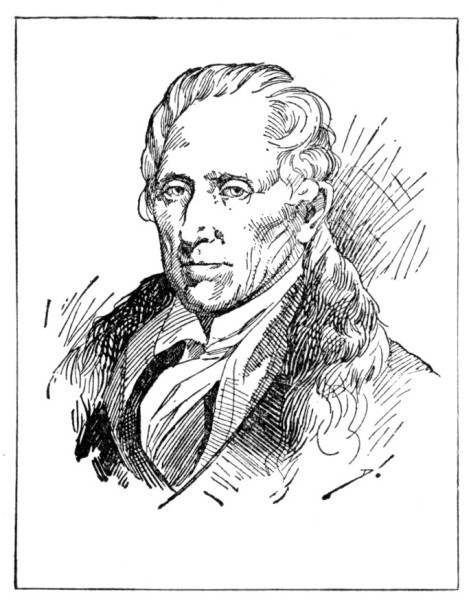
CHAPTER XVIII Daniel Boone, the Kentucky Pioneer
[1735-1820]
You will recall that at the beginning of the Last French War in 1756 the English colonies lived almost entirely between the Alleghany Mountains and the Atlantic Ocean. Such continued to be their narrow boundaries up to the beginning of the Revolutionary War. To understand how, at the end of this war, the western boundary had been extended to the Mississippi, we must turn our attention to those early western pioneers, the backwoodsmen, who rendered very important services to their country.
One of the most noted of these pioneers was Daniel Boone. He was born in Bucks County, Pa., in 1735. Caring little for books, he spent most of his time in hunting and fishing. The woods were his special delight, and naturally he became an expert rifleman.
The story is told that when a small boy he wandered one day into the forest some distance from home, and built himself a rough shelter of logs. There he would spend days at a time with only his rifle and game for company. The rifle served to bring down the game, and this he cooked over a fire of logs. A prince might have envied his dreamless slumber as he lay on a bed of leaves with the skin of a wild animal for covering. This free, wild life trained him for his future career as a fearless hunter and woodsman.
The Kentucky Settlement.
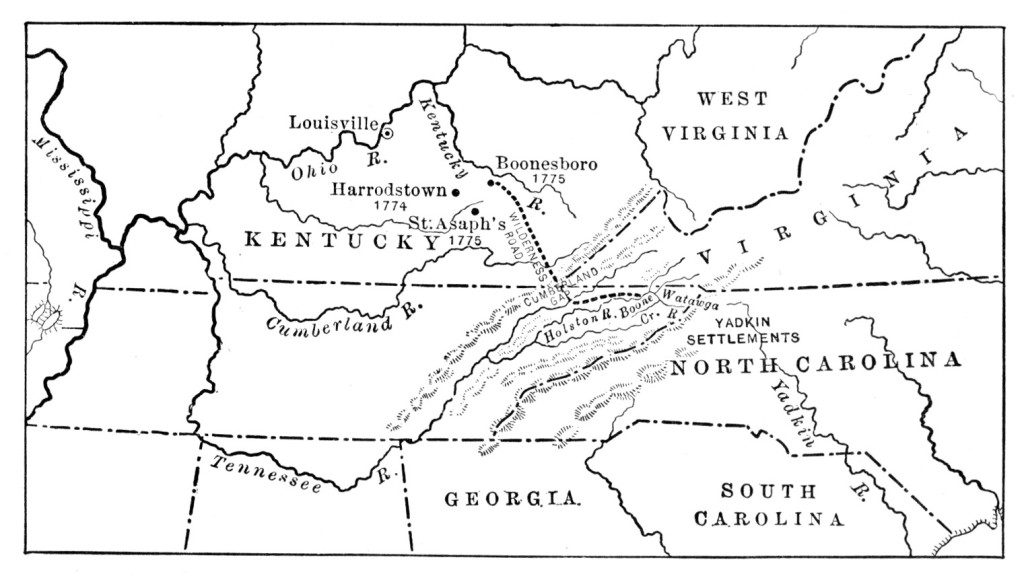
When Daniel was about thirteen years old his father moved to North Carolina and settled on the Yadkin River, where Daniel grew to manhood. After his marriage at the age of twenty, he built him a hut in the solitude of the wilderness, far removed from other settlers' homes.
Indian Costume (Female).
But Boone was restless. For years he looked with eager eyes toward the rugged mountains on the west and to the country beyond. Day by day, his desire to visit this wild unknown region increased, until he could no longer restrain it. By the time he was twenty-five he had begun his explorations and had pushed his way as far as Boone's Creek, which is a branch of the Watauga River in Eastern Tennessee. Near this creek there yet stands a beech-tree with the inscription: "D. Boon cilled a bar on (this) tree in the year 1760."
Nine years after this date Daniel Boone, in company with five other men, started out on May 1st to cross the Alleghany Mountains. For five weeks the bold travellers picked their way through the pathless woods. But when in June they reached Kentucky, they were rewarded for all the hardships they had endured. For here was a beautiful country with an abundance of game, including deer, bears, and great herds of bison.
They promptly put up a shelter made of logs and open on one side. The floor of this camp, as it was called, was the earth, covered with leaves and hemlock twigs.
Indian Costume (Male).
Six months after their arrival Boone and a man named Stewart had an unpleasant experience. While off on a hunting expedition, they were captured by an Indian party. For seven days the dusky warriors carefully guarded their prisoners. But on the seventh night, having gorged themselves with the game killed during the day, the Indians fell into a sound sleep. Boone, while pretending to be asleep, had been watching his opportunity. So when the right moment came he quietly arose, awoke Stewart, and the two crept stealthily away until out of hearing of the Indians. Then, leaping to their feet, they bounded away like deer, through the dark woods toward their camp. This they found deserted, and what had become of their friends they never learned.
Some weeks later Boone was pleasantly surprised by the appearance at the camp of his brother, Squire Boone, and a companion. The four men lived together without special incident, until one day Stewart was surprised and shot by some Indians. Stewart's death so terrified the man who had accompanied Squire Boone, that he gave up the wilderness life and returned to his home.
Boone and his brother remained together in the forest for three months longer, but their ammunition getting low, on May 1st Squire Boone returned to North Carolina for a fresh supply and for horses. Daniel was thus left alone, 500 miles from home. His life was in constant peril from wild beasts and Indians. He dared not sleep in his camp, but resorted at night to a canebrake or some other hiding-place, where he lay concealed, not even kindling a fire lest its light might betray him. During these months of solitary waiting for his brother, Boone endured many privations. He had neither salt, sugar, nor flour, his sole food being game brought down by his rifle. But the return of his brother, in July, with the expected provisions, brought him much good cheer.
After two years of this experience in the wilderness, Daniel Boone returned to his home on the Yadkin to make preparations for removal. By September, 1773, he had sold his farm and was ready to go with his family to settle in Kentucky. His enthusiastic reports of the fertile country he had been exploring found eager listeners, and when his party was ready to start it included, besides his wife and children, five families and forty men, with a sufficient number of horses and cattle. Unhappily they were attacked on their way by Indians, and six men, one of them Boone's eldest son, were killed. Discouraged by this setback the party returned to the nearest settlement, and for a while longer the migration westward was postponed.
But it was Boone's unflinching purpose to settle in the beautiful Kentucky region. It had already become historic, for the Indians called it a "dark ground," a "bloody ground," and an old Indian Chief had related to Boone how many tribes had hunted and fought on its disputed territory.
None of the Indians held an undisputed claim to the land. Nevertheless a friend of Boone, Richard Henderson, and other white men made treaties with the powerful Cherokees, who allowed them to settle here. As soon as it became certain that the Cherokees would not interfere, Henderson sent Boone in charge of thirty men to open a pathway from the Holston River, over Cumberland Gap to the Kentucky River. This is still known as the Wilderness Road, along which so many thousand settlers afterward made their way.
On reaching the Kentucky River, Boone and his men set to work to build a fort on the left bank of the stream. This fort they called Boonesborough. Its four stout walls consisted in part of the outer sides of log cabins and in part of a stockade, some twelve feet high, made by thrusting into the ground stout pieces of timber pointed at the top. There were loop-holes in all the cabins, and a loop-holed block-house at each corner of the fort.
Daniel Boone, the leader of this settlement, was a man of interesting personality. He was a tall, slender backwoodsman, with muscles of iron and a rugged nature that enabled him to endure great hardship. Quiet and serious, he possessed courage that never shrank in the face of danger. Men had confidence in him because he had confidence in himself. Moreover, his kind heart and tender sympathies won lasting friendships. He usually though not always dressed like an Indian. A fur cap, a fringed hunting shirt, and leggings and moccasins, all made of skins of wild animals, made up his ordinary costume.
Daniel Boone in his Cabin.
If we should go in imagination into Daniel Boone's log cabin out in the clearing not far from the fort, we should find it a simple home with rude furnishings. A ladder against the wall was the stairway by which the children reached the loft. Pegs driven into the wall held the scanty family wardrobe, and upon a rough board, supported by four wooden legs, was spread the family meal.
A Hand Corn Mill.
There was an abundance of plain and simple food. Bear's meat was a substitute for pork, and venison for beef. As salt was scarce, the beef was not salted down or pickled, but was jerked by drying in the sun or smoking over the fire. Corn was also an important article of diet. When away from home to hunt game or to follow the war trail, sometimes the only food which the settler had was the parched corn he carried in his pocket or wallet. Every cabin had its hand-mill for grinding the corn into meal and a mortar for beating it into hominy. The mortar was made by burning a hole into the top of a block of wood.
A pioneer boy found his life a busy and interesting one. While still young he received careful training in imitating the notes and calls of birds and wild animals. He learned how to set traps, and how to shoot a rifle with unerring aim. At twelve years of age he became a fort-soldier, with port-hole assigned to him for use in case of an Indian attack. He received careful training, also, in following an Indian trail and in concealing his own when on the warpath. For expert knowledge of this kind was necessary in the midst of dangers from unseen foes that were likely to creep stealthily upon the settlers at all times whether they were working in the clearings or hunting in the forest.
After building the fort, Boone returned to his home in North Carolina for his family. Some months after the family reached Boonesborough, Boone's daughter with two girl friends was one day floating in a boat near the river-bank. Suddenly five Indians darted out of the woods and, seizing the three girls, hurried away with them. When in their flight the Indians observed the eldest of the girls breaking twigs and dropping them in their trail, they threatened to tomahawk her unless she stopped it. But watching her chance, she from time to time tore off strips of her dress, and dropped them as guides to the pursuing whites.
A Wigwam.
As soon as possible after hearing of the capture Boone, with seven other men from the fort, started upon the trail of the Indians and kept up the pursuit until, early on the second morning, they discovered the Indians sitting around a fire cooking breakfast. Suddenly the whites, firing a volley, killed two of the Indians and frightened the others so badly that they beat a hasty retreat, leaving the girls uninjured.
Early in 1778, Boone and twenty nine other men were captured and carried off by a party of Indian warriors. At that time the Indians in that part of the country were fighting on the English side in the Revolution, and as they received a ransom for any Americans they might hand over to the English, they took Boone and the other men of his party to Detroit.