Chapter XII
Reading edition
PHINEAS BURGESS, 1807-1890
Phineas, son of the second John, bought the homestead from his father at age 27 in 1831. He spent his eighty-three years mostly at Boot Pond, except in Middleboro for a period as a young man.
He married Charlotte Thomas, 1812-1903, who had been a school teacher there. She was the daughter of Ezra Thomas. Ezra Thomas, the father of Charlotte, came from Edinburgh, Scotland, so the family tradition runs, and had been wealthy. His first wife was an English lady. He had several children by his second wife, Lucy Sturdevant of Carver, Mass. Sometime during his life in Middleboro the family fortunes were lost. Some of the daughters removed to Lawrence, Massachusetts, and worked in the textile mills there.
Charlotte was affectionately known as Aunt Charlotte. From the 1850’s through the 1870’s with the help of neighboring housewives from South Pond village she offered clambakes, picnics and luncheons at the Boot Pond homestead for various social organizations that were popular and well attended. Mary Burgess mentioned that her grandmother, Charlotte, was very fond of lilacs and planted clumps of them around the house and barn. These same clumps of great age are now found in four different spots and bring fragrant blossoms each May. She said her grandmother would refer to them as lill-acs.
Phineas and Charlotte Burgess had the following children:
Phineas Franklin, b.1833, Isaac Sturdevant, 1835-1925, Ezra Thomas, 1837-1924, Peleg Sprague, 1840-1931, Charlotte Thomas, 1847-1876, Ruth Anna, 1851-1956. In the photograph from left to right they are Peleg, Ruth Anna, Ezra, Isaac, Phineas, Franklin, Charlotte died at age 29.
Writing in the Pilgrim Society Notes, #13, August 1963, Margaret Kyle describes the picnics held at the Burgess place at Great South Pond.
“That was a favorite spot for an all day affair. A summer was not complete without such a picnic. It was the event of the season. If company was to be invited for a visit, the invitation waited until the date of the next Burgess Place picnic. Just before the Fourth was the usual day. Up the winding road through the pine woods the carryalls went, barges, too, full of young people, the horses with indigo tucked into their bridles to keep the flies off.
“In those good old days Plymouth ‘had itself to itself.’ Each family took its own silver (one had a great time sorting it afterwards) and good food of all sorts was tucked under the carriage seats. Marm Burgess was ‘Aunt Charlotte’ to everyone—the chowder was entirely her affair and oh! the savor of its cooking in great washboilers as twelve o’clock approached. There were endless things to do at the Burgess Place—fishing, blueberrying, croquet, rowing, ball playing, wading, games for young and old. But nothing compared to the moment when the yard began to hum with activity back and forth around the long tables set out under the trees, and the chowder appeared.
“Once, when the company was all assembled, a sudden shower came up. Such a flurry and consternation! One of the ‘Hobshole Boys’ seized the steaming caldron at his end of the long table and ran with it into the house crying: In the name of Cromwell, fear God, and keep your chowder dry!”
“The guest books of those ‘Jolly Jamborees’ picnics at the Burgess Place are worn lined old ledgers dating back almost a hundred years. The records range from grandfathers and great-grandfathers, the children of long ago, just able to print with their hands held. Down to the very present the records run, for the Burgess Place and hospitality holds wide its doors.”
The journals and guest books kept of those enjoying the outings were recently given to Pilgrim Hall by Mary Burgess. Susan Burgess told my son, Daniel, in 1960, that in a snowy winter when they were courting, Phineas and Charlotte had their sleigh turned over on a trip from Middleboro, but neither were injured. There is a picture of them at the house taken outside by the big apple tree, Charlotte with a spinning wheel and Phineas sitting beside her reading. He has abundant hair and lower beard. This photo was probably taken in 1885. It was done by Harvey Burgess, brother of Minnie Burgess, both children of Isaac Burgess, she has told me. Harvey Burgess was of the class of 1883 at Plymouth High School.
Ruth Anna, 1851-1956, a centenarian, married Benjamin B. Manter, later a lighthouse keeper. A major contribution of hers to the Burgess Place was the planting of the swamp maple tree in front of the barn when she was a young girl, according to Mary Burgess. It is now of massive size and majestic in character.
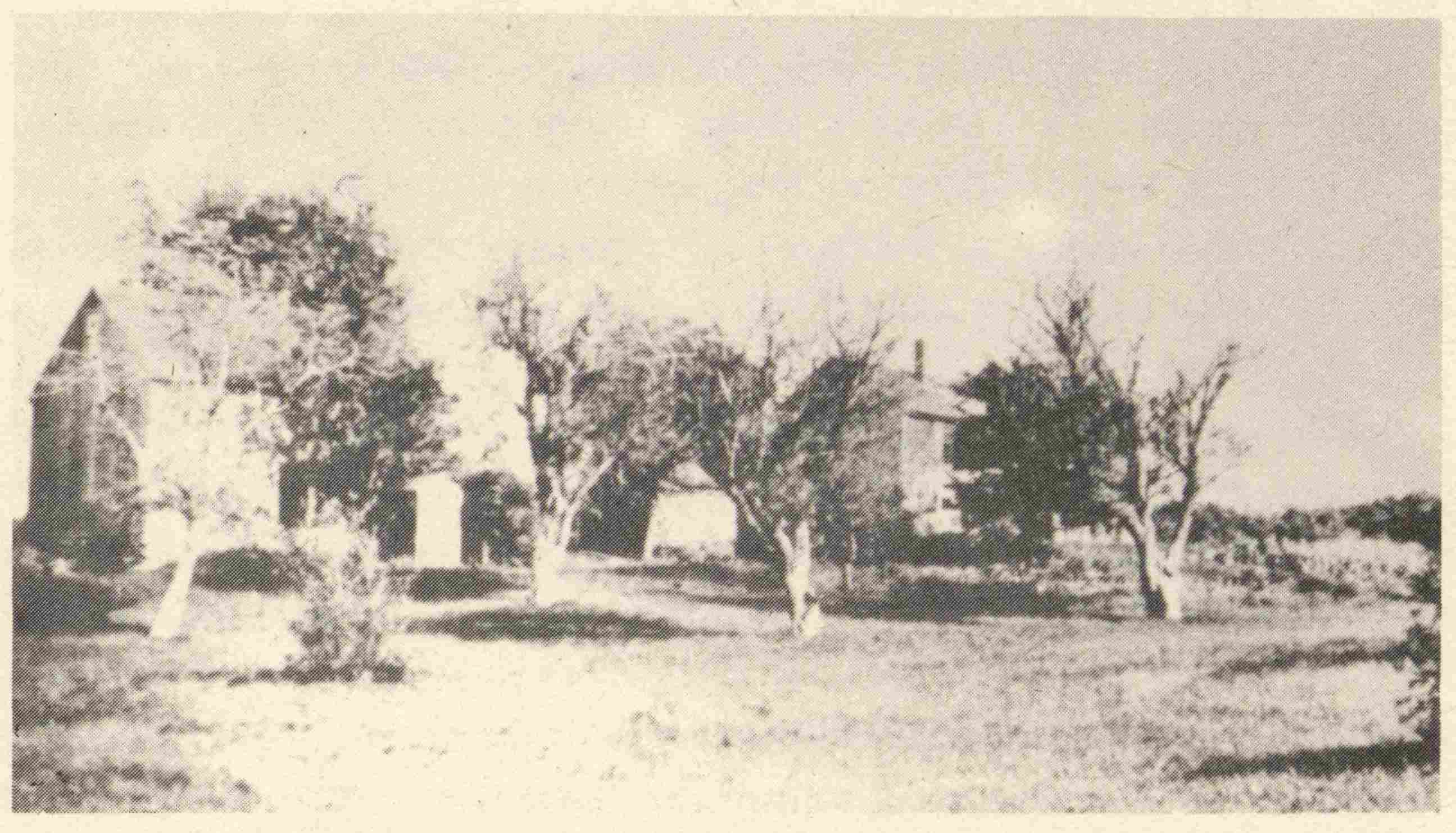
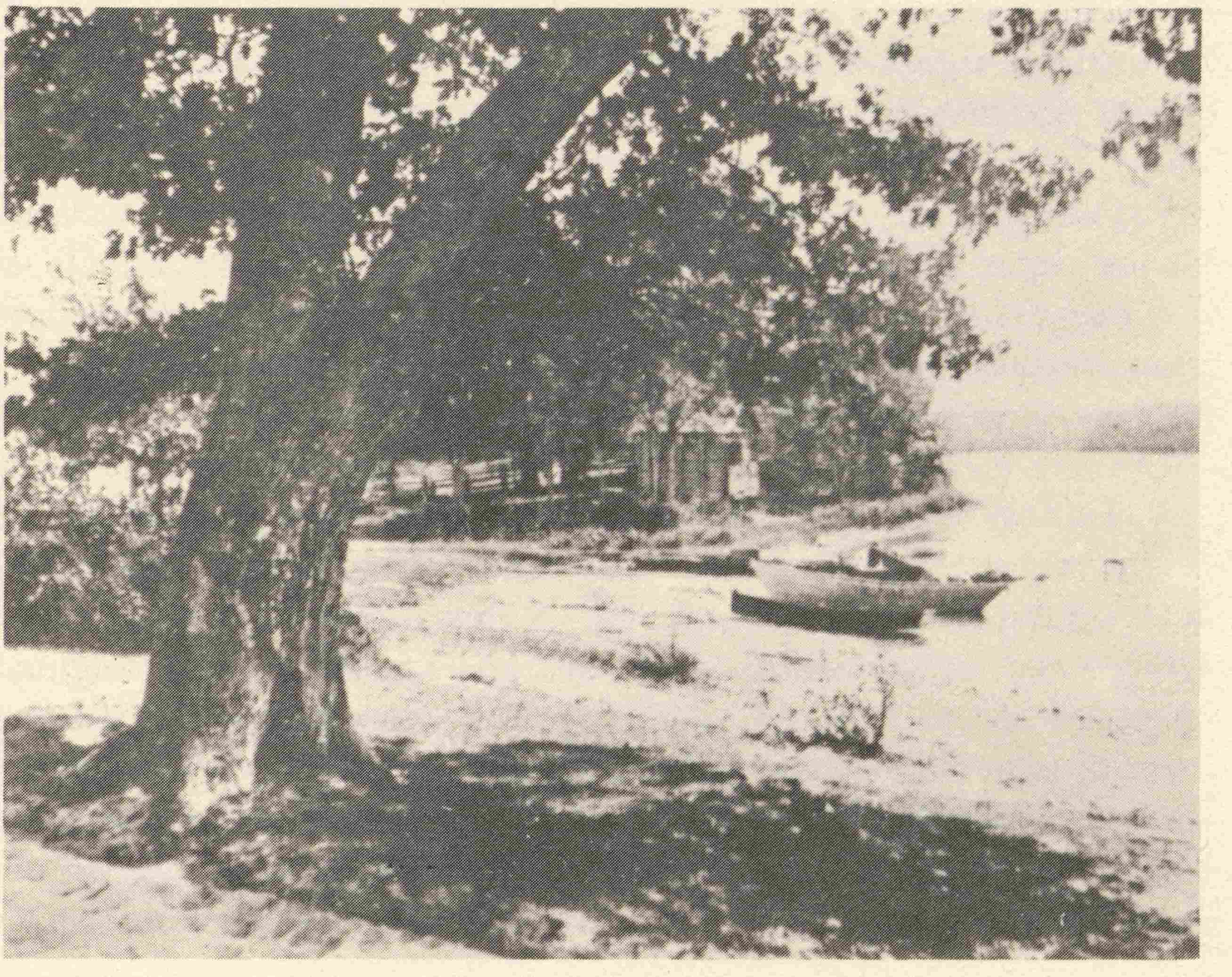
During his long life at the homestead, Phineas Burgess led the life of a countryman. He and his family experienced and had to accept long or short winters, dry or wet summers, early or late springs and continue to overcome the vagaries of nature which could be severe in some years for those deriving their livelihood from the land. The rains, the winds and sun were a close part of living. He could work the soil, tend his animals, raise crops and berries, harvest ice from the Pond into his icehouse located on the shore, shear the wool of sheep for clothes, and provide for his family with their help. He did not have the creature comforts of our present technological society, but there were rewards for living close to nature at its best.
At this time soaps were made, using lye, from the grease and fats from farm animals. Aside from the use of ice from the Pond preserved with sawdust, butter and perishables could be kept cool in the summer in the well near the house.
To understand what families in the mid-nineteenth century had for crops to provide food and nourishment, I believe Ruth Tirrell, writing in the Sunday New York Times of January 13, 1974, provides accurate information. Her grandmother, now in her tenth decade, recalls the Rhode Island farm of her great grandmother, a span going back to the time of John Adams.
In the time of Grover Cleveland, farm crops were the same as in colonial days, the three sisters of the Indians—squash, beans, and corn. Johnnycakes, made on the griddle from the meal of white flint corn were served three times per day on the farm. Beans were “string” then, not “snap.” Salads were made from cucumbers and a coarse, curly lettuce, dressed with sugar and vinegar homemade from apples.
Beet greens were a staple, cooked with bacon. Beet roots were for fodder. Turnips were an important winter vegetable kept in the cellar. Squashes could be stored in the attic. Carrots were for cattle, but parsnips for people. Fertilizer was manure, horse, cow, sheep, pig and fowl—“organic,” like all farms once. Tomatoes, the “love apple” of the French, were suspected to be poisonous in the first half of the century.
As at the Boot Pond Place, raspberries, strawberries, currants could be combined in pies and preserves for a marvelous sweet-acid taste. Apple slices were dried on racks for winter pies. Some varieties would last until spring in barrels of leaves in a cool shed.
Peaches, high bush blueberries, wild fox grapes were nearby, as were wild cranberries.
The high holiday was Thanksgiving. “Except for sugar, salt, tea and white flour for pie crust, nothing on the table was ‘bought.’” Christmas was not celebrated on the farm according to the custom of colonial ancestors which survived until mid-century.
For heat the house had a central chimney with two fireplaces. Iron stoves replaced fireplaces early on as local bog iron and its technology became known. They are a vastly more efficient heat source. In Taunton an iron foundry was established in 1655. One began in Pembroke as early as 1648. Carver had bog iron deposits. The stoves were considered of enough value to be listed in early inventories of estate. Later in Plymouth, the Plymouth Iron Foundry on Water Street began making stoves in the 1860’s.
There have been some conclusions about certain aspects of family life pointed out by John Demos in his fascinating studies in A Little Commonwealth that throw light on practices observed in the continuity of such families as the Churchills, Richmonds, Wrights and Burgesses.
He explains that the average number of children per couple of eight or nine apiece was quite standard in the seventeenth century. It seems to me it continued probably in a not greatly different way one hundred years later. A basic conviction was that the purpose of marriage was procreation, even if other considerations were not openly emphasized. Children could ultimately bring economic benefits to the family as a whole, not forgetting the more important benefits to the quality of life such as mutual love and affection, care, security in old age, barriers against loneliness and the like.
There was no birth control as we know it. The fact that all babies were generally breast fed naturally provided a two year interval between births. In contrast with today’s average of mothers having their last baby at age 26, couples in the Colony might have a full-grown son or daughter about to marry and an infant at the mother’s breast all under the same roof. This fact gave a gradualness to the lives of siblings along the way and a chance to absorb family culture and to come of age by gradual stages.
The mortality rate between birth and maturity is suggested by the evidence as 25% or possibly less. This is very high by comparison with our own one percent, producing obvious sorrows. As for life expectancy, for example, a male of 21 years could expect to reach an age of 69.2 years and a female of 62.4 years, indicating the losses for women in childbirth, estimating that one birth in thirty resulted in the death of the mother. A Little Commonwealth, p. 66. Yet we must realize the perpetual pregnancies for some women were a hard fact of life.
So we can see some of the reasons why, although the families we speak about had large numbers in each generation, they were able to provide for them. They were able to bring the children to maturity in part because of the opportunities that lay at hand, in the accessibility of new lands, inheritance, farming, and a type of life that required self-sufficiency. The possibility of “growth” was a part of the spirit of the times.
We might recount at this point the number of children in the seven Burgess generations in the direct line from the first Thomas to Peleg.
First Thomas 5 plus others
Second Thomas 1
Third Thomas 13
Nathaniel 11
John 12
Phineas 6
Peleg 8
—
56
This is an average of eight children per generation.
I have had conversations with Mary Burgess, then aged 87, about her recollections about her grandparents’ life at the Pond. She remembers more of her grandmother Charlotte, being 18 at the time of her death in 1903, and also because she lived her last years in the Plymouth home of her son, Peleg.
She said her grandparents were dedicated abolitionists before the Civil War, Charlotte in particular. There had been centers of such activity on North Street and on Clark’s Island. They had local black people working at the homestead for helping with the crops and the growing of all sorts of berries, such as raspberries and strawberries for sale in the markets.
Each summer Indians from farther south at the Cape came to South Pond and lived out in the vicinity of Pinnacle Hill across the Pond. They would travel by canoe to work by day. Some of the activities for the Indian women included spinning and weaving on looms in the attic for making cloth and related items. They had good numbers of sheep for the purpose. In the spring upon arrival the Indians would bring quantities of herring from the spawning in fresh water streams for gifts to the family.
The Indians in the area at the time of the arrival of the settlers belonged to the Wampanoag tribe, a member of the group designated as Algonquins. She said the Indians buried in graves in South Pond cemetery had presumably died from small pox epidemics.
She told me about her grandparents. They lived in Middleboro at an early time in their marriage. Phineas was a member of the Middleboro School Committee; Charlotte was a school teacher. They had a young girl as a servant who grew up in the family, probably in the 1850’s. She learned from the other family children ways in which to be productive and self-reliant, such as weaving cloth from wool, making her own clothes, learning to read and write and the like.
The girl, at the time of the Civil War, made herself a soldier’s uniform, posed as a male, enlisted, and served during the war. Afterward she got married and lived in Middleboro. Mary Burgess has told me that she thinks the “bounded servant,” as she refers to her, was named Deborah Sampson.
Raising other people’s children in one’s family was not an uncommon custom. The reason for its prevalence is explored in an extended account of the whole custom in the John Demos book, A Little Commonwealth. The term “servant” as we now understand it is not an accurate indication of what took place from the early days of the Colony well into the early part of the nineteenth century.
It was an extension of the concept of family that for the most part benefited those who came to the family and also those in the immediate family. It was widely practiced and accepted and was regulated by judicial decisions when necessary to prevent injustices. There is a great deal of evidence in wills and court decisions that the custom provided security and a sense of identity for the many involved. It is estimated that ten percent of the children in families in an earlier time lived with families other than their own for care, upbringing, education at home in a more worthwhile manner than possible in their own families. The prevailing view had been that a child was a miniature adult and from the age of eight years on he was ready to begin assuming responsibilities. The void caused by a leap into a world outside his immediate family was largely filled by the kind of nurture in a family group other than his own. Many circumstances could bring about such a situation, like the death of one or more parents, real poverty, family conflicts, opportunities to learn a trade, shifts from an illiterate family to one with the capability to provide home instruction in reading and writing. Possibly some families had more children than they could properly rear and were willing to let other families who could offer more take a child in.
The Burgess family members, during the time of Phineas Burgess and his sons, took an active part in the formation of the Union Evangelical Society at South Pond village and the building of the present chapel there in 1870.
Phineas Burgess’s son Isaac, 1835-1924, and brother of Peleg, 1840-1931, gave part of the land near his dwelling house at the time for the location of the chapel. His relative, William Burgess, also owned land adjoining the proposed chapel location and also gave a portion of his land for the site. It was located where a “private way leading to the burying hill called the burying hill road makes a junction with said main road.”
The joint gift is recorded in the deed of Book 367, Page 214, December 15, 1870, signed by Isaac and Ruth Burgess, William and Lucy L. Burgess.
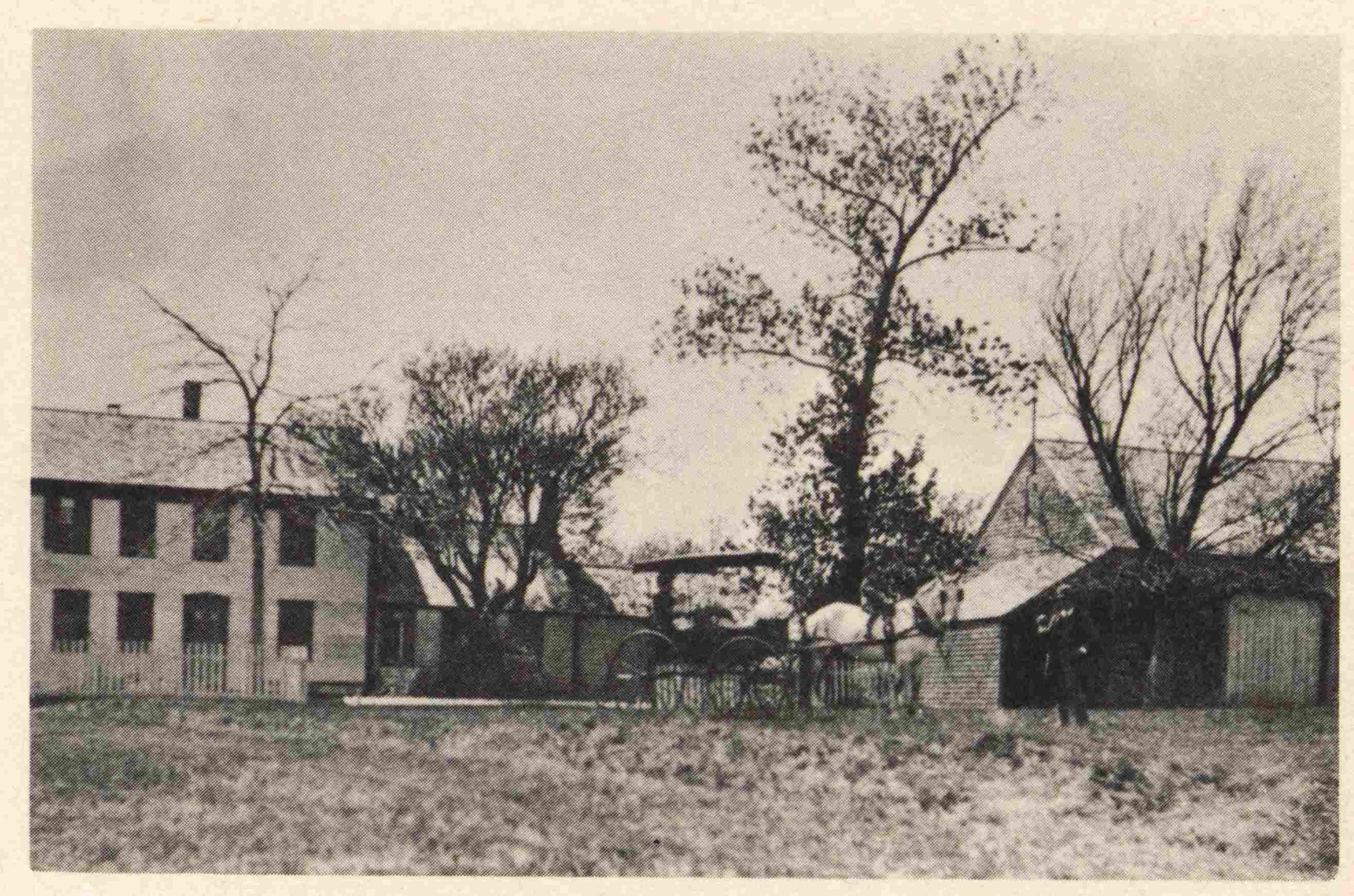
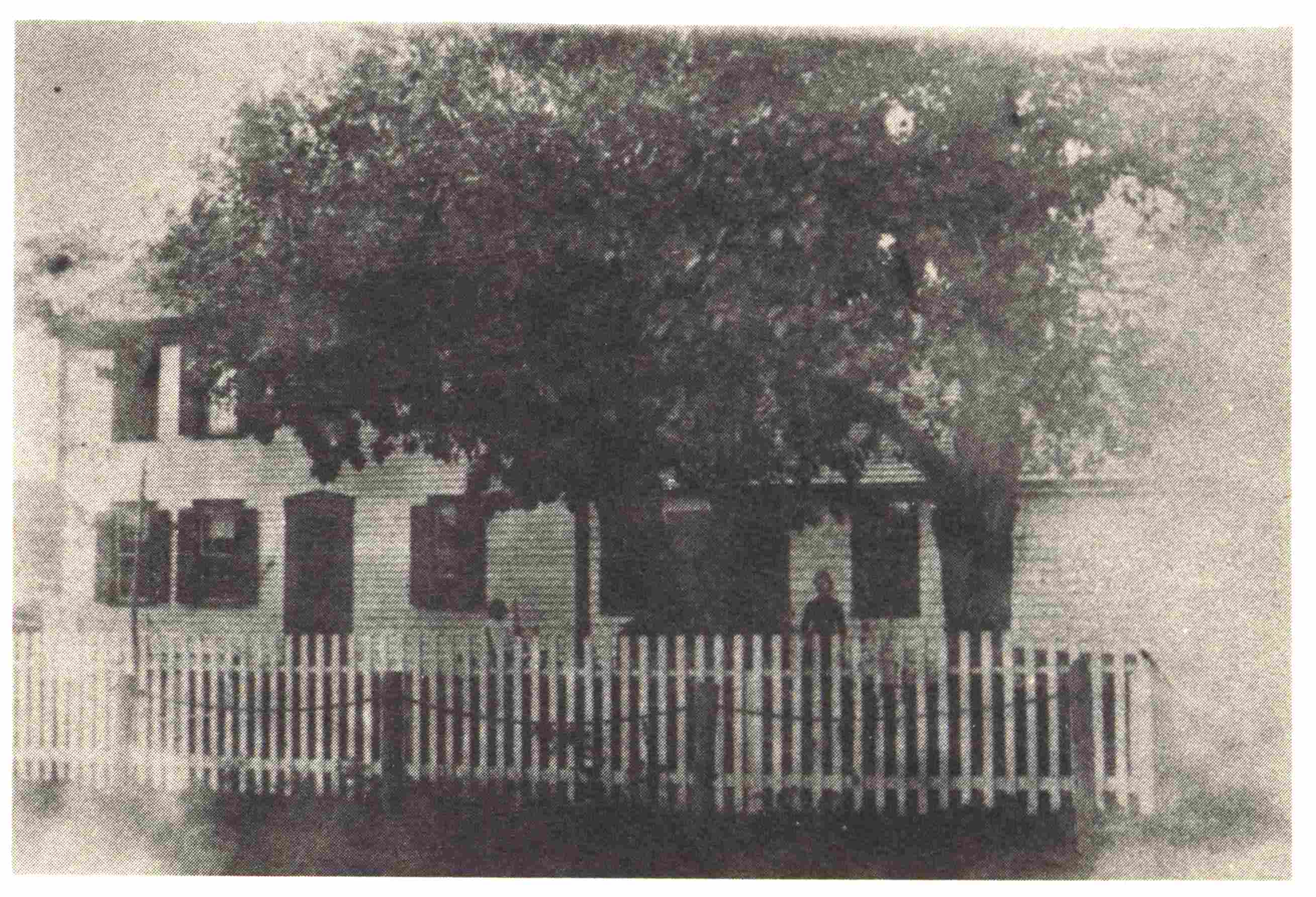
There are two significant convictions stated in this deed:
“If meeting house taken for debt or any change made from the Union Evangelical Church as it stands at this date the lot to go back to the former owners or heirs, also that the women of the society shall have equal rights with the men in holding offices and voting in other affairs.”
The present and long-time president of this church Society is the still active Miss Minnie Burgess, aged 94, daughter of Isaac. She has been one of its continuous benefactors. Services are held weekly each Sunday during the summer and she is an active participant. I recently attended a moving service conducted by Rev. Peter Gomes. The singing of the congregation was a delight.
The Chapel itself has simplicity and the charm of long ago. It may remind one of a Shaker interior, with wooden settees, clear glass windows with gothic type upper arch, small pulpit in the front, and a black cast iron, flat topped wood-burning stove of the 1870 period. There is an unusual large recessed dome in the center ceiling.
Miss Minnie Burgess has kindly let me examine a hand written account in her possession of the early days of the Chapel by her aunt, Ruth Anna Manter, of an account she wrote and read in the Chapel about 1940.
“Before the years 1865-1867 the people living in this neighborhood held their meetings in the school house. Services were well attended and they had a Sunday School.
“In the year 1868 they began to talk about building this Chapel. The women formed a sewing society, quilting bed quilts and doing other kinds of work.
“The lot was given by I. S. Burgess who owned a house on the South Side where the Chapel now stands. There was a big rock on his land which they blasted to make the underpinning for the Chapel. Sylvanus W. Burgess having charge of that work, I. S. Burgess being head carpenter. Seth Burgess, Henry Sampson, Braman Bennett, Phineas Burgess, Truman Sampson, William Pierce, George Manter, Seth Bennett were some of the helpers.
“As near as I can remember the chapel was ready for use in 1874 or 5.
“This history is written by Ruth Manter who seems to be the only one to remember what took place here 71 years ago.
Signed Ruth A. Manter.”
Miss Minnie Burgess also possesses a record book of the organizing of the Society, Plymouth, South Ponds, Apr. 4, 1870. Reckords of the Organization of the Union Evangelical Society. The names listed give an indication of some of the families living in the South Pond village area at the time.
Expressing a desire to be legally organized, the undersigned were:
Isaac Burgess Seth Burgess William Burgess Sylvanus Sampson Sylvanus S. Bennett Chriss Bennett Solomon Holmes Nelson L. Sampson Sylvanus W. Burgess Truman Sampson Aaron Sampson Henry H. Sampson Barzilla Holmes Frederick Burgess Seth Bassett Gustavus G. Sampson Charlotte Burgess Ruth Burgess Aseneth Sampson Harriet L. Burgess Sarah H. Burgess
At the meeting of December 8, 1870, Article 4 was adopted which explained the denominational constituency, a truly ecumenical move forward:
Free Will Baptists Calvinist Baptists Christian Baptists Methodists Congregationalists Advent
At a meeting of March 6, 1871 the following women for the first time were admitted as members:
Charlotte Burgess (daughter of Phineas) Ruth Burgess (wife of Isaac) Aseneth Burgess Harriet L. Burgess (wife of Phineas Franklin Burgess) Charlotte T. Burgess (wife of Phineas) Sarah H. Burgess (wife of Seth Burgess)
In 1874, Phineas Burgess, now 67 years old, who had actively farmed the property during his long life there, sold the property to his sons Phineas Franklin and Peleg, as recorded in Book 1552, Page 357. There was a provision for occupancy during his remaining lifetime. The price was $2,000.00. The provision was similar to that between John and Phineas in the previous generation. Peleg watched over and provided care for his parents until the end of their lives.
The next Burgess generation in our chronical, that of Peleg, marks a change. Although he was born at the Pond Place, he lived most of his life in Plymouth center. Yet he did keep close touch with the homestead, became the owner of it and held it until the last twelve years of his life.
Before leaving Phineas and Charlotte Burgess we offer an intimate glimpse of their times at the Pond Place, presenting a real treasure from a person who knew those times, wrote about them in imaginative and poetic prose, and as an artist pictured some scenes in watercolors.
Here follows the recollection by Susan Burgess of her grandparents’ home in the form of a children’s story. There is some background material in the notes for this section.[99]