Chapter XVII
Reading edition
ANGLO-AFGHAN RELATIONS—continued
Upon the conclusion of the Tirah campaign the forward policy ceased to be measured by the virulence of Anglo-Afghan amenities. Relations between Kabul and Calcutta were dominated by the pleasant impressions of his guest which Abdur Rahman had gathered when, as the Honourable George Nathaniel Curzon, M.P., the incoming Viceroy had visited Kabul in 1894. With much care this distinguished student had made an elaborate examination of border politics, presenting the results of his diligence in a series of scholarly and exhaustive studies of Russia in Central Asia, Persia and the Persian Question, The Pamirs and the Source of the Oxus, and A Recent Journey in Afghanistan. By reason of these journeys across Asiatic Russia, the Pamirs, Afghanistan and Persia, and through his remarkable opportunities for observation, unrivalled powers of assimilation, grasp of subject, luminosity of judgment and lucidity of expression, Mr. George Curzon was without a peer as an authority on frontier problems. When this brilliant and indefatigable mind was called to India as Lord Curzon of Kedleston, the methods by which the forward policy had been regulated in the closing decade of the nineteenth century had broken down, the labour of reconstruction reverting to a man who at least was the foremost expert of his time. Modifications were now essential; and Lord Curzon at once put into execution a number of important reforms in the economic and military control of the north-west frontier. The regular garrison in Chitral was lessened by one third. The soldiers in Lower Swat and the Malakand were reduced from 3550 men to one battalion and a half of native infantry and a small detachment of cavalry, while regular troops were withdrawn from the Gilgit Agency. Similarly, communication with Malakand was strengthened by constructing a railway, 2 feet 6 inches in breadth from Nowshera to Dargai, to which four companies were posted, while a very large cantonment was created at Nowshera. In the Khyber the regular establishment, 3700 strong, was replaced by two battalions (1250 in all) of the reorganised and enlarged Khyber Rifles, with an increased number of British officers and an improved scale of pay. The costly and extensive fortifications which at one time it was proposed to build in the pass, and at its further extremity, were abandoned in favour of a cheaper and improved scheme of defences, constructed to meet the requirements of the Afridi garrison. The plan of laying either the bed of a railway or a railway itself up the Khyber pass was displaced by the extension of the existing north-west railway from Peshawar to Jamrud, a distance of 10 miles.
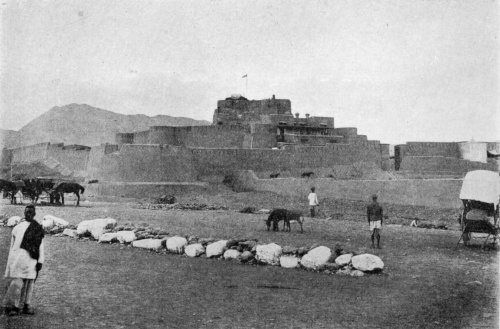
JAMRUD FORT, KHYBER PASS
Between Peshawar and Kohat, the amiable co-operation of the pass tribes was secured in the peaceable construction of the long desired cart-road through the Kohat pass, and a military road through the Mullagori country in the Khyber region, serving as a safe alternative road to that by way of Ali Masjid, was undertaken. At the same time a narrow gauge line, linking Thall viâ Kohat with Kushalgarh upon the Indus and now converted to broad gauge, was projected; while, at a later date Nushki was joined up with Quetta. The finishing touch to an almost perfect system of frontier communications may be found in the preparations recently made for carrying the line along the left bank of the Kabul river to Dakka.
South of Kohat the Samana Rifles, a force of tribal militia 450 strong under British officers and recruited from the Orakzai tribesmen, was furnished as an extra battalion to the border military police, and the strength of the regular garrisons, maintained on the Samana range, reduced from 1700 to 600 men. In the Kurram valley, the Kurram militia were reorganised in two battalions (1250 strong) under British officers. In Waziristan, two battalions of Waziristan militia, 800 strong, were raised, the one for the Tochi valley or Northern Waziristan, the other for the Gomul valley or Southern Waziristan, thus releasing the services of 4000 regulars. These changes were rendered possible by the organisation and training of border police, militia and levies, the total strength of which is 10,000 men. The risk of entrusting to these irregulars the garrisoning of advanced posts was provided against by maintaining flying columns at Peshawar, Kohat, Bannu and Dera Ismail Khan, and minimised by the marked improvement of road and railway communication with all strategic centres in the North-West Province. While the financial saving was great, efficiency was increased because regiments were no longer split up into detachments. The number of regulars serving beyond the administrative frontier was reduced from 10,200 in 1899 to 5000, while supporting garrisons were increased from 22,000 in 1899 to 24,000.
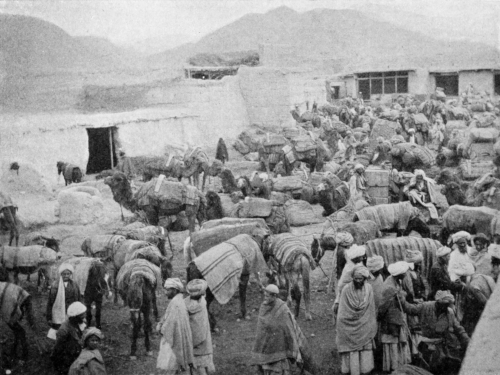
CARAVANSARY AT DAKKA
When the Viceroy of India was satisfied that these measures were destined to reap their complement of success he supplemented his experiments in frontier management by their concluding phase. On August 27, 1900, after eighteen months’ patient inquiry and constant observation, he drew up a Minute advocating the separation of the administration of the north-west frontier from the control of the Punjab Government. These proposals were supported by the signatures of his colleagues in a covering despatch on September 13. Following the lines of Lord Lytton’s celebrated Minute upon the creation of a distinct Trans-Indus District, April 22, 1877, Lord Curzon embodied in one of the most brilliant pieces of analysis ever placed before the Imperial Government a temperate and lucid exposition of the existing order of frontier administration. The acceptance of the views enunciated in this Minute was notified by the Secretary of State for India, Lord George Hamilton, on December 20, 1900, but it was not until November 9, 1901, that the establishment of the new territory under the name of the North-West Frontier Province was proclaimed.
While Lord Curzon during the first three years of his régime—January 1899 to November 1901—was occupied with repairing the fabric of Indian frontier administration, Afghanistan, in the early spring of 1900, became the cause of an exchange of diplomatic notes between the late Lord Salisbury as Secretary of State for Foreign Affairs and the late Russian Ambassador to Great Britain, M. de Staal, acting under the orders of the Russian Minister for Foreign Affairs, Count Mouravieff. In a communication dated February 6, 1900, M. de Staal informed the Foreign Office that the Russian Government were proposing that direct relations should be established between Russia and Afghanistan with regard to frontier matters; but that such relations should have no political character as the Russian Government intended to maintain their former engagements and would continue to consider Afghanistan outside the sphere of Russian influence. An immediate reply to this request was vouchsafed in which it was stated that, having regard to the understanding by which Afghanistan is outside the sphere of Russian influence,
... it would be impossible for the British Government to take into consideration any change in existing arrangements or to frame proposals to be brought before the Amir without more precise explanation in regard to the method which the Russian Government would desire to see adopted for the exchange of such communications between the frontier officials, the limitations to be placed on them and the means of ensuring that those limitations would be observed.
To this intimation no reply at the moment was preferred by the Russian authorities, and the study of Anglo-Afghan relations shifts once more to the dominions of the Amir. Throughout the period in which Lord Curzon was so engrossed with the machinery of frontier and administrative reforms Abdur Rahman had not been in any way an idle ruler. In spite of his failing powers, with great energy and determination, he had concentrated his efforts upon the completion of his life’s work. With that accomplished, assured of the good-will of the Government of India shortly after Lord Curzon’s arrival in 1899 by the release of the munitions of war which had been detained through the outbreak of the Tirah troubles, he turned his hand to matters of more domestic concern. Satisfied with the improvements in his military establishment, content with the reforms which he had introduced in the administrative economy of his state, and having established its independence by elaborate artifices, he again sought the preservation of his line. In an effort to prepare his people for the acceptance and accession of Habib Ullah Khan at his demise he had, in 1891, delegated to this son authority to hold the public Durbars in Kabul. At the same time he had reserved to himself the control of foreign affairs, manifesting in this direction a keen appreciation of the value to the position of India which underlay the situation of Afghanistan. Menaced by growing physical infirmity and with strange premonition of his approaching end, at a special Durbar in the autumn of 1900 he informed the assembled nobles and high officials of his inability to cope with the increasing volume of affairs. Thereupon, amid a scene of singular pathos, the old Amir indicated that his son, Habib Ullah, would be given a still larger measure of authority.
A few months later, in May of 1901, a more emphatic warning of the grave state of the Amir’s health was received. Intelligence came through from Kabul to Peshawar that Abdur Rahman was no longer able to walk, and that he was not expected to live through the approaching winter. Incapacitated by a combination of Bright’s disease and gout as he was, the mental faculties of the ruler of Afghanistan were nevertheless unimpaired, and throughout the closing year of his life he applied them constantly to the improvement of his country. Interested in the South African War and grasping the salient lessons of our unreadiness, the Amir laid out much money in 1900-1901 upon a scheme of mobilisation; while in May 1901 he secured permission to import from Germany some thirty howitzers and field guns. At the same time, and without informing the Government of India, he ordered a large number of castings for big guns, an order which was subsequently repudiated by Habib Ullah. In August 1901 he personally directed the preparations for the suppression of the threatened disaffection in Khost, besides attending to the rising of the Tagis of Hariob on the Peiwar in September. These events were the last affairs of a prominent description to which Abdur Rahman was able to apply himself. Even while engaged in the business attending the Tagis operations his Highness began to show signs of decline and, on September 20, he was seized with a stroke of paralysis which disabled his right side.
His native physicians had prepared a compound of rare medicines costing several thousand rupees; but, as the paralytic seizure was kept strictly secret in the palace, this concoction was not in readiness and, when offered to the Amir, he could not take it. On September 28 his Highness, feeling his end approaching, summoned his sons, the nobles, the principal civil and military officers and the chief raises of Kabul, Hindu and Mahommedan. One son only, Mahommed Afzul Khan, a boy of thirteen, was absent. He was with his mother at Balkh, that lady belonging to the Saids of Balkh. When all had assembled the Amir by look acknowledged their homage and then addressed them in a feeble, but distinct voice, saying:
You know when a king becomes old and infirm and near his end he always desires to nominate a successor. I wish to have my successor settled now. Consider among yourselves whom you believe fit to succeed me.
The listeners were affected to tears by this speech. They declared that the Shahzada Habib Ullah, who had managed the state affairs so well for eight years, was the ruler whom they desired. On this the dying Amir indicated that a sword with a belt set with precious stones should be handed to Habib Ullah, together with a big volume containing his will and instructions for the future management of the state. He then ordered Nasr Ullah Khan to gird his brother with the sword, and dismissed the audience. Abdur Rahman had always the presentiment that he would die in the same year as our lamented sovereign Queen Victoria; and, after this assemblage, his condition became rapidly worse and he died on October 1. The news was kept secret until the morning of the 3rd, when, his precautions against disturbance having been completed, Habib Ullah himself made it public. Later in the day, on October 3, at a special Durbar Habib Ullah was formally accepted as Amir, whereupon he issued the following proclamation to the high officers of state:
His Excellency is informed of the demise of my august father, the light of religion and the kingdom (may his abode be in Paradise) who (as the verse runs “Death is the end of all and not a moment’s delay is possible when it draws nigh”) welcomed the invitation of God, and took his way to Paradise.
His Excellency is now given a detailed account of what happened. His late Highness had been frequently unwell; but notwithstanding his chequered health he was not for a moment found lacking in the conduct of his kingly duties, until the light of his life was put down. He breathed his last on Thursday night dated 19th Jamadi-ul-Sani at Kala Bagh, his summer residence. He gave his soul to the Creator of the Universe (truly all things tend towards God). On Friday 19th rumours got abroad and the news was communicated to the capital for the information of officials. The people of the country, subjects as well as military, came together to convey condolence, one and all. Beyond the possibility of doubt they considered the monarch was their kind father and their gracious ruler. The people of the territories of Herat, Kandahar and Turkestan, etc., who were present in the metropolis, attended the exalted Court and My Presence (who am the slave of God) and praised the Almighty. Great was the concourse and so large the number of those who witnessed the Fateha[44] that it is known to God and to God alone. All of them followed the service with sincerity of heart and purity of mind. Then they took the oath of allegiance with praises to Omnipotent God. They said as follows: “We desire to make your Highness our king so that we may not live in an uncivilised state. We wish you to acknowledge our oath of allegiance; and we beg your Highness to take the management of all the affairs of state and that of our nation; and we ask you to discharge your duties night and day like his Highness the deceased ruler of ours and to give us rest and repose.”
After the close of the speech and prayer I too with the Throne’s usual kindness and munificence accepted their oath of allegiance and request; and I have given them such entire satisfaction as lies in my power. On that very day all of our brothers took their oath of allegiance and after them all the members of the House Royal and persons of the noble families of Mahommed Zai and other tribes, saids, priests, gentry and all officials of state, civil and military, took the oath; and I too for my reign and time acknowledged the oath. Then all offered up their prayers for the late monarch (may his abode be in Paradise) and gave thanks to God for my reign. After the dismissal and breaking up of all the aforesaid proceedings the officials of state, civil as well as military, and all those who could afford and spare time from matters temporal took their road to Kala Bagh and, together with those who were already present, joined the funeral procession of the late ruler (Light of the Country and Religion). The blessed corpse of that august and potent king, according to his will, was carried to the royal cemetery with great pomp and honour; and he was interred in the ground and placed in the place which is the real and ultimate abode for man. That august and potent monarch, that king of pleasing and praiseworthy manners, expired and sank in the depth of the kindness of God (may his abode be in Heaven).
His Excellency is now informed of all that has happened. He is given an account for his full information; and a separate report is despatched to His Excellency the Viceroy of India on account of the alliance that exists between us.
A second Durbar was held on the 6th, when the commander-in-chief, the principal military officers, the tribal chiefs then in Kabul, the leading nobles and the chief mullahs renewed publicly their agreement, made with the late Amir in the autumn of 1900, regarding the succession of Habib Ullah. With the Koran before them they affixed their seals to an oath which ran as follows:
We, all military officers, together with the army, all Afghan tribal chiefs, sirdars, mullahs and other followers of Islam in Afghanistan, do swear by the Koran to accept Amir Habib Ullah as our King of Islam.
Habib Ullah replied:
You have appointed me as your king and I accept the office. Please God I will be always a follower of the religion of Mahomet the Prophet of God (may peace be on him) and I will be guardian of the Mussalmans of Afghanistan who will obey me as King of Islam.
The thousands of people assembled on the occasion of this Durbar solemnly removed their turbans, loudly acclaiming Habib Ullah as their new ruler. The leading Hindus of Kabul, headed by Dewan Harinjan, afterwards presented their agreement to the Amir, who graciously accepted it with the assurance that they should continue to live in peace and quietude, and promising a reduction of the taxes hitherto levied on their community. In Kabul on October 8, yet another Durbar was held, whereat Sirdar Nasr Ullah Khan brought the Koran, the sword and the flag belonging to the late Amir. Habib Ullah rose on the approach of his brother. Placing the Koran upon his head and fastening the sword round his waist, he raised the flag and took the oath to rule Afghanistan as a true Mahommedan. He said his brothers, the whole army and the people had appointed him king. He accepted the office and publicly asked God to pardon all his sins. The Amir then declared that he confirmed his brother, Nasr Ullah Khan, in the offices which he had held under the late Amir, at the same time appointing Omar Khan to take charge of the Revenue Department and Amin Ullah Khan to preside over the Judicial Department.
Simultaneously with these announcements several acts of clemency and generosity were proclaimed. In each of the important centres prisoners, confined for minor offences, were released; while various sums of money for charitable distribution, in all aggregating one lakh of rupees, were remitted to the local authorities. Kabul naturally came in for especial marks of grace. The trading community was advised of the remission of the more oppressive taxes, and certain guilds were notified that Treasury grants would be made to them. Five hundred prisoners in the capital province were also set at liberty. In a general way, since Abdur Rahman’s scheme of taking one able-bodied man in eight for military service had given rise to discontent, Habib Ullah advanced the pay of all ranks in the Regular and Irregular establishments. The pay of the cavalry was increased from twenty rupees to twenty-five rupees per month, the infantry from eight rupees to ten rupees per month, and the levies from six rupees to eight rupees per month. The officers enjoyed a proportionate increment. These evidences of consideration secured the tranquillity of the people at a change of ruler, although the perspicacity of the late Amir, in arranging matrimonial alliances for Habib Ullah with the leading families in the army and priesthood, had already secured the allegiance to his successor of these two important factors in the state. The accession, therefore, was undisturbed; and, while couriers bore the news far and wide to officials, the issue of a fresh coinage, bearing the impression in Turkish characters “Amir Habib Ullah Khan, Amir of Kabul, the Seeker of God’s Help,” carried conviction in the market-place. At the same time in India, October 14, was observed as an official Day of Mourning, and Habib Ullah was informed that a Mahommedan deputation, charged with the condolences of the Government of India and the personal greetings of the Viceroy, would immediately set out for Kabul. A few days later Habib Ullah’s preoccupation with the affairs of state passed from the civil to the spiritual side, when the new ruler of Afghanistan gave an ominous sign of that bigotry which has since distinguished him. For the first time in the country’s history the head of the state publicly performed the priestly functions in celebrating the Id at the Idgah Mosque. The chief priest of Kabul immediately proclaimed Habib Ullah to be the successor of Mahommed, whereupon the Amir of Afghanistan delivered an address inspired throughout by a spirit of intolerant ecclesiasticism. Among other things, he laid down that a fine not exceeding ten Kabuli rupees would be inflicted on all who did not offer prayers night and morning in the mosques. A register of the daily attendance of all individuals in the various quarters was to be kept; and a “box of justice” set up in each into which secret reports, upon any who neglected their religious duties, could be dropped.
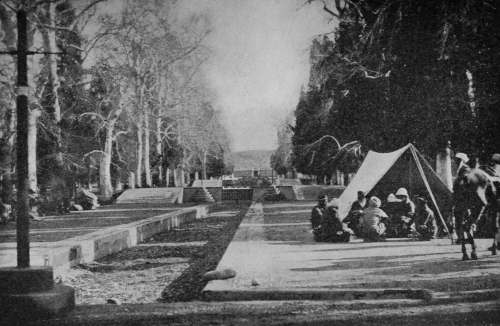
GROUNDS OF PALACE OCCUPIED BY THE DANE MISSION
The visitation of Providence upon Abdur Rahman could hardly have come at a more inopportune moment. Although the peace of the Indian frontier in 1901 was disturbed only by the Mahsud-Waziri operations, resulting from the legacy of hate which our activities on the Waziristan border during Lord Elgin’s administration had bequeathed to Lord Curzon, the action of Russia in the previous year in respect of Russo-Afghan relations had made it quite clear that the harmony of Mid-Asia was involved in the disastrous failure of British arms in the Transvaal. Nothing had ever been more probable than that an irruption of disorder throughout Afghanistan would attend the death of the late Amir. It was upon this contingency that, in the past, much thought and no little speculation had turned. Even if historical parallels were ignored, there were so many claimants to the accession in the field that the wiseacres of the chancelleries throughout the world had freely prophesied the decease of Abdur Rahman to be the signal for a general mêlée in Asia, in which Russia and Great Britain would support the rival factions. The Russians, no less than ourselves, shared these premonitions; and, when the precarious condition of Abdur Rahman’s health became actually alarming in the spring of 1901, there was a wealth of suggestion in the silent preparation which took place along the Russo-Afghan and Indo-Afghan borders. Under the watchful ægis of Lord Curzon no sign of the apprehensions to which the death of Abdur Rahman gave rise in the mind of the Government of India was permitted to become public. While the first indication of a recrudescence of Russian activity along the Afghan border had been given nearly two years before, a fresh fillip to the situation was imparted by the sudden departure for the Afghan frontier of the Russian Minister of War, General Kuropatkin, who quitted St. Petersburg immediately after the receipt of the tidings of the Amir’s demise. Almost the earliest act of the former Governor-General of Asiatic Russia upon his arrival in Trans-Caspia was to release from imprisonment at Merv, on October 19, 1901, six Afghans who had been charged with espionage. Summoning them to his presence, he gave them the following message of good-will to the new Amir:
A misfortune has befallen Afghanistan. The Amir Abdur Rahman is dead and Habib Ullah, one of his sons, has ascended the throne. We Russians have always considered ourselves friends of Afghanistan and we wish to remain so in the present change of Government. Therefore, in setting you at liberty, I command you to report yourselves to your nearest chieftain and to repeat to him the words you have heard from the Russian Minister of War.
While General Kuropatkin moved from Merv to Tashkent, where he was engaged in an inspection of the garrison, besides taking part in the ceremonies attendant upon the turning of the first sod of the Tashkent division of the Orenburg-Tashkent Railway, the Government of India replied to his act of overt insolence by entrusting to the chief of the Mahommedan Mission, which left Peshawar for Kabul on November 20, 1901, an invitation for his Highness the Amir of Afghanistan to visit India. In spite of certain pre-occupation, General Kuropatkin, during his visit to Central Asia, found time to devote considerable attention to Abdur Rahman’s successor. Before December 11, when the deputation of Indian Mahommedans quitted Kabul for their own homes, Habib Ullah received from the Governor of Mazar-i-Sharif an intimation that the Governor of Tashkent would send towards the close of the winter 1901-02 a deputation of Mahommedan officials from Russian Turkestan to participate in the Nauroz festival on March 21 at Kabul. Accompanying the escort were to be several batteries of field guns with supplies of ammunition, intended as a gift to his Highness in commemoration of his accession.
The significance of these circumstances was not lost upon Habib Ullah, whose perception would indeed have been dim if the antagonism of Anglo-Russian interests at the Court of Kabul had escaped his notice. An inkling of his attitude towards foreign affairs had been given when, in the very early days of his reign, he had ordered his people to observe Abdur Rahman’s prohibition against any use of the Quetta-Chaman extension between the first station on the southern side of the Khwaja Amran tunnel and the terminus at its northern extremity. In view of this, more than ordinary interest attached to the pronouncement which, it was anticipated, Habib Ullah would make to the members of the Indian Mission of Condolence.
At their first reception Habib Ullah’s attitude hardly commended itself to the pleasure of his guests. Inquiring what were the intentions of the Government of India in respect of his father’s subsidy, the invitation from the Viceroy was handed to him. After expressing satisfaction at the compliment which had been paid to him and alluding to the difficulty of accepting the invitation for some time, he hinted that the obligations contracted by Abdur Rahman were not binding upon himself. Finally, he threw the delegates a crumb of comfort in the assurance that he would follow in the footsteps of his lamented father. At a later date, in full Durbar and attended by the Mission, he expounded his policy, reiterating his intention to respect Abdur Rahman’s prejudices in regard to the introduction of telegraphs, the construction of railways, the reorganisation of the army, the appointment of a European British agent to Kabul and the adoption of Western customs—even the use of foreign medicines was banned. Schools for instruction in the Persian and Arabic languages, and the Mahommedan faith, would be opened, but the country would be jealously guarded against every form of external aggression.
For reasons which did not transpire, but which would not be difficult to determine, the visit of a Mahommedan deputation from Russian Turkestan did not take place. Meanwhile, astonishment at the promulgation of the recent ordinances had barely subsided when Habib Ullah began to press attentions upon his former tutor and pestilential frontier fanatic, Najib-ud-Din, the Mullah of Hadda, this action at once introducing into the arena of Anglo-Afghan relations a disquieting figure. Ostensibly with a view to honouring his former teacher, Habib Ullah detached certain disciples from the mullah’s entourage for a Mahommedan crusade in Kafiristan, increased his sacerdotal powers by placing a large section of the frontier within his religious jurisdiction, ordered a new mosque to be built for him and invited him to participate in the Installation ceremonies at the Nauroz, presenting him with the gift of an elephant and howdah for the journey. Invitations to the Nauroz celebrations were issued to other leading spirits in the frontier disturbances of 1897, including the notorious Mullah Powindah from Waziristan, the troublesome fire-eater Mullah Said Akbar from Tirah and the Safi Mullah. Following so closely upon the semi-contemptuous rejection of the representations which the Government of India had made through the deputation of Indian Mahommedans, Habib Ullah’s predilection for the society of men who had already incurred the displeasure of the Government of India made manifest the fact that the impulse of bigotry was stronger in him than the dictates of policy. The late Amir was accustomed to use the mullahs to consolidate his own authority and to interpose a fretful hedge of fanaticism between his kingdom and the outside world. But he knew also how to curb their insolence when occasion required, and he made them all—kazis, imams and muftis—servants of the state. This adroitness in professing a militant orthodoxy and in securing at the same time the supremacy of the state over the church in Afghanistan, has been described as one of the most remarkable proofs of Abdur Rahman’s political genius.
Habib Ullah’s action in immersing himself in religious affairs so soon as he had ascended the throne, belonged to a different category. It gave rise to misgivings with regard to his capacity to hold the helm of state with the same firmness and clearness of vision as had enabled his father to descry the various shoals ahead. In any case since it boded no good to the peace of the frontier, it drew down upon the Amir a polite but unmistakable remonstrance. The effect of this was not lost upon the throne; and when the aged mullah pleaded, in excuse of his inability to attend the Nauroz, the difficulties of a journey across the hills in March, the point was conceded by his late pupil. Moreover, the Amir’s attitude at the Nauroz was circumspect and remarkable only for a very colourless exposition of the divine character of the shariat, the strict fulfilment of which he enjoined upon all good Mahommedans. Five days after the celebration of the Nauroz, however, the summons to the Hadda Mullah was repeated, but the Amir’s reception of this distinguished prelate was sufficiently cool to disarm criticism.
Administrative and domestic difficulties beset Habib Ullah at an early date in his career as Amir of Afghanistan. Before the summer of 1902 had waned the discovery of a palace intrigue with extensive ramifications induced him, at a Durbar on June 8, to order the re-establishment of the Secret Intelligence Branch in Kabul, the reports from which were to be presented to him each morning. At the same time, in an interesting attempt to temper despotism with justice, he ordained that an influential rais from each tribe should be associated with each local governor to assist in the disposal of tribal cases. More important matters were to come before a Council of State in Tribal Affairs, which he now proceeded to create. It was composed of leading members of various tribes; and weekly meetings were to take place in Kabul under his own presidency. Almost the first matter to engage the consideration of this body was, in August 1903, a joint protest from the Ghilzais, Duranis and Suliman Khels against the application of Abdur Rahman’s scheme of calling up one man in eight for military service. In preference to this measure the objectors propounded the suggestion that musketry instructors should be appointed to all large villages. Acceptance of any modification of Abdur Rahman’s plan was deferred until the return of Nasr Ullah Khan from a tour of inspection of the military conditions of the state, which the Amir had projected.
As these events were occurring at Kabul, it became evident in Europe, that although Russia had not returned to the charge in respect of her communication to the Foreign Office on February 6, 1900, she had not abandoned the purpose which she had in view. In the middle of August 1902 the Russian authorities, in defiance of their treaty limitations, twice secretly addressed the Afghan Government, concealing this grave breach of their obligations towards us by an impudent agitation in the press for liberty of direct communication with Afghanistan. On August 31, the mouthpiece of the Russian Foreign Office, the Novoe Vremya, contained the following startling observation:
... The necessity for closer intercourse has so increased that it is impossible longer to observe the conditions of the 1873 Agreement. The Russian Government have notified England that the effort of two years ago to enter into direct relations with Afghanistan continues. We cannot, therefore, consider ourselves bound by any obligations whatsoever on the question of having direct relations with Afghanistan on any subject that might interest us. By virtue of the proximity of the two countries, the development of intercourse between the local populations which goes on every year will undoubtedly call for the adoption of measures for the establishment of normal relations with Afghanistan as being the only ones possible with a neighbouring state. Upon the progress of events generally and the civilising effects over the local populations of Russian influence will depend alone the time when such measures will be adopted....
Four days later, on September 4, the St. Petersburg Bourse Gazette, a paper in close relation with the Finance Ministry, said:
... The question which is ripe for settlement and will not brook delay is the question of Russian diplomatic representation at Kabul. Now that the Russian outposts have been pushed to the Afghan frontier, it is unreasonable that Kabul should remain inaccessible....
A message from the governor of Russian Turkestan to the governor of Afghan Turkestan, requesting that direct commercial intercourse might be established across the Oxus, had already been delivered when the initiatory efforts of the Novoe Vremya and the St. Petersburg Bourse Gazette were seconded by the Viedomosti and the Moscow Bourse Gazette. While the Russian press debated the character of their obligations to us in respect of Afghanistan, the emissary of the Russian Government, Sikandur Khan, a Turcoman from Ali Yurt, proceeded to Kabul. Nearly two months elapsed before tidings of the arrival of Sikandur Khan at Kabul on September 4, reached India. Proof of Russia’s proceedings was then incontestable since, on September 5, at a State Durbar which had been specially summoned, Habib Ullah read a letter from the Russian Government to the following effect:
... In the opinion of the Russian Government the time has now come for closer commercial relationship between Afghanistan and Russia. The Afghans have nothing to fear from Russian aggression, since the friendliness existing between England and Russia would be endangered if further annexations were made by the Government of the Tsar in the direction of Badakshan and Wakhan. This fact in itself becomes a permanent guarantee of peace. In these circumstances it is an act of folly to continue the attitude of suspicion and concealed hostility that now exists between the Afghan and Russian commanders of frontier posts. The Russian Government, therefore, invites the Amir to throw open to Russian caravans the trade routes between Khushk and Herat and Khushk and Kabul. The Russian Government in return will allow Afghan traders to enter freely and traverse without restrictions Russian territory. The matter has already been laid before the British Government, but this letter is addressed personally to the Amir of Afghanistan because a favourable answer from the Afghan Government would greatly strengthen the Russian case....
When the reading of this document was finished the Amir asked for the opinion of the Durbar, the temper of its members being illustrated by Ali Yar Khan, who said:
“Let this Turki dog who carries messages for infidels be beaten on the head with shoes till his hair falls off. That ought to be our answer to the Russians.”
The Amir, greatly displeased at this remark, observed that, if there were any shoebeating, it would be for him who suggested the maltreatment of the messenger. Subsequently fifty rupees were given to the Russian courier. After some public discussion the Durbar dispersed, the Amir ordering the State Secretary to acknowledge receipt of the Russian communication, and to say that, while he was willing to discuss the matter, the interchange of views must in future be made through the Government of India in accordance with the precedent established by his father, the Amir Abdur Rahman. The Russian proceedings not unnaturally attracted the attention of Parliament; and on October 21, Lord George Hamilton acquainted the British public for the first time with the receipt of the proposal which had been transmitted by the Russian Embassy to the Foreign Office nearly three years before. The correctness of the Amir’s reply was in striking contrast with the impropriety of the Russian communication, the despatch of which had transgressed the limits of diplomatic etiquette. As far back as 1868-69, Prince Gortchakoff had assured Lord Clarendon that the Russian Government regarded Afghanistan as completely outside her sphere of influence. That engagement had been re-affirmed in 1875; extended, according to the statement made by M. de Giers to Mr. Kennedy on October 2, 1883, to include abstention from the transmission of letters of ceremony, and constantly renewed in personal conversation upon a variety of occasions since the original was enacted.
This action of Russia on the waters of the Oxus had drawn attention to the vague, uncertain state of the relations subsisting between Kabul and Calcutta. As matters stood all former agreements between India and Afghanistan had automatically terminated with the death of Abdur Rahman; and it remained for the succeeding Amir to adjust the situation by calling upon the Government of India to renew the arrangements by which Afghanistan had become a subsidised and protected state of India. Although twelve months had passed since the decease of the late Amir and many opportunities had been accorded him, Habib Ullah had given no indication of any desire to enter into any undertaking with the Government of India. Nevertheless he credited himself quite wrongfully each month with the accretions of his subsidy and the balance of his father’s monies which were lying, by the particular arrangement of the late Amir, at the Treasury in India. There is, to the onlooker, the greater piquancy in this regular remittance to India of debit cheques against the Treasury, since Habib Ullah, from the outset of his reign, had exhibited a most imperfect loyalty. The patronage which he extended to the Hadda Mullah had already brought one rebuke upon him; its continuation, in the face of such remonstrance, disclosed no sense of responsibility to the Government of India. Again his procrastination in dealing with the Viceroy’s invitation to a conference obviously qualified those amiable expressions of regard for Lord Curzon which Habib Ullah was at such pains to profess.
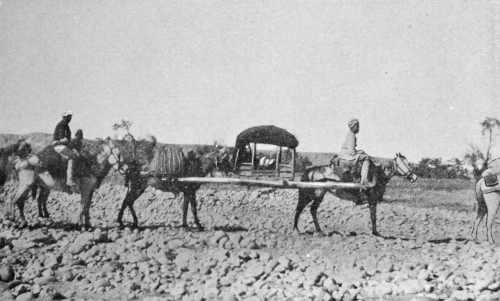
TAKHT-I-RAWAN
Since his accession, in marked contrast with the policy of his father, he had received numerous deputations from the Afridi zone, including one from the most predatory of all the clans south of the Khyber, the Zakka Khels, whose hostility to the British Government has always been a prominent feature of the frontier. The good impression, created in September, when he had invited the Hadda Mullah to return finally to his own country, placing a takht-i-rawan at his disposal for the journey, was ruined by this foolish dalliance with Afridi tribes from within the Durand border. At the moment, taking time by the forelock, Habib Ullah was anxious to raise an Afridi bodyguard, composed of men upon whose personal loyalty absolute reliance could be placed in case of an émeute in the palace. Knowledge of this fact acted as a spur to the more disorderly border-elements, who wished to separate the Afridis, as a tribe, from the control of the Indian Government. Embodying their several schemes in one, they put forward a plan which was presented to Habib Ullah by Khawas Khan, an Afridi malik, who, in 1897, had fled before the avenging arm of the Indian Government to Kabul. This worthy, now entirely dependent upon the benevolence of the Amir’s Government, urged his protector to raise an Afridi contingent, to which project Habib Ullah was foolish enough to assent. Robes of honour were issued to the tribal chiefs and a rate of pay, double the amount allowed to the Afghan soldiery, with a month’s advance, was promised to all recruits. Two thousand Afridis came forward in the first week, 500 of whom after receiving their rewards at once deserted. The success of this new departure appeared to be assured, when the corps was disbanded on account of the hostility which was displayed by the Afghans themselves to the scheme, the men being permitted to retain the clothing, modern breech-loading rifles and ammunition with which they had been supplied. The moving influence in this salutary change of mind on the part of Habib Ullah had been that of Nasr Ullah Khan; and it was with the greater regret that, in a little time, the Amir of Afghanistan was found to have broken away from the more masterful will of his brother to toy once again with the questionable ministrations of the Hadda Mullah. Early in November this holy, but tiresome, prelate wrote and persuaded Habib Ullah to hold a special Durbar in order to accept from the hands of the mullahs the title of Siraj-ul-Millat wa ud-Din—“The Lamp of The Congregation and The Faith.” In view of this it was generally felt that the happiest augury for the peace of the Indo-Afghan border, at the end of 1902, was the death of the Hadda Mullah on December 23, when the Afghan Government devoted a sum of 30,000 rupees towards the funeral obsequies of their sainted protégé.
The removal of the obstacles in the way of any cordial understanding between Russia and Great Britain in respect of Afghanistan was not assisted when, on January 14, 1903, the Foreign Office in St. Petersburg issued, in reference to the declaration made by Lord George Hamilton, the following communique:
As regards Russia’s relations with Afghanistan, it is necessary to declare that Russia addressed no request of any sort to the British Cabinet, but simply notified it of her desire and purpose to enter into direct relations with Afghanistan in the future.
No further declarations were made on this subject.
If language is to have any meaning at all in diplomacy, as in ordinary life, this utterance can only be characterised as one of the most flagrant perversions of truth that have ever disgraced the history of even Russian politics. Quite rightly the request of February 6, 1900, had been interpreted as a veiled demand for the right to establish a Russian representative at Kabul. The proposal admits of being supported by the plausible contention that such an agency would be a convenient means of settling disputes and avoiding collisions on the Russo-Afghan border. It must not be forgotten that it was over almost an identical question—the reception of the Stolietoff Mission by Shir Ali—that Great Britain fought the Second Afghan War; and it can hardly be denied that, if the concession demanded by the Note of 1900 were granted, the result would be to set up an influence in Kabul hostile in spirit to our own and from the first day of its existence there devoted to the sapping of our position.
Great inconvenience of course attaches to a system by which the smallest detail in the adjustment of any difficulty along the Russo-Afghan frontier must be referred for settlement from the Oxus to Tashkent, from Tashkent to St. Petersburg, from St. Petersburg to London, from London to the Government of India, and from the Viceroy’s Council to Kabul where, after much delay, the same process is repeated over the return journey. Unfortunately, the maintenance of such a cumbersome procedure is essential to the harmony of Anglo-Afghan relations since, although Russia professes to require facilities for frontier intercourse in commercial matters alone, similar protestations reduced Manchuria to the level of a Russian protected State until Japan intervened. Great Britain does not wish to embark upon a campaign in Central Asia and there need be no war so long as Russia, observing the pledges which she has given, tempers her desires with discretion. But continuation of the mischievous interference in Persia and Afghanistan, which has distinguished her actions hitherto, is a menace to the world’s peace, as the indulgent nature of the British Government has now been pushed to the limit of its endurance.
So far as Anglo-Afghan relations were concerned the New Year of 1903 held out little prospect of improvement. Possibly the mass of business, associated with Habib Ullah’s installation as Siraj-ul-Millat wa ud-Din, early in April, did prevent the Amir of Afghanistan from visiting India in the spring of this year. But, aside from the irregularity of the Amir’s behaviour, the incident of April 6, when Lieutenant-Colonel A. C. Yate, commanding the 24th Baluchistan Infantry Regiment and stationed at Chaman, was arrested by Afghan officials for an innocent trespass beyond the Indo-Afghan border and removed to the fort at Baldak Spin, may be regarded as throwing light upon the precise quality of the bonds of amity which were uniting the two countries. Again, serious exception could be taken at the manner in which the Amirs of Afghanistan were employing the permission to import munitions of war which had been granted by the Government of India. The arrival of the thirty Krupp guns, acquired by Abdur Rahman on the eve of his death, had revealed the presence of a large number of castings for heavy ordnance which had been secretly obtained from Essen by the late Amir. A small army of carts and camels, lent by the Government of India, carried the thirty guns from Peshawar to Jelalabad, whence forty elephants, sent by Habib Ullah for the purpose, bore them to Kabul. Very properly transport was denied to that part of the purchase which disclosed Abdur Rahman’s strange dereliction of his treaty rights. Moreover, it was not difficult for Habib Ullah to recognise the irregularity of his father’s procedure, the immediate consequence of which was the repudiation of the order by the son. Unhappily, before this particular incident could be considered to have closed an immense consignment of rifle cartridges, numbering several millions of rounds, many of which were found to be of the explosive character condemned by the Hague Conference, arrived from the Amir’s agents in England. Since it never had been intended that the right to import munitions of war accorded to the late Amir of Afghanistan implied the power to amass an unlimited amount of war matériel in Kabul, no other course was open to the Viceroy of India than to see that these other stores were likewise detained by the frontier authorities.
Something more important than considerations of prestige, therefore, was embroiled in the indifference which the Amir of Afghanistan displayed towards India as the paramount state, making it incumbent upon the Government to repeat their earlier representations. There was no need, indeed the occasion had hardly arisen, for any violent coercion. The situation required merely such tightening of the reins as would bring to the ruler of Kabul a proper comprehension of the actual ties between his country and India. In the correspondence which ensued, the Amir claimed the right to import munitions of war under the treaty which had given similar powers to Abdur Rahman. Unfortunately Habib Ullah had no such right; nor was any moral obligation to honour the debit notes which Habib Ullah had drawn every month against the Indian Treasury attaching to the Government of India. These points were made clear to the Amir who had neither the funds to pay for nor the authority to order the armaments which were then waiting at the frontier. The lesson had been driven home, and the loftiness of tone, which the Amir of Afghanistan had adopted in the initiatory letter, was hardly discernible in his concluding statement. Since there was no malice in the attitude of the Government of India, the Amir of Afghanistan was again invited to visit India for purposes of a conference with the Viceroy. A visitation of cholera, which swept through Kabul and North-eastern Afghanistan in 1903, the worst since the epidemic of 1879, permitted an excuse to be offered at which no exception could be taken. Before the scourge had subsided Russia had repeated her designs against Afghanistan. This, in view of the explicit denouncement of her treaty requirements, implied by the communique of January 1903, was not perhaps surprising. Their renewal was denied by Lord Cranbourne in the House of Commons both in the spring and autumn sessions of 1903. Nevertheless, in the middle of February, Sirdar Ali Khan, the governor of Afghan Turkestan, had sent to Kabul four Russian spies whom he had arrested near Mazar-i-Sharif; but the most flagrant of these insidious encroachments upon a British preserve occurred in the following August, when the governor of Russian Turkestan sent back some deserters from the Afghan army who had escaped into Russian territory. Obviously the note of defiance in the message which accompanied them was addressed to the suzerain power.
It ran:
As the Tsar and the Amir are amicably disposed the one to the other, His Imperial Majesty has given orders that every effort shall be made to continue the friendly relations existing between Russia and Afghanistan.
As representative of the Tsar I am directed to send back all refugees and evil-doers who come to my territory from Afghanistan. This is the reason why I send back to you these eleven soldiers with their arms.
Please be kind enough to communicate this to the Amir.
In spite of these persistent endeavours to establish friendly relations with Kabul there is little reason to believe that Habib Ullah offered any encouragement to the Russian frontier officers. Inveterate suspicion of foreign influence characterises every aspect of his external policy and Russia and Great Britain are made to feel impartially the effect of this attitude. Abdur Rahman accepted the good faith of the Indian Government unquestioningly and understood his northern neighbour sufficiently to realise that it was less a wish for the friendship of Afghanistan than a desire to pin-prick India which prompted her overtures. Habib Ullah has yet to learn how to stand where his father strode with perfect confidence, a foolish mistrust sapping the strength of the son. Under a less skilful statesman than Lord Curzon it is conceivable that the patience of the Government of India would long since have been exhausted. That exceptional familiarity with the affairs of Asia, which preeminently distinguishes the late Viceroy, enabling him to tread Oriental labyrinths with wise discrimination, permitted him upon this occasion to bridge once more a crisis between Afghanistan and India. Almost in defiance of Kabul obstruction, he proceeded to the solution of difficulties which did not require any personal discussion with a refractory potentate. Early in the winter of 1903-04, the Government of India took up for consideration those sections of the Afghan boundary which, ever since the withdrawal of the Udny Mission eight years previously, had required demarcation. Surprised into ruffled acquiescence, the Amir in January 1904 began to make extensive preparations for a meeting between Major Roos-Keppel, the chief of the British Commission, and his own representative. Through the brief absence of Lord Curzon from the helm of state, the vacillation of the Amir precipitated a collapse of these plans at the last moment. Wilfully stupid, too, only a little later—in July 1904—was Habib Ullah’s order to Nasr Ullah Khan to select twenty-four officers who were to be detailed as envoys to England, France, Germany, Russia, Persia, China, Japan, Turkey and Egypt in the Old World, and America in the New World.
If the break-down in the negotiations anent the Mohmand boundary had increased the tension between Kabul and Calcutta, it was certainly impossible to tolerate this more direct perversion of the principles out of which the fabric of our relations with Afghanistan had been woven. Concerned at the rupture which was threatening between India and Afghanistan at a moment when Lord Curzon was absent from India and too timid to insist upon the Amir’s acceptance of the Viceroy’s invitation to a conference, the Imperial Government, as the only means of renewing the Agreements upon which they were set which remained to them, decided to despatch a Mission to Kabul. At the instance of the Secretary of State for India, Mr. St. John Brodrick, the acting Viceroy of India, Lord Ampthill, acquainted Habib Ullah with the wishes of His Majesty’s Government. In reply His Highness, with the hope of improving his position when the time came for diplomatic discussion and as an act of conciliation towards the Viceroy, intimated his willingness to send his son Inayat Ullah Khan—a charming, intelligent boy of sixteen and a remarkable instance of that youthful precocity which attains so abnormal a development in the Oriental—to meet Lord Curzon upon his return to India. However pressing may have been the questions outstanding between the Government of India and the Amir of Afghanistan, the visit of a British Mission to Kabul—no doubt desirable and in that sense opportune—was derogatory in a Government whose invitations to the head of the country, which it was proposed to honour in such an emphatic fashion, had been treated with contumacy. Lord Curzon’s opposition to the project is well-known; but with the exception of this distinguished statesman few were prepared for the unfortunate set back which the mission received. A grievous miscalculation undoubtedly was made. But the blunder, which determined its existence and brought about a complete miscarriage of Anglo-Indian policy, lay not so much in sending the mission as in His Majesty’s Government not having decided, if the Amir proved recalcitrant, how far and upon what ground the Cabinet should stand firm.
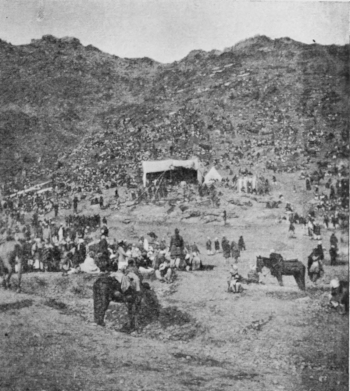
FESTIVAL IN HONOUR OF THE DANE MISSION
As constituted, the Mission comprised Mr., now Sir, Louis Dane, Foreign Secretary at Simla, Mr. H. R. Dobbs—who, together with Major Wanliss, had recently returned from replacing the boundary pillars on the Perso-Afghan border—Major W. Malleson, R.A., Captain Victor Brooke, 9th Lancers, and a British doctor. Leaving Peshawar on November 27, the mission reached Dakka on November 29, and was met at Lundi Khana by 200 Afghan cavalry under the Sipah Salar Ghulam Hussein, the Sarhang of Dakka, and Mahommed Hasan Khan. Major Roos-Keppel, political agent for the Khyber, accompanied the party for a few miles beyond Lundi Khana to Torkhana, where a guard of honour of the Khyber Rifles was drawn up, the mission ultimately arriving at Kabul on December 10. Elaborate gifts were conveyed by Mr. Dane for presentation to the Amir, among many others a £700 motor-car and several cases of sporting equipment. As a compliment to the ladies of the harem the Government of India thoughtfully included a cinematograph, providing at the same time the necessary operator. Among the presents to the Mission from his Highness were a gold watch and a set of gold cuff links which Habib Ullah had offered to Mr. Dane. The note struck by the negotiations was scarcely in the same pitch as the festivities by which the withdrawal of the Mission was celebrated, when seven gramophones simultaneously discharged bursts of discordant revelry. Nevertheless, the din of these instruments fell on the ears of those who had every cause to be relieved at the peaceful termination of their labours, since the clouds had hung low over Kabul throughout the Anglo-Afghan conferences of 1904-05.
Many things in our buffer state of course required to be improved as much for the enhancement of its own interests as for the advantage of India. There was the Amir’s perpetuation of Abdur Rahman’s objection to Afghan subjects using the northern extremity of the Quetta-Chaman railway to be discussed, as well as the projection of railways from Chaman to Kandahar and from Peshawar to Kabul. Besides these important subjects there were the prolongation of the Indian system of telegraphs to Kabul and Kandahar; the provision of telegraphic communication between Kabul, Mazar-i-Sharif and Herat; Kabul and Kandahar; Kandahar and Herat. The re-organisation of the Afghan army had also to be considered, while the demarcation of the Mohmand boundary and the Seistan border, the definition of the Amir’s control over border tribes, the question of the subsidy and Habib Ullah’s powers in respect of the importation of munitions of war were topics, the examination of which would be, it was expected, to the mutual benefit of the contracting parties in an Anglo-Afghan alliance. In India it was understood that there might be a difficulty in the arrangement of the terms which were to be secured from the Amir; but that ultimately, and after protracted negotiations, our demands would be conceded. To this end the chief of the Mission was provided with a treaty, drawn up under the personal supervision of Lord Curzon during his brief residence in London in 1904, which was designed to bring about a discussion of every aspect of the old agreements with a view to removing previous difficulties and arriving at a clear understanding for the future.
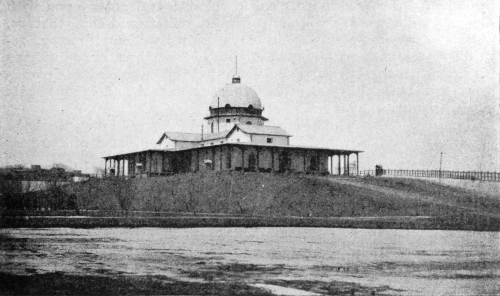
SCENE OF THE AUDIENCES BETWEEN HABIB ULLAH AND SIR LOUIS DANE
This treaty comprised three clauses, but Habib Ullah, simulating annoyance at the terms of the clause which attempted to restrict the importation of arms, would not enter into any discussion over it. After the Mission had passed four months in the Afghan capital, the limit, to which the Amir of Afghanistan would permit himself to go, reproduced simply the formal renewal on both sides of the engagements entered into between Abdur Rahman, the late Amir of Afghanistan, and the Government of India.
The Dane Treaty therefore was as follows:
He is God, Extolled be His perfection,
His Majesty Siraj-ul-millat-wa-ud-din, Amir Habib Ullah Khan, Independent King of the State of Afghanistan and its Dependencies, on the one part, and the Honourable Mr. Louis William Dane, C.S.I., Foreign Secretary of the Mighty Government of India and the Representative of the Exalted British Government on the other part.
His said Majesty doth hereby agree to this, that in the principles and in the matters of subsidiary importance of the Treaty regarding internal and external affairs, and of the engagements which his Highness my late father, that is, Zia-ul-millatwaud-Din, who has found mercy, may God enlighten his tomb! Concluded and acted upon with the Exalted British Government, I also have acted, am acting, and will act upon the same agreement and compact, and I will not contravene them in any dealings or in any promise.
The said Honourable Mr. Louis William Dane does hereby agree to this, that as to the very agreement and engagement which the Exalted British Government concluded and acted upon with the noble father of his Majesty Siraj-ul-millatwaud-Din, that is, his Highness Zia-ul-millatwaud-Din, who has found mercy, regarding internal and external affairs of principle or subsidiary importance, I confirm them and write that they (the British Government) will not act contrary to those agreements and engagements in any way or at any time.
Made on Tuesday, the 14th day of Muharram-ul-haram of the year 1323 Hijri, corresponding to the 21st day of March of the year 1905 A.D. (Persian Seal of Amir Habib Ullah Khan.)
This is correct. I have sealed and signed.
Amir Habib Ullah, Louis W. Dane, Foreign Secretary, Representing the Government of India.
Thus the situation upon the arrival of Mr. Dane from Kabul differed in no way from that which had preceded his departure for the Afghan capital, save that substantial concessions had been awarded to the Amir of Afghanistan who, in return, had conceded nothing. In addition to an astonishing and entirely unnecessary elevation in the style and title of the ruler of Afghanistan—conveyed in the charge “Independent King of the State of Afghanistan and its Dependencies,” and the reference to “His Majesty,” which the precious instrument reveals—inevitable corollaries of the transaction were the continuation of the annual subsidy of eighteen lakhs to Abdur Rahman’s successor, the release of the arrears—approximately amounting to £400,000—which had been accumulating since a little previous to the demise of the late Amir, and the right to an unrestricted importation of arms.
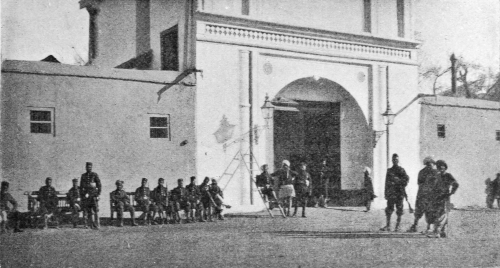
ESCORT OUTSIDE THE GATE OF THE QUARTERS OCCUPIED BY THE DANE MISSION
It must not be supposed that the mere ratification of the engagements was sufficient for the purposes of British policy in Central Asia. Much more was needed; and, since facilities were deliberately withheld and the Amir rejected consideration of our pledged responsibility, it is evident that the subjugation of Afghanistan to the interests of India is incomplete. It is of value perhaps to have ascertained that the Amir is disaffected and untrustworthy. There was always a doubt but it was hoped that the affront, which he offered so sedulously to the British Government, was due to his own conspicuous vanity rather than the manifestation of actual ill-will. The Kabul conference made that point clear; but, as the Imperial Government have elected to observe an impressive reticence upon the circumstances of this unfortunate episode, it is no less incumbent upon others to do likewise. Nothing can be gained by revealing to the world the details of a rebuff without parallel in the history of Indian politics, unless such acknowledgment were made to assist public opinion in appreciating the issues involved in the absence of any satisfactory understanding between Kabul and Calcutta. That this course formed no part of the late Government’s policy was disclosed on June 21, 1905, by the debate in Parliament upon the Indian budget and, at a later date, upon Mr. Balfour’s speech on Imperial Defence. The Ministers, who spoke on these occasions, concealed the truth rather than stated it, and their utterances cannot be accepted as either correct or adequate. Mr. Balfour’s statement that the construction “of strategic railways by Russia in Afghanistan” would provoke Great Britain to war does not render the character of Anglo-Afghan policy more intelligible, nor remove the disadvantages from our position. On the contrary, the utterance was most misleading since no such contingency, as the construction of Russian railways in Afghanistan itself, is likely to occur until Russia is prepared to strike with all her strength in Persia and Afghanistan. The question of Anglo-Afghan relations, therefore, remains for solution, having given rise to a situation which was regarded by the late Viceroy and every member of his Council with the gravest apprehension.
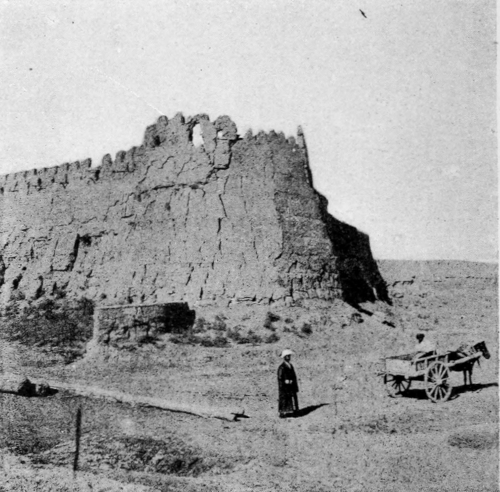
THE WALLS OF BOKHARA
APPENDICES
APPENDIX I
NAMES OF STATIONS ON THE ORENBURG-TASHKENT RAILWAY
Name of Station and distance from Orenburg.
(1) Orenburg
(2) Myenovoi dvor
(3) Donguzskaya
(4) Mayatchnaya
(5) Iletsk (72 versts)
(6) Grigoryevskaya
(7) Ak Bulak
(8) Yaksha
(9) Yaisau
(10) Aksu
(11) Kara Tugai
(12) Kuraili
(13) Aktiubinsk (255 versts)
(14) Bish Mamak
(15) Tamdi
(16) Akkemir
(17) Kandagatch
(18) Temirskaya
(19) Ker
(20) Kuduk
(21) Emba
(22) Kirghizskaya
(23) Mugodjarskaya (400 versts)
(24) Rodniki
(25) Karaganda
(26) Kauldjir
(27) Solenaya
(28) Ulpan
(29) Tchelkar
(30) Biriuk
(31) Djilan
(32) Tuguz
(33) Kara-Tchokat
(34) Altin
(35) Saksaoulskaya
(36) Kontu
(37) Arabskoye Morye (790 v’sts)
(38) Sappak
(39) Andreevskaya
(40) Kamyshli Bash
(41) Bik Bauli
(42) Kazalinsk (942 versts)
(43) Bashkara
(44) Mai Libash (978 versts)
(45) Ak Suat
(46) Turatan
(47) Durmen Tubeh
(48) Khor Khut
(49) Karmakchi (1108 versts)
(50) Kizyl Tam
(51) Kara Ketkeu
(52) Ak-Su
(53) Teren Uzyak
(54) Kara Uzyak
(55) Perovski (1246 versts)
(56) Ber Kazau
(57) Solo Tubeh
(58) Tar Tugai
(59) Djulek (1343 versts)
(60) Skobelevo (1367 versts)
(61) Tumen Arik (1394 versts)
(62) Yani Kurgau
(63) Ak Kum
(64) Sauran
(65) Tchornak
(66) Turkestan (1514 versts)
(67) Ikan (1543 versts)
(68) Otrar (1558 versts)
(69) Kara Kungur
(70) Aris (1570 versts)
(71) Kabul Sai
(72) Uzun Sai
(73) Tchanak
(74) Sari Agatch
(75) Djilga
(76) Darbaza
(77) Keless (1740 versts)
(78) Tashkent (1762 versts)
APPENDIX II—(A)
LIST OF STATIONS FROM TASHKENT TO MERV, WITH DISTANCES FROM KRASNOVODSK AND TASHKENT
Name of Station. Distance from Krasnovodsk. Distance from Tashkent.
Versts. Versts.
(1) Tashkent 1747
(2) Kauffmanskaya 1721 26
(3) Vrevskaya 1698 51
(4) Syr-Darinskaya 1672 75
(5) Golodnaya Steppe 1637 110
(6) Chernaievo 1605 142
(7) Obrutchevo 1557 190
(8) Lomakino 1548 199
(9) Jizak 1522 225
(10) Milyutinskaya 1498 249
(11) Kuropatkino 1473 274
(12) Rostovtsevo 1445 302
(13) Samarkand 1415 332
(14) Djuma 1394 353
(15) Nagornaya 1365 382
(16) Katta-Kurgan 1343 404
(17) Zirabulak 1316 431
(18) Ziadin 1291 446
(19) Kermine 1269 478
(20) Malik 1243 504
(21) Kizil-Teppe 1223 524
(22) Kuyu-Mazar 1206 541
(23) Kagan 1182 565
(24) Murgak 1160 587
(25) Yakatut 1142 605
(26) Kara-Kul 1117 630
(27) Khodja-Davlet 1098 649
(28) Farab 1078 669
(29) Charjui 1070 677
(30) Barkhani 1038 709
(31) Karaul-Kuyu 1020 727
(32) Repetek 1003 744
(33) Pesski 970 777
(34) Utch-Adja 954 793
(35) Ravnina 924 823
(36) Annenkovo 904 843
(37) Kurban-Kala 885 862
(38) Bairam-Ali 869 878
(39) Merv 842 905
APPENDIX II—(B)
MURGHAB VALLEY RAILWAY LIST OF STATIONS FROM MERV TO KUSHKINSKI POST WITH DISTANCES FROM KRASNOVODSK AND MERV
Station. Height above Caspian Sea. Distance from Merv. Distance from Krasnovodsk.
Sagenes. Versts. Versts.
Merv 118.01 — 842
Talkhatan Baba 127.06 37 879
Yulatan 134.16 56 898
Sultan-i-Band 139.55 76 918
Imam Baba 148.60 120 962
Sari Yazi 155.57 157 999
Tash Kepri 164.00 197 1039
Kala-i-Mor 202.07 244 1086
Kushkinski Post 303.04 293 1135
APPENDIX III
Kishlak, a village of sedentary Turcomans, as opposed to Aoul, the nomad village.
Mekteb, the lower-class Mussulman elementary school.
Medresse, university of a theological order.
Arik, canal or channel diverted from river for irrigation purposes.
TABLE OF MEASUREMENTS
1 sagene = 7 ft.
1 dessiatine (= 2400 sq. sagenes) = 432 sq. roods (2.70 acres)
1 square sagene = 49 sq. ft.
1 arshine = .77 yard (2.33 ft.)
1 vershok = 1.75 in.
A dessiatine (land measure) is a parallelogram having a length of 80 sagenes and a breadth of 30 sagenes, or it may be 40 by 60 sagenes, therefore the dessiatine is 2400 square sagenes, or 21,600 square arshines.
1 verst = ⅔ of an English mile.
APPENDIX IV
THE TREATY OF GANDAMAK
Treaty between the British Government and his Highness Mahommed Yakub Khan, Amir of Afghanistan and its dependencies, concluded at Gandamak on the 26th May, 1879, by his Highness the Amir Mahommed Yakub Khan on his own part and on the part of the British Government by Major (afterwards Sir Louis) P. L. N. Cavagnari, C.S.I.
(1) From the day of the exchange of the ratifications of the present Treaty there shall be perpetual peace and friendship between the British Government on the one part and his Highness the Amir of Afghanistan and its dependencies, and his successors, on the other.
(2) His Highness the Amir of Afghanistan and its dependencies engages, on the exchange of the ratifications of this Treaty, to publish a full and complete amnesty, absolving all his subjects from any responsibility for intercourse with the British forces during the war, and to guarantee and protect all persons of whatever degree from any punishment or molestation on that account.
(3) His Highness the Amir of Afghanistan and its dependencies agrees to conduct his relations with Foreign States in accordance with the advice and wishes of the British Government. His Highness the Amir will enter into no engagements with Foreign States, and will not take up arms against any Foreign State, except with the concurrence of the British Government. On these conditions the British Government will support the Amir against any foreign aggression with money, arms, or troops, to be employed in whatsoever manner the British Government may judge best for this purpose. Should British troops at any time enter Afghanistan for the purpose of repelling foreign aggression, they will return to their stations in British territory as soon as the object for which they entered has been accomplished.
(4) With a view to the maintenance of the direct and intimate relations now established between the British Government and his Highness the Amir of Afghanistan, and for the better protection of the frontiers of his Highness’s dominion, it is agreed that a British Representative shall reside at Kabul, with a suitable escort, in a place of residence appropriate to his rank and dignity. It is also agreed that the British Government shall have the right to depute British Agents with suitable escorts to the Afghan frontiers, whensoever this may be considered necessary by the British Government in the interests of both States, on the occurrence of any important external fact. His Highness the Amir of Afghanistan may on his part depute an Agent to reside at the Court of his Excellency the Viceroy and Governor-General of India, and at such other places in British India as may be similarly agreed upon.
(5) His Highness the Amir of Afghanistan and its dependencies guarantees the personal safety and honourable treatment of British Agents within his jurisdiction; and the British Government on its part undertakes that its Agents shall never in any way interfere with the internal administration of his Highness’s dominions.
(6) His Highness the Amir of Afghanistan and its dependencies undertakes, on behalf of himself and his successors, to offer no impediment to British subjects peacefully trading within his dominions so long as they do so with the permission of the British Government, and in accordance with such arrangements as may be mutually agreed upon from time to time between the two Governments.
(7) In order that the passage of trade between the territories of the British Government and of his Highness the Amir of Afghanistan may be open and uninterrupted, his Highness the Amir of Afghanistan agrees to use his best endeavours to ensure the protection of traders and to facilitate the transit of goods along the well-known customary roads of Afghanistan. These roads shall be improved and maintained in such manner as the two Governments may decide to be most expedient for the general convenience of traffic, and under such financial arrangements as may be mutually determined upon between them. The arrangements made for the maintenance and security of the aforesaid roads, for the settlement of the duties to be levied upon merchandise carried over these roads, and for the general protection and development of trade with and through the dominions of his Highness, will be stated in a separate Commercial Treaty, to be concluded within one year, due regard being given to the state of the country.
(8) With a view to facilitate communications between the allied Governments and to aid and develop intercourse and commercial relations between the two countries, it is hereby agreed that a line of telegraph from Kurram to Kabul shall be constructed by and at the cost of the British Government, and the Amir of Afghanistan hereby undertakes to provide for the protection of this telegraph line.
(9) In consideration of the renewal of a friendly alliance between the two States which has been attested and secured by the foregoing Articles, the British Government restores to his Highness the Amir of Afghanistan and its dependencies the towns of Kandahar and Jelalabad with all the territory now in possession of the British armies, excepting the districts of Kurram, Pishin, and Sibi. His Highness the Amir of Afghanistan and its dependencies agrees on his part that the districts of Kurram and Pishin and Sibi, according to the limits defined in the schedule annexed, shall remain under the protection and administrative control of the British Government: that is to say, the aforesaid districts shall be treated as assigned districts, and shall not be considered as permanently severed from the limits of the Afghan kingdom. The revenues of these districts, after deducting the charges of civil administration, shall be paid to his Highness the Amir.
The British Government will retain in its own hands the control of the Khyber and Michni Passes, which lie between the Peshawar and Jelalabad districts, and of all relations with the independent tribes of the territory directly connected with these passes.
(10) For the further support of his Highness the Amir in the recovery and maintenance of his legitimate authority, and in consideration of the efficient fulfilment in their entirety of the engagements stipulated by the foregoing Articles, the British Government agrees to pay to his Highness the Amir and to his successors an annual subsidy of six lakhs of Rupees.
Done at Gandamak, this 26th day of May 1879, corresponding with the 4th day of the month of Jamadi-us-sani, 1296 A.H.
AMIR MAHOMMED YAKUB KHAN. N. CAVAGNARI, Major.
Letter, dated June 14, 1880, from Mr. (afterwards Sir Lepel) Griffin to Abdur Rahman Khan.
(After compliments.)
“I am commanded to convey to you the replies of the Government of India to the questions you have asked.
“First, with regard to the position of the ruler of Kabul in relation to Foreign Powers. Since the British Government admit no right of interference by Foreign Powers in Afghanistan, and since both Russia and Persia are pledged to abstain from all political interference with Afghan affairs, it is plain that the Kabul ruler can have no political relations with any Foreign Power except the English: and if any such Foreign Power should attempt to interfere in Afghanistan, and if such interference should lead to unprovoked aggression on the Kabul ruler, then the British Government will be prepared to aid him, if necessary, to repel it, provided that he follows the advice of the British Government in regard to his external relations.
“Secondly, with regard to limits of territory, I am directed to say that the whole province of Kandahar has been placed under a separate ruler, except Pishin and Sibi, which are retained in British possession. Consequently, the Government is not able to enter into any negotiations with you on these points, nor in respect to arrangements with regard to the north-west frontier, which were concluded with the ex-Amir Mahommed Yakub Khan. With these reservations, the British Government are willing that you should establish over Afghanistan (including Herat, the possession of which cannot be guaranteed to you, though the Government are not disposed to hinder measures which you may take to obtain possession of it) as complete and extensive authority as has hitherto been exercised by any Amir of your family. The British Government desires to exercise no interference in the internal affairs of these territories, nor will you be required to admit an English Resident anywhere; although, for convenience of ordinary and friendly intercourse between two adjoining States, it may be advisable to station by agreement a Mahommedan agent of the British Government at Kabul.”
From Amir Abdur Rahman Khan to Mr. Griffin, dated June 22, 1880.
(After compliments.)
“Regarding the boundaries of Afghanistan which were settled by treaty with my most noble and respected grandfather, Amir Dost Muhammad, these you have granted to me. And the Envoy which you have appointed in Afghanistan you have dispensed with, but what you have left to (be settled according to) my wish is, that I may keep a Mussulman Ambassador, if I please. This was my desire and that of my people, and this you have kindly granted.
“About my friendly relations and communication with Foreign Powers, you have written that I should not have any without advice and consultation with you (the British). You should consider well that if I have the friendship of a great Government like yours, how can I communicate with another Power without advice from and consultation with you? I agree to this also.
“You have also kindly written that should any unwarranted (improper) attack be made by any other Power on Afghanistan, you will under all circumstances afford me assistance; and you will not permit any other person to take possession of the territory of Afghanistan. This also is my desire, which you have kindly granted.
“As to what you have written about Herat. Herat is at present in the possession of my cousin. So long as he does not oppose me, and remains friendly with me, it is better that I should leave my cousin in Herat, rather than any other man. Should he oppose me, and not listen to my words (advice) or those of my people, I will afterwards let you know. Everything shall be done as we both deem it expedient and advisable.
“All the kindness you have shown is for my welfare and that of my people: how should I not accept it? You have shown very great kindness to me and my people.”
Letter from Mr. Griffin to Amir Abdur Rahman Khan, dated “July 1880.”[45]
(After compliments.)
“His Excellency the Viceroy and Governor-General in Council has learnt with pleasure that your Highness has proceeded toward Kabul, in accordance with the invitation of the British Government. Therefore, in consideration of the friendly sentiments by which your Highness is animated, and of the advantage to be derived by the Sirdars and people from the establishment of a settled government under your Highness’s authority, the British Government recognises your Highness as Amir of Kabul.
“I am further empowered, on the part of the Viceroy and Governor-General of India, to inform your Highness that the British Government has no desire to interfere in the internal government of the territories in the possession of your Highness, and has no wish that an English Resident should be stationed anywhere within those territories. For the convenience of ordinary friendly intercourse, such as is maintained between two adjoining States, it may be advisable that a Mahommedan Agent of the British Government should reside, by agreement, at Kabul.
“Your Highness has requested that the views and intentions of the British Government with regard to the position of the ruler at Kabul in relation to Foreign Powers should be placed on record for your Highness’s information. The Viceroy and Governor-General in Council authorises me to declare to you that since the British Government admits no right of interference by Foreign Powers within Afghanistan, and since both Russia and Persia are pledged to abstain from all interference with the affairs of Afghanistan, it is plain that your Highness can have no political relations with any Foreign Power except with the British Government. If any Foreign Power should attempt to interfere in Afghanistan, and if such interference should lead to unprovoked aggression on the dominions of your Highness, in that event the British Government would be prepared to aid you, to such extent and in such manner as may appear to the British Government necessary, in repelling it; provided that your Highness follows unreservedly the advice of the British Government in regard to your external relations.”
Letter from the Viceroy of India (Marquis of Ripon) to the Amir Abdur Rahman.
(After compliments.)
“Simla, June 16, 1883.
“Your Highness will remember that, at Sir Lepel Griffin’s interview with you at Zimma on July 31, 1880, he said that the Government of India could only start your administration by giving you a grant to pay your army and officials and your immediate expenses; and that, having recognised you as Amir, it was anxious to see you strong; but after you had taken possession of Kabul, you must rely on your own resources.
“I have always interested myself so much in your Highness’s success, and have felt so great a desire for the establishment of a strong and friendly Power under your Highness’s auspices in Afghanistan, that I have on various occasions gone beyond the determination then communicated to you, and have from time to time aided your Highness with sums of money and arms, besides devoting some lakhs a year to the support of Afghan refugees and détenus, whose presence in Afghanistan is, I understand, regarded by your Highness as dangerous to your power. Still, my view of the relations to each other of the two countries has throughout been that, in matters of internal policy and finance, India should not seek to interfere with Afghanistan, but should confine herself to the part of a friendly neighbour and ally. On these conditions, it would be in accordance with the practice of nations that Afghanistan should regulate her own finance and bear her own burdens, as she has always done heretofore.
“As regards matters of external policy, your Highness was informed in the communication from the Foreign Secretary to the Government of India, dated July 20, 1880, and again in my letter of February 22, 1883, that if any Foreign Power should attempt to interfere in Afghanistan, and if such interference should lead to unprovoked aggression on the dominions of your Highness, in that event the British Government would be prepared to aid you to such extent and in such manner as might appear to the British Government necessary in repelling it; provided that your Highness follows unreservedly the advice of the British Government in regard to your external relations.
“On consideration, however, of your accounts of the condition of your north-west frontier, I have been satisfied that your Highness has to contend with exceptional difficulties in that quarter. I have understood that, owing to various untoward circumstances, your Highness has not yet been able to reduce the important frontier province of Herat to the orderly and secure condition so essential for the protection of Afghanistan as a whole; and therefore that, for the settlement of the affairs of that frontier, some friendly assistance may be needful to you. I further observe, with satisfaction, your Highness’s assurances of good faith and loyalty to the British Government; and your Highness’s language convinces me that you realise how much it is to the interest of Afghanistan to maintain friendly relations with the Government of India.
“Impressed by these considerations, I have determined to offer to your Highness personally, as an aid towards meeting the present difficulties in the management of your State, a subsidy of twelve lakhs of rupees a year, payable monthly, to be devoted to the payment of your troops, and to the other measures required for the defence of your north-western frontier. I feel that I may safely trust to your Highness’s good faith and practised skill to devote this addition to your resources to objects of such vital importance as those which I have above mentioned.”
The Amir of Afghanistan to the Viceroy of India. (Extract.)
(After compliments.)
“6th Ramazan, 1300 H. (July 11, 1883).
“I have announced the glad tidings of your Excellency’s determination, which is calculated to conduce to the well-being of the British Government and of the people of Afghanistan, and to put in order and keep going my affairs, to the people of Afghanistan at large, who all offered up thanks, saying, ‘For many years we, the Afghan nation, have been suffering from innumerable calamities. Thanks be to God that a glorious Government like this (British Government) has befriended us.’
“God willing, the people of Afghanistan will never allow their heads to swerve from the line of friendship to the illustrious British Government, and so long as I live I will not think of making friends with any one but with the illustrious British Government. I have offered my prayers to God for the (increased) glory of that powerful Government.”
The Amir’s Speech at the Rawal Pindi Durbar.
At the great Durbar held by Lord Dufferin on April 8, 1885, the Amir Abdur Rahman spoke as follows:
“In return for this kindness and favour I am ready with my arms and people to render any services that may be required of me or of the Afghan nation. As the British Government has declared that it will assist me in repelling any foreign enemy, so it is right and proper that Afghanistan should unite in the firmest manner and stand side by side with the British Government.”
Letter from Sir Mortimer Durand to Abdur Rahman, dated Kabul, November 11, 1893.
(After compliments.)
“When your Highness came to the throne of Afghanistan, Sir Lepel Griffin was instructed to give you the assurance that, if any Foreign Power should attempt to interfere in Afghanistan, and if such interference should lead to unprovoked aggression on the dominions of your Highness, in that event the British Government would be prepared to aid you to such extent and in such manner as might appear to the British Government necessary in repelling it, provided that your Highness followed unreservedly the advice of the British Government in regard to your external relations.
“I have the honour to inform your Highness that this assurance remains in force, and that it is applicable with regard to any territory which may come into your possession in consequence of the agreement which you have made with me to-day in the matter of the Oxus frontier.
“It is the desire of the British Government that such portion of the northern frontier of Afghanistan as has not yet been marked out should now be clearly defined; when this has been done, the whole of your Highness’s frontier towards the side of Russia will be equally free from doubt and equally secure.”
Agreement signed at Kabul on November 12, 1893.
Whereas the British Government has represented to his Highness the Amir that the Russian Government presses for the literal fulfilment of the Agreement of 1873 between Russia and England by which it was decided that the river Oxus should form the northern boundary of Afghanistan from Lake Victoria (Wood’s Lake) or Sarikul on the east to the junction of the Kokcha with the Oxus, and whereas the British Government considers itself bound to abide by the terms of this Agreement, if the Russian Government equally abides by them, his Highness Amir Abdur Rahman Khan, G.C.S.I., Amir of Afghanistan and its dependencies, wishing to show his friendship to the British Government and his readiness to accept their advice in matters affecting his relations with Foreign Powers, hereby agrees that he will evacuate all the districts held by him to the north of this portion of the Oxus on the clear understanding that all the districts lying to the south of this portion of the Oxus, and not now in his possession, be handed over to him in exchange. And Sir Henry Mortimer Durand, K.C.I.E., C.S.I., Foreign Secretary to the Government of India, hereby declares on the part of the British Government that the transfer to his Highness the Amir of the said districts lying to the south of the Oxus is an essential part of this transaction, and undertakes that arrangements will be made with the Russian Government to carry out the transfer of the said lands to the north and south of the Oxus.
H. M. Durand. Amir Abdur Rahman Khan.
Kabul, November 12, 1893.
Agreement between Amir Abdur Rahman Khan, G.C.S.I., and Sir Henry Mortimer Durand, K.C.I.E., C.S.I.
Whereas certain questions have arisen regarding the frontier of Afghanistan on the side of India, and whereas both his Highness the Amir and the Government of India are desirous of settling these questions by a friendly understanding, and of fixing the limit of their respective spheres of influence, so that for the future there may be no difference of opinion on the subject between the allied Governments, it is hereby agreed as follows:
(1) The eastern and southern frontier of his Highness’s dominions, from Wakhan to the Persian border, shall follow the line shown in the map attached to this agreement.
(2) The Government of India will at no time exercise interference in the territories lying beyond this line on the side of Afghanistan, and his Highness the Amir will at no time exercise interference in the territories lying beyond this line on the side of India.
(3) The British Government thus agrees to his Highness the Amir retaining Asmar and the valley above it, as far as Chanak. His Highness agrees, on the other hand, that he will at no time exercise interference in Swat, Bajaur, or Chitral, including the Arnawai or Bashgal valley. The British Government also agrees to leave to his Highness the Birmal tract as shown in the detailed map already given to his Highness, who relinquishes his claim to the rest of the Waziri country and Dawar. His Highness also relinquishes his claim to Chageh.
(4) The frontier line will hereafter be laid down in detail and demarcated, wherever this may be practicable and desirable, by joint British and Afghan commissioners, whose object will be to arrive by mutual understanding at a boundary which shall adhere with the greatest possible exactness to the line shown in the map attached to this agreement, having due regard to the existing local rights of villages adjoining the frontier.
(5) With reference to the question of Chaman, the Amir withdraws his objection to the new British cantonment and concedes to the British Government the rights purchased by him in the Sirkai Tilerai water. At this part of the frontier the line will be drawn as follows:
From the crest of the Khwaja Amran range near the Psha Kotal, which remains in British territory, the line will run in such a direction as to leave Murgha Chaman and the Sharobo spring to Afghanistan, and to pass half-way between the New Chaman Fort and the Afghan outpost known locally as Lashkar Dand. The line will then pass half-way between the railway station and the hill known as the Mian Baldak, and, turning southwards, will rejoin the Khwaja Amran range, leaving the Gwasha Post in British territory, and the road to Shorawak to the west and south of Gwasha in Afghanistan. The British Government will not exercise any interference within half a mile of the road.
(6) The above articles of agreement are regarded by the Government of India and his Highness the Amir of Afghanistan as a full and satisfactory settlement of all the principal differences of opinion which have arisen between them in regard to the frontier; and both the Government of India and his Highness the Amir undertake that any differences of detail, such as those which will have to be considered hereafter by the officers appointed to demarcate the boundary line, shall be settled in a friendly spirit, so as to remove for the future as far as possible all causes of doubt and misunderstanding between the two Governments.
(7) Being fully satisfied of his Highness’s goodwill to the British Government, and wishing to see Afghanistan independent and strong, the Government of India will raise no objection to the purchase and import by his Highness of munitions of war, and they will themselves grant him some help in this respect. Further, in order to mark their sense of the friendly spirit in which his Highness the Amir has entered into these negotiations, the Government of India undertake to increase by the sum of six lakhs of rupees a year the subsidy of twelve lakhs now granted to his Highness.
H. M. Durand. Amir Abdur Rahman Khan.
Kabul, November 12, 1893.
And on March 11, 1895, the following Agreement between the Governments of Great Britain and Russia, with regard to the spheres of influence of the two countries in the region of the Pamirs, and concerning the position of Afghanistan in that region, was drawn up:
(1) The spheres of influence of Great Britain and Russia to the east of Lake Victoria (Zor Koul) shall be divided by a line which, starting from a point on that lake near to its eastern extremity, shall follow the crests of the mountain range running somewhat to the south of the latitude of the lake as far as the Bendersky and Orta Bel Passes.
From thence the line shall run along the same range while it remains to the south of the latitude of the said lake. On reaching that latitude, it shall descend a spur of the range towards Kizil Rabat on the Aksu river, if that locality is found not to be north of the latitude of Lake Victoria, and from thence it shall be prolonged, in an easterly direction, so as to meet the Chinese frontier.
If it should be found that Kizil Rabat is situated to the north of the latitude of Lake Victoria, the line of demarcation shall be drawn to the nearest convenient point on the Aksu river, south of that latitude, and from thence prolonged as aforesaid.
(2) The line shall be marked out, and its precise configuration shall be settled, by a Joint Commission of a purely technical character, with a military escort not exceeding that which is strictly necessary for its proper protection.
The Commission shall be composed of British and Russian delegates, with the necessary technical assistance.
Her Britannic Majesty’s Government will arrange with the Amir of Afghanistan as to the manner in which his Highness shall be represented on the Commission.
(3) The Commission shall also be charged to report any facts which can be ascertained on the spot bearing on the situation of the Chinese frontier, with a view to enable the two Governments to come to an agreement with the Chinese Government as to the limits of Chinese territory in the vicinity of the line, in such manner as may be found most convenient.
(4) Her Britannic Majesty’s Government and the Government of his Majesty the Emperor of Russia engage to abstain from exercising any political influence or control, the former to the north, the latter to the south, of the above line of demarcation.
(5) Her Britannic Majesty’s Government engage that the territory lying within the British sphere of influence between the Hindu Kush, and the line running from the east end of Lake Victoria to the Chinese frontier, shall form part of the territory of the Amir of Afghanistan, that it shall not be annexed to Great Britain, and that no military posts or forts shall be established in it.
The execution of this agreement is contingent upon the evacuation by the Amir of Afghanistan of all the territories now occupied by his Highness on the right bank of the Panjah, and on the evacuation by the Amir of Bokhara of the portion of Darwaz which lies to the south of the Oxus, in regard to which her Britannic Majesty’s Government, and the Government of his Majesty the Emperor of Russia, have agreed to use their influence respectively with the two Amirs.
Agreement for laying down the Afghan Boundary from the Hindu Kush Range to Nawa Kotal; and confirmed by his Highness the Amir of Afghanistan on December 19, 1895.
Agreement dated Camp Nashagam, April 9, 1895 = 13th Shawal, 1312
Forasmuch as, under Article (4) of the Convention concluded at Kabul on November 12, 1893, between his Highness the Amir of Afghanistan and Sir Mortimer Durand on behalf of the Government of India, we the undersigned have been appointed by our respective Governments for the purpose of demarcating in concert the frontier of his Highness the Amir’s dominions on the side of India in this neighbourhood of Chitrar and Bajaur, it is hereby agreed as follows:
(1) That on the western side of the Kunar River, this frontier will be the further or eastern watershed of the stream which in the idiom of Afghans is notorious and known as the Landai Sin pertaining to the limits of Kafiristan, and which in the survey map is also written by the name of Bashgal, so that all the country of which the drainage falls into the Kunar River by means of this stream belongs, and will belong, to Afghanistan, and the eastern drainage of this watershed, which does not fall into the Landai Sin stream, pertains to Chitrar.
(2) That on the eastern side of the Kunar River, from the river bank up to the crest of the main range which forms the watershed between the Kunar River and the country (lit. direction) of Barawal and Bajaur, this frontier follows the southern watershed of the Arnawai stream, which falls into the Kunar River close to the village of Arnawai, leaving to Chitrar all the country of which the drainage falls into the Kunar River, by means of this stream, while the southern drainage of this last-mentioned watershed, which does not fall into the Arnawai stream, pertains to Afghanistan.