Chapter XVII · (continued 3)
Reading edition
The following Notes were exchanged between the Russian Ambassador in London and Lord Salisbury before General Stolietoff’s final recall from Kabul after the conclusion of the Congress of Berlin:
Count Schuvaloff to the Marquis of Salisbury
London, December 7,19, 1878.
“You have expressed surprise on learning that the Russian mission, which you thought had left Kabul, was still there. You reminded me of the declaration made by M. de Giers to the British Chargé d’Affaires concerning the provisional character of this mission, which was despatched under exceptional circumstances, and at a time when it was to be feared that war might break out between England and Russia.
“I have received a telegram from Prince Gortchakow, in which he charges me to ask you whether the arrangements between Russia and England, such as they existed before the despatch of the mission, and such as they are recorded in the correspondence exchanged on this subject between the two Cabinets, are maintained by her Majesty’s Government, and whether they retain in their eyes their obligatory character.
“His Majesty the Emperor is disposed, on his part, to observe all the arrangements relative to Central Asia concluded between Russia and England, and to recall immediately the mission which is at Kabul.”
The Marquis of Salisbury to Count Schuvaloff.
“Foreign Office, “December 19, 1878.
“In reply to your letter of this day’s date, I have to state to your Excellency that the continued presence of the Russian Mission at Kabul is the sole obstacle to a full revival of the understanding between the two Powers expressed in the correspondence which has passed between them upon the subject of Afghanistan and Central Asia; and when the Russian Mission is withdrawn, her Majesty’s Government will consider that all engagements on both sides with respect to those countries retain their obligatory character.”
In 1882 the position of the two countries in Asia was again discussed in connection with the Russian advance to Merv.
Earl Granville to Sir E. Thornton.
“Foreign Office, February 22, 1882.
“The Russian Ambassador called upon me this afternoon by appointment. His Excellency told me that he had reported to his Government the substance of the conversation we had had on the 2nd instant on the policy of the two Governments in Asia, as reported in my despatch of that date.
“Prince Lobanow said that he had told his Government that I had commenced by stating that the present good relations between Russia and England offered an opportunity, of which it was desirable to take advantage, for coming to some further understanding as to the position of the two countries in Central Asia; that he had thereupon suggested a renewal of the agreement formerly made with Prince Gortchakow by Lord Clarendon and me; that to this I had replied that I looked upon that agreement as still existing in full force, but that it left certain matters undecided which it would be well definitely to settle; and that I had finished by proposing a delimitation of the Persian frontier from Baba Durmaz to a point in the neighbourhood of the Hari Rud.
“He had now received the reply of his Government. They acknowledged the continued validity of the agreement formerly entered into by Prince Gortchakow, by which Afghanistan was admitted to be beyond the sphere of Russian influence. That agreement was, however, as I had said, incomplete: and they were ready to supplement it by a settlement of the frontier of Afghanistan, from the point where it had been left undefined as far as Sarakhs.”
In 1883 the following correspondence took place:
Earl Granville to Mr. J. G. Kennedy.
“Foreign Office, “October 2, 1883.
“A report has reached her Majesty’s Government of an intended visit of a Russian to Kabul bearing a letter from the Emperor of Russia to the Amir.
“Such a proceeding on the part of the Russian Government would be inconsistent with the assurances which they have given to her Majesty’s Government from time to time on the subject of Afghanistan.
“I have to instruct you to inquire as to the truth of this report, and to inform me of the result by telegraph.”
Mr. J. G. Kennedy to Earl Granville.
“St. Petersburg, October 3, 1883.
“I have the honour to state that on receipt to-day of your Lordship’s telegram of the 2nd instant I immediately waited on M. de Giers at the Foreign Department, and inquired of his Excellency whether there was any truth in a report which had reached her Majesty’s Government that a Russian intended to go to Kabul, furnished with a letter to the Amir from the Emperor.
“M. de Giers at once replied that such an event was impossible. The Emperor was most unlikely to give any letter addressed to the Amir to any one. No such letter could be written without M. de Giers’ knowledge, and he could positively and solemnly assure me that no such letter had been written by his Imperial Majesty.
“M. de Giers further states that so anxious were the Emperor and himself to avoid all suspicion of Russian communication with Afghanistan, that strict orders had been sent to the Governor-General of Turkestan to desist from the transmission of letters of ceremony, or even of letters of recommendation, to the Amir in favour of travellers. In fact, all possible steps were taken to prevent intercourse between Russia and Afghanistan, which latter country was considered to be in England’s ‘orbit.’
“In reply to a suggestion of mine, M. de Giers stated that no such letter could have been written during the Moscow Coronation festivities, at which period the Emperor had been most guarded in all his dealings with the various Asiatic potentates there assembled.
“M. de Giers also promised to inform me at once whenever any intention existed of such an improbable event as the transmission of a letter from his Imperial Majesty to the Ruler of Afghanistan.”
In 1884, in view of inquiries made by the British Government as to the reported despatch of a Russian Agent to Maimana, within the frontiers of Afghanistan, M. de Giers communicated on April 1527 to the British Ambassador at St. Petersburg the following:
“The Imperial Ministry can, on the other hand, state that no agent has been sent to Maimana. According to the terms of the arrangement come to between the two Powers, Maimana is included in the country of the Amir of Afghanistan, and the Government of his Majesty the Emperor is resolved to scrupulously respect, as it has done in times past, all the engagements it contracted in virtue of the arrangement in question.”
In 1885 further disquieting reports having arisen with regard to the proceedings of the Russians on the Afghan frontier, the following Memorandum was communicated by the Russian Foreign Office to the British Ambassador at St. Petersburg:
“The Imperial Ministry for Foreign Affairs has taken note of the Memorandum which was transmitted by the English Ambassador on the 16th instant, and which contains the expression of the wish of her Majesty’s Government that the agitation raised in the two countries by the rumours about the preparations said to be in progress on both sides should cease.”
The same Memorandum states that, unless circumstances arise over which they have no control, which might bring about sudden changes, the two Governments are in a position which would allow them to arrive at an arrangement satisfactory and honourable for Russia, the Amir of Afghanistan, and England!
“The Imperial Cabinet cannot do less than join in this desire of her Majesty’s Government. They have never cherished, nor do they cherish, aggressive views on Herat, or any other part of the Amir’s possessions, and they only aim at contributing to the establishment of peace and security there. Resolved, as they are, to respect scrupulously the rights of Great Britain, as well as those of the Amir, the Imperial Cabinet hope that her Majesty’s Government will display the same regard for the rights of Russia, and they are convinced that the two Governments will thus succeed in avoiding everything which might interfere with a satisfactory solution of the question now under negotiation.
“St. Petersburg, March 18, 1885.”
The circumstances which had arisen made the arrangement of a Russo-Afghan Boundary Convention desirable, and it was agreed at St. Petersburg on July 10, 1887, that:
“(1) The frontier included between the pillars No. 1 and No. 19, and the pillars No. 36 and No. 65, should be considered as definitely settled. The trigonometrical points on the portion of the frontier line described above, and included between pillars No. 19 and No. 36, are likewise admitted as definitive. The description of this part of the frontier, as well as that of the part to the eastward of pillar No. 65, may be completed after the demarcation. The synopsis of pillars attached to Protocol No. 15, dated the 1st (13th) September, 1886, is admitted to be correct and definitive as regards pillars No. 1 to No. 19, and No. 36 to No. 65. It will be completed subsequently by the synopsis of the pillars from No. 20 to No. 35, and by that of the pillars to the east of No. 65.
“(2) Leaving pillar No. 19, the frontier shall follow a straight line up to the summit of the hill marked 2740 on map No. 1, annexed to the present Protocol. This point, where pillar No. 20 shall be placed, is known under the denomination of trigonometrical station of Kara Tepe (latitude 35° 17′ 49″, longitude 62° 15′ 17″). Farther on the line shall descend the crest of the hills, being directed from this point towards the confluence of the Kushk and the Moghur. Pillar No. 21 shall be placed on a point of this crest, or of its slope, so as to be seen from the confluence above-mentioned. A straight line shall connect No. 21 with No. 22, placed in the valley of the Kushk on the left bank of the river, 900 feet to the north of the confluence of the Kushk with the Moghur. Leaving pillar No. 22, the line shall ascend the thalweg of the Kushk to pillar No. 23, placed 2700 feet above the head of the new canal, on the right bank of which the water-supply is situated about 6000 feet to the N.N.E. of the Ziaret of Chahil-Dukhter. From pillar No. 23 a straight line shall be traced to the point marked 2925 on map No. 3 annexed to the present Protocol (latitude 35° 16′ 53″, longitude 62° 27′ 57″). Whence the frontier shall follow the line of the water-parting, passing through the following points: The point 3017 (Bandi Akhamar, latitude 35° 14′ 21″, longitude 62° 35′ 48″, pillar No. 26); the point 3198 (latitude 35° 14′ 20″, longitude 62° 41′ 0″, pillar No. 27); and the point Kalari 2 (latitude 35° 18′ 21″, longitude 62° 47′ 18″); and shall run on to the point marked No. 29 on map No. 4 annexed to the present Protocol. The frontier shall cross the valley of the river Kashan in a straight line between pillars No. 29 and No. 30 (trigonometrical station of Tori-Scheikh, latitude 35° 24′ 51″, longitude 62° 59′ 43″, map No. 3), where it meets the line of the water-parting of the Kashan and the Murghab, shall pass on to this latter, and shall follow it up to the trigonometrical station of the Kashan (latitude 35° 38′ 13″, longitude 63° 6′ 4″, pillar No. 32). From this station a straight line shall be traced to a point on the Murghab (pillar No. 35) situated 700 ft. above the canal-head of the canal Yaki-Yuz or Yaki-Yangi. Further on the frontier, descending the thalweg of the Murghab, shall join pillar No. 36 of the frontier demarcated in 1885-86. To the east of pillar No. 65 the frontier shall follow the line marked A B C D on map No. 8 annexed to the present Protocol, the point A being situated at a distance of 3500 ft. south of the walls of Tinam Nazar; the point B being near Kara Tepe Khurd-Kak, which remains to the Afghans; the point C about midway between the east and west walls of Katabadji; and lastly, the point D about midway between the wells Ali Kadim and the wells marked Chahi. The wells of Tinam Nazar, Kara-Tepe-Khurd, West Katabadji and Ali Kadim remain outside of Afghan territory. From the point D a straight line shall be traced as far as the commencement of the local frontier demarcated between Bosagha and Khamiab, which shall continue to serve as frontier between the two villages, with the single reservation that the canals of Bosagha along all their course, that is to say, as far as Koinli (point H), shall be included in Russian territory. In other words, the present demarcation will confirm the existing rights of the two parties on the banks of the Amu Daria, that is to say, that the inhabitants of Khamiah shall retain all their lands and all their pastures, including those which are east of the local frontier marked E F G on maps Nos. 9 and 10 annexed to the Protocol. On the other hand, the inhabitants of Bosagha shall retain the exclusive enjoyment of their canals as far as Koinli, with the right of repairing and supplying them, in accordance with the customs in force in regard to those of Khamiab, when the waters of Amu Daria are too low to supply directly the canal-heads of Koinli. The officers who shall be charged to execute on the spot the provisions of the present Protocol between the above-named pillars shall be bound to place a sufficient number of intermediate pillars, taking advantage for this purpose as much as possible of the salient points.
“(3) The clause in Protocol No. 4 of the 14th (26th) December, 1885 prohibiting the Afghans from making use of the irrigating canals in the Kushk valley below Chahil Dukhter, which were not in use at that time, remains in force; but it is understood that this clause can only be applied to the canals supplied by the Kushk. The Afghans shall not have the right to make use of the waters of the Kushk for their agricultural works north of Chahil Dukhter; but the waters of the Moghur belong exclusively to them, and they may carry out any works they may think necessary in order to make use of them.
“(4) The clauses in Protocols No. 4 of the 14th (26th) December, 1885, and No. 15 of the 1st (13th) September, 1886, relative to the construction of a dam on the Murghab, remain in force. M. Linoview having expressed the wish that the obligation imposed on the Amir of Afghanistan to give up for this purpose a tract of land on the right bank of the Murghab, under the conditions stipulated in the said Protocols, should be extended to the whole course of the river below the canal-head of Yaki-Yuz, Colonel Ridgeway is of opinion that the necessary steps to obtain the assent of the Amir might delay the conclusion of the present arrangement; but he is nevertheless convinced that the assent of the Amir to this cession, under the same conditions, of a tract of land on the right bank can be obtained without difficulty, if later on the Imperial Government should inform her Britannic Majesty’s Government of their intention of proceeding to the construction of a dam above the canal-head of Bendi Nadiri.
“(5) The British Government will communicate without delay to the Amir of Afghanistan the arrangements herein agreed upon, and the Imperial Government of Russia will enter into possession of the territory adjudged to them, by the present Protocol, from the 1st (13th) October of the present year.
“(6) The frontier agreed upon shall be locally demarcated by a mixed Commission according to the signed maps. In case the work of demarcation should be delayed, the line traced on the maps shall nevertheless be considered binding by the two Governments.”
APPENDIX V
A.—SUMMER SERVICE OF THE OXUS FLOTILLA
KEY:
B: Number of versts from Charjui to Patta Hissar.
C: Cost of transport of 1 pood of baggage from Charjui.
D: Cost of transport of 1 pood of baggage from Patta Hissar.
E: Number of versts from Patta Hissar.
B Cost of passage for passengers from Charjui. C Voyage from Charjui to Patta Hissar. Points touched at. Voyage from Patta Hissar to Charjui. Cost of passage for passengers from Patta Hissar. D E
1 Cl. 3 Cl. Arrive. Depart. Arrive. Depart. 1 Cl. 3 Cl.
R K R K Kop. R K R K Kop.
56 1 68 - 56 5,6 Thur. & Mon. Wed. & Sun. Charjui ⎫ ⎫ 12 99 4 33 43,3 433
109 3 27 1 09 10,9 ” ” Thur. & Mon. Natizin ⎪ ⎬Sat. & Mon. 11 31 3 77 37,7 377
126 3 78 1 26 12,6 ” ” ” ” Burdalik ⎬Sat. & Mon. ⎪ 9 72 3 24 32,4 324
151 4 53 1 51 15,1 Fri. & Tues. ” ” Polvart ⎪ ⎭ 9 21 3 07 30,7 307
212 6 36 2 12 21,3 ” ” Fri. & Tues. Bashir ⎪ Fri. & Sun. 8 46 2 82 28,2 282
233 6 99 2 33 23,3 ⎫ ⎧Karki ⎭ ⎫ 6 63 2 21 22,1 221
225 7 65 2 55 25,5 ⎬Wednesday Wednesday ⎨Kundalem ⎫ ⎪ 6 00 2 00 20,0 200
271 8 13 2 71 27,1 ⎪ ⎪Mukri ⎬Sunday ⎬Sunday 5 34 1 78 17,8 178
303 9 09 3 03 30,3 ⎭ ⎩Ak Kum ⎭ ⎭ 4 86 1 62 16,2 162
322½ 9 98 3 33 33,25 Thursday Thursday Charshangu ⎫ ⎫ 3 90 1 30 13,0 130
358½ 10 76 3 59 35,85 Thursday Thursday Kelif ⎪ ⎪ 3 02 1 10 10,05 100½
385 11 55 3 85 38,5 ⎫ ⎫ Kuyu Kara Mazar ⎬Saturday ⎬Saturday 2 24 - 75 7,45 74½
399 11 97 3 99 39,9 ⎬ Friday ⎬ Friday Chushka-Gisar ⎪ ⎪ 1 44 - 48 4,8 48
404 12 12 4 04 40,4 ⎪ ⎪ Shur Ob ⎪ ⎪ 1 02 - 34 3,4 34
433 12 99 4 33 4,33 ⎭ ⎭ Patta Hissar ⎭ ⎭ - 87 - 29 29,9 29
B.—WINTER SERVICE OF THE OXUS FLOTILLA
Voyage from Charjui to Patta Hissar. Points touched at. Voyage from Patta Hissar Charjui.
Arrive. Depart. Arrive. Depart.
Monday Sunday Charjui Tuesday Tuesday
Tuesday Monday Narizim Tuesday Monday
Tuesday Tuesday Burdalik Monday Monday
Wednesday Wednesday Polvart Monday Sunday
Friday Wednesday Bashir Sunday Sunday
Friday Friday Karki Sunday Saturday
Saturday Saturday Kundalem Saturday Saturday
Sunday Saturday Mukri Saturday Saturday
Sunday Sunday Ak Kum Friday Friday
Monday Monday Charshangu Friday Friday
Tuesday Monday Kelif Friday Thursday
Tuesday Tuesday Kuyu Kara Mazar Thursday Thursday
Wednesday Wednesday Chuska Gisar Thursday Thursday
Wednesday Wednesday Kuyu Shur Ob Thursday Thursday
Wednesday Wednesday Chur Ob Thursday Thursday
Wednesday Wednesday Patta Hissar Thursday Thursday
APPENDIX VI
RETURN OF ARTICLES EXPORTED FROM RUSSIA TO KHORASSAN DURING THE PERIOD MARCH 21, 1903, TO MARCH 20, 1904, COMPARED WITH 1900-03
Articles. Value. 1903-04. Destination of Imports.
1900-01. 1901-02. 1902-03. Quantity. Value.
Animals— £ £ £ £ Khorassan only, though many of the camels go to Azerbaijan. Specification of various animals was only kept at Meshed. Those here entered as “Unspecified” are animals that entered at Kuchan, and of which no detail was kept
Camels 592 858 8,198 Number 293 1,806⎫
Donkeys — 56 832 ” 47 73⎬
Horses — 584 2,901 ” 155 649⎪
Unspecified — — 94 ” 1,626 6,386⎭
Animal products, crude — — — Lbs. 232,700 2,926 Khorassan. Chiefly intestines and some silkworm eggs from France
Beer, vinegar, and other fermented beverages 122 221 319 ” 32,273 360⎫ ⎬Khorassan
Butter and other edible fats 62 195 967 ” 75,754 2,059⎭
Candles 2,283 2,139 2,726 ” 59,898 1,836 Khorassan, Seistan, Birjand, Yezd, Kerman, and Afghanistan
Carpets 506 348 248 ” 5,018 618 Khorassan. Chiefly Turkoman carpets
Chemical products — — 299 ” 85,593 1,086 Khorassan, Afghanistan, Birjand, and Seistan
Cochineal 385 228 573 ” 34,775 1,377 Khorassan and Birjand
Copper and nickel, in sheets, bars, &c. — — 85 ” 1,697 58 Khorassan, Birjand, and Afghanistan
Copper, brass, and nickelwork — — 355 ” 38,279 2,669 Chiefly brasswork. Goes to Khorassan, Afghanistan, Birjand, Yezd, Kerman, Seistan, and samovars (tea-urns) even to India
Cotton, raw — — — ” 6,045 126 Khorassan
Drugs 226 1,004 160 ” 15,048 640 Khorassan, Afghanistan, Birjand, and Seistan
Dyes and varnishes 83 171 165 ” 14,600 321 Khorassan and Birjand
Earthenware and crockery 2,343 1,236 1,090 ” 123,507 3,208⎫ ⎬Khorassan, Afghanistan, Seistan, Birjand, Yezd, and Kerman
Fabrics of hemp and flax 4,746 2,764 3,858 ” 302,310 8,026⎭
Fish, fresh and salted 61 69 — ” 1,528 45⎫ Khorassan
Flour — — 232 ” 55,983 317⎬
Fruits— ⎪
Dried — — 620 ” 1,242 19⎭
Fresh 27 51 — ” 17,167 162 Khorassan. Lemons, oranges, &c., brought from Resht via Russia
Furniture 432 839 1,612 ” 76,174 1,994 Khorassan, Birjand, and Seistan
Glass, mirrors, &c. — — 1,077 ” 57,585 732⎫ ⎬Khorassan, Birjand, Seistan, and Afghanistan
Glassware 7,127 4,330 1,591 ” 148,909 3,520⎭
Gold and silver work — — 22 ” 1 127⎫ ⎬Khorassan
Grain, wheat, and barley 556 849 1,430 ” 408,909 1,888⎭
Iron in bars, &c., and scrap-iron 7,084 5,248 4,671 ” 1,084,090 7,646⎫ Khorassan, Birjand, Seistan, and Yezd
Iron and steel, manufactured 4,784 3,308 2,483 ” 225,713 5,845⎬
Lead, zinc, and tin in sheets and ingots — — 399 ” 32,474 972⎪
Leather work — — — ” 4,316 543⎭
Lemonade and fruit syrups 194 261 147 ” 28,966 214 Khorassan
Matches 573 5,127 2,005 ” 221,423 3,616 Khorassan, Afghanistan, Birjand, Seistan, Yezd, and Kerman
Mercery and hardware 1,276 7,786 4,697 ” 25,266 2,590 Khorassan, Afghanistan, Birjand, and Seistan
Minerals not specified 98 45 16 ” 3,679 61 Khorassan
Musical Instruments — — — ” 410 269 Khorassan and Birjand
Oil—
Petroleum 14,847 14,618 14,375 ” 4,007,985 19,619 Afghanistan, Khorassan, Birjand, Seistan, and Yezd
Other 14 37 248 ” 17,889 153 Khorassan
Papers and wares thereof 1,123 1,928 1,044 ” 71,189 1,908 Khorassan, Afghanistan, Birjand, and Seistan
Printed matter — — 110 ” 5,480 270⎫ ⎬Khorassan
Provisions 4 7 2,217 ” 6,819 120⎭
Rice — 4,247 3,682 ” 2,329,587 22,878 Comes from Resht in Persia via Enzeli and Krasnovodsk to Khorassan, Afghanistan, Birjand, and Seistan
Rope, &c. 87 89 134 ” 8,769 164 Khorassan
Rubber goods — — 5 ” 3,195 532 Khorassan, Afghanistan, Birjand, Seistan, Yezd, and Kerman
Silk, raw 72 332 515 ” 4,830 1,630 Khorassan and Yezd
Skins
Untanned 50 633 921 ” 11,206 585⎫ Khorassan, Afghanistan, Birjand, and Seistan
Other 1,748 2,074 1,532 ” 23,713 1,186⎬
Soap 101 88 187 ” 9,322 352⎭
Spices — 448 92 ” 531 40 Khorassan, Birjand, and Seistan
Spirits 187 227 469 ” 6,176 245⎫ ⎬Khorassan
Stones, precious and other — — — ” 2,782 73⎭
Sugar—
Loaf 107,032 118,422 132,090 ” 12,696,665 107,978⎬
Other 19,259 26,203 38,444 ” 4,330,320 37,694⎭
Tea 961 925 353 ” 110,949 7,937 Largely Indian tea. Khorassan, Afghanistan, Birjand, and Seistan
Thread—
Cotton 222 356 177 ” 8,457 604⎫ Khorassan, Afghanistan, Birjand, Seistan, Yezd, and Kerman
Imitation gold and silver 1,112 — — ” 7,326 1,325⎬
Other 449 3,565 610 ” 169 66⎭
Tissues—
Cotton 70,305 115,799 65,521 ” 1,682,447 604⎫ Khorassan, Afghanistan, Birjand, Seistan, Yezd, and Kerman
Silk 1,498 3,978 997 ” 1,245 1,175⎬
Woollen 1,405 2,548 3,361 ” 17,383 4,175⎪
Other 476 2,600 — ” 2,009 296⎭
Tobacco and cigarettes 2,345 1,794 3,634 ” 54,113 3,120 Khorassan, Afghanistan, Birjand, Seistan, Yezd, and Kerman
Vehicles 82 410 653 Number 111 844 Khorassan
Vegetables and vegetable substances — — — Lbs. 28,048 1,134 Khorassan and Birjand
Watches 139 47 79 Number 83 146 Khorassan and Afghanistan
Wearing apparel 1,145 1,350 842 Lbs. 3,811 1,223 Khorassan, Birjand, and Seistan
Wines 98 127 297 ” 3,211 95 Khorassan
Wood, manufactured — 126 44 ” 35,516 99 Khorassan and Seistan
Miscellaneous 2,523 752 137 ” 293 56
Total £260,844 £341,447 £316,642 — — £405,028
APPENDIX VII
RETURN OF ARTICLES EXPORTED FROM KHORASSAN TO RUSSIA DURING THE PERIOD MARCH 21, 1903, TO MARCH 20, 1904, COMPARED WITH 1900-03
Articles. Value. 1903-04. Remarks.
1900-01. 1901-02. 1902-03. Quantity. Value.
£ £ £ £
Almonds and pistachio nuts 3,017 1,166 1,639 — — — Included in “Fruits, dried”; separate figures not obtainable
Animals—
Camels 540 — 94 Number 8 46
Cattle 1,719 7,913 13,702 ” 5,764 8,496
Donkeys — — 19 ” 14 18
Horses — — 136 ” 43 199
Sheep 429 2,008 1,905 ” 22,879 8,434
Unspecified 2 201 313 ” 8,947 178 Poultry, &c.
Animal products, crude — — — Lbs. 38,590 505
Butter and other edible fats — 3 — ” 2,919 114
Carpets 20,855 15,600 32,958 ” 66,125 6,233 For Constantinople, American, and European markets
Charcoal 15 — 134 ” 421,512 928 Exported chiefly from Sarakhs district
Copper-work — — 317 ” 1,846 149 Chiefly basins, ewers, and trays
Cotton, raw 162,318 74,330 121,906 ” 10,839,589 196,081 Some for European, greater part for Russian, markets
Drugs 270 212 245 ” 4,921 135
Dyes 2,783 1,918 1,999 ” 89,245 1,280 Chiefly henna and a dye made from the pistachio-tree and used for dyeing skins
Earthenware and crockery 146 61 35 ” 1,547 99
Fodder — — 23 ” 132,392 91
Fruits, dried and fresh 5,219 10,281 2,966 ” 10,244,286 54,716[47]
Glassware 16 1 40 — — —
Gold and silver work — — 6 Lbs. 2 30
Grain 696 765 2,378 ” 33,365 163
Gums 279 14 151 ” 13,462 181
Gut 233 627 195 — — —
Indigo 717 352 241 Lbs. 761 53 Entered as “Animal products, crude”
Iron, manufactured 39 11 580 ” 1,243 73 Entirely Indian
Mercery and hardware 365 1,823 656 ” 9,438 1,859
Minerals, not specified 273 418 57 ” 1,287 74
Oils 128 286 89 ” 1,950 24
Opium 36 6,681 2,975 ” 18,532 8,553
Precious stones 492 595 5,592 ” 1,638 4,597 Principally turquoises
Provisions, fresh and preserved 96 37 302 ” 15,457 1,245
Raisins 2,948 20,483 37,041 — — — Included in “Fruits, dried”; separate figures not obtainable
Rope, &c. 6 51 37 Lbs. 130 4
Shawls 12,763 16,579 12,833 ” 45,065 6,134 Chiefly from Khorassan, some from Kerman
Silk, raw 361 204 278 ” 72,326 5,074
Skins—
Untanned 29,006 26,466 18,951 ” 1,841,815 48,164
Other 2,270 6,070 3,448 ” 29,029 1,509
Spices 914 443 240 ” 32,050 684 Almost entirely Indian
Sugar—
Loaf — — 1,029 ” 114,862 1,302
Other 326 2,683 71 ” 41,757 293
Tea 25,197 34,062 10,255 ” 170,840 11,569 Entirely Indian tea
Thread—
Cotton 201 340 56 ” 345 21
Silk 211⎫ ⎬480⎨ ⎧425 ” 1,547 561
Wool 10⎭ ⎩ 59 ” 13,429 218
Timber 106 38 175 ” 460,025 320
Tissues—
Cotton 15,721 21,110 13,703 ” 142,578 12,615 Chiefly turbans. Coarse locally made cloth
Silk 3,540 10,129 11,255 ” 460,764 28,030 From Khorassan chiefly, but also from Yezd and Kerman
Woollen 291 1,874 2,853 ” 27,399 5,253
Other 39 199 — — — —
Tobacco and cigarettes 462 152 181 Lbs. 559 36
Vegetables and vegetable substances — — 1,929 ” 893,009 5,372
Wearing apparel 1,032 372 1,403 ” 11,025 1,167
Woodwork — — — ” 7,781 154
Wool 62,770 34,498 68,121 ” 5,477,771 104,166 Largely Afghan wool, vide “Imports from Afghanistan”
Miscellaneous 1,078 3,415 170 ” 1,378 52
Total £359,935 £304,951 £376,166 — — £527,252
VIII
RETURN OF ARTICLES EXPORTED FROM AFGHANISTAN TO KHORASSAN AND SEISTAN DURING THE PERIOD MARCH 21, 1903, TO MARCH 20, 1904, COMPARED WITH 1900-03
Articles. Value. 1903-04. Remarks.
1900-01. 1901-02. 1902-03. Quantity. Value.
£ £ £ £
Almonds and pistachio nuts 404 3,297 1,479 — — — Included in “Fruits, dried”; separate figures not obtainable
Animal products, crude 22 68 25 — — —
Butter and other fats 2,070 14,100 6,486 Lbs. 38,318 1,231 Decrease of importation in 1903-1904, due to mortality among the sheep owing to drought
Camels — 188 351 — — —
Carpets 1,291 1,091 2,524 Lbs. 18,857 1,285
Cattle — — 357 — — —
Cotton, raw 18 388 358 Lbs. 57,779 1,061 Re-exported to Russia
Drugs 1,759 741 1,189 ” 78,072 1,742 Partly Indian
Fruits, fresh and dried 16 171 15 ” 69,999 607
Grain 594 889 671 ” 4,355 56
Gum 5 — 21 ” 131 7
Horses — 33 1,116 — — —
Indigo 77 161 231 Lbs. 6,747 720 This is entirely indigo come through Afghanistan from India
Iron, manufactured — — 17 ” 3,419 58
Leather work — — — ” 208 58
Mercery and hardware 229 819 391 ” 2,399 400
Oils 47 118 — — — —
Opium 682 865 197 Lbs. 104 46 Decrease due to heavy increase of duty under new tariff
Packing materials 164 630 1,015 — — — These are woollen sacks for packing wool, &c.
Provisions — 436 650 Lbs. 28,756 285
Raisins 1 440 201 — — — Included in “Fruits, dried”
Rice 5,791 5,737 2,426 Lbs. 74,302 731
Rope — 43 24 — — —
Sheep — 2,039 12,223 Number 8,388 2,048 Decrease due to mortality among the sheep
Skins—
Tanned 3,493 1,635 8,638 Lbs. 11,363 833 These are chiefly postins (sheep-skin coats)
Untanned 1,548 1,640 7,526 ” 324,617 8,235 Large part re-exported to Russia
Spices 24 1,347 305 ” 87,126 1,060 Come chiefly from India
Thread 62 113 702 ” 2,783 380
Tissues 1,062 1,703 774 ” 6,815 271
Tobacco 230 307 174 ” 1,762 22
Wearing apparel 781 1,184 1,120 ” 1,534 275
Wool 11,245 29,156 45,113 ” 3,240,692 90,366 Re-exported to Russia, and to United Kingdom and America via Russia
Miscellaneous 37 420 156 ” 80 3
Total £31,652 £69,759 £96,475 — — £111,780
APPENDIX IX
RETURN OF ARTICLES EXPORTED FROM KHORASSAN AND SEISTAN TO AFGHANISTAN DURING THE PERIOD MARCH 21, 1903, TO MARCH 20, 1904, COMPARED WITH 1900-03
Articles. Value. 1903-04. Remarks.
1900-01. 1901-02. 1902-03. Quantity. Value.
£ £ £ £
Animal products, crude — — — Lbs. 12,670 196
Camels — — 120 Number 7 43
Candles 50 32 139 Lbs. 4,713 154 Entirely Russian candles
Carpets — — 28 ” 12,428 989
Cattle — — — Number 8 15
Chemicals — — 67 Lbs. 2,425 52
Copper in bars — — 2 ” 1,950 27⎫ Comes from Russia and is made into trays, water vessels, &c., in Khorassan and exported to Afghanistan
” work — — 125 ” 9,562 475⎭
Drugs 39 120 158 ” 12,883 228
Dyes 5 298 205 ” 3,003 27
Earthenware and crockery 71 27 197 ” 3,081 96 Comes from Russia
Fruits, fresh and dried 36 23 145 ” 24,649 192
Glass, mirrors, &c. — — 166 ” 2,340 40⎫ ⎬Comes entirely from Russia
Glassware 102 2 170 ” 11,213 364⎭
Gold and silver work — — 39 ” 5 34
Grain 1 — 2 ” 14,359 73
Hardware 248 515 1,324 ” 17,986 1,248 Lamps, boxes in wood and metal, needles, &c., buttons and beads; mostly from Russia
Horses — — 19 Number 34 115
Indigo 72 71 572 — — — Indian. Export ceased owing to heavy customs duty in Persia
Iron in sheets, &c. 260 152 38 Lbs. 28,900 229⎫ ⎬Comes entirely from Russia
” and steel, manufactured 108 128 101 ” 5,259 151⎭
Leather-work — — — ” 1,287 120 Both Russian and Indian
Oil— ”
Petroleum 31 27 428 ” 137,163 818 Entirely from Russia
Other — — 273 ” 3,553 87
Paper 10 106 102 ” 780 15 Chiefly Russian
Provisions — — 162 ” 1,346 8 Butter, flour, and salt
Sheep — 2 4 Number 1,067 195
Silk, raw 66 — 96 Lbs. 2,977 1,580
Skins— ”
Furs — — — ” 13 33
Tanned and untanned 100 180 54 ” 1,742 91
Spices 255 524 801 ” 20,753 602 Almost entirely from India
Sugar— ”
Loaf 3,747 — 4,925 ” 615,180 7,743⎫ ⎬Entirely Russian
Other 1,982 450 2,600 ” 357,494 4,751⎭
Tea 1,155 802 1,898 ” 1,112 88 ndian green tea
Thread— ”
Cotton — 144 266 ” 3,458 182
Imitation gold and silver — ⎫ ⎬ 601⎨ ⎧ 9 ” 533 115
Silk 42⎭ ⎩2,547 ” 423 175
Tin and lead in ingots — — 51 ” 2,301 192 Russian
Tissues— ”
Cotton 9,588 12,713 24,550 ” 387,777 29,792 Chiefly Russian
Silk — 622 1,865 ” 9,065 4,635 ” Persian
Woollen 5,102 336 97 ” 17,108 2,843
Turquoises — — — ” 384 591
Vegetables — — — ” 4,589 117
Vehicles — — 24 Number 2 84 Two Russian carriages exported for Commander-in-Chief, Herat
Wearing apparel 2 162 94 Lbs. 2,460 221
Wood, manufactured — 4 63 ” 1,755 37
Miscellaneous 215 204 129 ” 468 40
Total 23,287 18,245 44,655 — — 59,903
APPENDIX X
RETURN OF ARTICLES EXPORTED FROM INDIA TO KHORASSAN VIA THE SEISTAN ROUTE DURING THE PERIOD MARCH 21, 1903, TO MARCH 20, 1904
Articles. Value. 1903-04.
Khorassan and Seistan. Khorassan only.
1900-01. 1901-02. 1902-03. Quantity. Value.
£ £ £ Lbs. £
Camels — — 246 — —
Candles — 115 19 — —
Drugs 9 150 45 — —
Dyes — 32 21 — —
Earthenware and crockery — 83 35 1,750 37
Fruits, dried 2 — 389 — —
Glassware — 1,508 34 — —
Indigo 1,825 8,226 3,575 47,097 5,531
Iron and brass in bars and sheets — 96 3 1,120 64[48]
Leather work — — — 3,250 409
Machinery — — 121 — —
Mercery, &c. — 2,487 840 3,350 2 9[49]
Provisions, preserved — 113 69 — —
Rice — — 102 — —
Skins 89 195 721 10,925 1,463[50]
Spices — 556 183 7,345 236
Sugar — 64 131 — —
Tea — 9,011 434 79,579 4,134[51]
Thread (cotton) and yarn — 2 101 6,500 818
Tissues— —
Cotton — 4,427 3,281 — —
Silk — 155 — — —
Woolen — 206 109 — —
Tobacco — 83 109 840 74[52]
Wearing apparel — 245 464 — —
Wines — — — 728 49
Miscellaneous — 148 71 227 26
Total £1,925 £27,902 £11,103 — £13,060
APPENDIX XI
RETURN OF ARTICLES EXPORTED FROM KHORASSAN TO INDIA VIA THE SEISTAN ROUTE DURING THE PERIOD MARCH 21, 1903, TO MARCH 20, 1904
Articles. Value. 1903-04.
Khorassan and Seistan. Khorassan only.
1900-01. 1901-02. 1902-03. Quantity. Value.
£ £ £ Lbs. £
Almonds and pistachio nuts 261 44 37 ” 87,750 1,039[53]
Butter (ghi) — 1,039 — ” — —
Carpets — 134 273 ” — —
Copper, brass, and nickel work (tea-urns) — — — ” [54] 10
Drugs 153 507 316 ” — —
Earthenware and crockery — — 32 ” 700 94
Fruits, dried — 62 8 ” 10,400 87[55]
Grain — — 179 ” — —
Horses 862 2,493 3,631 Number 192 1,792
Mules 338 162 — ” — —
Silk, raw — — — Lbs. 312 218
Skins, untanned — — 429 ” — —
Tissues— ”
Cotton 50 — 55 ” — —
Silk 1,255 2,046 7,336 ” 7,598 3,658
Woollen — 2 106 ” — —
Turquoises — — — ” 180 326
Miscellaneous — 179 32 ” — 32
Total £2,919 £6,668 £12,434 — £7,256
APPENDIX XII
TRADE VALUE OF THE SEISTAN ROUTE COMPARED WITH COMPETING ROUTES
Year By the—
Quetta-Seistan Route. Bunder Abbas Route. Trebizond-Tabriz-Teheran Route. Baghdad-Kermanshah-Teheran Route.
Imports. Exports. Total. Imports. Exports. Total. Imports. Exports. Imports. Exports.
£ £ £ £ £ £ £ £ £ £
1903-04[58] 13,060 7,256 20,316 80,261 38,165 118,426 21,780 — 20,800 —
APPENDIX XIII
AGREEMENT BETWEEN THE UNITED KINGDOM AND JAPAN Signed at London, August 12, 1905 Preamble.
The Governments of Great Britain and Japan, being desirous of replacing the Agreement concluded between them on January 30, 1902, by fresh stipulations, have agreed upon the following Articles, which have for their object—
(a) The consolidation and maintenance of the general peace in the regions of Eastern Asia and of India;
(b) The preservation of the common interests of all Powers in China by ensuring the independence and integrity of the Chinese Empire and the principle of equal opportunities for the commerce and industry of all nations in China;
(c) The maintenance of the territorial rights of the High Contracting Parties in the regions of Eastern Asia and of India, and the defence of their special interests in the said regions:—
Article I.
It is agreed that whenever, in the opinion of either Great Britain or Japan, any of the rights and interests referred to in the preamble of this Agreement are in jeopardy, the two Governments will communicate with one another fully and frankly, and will consider in common the measures which should be taken to safeguard those menaced rights or interests.
Article II.
If by reason of unprovoked attack or aggressive action, wherever arising, on the part of any other Power or Powers either Contracting Party should be involved in war in defence of its territorial rights or special interests mentioned in the preamble of this Agreement, the other Contracting Party will at once come to the assistance of its ally, and will conduct the war in common, and make peace in mutual agreement with it.
Article III.
Japan possessing paramount political, military, and economic interests in Korea, Great Britain recognises the right of Japan to take such measures of guidance, control, and protection in Korea as she may deem proper and necessary to safeguard and advance those interests, provided always that such measures are not contrary to the principle of equal opportunities for the commerce and industry of all nations.
Article IV.
Great Britain having a special interest in all that concerns the security of the Indian frontier, Japan recognises her right to take such measures in the proximity of that frontier as she may find necessary for safeguarding her Indian possessions.
Article V.
The High Contracting Parties agree that neither of them will, without consulting the other, enter into separate arrangements with another Power to the prejudice of the objects described in the preamble of this Agreement.
Article VI.
As regards the present war between Japan and Russia, Great Britain will continue to maintain strict neutrality unless some other Power or Powers should join in hostilities against Japan, in which case Great Britain will come to the assistance of Japan, and will conduct the war in common, and make peace in mutual agreement with Japan.
Article VII.
The conditions under which armed assistance shall be afforded by either Power to the other in the circumstances mentioned in the present Agreement, and the means by which such assistance is to be made available, will be arranged by the Naval and Military authorities of the Contracting Parties, who will from time to time consult one another fully and freely upon all questions of mutual interest.
Article VIII.
The present Agreement shall, subject to the provisions of Article VI., come into effect immediately after the date of its signature, and remain in force for ten years from that date.
In case neither of the High Contracting Parties should have notified twelve months before the expiration of the said ten years the intention of terminating it, it shall remain binding until the expiration of one year from the day on which either of the High Contracting parties shall have denounced it. But if, when the date fixed for its expiration arrives, either ally is actually engaged in war, the alliance shall, ipso facto, continue until peace is concluded.
In faith whereof the Undersigned, duly authorised by their respective Governments, have signed this Agreement and have affixed thereto their Seals.
Done in duplicate at London, the 12th day of August, 1905.
LANSDOWNE. (L.S.) TADASU HAYASHI.
APPENDIX XIV
CHRONOLOGICAL SKETCH OF AFGHAN HISTORY
1747.—Nadir Shah, a Turcoman bandit, conquers Persia with an army composed largely of Afghans. Sacks Delhi and is assassinated in camp on return from India.
Sirdar Ahmed Khan, an Afghan cavalry general of the Saddozai section of the Abdali Afghans, seizes the treasure near Kandahar and has himself crowned king of the Durani with the title of Ahmed Shah, Duri Duran. With Ahmed commences history of Afghan nation as an independent kingdom. He builds Kandahar shortly afterwards, calling it Ahmed Shahior Ahmed Shahr. (These events occur about 1747.) Ahmed Shah reigns twenty-six years. He replenishes his treasuries by frequent invasions of India. He is succeeded by his son Timour Shah.
1773.—Timour Shah’s succession to the throne. He removes the seat of government from Kandahar to Kabul. He reigns twenty years and dies 1793, leaving three sons:
(1) Zaman Shah, who reigns four years, living chiefly at Peshawar. He is deposed by his half-brother, Mahommed, and blinded as retaliation for having caused to be executed Wazir Surfaraz Khan Barakzai (called Paindah Khan).
(2) Mahommed, who is attacked and imprisoned by
(3) Shah Shujah, full brother of Zaman Shah. He ascends the throne of Kabul, but lives principally at Peshawar.
1800.—Proposed invasion of India by the emperors Paul and Napoleon.
1807.—Scheme of Indian invasion by the emperors Alexander and Napoleon.
1809.—News having been received that Emperor Napoleon and Tsar Alexander had agreed to invade India through Persia, Mr. Elphinstone is sent as an ambassador to Kabul, meets Shah Shujah at Peshawar, and concludes a treaty.
1809.—Fateh Khan, son of murdered Wazir Surfaraz Khan, releases Mahommed and places him on the throne. Flight of Shah Shujah from Peshawar to take refuge with Ranjit Singh at Lahore, the latter extracting from him the famous Koh-i-Nur diamond, but refusing to protect him.
1818.—Murder of Fateh Khan by order of Shah Mahommed and his son Kamran. Country again convulsed with anarchy. Mahommed and Kamran retire to Herat, the rest of the country being divided between the brothers of Fateh Khan, the murdered Wazir, amongst whom Dost Mahommed Khan got Kabul, Jelalabad, and Ghazni.
1826.—Accession of Dost Mahommed, Amir of Afghanistan.
1832.—Lieutenant A. Burnes’ journey to Kabul, Bokhara, Merv, and Meshed.
1833.—Unsuccessful Persian expedition against Herat.
1837.—Persia, instigated by Russia, marches against Herat.
1837.—Siege of Herat and defence by Eldred Pottinger, November 1837, to June 1838.
1837.—Mission of Sir Alexander Burnes to Kabul to make peace between Dost Mahommed and Ranjit Singh, September 1837.
1837.—Russian agent, Vitkievitch, at Kabul, December 1837.
1838.—Wood explores the Upper Oxus to Lake Siri-kol.
1838.—Rupture of relations with Dost Mahommed. Recall of Burnes.
1838.—Beginning of first Afghan War, November 1838.
1839.—Capture of Kandahar.
1839.—Capture of Kabul, flight of Dost Mahommed, and restoration of Shah Shujah (August).
1840.—Rising of Dost Mahommed (September).
1840.—Defeat and surrender of Dost Mahommed at Bamian (November).
1841.—Assassination of Sir A. Burnes at Kabul (November).
1841.—Murder of Sir W. Macnaghten at Kabul (December).
1842.—Siege of British forces in Kabul (December 1841, to January 1842).
1842.—Retreat and massacre of British army (January).
1842.—Advance of British relief column under General Pollock (April).
1842.—March of General Nott from Kandahar to Kabul (August to September).
1842.—General Pollock re-enters Kabul (September).
1842.—Evacuation of Afghanistan (October).
1842.—Dost Mahommed restored to throne.
1854.—Meeting between Ghulan Hydel, Envoy of Dost Mahommed and Sir John Laurence at fort Abbotabad to discuss question of alliance.
1855.—First treaty between Great Britain and Dost Mahommed (January).
1856.—Surrender of Herat to the Persians (October).
1857.—Meeting between Sir John Laurence and Dost Mahommed at Peshawar.
1857.—Second treaty between Great Britain and Dost Mahommed (January).
1857.—Grant of subsidy to Dost Mahommed of 12 lakhs.
1857.—Mission of Major Lumsden to Kandahar (March to April).
1857.—War between Great Britain and Persia upon behalf of Afghanistan (November 1856, to March 1857).
1857.—Appointment of British agent to Kabul. Removal to Kandahar.
1857.—Treaty of Paris between Great Britain and Persia (March).
1858.—Recall of Kandahar Mission: agent remains.
1858.—Russian Mission of Khanikoff to Herat.
1858.—Death of Ghulam Hyder, son of Dost Mahommed; and Shir Ali nominated successor to Dost Mahommed.
1863.—Death of Dost Mahommed (June). Accession of Shir Ali; return to Kabul with British Agent from Kandahar.
1863.—Requests recognition of Mahommed Ali; treaty of peace, and grant of 6000 rupees.
1863-1868.—Civil War in Afghanistan.
Consequent upon the nomination of Shir Ali, serious dissension occurred in the family of Dost Mahommed. Upon the succession of Shir Ali, rebellion broke out, and Azim, brother to Shir Ali by a different mother, fled into British territory. Afzal, the brother of Azim, serving as Governor of Balkh, also revolted. Shir Ali defeated Afzal, imprisoning him in August 1864. Abdur Rahman, the son of Afzal, was pursued by Shir Ali. Abdur Rahman was joined by Azim, the two marching on Kabul, released Afzal and attacked Kabul in 1866. Shir Ali fled to Kandahar, Afzal entering Kabul as Amir on May 21, 1866. Recognised by the Government of India, he died suddenly in 1867. He was succeeded by Azim, who was never recognised officially by the Government of India. Shir Ali then marched against Azim in 1869, defeating him. Azim died in flight to Teheran, the final triumph and the concluding act of the rebellion being the accession to the throne of Shir Ali Khan in 1869.
1865.—Mahommed Ali killed.
1869.—Flight of Abdur Rahman Khan to Samarkand.
1869.—Shir Ali endeavours to obtain recognition by British Government of his son Abdullah Jan as successor. Refused.
1869.—Umballa Conference between Lord Mayo and Shir Ali (March).
1869.—First overtures from Lord Clarendon to Prince Gortchakow about Afghanistan.
1872.—Gortchakow-Granville Agreement as to boundaries of Afghanistan (October).
1872.—Seistan Boundary Commission.
1873.—Evidences of estrangement of Shir Ali from Government of India.
1873.—Abdullah Jan proclaimed heir-apparent. Yakub Khan revolts. Flight to Herat.
1874.—Imprisonment at Kabul of Yakub Khan.
1876.—Cool reception of Mission from Lord Lytton to Kabul.
1876.—Quetta occupied.
1877.—Abortive Conference at Peshawar between Sir L. Pelly and the Prime Minister of Shir Ali, Nur Mahomet Shah (February).
1877.—Estrangement of Shir Ali completed.
1878.—Kauffman threatens invasion of Afghanistan and India (June).
1878.—Pamir column despatched under General Abramoff (June).
1878.—Arrival of Stolietoff mission at Kabul (July).
1878.—Refusal of Shir Ali to allow the Mission under Sir Neville B. Chamberlain, Commander of the Madras army, to enter Afghanistan. Major Cavagnari and party threatened with attack at Ali Musjid if progress through Khyber Pass maintained (September 20 and 21).
1878.—Advance continued, November 21.
1878.—Colonel Grodekoff’s ride from Samarkand to Herat (October to November).
1878.—Denunciation of alliance with Dost Mahommed by Lord Lytton (November 21).
1878.—Second Afghan War begun (November).
1878.—Flight of Shir Ali from Kabul and release of Yakub Khan.
1879.—Death of Shir Ali in February and accession of Yakub Khan (February).
1879.—Treaty of Gandamak with Yakub Khan (June 8).
1879.—Assassination of Sir L. Cavagnari at Kabul, Dr. Ambrose Kelly, Lieut. Hamilton, and Mr. Jenkins and others (September 3 and 4).
1879.—Third Afghan War begun (September 6). March of General Roberts on Kabul.
1879.—General Roberts arrives at Kabul (September 28), and occupies Dakka (September 22).
1879.—Execution of murderers of Sir L. Cavagnari (October 20-24).
1879.—Twenty-five thousand Afghans defeated by Generals Roberts and Gough (December 23).
1879.—Kabul deserted by Afghans; re-occupation by British (December 26).
1879.—Yakub Khan deported to India (December).
1880.—Recognition of Abdur Rahman Khan as Amir (July).
1880.—Disaster of Maiwand (July 27). Defeat of General Burrows by Ayub Khan.
1880.—March of Sir F. Roberts to the relief of Kandahar (leaving Kabul August 8, arriving Kandahar August 31).
1880.—Rejection of Ayub’s terms by Sir F. Roberts and defeat of Ayub at Mazra (or Battle of Kandahar on September 1).
1881.—Evacuation of Kandahar and entry of Abdur Rahman (September 30).
1882-1883.—Surveys of Lessar.
1882.—Moslim agent appointed to represent British Government at Kabul.
1882.—Quetta district handed over on a rent to the British.
1882.—Prince Lobanoff converses with Lord Granville re Prince Gortchakow’s circular of 1873.
1883.—Occupation by Russia of Tejend oasis (October).
1883.—Quetta district ceded to Great Britain.
1883.—Shignan and Roshan occupied by Abdur Rahman Khan.
1883.—Abdur Rahman passes a law concerning the status of women.
1883.—Subsidy of 12 lakhs, granted by Lord Ripon to Abdur Rahman, due.
1884.—Frontier negotiations between Great Britain and Russia. Sir Peter Lumsden proceeds with British Mission to Herat to demarcate Northern Boundary of Afghanistan.
1884.—Recommencement of Quetta Railway.
1884.—Sir P. Lumsden sent as British Boundary Commissioner (October 1884).
1884.—The Russians occupy Pul-i-Khatun (October).
1885.—The Russians occupy Zulfikar and Akrobat, and advance upon Pendjeh (February).
1885.—Fight between the Russians and Afghans at Tash-Kepri on the Kushk (March 30).
1885.—Rawal Pindi conference between Lord Dufferin and Abdur Rahman Khan. Amir received K.C.S.I. (April).
1885.—War scare in Great Britain (April).
1885.—Sir P. Lumsden recalled. Colonel West Ridgeway remains on the scene of activities of Mission.
1885.—British and Russian Boundary Commissioners meet again. First boundary pillar formally erected (November 12).
1886.—Bolan Railway constructed to Quetta.
1886.—Demarcation of Afghan boundary up to separation of Commission (September).
1886.—Return of British Commission through Kabul to India (October).
1887.—Occupation of Karki by Russia (May).
1887.—Negotiations at St. Petersburg continued and concluded (July).
1887.—Final settlement and demarcation of Afghan frontier (winter).
1887.—Escape of Ayub Khan from Persia; failure of rebellion in Afghanistan.
1887.—Surrender of Ayub Khan to General Maclean, Viceroy’s Agent at Meshed, and detention in India.
1888.—Quetta Railway continued to Kila Abdulla (January).
1888.—Revolt of Is-hak Khan against Abdur Rahman Khan (July to September).
1888.—Retreat of Is-hak Khan to Samarkand.
1889.—War scare on the Oxus boundary (February to March).
1891.—Abdur Rahman introduces the Oath of Allegiance on the Koran among his councillors.
1891.—Abdur Rahman appoints Habib Ullah to hold public Durbars.
1893.—Sir Mortimer Durand goes to Kabul to explain drift of negotiations between Great Britain and Russia in connection with Northern frontier and Pamir region.
1893.—Durand Agreement.
1893.—Increase of subsidy granted to Abdur Rahman by six lakhs, and permitted to import munitions of war as required.
1893.—Abdur Rahman recognises British protectorate over Chitral and agrees to respect Bajaor and Swat.
1893.—New Chaman occupied as railway terminus.
1894.—Abdur Rahman invited to England by Queen Victoria; unable to accept.
1895.—Abdur Rahman abolished slavery in Afghanistan.
1895.—Oath of Allegiance accepted from whole of the State of Afghanistan by Abdur Rahman.
1895.—Abdur Rahman adopts title Zia-ul-Millat-ud-Din.
1895.—Visit of Nasr Ullah Khan, second son of Abdur Rahman, to England.
1901.—Death of Abdur Rahman (October 1). Habib Ullah proclaimed (October 3).
1902-1903.—Re-erection of boundary pillars on Perso-Afghan border.
1903.—Construction Quetta-Nushki Railway begun.
1903-1904-1905.—McMahon Mission for delimitation of Seistan boundary.
1904.—Opening of the Orenburg-Tashkent Railway.
1904.—Visit of Sirdar Inayat Ullah to India.
1904-1905.—Mission of Sir Louis Dane to Kabul.
1905.—Opening of the Quetta-Nushki Railway (November).
1905.—Resignation of Lord Curzon of Kedleston. Appointment of Earl Minto as Viceroy of India. Kitchener-Curzon controversy.
1905-06.—Extension of railway to Dakka.
1906.—Shah rejects the award made by McMahon Mission in respect of the waters of the Helmund.
1906.—Rumours of autumn. Visit of Habib Ullah to India.
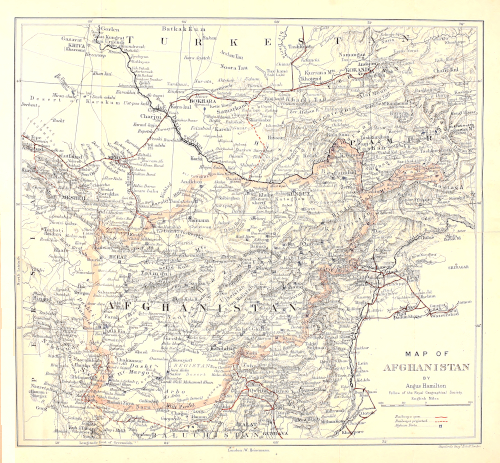
MAP OF AFGHANISTAN BY Angus Hamilton Fellow of the Royal Geographical Society London: H. Heinemann. Stanford’s Geogˡ Estabᵗ London
INDEX
Abdur Rahman, 91, 152, 247, 253, 258, 355-356, 433
Accession of Habib Ullah and, 432
Administrative system of, 269, 272
Afridi Elders and, 421-422, 424
Army under, 318-321, 325
Chitral crisis and, 415
Decline and death of, 432-434, 439
Lord Dufferin and, 401
Sir M. Durand and, 406
Lord Elgin and, 416, 418, 420
Europeans employed by, 394
Fiscal policy of, 231, 290-291
Foreign relations, 356-357, 403, 446
Frontier disturbances, 419, 422, 424
Gifts to, 402
Gun-running, 397
Sir Lepel Griffin and, 400
Imports of munitions, 407
Indian Government and, 419-425
Invited to England, 409
Mobilisation scheme, 432
Mullahs and, 415-416, 442
Queen Victoria, 433
Reception of Turkish visitor by, 416
Recognition of, as Amir, 400
Refusal to visit India, 403
Refusal to receive Roberts Mission, 405
Lord Ripon and, 400
Shir Afzal, 413, 414
and South African War, 432
Subsidy, 407
Swat-Tochi rising, 417
Theological studies of, 415
Treaties, 406, 412, 455
Tribal affairs, 270-271, 443, 447
Visits Afghan-Turkestan, 402
Warns Viceroy, 409
Western therapeutics and, 389
Abramoff, General, 40
Adiz Abad, 69
Afghan Turkestan, 94, 242, 262
Area of, 247
Coal deposits in, 396
Subjugation of, 250
Visited by Abdur Rahman, 402
Afghan War, First, 148
Second, 151, 152, 448
Afghanistan, administrative system of, 269-287
British relations with, 147-149, 155-156, 187-189, 220, 250, 356, 373, 375, 446, 455, 457, 458
Climate of, 261, 262
Currency of, 283
Ethnographic distribution, 262-263, 267-268
Khanates of, 250-253
Laws of, 275-280
Minerals of, 304
Orology of, 259, 260
Products and manufactures, 298-307
Provinces of, 242-247
Revenue of, 282-287
Rivers in, 260-276 (See Rivers)
Russian relations with, 121-122, 356, 440, 443, 447, 457-458
Trade of, 236, 288-298, 306
Afridis, 264, 408, 417, 418, 419, 423, 446
Agerskski valley, 14
Agreements (See Treaties)
Ahmed Khan, Sirdar, 189
Ahmed, Shah, tomb of, 190, 193
Akcha, 247, 258
Akrobat, 401
Aktash, 174
Ak-Tepe, 117
Aktinbinsk, 6, 7, 9, 13, 14
Alai mountains, 25, 26, 30
Alayar Khan, 62
Alcock, Surgeon-Captain A. W., 156
Alexander II., 60
Alexander of Macedon, 58, 62, 109
Alexandrovski, 18
Alexeieffski, 120, 124
Alichm Pamir, 174
Ali Mardan Khan, 377
Ali Masjid, 419 (See also Khyber)
Ali Yai Khan, remarks of, 445
Alvar, 259
Amir Ullah Khan, 362, 436
Ampthill, Lord, 452
Amritsar, 202
Amu Daria (See Oxus)
Amu Daria flotilla, 74, 75, 96, 97, 98, 102-104
Anardara, 204
Anderab, 244, 253
Anderson, Mr., 409
Andijan, 6, 11, 43, 49, 59, 110
Andkhui, 173, 242, 247, 258-259
Anglo-Afghan Boundary Mission, 155
Anglo-Russian Boundary Mission, 138, 141
Annenkoff, General, 7, 76
Annenkovo, 76, 77
Aral sea, 10, 16, 95, 96
Ardewan pass, 126, 157
Aris, 11
Army, 308-326
Under Abdur Rahman, 318-321, 325
Under Dost Mahommed, 308-311
Under Habib Ullah, 321-324
Under Shir Ali, 311-318
Askhabad, 3, 4, 5, 11, 70, 103, 173
Aslam Khan, Colonel, 419
Asmar valley, 403, 408, 425
Auckland, Lord, 1, 148
Aulie-ata, 8
Ayub Khan, 152, 187
Baber, 346
Badakshan, 242, 243, 244, 250-253, 405
Badghis, 156
Bad-i-sad-o-bist roz, 223
Badjira, 129
Baghdad, 237, 238
Baglan, 253
Bairam Ali, 77, 78, 79
Bajaur-Mohmands, 408, 412, 413, 414, 417
Bakhtiaris, 204
Bakwa plain, 181
Bala Murghab, 119, 135, 142
Balfour, Mr. A. J., speeches of, 457
Balkan hills, 96
Balkash, 8
Balkh, 173, 177, 242, 247, 250, 256-257, 260, 310-311
Balkh-Herat route, list of marches, 329-330
Baluchis, 204, 226, 227, 228, 241
Baluchistan, 189
Bam, 237
Bamian, 182, 243, 247
Band-i-Turkestan, 258
Bangash, Upper, 243
Bannu, 429
Barak pass, 228
Barakail, 250
Barkhani, 76
Barnaul, 8
Baroghil pass, 244
Barton, Captain, 419
Basawul, 359
Basra, 238
Basra-Baghdad-Kermanshah-Teheran route, comparison of, with Nushki-Seistan route, 237, 238
Belgian customs in Seistan, 235
Beetroot in Chimkent district, 19
Bell, Captain R. C., 241
Bellew, cited, 197
Benadar Kalan, 185
Benn, Major, 232
Ber Kazan, 10
Bibi Halima, 360, 361, 366, 369
Biggs, General Yeatman, 419
Binket (See Tashkent)
Bird, Major, 357, 358, 394, 395
Bird, General Corrie, 416
Bish Agatchski, 49
Black Sands of Bokhara (See Kara Kum)
Blood, General Sir Bindon, 417, 425
Bodorodski, 59
Bokhara, Khanate of, 25-39
City, 2, 6, 30, 36-39, 49, 52, 70-71, 104
Bazaars, 34, 44
Commercial relations, 70, 71
Imports from Kandahar, 203
Irrigation, 94
Masjid-i-Jama, 36
Medjidi Kalyan, 35
Medresse Mir-i-Arab, 36
Minai Kalan, 36
Population, 26, 29, 30, 33
Products, 29-30
Registan, 34
Soil, 29-30
Submission to Russia, 150
Walls of, 30
Water difficulty, 25, 26, 33, 72
Women in, 33, 34
Bolan pass, 230
Bombay, imports from, into Kandahar, 201-202
Bori valley, 260
Bozai Gumbaz, 85
British agent in Kabul, 374
Agent at Koh-i-Malik-Siah, 234
Interests in Persia, 220 in Seistan, 241
Merchants at Bunder Abbas, 237
Relations with Afghanistan, 147, 148, 149, 155, 156, 220, 250, 373-375, 446, 454, 457, 458
Relations with Russia, 1-3, 187, 188, 189, 448
Support of Abdur Rahman as Amir, 356
Brett, Lieutenant, 241
Brodrick, Mr. St. John, 452
Brooke, Captain Victor, 453
Brown, The Misses, 354, 395, 399
Bruce, Mr., 409
Buluna Khel, 408
Bunder Abbas, 234, 237
British merchants at, 237
Rate of camel-hire, 234
Buner, 408
Burnes, Alexander, 147-148
Burrows, General, 152, 187
Bushire, 237
Bustan, 69
Butkhak, 243
Cameron, Mr., 394
Campbell, Lieutenant, 310-311
Canals:
Angar, 48
Balungar, 65
Bos Su, 11, 59
Emperor Nicholas I., 59
Khani Yab, 114
Russki, 61
Shari Rud, 33, 73
Tchüli, 18
Tokhtamish, 79
Tumen, 10
Caspian Sea, 4, 95, 96
Cavagnari, Sir Louis, 347
Central Asian railway, 8, 11, 15, 18, 70, 75, 103, 155, 173
Chageh, 231, 232, 234, 408
Chahil Dukteran, 112, 125
Chakdara, 414, 417
Chakmakchak, 182
Charasia, 152
Chardar, 67
Charhardeh valley, 346
Charjui, 8, 74, 75, 76, 96, 97, 98, 102, 103, 104, 107, 108, 109
Charog, 86, 90, 91, 174
Chasma Sabz, 126
Chelyabinsk, 23
Chemen-i-Bed, 120
Chernaieff, General, 20, 48, 60, 61
Chernaievo, 59, 60, 61
Chigman, 49
Chilas, 408
Chiltan hills, 226
Chimkent, 6, 16, 18, 19, 20, 23
Chitral, 408, 413, 414, 415
British occupation of, 403
Military establishments of, 427
Relief of, 414
Shir Afzal, Mehtar of, 413, 414
Christie, cited, 169
Chushka, 173
Cidj Duvan, 69
Clarendon, Lord, 445
Clarke, Mr., 406
Clements, Mr., 394
Cleveland, Major, 394, 399, 354, 399
Mrs., 354, 399
Coldstream, Lieutenant, 410
Coal, 14, 396
Communications, 91, 92, 93, 329-341
Connaught, T.R.H. Duke and Duchess of, 401
Connolly, cited, 169
Copper, 14
Cotton, 30, 69, 73, 78, 117
Court, cited, 197
Cranbourne, Lord, 451
Currency, 436
Curzon, Hon. George Nathaniel, M.P., 427
Literary works of, 427
Visits Kabul, 427
Curzon of Kedleston, Lord, 426, 439, 452
Abdur Rahman’s death and, 440
Dane Mission, 453, 454, 455
Habib Ullah, 451
N.-W. F. Province, 431, 432
Reforms of, 427
Customs, Belgian, in Seistan, 235
Dakka, 359, 429
Daly, Mrs., 391, 392, 394, 395
Dane, Sir Louis, 453, 454-456
Mission, 189, 348, 353, 357, 360
Treaty, 373, 455, 456
Darband, 90
Darwaz, 25, 29, 30, 93, 244
Dawar valley, 260
Dasht-i-Margo, 221
Daulatabad, 129
Deane, Major, 425
Dehdadi, 177, 257
Dera Ismail Khan, 409, 429
Dera Ismail Khan-Kandahar, list of marches between, 335-337
Deregez valley, 129
Dersai, 89
Deserts:
Bolshiye sands, 9
Bolshiye Barsuki sands, 12, 13, 14
Golodnaya, 62
Kara Kum, 1, 6, 18, 44, 73, 76, 77, 96, 129, 156
Maliye Barsuki, 9
Desert shrubs (See Saxaoul)
Dir, 408, 417
Mir of, 413
Diseases:
Cholera, 450
Malaria, 18, 33, 50, 61, 114, 117, 124, 135
Filaria Medinesis, 33
Diwal Khol, 182
Djilgi valley, 11
Djulek, 10, 18
Djuma, 66
Dobbs, Mr. H. R., 453
Donald, Mr., 406
Donovan, Mr., 354, 394
Dost Mahommed, 169, 249, 269, 250
Afghan army under, 308, 311
Death of, 150
and Great Britain, 149
Dress, 379-384
Dufferin, Marquess of, 401, 402, 403
Durand, Major E. L., 155
Sir Mortimer, 405, 406, 446
Durani, Ahmed Shah, 249, 263, 264
Duranis, 178, 197, 263, 264, 344
Nurzai, 179
Durbadam, 129
Edrisi, 96
Education, 388-389
Edwards, Mr., 394
Elgin, Earl of, 409
Abdur Rahman, 416, 418, 420
Administration of, 439
Elles, Major-General Sir Edmond, 417, 418, 419
Ellis, Colonel, 406
Elphinstone, 348
cited, 197
Erivan, 130
Ersaris, 29, 111, 264
Europeans in Kabul, 394
Faizabad, 177, 242, 244, 253
Farab, 73, 74, 75, 96, 101, 103, 104, 129
Farah, 178, 180, 181, 182, 186, 249, 250
Strategic importance of, 181
Farkhar, 244
Fazindaz, 182
Fenn, Major, 406
Feramorz Khan, 162
Ferghana, 65
Ferozkhois, 264
Ferrier, cited, 169, 197
Ferries on the Oxus, 108
Festivals:
Asad, 388
Barat, 387
Id, 387, 416
Nauroz, 387, 415
Ramasan, 387
Fever, Kushk valley, 124
Murghab valley, 135
(See Malaria)
Filaria Medinesis, 33
Finlayson, Mr., 347, 354, 394
Fishing industry, Aral basin, 16
Firuza, 129
Fleischer, Mr., 392, 394
Murder of, 358-360
Fleischer, Mrs., 360, 397-398
Forts, list of, 326-328
Fowler, Sir Henry, 409, 415
Frontier, N.-W.: activity on, 403
Province, 429, 430, 431
Galkin, Colonel, 156
Gandamak, 402
Treaty of, 151
Gardan Diwar, 182
Garmab, 182
Gee, Mr., 416
Gerard, Major-General M. G., 155
Germany, antagonism of, 217, 218
Misrepresentations of Press, 218, 219
Ghaoch Khol, 182
Gharan, 90, 91, 93, 244
Ghazis, 388
Ghazni, 243, 260, 262, 305, 343-345
Ghilzais, 197, 263-264, 344
Trade with Kabul, 243
Ghorband, 243
Ghori, 244, 253
Ghorian, 248
Ghulam Ali Khan, Sirdar, 177, 247
Ghulam Haidar Khan (Sipah Salar) 403, 406, 412, 413, 414, 415, 417, 425
Abdur Rahman and, 410
Kafiristan, 413
Umra Khan, 413
Ghulam Hussein (Sipah Salar), 453
Giers, M. de, 445
Gilgit, 414
Agency, 427
Military establishment of, 427
Girdi Tallao, 228
Girishk, 178, 182, 185, 186, 187, 250
Girishk-Seistan, list of marches between, 341-342
God-i-Zirreh, 211
Gold, 14
Goldsmid, Sir Frederic, 212
Mission, 213, 216, 217, 218
Golodnaya steppe, 59, 62
Gomul pass, 343, 344, 345
Gomul valley, 260, 413, 429
Gore, Captain St. George, 155
Gortchakoff, Prince, 445
Grant, Mr., 394, 409
Gray, Dr. J. A., 389, 391, 392, 394, 395
Griffin, Sir Lepel, 400
Gulriz, 369
Gumesli, 123
Gun-running, 397
Guthrie, Mr. T. B., 375
Guzar, 173
Habib Ullah, Amir, 355, 360, 361, 362, 415, 432, 446
Abdur Rahman and, 433, 450
Accession, 434, 435, 436
Afghan envoys, 452
Army under, 321-324
Border tribes and, 446, 447
Dane Mission and, 454, 456, 457
Death of Abdur Rahman, 434
Europeans employed by, 394 received by, 354-358
Gun accident to, 357, 358, 394
Hadda Mullah and, 441, 442, 443, 448
Harem of, 362-369
Id festival and, 439
Inayat-Ullah and, 452
Islamism, 387
Khawas Khan and, 447
Nazr Ullah and, 338, 447
Pedigree of, 365
Policy of, 247, 291, 370-371, 388, 397
Priestly influence upon, 362
Quetta-Chaman Railway, 441
Russia, 440-441, 444, 457
Shiahs and, 386
Subsidy, 441, 446, 450
Sunnis and, 386
Hadda Mullah, 415, 417, 422, 425, 441, 442, 443, 446, 448
Hafiz Ullah Khan, 253
Haibak, 243, 254
Haji Khak pass, 182
Hamilton, Lord George, 431, 445, 448
Miss Lillias, 389, 390, 391, 394
Hardinge, Sir Arthur, 219
Hastings, Mr. C., 410
Hari Rud, valley of, 156
Hayat Ullah Khan, 247, 362, 369
Hazaras, 169, 243, 264, 344, 402, 403, 405
Hazrat Ali, 82, 257
Imam, 253
Helmund river, 107, 178, 182, 185, 260-261
Fords and ferries, 185
Seistan boundary and, 211, 213, 214, 215, 216
Herat City, 110, 111 119, 124, 125, 130, 166, 169, 178, 180, 181
Citadel of, 161
Defences of, 157-162
Description of, 157, 158
Deterioration of, 170
Garrison of, 162
Population of, 169, 170
Strengthening of, 401
Herat:
Expedition to, 147, 148, 149
Independence of, declared, 148
India and, 136
Persia and, 148, 149, 249
Restoration of, to Afghanistan, 149
Russia and, 162, 165, 173
Strategic position of, 173
Trade of, 170, 173
Trans-Afghan Railway and, 189
Herat-Balkh, list of marches between, 329
Herat-Kandahar route, list of marches, 331-335
Herat-Maimana, list of marches between, 341
Herat, province of, 156, 248-249
Hindu Kush mountains, 1, 89, 90, 92, 242, 243, 244, 247, 259, 260
Hindus, 29, 33, 169, 197, 198, 230, 255, 256, 259, 344, 379
Hissar, 173
Holdich, Colonel Sir Thomas, 410, 413, cited, 197
Colonel T. H., 155
Major T. H., 155
Hough, cited, 197
Hunza, 403
Husseinabad, 223, 224
Huzar, 129
Ibrahim Khan, Sirdar, 362
Id festival, 387, 439
Idgah mosque, 387, 439
Igdy wells, 96
Ikan, 11
Ikram-ul-Mul, 129
Ilek, 7
Iletsk, 8, 13
Mines, 13
Ilijik, 104
Ilyan Uta defile, 62
Imam Baba, 117
Kuli, 129
Nasar, 129
Inayat Ullah Khan, 357, 362, 369
Visit to India, 452
Indekki palace, 406
Indian Government, border tribes, 447
Correspondence with Abdur Rahman, 401, 406, 416, 418-425
Claims of, 408
Relations with Kabul, 148-149, 250, 373-375, 446, 454, 457-458
Indian plague and Seistan, 235
Trade with Afghanistan, 295-297
Trade with Seistan, 235
Indus river, 260, 261, 429
Irghiz, 16
Iron, 14, 244
Irvine, Major W., 241
Isazais, 403
Ishkashim, 86, 90, 91, 93, 244
Ivanoff, General, 39
Jagdalik, 242
Jamshidis, 136, 169, 264
Jandol, Khan of, 413
Jan Mahommed, 169
Jelalabad, 243, 261, 408, 410
Jerome, Monsieur, 394
Jews, 29, 33, 114, 119, 169, 256, 259
Jizak, 43, 61, 62
Julfa, 130
Jusufzais, 264
Kabadian, 253
Kabir Jan Khan, 362
Kabul, 416
Arms traffic, 396-397
Bala Hissar, 347, 348
Bazaars of, 376-380
British agent in, 374
British occupation of, 148, 152
Cholera, 450
Europeans employed in, 394
European medical advisers, 390-395
Evacuation of, 1842, 148
Nauroz festival, 440, 442, 443
Industries:
Leather Factory, 396
Ordnance yards, 396
Postin, 305
Tanning yards, 396
Workshop, 396
Military Academy, 388
Palaces:
Dekusha, 347
Durbar Hall, 353
Erg, 348, 349
Indekki, 353
Shah Ara, 353
Russian emissary visits, 444, 445
Russian influence at, 148
Russian Mission, 148, 150, 151
Russian representative at, 448
Secret Intelligence Branch established at, 443
Shirpur cantonment, 346, 348
Situation of, 345-346
Temperature, 262
Trade of, 170, 203, 294, 345
University, Lahore College and, 388
Kabul-Kandahar, list of marches between, 338
Kabul-Oxus river, list of marches between, 338-340
Kabul-Peshawar, list of marches between, 340
Kabul province, 242-243
Kafarkala, 259
Kafiristan, 415
Kagan, 70
Kainar, 234
Kaisar, 259
Kakuris, 197, 204
Kala Bar Panja, 81, 82, 91, 173, 174, 176
Drosh, 414
Kala-i-Zist, 185
Kala-i-Mor, 119
Kala Kafir, 129
Kala Nao, 138, 249
Panja, 81, 82, 89, 176
Wamar, 174
Wanj, 174
Kandahar, 178, 180, 181, 187, 189, 190, 193, 242, 250
Area of, 250
Bazaars of, 197-198
British occupation of, 148
Intervention in, 250
Beggars in, 198
Climate of, 208-210
Connection with proposed railway, 187, 189
Defences, 190
Description of, 189-194
Diseases prevalent in, 210
Fruit industry of, 345
Horse trade of, 204, 207
Population, 194, 197
Products of, 298, 304-306
Relief of, 152
Revenue of, 250
Strategic importance of, and situation, 189, 190
Temperature, 262
Trade of, 198-208, 294
Kadahar-Dera Ismail Khan, list of marches between, 335-337
Kandahar-Herat route, list of marches, 331-335
Kandahar-Kabul, list of marches between, 338
Kara Kliss, 130
Kul, 30, 73
Kum, 1, 6, 18, 44, 73, 76, 77, 93, 94, 96, 129, 156
Teppe, 124
Karabyl hills, 117
Karategin, 93, 94
Karaul Kuyu, 76
Karawal Khana, 138
Karez, 235
Karki, 8, 43, 97, 98, 102, 109, 129, 173
Karmakchi, 10, 15
Karshine oasis, 26
Kashan valley, 119, 137
Kashtalinski, Colonel, 146
Kataghan, 93, 244
Katta Kurgan, 66, 67
Kauffman, General von, 47, 48, 58, 68
Kauffmanskaya, 58
Kaunchi, 59
Kazalinsk, 6, 7, 10, 12, 13, 14, 15, 16, 18
Keane, Lord, 148
Kelat, Khan of, 232
Kelat-i-Ghilzai, 250, 342
Kelif, 96, 97, 98, 102, 109, 173
Kelly, Colonel, 414
Kennedy, Mr., 445
Kerbela, 238
Kerman, 237
Kermanshah, 237
Kermine, 69
Kettechinar, 129
Khanabad, 247, 254
Kharkoff, 5, 19
Khash, 250
Khawas Khan, Habib Ullah and, 447
Khidarzais of Zhob, 403
Khiva, 6, 8, 15, 75, 81, 94, 96, 101, 147
Russian conquest of, 151
Khokand, 6, 11, 43, 49, 173
Khan of, 48
Khoja Daolet, 73
Kul, 14
Khojakand, 259
Khojand, 43
Khorassan, 124, 203, 233, 234, 235, 236, 237, 239, 240
Khost, 260, 433
Khudadad, 358
Khulm, 242, 247, 254, 260
Khudrud, 182
Khurram Sarbag, 254
Khwaja Amran, 402, 403
Sala, 109, 247
Khwaja-ali, 215
Khyber pass, 417, 418, 419, 428, 429, 446
Abandonment of, 417
Afridi attack upon, 418
Militia in, 417, 419
Khyber Rifles, 428, 454
Kieff, 5
Kila Abdulla, 402
Kin Asu defile, 14
King, Mr., 409
Kirghiz, 13, 14, 15, 18, 29, 33
Steppe, 1, 6
Kirshul, 59
Kishingi, 229
Kishm, 244
Kizil Rabat, 174
Steppe, 69
Kluchevi fortress, 61
Kohak, 213, 232
Kohat pass, 429
Koh-i-Malik-i-Siah, 213, 215, 232, 234
Koh-i-Mulla Khwaja, 157
Kohistan, 262
Kokcha valley, mines of, 244
Kok Tash, Samarkand, 43
Komaroff, Lieut.-General, 118
Konevski, Staff-Captain, 39
Konnogvardeiski, 59
Konstantinovitch, Grand Duke Nicholas, 59
Kopal, 8
Krasnovodsk, 11, 59, 70, 74, 79, 111, 155
Kuchan, 129
Kah-i-Khwajah, 213
Kukchinski, 49
Kulab, 93, 253
Kum Asu pass, 9
Kunar, 243
Krutorogin, Captain, 156
Kunduz, 173, 253, 260
Kungrad, 8, 96, 97
Kurak, 249
Kurban Kala, 77
Kurgan, 23
Kur Kulduk, 58
Kuropatkin, General, 62, 118, 120, 173, 440
Kuropatkino, 62, 65
Kurram Valley, 260, 414, 429
Militia, 429
Kushk (Afghan), 137
Valley, 80
Extent and population of, 136-137
Irrigation of, 137
Prevalence of fever in, 124
Trade of, 137
Kushkinski Post, 5, 111, 112, 124, 173, 187
Russian garrison at, 120-123
Station, 119, 120, 123, 125, 126
Strategic value of, 124
Kuyu Mazar, 69
Lakes:
Berkazan, 10
Chakmaktin, 82, 91
God-i-Zirreh, 211
Hamun, 180, 182, 211, 212, 213, 218, 260
Issyk-Kul, 8
Koss Kue, 13
Sara Kamish steppe, 96
Tchelkar, 9, 14
Victoria, 82, 85
Landon, Lieutenant C. P., 241
Langar Kisht, 85, 86, 89, 90, 174
Lansdowne, Marquess of, 402, 403, 406, 409
Lapis-lazuli mines, 244
Lash, 180
Liebertziet, Frau, 397
Lockhart, General Sir William, 413, 423, 424
Logar, 243
Lomakin, General, 61
Lomakino, 61
Low, General Sir Robert, 414
Lughman, 243
Lumsden, Sir Peter, 155, 401
Lundi Khana, 358
Dane Mission arrives at, 453
Udny Mission at, 409
Lundi Kotal, 359, 419
Lytton, Lord, 431
Macdonald, Sir John, 147
Macnaghten, Sir William, 377
Macpherson, Captain, 223
Mahommed Afzul Khan, 310, 311
Akbar Khan, 250, 253
Alum Khan, 250, 253
Mirza Shah, 147
Mahmud Shah, 253
Mahsud-Wagiri operations, 439
Mai Libash, 10
Maimana, 173, 242, 247, 253, 258-260
Maimana-Herat, list of marches between, 341
Maitland, Captain, 155
Maiwand, 152, 187
Malakand, 414, 417
Military establishment of, 427
Malaria in:
Bokhara, 33
Imam Baba, 117
Kushk region, 124
Merv, 50
Perovski, 18
Murghab valley, 112, 117
Jizak, 61
Malleson, Major W., 453
Mangan defile, 142
Manners-Smith, V.C., Captain, 406
Mardar, not Mirdar, 226
Margelan, 43, 49, 173
Martin, Mr. F. A., 358, 392, 394
Sir Acquin, 375, 394
Maruchak, 138, 141, 142, 173
Valley, 138
Masjid-i-Jama, 36
Masson, cited, 197
Mastang, 231
Maude, Fort, 419
Mayo, Lord, 150
Mazar-i-Sharif, 177, 247, 257, 369, 440, 451
Mazar-tepe, 85
McDermot, Mr., 283, 394
McMahon, Captain H. (See Colonel Sir Henry)
Colonel Sir Henry, 214, 215, 241, 406
McNabb, Surgeon-Captain, 410, 413
McSwiney, Captain E. F. H., 155
Measures, table of Afghan, 306-307
Medjidi Kalyan, 35
Medresse, Mir-i-Arab, 36
Menzikoff, Prince, 147
Merv, 4, 5, 11, 50-56, 80, 110, 173, 440
Annexation of, 155, 401
District of, 76
Old, 52, 78, 114
Station of, 79, 111, 112
Merv-Herat road, 156-157
Meshed, 3, 52, 129, 130, 203, 234, 239
Russian commercial influence in, 236
Various routes to, 236-239
Meshed-Askakbad, proposed railway, 129
Meshed-Bunder Abbas, rate of camel-hire, 234
Middleton, Mr., 394
Mikhailovsk, 96
Miller, M., Russian Consul at Nasratabad, 214
Misrepresentation of, 217, 218, 219
Milyautinskaya, 62
Minar Kalan, 36
Mineral deposits of Afghanistan, 304
Minerals:
Coal, 14, 396
Copper, 14
Gold, 14
Iron, 14, 244
Lapis-lazuli, 244
Salt, 13, 244
Saltpetre, 181
Sulphur, 244
Mines of Aktinbinsk, 14
Iletsk, 13
Minjan, 244
Miranzai valley, 403
Mirza, Abbas, 147
Mahommed, 147
Missions:
Afghan Boundary, 1884; 155, 401, 402, 405
British visit to Jelalabad, proposed, 403-404
Bruce, 409, 413
Cavagnari, 151, 152, 347
of Condolence, 436, 440, 441
Dane, 453, 454, 455
Durand, 405, 406, 407
Goldsmid, 213, 216, 217, 218
Pamir Boundary, 155, 407, 415
Pamirs, 155
Roos-Keppel, 452
Roberts, proposed, 405
Udny, 409, 414, 452
Mitana Pefshanba, 67
Mohmands, 264, 408-409, 412-413, 425
Mongols, 264
Moscow, 4, 5
Bourse Gazette, statements of, 444
Mountains:
Alai, 25, 26, 30
Asmai, 345, 346
Badakshan, 91
Bend Chengurek, 120
Chupan Ata, 39, 65
Djaksi, 14
Djaman, 14
Gilkoh, 343
Go Um Tau, 65
Hindu Kush, 1, 89, 90, 92, 242-244, 247, 259, 260
Hissar, 25, 29, 30, 43, 44
Kara, 120
Kara Tau, 73
Karatavski, 23
Koh-i-Baba, 156, 182, 242, 259, 260
Kizi Kurt, 11
Mirdah, 226
Mugodjarski, 9, 12
Mustagh, 243
Nura Tau, 6, 62
Nuratinski, 62
Paropamisus, 120, 125, 156, 157
Sarikol, 243
Siah-koh, 213, 216
Sufed Koh, 242
Takht-i-Shah, 345
Tian Shan, 47
Trans Alai, 25, 93
Mouravieff, Count, 431
Mullagori country, 429
Mullah Powindah, 442
Said Akbar, 442
Multan, 202
Muminabad, 253
Munitions of war, 403, 407, 432, 433, 449, 450
Murad, Amir, 78, 146
Khan, 228, 229
Murgak, 72
Murghab Imperial estate, 78
River, 76, 80, 91, 93, 107, 111-114, 117, 119, 131, 136, 138, 146, 156
Valley, 80, 117, 131-146, 260
Prevalence of fever, 124
Railway, 3, 110, 111, 112, 120, 130
Trade of, 137
Murghabi, Fort, 174
Nadejdinski, 59
Nagornaya, 66
Naizar marsh, 211, 213
Namagut, 90
Namangan, 43
Naphtha, 14, 60
Narmashir, 237
Nasratabad, 179, 214, 217-219, 223-225
Garrison of, 225, 226
Russian Consul at, 214, 217, 218, 219, 224
Nasratabad-Nushki route, 226, 231-232
Naus, M., and Persian Customs, 235
Nawagai, 413
Nazr Ullah Khan, 360, 369, 386, 388, 415, 433, 436, 443, 447
Neh, 237
New Bokhara, 70
Chaman, 187, 189
Nialbash, 58
Ni-Amat Ulla, Shah; Wani of Kirman, 122
Nijni Volinski, 59
Nikolævski, 59
Nikolski, 49
Ningrahar valley, 408
North-W. F. Province, 429, 431
Novo Astrakhanski, 18
Novoe Vremya, statement of, 443-444
Nukus, 94, 96
Nushki, 229, 230, 429
Nushki-Quetta trade route, 226-229
Railway, 226
Nushki-Seistan trade route, 226, 231, 232, 233, 234, 235
Camel-hire, revision of charges, 234, 335
Comparison of, with alternative routes, 236, 237, 238, 239
List of marches, Nushki-Nasratabad, 233
Trade facilities of, 234
Returns, 233
Nut, 89
Obeh, 249
Obi, 8
Siab ravine, 65
Obrutcheff, General, 61
Obrutchevo, 61
Obyetovanni, 59
Odessa, 5
Old Tashkent (Stari Tashkent), 58
Merv, 78
Omar Khan, Sirdar Mahommed, 360, 361, 366, 369, 436
Omsk, 8
Orakolow, Lieutenant, 156
Orakzais, 264, 403
Orenburg, 6, 8, 12, 15, 23
Orenburg-Tashkent, old post-road, 6, 7
Railway, administration of, 12
Alternative schemes to, 7, 8
Branch line to Syr Daria, 10
Construction of, 3, 6, 7, 8, 9, 12, 13, 16, 50
Double track proposed, 11
Markets of Central Asia, 23, 24
Opened by General Kuropatkin, 440
Route followed by, 7, 8
Water-supply, 9, 13, 14, 16
Orsk, 6
Osh, 3, 4, 6, 43, 49, 173
Otrar, 11
Oxus flotilla, 74, 75, 96-98, 102-104
Region, temperature, 262
River, 8, 25, 26, 29, 43, 73, 74, 75, 76, 95, 96, 260, 261
Fall of, 98
Ferries and fords, 107, 108
Mines in valley of, 244
Mouths of, 94, 95
Navigation of, 96, 98, 104, 107
Russian and Afghan communications along, 91, 92
Russian military disposition along, 174, 175
Proposed railway to, 129
Source of, 81, 82
Trade upon, 104, 107
Upper, 82 (See Panja)
Oxus-Kabul, list of marches between, 338-340
Pack, Mr. E. T., 375
Paghman hills, 182, 346
Paiwar Kotal, 151
Palankoh route, 234
Pamir, Alichur, 405
Boundary Mission, 4, 155
Fort, 405
Great, 82
Little, 82
Sarez, 405
Pamirs, 4, 25, 81, 82, 91, 92, 405, 407
Afghan position in, 407
Russian force in, 174
Panafidine, M., 156
Panja River, 81, 82, 85, 86, 89, 90, 91, 92, 93
Paropamisus mountains, 120, 125, 156, 157
Parsiwans, 197
Pathans, 263, 264 (See also Ghilzai)
Patta Hissar, 75, 96, 97, 98, 102, 107, 173
Peacocke, Captain, 155
Pendjeh, 110, 111, 112, 119, 129, 145, 156, 173, 401
Fight at, 405
Pendjeh-Tanur-Sangi branch line, 80
Perovski, 6, 7, 10, 16-18
Count, 17
Fort, 17
Persia:
Designs upon Herat, 148, 149
Interests in Seistan, 213, 214
Obstruction to Seistan Boundary
Commission, 215, 216
Relations with Afghanistan,
Great Britain, and Russia, 147-149, 214
Perso-Afghan War, 147, 148, 149
Persians, 29, 33, 111, 114, 119, 198, 258, 264
Peshawar, 149, 429, 440, 449, 453
Peshawar-Kabul, list of marches between, 340
Pesski, 176
Petro-Alexandrovsk, 75, 96, 108
Pitniak, 94
Plague, Seistan and Indian, 235
Pollock, General, 377
Poltavski, 120, 124
Polytimætus (See Zerafshan)
Postins, manufacture of, 305-306
Practitioners, native, 392, 393
European, 394
Ptuk, 86
Pul-alak, 185
Pul-i-Khatun, 129, 401
Pul-i-Khisti, 117
(See Tash Kepri)
Pukhtun (See Pathans)
Pyne, Mr. (See Sir Salter)
Sir Salter, 373, 394, 396, 405, 408
Quetta, 187, 189, 215, 226, 228, 429
Railway, extension of, to New Chaman, 402
Quetta-Nushki railway, 226, 230, 231, 234
Route, 226-229, 291
Ragh, 244
Railways:
Across Persia, 130
Askhabad-Meshed, 129
Central Asian, 8, 11, 15, 18, 70, 75, 103, 155, 173
Indian, Kabul river, 429
Khyber, 429
Nowshera-Dargai, 428
Quetta-Chaman, 402, 441
Sakkur-Sibi, 401
Thau-Kushalgarh, 429
Murghab valley, 3, 110-130
Orenburg-Tashkent, 3-50
Russian, in Afghanistan, 457, 458
Saratoff-Uralsk, 8
Trans-Afghan, 189
Trans-Siberian, 7, 8, 11
Ramasan, 387
Ramsay, Captain, 241
Rang, 85, 86, 89
Ranjit Singh, British alliance with, 148
Ravania, 76, 77
Registan, Bokhara, 34
Samarkand, 40
Religion, 386-387, 388
Repetek, 76
Riches, Mr., 394
Ridgeway, Colonel Sir West, 155
Ripon, Marquess of, 400, 403
Rivers:
Ab-Dilawar, 182
Ab-i-Siah, 182
Ab-i-Wakhan, 82, 85
Abs-i-Panja, 82, 85, 93
Aksarai, 94
Ak-su, 19, 82, 91, 93
Alabass, 14
Argand-ab, 185, 260
Arghesan, 260
Arisi, 11, 19
Atrek, 129
Badam, 19
Balkh, 256
Bartang, 91, 93
Bolshoi, 9
Bugun, 19
Buraldai, 19
Burdjar, 19
Burgutai, 85
Burl, 14
Burt, 14
Chirchik, 47, 48, 49, 58, 59
Darban, 94
Djus, 14
Doaba, 255
Donguz, 13
Elshanka, 13
Embi, 9, 13
Farah Rud, 180, 211, 260
Farkhan, 254
Ghazni, 343
Ghori, 94
Ghund Daria, 90, 91, 174
Hari Rud, 130, 156, 248, 260, 261
Harud, 178, 211
Helmund, 107, 178, 182, 185, 211, 213, 214, 215, 216, 222, 260, 261
Ilek, 7, 13
Irtish, 8
Khargosh, 85
Kabul, 260, 261, 345, 346, 429
Kafirnahan, 94
Kaisar, 229
Karanzyak, 10
Kashan, 131, 137
Kashka, 25, 26
Keless, 11
Keshef Rud, 129, 130
Khabd, 14
Khanabad, 94
Khash, 211
Kizil-su, 94
Kokcha, 94, 247, 260
Krash, 221
Kuban, 14
Kubele, 9, 13
Kulab, 94
Kulden, 13
Kuljur, 9, 14
Kunar, 260
Kunduz, 94, 101, 108, 254
Kushk, 111, 113, 117, 119, 120, 131, 137, 138
Kutchuk-sai, 14
Little Pamir, 85
Logar, 260, 345
Mali Karagandi, 9
Maloi Khabd, 14
Murghab, 76, 80, 91, 93, 107, 111-114, 117, 119, 131, 136, 138, 146, 156
Narpai, 67, 68
Obi, 8
Oxus (See Oxus)
Pamir, 82, 85, 86
Panja, 81, 82, 85, 86, 89, 90, 91, 92, 93
Panj-Kola, 414, 425
Panjsher, 242, 260
Salar, 11, 58
Sangalak, 258
Sanzar, 61, 62, 65
Shakh Dana, 91
Sherinab, 228
Suchan Daria, 91, 93
Surkan, 29, 94
Syr Daria, 10, 11, 15, 16, 18, 20, 59
Taldik, 94, 95
Tchayan, 19
Tejend Rud, 130
Temir, 9, 13
Teress Butak, 14
Tezin, 182
Ulkan, 94
Ural, 7, 8, 9, 13
Wakhan Daria, 85
Wakhan-su, 85
Wakh-jir, 82, 85
Waksh, 29, 94
Yani Su, 94, 95
Zerafshan, 25, 26, 33, 39, 65, 67-69, 72, 73
Zirreh, 211
Robat, 232
Roberts, General Sir Frederick (See Lord Roberts)
Lord, 151, 152, 403, 404, 405, 408
Robertson, Dr. Sir George, 414
Romanovski, 89
General, 61, 62
Roos-Keppel, Major, 452, 453
Rosebery, Earl of, 409
Roshan, 25, 253
Rostovtseff, Count, 65
Rostovtsevo, 65
Rubies, 244
Rudbar, 213
Russia:
Afghanistan and, 121-122, 148-150, 151, 162, 165, 173, 356, 405, 440, 441, 443, 444, 447, 452, 457, 458
Agents of, 444
and Great Britain, 1-4, 147, 187, 188, 189, 448
Imperial Bank of, 70, 129
Khorassan in, 236
in Mid-Asia, 2, 3-4, 5, 55-57, 149, 150, 174, 401
Oxus river and, 91, 149-150, 174, 175
Pamirs in, 405
Persia and, 147, 158
Seistan and, 214, 215, 217, 219, 236, 241
Russian Railways:
Askhabad-Meshed, 129, 130
Murghab Valley, 110-130
Railway schemes, 1, 126, 129,188, 189, 237
Trade with Afghanistan, 179, 295-298
Russo-Chinese Bank, 70
Russo-Persian War, 147
Rustak, 93, 244, 253
Saad-ud-Din Khan, 362
Sabzawar, 178, 179, 181, 186, 240, 249
Safi Mullah, 442
Said Akbar, 415
Saids of Peshin, 204, 207
St. Petersburg Bourse Gazette, 444
Sais Khaneh ravine, 62
Sakhir, 182
Sakis, 58
Salaam Khana, 387
Salisbury, Marquess of, 431
Salt, 13, 244
Saltpetre, 181
Samana, 414, 418, 429
Rifles, 429
Samara, 7
Samarkand, 3, 5, 6, 11, 39-44, 49, 52, 65, 110, 155, 173
Bazaars of, 43, 44
Bibi Khanum, 43
Capture of, by Russia, 149
Gur Amir, 43
Ivanovski Square, 39
Kok Tash, 43
Old town, 40, 43
Population, 39, 40
Registan, 40
Shir Dar, 40
Station of, 66
Tillah Kori, 40
Tomb of the Shah Zindeh, 43
of Timur, 43
Trade of, 40, 43, 66
Ulug Beg, 40
Urda, 43
Samchan, 89, 90
Samungli, 228
Sand shrubs (See Saxaoul)
Saraghari, fort, 423
Sarakhs, 111, 129, 130, 156, 401
Saratoff-Uralsk railway, 8
Sarhad river, 82, 85, 247
Sari Agatch pass, 11
Saripal, 258
Sari Tchegonak, inlet, 10
Yazi, 117, 145
Sarlor Fakir, 415, 417
Sarshela ravine, 211
Sarts, 29, 111, 114
Sarwar Khan, Shahgassi Mahommed, 361, 362
Sauran, 20
Saxaoul, (desert shrub), 73, 75, 76, 77
Sayid Mozaffrar Eddin, Amir, 68
Sazan Bulak, 91
Seistan, 179, 186, 211, 212, 213, 214, 240, 241, 242
Afghan, 250
Afghan interests in, 213, 214
Belgian customs and, 235
Boundary Mission, 215, 216, 217, 219, 220, 221, 222, 241
British interests in, 241
Indian plague in, 235, 236
Irrigation of, 222
Persian interests in, 213-214
Population of, 213
Russian interests in, 214, 215, 236
Taxes and revenue of, 222, 223
Trade with India, 235
Seistan-Girishk, list of marches between, 340-341
Seistan-Nushki, overland route, 231, 232, 233, 234, 235
Sekuha, 213
Semipalatinsk, 8
Semut, 86
Shabkaddar, 417
Shah Maksud, 306
Zindeh, tomb of, Samarkand, 43
Shaikhantaurski, 49
Shakhri oasis, 26
Shar-i-Sabz, 129, 173
Shezand, 230
Shiahs, 169, 258, 386, 387
Shibirghan, 247, 258
Shignan, 25, 82, 91, 203
Shikarpur, 230
Shinwaris, 264
Shirabad, 129
Shir Afzal, 413-414
Ali, 150, 151, 250, 269-270
Conference with Lord Mayo at Umballa, 150
Refusal to admit British representatives to Kabul, 151
Reform of Afghan army by, 311-318
and Stolietoff Mission, 448
Dar, Samarkand, 40
Darwaza, Mrs., 345, 346
Shirtar, 86, 89
Shiwa, 244
Shoemaker, cited, 51
Shujah, Shah, 1, 48
Shuturket, 59
Shveikovski, Major-General Povalo, 156
Sibzyarski, 49
Sikandur Khan, 444
Si Khanah, 89
Simpheropol, 5
Skobeleff, 7, 10
Skobelevski, 18
Slave trade in Kandahar, 207-208
Slee, Mr., 231
Sokovnin, Colonel, 39
Somatash, 405
South African War, 439
Spies, Russian, in Mazar-i-Sharif, 451
Staal, M. de, 431
Stari Tashkent (Old Tashkent), 58, 59
Stewart, Lieutenant-General Sir Donald, 151, 152, 400
Lieutenant A. E., 241
Mr., 394
Stolietoff Mission, 448
Strabo, 95
Stroieff, M., 129
Sulphur, 244
Sultan-i-band, 114, 146
Sundukli, 73
Sunnis, 258, 386, 387
Superstitions, Afghan, 385-386
Swat, 408, 417, 427
Syabz oasis, 26
Syr Daria, 10, 11, 15, 16, 18, 20, 59
Province, 81
Darinskaya, 59
Tabriz, 130, 237, 239
Tagis, 433
Taimanis, 169, 180, 264
Tajiks, 29, 30, 244, 258, 259, 264, 344
Takhta Bazar, 118, 119
Takht-i-pul, 173, 177, 257
Takht-i-rawan, 446
Talbot, Captain the Hon. M. C., 155
Talikhan, 253
Talkhatan Baba, 113
Tamerlane, Ark of, 65 (See also Timur)
Gates of, 62 (See also Timur)
Tanur Sangi, 80, 112, 119, 138, 173
Tarnak, 189, 260
Tartars, 18, 119
Tashkent, 4-7, 11-13, 15, 16, 20, 23-24, 43-50, 74, 79, 110, 173, 440
Alexandrovski Park, 48
Angar canal, 48
Capture of, by Russians, 60
Cathedral, 44, 47
Climate, 47, 49
District, 23
Population, 16
Dukhovskaya, 48
Fortress Esplanade, 49
Gospitalnaya, 48
Irrigation of, 12
Kailuski Prospekt, 48
Konstantinovski Square, 47
Native quarter, 49
Oasis of, 12
Old (See Stari Tashkent)
Orenburg-, railway (See Orenburg-Tashkent railway)
Population, 49, 50
Romanovski Street, 48
Russian garrison, 48-49
Quarter, 44, 48, 49
Sobornaya Boulevard, 48
Station of, 11
Town revenues, 48
Trade returns, 24
Turkestan Public Library, 48
Water difficulty, 48
Tash Kepri, 117-119, 135, 401
Tashkurgan, 174, 242, 247, 254, 255
Population of, 255
Tasker, Mr., 394
Tate, Mr., 241
Teheran, 130, 147, 237-239
Routes to, 237-239
Tejend, 111, 129, 156
Tekkes, 77, 114, 117
Temir Utkul, 13
Termes, 3, 8, 97, 129, 173
Thana, 417
Thornton, Mr. E. T., 354, 392, 394
Tian Shan mountains, 47
Tiflis, 130
Tigris river, 237
Tillah Kori, Samarkand, 40
Tilleri, 228
Timur, 11, 40, 43, 249 (See also Tamerlane)
Tomb of, Samarkand, 43 (See also Tamerlane)
Tirah operations, 423, 425, 426
Tirogkhoi plateau, 259
Tochi, 414, 416, 429
Torashekh, 119
Torkhana, 453
Trade of Afghanistan, 288-298, 306
Traku, 185
Trans-Afghan railway, proposed, 187
Trans-Atai mountains, 25, 93
Trans-Caspian Gazette, 218-219
Trans-Caspian railway, 3-6, 110, 111
Trans-Siberian railway, 7, 8, 11
Treaties:
Anglo-Russian, 1873, 406
Dost Mahomed and British, 149
Durand, 231, 373, 407, 408, 412, 446
Gandamak, 402
Khyber, 481
Trebizond-Tabriz-Teheran route, comparison of, with Nushki-Seistan route, 239
Trench, Major, 223, 232
Tribal affairs, 270-271, 443, 447
Troitzki, 49
Tuckatoo hills, 2260
Turbat, 237
Turbat-i-Naidari, 235
Turcomans, 29, 33, 52, 258, 264
Turkestan, 7, 10-11, 20, 23, 179
Afghan (See Afghan Turkestan)
Cotton Company, 67
Public Library, Tashkent, 48
Russian, 11, 20, 23, 39, 44, 47, 68
Turgai province, 13
Turkish Emissary to Abdur Rahman, 416
Turkoman Expedition, 61
Twakim-ud-Din, 415
Uch Udja, 76
Udny, Mr. (See Sir Richard Udny)
Sir Richard, 410, 412, 417-419, 452
Proclamation, 410, 412, 413
Ulia Jancah, 362
Ulug Beg, Samarkand, 40
Ulyanin, Colonel, 111
Umra Khan, 413, 425
Upper Oxos (See Panja river)
Ural Cossacks, 18
Uralsk, 8
Urda, Samarkand, 43
Urt plateau, 182
Urta Chul steppe, 30
Urumbai, 59
Usef Khan Barakzai, 362
Ushturket, 59
Utch Tubeh, 59
Uzbegs, 30, 33, 258, 259, 264
Uzboi channel, 96
Vaganzi, 69
Vambéry, cited, 169, 170
Vani Kurgan, 20
Venice Sanitary Congress, 235
Verevkin, General, 20
Verkhni, 59
Verni, 8, 11, 20
Victoria, lake, 82, 85
Viedomosti, statements of, 444
Vrevskaya, 58
Wahab, Lieutenant-Colonel R. A., 155
Wakhan, 91-93, 242, 244, 247, 253
Valley, 85, 86
Wakh-jir pass, 82, 85
Walter, Mr., 394
Walters, Major H. F., 241
Wanliss, Major, 453
Wano, 345, 413, 414, 416
War, Afghan, First, 148
Second, 151, 152, 448
Perso-Afghan, 148-149
Ward, Mr., 241
Ware, Captain Webb, 232
Waziris, 264
Waziristan, 408, 413, 416, 429, 439
Weights, Afghan, 307
Welman, Doctor, 156
Women in Afghanistan, 197, 383-385
in Bokhara, 33, 34
Wood, Lieutenant, 82, 85
Wood’s Lake (See Victoria Lake)
Woodside, Mr., 231
Yaghistan, 408
Yaims, skirmish at, 407
Yakatut, 72
Yakshi Kargach river, 14
Yakub Khan, 151, 152
Yarkand, 255
Yate, Colonel A. C., 182, 449
cited, 170
Lieutenant A. C., 155
Major C. E., 155
Yezd, 237
Yonoff, Captain, 405
Young, Mr., 231
Yulatan, 111, 113, 114, 145, 146
Zakka Khels, 446
Zamindawar, 178, 186
Zangi-ata, 58
Zarghun hills, 226
Zarghim, 226
Zebak, 244
Zerafshan river, 25, 26, 33, 39, 65, 67-69, 72, 73
Ziadin, 68, 69
Zirabulak, 68
Zhob valley, 260, 403
Zulfikar, 129, 401
Zung, 86, 89
Printed by Ballantyne & Co. Limited Tavistock Street, London
Transcriber’s Note:
Footnotes were renumbered sequentially and were moved to the end of the chapter. Footnotes [27], [56] and [57] have multiple anchors. A few anchors are positioned at the beginning of the sentence.
Words may have multiple spelling variations or inconsistent hyphenation in the text. Obsolete and alternative spellings were left unchanged. Misspelled words were corrected. Where spelling varies between an index entry and the text of the book, the index entry was adjusted to match the text. Obvious printing errors, such as backwards, upside down, or missing letters and punctuation, were corrected. Use of italics was made consistent in various lists. Final stops missing at the end of sentences and abbreviations were added.
Columns and rows were reversed for two tables on page 293. When a table does not display completely on small handheld devices, tapping the screen may present the entire table in miniature.
The pedigree chart in Chapter XIV was converted to a descendant format to fit electronic screens. Spouses are indented between the male's name and their children. An image of the original chart was added.
There may be a digit not printed in Appendix X, last column for entry of Mercery, &c.
Mimosa, _Acacia_ was changed to Mimosa, Albizia.