Front matter (continued 4)
Reading edition
“March 22, Saturday. I started again for the ice-openings. There had evidently been a good deal of commotion in the night; but nothing so violent as to negative my yesterday’s conclusions. Still there were hummocks of young tables, and some ugly twists of the beach line; and matters had not yet settled themselves into rest. As the great floe on which I stood traveled, under the influence of the west wind, obliquely eastward, I heard once more the familiar sounds of our noctes Lancastrianæ. The grating of nutmegs, the cork rubbing of old-fashioned tables, the young puppies, and the bee-hives; all these were back again; but we missed pleasantly the wailing, the howling, the clattering, the exploding din, which used to come to us through the darkness. The pulse-like interval was there too, like a breathing-time; but the daylight modified every thing, my feelings most of all. They became almost pleasant, as I listened, after a lullaby fashion, to the bees and puppies; and something very like gratitude came over me, as I thought of the uncertain gloom or palpable midnight which accompanied a few weeks ago the ‘voices of the ice.’ The thermometer was 21° below zero, and the wind blowing: naturally enough, my nose became a tallow nose in the midst of my reverie. So I rubbed the nose, blew the nose, buffeted my armpits until my fingers tingled, and then started off on a tramp.
“Seal were seen, curious as usual, but indulging in the weakness afar off. Presently two poor winter-mated little divers met my meat-seeking senses. One of these I killed with my rifle, covetously regretting that my one ball could not align his mate. This was the first game we had obtained since the fall: he was divided, poor fellow, between two of my scurvy patients. In getting this bird out, I came very near getting myself in; and that, when a ducking means a freezing, is no fun.
“10 P.M. To-night finds me knocked up. Be it known, that after crawling on my belly, not like the wisest of animals, for two hours, I came nearly within shot of a week’s fresh meat. The fresh meat dived, first shaking his whisker tentacles at my disconsolate beard, leaving me half frozen and wholly discontented. Fool-like, after the long walk back, the warming, the drying, and the feeding, I returned by the other long walk to the ice-openings, tramped for two hours, saw nothing but frost-smoke, and came back again, dinnerless, with legs quaking, and spirits wholly out of tune.
“Our drift to-day, at meridian, was in the neighborhood of 9 miles; our latitude was 71° 9′ 18″.
“March 23, Sunday. After divine service, started for the ice-openings. We are now in the centre of an area, which we estimated roughly as four miles from north to south, and a little more east and west. On reaching what was yesterday’s sea-beach, I was forced to recant in a measure my convictions as to the force of the opposing floes. Yesterday’s beach existed no longer; it was swallowed up, crushed, crumbled, submerged, or uplifted in long ridges of broken ice.
“The actions were still in progress, and fast intruding upon the solid old ice which is our homestead. The ice-tables now crumbling into hummocks were from eight to fourteen inches thick, generally ten. Not even in Lancaster Sound did the destruction of surface go on more rapidly. The wind was a moderate breeze from the northwest, and the floes were advancing on each other at a rate of a knot and a half an hour, building up hummock tables along their Hue of collision. Several rose in a few minutes to a height of ten or twelve feet. I have become so accustomed to these glacial eruptions, that I mounted the upheaving ice, and rode upon the fragments—an amusement I could hardly have practiced safely before I had studied their changes.
“The snow-covered level upon which Brooks and myself were walking was about thirty paces wide, between the older ice on one side and the encroaching hummock-line on the other. Upon our return, after a walk of a short half mile, we found our footsteps obliterated, and the hummock-line within a few yards of this older ice. Things are changing rapidly.
“A new crack was reported at one o’clock, about the third of a mile from our ship; and the bearings of the sun showed that our brig had, for the first time since entering Baffin’s Bay, rotated considerably to the northward. Here were two subjects for examination. So, as soon as dinner was over, I started with Davis and Willie, two of my scurvy henchmen, on a walk to the openings. Reaching the recent crack, we found the ice five feet four inches thick, and the black water, in a clear streak a foot wide, running to the east and west.[G] I had often read of Esquimaux being carried off by the separation of these great floes; but, knowing that our guns could call assistance from the brig, we jumped over and hurried on. We were well paid.
“The hunamockings of this morning had ceased; the wind so gentle as hardly to be perceptible: the lead before me was an open river of water, and in it were narwhals (M. monoceros), in groups of five or six, rolling over and over, after the manner of the dolphin tribe. They were near me; so near that I could see their checkered backs, and enjoy the rich coloring that decorates them. The horn, that monodontal process which gives them their name of sea-unicorn, was perfectly examinable. Rising in a spirally indented cone, this beautiful appendage appeared sometimes eight and ten feet out of water; one especially, whose tall curvetings astonished my body-guard. I never saw a more graceful, striking, and beautiful exhibition than the unrestrained play of these narwhals.[H] In the same open water, almost in company with the narwhals, were white whales (Delphinopterus albicans, or Beluga: these cetacea have so many names, they puzzle me), and seal besides.
“I was tempted to stay too long. The wind sprang up suddenly. The floe began to move. I thought of the crack between me and the ship, and started off. The walking, however, was very heavy, and my scurvy patients stiff in the extensors. By the time I reached the crack, it had opened into a chasm, and a river as broad as the Wissahiccon ran between me and our ship. After some little anxiety—not much—I saw our captain ordering a party to our relief. The sledges soon appeared, dragged by a willing party; the India rubber boat was lowered into the lead, and the party ferried over. So ends this last trip to these ice-openings.
“It is evident that these gradual crack-formings and chasm-openings, with the hummocking and other attendant actions, are but preludes to a complete breaking up. Our previous observations show that the disruption of these large areas can not be effected suddenly. It is a gradual process; so gradual, even in Lancaster Sound, as to allow time for personal escape, although the vessel be a victim.
“From the 12th of January, the date of our last break-up, down to the present movement, is two months. The intense cold, with feeble winds and the absence of impact or collisions, have kept up the integrity of this great pack. I think it may reasonably be doubted whether it will now close again before our liberation or destruction. The excessive thickness of the tables, the wave and tidal actions, the mildening temperature, and the probable continuance of winds, all point to this. We have already a system of fissures within a third of a mile of us; and a continued augmentation of their number must soon place us in a centre of commotion. It is pleasant by one’s ice-experience to anticipate the state of things: and now that the battle is coming on again, I make a record of these reasoned expectations, to show you hereafter how well I am reasoning.
“One thing more: the days have stolen upon us—longer, and longer, and longer, until now the long twilight lets me read on deck as late as eight P.M. In fact, the sun’s greatest depression below the horizon is now 18°, the limit of theoretical twilight.
“March 26, Wednesday. The same peculiar crisping or crackling sound, which I noted on the 2d of February, was heard this morning in every direction. This sound, as the ‘noise accompanying the aurora,’ has been attributed by Wrangell and others, ourselves among the rest, to changes of atmospheric temperature acting upon the crust of the snow. We heard it most distinctly between seven and eight A.M., when the solar ray should begin to affect the snow. The mercury stood at -27° at five, rising to -19° by nine A.M., and attaining a maximum of -2° by noonday. But this is not to be regarded as indicating the temperature of the snow surface. The snow, when horizontal, according to all my observations, differs but little in temperature from the atmosphere, owing probably to its oblique reception of the solar ray; while the snow-coverings of the hummocks and angular floe-tables, which receive the rays at right angles, show by repeated trials a marked augmentation. I venture, therefore, to refer this peculiar crisping sound to the unequal contraction and dilatation of these unequally presenting surfaces, not to a sudden change of atmospheric temperature acting upon the snow.
“To-day we saw a couple of icebergs looking up in the far south.
“March 27, Thursday. The sun shone out, but not as yesterday. The little cirrus clouds interfere with its brightness, and affect very perceptibly its warmth. To the eye, however, the day is undimmed.
“The wind, which we watch closely as the index of our ice-changes, our leading variety, came out at seven in the evening from the northward; and with it came a rise of black frost-smoke to the south, showing that the old ice-opening had gaped again. I had started before this at half past five, with old Blinn, my faithful satellite, for a bright plain, glittering in the low sunshine some three miles to the west, a new direction. We did not get back till eight.
“Let me make a picture for you without a jot of fancy about it, and you may get H. to put it into colors if he can. The sun was low, very low; and his long, slanting beams, of curious indescribable purple, fell upon old Blinn and myself as we sat on a crag of ice which overhung the sea. The chasm was perhaps a mile wide, and the opposite ice-shores were so painted by the glories of the sunshine, that they appeared like streaks of flame, licking continuous water. The place to which we had worked ourselves had been subjected to forces which no one could realize, so chaotic, and enormous, and incomprehensible were they. A line of old floe, eight feet thick and four miles long, had been powdered into a pedragal of crushed sugar, rising up in great efflorescing knobs fifteen and twenty feet high; and from amid these, like crystal rocks from the foam of a cataract, came transparent tables of blue ice, floating, as it were, on unsubstantial whiteness. Some of these blocks measured eight feet in thickness by twenty-two long, and of indeterminate depth, one side being obliquely buried in the mass. On one of these tables, that stretched out like a glass spear-point, directly over the water, were straddled your brother and his companion. Underneath us the narwhals were passing almost within pole-reach. As they rolled over, much after the fashion of our own porpoises, I could see the markings of their backs, and the great suction of their jaws throwing the water into eddies. Seal, breast-high, were treading water with their horizontal tails, and the white whale was blowing purple sprays into the palpable sunshine.
“March 23, Friday. I visited the western opening of yesterday. The sea has dwindled to a narrow lane, flanked by the heavy hummocks, whose rupture formed the sides. Although the aperture was so distant yesterday that I could barely see the further banks, here and there dotting the horizon, it has now closed with such nice adaptation of its line of fracture, that, but for a few yards of lateral deviation, this ‘yesternight sea’ would be nothing but a crack in the ice-field. The area of filmy ice that was between the edges of the lead had been thrust under the floe, thus aiding the process of re-cementation. These ice-actions are very complicated and various.
“Retracing my steps by a long circuit to the southward, I came to a spot where, without any apparent axis of fracture (chasm), the ice presented all the phenomena of table-hummocks. It was very old and thick, at least nine feet in solid depth. About a little circle of a hundred yards diameter, it had been thrown up into variously-presenting surfaces, with a marked bearing toward a focus of greatest energy and accumulation, presenting an appearance almost eruptive. The crushed fragments exuding and falling over, and rolling down toward the level ice, so as to cover it for feet in depth with powdery, granulated rubbish!”
CHAPTER XVII
M
Y journal for the closing days of March and the early one of April is full of varying drifts and alternating temperatures. Still, it seemed as if, by some gradual though scarcely explicable process, the work of our extrication was going on. Sometimes the wind would come to us from the southeast—the breaking-up wind as we called it, because as it subsided the reaction of the floes developed itself in fissures; but more frequently from the north, expediting our course to a more genial latitude. The floes themselves were, however, much more massive and gnarled than any we had seen before: every party that left the vessel for an ice-tramp came back with exaggerated impressions of the mighty energies that had hurled them together. We felt that it would have been impossible for any organized structure of wood and metal to resist such Maelstroms of solid ice as had left these memorials around us, and looked forward with scarcely pleasurable anticipations to the equivalent forces that might be required to obliterate them. Some extracts from my journal may show how far other causes were in the mean time operating our release.
“April 7, Monday. For the last fortnight the ice has been perceptibly moist at the surface. The open crack near our brig to the south has now been closed for nearly a fortnight; yet the snow which covers it is quite slushy. The trodden paths around our ship are in muddy pulp, adhering to the boots. All this can hardly be the direct influence of the sun upon the surface; for the thermometer seldom exceeds +16°, and is more generally below +10° at noonday. Yet this temperature has an evident influence upon the status of the ice, increasing its permeability, and permitting some changes analogous to thawing, but which I can not explain. May it be that the crystalline structure of the ice is undergoing some modification, that increases its capillarity, or develops an action like the endosmose and exosmose!
“It is a mere puzzle, of course, for we have not data enough to make it a question. Yet there is another like it that I can not help setting down. Can it be that our thermometers, so notorious in this Polar region for their imperfect coincidence with ‘sensations of cold,’ are equally fallacious as measures of absolute increments or decrements of sensible caloric? It will not do, I suppose, to admit such a supposition; yet the marvels which come constantly before me may almost justify it. You know that I am no heat-maker. Well, my winter trials, as you may imagine, have not increased my vital energies. Suppose me, then, as you knew me when I left New York. For the past week I have almost lived in the open air—genial, soft, bland, and to sensation just cool enough to be pleasantly tonic. I walk moderately, and am in comfortable, glowing warmth. I walk over the hummocks or ice floes, and am oppressed with perspiration and lassitude. This at a temperature of zero in the shade, and +11° in the sun! I can not realize it. To-day the thermometer gave +10° in the shade of the ship, obviously affected not a little by radiation, +34° in the sun over the ship’s painted side, +13° by my own observation of an instrument suspended at a distance from the ship, and under the same circumstances in the shade, zero! Yet the day seemed spring-like and delicious. The early breezes (8 A.M.) from the southeast came with a sensation of reviving coolness, although to their warmth we perhaps owed our sensations of pleasant heat. While I am writing, the skaters come in to say that ‘it is too warm to skate:’ yet the sun is low, and my shade thermometer gives some ten degrees below the point of freezing.
“I have often alluded to this discrepancy between our feelings and the recorded temperature. I have read of the same thing in the Arctic voyages, with a reference to contrast for the explanation. But I never until to-day realized so fully that we were warmed from within by a mysterious, and, I must believe, unknown system of functional compensation. I wish Liebig could make a Polar voyage! As you feel open-windowed at the first breaking-in day of spring, with your thermometers at vernal 60°, so feel I with the thermometer at zero!
“April 10, Thursday, 2 P.M. The south-easter blows on with steady endurance. It is now east by south; a snow-storm reminding me of home, so soft and flaky, drifting every where; and the thermometer rising steadily to +32° at noonday. Once more at the freezing point! it seems hard to realize. The decks are wet, the housing dripping, the snow adhesive and slushy.
“9 P.M. The gale continues. Our thermometer outside at a maximum of +33°. Every thing wet, warm, and summer-like.
“I have a story to tell—a foolish adventure; but I was ennuied past all bearing. Walking the deck, beast-like, in our damp cage, it occurred to me that I would climb the rigging. Climb the rigging I did; and, by a glimpse between the long wreaths of drift, saw Water! The temptation was a sore one: I yielded to it, came down from my perch, donned my seal-skin, shouldered my carbine, and walked off with my face toward the wonder. None of the crew would accompany me: my mess-mates did not volunteer: so I was alone.
“It was a walk to be remembered. Snow up to the neck; drift moist and blinding; and a gale, luckily not a cold one, in my face. But after a mile of such promenading as no other region can boast of, I reached the water at last. Water it was; dark, surging water; no pellicles of glazing ice; no sludgy streams of pancake; but the liquid element itself, such as we saw last summer, and you see every day, stretching out as broad as the Delaware, and in contrast with the snow at its margin as black as Styx.
“I took a good look at it, and turned to come back. The wind had wiped out my footsteps: all within the horizon was a waste of sleet. I had neither compass nor signal pole to show me the way; but I kept the gale behind me, and waded onward. I do not know how far I might have traveled before reaching the vessel; but I had buffeted the elements quite long enough to content me, when I heard Captain Griffin hailing me through the drift. He had been uneasy at my stay, and was out in search of me. We took a new departure together, were blown over a few times, and tumbled over, no matter how often; but we hit the ships to a notch.
“This crack is the old transverse one from northeast to southwest, off the Rescue’s port beam. The gale, with such a temperature, must be achieving much upon the ice to the southward. It can hardly reach men so imbedded as we are; but it may so break up the southern edge of the pack as to give us a ready drift, should we have a favoring wind. As it is, we are undoubtedly flicking it to the north again.
“April 15. The sun perceptibly warmer, and the indications of thaw unequivocal. To guard as far as we can against the chance of the two vessels being separated among the floes when the general break-up comes, we began a trench to-day from one to the other. It goes down through the snow to the solid ice; and we are going to strew rock-salt in it, remembering that even a slight scratch on the surface will determine the line of fracture. We will try it at any rate, even across the entire floe to the present seat of hummocking at the open water, though it is a distance of nearly or quite two miles. We are looking to our approaching disruption with absorbing interest; and whether our theories are good or bad, they give us something to think and talk about. Our ice-cutting machine belongs to the same family. We finished it to-day, and it will be tested to-morrow.
“The ice in the neighborhood of the fire-hole is wet and overflowed. It seems to be depressed below the water-level. The snow has piled up some seven or eight feet high on the vessel’s side, and this, with the radiating heat, may possibly explain this depression. But I am strongly inclined to believe in endosmotic actions in the ice.
“April 16. To-day the salting continues. The men call it our spring-seed sowing. On board the Rescue, a party are at work preparing for the return to her. The ice-cutting machine proves a failure.
“This afternoon a solitary snow-bunting was seen flitting around our vessel. The last time we saw this little animal was at Griffith’s Island, in the midst of the terrible storm which we were sharing with our English brethren. Goodsir saw the same bird on the 13th, in latitude 54°; but he was not at Winter Island till the 27th. Since then, the little family have made their migratory journey, and are now on their way again to these Polar seas. They breed seldom or never south of 62°, and linger late among the Northern snows. This poor little wanderer was an estray from his fellows. He paused at the treasures which surrounded our ship, refreshed himself from our dirt pile, and then flew away again on his weary journey.
“April 17. A memorable day. We put out our cabin lamps, and are henceforward content with daylight, like the rest of the world. Our latitude is 69° 52'; our longitude, 63° 03'.
“This afternoon, while walking deck, this endless deck, with Murdaugh, we discovered a bear walking tranquilly alongside, nearly within gunshot. We have lost so many opportunities by the bustle and ignorance of a universal chase, that I crawled out to attack him alone. To my sorrow, the brute, who had been gazing at the ship dog-fashion and curious, turned tail. He was out of range for my carbine, but I gave him the ball as he ran in his right hind-quarter. He fell at once, and I thought him secure; but rising instantly, he turned upon his wounded haunch, and, very much as a dog does at a bee-sting, bit spasmodically at the wound. For a little while he spun round, biting the bloody spot with a short, probing nip; and then, before I could reload my piece, started off at a limping but rapid gait. I mention this movement on account of the very curious fact which follows. The animal had found the ball, seized it between the incisors, and extracted it. The bullet is now in my possession, distinctly marked by his teeth.
“After a very tedious and harassing pursuit, I came up to him at the young ice. He stood upon the brink of the lead. I was within long shot, and about to make preparations for a more deliberate and certain aim, when he took to the water, and then to the opposite young ice, bleeding and dropping every few yards.
“Joined by Daly, a bold, bull-headed Irishman, I crossed by a circuitous channel, and then took to the young ice myself, and tried to run him down. It was very exciting; and I fear I was not as prudent as I ought to have been; for a dense fog had gathered around us, and the young floe, level as the sea which it covered, was but two nights old. The bear fell several times; and at last, poor fellow, dragged himself by his fore feet, trailing his hind quarters over the incrusted snow, so as to leave a long black imprint stained by blood.
“The fog was getting more and more dense, and the frail ice—we were now walking, as it were, over the sea itself—bent under us so much, that I, like a prudent man, ordered a return. This chase cost us at least ten miles of journey, part of it at an Indian trot. We dripped like men in a steam bath.
“April 20, Sunday. Daly started with a company of sailors after the wounded bear. They walked, by their own account, six miles before they found him. He was unable to retreat—stood at bay; and the fools were so scared at his ‘growlings’ and his 'bloody tongue,' that they returned without daring to attack him.
“April 21, Monday. I have more than common cause for thankfulness. A mere accident kept me from starting last night to secure our bear. Had I done so, I would probably have spared you reading more of my journal. The ice over which we traveled so carelessly on Saturday has become, by a sudden movement, a mass of floating rubbish. An open river, broader than the Delaware, is now between the old ice and the nearest part of the new, over which I walked on the 19th more than three miles.
“In the walk of this morning, which startled me with the change, I saw for the first time a seal upon the ice. This looks very summer-like. He was not accessible to our guns. To-day, for the first time too, the gulls were flying over the renovated water. Coming back we saw fresh bear tracks. How wonderful is the adaptation which enables a quadruped, to us associated inseparably with a land existence, thus to inhabit an ice-covered ocean. We are at least eighty miles from the nearest land, Cape Kater; and channels innumerable must intervene between us and terra firma. Yet this majestic animal, dependent upon his own predatory resources alone, and, defying cold as well as hunger, guided by a superb instinct, confides himself to these solitary, unstable ice-fields.
“Parry, in his adventurous Polar effort, found these animals at the most northern limit of recorded observation. Wrangell had them as companions on his first Asiatic journey over the Polar ocean. Navigators have found them also floating upon berg and floe far out in open sea; and here we have them in a region some seventy miles from the nearest stable ice. They have seldom, or, as far as my readings go, never—if we except Parry’s Spitzbergen experience—been seen so far from land. In the great majority of cases, they seem to have been accidentally caught and carried adrift on disengaged ice-floes. In this way they travel to Iceland; and it may have been so perhaps with the Spitzbergen instances. Others have been reported thirty miles from shore in this bay. I myself noticed them fifty miles from the Greenland coast last July.
“There is something very grand about this tawny savage; never leaving this utter destitution, this frigid inhospitableness—coupling in May, and bringing forth in Christmas time—a gestation carried on all of it below zero, more than half of it in Arctic darkness—living in perpetual snow, and dependent for life upon a never-ending activity—using the frozen water as a raft to traverse the open seas, that the water unfrozen may yield him the means of life. No time for hibernation has this Polar tiger: his life is one great winter.”
CHAPTER XVIII
"A
PRIL 22. The past week has been one of dismantling, rubbish-creating, ship-cleaning torment. First, bull’s-eyes were inserted in the deck; and the black felt housing, so comfortable in the winter darkness, but that now shut out the sunlight like a great pall, was triced up fore and aft, remaining only amidships. Next, the Rescue, with her new bowsprit in, received her crew and officers. They slept on board last night for the first time, but still walk over the ice to their meals.
“When I saw the little brig through the darkness, on the afternoon of the 13th of January, moving slowly past us and losing herself in the gloom, while sounds like artillery mingled with the shrieking, howling, and crashing of the ice, as the great ridges rose and fell—and when the India-rubber boat was launched, and the men took their knapsacks, and old Brooks called out to us to get out of the way of the rigging, believing the brig about to topple over—I did not think there would be a spring-time for the Rescue.
“We are now in the midst of those intestine changes which characterize the house-cleanings at home. The disgusting lamps have done smoking, the hatches are allowed to look out at the sun, and the galley, with its perpetual odors, is banished to the hurricane-house on deck. That peculiar interspace between the coal and the ‘purser’s slops,’ so dark and full of head-bumping beams, exults in the full glare of day. What a wonderful hole we have been existing in! It, the half-deck, as it is called on board ship, is three feet six inches high, by fourteen feet long and seventeen broad. On it, forgetful of precedence and rank, our bedding separated from the loose planking by a canvas cot frame, slept Murdaugh, Vreeland, Brooks, De Haven, two cooks, and Dr. Kane. The last-named came on board last, and found, though he is not a very large man, a sufficiently narrow kennel between the companion-ladder and the dinner-table. Our clothing, as it now welcomed the sun, was black with lamp-soot; the beams above fringed, and festooned, and wreathed with the same. My bed-coverings, frozen over the feet in the winter, are bathed with inky water. But all this is to be removed to-day; and we go back to the luxuries of bunks, and daylight, and a long breath.
“The day was bright and sunny. I walked out to the open water. Marks of commotion, hummock ridges, and chasms. A new feature was the thaw. Heretofore I could stand upon the brink of the cleanly-separated fissures, and look down upon the bleak water as securely as from a quartz rock. To-day every thing around (pshaw! the snow and ice, I mean; we have no things here) was wet and crumbling. The snow covered deceitfully some very dangerous cracks: in one of these I sunk neck deep. My carbine caught across it, and Holmes pulled me out.
“We are very anxious to obtain fresh meat for the invalids. Indeed, our longing for something fresh is itself a disease. To-day a tantalizing seal kept me prostrate upon the slushy ice for an hour and a half. In spite of all my seal craft, the prime secret of which is patience, I could not draw him into gunshot. With the characteristic curiosity of his tribe, the poor animal would rise breast high to inspect my fur cap. Presently a whale spouted, and off he went.
“The decks are clear! the barrels stowed away below, the fore-peak restored, the old bunks reoccupied, and my mess-mates snoozing away as in old times, a fire burning in the stove, and lard lamps flaming away vigorously upon my paper. Daylight still finds its way down the hatch, although it is eleven o’clock.
“April 24, Thursday. The snow falls in loose, flaky, home feathers. The decks are wet, and the misty air has the peculiar ground-glass translucency which I noticed last summer. When I came up before breakfast to look around, the thermometer gave +32°, the familiar temperature of old times: to me it was warm and sultry.
“The season of summer, if not now upon us, is close at hand. It seems but yesterday that we hailed the dawning day and burned our fingers in the frozen mercury; now we have a summer snow-storm at 32°.
“This little table will show you how stealthily and how rapidly summer has trampled down winter:
Mean temperature for week ending March 14th, -23° 94'.
Mean temperature for week ending March 21st, -9° 07'; gain, 14° 87'.
Mean temperature for week ending March 28th, -16° 90'; loss, 7° 83'.
Mean temperature for week ending April 4th, -4° 31'; gain, 12° 39'.
Mean temperature for week ending April 11th, +8° 59'; gain, 12° 90'.
Mean temperature for week ending April 18th, +9° 55'; gain, 0° 55'.
Mean temperature for five days ending April 23d, +14° 56'; gain, 5° 01'.
“Changes show themselves in the configuration of the snow surfaces. The hummocks seem already to have diminished by evaporation. They are less angular, and blend in rounder hues with the snow drifts. Night has gone. I see still at midnight the circumpolar stars, and Jupiter, in his splendor, on the eastern sky; but I can read at midnight.
“April 25, Friday. Walked to open water to the northeast. The snow is melted through the crust. I sink up to my knees. Saw the tracks of a fox, very recent. The little fellow had come from the direction of the poor wounded bear, now cut off from us by the broken ice, swimming the lead at its narrowest crossing, some fifteen paces. So long as his patron could have supplied him with food, the little parasite would not have left him. It may be that the bear has perished from inability to hunt for both.
“Saw a right whale! Saw also a large flock of geese at 9 A.M., winging their way to the northward, and flying very low. They were so irregular in their order of flight, that I would have taken them for ducks—the Somateria; but my mess-mates say geese.
“April 26, Saturday. One of the changes which we must expect has brought back to us comparative winter. Yesterday gave us a noonday and morning temperature of +28°. It is now (10 P.M.) -9°. It was -7° at noonday, with a bright, clear sunshine. The change is due to a northerly wind. It has blown steadily throughout the day from northwest by north. We hope much from it in the way of drift. Our latitude was 69° 40′ 42″ N.; our longitude, 63° 08′ 46″ W.
“The wind change has given us no new ruptures. Indeed, it seems to have shut up the environing ‘leads’ around us. This may be a good preface to a squeeze; for I can see no water from the mast-head.
“The stars at midnight remind me of our Lancaster Sound noondays. The peculiar zone of fairly blended light, stretching over an amplitude of some seventy degrees—the colors red, Indian red, Italian pink, with the yellows; and then a light cobalt, gradually deepening into intense indigo as it reaches the northern horizon.
“April 27, Sunday. The cold increases, and our northwest wind continues. The day’s observation gives us 69° 35′ 50", so that we still go south encouragingly, though slowly. This big floe is so solid, that some of us are beginning to fear it may resist the pressure, and not break up in the bay; leaving us to the thaws of summer and the stormy winds of September before our imprisonment ceases. The apprehension has no mirth in it.
“Walked to the open water to the northward, nearly ahead of us. The leads were so frozen over as to bear me. Looking across the level, letting my eyes wander from tussock to tussock of entangled floe-ice, as they had grouped themselves in freezing, I heard the blowing of a narwhal, followed by the peculiar swash of squeezing ice. A short walk showed me some six or eight conical elevations, forced upward upon the recently-formed ice, evidently by a force protruding from beneath. While looking at these, the sounds, though seemingly further off, increased to such a degree that I was convinced the ice was in action, and started off to double a cape of hummocks and see the commotion. Our steward, Morton, a shrewd, observant fellow, who was with me, suddenly called out, ‘Look here, sir—here!’
“Each of these little cones was steaming like the salices or mud-volcanoes of Mexico, the broken ice on top vibrating, and every now and then tumbling, as if by some pulsatory movement below. Presently, in one concerted diapason, a group of narwhals, imprisoned by the congelation of the opening,[I] spouted their release, scattering spray and snow in every direction. I was not more than three yards from the nearest cone; yet I could see nothing of the animal except this jet.
“The noise was so great that I could hardly make the steward hear me. It had, moreover, more of voice mingled with its sibilant ‘blow’ than I had ever heard—a distinct and somewhat metallic tone, thrown out impulsively, and yet with the crescendo and diminuendo of an expiration. According to the views of some systematic naturalists, the cetacea have, strictly speaking, no voice. This opinion admits of much modification. The white whale in Wellington Sound whistled while submerged and swimming under our brig; and, in the present singular case, the ejaculatory character of the tone sounded like a gigantic bark.[J]
“May 1, Thursday. A little before ten this morning, the sun showed almost half its disk above the snow horizon, with his usual appanage of pearly opals and mellowed fire displayed about the southern heavens. At noon I walked out in the full glare, twenty-five degrees above the freezing-point on my face, and about as many below it on my back—a May-day frolic in the snow! The crisp covering, over which I used to skim along a few weeks ago, broke through with me at every step. It was just strong enough to tantalize and deceive. Never, in the warmest days of summer harvest-time, have I felt the heat so much as on this Arctic May-day; and yet no life, no organization carried me back to the spring-time of reviving nature. Even the tinnitus of the idle ear, that inner droning that sings to you in the silent sunshine at home, was wanting. In fact, the silentness was so complete, and the reflection from the snow so excessive, though I had a green rag over my face, that when I got far away, and out of sight of every thing but the interminable ice, it made me feel as if the world I left you in and the world about me were not exactly parts of the same planet.
“And so I traveled back to my sick men. God bless us! here are old Blinn, and Carter, and Wilson, all on my list for fainting spells: the same scurvy syncope our officers complain of. Captain Griffin fainted dead away, and Lovell complains of strange feelings. We need fresh food sorely. I hardly think any organized expedition to these regions was ever so completely deprived of anti-scorbutic diet as we are at this time.
“Midnight. My old scurvy symptoms, it may be, that keep me from sleeping. But I write by the light of the sun; and it really seems to me that there is a something about this persistent day antagonistic to sleep. The idea thrust itself upon me last summer. Thinking the fact over afterward, I referred it to habit, acting unphilosophically, as it is apt to do; and concluded that my sleeplessness was not connected directly with the augmented or continued light. But this is not so. I neither get to sleep so easily nor sleep as long, nor, indeed, do I seem to need the same quantity of sleep as when we had the alternation of light and darkness. On the other hand, I think our long Arctic night solicited a more than common ration of the same restorative blessing, though my journal has shown you that our waking energies during that period were not so heavily taxed as to require more than their usual intermission."
The day after this entry superadded the visitation of snow blindness to our trials. Four of the party were attacked severely, myself among the rest; so severely, indeed, as to make it impossible for me to write, and, what was much more important in the estimation of our scurvy patients, impossible for me to hunt. The brief notes which were made in my journal by the kindness of a brother officer speak of our sensible approach toward a final disengagement from the ice-field. Though the winds were generally from the southwest, our drift tended very plainly to the south: in one day, we reduced our latitude eighteen miles, passing at the same time nearly a degree of longitude, twenty-two miles to the east. The ice, too, was becoming more infiltrated, and the heavy snow-banks that surrounded our vessel were saturated with water. Spring was doing its office.
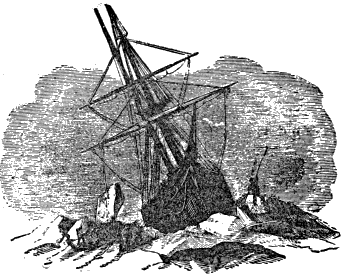
CUTTING OUT, MAY, 1851.
CHAPTER XIX
"O
N the 11th, I was well enough, or imprudent enough, to attempt a seal hunt. Our mean temperature had sunk to 19° 5\ and the snow-crust was strong enough to bear. A gale had swept away the loose, fleecy drifts of the fortnight before, exposing the familiar surface of the older snow. I walked over it as I did in April.
“Reaching the seat of the open water to the northward, I found it closed by young ice, an extensive surface frail and unsafe. About a quarter of a mile from the edge of the old floe, almost in the centre of this recent lead, was a seal. The temptations of the flesh were too much for me: I ventured the ice, crawled on my belly, and reached long-shot distance.
“The animal thus laboriously stalked was large; a hirsute, bearded fellow, with the true plantigrade countenance. All his senses were devoted to enjoyment: he wallowed in the sludge, stretched out in the sunshine, played with his flippers, lying on his back, much as a heavy horse does in a skin-loosening roll. I rose to fire—and down he went. An unseen hole had received him: a lesson for future occasions. This hole was critically circular, beveled from the under surface, and symmetrically embanked round with the pulpacious material which he had excavated from the ice.
“Crawling back less actively than I had approached, my carbine arm broke through, carrying my gun and it up to the shoulder. It was very well, all things considered, that my body did not follow; for I was on a very rotten shell, and nearly two miles from the brigs, alone.
“Wednesday, 12. For the last fortnight, our ice-saw, under Murdaugh’s supervision, has been hard at work. To-day we have a trench opened to our gangway.
“The ice shows the advancing season. It is no longer splintery and quartz-like, spawling off under the axe in dangerous little chips; but sodden, infiltrated ice, such as we see in our ice-houses. The water has got into its centre, and the crowbars, after the sawing out, break it readily up for hauling upon the field. The process is this: First, we cut two parallel tracks, four feet asunder, through six and five feet ice, with a ten-foot saw; then lozenged diagonals; then straps (ropes) are passed around the fragments, and a block and line, nautice jigger, or watch tackle, made fast to the bowsprit, hauls the lumps upon the floe, where they are broken up by the ice bars. A formidable barricade of dirty ice, about the size and shape of gneiss building stones, is already inclosing our vessel. Many a poor fellow has had an involuntary slide-bath into the freezing mixture alongside; but in most cases without unpleasant consequences."
I remember only one serious exception. It was that of our heroine of the Thespian corps, Jim Smith. The immediate result for him was an attack of scurvy, so marked, yet so blended with the active symptoms belonging to arthritic disease, as to incline me to an opinion for the time that there may be such a thing as acute scurvy, or a sudden inflammatory sthenic action, whose characteristics are scorbutic. He had immediately stitch, dyspnœa, pains in the back and joints, and in the alveolar and extensor muscles, just as in his previous attacks of scurvy, but without fever. The day after, he was so distressed by his stitch, that I feared pleuritis. On looking at his shins, I found large purpuric blotches, which were not there a week before. I commenced the anti-scorbutic tyranny at once; and the next morning his gums bled freely, his pains left him, and he took his place again at the ice-saw.
“Several laridæ flew about us: I heard them to-day for the second time—pleasant tones, with all their discord. Do you remember the skylark’s song, ‘a dropping from the sky,’ in the ‘Ancient Mariner’? I thought of it this morning when the gulls screeched over our motionless brig.
“May 18, Sunday. First, of late, in my daily records is this glorious wind, still from the northwest, fresh and steady. It is, as is every thing else for that matter, a Godsend. To-day’s observation places us but thirty-two miles from Cape Searle, and seventy from Cape Walsingham, the abutting gates of Davis' Straits, where the channel is at its narrowest, and where our imprisonment ought to end.
“This welcome wind-visitor is still freshening: it is not perpetrating, I hope, an extra brilliancy before its congé.
“I found to-day a rough caricature drawing by one of the men: some of the mess call it a portrait of myself. By-the-way, suppose I tell you of my latest rig? Here it is. A long musket on shoulder; a bear-knife in the leg of the left boot; a rim of wolf-skin around my head, leaving the bare scalp with its ‘hairs’ open to the breeze; rough Guernsey frock, overlined by a red flannel shirt, in honor of the day on which thou shalt do no labor; legs in sailor pants of pilot cloth, slop-shop cut; feet in seal-hide socks or buskins, of Esquimaux fabric and Esquimaux smell; a pair of crimson woolen mittens, which commenced their career as a neck comforter; and a little green rag, the snow veil, fluttering over a weather-beaten face: place all this, for want of a better lay figure, on your brother of the Arctic squadron.
DR. KANE IN ARCTIC RIG.
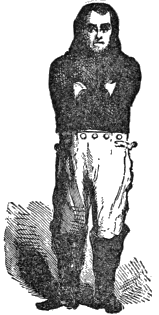
“With a delicacy which may possibly do me discredit, I have never before alluded to the garniture of my outer man. I may as well tell the truth at once. We are an uncouth, snobby, and withal, shabby-looking set of varlets. L’illustre Bertrand would be a Beau Brummel alongside of us. We are shabby, because we have worn out all our flimsy wardrobes, and have of late resorted to domestic tailorization. We are snobby, because our advance in the new art does not yet extend to the picturesque or well-fitting. I wish some of my soda-water-in-the-morning club friends could see me perspiring over a pair of pants, dorcassing a defunct sock. We do our own sewing, clothing ourselves cap-à-pie; and it astonishes me, looking back upon my dark period of previous ignorance, to feel how much I have learned. I wonder whether your friend the Philadelphia D’Orsay knows how to adjust with a ruler and a lump of soap the seat of a pair of breeches?
“Why, I have even made discoveries in—I forget the Greek word for it—the art which made George the Fourth so famous. Thus a method, adopted by our mess, of cutting five pairs of stockings out of one hammock blanket—a thing hitherto deemed impossible—is altogether my own. In the abstract or speculative part of the profession, I claim to be the first who has reduced all vestiture to a primitive form—an integral particle, as it were. I can’t dwell on this matter here: it might, perhaps, be out of place; perhaps, too, attributed in some degree to that personal vanity almost inseparable from invention. I will tell you, however, that this discovered type, this radical nucleus, is the ‘bag.’ Thus a bag, or a couple of parallelogramic planes sewed together, makes the covering of the trunk. Similar bags of scarcely varied proportion cover the arms; ditto the legs; ditto the hands; ditto the head: thus going on, bags, bags, bags, even to the fingers; a cytoblastic operation, having interesting analogies with the mycelium of the fungus or the saccine vegetation of the confervas.
“All this is a digression, perhaps; yet I am not the first traveler whose breeches have figured in his diary of wonders: you remember the geometrical artist of Laputa who re-enforced the wardrobe of Mr. Gulliver. But to return to less ambitious topics. The birds, in spite of the increasing wind, fly over in numbers, all seeking the mysterious north. What is there at this unreached pole to attract and sustain such hordes of migratory life? Since the day before yesterday, the 16th, we can not be on deck at any hour, night or day—they are one now—without seeing small bodies, rather groups than flocks, on their way to the unknown feeding or breeding grounds. Toward the west the field of a telescope is constantly crossed by these detachments. The ducks are now scarce: in fact, they have been few from the beginning. Geese are seen only in the forenoon and early morning. The guillemots, also, are not so numerous as they were two days ago; but from to-day we date the reappearance of the little auk. This delicious little pilgrim is now on his way to his far north breeding grounds. Toward the open lead the groups fly low, sometimes doubtless pausing to refresh. At the water’s edge I shot five, the first game of the season; and most valuable they were to our scurvy men. If this snow blindness permits me, I hope to-morrow to prove myself a more lucky sportsman.
“May 19, Monday. Jim Smith, little Jim Smith, reported ‘Land.’ We have become so accustomed to this great sameness of snow, that it was hard to realize at first the magnitude of our drift. Our last land was the spectral elevation upreared in the sunset sky of the 9th of February. The land itself must have been eighty miles off. Our drift, although now not absolutely fixed by observation, has probably carried us to within forty miles, perhaps thirty, of Cape Searle. Land it certainly is, shadowy, high, snow-covered, and strange. It is ninety-nine days since we looked at the refracted tops of the Lancaster Bay headlands, our last land.
“May 20, Tuesday. So snow-blind that I can barely see to write. A gauzy film floats between me and every thing else. I have been walking twelve miles upon the ice. No sun, but a peculiar misty, opalescent glare. I bagged thirty-three auks; but my snow-blindness avenges them.”
For some days after this entry my snow-blindness unfitted me for active duty. Several of the officers and men shared the visitation, Captain De Haven more severely than any of us. My next quotation from my journal dates of the 24th.
“May 24, Saturday. The ship shows signs of change, grating a little in her icy cradle, and rising at least nine inches forward. The work of removing the ice goes on painfully, but constantly. The blocks are now hoisted with winch and capstan by a purchase from the fore-yard; the saw, of course, pioneering. The blocks when taken out resemble great break-water stones, measuring sometimes eight by six feet.
“Thus far, by persevering labor, we have cut a four-feet wide trench to our starboard gangway, a little vacant pool of six yards by three in our bows, and a second trench now reaching amidships of our fore-chains.
“The difference of level between the deck at our bows and stern is still five feet three inches. It is proposed to launch the brig, as it were, from her ice-ways. To this purpose a screw jack is to be applied aft, and strong purchases on the ice ahead. The experiment will take place this afternoon. We have now been five months and a half, since the seventh of December, living on an inclined plane of about one foot in sixteen.
“10 P.M. The effort failed, as no doubt it ought to have done: we must wait for the great break-up to give us an even keel. From the mast-head we can see encroachments all around. The plains, over which I chased the bear and shot at auks, are now water. The floe is reduced to its old winter dimensions, three miles in one diameter, five in the other. We have not yet reached the narrow passage; and the wind, now from the southward, seems to be holding us back. Strange as it sounds, we are in hopes of a break-up at Cape Walsingham.
“May 25, Sunday Howling a perfect gale; drift impenetrable. By some providential interference the wind returned last night to its old quarter, the northwest, a direction corresponding with the trend of the shore. It is undoubtedly driving us fast to the southward, and is, of all quarters, that most favorable to a passage without disruption. Once past Cape Walsingham, the expansion of the bay is sudden and extensive. If, then, our floe maintains its integrity through the strait, the relief from pressure may allow us to continue our drifting journey. So at least we argue.
“And just so, it may be, others have argued before us about chances of escape that never came: there is a cycle even in the history of adventure. It makes me sad sometimes when I think of the fruitless labors of the men who in the very olden times harassed themselves with these perplexing seas. There have been Sir John Franklins before, and searchers too, who in searching shared the fate of those they sought after. It is good food for thought here, while I am of and among them, to recall the heart-burnings and the failures, the famishings and the freezings, the silent, unrecorded transits of ‘ye Arctic voyageres.’
“Mount Raleigh, named by sturdy old John Davis ‘a brave mount, the cliffes whereof were as orient as golde,’ shows itself still, not so glittering as he saw it two hundred and sixty-five years ago, but a ‘brave mount’ notwithstanding. No Christian eyes have ever gazed in May time on its ice-defended slope, except our own. Yet there it stands, as imperishable as the name it bears.
“I could fill my journal with the little histories of this very shore. The Cape of God’s Mercy is ahead of us to the west, as it was ahead of the man who named it. The Meta Incognita, further on, is still as unknown as in the days of Frobisher. We have passed, by the inevitable coercion of ice, from the highest regions of Arctic exploration, the lands of Parry, and Ross, and Franklin, to the lowest, the seats of the early search for Cathay, the lands of Cabot, and Davis, and Baffin, the graves of Cortereal, and Gilbert, and Hudson—all seekers after shadows. Men still seek Cathay."
CHAPTER XX
"T
HE storm broke in the early morning hours. We have drifted more than sixteen miles since Saturday. The true bearing of the prominent cape we supposed to be Cape Walsingham was found by solar distance to be S. 63° W.; while our observed position, by meridian altitude and chronometers, placed us but four miles north of Exeter Bay. Either, then, the protruding cape is not Walsingham, or our chronometers are at fault. This latter is probably the case; for if the coast line be correctly laid down on the charts, the true bearing cited above, projected from our present parallel of latitude, would place us thirty-six miles from the cape. More likely this than so near Exeter.
“Our latitude is about 66° 51', a very few miles north of the projecting headland, the western Gades of our strait. The character of the land is rugged and inhospitable. Ridges, offsetting from the higher range, project in spurs laterally, creviced and water-worn, but to seaward escarped and bluff. Some of these are mural and precipitous, of commanding height. The main range does not retire very far from the sea; it seems to follow the trend of the peninsula, and most probably on the Greenland shore is but the abutment of a plateau. Its culminating points are not numerous: the highest. Mount Raleigh, is, by my vague estimate, about fifteen hundred feet high.
“May 27. The land is very near to the eye; but in these regions we have learned to distrust ocular measurements of distance. Though we see every wrinkle, even to the crows' feet, on the cheeks of Mount Raleigh, I remember last year, on the west coast of Greenland, we saw almost under our nose land that was thirty-five miles off. A party from the Rescue measured a base upon the ice to-day, and attempted trigonometrical measurements with sextant angles. They make Cape Walsingham seven miles distant, and the height of the peak at the cape fifteen hundred feet. Our observation places us in latitude 66° 42′ W; our longitude by time sights, at 5h. 43m. P.M., was 60° 54'. According to the Admiralty chart, this plants us high and dry among the mountains of Cape Walsingham.
“It is evident that our rate of drift has increased. The northwest winds carried us forward eight miles a day while near the strait—a speed only equaled in a few of the early days of our escape from Lancaster Sound. What has become of all the ice that used to be intervening between us and the shore? At one time we had a distance of ninety miles: we are now close upon the coast. What has become of it? If it moves at the same rate as we do, why have we no squeezing and commotion at this narrow strait? Can it be that the ice to the westward of us has been more or less fixed to the land floe, and that we have been drifting down in a race-course, as it were, an ice-river whose banks were this same shore ice? Or is it, as Murdaugh suggests, that the inshore currents, more rapid, have carried down the inshore ice before us, thus widening the pathway for us? It is certainly very puzzling to find ourselves, at the narrowest passage, close into the land; and no commotion, no disturbance. On the contrary, from the mast-head abundant open water meets the eye; and could we escape from our imprisoning, but—thankfully I say it—protecting floe, we might soon be moving in open seas.
“May 28, Wednesday. The fact of the day is the rotation of our floe. In spite of its irregular shape, it has rotated a complete circle within the past twenty-four hours. It is still turning at the same rate, wheeling us down along the inshore fields. The Rescue, early this morning, was between us and the land: the evening before, the same land was astern of us. Strange that no rupture takes place!
“May 29, Thursday. I have just been witnessing one of the oddest of Arctic freaks. We were all of us engaged in tracing out the rugged indentations on Mount Raleigh, as the floe was rolling our vessels slowly along past Cape Walsingham, when, at five o’clock in the afternoon—the thermometer at 27°, the barometer at 30.31, and the atmosphere of the usual pearly opalescence—the captain, sweeping shoreward with his glass, saw a large pyramidal hummock, with a well-defined figure projecting in front of it, evidently animated and moving. Murdaugh, looking afterward, declared it ‘a man.’ I saw it next, a large human figure, covered with a cloak, and motionless. Murdaugh took the glass again, and holding it to his eye, suddenly exclaimed, ‘It moves:’ ‘it spreads out its arms;’ ‘it is a gigantic bird!’
“The hummock was within a mile of us. The words were hardly uttered before the object had disappeared, and the white snow was without a speck. A discussion followed. The size made us at once reject the bird idea: the shape, too, was that of a cloak-covered man; the motion, as if he had opened his mantle-covered arms. Convinced that it was a human being, an Esquimaux astray upon the ice, Murdaugh and myself started off, nearing the hummock with hearts full of expectation. The traces on the soft snow would soon solve the mystery, and remove our only doubt, whether the ‘Rescues’ might not be playing us a trick.
“Whatever it was, it either did not perceive us approaching, or was willing to avoid us; for it kept itself hidden behind a crag. Reaching, however, the spot where it had stood, we found traces, coprolitic and recent, of a bird; footprints, as a learned professor would have said, of certain familiar animal processes, exaggerated and dignified by those of refraction.
“On returning to the brig, the watchers told us that we had been ourselves curiously distorted; and that, when perched on the little icy crag we had gone to scrutinize, we lengthened vertically into gigantic forms. The position of the bird, probably a glaucous gull, had been breast toward the brig: a vertical enlargement, with the white body and moving wings, explained the phenomenon.
“The ‘Rescues’ had a very large bear hovering around them all this morning. At one P.M. he came within reach of a carefully-prepared ambush, receiving four out of a half dozen balls, a number soon increased to nine. You may have some idea of the superb tenacity of life of this beast, when I tell you that he ran, thus perforated, with his skull broken and his shoulder shivered. He even attempted a charge, uttering a hissing sound, ejaculated by sudden impulse, like the ‘blowing of a whale,’ to use Captain Griffin’s comparison. He measured eight feet five inches, only three inches less than my own big trophy, which, with one exception, is the largest recorded in the stories of the Polar American hunt. What a glorious feed for the scurvy-stricken ships!
“To-day, for the first time, we had a tide, made evident by the changing phases of the shore. We made southing in the forenoon: now, at half past eight P.M., the alignment of the hills shows a northward drift. The ice is unchanged: our floe is rotating from west to south, against the sun, but not equably. We crossed the Arctic circle at some unknown hour this forenoon. To the eye every thing is as before; yet it cheats one into pleasant thoughts. I do not wish to see a midnight sun again.
“May 30. The seal are out upon the ice, one of the most certain signs of summer. They are few In number, and very cautious. We notice that they invariably select an open floe for their hole, and that they never leave it more than a few lengths. Their alertness is probably due to their vigilant enemy, the bear. Sometimes you will see them frolicking together like a parcel of swimming school-boys; sometimes they are solitary, but keenly alive always to the enjoyment of the sunshine. I have often crawled within fair eye-shot, and, seated behind a concealing lump of ice, watched their movements.
“The first act of a seal, after emerging, is a careful survey of his limited horizon. For this purpose he rises on his fore flippers, and stretches his neck in a manner almost dog-like. This maneuver, even during apparently complete silence, is repeated every few minutes. He next commences with his hind or horizontal flippers and tail a most singular movement, allied to sweeping; brushing nervously, as if either to rub something from himself or from beneath him. Then comes a complete series of attitudes, stretching, collapsing, curling, wagging; then a luxurious, basking rest, with his face toward the sun and his tail to his hole. Presently he waddles off about two of his own awkward lengths from his retreat, and begins to roll over and over, pawing on the most ludicrous manner into the empty air, stretching and rubbing his glossy hide like a horse. He then recommences his vigil, basking in the sun with uneasy alertness for hours. At the slightest advance, up goes the prying head. One searching glance; and, wheeling on his tail as on a pivot, he is at his hole, and descends head foremost.
“I have watched so many without success, that to-night I determined to try the Esquimaux plan—patience and a snow-screen. This latter, the easier portion of the formula, I have just returned from completing; it was a mile’s walk and an hour’s snow-shoveling. The other, the patience, I attempt to-morrow, ‘squat like a toad’ on the ice for an unknown series of hours, with the sun blistering my nose, and blinking my eyes the while; a sort of sport so much like fishing, that it ought to be reserved for the Piscators of our Schuylkill Club.
“The walk over the snow to-night was very delightful. The opalescence, so painful to the eyes, had given place to a clear atmosphere; and the low sun was full of rich coloring. Land, too, that pleasing representative of the world we are cut off from, was refracted into grotesque knolls and long spires.
“The surface of the floes shows more and more the thawing influence of our sun, now half as high at meridian as in the torrid zone! The immediate surface to-day was often entire, though we plunged almost knee-deep in water below it. This you will easily understand when I tell you that the thermometer in the sun gave, for four successive hours to-day, a mean of nearly 80°. The surface thaw percolates through the loosely-compacted snow, and, forming a pasty substratum, is protected from re-freezing by the very snow through which it has descended. Our mean temperature of late has varied but little between 25° and 27° for any twenty-four hours.
“The infiltration of saline water through the ice assists the process of disintegration. The water formed by surface or sun thaw is, by the peculiar endosmitic action which I believe I have mentioned elsewhere, at once rendered salt, as was evident from Baumé’s hydrometers and the test of the nitrate of silver. The surface crust bore me readily this evening at a temperature of 21° and 19°, giving no evidences of thaw. Beneath, for two inches, it was crisp and fresh. As I tried it lower, cutting carefully with my bear-knife, it became spongy and brackish; at eight inches markedly so; and at and below twelve, salt-water paste. On the other hand, all my observations, and I have made a great many, prove to me that cold, if intense enough, will, by its unaided action, independent of percolation, solar heat, depending position, or even depth of ice, produce from salt water a fresh, pure, and drinkable element.
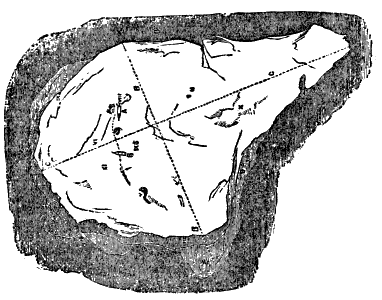
“May 31, Saturday. Walked to-night to the southward in search of seal: found the ice in motion, and had some difficulty in getting back. Wind from southward, and freshening, after a day of nearly perfect calm. The drift is somewhat to the eastward. The tables were heaping up actively, and the chewing process of demolition was in full energy among them. I have some hope that the action may extend itself to the core of our veteran floe-circle; but for the present it is confined to those peripheral adjuncts that have grown up around it in more recent freezings. A bird’s-eye view from the mast-head, corrected by my walks, enables me to map out its present shape with considerable accuracy."
The “month of roses” closed on us without adventure; but its last ten days were full of monitory changes. The increased temperature had been visibly acting upon the ice, softening down its rough angles, and reducing bowlders to mere knobs on the surface; its weary monotony becoming every day only more disgusting. From the 1st to the 19th we had drifted almost a hundred miles, and had been expecting daily to make the eastern shore, when land was reported ahead. It proved to be the Highlands around Cape Searle, about thirty-five miles off.
It was the first inbreak upon our desolate circle of ice and water that we had experienced in ninety-nine days. The hundredth gave us a complete range of dreary, snow-covered hills; but to men whose last recollections of terra firma were connected with the refracted spectres that followed us eighty miles from shore, just one hundred days since, the solid certainty of mountain ridges was inexpressibly grateful. We studied their phases, as we drew nearer to them, with an intentness which would have been ludicrous under different circumstances: every cranny, every wrinkle spoke to us of movement, of a relation with the shut-out world. Our drift which brought us this blessed variety was favored by an unusual prevalence of northwesterly winds. We made in the thirty-one days of May one hundred and ninety odd miles to the southward and eastward.
For the last four days of the month we were at the margin of the Arctic circle, alternating within and without it. We passed to the south of it on the 30th, to recross it on the 31st with an accidental drift to the northward. We were experiencing at this time the rapid transition of seasons which characterizes this climate. The mean of the preceding month, April, had been +7° 96'; that of May was 20° 22'—a difference of nearly twelve degrees. At the same time, there was a chilliness about the weather, an uncomfortable rawness, both in April and May, which we had not known under the deep, perpetual frosts of winter. Cold there seemed a tangible, palpable something, which we could guard against or control by clothing and exercise; while warmth, as an opposite condition, was realizable and apparent. But here, in temperatures which at some hours were really oppressing, 60° to 80° in the sun, and with a Polar altitude of 45°, one half the equatorial maximum, we had the anomaly of absolute discomfort from cold. I know that hygrometric conditions and extreme daily fluctuations of the thermometer explain much of this; but it was impossible for me to avoid thinking at the time that there must also be a physiological cause more powerful than either.
I have alluded in my journal to the return of the birds. They were most welcome visitors. Crowds of little snow-birds (Emberiza and Plectrophanes), with white breasts and jetty coverts, were attracted by the garbage which the thaw had reproduced around us, and twittered from pile to pile, chirping sweet music over their unexpected store-house. Some of the larger birds, too, were with us, returning to the mysterious North; the anatinæ, represented by the eiders (Somateria), followed by two of the uria genus, the grylle and the alke. We recognized the latter as our little fat friend of last summer, and gave him treatment accordingly. I shot thirty-three in one day, which my mess-mates made up to sixty.
The characteristic disease of May was the snow-blindness, severe and acute, leaving with some of us a disturbed, uncertain state of vision far from pleasing. The remedy most effective was darkness. A disk of hard wood, with a simple slit, admitting a narrow pencil of light, we found a better protection than the goggle or colored lens; the increased sensibility of the retina seeming to require a diminution of the quantity rather than a modification of the character of the ray. The slightest automatic movement varied, of course, the sentient surface affected by the impression.
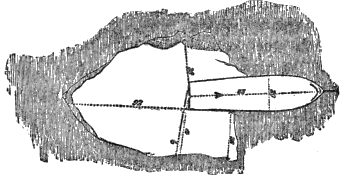
TOPOGRAPHY OF THE FLOE, MAY 31. A. Advance. B B. Shorter diameter, 314 miles. R. Rescue. CC. Longer diameter, 51/2 miles. Distance between the vessels, 500 yards.
CHAPTER XXI
"J
UNE 1. June opens on us warm. Our mean temperature to-day has been above the freezing point, 34°; our lowest only 29°; and at 11 this morning it rose to 40°. The snow-birds increase in numbers and in confidence. It is delightful to hear their sweet jargon. They alight on the decks, and come unhesitatingly to our very feet. These dear little Fringillides have evidently never visited Christian lands.
“June 3. The day misty and obscure: no land in sight from aloft; and no change apparent in the floe. But we notice a distinct undulation in the ice trenches alongside, caused probably by some propagated swell.
“I walked out at night between 9 and 11 o’clock in search of open water. We had the full light of day, but without its oppressive glare. The thawed condition of the marginal ice made the walk difficult, and forced us at last to give it up. But, climbing to the top of a hummock, we could see the bay rolling its almost summer waves close under our view. It was a grand sight, but more saddening than grand. It seems like our cup of Tantalus; we are never to reach it. And while we are floating close upon it, the season is advancing; and if we are ever to aid our brothers in the search, we should even now be hurrying back.
“June 4. Yesterday over again. But the water is coming nearer us. As we stand on deck, we can see the black and open channel-way on every side of us, except off our port quarter: it is useless to talk of points of the compass; our floe rotates so constantly from right to left, as to make them useless in description. To port, the extent of ice baffles the eye, even from aloft; it must, however, be a mere isthmus.
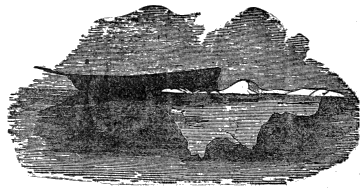
“June 5, Thursday. We notice again this morning the movement in the trench alongside. The floating scum of rubbish advances and recedes with a regularity that can only be due to some equable undulation from without to the north. We continue perched up, just as we were after our great lift of last December. A more careful measurement than we had made before, gave us yesterday, between our height aft and depression forward, a difference of level of 6 feet 4 inches. This inclination tells in a length of 83 feet—about one in thirteen.
“P.M. The break-up at last! a little after five this afternoon, Mr. Griffin left us for the Rescue, after making a short visit. He had hardly gone before I heard a hail and its answer, both of them in a tone of more excitement than we had been used to for some time past; and the next moment, the cry, ‘Ice cracking ahead!’
“Murdaugh and myself reached the deck just in time to see De Haven crossing our gangway. We followed. Imagine our feelings when, midway between the two vessels, we saw Griffin with the ice separating before him, and at the same instant found a crack tracing its way between us, and the water spinning up to the surface. ‘Stick by the floe. Good-by! What news for home?’ said he. One jump across the chasm, a hearty God-bless-you shake of the hand, a long jump back, and a little river divided our party.
“Griffin made his way along one fissure and over another. We followed a lead that was open to our starboard beam, each man for himself. In half a minute or less came the outcry, ‘She’s breaking out: all hands aboard!’ and within ten minutes from Griffin’s first hail, while we were yet scrambling into our little Ark of Refuge, the whole area about us was divided by irregular chasms in every direction.
BIRD’S-EYE view of floe, JUNE 5. A. Advance. D. Floe adhering to the Advance. R. Rescue. C. Path between brigs before break-up. H H. Hummocks.
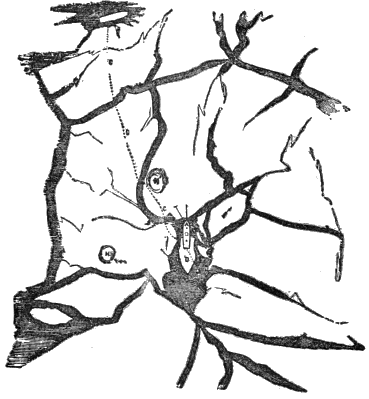
“All this was at half past five. At six I took a bird’s-eye sketch from aloft. Many of the fissures were already some twenty paces across. Conflicting forces were at work every where; one round-house moving here, another in an opposite direction, the two vessels parting company. Since the night of our Lancaster Sound commotion, months ago, the Rescue had not changed her bearing: she was already on our port-beam. Every thing was changed.
“Our brig, however, had not yet found an even keel. The enormous masses of ice, thrust under her stern by the action of repeated pressures, had glued themselves together so completely, that we remained cradled in a mass of ice exceeding twenty-five feet in solid depth. Many of these tables were liberated by the swell, and rose majestically from their recesses, striking the ship, and then escaping above the surface for a moment, with a sudden vault.
“To add to the novelty of our situation, two cracks coming together obliquely, met a few yards astern of us, cleaving through the heavy ice, and leaving us attached to a triangular fragment of 14 by 22 paces. This berg-like fragment, reduced as it was, continued its close adhesion. Its buoyancy was so great, that it acted like a camel, retaining the brig’s stern high in the air, her bows thrown down toward the water. We are so at this moment, 10 P.M."
All hands were in the mean time actively at work. The floe had been to us terra firma so long that we had applied it to all the purposes of land. Clothes and clothes' lines, sledges, preserved meats, kindling wood and planking, were now all bundled on board. The artificial horizon, which had stood for eight months upon a little ice-pedestal, was barely saved; and I had to work hard to get one of my few remaining thermometers from a neighboring hummock.
The cause of this sudden disruption—I mean the immediate cause, for the summer influences had prepared the floe for disintegration—was evidently the sea-swell setting from the southeast. This swell had given us minor manifestations of its existence as far back as the 1st of June. Whether it was increased without, or our floe made more accessible to it by the drifting away of other and protecting floes, I can not say. This, however, was clear, that the great undulations propagated by wave action caused our disruption. The proof of this I shall not forget.
Standing on our little deck, and looking out on the floe, we had the strange spectacle of an undulating solidity, a propagated wave borne in swell-like ridges, as if our ice was a carpet shaken by Titans. I can not convey the effect of this sublime spectacle. The ice, broken into polyhedric masses, gave at a few hundred yards no indications to the eye of the lines of separation; besides which, the infiltration of salt water had no doubt increased the plasticity of the material. Imagine, then, this apparently solid surface, by long association as unyielding to us as the shore, taking suddenly upon itself the functions of fluidity, another condition of matter. It absolutely produced something like the nausea of sea-sickness to see the swell of the ice, rising, and falling, and bending, transmitting with pliant facility the advancing wave.
A hummock hill, about midway between us and the Rescue, gave me an opportunity of measuring rudely the height of the swell. It rose till it covered her quarter boat; sinking again till I could see the side of the brig down to her water-line, an interval of five feet at least.
“As we walk along the edge of the open fissures, we see a wonderful variety in the thickness of the ice. Our apparently level surface is, in fact, a mosaic work of ices, frozen at separate periods, and tesselated by the several changes or disruptions which we have undergone. Thus I can see the tables under our stern extending down at least twenty-five feet: adjoining this is ice of four feet; next comes a field of six feet; and then hummock ridges, with tables choked below, so as to give an apparent depth of twenty.
“The ‘calves’ also, of which a great many have now risen to the surface, are worthy of note. These singular masses are evidently fragments of tables, of every degree of thickness, which have been forced down by pressure, and afterward, by some change in the temperature of the water, or by wave and tidal actions, have been liberated again from the floe, and find their way upward wherever an opening permits. We saw them honeycombed and cellular, water-sodden and in rounded bowlders, rising from the depths of the sea. Their density, so near that of the liquid in which they were submerged, made this rise slow and impressive. We could see them many fathoms below, voyaging again to the upper world. Once between the gaping edges of the lead, they effectually prevent the closing. They are about us in every direction, interposed between the fields.
“The appendage which sustains our brig has a good deal of this character. I will try to make an exact drawing of it as a curiosity, if it hangs on to us much longer. Its buoyancy indicates great submerged mass. A strong cable and ice anchor have been carried to a floe on our starboard bow, and the swell drives it upon us like a great battering-ram. This ingenious method of pounding us out of our tenacious cradle subjects us to a regular succession of heavy shocks, which would startle a man not used to ice navigation. At the time I write, 11 P.M., we have been nearly three hours subjected to this banging without any apparent impression. To-morrow we will, if not liberated, apply the saw; and then again to the warps!
“11:20 P.M. In the midst of fragments, few more than a hundred yards in length, nearly all much smaller. Between them are zigzag leads of open water. Astern of us is an expansion of some fifty yards across; ahead, a winding creek, wider than our brig. Thus closes the day.
“One thing more: a thought of gratitude before I turn in. This journal shows that I have been in the daily habit of taking long, solitary walks upon the ice, miles from the ship. Suppose this rupture to have come entirely without forewarning! I had greased my boots for a walk a few hours before the change, and only postponed it because I happened to get absorbed in a book.”
TOPOGRAPHY OF FLOE, JUNE 5.
PROFILE OF FLOE; PORT SIDE.
CHAPTER XXII
"J
UNE 6. Our bumping continued all I night, without any apparent effect I upon our sticking-plaster. Acting, as this impact does, at the long end of a lever, our stern being immovably fixed, it must be hard upon the rudder post, a beam that is now protruding from the least strengthened part of our brig into a transparent glue of tenacious ice. The twelve-feet saw, suspended from a tripod of spars, is at work, trying to cut a line across the mass to our keel. But for this appendage, we would be now warping through the fissures.
“7 P.M. The position of things continues unchanged. Our ice-saw with great labor buried its length in the floe, reaching nearly to our stern; but the submerged material is so thick that it has little or no effect. Wedging, by billets of wood between her sides and the mounding ice, was equally ineffectual. Gunpowder would perhaps release us; but that we can not spare.
“I tried to measure the depth of this inveterate companion of ours. Standing at our port gangway, I lowered the pump-rod twenty-four feet to a shelf projecting from the mass: beneath this, a prolongation or tongue stretched to a depth which I could not determine. On the other side, to starboard, the ice descends in solid mass some twenty feet. Adopting twenty-four feet as a mean depth, and ninety by fifty feet as the mean of dimensions at the surface, the solid contents of this troublesome winter relic would be 108,000 cubic feet. No wonder it lifts up our little craft bodily. I have made my drawings of it with all topographical accuracy.
“The wind has been hauling round from the south to the west, and by afternoon blew quite freshly. We made all sail, even to studding-sails, in hopes of forcing the cracks ahead, and tearing ourselves, as it were, from our impediment. Thus far all has failed.
“10 P.M. The ship is covered with canvas: she stands motionless amid the ice, although her wings are spread and tense. The wind is fresh and steady from the northwest. Our swell ceases with this wind, and the floes seem disposed to come together again; but the days of winter have passed by, and the interposing calves prevent the apposition of the edges.
“The effects of a constant force, slight as it seems, have been beautifully shown by our brig. Pressing as we do, under full canvas, against heavy yet quiescent masses, we gradually force ahead, breasting aside the floes, and leaving behind us a pool of open water. Our rate is ten feet per hour! Remember that the old man of Sinbad still clings to us, and that we carry the burden in this slow progress. I hope that the Sinbad comparison will end here; for I can readily, without much imagination, carry it further.
“12 Midnight. Still advancing, dragging behind us this pertinacious mass. We have butted several times against projecting floes, but it is as unmoved as solid rock. Very foggy: Rescue not visible. Thermometer at 29 degrees.
“We recognize, among the floe fragments around us, old play-fellows. Here we played foot-ball; there we skated; by this hummock crag stood my thermometers; and here I shot a bear. We are passing slowly from them, or they from us. Now and then a rubbish pile will show itself, cresting the pure ice. Even an old champagne basket, full of nothing but sadly-pleasant associations, is recognized upon a distant floe. This breaking up of a curtilage is not without its regrets. I wish that our ‘old man’ would loosen his gripping knees: three hours would put us into comparatively open water.
“June 7, Saturday. The captain says that the shocks of the night of the fifth were the hardest our brig has experienced yet.
“This morning we made our incubus fast to one end of a passing floe, and ourselves fast to the other: double hawsers were used, blocks and tackle rigged, and all hands placed at our patent winch, the slack being controlled by a windlass. We parted our stern hawser, and that was all. Our resort now is to the fourteen-feet saw. With this, before the day closes, we shall cut a skerf as far as our fore-foot, and then try the efficacy of wedges.
“Toward evening the Rescue made sail, and forced her way slowly through the fragments. By eight P.M. she was snugly secured to the other side of our own floe. A beautiful sight it was to see once more, even in this labyrinth of rubbish, a moving sail-spread vessel. Once a momentary opening showed us the dark water, and beneath it the shadow of the brig.
“10:40. A crash! a low, grinding sound, followed by loud exclamations of ‘Back,’ ‘back!’ ‘Hold on,’ ‘hold on!’ I ran upon deck in time to add one cheer more to three which came from the ice. A large fragment, extending from her saw-crack along the bottom on the port side, had broken off, cutting the triangle in half, and leaving the crew behind floating and separated from the ship. All that now confined us was the mass (a) which remained on her starboard quarter. This descended some twenty or more feet, embracing our keel, and by its size sustaining us in our perched condition. We had settled but nine inches in consequence of our partial disengagement.
“Looking from the taffrail down the stern-post, we can now see the position of this portion of our brig distinctly. A strip of her false keel has been forced from its attachments, drawing the heavy bolts, and tearing away some of our sheathing. How far the injury extends, whether the entire length of the brig, or through some few yards, we can not tell. It must have occurred during the great ice commotion of December 7th and 8th. The disruption of January no doubt added to the thickness of the underlying tables; but our keel probably received its shock at the same time that we received our elevation. We have escaped wonderfully.
“June 8, Sunday. Even keel again! Once more floating ship-fashion, in a ship’s element. It was between twelve and one o’clock this morning. Murdaugh went down upon the fragment, which was still adhering to our starboard side. He had hardly rested his weight upon it, when, with certain hurried, scarcely premonitory grindings, it cleared itself. He had barely time to scramble up the brig’s side, tearing his nails in the effort, before, with crash and turmoil, it tumbled up to the surface, letting us down once more into clear water. When I reached the deck, I could hardly realize the level, horizontal condition of things, we have been accustomed to this up and down hill work so long.
“9 P.M. At 1 o’clock P.M. the wind freshened from the northward, enough to make sail. We cast off, and renewed the old time process of boring, standing irregularly among the fragments to the southward and eastward. We received some heavy bumps, but kept under weigh until 6 P.M., when an impenetrable ice-fog caused us to haul up to a heavy floe, to which we are now fast by three anchors. We estimate our progress at six miles. The Rescue is not visible.
“From the heavy floe to which we are secured we obtained fresh thawed water. This is the first time since the 15th of September that I have drunk water liquefied without fire. Eight months and twenty-four days: think of that, dear strawberry and cream eating family!
“We saw an ice-floe to-day, which had evidently come from the upper northern regions of Wellington, or the North Baffin’s Straits. This ice, though pure and beautiful, could never have been created in any single winter. It has made me understand for the first time the startling stories of Wrangell. This floe is now more than two hundred and fifty yards long by four hundred wide; a size too large for infraposition of tables, while its purity precludes the idea of ground ice. Its depth, ascertained from its mean line of flotation, exceeds forty feet. Its surface is level, and the appearance, looking down into its pure depths, beautiful beyond description. It forms part of a great field, miles in circumference, as similar coaptating fragments are seen in every direction; the great swell of the 5th having no doubt destroyed its integrity. From what great winter basin comes this colossal ice?”
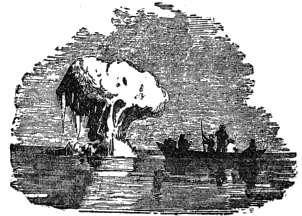
CHAPTER XXIII
W
E continued our progress through a labyrinth of ice, sometimes running into a berg, or grazing against its edge so close as to carry away a spar or stave a quarter-boat, but still making our way across to the Greenland shore. The sea was studded with low bergs and water-washed floes, wearing the fantastic forms which had surprised us the year before. Some were both complicated and graceful, supported generally by peduncular bases, which gave them a curious aspect of fragility. This was evidently due to the action of the waves at the water-line, aided by the warmth of the atmosphere.
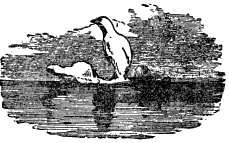
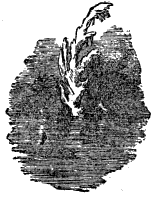
If we suppose a nearly symmetrical lump of ice, floating with that stable equilibrium which belongs to its excessive submergence, the atmosphere, which has now a temperature as high as 64° in the sunshine, will gradually round off and crease the edges, and at the same time will melt the portions of the mass which are above water. Its buoyancy increasing as its weight is reduced, the berg will now rise slowly, presenting a succession of new surfaces to the abrasion of the waves; and thus we shall have the familiar mushroom or fungoid appearance which is shown in many of the plates illustrating peculiar berg forms.
The process continuing under all the modifications of wave action, while the opposing face of the berg varies with every change of its gravitating centre, we may have eccentric resemblances to animated things sculptured in the ice, and at other times forms of classic symmetry, or the frets and garniture of mediæval art.
Our sail through this fanciful archipelago was a most uncomfortable one. Our stoves had been taken down; and the scurvy, exaggerated by the increased exposure to damp, began again to bear hard upon us. We devoured eagerly the seal, of which, by good fortune, we had several re-enforcements; but as the excitements of peril declined, the energies of the men seemed to relax more and more; and I had reason to fear that we should not be able to resume our search effectively, until the health of our party had undergone a tedious renovation.
It had been determined by our commander that we should refresh at Whale Fish Islands, and then hasten back to Melville Bay, the North Water, Lancaster Sound, and Wellington Channel; and certainly there was no one on board who did not enter heart and soul into the scheme. It was in pursuance of it that we were now bending our course to the east.
The circumstances that surrounded us, the daily incidents, our destination and purpose, were the same as when approaching the Sukkertoppen a year before. There were the same majestic fleets of bergs, the same legions of birds of the same varieties, the same anxious look-out, and rapid conning, and fearless encounter of ice-fields. Every thing was unchanged, except the glowing confidence of young health at the outset of adventure. We had taken our seasoning: the experience of a winter’s drift had quieted some of our enthusiasm. But we felt, as veterans at the close of a campaign, that with recruited strength we should be better fitted for the service than ever. All, therefore, looked at the well-remembered cliffs, that hung over Kronprinsen, with the sentiment of men approaching home for the time, and its needed welcomes.
We reached them on the 16th. Mr. Murdaugh, and myself, and four men, and three bottles of rum, were dispatched to communicate with the shore. As we rowed in to the landing-place, the great dikes of injected syenite stood out red and warm against the cold gray gneiss, and the moss gullies met us like familiar grass-plots. Esquimaux crowded the rocks, and dogs barked, and children yelled. A few lusty pulls, and after nine months of drift, and toil, and scurvy, we were once more on terra firma.
God forgive me the revulsion of unthankfulness! I ought to have dilated with gratitude for my lot.
Winter had been severe. The season lagged. The birds had not yet begun to breed. Faces were worn, and forms bent. Every body was coughing. In one hut, a summer lodge of reindeer and seal skins, was a dead child. It was many months since I had looked at a corpse. The poor little thing had been for once washed clean, and looked cheerful. The father leaned over it weeping, for it was a boy; and two little sisters were making lamentation in a most natural and savage way.