Front matter (continued 2)
Reading edition
“No snow until afternoon. Thermometer, maximum 22°, minimum 19°, mean 20° 35'. Wind gentle, and now nearly calm, from southward and eastward to southward.
“About tea-time (21st), the sun sufficiently low to give the effects of sunset, we saw distinctly to the north by west a series of hill-tops, apparently of the same configuration with those around us. The trend of the western coast extending northward from the point opposite our vessel receded westward, and a vacant space, either of unseen very low land or of water, separated it from the Terra Nova, which we see north of us. Whether this Grinnell Land, as our captain has named it, be a continuation of Cornwallis Island or a cape from a new northernland, or a new direction of the eastern coast of North Devon, or a new island, I am not prepared to say. We shall probably know more of each other before long.
“September 22, Sunday. A cloudless morning: no snow till afternoon. Our drift during the night has been to the northward; and, except an occasional crack or pool, our horizon was one mass of snow-covered ice.
“The beautifully clear sky with which the day opened gave us another opportunity of seeing the unvisited shores of Upper Wellington Sound. Our latitude by artificial horizon was 75° 24′ 21″ N., about sixty miles from Cape Hotham. Cape Bowden, on the eastern side, has disappeared; and on the west, Advance Bluff, a dark, projecting cape, from which we took sextant angles, was seen bearing to the west of south. To the northward and westward low land was seen, having the appearance of an island,[B] and mountain tops terminating the low strip ahead. The trend of the shore on our left, the western, is clearly to the westward since leaving Advance Bluff. It is rolling, with terraced shingle beach, and without bluffs. It terminates, or apparently terminates, abruptly, thus:

after which comes a strip without visible land, and then the mountain tops mentioned above. Beyond this western shore, distant only seven miles, we see mountain tops, distant and very high, rising above the clouds.
“September 25, Wednesday. The wind has changed, so that our helpless drift is now again to the north. The day was comparatively free from snow; but not clear enough to give us an observation, or to exhibit the more distant coast-lines. We can see the western shore very plainly covered with snow, and stretching in rolling hills to the north and west. A little indentation, nearly opposite the day before yesterday, is now in nearly the same phase—if any thing, a little to the southward. We have therefore changed our position by drift not so much as on the preceding days. The winds, however, have been very light. Advance Bluff is now shut in by ‘Cape Rescue,’ the westernmost point yet discovered of Cornwallis Island. This shows that we are nearing the shore.
“Toward the north and a little to the west is a permanent dark cloud, a line of stratus with a cumulated thickening at the western end. This is the same during sunshine and snow-storm, night and day. It is thought by Captain De Haven to be indicative of open water. It may be that Cornwallis Island ends there, and that this is a continuation of the present channel trending to the westward. Or this dark appearance may be merely the highland clouds over the mountains seen on Sunday; but De Haven suggests that it is rather a vacant space, or water free from ice; the exemption being due to the island and adjacent western shore (not more than seven miles from it), acting as a barrier to the northern drift of the present channel."
CHAPTER VI
I
AM reluctant to burden my pages with the wild, but scarcely varied incidents of our continued drift through Wellington Channel. We were yet to be familiarized with the strife of the ice-tables, now broken up into tumbling masses, and piling themselves in angry confusion against our sides—now fixed in chaotic disarray by the fields of new ice that imbedded them in a single night—again, perhaps, opening in treacherous pools, only to close round us with a force that threatened to grind our brigs to powder. I shall have occasion enough to speak of these things hereafter. I give now a few extracts from my journal; some of which may perhaps have interest of a different character, though they can not escape the saddening monotony of the scenes that were about us.
I begin with a partial break-up that occurred on the 23d.
“September 23. How shall I describe to you this pressure, its fearfulness and sublimity! Nothing that I have seen or read of approaches it. The voices of the ice and the heavy swash of the overturned hummock-tables are at this moment dinning in my ears. ‘All hands’ are on deck fighting our grim enemy.
“Fourteen inches of solid ice thickness, with some half dozen of snow, are, with the slow uniform advance of a mighty propelling power, driving in upon our vessel. As they strike her, the semi-plastic mass is impressed with a mould of her side, and then, urged on by the force behind, slides upward, and rises in great vertical tables. When these attain their utmost height, still pressed on by others, they topple over, and form a great embankment of fallen tables. At the same time, others take a downward direction, and when pushed on, as in the other case, form a similar pile underneath. The side on which one or the other of these actions takes place for the time, varies with the direction of the force, the strength of the opposite or resisting side, the inclination of the vessel, and the weight of the superincumbent mounds; and as these conditions follow each other in varying succession, the vessel becomes perfectly imbedded after a little while in crumbling and fractured ice.
“Perhaps no vessel has ever been in this position but our own. With matured ice, nothing of iron or wood could resist such pressure. As for the British vessels, their size would make it next to impossible for them to stand. Back’s ‘Winter’ is the only thing I have read of that reminds me of our present predicament. No vessel has ever been caught by winter in these waters.
“We are lifted bodily eighteen inches out of water. The hummocks are reared up around the ship, so as to rise in some cases a couple of feet above our bulwarks—five feet above our deck. They are very often ten and twelve feet high. All hands are out, laboring with picks and crowbars to overturn the fragments that threaten to overwhelm us. Add to this darkness, snow, cold, and the absolute destitution of surrounding shores.
“This uprearing of the ice is not a slow work: it is progressive, but not slow. It was only at 4 P.M. that nips began, and now the entire plain is triangulated with ice-barricades. Under the double influence of sails and warping-hawsers, we have not been able to budge a hair’s-breadth. Yet, impelled by this irresistible, bearing-down floe-monster, we crush, grind, eat our way, surrounded by the ruins of our progress. In fourteen minutes we changed our position 80 feet, or 5.71 per minute.
“Sometimes the ice cracks with violence, almost explosive, throughout the entire length of the floe. Very grand this! Sometimes the hummock masses, piled up like crushed sugar around the ship, suddenly sink into the sea, and then fresh mounds take their place.
“Our little neighbor, the Rescue, is all this time within twenty yards of us, resting upon wedges of ice, and not subjected to movement or pressure—a fact of interest, as it shows how very small a difference of position may determine the differing fate of two vessels.
“September 24. The ice is kinder; no fresh movements; a little whining in the morning, but since then undisturbed. The ice, however, is influenced by the wind; for open water-pools have formed—three around the ship within eye distance. In one of these, the seals made their appearance toward noon; no less than five disporting together among the sludge of the open water. I started off on a perilous walk over the ruined barricades of last night’s commotion; and, after cooling myself for forty minutes in an atmosphere ten degrees above zero, came back without a shot. The condensed moisture had so affected my powder that I could not get my gun off.
“This condensation is now very troublesome, dripping down from our carlines, and sweating over the roof and berth-boards. When we open the hatchway, the steam rises in clouds from the little cabin below.
“We have as yet no fires; worse! the state of uncertainty in which we are placed makes it impossible to resort to any winter arrangements. Yet these lard lamps give us a temperature of 46°, which to men like ourselves, used to constant out-door exercise, exposure, and absence of artificial heat, is quite genial. But for the moisture—that wretched, comfortless, rheumatic drawback—we would be quite snug.
“Our captain is the best of sailors; but, intent always on the primary objects and duties of his cruise, he is apt to forget or postpone a provident regard for those creature-comforts which have interest for others. To-day, with the thermometer at 10°, we for the first time commenced the manufacture of stove-pipes. I need not say that the cold metal played hob with the tinkers. If they go on at the present rate, the pipes will be nearly ready by next summer.
“September 26. The hummocks around us still remain without apparent motion, heaped up like snow-covered barriers of street rioters. We are wedged in a huge mass of tables, completely out of water, cradled by ice. I wish it would give us an even keel. We are eighteen inches higher on one quarter than the other.
“The two large pools we observed yesterday, one on each side of us, are now coated by a thick film of ice. In this the poor seals sometimes show themselves in groups of half a dozen. They no longer sport about as they did three weeks ago, but rise up to their breasts through young ice, and gaze around with curiosity-smitten countenances.
“The shyness of the seal is proverbial. The Esquimaux, trained from earliest youth to the pursuit of them, regard a successful hunter as the great man of the settlement. If not killed instantaneously, the seal sinks and is lost. The day before yesterday, I adopted the native plan of silent watching beside a pool. Thus for a long time I was exposed to a temperature of +8°; but no shots within head-range offered; and I knew that, unless the spinal column or base of the brain was entered by the ball, it would be useless to waste our already scanty ammunition.
“To-day, however, I was more fortunate. A fine young seal rose about forty yards off, and I put the ball between the ear and eye. A boat was run over the ice, and the carcass secured. This is the second I have killed with this villainous carbine: it will be a valuable help to our sick. We are now very fond of seal-meat. It is far better than bear; and the fishiness, which at first disturbed us, is no longer disagreeable. I simply skin them, retaining the blubber with the pelt. The cold soon renders them solid. My bear, although in a barrel, is as stiff and hard as horn.
“Took a skate this morning over some lakelets recently frozen over. The ice was tenacious, but not strong enough for safety. As I was moving along over the tickly-benders, my ice-pole drove a hole, and came very near dropping through into the water.
“September 27. This evening the thermometer gave 3° above zero. A bit of ice, which I took into my mouth to suck, fastened on to my tongue and carried away the skin. When we open the cabin hatch now, a cloud of steam, visible only as the two currents meet, gives evidence of the Arctic condensation.
“Afar off, skipping from hummock to hummock, I saw a black fox. Poor desolate devil! what did he, so far from his recorded home, seven miles from even the naked snow-hills of this dreary wilderness? In the night-time I heard him bark. They set a trap for him; but I secretly placed a bigger bait outside, without a snare-loop or trigger. In the morning it was gone, and the dead-fall had fallen upon no fox. How the poor, hungry thing must have enjoyed his supper! half the guts, the spleen, and the pluck of my seal.
“Lovell raised a swing; cold work, but good exercise. He rigged it from the main studding-sail boom. Murdaugh and Carter are building a snow-house. The doctor is hard at work patching up materials for an overland communication with the English squadron—an enterprise fast becoming desperate. Yet, drifting as we are to unknown regions north, it is of vast importance that others should know of our position and prospects.”
Our position, however, at the end of September, thanks to the rapidly-increasing cold, gave promise of a certain degree of security and rest. The Advance had been driven, by the superior momentum of the floes that pressed us on one side, some two hundred and fifty feet into the mass of less resisting floes on the other; the Rescue meanwhile remaining stationary; and the two vessels were fixed for a time on two adjacent sides of a rectangle, and close to each other. The unseen and varying energies of the ice movements had occasionally modified the position of each; but their relation to each other continued almost unchanged.
We felt that we were fixed for the winter. We arranged our rude embankments of ice and snow around us, began to deposit our stores within them, and got out our felt covering that was to serve as our winter roof. The temperature was severe, ranging from 1°.5, and 4° to +10°; but the men worked with the energy, and hope too, of pioneer settlers, when building up their first home in our Western forests.
The closing day of the month was signalized by a brilliant meteor, a modification of the parhelion, the more interesting to us because the first we had seen.
“October 1, Tuesday. To-day the work of breaking hold commenced. The coal immediately under the main hatch was passed up in buckets, and some five tons piled upon the ice. The quarter-boats were hauled about twenty paces from our port-bow, and the sails covered and stacked; in short, all hands were at work preparing for the winter. Little had we calculated the caprices of Arctic ice.
“About ten o’clock A.M. a large crack opened nearly east and west, running as far as the eye could see, sometimes crossing the ice-pools, and sometimes breaking along the hummock ridges. The sun and moon will be in conjunction on the 3d; we had notice, therefore, that the spring tides are in action.
“Captain Griffin had been dispatched with Mr. Lovell before this, to establish on the shore the site for a depôt of provisions: at one o’clock a signal was made to recall them. At two P.M., seeing a seal, I ran out upon the ice; but losing him, was tempted to continue on about a mile to the eastward. The wind, which had been from the westward all the morning, now shifted to the southward, and the ice-tables began to be again in motion. The humming of bees and upheaving hummocks, together with exploding cracks, warned me back to the vessel.
“At 3:20, while we were at dinner, commenting with some anxiety upon the condition of things without, that unmistakable monitor, the ‘young puppies,’ began. Running on deck, we found a large fissure, nearly due north and south, in line with the Advance. A few minutes after, the entire floe on our starboard side was moving, and the ice breaking up in every direction.
“The emergency was startling enough. All hands turned to, officers included. The poor land party, returning at this moment, tired and dinnerless, went to work with the rest. Vreeland and myself worked like horses. Before dark, every thing was on board except the coal; and of this, such were the unwearied efforts of our crew, that we lost but a ton or two.
“This ice-opening was instructive practically, because it taught those of us who did not understand it before how capriciously insecure was our position. It revealed much, too, in relation to the action of the ice.
“1. The first crack was nearly at right angles to the axis of the channel; the subsequent ones crossed the first; the wind being in the one case from the westward, and afterward changing to the southward.
“2. The next subject of note was the disintegration of the old floes. It took place almost invariably at their original lines of junction, well marked by the hummocky ridges. This shows that the cementation was imperfect after seventeen days of very low temperature; a circumstance attributable, perhaps, to the massive character of the up-piled tables, which protected the inner portion of them from the air, and to the constant infiltration (endosmose) of salt-water at the abraded margins.
“3. The extent to which the work of super and infra position had been carried during the actions may be realized, when I say that the floe-piece which separated from us to starboard retained the exact impression of the ship’s side. There it was, with the gangway stairs of ice-block masonry, looking down upon the dark water, and the useless embankment embracing a sludgy ice-pool.
“We could see table after table, more properly layer after layer, each not more than seven inches thick, extending down for more than twenty feet. Thus, it is highly probable, may be formed many of those enormous ice-tables, attributed by authors to direct and uninterrupted congelation.
“The quantity of ice adhering to our port-side must be enormous; for although the starboard floe, in leaving us, parted a six-inch hawser, it failed to budge us one inch from the icy cradle in which we are set.”
CHAPTER VII
T
HREE days after this entry the thermometer had fallen to 11° below zero. Our housings were not yet fixed, and we had no fires below; indeed, our position was so liable to momentary and violent change that it would have been impracticable to put up stoves. Still, our lard-lamp in the cabin gave us a temperature of +44°; and so completely were our systems accommodated to the circumstances in which we were, that we should have been quite satisfied but for the condensed moisture that dripped from every thing about us. Our commander had allowed me to place canvas gutters around the hatchways, and from these we emptied every day several tin cans full of water, that would otherwise have been added to the slop on our cabin floor. But the state of things was, on the whole, exceedingly comfortless, and, to those whom the scurvy had attacked, full of peril. I remember once, when the lard-lamp died out in the course of the night, the mercury sunk in the cabin to 16°. It was not till the 19th that we got up our stoves.
The adaptation of the human system to varying temperatures struck me at this time with great force. I had passed the three winters before within the tropics—the last on the plains of Mexico—yet I could now watch patiently for hours together to get a shot at seals, with the thermometer at +10°. I wrote my journal in imaginary comfort with a temperature of 40°, and was positively distressed with heat when exercising on the ice with the mercury at +19°.
I return to my diary.
“October 3. I write at midnight. Leaving the deck, where I have been tramping the cold out of my joints, I come below to our little cabin. As I open the hatch, every thing seems bathed in dirty milk. A cloud of vapor gushes out at every chink, and, as the cold air travels down, it is seen condensing deeper and deeper. The thermometer above is at 7° below zero.
“The brig and the ice around her are covered by a strange black obscurity—not a mist, nor a haze, but a peculiar, waving, palpable, unnatural darkness: it is the frost-smoke of Arctic winters. Its range is very low. Climbing to the yard-arm, some thirty feet above the deck, I looked over a great horizon of black smoke, and above me saw the heaven without a blemish.
“October 4. The open pools can no longer be called pools; they are great rivers, whose hummock-lined shores look dimly through the haze. Contrasted with the pure white snow, their waters are black even to inkyness; and the silent tides, undisturbed by ripple or wash, pass beneath a pasty film of constantly forming ice. The thermometer is at 10°. Away from the ship, a long way, I walked over the older ice to a spot where the open river was as wide as the Delaware. Here, after some crevice-jumping and tickly-bender crossing, I set myself behind a little rampart of hummocks, watching for seals.
“As I watched, the smoke, the frost-smoke, came down in wreaths, like the lambent tongues of burning turpentine seen without the blaze. I was soon enveloped in crapy mist.
“To shoot seal, one must practice the Esquimaux tactics of much patience and complete immobility. It is no fun, I assure you after full experience, to sit motionless and noiseless as a statue, with a cold iron musket in your hands, and the thermometer 10° below zero. But by-and-by I was rewarded by seeing some overgrown Greenland calves come within shot. I missed. After another hour of cold expectation, they came again. Very strange are these seal. A countenance between the dog and the mild African ape—an expression so like that of humanity, that it makes gun-murderers hesitate. At last, at long shot, I hit one. God forgive me!
“The ball did not kill outright. It was out of range, struck too low, and entered the lungs. The poor beast had risen breast-high out of water, like the treading-water swimmers among ourselves. He was thus supported, looking about with curious, expectant eyes, when the ball entered his lungs.
“For a moment he oozed a little bright blood from his mouth, and looked toward me with a sort of startled reproachfulness. Then he dipped; an instant after, he came up still nearer, looked again, bled again, and went down. A half instant afterward, he came up flurriedly, looked about with anguish in his eyes, for he was quite near me; but slowly he sunk, struggling feebly, rose again, sunk again, struggled a very little more. The thing was drowning in the element of his sportive revels. He did drown finally, and sunk; and so I lost him.
“Have naturalists ever noticed the expression of this animal’s phiz? Curiosity, contentment, pain, reproach, despair, even resignation I thought, I saw on this seal’s face.
“About half an hour afterward, I killed another. Scurvy and sea-life craving for fresh meat led me to it; but I shot him dead.
“On returning to the ship, I found one toe frost-bitten—a tallow-looking dead man’s toe—which was restored to its original ugly vitality by snow-rubbing. Served me right!
“Spent the afternoon in unsuccessful seal stalking, and in rigging and contriving a spring-gun for the Arctic foxes: a blood-thirsty day. But we ate of fox to-day for dinner; and behold, and it was good.
“October 5, Saturday. The wind evidently freshens up. The day has been bitterly cold. Although our lowest temperature was zero and—1°, we felt it far more than the low temperature of yesterday. Our maximum was as high as 4°; yet, with this, it required active motion on deck to keep one’s self warm.
“At 12h. 55m., we had an interval of clear sunshine. The utmost, however, to which it would raise one of the long register Smithsonian thermometers was 7°. The air was filled with bright particles of frozen moisture, which glittered in the sunshine—a shimmering of transparent dust.[C]
“At the same time, we had a second exhibition of parhelia, not so vivid in prismatic tints as that of the 30th of September, but more complete. The sun was expanded in a bright glare of intensely white light, and was surrounded by two distinct concentric circles, delicately tinted on their inner margins with the red of the spectrum. The radius of the inner, as measured by the sextant, was 22° 04'; that of the outer, 40° 15'. The lowest portions of both were beneath the horizon, and of course not seen.
“From the central disk proceeded four radii, coincident with the vertical and the horizontal diameters of the circles.
“Their visible points of intersection were marked by bright parhelia; each parhelion having its circumference well defined, but compressed so as to have no resemblance to the solar disk.
“Six of these were visible at the same moment; those of the outer circle being fainter than the inner. Touching the upper circumference of this outer circle was the arc of a third, which extended toward the zenith. Indeed, at one time I thought I saw a luminosity overhead, which may have corresponded to its centre. The tints of this supplemental circle were very bright. The glowing atmosphere about the sun was very striking.
“The strange openings in the water of a few hours ago are now great rivers, lined by banks of hummocks, and wreathed in frost smoke. The continually increasing wind from the northward explains this southern drift of the ice, and with it these unwelcome openings. We are stationary, and the detached ice is leaving us.
“The strong floe of ice-table under ice-table, and hummock upon hummock, makes our position one of nearly complete solidity. We are glued up in ice; and to liberate us, some fearful disruption must take place. Twenty-five feet of solid ice is no feeble matrix, for a brig drawing but ten. Yet the water is wider, and still widening around us; so that now we hold on—that is, our floe holds on, to the great mass to the north of us, like a little peninsular cape.
“To the south every thing is in drifting motion—water, sludge, frost-smoke—but no seals.
“We caught a poor little fox to-day in a dead-fall. We ate him as an anti-scorbutic.
“October 6, Sunday. A dismal day; the wind howling, and the snow, fine as flour, drifting into every chink and cranny. The cold quite a nuisance, although the mercury is up again to +6°. It is blowing a gale. What if the floe, in which we are providentially glued, should take it into its head to break off, and carry us on a cruise before the wind!
“8 P.M. Took a pole, and started off to make a voyage of discovery around our floe. After some weary walking over hummocks, and some uncomfortable sousings in the snow-dust, found that our cape has dwindled to an isthmus. In the midst of snow and haze, of course, I did not venture across to the other ice.
“We look now anxiously at the gale—turning in, clothes on, so as to be ready for changes.
“12 Midnight. They report us adrift. Wind, a gale from the northward and westward. An odd cruise this! The American expedition fast in a lump of ice about as big as Washington Square, and driving, like the shanty on a raft, before a howling gale.
“October 7, Monday. Going on deck this morning, a new coast met my eyes. Our little matrix of ice had floated at least twenty miles to the south from yesterday’s anchorage. The gale continues; but the day is beautifully clear, and we have neared the western coast enough to recognize the features of the limestone cliffs, although many a wrinkle of them is now pearl-powdered with snow-drift.
“Prominent among these was Advance Bluff; and to the south of it, a great indentation in the limestone escarpment, which ran back into a gray distance—a sort of gorge, with a summer water-course. Further off. Point Innes again, and the shingle beach of ‘the Graves’; and a high bluff-like cape or headland to the southward and westward, which the captain supposes to be Barlow’s Inlet.
“10 P.M. Our master got an observation this evening of a Aquila (circum-meridian altitude), giving us a latitude of 74° 54′ 07″. The seat of our late resting place was in latitude 75° 24′ 52″ N. We have therefore voyaged 30 miles 45 seconds since this new start. At this rate, should the wind continue, another day will carry us again into Lancaster Sound.
“October 8. Still we drift. Barlow’s Inlet is nearly abreast of us, and Cape Hotham seen distinctly. The broad, unterminated expanse of ice to the south is Lancaster Sound, sixty miles distant when we first began our prisoner’s journey. Thermometer at +8°.
“To-day seemed like a wave of the handkerchief from our receding summer. Winter is in every thing. Yet the skies came back to us with warm ochres and pinks, and the sun, albeit from a lowly altitude, shone out in full brightness. It was a mockery of warmth, however, scarcely worthy the unpretending sincerity of the great planet; for the mercury, exposed to the full radiance of his deceitful glare, rose but two degrees: from +7° to 9°. In spite of this, the day was beautiful to remember, as a type of the sort of thing which we once shared with the world from which we are shut out; a parting picture, to think about during the long night. These dark days, or rather the dark day, will soon be on us. The noon shadows of our long masts almost lose themselves in the distance.
“A little white fox was caught alive in a trap this morning. He was an astute-visaged little scamp; and although the chains of captivity, made of spun-yarn and leather, set hardly upon him, he could spare abundant leisure for bear bones and snow. He would drink no water. His cry resembled the inter-paroxysmal yell of a very small boy undergoing spanking. The note came with an impulsive vehemence, that expressed not only fear and pain, but a very tolerable spice of anger and ill-temper.”
He was soon reconciled, however. The very next day he was tame enough to feed from the hand, and had lost all that startled wildness of look which is supposed to characterize his tribe. He was evidently unused to man, and without the educated instinct of flight. Twice, when suffered to escape from the vessel, he was caught in our traps the same night. Indeed, the white foxes of this region—we caught more than thirty of them—seemed to look at us with more curiosity than fear. They would come directly to the ship’s side; and, though startled at first when we fired at them, soon came back. They even suffered us to approach them almost within reach of the hand, ran around us, as we gave the halloo, in a narrow circle, but stopped as soon as we were still, and stared us inquisitively in the face. One little fellow, when we let him loose on the ice after keeping him prisoner for a day or two, scampered back again incontinently to his cubby-hole on the deck. There may be matter of reflection for the naturalist in this. Has this animal no natural enemy but famine and cold? The foxes ceased to visit us soon after this, owing probably to the uncertain ice between us and the shore: they are shrewd ice-masters.
CHAPTER VIII
W
E remained during the rest of this month ice-cradled, and drifting about near the outlet of Wellington Channel. Occasionally a strong southerly wind would set us back again to the north, as far, perhaps as Barlow’s Inlet; but it was soon apparent that the greater compactness of the barrier that had come down after us, and the force of some unknown current, were resisting our progress in that direction. A northerly wind, on the other hand, seemed to have no counteracting influences. A little while after it began to blow, open leads would present themselves under our lee, and the floe which imbedded us moved gradually and without conflict through them toward the south. Our thoughts turned irresistibly to the broad expanse of Lancaster Sound, which lay wild and rugged before us, and to the increasing probability that it was to be our field of trial during the long, dark winter—perhaps our final home.
With this feeling came an increasing desire to communicate with our late associates of Union Bay. I had volunteered some weeks before to make this traverse, and had busied myself with arrangements to carry it out. The Rescue’s India-rubber boat was to carry the party through the leads, and, once at the shore, three men were to press on with a light tent and a few days' provisions. The project, impracticable perhaps from the first, was foiled for a time by a vexatious incident. I had made my tent of thin cotton cloth, so that it weighed, when completed, but fourteen pounds, soaking it thoroughly in a composition of caoutchouc, ether, and linseed oil, the last in quantity. After it was finished and nearly dried, I wrapped it up in a dry covering of coarse muslin, and placed it for the night in a locked closet, at some distance from the cook’s galley, where the temperature was between 80° and 90°. In the morning it was destroyed. The wrapper was there, retaining its form, and not discolored; but the outer folds of the tent were smoking; and, as I unrolled it, fold after fold showed more and more marks of combustion, till at the centre it was absolutely charred. There was neither flame nor spark.
In a few days more the tumult of the ice-fields had made all chance of reaching the shore hopeless. But the meantime was not passed without efforts.
“October 23. I started with a couple of men on another attempt to reach the shore. After five miles of walking, with recurring alternations of climbing, leaping, rolling, and soaking, we found that the ice had driven out from the coast, and a black lane of open water stopped our progress. This is the seventh attempt to cross the ice, all meeting with failure from the same cause. The motion of ice, influenced by winds, tides, and currents, keeps constantly abrading the shore-line. Any outward drift, of course, makes an irregular lane of water, which a single night converts into ice; the returning floes heap this in tables one over another; and the next outward set carries off the floes again, crowned with their new increment.
“The haze gathered around us about an hour after starting, and the hummocks were so covered with snow that the chasms often received us middle deep. We walked five hours and a half, making in all but eleven miles; and even then were at least a mile from the beach.
“At one portion of our route, the ice had the crushed sugar character; the lumps varying in size from a small cantaloupe to a water-melon, but hard as frozen water at zero ought to be. Over this stuff we walked in tiptoe style—and a very miserable style it was.
“At another place, for a mile and a half, we trod on the fractured angles of upturned ice. Call these curbstones; toss them in mad confusion, always taking care that their edges shall be uppermost; dust them over with flour cooled down to zero; and set a poor wretch loose, in the centre of a misty circle, to try for a pathway over them to the shore!
“At another place, break-water stones, great quarried masses of ice, let you up and down, but down oftener than up. At another time, you travel over rounded dunes of old seasoned hummock, covered with slippery glaze. Again, it is over snow, recent and soft, or snow, recent and sufficiently crusty to bear you five paces and let you through the sixth—a trial alike to temper and legs.
“At last, to crown the deliciæ of our Arctic walk, we come to a long meadow of recent ice, just enough covered with snow to keep you from slipping, and just thin enough to make it elastic as a polka floor. Over this, with a fine bracing air, every nerve tingling with the exercise, and the hoary rime whitening your beard, you walk with a delightful sense of ease and enjoyment.
“One of my attendants had both ears frost-bitten; the whole external cartilage (Pinna) was of tallow, jaundiced. Snow-rubbing set him right. I have ordered the men to take ear-rings from their ears. Wilson, a Livournese, rejoiced in a couple of barbaric pendules, doubtless of bad gold, but good conducting power.”
The indications of winter were still becoming more and more marked. On the 11th, the sun rose but 9° at meridian; on the 15th but 6°; and on the 7th of November, at the same hour, it almost rested on the horizon. The daylight, however, was sometimes strangely beautiful. One day in particular, the 8th, a rosy tint diffused itself over every thing, shaded off a little at the zenith, but passing down from pink to violet, and from violet to an opalescent purple, that banded the entire horizon.
The moon made its appearance on the 13th of October. At first it was like a bonfire, warming up the ice with a red glare; but afterward, on the 15th, when it rose to the height of 4°, it silvered the hummocks and frozen leads, and gave a softened lustre to the snow, through which our two little brigs stood out in black and solitary contrast. The stars seemed to have lost their twinkle, and to shine with concentrated brightness as if through gimlet-holes in the cobalt canopy. The frost-smoke scarcely left the field of view. It generally hung in wreaths around the horizon; but it sometimes took eccentric forms; and one night, I remember, it piled itself into a column at the west, and Aquila flamed above it like a tall beacon-light. We were glad to note these fanciful resemblances to the aspects of a more kindly region; they withdrew us sometimes from the sullen realities of the world that encompassed us—ice, frost-smoke, and a threatening sky.
We had parhelia again more than once, but developed imperfectly; a mass of incandescence 22° from the sun, with prismatic coloring, but without the circular and radial appearances that had characterized it before. On the 27th, a partial paraselene was visible, the first we observed—merely the limbs of two broken arcs, destitute of prismatic tint, stretching like circumflexes at about 23° distance on each side the moon; the moon about 20° high, thermometer -10°, barometer 30.55, atmosphere hazy. The sky clearing shortly afterward, it shone out with increased beauty for a while, but died away as the haze disappeared.
The thermometer was now generally below the zero point, sometimes rising for a little while about noon a few degrees above it, once only as high as +13°. When there was no wind, even the lowest of its range was quite bearable; and while we were exercising actively, it was difficult to believe that our sensations could be so strikingly in contrast with the absolute temperature. But a breeze, or a pause of motion till we could raise the sextant to a star or make out some changing phasis of the ice-field, never failed to persuade us, and that feelingly, that the mercury was honest. Night after night the bed-clothes froze at our feet; and a poor copy of the New York Herald, that lay at the head of the captain’s bunk, was glazed with ice.
“November 8. Tempted by the overarching beauty of the sky, I started off this morning with Captain De Haven on a walk of inspection shoreward. The open water, frozen since October 2d, is now nearly two feet thick, and at this low temperature (-15°) it becomes hard and brittle as glass. Wherever the nipping has caught two of the floes, they have been driven with a force inconceivable one above the other, rising and falling until they now form a ridge fifteen or twenty feet high.
“The tension of the great field of ice over which we passed must have been enormous. It had a sensible curvature. On striking the surface with a walking-pole, loud reports issued like a pistol-shot, and lines of fissure radiated from the point of impact. It seemed as if the blow of an axe would sever the keystone, and break up by a shock the entire expanse. In one place the ice suddenly arched up like a bow while we were looking at it, burst into fragments, collapsed at the exterior margins of fracture, and by the work of a moment created a long barrier line of ruins ten feet high. Our position was one of peril. We had crossed two miles of ice. A change of tide relieved the strain, and we returned.
“The nearest break-up to our homestead floe is about one hundred and fifty yards off. It is now to the south; though our position, constantly changing, alters the bearing by the hour. Very many of the masses that compose it are as large as the grapery at home, two hundred feet long perhaps, and lifted up, barricade-fashion, as high as our second story windows.”
The next day our winter arrangements were completed. They were simple enough, and hardly worth describing in detail. A housing of thick felt was drawn completely over the deck, resting on a sort of ridge-pole running fore and aft, and coming down close at the sides. The rime and snow-drift in an hour or two made it nearly impervious to the weather. The cook’s galley stood on the kelson, under the main hatch; its stove-pipe rising through the housing above, and its funnel-shaped apparatus for melting snow attached below. The bulkheads between cabin and forecastle had been removed; and two stoves, one at each end of the berth-deck, distributed their heat among officers and seamen alike. We had of course a community of all manner of odors; and as our only direct ventilation was by the gangway, we had the certainty of a sufficient diversity of temperatures.
The exemption from gales, that has attracted the notice of other travelers in this region, had not yet been confirmed by our experience. On the contrary, our approach to Lancaster Sound, and the earlier part of our drift after we entered it, were marked by frequent storms. Some of these had all the sublimity that could belong to a mingled sense of danger and discomfort. They reminded me of the sand-storms of the Sahara. "The fine particles of snow flew by us in a continuous stream. When they met the unprotected face, the sensation was like the puncture of needles. Standing under the lee of our brig, and watching the drift as it scudded on the wings of the storm through the interval between the two vessels, the lines of sweeping snow were so unbroken that its filaments seemed woven into a mysterious tissue. Objects fifty yards off were invisible: no one could leave the vessels."
STOVE IN COOK’S GALLEY WITH APPARATUS FOR MELTING SNOW.
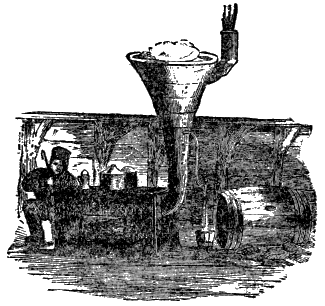
The month of November found us oscillating still with the winds and currents in the neighborhood of Beechy Island. Helpless as we were among the floating masses, we began to look upon the floe that carried us as a protecting barrier against the approaches of others less friendly; and as the month advanced, and the chances increased of our passing into the sound, our apprehensions of being frozen up in the heart of the ice-pack gave place to the opposite fear of a continuous drift. We had seen enough, and encountered enough of the angry strife among the ice-floes in the channel, to assure us of disaster if we should be forced to mingle in the sterner conflicts of the older ice-fields of the sound. Yet, as the new fields continued forming about us, thickening gradually from inches to feet, and locking together the floes in one great amorphous expanse, we retained a hope to the last that our island floe, thickening like the rest, and piling its wall of hummocks around us, would continue to ward us from attack, till the all-pervading frost had made it a stationary part of the great winter covering of the Arctic Sea. It encountered almost daily immense hummocks, some of them impinging against us while we were apparently at rest; some, apparently motionless, receiving the impact from us. At such times our floe would be deflected at an angle from its normal course, or would rotate slowly round its centre, and pass on—not, however, always in the same direction; sometimes nearing the western shore, sometimes closing in upon the beach of “the Graves,” and sometimes fluctuating slowly to the northward.
But our general course was toward the south and east. On the 17th we were fairly in the sound. It welcomed us coldly. The mercury stood for a while at -19°, and sunk during the night to -27°.
The next day, however, a shift of wind, gradually increasing in force, combined with a tidal influence to drive us back to our old position. The thermometer was at this time lower than we had ever seen it, and the sky seemed to sympathize with the temperature. The moon had a solid look, resting upon the snow-hills of Cape Riley, like a great viscid globe of illumination. In the morning the sky combined all the tints of the spectrum in regular zones, a broad band of orange girding the horizon with an almost uniform intensity of color. The stars shone during the entire day. At daybreak on the 18th, Leopold’s Island rose by refraction above the ice, standing with its unmistakable outline clearly black against the orange sky; but it went down as the sun neared the horizon, and passed to the south of his low circuit. My journal for the next two days shows the degree of illumination at the different hours.
“November 20, Wednesday. The winds are unlike those encountered by Parry, our only predecessor in this region at this season of the year. It has been very providential, and very unexpected for us, this predominance of breezes from the southward and eastward. It has prevented our drifting into the dreaded sound, there to be carried, if it pleased Fortune, into Baffin’s Bay by the easterly current.
“We had a heavy gale from 2 P.M. of yesterday (19th) until this morning at 9 A.M., hauling round from southeast to east-south-east. After this last hour, it gradually died away; and now, at 3 P.M., we have a gentle breeze from the same quarter. The wind has left the north since the 18th.
“Our temperature, which on the 18th gave us -27°, the lowest we have yet recorded, was at the close of the next day but -6°; and to-day its extreme was -4°. Now, by gradual elevation, it has reached zero.
“Zero once more, and a positive sensation of warmth! There was no wind; and the haze vapors so softened this once greatest cold, that I walked about with bare hands and sweating body.
“The daylight is hardly now worthy of the name, according to the Philadelphia notions of the blessing; but to us it is the last leaf of the sibyl. Here is a little record of its incomings and outgoings.
“9 A.M. Breakfast over; furs on; deck covered in with black felt, the frozen condensation patching it with large white wafers of snow. A lantern makes it barely light enough to walk. No red streak to the east: one misty haze of visible darkness.
“10 A.M. A twilight gloom: can just see the Azimuth, with its tripod stand, thirty yards off on the ice. Snow whirling in drifts.
“11 A.M. Can read newspaper print by going to open daylight, i. e., twilight—the twilight of a foggy sunrise at home.
“12 M. Noonday. A streak of brown red looms up above the mist to the south. Save a little more light from the ‘foggy sunrise’ of 11 A.M., no great perceptible difference; yet I can now read the finest print easily.
“1 P.M. Very decidedly more hazy than at 11, the corresponding hour before meridian. Can read with difficulty the newspaper—London Illustrated News.
“2 P.M. A hazy darkness, but so compounded with the fast-rising light of the dear moon, that it is far lighter than the corresponding hour before meridian.
“Day is over. Moonlight begins!
“This is a fair specimen of our usual day. The occasional clear day, such as we had the 18th, is far lighter, and full of variety and interest.
“November 21, Thursday. The day is clear; but the moonlight, an absolute clair de lune, so confounds itself with the day as to make a merely solar register impossible.
“8 A.M. The whole atmosphere bathed in pellucid clearness. The moon, like a luminous sphere, not a circle, as with us, is away up the straits in the northern sky. Not a speck betokens sunrise.
“9 A.M. The southeastern horizon is zoned with a mellow uniform band of light. Nothing we have seen has its extension or its uniformity. The visual angle is an unbroken tint, rising from the ice with a raw sienna, mellowing into pink, and softened again into an orange yellow, which runs sometimes through a gradation of green into the clear blue sky. The moon absorbs all perception of other light.
“10 A.M. The light of dawn begins to mingle with the moon-light; I can not say where or how, but I am conscious of an interfering light. To the southward all is orange, and red, and solar. To the northward, from a cobalt sky of even tint, the moon ‘shineth down alone’—alone, save the bright planet Saturn to the northward, and the broad zone of red sunrise at the south.
“11 A.M. Day upon us on one side, and moon bright on the other: moon-light and sunlight blend overhead. To the north and south, each keeps its separate dominion. I read the finest print readily.
“12 M. Walked out to see the ice. I have no change of words left to describe noonday. The sunlight zone of color was more light and less bright, perhaps—and the moon was more bright and less light, perhaps; but both were there.
“1 P.M. The light hardly dimmed; but the moon shines out so emulously, that it is hard to measure the sunlight.
“2 P.M. It is evidently no longer day, although the southwestern horizon is flared with red streaks, and a softening of yellow into the blue of heaven says that the sun is somewhere below it. The moon has confused the day; and coming as she does at this commencement of our long night, I bless her for the grateful service. I make my four to six hours of daily walk, and hardly miss the guidance of day.
“3 P.M. Moonlight!"
CHAPTER IX
"N
OVEMBER 22. I walked yesterday, and to-day again, to the open water that separates us from Wellington Channel. It is a bold and rapid river, as broad as the Delaware at Trenton or the Schuylkill at Philadelphia, rolling wildly between dislocated hummock crags, and whirling along in its black current the abraded fragments of its shores. Ice of recent growth had cemented the gnarled masses about its margin into a ragged wall some twenty feet high, and perhaps thirty paces wide. I stood with perfect safety on a tall, spire-like pinnacle, and endeavored to trace its course. It could be seen reaching from a remote point in the southeastern part of the channel, and is probably connected with the open shore leads that stretch from Cape Riley past Cape Spencer toward the further coasts of North Devon. It passed about a mile and a half to the northwest of our vessels, and was lost in the distant ice-fields to the east.
“Returning with Captain De Haven, we saw the recent prints of a bear and two cubs, that had evidently been scenting our footmarks of the day before. The old bear was not large, measuring by her tail only six feet four inches; the young ones so small as to surprise us, their track not much bigger than that of a Newfoundland dog. At what breeding season were these cubs produced?
“I have been for some evenings giving lectures on topics of popular science, the atmosphere, the barometer, &c., to the crew. They are not a very intellectual audience, but they listen with apparent interest, and express themselves gratefully.
“November 25. Great clouds of dark vapor were seen to the southward to-day, the crape-wreaths of our first imprisonment. This frost-smoke is an unfailing indication of open water, and to us, poor prison-bound vagrants, is suggestive of things not pleasant to think about. It streamed away on the wind in black drifts.
“Our daylight to-day was a mere name, three and a half hours of meagre twilight. I was struck for the first time with the bleached faces of my mess-mates. The sun left us finally only sixteen days ago; but for some time before he had been very chary of his effective rays; and our abiding-place below has a smoky atmosphere of lamplit uncomfortableness. No wonder we grow pale with such a cosmetic. Seventy-seven days more without a sunrise! twenty-six before we reach the solstitial point of greatest darkness!
“The temperature continues singularly mild. Parry, at Melville Island, had -47° before this, twenty degrees lower than our minimum; and even in the more southern regions of Port Bowen and Prince Regent’s Straits, the cold was much greater. For some days now, zero has not been an uncommon temperature; and to-day we are in -14°, here far from unpleasantly cold. May not much of this moderated intensity of the weather be referred to the influence of the open water around us?
“We are still in our old neighborhood, at the brink of the channel, a mile or so from Cape Riley, and both shores in view.
“November 28. The sunlight, a mere band of red cloud; the day, a poor apology. Walked eastward toward Beechy Island, dimly seen. The ice river is clogged with ground masses of granular ice: toward the south it is more open.
“The wind to-day is getting stronger from the west, with some northing, of all winds the most to be feared: the north drives us into Lancaster; the west comes in aid of the current to keep us there, and speed us back toward Baffin.
“Our thermometer does not fall below -11°. The frost-smoke is all around us in bistre-colored vapor. Can it be that we are again detached, our floe independent altogether of the field? We have heard noises of grinding ice, distant, but bodingly distinct.
“In my walks for some days past, I have been studying the topography of our ice-island residence. Here are my elements:
“1. To the north; over broken ice and edge-hummocks, that is to say, hummocks formed at the margin of floes and afterward cemented there, all of this season’s growth. Several large masses, resembling berg-ice; one, the largest, twenty-seven feet high. The water-lead margined by rude hummocky crags trending to the westward and southward from the southward and eastward, forming a rude, broken horseshoe. Distance to water, one mile.
“2. To the south; over long floes of recent ice, young snow-covered, and smooth, with few indications of heavy pressure at their junctions. Distance to open water, glazed over with young ice, two miles: trend of this lead east and west. The diameter of the floe, north and south, is three miles from water to water.
“3. To the east, i. e., northeast by east; rough, mixed ice, with lines of recent heavy hummocks. Thickness of ice, averaging four feet to five feet eight inches; ice of the early part of last August. Distance to open river, one and three fourths to two miles. Marks of recent action excessive here; hummock banks massive; and tables sometimes five feet thick, rising to a height of eighteen feet. From the east and northeast, the trend of the break is to the southward at first, and some two miles below to the westward.
“4. To the west; over the broken region of varied ice, traveled over in my attempts to reach Barlow’s Inlet some days ago. Distance to lead, one mile. Chasm very irregular; but from the point I visited at the north and east, trending nearly due west, and pointing to the southward of Cape Hotham.
“From all this it is clear enough that we are a moving floe, comparatively isolated. The only point of our circumscribed horizon I have not visited, and where no frost-smoke asserts the near proximity of water, is the northwest. Whether on that side the ice of Lancaster is blocked against us by the easterly current, or whether the frost has made our floe one more speck in the massive field, is the only question remaining.
“November 29. The doubt is gone. Our floe, ice-cradle, safeguard, has been thrown round. Its eastern margin is grinding its way to the northward, and the west is already pointing to the south. Our bow is to Baffin’s Bay, and we are traveling toward it. So far, ours has been a mysterious journeying. For two months and more, not a sail has fluttered from our frozen spars; yet we have passed from Lancaster Sound into the highest latitude of Wellington Channel, one never attained before, and have been borne back again past our point of starting, along a capriciously varied line of drift. Cape Riley is bearing, by compass, S. ½ E., N.N.E. ½ E. (true); and Beechy Head, by compass, S.E. ½ E., N. ½ E. (true). Cape Hurd is visible to the northward and eastward, and to the east are the ice-clogged waters of Lancaster Sound.
“November 30. When I came on deck this morning, the lanterns were burning at ten o’clock, and the southern sky had not even a trace of red. Our head had slewed rather more to the southward; and off on our starboard beam sundry dark lines on the ice had a suspicious look. I walked toward them with some of our officers. After sundry groping tumbles, we came, sure enough, upon open water, one hundred yards to the south of the brig. Returning on our track, and taking a new departure toward the east—open water again. Off to the dim, hazy north—still open water. Off to the hummocky west, feeling our way with walking-poles—open water all round us. Once more, then, we are launched on a little ice-island, to float wherever God’s mercy may guide us.
“The India-rubber boat inflated, and a few clothes stowed away, ready for a sudden break out; and all hands turn in for the night.
“December 1. There was a rude murmur in the night, that mingled its tones of admonition with the wind. But we are habituated pretty thoroughly to sounds of this sort, and they have ceased to disturb us. Walking after breakfast toward the northeast, to an ice-quarry, from which we have obtained our fresh water of late, we found that a water-crack we observed yesterday had undergone severe pressure during the night, and that the action was still going on. A low, hazy twilight just allowed us to distinguish near objects. A level, snow-covered surface was rising up in inclined planes or rudely undulating curves. These, breaking at their summits, fell off on each side in masses of twenty tons' weight. Tables of six feet in thickness by twenty of perpendicular height, and some of them fifteen yards in length, surging up into the misty air, heaving, rolling, tottering, and falling with a majestic deliberation worthy of the forces that impelled them. When a huge block would rise vertically, tremble for a moment, and topple over, you heard the heavy sough of the snow-padding that received it; but this was only the deep bass accompaniment to a wild, yet not unmusical chorus. I can not attempt to describe the sounds. There was the ringing clatter of ice, made friable by the intense cold and crumbling under lateral force; the low whine which the ice gives out when we cut it at right angles with a sharp knife, rising sometimes into a shriek, or sinking to the plaintive outcry of our night-hawk at home; the whirr of rapidly-urged machinery; the hum of multitudes: and all these mingled with tones that have no analogy among the familiar ones of unadventurous life.
“So slowly and regularly did these masses roll, rise, break, and fall, that, standing upon a broad table, ice-pole in air, we rolled when it rolled, rose when it rose, balanced when it broke, and jumped as it fell. What would our quiet people in brick houses say to such a ride? Temperature at 30° below zero.
“On deck; looming up in the very midst of the haze, land! so high and close on our port beam, that we felt like men under a precipice. We could see the vertical crevices in the limestone, the recesses contrasting in black shadow. What land is this? Is it the eastern line of Cape Riley, or have we reached Cape Ricketts?
“There is one thing tolerably certain: the Grinnell expedition is quite as likely to be searched for hereafter as to search. Poor Sir John Franklin! this night drift is an ugly omen.
“Do you remember, in the Spanish coasting craft, down about Barcelona and the Balearies, the queer little pictures of Saint Nicholas we used to see pasted up over the locker—a sort of mythic effigy, which the owner looked upon pretty much as some of our old commodores do the barometer, a mysterious something, which he sneers at in fair weather, but is sure, in the strong faith of ignorance, to appeal to in foul! Well, very much such a Saint Anthony have we down in the cabin here, staring us always in the face. Not a vermilion-daubed puerility, with a glory in Dutch leaf stretching from ear to ear; but a good, genuine, hearty representative of English flesh and blood, a mouth that speaks of strong energies as well as a kindly heart, and an eye—the other one is spoiled in the lithography—that looks stern will. Many a time in the night have I discoursed with him, as he looked out on me from his gutta percha frame—‘Sir John Franklin; presented by his wife;’ and sometimes I have imagined how and where I was yet to shake the glorious old voyager by the hand. I see him now while I am writing; his face is darkened by the lamp-smoke that serves us for daylight and air, and he seems almost disheartened. So far as help and hope of it are afloat in this little vessel, Sir John, well you may be!
“It is Sunday: we have had religious service as usual, and after it that relic of effete absurdity, the reading of the ‘Rules and Regulations.’
“We had the aurora about 7 P.M. The thermometer at -33° and falling; barometer, aneroid, 30°. 74; attached thermometer, 86°. Wind steady, W.N.W. The meteor resembled an illuminated cloud; illuminated, because seen against the deep blue night sky; otherwise it resembled the mackerel fleeces and mare’s tails of our summer skies at home.
“It began toward the northwestern horizon as an irregular flaring cloud, sometimes sweeping out into wreaths of stratus; sometimes a condensed opaline nebulosity, rising in a zone of clearly-defined whiteness, from 3° to 5° in breadth up to the zenith, and then arching to the opposite horizon. This zone resembled more a long line of white cirro-stratus than the auroral light of the systematic descriptions. There was no approach to coruscations, or even rectangular deviations from the axis of the zone. When it varied from a right line, its curvatures were waving and irregular, such as might be produced by wind, but having no relation to the observed air-currents at the earth’s surface. It passed from the due northwest, between the Pleiades and the Corona Borealis; the star of greatest magnitude in the latter of these constellations remaining in the centre, although its waving curves sometimes reached the Pleiades. At the zenith, its mean distance from the Polar Star was 7° south, and it passed down, increasing in intensity, near Vega, in Lyra, to the southeast.
“There was throughout the arc no marked seat of greatest intensity. Around the Corona of the north, its light was more diffused. The zone appeared narrowed at the zenith, and bright and clear, without marked intermission, to the southeast. The frost-smoke was in smoky banks to the northwest; but the aurora did not seem to be affected by it, and the compass remained constant.
“December 2. Drifting down the sound. Every thing getting ready for the chance of a hurried good-by to our vessels. Pork, and sugar, and bread put up in small bags to fling on the ice. Every man his knapsack and change of clothing. Arms, bear-knives, ammunition out on deck, and sledges loaded. Yet this thermometer, at -30°, tells us to stick to the ship while we can.
“This packing up of one’s carpet-bag in a hurry requires a mighty discreet memory. I have often wondered that seamen in pushing off from a wreck left so many little wants unprovided for; but I think I understand it now. After bestowing away my boots, with the rest of a walking wardrobe, in a snugly-lashed bundle, I discovered by accident that I had left my stockings behind.
“4 P.M. Brooks comes down while we are dining to say we are driving east like a race-horse, and a crack ahead: ‘All hands on deck!’ We had heard the grindings last night, and our floe in the morning was cut down to a diameter of three hundred yards: we had little to spare of it. But the new chasm is there, already fifteen feet wide, and about twenty-five paces from our bows, stretching across at right angles with the old cleft of October the 2d.
“Our floe, released from its more bulky portion, seems to be making rapidly toward the shore. This, however, may be owing to the separated mass having an opposite motion, for the darkness is intense. Our largest snow-house is carried away; the disconsolate little cupola, with its flag of red bunting, should it survive the winter, may puzzle conjectures for our English brethren.
“Mr. Griffin and myself walked through the gloom to the seat of hummock action abeam of the Rescue. A dark, hard walk: no changes. The crack, noticed some time ago as parallel to and alongside of the Rescue, has not opened. Her officers have brought their private papers on board the Advance, and such indispensable articles as may be needed in case of her destruction.
“Our ship’s head is toward a point of land to the northeastward, but her position changes so constantly that there is little use of recording it. Caught a fox this morning; have now two on board.
“Our bearings, taken by azimuth compass this morning at eleven, gave Cape Hurd, S. by W. ¼ W.; Western Bluff, of Rigsby’s Inlet, S.E. ¼ S.; Table-hill of Parry, S.E. by S. ½ S.; Cape Ricketts, E. by N.
“Wind changed at 9 P.M. to N.N.W.; thermometer, minimum, -26°; maximum, 22°; mean, 23° 82'.
“December 4, Wednesday. This morning showed us an interval of over two hundred yards already covered with stiff ice: so much for our chasm of last night! All around us is a moving wreck of ice-fields.
“Our drift seems to have been to the westward. We have certainly left the coast, which yesterday seemed almost over us, though it is still too near for good fellowship.
“This is the first clear day—truly clear, that we have had since my record of the changing daylight. Compared with the gloomy haziness of its predecessors, it was cheering. The southern horizon was a zone of red light; and although the clear blue soon absorbed it, we could read small print with a little effort at noonday by turning the book to the south. The stars were visible all the time, except where the horizon was lighted up."
The next four days were full of excitement and anxiety. One crack after another passed across our floe, still reducing its dimensions, and at one time bringing down our vessel again to an even keel. An hour afterward, the chasms would close around us with a sound like escaping steam. Again they would open under some mysterious influence; a field of ice from two to four inches thick would cover them; and then, without an apparent change of causes, the separated sides would come together with an explosion like a mortar, crunching the newly-formed field, and driving it headlong in fragments for fifty feet upon the floe till it piled against our bulwarks. Every thing betokened a crisis. Sledges, boats, packages of all sorts, were disposed in order; contingencies were met as they approached by new delegations of duty; every man was at work, officer and seaman alike; for necessity, when it spares no one, is essentially democratic, even on shipboard. The Rescue, crippled and thrown away from us to the further side of a chasm, was deserted, and her company consolidated with ours. Our own brig groaned and quivered under the pressure against her sides. I give my diary for December 7.
ILLUSTRATING THE CHANGES IN THE POSITIONS OF THE SHIPS FROM DAY TO DAY.
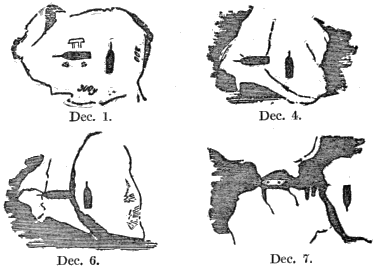
“December 7, Saturday. The danger which surrounds us is so immediate, that in the bustle of preparation for emergency I could not spend a moment upon my journal. Now the little knapsack is made up again, and the blanket sewed and strapped. The little home Bible at hand, and the ice-clothes ready for a jump.
“The above is a rough idea of our last three days' positions and changes.
“From this it is evident that a gradual process of breaking up has taken place. We are afloat.
“The ice, as I have sketched it, December 7, began to close at 11 A.M., and, at the same time, the brig was driven toward the open crack of December 4 (c). At 1 P.M. this closed on us with fearful nipping.
“1 P.M. Ran on deck. The ice was comparatively quiescent when I attempted to write; but it recommenced with a steady pressure, which must soon prove irresistible. It catches against a protruding tongue forward, and is again temporarily arrested.
“4 P.M. Up from dinner—‘all hands!’ The ice came in, with the momentum before mentioned as ‘irresistible,’ progressive and grand. All expected to betake ourselves sledgeless to the ice, for the open space around the vessel barely admits of a foot-board. The timbers, and even cross-beams protected by shores, vibrated so as to communicate to you the peculiar tremor of a cotton-factory. Presently the stern of the brig, by a succession of jerking leaps, began to rise, while her bows dipped toward the last night’s ice ahead. Everybody looked to see her fall upon her beam-ends, and rushed out upon the ice. After a few anxious breath-compressed moments, our nobly-strengthened little craft rose up upon the encroaching floes bodily. Her dolphin-striker struck the ice ahead; her bows began to feel the pressure; and thus lifted up upon the solid tables, we have a temporary respite again.
“Stores are now put out upon the ice, and we await—time. Cape Fellfoot, S. by W. ¼ W. Remarkable perpendicular bluff, S.S.E. Cape Hurd, E.N.E. ½ E., by compass; Cape Hurd, N.W. by W. ½ W. (true).
“We are at least fifty miles from Beechy Island and Union Bay—about forty-five miles from Leopold Harbor stores. Leopold Harbor, or our more distant English friends, about one hundred and twenty miles off, are our only places of refuge. We are daily, hourly, drifting further from both. It is this nakedness of resources, even more than perpetual darkness and unendurable cold, that makes our position one of bitterness. Drift a little westward; thermometer 17°."
My journal does not tell the story; but it is worth noting, as it illustrates the sedative effect of a protracted succession of hazards. Our brig had just mounted the floe, and as we stood on the ice watching her vibration, it seemed so certain that she must come over on her beam-ends, that our old boatswain, Brooks, called out to “stand from under.” At this moment it occurred to one of the officers that the fires had not been put out, and that the stores remaining on board would be burned by the falling of the stoves. Swinging himself back to the deck, and rushing below, he found two persons in the cabin; the officer who had been relieved from watch-duty a few minutes before, quietly seated at the mess-table, and the steward as quietly waiting on him. “You are a meal ahead of me,” he said; “you didn’t think I was going out upon the ice without my dinner.”
“December 8, Sunday, 8 P.M. This has thus far been a day of rest. Our vessel, lifted up upon the heavy ice, has borne without injury a few fresh pressures. The wind has been still from the eastward, and we have drifted about six miles to the westward again. This wind was almost a gale; yet its influence upon the eastern drift is barely able to produce this limited westing. I now regard it as past a doubt, that should we survive the collisions of the journey, we must float into Baffin’s Bay.
“A small auroral light was seen to the northwest at 9 A.M., the second within two days. Its axis was 16° W. of the magnetic meridian. The mean temperature of the day has been -12° 70'. Wind more gentle from the eastward.
“Mr. Griffin, who is now the executive officer of our consolidated squadron, has undertaken a systematic drill of the crew. He has mustered them for an ice-march, with knapsacks fitted to their backs, and sledge equipments, just such as will be required when the worst comes. Everything is rigorously inspected; the provisions and stores of all sorts are packed snug, and have their places marked; and the men are instructed as to their course in the moment of emergency.
“Here is a sketch of the present position of our vessel. It looks extravagant, but it is in truth the very opposite. Every thing like locomotion on board is up and down hill.
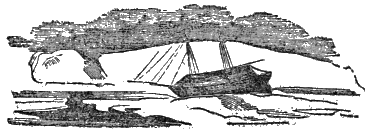
“December 9, Monday. Like its three predecessors, clear; that is to say, for three scanty hours of scanty twilight, you see the skeleton shore cliffs, and the bright stars, a little paled, but bright. The moon, a second-quarter crescent, was for a while on the northern and western horizon, distorted and flaming like a crimson lamp.
“Last night, mounted as we are, the nipping caused our timbers to complain sadly. We had to send out parties to crowbar away the ice from our bowsprit. The bob-stays were forced up and broken. Our floe movement continued to the southeast, driving the heavy ice in upon the Rescue. She rose up under the pressure, and is now surrounded by hummock ruins like ourselves. She is not more than fifty yards distant from us, astern.”
From this time to the 21st our drift was without intermission. As one headland after another defined itself against the horizon, it was apparent that we were skirting the northern coast of the sound. At first this gave us some anxiety, when our floe, pressing hard against the shore-ice as we doubled some projecting point, threatened to wreck us among its fragments. But as we drew nearer to the outlet, and began to compute the new hazards of entering Baffin’s Bay, this very circumstance became for us an important ground of hope. Theory, as well as the accounts of the whalers, made the southeastern cape of Lancaster Sound the seat of intense hummock action. The greater the distance from that point, the broader must be the curvature of the meeting currents, and the less perilous the conflict of the ice-masses in their rotation. There was, of course, no escape for us from this encounter; and the only question was of the degrees of hazard it must involve.
On the 19th, the tall, mural precipices to the northward, and the cape in which they terminated toward the east, convinced us that we had almost reached the western headland of Croker’s Bay. We had drifted one hundred and eleven miles since the beginning of the month. Our course had been without any cheering incident. There was the same wretched succession of openings and closings about our floe, somewhat dangerous, but too uniform to be exciting; and we had drilled with knapsack and sledge, till we were almost martinets in our evolutions on the ice. I group the few entries of my journal that have any interest.
“December 11. Wind last night fierce from the north; to-day as fierce from the west. It has carried us clear of the great cape that stretches out east of Maxwell’s Bay, and that threatened us with the variety of a lee shore. The Rescue has had another trial: her stern-post is carried away, her pintle and gudgeon wrenched off. A party of officers and men are out, trying the experiment of a night upon the ice, tented and bag-bedded. I wish them luck; but the thermometer fifty-seven degrees below freezing is unfavorable to a fête chainpêtre.
“December 12. Every thing solid, and looking as if it had always been so; yet, a few days ago, I had this journal of mine stitched up in its tarred canvas-bag, and ready for a fling upon the ice four times in the twenty-four hours. The floes have stopped abrading each other, and are driving ahead right peacefully, with our brig mounted on top: how far we are from the edges, it is too dark to see.
“December 13. A little clearer than yesterday, but too dark to read small print at noon. Something like a long reach of land looming up to southward: it can not be Croker’s Bay?
“All our mess took our tour of practice to-day, with a sledge and four hundred pounds of provender. Hard work, and sweating abundantly; but we feel already the good effects of this sort of exercise. Thermometer at -11°.
“December 14. A quiet day; the winds at rest, and the stars twinkling through the lazy sky as I never saw them before. The moon, too, is in high heaven, almost a three-quarter disk. She is a great comfort to us; her high northern declination makes her visible all the time. It looks strangely this undying fortnight moon. The frost-smoke is wreathing the red zone of our southern horizon. It would be a good night-scene for a painter.
“At 7 P.M. the thermometer rose from -3° to -1°. At 10 o’clock it was -4°. Its maximum was +10°, a temperature mild and comfortable. The wind changed from west by south to west by north, and the ice and the drift are as yesterday.
“A poor bear, fired at last night by Mr. Carter, was found this morning, about three hundred yards from the ship, dead. He was wedged between two slabs of ice, and in his agony had rubbed his muzzle deep into the frozen snow. Twice he had stopped to lie down during his death-walk, marking each place with a large puddle of blood, which branched out over the floe like crimson-streaked marble. He measured eight feet four inches from tip to tip. I killed a fox; but missing his head, opened the large arteries of the neck, and spoiled his pelt. The temperature at the orifice of the ball was +92°. The crew were at work till eleven, leveling our rugged floe, and heaping up snow against the sides of the brig. The position of our vessel, high perched in air, and dipping head foremost in a way most Arctic and uncomfortable, makes the protection of snow very desirable. We feel the cold against her walls. The crew had an hour of sledging, as well by way of exercise as of preparation for their expected trials.
“A point supposed to be Cape Crawfurd bore, by compass, west. Our distance from the north shore is about five miles.”
CHAPTER X
I
EMPLOYED the dreary intervals of leisure that heralded our Christmas in tracing some Flemish portraitures of things about me. The scenes themselves had interest at the time for the parties who figured in them; and I believe that is reason enough, according to the practice of modern academics, for submitting them to the public eye. I copy them from my scrapbook, expurgating only a little.
“We have almost reached the solstice; and things are so quiet that I may as well, before I forget it, tell you something about the cold in its sensible effects, and the way in which as sensible people we met it.
“You will see, by turning to the early part of my journal, that the season we now look back upon as the perfection of summer contrast to this outrageous winter was in fact no summer at all. We had the young ice forming round us in Baffin’s Bay, and were measuring snow-falls, while you were sweating under your grass-cloth. Yet I remember it as a time of sunny recreation, when we shot bears upon the floes, and were scrambling merrily over glaciers and murdering rotges[D] in the bright glare of our day-midnight. Like a complaining brute, I thought it cold then—I, who am blistered if I touch a brass button or a ramrod without a woolen mitt.
“The cold came upon us gradually. The first thing that really struck me was the freezing up of our water-casks, the drip-candle appearance of the bung-holes, and our inability to lay the tin cup down for a five-minutes' pause without having its contents made solid. Next came the complete inability to obtain drink without manufacturing it. For a long time we had collected our water from the beautiful fresh pools of the icebergs and floes; now we had to quarry out the blocks in flinty, glassy lumps, and then melt it in tins for our daily drink.
“By-and-by the sludge which we passed through as we traveled became pancakes and snow-balls. We were glued up. Yet, even as late as the 11th of September, I collected a flowering Potentilla from Barlow’s Inlet. But now any thing moist or wet began to strike me as something to be looked at—a curious, out-of-the-way production, like the bits of broken ice round a can of mint-julep. Our decks became dry, and studded with botryoidal lumps of dirty foot-trodden ice. The rigging had nightly accumulations of rime, and we learned to be careful about coiled ropes and iron work. On the 4th of October we had a mean temperature below zero.
“By this time our little entering hatchway had become so complete a mass of icicles, that we had to give it up, and resort to our winter door-way. The opening of a door was now the signal for a gush of smoke-like vapor: every stove-pipe sent out clouds of purple steam; and a man’s breath looked like the firing of a pistol on a small scale.
“All our eatables became laughably consolidated, and after different fashions, requiring no small experience before we learned to manage the peculiarities of their changed condition. Thus, dried apples became one solid breccial mass of impacted angularities, a conglomerate of sliced chalcedony. Dried peaches the same. To get these out of the barrel, or the barrel out of them, was a matter impossible. We found, after many trials, that the shortest and best plan was to cut up both fruit and barrel by repeated blows with a heavy axe, taking the lumps below to thaw. Saur-kraut resembled mica, or rather talcose slate. A crowbar with chiseled edge extracted the laminæ badly; but it was perhaps the best thing we could resort to.
“Sugar formed a very funny compound. Take q. s. of cork raspings, and incorporate therewith another q. s. of liquid gutta percha or caoutchouc, and allow to harden: this extemporaneous formula will give you the brown sugar of our winter cruise. Extract with the saw; nothing but the saw will suit. Butter and lard, less changed, require a heavy cold chisel and mallet. Their fracture is conchoidal, with hæmatitic (iron-ore pimpled) surface. Flour undergoes little change, and molasses can at -28° be half scooped, half cut by a stiff iron ladle.
“Pork and beef are rare specimens of Florentine mosaic, emulating the lost art of petrified visceral monstrosities seen at the medical schools of Bologna and Milan: crowbar and handspike! for at -30° the axe can hardly chip it. A barrel sawed in half, and kept for two days in the caboose house at +76°, was still as refractory as flint a few inches below the surface. A similar bulk of lamp oil, denuded of the staves, stood like a yellow sandstone roller for a gravel walk.
“Ices for the dessert come of course unbidden, in all imaginable and unimaginable variety. I have tried my inventive powers on some of them. A Roman punch, a good deal stronger than the noblest Roman ever tasted, forms readily at -20°. Some sugared cranberries, with a little butter and scalding water, and you have an impromptu strawberry ice. Many a time at those funny little jams, that we call in Philadelphia ‘parties,’ where the lady-hostess glides with such nicely-regulated indifference through the complex machinery she has brought together, I have thought I noticed her stolen glance of anxiety at the cooing doves, whose icy bosoms were melting into one upon the supper-table before their time. We order these things better in the Arctic. Such is the ‘composition and fierce quality’ of our ices, that they are brought in served on the shaft of a hickory broom; a transfixing rod, which we use as a stirrer first and a fork afterward. So hard is this terminating cylinder of ice, that it might serve as a truncheon to knock down an ox. The only difficulty is in the processes that follow. It is the work of time and energy to impress it with the carving-knife, and you must handle your spoon deftly, or it fastens to your tongue. One of our mess was tempted the other day by the crystal transparency of an icicle to break it in his mouth; one piece froze to his tongue, and two others to his lips, and each carried off the skin: the thermometer was at -28°.
“Thus much for our Arctic grub. I need not say that our preserved meats would make very fair cannon-balls, canister shot!
“Now let us start out upon a walk, clothed in well-fashioned Arctic costume. The thermometer is, say -25°, not lower, and the wind blowing a royal breeze, but gently.
“Close the lips the first minute or two, and admit the air suspiciously through nostril and mustache. Presently you breathe in a dry, pungent, but gracious and agreeable atmosphere. The beard, eyebrow, eye-lashes, and the downy pubescence of the ears, acquire a delicate, white, and perfectly-enveloping cover of venerable hoar-frost. The mustache and under lip form pendulous beads of dangling ice. Put out your tongue, and it instantly freezes to this icy crusting, and a rapid effort and some hand aid will be required to liberate it. The less you talk, the better. Your chin has a trick of freezing to your upper jaw by the luting aid of your beard; even my eyes have often been so glued, as to show that even a wink may be unsafe. As you walk on, you find that the iron-work of your gun begins to penetrate through two coats of woolen mittens, with a sensation like hot water.
“But we have been supposing your back to the wind; and if you are a good Arcticized subject, a warm glow has already been followed by a profuse sweat. Now turn about and face the wind; what a devil of a change! how the atmospheres are wafted off! how penetratingly the cold trickles down your neck, and in at your pockets! Whew! a jack-knife, heretofore, like Bob Sawyer’s apple, ‘unpleasantly warm’ in the breeches pocket, has changed to something as cold as ice and hot as fire: make your way back to the ship! I was once caught three miles off with a freshening wind, and at one time feared that I would hardly see the brig again. Morton, who accompanied me, had his cheeks frozen, and I felt that lethargic numbness mentioned in the story books.
“I will tell you what this feels like, for I have been twice ‘caught out.’ Sleepiness is not the sensation. Have you ever received the shocks of a magneto-electric machine, and had the peculiar benumbing sensation of ‘can’t let go,’ extending up to your elbow-joints? Deprive this of its paroxysmal character; subdue, but diffuse it over every part of the system, and you have the so-called pleasurable feelings of incipient freezing. It seems even to extend to your brain. Its inertia is augmented; every thing about you seems of a ponderous sort; and the whole amount of pleasure is in gratifying the disposition to remain at rest, and spare yourself an encounter with these latent resistances. This is, I suppose, the pleasurable sleepiness of the story books.
“I could fill page after page with the ludicrous miseries of our shipboard life. We have two climates, hygrometrically as well as thermometrically at opposite ends of the scale. A pocket-handkerchief, pocketed below in the region of stoves, comes up unchanged. Go below again, and it becomes moist, flaccid, and almost wet. Go on deck again, and it resembles a shingle covered with linen. I could pick my teeth with it.
“You are anxious to know how I manage to stand this remorseless temperature. It is a short story, and perhaps worth the telling. ‘The Doctor’ still retains three luxuries, remnants of better times—silk next his skin, a tooth-brush for his teeth, and white linen for his nose. Everything else is Arctic and hairy—fur, fur, fur. The silk is light and washable, needing neither the clean dirt of starch nor the uncomfortable trouble of flat-irons. It secures to me a clean screen between my epidermoid and seal-skin integuments.
“I try to be a practical man as to clothing and the et ceteras of a traveler. All baggage beyond the essential I regard as impedimenta, and believe in the wisdom of Titian Peale, who, when preparing for an exploring tour around the world, purchased—a tin cup. For the sake of poor devils condemned to cold winters, I give in detail my dress, the result of much trial, and, I think, nearly perfect. Here it is, from tip to toe.
“1. Feet. A pair of cotton socks (Lisle thread) covered by a pair of ribbed woolen stockings, rising above the knee and half way up the thigh. Over these a pair of Esquimaux water-proof boots, lined by a sock of dog-skin, the hair inside; the leg of dressed seal-hide; a sole with the edges turned up, and crimped so as to form a water-tight cup; the furred edge of a dog-skin sock inserted as a lining; and some clean straw laid smoothly at the bottom, which forms the elastic cushion on which you tread.
“2. Legs. A pair of coarse woolen drawers, and a pair of seal-skin breeks over them, stitched with reindeer tendon.
“3. Chest. A jumper or short coat, double, of seal-skin and reindeer fur. This invaluable article I got at Disco on my fur journey, obtaining a good number besides for men and officers. It consists of an inner-hooded shirt of reindeer-skin with the hair inside, reaching as far as the upper ridge of the hips, so as to allow free swing to the legs, and fitting about the throat very closely. It is drawn on like the shirt, and, except at the neck, is perfectly loose and unbinding.
“4. Head. Our people generally wear fur caps. I wear an ear-ridge, a tiara, to speak heroically, of wolf-skin. Excellent is this Mormon fur! Leaving the entire poll bare to the elements, it guards the ears and forehead effectually: in any ordinary state of the wind above -15°, I am not troubled with the cold. Before I resorted to this, my cap was full of frozen water, stiff and uncomfortable, all the condensation turning to ice the moment I uncovered. When the weather is very cold, I up hood; when colder, say -40°, with a middling breeze—quite cold enough, I assure you—I wear an elastic silk night-cap in addition, one of a pair forced on me by a certain brother of mine as I was leaving New York, drawn over my head and face, and lined with a mask of wolf-skin. To prevent excessive condensation, I cut only two eye-holes, and leave a large aperture below the point of the nose for talking and breathing. A grim-looking object is this wolf-skin mask, its openings lined with water-proof oiled silk.
“The only changes in the above are a pair of cloth pants for fur, when the thermometer strays above -15°, and a pair of heavy woolen wad-mail leggins, drawn over my fur pants, and worn, stocking fashion, within my boots, in windy weather, when we get down to -30° or thereabouts. A long waist-scarf, worn like the kummerbund of the Hindoos, is a fine protection while walking, to keep the cold from intruding at the pockets and waist: it consummates, as it floats martially on the breeze, the grotesque harmonies of my attire."
CHAPTER XI
"D
ECEMBER 21, Saturday. To-day at noon we saw, dimly looming up from the redness of the southern horizon, a low range of hills; among them some cones of great height, mountains of a character differing from the naked table-lands of the northern coast. The land on the other side of Croker’s Bay, with one high headland, supposed to be Cape Warrender, is in view. From all of which it is clear that we are drifting regularly on toward Baffin’s Bay.
“An opening occurred last night in the ice to the northward. It is not more than a hundred yards from us, and it is already seventy wide. It was explored for about a mile in a northwest and southeast course. Another of the same character is about half a mile to the south of us.
“Our floe has now remained in peace for nearly three weeks; and, with the happy indifference of sailors' human nature, we are beginning to forget the driving ice and the groaning pressures which have perched us thus upon a lump of drift. I look, however, to the spring-tides for a renewal of the trouble. The ice about us is apparently as strong and solid as the slow growth of Wellington Channel; but we know it to be recent, and less able to withstand pressure. Every thing now depends upon preserving our vessel and stores. A breaking up must take place, and for us the later in the spring the better. At the present rate of progress, we shall be in Baffin’s Bay by the latter end of January. There the daylight will be with us again; most providentially, for the icebergs are wretched enemies in darkness. Thirty more days, and we may take a noonday walk; forty-four, and the sun comes back.