Front matter (continued 3)
Reading edition
“Our men are hard at work preparing for the Christmas theatre, the arrangements exclusively their own. But to-morrow is a day more welcome than Christmas—the solstitial day of greatest darkness, from which we may begin to date our returning light. It makes a man feel badly to see the faces around him bleaching into waxen paleness. Until to-day, as a looking-glass does not enter into an Arctic toilet, I thought I was the exception, and out of delicacy said nothing about it to my comrades. One of them, introducing the topic just now, told me, with an utter unconsciousness of his own ghostliness, that I was the palest of the party. So it is, ‘All men think all men,’ &c. Why, the good fellow is as white as a cut potato!"
In truth, we were all of us at this time undergoing changes unconsciously. The hazy obscurity of the nights we had gone through made them darker than the corresponding nights of Parry. The complexions of my comrades, and my own too, as I found soon afterward, were toned down to a peculiar waxy paleness. Our eyes were more recessed, and strangely clear. Complaints of shortness of breath became general. Our appetite was almost ludicrously changed: ham-fat frozen, and saur-kraut swimming in olive-oil were favorites; yet we were unconscious of any tendency toward the gross diet of the Polar region. Most of my companions would not touch bear; indeed, I was the only one, except Captain De Haven, that still ate it. Fox, on the other hand, was a favorite. Things seemed to have changed their taste, and our inclination for food was at best very slight.
Worse than this, our complete solitude, combined with permanent darkness, began to affect our morale. Men became moping, testy, and imaginative. In the morning, dreams of the night—we could not help using the term—were narrated. Some had visited the naked shores of Cape Warrender, and returned laden with water-melons. Others had found Sir John Franklin in a beautiful cove, lined by quintas and orange-trees. Even Brooks, our hard-fisted, unimaginative boatswain, told me, in confidence, of having heard three strange groans out upon the ice. He “thought it was a bear, but could see nothing!” In a word, the health of our little company was broken in upon. It required strenuous and constant effort at washing, diet, and exercise to keep the scurvy at bay. Eight cases of scorbutic gums were already upon my black-list. One severe pneumonia left me in anxious doubt as to its result. There was, however, little bronchitis.
“December 22, Sunday. The solstice!—the midnight of the year! It commences with a new movement in the ice, the open lead of yesterday piling up into hummocks on our port-beam. No harm done.
“The wind is from the west, increasing in freshness since early in the morning. The weather overcast; even the moon unseen, and no indications of our drift. We could not read print, not even large newspaper type, at noonday. We have been unable to leave the ship unarmed for some time on account of the bears. We remember the story of poor Barentz, one of our early predecessors. One of our crew, Blinn, a phlegmatic Dutchman, walked out to-day toward the lead, a few hundred yards off, in search of a seal-hole. Suddenly a seal rose close by him in the sludge-ice: he raised his gun to fire; and, at the same instant, a large bear jumped over the floe, and by a dive followed the seal. Blinn’s musket snapped. He was glad to get on board again, and will remember his volunteer hunt. Thermometer, minimum, -18°; maximum, -6°. A beautiful paraselene yesterday!
“December 23, Monday. Perfect darkness! Drift unknown. Winds nearly at rest, with the exception of a little gasp from the westward. Thermometer never below -12°, nor above -7°.
“December 24, Tuesday. ‘Through utter darkness borne!’
“December 25. ‘Ye Christmas of ye Arctic cruisers!’ Our Christmas passed without a lack of the good things of this life. ‘Goodies’ we had galore; but that best of earthly blessings, the communion of loved sympathies, these Arctic cruisers had not. It was curious to observe the depressing influences of each man’s home thoughts, and absolutely saddening the effort of each man to impose upon his neighbor and be very boon and jolly. We joked incessantly, but badly, and laughed incessantly, but badly too; ate of good things, and drank up a moiety of our Heidsiek; and then we sang negro songs, wanting only tune, measure, and harmony, but abounding in noise; and after a closing bumper to Mr. Grinnell, adjourned with creditable jollity from table to the theatre.
“It was on deck, of course, but veiled from the sky by our felt covering. A large ship’s ensign, stretched from the caboose to the bulwarks, was understood to hide the stage, and certain meat-casks and candle-boxes represented the parquet. The thermometer gave us -6° at first; but the favoring elements soon changed this to the more comfortable temperature of -4°.
“Never had I enjoyed the tawdry quackery of the stage half so much. The theatre has always been to me a wretched simulation of realities; and I have too little sympathy with the unreal to find pleasure in it long. Not so our Arctic theatre: it was one continual frolic from beginning to end.
“The 'Blue Devils:' God bless us! but it was very, very funny. None knew their parts, and the prompter could not read glibly enough to do his office. Every thing, whether jocose, or indignant, or commonplace, or pathetic, was delivered in a high-tragedy monotone of despair; five words at a time, or more or less, according to the facilities of the prompting. Megrim, with a pair of seal-skin boots, bestowed his gold upon the gentle Annette; and Annette, nearly six feet high, received it with mastodonic grace. Annette was an Irishman named Daly; and I might defy human being to hear her, while balanced on the heel of her boot, exclaim, in rich masculine brogue, ‘Och, feather!’ without roaring. Bruce took the Landlord, Benson was James, and the gentle Annette and the wealthy Megrim were taken by Messrs. Daly and Johnson.
“After this followed the Star Spangled Banner; then a complicated Marseillaise by our French cook, Henri; then a sailor’s horn-pipe by the diversely-talented Bruce; the orchestra—Stewart, playing out the intervals on the Jew’s-harp from the top of a lard-cask. In fact, we were very happy fellows. We had had a foot-race in the morning over the midnight ice for three purses of a flannel shirt each, and a splicing of the main-brace. The day was night, the stars shining feebly through the mist.
“But even here that kindly custom of Christmas-gifting was not forgotten. I found in my morning stocking a jack-knife, symbolical of my altered looks, a piece of Castile soap—this last article in great request—a Jew’s-harp, and a string of beads! On the other hand, I prescribed from the medical stores two bottles of Cognac, to protect the mess from indigestion.[E] So passed Christmas. Thermometer, minimum, -16°; maximum, -7°. Wind west.
“December 26, Thursday. To-day, looming up high in the air, we catch a sight of new unknown land. Of our drift, save by analogy, we know nothing.
“December 27, Friday. The shores of this coast seem to have changed their scale. At Cape Riley, as my sketches show, the limestone rises in a mural face, based by a deposit of detritus, which extends out in tongues, indentations, and salient capes; and between these, a cemented shingle, full of corallines and encrinites, forms a beach of varying extent.
“Sometimes this beach is backed by rolling dune-like hills of the scaly mountain limestones; but after a mile or two of intermission, the high cliffs rise up again in abutments, and continue unbroken until another interval occurs. As we proceeded east, these escarped masses became more buttress-like and monumental, rising up into plateau-topped masses, separated by chasms, which seem mere ruptures in the continuous hill-line. Now, however, a trace is seen in the clouds indicative of distant land, higher, more mountainous, rolling, and broken. It may be the Cunninghame Mountains toward Cape Warrender.
“The wind is quietly blowing from the west, and the misty haze gives us barely a vestige of daylight.
“December 28, Saturday. From my very soul do I rejoice at the coming sun. Evidences not to be mistaken convince me that the health of our crew, never resting upon a very sound basis, must sink under the continued influences of darkness and cold. The temperature and foulness of air in the between-deck Tartarus can not be amended, otherwise it would be my duty to urge a change. Between the smoke of lamps, the dry heat of stoves, and the fumes of the galley, all of them unintermitting, what wonder that we grow feeble. The short race of Christmas-day knocked up all our officers except Griffin. It pained me to see my friend Lovell, our strongest man, fainting with the exertion. The symptoms of scurvy among the crew are still increasing, and becoming more general. Faces are growing pale; strong men pant for breath upon ascending a ladder; and an indolence akin to apathy seems to be creeping over us. I long for the light. Dear, dear sun, no wonder you are worshiped!
“Our drift is still eastward, with a slow but unerring progress. The high land mentioned yesterday took, in spite of the obscuring haze, a distinguishable outline. It is not more than eight miles off, and so high that, with its retiring flanks on either side, it can be none other than the projecting Cape Warrender. Its structure is unmistakably gneissoid. We have now left the limestones.
“This cape is the great entering landmark of the northern shores of Lancaster Sound. Just one hundred days ago we passed it, urged by the wings of the storm; our errand of mercy filling us with hope, and the gale calling for our best energies. We were then but a few hours from Baffin’s Bay, and not over twenty-four from the coast of Greenland. How differently are we journeying now!
“The Bay of Baffin, with its moving ice and opposing icebergs, bathed in foggy darkness and destitute of human fellowship or habitable asylum, is before us; and we, so utterly helpless, hampered, and nonresistant, must await the inevitable action of the ice. This nearness to Cape Warrender makes us feel that our silent marches have brought us near to another conflict.
“December 29, Sunday. The drift shows an indent of the cape now abaft our beam. We are slowly making easting. The day is one of the same obscure and dimmed fog which for the past week has wrapped us in darkness. The ice gives no change as yet: the same great field of moving whiteness.
“December 30, Monday. By a comparison of our several days' positions, I find that from the 18th to the 28th we have drifted fifty-two miles and a half, something over five miles a day. The winds during this period have been from the westward, constant though gentle; and our progress has been of the same steady but gentle sort. At this rate, we will in a few days more be within the Baffin’s Bay incognita.
“Looking round upon my mess-mates with that sort of scrutiny that belongs to my craft and my position, I am startled at the traces, moral and physical, of our Arctic winter life. Those who con it over theoretically can hardly realize the operation of the host of retarding influences that belong to a Polar night. If I were asked to place in foremost rank the item that has been most trying, it would be neither the perpetual cold, nor the universal sameness, nor our complete exclusion from the active world of our brother men, but this constant and oppressing gloom, this unvaried darkness.
“To-day was clear toward the south, so that the blessing of light came to us more largely than of late. I walked about a mile on the recent lead, now frozen to a level meandering lane. We see to the north the Cunninghame Mountains of Cape Warrender, but can not make out our change of position definitely. To the south, an outlined ridge of doubtful mountain land shows itself high in the clouds; probably a part of the high ridges east of Admiralty Inlet.
“The thermometer fell at eight this morning to -21°. By noonday it gave us -26° and -27°. It is now -22°. The wind is gentle and cold, but not severe.
“December 31, Tuesday. The ending day of 1850! So clear and beautiful is this parting day, that I must take it as a happy omen. Pellucid clearness, and a sky of deep ultra-marine, brought back the remembrance of daylight. I give the record of the day.
“9 A.M. The stars visible even to the lesser groups; but a deep zone of Italian pink rises from the south, and passes by prismatic gradations into the clear blue. The outline of the shore to the northward is well defined.
“10. The day is growing into clearness. The thermometer is at twenty-seven degrees below zero. Your lungs tingle pleasantly as you draw it in.
“11. Can read ordinary over-sized print. Started on a walk, the first time for twenty-odd days. Saw the great lead, and traveled it for a couple of miles, expanding into a plain of recent ice.
“M. Passed noon on the ice. Can read diamond type. Stars of the first magnitude only visible. Saturn magnificent!
“1 P.M. With difficulty read large type. The clouds gathering in black stratus over the red light to the south.
“2. The heavens studded with stars in their groupings. Night is again over every thing, although the minor stars are not yet seen.
“Since the first of this month, we have drifted in solitude one hundred and seventy miles, skirting the northern shores of Lancaster Sound. Baffin’s Bay is ahead of us, its current setting strong toward the south. What will be the result when the mighty masses of these two Arctic seas come together!"
CHAPTER XII
1
851, January 1, Wednesday. The first day of 1851 set in cold, the thermometer at -28°, and closing at -31°. We celebrated it by an extra dinner, a plumcake unfrosted for the occasion, and a couple of our residuary bottles of wine. But there was no joy in our merriment: we were weary of the night, as those who watch for the morning.
It was not till the 3d that the red southern zone continued long enough to give us assurance of advancing day. Then, for at least three hours, the twilight enabled us to walk without stumbling. I had a feeling of racy enjoyment as I found myself once more away from the ship, ranging among the floes, and watching the rivalry of day with night in the zenith. There was the sunward horizon, with its evenly-distributed bands of primitive colors, blending softly into the clear blue overhead; and then, by an almost magic transition, night occupying the western sky. Stars of the first magnitude, and a wandering planet here and there, shone dimly near the debatable line; but a little further on were all the stars in their glory. The northern firmament had the familiar beauty of a pure winter night at home. The Pleiades glittered “like a swarm of fire-flies tangled in a silver-braid,” and the great stars that hang about the heads of Orion and Taurus were as intensely bright as if day was not looking out upon them from the other quarter of the sky. I had never seen night and day dividing the hemisphere so beautifully between them.
On the 8th we had, of course, our national festivities, and remembered freshly the hero who consecrated the day in our annals. The evening brought the theatricals again, with extempore interludes, and a hearty splicing of the main-brace. It was something new, and not thoroughly gladsome, this commemoration of the victory at New Orleans under a Polar sky. There were men not two hundred miles from us, now our partners in a nobler contest, who had bled in this very battle. But we made the best of the occasion; and if others some degrees further to the south celebrated it more warmly, we had the thermometer on our side, with its -20°, a normal temperature for the “laudatur et alget.”
But the sun was now gradually coming up toward the horizon: every day at meridian, and for an hour before and after, we were able to trace our progress eastward by some known headland. We had passed Cape Castlereagh and Cape Warrender in succession, and were close on the meridian of Cape Osborn. The disruptions of the ice which we had encountered so far, had always been at the periods of spring-tide. The sun and moon were in conjunction on the 21st of December; and, adopting Captain Parry’s observation, that the greatest efflux was always within five days after the new moon, we had looked with some anxiety to the closing weeks of that month. But they had gone by without any unusual movement; and there needed only an equally kind visitation of the January moon to give us our final struggle with the Baffin’s Bay ice by daylight.
Yet I had remarked that the southern shore of Lancaster Sound extended much further out to the eastward than the northern did; and I had argued that we might begin to feel the current of Baffin’s Bay in a very few days, though we were still considerably to the west of a line drawn from one cape to the other. The question received its solution without waiting for the moon.
I give from my journal our position in the ice on the 11th of January:
“January 11, Saturday. The floe in which we are now imbedded has been steadily increasing in solidity for more than a month. Since the 8th of December, not a fracture or collision has occurred to mar its growth. The eye can not embrace its extent. Even from the mast-head you look over an unbounded expanse of naked ice, bristling with contorted spires, and ridged by elevated axes of hummocks. The land on either side rises above our icy horizon; but to the east and west, there is no such interception to our winteryness.
“The brig remains as she was tossed at our providential escape of last month, her nose burrowing in the snow, and her stern perched high above the rubbish. Walking deck is an up and down hill work. She retains, too, her list to starboard. Her bare sides have been banked over again with snow to increase the warmth, and a formidable flight of nine ice-block steps admits us to the door-way of her winter cover. The stores, hastily thrown out from the vessel when we expected her to go to pieces, are still upon the little remnant of old floe on our port or northern side. The Rescue is some hundred yards off to the south of east."
The next day things underwent a change. The morning was a misty one, giving us just light enough to make out objects that were near the ship; the wind westerly, as it had been for some time, freshening perhaps to a breeze. The day went on quietly till noon, when a sudden shock brought us all up to the deck. Running out upon the ice, we found that a crack had opened between us and the Rescue, and was extending in a zigzag course from the northward and eastward to the southward and westward. At one o’clock it had become a chasm eight feet in width; and as it continued to widen, we observed a distinct undulation of the water about its edges. At three, it had expanded into a broad sheet of water, filmed over by young ice, through which the portions of the floe that bore our two vessels began to move obliquely toward each other. Night closed round us, with the chasm reduced to forty yards and still narrowing; the Rescue on her port-bow, two hundred yards from her late position; the wind increasing, and the thermometer at -19°.
My journal for the next day was written at broken intervals; but I give it without change of form:
“January 13, 4 A.M. All hands have been on deck since one o’clock, strapped and harnessed for a farewell march. The water-lane of yesterday is covered by four-inch ice; the floes at its margin more than three feet thick. These have been closing for some time by a sliding, grinding movement, one upon the other; but every now and then coming together more directly, the thinner ice clattering between them, and marking their new outline with hummock ridges. They have been fairly in contact for the last hour: we feel their pressure extending to us through the elastic floe in which we are cradled. There is a quivering, vibratory hum about the timbers of the brig, and every now and then a harsh rubbing creak along her sides, like waxed cork on a mahogany table. The hummocks are driven to within four feet of our counter, and stand there looming fourteen feet high through the darkness. It has been a horrible commotion so far, with one wild, booming, agonized note, made up of a thousand discords; and now comes the deep stillness after it, the mysterious ice-pulse, as if the energies were gathering for another strife.
“6½ A.M. Another pulse! the vibration greater than we have ever yet had it. If our little brig had an animated centre of sensation, and some rude force had torn a nerve-trunk, she could not feel it more—she fairly shudders. Looking out to the north, this ice seems to heave up slowly against the sky in black hills; and as we watch them rolling toward us, the hills sink again, and a distorted plain of rubbish melts before us into the night. Ours is the contrast of utter helplessness with illimitable power.
“9:50 A.M. Brooks and myself took advantage of the twilight at nine o’clock to cross the hummocky fields to the Rescue. I can not convey an impression of the altered aspects of the floe. Our frozen lane has disappeared, and along the line of its recent course the ice is heaped up in blocks, tables, lumps, powder, and rubbish, often fifteen feet high. Snow covered the decks of the little vessel, and the disorder about it spoke sadly of desertion. Foot-prints of foxes were seen in every imaginable corner; and near the little hatchway, where we had often sat in comfortable good-fellowship, the tracks of a large bear had broken the snow crust in his efforts to get below.
“The Rescue has met the pressure upon her port-bow and fore-foot. Her bowsprit, already maimed by her adventure off Griffith’s Island, is now completely forced up, broken short off at the gammoning. The ice, after nipping her severely, has piled up round her three feet above the bulwarks. We had looked to her as our first asylum of retreat; but that is out of the question now; she can not rise as we have done, and any action that would peril us again must bear her down or crush her laterally.
“The ice immediately about the Advance is broken into small angular pieces, as if it had been dashed against a crag of granite. Our camp out on the floe, with its reserve of provisions and a hundred things besides, memorials of scenes we have gone through, or appliances and means for hazards ahead of us, has been carried away bodily. My noble specimen of the Arctic bear is floating, with an escort of bread barrels, nearly half a mile off.
“The thermometer records only—17°; but it blows at times so very fiercely that I have never felt it so cold: five men were frost-bitten in the attempt to save our stores.
“9 P.M. We have had no renewal of the pressure since half past six this morning. We are turning in; the wind blowing a fresh breeze, weather misty, thermometer at -23°."
The night brought no further change; but toward morning the cracks, that formed before this a sort of net-work all about the vessel, began to open. The cause was not apparent: the wind had lulled, and we saw no movement of the floes. We had again the same voices of complaint from the ship, but they were much feebler than yesterday; and in about an hour the ice broke up all round her, leaving an open space of about a foot to port, indented with the mould of her form. The brig was loose once more at the sides; but she remained suspended by the bows and stern from hummocks built up like trestles, and canted forward still five feet and a quarter out of level. Every thing else was fairly afloat: even the India-rubber boat, which during our troubles had found a resting-place on a sound projection of the floe close by us, had to be taken in.
This, I may say, was a fearful position; but the thermometer, at a mean of -23° and -24°, soon brought back the solid character of our floating raft. In less than two days every thing about us was as firmly fixed as ever. But the whole topography of the ice was changed, and its new configuration attested the violence of the elements it had been exposed to. Nothing can be conceived more completely embodying inhospitable desolation. From mast-head the eye traveled wearily over a broad champaigne of modulating ice, crowned at its ridges with broken masses, like breakers frozen as they rolled toward the beach. Beyond these, you lost by degrees the distinctions of surface. It was a great plain, blotched by dark, jagged shadows, and relieved only here and there by a hill of upheaved rubbish. Still further in the distance came an unvarying uniformity of shade, cutting with saw-toothed edge against a desolate sky.
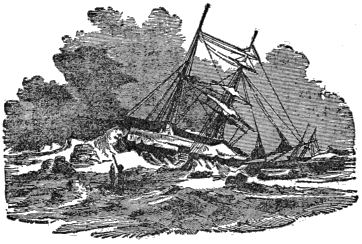
Yet there needed no after-survey of the ice-field to prove to us what majestic forces had been at work upon it. At one time on the 13th, the hummock-ridge astern advanced with a steady march upon the vessel. Twice it rested, and advanced again—a dense wall of ice, thirty feet broad at the base and twelve feet high, tumbling huge fragments from its crest, yet increasing in mass at each new effort. We had ceased to hope; when a merciful interposition arrested it, so close against our counter that there was scarcely room for a man to pass between. Half a minute of progress more, and it would have buried us all. As we drifted along five months afterward, this stupendous memento of controlling power was still hanging over our stern. The sketch at the head of the next chapter represents its appearance at the close of the month.
THE ADVANCE, FEBRUARY, 1851.
CHAPTER XIII
W
E had lost all indications of a shore, and had obviously passed within the influences of Baffin’s Bay. We were on the meridian of 75°; yet, though the recent commotions could be referred to nothing else but the conflict of the two currents, we had made very little southing, if any, and had seen no bergs. But on the 14th the wind edged round a little more to the northward, and at six o’clock in the morning of the 15th we could hear a squeezing noise among the ice-fields in that direction. By this time we had become learned interpreters of the ice-voices. Of course, we renewed our preparations for whatever might be coming. Every man arranged his knapsack and blanket-bag over again with the practiced discretion of an expert. Our extra clothing sledge, carefully repacked, was made free on deck. The India-rubber boat, only useful in this solid waste for crossing occasional chasms, was launched out upon the ice for the third time. Our former depôts on the floe had fared so badly that we were reluctant to risk another; but our stores were ready to be got out at the moment.[F]
Now began, with every one after his own fashion, the discussion what was best to be done in case of a wreck. Should we try our fortunes for the while on board the Rescue? She would probably be the first to go, and could hardly hope for a more protracted fate than her consort. Or should we try for the shore, and what shore? Admiralty Inlet, or Pond’s Bay, or the River Clyde? We have no reason to suppose the Esquimaux are accessible on the coast in winter; and if they are, they can not have provisions for such a hungry re-enforcement as ours; besides, the chance of reaching land from the drift-field through the broken ice between them is slender at the best for men worn down and sick; much more if they should attempt to carry two months' stores along with them. There was only one other resort, to camp out on the floe, if it should kindly offer us a foothold, and then move as best we might from one failing homestead to another, like a band of Arabs in the desert. Happily, Captain De Haven was spared the necessity of choosing between the alternatives: the ice-storm did not reach us.
“January 15. The moon is now nearly full. Her light mingles so with the twilight of the sun that the stars are quite sobered down. Walking out at 4 P.M., with the thermometer at -24°, to find, if I could, the cause of a sound a good deal like that of the surf, I was startled by a noise like a quarry blast, explosive and momentary, followed by a clatter like broken glass. Some ten minutes afterward, it was repeated, and a dark smoke-like vapor rose up in the moon-light from the same quarter. These things keep us on the qui vive.
“January 16. In the course of a tramp to-day about noon, the thermometer standing at -18°, I came across a wonderful instance of the yielding elasticity of ice under intense pressure. About two hundred yards from the brig, on her starboard quarter, was an unbroken plain of level ice, which before our recent break-up used to form one of my daily walks. It measured one hundred and thirty paces in its longer diameter and eighty-five in its shorter, and its thickness I ascertained this morning was over five feet. I found in crossing it to-day that the surface presented a uniform curve, a segment whose versed sine could not have been less than eight feet, abutted on each side by a barricade of rubbish. It strikes me that the dehiscence, lady’s slipper or Rupert’s drop fashion, of such tensely-compressed floes, must be the cause of the loud explosions we have heard lately. At -30° or -40° the ice is as friable and brittle as glass itself; besides, one of those yesterday was followed by a ringing clatter.
“January 18. The extreme stillness, and the facility with which sound travels over these Polar ice-plains, make us err a good deal in our estimates of distance at night. I went out to-day with Dr. Vreeland in search of a violent disruption of the ice, which our look-outs declared they had heard at the very side of the brig. We had some difficulty in finding it: it was the closing of a fissure considerably more than half a mile off.
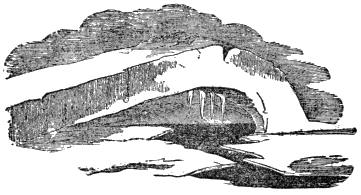
“As we were returning we noticed some additional results of the ice action of the 13th. Among them was a table of ice, four feet thick, eighteen long, and fifteen broad, so curved without destroying its integrity as to form a well-arched bridge across a water chasm. It had evidently reared up high in air, and then, toppling over, bent into its present form—a marked instance of the semi-solid or viscous character which forms the basis of Professor Forbes’s glacial theory. It is not, however, the first extreme change of form that I have noticed in apparently matured ice at a low temperature: its plasticity at +32° must be much greater.
AN ICE-BRIDGE FORMED BY PRESSURE.
“Observations by meridian altitudes of Saturn and Aldebaran give us to-day a latitude of 73° 47′ north. Yesterday we were at 73° 5\ This progress to the south is shown also by the bearing of the Walter Bathurst coast in the neighborhood of Possession Bay. We are fully inside of Baffin’s Bay, and with the wind at northwest. There are some signs of ice trouble ahead; a crack has been gradually opening toward our quarter, and has got within eight hundred yards of us."
The day after this the crack approached us till it was only about three hundred yards off, and then began closing again, with the usual accompanying phenomena. The ice between it and us was apparently quiescent; but our ship quivered and jumped under the transmitted pressure. Soon after, in the midst of a heavy snow-drift, and with a temperature of -30°, another crack showed itself close upon our cut-water. The shocks which reached us during these commotions are noted in the log-book as “apparently lifting the vessel aft:” the feeling was, indeed, not unlike that which has been observed during an earthquake, immediately before and sometimes during a vibration.
“January 20. The ice sounded last night like some one hammering a nail against the ship’s side, clicking at regular intervals. Another crack on the other side of the Rescue, now showing open water, was perhaps the cause.
“We already begin to experience the change in our axis of drift. The changes of the wind and the currents of Baffin’s Bay have impressed the great system which surrounds us with a marked progress to the south.
“Throughout last night, and until nine o’clock this morning, a column of illumination depended from the moon. Viewing it obliquely, its penciled rays could be seen reaching nearly to the horizon; while in its direct aspect a manifest but intermitting interval was apparent. It struck me as an illustration, perhaps, of Sir John Herschell’s remark when observing the Pleiades, that the centre of the retina is not the seat of greatest sensibility.
“Our snow-water has been infected for the past month by a very perceptible flavor and odor of musk, to such a degree sometimes that we could hardly drink it. After many attempts to find out its cause, and at least as many philosophical disquisitions to account for it without one, I accidentally saw to-day a group of foxes on the floes about our brig, who resolved our doubts by an illustration altogether simple and natural.
“January 22. On reaching the deck at half past eight this morning, after my usual sleepless night in the murky den below, I found the horizon free from cloud stratus, and the feeble foreshadowings of day bathing the snow with a neutral tint. By nine we could see to walk; and as late as five in the afternoon, the refracted twilights hung about the western sky. How delicious is this sensation of coming day! In less than a fortnight the great planet will be lifted by the bountiful refraction of the Arctic circle into clear eye presence.
“I long for day. The anomalous host of evils which hang about this vegetation in darkness are showing themselves in all their forms. My scurvy patients, those I mean on the sick-list, with all the care that it is possible to give them, are perhaps no worse; but pains in the joints, rheumatisms, coughs, loss of appetite, and general debility, extend over the whole company. Fifteen pounds of food per diem are consumed reluctantly now, where thirty-two were taken with appetite on the 20th of October. We are a ghastly set of pale faces, and none paler than myself. I find it a labor to carry my carbine. My fingers cling together in an ill-adjusted plexus, like the toes in a tight boot, and my long beard is becoming as rough and rugged as Humphrey of Gloster’s in the play.
“12 M. The thermometer keeps steadily at -20°, but to-day is the coldest I have ever felt. It blows a young gale. Brooks and myself have been flying kites. The wind was like prickling needles, and the snow smoked over the moving drifts.
“I am struck more and more with the evidences of gigantic force in the phases of our frozen pedragal. Returning from a chase after an imaginary bear, we came across, yesterday, a suspended hummock, so imposing in its form, that, half frozen as we were, we stopped to measure it. It was a single table of massive ice, supported upon a pile of rubbish, and inclined about 15° to the horizon. Its length was ninety-one feet six inches, its breadth fifty-one feet, and its average solid thickness eight feet. At its lower end it was seven feet above the level of the adjacent floe; at its upper, twenty-seven. The weight of such a mass, allowing 113 lbs. to the cubic foot, would be 1883 tons. I almost begin to realize Baron Wrangell’s account of the hummocks on the coast of Siberia. We have here, perhaps, some five hundred fathoms of water: the six, or twelve, or twenty fathoms of slimy mud, that he speaks of as forming the inclined plane of the shore, must facilitate very much the upheaval of ice-tables.
“10 P.M. The wind has freshened to a gale of the first order, and it howls outside like the dog-chorus of outer Constantinople. But cheerless as these heavy winds are in all out-of-the-way, undefended places, it is only when they announce or accompany a change of direction that we fear them. So stable and so elastic withal is the cementing effect of the cold here, that the strongest gales do not break up the ice after it has been once set in the line of the wind. On the other hand, a trifling breeze, if it deviates a very few points from the axis of the last set, puts every thing into commotion.
“January 23. The gale of last night subsided into the usual quiet but fresh westerly breeze, sometimes inclining to the W.N.W. To-day is very clear; the stars, except one or two of the northern magnates, invisible at noonday; and two or three well-marked crimson lines streaking the dawning zone above the sun. The hills around Walter Bathurst and Possession Bay, the entering southern headlands of Lancaster Sound, have sunk in the distance. Two summits, bearing southwest by west, probably belonging to Possession Mount, are all that remains of the coast. We are more than fifty miles from land, and still drifting rapidly to the east. To the southwest, by compass (true S.E. ½ E.), little volumes of smoke have been rising; but after a tolerably long walk, I could not find any further signs of the open water. We are now in latitude 73° 10'.
“The daylight is very sensibly longer: the moon was quite joyous with its little crimson flocculi; and five, or even five and a half hours afterward, when we looked toward the day quarter, instead of a grim blackness, or, as we had it more recently, a stain of Indian-red, we saw the pale bluish light, so gratefully familiar at home."
The appearances which heralded the sun’s return had a degree of interest for us which it is not easy to express in words. I have referred more than once already to the effects of the long-continued night on the health of our crowded ship’s company. It was even more painful to notice its influence on their temper and spirits. Among the officers this was less observable. Our mess seemed determined, come what might, to maintain toward each other that honest courtesy of manner, which those who have sailed on long voyages together know to be the rarest and most difficult proof of mutual respect. There were of course seasons when each had his home thoughts, and revolved perhaps the growing probabilities that some other Arctic search party might seek in vain hereafter for a memorial of our own; yet these were never topics of conversation. I do not remember to have been saddened by a boding word during all the trials of our cruise.
With the men, however, it was different. More deficient in the resources of education, and less restrained by conventional usages or the principle of honor from communicating to each other what they felt, all sympathized in the imaginary terrors which each one conjured up. The wild voices of the ice and wind, the strange sounds that issued from the ship, the hummocks bursting up without an apparent cause through the darkness, the cracks and the dark rushing water that filled them, the distorted wonder-workings of refraction; in a word, all that could stimulate, or sicken, or oppress the fancy, was a day and nightmare dream for the forecastle.
We were called up one evening by the deck-watch to see for ourselves a “ball of fire floating up and down above the ice-field.” It was there sure enough, a disk of reddish flame, varying a little in its outline, and flickering in the horizon like a revolving light at a distance. I was at first as much puzzled as the men; but glancing at Orion, I soon saw that it was nothing else than our old dog-star friend, bright Sirius, come back to us. Refraction had raised him above the hills, so as to bring him to view a little sooner than we expected. His color was rather more lurid than when he left us, and the refraction, besides distorting his outline, seemed to have given him the same oblateness or horizontal expansion which we observe in the disks of the larger planets when nearing the horizon.
For some days the sun-clouds at the south had been changing their character. Their edges became better defined, their extremities dentated, their color deeper as well as warmer; and from the spaces between the lines of stratus burst out a blaze of glory, typical of the longed-for sun. He came at last: it was on the 29th. My journal must tell the story of his welcoming, at the hazard of its seeming extravagance: I am content that they shall criticise it who have drifted for more than twelve weeks under the night of a Polar sky.
“January 29. Going on deck after breakfast at eight this morning, I found the dawning far advanced. The whole vault was bedewed with the coming day; and, except Capella, the stars were gone. The southern horizon was clear. We were certain to see the sun, after an absence of eighty-six days. It had been arranged on board that all hands should give him three cheers for a greeting; but I was in no mood to join the sallow-visaged party. I took my gun, and walked over the ice about a mile away from the ship to a solitary spot, where a great big hummock almost hemmed me in, opening only to the south. There, Parsee fashion, I drank in the rosy light, and watched the horns of the crescent extending themselves round toward the north. There was hardly a breath of wind, with the thermometer at only -19°, and it was easy, therefore, to keep warm by walking gently up and down. I thought over and named aloud every one of our little circle, F. and M., T. and P., B. and J., and our dear, bright little W.; wondered a while whether there were not some more to be remembered, and called up one friend or relative after another, but always came back to the circle I began with. My thoughts were torpid, not worth the writing down; but I was not strong, and they affected me. It was not good ‘Polar practice.’
“Very soon the deep crimson blush, lightening into a focus of incandescent white, showed me that the hour was close at hand. Mounting upon a crag, I saw the crews of our one ship formed in line upon the ice. My mind was still tracing the familiar chain of home affections, and the chances that this one or the other of its links might be broken already. I bethought me of the Sortes Virgilianæ of my school-boy days: I took a piece of candle paper pasteboard, cut it with my bowie-knife into a little carbine target, and on one side of this marked all our names in pencil, and on the other a little star. Presently the sun came: never, till the grave-sod or the ice covers me, may I forego this blessing of blessings again! I looked at him thankfully with a great globus in my throat. Then came the shout from the ship—three shouts—cheering the sun. I fixed my little star-target to the floe, walked backward till it became nearly invisible; and then, just as the completed orb fluttered upon the horizon, filled my ‘salut.’ I cut M in half, and knocked the T out of Tom. They shall draw lots for it if ever I get home; for many, many years may come and go again before the shot of an American rifle signalizes in the winter of Baffin’s Bay the conjunction of sunrise, noonday, and sunset.
“The first indications of dawn to-day were at forty-five minutes past five. By seven the twilight was nearly sufficient to guide a walking party over the floes. I have described the phenomena at eight. At nine the deck-lantern was doused. By 11h. 14m. or 15m. those on board had the first glimpses of the sun. At 5 P.M. we had the dim twilight of evening.
“Our thermometric records on board ship can not be relied on. I mention the fact for the benefit of those who may hereafter consult them. My wooden-cased Pike thermometer, hung to a stanchion on the northern beam of the brig, gave at noonday—19°; exposed to the sun’s rays on the southern, -14°. The observation repeated at 12h. 30m., gave -20° for the northern, and -15° for the southern side; the difference in each case being five degrees. The same thermometer, carefully exposed about a hundred yards from the ship, gave at noon, on the north and windward side, -21°; on the south, exposed to the sun, -18°; and at thirty minutes afterward (nearly), on the north, -20° 5'; toward the sun, -16°. The difference in these last observations of 3° in the first and 4° 5′ in the second was owing unmistakably to the effect of the solar rays. The ship’s record for the same hours was simply -19° and -18°. The fact is, that there is always a varying difference of two to five degrees of temperature between the lee and weather sides of the brig; the quarter of the wind and its intensity, the state of our fires, the open or shut hatches, and other minor circumstances, determining what the difference shall be at a particular time.
“January 30. The crew determined to celebrate ‘El regresado del sol,’ which, according to old Costa, our Mahonese seaman, was a more holy day than Christmas or All-Saints. Mr. Bruce, the diversely talented, favored us with a new line of theatrical exhibition, a divertissement of domestic composition, ‘The Countryman’s first Visit to Town;’ followed by a pantomime. I copy the play-bill from the original as it was tacked against the main-mast:
ARCTIC THEATRE
To be performed, on the night of Thursday, the 30th day of January, the Comic Play of the Countryman. After which, a Pantomime.
To begin with
A Song By R. Bruce.
THE COUNTRYMAN.
Countryman R. Baggs.
Landlady C. Berry.
Servant T. Dunning.
PANTOMIME.
Harlequin James Johnson.
Old Man R. Bruce.
Rejected Lover A. Canot.
Columbine James Smith.
Doors to be opened at 8 o’clock. Curtain to rise a quarter past 8 punctually. No admittance to Children; and no Ladies admitted without an escort.
Stage Manager, S. BENJAMIN.
The strictest order will be observed both inside and outside.
We sat down as usual on the preserved-meat boxes, which were placed on deck, ready strapped and becketed (nautice for trunk-handled) for flinging out upon the ice. The affair was altogether creditable, however, and everybody enjoyed it. Here is an outline of the pantomime, after the manner of the newspapers. An old man (Mr. Bruce) possessed mysterious, semi-magical, and wholly comical influence over a rejected lover (M. Auguste Canot, ship’s cook), and Columbine (Mr. Smith) exercised the same over the old man. Harlequin (Mr. Johnson), however, by the aid of a split-shingle wand and the charms of his “motley wear,” secures the affections of Columbine, cajoles the old man, persecutes the forlorn lover, and carries off the prize of love; the fair Columbine, who had been industriously chewing tobacco, and twirling on the heel of her boot to keep herself warm, giving him a sentimental kiss as she left the stage. A still more sentimental song, sung in seal-skin breeks and a “norwester,” and a potation all round of hot-spiced rum toddy, concluded the entertainments.
CHAPTER XIV
O
N the 2d of February the sun rose up in full disk at a quarter before eleven. The atmosphere was clear, but filled with minute spiculæ. The cold was becoming more intense: our ship thermometers stood at -32°, my spirit standard at -34°, and my mercurial at -38°. The ice that had formed between the floes since our break-up of January 12th was already twenty-seven inches thick, and was increasing at the rate of five inches in the twenty-four hours. The floes crackled under the intense frost, and we heard loud explosions around us, which one of our seamen, who had seen land service in Mexico, compared very aptly to the sound of a musket fired in an empty town. The 6th was still colder. At seven in the evening my spirit standard was at -40°. The day, however, had been graced with some hours of sunshine, and we worked and played foot-ball out on the ice till we were many of us in a profuse perspiration. The next morning my mercurial thermometer had frozen, leaving its parting record at -42°; and at half past eight one of the spirit standards indicated the same point. Up to this period, it was our lowest temperature. The frozen mercury resembled in appearance lead, recently chilled after melting. You could cut the thinner edges easily enough with a penknife; but where it was heaped up, nearer the centre of the solid mass, it was tenacious and resisting. I wished to examine it under the microscope, but was unable to procure a fractured surface.
Between six and eight o’clock in the evening of the 2d, we had a magnificent though nearly colorless exhibition of the aurora; and on the 7th, at 10h. 20m. A.M., the southern sky presented the appearance of a day aurora attending on the sun. The observations which I made of these two phenomena may be the subject of a distinct chapter; I will only say here, that it was difficult to doubt their identity of character or cause. We had several displays of the paraselene, too, in the earlier days of the month, and an almost constant deposition of crystalline specks, which covered our decks with a sort of hoar-frost. The rate of this deposition on the vessel was about a quarter of an inch in six hours; but in an ice-basin on the floes, surrounded by hummocks, and thus protected from the wind, I found it nine inches deep.
When accumulated in this manner, it might, on a hurried inspection, be confounded with snow; but it differs as the dew does from rain. It is directly connected with radiation, and is most copious under a clear sky. Snow itself, the flaky snow of a clouded atmosphere, has not been noticed by us when the temperature was lower than -8° or at most -10°. Our last snow-fall was on the 1st of February and the day preceding. It began with the thermometer at -1°, and continued after it had sunk to -9°; but it had ceased some time before it reached -13°.
“February 9. To-day we had a sky of serene purity, and all hands went out for a sanitary game of romps in the cold light. Presently three suns came to greet us—strange Arctic parhelia—and a great golden cross of yellow brightness uniting them in one system. Under the glare of these we played foot-ball.
“At meridian we made a rough horizon of the ice, and found ourselves in latitude about 72° 16'. At this time another marvel rose before us—Land. The monster was to the W.S.W., in the shape of two round-topped hills, lifted up for the time into our field of view. An hour or two later, while the day was waning, these hills became mountains, and then a line of truncated cones, the spectre of some distant coast. Looking a few minutes later out of the little door in our felt house, the port gangway of the log-book, to where for this last fortnight a bleak sameness of snow has been stretching to the far north, we saw a couple of icebergs standing alone in the sky, and at their shadowy tops their phantom repetitions inverted. By this time the mountains also had become twain, and the long line of resurrected coast was duplicated in the clouds. A stratum of false horizon separated the two sets of images.
“We have been now for many months without seeing the icebergs. They were beautiful objects, monuments of power, when we met them on the coast of Greenland, floating along on a liquid sea. Now they admonish us only of our helplessness and of perils before us. We should be glad to keep them in the clouds.
“The sun begins to make himself felt, though as yet feebly enough. My large spirit thermometer, in the shade of a hummock some hundred yards from the brig, gave us at noon -21° 5', and on the sunny side of the same hummock -12°. The same thermometer, before a blackboard exposed to the sun, was at -7°. Twenty minutes later, the thermometer at the blackboard rose to +2°, and twenty minutes later still it was at -2°. The ice formed within the twenty-four hours in the fire-hole measured four and a quarter inches; three quarters of an inch less than our measurements of it a week ago. A thermometer plunged two feet deep in a bank of light snow-drift indicated -12°.
“February 10. A hazy day; with moon-light, and a drizzling fall of broken spiculæ following it. Mr. Murdaugh obtained observations for meridian altitude and time-sights of Aldebaran: our latitude is 72° 19', our longitude 68° 55'. The winds have been unfavorable to the rapidity of our drift, which has been reduced in its rate since our observation on the 29th of January from five and a quarter to four miles a day. It may be that our approach to the narrower parts of the bay and the increased cold together have been disturbing causes in the movement of the great pack; but the wind has been the most important in its influence.
“To look at the completely unbroken area which shows itself from our mast-head, motion would be the last idea suggested. In Lancaster Sound the changing phases of the coast gave us a feeling of progress, movement, drift—that sensation of change so pleasing to one’s incomprehensible moral machinery. But here, with this circle of impenetrable passive solidity everywhere around us, it is hard to realize that we move. But for the stars, my convictions of rest would be absolute. Yet we have thus traveled upward of three hundred miles. I shall not soon forget this inevitable march, with its alternations of gloomy silence and fierce disruptions.
“February 11, Wednesday. Day very hazy, and nothing to interrupt its monotony. It requires an effort to bear up against this solemn transit of unvarying time.
“I will show you how I spend one of these days—that is, all of them. It is the only palliation I can offer for my meagreness of incident. As for the study we used to talk about—even you, terrible worker as you are, could not study in the Arctic regions.
“Within a little area, whose cubic contents are less than father’s library, you have the entire abiding-place of thirty-three heavily-clad men. Of these I am one. Three stoves and a cooking galley, four Argand and three bear-fat lamps burn with the constancy of a vestal shrine. Damp furs, soiled woolens, cast off boots, sick men, cookery, tobacco-smoke, and digestion are compounding their effluvia around and within me. Hour by hour, and day after day, without even a bunk to retire to or a blanket-curtain to hide me, this and these make up the reality of my home.
“Outside, grim death, in the shape of -40°, is trying—most foolishly, I think—to chill the energy of these his allies. My bedding lies upon the bare deck, right under the hatch. A thermometer, placed at the head of my cot, gives a mean temperature of 64°; at my feet, under the hatchway, +16° to -4°—ice at my feet, vapor at my head. The sleeping-bunks aft range from 70° to 93°; those forward, regulated by the medical officer, from 60° to 65°.
“We rise, the crew at six bells, seven o’clock, and the officers at seven bells, half an hour later. Thus comports himself your brother. He sits up in the midst of his blankets, and drinks a glass of cold water; eyes, nose, and mouth chippy with lamp-black and undue evaporation. Oh! how comforting this water is! That over, a tin-basin, in its turn, is brought round by Morton, mush-like with snow; and in this mixture, by the aid of a hard towel, with a daily regularity that knows no intermission, he goes over his entire skeleton, frictionizing.
“This done, comes the dressing—the two pairs of stockings, the three under-shirts, the fur outer robing, and the seal-skin boots; and then, with a hurried cough of disgust and semi-suffocation, he is on deck. There the air, pure and sharply cold, now about 26° or 30°, last week 40° below zero, braces you up like peach and honey in a Virginia fog, or a tass of mountain dew in the Highlands. Then to breakfast. Here are the mess, with the fresh smell of overnight undisturbed, and on our table griddle cakes of Indian meal, hominy, and mackerel: with hot coffee and good appetites, we fall to manfully.
“Breakfast over, on go the furs again; and we escape from the accumulating fumes of ‘servants’ hall,' walking the floes, or climbing to the tops, till we are frozen enough to go below again. One hour spent now in an attempt at study—vainly enough, poor devil! But he does try, and what little he does is done then. By half past ten our entire little band of officers are out upon the floes for a bout at anti-scorbutic exercise, a game of romps: first foot-ball, at which we kick till our legs ache; next sliding, at which we slide until we can slide no more: then off, with carbine on shoulder, and Henri as satellite, on an ice-tramp.
“Coming back, dinner lags at two. Then for the afternoon—God spare the man who can with unscathed nose stand the effluvium. But night follows soon, and with it the saddening question. What has the day achieved? And then we stretch ourselves out under the hatches, and sleep to the music of our thirty odd room-mates.
“February 14, Friday. A glorious day, with the sun from nine to half past two. Three bergs seen by refraction. The mercury rose to +2° over a black surface turned toward the sun. To-day the usual foot-ball.
“Our Arctic theatre gave us to-night ‘The Mysteries and Miseries of New York,’ followed by a pantomime. The sitting temperature was -20°; that outside, -36°; behind the scenes, -25°. A flat-iron used by the delicate Miss Jem Smith gave the novel theatrical effect of burning by cold. Poor Jem suffered so much in her bare sleeves and hands, that whenever the iron touched she winced. Cold merriment; but it concluded with hotchpot and songs.
“February 15, Saturday. Another glorious day; the sun visible from 9 A.M. to 3 P.M., and embanked during the remaining time. Much to our surprise, at the moment of setting, a startling ridge of mountain peaks rose into sight to the westward. Their distance, as estimated by the latest charts, was no less than 76 miles.
“February 22, Saturday. ‘Some things can be done as well as others:’ so at least Sam Patch said, when he scrambled up after his jump at Niagara. I walked myself into a comfortable perspiration this morning, with the thermometer at -42°, seventy-four degrees below the freezing point. My walk was a long one. When about three miles from the brig, a breeze sprang up: it was very gentle; but instantly the sensation came upon me of intense cold. My beard, coated before with massive icicles, seemed to bristle with increased stiffness. Henri, who walked ahead, began to suffer: his nose was tallow white. Before we had rubbed it into circulation, my own was in the same condition; and an unfortunate hole in the back of my mitten stung like a burning coal. We are so accustomed to cold that I did not suffer during our walk back, though it was more than an hour of hummock crossing.
“The sensation most unendurable of these extremely low temperatures is a pain between the eyes and over the forehead. This is quite severe. It reminded me of a feeling which I have had from over-large quantities of ice-cream or ice-water, held against the roof of the mouth. I reached the brig in a fine glow of warmth, having skated, slid, and made the most of my time in the open air.
“An increased disposition to scurvy shows itself. Last week twelve cases of scorbutic gums were noted at my daily inspections. In addition to these, I have two cases of swelled limbs and extravasated blotches, with others less severely marked, from the same obstinate disease. The officers too, the captain, Mr. Lovell, and Mr. Murdaugh, complain of stiff and painful joints and limbs, with diarrhœa and impaired appetite: the doctor like the rest. At my recommendation, the captain has ordered an increased allowance of fresh food, to the amount of two complete extra daily rations per man, with potatoes, saur-kraut, and stewed apples; and we have enjoined more active and continued daily exercise, more complete airing of bedding, &c. I have commenced the use of nitro-muriatic acid, as in syphilitic and mercurial cases, by external friction.
“The state of health among us gives me great anxiety, and not a little hard work. Quinine, the salts of iron, &c., &c., are in full requisition. For the first time I am without a hospital steward.
“It is Washington’s birth-day, when ‘hearts should be glad;’ but we have no wine for the dinner-table, and are too sick for artificial merriment without it. Our crew, however, good patriotic wretches, got up a theatrical performance, ‘The Irish Attorney;’ Pierce O’Hara taken by the admirable Bruce, our Crichton. The ship’s thermometer outside was at -46°. Inside, among audience and actors, by aid of lungs, lamps, and housings, we got as high as 30° below zero, only sixty-two below the freezing point! probably the lowest atmospheric record of a theatrical representation.
“It was a strange thing altogether. The condensation was so excessive that we could barely see the performers: they walked in a cloud of vapor. Any extra vehemence of delivery was accompanied by volumes of smoke. The hands steamed. When an excited Thespian took off his hat, it smoked like a dish of potatoes. When he stood expectant, musing a reply, the vapor wreathed in little curls from his neck. This was thirty degrees lower than the lowest of Parry’s North Georgian performances.
“February 23, Sunday. Mist comes back to us. After our past week of glorious sunshine, this return to murkiness is far from pleasing. But it might be worse: one month ago, and a day like this would have made our winter-stricken hearts bound with gladness.
“Caught a cold last night in attending the theatre. A cold here means a sudden malaise, with insufferable aches in back and joints, hot eyes, and fevered skin. We all have them, coming and going, short-lived and long-lived: they leave their mark too. This Arctic work brings extra years upon a man. A fresh wind makes the cold very unbearable. In walking to-day, my beard and mustache became one solid mass of ice. I inadvertently put out my tongue, and it instantly froze fast to my lip. This being nothing new, costing only a smart pull and a bleeding abrasion afterward, I put up my mittened hands to ‘blow hot’ and thaw the unruly member from its imprisonment. Instead of succeeding, my mitten was itself a mass of ice in a moment: it fastened on the upper side of my tongue, and flattened it out like a batter-cake between the two disks of a hot griddle. It required all my care, with the bare hands, to release it, and that not without laceration.
“February 25. A murky day. Two hundred and forty-four fathoms of line gave no bottom at the air-hole. Scurvy getting ahead. Began using the remnant of our fetid bear’s meat: nasty physic, but we will try it. It is colder to-day, with the wind and fog at -15°, than a few days ago at -46°. Wind south by east: sun not seen.
“February 26, Wednesday. The sun came back again with such vigor, that my spirit standard rose over black to +14°; my glass—cased, to +35°. The difference between shade and sunshine is 30°: a thermometer freely suspended in shade and in sun gave -32° and -2°. Black surfaces begin to scale off their snowy covering, not by thawing attended by moisture, but with a manifest diminution in the tenacity and adhesiveness of the snow. We observe these indications of returning heat closely.
“The scurvy has at last fairly extended to our own little body, the officers. Pains in the limbs, and deep-seated soreness of the bones, seem to be its most common demonstration. The complaint is of ‘a sort of tired feeling,’ or as if ‘they had had a beating.’ Our usual supper, the saur-kraut, has become excessively popular. Even the abused bear is not quite as bad as it was.
“The crew have been snow-rubbing their blankets. The snow is so fine and sand-like, that under these low Arctic temperatures it acts mechanically, and is an effectual cleanser. Withal, if you beat it well out of the tissue, it is not a damp application. The only trouble is that, on taking the bedding below, the condensation covers it with dew-drops. With drying-lines on the lower decks, the resort would be excellent.
“The setting sun, now fast approaching the home quarter of setting suns, the west, gave us again the spectral land about Cape Adair, eighty miles off.
“Sirius is beautifully resplendent on the meridian. What a fine exhibition it is! As it rises from the banked horizon, it gives us nightly freaks of terrestrial refraction. Its colors are blue, crimson, and white; its shapes oval, hour-glass, rhomboid, and square. Sometimes it is extinguished; sometimes flashing into sudden life: it looks very like a revolving light.
“To-day, in putting my hand inside my reindeer hood, I felt a something move. The something had a crepitating, insectine wriggle. Now, at home and everywhere else, without being a nervous man as to insects—for I have eaten locusts In Sennaar and bats in Dahomey—I rather dislike the crawl of centipede or slime of snail. Here, with an emotion hard to describe, surprise, pleasure, and a don’t-know-why wonderment, I caught my bug gently between thumb and finger.
“An air insect would be, in this dreary waste of cold, an impossibility greater than the diamond in the snow-drift. Save a seal and a fox, nothing sharing our principle of vitality has greeted us for months. The teeming myriads of life which characterized the Arctic summer have gone. The anatidæ are clamoring in the great bays and water-courses of the middle south. The gulls have sought the regions of open water. The colymbi and auks are lining the northern coasts of my own dear home. The croaking raven, dark bird of winter, clings to the inshore deserts. The tern are far away, and so, thank Heaven, are the mosquitoes. There are no bugs in the blankets, no nits in the hair, no maggots in the cheese. No specks of life glitter in the sunshine, no sounds of it float upon the air. We are without a single sign, a single instinct of living thing.
“If now, with the thermometer eighty degrees below the freezing point, and the new sun casting a cold gray sheen upon the snow, you leave the thirty-one, to whom you are the thirty-second, and walk out upon the ice away off—so far that no click of hammer nor drone of voice places you in relation with that little outside world—then you will know how I felt when I caught that ‘creeping wonder’ on my reindeer hood. It was a frozen feather.
“February 27, Thursday. An aurora passing through the zenith, east and west, at 3h. 30m. this morning. What little wind we have is coming feebly from the west and southwest. The thermometer has traveled from -40° to -31°, and the sun is out again in benign lustre. A difference of 27°, due to his influence, was evident as early as 10h. 20m., viz.: Green’s spirit standard gave, in shade,-33°; over black surface, in sunshine, -7° and -6°. At noonday, the same thermometer gave +2°. My glass—cased, hot-house like,—gave the pleasant deception of +40°.
“Still the scurvy increases. I am down myself to-day with all the premonitories. It is strangely depressing: a concentrated ‘fresh cold’ pain extends searchingly from top to toe. I am so stiff that it is only by an effort that I can walk the deck, and that limpingly. Once out on the floes, my energies excited and my blood warmed by exercise, I can tramp away freely; back again, I stiffen.
“Walked with our other cook, Auguste Canot. Queer changes these Frenchmen see! Canot’s father, a captain in the French army, was shot while serving with Oudinot, beneath the infernal ‘barricades’ of Rome—Canot the younger looking on. A few months after, the son had figured upon the list of condemned for the affair at Lyons, and was a fugitive emigré to the United States. The same sergeant-major, Canot, is now cooking salt junk in Baffin’s Bay. His confrère, the modest but gifted Henri, although a worse soldier, is a better cook. He first saw ice among the glaciers of La Tour. He has scullionized at the 'Trois Frères/ and played chêf to a London club-house. He passed through this latter ordeal, strange to say, unscathed; and, but for an amorous temperament, might be now at Delmonico’s, upon good wages and bad Bordeaux. Henri is a boy of talent, pensive by temperament, and withal ambitious. Were it not for the somewhat unequal distribution of two molars and an incisor, his entire stock of teeth, he would be an insufferable coxcomb. As it is, he treats his infirmity with amiable, if not philosophic contempt. He made me this morning an idea of white bear’s liver, à la brochette. The idea was good, the liver hippuric and detestable. Henri prides himself upon that most difficult simplicity, the filet. He prepares thus a sea-gull à merveille.
“February 28, Friday. The most wintery-looking day I have ever seen. The winds have been let loose, and the cheering novelty of a northwester breaks in on our calm. The drifting snow either rises like smoke from the levels, or whirls away in wreaths from the hummocks. The atmosphere has an opaline ashy look; in the midst of which, like a huge girasole, flashes the round sun. The clouds are of a sort seldom seen, except in the conceptions of adventurous artists, quite undefinable, and out of the line of nature, defying Howard’s nomenclature. They are blocked out in square, stormy masses, against a pearly, misty blue—harsh, abrupt, repulsive, quite out of keeping with the kindly lightness of things belonging to the sky."
The lowest temperature we recorded during the cruise was on the 22d of this month, when the ship’s thermometer gave us -46°; my offship spirit, -52°; and my own self-registering instruments, purchased from Green, placed on a hummock removed from the vessels, -53°, as the mean of two instruments. This may be taken as the true record of our lowest absolute temperature.
Cold as it was, our mid-day exercise was never interrupted, unless by wind and drift storms. We felt the necessity of active exercise; and although the effort was accompanied with pains in the joints, sometimes hardly bearable, we managed, both officers and crew, to obtain at least three hours a day. The exercise consisted of foot-ball and sliding, followed by regular games of romps, leap-frog, and tumbling in the snow. By shoveling away near the vessel, we obtained a fine bare surface of fresh ice, extremely glib and durable. On this we constructed a skating-ground and admirable slides. I walked regularly over the floes, although the snows were nearly impassable.
With all this, aided by hosts of hygienic resources, feeble certainly, but still the best at my command, scurvy advanced steadily. This fearful disease, so often warded off when in a direct attack, now exhibited itself in a cachexy, a depraved condition of system sad to encounter. Pains, diffuse, and non-locatable, were combined with an apathy and lassitude which resisted all attempts at healthy excitement.
These, of course, were not confined to the crew alone: out of twenty-four men, but five were without ulcerated gums and blotched limbs; and of these five, strange to say, four were cooks and stewards. All the officers were assailed. Old pains were renewed, old wounds opened; even old bruises and sprains, received at barely-remembered periods back, came to us like dreams. Our commander, certainly the finest constitution among us, was assailed like the rest. In a few days purpuric extravasations appeared on his legs, and a dysentery enfeebled him to an extent far from safe. An old wound of my own became discolored, and, curious to say, painful only at such points of old suppuration, three in number, as had been relieved by the knife. The seats of a couple of abscess-like openings were entirely unaffected and free from pain.
The close of the month found this state of things on the increase, and the strength of the party still waning.
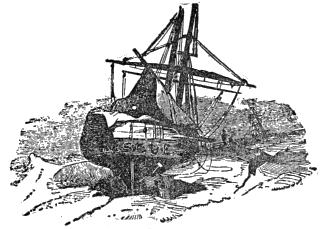
THE RESCUE IN HER ICE-DOCK.
CHAPTER XV
O
UR brig was still resting on her cradle, and her consort on the floe a short distance off, when the first month of spring came to greet us. We had passed the latitude of 72°.
To prepare for our closing struggle with the ice-fields, or at least divide its hazards, it was determined to refit the Rescue. To get at her hull, a pit was sunk in the ice around her, large enough for four men to work in at a time, and eight feet deep, so as to expose her stern, and leave only eighteen inches of the keel imbedded. This novel dry-dock answered perfectly. The hull was inspected, and the work of repair was pressed so assiduously, that in three days the stern-post was in its place, and the new bowsprit ready for shipping. We had now the chances of two ships again in case of disaster.
Since the middle of February the felt housing of our vessel had shown a disposition to throw off its snowy crust. There was an apparent recession, or, rather, want of adhesion about it, that spoke of change. But it was not till the 7th of March that we witnessed an actual thaw. On the black planking of the brig’s quarter, in full sun glare, the snow began to move, and fell, leaving a moist stain. This was either evaporated or frozen instantly; but still it had been there, unequivocal moisture. A sledge, too, alongside the vessel, kept laden to meet emergencies, with a black felt cover, gave on its southern side a warm impression to the unmittened hand; and several drops of water rolled from its mounting of snow, and formed in minute icicles.
With these cheering signs of returning warmth came a sensible improvement in my cases of scurvy. I ascribed it in a great degree to the free use of saur-kraut and lime-juice, and to the constant exercise which was enforced as part of our sanitary discipline. But I attributed it also to the employment of hydrochloric acid, applied externally with friction, and taken internally as a tonic. The idea of this remedy, hitherto, so far as I know, unused in scurvy, occurred to me from its effects in cachectic cases of mercurial syphilis. I am, I fear, heterodox almost to infidelity as to the direct action of remedies, and rarely allow myself to claim a sequence as a result; but, according to the accepted dialectics of the profession, the Acid. chlorohyd. dilut. may be recommended as singularly adapted to certain stages of scorbutus.
The great difficulty that every one has encountered in treating this disease is in the reluctance of the patient to rouse himself so as to excite the system by cheerful, glowing exercise, and in the case of seamen, to control their diet. My ingenuity was often taxed for expedients to counteract these predispositions. Some that I resorted to were ludicrous enough.
James Stewart, with purpuric blotches and a stiff knee, had to wag his leg half an hour by the dial, opposite a formidable magnet, each wag accompanied by a shampooing knead. Stewart had faith; the muscular action, which I had enjoined so often ineffectually, was brought about by a bit of steel and a smearing of red sealing-wax. They cured him.
Another, remarkable for a dirty person, of well used-up capillary surface, a hard case—one of a class scarcely ever seen by any but navy doctors—sponged freely and regularly from head to foot in water colored brown by coffee, and made acid with vinegar. His gums improved at once. He would never have washed with aqua fontana.
Another set of fellows adhered pertinaciously to their salt junk and hard tack, ship bread and beef. These conservative gentlemen gave me much trouble by repelling vegetable food. The scurvy was playing the very deuce with them, when the bright idea occurred to me of converting the rejected delicacies into an abominable doctor-stuff. It was an appeal to their spirit of martyrdom: they became heroes. Three times a day did these high-spirited fellows drink a wine glass of olive-oil and lime-juice, followed by raw potato and saur-kraut, pounded with molasses into a damnable electuary. They ate nobly, and got well.
But the causes of scurvy were relaxing their energies only for the time. Before the month was out, the disease had come back with renewed and even exacerbated virulence. Some of its phases were curious. The joint of Captain De Haven’s second finger became the seat of severe pain, accompanied by a distinct tubercle cartilaginous to the touch. It exactly recalled, he said, the appearance and feeling of the part for some months after it had been hurt by a schoolmaster’s ruler twenty-five years before. One of the crew had his tongue completely excoriated. Another, who had lost a molar tooth seven years ago, spit from the cavity a conoidal wedge: I had no chance of examining it by the microscope; but an impression of the cavity in wax showed the sides perfectly smooth, and the vertex intersected by lines of ossification. I have spoken already of my lance mark in the groin: it had been healed some three years; but it now threatened suppuration again wherever it bore the marks of the surgeon’s knife.
We had unfortunately almost exhausted our supply of anti-scorbutic drinks, and were driven to the manufacture of substitutes not always the most palatable. One of them, which served at least as a vehicle for lime-juice and muriate of iron, was, however, a recognized exception. It was a beer, of which a remnant of dried peaches and some raisins, with barley and brown sugar, formed the fermenting basis. The men drank it in most liberal quantities.
On the 10th we had an exhibition of the day aurora again, less brilliant than the one I have described a few pages back, but quite well marked. It was followed at night by the paraselene. Another atmospheric display, which occurred a few days afterward, attracted more notice.
“March 13. Again a day of bright sunshine, but to my feelings colder than our lowest temperatures. The thermometer stood at -24° in the shade at noon, and the wind was very light. Yet there was a cutting asperity about it that made your face tingle—a sensation as if evaporation was going on under the skin—quite a painful one. At four in the afternoon the atmosphere was studded with glistening particles. I have never seen them so manifest and so numerous. Our slide, a polished surface of clear ice, became clouded in a few minutes, and before five o’clock it was perfectly white. The microscope gave me the same broken hexagonal prisms, mixed with tables closely resembling the snow-crystal. A haze surrounded the horizon, rising for some six degrees in a bronzed purple bank; after which it gradually blended with the sky, a clear blue, undisturbed by cirri.
“Accompanying this redundancy of atmospheric spiculæ was a parhelion of remarkable intensity. There was no halo round the sun, and no vertical or horizontal column; but at the distance of 22° 04' from the sun’s centre were three solar images, one on each side, and the other immediately above the sun. This latter image was intensely luminous, but not prismatic; the others had the rudiments of an arc, highly colored, the red upon the inner margin. The haze rose as high as these horizontal images; and the arc, which in so short a segment presented no visible curvature, expanded as it descended, so as to form an elongated pyramid or column, the prismatic tints increasing in intensity as they approached the horizon. The effect of this was that of two illuminated beacons or rainbow towers, the sun blazing between them. As we stood a little way off on the ice, it was very beautiful to see the brig, with its spars and rigging cutting like tracery against the central light, with these prismatic structures on each side, capped by a spectral sun."
Two evenings later, the parhelia gave us another spectacle of interest. Two mock suns, which had accompanied the sun below the horizon, sent up an illuminated and colored arc some eight or ten degrees in height. Midway rose a brush-like column of crimson (baryta) light. A series of flame-colored strata, alternating with an incomprehensible black cloud, was so completely eclipsed by the vertical column, that it seemed to cut its way without a diminution of its brightness. The whole atmosphere was as warmly tinted as in the evenings of Melville Bay.
Indeed, from the beginning of the month, the skies had undergone a sensible change of aspect. Instead of the heavy-banked or linear stratus about the horizon, and the light, cold cirri above, we were getting back to something like the fall skies of our own climate, the misty bands of morning becoming fleecy as the day wore on, and taking the marbled or mackerel character before they blended with the western skies.
I am tempted to apologize, once for all, for the imperfect character of these observations. Our stock of instruments on board was scanty at the best, and the routine observances of a ship of war do not favor the prosecution of merely scientific researches. We had no actinometer to mark the daily increments of solar radiation: om' thermometers were generally of rude construction, and were not so placed as to give the highest value to their results; and an entry which I find in my journal explains why my barometrical records were so few.
“March 12. To-day, for the first time during the cruise, I had the pleasure of seeing our mountain barometer released from its stowage, and an attempt made to compare it with our aneroids. Before we began our drift to the north, when we had no fires below to give us a constantly vibrating temperature, and the aneroid of the Rescue had not come into the over-crowded cabin of our vessel to divide the formalities of registration with our own, it might have been well to make a careful comparison of the two with those of the British vessels, and with our mountain barometer also. The index error of this instrument on its zero point could have been adjusted then by reference to others that were just from Greenwich, and it would have been practicable, perhaps, to give something of increased value to our log-book records of the atmospheric pressure. Under all the circumstances, I have not thought it necessary to transfer them to my journal."
As the middle of March approached, our drift became gradually slower, until we almost reached a state of rest. For several days we advanced at an average rate of scarcely half a mile a day. We were at this time some seventy miles east of Cape Adair, our nearest Greenland shore being somewhere between Upper Navik and Disco; and the idea of encountering the final break-up among the closely-impacted masses that surrounded us, or of being carried back to the north by some inopportune counter-current, was far from pleasant. But our log-line, in an attempt at soundings, showed still a marked under-draught toward the south; and in a few days more we were moving southward again with increased velocity.
The 19th gave us a change of scene. I was aroused from my morning sleep by the familiar voice of Mr. Murdaugh, as he hurried along the half-deck: “Ice opening”—“Open leads off our starboard quarter”—“Frost-smoke all around us!” Five minutes afterward, Henri had been summoned from the galley; and, carbine in hand, I was tumbling over the hummocks.
After a heavy walk of half a mile, sure enough there it was—the open lead—stretching with its film of forming ice far in a narrowing perspective to the east and west. Balboa himself never looked out upon an ocean with more grateful feelings than I did upon this open chasm, the first inbreak upon complete solidity which we had known since the 15th of January. It was a breach in our prison-walls. The undulatory movement of the mercury and the varied appearance of the clouds were now explained. Although only discovered this morning, the rupture must have been going on for days, perhaps a week. Our winds had favored the separation of cracks into wide channels; but how such changes could have taken place puzzled me.
The ice, as shown by my measurements, was from four to eight feet; and even now, when I recall the fearful sounds which accompanied the Lancaster Sound commotions, I can hardly realize that such extensive chasms should have been formed almost in silence. We could only guess what had been the extent of our ice-field at this time. Baffin’s Bay was nearly three hundred miles across, and the field may have been twice as long in the other direction. Perhaps the wave action of a heavy sea, great subglacial billows, unfelt at our fast-cemented little vessel, may have broken the tables without the crash and tumult of a collision. The lead where I first reached it, to the southeast of our brig, was nearly three hundred yards across; not, however, three hundred yards of open water, but a separation between the two sides of the original floe of about that distance. The sides still showed their clean-edged fracture, diversified by drift and hummock, and rising above the intervening level, like the banks of a tideless river, margined by new ice and crusted with efflorescing snow. But at its further or southern side, a long strip, narrow and very black, gave evidence of open water. In this, surrounded by exhaling mist and frost-smoke, were our old friends, the seal; grave, hirsute-looking fellows, who rose out of the water breast-high, and gazed upon us with the curious faces of old times. Near them was a solitary dovekie, dressed in its gray winter plumage, the first bird I had seen for days; here, too, had crossed the tracks of a bear.
All this was very cheering. To see something, no matter what, checkering the waste of white snow, was like a shady grove to men sun-tired in a prairie; but to see life again—life, tenanting the desolate air and inhospitable sea—was a spring of water in the desert. My old hostility to gun-murder was forgotten. I wasted, of course, some small remnant of poetic sympathy with fellow-life thus springing up out of the wilderness; but then, in the midst of my sympathies, came the destructive instinct which longed to make it subservient to my wants. The scurvy, the scurvy patients, myself among the rest!—but the seal and the dovekies kept themselves out of shot.
At this lead we saw the recent frost-smoke within a few yards of us in pointed tongues of vapor: further off, the long, wreathy brown clouds were rising. I never before, not even in Wellington Channel, saw this phenomenon in greater perfection: in Wellington it was an interesting, sometimes a gloomy feature; here it was imposing. As far back as the twelfth, we had caught glimpses of brown vapor in this very direction: we now learned to look upon it in certain phases as an unerring indication of open water, and wondered that we did not so regard it earlier.
The chasms were not limited to the long lead before us. They extended to the east and west indefinitely; and were intersected by transverse fissures, which so met each other as completely to surround our vessels. From this circuit the frost-smoke was rising. The thermometer stood at -20°, fifty-two degrees below the freezing point in the shade; but the sun was shining brilliantly, raising the mercury to +10°. Under these circumstances, theoretically so favorable, this Arctic phenomenon became the most prominent feature in the scene.
As I stood upon a tall knob of hummock, the entire horizon seemed to be sending up, exhaling a bronzine smoke—not the lambent, smoky wreaths which I have compared to burning turpentine, but a peculiar russet brown smoke, tongued and wreathy when near, but at a distance rolling in cumulated masses. These seemed to cling at their bases to the surface from which they rose, like the discharges of artillery over water, or a locomotive steaming over a cold, wet meadow. They were wafted by the wind, so as to drive them out in lines two or three hundred yards long; but they clung tenaciously to the water and young ice, giving us a varying but always narrow horizon of smoke. The Rescue was enveloped with the heavy, sooty clouds of repeated broad-sides. If I had seen the flashing of guns or the glimmer of burning prairie-grass, I should have been less impressed; so strange, very strange, was this ordinary attendant on conflagration rolling in the midst of our winteriness.
EFFECT OF FROST-SMOKE.
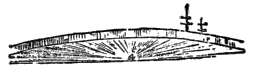
CHAPTER XVI
"M
ARCH 20. Thursday, the 20th of March, opens with a gale, a regular gale. On reaching deck after breakfast, I found the wind from the southeast, the thermometer at zero, and rising. These southeast storms are looked upon as having an important influence on the ice. They are always warm, and by the sea which they excite at the southern margin of the pack, have a great effect in breaking the floes. Dr. Olrik told me that they were anxiously looked for on the Greenland coast as precursors of open water. The date of the southeast gale last year, at Uppernavik, was April 25th. Our thermometer gave +5° at noonday, +7° at one, and +8° at three o’clock!
“This is the heaviest storm we have had since entering Lancaster Sound, exactly seven months and a day ago. The snow is whirled in such quantities, that our thick felt housing seems as if of gauze: it not only covers our decks, but drives into our clothes like fine dust or flour. A plated thermometer was invisible fourteen feet from the eye: from the distance of ten paces off on our quarter, a white opacity covers every thing, the compass-stand, fox-traps, and all beyond: the Rescue, of course, is completely hidden. This heavy snow-drift exceeds any thing that I had conceived, although many of my Arctic English friends had discoursed to me eloquently about their perils and discomforts. As to facing it in a stationary position, nothing human could; for a man would be buried in ten minutes. Even in reaching our little Tusculum, we tumble up to our middle, in places where a few minutes before the very ice was laid bare. The entire topography of our ice is changing constantly.
“7 P.M. ‘The wind is howling.’ Our mess begin to talk again of sleeping in boots, and the other luxuries of Lancaster Sound. For my own part, better, far better this, with the spicy tingling of a crisis, than the corroding, scurvy-engendering sameness of the past two months. Every moment now is full of expectation.
“March 21. The wind changed this morning to the westward, and by daylight was blowing freshly. After breakfast, Murdaugh and myself started on a tramp to the ‘open water,’ to see the effects of the gale. The drift was beyond conception; sufficient, in many places, to have covered up our whole ship’s company. The wind made it as cold at -5° as I have seen it at -30°, and the fine snow pelted our faces; but the surface was frozen so hard that we walked over the crust, and in a little over half an hour we reached the lead.
“Planting a signal pole, with a red silk handkerchief as a mark, and taking compass-bearings to guide us back again, we began to look around us. Our expectations of hummock action were agreeably disappointed. We thought that the storm would have driven the ice from the southward, and that the change of wind would have marshaled opposing floes to meet it. But it was not so. Even the young, marginal ice, though warped, was unbroken. The pressure had evidently taken place, but with little effect. After the gigantic upheavings of Lancaster Sound, excited by winds much weaker, no wonder I was surprised. Upon thinking it over, I came to the conclusion that the absence of a point d’appui, either of land or land-ice, was the cause of these diminished actions. We were now in a great sea, surrounded by consolidated floes, and away from salient capes or shore-bound ice. The pressure was diffused throughout a greater mass, without points of special or even unequal resistance. If this reasoning holds, we will not experience the expected tumult until we drift into a region where forces are more in opposition; perhaps not until we reach the contraction of Davis' Straits.
“The young ice margin of this open lead had the appearance of a beautiful wave-flattened sand beach. The lead itself had opened so far that its opposite shores were barely visible. The wind checked the immediate formation of new ice; and, to our inexpressible joy, there, glittering in the cold sunlight, were little rippling waves. So long have we been pent up by this wretched circle of unchanging snow, that I make myself ridiculous by talking of trifles, with which you, milk-drinking, sun-basking, melted-water-seeing people at home can have no sympathy. In spite of the winds and the snow-drift, I could hear the babbling of these waves as they laughed in their temporary freedom.