6
Reading edition
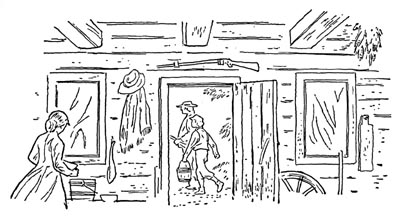
Many changes were taking place in the Lincoln cabin. Sarah persuaded Tom to cut two holes in the walls for windows, and she covered them with greased paper to let in the light. He made a wooden door that could be shut against the cold winter winds. Abe and Dennis gave the walls and low ceiling a coat of whitewash, and Sarah spread her bright rag rugs on the new wooden floor.
"Aunt Sairy," Dennis told her, "you're some punkins. One just naturally has to be somebody when you're around."
Abe smiled up at her shyly. "It is sort of like the magic in that story of Sinbad you gave me."
The other children were asleep. Abe sprawled on the floor, making marks on a wooden shovel with a pointed stick. Tom, seated in one of his wife's chairs, was dozing on one side of the fireplace.
Sarah put down her knitting and looked around the cabin. "The place does look right cozy," she replied. "What is that you're doing, Abe?"
"Working my sums."
Tom opened his eyes. "You know how to figure enough already. Put that shovel up and go to bed."
Abe took a knife and scraped the figures from the wooden shovel. He placed it against one side of the fireplace. "Good night, Mamma," he said.
"Good night, Abe."
Sarah's eyes were troubled. She waited until Dennis had joined Abe in the loft, then turned to her husband. "I've been meaning to tell you, Tom, what a good pa you've been to my young ones."
She saw that he was pleased. "I've tried to be a good mother to Abe and Sally, too," she went on.
"You have been, Sairy. They took to you right off."
"I'm right glad, but there's something else I want to talk to you about, Tom." He was nodding again in his chair, and she paused to make sure that he was listening. "Abe's a smart boy. I told him the next time a school keeps in these parts, I'd ask you to let him and the other children go."
"Humph!" Tom grunted. "There ain't any school for him to go to. Anyway, he wastes enough time as 'tis. He's always got his nose buried in those books you brought."
"That bothers me, too. I saw you cuff him the other day because he was reading."
"I had to, Sairy. I told him to come out and chop some wood, but he up and laughed in my face."
"He wasn't laughing at you, Tom. He was laughing at Sinbad."
"Who in tarnation is Sinbad?"
"A fellow in one of his books. Abe said that Sinbad sailed his flatboat up to a rock, and the rock was magnetized and pulled all the nails out of his boat. Then Sinbad fell into the water."
"That's what I mean," Tom exploded. "Dennis told him that book was most likely lies, but Abe keeps on reading it. Where is all this book learning going to get him? More'n I ever had."
"Maybe the Lord meant for young ones to be smarter than their parents," said Sarah, "or the world might never get any better."
Tom shook his head in dismay. "Women and their fool notions! If I don't watch out, you'll be spoiling the boy more'n his own mammy did."
Sarah's cheeks were red as she bent over her knitting. Tom was right about one thing. There was no school for Abe to go to. But some day there would be. Every few weeks another clearing was made in the forest, and the neighbors gathered for a "house raising" to help put up a cabin. Then smoke would rise from a new chimney, and another new home would be started in the wilderness.
With so many new settlers, there was usually plenty of work for Abe. Whenever Tom did not need him at home, he hired out at twenty-five cents a day. He gave this money to his father. That was the law, Tom said. Not until Abe was twenty-one would he be allowed to keep his wages for himself. As a hired boy, he plowed corn, chopped wood, and did all kinds of chores. He did not like farming, but he managed to have fun.
"Pa taught me to work," Abe told one farmer who had hired him, "but he never taught me to love it."
The farmer scratched his head. He couldn't understand a boy who was always reading, and if Abe wasn't reading he was telling jokes. The farmer thought that Abe was lazy.
"Sometimes," the farmer said, "I get awful mad at you, Abe Lincoln. You crack your jokes and spin your yarns, if you want to, while the men are eating their dinner. But don't you keep them from working."
The other farm hands liked to gather around Abe when they stopped to eat their noon meal. Sometimes he would stand on a tree stump and "speechify." The men would become so interested that they would be late getting back to the fields. Other times he would tell them stories that he had read in books or that he had heard from some traveler who had passed through Pigeon Creek. He nearly always had a funny story to tell.
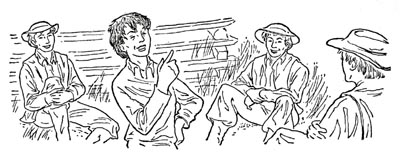
Yet there was "something peculiarsome about Abe," as Dennis Hanks once said. He would be laughing one minute; the next minute he would look solemn and sad. He would walk along the narrow forest trails, a faraway look in his eyes. Someone would say "Howdy, Abe." Then he would grin and start "cracking jokes" again.
Although he worked such long hours, Abe still found time to read. He sat up late and got up early in the morning, and Sarah made the children keep quiet when he wanted to study. Sometimes he took a book to work with him. Instead of talking to the other farm hands at noon, he'd go off by himself and read a few pages while he ate his dinner. People for miles around loaned him books. Sometimes he walked fifteen miles to Rockport, the county seat, to borrow books from John Pitcher, the town lawyer.
"Everything I want to know is in books," he told Dennis. "My best friend is a man who can give me a book I ain't read."
Late one afternoon, about two years after Sarah had arrived, Abe came home with a new book under his arm. Tom and Dennis had joined several of their neighbors in a big bear hunt and planned to be gone for several days. Abe planned to read—and read—and read.
"What do you think, Mamma?" he asked. "I have a chance to read the Declaration of Independence."
Sarah smiled into his eager eyes. "Now isn't that nice?"
He showed her the book. It belonged to David Turnham, the constable. Mr. Turnham had said that Abe might borrow it for several days, if he promised to be careful.
"What is it about?" Sarah asked.
"It has the laws of Indiana in it, and it tells how the government of our country was started." Abe's voice took on a new tone of excitement. "It has the Declaration of Independence in it and the Constitution, too."
He pulled a stool up to the fire and began to read. There was no sound in the little cabin except the steady click-click of Sarah's knitting needles. She glanced at him now and then. This tall, awkward boy had become very dear to her. As dear as her own children, perhaps even dearer, but he was harder to understand. No matter how much he learned, he wanted to learn more. He was always hungry, hungry for knowledge—not hungry for bacon and cornbread the way Johnny was. The idea made her chuckle.
Abe did not hear. He laid the book on his knee and stared into the flames. His lips were moving, although he made no sound.
"What are you saying to yourself?" Sarah asked. "You look so far away."
"Why, Mamma." Abe looked up with a start. "I was just recollecting some of the words out of the Declaration of Independence. It says all men are created equal."
"You don't mean to tell me!" Sarah was pleased because Abe was.
"I'm going to learn as much of the Declaration as I can by heart, before I take the book back," he said. "That way I can always keep the words."
"I declare," said Sarah, "you grow new ideas inside your head as fast as you add inches on top of it."