2
Reading edition
Abraham Lincoln did grow. He seemed to grow bigger every day. By the time he was seven, he was as tall as his sister, although Sally was two years older. That fall their father made a trip up to Indiana.
"Why did Pappy go so far away?" Sally asked one afternoon.
"When is he coming home?" asked Abe.
"Pretty soon, most likely."
Nancy laid down her sewing and tried to explain. Their pa had had a hard time making a living for them. He was looking for a better farm. Tom was also a carpenter. Maybe some of the new settlers who were going to Indiana to live would give him work. Anyway, he thought that poor folks were better off up there.
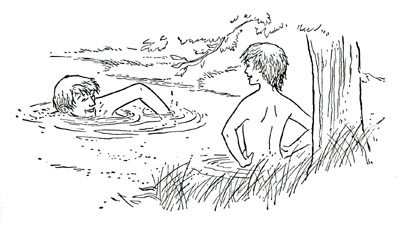
Abe looked surprised. He had never thought about being poor. There were so many things that he liked to do in Kentucky. He liked to go swimming with Dennis after his chores were done. There were fish to be caught and caves to explore. He and Sally had had a chance to go to school for a few weeks. Abe could write his name, just like his father. He could read much better. Tom knew a few words, but his children could read whole sentences.
Abe leaned up against his mother. "Tell us the story with our names," he begged.
Nancy put her arm around him. She often told the children stories from the Bible. One of their favorites was about Abraham and Sarah. "Now the Lord said unto Abraham," she began—and stopped to listen.
The door opened, and Tom Lincoln stood grinning down at them. "Well, folks," he said, "we're moving to Indiany."
Nancy and the children, taken by surprise, asked questions faster than Tom could answer them. He had staked out a claim about a hundred miles to the north, at a place called Pigeon Creek. He was buying the land from the government and could take his time to pay for it. He wanted to start for Indiana at once, before the weather got any colder.
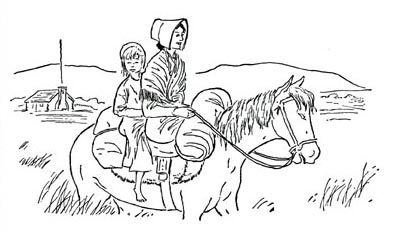
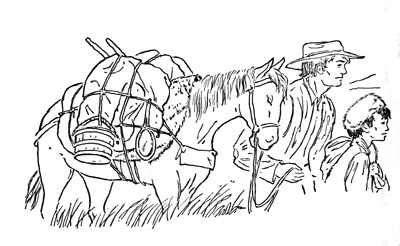
It did not take long to get ready. A few possessions—a skillet, several pans, the water buckets, the fire shovel, a few clothes, a homespun blanket, a patchwork quilt, and several bearskins—were packed on the back of one of the horses. Nancy and Sally rode on the other horse. Abe and his father walked. At night they camped along the way.
When at last they reached the Ohio River, Abe stared in surprise. It was so blue, so wide, so much bigger than the creek where he and Dennis had gone swimming. There were so many boats. One of them, a long low raft, was called a ferry. The Lincolns went right on board with their pack horses, and it carried them across the shining water to the wooded shores of Indiana.
Indiana was a much wilder place than Kentucky. There was no road leading to Pigeon Creek; only a path through the forest. It was so narrow that sometimes Tom had to clear away some underbrush before they could go on. Or else he had to stop to cut down a tree that stood in their way. Abe, who was big and strong for his age, had his own little ax. He helped his father all he could.
Fourteen miles north of the river, they came to a cleared place in the forest. Tom called it his "farm." He hastily put up a shelter—a camp made of poles and brush and leaves—where they could stay until he had time to build a cabin. It had only three walls. The fourth side was left open, and in this open space Tom built a fire. The children helped their mother to unpack, and she mixed batter for cornbread in a big iron skillet. She cut up a squirrel that Tom had shot earlier in the day, and cooked it over the campfire.
"Now if you will fetch me your plates," she said, "we'll have our supper."
The plates were only slabs of bark. On each slab Nancy put a piece of fried squirrel and a hunk of cornbread. The children sank down on one of the bearskins to eat their first meal in their new home. By this time it was quite dark. They could see only a few feet beyond the circle of light made by their campfire.
Nancy shivered. She knew that they had neighbors. Tom had told her there were seven other families living at Pigeon Creek. But the trees were so tall, the night so black, that she had a strange feeling that they were the only people alive for miles around.
"Don't you like it here, Mammy?" Abe asked. To him this camping out was an adventure, but he wanted his mother to like it, too.
"I'm just feeling a little cold," she told him.
"I like it," said Sally decidedly. "But it is sort of scary. Are you scared, Abe?"
"Me?" Abe stuck out his chest. "What is there to be scared of?"
At that moment a long-drawn-out howl came from the forest. Another seemed to come from just beyond their campfire. Then another and another—each howl louder and closer. The black curtain of the night was pierced by two green spots of light. The children huddled against their mother, but Tom Lincoln laughed.
"I reckon I know what you're scared of. A wolf."
"A wolf?" Sally shrieked.
"Yep. See its green eyes. But it won't come near our fire."
He got up and threw on another log. As the flames blazed higher, the green lights disappeared. There was a crashing sound in the underbrush.
"Hear him running away? Cowardly varmint!" Tom sat down again. "No wolf will hurt us if we keep our fire going."
It was a busy winter. Abe worked side by side with his father. How that boy can chop! thought Nancy, as she heard the sound of his ax biting into wood. Tree after tree had to be cut down before crops could be planted. With the coming of spring, he helped his father to plow the stumpy ground. He learned to plow a straight furrow. He planted seeds in the furrows.
In the meantime, some of the neighbors helped Tom build a cabin. It had one room, with a tiny loft above. The floor was packed-down dirt. There were no windows. The only door was a long, up-and-down hole cut in one wall and covered by a bearskin. But Tom had made a table and several three-legged stools, and there was a pole bed in one corner. Nancy was glad to be living in a real house again, and she kept it neat and clean.
She was no longer lonely. Aunt Betsy and her husband, Uncle Thomas, brought Dennis with them from Kentucky to live in the shelter near the Lincoln cabin. Several other new settlers arrived, settlers with children. A schoolmaster, Andrew Crawford, decided to start a school.
"Maybe you'll have a chance to go, Abe," Nancy told him. "You know what the schoolmaster down in Kentucky said. He said you were a learner."
Abe looked up at her and smiled. He was going to like living in Indiana!