3
Reading edition
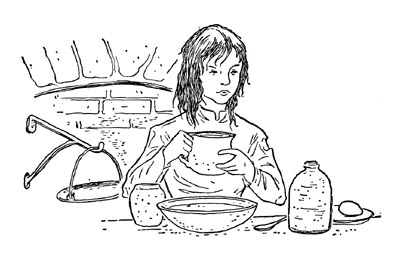
But sad days were coming to Pigeon Creek. There was a terrible sickness. Aunt Betsy and Uncle Thomas died, and Dennis came to live with the Lincolns. Then Nancy was taken ill. After she died, her family felt that nothing would ever be the same again.
Sally tried to keep house, but she was only twelve. The one little room and the loft above looked dirtier and more and more gloomy as the weeks went by. Sally found that cooking for four people was not easy. The smoke from the fireplace got into her eyes. Some days Tom brought home a rabbit or a squirrel for her to fry. On other days, it was too cold to go hunting. Then there was only cornbread to eat and Sally's cornbread wasn't very good.
It was hard to know who missed Nancy more—Tom or the children. He sat around the cabin looking cross and glum. The ground was frozen, so very little work could be done on the farm. He decided, when Andrew Crawford started his school, that Abe and Sally might as well go. There was nothing else for them to do, and Nancy would have wanted it.
For the first time since his mother's death Abe seemed to cheer up. Every morning, except when there were chores to do at home, he and Sally took a path through the woods to the log schoolhouse. Master Crawford kept a "blab" school. The "scholars," as he called his pupils, studied their lessons out loud. The louder they shouted, the better he liked it. If a scholar didn't know his lesson, he had to stand in the corner with a long pointed cap on his head. This was called a dunce cap.
One boy who never had to wear a dunce cap was Abe Lincoln. He was too smart. His side won nearly every spelling match. He was good at figuring, and he had the best handwriting of anyone at school. Master Crawford taught reading from the Bible, but he had several other books from which he read aloud. Among Abe's favorite stories were the ones about some wise animals that talked. They were by a man named Aesop who had lived hundreds of years before.
Abe even made up compositions of his own. He called them "sentences." One day he found some of the boys being cruel to a terrapin, or turtle. He made them stop. Then he wrote a composition in which he said that animals had feelings the same as folks.
Sometimes Abe's sentences rhymed. There was one rhyme that the children thought was a great joke:
"Abe Lincoln, his hand and pen, He will be good, but God knows when."
"That Abe Lincoln is funny enough to make a cat laugh," they said.
They always had a good time watching Abe during the class in "Manners." Once a week Master Crawford had them practice being ladies and gentlemen. One scholar would pretend to be a stranger who had just arrived in Pigeon Creek. He would leave the schoolhouse, come back, and knock at the door. Another scholar would greet "the stranger," lead him around the room, and introduce him.
One day it was Abe's turn to do the introducing. He opened the door to find his best friend, Nat Grigsby, waiting outside. Nat bowed low, from the waist. Abe bowed. His buckskin trousers, already too short, slipped up still farther, showing several inches of his bare leg. He looked so solemn that some of the girls giggled. The schoolmaster frowned and pounded on his desk. The giggling stopped.
"Master Crawford," said Abe, "this here is Mr. Grigsby. His pa just moved to these parts. He figures on coming to your school."
Andrew Crawford rose and bowed. "Welcome," he said. "Mr. Lincoln, introduce Mr. Grigsby to the other scholars."
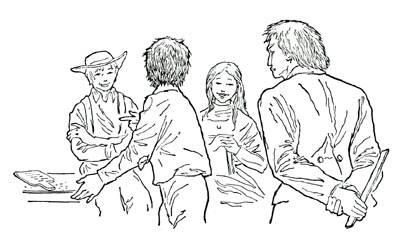
The children sat on two long benches made of split logs. Abe led Nat down the length of the front bench. Each girl rose and made a curtsy. Nat bowed. Each boy rose and bowed. Nat returned the bow. Abe kept saying funny things under his breath that the schoolmaster could not hear. But the children heard, and they could hardly keep from laughing out loud.
Sally sat on the second bench. "Mrs. Lincoln," said Abe in a high falsetto voice, "this here be Mr. Grigsby."
While she was making her curtsy, Sally's cheeks suddenly grew red. "Don't let on I told you, Mr. Grigsby," Abe whispered, "but Mrs. Lincoln bakes the worst cornbread of anyone in Pigeon Creek."
Sally forgot that they were having a lesson in manners. "Don't you dare talk about my cornbread," she said angrily.
The little log room rocked with laughter. This time Master Crawford had also heard Abe's remark. He walked over to the corner where he kept a bundle of switches. He picked one up and laid it across his desk.
"We'll have no more monkeyshines," he said severely. "Go on with the introducing."
One day Abe almost got into real trouble. He had started for school early, as he often did, so that he could read one of Master Crawford's books. He was feeling sad as he walked through the woods; he seemed to miss his mother more each day. When he went into the schoolhouse, he looked up and saw a pair of deer antlers. Master Crawford had gone hunting. He had shot a deer and nailed the antlers above the door.
What a wonderful place to swing! thought Abe. He leaped up and caught hold of the prongs. He began swinging back and forth.
CRASH! One prong came off in his hand, and he fell to the floor. He hurried to his seat, hoping that the master would not notice.
But Master Crawford was proud of those antlers. When he saw what had happened, he picked up the switch on his desk. It made a swishing sound as he swung it back and forth.
"Who broke my deer antlers?" he shouted.
No one answered. Abe hunched down as far as he could on the bench. He seemed to be trying to hide inside his buckskin shirt.
Master Crawford repeated his question. "Who broke my deer antlers? I aim to find out, if I have to thrash every scholar in this school."
All of the children looked scared, Abe most of all. But he stood up. He marched up to Master Crawford's desk and held out the broken prong that he had been hiding in his hand.
"I did it, sir," he said. "I didn't mean to do it, but I hung on the antlers and they broke. I wouldn't have done it, if I had thought they'd a broke."
The other scholars thought that Abe would get a licking. Instead, Master Crawford told him to stay in after school. They had a long talk. He liked Abe's honesty in owning up to what he had done. He knew how much he missed his mother. Perhaps he understood that sometimes a boy "cuts up" to try to forget how sad he feels.
Abe felt sadder than ever after Master Crawford moved away from Pigeon Creek. Then Tom Lincoln left. One morning he rode off on horseback without telling anyone where he was going. Several days went by. Even easy-going Dennis was worried when Tom did not return.
Abe did most of the chores. In the evening he practiced his sums. Master Crawford had taught him to do easy problems in arithmetic, and he did not want to forget what he had learned. He had no pen, no ink, not even a piece of paper. He took a burnt stick from the fireplace and worked his sums on a flat board.
He wished that he had a book to read. Instead, he tried to remember the stories that the schoolmaster had told. He repeated them to Sally and Dennis, as they huddled close to the fire to keep warm. He said them again to himself after he went to bed in the loft.
There were words in some of the stories that Abe did not understand. He tried to figure out what the words meant. He thought about the people in the stories. He thought about the places mentioned and wondered what they were like.
There were thoughts inside Abraham Lincoln's head that even Sally did not know anything about.