Front matter
Reading edition
Transcriber's Note:
Obvious typographical errors have been corrected. Inconsistent spelling and hyphenation in the original document have been preserved.
On page 128, the sentence starting "I did not," may be missing words.
A YANKEE IN THE FAR EAST
A YANKEE IN THE FAR EAST
BY GEORGE HOYT ALLEN Author of "It Tickled Him"
WITH ILLUSTRATIONS BY H. S. WELLER

CLINTON, N. Y. TRAVELOGUE-ART ASSOCIATION INCORPORATED 1916
Copyright, 1914 By Travelogue-Art Association, Inc.
Copyright, 1915 By Travelogue-Art Association, Inc.
All rights reserved
Second Edition
To my Friend J. Whitfield Hirst
CONTENTS
PAGE
Author's Preface 1
I. War Hell and Bull Fights 7
II. "Missouri" and His False Teeth 17
III. Wong Lee—The Human Bellows 28
IV. Hawaii—and the Fisherman Who'd Sign the Pledge 33
V. The Umpire Who Got a Job 44
VI. The Japs' Five-Story Skyscraper and a Basement 53
VII. Japanese Girls in American Clothes—They Mar the Landscape 59
VIII. Ceremonious Grandmother—"Missouri" a "Heavenly Twin" 64
IX. Ushi the Rikisha Man 79
X. Missionaries, Tracts, and a Job Worth While 91
XI. Yamamoto and High Cost of Living 99
XII. The Soldier Said Something in Chinese 103
XIII. Ten Thousand Tons on a Wheelbarrow and the Ananias Club 114
XIV. "Missouri" Meets a Missionary 120
XV. A Sto-o-rm at Sea 133
XVI. The Islands "Discovered" by Dewey 138
XVII. White Filipinos, Aguinaldo, and the Busy Moth 147
XVIII. Singapore—The Humorist's Close Call 156
XIX. The Hindu Guide a Saint Would Be 168
XX. Penang—A Bird, the Female of Its Species, and the Mangosteen 172
XXI. Burma and Buddha 176
XXII. Baptists and Buddhism 181
XXIII. The Rangoon Business Man Who Drove His Sermon Home 185
XXIV. The Glass of Ice-Water That Jarred Rangoon 188
XXV. The Calcutta Sacred Bull and His Twisted Tail 194
XXVI. The Guide Who Wouldn't Sit in "Master's" Presence 201
XXVII. Royalty vs. "Two Clucks and a Grunt" 206
XXVIII. One Wink, Sixteen Cents, and Royalty 210
XXIX. The Englishman and Mark Twain's Joke, "That's How They Wash in India" 215
XXX. English as "She Is Spoke" in India 223
XXXI. Five Days' Sail and a Measly Poem 225
XXXII. Beating the Game With One Shirt 240
XXXIII. Through Hell Gate Steerage 257
LIST OF ILLUSTRATIONS
PAGE
I found myself jammed in with the cruelest, most blood-thirsty, cut-throat gang I've ever seen 11
They tortured three yesterday, but I was more than satisfied with one, when I left them to their sport 15
"You see, Mr. Allen, I got those teeth to please my wife" 20
"When I didn't have them in my wife was giving me Hail Columbia" 24
"With a mouthful of victuals I'd find myself chewing those false teeth with my other teeth" 26
"Wong," I said, "how fashion you talkee so? "No can slmoke stlate loom! "No tlouble slmoke stlate loom. Can slmoke stlate loom easy, see?" 29
My great fear was that before we landed at Yokohama Wong would surely burst in his efforts to keep the smoke in my state room blown out of the porthole 31
I snitched it from a folder put out by the Hawaiian Promotion Society 37
A fellow tied up that way can't come to the Hawaiian Islands to live 39
Just one look at that fish and he'd yell and drop fish, line and pole right back in the pond 41
You wouldn't expect to find any kickers in the Islands 43
But I'll bet it would make it shy 47
I won't say it would scare a locomotive off the tracks 48
Author's illustration 49
Believe me, that umpire could make anyone see 51
They have the taxicab, but someone else had it during my three days' stay 55
While you're working out the problem your car passes 57
She is a part of the landscape that way. She fits in and makes me glad 62
Pained! Grieved! Shocked! were too mild words. I was disappointed in "Missouri" 65
"Lord, Mr. Allen, I'm glad to see you," he said, as the machine stopped 67
We S.O.S.'d Yokohama for four hours with that saki house telephone 73
That surely was some bow 76
But Ushi's card had pulled a customer 81
"Ushi, what for you mope? Didn't I make a deal with you last night to be my rikisha boy today? Hitch on behind and push, Ushi" 87
With reckless abandon I had decided to blow myself for a whole dollar, and twenty-five cents for ten hours' horse and carriage hire 88
That missionary seemed to exude tracts—I didn't know one missionary could hold so many 93
Except potato bugs, I always want to poison them 97
He said to have a foreigner as a guest at his humble home would bring around his house such a crowd of curious neighbors 100
I felt a good deal better after what I'd said, and I think what the soldier said made a hit with him 110
With a mighty bound I landed in that man's arms 112
"Dr. 'Blank'," I said, "you're the one man in China I'm looking for. I have a warrant for your arrest" 113
The chance acquaintances would cast significant glances and cough 115
There are some Americans whom even a Shanghai wheelbarrow don't particularly interest 121
"Women who are interested in foreign missions and preachers in our town set quite a store by me" 123
"For about a minute, as I looked at what was in front of me, I couldn't think of anything but the two of diamonds" 126
"Humph!" snorted "Missouri," "he said, 'You've probably gathered your information of the missionary work in the Far East from your bar-room associates'" 129
As we jounced along over the bridge in front of our hotel on a Shanghai wheelbarrow 131
Word has come to me that some of my readers are disappointed that I shied at a description of seasickness, but instead went off on a tangent about false teeth 134
Astride the bowsprit, pen in hand, writing a sto-o-rm at sea 137
Admiral George Dewey of the American Navy discovered these islands May 1st, 1898 140
I hit a prominent official in Washington for a free pass on a transport to the Philippines 144
You cannot starve these people; they live in a land of perpetual summer 148
There is not another city in Japan, China, or India that can equal it in cleanliness 150
The chief industry of the owners of the shacks is to roost in them out of the sun and rain 152
Ye gods! Tell a Singapore official to his face that you are going to shake the town! 159
I swelled out my chest and swaggered away and thought I was funny 161
The "funny man" gently lifted the derby from the dozing passenger's head and set his own sombrero in its place 163
"And dommed if I didn't thank him twice when I should 'ave punched his 'ead" 166
No matter what the hole you're in, there is a deeper one 167
And now there is something to write about—the mangosteen 174
Would be like going to Venice and not having your picture taken with the doves roosting all over you 189
The only thing of note in the whole transaction is the boy's self-satisfied air of having done his whole duty 192
She said: "I wish I were a flying fish, o'er ocean's sparkling waves to sail" 195
"Twist his tail," I said, "that will start him" 197
"You stay where you belong. I'll do the sacred bull business around this neck of the woods" 199
Get that? Royalty, don't you know 203
It's hard lines to pour out money in this way on Lal—but Royalty is expensive anyway 205
"Of course I don't," I came back at him. "You stung me the last trip across India" 208
Lal tells the string of porters to put "Master's" baggage into the compartment—no matter how much, put it all in, boxes, bags, bedding, and trunks 212
The town turned out en masse to hear me talk 216
The coffee began to boil in the church kitchen, the aroma floated through the auditorium 218
That old joke about the English being slow is no joke—it's a sad fact 220
And every time the Englishman has explained to me that he wasn't trying to break the stone 221
Home loomed large in my mind—I wanted to go home 226
Just like committing suicide 229
He had been filled as full, if not fuller, than myself 230
To write that invoice all over again * * * to get out of that was the determining factor 233
With my teeth chattering with valor 235
Anxiously watching specks in the horizon 238
We do, on occasions, don it 241
I've attended twenty-two "he" tea parties on this voyage 245
No hope of being sunk before dinner 247
I turned that shirt around 248
I felt like a thief in that shirt 251
With my jack-knife to rip and some puckering strings I went at it 253
I turned that shirt upside down 254
Also, I finally accepted his apology 255
"You're a third-class passenger on this ship"—and further conversation with me seemed to give him a pain 264
He swore like a pirate 271
"It is hard when they loiter, isn't it?" 274
And "Beef" came in 279
And those pants did look bad. There was no doubt about that 281
"If Mr. Allen says I have insulted women, he's a liar" 284
AUTHOR'S PREFACE
There are so many ways suggested these days by the various periodicals on how to make money at home, it would seem that all ingenuity in that direction must be exhausted; but how to make money abroad seems to me to be almost a virgin field.
New pastures have always interested me, and if I can add to the sum of human happiness by a wise suggestion, and point the way to satisfy an almost universal longing to see the world,—for instance, if I can show how one can make a luxurious world tour and come out ahead of the game while doing it,—I shall be only too glad.
It's no new trick to beat one's way around the world with the hardships attending such an enterprise, but to tell how to do it in ease and luxury surely ought to earn me the gratitude of my fellow-men.
Get a bunch of pencils and some pads of paper and announce to a waiting editorial world that you are about to take a trip around the globe, and that you propose to write some letters of travel and syndicate them. That, for a consideration, you'll let some good papers print 'em.
Don't be modest about naming a good round price for the consideration of letting your papers in. Because you'll need the money.
All editors you'll find are hankering for letters of travel.
Letters of travel are a novelty. The first editor you call on early in the morning, say about ten o'clock (that's early enough to get to work in this new enterprise I'm tipping you off to—gone is grinding toil and worry—let others moil), this first editor of some big daily (big dailies are the easiest)—don't be timid—brace right up to him, and give him your proposition in a nutshell—easy-like—right off the bat.
It will be a pleasure to you to watch him brighten up at your offer.
Managing editors of big dailies are hard-worked men.
Atlas' job (merely physical) is easy compared with the mental strain and worry the managing editor of a big daily paper is subjected to these days.
You'll find him feeling the need of something—it's travel dope.
Don't be too arbitrary with him when he inquires in a tentative, anxious way, as he is about to affix his signature on the dotted line in your contract: "Of course no other paper in our town gets these letters?"
Assure him he will have exclusive use in his town. One paper in a town is enough, if you select the biggest and best one.
If (an almost impossible contingency) there should be any hesitancy on the part of the editor in grabbing your offer, if it seems to you that the price may be giving him pause, don't make the mistake of cutting the price. Tell him you may (don't promise for sure,—it won't be necessary,—a hint will be enough), tell him you may run a little poetry into your letters—that poetry comes easy for you to write—a sort of a fambly gift.
Don't stall, for fear you can't write poetry. You can do it if you think you can. It's dead easy.
Newspapers are just crazy for poetry—so crazy for it that lots of them will buy it when every line don't begin with a capital—where the poet ends a sentence right in the middle of a line, puts a period there, and just to beat the compositor out of a little fat starts a new verse after that period.
Why, they will buy poetry where the reader will get half through the piece before he discovers that it is poetry, and after he has caught the swing he will start at the top and begin over, and go clear to the end every time, and feel good over it.
This is where this kind of poetry differs from patent medicine advertisements.
In the latter, when the poet begins to advise the use of a new brand of pills, when the poet's ulterior motive begins to crop out, you stop reading, get mad, and want to swat the poet.
The paper gets paid for printing the pill poem. It is in cahoots with the poet to put one over on the public, but it pays money for the kind of poetry I have described.
I'm glad I thought to post you about the poetry, because it's just barely possible that the editor may be contemplating a trip himself, in which case his paper won't want your stuff,—he will send in some articles; or that his brother, or his sister, or his cousin, or his aunt, all of them gifted writers, are now on the bounding billows, en route for foreign parts, armed with pencils and pads; or that even now one of the paper's big advertisers is in Europe, and some travel stuff he is writing is just beginning to arrive and space must be found for it somewhere (it's just barely possible, I say barely, that that is one of the editor's problems as you drop in on him at 10 A. M.), so don't forget about the poetry.
This is important, because if you do, in all probability the next issue of that paper will have a scoop in a news story headed:—"Mysterious and Brutal Murder! Unknown Man Found Mutilated Beyond All Possibility of Identification! No Clue to the Perpetrators!"
So, after you've made your offer, and before the editor has time to draw his gun or grab an axe, tell him you can write poetry, which, when set in his paper, will at first sight look just like Johnnie's composition on Spring.
In addition to saving your local paper from publishing a harrowing tale of a mysterious disappearance, you'll land your contract with that hint of some possible poetry. When, I started out to do what I am advising you to do, I made nine towns before I signed up a paper.
There was considerable iron in my soul when I tackled the tenth town, and I had to do something,—so I dropped a hint that I might possibly run in a little poetry. After that it came easy.
With this kindly hint on "How to Make Money Abroad," herein is presented the letters I wrote on my 1914 world tour for a syndicate of papers.
With the kindly aid of the artist to help you over the hard places, "A Yankee in the Far East" for a title (a book must have a title), and good, plain print, the publishers launch this little book.
A YANKEE IN THE FAR EAST
I WAR HELL AND BULL FIGHTS
Up in the interior of our country we don't look upon the Mexican situation with the same passionate interest that they do down here on the border—in El Paso, for instance.
Here is a town of sixty thousand. A magnificent city, with everything that goes to make our modern civilization desirable. A city of sky-scrapers, a million-dollar hotel (the one I'm stopping at), with still others that would do credit to a city twice its size. Splendid stores, residences, and railway station, and forty-five miles of fine macadam streets—a city of gimp, go, and bang—a city to make an American citizen proud of his country.
It costs five cents and ten minutes' time to go from the center of El Paso over to Mexico across the Rio Grande—a muddy, dirty stream that one could wade across—into the city of Juarez—a town of about ten thousand—the quickest change from everything desirable to everything undesirable that I have ever experienced. A fit title to the story would be "From Heaven to Hell." I went to see a bull fight in Juarez, the first and last bull fight I shall ever witness.
I wonder if Sherman ever saw a bull fight; I don't believe he did, or he would have said, "War is the vestibule—the real thing is what is called a bull fight." In my humble opinion the Almighty allowed the devil to institute war among men to give us a warning foretaste of hell. The devil, ambitious to outdo himself, made one more try and invented the bull fight (which is a misnomer—it is not a "fight"), and then the devil said: "I'm through, beat it if you can."
War is a fight—men against men, intellect against intellect. A cock fight is a fight—cock against cock. A dog fight is a fight—dog against dog. A prize fight is a fight—bruiser against bruiser, go to it, and may the best side win.
The devil invented all these, but there was an element of fairness in them. The devil looked upon them and saw the element of fairness. It girded him. He tried once more, invented bull torturing, baited his hook by naming it bull "fighting," and fished for a nation to adopt it. Spain bit, and she and her offspring deserve all they've reaped in consequence—and then some.
For a hellish, damnable, brutalizing institution, I place the torturing of bulls for amusement at the head of the class for the double-distilled quintessence of his Satanic Majesty's final and last effort to put one over on the Angel of Light. The horrors and cruelties practiced since time began have back of them ambition, hate, bigotry, ignorance, or supposed justice; but the bull fight has none of these back of it for an excuse. It's done in the name of sport! for pastime!
Ambition?—"It's a glorious cheat," but posterity may reap the benefit. Hate?—It burns itself out. Bigotry?—Darkness, preceding dawn. Ignorance?—It can be cured. Justice?—Blind but sometimes hits the mark. But the bull fight! Invented for sport, pastime—that which is as necessary to man's development as food. A country that lets its children have the bull fight to play with is on the toboggan slide.
I've seen them chop off human being's heads in China, in the name of justice. It jarred me some. I've seen the awful condition of human life in India. That jarred me more. But yesterday I saw five thousand men, women and children gathered to witness bulls tortured for "fun"!
I found myself jammed in with the cruelest, most blood-thirsty, cut-throat gang I've ever seen—and the fact that human beings could be brought to look upon that thing as "sport," "pastime," "pleasure," jarred me most of all—and Juarez is only a little more than a stone's throw from El Paso! El Paso has poignant feelings on the Mexican situation—the nuisance is at her door.
Twenty-five years ago El Paso was a cluster of mud huts. Juarez was a town five hundred years ago, and it's little more than a cluster of mud huts now. Some fair-size two-story brick buildings, but a sorry makeshift of a city, the chief thing in evidence being poverty, vice, and dirt. Its chief pride, and by all odds largest building, is its bull ring—an amphitheater that will seat 10,000, built around an arena. This arena, about 100 feet in diameter, is fenced in with a high-board fence. A gate opens out of the arena, through which first come six gaily-dressed bull baiters on foot, followed by three more riding blindfolded, scarecrow horses, sorry, poor, limping old beasts, which, in man's service have earned a merciful death—their value in the open market would not exceed $2.00 each. Their riders are armed with long-handled spears. They all, on foot and horseback, have official names. I don't know, nor want to know, what their titles are. They are men!—not brutes. It would be an insult to the brutes that go to make up the sketch to call them that. They doff their hats and salaam to the throng, who answer back with lusty cheers.
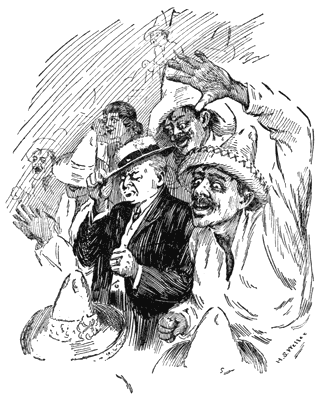
I found myself jammed in with the cruelest, most blood-thirsty, cut-throat gang I've ever seen
And now the bull comes from the darkened pen, where he has been kept for twenty-four hours,—a walk of thirty feet through a fenced-in lane. His bovine majesty, a splendid bull, comes walking leisurely along, rejoicing to get into God's sunlight, no thought of malice in his heart. He seems to nod a kindly good-afternoon to the attendants, who drive him towards the gate that opens into the arena. As he is passing through the gate a man perched up out of harm's way jabs a cruel harpoon on the end of a handle decked with gaily colored ribbons between the bull's shoulders.
There is no maddened rush of an angry bull. He stops for an instant with a startled look—surprise, and hurt wonderment, and "what for?" written on his face as plain as man can talk. A baiter inside the ring with a blanket shook out at his side stands just ahead of him. The bull charges the blanket—no danger to the man—the gate is shut, and the baiters with their blankets held out at their sides get the bull more and more into fighting trim.
But the crowd wants blood. So a baiter on a horse, rides up and jabs the bull's shoulder with his spear, and another rider jabs him on the other side. The bull wheels to catch his tormentor, who is out of harm's way on his horse. The bull charges back and forth, from rider to rider, until one of them deliberately reins his blinded horse directly in range of the bull, who rips its entrails out. The rider deftly and easily dismounts; the blinded horse is down, and the bull finishes him with a thrust or two, and the crowd goes mad with "delight." The remaining two riders have played their part, and withdrawn from the ring, and six baiters on foot take up the "sport," and with their blankets draw the bull from the now dead horse. He charges from one to the other, with no more danger to the trained athletes on foot than there would be to a hound after a rabbit.
But the rabbit has a chance for its life—the bull none.
And now another baiter comes with two harpoon spears on handles two feet long decked with ribbons, and tempts the bull to charge him. The bull accepts the challenge, and as he charges the trained baiter side-steps, and, as the bull passes, plants his harpoons in the bull's sides.
Good act! The crowd goes wild again. This sport is kept up for half an hour, till the poor beast's sides are full of barbed spears, and the crowd cries out for blood, more blood, when the lord high executioner steps up with a long, murderous, stiff-bladed sword, about four feet long, and with his blanket tempts the tired bull to lower his head, then he drives the sword to its hilt between the bull's shoulders.
The bull does not drop dead. The matador missed his heart; but with that blade thrust through his body, the bull staggers—braces himself on his four feet. The matador vainly tempts the bull to charge the blanket. The look in the dying bull's eyes would move a heart of stone to pity—he trembles, falls to his knees, drops in a convulsive heap, and dies.
The matador salaams low as he receives the plaudits of the crowd. A team of fine horses, decked in red blankets, is driven on a gallop to the dead bull, a rope is attached to his legs, and the horses gallop out of the arena, snaking the bull in their wake.
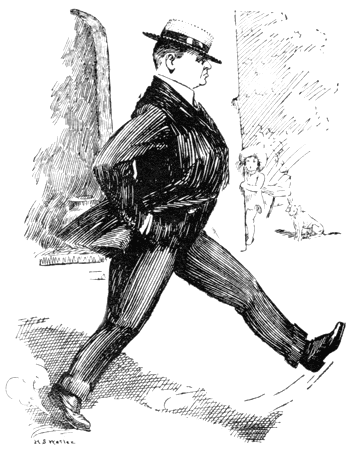
They tortured three yesterday, but I was more than satisfied with one, when I left them to their sport
The team comes back, and in like theatrical manner the dead horse is snaked off, and the crowd sets up a howl to bring on another bull. Three to five bulls are tortured for an afternoon's "entertainment." They tortured three yesterday, but I was more than satisfied with one, when I left them to their "sport." Carranza's headquarters are at Juarez. He "graced" the bull fight with his presence, and if Huerta had been in Juarez he would probably have been there too.
II "MISSOURI" AND HIS FALSE TEETH
I labor under a great disadvantage in writing this ship-board letter, en route from San Francisco to Yokohama.
My contract reads that these letters shall tell of personal experiences, and when I discover a new, fresh theme that I am not qualified to tackle, I naturally feel that fate has been unkind to me.
There has recently been discovered a strange malady which attacks travelers at sea. I find competitors in writing travel stuff have me on the hip in this regard. This new malady, in which I know the public must have a breathless interest, is so replete with possibilities from a pencil pusher's standpoint, I more than half suspect that some writers aren't playing fair.
I fear some of them are no more qualified from personal experience to write about it than I am, but they are banging ahead and writing about it anyway, just because it is a new, fresh subject, full of thrilling possibilities for the pen artist, and as for the artist who can draw pictures to illustrate it—honest you'd die laughing, there's so many funny things about it.
The ship's doctor, whom I've interviewed for data, advised me to cut it out; that, like everything new, the writers have already overworked it.
He told me they called it seasickness in the steerage, and mal de mer in first cabin, and that it hits first cabin harder than it does steerage.
I never was strong on fads. The beaten path for me!
I am also under contract to write about the folks I meet. Now there's a subject worth while,—folks. You'll strike them on shipboard. I'm pretty close to one chap so soon. He is on a business trip to China. He is from some place in Missouri—he's from Missouri all right.
I understand he has dealt largely in horses. It's his first trip to Japan and China, and he seems to cling to me, and I have much of his life's history. The first thing I noticed about him was his beautiful teeth—as fine a set of teeth as I ever saw in a man's mouth. The first meal after sailing he got up and left the table abruptly, and I missed him till the next meal, when again he left the table—seemed to be in trouble.
The next time I saw him was at dinner, and I was shocked! He had lost two teeth on one side and three on the other—upper teeth. It made a great difference in his personal appearance—but he seemed to enjoy that meal without any break.
After dinner, on deck, away from anyone else, I commiserated him on the loss of those teeth—felt well enough acquainted—you can make better time getting acquainted on shipboard than anywhere else.
I asked him why he had to sacrifice those teeth; that they looked like fine teeth. Was it really necessary to have them out? Hadn't he taken a chance in having the ship's doctor play dentist? And then he poured out his whole soul to me about those teeth.
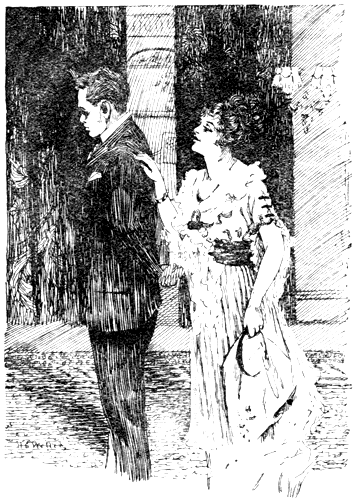
"You see, Mr. Allen, I got those teeth to please my wife"
"Mr. Allen," he said, "the ship's doctor didn't take them out. I haven't lost them. I'm wearing them in my coat pocket. Those teeth were artificial, Mr. Allen."
"You see," he continued,—it seemed as if he just wanted to talk about those teeth, now that he was started,—"You see, Mr. Allen, I got those teeth to please my wife. I didn't really need them, only for looks. I've got all the rest of my teeth, except those side ones.
"Wife said it was all right while I was home where my friends all knew me—were used to me; but in taking this trip among strangers, I really ought to have those gaps filled in. So I went to a toothsmith, and he shod me up with some new teeth. He talked about bridges, and scaffolding, and roofing, and one thing and another, and owing to the situation he found in his explorations, 'a partial plate,' as he called it, he thought was the best way out.
"When he connected me with those teeth, it felt just like it looks to nail a shoe on a horse. I felt as a colt must feel when it's first hitched up with bit and bridle.
"'Do you mean to tell me,' I asked that dentist, 'that I've got to go through life with that in my mouth?'
"'Oh, no,' he said, 'this is only a partial plate. Some day you'll lose all your teeth and will have to have a double set, upper and lower. Then you will feel as if you were somebody else—this is only a little trouble. You'll get used to this partial plate and not mind it a bit. They look dandy. Just take a peek at yourself. You look ten years younger. You just stick to them for a couple of days and you'll be all right.'
"I went home feeling that the bloom of youth was all rubbed off—felt as if I had a billiard ball in my mouth.
"My wife was delighted, and gave me that same josh the dentist handed me—said I looked ten years younger.
"I felt forty years older, and told her so—and when it came to eating, everything tasted just alike—and all bad.
"I stood it for six hours, and gave up. I went to take them out and got scared. I couldn't get them out. Then I was sure the dentist had nailed them in.
"I called him up and asked him would he go to his office? Told him I was in trouble. When I got there I found him waiting for me.
"He wanted to know where they hurt.
"I told him, 'All over.' That the joy and jounce and bounce of life had all left me. He had filled me full of woe and sadness. That my shoes pinched, my hair pulled, and my collar choked me.
"'Take 'em out, doctor, take 'em out,' I sobbed. 'I don't believe they were made for me. I think you've made a mistake and got some other fellow's teeth in my mouth. I think these teeth were made for a very large man with a very large mouth,' I said.
"He pried me loose from the work of his hands, and took the artificial part of me into his den, put it on his anvil, and ran it over his buzz saw and through his planer, and brought it back to me, and said, 'Open up,' just as if I were a horse; and he bitted and bridled me for another race.
"I wrestled with those teeth for a week before I left for this trip. I kept them in different places—in the bathroom, on top of my chiffonier, and in my pocket. Not all the while, you understand. I got so I could take them out myself, and I alternated them between the place where they made me look ten years younger, and those places I've mentioned; and when I didn't have them in, my wife was giving me Hail Columbia. Said I didn't have as much sand as a Chippy bird; acted as if I were the only person who had ever had to learn to wear false teeth.
"I made a few more trips to the dentist, to ask him if he was dead sure he hadn't got me breaking in some other fellow's teeth; and if he would plane them down a little here and there.
"He growled considerable. Said he'd get them too loose, and then I'd be having trouble the other way.
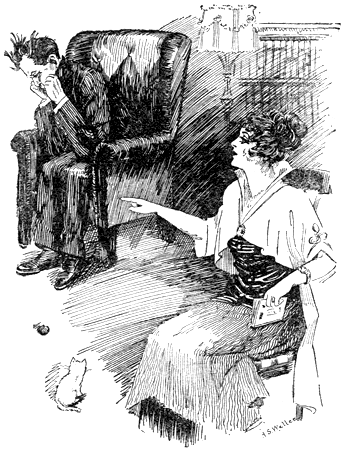
When I didn't have them in my wife was giving me Hail Columbia"
"Well, I got so I could wear those teeth and think of something else at the same time; and then I started for San Francisco to catch this ship. I can't understand it at all; but somehow or other, those teeth have shrunk. They began to shrink as soon as I struck the Pullman, and when I got aboard this ship the blamed things had shrunk some more. They got so they would drop on me while eating. I'd be going along all right, when all of a sudden, with a mouth-full of victuals, I'd find myself chewing those false teeth with my other teeth. I felt like a cannibal chewing a corpse. I felt like a ghoul robbing a graveyard. It was worse than the neck of a chicken, that any man who has kept house for twenty years or so, knows all about. After you've helped all the rest, all that's left for you is the neck, don't you know?"
"Missouri" had me crying; but I gave three emphatic and sympathetic nods. I've kept house for more than twenty years, and I'm a connoisseur myself on that part of the fowl—and the gizzard.
"Well," "Missouri" continued, "I felt like a Fiji Islander before the missionaries taught them to love their enemies, but not to eat them. So I'm wearing those teeth in my coat pocket.
"I may not look so young, but I don't feel so like a blithering savage. I hate to go home without a full set of teeth, though.
"How are the Japanese on dentistry, Mr. Allen? Do you suppose I could get fixed up over there?"
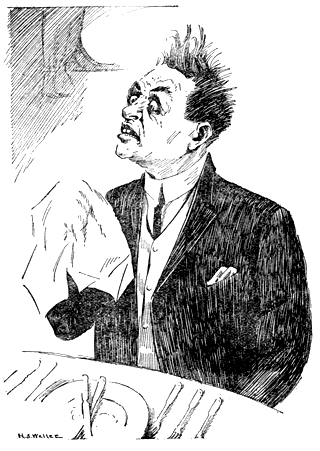
"With a mouthful of victuals, I'd find myself chewing those false teeth with my other teeth"
I told him I didn't know about their dentistry, but that they were clever little beggars. That they were strong on tea and tooth brushes.
"Tea, teeth, and tooth brushes," "Missouri" said, in a speculative and hopeful tone. "Now maybe so, maybe so," and we parted for the night.
"Missouri" is not a half bad sort, and, anyway, his teeth story is different than a yarn on seasickness.
III WONG LEE—THE HUMAN BELLOWS
This is a fine, large ship—Japanese line.
I don't call to mind any line of ships I have not sailed on prior to this voyage in my chasing up and down the world in search of a "meal ticket," and pleasure; but this is my first voyage on a Japanese liner, and I'm simply delighted with it.
It contrasts delightfully with a ship I sailed on, on one of my former trips across the Pacific.
That boat was all right, too. Good ship, good service—particularly good service—Chinese help; and anyone who has ever sailed with Chinese crews, waiters and room boys, knows what that means—nothing better in that line. I had a fine stateroom and a good room boy—that boy was a treasure.
I cottoned to that boy the minute he grabbed my baggage at the wharf, and blandly said, "You blong my," as he led me to my stateroom.
There was an obnoxious sign in that stateroom which read: "No Smoking in Staterooms." I settled for the long voyage, hung a coat over that sign, and lit up.
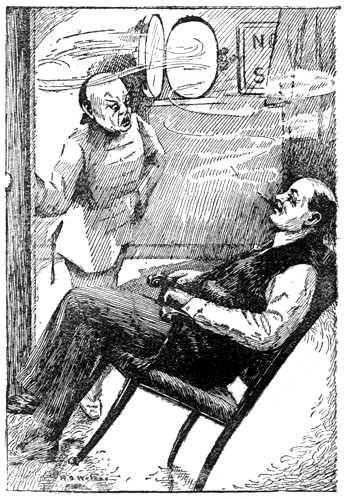
"Wong," I said, "how fashion you talkee so? "No can slmoke stlate loom! "No tlouble slmoke stlate loom. Can slmoke stlate loom easy, see?"
Wong Lee flagged me with a word of warning: "No can slmoke stlate room. Slmoke loom, can do."
"Wong," I said, "how fashion you talkee so? 'No can slmoke stlate loom!' No tlouble slmoke stlate loom. Can slmoke stlate loom easy, see?"
If anyone tells you the Chinese can't see a joke, tell them to guess again. Wong saw that little one—saw it through a cloud of smoke, at that. Wong shut my stateroom door, like a boy in the buttery stealing jam, and said: "Lofficers findee out. They flobid."
"All right, Wong, I won't tell them if you don't," I said. And Wong didn't—Wong certainly didn't betray me.
The further we sailed the more I became attached to the boy—he took such excellent care of me—I got so I really loved that boy.
All Wong's other duties seemed easy compared to his efforts, in my behalf, to see that my slight and harmless infraction of the ship's rules should not be discovered. If I dropped a little ash, Wong was on hand to brush it up. A tell-tale cigar stub, carelessly left—Wong was there to whisk it out of sight with: "Lofficers may come insplection any time. No can tell when."
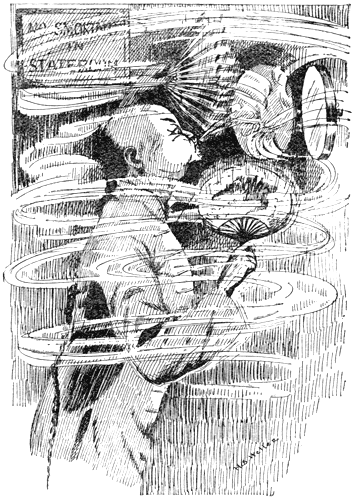
My great fear was that before we landed at Yokohama Wong would surely burst in his efforts to keep the smoke in my stateroom blown out of the porthole
It wasn't my uneasiness at fear of being found out that robbed me of some of the pleasures of the trip, but an anxious fear that Wong, 'round whom the tendrils of my heart's affections were gaining strength each day as we neared the mystic land of the rising sun—my great fear was that before we landed at Yokohama, Wong would surely burst in his efforts to keep the smoke in my stateroom blown out of the port-hole.
Now this ship is different. No silly rules that drive a man out of his room onto the deck, or the smoking room, when he feels like drawing a little inspiration from the weed that cheers but don't inebriate—I like this ship.
"Land ho!" Hawaii in the distance.
IV HAWAII—AND THE FISHERMAN WHO'D SIGN THE PLEDGE
"Under the setting sun, in the Mid-Pacific, lie the Islands of the Hawaiian group, which present to the traveler or home-seeker more alluring features than are combined in any other country in the world. Nowhere else are such pictures of sea and sky and plain and mountain, such magnificence of landscape, such bright sunshine and tempering breeze, such fragrant foliage, such brilliant colorings in bush and tree, such dazzling moonlight.
"With a climate world-excelling for its equableness, these happy islands afford a refuge for those who would escape the rigors of cold or heat encountered in the temperate zones; an entertaining resort for the pleasure-seeker, an almost virgin field of research for the scientist, a sanitarium for the ill, weary or overwrought. For the man who would build a home where conditions of life are most nearly ideal, and where nature works with man and not against him, Hawaii smiles a radiant welcome.
"It is withal an entrancing land, these mid-sea dots, for the combination of tropical sunshine and sea breeze produces a climate which can be compared to nothing on any mainland, and by reason of peculiar situation, to that of no other island group. Hawaii has a temperature which varies not more than 10 degrees through the day, and which has an utmost range during the year from 85 degrees to 55 degrees. Sweltering heat or biting cold are unknown, sunstroke is a mythical name for an unthought thing, a frost-bite is heard of no more than a polar bear.
"Conjure up a memory of the most perfect May day, when sunshine, soft airs and fragrance of buds and smiling Nature combine to make the heart glad, multiply it by 365, and the result is the climate of Hawaii. The sky, with the blue of the Riviera and the brilliance of a sea-shell, is seldom perfectly clear. Ever the fleecy white clouds blowing over the sea form masses of lace-like broidery across the blue vault, adding to the natural beauty, and when gilded or rouged by sunrise or sunset make the heavens a miracle of color.
"And, as in Nature's bounty the climate was made close to perfection, so the good dame continued her work and gave to the land such features as would make not alone a happy home for man, but as well a pleasure ground: for there are mountains and valleys, bays and cataracts, cliffs and beaches in varied form and peculiar beauty, foliage rich in color and rare in fragrance, flowers of unusual form and hue, and all without a poisonous herb or vine, or a dangerous reptile or animal. To fit the paradise was sent a race of people stalwart in size, hospitable, merry, and music-loving. The door is always open and over its lintel is 'Aloha,' which means 'Welcome.' All are given cordial greeting on the summer shores of the Evening Isles, and nowhere else may be found so many joys and such new lease of life as under Hawaii's smiling skies.
"More prominent than any other cause for this condition of affairs is the fact that Hawaii is windswept throughout the year. The northeast trades bring with them new vitality, and make of Hawaii a paradise where life is pleasure all the year round. From out of the frozen north, picking from the blossoming whitecaps the fragrant and sustaining ozone, sweeping across the breakers to caress the land, comes the constant northeast trade-wind. It is not a strong, harsh blow at all, rather a fanning breeze—Nature's punkah. The average velocity for the year is but eight miles per hour. The mission of the trade-wind is a beneficent one always. Cyclones or hurricanes in Hawaii are unknown."
I didn't write the above. That is a piece of pure plagiarism on my part. I snitched it from a folder put out by the Hawaiian Promotion Society.
The first time I saw that folder I got hold of it on shipboard a few hours before reaching Honolulu the first time I came here, years ago. I read it through and smiled like Noah's neighbors when he allowed there was going to be a wet spell—and got off the ship and "did" Honolulu.
I kept on smiling, albeit not cynically.
No living man can adequately describe the beauties of these islands. I just wandered around in a daze until I found myself on top of one of their mountains, and when I took it all in I felt as if I'd burst if I didn't say something, and I began apostrophizing Hawaii in a rapturous rhapsody.
I felt a good deal better after that, but as I was pressed for time I had to leave the islands and hike along; or I thought I had to. I did, at least.
But that rhapsody stands. The islands are still here, and as lovely as ever.
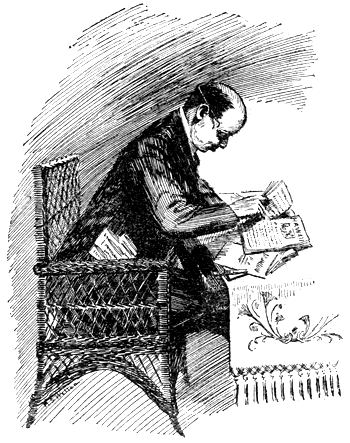
I snitched it from a folder put out by the Hawaiian Promotion Society
What I can't understand is, that there are only 191,000 inhabitants on these islands, with room for several times that many; and something over a billion in the rest of the world. I don't know why I'm not living here myself, and for the life of me I don't know why I leave them—my ultimate aim has been to get to Heaven.
I can only account for it on one theory: I own a house and lot and some land in Central New York, and I'm so busy shoveling snow outdoors and coal indoors from some time in November to some time in April, and during May and June getting some stuff started, hoping it won't get nipped by the late frosts, and working it along before September frost gets it—in the meantime saving it from more bugs than a fellow, if he saves his crop, can take time to learn the names of—what with hustling that stuff through between frosts and saving it from pests, and planning the while to be in shape to get some coal to keep from freezing to death the coming winter—a fellow tied up like that can't come to Hawaii to live. I suppose that billion or so who are not living in the Hawaiian Islands are all fixed in some such a way.
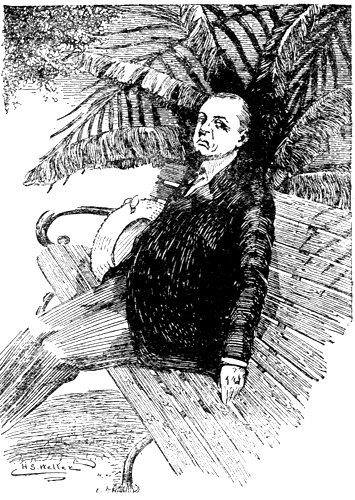
A fellow tied up that way can't come to the Hawaiian Islands to live
But I feel a little sore at that Hawaiian booster. He didn't tell about the fish they have here. There is an aquarium in Naples, Italy, said to be the finest in the world. I've been through that Naples aquarium several times, and it is a drab affair compared with the aquarium here at Honolulu. In the Honolulu aquarium may be seen fish of odd shapes and so brilliantly and beautifully colored that no artist could show these colors with paint and brush. There is the Humuhumu for instance. A fish six or seven inches long. It has bright green fins, and a stripe of jet black starting in a narrow band at the top of its back, broadening out diagonally around its body. On its side, set in the band of black, is a bright red spot. Rearwards of the black band its body is a bright red, and forward of the band the body is bright red shading off to white. Its tail is striped, red, yellow and black. Somewhat bass-shaped, its eyes are not in its head, but set on top of its back.
A man not knowing such a fish existed, if he were fishing in one of our ponds in New York State, if he should pull up a Humuhumu, he would stop fishing. He certainly would. And he wouldn't stop to land it, either. Just one look at that fish and he'd yell and drop fish, line and pole right back in the pond, and hunt up the chairman of the temperance movement in his town and sign the pledge.
Then there is the Lae-Nihi. A fish about eight inches long, all blue. You can't know how bright and beautiful blue can be until you see a Lae-Nihi swimming in the water. Dozens of other odd-shaped fish, wonderfully marked in brilliant variegated patterns, are in the aquarium.
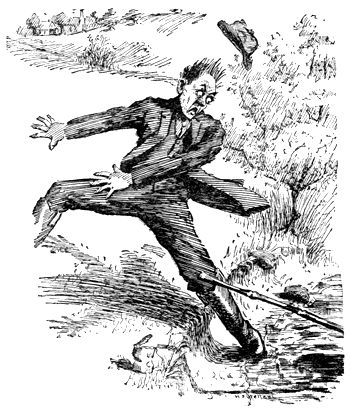
Just one look at that fish and he'd yell and drop fish, line and pole right back in the pond
The government at Washington has made colored plates showing the shapes, markings, and giving the names of these fish, and attempting to show the colorings. Anyone looking at the colored prints and not knowing of these wonderful fish would say, "Preposterous! No such colored fish exist!" But the cold fact is, those colored prints but faintly portray the brilliant colors of the fish as they are seen in life.
With all this, you'd think they ought not to be anything but happy in Hawaii. You wouldn't expect to find kickers on the islands.
But the truth is, they are in a blue funk. They think that the islands are going to the bow-wows financially, because of the tariff legislation on sugar. I tell them to brace up and advertise the islands as more than the biggest show on earth; and, in place of begging for settlers, to pass out the word that the truly good may come, for a satisfactory consideration; and that the chances are they will have standing room only, and won't know what to do with their money.
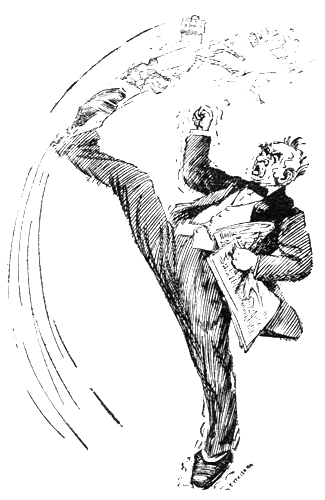
You wouldn't expect to find any kickers in the islands
V THE UMPIRE WHO GOT A JOB
More and more I am convinced of the cleverness of the Japanese after a voyage across the Pacific in one of their magnificent ocean liners—a 22,000-ton ship, built at their yards at Nagasaki, Japan—built, owned, and operated by the Japanese. The officers are Americans, with the exception of the chief engineer, who is Japanese. The crew is Japanese. Dining room waiters, Chinese and Japanese; and room boys are Japanese.
The cuisine more thoroughly conforms to American tastes than that found on any other ocean liners I am acquainted with, and nothing left to be desired in quality, variety, and way of serving. All the appointments of the ship for luxurious and comfortable travel are as nearly perfect as anything can be, with absolute cleanliness emphasized at every point—a trip through the culinary department prior to sitting down to a meal adding zest to one's appetite—and that's some test. The management does everything possible for the passenger's enjoyment. Nearly every evening a moving picture entertainment is given on one of the spacious decks. The ship carries films to the Orient as an item of freight, and has the use of them en route.
A seventeen days' voyage from San Francisco to Yokohama is not long enough to exhaust the supply if an hour's exhibition were to be given every evening. The event of the voyage is the theatricals given by the ship's crew, the common sailors, who do the work of running the ship. I was not surprised to see Japanese sailors in an exhibition of ship games for the passengers' entertainment one forenoon, carrying them off creditably—games indulged in by sailors the world around: the tug-of-war, chair race, potato race, cock-fighting, etc.; but to see them put on an elaborate theatrical for an evening's entertainment filled me with wonder and admiration.
The first act on the program was a "Union Dance." In this all leading nations were represented. And next was "The Lion Dance." They say the Japanese are imitative. I would like to know which nation they imitated in producing that beast! It was an animal about fifteen feet long. It had a bushy tail that stood in the air three feet and waved continuously. Along its back was a series of short, stubby wings; and its head! Fearfully and wonderfully made was that head, which was mounted on a serpentine neck. The genius who created that head must have searched the earth, sea, and air for inspiration in his work.
And it danced!
Oh, that beast danced!
The power that moved the thing was two sailors inside, but how under the heavens they kept that tail waving, those wings working, and the eyes, ears, and tremendous jaws of that combination of earth, air, and sea monster all going at one and the same time, the while it danced, and reared, and crawled, and writhed, and gamboled, and all but flew—I would like to know how they did it. If anyone will tell me which nation they imitated to put that number on, I'll make a trip to that country—I want to see those folks. I've seen something on this order, large animals, elephants, bears, cows, etc., impersonated with man power inside, in New York, London, and Paris. They were good, too. A lot of fun. Amuse the children. But here was something good enough to—to—well, I won't say to scare a locomotive off the track, but I'll bet it would make it shy.
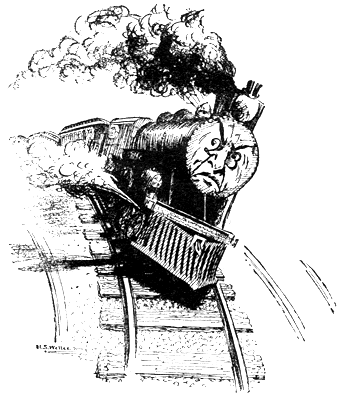
But I'll bet it would make it shy
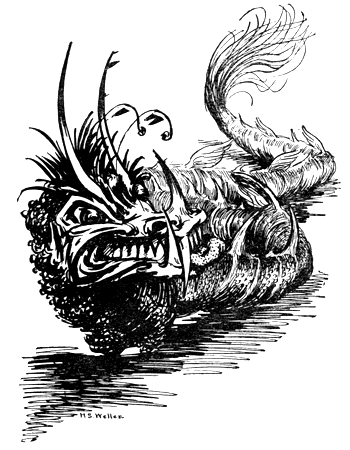
I won't say it would scare a locomotive off the track
The next number was "Wrestling and Fencing." A half dozen pairs of contestants. Japanese wrestling is always good and needs no comment, but the actor who announced the bouts, and the umpire who started them and announced decisions, would have made a whole evening's entertainment in themselves. Adverse comments on some of that umpire's decisions, by certain Japanese passengers, brought him to the front of the stage with a little preachment. It all being in Japanese, of course I couldn't understand what he said, but there seemed to be fire and tow and ginger in that umpire's words; indeed, everything that he did savored of fire and tow and ginger.
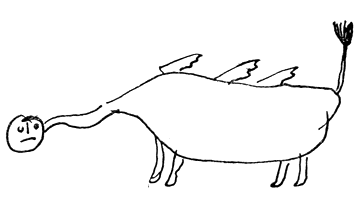
The artist hasn't quite the right idea of that beast, so I'll draw a picture of it myself, and then you can see just how it looked, only it was fiercer, you understand. —The Author.
I asked a Japanese passenger who sat next to me and who was not one of the dissenters: "What did the umpire say?" Turned into English the umpire said: "Go chase yourselves, you lobsters who are finding fault with my decisions. I'm umpiring these bouts, and my decisions go, see?" And they saw. Believe me, that umpire could make anyone see.
The commander of the ship told me that that umpire finally made him "see."
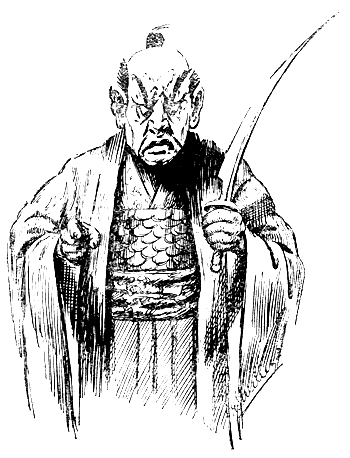
Believe me, that umpire could make anyone see
He (the umpire) is 62 years old. He asked the commander for a job, and failing to get it, he rode as a stowaway on the ship across the Pacific. He made the trip three times in that way, until finally he wore the commander out, and got his job. He is a good sailor, a star actor, and somewhat of a privileged character. I could see from the way the commander told me the story of how he got his job that he considered the umpire a good sort.
But the climax of surprises—of common sailors holding for over two hours a most critical audience, and delighting them to the last drop of the curtain—was "Cushingura," one of Japan's classical dramas. It took a dozen or so actors to produce it. The crew, from money raised by delighted auditors, had provided splendid and appropriate costumes to dress the parts.
That play was presented magnificently.
It smacked nowhere of amateur theatricals. It moved off from the opening to the closing act without a hitch. So vivid and admirable was the acting, although spoken in Japanese, even those of us who could not understand the words were charmed, delighted.
Last night a royal shogun, dressed in regal robes, treading the boards with tremendously dramatic effect; today, washing down the decks or polishing up the brass trimmings of the ship, that Japanese sailor man is an object for contemplation.
But again: "Land ho." Japan is sighted, and all interest centers at the ship's rail as we steam towards Yokohama.
VI THE JAPS' FIVE-STORY SKYSCRAPER AND A BASEMENT
I believe I ended my last letter by ho-ing the land, and hanging a shipload of passengers over the rail, sailing into Yokohama harbor.
When a shipload of passengers get off at Yokohama, there is joy among the rikisha boys, and the passengers who are getting their first ride in a rikisha have an experience they will never forget. The first ride in a jinrikisha in Japan is an experience to lay away among one's choice collection of experiences.
A first ride in a rikisha has been fully described by myself and published, and to go into it in these letters would be to plagiarize myself: so, on to Tokio, the capital and largest city in Japan—the same old tremendous town, only more so—Greater Tokio has three million souls today. Compared to one of our great cities Tokio has the appearance of an overgrown village.
Many wide thoroughfares and narrow streets lined with low one- and two-story buildings—a clean city, covering a tremendous area.
You occasionally see a three-story building and they have one "skyscraper" that towers up into the air five stories—a landmark.
The Mitsukoshi, Japan's one great department store, is now housed in a modest three-story building, but they are building a new store.
The general factotum of the store who can speak English showed me a drawing of the new store. I exclaimed with admiration: "And she is going to be five stories high, isn't she?" "Yes," he said, proudly, "and a basement."
The government buildings are not so imposing as in many other of the world's capitals, and there is no single business center. The business of the city is widely scattered. Rapid transit in Tokio is in a state of transition. The trolley has come, but not sufficiently strong to be adequate for the traffic, but enough to discourage the rikisha boys—the rikisha boy has run his legs off in Tokio. He is still here, but in decreasing numbers, and what there is left of him is the beginning of the end, so far as Tokio is concerned.
He is an expensive proposition. He wants ten cents to take one any distance at all, and that is equivalent to a ten-cent car ride at home; and to take one any considerable distance is twenty-five cents.
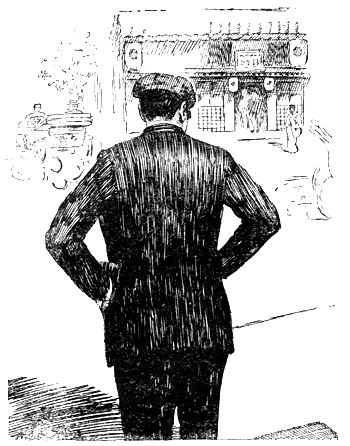
They have the taxicab, but someone else had it during my three days' stay
They have the taxicab, but someone else had it during my three days' stay. They have automobiles, but not to such an extent that one has to do much dodging. In an hour's ride across the city I counted six—and it was a fine day for automobile riding, too.
To get around in Tokio is a problem. Like Washington, it is a city of magnificent distances. The street cars go where you want to go, but they don't come where you are. The charge is only two and one-half cents for a ride, but it costs ten cents for a rikisha boy to take you to the car. The boy will land you where you want to go for twenty-five cents, but there is a two and one-half cent street car fare against a twenty-five cent rikisha ride; so you tell your boy to take you to the car. Then it percolates into your mind that you have ten cents invested in that ride. But there is still a fifteen cent salvage if you take the car, less the two and one-half cents the car will cost—twelve and one-half cents net. While you are working out the problem your car passes, and you tell your boy to go on and take you there—you'd only save twelve and one-half cents anyway.
But that's another ride—twenty-five cents—new deal—and you sigh for the days of your old Tokio, before the street cars came to fuss you up.
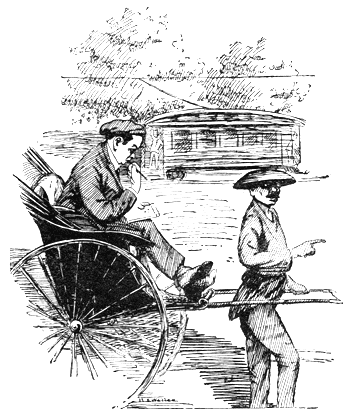
While you are working out the problem your car passes
Also, they have raised the price of laundry in Tokio—yes, sir, the price of laundry has gone up. They now have the effrontery to charge you two and one-half cents to wash a handkerchief or a pair of socks. Of course it's two and one-half cents for a shirt, a white coat, or a pair of pants—flat rate, two and one-half cents, "Big or little piecee all samee." But it used to be one and one-half cents.
Those were the days when you didn't have to hold a shirt in one hand while you speculated with the other as to whether it would go one more time—under that old scale you just put it in the wash.
VII JAPANESE GIRLS IN AMERICAN COSTUMES—THEY MAR THE LANDSCAPE
I noticed the following account of the death of the Empress Dowager in the Japan, a magazine printed in English in Tokio:
"Whilst as yet the earth mound set up over the august remains of the late lamented Emperor Meiji at Momoyama, Fushimi, is fresh and damp, the Japanese have been stricken with a renewed sorrow and bereavement, none the less profound, at the demise of their cherished, beloved Empress Dowager, the First Lady of the Land, who graciously shared the glorious throne of Japan with her lord and sovereign, the late illustrious Emperor Meiji, for forty-five long years of brilliant progress, splendid achievement, and the 'Reign of Enlightened Government.' As the beautiful, fragrant blooms of the cherry fall, ere the dawn comes when the stern, pitiless tempest ravages the tree in the evening, so the exalted person has sunk to rise no more at the inevitable, nay, unexpected, touch of the death's cold fingers.
"Although her recovery from the illness had been ardently prayed and hoped for by all her devout subjects, and although the medical attentions, the best the modern sciences can procure, having been concentrated upon the noble patient, the rays of hope for her recovery seemed to beam, the fatal crisis came suddenly and unexpectedly.
"Her Majesty had been suffering from chronic bronchial catarrh and nephritis, which became complicated by angina pectris on March 29, followed by a urine poisoning toward the end of that month. She seemed to be recovering from the urine-poisoning and the heart trouble due to angina pectris, until April 9, when at about 1:30 A. M. the second attack of angina pectris came, followed by the failure of the heart. The latter proved fatal; and the exalted patient in this critical condition returned to the capital from the imperial villa at Numazu, where she had been laying ill. The sad event was officially announced two hours after Her Majesty's arrival at the imperial detached palace at Aoyama, Tokio, the demise having been recorded as taking place April 11 at two A. M."
I was moved over that account more than I was over the fact that the Empress Dowager had passed away. I was not acquainted with the Empress Dowager, and therefore only felt that general interest one naturally feels in an event of the kind; but over that account I had emotions.
I had still more acute emotions when I saw a Japanese girl dressed in American girls' clothes. The Japanese girl in her own clothes is an old friend of mine.
I have known her for forty years—in her clothes—on lacquer boxes, screens, and fans; and for fifteen of those forty years, on periodical visits to Japan, she has danced and sung for me, and bowed and smiled to me, most bewitchingly—"belitchingly" in her native garb. But to see her tog herself out in high-heeled shoes, a basque, and a polonaise, and a hat with heaven knows what and then some on it! The editor of the Japan in his account moved me some, but that girl gets me going good.
I hope she will get well, and go back to her kimono, with her cute little feet encased in white mittens, pigeon-toeing along on her wooden sandals, held on with thongs between her toes, and her bustle on outside of her dress. She is part of the landscape that way. She fits in, and makes me glad.
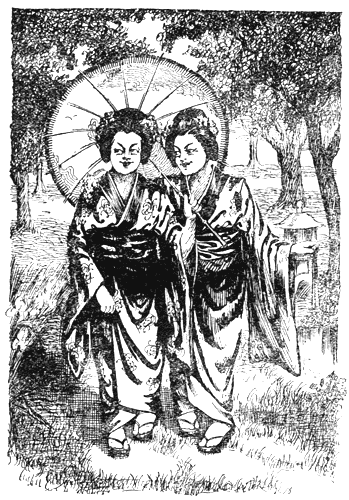
She is a part of the landscape that way. She fits in and makes me glad
There is only now and then one of her stricken, but if it spreads, becomes universal in Japan, that editor will be called upon to tell us: "The Japanese girl has had a fatal attack of heart failure—and from this she did not recover."
VIII CEREMONIOUS GRANDMOTHER—"MISSOURI" A HEAVENLY TWIN
Returning from a trip to Tokio on a Monday forenoon I found at my hotel in Yokohama the following letter from my shipboard friend "Missouri":
Dear Mr. Allen:
You'll be surprised to learn that I am in jail. I started out this morning at 8 o'clock to go to church. At 8:30 I stopped at a saloon and met a delightful bunch and didn't get away from that saloon till 5 o'clock this evening. At 5:30 I was pinched and put in jail on a charge of assault with attempt to kill.
If the victim dies, please find out for me whether they behead, hang, or electrocute in Japan for capital punishment.
I've learned the Japanese language today, but don't want to talk to the jailer, as it might prejudice my case. For heaven's sake come and see me and I'll explain it all.
Hastily yours, "Missouri".
On his own statement it looked bad for "Missouri." I had left him at Yokohama, where he had some business to look up, while I went to Tokio.
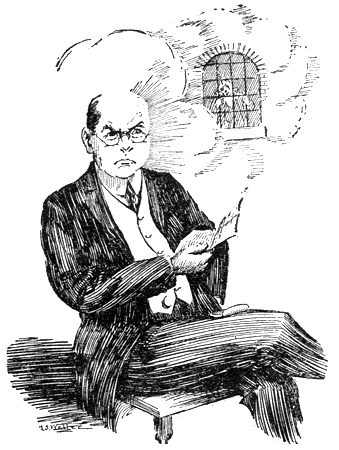
Pained! Grieved! Shocked! were too mild words. I was disappointed in "Missouri"
I had expected to find "Missouri" on my return to Yokohama that Monday forenoon, and instead of him I found his letter.
Pained! Grieved! Shocked! were too mild words. I was disappointed in "Missouri." A countryman in trouble under circumstances like these, however, called for prompt action, and I started off post-haste in a rikisha to see what could be done about it.
I conjured up a picture of "Missouri," the erstwhile prepossessing chap (even minus those side teeth "Missouri" was a fine-looking man), now battered, bruised and blear-eyed, disheveled and disreputable; probably he had been on a long toot—a relapse from rectitude, I surmised.
He had been entirely abstemious on the voyage, but there may have been chapters in his past life o'er which he'd drawn a veil in our shipboard confidences—anyway, it looked bad for "Missouri." His reference to starting out to church was probably only a vagary of a befogged brain.
These thoughts were mine as I was being rikishaed along to "Missouri's" rescue, when, whom should I see coming toward me in an automobile but "Missouri," the same "Missouri," in company with another just as smooth-looking individual, who was driving the machine.
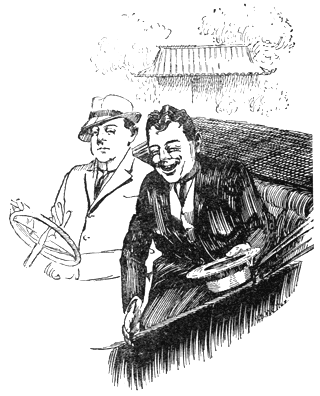
"Lord, Mr. Allen, I'm glad to see you" he said, as the machine stopped
"Missouri's" mouth was stretched from ear to ear in a joyous greeting as he caught sight of me. Those "gaps" showed tremendously—one couldn't blame his wife for wanting them "filled in."
"Lord! Mr. Allen, I'm glad to see you," he said, as the machine stopped. "Meet my friend here, 'Pennsylvania.' 'Pennsylvania' and I have had an experience. Too long a story to tell you here. Come on back to the hotel and I'll tell you all about it."
"That's all right, 'Missouri'," I said, "but," waving his letter at him, "what the devil do you mean by handing me such a story as this?"
"That letter is all right, Mr. Allen; come on back to the hotel and I'll give you the details."
The man "Missouri" had introduced to me as "Pennsylvania," who was apparently owner of the machine, advised me to let my rikisha boy go and come back to the hotel in the car with them; and in a couple of minutes we drew up to the hotel entrance and I invited them to my room, where I asked "Missouri" to square himself.
"Missouri" did the talking while "Pennsylvania" nodded assent at points where the story would seem to need a girder under it.
"This is how it happened, Mr. Allen," "Missouri" started in. "There's a missionary over in Tokio in whom the folks back in my town are interested, and they wanted me to look him up if I had time when I got to Japan. I dropped him a line upon my arrival, and told him where I was from, and that I was stopping in Yokohama at this hotel, and that I proposed to call on him the following Sunday. You know we landed on Monday. Wednesday of last week my missionary dropped over from Tokio and called on me and told me he'd be glad to see me in Tokio on the coming Sunday, to see the missionary work in that particular corner of the Lord's vineyard. We parted, and I assured him I would look him up in Tokio on Sunday—and that was yesterday.
"I met 'Pennsylvania' here the latter part of the week and we got acquainted. 'Pennsylvania' doesn't look like a disreputable character, and he isn't—ordinarily. Fact is, he's a most reputable manufacturer from Pennsylvania, doing Japan with his touring car.
"Saturday evening I told him of my program for Sunday, and he suggested we do the missionary field in Tokio the next day in his car.
"He told me Tokio was sprawled out over a good part of Japan, that rapid transit was in a chaotic state over there, and his car would be convenient. Furthermore, he said he had been chipping pennies, dimes and dollars into Foreign Missions ever since he could remember, and that he'd like to look into the missionary's game on his own account.
"I told him the plan looked seraphic to me; we'd be just like a pair of 'Heavenly Twins' the next day. I knew that you were stopping at the Imperial over there, and I suggested we look in at the hotel and take you along if you were loose for the day and wanted to go.
"I told 'Pennsylvania' you were sort of a solemn cuss and that I thought the day's program would appeal to you, and 'Pennsylvania' said, 'Certainly, heavenly triplets.'
"We got started at eight yesterday morning. Figured on reaching Tokio by nine, easy enough, but the machine went dead at eight-thirty, nine miles out of Yokohama, square in front of a saki house—steering gear busted.
"'Pennsylvania' investigated, and said, 'Bad break, got to get help from Yokohama.'
"Now that Japanese saloon was the missing link—it was a good place—for us. Not that either of us are patrons of saloons.
"Why, I learn that 'Pennsylvania' is one of the great exponents of temperance in his State, the deadly foe of the American saloon—since yesterday morning 'Pennsylvania' and I have formed a David and Jonathan Club—we are like brothers—our souls are knit together since what we have gone through in the past twenty four hours—and as for me, you never saw me touch a drop.
"I tell you I'm a disciple of Sam Blythe's in beating the old game with water. Sam says you couldn't get a drink into him without an anæsthetic and a funnel, and I'm just as pronounced against the drink habit as that. Furthermore," "Missouri" continued plaintively, "if you want to get further lines on me, Mr. Allen, just write the Epworth League or the Young People's Society of Christian Endeavor or the Y. M. C. A., Bradstreet or Dun's, or the Horse and Mule Traders' Union, of my home town.
"I tell you, Mr. Allen, I'm counted quite a desirable citizen back home in Missouri, where they know me, but we were 'two orphans' with a stranded automobile in Japan, and we needed friends.
"All the Japanese we knew between us was 'dozo,' 'aringetta,' 'soduska,' and 'ohio' and none of these words fitted the case.
"'Pennsylvania' went at his auto with all the tools he carried. We were blocking trade for the saki house, but they didn't kick. While 'Pennsylvania' was monkeying with the machine, I took a Japanese-English dictionary we had with us, and found out that they had a telephone in the house, and they invited me in to use it. Sounds easy, and as if we ought to have gotten a relief corps out from Yokohama and be on our way in an hour.
"We S.O.S.'d Yokohama for four hours with that saki house telephone, that dictionary, and with the help of the proprietor's son, and it was noon before we got a message through.
"In the meantime the saki house people were making us at home. We pulled off our shoes and lived in the house while working their 'phone, and they treated us as honored guests. We thought a saki house ought to be a legitimate place to get a meal of victuals, so, pending the arrival of the mechanics from the Yokohama garage, who, after getting our message might be along in an hour, or a day, being mighty hungry about noon, we worked with our dictionary and the proprietor's son (a young fellow twenty-six years old) to order a meal of victuals. At the end of half an hour we got the request home, and understood, and the answer back that that was a private home and that they didn't sell food, only sold saki.
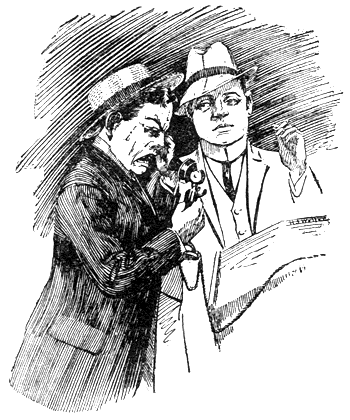
We S.O.S.'d Yokohama for four hours with that saki house telephone
"But the son's wife, a most comely little woman, caught the drift of our request, and by one o'clock had prepared us a dainty Japanese lunch, and invited us to it. We both agreed that we'd never had a better time in our lives, getting away with a meal and affording amusement to our hosts as we labored, first with chop-sticks and finally fell back to fingers. We knew we'd be in bad if we offered to pay for that meal, and still we had ordered it. We'd be cheap skates not to offer to pay for what we had ordered, and we'd be barbarians if we offered to pay. We compromised by asking how much we owed, and got the answer we expected, 'No charge.'
"By two o'clock an automobile from Yokohama garage hove in sight with a load of mechanics, and by five o'clock our machine was in commission.
"After we had finished that meal, about two o'clock, the proprietor of the establishment showed up. He had been absent from home up to that time. He was a high-class individual. He added his welcome to that of the rest of the family's to the foreigners within his gates—he also made us feel as if the home was ours. While the work of repair to the damaged car was progressing we worked that dictionary to the limit. We learned the Japanese language and got the household proficient in English.
"During the afternoon the proprietor's mother came in for a call, and it was worth a trip across the Pacific to watch the greeting between the grandmother and her grandson, the twenty-six-year-old chap. The old lady was beautifully dressed. She got down on her hands and knees, her palms flat on the matted floor. Grandson did the same. For about a minute they posed like two fighting cocks ready for a bout.
"Then grandma's forehead went down on the matting, so did grandson's.
"They stayed in that position so long I was afraid the old lady had fainted and was for picking her up, but just then she raised her head, peeked out of the tail of her eye at grandson, whose head raised a little, then down to the matting went her head again, followed by grandson. Up with their heads and down to the matting again, playing peek-a-boo to catch each other at it; several times they went through those motions, until justice, or something else, was satisfied; then the old lady got up and shuffled away, and grandson got up and told us that she was his grandmother, and eighty-two years old.
"That surely was some bow.
"The house was as clean as a hound's tooth, and they showed us through kitchen, bedrooms, and living rooms, and the little garden in the rear.
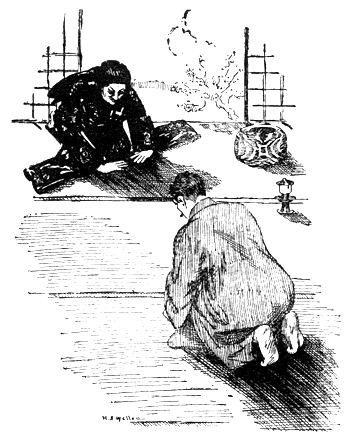
That surely was some bow
"There were no screens up before the doors of that Japanese saloon. The saloon, the front room of the house, was fifteen feet wide, so was the door—that was an open-faced saloon, opening onto the street the width of the room.
"And customers came and went, working in around the automobile. A husband and wife came in and sat down on a matted platform. Hubby ordered one big tumbler of saki—the kind they had the biggest run on was as thick as buttermilk, looked just like buttermilk, and was ladled out of a big crock by a little Japanese barmaid.
"She'd fill the glasses so full that they would heap up at the brim—hubby carried the glass carefully to his mouth so's not to spill any, drank off a swallow, and handed it to his wife, who hit it for another swallow, and back and forth they passed that glass, taking a swallow a trip until they had finished it, and they walked away, to make an afternoon call, perhaps.
"Everyone paid for his own drink—there was no treating and no drunkenness.
"Everything that went on in that saloon was as open to the public gaze as the sun, and 'Pennsylvania' and I decided that the saloon business in the United States was one thing, and the way we were seeing it conducted in Japan an entirely different thing.
"At five o'clock our machine was ready for us and we left our saki house friends.
"We invited them to come to America. There are two front yards in America in which those folks are welcome to camp, if they ever come. One in Missouri and one in Pennsylvania. We both told them so, and that the freedom of two homes and the best those homes afforded would be theirs."
"Missouri" paused in his story, and "Pennsylvania" nodded twice and said, "You bet."
"Well," "Missouri" continued, "it was too late to take in Tokio, so we headed back for Yokohama.
"At five-thirty we were bowling along at a pretty good clip—we didn't kill that Jap, we only wrecked his cart and jounced him up a bit—we were going less than forty miles an hour, but a scrappy little cuss in brass buttons pinched us for exceeding the speed limit, and locked us up on a charge of assault with attempt to kill, pending the outcome of our victim's injuries.
"He came to, all right, this A. M. Ten yen and a new cart fixed the Jap—he needed a new cart, all right—and you met us on our way from jail. We may do the missionary stunt some other day," "Missouri" said, but I didn't notice "Pennsylvania" nod.
IX USHI, THE RIKISHA MAN
I started out of a Saturday evening in Kioto, which is one of the best cities in Japan—the best, I think—the old capital of the Empire, to take a walk on Theater Street, which is the Great White Way of Kioto, and one of the best spots in Japan to study Japanese life and character.
I hadn't more than stepped outside the walled-in yard of my hotel, having declined the offers of the favored rikisha men within the enclosure to take me for a ride, than a rikisha man outside the gate accosted me and pressed the card shown below into my hand.
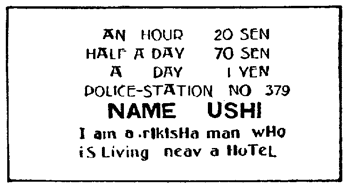
AN HOUR 20 SEN HALF A DAY 70 SEN A DAY 1 YEN POLICE-STATION NO 379 NAME USHI I am a rIkIsHa man wHo iS Living near a HoTeL
At the same time he assured me that to ride was far better for a foreign gentleman than to walk. As I perused the card by a street light I probably detected more than you will, kind reader, for whom these lines are written on the other side of the world, as you hastily skim it and only catch its grotesque, misspelled and labored English. Its humble effort at enterprise impressed me.
Ushi mistook my mental attitude for one of indecision, and supplemented the appeal on the card with the added information that he was considerable of a linguist—that he spoke English pretty well. Also that he knew all the points of interest in Kioto, and that not to engage him for the evening was to miss a great opportunity—but Ushi's card had pulled a customer.
I stepped into his little carriage and said: "Ged app, Ushi, show me Kioto. For the evening you may be my horse and guide."
No need to crack a whip to start your Oriental human horse. Up one street and down another Ushi whirled me and drew up in a narrow alley leading into Theater Street, and invited me to alight. "We will have to walk through Theater Street. All must walk, no can ride in Theater Street," Ushi announced.
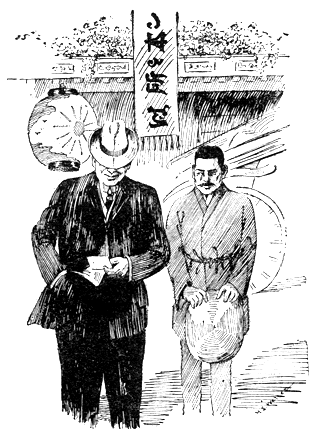
But Ushi's card had pulled a customer
He took from under the seat of his rikisha a green bag, such as lawyers in the United States used to carry.
No, he didn't have his jewels in that bag.
Through Theater Street, we walked, Ushi at my side, with his bag, the street brilliantly lighted and seething with Japanese life.
Both sides were lined with theaters big and little, shooting galleries, sideshows, fakirs' stands—a bit of Coney Island life with Japanese coloring and settings. High and low of Kioto's populace, a city of half a million, surged through Theater Street. A mother with a baby on her back; couples and trios of little girls with their arms around each other's waists; and girls in bevies. Swains and sweethearts. Big boys and little ones. Kids just able to walk, all sorts, all conditions. Theater Street in Kioto of an evening is worth seeing.
Ushi took me to the leading theater, up to the ticket window, and told me it was on the evening's program to go to that show.
Ushi was boss.
I bought a ticket for ten cents and Ushi led me to the entrance and bade me halt and hoist. At the side of the entrance was a great stack of Japanese wooden street shoes, the owners of which were in the theater.
I would not be allowed in that theater without removing my shoes if it were not for Ushi with his bag. Hence Ushi's command to halt and hoist.
Down on his knees at my feet went Ushi, opened his bag, and selected from it a pair of cloth footgear to slip on over my shoes. An assortment of these things he carried, small, medium and large. Fortunate for me, he had an assortment—he found some big enough to go over my shoes, tied them around my ankles, and I was shod with the preparation necessary to take in a Japanese theater.
Twenty minutes of the show sufficed, and I came out and found Ushi waiting for me. He took off those cloth over-shoes, put them in his bag, and led me to his rikisha.
For two hours Ushi showed me Kioto by electric light, taking me rapidly through thoroughfare after thoroughfare, pointing out and explaining points of interest as we passed, always on a rapid trot. Now a leading business house, here a temple, there a leading Japanese hotel—down through the underworld, threading narrow streets and dark alleys, over a famous bridge, across, and through, and back again, always on his rapid trot, an eight or nine miles' run, at last to drop the shafts of his rikisha at the entrance to my hotel.
Ushi wiped the sweat from his beetling brow and demanded twenty cents for that evening's service. Yes, sir, Ushi thought he was entitled to twenty cents!
"Ushi," I said, "tomorrow, Sunday, I'll hire you for the day," and Ushi said, "Good-night," well pleased.
I went into my hotel, showed Ushi's card to mine host, the Japanese proprietor, and said: "Ushi is quite a character."
"Beware of him," mine host replied, "he is not reliable. He used to work for us, but we had to dismiss him, and now he has gone and got those cards printed, and has stationed himself just outside our gate. He has cut under the regular prices (a yen and a half a day is our regular rikisha men's charge), and he seeks to capture trade with that card."
"So?" I replied.
I read the card again, and thought, "Ushi, you clever rascal. Somehow my heart warms up to you. Competition's fierce, Ushi, and it's war, alias 'hell,' to make a livin'"—and I went to sleep that night with designs on Ushi's time for the morrow.
Bright and early next morning, after breakfast, I stepped outside the gate, and Ushi, the "rascal," who was doing business "near a HoTeL," greeted me with a smile, briskly arranged the seat to his rikisha and stepped aside for me to take my place.
I didn't get in. I said, "Ushi, you got a family?"
"No," Ushi said.
"What? No wife, no children?"
"No," Ushi said, "my wife, she die. Very sorry."
"Tough luck, Ushi," I said.
"Lost your wife, lost your job. Life's made up of lights and shadows. You don't fit into the color scheme for my day's program, Ushi. I must have a rikisha man with a wife and children," and I walked away, leaving Ushi standing there, sadly watching an all day's job go glimmering.
I stepped back into the yard, looked over the semi-circle of rikisha boys, accredited, guaranteed, within the pale rikisha boys, boys of reputation, standing and character. No "rascals" who had to resort to the "nefarious" expedient of issuing cards like Ushi's, and standing "outside the gate" to secure trade at a cut price.
I stepped up to one who looked the best to me and said: "What is your name?"
"Yamamoto. You want rikisha?"
"Yamamoto, you got wife and children?"
"Yes," wonderingly.
"How many children, Yamamoto?"
"Three, two girls and a boy."
"Yamamoto, I'll hire you for the day," and Yamamoto fixed the seat and asked: "Where go?"
"Take me out first to where Ushi stands."
Ushi wasn't standing. He was sitting, dejectedly, on the dashboard of his rikisha, waiting for someone to come along on whom he could spring his card—that "nefarious" card that cut the rates, and as he saw me draw up seated in Yamamoto's rikisha—Yamamoto, favored of fortune, taking off his fare, Ushi cast a reproachful glance on me.
"Ushi, what for you mope? Didn't I make a deal with you last night to be my rikisha boy today? Hitch on behind and push, Ushi—what difference if you pull or push? That yen is yours when night shall come."
Ushi caught on—behind. He left his rikisha standing by the wall. There's some class to serve a man who'll hire a rikisha boy to push as well as one to pull in Kioto, and with reckless abandon I had decided to blow myself for a whole dollar and twenty-five cents for ten hours' horse and carriage hire that day, just because Ushi didn't have a family.
If Ushi hadn't lost his wife, and if he had had a pickaninny or two, I'd got off for fifty cents and could have given my story the twist I'd planned for it.
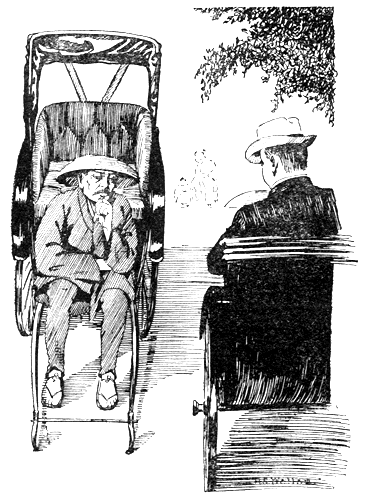
"Ushi, what for you mope? Didn't I make a deal with you last night to be my rikisha boy today? Hitch on behind and push, Ushi"
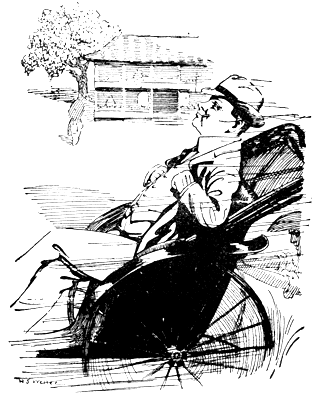
With reckless abandon I had decided to blow myself for a whole dollar and twenty-five cents for ten hours' horse and carriage hire
But East or West or North or South the picking is always good for a story in Japan, and while to tell it as it is may not be so spectacular, at least it's safe.
My old grandfather, who was somewhat of a sage, once said to me (and his words of wisdom have survived the years), "George, a man must have an excellent memory to be a successful liar." I have a wretched memory, so the beaten, conservative, humdrum path of narrative for me.
With Ushi duly coupled on behind—"Where go?" Yamamoto asked. The pride of a double team was noticeable.
Now "Missouri's" hard luck in his missionary hunt with an automobile had inspired me to do a little investigating of this world's work on my own account, but in a more humble way. So I gave Yamamoto the address of a leading missionary, which I had easily secured from mine host, the hotel man.
"I know," Yamamoto said, "other side Emperor's palace, thirty minutes."
With Ushi on behind the ground fairly flew under us and Yamamoto and Ushi vied with each other to tell about the points of interest that we passed.
In less than thirty minutes I was landed at the missionary's gate.
"Man, man," I said, waving my hand to my coolies as I alighted. Say "man, man" to your rikisha coolie when you leave him and you'll find him right there waiting for you when you come back. It's an imaginary hitching strap I've never known to break.
X MISSIONARIES, TRACTS, AND A JOB WORTH WHILE
The missionary met me at the door and I told him who I was—a wayfaring man in Japan, and would he show me somewhat of his work?
He would, and gladly. If I had been a long lost brother or a wealthy uncle with a will to make, he couldn't have been more cordial—a keen young man of thirty-six or thirty-eight I found this missionary.
"Do you mind walking?" he asked.
"I have a team of rikisha coolies at your gate," I said.
"Well," he replied, "our work is scattered over Kioto. We can reach it by trolleys and walking, with an occasional rikisha ride between trolley lines, better than to try to do it all by rikisha from here. Better pay off your coolies and dismiss them."
"I've chartered them for the day," I said.
We started out to see the missionary work in Kioto, that young missionary and I.
At the gate I told my boys to loaf, or play, or fish, or pick up fares which they might pocket for themselves—they were on my payroll for the day—but to report for duty there at the gate at 1 P. M.
The missionary and I walked a mile and passed two of his mission churches on the way, where services were being held, and which through the week were used for schools and meetings; the missionary dispensing tracts as we walked along. That young missionary seemed to exude tracts—I didn't know one missionary could hold so many.
We boarded a trolley, and all the passengers got a tract. We dismounted at a corner to look over another mission church where the natives were holding a meeting; a little walk and we boarded another trolley and the missionary started in to give the passengers tracts.
"Here, dominie," I said, "give me some of those tracts and I'll help you to push God's word along"—I rather surmised by then that he was out of tracts and had a momentary—just a teenty, decent little momentary pang of shame that I hadn't offered sooner.
But the missionary wasn't out of tracts. His clothes were full of pockets and they all held tracts. He dug up a pack and handed them to me.
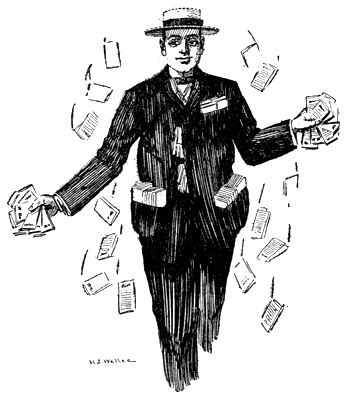
That missionary seemed to exude tracts—I didn't know one missionary could hold so many
I started at one end of the car and he at the other, and every Jap in that car had a tract when we met midway.
We must have boarded six more trolley cars and still the tracts held out, and I had a few left in my pocket after the last car was served.
No tract was thrown away. They were read on the spot and then safely tucked away in the folds of kimonos, or respectfully received and tucked away to be carried home and read.
Every tract would serve five readers, on an average, the missionary told me.
We looked in on little mission churches scattered over Kioto, all under the jurisdiction of that one missionary. He told me how, through himself, his board had bought land and built the little missions, or were renting places for their work.
We worked our way across that tremendous town and at the end of a rikisha ride he showed me his chief pride—a plot of several lots he'd bought, and on them erected a splendid church at the very gates of one of Japan's chief universities of learning.
Ten thousand dollars had been donated toward the work by an American soap manufacturer who had visited Kioto and seen his work, and placed the cash in the young man's hands to build that church.
"Dominie," I asked, as we worked our way back to his home, via rikisha, trolleys and on foot, "what is your yearly budget for all this work you are carrying on here in Kioto?"
"Twenty-five hundred gold dollars," he told me. His and his wife's salary (he married a missionary) was $750.00 each.
Only one thousand dollars for the annual expense, outside their salaries, to pay for tracts and current expenses for the work—native preachers and teachers to keep the enterprise going—twenty-five hundred dollars came from the homeland to push the gospel in Kioto under his charge.
I mentally took this missionary's measure as he told me his story. He was more than preacher, as we know the ordinary type at home. Of necessity his was a wider range of activities; a business man, a man of affairs, keen, alert, his eye on the gun.
His heart was in his work, to hold up his end in bringing over to Christianity a constituency of half a million souls—a young man putting in ability which, if as intelligently and earnestly directed in a business career in America, should win him ten, twenty—who knows how many thousand dollars per year reward?
I doubt if a guarantee of that difference in pay would tempt the young man from his chosen work—at least that was the impression I got as he unburdened his heart to me.
The young man had a vision of things worth more to him than money.
We wound up the forenoon tour at one o'clock at a union meeting of missionaries—got in as the meeting was drawing to an end.
He introduced me to these missionaries as they passed out at the close. I told each one whose hand I shook that the meeting gave me pleasure, and handed out a tract.
One or two of the bunch without the saving sense of humor the Lord meant all should have, didn't receive them as gratefully as the Japanese I passed them to—it takes all kinds of folks to make a world, I find, and most all of them are good, I think—but some are better than others.
The best thing in Japan I missed this trip—a kindergarten of Japanese children.
This missionary's wife had, among other things, this work in hand. I saw the room and the little empty chairs where fifty Japanese children, of from three to five years, were taught.
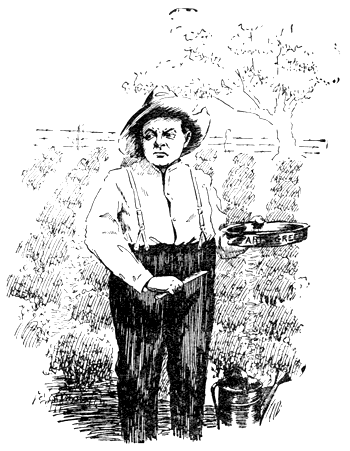
Except potato bugs, I always want to poison them
Babies are always a lot of fun. The young of the animal kingdom are always interesting—a baby colt, a baby calf, or pig, or dog, or cat—I can't think of the young of anything that don't appeal to me (except potato bugs—I always want to poison them), and most of all human babies. I'd turn aside from any task to see a lot of babies in a bunch.
But fifty Japanese babies in their fantastic clothes doing kindergarten stunts—my eye! a show to please the gods!
The obsequies of the Empress Dowager had closed the kindergarten school for days, and I missed the best show in Japan.
The missionary and his wife insisted that I take lunch with them. My team of coolies were champing at their bits—my lunch was ready at my hotel—I told them so. They told me that the hotel would excuse me and they would not.