Front matter (continued 3)
Reading edition
Cook's take care of a traveler they book in this way, and their representatives look out for you on arrival and departure from ports.
In my role of Royalty I bade my vassal, Lal, to hoist himself up on the driver's seat, and to tell the driver to go to Cook's.
Laying my itinerary before a booking clerk at Cook's I said: "Please book me to Bombay over this route."
As I was traveling first-class by water, which they knew all about, and as I preserved my regal tread from my carriage door right up to Cook's counter, the clerk said: "Of course you want first-class, Mr. Allen?"
"Of course I don't," I came back at him; "you stung me last trip across India for first-class, and you know the only difference between first and second here in India is the price, just double second, and the number on the door of the compartment. You'll book me second, please."
This Royalty act is all right here in India, but you want to know where to draw the line when it affects your pocketbook with nothing to show for it.
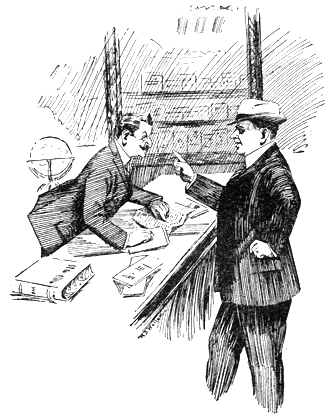
"Of course I don't," I came back at him. "You stung me the last trip across India"
The man saw I was wise, grinned, and issued me a second-class ticket, and third-class for my servant; and the evening of that same day saw me starting for the railroad station in another victoria, Lal and the driver up front, footman on behind, the lord my duke (meaning me) in the "tonneau" with bedding, grips, steamer trunk, camera, coats, etc., etc., all royally placed in the same vehicle.
When a traveler starts out from Calcutta to take the train for a night's journey, if it don't look as if he was breaking up housekeeping and going somewhere, I've never asked for bacon and eggs in the woolly West and heard the shirt-sleeved waiter yell: "Two clucks and a grunt," and then collect more for the viands than it costs to be moved across the second city in the British Empire in royal entourage.
XXVIII ONE WINK, SIXTEEN CENTS, AND ROYALTY
The seasoned traveler in India, planning a night's journey, don't arrive at a station a minute or two before his train leaves, as we do in plebeian America. Rush and hurry should form no part of Royal journeys.
It isn't dignified.
You should get there at least half an hour before the train starts, especially if you are playing Royalty on a second-class ticket.
As your equipage draws up to the station your footman alights and swings open the carriage door, your guide descends from the driver's seat and summons low-caste vassals who load your impedimenta on their heads.
The cavalcade starts with you bringing up the rear.
You find the station-master, the string of your menials now following on behind.
Locate your station-master, or at least an official who will answer the same purpose, and tip him a wink, not forgetting to accompany it with half a rupee, and tell him you want a car for Benares.
This man is a Hindu who can write but can't read—I am quite certain he can't read.
He leads "Master" with his string of retainers to a car of four compartments, four berths in each compartment, the berths running with the train, with a toilet room for each compartment. He opens a door. Lal tells the string of porters to put "Master's" baggage into the compartment—no matter how much, put it all in, boxes, bags, bedding and trunks.
Then this functionary who has been the recipient of a wink and half a rupee (don't forget the coin when working the combination), who can write but who cannot read, fills in a placard which is hanging outside the compartment. This placard, before the recipient of the wink and half rupee begins to toy with it, is a blank which reads:
Lower Right Berth reserved for —— Upper Right Berth reserved for —— Lower Left Berth reserved for —— Upper Left Berth reserved for ——
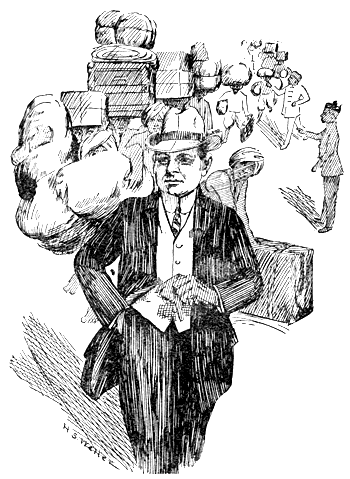
Lal tells the string of porters to put "Master's" baggage into the compartment—no matter how much, put it all in, boxes, bags, bedding, and trunks
This official who has received a wink and half a rupee—never, never forget the half rupee, because half a rupee is sixteen cents—fills in the blanks on the placard which now, in its completed state, reads:
Lower Right Berth reserved for Mr. Allen. Upper Right Berth reserved for Mr. Jones. Lower Left Berth reserved for Mr. White. Upper Left Berth reserved for Mr. Brown.
He hangs up the placard outside of the compartment, wishes "Master" a pleasant journey up to Benares, and closes the door.
Lal starts the electric fan, makes "Master's" bed, lays out "Master's" pajamas, and arranges "Master's" belongings promiscuously over Jones', White's and Brown's berths—Lal, a seasoned guide, is onto his job.
These last-named gentlemen get left—yes, sir, they get left. The train pulls out before they get around, and I am deprived of the pleasure of their company.
But if there is one place where a fellow can dispense with company it's on a hot night's run in a railroad carriage through India.
It's when I step out of the car at Benares the next morning that I learned that the fellow back in Calcutta couldn't read, for, blessed if the outside of that compartment I have occupied all night isn't labeled No. 1 instead of No. 2.
But that really makes no difference.
The compartment labeled No. 2, when you get inside, is just like compartment labeled No. 1, on the other side of the partition in the same car.
I conscientiously told that fellow I held a second-class ticket, and if he could read, Royalty is so cheap in Calcutta that you can buy a whole night of it with sixteen cents, and the number on the outside of the car, and the price charged for it, is all the difference between Royalty and Plebeian in India—and Plebeians have the laugh on Royalty—they have always had it on them for that matter.
XXIX THE ENGLISHMAN AND MARK TWAIN'S JOKE, "THAT'S HOW THEY WASH IN INDIA"
In my home town I was once asked to give a travel talk in a large stone church, the occasion being a rally for the Christian Endeavor Society.
It had been announced that there would be no charge for admission; furthermore, it had been thoroughly advertised that the young ladies of the church would furnish a delectable spread to the audience in the church parlors just as soon as I got through talking.
The town turned out en masse.
As the parson was leading me to the rostrum, the lights went out and there was Egyptian darkness.
After an anxious wait of five minutes, it being a hard stunt to get such a fine audience together in the classic, intellectual center in which I live, even with a chromo offer, the parson, fearing it would leave, made a little speech in the direction where he hoped the audience was—he couldn't see it—it was an act of faith.
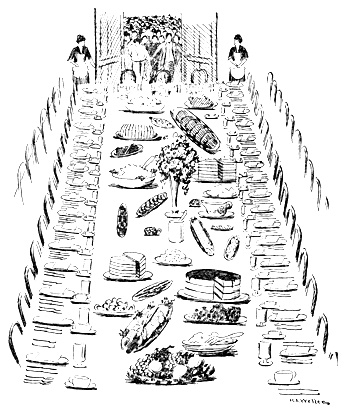
The town turned out en masse to hear me talk
He begged our good people to be patient under the trying circumstances, explained that the burned-out fuse would soon be replaced, that an electrician was even now on his way to the church, and told them that a good thing was in store for them—he assured them, "Mr. Allen is still with us."
Five more minutes passed and darkness still brooded.
Again the parson gave the audience, which he hoped was still there, the same little speech, assuring them again, "Mr. Allen is still with us—there's a good thing coming."
At the end of fifteen minutes he repeated it again, assuring them a good thing was coming—the coffee began to boil in the church kitchen, the aroma floating through the auditorium—the lights came on and there hadn't one guilty man escaped. The audience was still there.
Kind reader, you'd never guess what I was thinking about during that trying fifteen minutes.
Well, I was trying to think of an appropriate story to open my speech with, to illustrate the situation—something about where the lights went out.
I thought, and thought, and THOUGHT, but could not fetch it, but the next morning I thought of a corker—I am descended from the English.
The coffee began to boil in the church kitchen, the aroma floated through the auditorium
All my ancestors came from England and settled in New England. New England was chiefly inhabited by Indians at the time, but, I suppose, there still lurks a trace of English in me.
That old joke about the English being slow is no joke—it's a sad fact.
If further proof than my inability to corral that illustration inside of fifteen minutes were necessary, I've demonstrated it coming through India this trip.
The universal way of washing clothes in India is for a native, they call him a dobe, to take his clothes to the bank of a stream, conveniently near a large stone.
The larger the stone the better. One weighing from one to three tons is an ideal size.
The dobe picks up a garment, souses it in the water, and flails the stone with it.
The dobe is a particularly vigorous man. The average Indian is of a lymphatic nature, excepting the dobe. He is animated with a strenuousness entirely lacking in all other callings.
Mark Twain, passing through India some fifteen years ago, noting the strange sights, remarked that all over India he had seen the natives trying to break huge stones with a shirt; but, he added, he hadn't, in a single instance, seen one succeed.
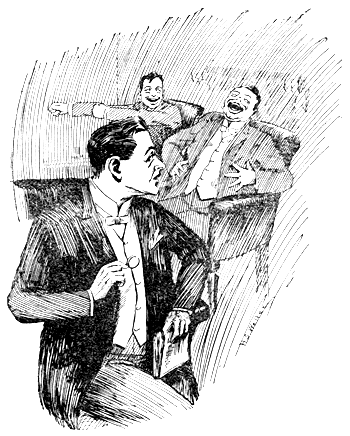
That old joke about the English being slow is no joke—it's a sad fact
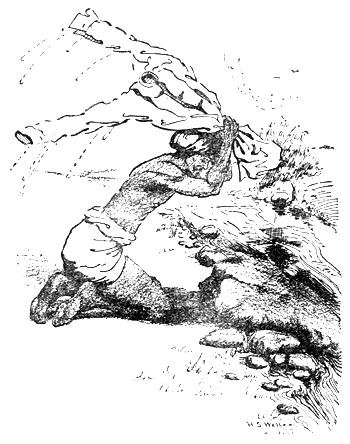
And every time the Englishman has explained to me that he wasn't trying to break the stone
Just to see whether our English cousins over here in India had caught that joke yet, when our train crossed a stream I would draw a chance English traveler's attention to the ubiquitous dobe flailing a stone, and wonderingly ask: "Why does the man try to break the stone that way?"—and every time the Englishman has explained to me that he wasn't trying to break the stone; and he would further kindly explain, "That's the way the Indians do their washing," and he would invariably add: "Beastly stupid, don't you know, isn't it?"
And every time I've sadly admitted that it was.
XXX ENGLISH AS "SHE IS SPOKE" IN INDIA
Benares is located on the Ganges River and is right in the center of things for devout Hindus—Benares bearing the same relation to Hinduism that Jerusalem does to Christianity.
Benares is the Hindus' sacred city, and the sacred Ganges River is lined with temples and bathing and burning ghats.
Hindus come from afar to die at Benares, where their bodies may be burned and their ashes consigned to the sacred waters of the Ganges. And after Benares, by easy stages, Lal and I reached Delhi, the old capital of India, until the seat of government was shifted to Calcutta, to be again brought back to Delhi three years ago. And here is some English "as she is spoke" in Delhi, handed out by an enterprising shopkeeper to both Royalty and Plebeian:
"Useful value, Save Your Money (Defy Competition)
"We have much pleasure to inform the Ladies and Gentlemen, Officers and visitors and prince and the public in general who have always been our customers or who wished to make the shopping they must not use the Hotel and traveling guides and Hotel Carriages at the purchasing time because they always Carried the visitors to those places where they getting 25 per cent Commission, now it is a great point to think that when they will get so High Commission from the shop keepers then the visitors cannot get the things worth of a rupee only they will be extorted and will get the things 4 ans. worth in a rupee, now it is useful advice for them that the visitors should not make any purchases without having inspected our prices and charges, as we are not going to any Hotel to distribute our cards and never use to give them any Commission that is why we are ready to sell our articles at comparatively prices, our firm oldest and reliable has been established in 1860 in Chandni Chowk now we have shifted our shop from there to here near the Jama Masjid No. 1 for the convenience of our customers.
"No use to get the money from your pocket and to give these guides and Ghari-walas."
XXXI A FIVE DAYS' SAIL AND A MEASLY POEM
We are nearing Aden in Arabia, en route from Bombay.
Bombay was all stirred up over the war and my itinerary is knocked into a cocked hat.
I had planned to go through Palestine to Constantinople and cross Europe to London, but I can't get my passport viseed—I'm no war correspondent, anyway. I'm strictly a man of peace.
When Lal and I reached Bombay war was on, and Bombay was about two-thirds of my way around the world, and home loomed large in my mind—I wanted to get home. This English P. & O. mail liner was ready to sail direct for London—and this was my ship.
For a strictly peaceful man this was not a good boat to sail on, I was advised, numerously, and from many sources.
All banks in India since war was declared had shut down paying out gold. This ship was going to carry four million pounds sterling to London, which, in round numbers, is twenty million dollars.
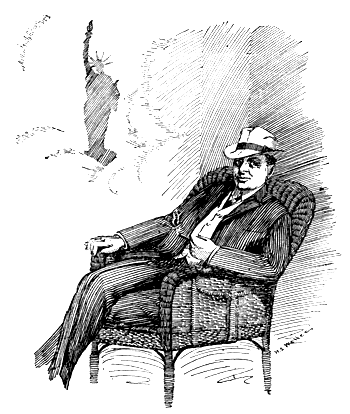
Home loomed large in my mind—I wanted to go home
She would be a prize for the German gunboats in the Arabian Sea. Aden would be her first stop, a five days' sail from Bombay. The Germans knew her schedule and her route and knew she would carry Indian gold to London. She would have no chance at all to make Aden with all that gold on board. The Germans would get her.
Then, from there up through the Red Sea to Suez she wouldn't be out of danger—there were German gunboats in the Red Sea. She might get through the Suez Canal all right, if she ever got so far as Suez. The trip through the canal might possibly be a peaceful one, but, ye gods! look out when she strikes Port Said at the other end of the canal, if she ever gets that far, was the word passed out.
Port Said would be a hot point. Nothing but submarines would be safe around Port Said about her due date there, it would be such a seething hot-bed of naval engagements.
From there her course through the Mediterranean to Gibraltar would be one trying ordeal for a man of peace, not used to, looking for, nor wanting war's alarms. Italy was hanging in the balance as a neutral power. She would probably be in it before the ship could reach the Mediterranean at Port Said—if she ever reached Port Said.
To sail on this ship through the Mediterranean under present conditions would be, for a rank civilian, just like committing suicide. Of course for a soldier, whose job is war, it would be all right—all in the day's business—justifiable.
Then after she reached Gibraltar (of course this was supposing the improbable chance of her ever getting so far as Gibraltar) she would have to sail out into the Atlantic through the Bay of Biscay, and up the Thames, and the telegraph said the Germans had slipped over and mined the mouth of the Thames—for a man anxious to get home this was a bad ship to sail on. That was the encouragement held out to book for passage on this ship.
I met a man at the Taj Mahal Hotel in Bombay (I'd met this man two weeks previously at Calcutta)—an American, a machinery salesman from the United States.
He told me he was on his way home, had crossed India to Bombay to connect with this P. & O. liner, but none of this ship for him.
He had been filled as full, if not fuller, than myself of the dire disasters that would, in all probability, overtake this ship.
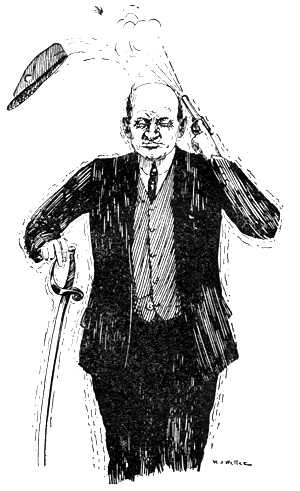
Just like committing suicide
"Why, Mr. Allen," he said, "that ship will have about as much chance to get to London as a celluloid dog would have to catch an asbestos cat racing through——" "Oh, say, my friend," I said, "don't say it.
"Aside from that illustration having gray whiskers, it makes me nervous and discourages me, because I want to get home, and that is the ship I ought to sail on. But let's go and see our Consul; he may be able to throw a little optimism on the situation."

He had been filled as full, if not fuller, than myself
The Consul took an even more gloomy view of it than my friend from Calcutta. Aside from the above cheerful opinions, all of which he shared, he had the air of a man who knew something worse but was not at liberty to tell.
That settled my friend from Calcutta.
He wanted to get home as bad as any man could, but he was going to retrace his steps and go home via Japan.
Our Consul advised me if I really wanted to get home that I had better go that way too. On the other hand, he advised, if I really enjoyed the sensation of momentarily living in expectation of being sunk, shot to pieces, or blown up, that this P. & O. liner was an ideal ship to sail on.
As I had just come from Japan, as my contract is to write travel stuff around the world—not two-thirds around and back over the same ground—and as I had picked up numerous cases of stuff coming across India, all of which were under consular invoice, said invoice reciting the fact that the goods it described were to leave India on this same ship, for entry at New York (it being a requirement of our tariff laws to name the ship, port of departure, and port of arrival of goods for entry into United States), I told our Consul and my Calcutta friend that I was going to take a chance and sail on this ship.
To write that invoice all over again for another ship, for entry into San Francisco en route from Japan—to get out of that was the determining factor.
Anyone who knows anything about the details of a consular invoice will understand.
So I boarded this ship with a handful of passengers booked for London. The tender steamed away and left us in Bombay Harbor, ready to weigh anchor and sail at 3 P. M. Saturday, the advertised hour for sailing.
But we didn't weigh—not at 3 P. M. that day, or the next. The next day, Sunday, all first and second-cabin passengers—the P. & O. carry no steerage—were shoved up forward, and British troops, homeward bound, were taken on aft—and I wondered if the Consul knew.
This changed the situation.
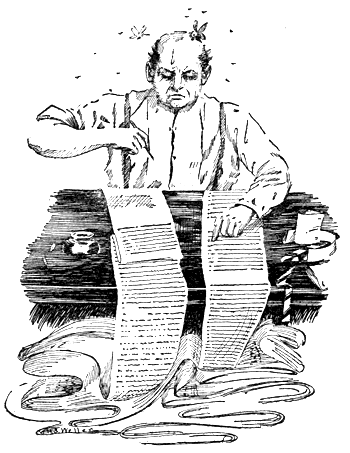
To write that invoice all over again * * * to get out of that was the determining factor
Sailing on a British ship with British troops, to say nothing of twenty million dollars in gold, with England and Germany at War, was no good place for a man of my peaceful proclivities.
I wasn't alone in these sentiments.
The purser, on that peaceful Sabbath day, put this question to the passengers: "Do you want to sail on this ship or go ashore?"
We might sail at our own risk. Anyone sailing was a belligerent. That question thinned the passenger list down to about a score. The most timid ones stampeded to leave the ship. I won first place at the ladder, but remembered that consular invoice and turned back, and one of our preacher passengers beat me to it and was the first one down the ladder.
He had spent his life preaching that Heaven was a desirable place, but he proposed to go there in God's good time. The purser, thinking he had missed me, put the question to me the second time.
With my teeth chattering with valor and my face blanched with the war spirit, to hide my real feelings I made reply: "P-p-please start your tank. I want to go home—I want to get there as soon as possible—I want to go home, I tell you."
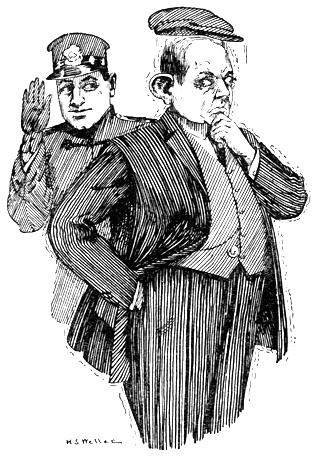
With my teeth chattering with valor
But I don't like this war game, and I decided right then and there if they sprung another one, if they added another war risk to the ship for this voyage, I would shake it and go home via Japan.
We stayed in Bombay Harbor until next day at noon, to throw the Germans off her schedule, and she sailed out of her regular course to throw them off her route.
Nights we sail in darkness—her lights out and her wireless out of commission; sailing phantom-like, with no lights to betray her to lurking German cruisers, and by the same token, no lights to warn a ship sailing north and south from ramming her.
I had fully intended to write some travel stuff coming across from Bombay, but shucks! I haven't felt like writing travel stuff—couldn't seem to get down to it.
A speck on the horizon would knock any travel stuff out of my mind—that speck might grow into a German cruiser, and England at war with Germany, and no guns aboard to shoot with! Just a merchant mail ship with twenty million dollars in gold and British troops aboard.
From all the accounts we had been getting of German atrocities, if a German gunboat met with us, she would snitch that twenty million first, help herself to our coal second, and, third, sink us.
That was the consensus of opinion of the handful of English and French passengers aboard. The Arabian Sea is full of sharks, terrible, ferocious, man-eating sharks; and what with anxiously watching specks on the horizon, speculating as to whether those specks would develop into German cruisers, and wondering how salt water tasted, and whether a shark would get me on the way down, with these pleasant thoughts a man of my peculiar temperament couldn't write travel stuff.
I tried, I honestly tried, but only one measly little poem was all I could accomplish on this five days' passage coming across from Bombay to Aden.
I never attempt poetry unless my soul is stirred with deep emotions.
Eight verses were wrenched out of me, when a smudge of smoke was visible on the horizon, and the bets were ninety to one that a German cruiser had sighted us.
The first two verses of that poem went:
Your scribe he is a soldier nit, Nor used to war's alarms; He never died, or bled, or fit, Save bugs upon his farms. And when at last he went to war On a big P. & O., He went to war, just only for To get home quick, you know.
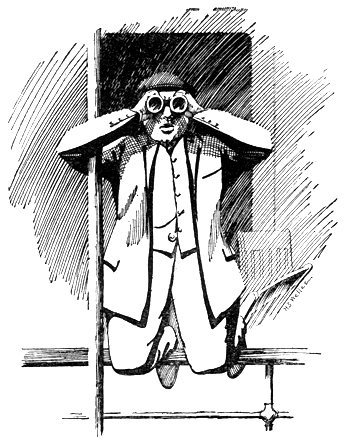
Anxiously watching specks on the horizon
And the next six verses were even worse than those two.
The smudge turned out to be an English merchantman, eastbound, as scared of the Germans as we were. There isn't a speck on the horizon in any direction, and with Aden almost in sight, in exuberance of spirit I wrote one more verse:
So whoop, hurrah, don't look askance, He's sailing o'er the sea; Doggone a man who'll take no chance, "A chance for me," quoth he.
XXXII BEATING THE GAME WITH ONE SHIRT
We will land at Tilbury (London) in an hour, and I have beaten the game with one shirt.
The English are great in many respects, but in nothing do they excel more thoroughly than in dressing for dinner. Now we, of the great American "proletariat," are not strangers to the dress-suit. We do, on occasions, don it.
At evening weddings we put it on.
When a town magnate gives an evening reception, those of us who are counted among the elect and get an invitation, put on a dress-suit.
Occasions of this kind may happen three or four times a year, and, to make sure that everything is in order, after the invitations are out and we have received ours, our wives, who are more solicitous about this thing than we men, dig up hubby's dress suit and give it an airing.
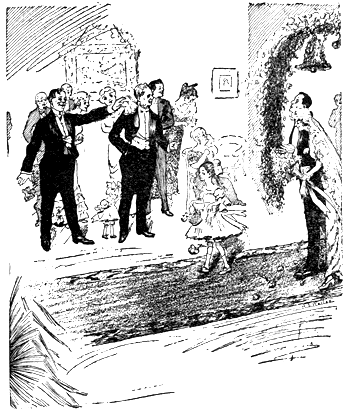
We do, on occasions, don it
Our dress shirt is sent to the laundry so as to have it fresh for the occasion, and a day or two before the event hubby gets into the spirit of the game, and at the earnest solicitation of the female portion of the house, submits to a dress rehearsal to make sure that shirt, studs, special collar, tie and all the toggery appertaining to the deal will be in order at the last moment prior to the final plunge.
Now our English cousin's familiarity with the dress-suit breeds contempt—that is, contempt for any exhilaration incident to getting into the thing on state occasions.
While it is not a criminal offense not to dress for dinner, it is something in the nature of a misdemeanor, and a rigid rule prescribes the dress-suit for dinner.
Nowhere on earth is this rigid rule more thoroughly observed than on the P. & O.
I was not a stranger to this rule—the P. & O. and I are not strangers. Nor am I a stranger to the customs of the Far East.
As the years have gone by I have added to the dress shirt a sufficient number to take care of the situations one meets with on world tours.
When I got to Bombay I found that the strenuous dobes had practically annihilated all but one of my dress shirts, so I presented those wrecked shirts to Lal, along with my bedding purchased in Calcutta, for which I had no further use, to take back to Calcutta with him.
If Mark Twain were alive today I'd be willing to bet him dollars to doughnuts that the dobes had succeeded in breaking stones clear across India with my dress shirts.
I had many things to do to get ready to sail on this ship, and one would have been enough—that consular invoice.
To lay in a bale of dress shirts was one of the items that should have been attended to, as I knew I was in for a twenty-two days' sail on a P. & O. to London; if all went well after boarding her.
But somehow, other things pressed more heavily.
I thought of the dress shirts several times, but I seemed to have a vague sort of an idea that dress-suits wouldn't cut much ice this trip, so I dismissed dress shirts with the idea that I had one, and the gloomy outlook was such that I must have decided that one shirt would last two days—three on a pinch—and that we were due to be sunk by that time, and if we were, a dress-suit would be of secondary importance to me—anyway I got aboard with only one dress shirt.
After clearing from Bombay for Aden, along about ten o'clock in the forenoon, the day slipped by without my realizing that I had started on a twenty-two days' voyage on a crack P. & O. liner with only one dress shirt.
The careful reader who has followed me in these travel letters will have gathered in my last that dress shirts were not weighing as heavily on my mind as some other things.
It was a doughty lot of Englishmen, with a sprinkling of Frenchmen, that made up the passenger list, about a score of men. You might say it was a picked lot—sifted, as it were—English colonials going home to England for a holiday. Judges seemed to predominate—an especially good lot of fellows—and brave.
After tea that day (by the way, I've attended twenty-two "he" tea parties on this voyage, the Englishman's tea and his dress-suit are twin brothers), shortly after tea the bell rang to dress for dinner.
I had a hazy idea that the ceremony might be waived on this voyage.
I couldn't see any occasion to put on the glad rags—a handful of men, probably sailing to their doom—to get into gala attire seemed almost sacrilegious.
But every last man ducked for his cabin to get into his dress-suit.
Under the circumstances the Frenchmen wouldn't kick, no matter how they felt about it—they all ducked too.
I had no enthusiasm to dress for dinner.
Couldn't see the use.
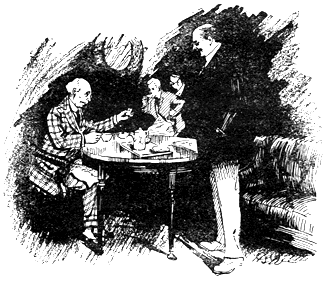
I've attended twenty-two "he" tea parties on this voyage
I felt, unless we were sunk, I couldn't play the game right more than three or four days with one shirt.
But I decided to be game and not cross a bridge till I came to it. I could hold out with my one shirt for three or four days and not be thrown overboard, and by that time we would all go down together.
After four days that shirt looked passe, not to say soiled.
No German gunboat had come to the rescue up to the time of the gong sounding to dress for dinner on the fifth day.
When the bell rang to dress that day I ducked with the rest of the boys.
I sadly looked at that dress shirt, shook my head, and took a turn up and down the deck.
No use, there wasn't a speck on the horizon; no hope of being sunk before dinner.
I went back to my cabin and turned that shirt around, and blossomed out with it hind side fore.
I was a little nervous at first, until after soup, but it went. Didn't occasion any remark or flutter, and I felt that I was good for four days more.
At the end of the second four days, eight days out from Bombay, we had passed Aden.
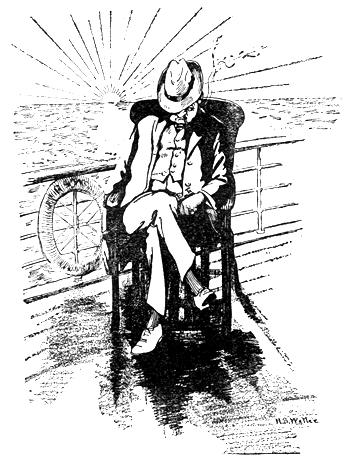
No hope of being sunk before dinner
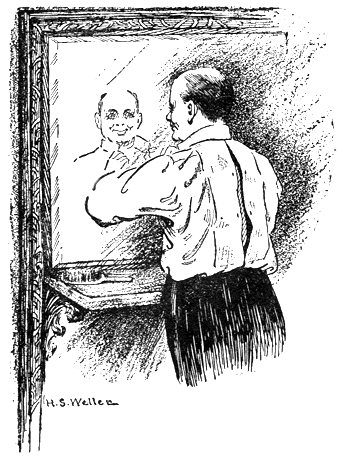
I turned that shirt around
We stopped there a few hours of a Saturday afternoon.
Everything was shut up—couldn't buy a shirt for love or money.
We were now in the Red Sea and no German gunboats had found us, as yet. By this time it wasn't the fear of German gunboats that was causing me anxiety. To dress for dinner with that bunch of Englishmen had gotten to be a mania with me, and there were five days more to Port Said before I could buy some dress shirts. My shirt would go one more time hind side to, but after that something would have to be done.
On the ninth day for dinner I turned that shirt inside out—and got by.
A mighty load was lifted from my soul. On a pinch she would last eight more days that way, four days inside out front to, four days inside out back to.
Safe for eight days more and we'd make Port Said in five!
We made Port Said all right—slipped past in the night; not so much as a fire-cracker to wake me up.
We were now in the Mediterranean, and Gibraltar our next stop—six days away.
Italy was still neutral. But I had got where I didn't give a tinker's dam about the neutrality of Italy—what I wanted was some clean dress shirts.
I'm ashamed to chronicle it, but all interest in the war seemed to dwindle with me. I was obsessed with one idea, one ambition—to make that shirt stand me until we could make Gibraltar.
Eighteen days from Bombay to Gibraltar, and I'd got by with sixteen of them. Two days more and we would be at Gibraltar, where I could get some dress shirts. There was no hope of being sunk, and getting out of it that way. The Mediterranean was as quiet as a duck pond.
I had found out by this time that the English would stand for anything in the shirt front, if the conventional dress-suit was on for dinner. So I contemplated that shirt fore and aft, inside and out, and used the best sides.
I was a good fellow and one of the boys. I had managed to dress every day for dinner, and while I felt like a thief in that shirt, it went, and I was accepted, and we got to Gibraltar.
But just before we anchored in the harbor at Gibraltar this notice was posted: "Only British subjects allowed ashore," and there were four more days to London!
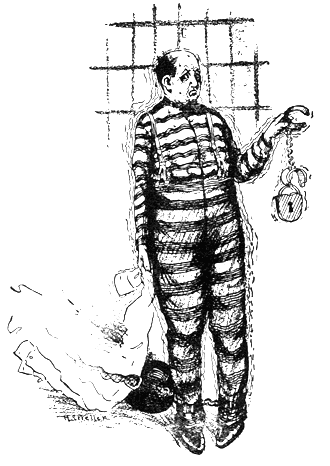
I felt like a thief in that shirt
I entreated the commander, I entreated the purser to give me a pass to go ashore.
They were adamant. The rules of war couldn't be broken. Only British subjects would be allowed ashore at Gibraltar.
I didn't wait for the gong to sound for dinner after leaving Gibraltar that day. Immediately after lunch I repaired to my cabin to consider my dress shirt.
Positively I didn't dare to risk it again. I was absolutely certain it wouldn't go another time on any of the four sides, and I was also just as absolutely certain that I was going to play the game right up to London.
Not dress for dinner the next four days on the P. & O. with my English friends? The spirit of Bunker Hill, Lexington, Cambridge, Ticonderoga, and the battle of the Oriskany fired my soul. With my jack-knife to rip, and some puckering strings, I went at it, right after lunch. I turned that shirt upside down—don't ask me how I managed. You can't stump a resolute man. I worked it—I won out.
We got up the Thames without striking a mine—I had no thought of mines.
I "dressed" for dinner the last day on board!
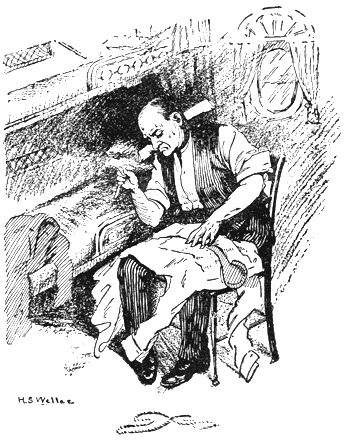
With my jack-knife to rip and some puckering strings I went at it
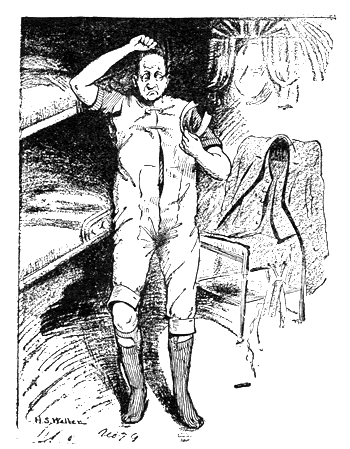
I turned that shirt upside down
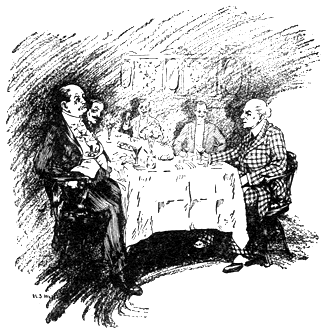
Also, I finally accepted his apology
A judge, an elderly Englishman who had sat opposite me all the way from Bombay, and who wasn't in rugged health, neglected to dress for that last dinner. He apologized profusely for coming to dinner "not dressed." Owing to it being the last day, his age and indisposition, his apology was accepted by the Englishmen at table.
Also I finally accepted his apology, but I never want to have an apology accepted in just quite the frigid manner in which I overlooked the judge's lapse.
XXXIII THROUGH HELL GATE STEERAGE
Here, then, is the final travel letter I shall write on this world-girdling tour.
It is a woeful ending for the "sparkling gems" of travel stuff which have gone before.
It will record the sad contrast between my start from my native land, gaily sailing out of the Golden Gate, a de luxe first-class passenger, and winding up my joy-ride around the world by coming through Hell Gate steerage, barely escaping being condemned as a criminal and executed on the high seas, chucked overboard and fed to the sharks.
The lights and shadows of this wicked world are something fierce.
I am glad I made good my promise to try to write a little poetry before I came to this letter. I would surely never try to put it over in this one—it would be too great a strain.
Coming through Hell Gate steerage—
The next line might have to end with "peerage," and steerage and peerage don't mix worth a cent.
My first errand upon arrival in London was to lay in a stock of dress shirts.
But I didn't need any dress shirts coming across the Atlantic.
Indeed I didn't. What I needed was a good stout hickory shirt—a pair of overalls and double-bitted axe.
I don't suppose a writer of travel stuff on a debonair trip around the world ever had so much trouble as I have had the last eight days.
As I have already explained in letter XXVII, I held an order for a first-class passage on any American or British ship I might choose from England to New York.
With two dozen dress shirts, latest approved "Lunnon" style, safely cinched—I didn't propose to take any chances the balance of my trip, so I bought two dozen—I went to get that order changed for passage home.
"Why," the man told me, "we can't book you first cabin on anything sailing for America for six weeks. We can send you to New York steerage, on a ship sailing the day after tomorrow, if you speak quick. There are a couple of vacancies left. But you need not be afraid of steerage at this time. Owing to the war, the flower of America are going home steerage. The truly refined, the got-rich-quick, high-brows of the deepest dye, prize-fighters, captains of industry, and card-sharps are all traveling steerage these days.
"Why, Mr. Allen," he said, "traveling steerage is a picnic now. Owing to the class of people who are patronizing it, everything is done by the ship's management to make the steerage journey home a pleasurable experience."
As I have never been able to get enough picnics—I am a fiend for picnics—I spoke quick. I said: "Book me now."
"And," the man told me, "there will be a rebate coming to you. The fare, steerage, is only seven pounds. You hold a twenty pound order."
"Sure," I said, "thirteen pounds coming my way."
"Oh, no, not thirteen pounds; but there will be something. Come around this evening and I will tell you how much of a rebate you will be allowed."
"Why not thirteen pounds?" I asked. "Over on our side the difference between seven and twenty is thirteen."
"Oh, yes," he said, "but the P. & O. won't stand for such an adjustment; but I'll do the best I can for you."
When I went to get my rebate I was offered one pound eleven shillings.
I told them to keep it; that nothing but a rebate of thirteen pounds looked good to me. "Furthermore," I said, "if the line slips a cog this trip across and forgets to make steerage passage home one continual round of pleasure, if, perchance, I should feel like shaking steerage before we get across, I'll try to work the purser to let me eat first and sleep in the steerage. Coming home from Naples in the rush season, holding a first cabin ticket, I once had to accept second cabin berth, but was allowed to eat in first cabin."
I was willing to shake steerage at Liverpool before ever boarding the ship. A madder lot of Americans I never met, of whom there were about seven hundred, mixed in with about three hundred immigrants. Hours were consumed to get that thousand steerage passengers aboard the tender. No effort was made to separate them. The great majority being Americans with passports to be examined, immigrants and Americans were all held standing for hours in a hot, broiling sun, a congested herd of humanity, while the tedious task of examining the passports was carried on at the gang-plank—a task that could have been done in comfort in a large and commodious room on the wharf, where there were the accommodations for at least our women and children to be seated while immigrants and Americans were separated; after which both bodies could have passed on board in comfort and with dispatch.
But when we reached the ship, wow! a howl went up. We had consumed the biggest part of the day in getting from the wharf to the ship via tender, and we struck it at supper-time. Seven hundred Americans who had been told that steerage home would be a picnic!
Gur-r-r—"picnic!"
Filth! Stench! Vermin! Our illusion was dispelled.
Now there is a streak of yellow in almost everyone. Once in a while a noble, self-sacrificing character is born who had rather suffer with his kind than be delivered, like Daniel, and Joseph, and Moses, and who, by persistently sticking to exalted ideals, win out, so that all ages ring with extolling their characters.
But most of that kind die young.
There are moments when I feel that I'd like to be grand, and good, and noble, like Daniel, and Joseph, and Moses. Then the temptations of the world, the flesh, and the devil get in between and I slip back. Every time after slipping back from those noble aspirations and high aims a particular and special brand of hard luck strikes me. My heart beat in sympathy with that crowd of seven hundred Americans traveling steerage with whom I had cast my lot; but after the first meal I decided that I'd try to shake them. So I went up first to ask the purser to let me at least eat first cabin.
"Purser," I said, "I am booked to travel home steerage—"—that haughty individual interrupted me with: "You're a third-class passenger, then, on this ship," and he looked at me as if I were an angleworm.
"Even so," I said; "but——" and I was reaching into my pocket to get at the document to prove to him that I had paid for a first-class passage.
He evidently thought that I was reaching to get my card, because he snapped out, "I don't care who you are, you're a third-class passenger on this ship."
"Yes, purser," I said, "but this"—handing him my document—"will show you that while I am booked steerage, I paid for first; and couldn't arrangements be made for me to sleep in the steerage and eat at the first table? You know, purser, it's just a little rocky back there in the steerage—and you see I paid for first-cabin passage."
There is no doubt but what that fellow could read, but he seemed so horrified at a steerage passenger invading the holy precincts of first cabin that he wouldn't attempt to read anything that had been contaminated by being in the possession of a steerage passenger.
Anyway, he handed it back to me without reading it, with the remark: "I've only got your word for that."
"Um huh, purser," I said, "and when it comes to a plain statement of facts, my word is good for even more than that."
"You're a third-class passenger on this ship, and you'll have to eat third-class where you belong," and further conversation with me seemed to give him a pain.
After that unsatisfactory interview with the purser, the high and holy self-sacrificing sentiments that I had had just prior to my desire to try and shake that bunch of steerage passengers—that part of my better nature that made me feel for the misfortunes of my kind returned, and I went back to the steerage, "where I belonged," to share their lot—it was either that or jump overboard.
There was just one topic of conversation back in steerage—the rotten treatment we were getting; and it was the voice of our little democracy that we ought to try and do something. I told you in letter II that one can make better time getting acquainted on shipboard than anywhere else, but you may have missed that wheat grain of information in the surrounding chaff. But it is there, and already there were those aboard who had learned that I was doing newspaper work, so they wished the job of trying onto me.
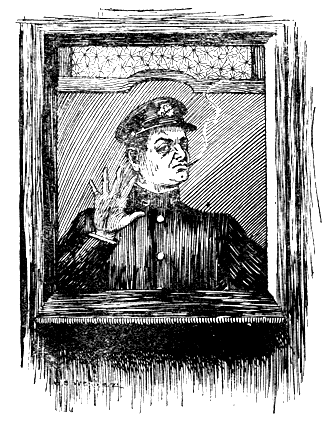
"You're a third-class passenger on this ship"—and further conversation with me seemed to give him a pain
If a protest and a petition for an effort to try and make things better, signed by a goodly number of us from the underworld who were American citizens, were sent up to the captain, it might mend matters, and wouldn't I draft it?
After my encounter with that purser—the purser standing high in the management of a passenger ship at sea—I had a fear that any petition we might make wouldn't be received with favor by the management, but my election for the job was so unanimous, spontaneous and hearty that I buckled to it and wrote a petition, in which I told the management what we American steerage passengers thought of what was being handed to us on our passage home. I told them we were steerage passengers not from choice, but owing to the fortunes of war, and instead of trying to emphasize the fact that we were steerage passengers, wouldn't they see what they could do to make us forget it? Furthermore, I asked in the petition if they wouldn't at least see that the stewards who served us our food put on clean clothes: that the white suits they wore were filthy when we left Liverpool, and that they were still wearing the same filthy suits. And also wouldn't they see that the dishes were given an occasional bath—that the knives and forks they were handing us turned our stomachs. And couldn't we have ice water to drink? Even had the temerity to suggest that they give us napkins—qualified the suggestion of napkins by telling them paper ones would be counted a boon.
I read my petition to the crowd and it was loudly acclaimed a choice bit of literature, right to the point, and exactly fitted the case; and they crowded around to sign it, and wanted me to get it into the captain's hands as quick as I could. I went up to first cabin to hunt for the captain and ran into the purser. When he saw me coming he looked even more aggrieved than when he told me to stay where I belonged. But I told him this time I came with a petition, signed by several hundred American citizens, and that I wanted to give it to the captain.
"We're in a fog now and captain is on the bridge; I'll give your petition to him when he comes off the bridge," the purser said.
"All right, purser," I said; "and you needn't return the petition to me. I've got a copy of it and a copy of all the names of the signers." And I went back to steerage, from choice now. I fear that I've always set too great a store on ease and luxury—asceticism has never appealed to me as a personal practice; but it would have taken a roll of money to have hired me to shake steerage now. My better nature, or something, had triumphed, and my lot was cast with that down-trodden, forsaken, and hopeless crowd of steerage travelers. A revulsion of feeling for first-class on that ship had filled my soul. They couldn't have hired me to travel first-class now. When I got back "amongst my own people" I was the recipient of so many tales of woe—I was so filled up with steerage passengers' grievances, that if my interior had been analyzed it would have looked just like the bureau for the amelioration of troubles at San Francisco after the earthquake.
Shake that bunch? Nay, nay. In my contrition of spirit I concluded that what I was getting was just retribution for ever trying to do such a thing; and I feared if I should let go and make another attempt to do it, something worse might come to me—although I couldn't figure out just what it could be. Besides, after that petition reached the throne, I'd be in bad with the ship's management, and another attempt to get away from steerage would be futile.
My-o! but that was a forlorn lot of passengers traveling steerage.
Our chief aversion was "Beef," chief steward of steerage (he was dubbed "Beef" by the sufferers an hour after we got aboard). He was big, beefy, brass-buttoned and shoulder-strapped, evidently hired by the line for his ability to drive over-worked stewards and handle immigrant passengers.
Almost immediately after boarding the ship he had earned the indignation of the Americans by insulting one of our country-women, a woman of refinement and culture, who was traveling alone—the wife of a banker. When she protested at the deplorable condition of the dishes, he stormed up to her and asked her what was wrong. "Why," she said, "you don't expect us to eat our meals off such dirty dishes, do you?"
"You're no better than immigrants, and you'll be handled as such," "Beef" said. And when she told him she would report him to the captain he bellowed out most insultingly: "Go ahead and report; we aren't afraid."
Subsequent events proved that "Beef" had no cause to fear the captain.
It was not a nice way for a servant of a transportation line to talk to any patron, immigrant or otherwise, voicing a just protest, and especially not to an unprotected lady traveling alone, subject to the care and courtesy of the transportation company she was traveling with.
Indignant? Oh my! I should say so.
If indignation could sink a ship, we'd never have got across.
As Chairman of the Protest and Indignation Committee, all that indignation was poured into me. I didn't know I could hold so much. And still it came. One woman wanted to sue the company when she got home for a million dollars, and she came and asked my advice about it. I told her I wasn't a lawyer, but being Chairman of the Committee on Protest and Indignation, I told her to state her case. She said she was going down a darkened stairway to the noisome, filthy quarters where they had to sleep; the stairway wasn't lighted and in consequence she fell down stairs and was picked up for dead, jarred, bruised, broken and bleeding profusely. The ship's doctor attended her injuries and charged her two dollars, and she wanted her two dollars back and a million on top of it.
Speaking from underneath the load of other people's woes I had aboard, to say nothing of those of my own, I told her she had, in my opinion, a just claim. To sue the company when she got home—this last advice I threw over my shoulder at her, as another woman was dragging me off to investigate the "awful condition" below deck where they were herded to spend the nights.
And still the indignation grew and grew. Our petition hadn't bettered matters.
We were steerage passengers—just that and nothing more, and if there wasn't some new, fresh, sensational bit of steerage news to tell there was always "Beef" and his insults to discuss.
One evening as curfew rule was being enforced (it seems there is a law that demands that female immigrants en route to the United States shall be ordered below deck at 9 o'clock), as this rule was being applied to our steerage passengers, both Americans and immigrants, and as they were being driven to the filth and stench and vermin below, indignation boiled over again.
One young fellow whose wife was driven from his side, swore like a pirate, but had to submit—we were steerage passengers.
"Beef" was boss of the steerage, and as he was standing near, to voice our indignation, I said to the men who were allowed to stay on deck: "Men, if any of us catch an officer on this ship insulting a woman, whether she is American or an immigrant, no matter how many shoulder straps or brass buttons he wears, I propose we knock him down, and if he is too big to handle with our fists, take a club." That little speech was for "Beef's" benefit—but things didn't mend.
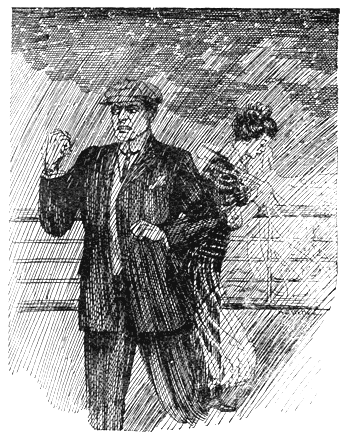
He swore like a pirate
The well deck was the outdoor privilege for steerage passengers, set nine feet down in the hull of the ship, forward the poop deck and aft second cabin promenade deck, with a railing across the latter to prevent cabin passengers falling off into the well deck. All view available for steerage passengers on the well deck was up into the sky—whence we might look and pray for deliverance. We could sit on the bulkheads that formed a part of the floor and lean our backs against the wall, which our women folk did.
Cabin passengers up top side would lean on that rail and spit on us! And they complained to me about it—of course they did—to whom else should they tell their troubles?—wasn't I Chairman of Committee on Complaints? I was, and it was another case of "Let George do it." There was no one to appeal to but "Beef." Captain and purser held aloof and wouldn't answer our petition.
I didn't have much hope in approaching "Beef" after my proposition of the night before at curfew—"Beef" knew I was driving at him—but I thought of Moses and how he had to appeal to Pharaoh, of the stony heart—what little I knew of the career of Moses was especially comforting to me—but since I'd been purged of the streak of yellow in me that prompted me to try and shake my steerage friends I was willing to do anything; so I went to "Beef" and said: "Say, those low-brow cabin passengers along the rail up top side are spittin' on the ladies and gentlemen down here in the steerage!"
The enormity of the outrage didn't faze "Beef." Cabin passengers had the privilege to spit on steerage. He wouldn't do anything. All the attention he paid to the complaint was to look at me and say: "I don't consider you're a gentleman."
And I told him if in his opinion I was a gentleman I'd go and hang myself.
And the indignation grew and grew.
All the comfort there was on hand was to lodge complaints with me and to express the hope that I'd do justice to the situation when I got home.
"Don't forget to tell about the rats, Allen," a man from Maryland piped up.
"Yes, touch up the rats," a man from Iowa admonished me, while a man from Kentucky said he had become so innured to hardship he didn't mind the rats so much, he could stand their running over his face nights, if they would only hurry across.
"Yes," a man from Massachusetts plaintively wailed, "it is hard when they loiter, isn't it?" While a man from Florida said that he didn't mind their feet so much—it was the dragging their tails across his face that got onto his nerves.
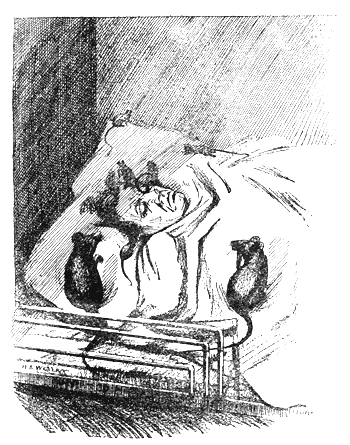
"It is hard when they loiter, isn't it?"
"And don't forget to tell how they served us those little, pithy oranges that day, Allen," a man from California broke in.
This was hardly worthy. The man who lodged that complaint ought to have been ashamed of himself, and his ingenuity for finding things to kick about was of a low order—he was straining at a gnat and swallowing camels.
It's true the stewards brought them on in their dirty aprons and pitched them at us—not the stewards' fault, they were doing the best they could with the tools furnished them—but steerage passengers ought to be grateful for any kind of oranges, served in any shape. While it's quite true, in my adolescent years, as a boy on the farm I have fed apples to hogs with the same courtesy, the complaint was too trivial to be spread on the minutes of the meeting. But it was voted to spread it, hence the mention.
Before the meeting adjourned, under the head of "New Business," a portly judge advised that the petition sent to the captain be rewritten and signed again with the home addresses of all signers opposite their names, and that I take the resigned petition home with me. Some of the ship's letterheads were pasted together until we had a sheet nearly five feet long on which to rewrite the petition, and on both sides of the paper there was not enough space to hold the signers' names, and an overflow sheet had to be supplied.
The next day all steerage passengers were subjected to a medical examination. Americans examined on deck—immigrants in the dining saloon.
A brother-in-tribulation, "New York," and I, after we were released from the examination, started down a noisome alleyway to go to our cabins, and we had to pass through the dining-room, where immigrants were being examined. We were in "New York's" cabin when a dining-room steward came to us and told us he had been sent to tell us to go on deck; that we were holding up the medical examination. No steerage passengers were allowed in the cabins until medical examinations were completed, he told us, and that he was ordered to tell us to go on deck.
We had gotten so used to being ordered up and down and in and out that we obeyed like dumb driven cattle. As we were about to pass through a companionway to get on deck, dining-room stewards guarded it and told us we couldn't go on deck. "New York" was ahead, and paid no attention to the contradictory order. They let him pass, but when I followed, one of the guards took hold of my arm to stop me, and I brushed past him. He fell down and began to howl before he struck the deck. I joined "New York" on deck and told him I suspected a frame-up, and that I would hear of it later.
Sure enough, in about half an hour "Beef" hove in sight and told me the captain wanted to see me in the purser's room.
"Glory be, 'New York'," I said, "let's shake the nether regions and go up first and see the captain. I've an invitation to meet him in the purser's room. We've been wanting to see that fellow ever since we left Liverpool, and I invite you to go with me as my guest."
"Only Mr. Allen is wanted," "Beef" vouchsafed, but "New York" didn't pay any more attention to him than if he'd been a toadstool—I was going to say mushroom, but I like mushrooms—and together we went to pay our respects to his nibs, the captain, "Beef" following on behind.
As we neared the purser's room we passed the entrance to first-cabin dining-saloon, and as we saw the luscious fruits and viands prepared, and took in the luxurious surroundings, we clasped our hands and simultaneously exclaimed: "Is this heaven?"
I was ushered into the purser's room, "New York" sticking to me closer than a brother. There sat his nibs, the captain, togged out with enough gold braid to scare a horse. The purser stood at his side, and "Beef" came in. There were some chairs in the room.
My! but those chairs did look good to "New York" and me. Neither of us had sat on anything soft for nearly a week.
An irresistible impulse to sit down on something soft seized us, and, unabashed in the presence of all that gold braid confronting us, we were about to sink into their luxurious depths when his royal gazooks, with an imperious wave of his hand, bade us remain standing in his presence. It was really an awful break on our part—we should have waited for him to have invited his guests to take a seat, but we were so dazzled and dazed by the sudden transition from steerage to first that we were momentarily shy a few buttons on the niceties—and besides, we wanted to sit on a cushioned chair—we ached to sit on a cushioned chair, I'm telling you, but we didn't—I thought of Lal and stood.
It was up to me to stand—I was up for trial before the most absolute monarch in the world, the commander of a ship at sea.
He asked me my name, and I told him.
"You are charged with assaulting an officer in the discharge of his duty," he said. "What have you to say for yourself?"
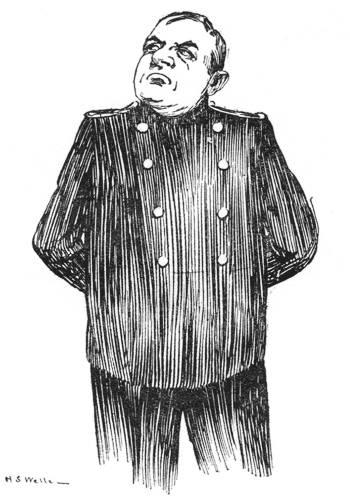
And "Beef" came in
I told him the circumstances, "And, captain," I said, "that chap fell down mighty easy, and began to howl before he struck the deck."
The captain ordered the damaged steward to be produced.
The purser and "Beef" had him on tap, around the corner somewhere, and "Beef" led him in limping and sniveling.
"Did this man assault you?" the captain asked, pointing to me.
"Yes, sir, captain, 'e did, sir, thank you, sir. Hi was guardin' a door accordin' to horders, sir, and 'e pushed me over and I got an awful bruise, sir, thank you, sir."
According to the evidence, I was the one to thank, but I guess he got his thanks bestowed where they belonged, all right.
"Beef" explained that the man was badly hurt and under the doctor's care, and he turned him tenderly around so the captain could see where his pants had come in contact with the deck.
And those pants did look bad, there was no doubt about that.
"Yes, yes," the captain said, in a commiserating tone, "the man is undoubtedly severely injured."
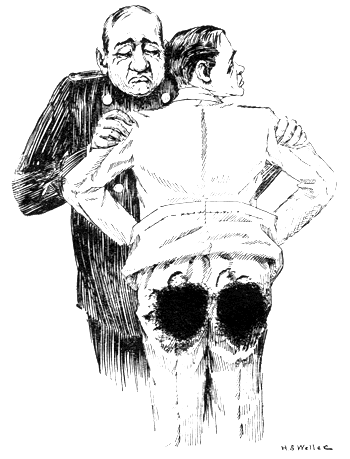
And those pants did look bad. There was no doubt about that
"Yes, captain," "Beef" said, "and the other night at curfew, out on the well deck, Mr. Allen made a speech and advised a lot of steerage passengers to knock down officers on the ship, no matter how many shoulder straps they wore."
This was a serious charge—mutiny on shipboard—and punishable, I am informed, with instant death.
With a shuddering gasp at the enormity of my crime—or was it ghoulish glee at having sufficient evidence to have me drawn and quartered—I credit him with the latter sentiment—a human being who would keep two free-born American citizens standing in his presence—men whom he knew had been living steerage on his ship for nearly a week—with those chairs standing tantalizingly, invitingly empty—the wearer of all that gold braid, lolling luxuriously in an easy chair, filled with such viands as "New York" and I had seen coming through—I'll never believe that man would shudder at crime. Rather, I think he was gloating over my ignoble end, and devising ways of still more horrible torture—that's the kind of a man I think that captain was, and I'll bet on it.
But according to the rules he didn't dare pass sentence without giving me a hearing. While he was judge, jury and prosecuting attorney, he had to give me a chance to clear myself, so he asked me what answer I had to make to the charge.
"Well, captain," I said, "'Bee—'—I mean your chief of steerage, hasn't got the story straight. At an indignation meeting out on the well deck the other night, as he has insulted women on this voyage, after he had ordered the women below decks at what you call your curfew time, I voiced the sentiments of the male portion of your steerage passengers by advising that if any of them caught an officer of the ship insulting a woman, whether she was an immigrant or an American, no matter how many brass buttons or shoulder straps he wore, to knock him down; and if he was too big to handle with the fist, to use a club."
"Beef" jumped up and shook his fist at me and bellowed: "If Mr. Allen says I've insulted women, he's a liar."
Right here is where "New York" shone.
"I would like a word here, captain," he said. "Mr. Allen is stating facts. Your chief of steerage has insulted women on this voyage."
That "impartial" judge, that embellished emblem of authority, said he had known "Beef" for a good many years, and he knew he wouldn't do such a thing, so, according to "Beef" and the captain, "New York" and I were both liars.
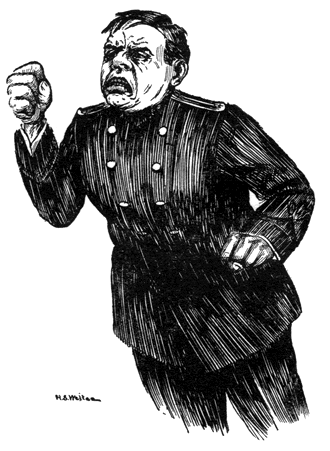
"If Mr. Allen says I have insulted women, he's a liar"
Then that bedizened judge turned on "New York" and said: "You look like a clean-cut, up-standing man" (this last was the unkindest cut of all; it's a compliment to have some men call you a liar, but he needn't have used that word "up-standing"; Lord knows, "New York" didn't want to stand up)—"how do you explain your associating with such a person as this man Allen?"
And then "New York" shone some more. He told the captain that he had found Mr. Allen a most agreeable and congenial companion on this voyage.
Oh, my! How this story does string out. I suppose "New York" saved my life. With "New York's" testimony the captain didn't pass the death sentence—he dismissed us with a magnificent wave of his embroidered coat-sleeve—the steward didn't die, but peeled potatoes, and I'm in New York, and Clinton only five hours away.
The End