Front matter (continued 2)
Reading edition
XI YAMAMOTO AND HIGH COST OF LIVING
After lunch at the missionary's I found my team at the gate spoiling for a run.
"Yamamoto, take me to your home," I said; "I want to meet your family. I want to see how a rikisha man lives. And, Yamamoto, I'll give you a yen if you'll invite me to supper at your home tonight."
The yen looked tempting, but Yamamoto wouldn't play the game.
He said to have a foreigner as a guest at his humble home would bring around his house such a crowd of curious neighbors that all pleasure in the repast would be spoiled—or words to that effect; but he would take me to his home. Off we started, a three-mile run; Ushi pushed and Yamamoto pulled, and I was soon a self-invited guest in Yamamoto's home; and, if to break bread or chopstick rice in Yamamoto's home would have brought a greater horde of curious neighbors than gathered to witness a foreigner's call at that home, then Yamamoto's head was level—Yamamoto's head was level anyway.
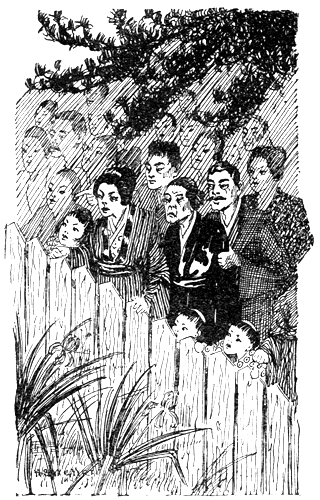
He said to have a foreigner as a guest at his humble home would bring around his house such a crowd of curious neighbors
A little house 8 x 16, two rooms 8 x 8, the front opening on a street about eight feet wide; a yard in the rear 6 x 8, was Yamamoto's home.
It was as neat as wax and furnished with an hibachi on which to cook, a tanstu in which to store their clothes. No chairs—they sit on the floor; no beds, save futons, to lay on the floor; and an okimono dai, a sort of what-not stand, on which a few ornaments and articles of household use were placed.
The wife was gone for the day, but his children were at home, and a more interesting trio of children one wouldn't ask to meet.
My team took me back to the hotel. I dismissed them for the day at five o'clock. I paid off Ushi, and made a deal with Yamamoto to go home and write me the story of his life. I told him I'd pay him a yen to tell me all about himself, his family, how they lived, and what it cost. To bring me the letter written the next morning and get one yen fifty for the day and an extra yen for the letter. Two yen fifty I would hand him in the morning when he handed me the letter; and Yamamoto said he would, and Yamamoto did—I imagine one of his daughters did the writing.
Here is an exact translation of Yamamoto's letter as he handed it to me the next morning—and Yamamoto has his stand within the wall, but Ushi does business without the gate:
The present living condition of Tokichi Yamamoto. He was born in the 12st May 2nd year Meiji 1869. I was born and bred in the city of Kioto, and have been engaging in the job of Rikisha for these twenty years, and my family is consisting of my wife and three children. Elder and younger girls who have had finished the whole course of the Primary school (4 years), and they are now working in the factory of the Tobacco Monopoly Buelow, and the young son is attending the Primary school.
I am somewhat puzzling with the expense of living. My estimated income is 30 yen each month in the months of April, May, October and November and the rest of is about 18 yen per month, therefore, I make it average, it becomes about 22 yen per month, and two girls get 16 yen, so all the income of my house is reckoned 38 yen per month.
The elder sister has just abandoned her work in the factory, and she attends a house for learning of sewing. The list of paying out a month:
House rent3.00yen
City tax and town expense.50
The expense of education1.10
The rice charge12.00
Wood, charcoal and oil1.30
Vegetable and fish7.00
Dressing charges3.00
Miscellaneous expense5.00
Total32.90*
* $16.45 American money.
Fortunately I am in robust health. Though I am not educated myself, I am thinking that the dutifulness and truthfulness are the most important to intercourse with people, and as I am truthful and dutiful to my friends, I am rather welcomed by them.
XII THE SOLDIER SAID SOMETHING IN CHINESE
Before starting on this around-the-world trip a friend of mine in the United States said to me: "When you get to Shanghai look up my friend, Dr. "John Blank." He has been in China over thirty years. He is the biggest individual intellectual asset in China today—the founder and moving spirit of an International Institute which recognizes the good in all religions and gives them all a hearing.
"He is a graduate of Hamilton College in your town of Clinton. He is a strong, a busy man, and true. Please look him up and arrest his attention long enough to give him my regards"—and I promised this enthusiastic friend of "John Blank's" I would do this thing.
"Missouri" had, by rare good luck, driven his business in Japan ahead of him to such purpose that he was ready to sail on the same ship that brought me from Nagasaki to Shanghai. He had, in his peregrinations through Japan, run his intense Americanism plumb against an English tea. Somehow, when "Missouri" and an English tea collided the tea got spilt—as "Missouri" told me the tale en route from Nagasaki to Shanghai the tea took second honors.
Arriving in Shanghai, "Missouri" went his way on business bent, while I looked up Dr. "John Blank," only to find that this busy man was out of town, and I regretted that I should have to disappoint our mutual friend and not be able to deliver his regards to Dr. "Blank." And I took a railroad trip to Pekin.
While I have come to China several times, until this trip I had never ridden a mile on a railroad in China, nor had I been north of Shanghai, and I was full of curiosity to see what I should see on a thousand-mile ride through China with its teeming millions.
At eleven P. M. of a sweltering night I found myself ensconced in a very comfortable sleeping car, composed of commodious staterooms of four berths each, two upper and two lower, and as the only traveling companion to share my stateroom, a young German of twenty-six years.
He was a keen young chap who had right ideas of life. Dropped in Shanghai four years ago, with an expired term in the German navy and fifty Mexican dollars in his pocket, bare-handed and alone, he had hit the Orient with such sturdy resolution and solid German sense that he had, in four short years, added to the fifty Mex. a young Urasian wife, half German and half Chinese (he assured me she was the dearest, sweetest little thing), a baby, and nine thousand good hard Mexican dollars in the bank.
A feat like that is worth mentioning—when you know the Orient—they don't all do so well, even with pull and influence to help.
It's good to have a chap like that, a right-principled, wholesome chap, who can speak your tongue and Chinese as well, in the berth across from you on a lonesome thousand-mile trip through China. A night's run and Nankin is reached at seven A. M. with a three hours' wait for breakfast, and to ferry across the Yangtze to Pukow to connect, at ten A. M., with the Pukow-Tientsin road—then settling down in a comfortable train, carrying a good restaurant car, for a ride of thirty hours without change of cars until we should reach Tientsin.
For an hour we followed up the delta of the Yangtze, low, level land devoted to rice culture, splendidly tilled. The only remarkable thing about the landscape was dearth of population.
We passed no towns of any size. A lonesome railroad station, now and then some little mud-walled, straw-thatched hamlets. A like ride over such agricultural land in any of our Middle States at home would show much greater evidence of population.
Then for another hour a poor strip of territory, a hilly, semi-barren country, then we rolled out onto level plains which stayed with us until darkness shut out the scene.
From a little after noon till dark on a day in early June we passed through Illinois and Iowa land, prairies bounded by the horizon, with fields of waving wheat and barley just coming into harvest, and fields of corn and beans six inches high. And in all that seven or eight hours of travel, at an average speed of twenty-five miles an hour, we passed no city of any size.
Lonesome, solidly well-built brick railroad stations, at long intervals villages and hamlets, set back from the railroad, of the same one-story, mud-walled, thatched construction.
The wonder to me was: Where did the population live to till the land so thoroughly?—for it was all tilled like a well-kept garden. Where the early wheat and barley was harvested it was threshed on threshing floors, even as Boaz threshed his grain, and all of those millions of acres of grain we passed was cut either with a crude cradle or sickle, or pulled up by the roots; and the farm animals used were the caribou, the ox, and ass.
No fences, no wagon roads. Where one man's land ended and another man's began you'd never guess, viewed from the car windows.
And all that plain defaced with graves! Out in the fields, helter-skelter, here and there. Here a single grave, there two or three, again six in a row. Pa, and ma, and brother John, sister Ann, and Will, and baby Tim, were buried there. Pa had a big grave. Ma's not so large, and tapering down in size to a small one for baby Tim, all of the same pattern; a haycock-shaped mound of earth topped with a wad of mud.
I had it in for the geography I studied as a boy that told me of China's teeming population. That geography told me that China was so full of folks that to support the congested population they loaded dirt onto flat boats and moored those boats in rivers and utilized the ground thus made for gardens—and in that same geography lesson I learned that these boats were called flower boats.
The erudite writer of that geography got mixed in his metaphors. The flower boats of China have been pointed out to me in the rivers of China. They are places where "gilded youth" resort, and it is not garden truck they raise on them, but Sherman's definition of war—but let it pass.
Night shut out the scene, and morning dawned and found us at a city. I was glad to find a city in China, and here I lost my German friend. I regretted the parting, for I could talk to him. We were in a mountainous country now with some vegetation snatched in spots. Not much, but some, and through this strip of meagre land they had good stone houses and wagon roads—and it looked more prosperous and more like folks back home.
For a couple of hours we passed through that kind of country, then came out onto prairies, and as far as the eye could reach the same sparse population, mud huts, and ugly graves, but all tilled like a well-kept garden. I'd lost my German friend for six hours now—and from morning until noon, having had no one to talk to, there had accumulated in me a considerable store of oratory.
We had stopped at a splendid brick station—perhaps some day a town will grow around that spot—and I got out to stretch my legs. A row of Chinese soldiers stood on guard; and in good old United States, the only tongue I speak, I broke loose on one of them: "China is a fine country, sir," I said; "a fine country, sir. The agricultural possibilities of China, sir, are great! Your boundless plains and mighty rivers are grand, sir; grand! Unshackled from your past, you've burst the bands of superstition, lethargy, inertia. You've climbed out of your rut. Unleashed from all your past, you've grasped the pregnant present, and now, with your eyes turned to the mighty achievements yet to come—with this glorious new Republic you've achieved, what the future holds for China is impressive, sir; impressive."
The soldier said something in Chinese.
"This railroad over which I've ridden, sir, is an earnest of greater things in store for China. The rolling stock is fine, the road well built, and wonderfully well ballasted.
"There is little left to be desired in the service on your trains. With the architectural taste displayed in this splendid station house, none but a carping critic could find fault. I'm pleased with what I've seen, sir; pleased—delighted, sir."
The soldier said something in Chinese.
I felt a good deal better after what I'd said, and I think what the soldier said made a hit with him, but we weren't getting anywhere, when, at that moment, there came along a foreigner to board the train. He'd overheard part of my talk. He looked at me and said: "You're from the United States, aren't you?"
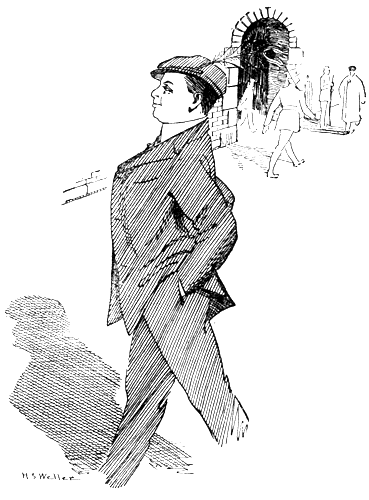
I felt a good deal better after what I'd said, and I think what the soldier said made a hit with him
"Pretty near," I said.
"Oh, from Canada?" he asked.
"No," I said, "I'm from New York State."
"Why," he said, "I was educated in Oneida County, your State."
"Indeed!" I said. "What institution?"
"Hamilton College," he said.
"And your name is?"
"'John Blank'," said he. With a mighty bound I landed in that man's arms. I fell on his neck and wept.
"Dr. 'Blank'," I said, "you're the one man in China I'm looking for. I have a warrant for your arrest."
We got into the dining car, and dined and talked, and talked and dined, and talked, until we reached Tientsin, four hours later.
We changed cars there and rode into Pekin. All the way it was the same level country, well-tilled fields, mud huts, and ugly graves. From Tientsin, a city of 1,000,000, to Pekin, a city of 1,300,000, is ninety miles, and not one-tenth the population in evidence that you'll find on that ninety-mile ride between New York and Philadelphia.
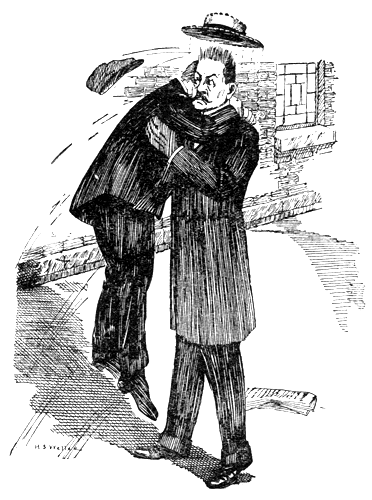
With a mighty bound I landed in that man's arms
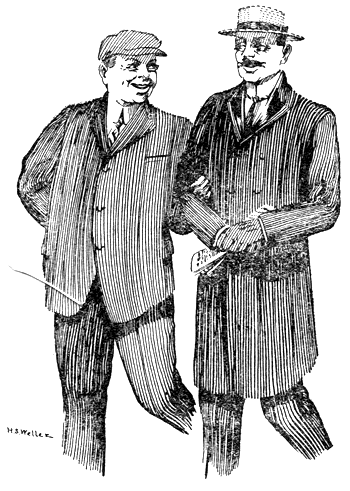
"Dr. 'Blank'," I said, "you're the one man in China I'm looking for. I have a warrant for your arrest"
XIII TEN THOUSAND TONS ON A WHEELBARROW AND THE ANANIAS CLUB
I was glad of the opportunity to come to Pekin, where I might see with my own eyes a Pekin cart.
Modes of travel and transportation have always had a fascination for me.
For instance, I was so captivated with the Shanghai wheelbarrows, that the first thing I did after arriving in Shanghai on my first trip to China was to tackle the first Chinaman I saw in the street pushing one of those empty barrows, dicker with him, and then and there buy that wheelbarrow.
Three dollars was the consideration, but, with first cost, boxing, freight, and duty it cost me $29.05 landed in Clinton—and I've never regretted the purchase.
When telling circles of chance acquaintances and friends at home that a Chinaman would carry a mixed cargo of from five to ten thousand tons on one of those barrows, the chance acquaintances would cast significant glances and cough, while my dear friends would hand me life membership cards in the Ananias Club.
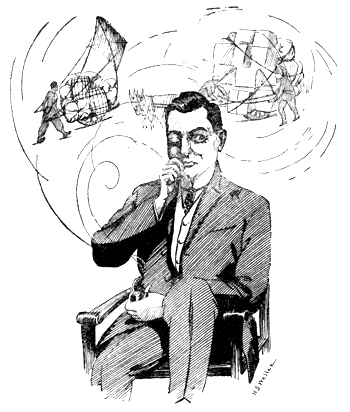
The chance acquaintances would cast significant glances and cough
My only regret in the matter is, that in telling about the Shanghai wheelbarrow I was not acquainted with all its possibilities. When a chance acquaintance doubts my word it's immaterial to me whether he is caught with a nasty little hacking cough, or contracts a violent and fatal congestive chill, and as for those dear doubting Thomas friends of mine who, from me, might have stood for a load of, say from three to five thousand tons—for their benefit I want to chronicle here that as you travel north from Shanghai they put bigger loads on that same pattern of wheelbarrow and rig them up with mules or sails, and I have photographs to prove it; and apologies will be accepted.
Now as to the Pekin cart:
We have all read of it and seen pictures of it, and travelers, irresponsible travelers of no reputation, or travelers without a sensitive and jealous regard for their veracity, have so misled me about that vehicle that what I expected to see was two wheels sawed off the end of a log, set on an axletree, a hood covering, and two stiff saplings for shafts. And, as I shut my eyes to let the picture sink in and tried to recall the motive power, I couldn't recall that there was any motive power. The cart was stuck in an awful rut in the streets of Pekin, and even though motionless, I could hear it squeak. A dead dog was lying to the right of the cart, the carcasses of a couple of cats to the left, and in the cart a load of human corpses—the life having been joggled out of them by being jounced over the awful ruts in the Pekin streets.
But now I find the Pekin cart with a well-tired wheel, having a felloe six inches wide, and for ornamentation studded thickly with wrought-iron headed nails the size of boiler rivets. The wheel is thickly set with spokes centering in a splendid hub set on a well-oiled axletree. The hood, however, is true to the picture, but the whole affair is varnished and shines like an undertaker's cart; and hitched to it is the most splendid mule I have ever seen in all my wanderings.
That mule would redeem any kind of a vehicle he might be hitched to—such a large, fat, well-groomed, glossy mule.
His ears are several sizes shorter than those of the mule of story and of song—an urbane, genial, gentle, loving-looking mule—I don't believe the Pekin mule would kick. Judged from the obvious care that's bestowed on him, the Pekin mule has no kick coming.
And the ruts in the streets of Pekin?—there are no ruts. Wide thoroughfares, well paved.
And the rubbish in the streets? Not there. It's a fairly clean city; a city of many modern and splendid buildings. A city of many legations set in ample grounds, with beautiful and imposing entrances bordered with trees, shrubbery and flowers. A city of ancient Chinese temples; a city set in a fertile plain and walled about—Pekin is a different-looking city than I expected to see.
Martial law prevails—the country is under martial law.
China a republic? A joke!
No more absolute monarchy could be imagined than Yuan Shih-Kai's China today.
An upper and lower house of his own choosing, an autocrat, a dictator, wishing for the old order, and himself the emperor. These are pretty generally the opinions you'll hear expressed. He seems to be the one statesman in a country of 400,000,000 whom foreigners and Chinese generally center on as the only man to hold the reins. Hated by many, feared by more, plots and counterplots against his life—all agree that chaos would result were he taken away.
China today, some say, is a smoldering volcano, but more will not venture an opinion as to what the future holds for her.
With her centuries of conservatism drilled into a population which has submitted to official greed and graft, and accepted it as a matter of course, China has few statesmen, none on the horizon to contest the supremacy of Yuan Shih-Kai, who has seized the reins of power. That China has not fallen to pieces long before is the wonder of students who have spent their lives in China, and the most profound opinion hazarded is—she has lumbered along because she has; and because she has, the chances are she will continue to lumber along. What seems to be her weakness is her strength—400,000,000 patient endurers, with power to endure and not ask too much for the privilege to exist. There are no other people with their peculiar temperament. With a nervous organization that don't give way to trifles, a people who can grin and bear it—this seems to be the opinion of those who are in best position to render judgment.
Greedy nations have stood by and waited for her to fall to pieces, and are even now waiting. China has fooled them right along, and she may fool them yet a spell—so keep your eye on China, but keep on winking.
XIV "MISSOURI" MEETS A MISSIONARY
I found "Missouri" in Shanghai on my return from Pekin, and he seemed to be in a dejected mood. Something had evidently gone wrong with him.
"How do you like Shanghai, 'Missouri'?" I asked.
"Fine," "Missouri" said. "Good town—lot of go."
"Had any rides on these Shanghai wheelbarrows?"
"Missouri" only grinned and didn't go off into wild, exuberant enthusiasm, by which token I knew there must be something the matter with "Missouri."
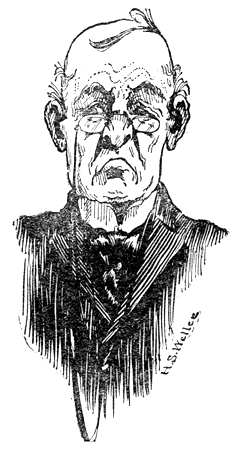
There are some Americans whom even a Shanghai wheelbarrow don't particularly interest
There are some Americans whom even a Shanghai wheelbarrow don't particularly interest. But there are some Americans who can't see anything particularly interesting in lots of things; who go mooning along through life; who, if you told them the moon was made of green cheese, would get into an argument with you on the subject and tell you there must be some mistake about it. But from what I'd seen of "Missouri" I didn't put him down for that kind of an American; and I knew there must have something gone wrong with him or else he'd have warmed up over the wheelbarrows in Shanghai.
"Business bum, 'Missouri'?" I asked.
"Nope," said "Missouri." "Done better than I expected to."
"What's the matter, 'Missouri'?" I asked. "Your false teeth aren't aching are they? You seem to lack enthusiasm. Anything gone wrong since I saw you last? Bad news from home? Long on mules and the bottom dropped out of the market? Has the treasurer of the Epworth League at home run off with the funds, or has your bank cashier run off with your safe?"
"Say, Mr. Allen, the bank's all right. Mules and horses are O. K. Everything is lovely so far as the outcome of my trip is concerned in a business way.
"But that Epworth League is no joke. You see, my town is looking for me to bring home a report on the missionary game out here in the Far East.
"As I've told you, I'm a fairly good proposition where I live—an easy mark when it comes to digging down and boosting anything worth boosting.
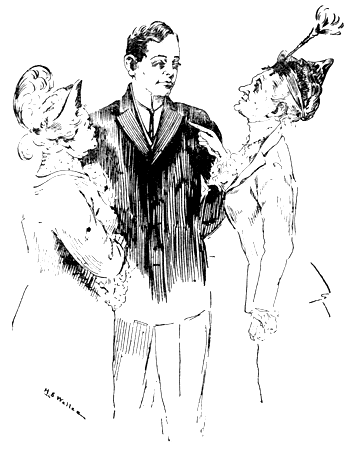
"Women who are interested in foreign missions and preachers in our town set quite a store by me"
"Women who are interested in foreign missions and the preachers in our town set quite a store by me, and I was given that commission to look up the missionary in Tokio and report on his work, and you know all about how I came out on that enterprise.
"I got tied up in Japan, so I didn't go to look his field over—thought I wouldn't have any trouble to get next to missionaries out here, and when you told me how you came out with that missionary in Kioto, I thought it would be a cinch to take back a report from some of these posts.
"Say, Mr. Allen, I'm never going to get funny again as long as I live, if I ever have anything more to do with the 'cloth.'
"After you left me to run up to Pekin I got things shaped around here in Shanghai where I could spare a day, so I looked up the missionaries in the city directory, and by a little inquiry, located one who was said to be a hot tomolie in his line. Didn't have a letter of introduction to him, but banked on my general appearance to carry me through.
"I found my man and told him where I was from. I noticed he was a solemn-looking individual. I lit into him in a more or less free-and-easy way, and that's where I got in bad with that particular dispenser of the gospel to the heathen.
"I told him that I was a business man and that I wanted to learn something of the missionary work to tell about it when I got home.
"From what you'd told me of your experience in Kioto, I rather expected he would enthuse somewhat.
"But he didn't enthuse.
"He made a diamond of the index fingers and thumbs of his hands, held them in front of him, and waited for me to proceed. I looked at him—I looked at him twice. And then I told him of my effort in Tokio.
"I said: 'I started out to do this thing in Tokio; started one Sunday morning, but got tied up in a saki house, where I met a delightful bunch, and didn't get away from that saloon till five o'clock in the afternoon, and I have yet to come in personal contact with the missionary work in the Far East.'
"I meant to say something that would jar his hands out of the position they were in, but it didn't work that way.
"He kept them held just so, and his mouth took on something of the same shape. For about a minute as I looked at what was in front of me I couldn't think of anything but the two of diamonds. Between you and me, that missionary is a two-spot, all right.
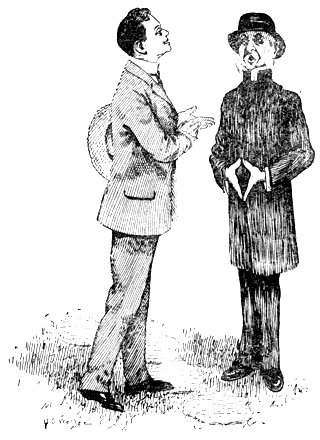
"For about a minute, as I looked at what was in front of me, I couldn't think of anything but the two of diamonds"
"Then I elaborately explained about the automobile breaking down in front of the saki house, and how the keepers of the saki house had befriended us, but the whole story didn't warm him up.
"I discoursed along and tried to overcome the bad impression I had made. I did my level best to make that chap see that while I didn't have any letter of introduction, that it might be well to consider strangers, because we've Holy Writ for it that by so doing a good many have caught angels unawares.
"But that fellow couldn't see any angel in me. He acted as if I had hoofs and horns.
"I was having the time of my life to get through that missionary's crust. I did enough mental and 'charming personality' work to sell a trainload of mules to a business man.
"It was a one-sided confab, but I didn't propose to give it up. I said to myself: 'I've pulled over harder deals in my life than mellowing up and bringing this missionary around.' I went along careful like, discoursing and discussing (if one man doing all the talking could be called discussing)—I'd cash a stranger's check at our bank on half as good a showing as I was making—and I rather thought I was getting by.
"He had shut his mouth, and while he held his hands in that same position, with his mouth shut, he didn't remind me so much of a two-spot. He looked more like an ace, and I thought I was winning.
"And then I let go one that gave him the opening he'd evidently been waiting for. I told him that I hadn't found the cordial relations existing between the business men of the Orient and the missionary cause I had expected I would find—and then he said something. What do you think that missionary said to me, Mr. Allen?"
"I haven't an idea, 'Missouri'. What did he say?"
"Humph!" snorted 'Missouri'. "He said: 'You have probably gathered your information of the missionary work in the Far East from your bar-room associates'."
I laughed. "Hard luck, 'Missouri'. Did you tell him about the funnel and anæsthetic?"
"I did not," disgustedly. "I left him encased in his armor plate of self-righteousness."
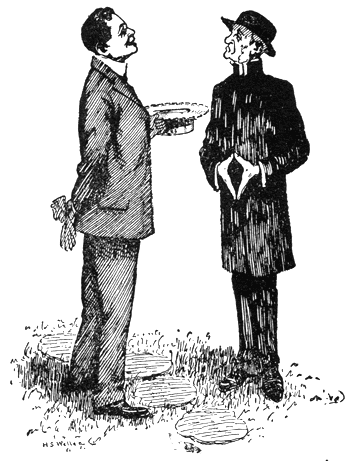
"Humph!" snorted "Missouri," "he said, 'You've probably gathered your information of the missionary work in the Far East from your bar-room associates'"
"Oh, forget it, 'Missouri'," I said. "The missionary work is a tremendous undertaking. There are thousands of missionaries scattered over the world. You can't pick out thousands of men for any great work, in religion, business, politics, or war, without occasionally drafting one whom the French so graphically describe as 'damphol.' That particular missionary has evidently missed his calling."
"Um," "Missouri" pondered meditatively. "Just what sort of a calling would fit that kind of a man? I wouldn't undertake to make a banker of him. I wouldn't trust him with a big mule deal. He'd scare trade away from a country store"—
"Forget it, 'Missouri.' Let's take a wheelbarrow ride and you can use my Kioto experience when you get home—just tell it to your good people as if it had happened to you. Or, if you have time when you get to Canton, go and call on my friend S——.
"He is a missionary. I won't let him know that you are coming to see him, and I won't give you a letter of introduction to him—you won't need a letter.
"Go at him just as you did at your 'two-spot'—you won't fool him—he'll see back of it. You wouldn't have fooled me in Yokohama if you'd declaimed it instead of writing it to me. You're something of a josher, 'Missouri,' but you don't exactly impress even the ordinary run as a gleaner of your views from bar-room associates.
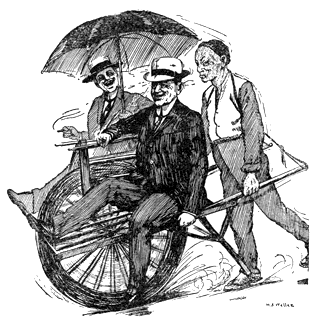
As we jounced along over the bridge in front of our hotel on a Shanghai wheelbarrow
"S—— would have made a whale of a business man if he hadn't given his life to missions. He's a whale of a business man as it is. I misjudge him, and I misjudge you, if he don't work you for a contribution to foreign missions that will make the Board in New York throw up their hats when they hear of it, and show you a story to take back home that will make the tight-wads in your community loosen up when the hat is passed around for foreign missions."
As we jounced along over the bridge in front of our hotel and along the bund on a Shanghai wheelbarrow, passing mixed cargoes of merchandise and passengers on those same homely vehicles, and as I explained to "Missouri" how those were only little loads, how up north they piled on more and more and then rigged them up with sails, the absolute ludicrousness of it all made "Missouri" forget his grouch, and he promised me that he'd try to look up S—— in Canton—and I thought I saw where Missouri mules might be hitched to Foreign Missions—and that's some motive power.
XV A STO-O-RM AT SEA
Since starting my series of travel letters, word has come to me that some of my readers are disappointed that I shied at a description of seasickness—an eminently looked-for and expected dissertation—and instead went off on a tangent about false teeth, which was not in the regular line of letters of travel; and I also learn that the hope is entertained that I will not close this series without describing a storm at sea, the which is a regular, fit, and greatly-to-be-desired adjunct to such a series of letters as I am writing.
I have written on former occasions a description of St. Peter's Church at Rome, taken a running jump at the Pyramids, and once, just once, I wrote a rhapsody—about the Hawaiian Islands—most beautiful spot on earth. But I've always promised myself that I'd leave a sto-o-rm at sea alone.
But when an exacting public drives, a hack must needs travel, and if I must come through with a storm at sea, right here and now is the time and place to do it, as we are in the midst of a typhoon.
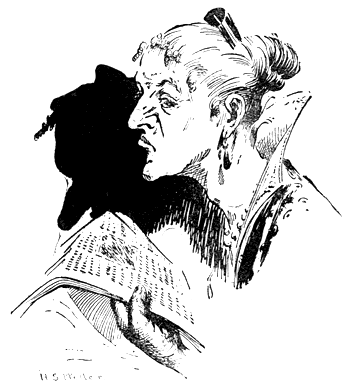
Word has come to me that some of my readers are disappointed that I shied at a description of sea sickness, but instead went off on a tangent about false teeth
Now a typhoon is conceded to be the most colossal kind of a storm, and right here in the China Sea, between Hong Kong and Manila, is the place where they grow the biggest typhoons—this is headquarters for typhoons—and we are now in the midst of the biggest of its kind. So while I have the data right at hand where I can pick it fresh from the hat—get all the local coloring—I'll do the regular and conventional thing, albeit under protest. Ah me! ah my! ah mo! ah me! I say, and then some more. I wish you might be with me now and hear the billows roar. A storm has struck this good old ship, the waves are mountain high, the billows rise, and rise, and rise, and mount up to the sky, while gullies in the vasty deep the valiant ship must try. Down, down she goes, and still down, down, into the depths of hell, and then she strives to rise again on ocean's mighty swell. She climbs, and climbs, and climbs, and climbs—almost she makes the top—the billow breaks—comes crashing down—the ship is in the sop. Ten thousand tons of briny sea come crashing on her deck; another blow like that I fear the gallant ship will wreck. Forked lightning splits the inky sky, with blinding flash on flash, while thunder-bolts shoot up the ship with awful deafening crash. Up through the billows, up she comes, she whoofs, and groans, and creaks—a mightier billow still in store the ship's destruction seeks. She rides the crest, then plunges down to greater depths below; the greedy sea laughs in its glee, then thunderous billows throw o'er bow and poop of fated sloop—they stab her through and through, they wash the captain overboard, likewise his mate and crew. The bos'n and the cook are gone, also the nine-lived cat—on all the ship no soul is spared, no, not one lonesome rat. The ship is lost! Where is the scribe—the boy, oh where is he? Astride the bowsprit, pen in hand, writing a sto-o-rm at sea.
MORAL: Genius should be coaxed, not driven.
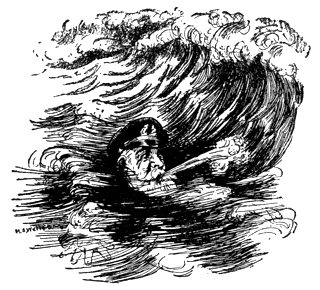
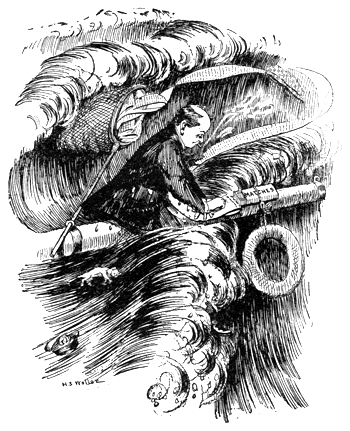
Astride the bowsprit, pen in hand, writing a sto-o-rm at sea
XVI THE ISLANDS "DISCOVERED" BY DEWEY
I arrived in Manila—not seasick—I never was seasick in my life (I've mentioned that before, haven't I?)—but anyone who read my last letter with that degree of attention necessary to get the meat out of letters of travel will have gathered that there was a bit of a blow coming over from Hong Kong, and that it was a rough crossing.
Those of my readers who regret that the bowsprit and I reached Manila are no friends of mine, and any invidious remarks they may make about my last letter are of no consequence to me.
The Philippine Islands are a tropical group. There are about 3,000 of them. They lie between five degrees and twenty degrees north latitude, and one hundred and seventeen degrees and one hundred and twenty-seven degrees east longitude, and they contain 120,000 square miles of land.
The Pacific Ocean washes their eastern boundaries and the China sea the western. The largest islands are Luzon and Mindano—Luzon with about 40,000 square miles and Mindano with 36,000. About 400 of the islands are inhabited.
They are quite a big chunk of land, as big as New England, New York, and New Jersey. Winter never comes; three crops of corn can be raised on the same piece of ground in a year, and six crops of corn fodder.
While they are mountainous, they are not so mountainous as Japan, and have broader valleys of rich, fertile land. They are pretty nearly as large as Japan, without its new possessions of Formosa and Korea, the difference in area being about 170,000 square miles in Japan against 120,000 in the Philippines. They are just a little shy of having 9,000,000 inhabitants, who are chocolate brown in color, have straight hair, and in stature are about the size of the Japanese.
Admiral George Dewey of the American navy discovered these islands May 1, 1898. No one except the natives knew anything about them until that momentous date in history.
We were at that time at war with Spain, a decrepit old nation which hadn't progressed beyond torturing bulls for pastime, when Admiral George, walking his fleet out for a constitutional one morning before breakfast, out here in the China Sea, saw something flying the Spanish flag.
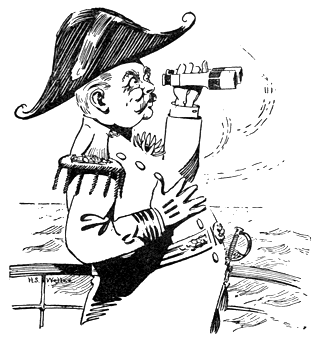
Admiral George Dewey of the American Navy discovered these islands May 1st, 1898
George had got word that we were at war with Spain, and anything flying the Spanish flag was fair game for the doughty George, so he shot it up.
He lowered a boat and rowed off to pick up his game, and found the Philippine Islands.
None of my readers who were old enough at the time to remember anything will fail to recall how the United States went mad with joy over the discovery.
Here this old earth had plugged along until A. D. 1898 and it was supposed that all lands had been discovered except the North and South Poles, and it was pretty well believed if they were ever discovered it wouldn't go very far toward reducing the high cost of living—it was pretty thoroughly believed that it wasn't a good farming country around either of those poles—but to discover, dropped right out of the blue, a veritable Garden of Eden, a land flowing with milk and honey, as big as New England, New York, and New Jersey—our nation went mad, delirious with joy. You all recall it.
When George came sailing home from that wonderful cruise we were for making him President of the United States, and I guess we might have done it if he had known whether he was a Democrat or Republican.
As soon as his flagship was seen in the offing on his return, we went off in a small boat to meet him, clambered on deck, and the first question we popped at him was, "George, are you a Democrat or a Republican?"
George said he didn't know—he thought he was a Democrat. Then on second thought he said he was a Democrat.
But things were in such shape at that time that the slightest suspicion of doubt in a candidate's mind as to whether he was a Democrat or Republican spoiled his chances for the Presidency.
Well, I guess!
Why, a fellow out for the Presidency in those times would wear a great big feather plume stuck in his hat and you could hardly see the plume for the prominent words, "I Am a Democrat," displayed on it.
He might buy a new hat, but the same plume would be stuck in it. And vice versa some other chap seeking the Presidency—while he couldn't wear a plume in his hat saying "I Am a Republican" (the fellow with the plume had that device copyrighted), he would have something else just as effective—a newspaper, or a tariff bill, or a sombrero, or something with which he would proclaim from shore to shore, "I Am a Republican."
While it was tweedle-dee and tweedle-dum which you were, a term of years of that blatant, persistent advertising declaration was necessary to cop out the Presidency.
George had been so busy discovering new lands that he wasn't hep to this, so when we shot that question at him, he said he didn't know. He knew he was a patriot, and all coons looked alike to George, so that was what he said.
Shucks! With that answer George didn't have any more show for the Presidency than a rabbit.
While we couldn't give him the Presidency, we gave him the most popular outburst of a country's gratitude—the most hilarious, spontaneous, delirious paean of praise ever awarded any discoverer of new lands—Christopher Columbus was a piker.
We bought George a house—he shook the sea, married a wife and settled down and lived happily ever after.
We were so grateful to Spain for locating the islands for George that we paid her $20,000,000, because she needed the money.
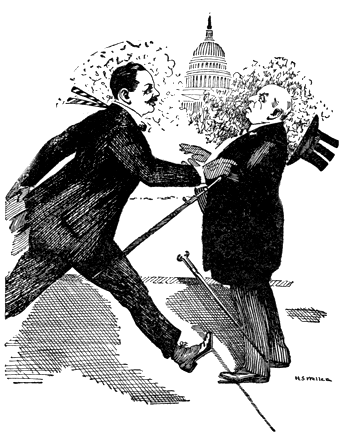
I hit a prominent official in Washington for a free pass on a transport to the Philippines
I got so excited over the new find that I packed my grip, hit a prominent official in Washington for a free pass on a transport to the Philippines—on the grounds of my being an ultra patriotic American—and made a bee line for the Pacific coast. When I got to San Francisco I learned that the next transport for the Philippines wouldn't leave for a week. There was a liner leaving for the Orient that day, so I forfeited my pass and bought a ticket on the liner—I was in a hurry to see these islands. When I got here, shortly after George had discovered them, the Filipinos tried to stuff me with a story about a fellow by the name of Magellan having discovered the islands way back in 1521—blamed if they didn't try to knock out George's patent with a claim of priority.
I looked the islands over from Luzon to Mindano—had a "lovely" time.
I told the Filipinos I didn't take any stock in that alleged Magellan discovery. On their own story about it that discovery was nearly four hundred years old, and, even if it were true, it was moth-eaten, rust-worn, and had no cutting edge.
If they had been discovered nearly four hundred years ago it was high time that there should be some evidence of that discovery to prove it—they hadn't made any use of the discovery.
Manila was the toughest city in the Orient. Dirty, cholera and plague-ridden, out at the elbows and down at the heel, and that general description would apply all over the islands.
But the Filipinos set some store by that Magellan myth. The shock of a real discovery set them off and stirred them up, and they set up a republic, alla samee melican man, and proclaimed Aguinaldo President.
Aguinaldo was running around in the woods somewhere, current historians didn't seem to know just where, and wasn't having any marked success with his Presidency; and, after some argument, was persuaded to quit the Presidency and go to farming.
XVII WHITE FILIPINOS, AGUINALDO, AND THE BUSY MOTH
In my last letter I believe I changed my style somewhat and became an historian. I realize I'm serving up several different styles of narrative in these letters, and know it's taking a chance to adopt the historical. History is dry stuff, but another chapter of it seems necessary to clear the situation at this mile-post I'm passing—the Philippine Islands.
You can't get the President of a republic running around in the woods, and as goodly a land as the Philippines in chaos, and then go off and leave it without some further word of explanation than I gave in my last letter, in which I left the President safely anchored on a farm.
The Philippine Islands at this time were in a fearful mess. The natives were half child, half savage. Dirt, vice, degradation, war, pestilence, everything but famine, were the rule—you cannot starve these people; they live in a land of perpetual summer: clothing not a necessity; and they can pick their living off the trees.
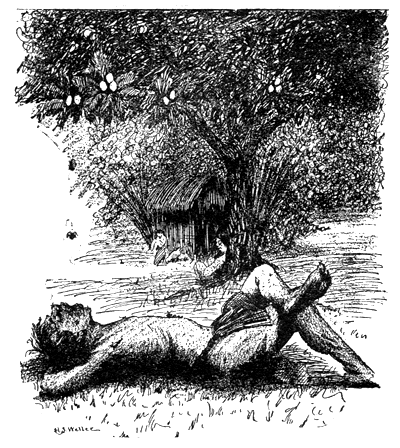
You cannot starve these people; they live in a land of perpetual summer
Under the stimulus of being named "Little Brown Brothers" to the nation which had discovered them, they bucked up and went to it; and they have made the most wonderful progress in the past sixteen years!
From the worst city they have made Manila the best city in the Orient. There is not another city in Japan, China, or India that can equal it in cleanliness and healthfulness, with well-paved roads running through it, and leading out from it in all directions. One of these roads they have made, a hard macadam, none better anywhere, reaches clear across the Island of Luzon, from Manila Bay to the Pacific Ocean, 110 miles. They have actually eclipsed their big white brothers in respect to roads.
We wait until population and improvements in the way of well-tilled farms strike us, and then, after a great while, in rare instances, after enough wagons and horse flesh have been worn out hauling produce over muddy soft dirt roads to build a good road several times, we get wise and build a good road. Not so our progressive Filipinos. They put the road through first. Then, when the country settles up, and the natives decide to come down out of the trees and till the land, there will be a good hard road to haul their produce over.
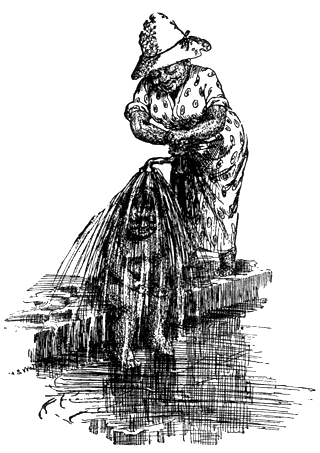
There is not another city in Japan, China, or India that can equal it in cleanliness
We ought to be jarred out of our rut—get discovered.
That 110 miles of road runs largely through rich bottom land, the major part of which is as innocent of cultivation as Adam and Eve were of clothing before the Lord caught them stealing apples.
Occasional villages of nipa palm shacks, stuck up on bamboo poles, are passed, the chief industry of the owners of the shacks being to roost in them out of the sun and rain, when they are not out gathering something to eat that Nature provides without labor. But they have made good roads.
There is not another city in the Orient that equals Manila in hotel accommodations; in an up-to-date telephone system; in electricity and ice; in rapid transit by trolley, carriages, and automobiles; in a fire department, and a live and enterprising press.
These Filipinos are truly a wonderful and progressive people!
I've been so busy stepping over the ground in seven-league boots, jumping from premise to conclusion, that I haven't, perhaps, dwelt enough on details.
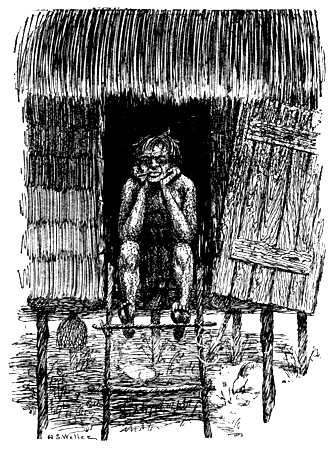
The chief industry of the owners of the shacks is to roost in them out of the sun and rain
The inhabitants of the islands are not all of the same color. There are two colors—white and chocolate brown. The latter is the popular shade—you might say they are the style. The whites are the most dejected, forlorn bunch I've ever seen. They give me the jimjams, the willies, and I want to get away. The Filipinos' wonderful progress dates back sixteen years, from the time the white population began to make its appearance here, and the casual observer might draw conclusions.
But conclusions are the last thing in the world an historian should tamper with. He should confine himself to reciting facts, and let statesmen and politicians draw conclusions—and their pay.
The white population is leaving the islands—those who can get away. Those who can't, whose fortunes are tied up in the islands, put one in mind of a lot of ship-wrecked voyagers, who, with all hope of succor abandoned, are waiting for their ship to sink.
They have expatriated themselves (it amounts to that), and for sixteen years have become acclimated—invested their lives and fortunes in the islands. But they are not the right color—their color is against them.
Back in the old district school days in one of McGuffey's readers (was it the Fifth?) there was a very eloquent speech by some statesman (name has slipped my memory), entitled: "Whither Are the Cherokees to Go?"
It was an impassioned appeal. The reading of that speech used to swell my little chest till the buttons on the little bob-tailed jacket we used to wear in those days, called "a round-about," gave way. Won't someone make a speech for these white Filipinos? They ought to have an advocate somewhere, even though they are white. They aren't to blame for that. The Lord made them that way.
I've been to see Aguinaldo at Cavete, about twenty-five miles from Manila, over a good automobile road. I went in company with Dr. Fitzsimmons, of the Manila Municipal Commission, and Mr. Watson, of the Manila Cable News. Mr. Watson acted as interpreter, as Aguinaldo does not speak English.
We found Aguinaldo at a neighboring village, where he had just been initiated into the order of Masons.
He invited us to go to his home, where we paid him a short visit. I found Aguinaldo a very courteous and genial gentleman, and when I told him that he was spoken of as the George Washington of the Philippines, he modestly protested at the honor of such a comparison.
When I reminded him that he, like Washington, had retired to the farm, he reminded me that Washington took up agriculture after his people had secured their independence, while the Filipinos were still looking for theirs.
I asked him if he thought it for the best interests of the Filipinos to have the islands turned over to them at this time, and he thought it was. I told him it was a great object lesson to the Filipinos to see their foremost countryman turning his attention to the soil, the islands' chief source of wealth, and he told me that many of them were doing the same thing.
After some general remarks we left Aguinaldo on the piazza of his home, which, in comparison with the average Filipino's residence, was commodious and palatial.
He is very much in earnest in tilling his 3,000 acres; and we gave hearty assurance of our most earnest wish that he would come out victorious in the battle he was waging against a pest of moth which was disputing with him the title to his crops.
XVIII SINGAPORE—THE HUMORIST'S CLOSE CALL
There are more different ways of getting in bad than there are to keep out of trouble—a lot more. Indeed, straight and narrow is the road. But there are lots of by-ways leading off from the safe and beaten path, from which one's feet should never stray. In going around the world one can't keep too sharp a lookout for the prescribed highway.
This homely, safe and sane reasoning comes to me with force as I sadly pen these lines here in Singapore, having turned off on a side street that looked all right when I swerved—i. e., I knew it wasn't exactly the middle of the road, but I took a chance, because it looked inviting and I felt sure I could see my way back to the main line.
Leaving the Philippine Islands for Hong Kong, and taking a ship from there to Singapore is only a detail of my present perturbation.
That Hong Kong was an infected port, Black Plague being prevalent, is largely to blame.
I'd be easy in my mind this minute if Hong Kong had not been an infected port. Anyway, if my feet had slipped it would have been on a different orange peel or banana skin.
Singapore has very stringent health regulations against passengers arriving from Hong Kong.
To get into Singapore, to land at the port, one must sign what is called an "Undertaking"; the same being an agreement that if you stay in the town over twenty-four hours you agree to report at the health office in Singapore at 3 P. M. every day. Failing to do this, the penalty is arrest and a fine of $500.00.
The exact minute at which you must report is prescribed—3 P. M. There is no leeway given, as, between the hours of two and three, or three and four.
If you hail from Hong Kong you may land at Singapore, and stay there more than twenty-four hours if you sign an agreement that you will report at the health office at 3 P. M. sharp, daily. Failing this, to the dungeon and $500.00, please.
My only object in coming to Singapore is to tranship for Rangoon; and, as we sailed up to quarantine at 8 this morning, we passed my ship laying at anchor, scheduled to sail for Rangoon at 5 P. M. today.
A row of "undesirables" from Hong Kong for Singapore ranged up in the dining saloon before an austere and awful health official, and were put through the thirty-second degree—it was a meek and patient lot of lambs that passed before the throne of his majesty.
When it came my turn, with my eye on the ship that was going to bear me hence from Singapore, as the gruelling questions were put to me, I told the official I was going to shake Singapore at 5 P. M. today.
Now it will be necessary for you to know the English better than perhaps you do, indeed, even with this increased knowledge you'll still be short unless you know the Singapore English, and, even with that knowledge, you won't be fully enlightened unless you've come in contact with the Singapore English official, to realize what a regular Daniel in the lion's den I was to tell that being that I proposed to "shake" Singapore.
Shake Singapore!
Ye gods!
Tell a Singapore official to his face that you are going to shake the town! A Yankee at that, and from Hong Kong to boot!
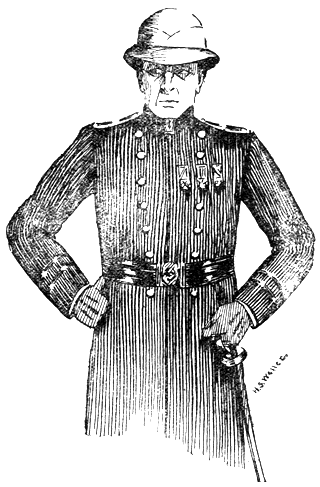
Ye gods! Tell a Singapore official to his face that you are going to shake the town!
A Singapore Englishman feels about Hong Kong, even when not infected, as a St. Paul man used to feel about Minneapolis before Minneapolis put it out of the running.
That Rangoon steamer was due to sail at 5 P. M. this very day, or I wouldn't have dared.
A laugh went down the line of crushed candidates for landing at the heavenly port of Singapore, which helped me to bear the jove-like frown of the official—it helped a lot. It egged me on to further deeds of daring; for when he handed me a duplicate of the undertaking I had signed, to remind me of what I was up against if I didn't report to him at 3 sharp the following day, if I was still in town, with the remark: "Right-o, see that you report at the health office daily at 3 P. M. every day you're in town after today"—with my eye on that ship for Rangoon I came back with: "Right-o, if I don't shake Singapore today you'll find me on the stoop of your office daily at 2:59, so you can feel my pulse and look at my tongue. But, oh man, my only object in coming to Singapore at all is to get out of it. Wouldn't have come to Singapore if there had been a way around it. I don't like Singapore. I think it a measly town. I like Hong Kong. Hong Kong is a nice town. It's got Singapore beaten forty ways"—and it made a hit with the crowd, and I swelled out my chest and swaggered away, and thought I was funny.
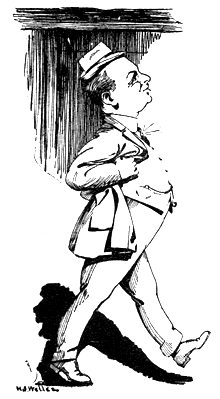
I swelled out my chest and swaggered away and thought I was funny
Now word has just come to me that my ship won't sail today. Owing to unforeseen delays, she won't sail till tomorrow at 5 P. M., and it's the ship's delay, and "the haughtiness of office" for me. I feel just like the melancholy Dane in his famous soliloquy.
I'm in the same fix another fellow was, who thought he would be funny. He was standing on the rear platform of a train that was just pulling out from a town in Illinois, noted for its blood-thirsty, scrappy natives. The train was getting under good headway when this "humorist" thought it would be funny to shake his fist at one of the natives standing along the line, a great big especially vicious-looking citizen, and to promise him one good thrashing the next time he (the humorist) came that way.
Just then the train stopped and backed down to the station onto a siding.
With a blood-curdling whoop that native jumped aboard the train.
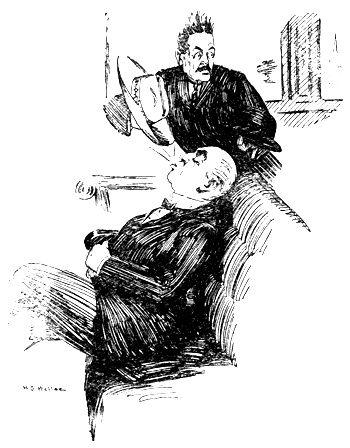
The "funny man" gently lifted the derby from the dozing passenger's head and set his own sombrero in its place
The humorist, who was wearing a wide-brimmed, conspicuous sombrero, ducked into the car, and espying an English tourist dozing and wearing a modest little derby, the "funny man" gently lifted the derby from the dozing passenger's head and set his own sombrero in its place, and sat down two seats back and was nonchalantly looking out of the window as the native raged into the car looking for blood and that fellow with a hat.
There was no mistaking the hat; he spotted his man and was going to eat him alive.
The poor bewildered English tourist didn't know what it was all about. But that didn't go—nothing but blood would answer. It was looking dark for the bewildered Englishman when the rear platform orator stepped up and pacified the native by telling him that the gentleman didn't mean anything—that he wasn't quite right in his head, and in that way blood was averted.
The native got off; the train pulled out, this time for good. After it was fully forty miles from that station, and going sixty miles an hour, the owner of the sombrero stepped across the aisle, and, addressing the bewildered passenger, said: "Excuse me, sir, but I believe you are wearing my hat." B. p. reached for the hat on his head, saw it wasn't his (it was an afternoon of surprises), and handed it to the rightful owner, and, as he was a perfect gentleman, he thanked the man again for his presence of mind in saving him from a beating up. The rear platform humorist, orator, funny man, begged him not to mention it, and the incident was closed.
The funny man left the train at Milwaukee at supper time. The bewildered passenger stayed on and sat all night in a brown study—seemed to be trying to solve something. He reached St. Paul in the morning at sun-up, and with the coming of a new day, light dawned and he jumped up, shook his fist in the direction of Milwaukee, and said: "And domned if I didn't thank him twice, when I should 'ave punched his 'ead!"
Well, it's 7 P. M. I should have been two hours on my way to Rangoon. I'll drop this letter in the mail to catch the P. & O. going west, eat my dinner, and retire and get a good night's sleep; and after breakfast tomorrow I'll think till 2:59 P. M. There's no use worrying, for if worry gets you going it will keep you on the run. No matter what the hole you're in, there is a deeper one. I'll get up in the morning and I'll think, and think, and think how I can put that dread official on the blink, blink, blink. But a Singapore official, oh, he's a mighty gun, and this Singapore official he weighs about a ton—I guess. Still, I will not worry, but then, for all of that, I wish that I'd been wearing a great big sombrero hat.
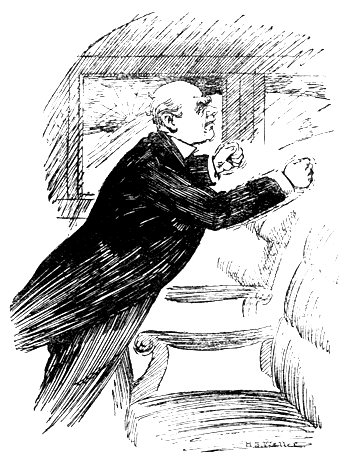
"And domned if I didn't thank him twice when I should 'ave punched his 'ead"
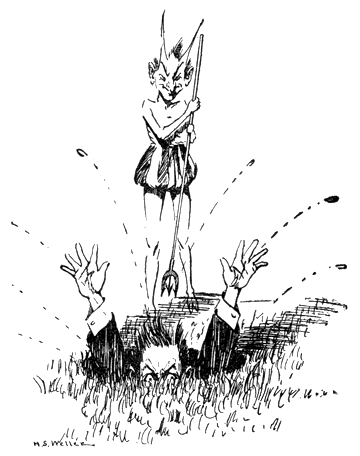
No matter what the hole you're in, there is a deeper one
XIX THE HINDU GUIDE A SAINT WOULD BE
Last evening I wrote you about my perturbed state of mind regarding quarantine here in Singapore.
After chota hazri this morning I thought for a couple of hours, then ate breakfast, after which I met a Hindu in my hotel (there are thirty thousand Indians in Singapore), who looked at me as if he were desirous of opening a conversation.
I stopped, saluted, and said to him: "Did you wish to speak to me?"
"Only to ask you if you wanted a guide for Singapore today. I can show you all the sights of Singapore and explain them to you in understandable English."
"By jove!" I exclaimed. "I believe you can. You speak English like an educated Englishman. What do you want for your day's services? You look like —— ——." I named an eminent American statesman, and he did look like him, too, except for color. I asked the guide if he knew of this statesman of whom he reminded me.
He said he didn't.
"Well," I said, "he is one of the most brilliant men on earth today."
The fellow smiled and showed a splendid set of teeth—a Hindu guide is susceptible to compliments.
"How much do you want for your day's services?" I again asked him.
"Three dollars."
"I'll give you a dollar and a half," I said.
"Pay me anything you like and then you'll pay me more than I am worthy of," he said.
We started off in a gharry, and he surely was a character.
Keen, bright, the most interesting guide I've ever struck—a Hindu.
We talked Hinduism till twelve o'clock, riding around Singapore; and if you think foreign missionaries aren't up against it in their job of converting India from Hinduism, or Brähmanism, you can think again.
He was a great solace to me.
"There are," he told me, "four great tenets to Hinduism:
"First—Don't question the mysteries. No one can solve them.
"Second—Don't worry about the future. No one knows what it has in store."
He frankly told me that the other two had slipped his memory, but he had cinched those two.
With me, number two was enough for today, with my job of thinking on hand.
That guide was a wonder. He was intelligent. There is not one Christian in ten thousand who could give a better argument for his faith than that guide gave me for his faith. He was about as refreshing a character as I have ever met.
He took me through a Hindu temple and laughed at Christians' "ignorance" in condemning the Hindus' idols. Hindus didn't worship the idols; but the Great Being the idols were to remind the worshiper of; they were only links between the worshipers and the Great Being.
He expects to be born over again and to answer in his new existence for the sins he has committed in this life; and the great end to be striven for, is to fly off into nothing and nobody.
"Why," I said, "that's Buddhism."
"Buddhism," he scoffed, "Buddhism is only an offshoot from Hinduism, borrowed from Hinduism." There were saints and sages among Hindus, he told me. Saints could die, sages never. He had tried to be a saint, but gave it up. No one was worthy of what they got, he the least of all. Here he was getting $1.50 a day. If I had offered him anything he would have taken it—10c, 20c, and even then he wouldn't be worthy of it.
"Why in blazes didn't you tell me that before we closed for $1.50?" I asked him.
"I told you my price was $3.00, but that I would take anything you offered me. My offer stands," he said; "you offered me $1.50. At $1.50 I am riding around on a cushioned seat with a gentleman for four hours, as a day's work. Out there, digging in the street, in the hot sun, dressed only in a loin cloth, is a sweating, toiling brother Hindu, putting in ten hours a day for thirty cents. He is entitled to $1.50 for his day's work, more than I am entitled to thirty cents for my day's work."
He was a sinner and admitted it. A most unworthy sinner, and expected to get what was coming to him.
I dismissed him at lunch time to eat my lunch and prepare myself for three o'clock.
XX PENANG—A BIRD, THE FEMALE OF ITS SPECIES, AND THE MANGOSTEEN
I want to draw a veil over my exit from Singapore on this trip.
There are some things that are too painful to talk about. What I think of the quarantine arrangements of that sun-blistered port, and what the health officials think of me will form no part of these notes of travel—suffice it to say that I got by the Singapore health officials. I escaped! I got away! Our expressions of endearment would be a new brand of travel stuff, and there are enough different kinds in these letters now.
After Singapore is Penang; and as I sit in my steamer chair, in my pajamas, in the grey of the dawning of a new day, on the freshly washed teak-deck of the steamer, as it sails through the peaceful strait nearing Penang, I can't see as there is a blessed thing to write about—not a blessed thing. A couple of junks float across the peaceful strait, the soft tropical breeze bellying their sails. One solitary bird, not a seagull, much bigger than a gull, lazily wings its way across the peaceful strait, aiming for the opposite shore. I think it's the female of its species, because when it gets nearly over it changes its mind, turns around, and flies back again across the peaceful strait.
The junks—the bird—the ship with its teak-decks freshly washed—the grey of the morning—the soft tropical breeze—the peaceful strait—me in my pajamas in a steamer chair—the low fringe of hills with cocoanut groves to the east—Penang rising out of the peaceful strait—not a blessed thing to write about.
The east reddens, the sun is going to rise over the peaceful strait. It's a peaceful scene. I've mentioned that the straits are peaceful, haven't I? That feature of the scene especially appeals to me after my exit from Singapore.
But the sun is rising! While this is not an exciting or unusual thing—while one doesn't have to come to Penang to see the sun rise—while I feel safe in boldly asserting that this is a matter of daily occurrence both here and at home, the chances are, kind reader, that you have never seen the sun rise. First you see a bright red convex streak, then the slice of a sphere, then more, and more, and more, and more, and more, and then the sun is up to meet the lark.
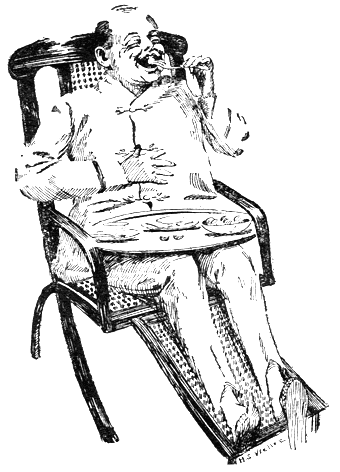
And now there is something to write about—the mangosteen
A Hindu comes with a cup of coffee, some toast, and six mangosteens on a tray, and asks: "Will master have his chota hazri here?" And now there is something to write about—the mangosteen!
The most unprepossessing fruit to look at, the size of a black walnut in its husk; an unlovely dark brown color on the outside. If you didn't know the mangosteen; if a plateful were brought to you for breakfast you'd eye the things askance, and say, "Take 'em away, please; take 'em away." But cut around its circumference through the husk, a quarter of an inch thick, and lift it apart. One of the halves makes a little bowl, its inside the most lovely old rose color, the other half holding a beautiful white pulp. The rich old rose edge of the husk hugs the mound of pulp, the combination making a color scheme to delight an artist's soul.
Insert a fork in the edge of the pulp, lift it out bodily, open your mouth, and—oh, say, after all the other delicious fruits on earth were made and pronounced good by the beneficent Creator, it would seem as if He had said: "Go to, now, let one more fruit be made for man, more delicate in flavor, more delicious than all the rest"—so He made the mangosteen.
XXI BURMA AND BUDDHA
And Rangoon is in Burma, a city of some three hundred thousand, the chief commercial city of Burma.
It is located in the south of that country, on one of the numerous mouths of the Irawadi River. Burma forms a part of the narrow Malay Peninsula, broadening out after Rangoon is reached, coming north from Penang, into a country as large as Texas, bounded on the west by India, on the north by Thibet, on the east by Siam, Laos and China, with the Bay of Bengal washing its southern coast.
Burma is the most thoroughly Buddhistic country in the world.
Now Buddha was not a god, never claimed to be, and is not worshiped as one.
But he was a tremendous personage.
He was born in India 2500 years ago, and after that lapse of time his image and teachings live in the hearts of every third man on earth today.
That fact puts Buddha in a class with such personages as Moses and Confucius.
These men are three of a kind and hard to beat when it comes to putting one's name over into the minds of men and making it stick. A score or so of other mere men since Adam's time, whose names loom large today, are mere pikers in comparison, and need not be considered in this short sketch.
The exact date of Buddha's birth seems shrouded in mystery, but it is placed during the sixth century, B. C.
He was born in the town of Kapila-Vastu. Since that time the town has changed its name to Kohana, and is located northeast of Benares.
Buddha spent his early boyhood in that region. His father's name was Suddodana, which same is a long, hard name to pronounce, but his mother's name was Maya, and she died when Buddha was seven days old, and his aunt brought him up. Her name was Maha-Prajapati.
There is not much known about his youth and early education, except that he was a promising boy and put over everything he undertook.
He was supposed to be a prince of the Royal blood. He was a Hindu, and was faithful to the demands of that faith.
He was married, and when he was thirty years old there was born to him a son named Rahlu.
No one knows how well his family did for him in picking out a wife, but it is of record that he left wife and son and home shortly after the boy was born.
He just left home one day, and when next heard from was at Rajagriha and was leading the life of an ascetic.
Buddha never did things by halves. He was out seeking the way of salvation in rigorous and excessive asceticism, and he went at it with such intense earnestness that he nearly lost his life—he overworked it, and was all played out when he came to the conclusion that he was on the wrong track.
Abandoning asceticism, he gave himself up to a life of thought and meditation, and as a result he gradually evolved his religious and philosophic theory of the general existence of evil, its origin, and its eradication.
He was sitting under a pipal tree in a little village named Buddh-gaya, southeast of Benares, when light dawned upon his soul. As the result of his emancipation of spirit he became a poet.
He became thoroughly convinced that the great end and aim of existence was to attain non-existence: and that the cause of all evil was wanting things. We were here through no fault of our own; that we would continue to be born over and over; and that the next state into which we were born would depend upon how we used our present life.
To illustrate the idea: A tramp or hobo, if he tried to be as good a tramp or hobo as he could, would be born next time to be a roustabout, deck hand, or day laborer.
Continuing to be as good as possible in those callings, the next birth would be a step up, to, say, a bookkeeper, clerk, or possibly a commercial traveler.
The next birth, continuing meritorious in these last named capacities, would be a more desirable existence, and on up, passing the stage of a successful politician with a pull, to still higher and higher existence, until finally, getting out of the trouble and vexation of being any of them, one's individuality would be lost entirely in the great spirit of Nirvana—rest—peace—out of it—finished.
On the other hand, the politician with a pull if he didn't keep his eyes set toward righteousness, would slip down the scale in a future birth, and, continuing bad behavior in new births, run clear down past the hobo to be nothing more than a potato-bug, to end that existence for one even lower than that; unless, perchance, he decided to be an exemplary potato-bug and climb back up again.
After Buddha had thoroughly worked out his solution of life's problems, he settled in Benares, gathered five choice spirits who had been companions in his life as an ascetic, imparted to them his discovery of what he believed to be the path of truth, and spent the rest of a long life developing truth as he believed it.
He had to compete with Hinduism in India, and was only measurably successful there, but his theories captured Burma, and overspread Ceylon, China, and Japan, and, judging by results, anyone making a tour of China and Japan must take off their hats to Buddha. His long ministry was marked with a life of purity, gentleness, earnestness, and firm convictions.
He preached his doctrines for forty years and lived to be eighty years of age.
XXII BAPTISTS AND BUDDHISM
There are twelve million Burmese here in Burma. I told you in my last letter how thoroughly Buddha had, 2500 years ago, captured the Burmese with his doctrines.
For 2400 years Buddha practically had it all his own way. If in that time any other competing religions sought a foothold in Burma, they became discouraged and moved out.
Burma was solid for Buddha.
Buddha had a monopoly and held it against all comers for 2400 years. One hundred and one years ago the Baptists came to contest the field.
They didn't come with a blare of trumpets. One man, a Rev. Adoniram Judson, and his wife started out from Salem, Massachusetts, came to Burma and settled here in Rangoon, to wrest from Buddha his adherents, and add them to the Baptist Church. They worked six years without winning a convert. After one hundred and one years the results are:
Baptists 66,000
Buddhists 10,000,000
from which figures one must agree with me that Buddha ploughed deep and planted thoroughly. The other Christian denominations have about 66,000 members between them.
There are of baptized Baptists in Burma 66,000, all other Christians about the same number. The Christians claim an adherent, or nominal Christian, for every church member; so baptized and nominal Christians in Burma number 264,000.
This makes 10,264,000 Buddhists and Christians. The balance of the 12,000,000 in Burma are non-Christians or non-Buddhists, and are composed of various peoples, and tribes: the Karens, Chins, Kachins, Musos, etc.
But the Baptists admit that the great majority of their converts were not made from Buddhists, but from the Karens, Chins, Kachins, and Musos, chiefly from the Karens.
To quote from the minutes of the Judson Centennial held here in Rangoon in 1913:
"But what of the Buddhist population, which is so greatly in the majority that out of a total of 12,115,217 dwellers in the land, 10,384,579 are returned as Buddhists? From among the Buddhists only 3,197 are members of our own Baptist churches, and a correspondingly small number are members of other communions. It is thus readily seen that, while the success of our missions in Burma has been very great, those who have professed belief in Christ have come very largely from the non-Buddhist population.
"Of the ten million Buddhists, eight million are Burmans, and of Burman Baptist Christians we find but 2,700. Please bear that fact in mind—2,700 Burmans in our churches and eight million Buddhist Burmans. To each Burman Baptist church member there are 3,000 Burman Buddhists looking us in the face as we turn to our task for the coming century."
The Baptists here are hotly contesting the field; bombarding it with a thoroughly up-to-date publishing plant; with a college, schools, and missionaries. For the first twenty years of work we find them with 2,000 converts to their credit.
After half a century of labor we find them with 12,000 converts, while for the full century we find them with 66,000.
A significant fact stands out clear and forceful: They gained in the last decade of work 20,000 converts, nearly one-third as many as they won in ninety years of struggle.
But still Buddhism stands, and Buddha, its founder, after 2500 years, looks with peaceful, quiet eyes from innumerable images set in temples throughout the land—to me more impressive than the Sphinx with the secrets of the centuries locked in its impassive gaze.
Buddha held back no secrets—with burning zeal he preached what he believed was truth. Today one image of the Sphinx, with its riddle—but countless images of Buddha, many of heroic size.
The most impressive one I've ever seen is the Daibutsu in Kamakura in Japan. A temple built in the form of Buddha of solid bronze and silver, with eyes of gold.
This temple was built centuries ago, to keep alive the name and teachings of a man who taught and wrought a score of centuries before this wonderful temple was built—the mystic past steals over you as you look, and you turn and walk away—wondering, wondering, wondering.
XXIII THE RANGOON BUSINESS MAN WHO DROVE HIS SERMON HOME
There is a business man here in Rangoon who, to my mind, has put one over on the missionaries, by seeing their game and beating them at it with a sermon—a sermon with more ring and go to it than anything of that kind I've struck in the Orient—or out of it.
They are really a godless lot out here in the Orient, as we look at godliness; or, at least, profess to.
They haven't any more respect for the Sabbath day on this side of the world (except in a few spots where the missionaries have made a dent in the situation) than a lot of crows have for a farmer's rights in a field of growing corn.
Now, this business man I am writing about was born and brought up in England. He had it drilled into him when he was a boy that we should remember the Sabbath day to keep it holy; and the teaching stuck.
He is a character.
Between the ages of seventeen and fifty-six he got started in life; got rich; retired; and lost his fortune; and when he was fifty-six years old he was broke—down and out.
He came to Burma, prospected for gold until he was sixty-six years old, and the net result of that ten years of gold prospecting was—still broke.
As he had a character just like Gibraltar, he was able to borrow a few pounds sterling, and with it started life all over again in business here in Rangoon.
He got to going to the good; and at the end of five years, when he was seventy-one years old, he had a name and some fame in his line of trade.
At that time the heir apparent to a mighty throne came through Rangoon, touring Burma with his staff.
He heard of this man, and wanted to buy some of his goods. He decided on a Saturday afternoon, that the next day at eleven o'clock he would call at this man's store and inspect his stock with a view to purchasing.
As this potentate was a mighty gun—none bigger—he prepared the way to his proposed visit by sending one of his numerous staff to this man's store Saturday evening, to inform him that at eleven o'clock of the next day his Royal Highness would be around to buy some goods.
It's right at this point in the narrative that this man got there with his sermon. He said: "Present my compliments to his Royal Highness, but tell him I wouldn't open my store on Sunday to do business even with the King of England."
Get that?
Ever been in London, dear old "Lunnun"? They set great store by selling royalty in England. There's a fellow over there in London doing a smashing business in oysters just because he can put up over his door "Purveyor of Oysters to His Royal Highness, the Prince of Wales."
Well, this little-big sermon got back to England, and the result was that in the next five years this man sold goods to royalty pretty well over the world, and got rich. And he is here today; and he tells me that while he has played the game of business for the love of it, he is eighty years old now and is going to wind up. Being without wife or children, he is going to leave his wealth to orphan asylums.
XXIV THE GLASS OF ICE WATER THAT JARRED RANGOON
To come to Rangoon and not go to see the elephants work the teak timber that comes down the Irawadi River would be like going to Venice and not have your picture taken in St. Mark's Square with the doves roosting all over you; or to leave the pyramids without a photograph of yourself with the great pyramid of Cheops for a background.
I plead guilty to the dove picture—it's on our mantle at home—had it taken to please my wife, who was with me on that trip.
The great satisfaction I take in that picture is its proof of my self-sacrificing nature.
Having visited Venice several times before I took my wife there, I knew all about that "picture-with-the-doves" game.
Just before the photograph fiend in Venice, who will photograph an American with the doves for $2.00, an Englishman for $1.00, and a German for 20 cents, made his exposure, I bought my wife a cornucopia of corn that venders sell for a cent, with which to feed the doves.
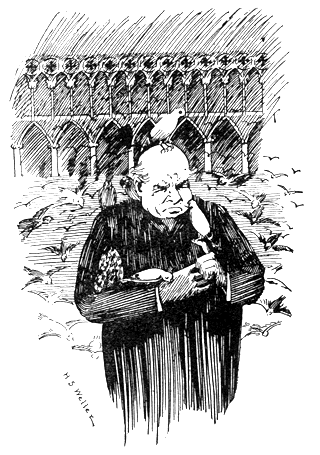
Would be like going to Venice and not having your picture taken with the doves roosting all over you
The woman in the picture behind the cloud of doves is my wife. The man at her side, minus any doves on him to mar his seraphic smile, is myself.
The photograph of me at the pyramids, taken on a former trip, would be a pretty good picture of me, too, if my natural modesty hadn't got the better of me, which modesty prompted me to get behind the pyramid when the photographer made his exposure.
This photographer is on the ground and does a rushing business photographing globe trotters at the pyramids. The pyramid being betwixt me and the camera made a failure of the picture so far as being a good one of me is concerned; but I'm ready to bet good money that I'm the only world tourist who can show a photograph of Cheops without a globe-trotter in the foreground. It's a good photograph of the pyramid.
But really one shouldn't leave Rangoon without seeing the elephants work the teak logs.
The human intelligence of the animals, coupled with their great strength as they push the logs into place, accurately measure distances, walk back and forth to study the problem of how best to place a log, and then roll and put it into place, is one of the sights worth seeing in Rangoon; which, in itself, is a town worth seeing.
A city well laid out with wide streets running at right angles, extending several miles along the river front, and a mile inland.
Many beautiful lakes are in the suburbs, and tropical parks abound: and it is the third city in British India.
It's an old, old town. Its chief attraction to draw visitors from the ends of the earth is the great Shwe Dagon Pagoda, the oldest Buddhist temple in the world, the foundation of which was laid 588 B. C.
And Rangoon has trolley cars and water-works, and electric lights, and an ice plant.
And ice is a precious commodity in Rangoon. In fact, ice is a precious commodity in any Oriental city excepting Manila.
In Manila they have caught onto the idea that ice is not a deadly poison or precious stones.
I attribute it to the influence of the white Filipinos living there, who are wonderfully like Americans in taste, habits and general all-around desirableness.
Ask for a glass of ice-water at a hotel in Rangoon, or Hong Kong, or Pekin, or Yokohama, or Calcutta, or Bombay and watch what happens.
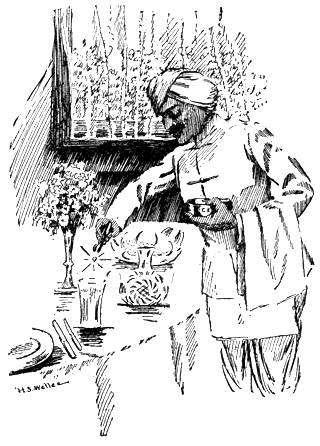
The only thing of note in the whole transaction is the boy's self-satisfied air of having done his whole duty
Your table boy will bring you a high glass of tepid water and drop a piece of ice in it as big as a hickory-nut, and the only thing in the whole transaction worthy of note is the boy's self-satisfied air of having done his whole duty.
I have demoralized the whole running-gear of the best hotel in Rangoon—I'll be known among the hotel fraternity of Rangoon in future as the "ice man" who visited the town in 1914.
Becoming weary of watching that little nugget of ice in a large glass of tepid water, doing its best to chill the water as it rapidly diminished to the size of a two-carat diamond, finally to dissolve entirely in an heroic effort to make good, I called the table boy to me and ordered him to empty the glass and bring me the several receptacles in the dining room that held ice for all the guests. Fishing enough nuggets from the lot to pack the glass full of ice, I ordered it filled with water—looked up at the boy and said: "Savvy? Ice-water!"
I leave town today for Calcutta—that glass of ice water has jarred Rangoon.
XXV THE CALCUTTA SACRED BULL AND HIS TWISTED TAIL
Did one of your old readers, kind friend (I think it was McGuffy's Second) way back in childhood days have a little poem in it all about a lot of little girls playing a wishing game? It's over forty years ago that I read that little poem, and I can only remember one little girl's wish.
She said: "I wish I were a flying fish, o'er ocean's sparkling waves to sail, a flying fish, that's what I wish, 'mid Neptune's blue to lave my tail."
Not having read that little poem for over forty years, and not having the book with me out here in Calcutta, I may not have quoted the lines verbatim, but as near as I can recall it, that's what she said.
That little girl didn't know what she was wishing for or she'd sooner have wished to be a devil bug.
The flying fish has got that old saying, "Between the devil and the deep sea," beaten to a frazzle.
The life of a flying fish may look all right to the unsophisticated, but things are rarely what they seem, and a flying fish's life is a hard lot.
She said: "I wish I were a flying fish, o'er ocean's sparkling waves to sail"
Chased up out of the water to escape the jaws of some horrid sea monster seeking to make a meal off it, it spreads its silvery wings o'er "ocean's sparkling waves," when a seagull comes along, and—good-bye little flying fish.
Now if I'd been one of those little girls playing that wishing game and had known as much as I know now, I'd have wished to be a sacred bull here in Calcutta.
That's one fine job—the life of a Calcutta sacred bull.
I stepped out of my hotel today onto one of Calcutta's best streets, with a pavement twenty feet wide, filled with pedestrians, lined with splendid shops.
Calcutta is a town of one million inhabitants and is the second city in size in the British Empire.
Just at the side of the entrance to a fine jewelry store lay a great big fat and glossy sacred bull, with a garland of roses round his neck, placed there by some devout Hindu.
"Twist his tail," I said, "that will start him"
The natives would stop and fondle and brush the flies off him. Stopping to look at the novel sight, and giving the fine old fellow a few gentle strokes, I turned to my guide and asked him to tell the natives who had stopped to witness the foreigner's interest, to make the bull get up. I wanted to see what he would do.
A native pushed him in the flank and ribs, but Mr. Bull only smiled, and as plain as words his actions said, "No, thanks, I'm perfectly comfortable here."
"Twist his tail," I said; "that will start him."
The native gave his tail one twist. The bull looked around with a surprised air and anyone could see that he said, "That's a new kind of a caress," but he didn't get up.
"Twist it harder," I said.
Three turns of the tail brought him to his feet, and he walked leisurely along the crowded thoroughfare, perfectly at home, wearing his garland of roses as naturally as a girl would wear a string of beads, receiving a gentle pat from the native passersby—even an English girl put out her hand and gave him a stroke in passing.
He was a great big, glossy, docile pet, expecting and getting a wealth of love.
I am told that when he is hungry he goes to a green grocer's store and makes a meal off the grocer's cabbage, with no protest from the grocer, after which he goes to a confectioner's shop for a dessert—and gets it.
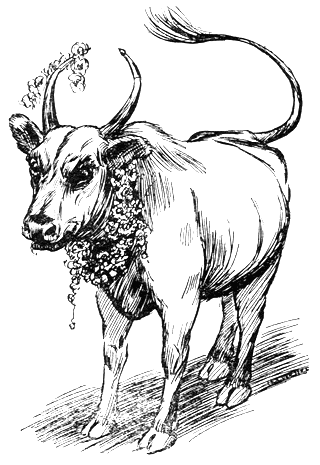
"You stay where you belong. I'll do the sacred bull business around this neck of the woods"
There are scores of sacred bulls in Calcutta. They have their special stamping ground. Let one bull poach on another one's preserve and there is a bullfight then and there. Not a Spanish "bullfight"—seven or eight trained athletes against one bull, with death for the bull a foregone conclusion—but a real, genuine, interesting bullfight, with the victor's tail in the air.
And it's a dull person who can't understand that that bull is saying to the vanquished one: "You stay where you belong. I'll do the sacred bull business around this neck of the woods."
XXVI THE GUIDE WHO WOULDN'T SIT IN "MASTER'S" PRESENCE
I call him Lal.
The rest of his name is too long for week-day use. He is my interpreter, my guide, my servant, my counselor, and my friend.
I have hired him for a two weeks' trip across India. He is considerable of an erudite gentleman—speaks several languages.
I speak only one, and I do queer things to that one lots of times.
But Lal doesn't try to impress me with his superiority just because he knows a lot more than I do—quite the reverse.
His wages are a rupee a day, out of which he feeds himself. That was his own price. I'm paying him all he asks. I've been told that I'm paying him too much, that he has stung me. A rupee is thirty-two cents!
But he is a superior guide. He admits it himself. To prove it he showed me a sheaf of recommendations from American globe-trotters whom he has guided across India in days gone by.
A good many of those recommendations are frayed at the edges through much showing, but I wouldn't mind having some of those names on a blank check, with privilege to write the rest of the check myself.
Lal tells me he is the "Professor" of the guides.
I hired him yesterday. He calls me "Master." That's regular. All servants and guides in India call their employers "Master."
With a two weeks' trip to plan across India, with a map of India, hotel guides and railroad time-tables, pencil and paper spread out before me in my room this afternoon, I said: "Draw up a chair, Lal, and sit down. Here is a two hours' job before us."
"Excuse me, 'Master'," Lal said, "but if 'Master' will excuse me I will not sit in 'Master's' presence."
Get that?
Royalty, don't you know?
Lal got "Master" in only three times in that sentence. I've known him to bring it in four times in a shorter one.
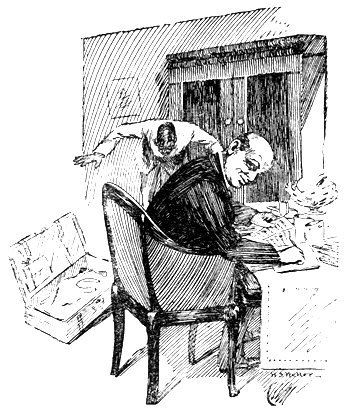
Get that? Royalty, don't you know
In addition to Lal's numerous duties—standing between me and the natives, brushing my clothes, looking after my laundry, making my bed in sleeping cars, and watching my goods and chattels while I take my meals in the dining car, and a score of other such duties, Lal was looking after "Master's" dignity.
Lal, old boy, after that gentle reminder, I'll know my place.
If there's nothing else to do, I'll let Lal fan me. I believe it's one of the prerogatives of Royalty to be fanned by vassals.
These Indian guides are a class by themselves. Many of them have traveled far.
Picked up by travelers for a tour across India, they are frequently taken to England and through Europe. For instance, Lal has been to England and Boston. In speaking of India he says: "My India," "my Calcutta," "my Bombay," and there isn't much about India he doesn't know.
They travel third-class, which is ridiculously cheap in India. The tourist, of course, pays his servant's railroad fare and must land him back to point of hiring him.
Lal's home is in Calcutta. I will have finished with him at Bombay and will have to send him back to Calcutta, across India, fifteen hundred miles, and that item of expense will be sixteen rupees six annas—all of five dollars and twenty cents.
It's hard lines to pour out money in this way on Lal—but Royalty is expensive anyway.
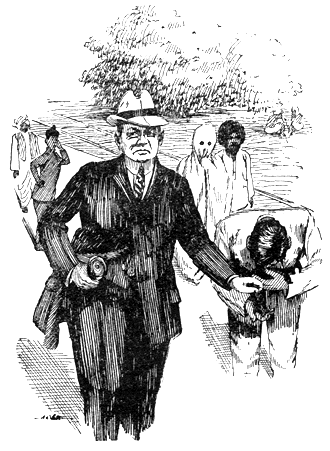
It's hard lines to pour out money in this way on Lal—but Royalty is expensive anyway
XXVII ROYALTY VS. "TWO CLUCKS AND A GRUNT"
To go across India from Calcutta one of the necessary things to consider is a railroad ticket.
After my vassal and I had planned an itinerary we called a victoria, or rather Lal flagged a Hindu driving a team hitched to one.
It was rigged for a footman at the rear. The footman was there, too, ready to open the door for "Master" when he wished to enter or alight.
This truly regal, royal outfit cost twelve annas for an hour's drive, and that's twenty-four cents.
You can work the Royalty racket in Calcutta cheaper than you can hang over a lunch counter and eat baked beans in America.
Now Cook's tourist agency has booked me from Hong Kong to New York via steamer, first-class, over the Peninsular and Oriental line, P. & O., for short.
That means steamer from Hong Kong to Calcutta via Singapore, Penang and Rangoon.
I have to pay my railroad fare across India to Bombay, and from that port privilege of P. & O. direct to London, via Aden, Port Said, Gibraltar and Marseilles, and home from London via any American or British line I choose from London.