CHAP. XVI.
Reading edition

EXTRACT FROM THE JOURNAL OF SIDI-CARACHI ON HIS RETURN FROM GALAM TO ISLE ST. LOUIS. — FARTHER PARTICULARS OF THE COUNTRY IN THE ENVIRONS OF GALAM.
SIDI-CARACHI, the Marabou Moor, who accompanied my traveller to Galam, set off to return to Isle St. Louis on the 29th of March, 1786. As he did not exactly come by the same route which he went, I shall give an extract from his journal, which will shew the distance of the journey by hours, from Isle St. Louis to Galam[3].
* From Tombaboukané to Golombo, 6 hours.
* Golombo — Médiné 5 ditto.
Médiné — Kainoura, 7 ditto.
* Kainoura — Gougiourou, 5 ditto.
Gougiourou — Sambacolo, 5 ditto.
Sambacolo — Buggil, 6 ditto.
** Buggil — Coussan, 5 ditto.
* Coursan — Coudi, 4 ditto.
** Coudi — Granado, 6 ditto.
** Granado — Tellika, 5 ditto.
** Tellica — Gambia, 8 ditto.
* Gambia — Kolor, 6 ditto.
** Kolor — Lamen, 8 ditto.
Lamen — Caldenne, 4 ditto.
* Caldenne — Cafime, 6 ditto.
* Cafime — Maleme, 5 ditto.
* Maleme — Passe, 6 ditto.
* Passe, four days travelling in the woods to arrive at Kiamen, eight hours march per day, 32 ditto.
* Kiamen — Caka, 6 ditto.
* Caka — Gury, 5 ditto.
* Gury — Hicarkor, 6 ditto.
* Hicarkor — Douai, 4 ditto.
Douai — Gasama, 6 ditto.
Gasama — Kibi, 5 ditto.
* Kibi — Coqui, 7 ditto.
Coqui — Betel-Diabi, 5 ditto.
* Betel-Diabi — Mériné 6 ditto.
* Mériné — Keainderain, 4 ditto.
Keainderain — Mériné-Giob, 5 ditto.
* Mériné-Giob — Maricamp, 5 ditto.
Maricamp — Gandiolle 7 ditto.
* Gandiolle — Isle St. Louis, 6 ditto.
Total 206 hours.
These 206 hours journey are calculated at the rate of three-fourths of a league per hour, a progress which appears reasonable, and which gives the distance of 154½ leagues. By the river, it is estimated at not less than 300 leagues; which makes an enormous difference; while it is evident that the abridgment of the journey nearly two months, in consequence of performing it by land, is the least advantage which Europeans will derive from the discovery.
I have said that Sidi-Carachi left Galam on the 29th of March; he arrived at Isle St. Louis on the 22d of April following. He performed his journey homewards without experiencing the least obstacle, and was every where received with the most generous hospitality. He returned upon one of the camels which had gone with the party to Galam. At the village of Sambacolo he was treated with great distinction. The place is remarkable for being inhabited entirely by farmers and hardware-manufacturers: the latter comprise sword-cutlers, smiths, farriers, and copper and gold-smiths, but they have neither forges nor shops. They work outside their houses, under the shade of trees, and convey the whole apparatus of their trades wherever they wish to move to; their working materials, however, consist only of a very small anvil, a goat’s-skin which serves them for bellows, a few hammers, a vice, and two or three files.
These workmen are naturally so indolent, that they always sit at their employment, and are incessantly talking and smoking. They never work alone; for the smallest job requires at least three assistants: one blows the bellows, and uses all sorts of wood for fuel; while the other two sit with the anvil between them; and in this posture they beat the metal carelessly, and with as little strength as if they were afraid of hurting it. Nevertheless, they manufacture articles of gold and silver, which appear by no means common; and if they were less idle and better informed, they would become excellent workmen.
In the articles which they make from iron, they are equally adroit; and the temper which they give to their cutting instruments is perfect. They have iron mines, but they prefer iron from ours, which we convey to them in bars. I have already observed, that these bars are considerably reduced, and serve for money, in the bargains which we make with them. Our iron ought to be nine feet long, two inches wide, and four lines thick: it is divided into fifteen parts, of seven inches and a half in length, which are called flaps, four of which form the bar.
Sidi-Carachi speaks, in his journal, of a tree which is found in these environs, where it is called Sanare: it is about the size of a large pear-tree; and its leaves, which resemble those of the rose, are always green. Its wood and flowers are odoriferous, and the Negroes use them to perfume their huts. They carefully preserve this species of tree, because the bees delight in it, and they sell their wax and honey to the English.
At Kiamen, Sidi-Carachi lodged with a Marabou Negro, who was the richest and most respectable of the inhabitants. This man enjoyed the highest reputation, on account of his holy character; and people came from very distant parts to make him offerings, and buy his gris-gris. He behaved extremely kind to his brother in Mahomet; and after talking on the object of his journey, he spoke about the desert which our traveller had just passed through. “It is there,” said the Marabou Negro, “in a vast place surrounded by trees, that I perform the august ceremony of circumcision.”
This ceremony takes place in the following order:—The procession is led by the Guiriots, who beat their drums, and march with a solemn step, without singing: they are followed by the Marabous of all the neighbouring villages, who are dressed in white, and walk in pairs. At some distance onwards, are placed the young Negroes who are to undergo the operation: they wear no breeches, and march one after the other, holding a large sagaye in the left hand: they are accompanied by their relations, who not only witness their profession of faith, but excite their courage to support the pain they are about to suffer, which, though very acute, the patients must not seem to feel.
The principal Marabou, or he from Kiamen, walks after the candidates, and the procession is closed by a body of armed men. On reaching the spot, the Marabous place themselves on each side of a plank, which is raised on two benches in the midst of the circle. The candidates and their relatives stand opposite to the platform, at the distance of about fifty feet, in the same order in which they arrived; and the armed men surround the place of sacrifice.
The Marabou operator then turns himself towards the east, says a sala or prayer, which all the assistants repeat with much gravity. This ended, the first candidate, followed by his friends, approaches the plank and bestrides it, taking off the pagne which covers his shoulders and body. The Marabou takes the prepuce, draws it as far as possible over the gland, holds it between his fingers, and quickly separates it with a knife. The Negro then gets from the board, retires laughing, and does not seem to mind the bleeding of the wound. The other candidates submit to the same ceremony, and all remain in sight till it is over.
When the wound has bled for some time, it is repeatedly washed, and this is continued every day with fresh water till it be healed, which generally takes place in ten days or a fortnight. This cure must be performed without any drug; and all the patients, when descending from the plank, are obliged to assume a cheerful aspect, though many of them are so much overcome as to require the help of their friends to conduct them away.
When the wounds are healed the patients make a tour through all the villages, and raise contributions for a public festival.
These people are rigid observers of all the laws of Mahomet; and one of their duties, which they exercise to the utmost extent, is to rob and cheat the Christians as often as possible. They say prayers five times a day, and on Friday, which is their sabbath, seven times. The Mahometans of Senegal only pray three times daily, viz. at the dawn, at noon, and at sun-set: for want of mosques, they meet in the place appropriated for public business, and join in prayer with much devotion and gravity. The ceremony lasts about half an hour each time, and no excuse is admitted for non-attendance. On praying they always turn their faces towards the east; but on the contrary, when they wish to satisfy the wants of nature, they turn towards the west, and crouch down like women.
All Mahometans are obliged to fast once a year for an entire moon, and this fast is called the ramadan. The period at which it takes place, changes annually, in consequence of their year being a lunar one, which makes it ten days shorter than the solar calculations; but the less informed Negroes, fix their fast on the appearance of the September moon, or the autumnal equinox. As soon as it appears, they salute it by offering it their right hand, which they previously spit in; they then bow their heads towards it, and walk two or three times in a circular direction.
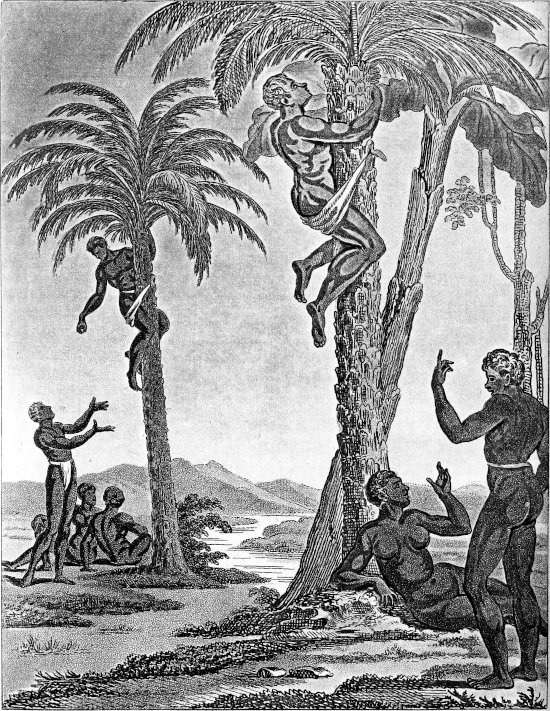
Negroes Swarming Trees.
All the Mahometans have a great veneration for the moon, insomuch that they never fail to salute it as soon as it rises. They present it their open purses, and pray that it will cause their money to increase, as it grows. They call their months by the name of moons.
Sidi-Carachi stopped at Gasama, a large village situated in a valley, which contains a prodigious number of palm-trees of every kind, and with the wine from which the inhabitants carry on a considerable trade. It is a liquor which runs from the top of the tree by means of an incision, and is of the consistence and colour of skimmed milk; it ferments like champaign: it is sweet when it issues from the tree, but becomes sour in a few days, and speedily changes to vinegar; notwithstanding which the Negroes frequently make it their common drink. This wine is very spirituous, and the intoxication which it produces often gives rise to fatal effects. One branch of these trees will frequently yield, from a single incision, two quarts of wine in twenty-four hours, and continue running for thirty or forty days; after which the Negroes, who interest themselves to preserve the trees, stop up the hole with clay, in order to give the sap another direction. Each branch will bear an incision, with the same result.
One manner of drawing off the wine is, to make a hole at the top of the tree, in which they fix a cane, to conduct the liquor down into their pots. The Negroes do not know why this method is preferable, but they say, that they pursue the means adopted by their forefathers: the reason, however, is obvious; for if the tree were perforated towards the bottom, the sap would run off before it had imparted any nourishment to the tree; and it is likewise ascertained, that the higher the tree, the more sweet and rich is the wine.
The Negroes do not use ladders to ascend these trees, but climb by means of a strong rope of cotton, or of palm leaves twisted together: this rope is long enough to embrace the trunk of the tree and the body of a man, leaving about two feet between them. The Negro encloses the rope by means of a button and loop, and then, by a circular motion, ascends the tree with the greatest confidence, having his arms at liberty to perform any operation.
Besides the wine, the Negroes derive from a certain species of the palm-tree, a kind of oil, which they eat, and use for anointing their bodies; it renders their skin glossy, and their joints supple. This oil has the taste and consistence of butter. The Europeans employ it in their cookery, and find it very good when fresh; but if kept for a time, it becomes rank, and loses its colour, taste, and smell. It is said to possess some medicinal virtues, particularly in the gout, the pain of which it relieves.
There are several species of palm-trees, all of which are produced in Africa in great abundance. Those which are found on the banks of the Senegal, afford no fruit; nor did I ever find any dates amongst them, though I made a particular search. Why these trees are barren in the positions just mentioned, I cannot perceive, as they bear fruit in the interior and on the coast of Barbary.
I have now said enough to shew the utility of the journey that I have described. I received through Rubault a letter from Sirlan, prince of Galam, stating that soon after my envoy’s arrival, he had procured for the company upwards of 200 slaves, and a quantity of gold and ivory.