CHAP. VI.
Reading edition

OF THE ISLES OF THE BISSAGOS AND THEIR INHABITANTS. — RECEPTION OF M. BRUE ON THE ISLE OF CAZEGUT. — ACCOUNT OF A PIRATICAL EXPEDITION. — COSTUME OF THE PEOPLE OF CAZEGUT. — PRECAUTIONS TO BE TAKEN ON TRADING WITH SEVERAL OF THE ISLANDS. — SANGUINARY AND TREACHEROUS CHARACTER OF THE PEOPLE.
ON passing the mouth of the rivers of Casamança and St. Domingo, you meet between Capes Rouge and Verga, with a large deep gulph, in which are several isles of various sizes, and inhabited by different tribes. You first observe the archipelago of the Bissagos, which takes its name from the people who inhabit its islands.
The French after discovering these spots, abandoned them on account of their wars in Europe. The Portuguese who inhabited the isles of Cape Verd, succeeded them, but were too weak to maintain the possession. The descendants of the first colonists, who are confounded with the aborigines, still live there in a humiliating and precarious condition; notwithstanding which, they pretend to be sovereigns of those isles, and have at different periods built several villages and forts; but the French have paid little respect to their pretended rights, and have established factories wherever they pleased.
The Bissago isles are about eighteen or twenty in number; the most considerable are Casnabac, Galline, Cazégut, Carache, Aranguena, Papaguaye or Parrots’ isle, Formosa, Babachoca, Bisague, Ouarangue, Jatte, Bussi, Bourbon, Bissaux, Bulam, and a few others which are less known, because they are less frequented. Of those which I have specified, the last two are the most important.
The archipelago of the Bissagos is nearly fifty leagues in length, by an unequal width. The isles are enclosed by a large chain of rocks, between which and the isles of Jatte, Bussi, Bissaux, and Bulam, which are near to the continent, is a canal three or four leagues wide, and in no part less than one league: it generally contains from eight to twelve fathoms of water, with a muddy bottom. There are several natural harbours in theses islands, which contain all the materials necessary for forming establishments.
Each of these isles is governed by a chief, who assumes the title and authority of a king; these petty princes are independent of each other, and sometimes make war amongst themselves, but they more frequently unite against the Biafares, who are their greatest enemies, and whom they have expelled from Bulam. They have canoes large enough to carry from twenty-five to thirty men with their arms, which are sabres and darts.
The Bissagos are large, strong, and robust people, though they feed only upon shell and other fish, palm-oil, and the nuts of the palm-tree; they sell to Europeans the millet, rice, and other vegetables which they produce. They have an extreme liking for brandy, which they drink in great quantities, and which is sold to them at a high price; indeed their propensity for this liquor is so great, that it renders them furious and unnatural. As soon as a vessel appears for the purpose of selling that article, they always quarrel amongst themselves about who shall obtain the greatest quantity, and be first served. The weakest on these occasions become the prey of the most powerful. The father sells his children; and if the son can seize his father and mother, he conducts them to the Europeans, and barters them for brandy; he then gets drunk, and continues so as long as the quantity will last, at which his relatives have been valued.
All these people are idolaters, and naturally cruel. They cut off the heads of the men they kill, drag their bodies through the streets, scalp them, dry the skins with the hair on, and ornament their houses with them as a proof of their bravery and victories. Their envious character renders suicide very frequent amongst them; the least chagrin induces them to turn their rage against their own persons. They hang themselves, jump from precipices, and throw themselves into the sea, while the most brave amongst them terminate their existence with the poniard.
Besides these general characters, there are distinctive traits amongst the inhabitants of the different isles: that of Formosa, the most eastern of the whole, is planted with the finest trees, which they consider as the residence of gods. They give a delightful aspect to the island, which, however, is uninhabited.
The isle of Galline and that of Casnabac, are at the head of the bank: they are populous and fertile; their shores abound in fish, and they contain plenty of fresh water. Nothing is wanting amongst the inhabitants, but an industrious disposition, to render them a social race. The isles in general are very fertile, and capable of supporting large colonies.
The isle of Cazégut is one of the most extensive, being six leagues long by two wide: it is surrounded by banks and shoals, except at its N. E. and S. W. points, where vessels can anchor in perfect safety. It abounds in fruit and timber trees, as well as in rice, pumpkins, peas, and every species of culinary vegetables. The Negroes are idolaters, and sacrifice cocks to their divinity; in other respects, they are very sociable and honest in their dealings. The trade which they carry on with the Europeans has refined their manners; and they have learned from the Portuguese the manner of building large and convenient houses.
M. Brue visited this island, and received on board his ship the greatest person belonging to it, except the king, to whom he was a near relation: this prince, accompanied by only two Negroes, came with great confidence on board the French frigate: he had only a piece of cotton round his loins, and a hat on his head; while his hair, which was almost red, was greased with palm oil. He saluted M. Brue very civilly, took off his hat to him, and said, through his interpreter, that the island was at his disposal. While they were in conversation with this prince, and were making him drink brandy, a canoe arrived from the island, having on board five men. One of the Negroes came on board holding a cock in his left hand and a knife in his right: he fell on his knees before M. Brue, then rose, and turning to the east, cut his cock’s throat; he then went upon his knees again, and scattered a few drops of the animal’s blood at M. Brue’s feet. He performed the same ceremony at the masts and at the pump, and then presented the cock to the French general: the latter wished to inform himself of the object of these ceremonies, and was told by the Negro, that the wise men of his country considered the whites as the gods of the sea, and that the mast was a divinity which caused the vessel to walk; while the pump was a miracle which made water rise, whose nature it was to fall down. These Negroes retired on the approach of night; and M. Brue promised the prince that he would visit him next morning.
He went according to his appointment, when the Negro prince received him on the shore, gave him his hand, and led him to his house, which was about 300 paces from the sea: it was large, built in the Portuguese style, and white-washed within and without; it had an open vestibule at the entrance, was surrounded with large palm-trees, and had convenient articles of furniture, including very neat chairs and stools of black wood. After offering M. Brue refreshments and palm wine, he led him to another building, about fifty paces farther: this was a chapel, with an altar and benches, and a bell was attached to a tree before the door. The prince ordered it to be rung, and said to M. Brue, who was singularly astonished at what he saw, that he had built this church himself for the use of the Christians who might wish to settle near him; that he was no Christian, but that he loved them; and that if some priest would come and live with him, he would let him want for nothing. M. Brue promised that he would send him a priest and some Frenchmen to live on the isle under his protection.
The king resided about a quarter of a league from this spot, and M. Brue was presented to him by the Negro prince, who received him in a gracious manner. He was a good looking old man, with a grey beard and white hair; he had lively eyes, a handsome mouth, and a majestic air. His cloathing consisted only of a piece of cotton and a hat, which he took off to salute M. Brue; he then offered him the land which he desired, to form an establishment, and promised to protect him against all enemies. He added, “I have forgotten all that has passed between one of my predecessors and a French pirate; because faults are personal, and vengeance should not be extended to those who are innocent.”
The following were the circumstances to which the Negro king alluded. In 1687, a Frenchman named Delafond, stopped at the island to barter some goods, and had reason to complain of the inhabitants, who stole some of his property. While he was thinking how he should revenge himself, a French ship of war arrived; and he proposed to the commander to conquer and pillage the island of Cazégut. The attack was resolved on, and 200 men were landed, who carried every thing before them. The king of the island at that time was invested and burnt in his huts; while his subjects flew to the woods and mountains; so that only ten or twelve were taken out of 2000 or 3000, who formed the population of the island.
This unfortunate and cruel expedition did not, however, interrupt the commerce of the French. Delafond had recourse to so many artifices, that he persuaded the principal people of the island, that he had taken no part in the attack, but that the death of the king, and the desolation with which it had been attended, were caused by a chief of pirates, on whom all the crime of the expedition was at length thrown.
The king having promised to forget this outrage, M. Brue felt inclined to accept his offers, and made him presents, which he much admired; amongst which were two casks of brandy.
The king’s house was neither so fine nor so well furnished as that of his relative; but it had some chairs and tables. The king invited M. Brue and his suite to dinner, and gave them venison, beef, and mutton, tolerably well prepared. They drank very good palm wine; and after dinner they smoaked and drank brandy, on which occasion the king caused M. Brue to smoke out of his own pipe. This was really a royal instrument, both with respect to its length and capacity; the tunnel was five feet long, and the bowl large enough to hold a quarter of a pound of tobacco: it was well ornamented outside.
The king presented two cocks to M. Brue. In this country, such a present is the most distinguished that can be made; as it is a sort of sacrifice in favour of the person who receives it. Soon afterwards the French officer left the island to visit Bussi, of which I shall have occasion to speak.
The women and girls of Cazégut wear no covering, but a sort of belt in the form of fringe, which is extremely thick, and made of rushes; it surrounds their loins, and reaches down to their knees. The rest of the body is generally naked, except when the wind blows from the N. E. at which time the cold, to which they are very sensible, obliges them to put a similar covering round their neck; this defends their arms, and falls down to the belt, in the shape of a cone. Some of them wear a third belt round the head, and which falls over their shoulders. They ornament themselves with bracelets of copper and tin, which they put on their arms and legs; and they always rub their hair with palm-oil, to make it red, fat, and soft, which with them is the highest degree of elegance.
In general, both the men and women are of a good size, and well shaped; their skin is of so fine a black, that it seems like polished marble. The features of their face are agreeable; they have neither the thick lips, nor pug nose, which seems the characteristic of the Africans; and they possess a degree of wit and address which would render them skilful in the arts, if they were less idle, and if their happy disposition could be cultivated. Their character, which is naturally proud, renders slavery insupportable to them, particularly out of their own country; and there is nothing which they will not undertake to rid themselves of it; when therefore they are embarked as slaves, too much precaution cannot be taken to prevent them from revolting; for when that happens, the women are as terrible as the men. If the Whites neglect the slightest means of security, they know how to profit by it: they murder them, seize the vessel, and make towards the coast, where they generally run the ship aground, and then save themselves by swimming.
The isle of Jatte is not more than ten leagues long. Its reduction would not be difficult; and it is asserted to be one of the most agreeable of the Bissagos.
The isle of Bussi is to the west of that of the Bissaux, from which it is separated by a large and deep channel. The entrance on the south side is dangerous, on account of shoals which cover a good part of its width. It is almost as large as that of the Bissaux, abounds in fine trees, and contains many rivulets, which run into the sea. The inhabitants are Papels; but, as they have not been civilized by commerce, they are wicked, treacherous, and addicted to thieving. The interior of the island is unknown, because voyagers have not a sufficient opinion of the inhabitants to expose themselves in going over it; and even in procuring from them provisions and refreshments, it is necessary to secure oneself from insult. This isle has two ports or roadsteads, in which ships can anchor and be secure from the sea winds. The old port is to the north, and the new one is to the south.
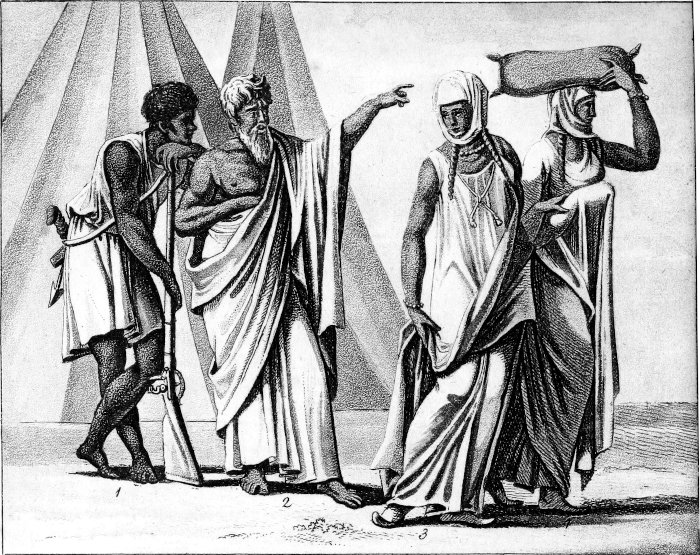
1 A Moorish Soldier. 3 A Moorish Princess. 2 A Moorish Prince. 4 A Woman of ordinary Rank.
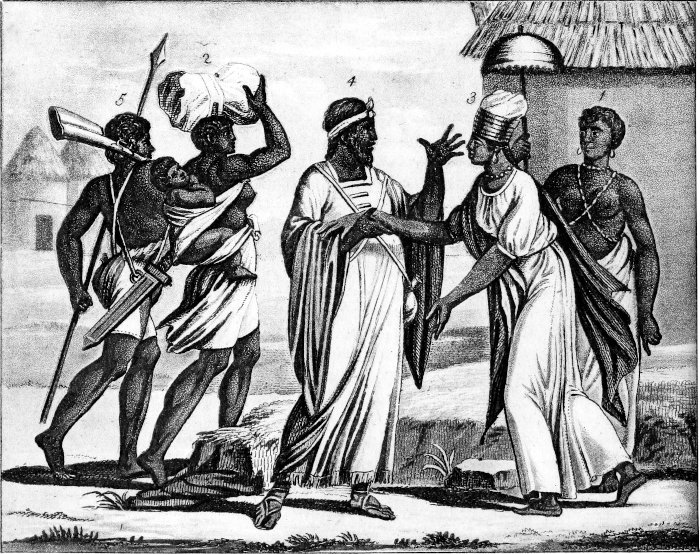
1 & 2 Female Slaves. 4 Priest of the Country. 3 Lady of the Isle of St. Louis. 5 An Armed Negro.
To the north of the isle of Bussi, and on the other side of the canal on the main land, is a tract of country ten or twelve leagues long, which is inhabited by Negroes, who are called Balantes, and who are remarkable for holding no intercourse whatever with their neighbours, either on the continent or the isles. They allow no one to enter their country, never give their daughters in marriage to the other Negroes, and very seldom allow their sons to unite themselves to foreign women. They are idolaters; their government is a sort of republic, administered by the elders of each canton, who form a council. They have slaves; but the free Negroes never attempt each other’s liberty. In other respects they are wicked, cruel, and all of them thieves. Their arms are saguayes, arrows, and sabres.
In their battles these negroes are daring, rash, and furious: they respect no flag; and all nations have occasionally been insulted by them. Notwithstanding they are often victorious, yet they are more frequently defeated; but their natural ferocity is always the same. They never abandon their piracies; and thus the navigation, near their territories, is always attended with danger.
These people are tolerably industrious; at least we judge so from the appearance of their country, as we pass along the coast. They traffic by carrying to their neighbours, and even to foreigners who enter their roads, rice, millet, culinary vegetables, oxen, goats, poultry, and particularly gold. The quantity of these different articles which they annually bring from their country, is a sufficient proof of its fertility. It is a generally received opinion, that the gold which the Balantes sell, is obtained from mines in the interior of the country which they occupy; and that this is the reason why they refuse to let any person enter it: they are aware that this precious metal excites the envy of the Europeans, and that they would expose themselves to expulsion or slavery, if they were to admit those nations amongst them. They pay a tribute in gold to the king of Casamança, and sometimes give this metal for such merchandise as pleases them, or for which they have great occasion. An analysis has been made of this gold, and of that from Galam, the result of which has proved the former far superior to the latter, and even to that of all the countries to the eastward. Several circumstances contribute to strengthen the opinion, that the country of the Balantes contains gold-mines; and it is not impossible for an European nation to possess them by the means of address or of force; but the former should be employed in preference.
The Portuguese, in 1696, united to their forces 300 Bissaux Negroes, and undertook an expedition against the Balantes: they effected a landing without opposition, but the time was not propitious, as they began their operations in the rainy season; and at the time of the action their arms and ammunition got wet, and were rendered unserviceable. In this disaster, which they ought to have foreseen, they were attacked by the Balantes, and pursued with a fury peculiar to people who fight for every thing which they hold dear: they were, therefore, completely defeated and obliged precipitately to re-embark, leaving the field strewed with their Negroes and their own people; while all their ammunition and baggage fell into the hands of the enemy, who have ever since been far more insolent.
Several Europeans who have since had the imprudence to land amongst these Negroes for commercial purposes, have been plundered and assassinated: it is, therefore, found to be more wise to trade with them without quitting one’s boats, and to be cautious that the tide does not leave them aground; for, on such occasions, which have often happened, these people without caring for the numbers which they may lose, attack the Europeans with singular fury, so that it is impossible to resist them.
When such accidents as have just been alluded to are foreseen and provided against, the merchants inform the Negroes of their arrival by the discharge of a cannon, on which they come down to the shore, and the king is almost always at their head. The interpreter then lands with specimens of the merchandise, and a bottle of brandy for the king, or the greatest personage present: the canoe which conveys him ought to be well armed; and immediately after landing him, it should return to the vessel. These people always receive a master of languages with proper respect. Presents follow their mutual compliments, and they then agree about the slaves, ivory, &c. He at length returns to the shore; a signal is made for the canoe, and he re-embarks, observing the same precautions as on landing.
The slaves and other merchandise, are conveyed on board the European ships by the canoes of the country. As soon as they approach, the whole crews of the vessels take up arms, the guns are primed, and the matches lighted; the canoes come along side one at a time, and only a very few Negroes are suffered to board at the same time: if they disobey these orders, they are fired on without hesitation; otherwise they would not fail to possess themselves of the ship, and murder all the people it might contain. On such an occasion, the Europeans cannot be too alert; for if they shew either weakness or pity, they are lost. Not only the captain, but none of the crew ought ever to go on shore, for they would thereby rashly expose themselves to slavery or loss of life; and in the former case their ransom would cost more than the entire cargo of the ship.
About twenty-eight years ago, a French vessel arrived at the Bissagos for the purpose of trading; but running aground off one of the isles, part of the crew were massacred, and the rest made slaves. Amongst the latter, was a man named Constantine, whom M. de Lajaille, who was employed to reconnoitre this archipelago, found at the Bissaux in 1785, and from whom he received some particulars of the country.
On the 31st December, in that year, M. de Lajaille cast anchor before the isle of Jatte, and disembarked in his canoe, followed by four armed boats; he first met with five or six negroes who were watching cattle on the strand. Soon afterwards about 100 unarmed inhabitants came forward, and advancing to M. de Lajaille, several of them took hold of his hand as a token of friendship. They were followed by a much greater number of the islanders who were not perceived by the crew, and who issued out from the bushes. They suddenly attacked him, seized him by the body and limbs, and endeavoured to confine him; but being a powerful man, he disengaged himself, and the boats, by firing amongst the assailants, favoured his re-embarkation. M. de Carbonneau, however, who came to his assistance, was wounded by a musket and a sabre; in consequence of which he died six days after. These events afford a recent proof of the ferocious character of the people who inhabit several of the islands in this archipelago, and of the contempt in which they ought to be held. Notwithstanding all these difficulties, and the risks with which they are attended, we do not hesitate to trade with them; and in exchange for slaves, ivory, wax, gold, and other articles, which they procure for us, we bring them yellow amber, baize, and serges made to imitate cloth, or dyed of two different colours, one on each side. We also convey to them a quantity of brandy, bells, red and yellow woollens, linen, glass work, fowling-pieces, powder, &c. This commerce, however, is very confined; but it might be carried on to a great extent if a number of ships were to proceed together on such a speculation.