CHAP. XIV.
Reading edition

OF THE MOORS WHO OCCUPY THE RIGHT BANK OF THE SENEGAL, WITH AN ACCOUNT OF THEIR ORIGIN, MANNERS, CUSTOMS, RELIGION, AND LANGUAGE. — OF THE GUM TRADE, WHICH THEY EXCLUSIVELY CARRY ON. — NATURE AND RESULT OF THAT TRAFFIC. — DESCRIPTION OF THE TREE WHICH PRODUCES THE GUM.
THE right bank of the Senegal is under the dominion of the Negro kings, Brack and Siratick, who, as we have already stated, reside on the left bank; but their sovereignty on the right side is almost nugatory: for there begins the immense desert which runs from east to west, from the sea as far as Galam; and from south to north, from the Senegal to the kingdom of Morocco. This sea of sand is known by the name of the Great Desert of Sahara, and is inhabited by the Moors, who, instead of acknowledging the authority of the Negro kings, are their irreconcilable enemies.
The name of Moors, which is given to all the tribes of the desert, seems to indicate that they are formed of the aborigenes; that is to say, that they have all descended unmixed from the Numidians, who, in the earliest times of which history informs us, inhabited the coasts of Africa, and the whole of the countries called Numidia and Mauritania; but their manners, customs, religion, and particularly their language, invincibly prove that the primitive race has been intermixed with other people, who brought them those ideas and that idiom which prevailed in another part of the world. They are at present distributed into tribes of greater or less extent, which are independent of each other, and each of which has its chief. Every tribe is divided into hordes; and each horde encamps on such a spot as will afford pasturage for their cattle; so that a whole tribe is never united in the same quarter.
In the interior of the desert reside the tribes of the Wadelims, of Labdesseba, Laroussye, Chelus, Tucanois, Ouadelis, Gedingouma, Jafanon, Ludamar, and several others. The first two are the most formidable, and extend their predatory system as far as the environs of Morocco, whose emperor is in constant alarm at their excesses. They are composed of large, strong, and well-made men; have generally a stiff hair, a long beard, a furious look, large pendent ears, and nails like talons: they even convert these into a formidable kind of weapon, in the quarrels which they have with their neighbours. The Wadelims in particular are the most arrogant and warlike race, and spread terror wherever they pass; though, like all the other Moors, their courage fails them, unless they have a decided superiority of numbers in their favour.
These people live under tents, which they move about at will: they are of a round form, terminating in a cone, and are covered with a thatch made of camel’s hair, so compact, that rain never penetrates through it. This covering is made by the women, who also prepare the leather of which the saddles, bridles, and various other articles, are manufactured.
The furniture of these dwellings consists of two large leather sacks, which hold a few rags and scraps of iron-work: sometimes they have a box or two, which become the object of cupidity amongst a whole horde. Three or four goat-skins, in which they keep their milk and water, several wooden platters, two large stones for pounding barley, a lesser one for driving in the pickets of the tents, some osier mats, which serve them for beds and covering, and a small copper kettle, are the whole of the goods which distinguish the rich from the poor.
It is also the business of the women to prepare the provisions, fetch water, and attend to the horses and cattle, which always lodge in the same tent. Those who are in easy circumstances keep Negro slaves to do the principal part of the labour; but they are always obliged to wait upon their husbands themselves. In short, nothing can exceed the arrogance of a Moor to his wife, nor the humility of the woman in presence of her husband.
The women, when a horde changes its situation, strike the tents, load and unburden the camels; and when the husband mounts his horse, his wife holds the stirrup: they are not even admitted to eat with the men, but when dinner is ready, they retire, and wait till they are called on, to take what is left.
These women are in some degree the property of their husbands: for a Moor does not marry till he is able to buy himself a wife. The fathers sell their daughters; and he who has most of them, is considered the richest man. The price agreed on is always paid in advance; and the husband may afterwards put away his wife, but what he has given for her is never returned. Nevertheless a Moor cannot turn away his wife without obtaining permission from the oldest people of the horde, but which they never refuse to give; so that the demand is a simple matter of form.
The women are treated by the Moors with the most sovereign contempt; they never take the names of their husbands, nor do the children even bear the names of their fathers. Amongst almost all the hordes they admit only of four or five different names. The men are distinguished by that of their tribe, and have some kind of surname.
Although the women in question are so badly used, and though they are very indecent in their manners and gestures, they are faithful to their husbands. An instance to the contrary seldom occurs; but when it does, the offender is driven from the house of her lord, and his relations generally revenge themselves by her blood, for the disgrace which she has brought upon their family.
The Moors consider the women as an inferior race of beings, created solely for their pleasure and caprice. With respect to female beauty they have singular ideas. An elegant shape, majestic walk, a mild and expressive physiognomy; in short, all the charms which delight our eyes, are to them without attraction. They must have women particularly fat; for with them corpulence seems to be every thing. Hence those women who only require the assistance of two slaves to help them to walk, can have but moderate pretensions; but those who cannot stir, and who are obliged to be conveyed upon camels, are considered perfect beauties, particularly if they have long teeth projecting out of the mouth.
This taste of the Moors for massive beauties induces the women to take the greatest care to make themselves fat. Every morning they eat an enormous quantity of cuscus, and drink several jugs of camel’s milk. The girls are obliged to take this food, whether they have an appetite or not; and when they refuse they are beaten to compliance. This forced diet does not occasion indigestion or any other disease; on the contrary, it induces that degree of fatness which passes for perfection in the eyes of the Moors. The Moorish girls are in other respects little attended to; and their education is totally neglected. These people think nothing of moral qualifications: for voluptuousness, submission, and corpulence are all that the Moors admire.
The boys are better treated; they are generally taught to read and write the Arabic language; and as soon as they begin to grow up, they are respected by the Moorish women, and even by their mothers, who no longer eat with them. At an early period they are accustomed to use the poniard adroitly, and to tear out with their nails the bowels of their adversaries: they are taught to give a lye the semblance of truth; are, in short, familiarized with wickedness, and are instructed to commit a crime with as much pleasure as they would do a good action.
A plurality of wives being permitted amongst the Moors, a hut is seldom seen with less than eight or ten children. The women live together under the same tent, and are witnesses of the partial attachment of the husband, without betraying any marks of jealousy.
The tent destined to receive a new married couple is ornamented with a little white flag, and the bridegroom has a band round his forehead of the same colour; and whether he be young or old, or be married for the first or sixth time, he is always decorated with the symbol of virginity.
On the day of the ceremony the bridegroom causes a camel to be killed, for the purpose of regaling the guests. The bride, with the women and young girls of her acquaintance, dance all day round a kettle-drum, and their motions are of a most indecent kind. They dance singly, and one after the other. She who begins the performance stretches out her neck, and makes the most shocking grimaces, which are repeated by the spectators with astonishing precision. They beat time with their hands; and at length all the company put themselves in motion.
The day after the wedding the bride is separated from her husband, and her friends wash her from head to foot; they afterwards comb her, plait her hair, redden her nails, and clothe her in a new drapery. She then pays visits through the camp, and in the evening is taken back to her spouse.
The Moors are extremely fond of their women and children, by whom they in return are tenderly loved. It is difficult to reconcile these sentiments of affection with the obdurate and barbarous conduct which they display in their families. For the slightest fault the offender is corrected with a revolting degree of severity; and the girls are always ill used, as they are indifferent both to the father and to the mother.
Nothing can exceed the joy of the parents on the birth of a son. The mother has neither doctor nor midwife to assist her; and she is most frequently alone and extended on the sand at the time of her accouchement. She immediately lays down her infant, takes some milk to refresh herself, and then goes to bed for the night. The mother who gives birth to a son, in order to testify her joy, blackens her face for forty days. On the birth of a daughter, she only daubs it half over, and keeps it so no longer than twenty days. A woman so disguised is a horrid and disgusting spectacle.
It is difficult to form an idea of the pride and ignorance of the Moors; they think themselves the finest people in the world, and suppose that the sun rises for them alone. “Contemplate that planet,” said a Moor to a Christian slave; “it is unknown in thy country: during the night you are not enlightened like us, by that orb which rules on our days and our fasts, or by those luminaries which fill the celestial arch, and indicate the hours for our prayers;—(he alluded to the stars.) You have no trees, nor camels, nor sheep, nor sand, nor goats,” continued he; “nor are your women made like ours. You do not inhabit the earth, but are born, live, and die in your houses that float on the sea.”
The greatest luxury of a Moor is to see his wives and daughters richly dressed, and on them he exhibits all his opulence by ornamenting their ears, arms, and legs with rings of gold and silver.
They have no knowledge of the arts and trade, though they make in a rude manner, pikes, knives, and even kettles, from the native iron which is furnished to them by the Negroes. Everything else for which they have occasion comes to them either directly or indirectly from the Europeans. They are a pastoral kind of people; and when at peace, rear great numbers of oxen, cows, sheep, goats, and horses. They make their oxen carry burdens, and cross rivers, on which occasions they ride them like horses.
They have no knowledge of cultivating land. The person who is charged with the labour, repairs to a spot which appears most moistened by rain, and scatters indifferently the seeds of millet, barley, and wheat, which he covers by drawing over them a plough harnessed to a camel. This implement, without breaking the ground, makes a simple furrow at its surface. If the subsequent rains promote the growth of the seed, each person takes the portion that belongs to him, and retires to his camp. Sometimes, instead of waiting till the grain comes to maturity, they cut it down and dry it on hot ashes, by which they deprive themselves of an abundant harvest, as well as of the straw that would feed their horses. But the Moors have no regard for futurity; they think only of the present.
Their common course of provisions is millet, barley, wheat, milk, honey, locusts, and wild animals. They make no use of poultry or domestic animals, except at the last extremity, or on solemn occasions, such as the visits of princes or distinguished friends, the birth of sons, marriages, or deaths. They pass alternately from abstinence to voracity. Their religion subjects them to frequent and rigorous fasts: in their travels they endure hunger and thirst; but when they find an opportunity of satisfying their appetite, they eat at a single meal more than three Europeans, and drink in proportion. Several of them, particularly the kings and great people, deprive themselves of wine, either from a religious principle or by way of example. But those who have connections with the Europeans are less scrupulous, and drink inordinate quantities of wine and brandy.
These people are almost always at war; frequently among themselves, but oftener with the Negroes. In battle, those who are mounted on horses are hidden in clouds of dust; but the camel, whose pace is heavy, though it takes long steps, is scarcely less useful than the horse: for, animated by the shouting of its rider, it dashes amongst the crowd, and produces more carnage by its bites than is effected by the musquetry. The Moors never make their attack in order of battle; but as many men as there happen to be, so many separate combats take place; and he who throws his adversary to the ground, seizes on his arms, and retires precipitately with the fruit of his conquest; but if the person conquered be a Negro, he is detained and made a slave. On some occasions two combatants of equal strength will give each other several stabs with their poniards, and then reciprocally tear out their entrails with their nails.
Such incursions generally ruin one party or the other. Those who possessed a considerable stock of cattle, are reduced in one day to the most dreadful misery, and despoiled by others, who, the evening before, had no property at all. The weaker tribes are of course the most exposed, and therefore take care to live at a distance from the others, especially from the Wadelims and Labdessebas.
Their ordinary arms are sabres, sagayes, and arrows, the last two of which they throw with great strength and accuracy. Some of them procure from the Europeans or Negroes musquets or pistols; but they cannot make use of them for any length of time, because those which are brought to them from Europe are of a very bad kind; besides which, the humidity of the climate causes them to be speedily covered with rust, while the heat spoils the temper of the metal: they therefore become good for nothing, and there are no workmen clever enough to repair them.
The Moors are very hospitable: every stranger, of whatever country or tribe he may be, or whether known to them or not, is kindly received. If several travellers arrive at any place together, the inhabitants defray amongst them the expences of their reception. They all, without distinction, go before a new comer, congratulate him upon his arrival, assist him in taking off his luggage, and convey it to a place of security. He is then conducted behind a bush to pass the night: for it is an invariable custom amongst these people never to admit a stranger into their tents. When this ceremony is over, the people sit down around him, and enquire the news of the country from which he comes; they ask, for example, whether such a horde have evacuated the spot on which they last encamped, whether he have met with others on his passage, &c. They then enquire the motives for and extent of his journey, and ask about the tribe to which he belongs. They never put any questions about his health till he has satisfied them on all the other points of their curiosity.
If the stranger do not know any person amongst the horde which he visits, it is the richest of them who is obliged to shew him the rights of hospitality; but this is not the case when the travellers do not come alone. They give to each a large porrenger of milk, and barley flour steeped in milk porridge or in water, when they happen to have any. If the visiter be able to read, they confer on him the honour of saying prayers; and on this occasion the table, or subordinate priest of the horde, places himself by his side as master of the ceremonies.
If the stranger have friends amongst the horde, and be distinguished either by his rank or property, they kill a goat or sheep, and sometimes an ox, for the purpose of regaling him. One of their wives prepares the feast. Before cooking the meat, she separates the suet, and serves it up to the guests in its raw state. As soon as the meat is dressed, she sets the share of her husband before his friends and neighbours; as it would be an irreparable error not to offer them this portion. She then puts the share of the stranger upon a layer of straw; and the Arabian who gives the treat, causing either a Christian or a negro slave to carry it, goes and offers it himself. This repast is never served up till ten o’clock at night, even though the stranger should have arrived in the morning. The Moors offer nothing except at night by the light of the moon, or round a large fire, which they generally kindle in all seasons. The traveller never fails to invite the person who treats him to do him the honour of eating with him; but the latter always beg to be excused, and his reason is, the respect which he bears for and ought to shew to strangers.
The next day the traveller continues his route, and goes off without taking leave of any one: if he happen to remain longer, it is considered an infringement upon their hospitality, and they let him know it by giving him a smaller allowance, which they continue to diminish as long as he stays, and thus politely force him to depart.
Amongst the Moors justice is prompt and decisive. Civil rights are little respected; but they know the necessity of checking men from committing crimes by the example of punishment. On these occasions, and in ordinary cases, the guilty individuals are conducted before the king of the tribe, who judges them alone and according to his caprice. When a man is accused of a capital offence, the prince calls in the most ancient people of the horde, and pronounces his judgment according to their opinion, which is instantly carried into execution. Capital punishments, however, are only inflicted upon Negroes: those of the Moors are merely fine, restitution, or banishment.
The most common diseases of the Moors are intermittent fevers and dysenteries, which are speedily cured by sudorifics, a few simple syrups, and a mild diet. Indeed, the patients often abandon themselves to the sole aid of nature, and quickly recover. The Moors have no physicians, and the old women are employed in taking care of the sick. There may be seen amongst them a great number of old men, who enjoy full health and vigour, though their whole time has been passed in continual exertions, and under all the fatigues and privations inseparable from their mode of life. It has, however, been remarked, that the less they have been connected with Europeans, the less have they been liable to infirmity and disease; because while they remained in their frugal and simple mode of life, their constitution was not affected by strong drinks or high-seasoned food.
The small-pox makes from time to time great ravages amongst the Moors, from whom it passes amongst the southern Negroes: those of the Senegal and the Gambia practise inoculation. At length the Moors, after a long career, come, like other men, to the end of their existence, and receive the last duties of their family and the whole of their horde. Amongst them a death is announced by terrible cries, and the women are employed to make the notification. On this occasion, all those belonging to an encampmant repair to the tent of the deceased, where some cry, and others sing his praises. Very often they change parts; so that the women cry, laugh, and sing alternately. Afterwards the body is washed, dressed, and carried to an elevated spot, where it is placed in a grave with the face turned towards the east, and the head rather raised. They cover the grave with stones, to secure the corpse from the attacks of certain carnivorous animals.
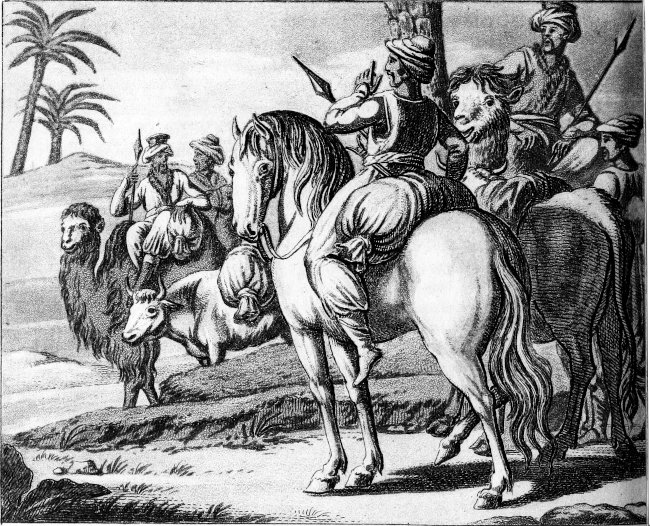
Their dress is very simple. The rich wear trowsers and pagnes, or pieces of cotton, which hang down to the ground: the latter forms a sort of great-coat without buttons, which they pass over the breast, and fasten with a belt; in this belt they place a poniard or large knife, sometimes two; and as they have no pockets, they put in their bosom whatever they have occasion to carry about them. A handkerchief is attached to the belt, but they use it more for wiping their hands and face than any other purpose: those who are of some respectability carry two. The common people have their head, legs, and feet naked; but the others wear, when they can get them, Morocco slippers, or sometimes half-boots, and always round the head a roll of white linen, which forms a turban. The latter likewise wear a woollen cloak, which is of a white colour, very finely made, and is brought to them from Morocco or Tunis: this cloak is very simple, and has at top a pointed cape, with which they cover their heads; at the end of this hood is a long string with a tassel. They never wear sabres except in the army; and then they either carry them in the hand, or pass them between the belt and their body. They do not know the use of regular belts; and though some richly embroidered ones have been sent to them as presents, they disdain to use them in battle, but make a parade of them when they go on visits. When they ride on horseback, the princes wear a sort of jockey boots of Morocco, and a mass of arms, which are fastened to the saddle bow; and they carry a lance or sagay in their hands. The others ride almost naked, but are always armed either with muskets, bows and arrows, or sagays.
Dresses of the Negroes of Senegal at Cape Verd.
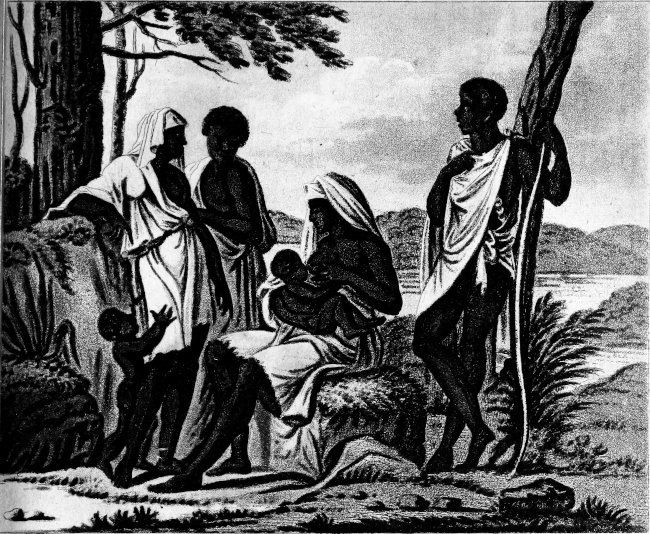
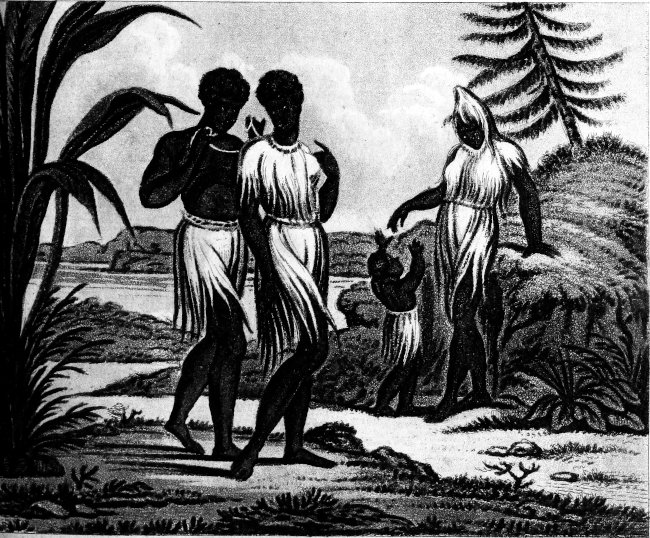
The kings are always dressed in finer stuffs than the other Moors; they have likewise larger tents, and are remarkable for being covered with white linen or cotton.
The head-dress of the Moorish women is generally composed of a bandeau of white cotton, a part of which is larger than the rest, and serves as a veil for the face when they go in the sun: they often go veiled from head to foot. They have fine and long hair, which they plait, and leave flowing on their shoulders.
The Moors purchase from the Europeans or Negroes all the articles necessary for their clothing, and they pay for them in slaves or gum. The women often appear with their faces uncovered: this is a positive fact, at least with respect to the hordes in the vicinity of the Senegal. I have seen a great number of them, and even queens and their daughters, in their camps, as well as on board our vessels at Isle St. Louis, and they never appeared veiled. Some of these females were very handsome, and many of them were pretty; in general they have a pleasing appearance; they are of the ordinary height, but are well made; their eyes are large, black, and very animated; their complexion, which is browned both by nature and art, does not want for vivacity. They put a blue tint on their eye-lids, and redden their nails. They are but slightly clothed: they wear long trowsers, shifts with very wide sleeves, and a girdle under the bosom; and round the neck a piece of linen, generally blue, which hangs down to the heels; they walk with their legs and feet naked; but the princesses, when they pay visits, or on the days of ceremonies, use European slippers.
The language and religion of these people are those which the Arabians brought into Africa. Mahometanism was preached by the conquerors, and was adopted by the Africans who submitted to them: the others were exterminated. Soon the conquerors and the vanquished became one people, professed the same religion, and spoke the same language.
Of all known languages, the Arabic is the most extensive. It is spoken in the three Arabias, in Palestine, Syria, Mesapotamia, Egypt, on the coasts of Abex and Darien, in the kingdoms of Tripoli, Tunis, Algiers, Fez, Morocco, and Talifez; in the immense countries which are in the environs and to the south of the Atlas; on the banks of the Nile, the Niger, the Senegal, and the Gambia; in short, it is the prevailing tongue wherever Mahometanism is established, but it is often disfigured by the dialects of the different nations who have adopted it.
It is the same with the religion of Mahomet, which was founded by valour, and extended by force: it has yielded in many parts to the manners and customs of the people on whom it has been imposed. The Moors, for example, are circumcised; but they have no fixed time for that ceremony, and they never perform it till after the age of thirteen years. The girls of these people are exempted from it, though there are some who make this operation by inflicting a slight wound. In the desert they have no mosques, but they meet in the open air: for the duty which they most scrupulously observe, is that of prayer, of which there are several repetitions in a day, and the first of which begins before sun-rise.
The talbe, or priest, is remarkable for his long beard; and is dressed in a piece of woollen cloth, half white and half crimson, which floats loosely about his body. His figure is emaciated by fasting and the continual wearing a kind of chaplet of an enormous size; and his voice is melancholy and lamentable. He begins his office by ordering the people to come and range themselves under his banner, to hear and sing the praises of the prophet; they all run towards him with the most holy respect. The talbe first inclines himself towards the earth, scatters with his hands that on which his feet have rested, and then taking a handful of that which has not been sullied by his steps, he, for want of water, rubs it over his face, hands, and arms, in order to purify himself, in which action the people all imitate him.
After the prayers they remain for some time squat on the ground, trace with the fingers different figures on the sand, and move their hands round their heads, as if they were anointing themselves with a holy unction. In their prayers the Moors preserve the most profound respect: the women, who only assist at those of the morning and at ten in the evening, place themselves at the entrance of their tents, and remain with their faces turned towards the rising sun. It does not appear that these people know the obligation of pilgrimages to Mecca; but they observe with the utmost scrupulousness the rhamadan, or lent.
The talbe is both the priest and schoolmaster: his scholars assemble every evening before the tent, and by the light of a large fire he teaches them some sentences of the koran, and initiates them in the principles of their religion. His greatest anxiety, however, seems to be to inspire them with an insurmountable aversion from strangers, and extreme horror at the name of a Christian. These principles, when once imbibed, are never effaced from their minds, and throughout the whole of their life they think the murder of an European no greater crime than that of a dog. The scholars write their lessons on small tablets, as paper is too scarce for common use. While they are at their daily occupations, the boys carry these tablets at their backs; and when they have learnt to read and write, and have acquired a few prayers by heart, they are considered sufficiently informed, and above the rank of children: they then look with contempt upon the unlettered Negroes, and even upon their own countrymen who have not made such progress in science as themselves.
All the Moors of the desert acknowledge the supremacy of the King of Morocco, but they pay him no tribute, and live in the greatest independence. Some of these people have abandoned the deserts, and taken up their residence in the towns, where they employ themselves in commerce, and carry on different trades; but they are looked upon by the others with contempt, and as having degenerated from the nobleness of their ancestors: others have established spots in the oases, or fields, where they devote themselves to agriculture; and even these are stigmatised as degenerate, and unworthy of the name of Arabs.
The real Arabs, indeed, are those who encamp in the desert, who live in complete liberty, and only acknowledge as their superiors the chiefs of their tribes. Those likewise are real Arabs, who live habitually in a state of war, who kill for the sake of robbing their victims, and who steal whatever comes in their way; so that the epithets of Arab and thief are synonimous.
There is in the desert and on the banks of the Senegal a race named Azounas, to whom the name of Arab properly belongs: they are neither herdsmen, merchants, nor cultivators; but are vagrants, thieves by profession, and consequently Moors or Arabs by acknowledged title. Their trade, which renders them dreaded by and odious to all their neighbours, keeps them in continual alarm at being surprised and punished by those whom they have plundered; they are therefore always on the alert, and continually changing their encampments; in consequence of which they have their tents more convenient and portable, while themselves are lightly armed and clothed, in order that they may carry off booty with greater swiftness. It is, however, the Negroes only whom they plunder; for an instance seldom occurs of other Moors being the objects of their outrage. They make frequent excursions on the other side of the river, and carry off whatever they find, whether men, women, cattle, provisions, or poultry, so that they are the greatest plague with which the Negroes are afflicted.
The Moors in general like long journies. I have observed that those of the desert do not go to Mecca; but the reason is, that this pilgrimage would be too long and unprofitable: they, however, frequently go to Galam and the more eastern kingdoms; or, in fact, to every part where they expect to find an advantageous change.
All the people of the interior want salt; the Moors therefore bring it them, as well as the linen and iron-work which they receive from the Europeans, and they get in exchange gold, elephants’ teeth, civet, and slaves. They set off in parties, like a caravan, and on their way they use the privilege which they have assumed of appropriating to themselves whatever they can find, whether belonging to their enemies or friends; who, however, cease to be the latter, if they possess what suits the purpose of the banditti. Their journey has, therefore, a double object, and they seldom fail to attain it.
On returning from the interior they generally divide, and some of them go home, while others repair to the banks of the Senegal, and several go even to Fez and Morocco. To these last-mentioned places they convey their gold, elephants’ teeth, and slaves in particular, as, from a religious principle, they are forbidden to sell the children of Mahomet to infidels. This precept, however, is not always scrupulously observed: the tribe of Azounas in particular despise it, and sell to us at Isle St. Louis a considerable number of slaves.
There is certainly a communication between the Senegal and Morocco. I knew several Moors who had performed this journey, and one of whom who came to reside at Isle at St. Louis, more than once offered to conduct to Morocco any white person with whom I might entrust him, and bring him back by the same route. This project would have been carried into execution, had my affairs allowed me to reside longer on the island. I know that these journies are difficult; but I think that their dangers are exaggerated. It is possible to open routes in Africa, even through the desert, to travel over the interior, and to procure all the information that may be required relative to this interesting part of the globe.
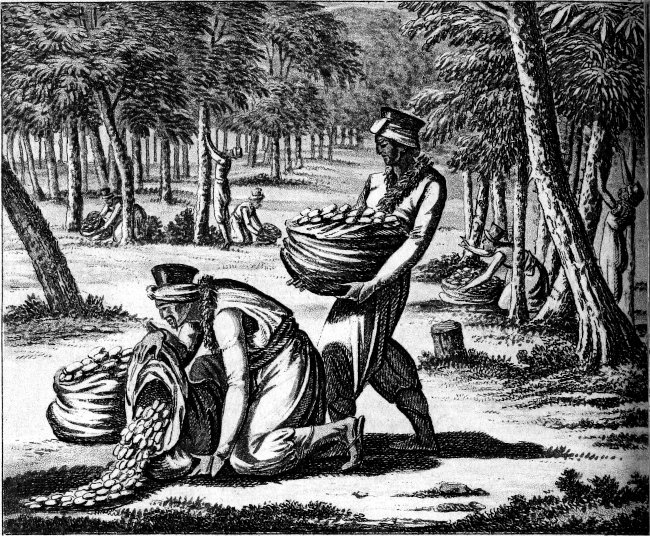
The Moors gathering Gums.
Conveying the Gums to Senegal.
It is in this same desert, between the banks of the Senegal and the Isle of Arguin, that there are to the northward, three forests of that species of tree which produces the gum, and which on that account is called the gum-tree. They are all situated at nearly an equal distance from the river, and which is supposed to be about forty leagues: the forests are ten leagues distant from each other. The first is called Sahel; the second, which is the largest, Lebiar; and the third is known by the name of Alfatack. Several small clusters of gum-trees, independent of these forests, are to be found at many other points of the Senegal.
The tree which produces the gum is a small species of Acacia: it is thorny, branched, and loaded with leaves, which are rough, always green, very narrow, and of a middling length: its flowers are white, and have but five petals, which form a calix, filled with stamina of the same colour, surrounding a pistillum which, changes into a pod or husk from three to four inches long: this at the beginning is round and green; but at its maturity acquires the colour of a dead leaf. It is filled with small, round, hard, and blackish seeds, which serve for the reproduction of the tree.
The gum is nothing else than the superabundant parts of the sap of this tree, which sap being too small in quantity, and drawn rapidly up by the heat of the sun, swells the fibres of the tree, bursts the imperceptible coats which surround it, and make a passage through the pores of the bark. This never happens when the tree only has the necessary quantity of sap for its preservation and growth; and then, if gum be wished for, it is necessary to use violence, and gain it from the nutriment of the tree by means of incision. This practice affords some produce, but cannot be executed without the loss of a large portion of the gum that escapes through these incisions, which the sap always endeavours to heal.
Two gum harvests are made every year: the first, which is the most abundant, takes place in December: the knobs are then larger, cleaner, and drier. This harvest is the best, because the rains, which have just ceased, have moistened the earth, which has, in consequence, afforded a more abundant sap to the trees; and this the heat of the sun has had time to consolidate, though without drying it. The second harvest is made in March; but this affords less, and the produce is of an inferior quality, because the heat is then too violent, and it is necessary to make incisions before the gum can be obtained.
Before the Senegal gum was known, that from Arabia furnished the whole consumption of Europe; but since this discovery the former has superseded the latter, and the Arabian gum is no longer to be seen: the little, however, which does come to us is derived from the Levant by the Provencals. They are in the habit of boasting of its properties as far beyond those of the Senegal gum; but several experiments have proved, that one is as good as the other, and may be employed for the same purposes. Besides the usual application of it in manufactures and medicine, we have a way of depriving it of its natural faintness; and, in several towns in France, they make it into excellent preserves. The Moors and Negroes are very fond of eating it in its crude state.
The regular consumption of this gum in Europe is estimated at 1000 tons of 2000 lbs. each. The India Company formerly imported, every year, 1200 Moorish quintals (the quintal is reckoned equal to 900 lbs. French.) At present our trade is about 1,500,000 lbs.; and we might extend it to 2,000,000, without the concurrence of the English at Portendick.
The price of gum is always regulated by the number of pieces of Guinea which it costs at first hand, and this price varies every year in consequence of the difference in the harvests, but chiefly from a combination amongst the purchasers. This combination was, a year or two since, carried to such an extent, that the ship-owners lost fifty per cent. by the expedition. In my time, 1785 and 1786, the price of the quantar, which weighed 2400 lbs. was fixed at ten pieces of Guinea: it has since been raised to fifty, and even sixty pieces; it will, probably, soon get above an hundred: in short, the Moors will ruin the French, if government do not interfere, and check the effects of their combination. According to the relative value of merchandize, the gum, in time of peace, ought to cost, on the spot, from fifteen to twenty sous per pound, and be worth in France from forty to forty-five sous.
Three races or tribes of Moors, each of whom have their chief, frequent the desert which borders on the Senegal, collect the gum, and carry on the trade exclusively. The first is called Trarzas, and occupies all the country comprised between Arguin, St. John’s river, and the Senegal. This country extends from the shores of the sea to forty leagues in-land; and the chief of the tribe is a descendant of Alikandora, whose name is celebrated in the festivals of the country: his name is Alikouri. The state is hereditary; and the eldest son of the king succeeds the father. In default of children, the crown descends to the nearest relation of the reigning family.
Alikouri being almost always encamped near Portendick, causes the gum which is collected by his tribe, to be conveyed thither, and only sends to Isle St. Louis what he cannot find room for at Portendick. Our government pays him annually a duty of 11,347 francs; and he likewise receives considerable fees from our merchant ships.
The second tribe is known by the name of Marabous of Armancour. The chief of this race is named Chems, and is also named Aulad-el-Hagi: these collect the gum from the forests of Lebiar, and bring it to the French in the Senegal, at about forty leagues only from Isle St. Louis. It does not appear that government pays any duty to the Marabous of Armancour, though they get much by trading with us, and the merchant vessels pay them nearly the same fees as to king Alikouri. All the members of this tribe are Marabous, that is, doctors or preachers of the law of Mahomet: they are hypocritical and superstitious; but they have good memories, are artful in their commercial dealings, and reason well on the course of the stars, which they are in the habit of observing.
The Bracknazians are the third tribe of Moors: they have a king named Hamet Mocktar, whose dignity is hereditary. They collect their gum from the forest of Alfatack, and sell it to the French near Podor.
This kind of fair or market is held in the open air: it begins in April, and ends in June or early in July; the rains then set in, and give the signal for retreat. They do not weigh the gum, but serve it in a cubic measure called quantar, which should be of a size that was long ago agreed on between the Moors and the French, but which the latter have taken care to augment, as often as they have found an opportunity. The measure is fixed on deck; it has a sliding bottom, which lets the contents fall into the hold as soon as the measure is full. At first it contained about 220 lbs. of eight ounces to the pound; but its size has so much increased, that at the time of my residence in the Senegal it held 2400 such pounds: I believe it has not been thought prudent to increase the size of the measure beyond this point. The Moors, however, are too cunning to be imposed on by such a gross artifice; and have therefore increased the price in the proportion already mentioned, which is about equal to the frauds practised in the measure.
During my stay at Isle St. Louis, I entered into some treaties with these tribes relative to the gum trade; and in April 1785, I went to the fort of Podor, where the trade was going on. I there found king Hamet Mocktar, his brother, the queen, their daughter, and suite. The Moors received me kindly, and I passed the day with them. The next day the king, his brother, the queen, and the daughter, made me ask them to dinner: they came betimes; and it is a fact, that during the two months while I remained in the environs of Podor, this family constantly honoured me with their company.
I received them with distinction, and under discharge of cannon. We dined under a tent, which I had caused to be erected upon deck. Hamet Mocktar was a fine figure, large, and well made; he was covered with a scarlet cloak, embroidered with yellow tinsel; his hat was laced in the same manner, and he wore green half-boots. After the first compliments, he began to put himself at his ease by taking off his clothes; and he, as well as the rest of his people, remained only in their shirts. His brother had no mark of distinction, but was dressed like the other Moors. The queen, who appeared to be about thirty-five years old, was of an ordinary size, but so prodigiously fat, that she could not walk without the support of two men, who never quitted her. The daughter was about sixteen or seventeen years old, and had a pleasant physiognomy: her figure was perfectly handsome. Both mother and daughter were dressed according to the custom of the country, but they were covered with gold and corals.
The dinner was very convivial, and the guests conducted themselves with the utmost decency and discretion, not the smallest excess or disturbance taking place. During the whole time of dinner we were regaled by music of the king’s band.
In the evening the guests retired within the fort; and every succeeding morning they not only returned the visit, but remained with me the whole day. We often went to walk on the banks of the river, and the king’s daughter was always of the party. She taught me a few Arabic words, and I in return instructed her in French; in which she made such progress, that before we separated, she could express her wishes, and ask for whatever she wanted. The king and queen testified no uneasiness at the familiarities that passed between us.
One day this young princess conceived she had a complaint against one of my clerks, named Bourdonnois, she having taken offence at a proposition which she did not rightly understand. She appealed to me, and relieved her mind by shedding tears. The king coming in unexpectedly, and observing the state of his daughter, flew into a dreadful rage. I ordered the clerk to be brought forward, and without wishing to hear what he had to say, gave orders, that he should be embarked, and sent to Isle St. Louis: I was immediately obeyed. As he was going away, the king and his daughter relented, and intreated me to pardon him. I pretended that I would not excuse him; but they pressed me to forgive him, and finding that I still refused, the princess fell at my feet. I raised her immediately, and granted her request. As soon as she was sure that the man would be liberated, her face was overspread with smiles, and I recognised by this trait the goodness of her heart. The king himself went to fetch back Bourdonnois; he brought him before me, and the pretended injury was forgotten. On this occasion my conduct was politic, and was attended with success. I suddenly terminated a discussion which might have become serious, if I had seemed to doubt of the offence, or hesitated to repair it.
Durand entertaining King Hamet & Family.
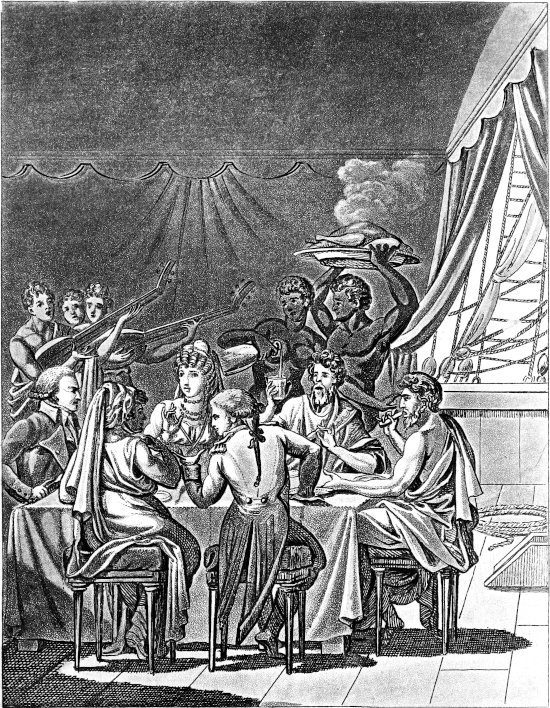
I have mentioned this anecdote by way of opposition to the naturally obdurate, barbarous, and cruel character of the Moors in general. It is a light upon the dark picture which I have already given of their savage manners; and it affords a proof, that our connections with these people render them more communicative, sensible, and humane.