Volume 1 — CHAPTER VIII.
Reading edition
Embarkation—Departure for Accra—Land Route—Accra Roads-Visit to Danish Accra—Dilapidations of the Fortresses at Dutch and English Accra—Captive Queen—Mr. Thomas Park—Cause of his Death unknown— Departure for Fernando Po—First view of the Island—Anchor in Maidstone Bay—Early History of the Settlement—Captain Owen's Expedition—Visited by the Inhabitants—Site for the Settlement determined—Author's Mission to the King of Baracouta—Visit of the King—Native Costume—Ecstacy of the Natives—Distribution of Presents—Second Visit to the King—His Majesty's evasive Conduct—Renewed Interviews—A Native Thief—Intended Punishment— Cut-throat, a Native Chief—Visit to King-Cove—Purchase of land
Friday, Oct. 19.—When on the point of embarking with Mr. Galler, the purser of the Eden, we took some refreshment at Mr. Castle's, a commissariat officer, whom I had the pleasure of unexpectedly meeting again at New South Wales, and who is one of the few survivors, after serving some years at Sierra Leone and Cape Coast. Embarking, as well as landing, at this place, is a matter of some moment, the passengers and a part of the crew being obliged to get into the boat before they launch her from the beach; for the surf is occasionally so heavy as to become exceedingly perilous. Canoes are frequently upset in the attempt to get off in bad weather, and the purser of a man-of-war was drowned in this manner a few years before; but the natives, who are like fish in the water, are indifferent to the danger; all they care about is to keep the boat from being stove, and to save her appointments. There was a small lodge of rocks about one hundred yards from the shore, that would answer for the foundation of a breakwater, which it is calculated might be effected at the cost of from three to five hundred pounds, and which certainly would be most desirable for affording protection, and facility to boats, both on landing and leaving the shore.
Saturday, Oct. 20th.—At eight this morning we left Cape Coast Roads with a fine breeze, for Accra, a distance of sixty miles by sea, and eighty-five by land. A sketch, of the land route may not be uninteresting. Four miles eastward of Cape Coast is Moree, and the Dutch Fort Nassau; six miles from Moree is Annamaboc, the most complete fortification in the country; five miles from thence Cormantine, the first fort possessed by the English, and built by them about the middle of the seventeenth century. It was taken afterwards by the Dutch, and being stormed, was almost destroyed by the Ashantee army, before it attacked Annamaboe; the position is very commanding. Tantumquerry, a small English fort, is about eighteen English miles from Cormantine (crossing the small river Amissa, an hour's walk inland from which is Mankasim, the capital of the Braffoe district of Fantee), the natives call the town Tuam; eight miles from Tantumquerry is the town of Afram, where there is a Dutch fort, and a small river; eight miles from Afram is Simpah or Winnebah. The people of Simpah are Fantees, but their language is called Affoottoo. They are in the district of Agoona. About nine miles from Simpah is the Dutch fort Berracoe; the natives call the town Leniah. Attah, of Akim, laid a contribution on this fort in March 1811. About twenty-seven miles from Berracoe is Accra or Inkran, once subject to Aquamboo, which people, according to Isert, formerly drove them to Popo.
We had only the Horatio schooner in company, the African steam-vessel, and Diadem transport, having sailed the preceding evening for Fernando Po.
Sunday, 21st.—At eleven o'clock this forenoon, we anchored in Accra Roads, where we found His Majesty's ship Esk, Captain Purchass, who came on board to wait on Captain Owen. I had the pleasure of accompanying this gentleman on his return, first to his ship and then to the shore, in a very fine canoe of the country, belonging to Mr. Bannerman, who is the only English merchant at Accra. This canoe was fifty feet in length, pulling seventeen paddles, and Mr. B. has had it raised two feet in the fore part (where the passengers were seated on chairs), expressly to protect him from the sea in his occasional voyages to and from Cape Coast Castle.
We found the beach equally bad for landing as at Cape Coast. Some of the officers of the Eden and Esk, as well as myself, dined with Mr. Bannerman, and I slept at the house of Captain Fry, who was commandant of the English fort here, which is in a most ruinous state, and instead of being fort, I should say it was foible.
Monday, 22nd.—After breakfast, a party of us in two gigs, drawn by four blacks each, went to Danish Accra, a distance of two miles, and a very good road. The Danish Governor and all the officers received us very politely, and invited us to remain and pass the day with them. The fortress was very clean, and every way apparently in good order. What is called Danish Accra is merely the fortress, which is the case with Dutch and English Accra,[26] for there are no Europeans living in private houses, except Captain Fry and Mr. Bannerman. The fortress of Dutch Accra is even in a more ruinous state than that of the English, and is entirely deserted. There is a native town, of course, and in it are to be found jewellers, who make ornaments of every fashion, out of the purest gold, brought from the interior. The gold is four pounds per ounce, and they charge an additional pound for converting it into necklaces, bracelets, or any other ornaments, of whatever pattern you may fancy.
Mr. Bannerman invited us to visit one of the King of Ashantee's favourite wives, who had been made prisoner during the war, with her daughter and grand-daughter, whom Mr. B. had accommodated with part of his house, where his own two sisters were living, distant about a quarter of a mile from the house of business where he resided. They were apprized of our visit, and were dressed accordingly to receive us. Mr. Bannerman is himself a gentleman of colour, and a man of education; he resided a long time in England, and is a sensible, mild, and gentlemanlike man. He supplies all our men of war, on the African station, when they call at Accra, with bullocks, vegetables, &c. &c.
Mr. Thomas Park, who left England, as one of the Midshipmen of the Sybille, but with three years leave of absence from his ship so soon as she arrived on the coast, ordered by the Admiralty for the express purpose of travelling in Africa, with the avowed intention of endeavouring to discover the course, and source of the Niger, was landed at Accra some time since from that ship, and passed a short time there in studying some of the languages of the countries through which he meant to travel. He left Accra to proceed on his journey into the interior on the 29th of September, 1827, and arrived at Mampong in Aquapim on the 2nd of October; this he left on the 5th for Acropong, the chief town of Aquapim, and on the 10th left Acropong, for Aquambo, a town at the head of the Volta river, where he arrived on the 16th of October. I heard that he had been kindly treated, so far as he had penetrated, but at the last mentioned place, he took a fancy to climb a particular tree, which the natives entreated him to desist from, saying that it was Fetished,[27] however, he persisted and accomplished his wish. A few days after this he was taken ill, and as every one knows, he did not survive to tell his own story: perhaps the precise cause of his death will ever remain in doubt. This gentleman was a son of the celebrated Mungo Park, than whom no man was better calculated for such an enterprise, and whose loss is perhaps more to be regretted than that of any other African traveller; but I lament to say that from the moment I heard of his son, an inexperienced young man, undertaking an enterprise of such magnitude, as that of penetrating alone into the interior of an unknown country, to solve a problem in the pursuit of which so many distinguished travellers had failed and fallen, I confess I never supposed he would live to return: in fact, the project appeared to me, what is emphatically expressed in the old proverb, "a wild-goose chase." For where men of maturer judgment and greater experience found that they could not contend against the superstitions, prejudices, and artifices of those cunning savages, how was it to be expected that a youth of nineteen could possibly succeed?
I have heard, that his desire for travelling in Africa, arose from a romantic notion, that had entered his head when a boy, of seeking for his father in the interior of that country, to ascertain whether he was alive and in slavery, or had lost his life by sickness, or violence. This filial enthusiasm continued to haunt him until a short time before he left England, when he abandoned the fond hope of recovering his father, whose death was confirmed by a variety of coincident circumstances, but still he resolved to persevere in his long-cherished scheme of visiting the interior of Africa. Impelled, perhaps, by the name he inherited, and a latent passion to emulate the deeds of his father, on the same field of action, he embarked in this hazardous and unfortunate enterprise. But mark the difference of character and qualifications. The father, a man of mature judgment, whose experience in the world gave him considerable advantages; was also of an age and temperament that rendered him less liable to the endemic diseases of such a climate,[28] while his patience, perseverance, and medical skill, enabled him to surmount difficulties which a younger man, by his rashness, would only increase. The son, a young sailor, just entering life, full of enthusiastic ardour, and, perhaps, of confidence, from the information he had collected from books, little thinking that theoretical knowledge is of no avail in comparison with the practical study of human nature, particularly amongst savage tribes, which time and experience alone can give, was, of all persons, the worst qualified for such an undertaking. He possessed no knowledge whatever of the country, or the people, and had not a single individual to hold council with, amongst a variety of savage nations, where he would, occasionally, meet with some of the most cunning and intriguing people in the world. I, of course, allude to the Arabs; who alone possess any influence, or can be supposed to be secure amongst the Africans of the interior, cut off, as they are, from all European nations on the coast:—the Mahommedan religion is the only one that is generally known, and the only written one amongst these people, the rest being mere superstitious forms and customs: which, however, do not vary, in any great degree, in the whole country. The Arabs are very jealous of the ascendancy they possess over the various nations of the continent of Africa, and studiously endeavour to prevent strangers from traversing the interior, from the fear of losing the influence they have acquired over this poor, ignorant, and superstitious people.
It appears singular, that there should have been no rain at Accra, where their crops were failing for the want of it, although it rained every day at Cape Coast. There were several heaps of shells on the beach at Accra, principally consisting of the common cowrie, and the large muscle. They had been collected for the purpose of undergoing the process of calcination. In the absence of limestone, they are used as a substitute, and are considered to produce a finer and stronger lime.
About sun-set we embarked in the same large canoe from which I landed, and immediately after our arrival on board, the Eden got under weigh, when we shaped our course for our ultimate destination, the Island of Fernando Po, a distance of 530 miles, bearing about E. by S. ¼ S. while H.M.S. Esk, left Accra roads for Cape Coast.
Friday, 26th.—After a four days' passage across the Gulf of Guinea, at seven o'clock this morning, we saw the island of Fernando Po, bearing S.E. This island can be seen from a considerable distance, being distinguished by some very high peaks. At four in the afternoon, the wind fell away nearly to a calm, when we found ourselves close in with the land, and a current carrying us still closer; however, fortunately, a light breeze sprung up, when we were glad to stand off for the night. On the following morning (Saturday, 27th) we made towards the land, sailing along the coast, which presented the most picturesque, scenery that could well be imagined, until we anchored in Maidstone Bay, at half past three in the afternoon, 12 fathoms water—black mud.
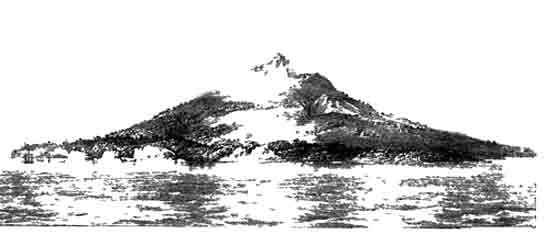
ISLAND OF FERNANDO PO
The island of Fernando Po, situated off the western coast of Africa, in the Gulf or Bight of Biafra, between 3°. and 4°. N. latitude, and 8°. and 9°. E. longitude, is about one hundred and twenty miles in circumference. It is generally believed to have been discovered in the year 1471, by a Portuguese navigator, who gave it the name of Ilha Formosa, or the Beautiful Isle, afterwards changed for that of its discoverer, which it now retains. The Portuguese first established a settlement upon it which they, however, abandoned, and subsequently transferred the right of possession to Spain, receiving in exchange the Island of Trinidad, off the coast of Brazil.
In the year 1764, a new settlement was founded by Spain, which, after a lapse of eighteen years, was also abandoned, for causes which have not been satisfactorily explained, although it is generally believed that a series of misunderstandings with the natives took place, which principally produced that result.[29]
Since this period the island has been left to its native inhabitants, excepting that various European, and particularly English vessels, have occasionally touched at it for the purpose of procuring water and yams; the latter of which it grows the finest in the world, and which the natives were accustomed to barter for pieces of iron.
At length, a variety of considerations determined the British Government to attempt a new settlement on this island; these it may be proper briefly to state.
In the first place, the convenient situation of the island, at the distance of only twenty miles from the main-land of Africa, and in the immediate neighbourhood of the mouths of the many large rivers which pour their waters into the Gulf of Biafra, appeared to afford a most eligible point for checking the slave-trade, of which this position may be considered the very centre.
Secondly, it, was imagined,—and the consideration reflects the highest honour on the humanity of our Government,—that the adoption of the measure would tend materially to diminish the sufferings of the miserable objects of human traffic—the unfortunate slaves—who too frequently sank under the confinement and disease incidental to a protracted voyage to Sierra Leone, before their liberation could be legally accomplished.
In the third place, it was hoped that the greater salubrity of the new colony would lead to the eventual abandonment of the settlements of Sierra Leone and Cape Coast Castle, the direful effects of whose climates upon European life have long been proverbial. The Insular position of Fernando Po, and the nature of its climate and localities, appeared to offer an earnest that it would not abound with those, destructive malaria which have proved, on the neighbouring continent, so fatal to our brave countrymen.
I might also advert to the facilities which the situation of Fernando Po, at the estuaries of so many great rivers, together with its insularity, holds out for extending and protecting our commercial relations with Central Africa, and probably extending the blessings of civilization amongst its inhabitants; these, however, although important, were minor considerations with the British Government.
To carry the proposed object into effect, an expedition was fitted oat in the early part of the summer of 1827, under the command of Captain William Fitzwilliam Owen, of His Majesty's ship Eden, who received the appointment of superintendent of the colony, and than whom no one could be better adapted to fulfil the important duties which were to devolve upon him; Captain Harrison, a highly meritorious and indefatigable officer, received the chief civil appointment under him. A number of appropriate artificers, with an abundant supply of the requisite stores, including several framed wooden houses ready for immediate erection, were embarked in a transport; and it was arranged that a body of troops, with an additional number of workmen and labourers from Sierra Leone, should be attached to the expedition on its arrival at that settlement.
On first approaching the island, its mountains were shrouded from view by heavy clouds and a hazy atmosphere; which, however, gradually dispersed as we neared the shore, and revealed to the eyes of my companions a magnificent display of mountain scenery, closely studded with large trees, and thick with underwood, whose luxuriant foliage of various tints and hues, blending with the scarcely ruffled bosom of the ocean, and the retiring clouds, making the sky each moment become more lucid and transparent, formed such a variegated picture of natural beauty, that we unanimously hailed it as the land of promise.
It was not long before the scene began to assume an aspect of animation, the immediate consequence of our arrival; for, in less than half an hour after we anchored, a number of canoes, with several natives in each, who had already been trafficking with the Diadem,[30] approached us for the purpose of bartering the productions of their island, namely, yams, fowls, palm-wine in calabashes, fish, some boxes made of split cane, monkey and snake skins, with other trifling articles; for pieces of iron hoop, a few inches long, which we afterwards found they made into two-edged knives, by beating them between stones, until they succeeded, in shaping the blade to their purpose, when they fitted it into a wooden handle, from four to six inches in length. In the first instance, however, they evinced considerable doubt and timidity, as they did riot venture to come alongside, but kept the stern of their canoes directed towards us, to be ready to paddle away on the first show of hostility, while a man remained in the forepart to carry on the barter. We in vain attempted to induce them to come on board, for, pointing in reply to their Fetish, they gave us to understand that this was either prohibited or imprudent. It was easy to perceive that the natives were fine-looking, active, middle-sized men, with an agreeable and animated expression of countenance. The natural colour of their skin was not ascertainable, the whole body being painted, or rather daubed over with a composition of clay, or ochre, mixed up with palm-oil. The prevailing colour was red, which seems to belong more exclusively to the lower classes: some few, however, had used a yellow, and others a grey pigment, probably as a mark of distinction, and which we afterwards found appropriated to the kings, or chief men. The faces were much seamed or scarified, while other parts of the body, and particularly the abdomen, were more or less tattoed. It is curious to remark, among the African savages, the variety of delineations on their skin, tattoed in lines, figures, or tropes, by way of ornament, fashion, or distinction, in nation and rank, which, perhaps, cannot be better described than in the words of the poet:—
Prince Giolo and his royal sisters, Scarr'd with ten thousand comely blisters, The marks remaining on the skin, To tell the quality within: Distinguish'd flashes deck the great, As each excels in birth or state; His oylet-holes are more and ampler; The king's own body was a sampler.
Their weapons were wooden well-barbed spears, with their points hardened by fire, each individual being provided with three or four. We afterwards, however, found that these were not the only means of defence, as they are possessed of slings, in the use of which they acquire no inconsiderable expertness. The canoes appeared to be from 15 to 30 feet in length, and each capable of carrying from three to twelve persons; these were provided with sails made of a kind of split rattan matting, of an oblong square form, the longer side placed perpendicularly, and some of them had a staff erected in the bow, with a bunch of feathers at the top of it.
When our muskets were fired at sunset, the whole immediately shoved off, being evidently much alarmed at the report; and most of them, hoisting their sails, endeavoured to reach the shore with all possible celerity.
Sunday, October 28.—Notwithstanding it rained heavily this morning, a great number of the natives came off to us at an early hour for the purpose of renewing their barter, to exchange their articles for pieces of iron, a metal which they appear to hold in the highest estimation, and which became the almost exclusive medium of our traffic with them. This metal they wisely prefer, nay, almost worship, for its usefulness; knives, hatchets, and iron-hoop, rank first in their good opinion, scissors and razors holding a secondary place; for they deem six inches in length of old iron-hoop, a quantity which would purchase half-a-dozen yams, varying from six to twelve pounds each in weight, far more valuable than the best razor you can present them with; in short, the ferri sacra fames may here be well substituted for the auri fames of more civilized nations. We may safely aver, that in our intercourse with these people, we have the 'love of iron' the chief exciting principle of their more generous, as well as malignant passions,—an opinion which many subsequent anecdotes in this narrative will prove.
The natives had to-day gained an evident accession of confidence, as some of them ventured on board, not, however, without many symptoms of timidity. A boy of twelve years old allowed himself to be conducted over the ship, and was shewn a variety of articles, of course entirely novel to him. With these he was, as may be supposed, exceedingly astonished, but more particularly with a looking-glass, and by the ringing of a small bell.
In the course of the day, Captain Owen landed at various points for the purpose of investigating the localities of the neighbourhood, and with a view of selecting the most eligible situation for our intended establishment. Lieutenant Robinson also went on shore to take sights for comparing the chronometers. Several natives approached the latter gentleman, offering him yams in barter, but were careful not to come too near, so long as his men remained armed with muskets. As it was evident from their signs that they wished these to be laid aside, Lieutenant Robinson, in order to inspire them with confidence, directed his party to ground arms, while he and Mr. Jeffery advanced towards them. Satisfied with this demonstration, their whole anxiety now appeared to be, how to dispose of their yams, which they professed, by signs, and with affectation of fatigue, to have brought from a great distance. They were not a little disappointed that our party, being unprovided with the necessary medium for payment, hoop-iron, were unable to effect the purchase.
Monday, Oct. 29.—The natives, who have visited us in great numbers to-day, are evidently increasing their stock of confidence, and, indeed, beginning to be, not a little troublesome, as we have no small difficulty in preventing them from coming on board. At seven o'clock in the morning we changed our anchorage to the opposite side of the bay, near the Adelaide islets, and close to Point William. A party went on shore for wood and water, in the procuring of which they were assisted by the natives.
Tuesday, Oct. 30.—Captain Owen, having now thoroughly investigated the vicinity of this place, determined upon the site of our future settlement. For this purpose, Maidstone Bay, in consequence of its capacity, (being about four miles and a half from Cape Bullen, its north-western limit, to Point William); the excellency of its anchorage, and the smoothness of its water, offered peculiar advantages; to which may be added, its reception of the waters of the Baracouta river, with other smaller streams, and the abundance of its fine fish of various kinds, including two or three species of turtle. On the south-eastern side, adjoining to coves which have received the respective names of Clarence and Cockburn Coves, two necks of land project into the bay, the one named Point Adelaide, with two small islands off it, bearing the same name; the other Point William. It was on the latter, constituting a kind of peninsula, projecting nearly six hundred yards into the sea, that Captain Owen decided upon fixing the infant settlement, which is probably destined to become the future emporium of the commerce, as well as the centre of civilization of this part of the globe,—giving it, out of compliment to His Royal Highness the Lord High Admiral, the name of Clarence. Besides the above named peninsula, the new settlement comprises other adjoining lands, which were afterwards respectively known by the appellations of Bushy Park, Longfield, Paradise, and New-lands, with some which have not yet received any name,—the whole constituting an elevated plain, lying between one and two hundred feet above the level of the sea, and at present thickly covered with timber and jungle. In Clarence Cove, there is an excellent spring of water issuing from a cliff, about sixty-six yards above low water-mark, well calculated to supply the exigencies of the settlement, and which it is intended to conduct, by means of shoots, down to the beach.
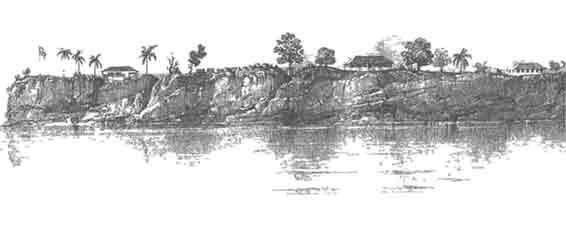
SETTLEMENT OF CLARENCE
The above situation having been finally decided upon, Captain Owen determined to lose no time in commencing operations, and, in the course of the day, notwithstanding it proved rainy, a party of a hundred Kroomen and other black labourers, were landed, under the command of Mr. Vidal, the senior lieutenant, and immediately began to clear a road through the jungle, to the spot selected for the new town.
Accompanied by Mr. Morrison, I also went ashore at Baracouta, for the purpose of inviting the supposed king of the island, but who, we have since reason to believe, is only the chief of a tribe. His Majesty would have accepted our invitation, had not his attendants offered a strong opposition: all we could gain was a promise that he would visit us early on the following morning. Our interpreter was a black soldier of the Royal African Corps, named Anderson, who professed to have some acquaintance with the language of the islanders. We found afterwards, however, that his Fernandian vocabulary was scarcely more copious than a sensible parrot might acquire in a month: his knowledge of the English, at all events, was so exceedingly defective, as to make another interpreter necessary, to explain what he meant to express, in our language. This man was left to pass the night at the royal residence, in order that he might avail himself of opportunities to inspire his Majesty with confidence, and be ready to accompany him on his visit in the morning.
Wednesday, Oct. 31.—The steam-vessel (African) arrived to-day, and brought in two vessels under Brazilian colours, which Lieutenant Badgeley had boarded and detained, under strong suspicion of their being engaged in the slave-trade.
At nine o'clock, the King of Baracouta, accompanied by his brother and five or six other chiefs, came on board according to promise, and without betraying any symptoms of timidity. The party were immediately conducted to the captain's cabin, and entertained with wine and biscuit, which they appeared to partake of with considerable relish. His Majesty, however, had not come unprovided, his canoe having been stored with some calabashes of palm-wine, which he sent for and distributed freely. We partook of this wholesome beverage, but some of the natives mixed it with Madeira. I must not omit to mention that, whether as a point of etiquette, or intended as an expression of gratitude for the attentions they were receiving, the King, and his Chiefs, were particularly desirous of rubbing their long beards against those of our party who happened to be possessed of a similar ornament. Amongst other circumstances which gave them satisfaction, they were highly gratified by sitting on our chairs; and we have since learned, that, in their own residences, they are in the habit of using logs of wood for this purpose, a custom differing from many of the African nations.
A description of their dress, which was in the most fanciful savage taste, cannot fail to be interesting. In the first place, the body was completely smeared over with the kind of paint I have before described: His Majesty's colour, like that which distinguishes the imperial family of China, being yellow, while the livery of his attendants was dark red. The hair of the head was dressed in long small curls hanging down behind, and which, instead of hair powder and pomatum, were well stiffened with ochre and oil: in front, similar curls dividing from the forehead, hung down on each side below the ears, somewhat in the style of Vandyke's female portraits of the age of Charles I. The forehead was generally round, sufficiently elevated to give phrenological indications of a fair portion of intellect, and, perhaps, unusually well displayed by a custom which prevails of having the hair shorn in front an inch beyond the line of its natural growth, so as, in conjunction with the peculiar disposition of curls before described, to leave the part fully exposed. In some instances, seven or eight strings of beads, in imitation of the natural curls, were adjusted with much care over the forepart of the head, and conducted separately behind the ears, the end of each string reaching down to the shoulders. This singularly ornamental head-dress was surmounted by a flatfish low-crowned hat, with a narrow brim, the whole shape not a little resembling that of Mambrino's helmet; the frame-work, constructed of loosely wove split rattan, was covered over and ornamented with leaves, the bones of monkeys and other animals, and a few white, and occasionally red, feathers; the latter of which appeared to have been dyed in the blood of some animal. This hat was secured to the head by a skewer, which passed through the crown, and penetrated a tuft of hair collected above the vertex. The neck, arms, body above the hips, and the legs below the knee, were encircled by ornamental bands, in the form of bracelets, which were, for the most part, composed of strings of beads, or the vertebrae of small snakes; to the girdle, which thus surrounded the body, was appended, hanging down in front, the only article of covering which they can be said to wear, consisting of the skin of some animal, and which, in many instances, was decorated with a bunch of herbage. His Majesty, however, as a mark of distinction, wore also a similar covering behind.
After having been entertained in the cabin, we conducted the party along the main-deck, and shewed them our horses, oxen, pigs, &c., with the whole of which they were highly gratified, especially with the cow, whose tail was a source of ineffable delight to them, each of them handling it in succession, plucking out its hairs, and shaking it with every indication of astonishment. The band was directed to play for their amusement, and delighted them to such a degree, that they could not restrain themselves from running into the midst of it. The King's brother was so enraptured, that he capered about with excess of joy, making the most uncouth gestures in accordance with the music.
"So play'd Orpheus, and so danced the brutes."
Our more difficult task was yet to be encountered—the distribution of presents. His yellow Majesty was in the first place complimented with the whole of an iron hoop straightened out for the occasion, and also with half a dozen fishing-hooks; to his brother we gave half the quantity: while the minor chiefs received about a foot in length each. Some squabbling occurred during this arrangement, which was, at length, happily concluded, pretty much to the satisfaction of the whole party, and they left the ship in apparent good humour, evidently highly gratified with their visit.
Thursday, Nov. 1.—A heavy fall of rain disappointed us in an arrangement to visit the chiefs on shore.
Friday, Nov. 2.—Notwithstanding it continued to rain heavily at intervals, I went on shore in company with Messrs. Galler and Morrison, for the purpose of arranging with the King for the establishment of a market. On landing, we were surrounded by a number of natives, who treated us with more kindness than on our preceding visit, not forgetting, however, both male and female, from the youngest to the oldest, to importune us incessantly for iron; it was almost dangerous to take particular notice of any individual, for they immediately assumed it as an indication of a disposition to make them a present, and began to double their importunities. Not finding the King or his chiefs on the beach, we sent to announce our arrival, yet we had to wait two hours before they condescended to appear. During this time, Mr. Galler amused himself with shooting monkeys; which appeared to afford some interest and amusement to the natives, who assisted in pointing out the game, and laughed heartily whenever he missed his aim.
At length the King arrived, and we explained as well as we could the object of our visit, to which he listened with great attention, appearing to comprehend, so as finally to accede to our wishes. He then proposed, in order to preserve a mutual good understanding, that, in the event of any breach of faith on the part of their people, we should immediately communicate the same to the chiefs, who would take care to have the delinquent properly punished; while, on the other hand, if any of our people were guilty of improper conduct towards them, they would represent it to our chief. This proposal, after a deliberate discussion, was agreed to on both, sides, the contract confirmed by drinking palm-wine, and a mutual exchange of presents, as follows, we tendered an axe to the King, and he returned the compliment by presenting us with a fowl.
We now proposed to accompany his Majesty back to his village. With this he appeared perfectly acquiescent, taking me by the hand, and leading me forward, as if he were conducting me to the point proposed; but we soon found that his real intention was to lead us to our boats. We still, however, imagined that this was only with the view of taking us some nearer way home; but when we wished him to enter the boat, with the intention of coasting it to another part of the shore, he positively declined, giving us to understand that his house was not good enough to receive us, and that it contained nothing in the shape of refreshments sufficient to do honour to the visit. We were, however, predetermined, and, as our interpreter was acquainted with the way, proceeded with Captain Smith and Mr. Jeffery, in addition to our former party. When we arrived, we were ready to admit that his Majesty had some reason not to be over-anxious for our company: for neither was the road, nor the accommodations of his hut, calculated either for a visit of pleasure or ceremony; in many parts the path was not only slippery, but interrupted by roots of trees and pools of water; added to which, it lay through a thick jungle, which swarmed with myriads of ants. His Majesty's hut was a mere thatched roof, the eaves of which nearly reached to the ground, supported by posts, and with only one end protected from the weather; the chief articles of furniture were logs of wood, as substitutes for stools, and an inclined plane of wood, five feet in length, to serve the purpose of a bed, the pillow of which was a round bar, three or four inches in diameter, supported at the proper height by two brackets. The king's brother, who had arrived first, received us with much good humour, but regretted that he had nothing to entertain us with. In a short time, however, a calabash of stale palm-wine was handed in, which, having first tasted, according to the African custom, with a view of proving that it contained no poison, he presented to us. After resting a short time, we returned to our boats.
In order to prosecute the formation of the now colony with the greatest energy, every hand which could possibly be spared, was sent on shore. A better approach to Point William, the acclivity being more gentle, was discovered this morning, and a large party immediately employed in clearing away the timber and brushwood, for the purpose of making a broad road through it.
Saturday, Nov. 3.—The Eden was moved nearer to Point William and the Adelaide Islands, for the greater convenience of landing the working parties, stores, &c. The steam-vessel and her prizes also left their anchorage in the bay, and moved into Clarence Cove. Not a single canoe was visible on the water, and very few natives on the shore; we were informed by our interpreter, that they were occupied with the funeral of a chief, but suspect that the different tribes were assembled in council to discuss the subject of our arrival, and our evident intention to form a settlement among them.
Nov. 4.—Some native chiefs were much delighted with sitting in our chairs; but, when the Captain presented them with a few knives, small looking-glasses, and other trinkets, their delight was raised to rapture, expressed by clapping their hands and singing certain short sentences in a high tone of voice, at the same time bowing their heads, as if to indicate their readiness to admit our superiority. We were afterwards informed, that these songs were in our praise, and implied the following meaning:—"Truly you are come to do us good." We entertained them with palm-wine, Madeira, biscuit, fish, and yams; we found, however, on this, as on all other occasions, that these unsophisticated people preferred their native viands to our European delicacies. They appeared much interested with the three European females we had on board; but, whether they had sufficient taste to prefer them to their native beauties, I shall not pretend to determine. After remaining two hours on board, they took their leave, and returned to the shore.
Monday, November 5.—Anderson, who had been absent two days, returned this morning in a large canoe of seventeen paddles, accompanied by the same party of chiefs who had visited us yesterday, with, however, an addition of the king's son. Before coming alongside, they pulled round the ship, singing most loudly and merrily. Though Captain Owen was on shore, they were taken into the cabin, and entertained until his return, after which he gave a present to each of them. Notwithstanding this liberality, the principal chief fixed his covetous eye upon an axe, and expressed a most eager desire to become possessed of it. Captain Owen, however, notwithstanding his wish to conciliate the natives as much as possible, did not think proper to gratify his cupidity; but he promised, that it should be presented to the King at the next interview with him. In the afternoon, a tornado arose and drove most of the canoes away; the chiefs, however, remained on board until it was over, and then left us under an arrangement that the Captain should pay a visit to the King on the following Wednesday.
Tuesday, Nov. 6.—We had a wet morning, succeeded by a fine day. Many canoes, full of natives, came alongside. About noon, a native was discovered, by the master-at-arms, to have stolen an axe, which he had secreted in a piece of canvas that he had picked up and tied round his waist in the manner of an apron. On taking it from him, he made a desperate attempt to escape, by running down the ship's side into a canoe, from whence he made his way over several others, with a view of reaching his own, but he was arrested in his progress. A warm discussion now arose among the chiefs present, as to the punishment he ought to be subjected to, having been taken flagrante delicto, under their own eyes. Captain Owen, to evidence his high displeasure at the transaction, cut the matter short, by ordering them all out of the ship. This gave rise to another commotion and discussion, the result of which was, that the culprit was assailed on all sides by his countrymen with their paddles; even a boy in the same canoe inflicted several blows, and he was finally severely injured about the head and body, when, with the blood streaming from various parts, he was compelled to leap into the sea, in order to wash it away, before they would allow him to re-enter his own boat. His punishment, however, did not terminate with the above discipline; for as he assisted in paddling his canoe ashore, his countrymen followed him with every denunciation of vengeance. On landing in the neighbourhood of our market, he was seized, conducted a short distance from the beach, and surrounded by an immense crowd of the natives. Mr. Jeffery, who happened to be near the spot, penetrated into the midst of them, with a view of ascertaining the nature of the affair, when, to his surprise, he was immediately laid hold of, and tied hand to hand with the bleeding prisoner. It may be imagined that this proceeding excited considerable alarm in Mr. Jeffery, who was led to infer that the wounds of the prisoner had been inflicted by our people, and that the natives were about to retaliate upon himself. A soldier, who was passing at the moment, lost no time in giving an alarm at the camp, when Capt. Harrison came with a party of soldiers to the assistance of our comrade; but Mr. Jeffery had, by this time, contrived to disengage his hand; and, our people appearing, the natives desisted from farther attempts upon him. It turned out that their object in offering this apparent violence, was merely to secure an evidence on our side of the final punishment of their countryman, which they now proceeded to carry into effect in the following extraordinary manner:—the poor wretch was, in the first place, tied hand and foot with his back to a tree, after which a discussion took place, between the chiefs and a man, whom we conceived to be a priest. This being finished, one of the chiefs, who, in consequence of the prominent part he played in this dramatic scene, was ever after known among us by the honourable name of Cut-throat, very coolly stepped up to the prisoner, the whole of the natives at the same time falling on their knees, and was proceeding with great deliberation to cut his throat, when Captain Harrison and Mr. Jeffery hastened forward, and prevented the perpetration of the act by holding back his arm, and making signs that our chief was coming. Fortunately, Capt. Owen was actually coming on shore at this juncture, and, having passed to the centre of the assembly, by means of signs succeeded in explaining that it was not his wish to have the man so severely punished. He then took him by the hand, led him through the crowd, and thus liberated him from the sanguinary vengeance of his own countrymen. During the whole of this trying occasion, the prisoner neither shrunk from the numerous and severe blows inflicted upon him in the earlier part of it; nor, in the latter part, did he indicate the slightest symptom of fear. This is one of the many traits we met with of either the great fortitude or little sensibility of these islanders.
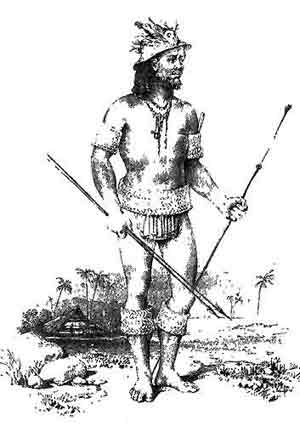
CUT THROAT
We were much surprised at finding a Demi-John in the woods at the back of our encampment; it certainly indicates that we are not the first Europeans who have visited this spot.
Wednesday, November 7.—Anderson, accompanied by two chiefs, came on board at 9 A.M. to say, that the King was on the beach, waiting for our boat to fetch him off. At eleven, the Captain, accompanied by several of his officers, myself, the band, and a party of marines, with a variety of presents, went in three boats for the purpose of paying our intended visit to his Majesty. We landed at a small cove, three miles to the eastward of the ship, since known by the name of King-Cove, and were conducted by the chiefs to a small open place in the woods, at the distance of about a hundred yards from the rocky shore, where the natives had placed a number of stones in the water in such manner as to leave a channel for only one canoe to land at a time. When the Captain was seated, a small ram, and several calabashes of palm-wine, were brought forward. After waiting an hour, the King arrived, when the Captain, rising to receive him, ordered a red cloak to be thrown over his shoulders, and a velvet cap to be put on his head; as his Majesty wore his native hat, ornamented with a pair of ram's horns on the fore part of it, it became necessary to place the velvet one above it, and secure it in its position by means of a bone skewer, which, piercing both at the same time, fastened them effectually to the tuft of hair on the top of the head. The sight of our presents, but more particularly the quantity of iron, excited so uncontrollably the feelings of the royal party, that the good order previously observed, could now no longer be maintained; we were pressed upon on all sides, and with such an inconceivable clatter and confusion of tongues, that the bellowing of cattle would have been comparatively musical to our ears; however, to do them justice, notwithstanding this horrid din, they did not make the least attempt upon our persons or property. It was noticed that the King himself gave away several small pieces of iron to certain individuals, probably an act of policy, which, by leading others to expect a similar token of royal favour, would restrain them from attempting to help themselves, and thus diminish the quantum of his own presents. During this scene of confusion, we retired to the beach and entered our boats, the crowd following us to the shore, and many even into the water. On this occasion, we calculated that there could not have been less than two thousand natives assembled, including many women, but they were kept apart from the men. Mr. Galler spoke to some of them; but they were excessively timid, although the men endeavoured to encourage familiarity by placing some of the younger women's hands into his. One peculiarity was remarked on the present occasion, that many of the natives had lost one of their hands, and some both, indeed we found this so common in the island, that there was no doubt of the deprivation of this part of the body being resorted to as a punishment. Before returning to the ship, I went with Messrs. Galler and Jeffery to visit the works at Clarence, when we were informed that the men employed in clearing the jungle, had discovered the Indian-rubber tree, and one or two other indigenous plants which had not been previously noticed.
Thursday, November 8th.—The importance of our acquiring a knowledge of the language of the natives of this island, must be obvious. In order to promote this object. Captain Owen selected an active and intelligent young man of the name of Elwood, who volunteered to reside for a week at a village in the interior of the island; and he left the ship this morning in pursuance of the plan. The Captain this day fixed upon a spot for the site of a house intended for his own residence: he also gave the name of Paradise to a portion of ground which had been cleared to form a garden for the use of the colony, and changed the appellation of Glover's Stairs for that of Jacob's Ladder. This consists of a flight of 150 steps, leading from the beach to the acclivity on which Clarence is situated that had been constructed, since our arrival, by Mr. Glover, and his body of English artificers.
Friday, 9.—During the night there had been much thunder and lightning, succeeded, in the morning, by heavy rains, which went off at eleven o'clock, and recommenced at two, accompanied by strong gusts of wind; at four, it cleared up again: scarcely a canoe or native was to be seen throughout the day.
Saturday, 10.—The weather is to-day extremely fine, and yet very few canoes or natives have been seen: and none have approached the ship. We apprehend that something has occurred to displease them—a suspicion afterwards confirmed. In the afternoon, at the time I happened to be on shore, a deputation of seven chiefs came to Mr. Jeffery, at Newmarket, with a complaint that our Kroomen had been cutting down the palm-trees for the leaves to thatch their huts with; and, also, that they were much annoyed by the frequent firing of muskets. In reply to the latter complaint, Mr. Jeffery explained to them, that the firing proceeded only from the attempts of our officers to shoot monkeys; to confirm which statement, the purser very opportunely came up at the instant with a large monkey and a small deer, which he had just shot. They did not, however, appear properly satisfied; for they shook their heads, and intimated that, if we persevered in cutting down the palms, it would not only deprive them of the advantages of that valuable tree, but, by diminishing the quantity of wood, extend the system of firing musketry farther into the interior of the country. At length, with a view of settling all grievances, and convincing them we had no intention of inflicting any injury, we took them a short distance beyond the points our men were occupied in clearing, and, placing a quantity of iron on the ground, gave them, by signs, to understand, that we would give them all that iron for the land contained within that boundary. The nature of this treaty for purchase, they appeared to understand well, and signified their assent by placing sticks, at equal distances from each other, in the line proposed. Mr. Jeffery, at the same time, marking a tree as an evidence of the agreement on our side. The quantity of land of which we had thus made a bonâ fide purchase, was equal to about a square mile in extent. The treaty was afterwards more fully ratified, and the property involved formally taken possession of by a public act, which will be duly noticed. Both parties being now satisfied, we returned to Newmarket, the natives accompanying us, and, sitting down in a row together, farther confirmed the bargain by plentiful libations of palm-wine.
Sunday, 11.—At half-past one divine service was performed by Captain Owen, when four of the natives attended, and behaved with great decorum; they also made signals to their companions in the canoes to avoid all noises which might disturb us.
Monday, 12.—A numerous deputation of chiefs, gaily dressed, came to our camp at Clarence, to conclude a definitive arrangement respecting the land we had purchased on Saturday. Captain Owen accompanied them to the boundary line, and marked an additional number of trees, to define the limits with more accuracy. He also promised them additional payments: after which he took four of the principal chiefs on board, drank palm-wine with them, and made them a variety of presents. Confidence was now fully restored, and great numbers of both sexes visited us before the day terminated.
Tuesday, 13.—We have additional proofs of the return of confidence on the part of the natives: a man and a boy insisted on remaining on board to sleep, probably induced by the anticipation of a present. There never were more harmless, inoffensive, or tractable people: for, when most troublesome, they may be led in any direction you choose, by taking hold of the hand, or even of a finger.