Volume 1 — CHAPTER II.
Reading edition
Teneriffe—Town of Santa Cruz—Female Costume—Incident at a Ball—Bad Roads—Climate—Productions—Population of the Canary Islands—Imports and Exports—Various Qualities of the Wines—Fishery—Leave Santa Cruz—Crossing the Tropic of Cancer—Shaving and Ducking—General Remarks—Make St. Jago—Anchor at Porto Praya—Sickly Season—Death of the Consul and his Wife—Consul's Sister—Governor's Garden and Watering-place—Population of the Island—Produce—The Orchilla Weed, its growth, uses, and varieties—Cause of Fever—Departure for Sierra Leone
Wednesday, 15th.—Fresh breezes and cloudy, with the wind and a swell from the eastward. At sunset passed within six or seven miles to the eastward of the Great Salvage Islands.
Thursday, 16th.—At daylight saw the island of Teneriffe,[4] and at nine anchored in Santa Cruz Roads, in nineteen fathoms water; the flag-staff on the mole bearing W. by N. We saluted the Spanish flag with thirteen guns, which was returned.
Mr. M'Gregor, our Vice-consul, came on board, when he immediately recognised me, as having seen me at Hamburg about three years before. On his returning to the shore he was complimented with a salute of seven guns, according to regulations. I accompanied some of the officers on shore to take a ramble over the town. I regretted to learn from Mr. M'Gregor that Mr. Bruce, our Consul-General for the Canaries, was in England. This circumstance was a serious disappointment to me, as I had a letter of introduction to that gentleman from a friend of his at Madeira, who assured me that he possessed so vigorous and intelligent a mind, and was so intimately acquainted with the island of Teneriffe, where he had long resided, that I could not fail to obtain much valuable information from him that was not generally known.
My friends were very much pleased with the cleanly appearance of the town and good pavement, affording a striking contrast to Funchal, which, like most Portuguese towns, was dirty and badly paved. There was another agreeable sight; the Spanish women, who were generally handsome, with an interesting character of expression in their faces, which is much heightened by their beautiful dark eyes and jet-black hair. Their dresses are remarkable for their neatness.
The town of Santa Cruz stands near the sea, on a plain of about two miles square, at the foot of the mountains. The population amounts to about 6,000 souls. It has a well fortified sea-line of defence, and a mole protected by a fort. It was on landing at this mole that Nelson lost his arm, and Captain Boscawen his life. The English colours taken on that occasion are preserved as trophies in the principal church. Few persons are seen walking about during the day, and those only of the lower orders. The women wear large shawls thrown over their heads, hanging very low down, and a round black hat with a high crown. A friend of mine once visited the island in one of H.M. ships at the time of the Carnival, and on the last day of the festivities there was a public ball, to which the officers of the ship were invited. They went early to see as much as they could of the inhabitants, and their opinion of the ladies was, that they looked more like English than Spanish women in almost all respects, except their remarkably black eyes and hair. Before the dancing commenced the ladies were all blindfolded, and each provided with a stick, when they were conducted to one end of the room, where a jar full of bon bons was suspended, which they were desired to break, but the blows from their delicate hands were not able to accomplish it, and one of the gentlemen at last performed this task for them, when there was a general scramble among the gentlemen, from a desire to procure some of the contents to present to their fair partners.
The Diadem transport anchored here soon after us.
Friday, 17th.—The York, East Indiaman, was lying off this place in the forenoon whilst her boat went on shore with letters. Some of the officers took horse this morning and went to the town of Laguna, which is about six miles from Santa Cruz. They found the road in a terrible state, from a quantity of large stones and rubbish, which a late hurricane, with heavy rain, had brought down from the higher lands. Their ride was a very cheap one, for they only paid half a dollar for each horse, including a guide—a rare occurrence for Englishmen to find any thing cheap in a foreign country. Port Oratava, which lies on the opposite or north side of the island, the principal town for commerce on it, is 21 miles by land from Santa Cruz; and it is said to be 36 miles from Oratava to the summit of the Peak, a journey of at least two days' ascent from the latter place, which is the starting point.
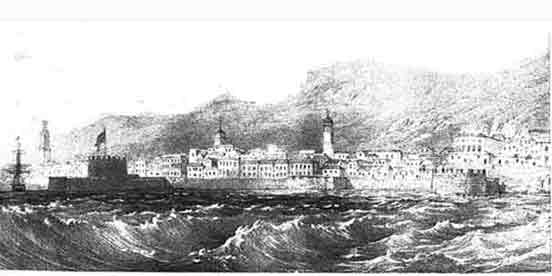
TOWN OF SANTA CRUZ, TENERIFFE
Our visit to this island was too short to be of much interest to a traveller, for it would have required at least a week to have visited the Peak only and returned to Santa Cruz, which I certainly would have done if the ship had remained a sufficient time; as I also wished to have visited Porto Rueva, at Madeira, but on my arrival at that island I had not sufficiently recovered my strength after the indisposition I experienced on leaving England.
They have at Teneriffe, (besides horses, asses, and mules,) camels, which are much in use as beasts of burden. Smoking is a very general practice here, and consequently there is no want of ordinary cigars; but I was surprised to find that Havannah cigars are very difficult to be procured. They can be obtained, however, but at un exorbitant rate, in consequence of the risks attending the smuggling. Tobacco is a royal monopoly, and the duty is so high, that it amounts almost to a prohibition, and consequently affords great temptation to smuggling. They have ice at their command here in abundance, which is a great luxury for a hot climate. They bring it down from the mountains, and use it very commonly in lemonade, creams, and for many other purposes. It is desirable to call here on your way to a hot climate, if it were only to procure a few good drip stones, the best of which are brought from Grand Canary, and which are to be had in great plenty, and very cheap, from one to three Spanish dollars each, which is the most current coin of this island.
Teneriffe, in climate, soil, produce, and general appearance, strongly resembles Madeira, from which it is distant 240 miles, due south. The principal towns are Port-Oratava, Oratava, Realexo, and Caracheeo, on the north side of the island; and on the south, Santa Cruz, Candilaria, and Adexi; besides the inland towns, Laguna, (the capital) about two leagues from Santa Cruz, Metanza, and Victoria, all on the road between Santa Cruz and Port-Oratava, which arc at an elevation, varying from 3,000 to 5,000 feet above the level of the sea. This affords a considerable variety of climate, and choice of residence. Teneriffe, however, possesses but little English society, consequently there are few comforts or inducements for invalids. There is an extensive plain of table land and corn country round Laguna, which is a bishop's see, with an income of 30,000 dollars per annum. The governor of the province resides at Santa Cruz. There is also a bishopric at Grand Canary (where the audience, or supreme court is held), worth about 50,000 dollars a-year.
Teneriffe, from its great elevation, and gradual slope to the sea, possesses every variety of vegetation from the tropic to the frozen regions. In the first or lower region are found the date, palm, pine-apple, alligator-pear, and sugar cane, tea and coffee trees, lemons, citrons, oranges and grapes; the next region is that of grain and fruits, and trees of temperate climates; next follow the chesnuts, pines (Pinus Cananensis), and other hardy Alpine trees; then the region of heaths, laurels, and other evergreens; and at the extreme limit of vegetation, a considerable distance from the summit, the white broom (Spartium Nubigenum.) The population of the Canary Islands is about 200,000, viz. Teneriffe, 80,000; Grand Canary, 60,000; Palma, 25,000; Lanzerota, 15,000; Forteventura, 10,000; Heirro, 4,000; Gomera, 6,000.
The exports, exclusive of the coasting trade, are wines, barilla, orchilla weed, rock-moss, safflower, (hay-saffron,) and silks. The imports are sugar, cocoa, oil, tobacco, paper, &c. from Cadiz; earthenware, from St. Lucia; brandy, from Catalonia; dry goods, cloth, iron, and hardware, from England; and staves, soap, candles, and rice from the United States of America.
The volcanic nature of the soil of the Canary Islands renders it extremely favourable to the cultivation of the vine, which grows luxuriantly in Teneriffe, where more than three-fourths of all the wines exported from the Canaries is produced. The Teneriffe wines are of the same description and varieties as the wines of Madeira, namely, Tinto, Verdelho, Gual, Listan, Malvasia,[5] &c., but they are not equal in quality to the fine wines of the south side, yet superior to the wines of the north side, of that island. They are distinguished by what may be called the generic denominations of dry and sweet. The dry is well known by the name of Vidonia, and the sweet as Malvasia. The first quality of the former can only be obtained from the most respectable merchants, it being a very common process to convert it, by admixtures, into a counterfeit of Madeira, or sherry, and occasionally to drug it with port. The strongest quality of the celebrated wine called sack,[6] is made in Teneriffe, Grand Canary, and Palma.
Carbonate of soda is obtained from the sal sola soda, extensively cultivated at Lanccrota and Forteventura. It is gathered in September, dried, and then charred or fused into a ringing, hard, cellular mass, of a greyish blue colour. A small quantity is made also at Grand Canary. The barilla of the Canary Islands has been sold in England so high as 80l. a ton, and as low as 6l.; at the present time, (December, 1833) it is worth 9l. 10s. a ton. The depreciation is caused chiefly by kelp, and other substitutes found in the British alkali, a French chemical discovery, manufactured from sea salt, from which, the other ingredients are detached, by combination with sulphur, and acids subjected to heat. The imports of barilla from the Canary Islands to this country are about 3,500 tons a-year. The United States of America, and of late years, Brazil, also, take off a few cargoes of this article. Lancerota produces, annually, about 300 tons of barilla; Forte ventura about 1500 tons.
Rock moss (Parmelia perlata) is worth about 70l. a ton, and is one of the innumerable lichens common to the Canary Islands; it is used in the manufacture of cudbear for the dyers. There is also a spurious kind, with difficulty distinguished from the good.
Silk is chiefly produced at Palma. There is but little exported from Teneriffe. It might, however, be produced in immense quantities, the white and red mulberry tree being indigenous and luxuriant in the middle region of the island, and the climate so mild, that the insect could be hatched and reared under wooden sheds, without any difficulty. The great defect in the Teneriffe silk is the coarseness of the fibre, from want of dexterity in winding it off the cocoons, and in regulating the heat to which it ought to be subjected during that separation.
A considerable emigration used to take place annually from the islands, and particularly from Lancerota and Forteventura, to the Spanish Main, and to Cuba, where those islanders were much in request, as labourers and muleteers; and often prospered so well as to be enabled to return home enriched: but the practice has been prohibited since the declaration of independence of Spanish South America.
There is a considerable fishery carried on from the Canary Islands, on the coast of Barbary, for a species of bream, which is salted in bulk, and sold very cheap, and in great quantities. This trade is pursued in decked schooners, or lugger-rigged vessels, of from 60 to 70 tons burthen, which rum down before the trade wind to their station, where they remain until they procure a cargo, when they beat up to the island, take in a fresh cargo of Cadiz salt, and again return to their station. They have very little intercourse with the Arab tribes of that coast, but they sometimes bring back a few lion, tiger, and leopard skins, and ostrich feathers. I am happy to learn that our knowledge of the natural history of these islands is likely to be soon very much increased, by the indefatigable exertions of P.B. Webb, Esq., a gentleman well known to the scientific world, who is now engaged at Paris in publishing the result of his researches in different branches of natural history.
In the afternoon we took in some oxen and wine, and left Santa Cruz roads at seven in the evening. From Santa Cruz to Porto Praya, St. Jago, the course is S. 26 deg. W. 920 miles.
Monday, 20th.—Having crossed the tropic of Cancer last evening. Captain Owen granted the ship's company permission to perform the customary ceremony of shaving and ducking all those who had not previously passed the tropic. Whenever a ship is intended to enter the southern hemisphere, this marine exhibition is not performed until she reaches the equinoctial line. Although this ceremony has been frequently described, I do not think it right to pass it over altogether unnoticed; I will therefore make a few general observations by way of comment on the practice.
A sea voyage is at the best a monotonous life, and a long voyage is only to be wished for by the few whose health it is calculated to improve; therefore, any little variety, that produces even but a temporary excitement, is desirable; and in this point of view only, is the old custom of shaving and ducking (which, by the bye, is a barbarous one) at all excusable.
When it is permitted to be practised, it should only be under certain regulations, as the consequences have frequently been very serious, for want of some salutary restrictions; in some cases the harmony that has existed amongst the society on board has been destroyed; actions at law, and duels, fevers from exposure daring the day's amusement, have ensued: it is, therefore, imperatively necessary that the law should take cognizance of this custom, and enforce some rigorous rules for the government of all commanders of vessels, whenever circumstances should permit the indulgence of this indefensible practice. In the first place, the ship should be always put under snug sail; and that part of the vessel, in which the scene takes place, should be completely screened in, and no cruel or offensive practices permitted. The Captain should always have the power of protecting his officers and passengers from being compelled to submit to the demands of old Neptune, by paying a small fine for the exemption: say cabin passengers, five shillings, steerage passengers half-a-crown. The sum total of these fines should be divided among those sailors who had previously crossed the line; and, if any of the sailors on board should be found to throw water, rope yarns dipped in tar, or in any other way insult, or annoy, persons who do not take a part in their proceedings, they should be punished as they would for a similar breach of discipline at any other time. There is one example, which I feel at liberty to quote, and which was nearly the occasion of a court-martial on the senior lieutenant of one of H.M. ships that arrived in Simon's Bay during my residence at the Cape of Good Hope. The circumstance was as follows:—The purser of the ship had shut himself up in his cabin, determined to resist any forcible attempt to make him undergo the ceremony of shaving; but those who were engaged in it, were resolved that he should not be permitted to escape: they accordingly forced the door of his cabin, from which they got him out, dragged him on deck, and performed the ceremony, in spite of his efforts and remonstrances. The charge against the first lieutenant was, I understood, for encouraging the persons who committed this act of violence. This formed the grounds of an application for a court-martial, which was only prevented from taking place by the intercession of some officers of rank. It is satisfactory to be enabled to add, that this barbarous and unworthy custom is rapidly falling into disuse.
Wednesday, 22nd.—A moderate trade wind, and all sail set. At daylight saw the island of Sall, bearing E.S.E. 15 miles. At half-past 5 in the afternoon saw the island of St. Jago,[7] when I went to the fore top-mast head, for exercise and amusement, while others went to see the land. At 11 brought the ship to the wind, and stood off the land at a convenient distance for going into Porto Praya on the following day.
At daylight, made all sail, and stood towards the anchorage, with a light breeze and very fine weather. At noon anchored off Porto Praya, in 12 fathoms water and sandy bottom. Extreme points of the bay from W. ¾ S. to E. ¾ S. Garrison flagstaff N.N.W. ½ W.
Our Consul-General for the Cape de Verds (Mr. Clark) waited on Captain Owen, from whom we learnt, that His Majesty's ship, North Star, sailed from this port five days before, and that a very heavy gale of wind arose from the S.W. on that night. We were also informed, that this is the most sickly part of the year, in consequence of its being the rainy season, which commences at the beginning of August, and continues to the end of October; during which time the winds are frequently from the southward and westward, making it hazardous to anchor at this port in those months. The whole of this time is generally very sickly, so much so that the principal authorities are glad to leave the island, and repair to Fuego, which is the highest, and also considered to be the most healthy of all the Cape de Verd group. The Chief Justice and his family left Porto Praya, for Fuego, in a Portuguese sloop of war, on the day we entered it, the Governor having previously left for the same destination.
There were many of the inhabitants suffering from fever, while we were at St. Jago, and two of the Consul's family were among the number, and I lament to relate, that not long after our departure, both the Consul and his wife fell victims to this too commonly fatal fever of St. Jago, leaving his sister, an amiable and accomplished young lady, dangerously ill of the same disease. The case of this lady was one of the most melancholy interest. She was entirely unprotected by the presence of any country people of her own, except a gentleman, who, happening to call there on his way from England to Sierra Leone, was induced to remain on the island, at the request of Mrs. Clark, for the purpose of acting as Vice-Consul, during the severe illness of her husband. This gentleman, after performing the painful duty of reading the burial service over the Consul-General and his lady, was himself attacked by the same fever, and after struggling for a length of time against it, was, at last, sent off to the island of Mayo, just in time to save his life, leaving the Consul's sister behind, reduced to the last extremity of the disease, with scarcely any symptoms of life remaining, and attended only by her Portuguese friends, and any occasional English visitors who landed incidentally from their ships for refreshments, on their way to other parts of the world. At last, however, she happily recovered, but after a very severe struggle, and a protracted illness, and then she could not return direct to England, but was obliged to go to the Brazils, in a French schooner, before she could procure a passage home. I shall give, hereafter, some further details of this young lady's history, leading to the attachment which afterwards sprung up between her and her medical attendant, who fell in love with her during a second attack of illness, and there is no doubt that her fortitude and good sense had a great share in the admiration with which she inspired him.
Friday, August 24th.—Soon after breakfast I accompanied Captain Owen, the Rev. Mr. and Mrs. Davy, and some of the officers of the ship, to pass the day at the Consul's. We took a walk before dinner, to visit the few places that were worthy of any notice; we first went to the fort. This fort was forty-seven paces long and seven broad, where the only objects of interest were the graves of two Captains in the Navy. One of them contained the remains of an old shipmate of mine, Capt. J. Eveleigh, who was mortally wounded when commanding the Astrea, in company with the Creole, during an engagement with two French frigates, the Etoile and Sultane, on the 23rd of January, 1814, off the Cape de Verds. I sailed in the same ship with this officer when I first went to sea. He was then junior lieutenant of the Royal George, bearing the flag of Lord Bridport. I met him some years afterwards, when he was lieutenant of the Isis, bearing the flag of Admiral Holloway, on the Newfoundland station, in which ship I was a passenger from England to Newfoundland, on my way to join the Cleopatra, as lieutenant, on the Halifax station. The other grave was that of Capt. Bartholomew, of the Lieven frigate, who died while he was occupied in the survey of these islands. The late Consul-General had been purser of that ship, and, poor fellow, both his grave and that of his wife were made near his former captain's.
From thence we went to visit the Governor's garden, which lies in a low swampy situation, much below the town, and not far from the sea, where the boats are obliged to land to procure water, subject to the inconvenience of the surf, which sometimes renders it very difficult to get the casks off. The water at this island does not deserve the bad character given of it by some persons. It is, in fact, very good, and it must, therefore, have been from negligence in procuring it, either by disturbing it too much, or by using bad bungs, which allowed the salt water to get in while floating off, that it acquired its unfavourable reputation. It is supplied by several springs, issuing from the side of the hill at the back of the town, which unite into one stream, and as it approaches the sea, expands and forms into a basin, the nearest part of which is forty yards from the beach. As this is rarely dry, ships may be easily watered, by landing their casks through the surf; and, when filled, floating them off to the ship. However, when it is dry, or nearly so, as was the case when we were there, you are obliged to roll the casks a considerable distance from the beach to a well in the Governor's garden, from which they must be filled. This mode is both tedious and laborious, while the sailors are almost sure to get drunk on a bad spirit called aqua dent, which is sold to them secretly by the blacks, who are ever on the watch to elude the vigilance of the officers employed in that service.
During the time of the former Governor, (the present one not having been long in command,) this garden received great attention, and was kept in excellent order; but the present Governor does not take any interest in it himself, and, consequently, it is very much neglected; indeed, there appears to be such a general apathy in all the people at Porto Pray a, that it seems more like a place allowed to go to decay, than a colony under an European Government, visited so constantly by vessels from all parts of the globe.
The population of Villa de Praya is about 4,000, and that of the whole island about 28,000, which are principally blacks. A large proportion of the male population of St. Jago, are enrolled in the militia, and armed with boarding pikes; 300 of whom are compelled, in rotation, to attend every Sunday, at their own expense, for the purpose of exercising at Villa de Praya. The regular troops do not amount to more than 400 for the whole of the islands.
This place owes its support entirely to the ships that call here for provisions; and the quantity of stock, fruit, vegetables, and water, that is purchased annually at the island is immense. A considerable sum of money is also spent by passengers, who go on shore for their amusement.
The landing at St. Jago is, at all times, indifferent, and in the rainy season frequently very bad, both on the rocks, and on the beach, for there are two distinct places of debarkation. Yet, with a little attention, and a small amount of labour, a more secure landing-place could very easily be made, by cutting a few steps in two or three favourable situations, that would readily admit of the improvement; whereas now you are obliged to watch the swell, and step out on pointed rocks, or an irregular surface, at the risk of falling back into the boat or the water; or bruising yourself severely on the rocks. Captain Owen and myself once fell, when he was kindly assisting me out of the boat. The best time for landing on the rocks is at half-tide. I was informed that materials have been collected for constructing a pier, a project, for which nature has provided an excellent site; but, from the poverty of the government, or some other cause, it has been postponed. This is the more extraordinary, as the Portuguese government has hitherto been in the habit of transporting to St. Jago convicted felons, by whom public works could have been cheaply accomplished. Angola, however, has latterly been adopted as the principal convict settlement of the Portuguese.
Hides, goat skins, and salt, are exported from these islands, but the chief and most valuable produce is the orchilla weed. It is a government monopoly, and is at present farmed out to a man named Martiney.
As the orchilla weed is a production, the practical application of which in various ways is diffused over a large surface of utility, and as its peculiar properties are not very generally known, a minute description of its nature and uses, which I have procured at some cost of time and research, may not prove uninteresting.
The orchilla is a delicate fibrous plant, springing up in situations that are apparently the most unfavourable to the sustenance of vegetable life. When gathered it has a soft delicious odour, which it retains for a great length of time. Mr. Glas, in his history of the Canary Islands, gives so clear and accurate an account of its growth, that I will avail myself of his description, as being not only the best I have met with, but as containing all the necessary particulars. "The orchilla weed," he observes, "grows out of the pores of the stones or rocks, to about the length of three inches: I have seen some eight or ten inches, but that is not common. It is of a round form and of the thickness of common sewing twine. Its colour is grey, inclining to white: here and there on the stalk we find white spots or scabs. Many stalks proceed from one root, at some distance from which they divide into branches. There is no earth or mould to be perceived on the rock or stone where it grows. Those who do not know this weed, or are not accustomed to gather it, would hardly be able to find it, for it is of such a colour, and grows in such a direction, that it appears at first sight to be the shade of the rock on which it grows."
Mr. Glas adds, that the best sort is of the darkest colour, and nearly round; and that the more white spots or scabs it exhibits the better. It is found in considerable quantities in the Canary Islands, the Cape de Verds, the Azores, and the Madeiras, and such are the nice varieties and properties incidental to the different soils, (if they may be so called,) or climates, that although the above clusters of islands are at no great distance from each other, the difference in the produce makes a very considerable difference in the value of the article. It is also found on the coast of Barbary, and the Levant, and on that part of the coast of Africa, which lies adjacent to the Canary-Islands; but, owing to the want of seasonable rains, the produce of the latter is not rapid or abundant, although the quality is excellent. It has been suggested, that the orchilla was probably the Gertulian purple of the ancients; a conjecture which is strengthened by the fact, that the coast of Africa, where the orchilla abounds, was formerly called Gertulia. That the vivid dye which resides in this weed was known to the ancients, does not admit of any doubt.
The plant belongs to the class Cryptogamia, and order Algae, of the Linnean system, and to the class Algae, and order Lichenes, of the natural system. Professor Burnett, in his Outline of Botany, informs us, that "Roccella, a corruption of the Portuguese Rocha, is a name given to several species of lichen, in allusion to the situation in which they are found; delighting to grow on otherwise barren seaward rocks, that thus produce a profitable harvest. Tournefort considers that one species at least (R. tinctoria) was known to the ancients, and that it was the especial lichen (Greek: leichaen) of Dioscorides, which was collected on the rocky islands of the Archipelago, from one of which it received the name of the 'purple of Amorgus.'"
Of all the known varieties of orchilla, that which is grown in the Canary Islands stands the highest in estimation, and brings the greatest price. In the collection of the weed, which is always performed by the natives, the risk is imminent: they are obliged to be suspended by ropes over the cliffs, many of which are of stupendous height, and loss of life frequently occurs in these perilous efforts to contribute to the luxury of man. Such is the esteem in which the orchilla of the Canaries is held, that it has recently reached the enormous value of 400l. per ton. That from the Cape de Verds is next in quality, but of much greater importance, in reference to the quantity produced. Madeira and the Azores produce the next qualities. The same plant, though of a very inferior character, is found in great abundance in Sardinia, in some parts of Italy, and also on the south coast of England, Portland Island, Guernsey, &c. but of so poor a kind that it would not reward the expense of collection.
The original mode of preparing orchilla, that which was practised by the ancients, is said to have been lost, and many chemical experiments exhausted in vain for its recovery. In 1300, however, it was rediscovered by a Florentine merchant, and from that period preserved as a profound secret, by the Florentines and the Dutch. It appears that the Florentines were not satisfied with keeping the preparation of orchilla a mystery from the rest of the world, but that they endeavoured to lead all inquiry into a false channel, by calling it tincture of turnsole, desiring it to be believed, that it was an extract from the heliotropium or turnsole: the Dutch also disguised it in the form of a paste, which they called lacmus or litmus. The process is now, however, generally known, and simply consists of cleaning, drying, and powdering the plant, which, when mixed with half its weight of pearl ash, is moistened with human urine, and then allowed to ferment: the fermentation, we are informed by Professor Burnett, "is kept up for some time by successive additions of urine, until the colour of the materials changes to a purplish-red, and subsequently to a violet or blue. The colour is extremely fugitive, and affords a very delicate chemical test for the presence of an acid. The vapour of sulphuric acid has been thus detected as pervading to some extent the atmosphere of London."
I understand—and for some valuable particulars I here beg to tender my acknowledgments to Mr. John Aylwin, merchant of London—that the great object obtained from this vegetable dye, is the production of a red colour, without the aid of a mineral acid. But the utility of the orchilla is not confined to the purposes of manufacture. It has been successfully employed as a medicine in allaying the cough attendant on phthisis, and in hysterical coughs. It is also variously used in many productions, where its splendid hue can be rendered available, and imparts a beautiful bloom to cloths and silks.
The introduction of the weed into England came originally through the Portuguese. The Cape de Verd Islands having long been a possession of the crown of Portugal, orchilla became a royal monopoly, and was transmitted in considerable quantities to Lisbon, where it was sold by public auction; from Lisbon it gradually found its way to England, France, Germany, &c. The recent political contest in Portugal, caused a total suspension of the shipment of orchilla at the islands. About six months ago, there were two cargoes at Bona Vista waiting for orders, one of them (a vessel of about 66 tons) put to sea, and arrived safe at Lisbon only a few weeks before Admiral Napier's naval victory. When the news of the result of that battle reached the island, the holders of the remaining cargo proposed to hand it over for a consideration to certain parties in the interest of Donna Maria, and it was accordingly consigned to a Portuguese house in London. The vessel in which it was sent was called the Saint Anne, of 60 tons, and sailed under British colours: the cargo consisted of 564 bags,[8] each containing 2 cwt., and the whole sold for 15,000£. I mention this circumstance as an occurrence worth being recorded; the arrival of a vessel to England direct from the islands being a great novelty, accounted for, in this instance, by the political events which threw the trade out of its regular channels.
The principal manufactories of orchilla in England are London and Liverpool, but there are many others in different parts of the country. The chief manufacturers are Messrs. Henry Holmes and Sons of Liverpool, and Mr. Samuel Preston Child of London. The manufactured orchilla is frequently shipped to Germany, Holland, &c. in its fluid state, with a small proportion of weed in each cask for the satisfaction of the purchasers. The inferior qualities of the weed, and also a variety of mosses that have the same properties as the orchilla, only in a minor degree, are dried and ground to a fine powder, which is denominated cudbear, and is applicable to the same purposes as the weed itself.[9]
It is a curious illustration of the importance that is attached to the weed generally, and to the weed of the Canaries in particular, that, within the last twenty years, the latter production was considered in London as a remittance equivalent to specie, and was invariably quoted in the usual channels of commercial intelligence with the price of gold and silver, thus:—
Doubloons per ounce
Dollars ditto
Orchilla Weed per ton
A bark called the Cape Packet, bound on a whaling voyage in the Pacific, arrived and sailed again to-day. Our consort the Diadem transport arrived this afternoon, and sailed the following evening, being Saturday 25th.
Sunday, August 26th.—The Consul General, with his wife and sister, came on board to attend divine service, and pass the remainder of the day.
Monday, 27th.—Very fine weather. At 7 in the morning, I accompanied the Rev. Mr. Davy to pass the day with the Consul's family. A bark from England, bound to the Cape of Good Hope, anchored in the roads to-day. A brig, loaded with timber, bound from Sierra Leone to England, was cast away on this island some time since, and the wreck was purchased by our Consul. He accordingly made an agreement with some people for the purpose of having it broken up, with the understanding that he was to retain the copper bolts, and they were to have the wood for their labour. I fear that this did not prove a good speculation on the side of the Consul, as he found it necessary to be nearly always on the spot, from a very reasonable suspicion that the workmen would steal some of his bolts. It is not unlikely, that so great an exposure to the sun as this occasioned him, had no small share in predisposing him for the fever that afterwards attacked him.
The cause of so much fever at St. Jago, may be traced to the peculiar situation of the town, which stands on an elevation between low swampy grounds, the exhalations from which pass over it as they arise.
There are a great number of horses, horned cattle, goats, pigs, &c. bred here. There was formerly an extensive traffic in slaves carried on between these islands and the coast of Africa, which I was informed is not yet wholly abolished. The best anchorage among the Capede Verds is at St. Vincent's. What should prevent the Portuguese giving it up to us, so that we might form an establishment for any ships to call there, instead of going to St. Jago, where they so often make fever an accompaniment with their refreshments? His Majesty's ship Tweed, visited this place on her way to the Cape of Good Hope station, and a great proportion of the young officers who slept on shore, died within a fortnight afterwards.
The bay abounds with fine fish, yet there are not many taken, therefore the town is badly supplied, owing entirely to the indolence of the inhabitants.
At 5 in the afternoon we made sail out of Porto Praya, leaving it without regret, except what we felt in parting from the Consul and his family. There was also a Consul for the United States, but he was not on friendly terms with Mr. Clark. Their differences, however, were very soon settled by the great pacificator, death, for they were not long after interred near each other in the fort. Visiting the Portuguese was quite out of the question, as very few of them had the power of entertaining strangers, excepting one old woman known by the name of English Mary, and she was well paid for her civilities. She could give you a sort of dinner with bad wine, bad spirits, and fruit. You could also get your things badly washed here, that is, wetted and well beaten for money. The Portuguese troops vary from black to white, with all the intermediate shades, in ragged party-coloured clothing: but a truce with the Colonial Portuguese:—I am now bound to an English colony, where I fear I shall not find every thing as it ought to be, and that is Sierra Leone, which bears from Porto Praya about S.E. by E. ½ E. 720 miles.
P.S. The port charges at St. Jago are not heavy, as they do not exceed sixteen dollars for a vessel of any size or nation.