Volume 1 — CHAPTER XIII.
Reading edition
Scarcity of Provisions in Fernando Po—Diet of the Natives—Their Timidity—Its probable Cause—The Recovery of a Liberated African Deserter—Departure from Fernando Po—Reflections on the Uses of the Settlement—Causes of Failure—Insalubrity of the Climate— Probabilities of Improvement—Arrival off the mouth of the Camaroon River—Chase of a Brigantine—Her Capture—Her suspicious Appearance— Slave Accommodations—Pirates of the North Atlantic Ocean—Prince's Island—Visit to the Governor—Drunken Frolic of a Marine—Provisions —Delicious Coffee—Account of the Town—Population—Varieties of Colour in the Inhabitants—West-bay—Inhospitality of the Governor and Merchants—Visit to a Brazilian Brigantine—Difficulty of obtaining a Passage to Angola—Departure of the Emprendadora—The Eden leaves Prince's Island—Crossing the Equinoctial Line—Dolphin and Flying-fish—Trade-winds—Ascension Island at Daybreak—Landing— Description of the Settlement—Turtle—Goats' Flesh—Abundant Poultry —Island Game—Aboriginal Foes—Unfaithful Friends—Gladiatorial Sports—Privileges of Settlers—Traffic—Roads—Water—Culture of Soil—Produce—Vegetables—Live Stock—Population—Employments—Hours of Labour—Recreations—Departure from the Island—Recollections of Ascension on a former Voyage—Dampier, the Navigator—The Variables— An Affidavit on Crossing the Line—Change of Weather—Dutch Galliot— Passage for the Brazils—Parting of Friends
Saturday, May 17, 1828.—Mr. Craig, who had come from Sierra Leone to set up a store, went into the country with a native chief this afternoon, for the purpose of procuring palm-oil. He returned, however, the next evening, very much fatigued and disappointed; for he not only found the journey very harassing, in consequence of the badness of the paths, but discovered that his mercantile project was fruitless, owing to the poverty of the natives. Indeed, the people of Fernando Po are less abundantly supplied with provisions than the nations of Africa in general; their principal dependance being on yams, which are, of course, liable to occasional failure. They have very little live stock of any kind, and the chiefs alone appear to indulge in the luxury of animal food. It is only on particular occasions, however, that they treat themselves to a goat, or sheep, as they are principally confined to fowls. That they are not plentifully supplied with fish, is owing solely to their own negligence, as there are abundance to be had by those who take the trouble of toiling for them; but for many days together, not a canoe was to be seen. It is difficult to ascertain the cause of this strange indifference; it may be that they are afraid to venture out to sea, and this is not unlikely, as they appeared, on our first arrival, to entertain much apprehension at the sight of a strange vessel on their coast; but, as they became accustomed to our presence, and began to entertain a feeling of confidence and protection in our friendship, this diffidence gradually wore off. It cannot be doubted, that their island has often been visited by vessels engaged in the slave-trade, as well as by men-of-war. A circumstance occurred a few years ago, which proves that they are not without hostile visitors; and which, in some measure, justifies the suspicions with which they regard all strangers. In the year 1820, or 1821, a Spanish vessel came over from the Camaroon river to this island, accompanied by King Aqua, with a number of war canoes, for the purpose of decoying the natives, or, in the event of failing in their artifice, to adopt hostile measures, with the ultimate view of seizing upon all they could capture, and selling them for slaves. They accordingly landed well armed, but met with a stout resistance, which proved, however, unavailing, the invaders succeeding in making about 150 prisoners, whom they carried off to the West Indies, and killing as many more in the skirmish. It is supposed that King Aqua received very little reward for his services on the occasion, or for the loss his subjects sustained in the fight. This anecdote was related to me by Captain Cumings, of the Kent, who was trading on the opposite coast for palm-oil, at the time it occurred.
Thursday, 22.—The Horatio, schooner (Eden's tender), arrived this afternoon with only her foremast standing, having lost her mainmast in a tornado. Mr. Craig has just opened his general store, which, with Captain Smith's, forms the second mercantile establishment in this infant settlement.
Friday, 23.—Mr. Adamson, the assistant-surgeon of the Eden, who had the charge of the hospital, as well as of the mechanics and labourers of the settlement, and who had resided on shore for the purpose of giving them his constant attendance, was sent on board the Eden to-day, in consequence of an attack of fever, which lasted five days.
Thursday, 29.—The weather has continued unsettled; sometimes clear and hot; sometimes cloudy and close; with alternate rain and cold. We fired a royal salute to-day on Adelaide Island, in commemoration of the Restoration.
Friday, 30.—One of the liberated Africans from the Voador, was brought in this morning by one of our black masons, having been absent, with three of his companions, ever since he was landed. We learned, that he, and his party, had lived in the bush by day, emerging at night to steal yams, and proceed on their journey, until, after an absence of four weeks, being at some distance up the mountain, they were fiercely attacked by the natives with spears, and stones thrown from slings. In this rencontre, one of them was killed, and another taken prisoner; while he, and his remaining companion, effected their escape, by taking different directions: they never, it appeared, met afterwards. From this circumstance, it is evident that the islanders are unwilling to give shelter to runaways; an occurrence by no means unsatisfactory, as the newly liberated Africans desert very frequently, and sometimes in small troops, so many as nine having been known to go away together.
Saturday, 31.—Captain Harrison, the superintendant of works, who had, up to this time, been living on board the Eden, gave a dinner to Captain Owen and a select party, at his new residence on shore to-day, to which I had the pleasure of being invited; but, alas! like most of those who accompanied the first part of the expedition to this settlement, his services have since terminated with his life.
The master of the ship Agnes, of Liverpool, trading for palm-oil, in the Old Calabar river, arrived in his long-boat this afternoon, for the purpose of obtaining men from Captain Owen, to navigate the Agnes to England, part of his crew having previously entered for and joined H.M.S. Eden.
Sunday, June, 1.—There has been scarcely a day during the last fortnight, that some vessel has not arrived at, or left the settlement, and one or more been seen in the offing; in fact, the little colony appears to become extensively known already, and it is expected that the large palm-oil vessels will find it more to their advantage to anchor in Maidstone Bay, and carry on their trade with their tenders only, than to take their vessels up the river, where the long period occupied in procuring their cargoes, affords time for the men to imbibe the pestilential disorders of the climate, frequently occasioning the sacrifice of many lives.
Tuesday, 3.—The day at last arrived on which I was to quit Fernando Po. Captain Owen, finding his crew much reduced in numbers from sickness, which appeared unlikely to diminish, and fearing also, that his operations would be retarded for the want of stores, determined to make a visit to Sierra Leone; by this step, hoping to re-establish the health of his men, and to procure the necessaries of which the Colony stood in need. Accordingly, making the requisite arrangements on the establishment, and committing it entirely to the charge of Captain Harrison, he got under weigh in the afternoon, when we made sail out of Maidstone Bay, and stood for the opposite coast, with the Agnes' long-boat in tow.
On looking back at this incipient colony, and reflecting upon the probabilities of its future destiny, a few thoughts arise, which this appears to be the proper place for inserting.
The formation of a new settlement amongst an uncivilized people must always be an event of interest, whether we regard it in a political or moral point of view, as extending the power of the parent nation, or spreading the advantages of improvement in regions hitherto sunk in the darkness of barbaric ignorance. The objects proposed by the British Government in establishing a colony at Fernando Po appear to have been three-fold, and not less connected with political than moral results.
First, to create facilities for promoting our commercial relations with the districts of tropical Africa, in which many valuable necessaries and costly luxuries are produced.
Second, to assist in carrying into effect the wise and benevolent regulations adopted by our Government for the suppression of the slave-trade, which has been so long the scourge and disgrace of our fellow men in this portion of the globe.
Third, to increase the means of advancing the civilization of central Africa.
The determination to endeavour to carry these leading objects into full effect, is sufficiently evidenced in the perseverance with which our Government has established the British name on the African Coast, in our different settlements at Sierra Leone, Cape Coast Castle, and other places. We have made as yet but slight progress towards the completion of designs so comprehensive in their purpose, we must look for the causes in impediments which time alone can conquer, and not in any lack of zeal on the part of those who were appointed to execute the plans of the Government. If firm resolution, meritorious conduct, and indefatigable diligence could have mastered the difficulties which meet the English residents on this insalubrious shore, the ends which it was desirable to attain must have been speedily accomplished: but unfortunately the laws of nature and the force of habit oppose us at the very threshold of our proceedings, and seem almost to render our labour a work of despair.
All our attempts to penetrate into Africa, to establish a friendly intercourse with the people, and to abolish the traffic in human life are repelled, and frequently rendered abortive, by the fatal influence of the climate, and the obstinate resistance of the natives to our projects of liberty, which they oppose because they derive a lucrative source of income from the slave-trade, while habit has made them insensible to its ignominies and miseries. This opposition to our progress would be of no moment, if the barbarous notions of the people were not favoured by the repulsive nature of the climate, which is even more pernicious than we originally believed when we ventured to form a British settlement within its range. It is so unpropitious to European life that the pestilential breath of death may be said to lurk in every calm, and to be wafted in every gale.
It has been supposed, and not without reason, that much of the insalubrity of the climate may be referred to local causes, and that if the soil could be completely cleared and drained, the operations of the air in the redeemed space would expel, or reduce, the baneful influences that at present produce such extensive mortality. But this would be a labour demanding almost an incalculable and indefinite period of time, and which the difficulty of procuring sufficient manual power must always render nearly impossible, to any great extent.
Hitherto, the situation and prospects of the settlement of Fernando Po have been discouraging, in consequence of the disease having been more universal in its ravages than we had anticipated. But it must not, therefore, be supposed that the place is more unhealthy than other parts on the coast, or even that the deaths which occurred, during the period to which I more particularly allude, were occasioned by the insalubrity of the situation. When the crew of the Eden suffered so much from fever, it broke out on board of that vessel while she was at Sierra Leone, and several of the officers and men died before she returned to Fernando Po: the mortality that ensued was in a great measure caused by the contagion which the infected sailors spread at the settlement. Several vessels also arrived before I left the Colony with invalids on board, but the deaths that took place in their number, certainly ought not to be introduced into the argument against the insalubrity of the island.
That Fernando Po must always be liable to considerable atmospheric changes, and become, at particular seasons, very unhealthy, there cannot be a doubt: but that is invariably the case in all low situations within the tropics, on the west coast of Africa, where the decomposition of animal and vegetable matter is so rapid in its progress. But the insular situation of Fernando Po, with its many local advantages and peculiarities, may ultimately have the effect of diminishing the production of miasmata, or at least of correcting their deleterious qualities, and preventing such immense and dangerous accumulations, as have on the adjacent continent produced so great a loss of European life.
Wednesday, 4.—At daylight we cast off the Agnes' long-boat, leaving her to prosecute her voyage up the Calabar to her own ship, while we stood to the eastward.
Thursday, 5.—Unsettled weather. In the afternoon we anchored off the mouth of the Camaroon river, where Lieutenant Badgeley and Mr. Wood went, in separate boats, to examine the river, for slave-vessels.
Saturday, 7.—Soon after daylight this morning our boats returned, reporting that there was a Brazilian brig, at anchor, some distance up the Camaroon river, waiting for a cargo of slaves; and a Brazilian schooner at the Island of Bimbia, near the entrance of the river, on the same service. At noon we got under weigh, and stood to the southward.
Wednesday, 11.—Lat. 2°. 4'. N. Wind from S.S.W. to W.S.W. Tacked and sounded occasionally, working up to Prince's Island, and also in chase of a brigantine.
Thursday, 12.—At 10 in the forenoon we tacked to the southward in hopes of falling in with the brigantine, which we supposed had stood toward the land in the night, and at noon our expectations were realized: we also saw her in a more favourable point for pursuit, she being a little under our lee. Finding that she could not escape us, she put a good face on the matter, and continued to stand towards us. Between one and two o'clock we sent a boat's-crew on board to examine her. She proved to be the Emprendadora, a Spanish brigantine from the Havannah, well armed, mounting one long eighteen-pounder on a swivel, and four 12 lb. carronades, and having thirty-two persons on board. Her outfit and general appearance were extremely suspicious, for she had not only a slave-deck, with irons, &c., but also two slaves, secreted in the forehold, from whom we learnt that they had been stolen from Po-Po, near Wydah. She had also a quantity of merchandise on board, without having any Custom-house certificate of clearance from the Havannah, or indeed any other account of it, which circumstances led us to believe that it had been plundered from some American vessel. It was evident that she had been along the Gold Coast, and round the Bights of Benin and Biafra. The Captain stated that he was going to Prince's Island to procure anchors, having only one remaining, and that one, with but a single fluke to it. We afterwards learnt from the crew that he had endeavoured to enter the river Lagos, but had been fired on and forced to retire, by several Brazilian vessels lying there at the time. We conjectured that she had left the West Indies, on a pretence of going to the coast of Africa, upon a slaving voyage, without any cargo, except perhaps a small quantity of specie, in dollars and gold, but carrying an efficient crew, composed of persons from various nations, and a good stock of provisions. Vessels, thus equipped, frequently traverse these seas, and being generally very fast sailers, they contrive to keep away from ships better armed than themselves, and to board only those that they can approach, or run away from, at convenience; when convinced that they are not likely to encounter any resistance, they plunder such vessels at their pleasure: but should they arrive on the coast of Africa, without having succeeded in obtaining plunder on their voyage to enable them to purchase slaves, they entrap and steal such negroes as they can get into their power, and then return to the West Indies to dispose of their slave cargo. This is the general character of these pirates, that are occasionally met in different parts of the North Atlantic Ocean, and also about the equinoctial line. I have heard numerous instances of vessels, from Europe, bound to these latitudes, meeting on their voyages with one or more of such vessels. Prison ships going to New South Wales have been followed by them; and scrutinized with spy glasses from their decks: but they have never yet ventured to attack a prison-ship, the sight of soldiers being quite enough to deter them from any hostile attempt. Indeed, I believe the best plan in meeting these marauders is, to assume as bold an air, and make as much show of resistance as possible. Knowing the character of these craft, Captain Owen thought it right to detain the brigantine, and therefore sent Lieut. Robinson, Mr. Wood, midshipman, and twenty-two men, to take her into Sierra Leone, for adjudication. In the evening we parted company, but expected to find her at our rendezvous in Prince's Island.
Saturday, 14.—At daylight saw Prince's Island, towards which we continued to make our course. At eight came to anchor in Port Antonio, where we found Lieutenant Robinson with the captured brigantine, and also the Vengeance, a Brazilian brigantine on a slaving voyage, which had put in for Cassada root, or Mandioc, upon which these people principally feed their slaves. After breakfast I accompanied Captain Owen on shore to wait on the Governor, who received us very politely, and introduced us to his lady and family. On leaving the Government House, we proceeded to that of Mr. Ferraro, who was said to be the richest and only respectable merchant here, but he had gone into the country; we therefore walked about the town until our curiosity was satisfied. There were no inns in the place, only some public houses, where nothing could be got but spirits, and inferior wines. The sailors, however, considered it a very civilized place, because it afforded them the means of getting most agreeably drunk, a feat which they could not accomplish at Fernando Po. Captain. Owen having allowed some of his men to go on shore for amusement, one of the marines contrived to get into a drunken frolic, and was so troublesome, that it puzzled the whole guard of black soldiers to secure him. I regret to remark that in many foreign places, the people intentionally lead our sailors into disputes, merely to obtain a fee for releasing them.
Sunday, 15.—After divine service, I accompanied Captain Owen in a walk to a negro village, about two or three miles distant, and to which there was no distinct road, but merely a rough irregular path. There was little of interest to be seen there, and scarcely any refreshment to be procured; the blacks brought us a few young cocoanuts, of which we drank the milk. The only fruits to be had on the island, were pine-apples, plantains, bananas, lemons, limes, and a few more common kinds, all of which the blacks brought to the ship in their own boats; as also vegetables, namely, pumpkins, onions, cucumbers, tomatos, &c. The oranges do not come into season until September. The principal plantations were mandioc and coffee, and there was also a small quantity of cocoa; the coffee is rather celebrated for its flavour and quality. The prices vary a good deal, but we found the average from eight to twelve pounds for a dollar. The natives both roast, and sell, their coffee with a pellicle over the berry, and I should imagine it is to this circumstance that its singularly delicious flavour may be attributed. We found the place very gay, it being the festival of St. Antonio, the patron saint, which, considering it is a Portuguese town, and situated in such a demi-civilized part of the world, may be called rather a neat one. It contained about twelve hundred houses, and seven churches, most of these, however, were in a miserable state. There were not more than fifty Europeans on the island, the whole population of which does not exceed four thousand. The principal part of these were negroes, who, of course, were slaves[39], and the remainder were of different shades from black to white. This island has still the character of slave-dealing, in a small way, with some of the African nations. One of the gentlemen of the Eden, rode across the island to West-bay, about six miles distant, but the road was a mere footpath, and scarcely entitled to be considered a bridle-road. West-bay is where our men-of-war, on the African station, generally anchor to procure water. It is a place of no consequence, in a mercantile point of view, as it consists merely of a small negro village. We heard that the great merchant, Mr. Ferraro, had been at his house in town to-day, but he left it again without having shewn the courtesy to return Captain Owen's visit; perhaps, he feared that such an effort of politeness might lead to a demand upon his hospitality, a virtue for which the Portuguese are not very remarkable, especially in their intercourse with Englishmen; in this respect, the Governor was no less a niggard of his attentions than the rest of his countrymen, giving no invitation either to Capt. Owen or any of his officers, whose ceremonious visit cost him, no doubt, infinite annoyance, as, upon that occasion, his Excellency was obliged to appear clean shaved, and in his full uniform, a laborious sacrifice to cleanliness and grandeur, at the expense of his accustomed habits of luxurious indolence and personal ease.
We found the latitude of Port Antonio, by a good observation with stars, to be 1°. 38'. N. while, in most books on navigation, it is laid down in 1°. 27'. N.
Monday, 16.—Visited the Brazilian brigantine (Vengeance), with Signor Begaro, who was sailing-master of the Voador, slave-schooner, taken by Lieutenant Badgeley, in the Eden's boat, in company with the African, schooner. This gentleman had prevailed on his countrymen to accommodate him on board, for a passage to the Brazils, however, they had first to procure their cargo of slaves; and told us, that they were going southward of the line for them, but we thought, if that were the case, they would not have come to the northward of the line, merely to get provisions.[40] From this circumstance, we suspected it to be their intention to go to the Camaroon, or some other river in that direction, where slaves are not above one-third of the price that they are to the south of the line, and where children (which they always prefer to adults) are also more easily procured. Could I have believed their assurance that they were southward bound, I should have endeavoured to have made arrangements with the captain to take me with him, being anxious to get to St. Paul de Loando, for the purpose of visiting different parts of Angola, and in which view I had prepared myself with a letter of introduction to the Viceroy of that country, from a distinguished person in England: but although I had been about seven months at Fernando Po, and other parts of the Bight of Biafra, I had never met with an opportunity for proceeding to Angola; I was therefore obliged to leave that place out of my plan, and to make the Brazils the next point in my route; with this intention I thought it most desirable to return to Sierra Leone with Captain Owen, where I might meet with a captured slave-vessel, that had been bought up by the agents, to be sent to some part of the Brazils, from whence there would be no difficulty in my ultimately reaching Rio de Janeiro.
Captain Owen had a Portuguese Abbe, Signor Begaro, and some of his officers, to dine with him to-day.
Tuesday, 17.—As it was Captain Owen's intention to visit Ascension before he went to Sierra Leone, we parted company with the Emprendadora, desiring Lieutenant Robinson to make the best of his way to the latter place; she accordingly sailed this morning at daylight, passing round to leeward of the island, while we followed soon after, with the intention of working to windward.
Wednesday, 18.—We had a fine fresh breeze, veering between S. and S.W., and kept our course to the westward. Lat. 1°. 0'. N. On getting into the open sea, we found the weather much colder than it was at Fernando Po, notwithstanding we were 3°. nearer the equinoctial line, than at the former place, while the thermometer for the last twenty-four hours, has only ranged from 74°. to 78°. F. Indeed, it is very commonly remarked, that the poor slaves brought from the Bights of Benin and Biafra, for the Brazils, suffer dreadfully from the cold, when they get into the open sea, and approach the line.
Thursday, 19.—There was a fine southerly breeze to-day, and we crossed the equinoctial line this forenoon, without observing the usual custom of shaving, having gone through that ceremony on passing the tropic, before we arrived at Sierra Leone, not expecting, at that time, the Eden would have occasion to cross the equinoctial line. Latitude, at noon, 0° 6'. S. steering W. by S. with the wind south. There have been numberless flying-fish, with a few bonetas and dolphins sporting round the ship at times, to-day; men-of-war are not very successful in taking these fish, but in a low, dull sailing merchant-vessel, it is otherwise, particularly if she is not coppered, and has been sometime in a warm climate. I consider the dolphin and flying-fish to be exceedingly palatable food, but the boneta is strongly flavoured, and very close grained, approaching to the solidity of animal flesh.
Sunday, 21.—Latitude, at noon, 28°. 19'. S. Still a fresh trade-wind, but as we advanced from the Bight of Biafra into the Southern Atlantic Ocean, increasing our distance, at the same time, from the continent of Africa, we found the wind gradually drawing from the westward of south, to the eastward of south, until it arrived at that point (S.E.), which is the prevailing trade-wind of the Southern Atlantic, from the equinoctial line to about the 28th degree of south latitude, varying a few degrees from these extremes, according to the season of the year. Being now in the regular trade-wind, I shall not think it necessary to trouble my readers with any farther remarks on the common routine of the duties of a ship, until we come within sight of Ascension,
Whose rocky shores to the glad sailor's eye Reflect the gleams of morning.
Having run for this little island in the middle of the ocean, during the night, we saw it immediately on the break of day, of Wednesday, 25th, within a mile of the computed distance, viz. three or four leagues. At eight, we anchored in N.W. Bay, in eleven fathoms water, about half a mile from the landing-place, when the Governor, Lieut.-Colonel Nichols, came on board; and after breakfast. Captain Owen and myself accompanied him on shore, in the gig. We landed with facility, there being very little surf, and some marines ready to run the boat upon the beach the moment she touched the ground. The officers of the establishment were prepared to receive us, and we were introduced to them individually. We first visited the mess-room, which, with some apartments attached to it for the officers' quarters, is one of three buildings that are distinct from the general establishment, called Regent Square. The second building is a store-house, containing provisions for the African squadron, as well as the persons employed on the island; and the third, a house that was built for the Governor, but which Colonel Nichols allows Lieutenant Stanwell to reside in, he being a married man, with a family of five children. One part of Regent Square is composed of the barracks for the marines, and the other for the liberated Africans that are employed on the island. All these buildings are of stone, which is the cheapest material that can be procured. The coral that is found on the beach, makes excellent lime, and enhances the utility of the quarries. It is fortunate that the island contains these resources, as it is entirely destitute of brick and timber. There was a tank of considerable size in progress, not far from the establishment; close to the landing-place there was a large pond of salt water for keeping the turtle which are taken during the season, for supplies to the shipping, &c.; there were about eighty turtles in it, at the time of our arrival.
Colonel Nichols, Captain Owen, and myself, dined with. Mr. and Mrs. Stanwell, where, among other things, we had a large loin of wether goat, which, in my opinion, was equal to the finest mutton; indeed, had it been called mutton, I should not have known the difference, it was so fat and highly flavoured. There are about six hundred goats on the island, who are allowed to wander in herds, browsing on the sides of the hills, and feeding on whatever herbage they can procure in the valleys. In this way, no doubt, they pick up many aromatic herbs,[41] which give a peculiarly fine flavour to the meat; but the flesh of goats, is not the only description of fresh provisions on the island. Those who reside here, are much better provided, in this particular, than people in England imagine, for there is a moderate supply of cattle and sheep, for general consumption, while most individuals have their own private stock of domestic poultry. Turkeys arid fowls thrive well here; but geese and ducks, very indifferently, from the want of fresh streams and pools, so necessary to their nature, in consequence of which they lay their eggs, but do not produce young. They have also a few goats, and abundance of guinea fowls,[42] in a wild state, which, in flavour, greatly surpass those that have been domesticated; and some of the domestic poultry of the gallinaceous tribe, that have returned to their aboriginal state. These three species of Ascension game, with the hunting of wild cats, occasionally afford no little amusement to the officers of the establishment. A number of cats were originally introduced; in their tame state, to destroy the rats, which, at one period, overran the island; but, after routing the rats, the cats, like the Saxons of old, finding themselves masters of the soil, became greater usurpers than the foes whom they had been called in to vanquish. These treacherous animals, and most unworthy allies, discovering that they could sustain themselves in freedom, without the aid of the biped population, fled into the least inhabited parts of the island, where they lived most royally upon young guinea fowl, and other wild poultry; regaling themselves occasionally upon eggs, or such other dainties as fell in the way of their most destructive claws. So numerous had this band of quadruped freebooters become, at the time of our visit, that the inhabitants had been compelled to call in the assistance of a number of dogs,[43] for the purpose of putting them to flight; and the gentlemen sportsmen of the island declare, that a battle between these belligerent powers and natural enemies presents a scene of unusual excitement and interest to the lovers of animal gladiatorship.
The sale of spirits is prohibited on the island, but each man may purchase one pint of brown stout per diem. Butter, cheese, and other little comforts, were to be procured from a stock that had been sent out by dealers in England; having, it is said, ten per cent. profit on their exportation, and two per cent. to the corporal who took charge of its disposal. It had no freightage to pay, as the owners were allowed the privilege of sending it out in a transport, which annually brings stores to the island; and, I was informed, that the British Government allowed the Governor to exchange turtle with any vessel for such necessaries, or temperate luxuries, that may be required by the establishment.
The turtle season here, is considered to be the interval between Christmas and Midsummer-day, during which time parties are stationed almost every night on each of the beaches,[44] where the turtle are known to land, for the purpose of depositing their eggs; upon these occasions, they turn as many as are likely to be required for the use of the establishment, until the following season, and also for the shipping that may call for them; these are kept in the pond, to be taken out at pleasure: two pounds of turtle is allowed as a substitute for one pound of ordinary meat.[45] The Wide-awakes, or Kitty-wakes,[46] as sailors call them, are also very numerous, both on the rocks and plains, in the laying and breeding season: and, consequently, an immense number of eggs are deposited, which are much used by the persons on the island.
We returned on board for the night, to avoid putting the officers to an inconvenience for our accommodation.
Thursday, 26.—We went on shore to breakfast, landing in a smaller boat to-day than yesterday, namely, a four-oared gig instead of a larger one with six, and yet we landed with more ease. About eleven o'clock, I accompanied Colonel Nichols and Captain Owen on horseback to visit the Colonel's residence on Green Mountain, distant about six miles from Regent Square. The roads have been made with a great deal of labour under the direction of the Colonel, and considering circumstances, there is no little credit due to that officer for his indefatigable exertions, and perseverance in accomplishing what would, to ordinary minds, have appeared impracticable. When about four miles from Regent Square we arrived at Dampier's Spring, a stream of water that might pass through an ordinary sized goose quill, and if allowed to spread over the surface of the ground in some climates, would evaporate as quickly as it flowed, but here, conducted into a cask, it affords no inconsiderable portion of the supply at Regent's Square. It is sent down in barrels on the backs of asses, or mules, and served out by measure, according to the quantity procured. There were a few habitations near this spring, cut out of the solid rock, for the residence of soldiers who were stationed here, with their wives and families. From Dampier's Spring we continued to ascend about two miles further, when we arrived at the Colonel's dwelling (which consisted merely of a ground floor), from whence all sterility ceases, the space between it and the top of the mountain being covered with a fine rich mould, partly cultivated with sweet potatoes, and partly covered with wild herbage, amongst which the Cape gooseberry is very abundant; this is an agreeable subacid fruit, pleasant to eat when ripe, and useful in a green state for tarts, &c.
Before dinner I took an opportunity of walking to the top of the hill, which is the highest on the island, being 800 feet above the Colonel's house, and 2,849 feet above the level of the sea.
After dinner Lieutenant Badgeley, Dr. Burn, and Lieutenant Carrington of the Marines, left us to return by way of Regent Square, to the Eden. These three gentlemen have all, since that time, paid the debt of nature on board that ship. I accompanied Mr. Butter round the side of the Mountain to the Black Rock, beneath which stretched a wide and deep valley. In this walk we passed various spots set apart for the cultivation of vegetables, to which the soil is exceedingly favourable, while the deposition of night dews, with light showers, and a genial climate, all combine to render vegetation here peculiarly luxuriant, so that the inhabitants are not only enabled to reserve an ample supply for themselves, but to spare a small quantity for most of the ships that call at the island. Colonel Nichols informed us that he had 1000 lbs. weight of vegetables, principally the sweet potatoe, ready to dispose of at this period. We had at dinner green peas, and French beans, besides the more common vegetables, likewise turnip-radishes with our cheese. In fact all European vegetables may be, and most of them are, produced here. The greatest range of the thermometer on the mountain in the winter months, which are August, September, October, and November, is from 58° to 70°, and in the summer from 70° to 82°, consequently the greatest range of the whole year is only 24° being from 58° to 82° F. The sweet potatoe, (of which there are a great many and very large[47]) was first brought here from Africa; the best method of cultivating them is found to be from shoots.
The following are the names and number of domestic animals now on the island, which is about 30 miles in circumference.
70 head of oxen.
60 sheep. (principally from Africa.)
600 goats.
8 horses.
4 mules.
27 asses.
There are likewise the dogs lately imported, and a few rabbits from the Cape of Good Hope, which have been turned loose in the valleys to breed; it is feared, however, that the cats will destroy the young rabbits, if they do not the old ones. Two red-legged partridges have also been brought from the Cape, and there are a few pigeons, likewise the English linnet in a wild state.
Friday, 27.—Fine morning with a few refreshing showers. Thermometer at 6 A.M. 70°. F. Soon after breakfast we left the Colonel's house to return to Regent's Square, but we walked nearly a mile before we mounted our horses. The officers of the Establishment invited all Captain Owen's party, and their Colonel, to dine with them to-day at their mess, which consists of Lieutenants Evans and Barns, R.M. Mr. Mitchell, Surgeon, and Mr. Trescot, Agent-victualler to the African squadron.
The population of the island at that time was 192 souls,[48] all Europeans, except 40 liberated Africans, and they were then deficient of 10: the Government having allowed the number of 50 to assist in carrying on the required improvements and other employments, which consists of road-making, erecting buildings, gardening, conveying water, &c. &c. The officers of the Establishment, superintend the working parties, however, these only work four days in the week, Wednesday and Saturday being allowed them for fishing,[49] cleaning their clothes, and other private purposes, while the Sunday is of course kept holy. Their working hours are from daylight until eight o'clock, when they are allowed three-quarters of an hour for breakfast; after which they return to labour till eleven, they then rest until three o'clock; from which time they work until sunset. This arrangement, which throws open to repose the hottest portion of the day, is highly to be approved of in a warm climate.
At 7 o'clock we took leave of the Colonel and his officers, to return on board the Eden. When we got under weigh, and made sail out of Ascension-roads, for Sierra Leone, steering N.N.E.
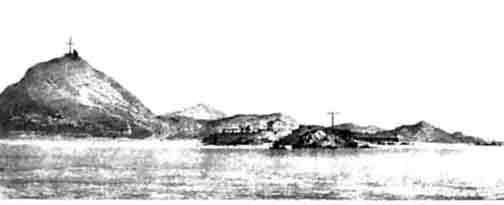
THE ISLAND OF ASCENSION
In the year 1801, when I belonged to H.M.S. Cambrian, (the Honourable Captain Legge,) on our return voyage from St. Helena, we passed so near this island, that we sent a 24-pound shot among the hills, and saw it scatter the dust around the spot where it fell, but we did not send a boat on shore, for we knew it was then uninhabited, and our Commander was not disposed to lose his time in turning turtle, while he might be more gallantly employed chasing the enemy. We merely fired as a signal to any one that might have been left on the island by accident, for on the preceding year H.M.S. Endymion took on board the crew of a brig that had been wrecked on the island: and the celebrated navigator, Dampier, was also cast away here in the Roebuck, of 12 guns, on his return voyage from New Holland. Little could I have imagined at the time of my first visit, that I should ever have landed here, under my present peculiar circumstances, or that after so many years I should find so much to interest me in a place that presented nothing to my recollection but utter desolation. The alteration in the island was indeed curious, and I am happy to learn, that the improvements still proceed with at least equal energy, and proportionate success. Since my last visit, I am told that, the inhabitants have greatly increased their facilities of obtaining, and preserving supplies of fresh water, an achievement which must necessarily add much to their daily comfort.
Saturday, 28.—Nothing material occurred on this or the following day, for we glided along pleasantly with a fresh trade-wind, varying only a couple of points from S.E. to E.S.E. until the morning of
Monday, 30.—When the wind got much lighter and we were afraid of losing the trade altogether, for although at this season of the year it prevails much further from the Southern towards the Northern Hemisphere, yet we can seldom hope to carry it beyond the equinoctial line, where we expect to get into what is very characteristically called "the variables": at one season of the year, these winds are very light and changeable, with frequent calms and occasional thunderstorms and waterspouts: at another season of the year, the weather is dark, gloomy, squally with occasional calms and much rain, until we advance to 12° or 14° N. latitude, where we usually fall in with the N.E. trade wind, however, ships are sometimes fortunate enough on leaving the Southern Hemisphere for the Northern, particularly in the months of May, June, and July, to carry the S.E. trade to the northward of the line, even until they fall in with the N.E. trade.
Between three and four this afternoon, we crossed the equinoctial line, at which time I took an affidavit before Captain Owen for my half-pay. I was induced to do this from the novelty of the circumstance, as well as a preparatory measure in case I should have an opportunity of forwarding a letter to England. Lat. at noon, for the last three days, 5°. 39'.—2°. 25'. and 0°. 13'. S.
Tuesday, July, 1.—There was a great change in the weather to-day. The wind was more unsettled, the clouds were heavy, and there was a general haze around the horizon. These were clear indications of our approaching the coast of Africa in the rainy season; there had also been a heavy dew last night, which aggravated these gloomy appearances. At sunset, we saw a vessel a few miles a-head of us, which we came up with in about an hour, she proved to be a Dutch galliot, from the island of Mayo, bound to Rio de Janeiro, with half a cargo of salt.
Immediately on receiving this intelligence, I requested the boarding officer to engage a passage for me to the Brazils, which being accomplished, I took leave of my kind and respected friend Captain Owen, after having been his guest for nearly twelve months; during which time I had experienced an unvarying series of unequalled attentions, a consideration for my interest and pursuits highly flattering, and had derived, from his conversation and society, an acquisition of truly valuable information; for which I desire to acknowledge myself deeply and gratefully his debtor.