"A Voyage round the World" (continued 8)
Reading edition
“We thought that when the gale abated, and the sea grew calm, and the sun came out, our sufferings would have an end; but they only then began. Our stock of water was becoming less and less. Many of our provisions had been so damaged by the sea, that they quickly decayed. The sea became calm as the lagoon inside a coral isle; the sun burst forth with intense heat; our thirst grew excessive. Our island was plentifully supplied with water, and we had always been accustomed to an abundance; yet now we dared not drink more than the shell of a small nut could hold at a time. Carefully we husbanded the precious fluid; we had learned to know its value. At last the time came when not a drop remained. Every calabash was examined over and over again—the last drop was drained out. We sat down, and looked mournfully at each other. Our thirst increased. We dipped our heads in salt water—we continually sprinkled each other over with it; but that did not convey coolness to our parched tongues. ‘We must die,’ exclaimed some one. ‘No, no,’ answered one of our missionary brethren; ‘we will pray without ceasing—we will trust in God. He will send us relief when we least expect it.’ That very evening a flight of sea-fowl flew close to the canoe. We were able to knock over several. Their blood assisted to quench our thirst; their flesh, too, revived our strength. The next day several fish were caught; but it was not food we wanted. ‘Water! water! water!’ was the cry from old and young alike. Still a day passed away—there was no sign of land—no sign of rain. The next day came; intolerable was the thirst we endured by noon. In vain we strained our eyes through the hot, quivering atmosphere; the sky was blue and pure as ever; not a speck could we discern in the horizon. We had hoped that we might reach the group of islands to which we had been bound; we accordingly kept, as we believed, a direct course for it. Another morning broke. During the night, our sufferings had been intense. Could we survive through another day? We stood up to glance round the horizon. Directly before us arose, as if sprouting out of the water, a line of palm and cocoa-nut trees! How eagerly we plied our oars to reach the island on which they grew! How thankfully our voices sang the morning hymn, and uttered our accustomed prayers! We rapidly neared the spot. We might have run close by it in the night without seeing it. We paddled round to find a spot on which to land. Tantalising indeed was it to see the ground where we might hope to gain life and strength, and yet not be able to place our feet on it. At last an opening appeared in the surrounding reef, we ran in, and, hauling up our canoe, hurried off in search of water. No water could we find, but the strongest climbed some of the cocoa-nut trees, and quickly threw down a supply of their refreshing fruit. Oh, how delicious and cool was the milk which they afforded us! Still, pure water was what we most wanted; but though we searched in every direction, and dug down as deep as we could with our rough wooden tools, not a drop could we find.
“We remained here a week hoping for rain, but it came not. The juice from the cocoa-nuts restored our strength. We collected all we could gather for our voyage. Once more we resolved to trust ourselves to the sea. We embarked, and hoisting sail, stood away on our former course. No land appeared in sight. Many days passed away. Our supply of cocoa-nuts was almost exhausted. Again death by thirst stared us in the face. Oh, how carefully we husbanded the few precious nuts which remained! They at last were exhausted. The hot sun again arose, and we had no liquid with which to quench our thirst. The burning rays of the bright luminary struck down on our heads with intense force. ‘Water! water! water!’ we repeated as before. Some almost gave way to despair. ‘We have before been preserved, why give up all hope now?’ said others. In the evening a small cloud was seen to rise out of the sea. It spread wider and wider. There was no wind. It advanced toward us. Fast from it fell a thick shower of pure, sweet water. On it came, we opened wide our mouths, we spread out our hands. Oh, how gratefully it moistened our parched lips! We stretched out our sail and all our garments, and let the precious streams we thus gathered run into our gourds and pots. All that evening the rain came down in a continuous fall, and every moment we were occupied in collecting it, till all our receptacles were full to the brim,—not a shell did we allow to remain empty: and then we poured it down our throats in a full, refreshing stream. Scarcely were we satisfied when the rain ceased—the dark cloud blew onward—the stars shone forth brightly from the clear sky, and we pursued our course.
“The next island we came to was barren—no water, and no nuts; we must have perished had we been cast on it. Then we reached another with some inhabitants on it. We understood, in part, their language. Their ancestors had, they believed, been cast on it wandering as we were across the ocean. Their canoe had been destroyed, and they had remained there without wishing to depart. They had been driven forth from their native isles by cruel wars, in which the greater number of their kindred had been destroyed. They received us in a friendly manner, and invited us to remain with them. They had heard nothing of the Truth. The gospel-message had never reached their ears. From consulting with them we were convinced that we had been driven so far out of our course that we should never reach the islands of which we were in search. Here, however, was work for us to do, pointed out clearly by the finger of God. We told the islanders, to their joy, that we would remain with them; and by degrees we opened to their wondering ears the glorious tidings we had brought. Astonished, they heard, but did not refuse to listen. Some speedily believed. The news we brought was of a nature their hearts had long yearned for; it spoke of rest from toil—rest from suffering—rest from sin. Others, in time, accepted the truth with thankfulness. Every day we preached, and every day some one acknowledged himself a sinner, and sought redemption through Him alone who can give it. At length our glorious work was accomplished. We gave them books; we taught them to read. We told them that we must depart to try and reach our own homes. They entreated that one of our number would remain with them. It was resolved that one should remain to guide them aright. We drew lots. He on whom the lot fell, without a murmur, with his wife and family, joyfully remained—though he well knew that he could never hope again to see the land of his birth, and many dear to him there. But I am making my story longer than I intended.
“Once more we set sail to return to our homes. Numerous were the hardships we endured, though no one murmured. Several islands were visited. At some, food was procured; at others we were afraid to stay, on account of the fierce character and the cannibal propensities of the inhabitants. We had been ten days out of sight of land when we reached your island, and truly did we rejoice to find not only whites, but Christian men to receive us.”
With these words the native missionary finished his narrative. I was particularly struck with the artless simplicity of his account, and the faith and perseverance he and his companions had exhibited, so worthy of imitation. I felt ashamed as he spoke of white men, when I recollected how many act in a way so totally at variance with their character as Christian and civilised men, and how bad an example they set to those whom they despise as heathens and savages. I have very frequently met young men who fancy when they are abroad that they may throw off all restraints of religion and morals, under the miserable excuse that people should do at Rome as the Romans do,—in other words, act as wickedly as those among whom they have gone to live. What would have become of Lot had he followed the example of those among whom he took up his abode? Now, my young friends, I daresay that you will think I am very young to lecture you; but remember that I have been round the world, and I should have been very dull and stupid had I not reaped some advantage from the voyage. What I want to impress upon you is, when you leave your homes and go abroad, to be if anything more strict, more watchful over yourselves even than you have before been. Society will, too probably, afford less moral restraint, the temptations to evil will be greater; but pray against them faithfully—strive against them manfully, and they will not overcome you.
Our voyage, as I was saying, had hitherto been prosperous; but a gale came on, and we were exposed to the very dangers the missionary had so well described to me. We could do nothing except help to bail out the canoe, for the natives understood how to manage her much better than we did; and, with all our civilisation and nautical knowledge, we had to confess that in that respect they were our superiors. The canoe laboured fearfully, and often I thought that she must founder. How anxiously we looked out for some sign that the gale was abating, but in vain. Had we been in our own ship, we should certainly have thought very little of the gale; but in this frail canoe we had ample reason to dread its consequences. At length the wind shifted, and drove us on in what the islanders considered our proper course. We ran on for some days without seeing land, and then the gale blew over and left us becalmed under a burning sun. We had carefully from the first husbanded our water, having the advantage of the previous experience of our companions. As it was, we had barely sufficient to quench the constant thirst produced by the heat. Every day, too, seemed to increase our thirst and to diminish our stock of the precious fluid. Our hope had been to fall in with some vessel which might either supply us or give us a course to the nearest island where we might obtain it. One forenoon, when we had been suffering even more than usual, the chief declared that he saw a vessel on our weather bow, and that she would cross our course. With intense eagerness and hope we all looked out for her. As her sails rose out of the water, we saw that she was a schooner. If we could but get on board her, we thought that we might again in time rejoin the Triton. We were very certain that Captain Frankland would not cease to look for us while a chance remained of our being discovered. Gradually we neared the schooner. I saw Cousin Silas and Ben Yool looking at her with great earnestness.
“What is she, Ben, do you think?” asked Cousin Silas.
“Why, Mr Brand, as you know, sir, I’ve been boxing about the world for the best part of the last forty years, and I think I ought to know one craft from another, and to my mind that vessel is no other than the piratical craft we were so long aboard. I say, if you ask me, sir, that we ought to stand clear of her. She’ll bring us no good.”
“Exactly my idea,” answered Cousin Silas; “the wretches might very likely send us to the bottom, or carry us off again as prisoners.”
We were, however, too near the schooner to hope to escape from her; but we agreed that we might lie concealed while the canoe sailed quietly by her, and that, probably, no questions would be asked. We had some little difficulty in explaining the character of the vessel to our friends. When they did understand it, they seemed to be much horrified, and undertook carefully to conceal us. As we drew near the schooner, the rest of our party went below; but I wrapped myself up in a piece of matting, leaving a small aperture through which I could see what was going forward. The schooner stood close up to us. I was very certain that she was the pirate. Several faces I recognised. Among them was Captain Bruno. At first I thought that they were going to run us down; then I dreaded that they were going to make us come alongside. Hauling their foresail to windward, they hailed two or three times, but in a language was not understood. At last an answer was given from the canoe. What it was I could not tell. It seemed to satisfy them. To my great joy they once more let draw their foresail, and stood away from us. This was not the last time we were to see that ill-omened craft.
As soon as she had got to some distance off, my friends came out of their hiding-place, and I disengaged myself from the folds of the mat. Truly thankful were we that we had escaped her. The missionary told us that the pirates had stated that we were about three hundred miles to the westward of Otaheite, and that we should pass several islands to get there. Once at Otaheite the chief knew the direct course to his own island, and believed that he should have no difficulty in finding it. Our escape from the pirate made us, for a time, almost forget our raging thirst; we could not, however, but admire the fidelity and resolution of the natives, who, rather than run the risk of betraying us, had refrained from asking for water from the pirate.
All that day our sufferings were very great. As we were running on during the night, our ears were assailed by the sound of breakers. We listened; they were on our weather bow. If we ran on we might miss the island; so we hauled down our sail, and paddled slowly on towards the spot whence the sound proceeded. All night we remained within sound of the surf. How anxiously we waited for daylight to ascertain that there was an island, and not merely a coral reef over which the sea was breaking! That night was one of the most anxious we had yet passed. Slowly the hours dragged along. It was wonderful to observe the calm and resigned manner of the islanders. The missionaries and the chief never gave the slightest sign of distress; even the women did not complain. “It must be near daybreak,” said Mr Brand, waking up out of a sleep into which he had at last fallen. “Look out.” We strained our eyes in the direction in which we believed the island to exist. A few pale streaks appeared in the east; and then, oh! our hearts leaped with joy as we saw tall, thin lines appear against the sky; and, as the light increased, the stems and tops of trees were revealed to view. But our joy was somewhat damped when we discovered that a long line of heavy breakers rolled between us and them. At sight of the island the natives, with one accord, raised a hymn of praise and thanksgiving which put our doubts to shame; and the chief, pointing to the surf, made signs that we must go round on the other side, where we should find a place to land. The sail was forthwith hoisted, and we quickly ran round to the lee side, where a wide opening in the surf presented itself. We paddled through it into the inner bay or lagoon, and reaching the shore, the canoe was secured.
The natives did not forget their prayers and hymn of thanksgiving, in which we all heartily joined them. They then looked cautiously about, to ascertain that there were no people on the island who might treat us as enemies. This necessary precaution being taken, we hurried about in every direction in search of water. Jerry and I kept together. Our tongues were parched with thirst. Some of the natives were climbing the cocoa-nut trees, in case any might still retain milk; but the season for the fruit was now passing. Indeed, we wanted water, pure simple water. We felt that we should value it far more than the richest wine from the vineyards of Burgundy or the Rhine. At last we observed a little moisture on the ground near a large tree. We followed up its trace, and soon, shaded by shrubs, we came to a basin of bright, cool water. We eagerly stooped down and lapped up some of the delicious fluid, and then shouted loudly to our friends to come and enjoy the valued luxury with us. In a very short time the pool was surrounded with men, women, and children, ladling up the water with their calabashes and bowls, the mothers pouring it into the mouths of their children before they would themselves touch a drop, while the men knelt down and lapped it up as we had done. As I watched the scene, I bethought me that it was a subject fit for the exercise of the painter’s highest art.
We spent a week on the island, repairing the canoe, catching fish, and filling our water jars with water. This may appear an unnecessarily long time to have waited on our voyage, but, after being cramped up for so many weeks, it was necessary to recruit our strength and to stretch our limbs. Much refreshed, we continued our voyage. I forgot to state that at every island where we touched we engraved our names on the trunks of trees, in the most conspicuous situation, and stated the direction in which we were going. We had done this also on our own island, as we called it, that should any vessel visit the spot she might perhaps convey intelligence to Captain Frankland that we were alive, and give him some clue as to where to look for us. Our friends understood our object, and now added some sentences in their own language to the same effect. The fine weather continued, and confident in the guidance and protection of Him who had hitherto preserved us from so many and great dangers, we launched forth again into the deep.
We passed several small islands; some had but a few stunted trees growing on them; others again had scarcely soil sufficient to nourish a few blades of long wiry grass; while others were barren rocks without verdure of any description, their heads but lately risen from beneath the waves. I believe that it was at one time supposed that these coral formations rose from immense depths in the ocean, and that those wonderful and persevering polypi worked upwards till they had formed submarine mountains with their honey-combed structures; but it is now ascertained that they cannot exist below at the utmost fifty feet of the surface, and that they establish the foundation of their structures on submarine mountains and table-lands, while they do not work above low-water mark. How comes it then, it will be asked, that they form islands which rise several feet above the sea? Although the polypi are the cause of the island being formed, they do not actually form it. They begin by building their nests on some foundation which instinct points out to them. First they work upwards, so as to form a wall, the perpendicular side of which is exposed to the point whence the strongest winds blow and the heaviest sea comes rolling in. Then they continue to work along the ground and upwards on the lee side of the wall, sheltered by their original structure from the heavy seas. They also work at each end of their wall in a curve with the convex side exposed to the sea. Thus, at length, beneath the ocean a huge circular wall of considerable breadth is formed. Storms now arise, and the waves, dashing against the outer part of the walls, detach huge masses of the coral, six feet square or more, and cast them up on the top of it, where they remain fixed among the rough peaks of coral; and gradually other portions are thrown up, till a mass is formed above high-water mark. Other bits, ground by the waves into sand, now form a beach, united with shells and various marine productions. Birds come and settle, and leave seeds which spring up; and trees grow, and attract moisture; and fresh springs are formed, and the spot becomes fit for the abode of man. Some islands have had a rock, or, perhaps, the plateau of some marine mountain for their commencement, and the polypi have simply enlarged it, and formed a reef around it. (“The Coral Island,” by R.M. Ballantyne, Esquire, Nelson and Sons.) However, this interesting subject has been so often well explained in other works that I will not further enlarge on it, though I could not pass it by in the description of my voyage without some notice.
Another week we had been out of sight of land. We were longing to find some spot on which we might stretch our legs, if only for a few hours, and, what was more important, obtain a fresh supply of water, when towards the evening the treetops of a large island appeared before us stretching away on either side to the north and south. We approached near enough to be seen from the shore, if there were inhabitants on it, of which there could be little doubt; but we could discover no place where it would be safe to attempt a landing. Judging that the shortest way to get round to the other side would be to go to the south, we paddled in that direction during the night. The roar of the surf prevented any sounds from the shore from reaching our ears; but we observed several fires lighted on the beach, which assured us that the island was populated. The question, of course, was—Would the inhabitants appear as friends or foes? We paddled but very slowly during the night, just sufficiently to keep the canoe away from the breakers, and to get round to the place where it was believed a passage would be found. At daylight we perceived the looked-for spot, and stood towards it. We observed a number of people on the beach. They had scarcely any clothing; their skins were dark, their hair was long and straggly, and the men had spears or clubs in their hands. Our chief stood up and examined them narrowly. No green boughs were waved as a sign of amity; on the contrary, their gestures appeared somewhat of a threatening character. We had just got to the mouth of the passage when his quick eye detected a number of canoes collected inside the reef, and full of men, armed with darts and bows and arrows. He made a hasty sign to his followers to back their paddles, and away we shot out of the trap.
As soon as our flight was discovered the canoes gave chase. They were small, each carrying not more than six or eight men; but from their numbers they were formidable. The men in them were also armed with a variety of weapons, and we thought it very likely that the arrows and darts might be poisoned. In a long line they darted out of the passage through the breakers, like hornets out of their nest, to the attack. “There they come, the black scoundrels!” exclaimed Ben Yool. “Ten, fifteen, twenty,—there are thirty of them altogether. They’ll give us no little trouble if they once get alongside. However, they think that they’ve only got their own countrymen, so to speak, to deal with. They’ll find themselves out in their reckoning, I hope.”
As we got away from the land we felt the force of the wind, and the chief ordering the sail to be set, we shot rapidly ahead. Still the small canoes made very rapid way through the water. The chief looked at us, as much as to ask, “What will you do, friends?” Mr Brand understood him, and answered by producing our fire-arms. Fortunately we had had very little necessity to expend our cask of powder and our shot, and we had a good supply. The missionaries, when they saw the fire-arms, put their hands to their heads as if in sorrow that it would be necessary to shed blood, but some words spoken by their chief reassured them. We could have told them that the sin lies with those who make the attack, provided the other party has employed all evident means to avoid hostilities.
By the orders of their chief our people got their own bows and spears ready, and then they set to work with their paddles again, and plied them most lustily, much increasing the speed of the canoe. This, however, had only the effect of making our enemies redouble their efforts to overtake us.
Mr Brand and Jerry and I were the best shots; the doctor was not a good one, and Ben knew better how to manage a big gun than a musket.
“You will fire over their heads, will you not?” said the doctor.
“I think not,” answered Mr Brand. “It will be mercy to make them feel the effects of our power. If each of us can knock over one of their people they may be so terrified that they will turn back at once; but if they once come on and attack us, we know not where the slaughter may end, even should we prove victorious.”
It was agreed, therefore, that as soon as the savages got near enough to distinguish us, we were to jump up, and taking steady aim, to pick off those who appeared to be chiefs in the headmost boats. We explained our plan to our chief, and he much approved of it.
The wind freshening we made good way, but still the flotilla of canoes was fast overtaking us. The voices of the savages, as they shouted and shrieked at us, were wafted across the water; but they had not the effect of intimidating our friends. “Ah, my boys, you’ll shout to a different tune, I suspect, before long,” exclaimed Ben, as he eyed them angrily. At length, in spite of all the efforts of our friends, the savages got close up to us; and two men in the leading canoe, lifting their bows, were about to draw their arrows, when Cousin Silas exclaimed, “Now is the time, my lads; give it them.” We all fired. The two savages dropped instantly, and one man in each of the next canoes went head foremost overboard. The people in the following canoes hesitated for a minute what to do. The delay gave us time to reload. Again we fired, while our people jumping up sent a flight of arrows among our enemies. Shrieks, and cries, and groans, arose from the canoes, which all crowded thickly together like a flock of sheep, their people astonished and terrified at what had occurred. Then they turned round, and all paddled back in evident confusion. We shouted, and gave them a parting volley; but this time it was over their heads to hasten their movements. We were preserved,—not one of us had received the slightest injury. Away we glided, as fast as the wind and our paddles would carry us from the inhospitable island.
Chapter Nineteen.
Voyage in a whaler—further adventures.
Wearily our voyage had continued for many weeks, yet we felt that having been preserved from so many dangers, it would be sinful to complain. No one was actually sick, not a life had been lost, and by great economy our provisions and water had hitherto been sufficient for our necessities. A flight of birds had passed over our heads, directing their course to the north-east. We saw our chief watching them, and he at once ordered the canoe to be steered in the same direction. All day we stood on. Just as the sun was setting, we thought we saw a faint blue peak rising out of the water, but even the most practised eye could not determine whether it was land or a light cloud. We continued the same course during the night. For several hours I watched, then, overcome by fatigue, I fell asleep. “See! see!” I heard Jerry exclaim. I jumped up. There appeared before us the lofty and rugged peaks of a line of mountains. Of great height they seemed, after the low land to which our eyes had been so long accustomed. Their sides were clothed with verdure, pleasant and refreshing to the sight; and at their bases were groves, and fields, and sparkling streams, with heat pretty-looking cottages scattered about. There was a slight swell. When the canoe rose to the top of it, we could see a yellow beach, with a circle of bright, blue, calm water around it, and outside a line of white foaming breakers, the guardians of the shore. “Otaheite! Otaheite!” exclaimed the chief and his followers; and we thus knew that we were on the coast of the dominion of the ill-treated Queen Pomare; but we also knew that there were civilised men on shore, and that we should probably be received there with kindness and hospitality.
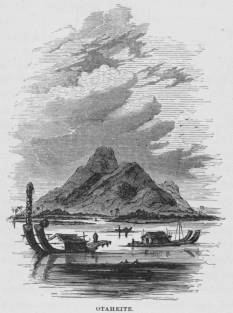
Soon discovering a passage through the reef, we ran in, and were at once surrounded by canoes full of people, wondering who we were and whence we had come. Our friends quickly gave an outline of our and their adventures, to satisfy curiosity. They found there several people from their own island, one a chief who had become a wealthy man. He took them to his own house, and had their canoe hauled up to be repaired. I need not say that she was visited by all the foreign residents, curious to examine a craft of so frail a structure which had performed so long a voyage. Our consul was very civil to us, and we were received into the house of an English gentleman, who treated us with the greatest kindness. As we met with no very interesting adventures during our stay here, I will content myself with giving a brief account of the island.
Otaheite was discovered in 1767, by Captain Wallis, who called it King George’s Island; but it is better known by the name of Tahiti. It is of volcanic formation, and consists of two peninsulas joined by a neck of low land, about two miles across. The whole island is about thirty miles in circumference. The smaller portion, called Tairaboo, is the most fertile; but as Tahiti proper has the best harbour, it is the most frequented, and is the seat of government.
We know very little of the history of the island. Soon after its discovery, a chief, who assumed the title of Pomare the First, made himself king. His son, and then his grandson, succeeded him, and the present queen is his granddaughter; her name is Aimata, but she has taken the title of Pomare the Fourth. She has established a constitution, and seven chiefs act as her ministers. For many years both the chiefs and people have professed Christianity, having been converted to a knowledge of the truth by Protestant missionaries. These missionaries were undoubtedly earnest, pious men, but they have been unable altogether to check the vices which the lawless rovers, outcasts of every civilised nation in the world, have introduced among them. Notwithstanding the counteracting influences I have mentioned, civilisation was making progress in the island, under the teaching of the Protestant missionaries, when the peace was disturbed by the arrival of two French Roman Catholic priests. They travelled about the country endeavouring to teach their doctrines, but in no place did they find willing hearers. A few chiefs who were in opposition to the Government for political motives, gave them some countenance, and they were entertained at the house of the American consul. The people, however, resolved that they should not remain to attempt the corruption of the faith in which they had been instructed, and rising in a body, compelled them to go on board a small vessel, which carried them to Wallis Island, two thousand miles off. The French who had long desired the possession of some island in the Pacific inhabited by partly civilised people, were too glad to found a pretext on this circumstance for interfering in the affairs of Tahiti. A frigate, the Venus, commanded by Monsieur Du Petit Thouars, entered the harbour of Papieti. The French, captain, bringing his guns to bear on the town, demanded satisfaction for the outrage committed on his countrymen. The queen was inclined to resist, but the foreign inhabitants, knowing that they should be the chief sufferers, collected the amount demanded, which was at least four times as much as any pecuniary loss the priests had incurred. He also forced a treaty on the queen, by which Frenchmen were allowed to visit the island at pleasure, to erect churches, and to practise their religion. This was the commencement of the complete subjugation of the Tahitians to the French. So much for the history of the island.
The valleys, and a plain which extends from the sea-shore to the spurs of the mountains, are very fertile, and produce in great abundance all tropical plants. The climate is warm, but not enervating; the scenery is in many parts very beautiful. Thus the natives are tempted to lead an easy and idle life, exerting but little their physical and mental powers. It is, indeed, to their credit that they do not altogether abandon themselves to indolence. They are by nature constituted to enjoy the beautiful scenes by which they are surrounded. Consequently, they delight in building their cottages in the most retired and lovely spots they can find. Their habitations are surrounded with fences, inside which they cultivate the taro, and sweet potatoes, the banana, the bread-fruit, the vi-apple, groves of orange and cocoa-nut trees, and at times the sugar-cane. Their habitations are of an oval shape, often fifty or sixty feet long, and twenty wide. They are formed of bamboos, planted about an inch apart in the ground. At the top of each wall thus formed, a piece of the hibiscus, a strong and light wood, is lashed with plaited rope. From the top of the four walls the rafters rise and meet in a ridge, those from the ends sloping like those from the sides. The rafters, which touch each other, are covered with small mats of the pandanus leaf, which, closely fitted together and lapping over each other, forms a durable roof, impervious to the rain. The earth, beaten hard, forms the floor. There are no regular partitions, but mats serve the purpose when required. Their bedsteads are made of a framework of cane raised two feet from the ground, and covered with mats, the most luxurious using pillows stuffed with aromatic herbs. They have neither tables nor chairs. Their style of cooking is very simple: they bake their food in extemporised ovens filled with hot stones. Since my return I have often intended to propose having a picnic, and to cook all our food in Tahitian fashion. The dress of the people is undergoing a rapid and considerable change. Formerly a native cloak and kilt was all that was thought necessary; now every sort of European clothing is in vogue. We had an example of this at a feast our English friend gave to a number of chiefs and their relations. Some of the gentlemen had on uniform coats, with nankeen trousers too short for them, and coloured slippers. Others had top-boots, red shirts, black breeches, sailors’ round jackets, and cocked hats. Some had high shoes and buckles, and others had no shoes at all; but all had shirts and trousers, or breeches. Some, indeed, were in complete costume: shoes, stockings, trousers, waistcoat, coat, shirt, with a huge neck-tie—every garment of a different colour, and often too large or too small—while a little straw hat was worn on the top of the head. Indeed, it was very evident that their clothes had been collected from all parts of the world, many garments probably having passed a probation in pawnbrokers’ shops, or in those of old clothes-men in London or Liverpool. I was particularly struck by the total want of perception of congruity as to dress exhibited both by men and women after they had abandoned their native costume, which, if somewhat scanty, was graceful and adapted to the climate. The women we saw were dressed in straw bonnets of huge proportions and ugly shape, and loose gowns of gay colours reaching from the throat to the ankles, with silk handkerchiefs tied round their necks. A few wore wreaths of flowers round their heads, which formed a picturesque part of their ancient costume. The people are said to be very honest, and always seemed in good-humour, happy and cheerful, while we never saw them quarrelling or disputing with each other, far less coming to blows. Many of them are scrupulous in their attendance on religious worship; the Sabbath is strictly kept by all, not even a boat being launched, while those who are seen abroad are decently clothed, going to or coming from church. What change French civilisation may have worked in this state of things it is painful to reflect. We visited several schools, and except that their skins were darker, the appearance of the children differed little from that of the same class in any part of Europe, while they appeared in no way wanting in intelligence. In fact, from all we saw and heard, we came to the conclusion that the inhabitants of the islands of Polynesia are generally as capable of a high state of education and civilisation as the people of any other race, while their minds are peculiarly susceptible of religious instruction. Our fellow-voyagers afforded us a good example of this. We much regretted that we could not converse familiarly with them. Our missionary friend had especially won our regard and esteem.
They were now anxious to return to their own island, the season of the year being favourable for the voyage. It was with much regret that we heard of their intended departure. With a large concourse of natives and several English missionaries, we accompanied them down to the beach to see them off. Prayers were offered up by all present for their safety during their voyage. It was an impressive and affecting scene. Many wept as the fine old chief and his friends stepped on board. He could scarcely refrain from tears, nor could we. The frail canoe was launched forth into the deep, the sail was hoisted, and away they went on a voyage of three hundred miles, with full faith that the God who had hitherto preserved them would watch over them still.
We did not at the moment believe that our departure was so near. The next day the Matchless, a Liverpool whaler, arrived in the harbour of Papieti. We met her master, Captain Brown, who told us that he was bound for the coast of Japan, and that he should touch at the Bonin Islands, and probably fish off there some time. At this latter place we knew that Captain Frankland fully intended to call. How much his plans might be changed by our supposed loss we could not tell, but at all events we could not hope for a better opportunity of falling in again with the Triton. Captain Brown had lost several of his people,—some by sickness, others in a gale, and others by desertion. Hearing this, Mr Brand offered his own and our services as far as the Bonin Islands, or for a longer period, should we gain no account of our own ship. They were without hesitation accepted. The Matchless remained but a few days, having called in merely to obtain water and a supply of fresh provisions. Our kind English friend, not content with having supported us all the time we remained at Tahiti, insisted on supplying us with as good an outfit as he could procure in the country. When we expressed our gratitude and unwillingness to be so great a burden on him, he smiled. “What is the use of property, unless to do good with it?” he remarked. “Do not say a word about the matter. When you reach home, should the obligation weigh too heavily on your conscience, you can send me back the value; but I then shall be the loser, as it will show me that you will not believe in the friendship which induces me to bestow these trifles as a gift.” After this very kind speech we could do no more than sincerely and cordially thank him. The day before we embarked, he told us that he had been making inquiries about Captain Brown. “I would rather that you had another man to sail with,” he observed. “He is a person with two countenances, I am afraid. On shore he is mild, and obliging, and well-behaved; but afloat he is, I am told, tyrannical and passionate, and often addicted to intemperance. You will, accordingly, be on your guard. You will probably remain only a few weeks with him, or I should advise you to give up the voyage, and wait for another opportunity of going westward.” This was not pleasant news, but we resolved on no account to delay our departure, and, thanking our friend for his warning, as well as for all the kindness we had received at his hands, we the next day went on board the Matchless.
She was a fine vessel, and well-found with boats and gear. How great a contrast did she offer to the frail canoe in which we had lately made so long a voyage! How strongly built and rigged! How well calculated to stand the buffeting of the winds and waves! How impossible did it seem that any harm could come to her! I felt this, I own, as I walked her deck. She had already taken twenty whales, or fish, as sailors wrongly call them. For some time Captain Brown was very civil and good-natured, and we began to hope that our friend had received a wrong account of him.
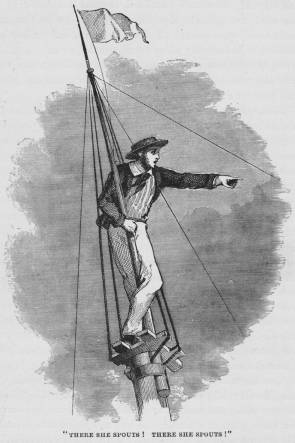
Although we did not expect to meet with whales, men were always kept at the mast-heads on the look-out. I shall not forget the excitement of the scene when, after we had been a week at sea, the cry was uttered from aloft, “There she spouts! there she spouts!” In an instant everybody was alert. “Where away? where away?” was asked. The point where the whale had appeared was indicated. The boats were lowered; the crews leaped into them. The master went in one, two mates in others. Off they pulled in hot chase. The whale sounded; the men lay on their oars. In half an hour she rose again, throwing up a jet of sparkling foam into the air. Again the boats dashed on. The master’s headed the rest. His harpoon struck the monster. One of the other boats got fast directly after. Then off went the whale at a terrific speed, dragging the boats after her directly away from the ship. Now she sounded, and all their lines were run out; but just as they would have to cut, up she came again. We followed under all sail.
The day was drawing to a close when another whale was seen floating idly close to us. The possibility of obtaining another rich prize was not to be lost. Mr Brand had served for three years in a whaler, and was now doing duty as mate. He ordered a boat to be manned. Jerry and I entreated that we might accompany him. “One only can go,” he answered; “I am very sorry.” The lot fell upon me. Jerry was never jealous. “Old Surley and I will take care of each other,” he answered. Away we went. A long, low island was in sight from the mast-head. The other boats could nowhere be seen. We got up to the whale before she sounded. I fancy she was asleep. The harpoon Mr Brand shot into her awakened her up. Off she went in the direction of the land, at a great rate. I wished Jerry had been with us. It was so pleasant to be dragged along at so furious a rate, the foam flying over the bows of the boat. Formerly harpoons were always darted by the hand. Now fire-arms are used. The butt of the harpoon is placed in the barrel, and the rope is attached to it by a chain. Less skill and strength is required to strike the whale, but just as much skill and experience is requisite to avoid being struck in return and smashed to atoms by the wounded animal. Whenever the whale slackened her speed, we hauled up in the hope of getting another harpoon into her, but she was soon off again; then she sounded, and we were nearly losing our line. Again she rose; a second harpoon was run into her. Off she was again. At length blood mingled with the foam from her spouts. With fury she lashed the water around. “Back! back for your lives!” shouted Mr Brand. Well it was that we got out of her way in time. One blow from those tremendous flukes would have destroyed us.
Loudly we shouted as the monster lay an inanimate mass on the surface of the deep. Then we looked about us. We had approached close to the island, but darkness was settling down over the face of the waters. The ship was not to be seen. Clouds were gathering thickly in the sky. A gale, we feared, was brewing. Our safest plan was to lie by all night under the lee of the whale. The wind came from the very direction where we believed the ship to be. We should never be able to pull against it. We had got out our harpoons from the dead whale, and were putting our gear in order, when, just as we were going to make fast to it, the huge mass sunk from our sight! We looked at each other with blank disappointment. It was gone—there can be no doubt about it, and was utterly irrecoverable. “Don’t grumble, my lads. We should have been worse off had we been fast to it with a gale blowing, and unable to cut ourselves adrift,” exclaimed Mr Brand. “Let us thank the Almighty that we have escaped so great a danger. We’ll run under the lee of that island for the night, and try and find the ship in the morning.” Accordingly we bore away, and were in a short time in comparatively smooth water. Still the weather looked very threatening. We pulled in close to the breakers. “Harry,” said Cousin Silas, “I think we should know that island. I see an opening in the breakers, and a clump of trees on it which seems familiar to my eyes. We shall be better off on shore than here. I will take the boat in.” The men were somewhat astonished when they received the order to pull in for the land. We exactly hit the passage, and soon had the boat hauled up on the beach. “We will have a roof over our heads to-night, lads,” said Cousin Silas, leading the way, and in a quarter of an hour we were seated under the shelter of the hut where we had lived for so many months! It was strange that we had so unexpectedly fallen in with our own island again.
We lit a blazing fire, and caught some wild-fowl, and knocked down some cocoa-nuts, which were now in season, and picked some bread-fruit, and, with the provisions we had in the boat, enjoyed a capital meal, which somewhat restored our spirits after the loss of our whale. As far as we could discover, no one had been there since we left the spot,—even our beds were ready for us. All hands rested soundly, and by the next morning the short-lived summer gale had blown itself out. I mounted to the top of our flag-staff, and to my no small satisfaction saw our ship lying-to five or six miles off to the westward. I was hurrying with the rest down to the boat, for I had no wish to be left again on the spot though I felt an affection for it, when Cousin Silas stopped me. “We have an important work to perform,” said he. “Before we go we will obliterate our former directions and write fresh ones, saying where we are now going.” I saw the wisdom of this precaution in case the Triton might visit the place; and, accordingly, with our knives we carved in a few brief words a notice that we were well and bound for the Bonins. This done, we embarked and ran out towards the ship.
On getting on board we found the captain in a desperately bad humour at having been compelled by the gale to abandon the whales he had caught; and our account of our loss did not improve his temper. He swore and cursed most terribly at his ill luck, as he chose to call it; and, to console himself, opened his spirit case and drank tumbler after tumbler of rum and water. The result was soon apparent: he issued contradictory orders—quarrelled with the mates—struck and abused the men, and finally turned into his cot with his clothes on, where he remained for several days, calling loudly for the spirit bottle whenever he awoke. From this period he became an altered man from what he had at first appeared, and lost all control over himself.
I will not dwell on the scenes which ensued on board the whaler. They were disgraceful to civilised beings, and to men calling themselves Christians. Cousin Silas, and the doctor, and Ben, did all they could to counteract the evil,—the latter by exercising his influence forward, and the others in endeavouring to check the officers, who seemed inclined to imitate the example of the master. Cousin Silas had charge of one watch, and he got Jerry and me placed in another, and he told us instantly to call him should we see anything going wrong. Thus three or four weeks passed away. We managed during the time to kill two whales, and to get them stowed safely on board; and this put the captain into rather better humour. However, the ship was often steered very carelessly, and a bad look-out was kept.
We were running under all sail one day when, as I was forward, I saw a line of white water ahead, which I suspected must be caused by a coral reef. I reported the circumstance. Fortunately there was but little wind. I looked out anxiously on either hand to discover an opening. To the southward the line of foam terminated. The helm was put down, and the yards braced sharp up; but in five minutes a grating noise was heard and the ship struck heavily. The seamen rushed from below,—they full well knew the meaning of that ominous sound, and they believed that the ship was hopelessly lost. The captain at the time was unconscious of everything. Cousin Silas hurried on deck, and, taking a glance round, ordered the helm to be put up again, the yards to be squared, and the courses which had been clewed up to be let fall. It was our only chance. The ship’s head swung round; once more she moved—grating on, and, the doctor said, tearing away the work of myriads of polypi. “Hurrah! hurrah!” a shout arose from all forward. We were free. Away we flew.
This narrow escape ought to have been a warning to all on board. Unhappily it was not. The same system was pursued as before. The other mates grow jealous of Cousin Silas, and did their utmost to counteract his efforts. One night Jerry and I were on deck, actively moving about, followed by Old Surley, looking out in every direction; for it was very dark, and the officers had been having a carouse. For some reason or other I was more than usually uneasy. So was Jerry.
“I should not wonder,” said he, “that something will happen before long.”
“I hope not, if it is something bad,” said I; “but I’m not altogether happy. I think that I will go and call Mr Brand.”
“What shall we say to him, though? There will be no use rousing him up till we have something to tell him.” I agreed with Jerry, so we continued talking as before.
“What are you youngsters about there?” shouted the first mate, who, although it was his watch, was half tipsy. “Go below, and turn in; I’ll not have chattering monkeys like you disturbing the discipline of the ship.” Jerry and I hesitated about obeying, and Jerry whispered to me that he would go and call Mr Brand. But the mate sung out, “Mutiny! mutiny! Go to your own kennels, you young hounds!” and ordered some of the watch on deck to carry out his commands. We could not help ourselves, so we went below, and turning into our berths very soon fell asleep.
How long we had been asleep I do not know. I was awoke by a terrific crash and loud cries and shrieks. Jerry and I sprung up, so indeed did everybody below, and rushed on deck. It was very dark; but from the way the ship heaved and lurched, and the sheets of foam which flew over her, we knew that she was among the breakers, and striking hard on a reef. The fore-mast and main-mast had gone by the board. The mizzen-mast alone stood. That fell soon after we got on deck, crushing several people beneath it. Anxiously we hunted about shouting for Cousin Silas, followed by Old Surley, who, since we came on board, scarcely ever left our heels. We naturally sought him for advice. It was, indeed, a relief to us to find him unhurt. In a short time we discovered the doctor and Ben. We clustered together, holding on by the bulwarks; for every now and then a sea came and washed over the decks, and we ran great risk of being carried away. Nothing could we see on either side beyond the white roaring breakers. Cousin Silas said that he was certain we must have been driven some way on the reef, or the sea would have broken more completely over us, and no one could have hoped to escape. Several people had already been washed overboard, and had been lost or killed by the falling masts; but who they were we could not tell. What, also, had become of the captain we did not know. He had not, that we could discover, come on deck. Perhaps, all the time he was below, unconscious of what had occurred. All we could do was to cling on where we were, till with daylight we should be able to tell our position. Every now and then we felt the ship lifting, and it appeared as if she was driving gradually over the reef. Another danger, however, now presented itself—we might drive over the reef altogether, and sink on the other side! We strained our eyes through the darkness; but, surrounded as we were with spray, it was impossible to distinguish the shore, even though it might be near at hand. If there was no land, our lot would indeed be sad; for, wherever we were, it was clear that the ship would be totally lost, and, as far as we could discover, all our boats were destroyed. After two or three hours passed in dreadful suspense, though it appeared as if the whole night must have elapsed, the ship became more steady, and the sea broke over her less violently. “We must get a raft made,” exclaimed Cousin Silas. The men seemed to look instinctively to him for orders, and willingly obeyed him. All hands set to work, some to collect the spars which had not been washed overboard, others to cut away the bulwarks and to get off the hatches—indeed, to bring together everything that would serve to form a raft. Dark as it was they worked away; for they knew that when the tide again rose the ship might be washed over the reef and sink, or go to pieces where she lay. How eagerly we watched for daylight to complete our work! The dawn at length came; and as the mists of night rolled off, we saw before us a range of lofty mountains, of picturesque shapes, rising out of a plain, the shore of which was not more than a quarter of a mile off. As the sun rose a rich landscape was revealed to us, of cocoa-nut groves, and taro plantations, and sparkling streams, and huts sprinkled about in the distance.
“At all events we have got to a beautiful country,” observed Jerry, as he looked towards it.
“One from which we shall be thankful to escape, and where our lives will be of little value unless we can defend ourselves from the inhabitants, who are, I suspect, among the most bloodthirsty of any of the natives of Polynesia,” answered Cousin Silas. “However, the sooner we can get on shore, and establish ourselves in some good position for defence, the better.”
The raft, which had been constructed with the idea that we might require it for a long voyage, was a very large one, and having launched it, we found that it could not only carry all the ship’s company, but a number of other things. We found an ample supply of arms and ammunition—most valuable articles under our present circumstances. We got them all up, as well as our clothes and everything valuable in the ship which could at once be laid hands on; we also took a supply of provisions, that we might for a time be independent of the natives. One thing more was brought up—that was, the still senseless body of the captain. There he lay, totally unconscious of the destruction his carelessness had brought on the ship intrusted to his care. In silence and sadness we shoved off from the ship which had borne us thus far across the ocean. Many of our number were missing; two of the mates and six seamen had been killed by the falling of the masts, or washed overboard.
We paddled across the smooth water inside the reef as fast as we could, hoping to land before any of the natives had collected to oppose us. All our people had muskets, and some had cutlasses, so that we were able to show a bold front to any one daring to attack us. As we neared the shore we saw in the distance a number of people with bows, and arrows, and clubs, hurrying towards our party. We soon ran the raft aground, and, leaping on shore, were led by Cousin Silas to the summit of a rocky hill close to where we were.
The savages advanced with threatening gestures. None of them had fire-arms. We thus felt sure that, if they ventured to attack us, we should make a good fight of it. Cousin Silas called four of the men to the front, and ordered them to fire over the heads of the savages, to show them the power we possessed. The savages halted at the sound, and looked about to see what had become of the balls they heard whistling above them. While they hesitated, Cousin Silas, cutting down a green bough, went to the brow of the hill and waved it over his head—a token of a friendly disposition, understood in all those regions. To our great satisfaction, we saw the savages tearing down boughs, which they waved in the same manner. Among the whaler’s crew was a Sandwich Islander who spoke the language of many of the people in those regions. He was told to try and see if he could make them understand him. Waving a bough he went forward to meet them, while the rest of us stood ready to fire should any treachery be practised. They did not seem, however, to have meditated any, and met him in a perfectly friendly manner. After talking to them for some time, he came back and said he had arranged everything. He told them that we were voyaging to our own country, and that we had landed here to await the arrival of another ship. If we were treated well, our friends would return the compliment; but that if otherwise, they would certainly avenge us. This, undoubtedly, was far from strictly true; but I have no doubt that it had the effect of making the savages disposed to treat us hospitably. The savages on this put down their arms and advanced towards us with friendly gestures. Mr Brand, consequently, went to meet them, ordering us, at the same time, to keep our arms ready in case of treachery. The savages were very dark. Some of them, whom, we took to be chiefs, wore turbans over their frizzled-out hair, and mantles and kilts of native cloth. They shook hands with Mr Brand in a very friendly way, and invited us all to their houses; but he replied that he preferred building a house where we had landed, though he would be obliged to them for a supply of food. The natives replied very politely that the food we should have, and that they hoped we should change our minds regarding the place where we proposed building a house.
After some further conversation the chiefs and their followers retired, and Mr Brand advised all hands to set to work to fortify the hill where we were posted, and to bring up the greater part of the raft, and everything on it, to our fort. When this was done, we made a small raft on which we could go off to the wreck, hoping to bring away everything of value before she went to pieces. The natives watched our proceedings from a distance, but our fire-arms evidently kept them in awe, and prevented them from coming nearer. As soon as they had completed the raft, three of the whaler’s crew were eager to go off to the wreck; but Mr Brand advised them to wait till just before daylight the following morning, when they might hope to perform the trip without being perceived. He warned them that the savages were especially treacherous, and could in no way be depended on. Five or six of them, I think it was, laughed at him, and asking why they should fear a set of black savages, expressed their intention of going on board at once. Accordingly, carrying only a couple of muskets with them, they shoved off from the shore, and without much difficulty got up to the wreck. It was then low-water, but the tide was rising. We watched them on board, and then they disappeared below. We waited anxiously to see them commence their return, but they did not appear. “They have broken into the spirit-room, I fear,” remarked Cousin Silas. “If so, I fear that they will be little able to find their way back.” An hour passed away. We began to fear some disaster had befallen them. While watching the wreck, we saw from behind a wooded point to the right a large canoe make its appearance, then another, and another, till a dozen were collected. It was too probable that some treachery was intended. We fired three muskets in quick succession, in hopes of calling the attention of the seamen. No sooner did the savages hear the sound of the fire-arms than they paddled away towards the wreck. They had got nearly up to it, when the seamen came on deck, and stared wildly around them, making all sorts of frantic gestures. Seeing the canoes, they fired their muskets at them, but hit no one; and then, throwing down their weapons on the deck, they doubled their fists, and with shouts of laughter struck out at their approaching enemies. The savages hesitated a moment at the discharge of the muskets, but finding that they were not again fired at, they paddled on at a rapid rate, and getting alongside the vessel, swarmed in numbers on board. We saw that the tipsy seamen who made a show of fighting were speedily knocked down, but what afterwards became of them we could not tell. The savages were evidently eagerly engaged in plundering the ship, and hurriedly loaded their canoes with the things they collected. They, of course, knew that the tide was rising, and that their operations might be speedily stopped. Some of the canoes, deeply laden, had already shoved off, when we saw the remainder of the savages make a rush to the side of the vessel; bright flames burst forth from every hatchway; several loud reports were heard; then one louder than the rest, and the ill-fated ship, and all who remained on board, were blown into the air!
Chapter Twenty.
Our escape from the island.
After the catastrophe I have described, the ship continued to burn furiously—the oil in her hold helping to feed the conflagration. The savages who were already in their canoes paddled rapidly away; many must have lost their lives, as several canoes appear to have been destroyed. Numbers of the unfortunate wretches, wounded by the explosion, were swimming about, trying to get hold of their canoes or of pieces of the wreck; while others, who had escaped injury, were making for the shore. But they had watchful enemies in the sea looking for them; the water swarmed with sharks, and several, unable to defend themselves, were caught by the voracious monsters. What became of our poor countrymen—whether they were blown up with the ship or carried off by the savages—we could not tell.
By this accident our numbers were sadly diminished, as was our hope of obtaining what we might require from the wreck. Cousin Silas took occasion to urge upon the remainder of the men the importance of keeping together for mutual support; but, from the way the whaler’s crew took his advice, I saw that they were in no way inclined to follow it. It was with difficulty even that he could persuade them to keep watch at night. That was a trying period with us. Cousin Silas and I, with two of the crew kept our watch; and Ben, and the doctor, and Jerry, with two others, watched the rest of the night. We kept our ears and eyes wide open, and fancied that we could see under the shadow of the trees the savages prowling about us, and could hear their suppressed whispers; but if such was the case, when they found that we were on the alert, they refrained from attacking us.
That first night the captain awoke from his stupor, and, sitting up, inquired what had occurred. When he was told, somewhat abruptly, by one of his crew that the ship was cast away, that the mates and several of the men were lost, and that we were surrounded by savages ready to destroy us, the account had so great an effect on him that it seemed to drive him out of his mind. He shrieked out, “It is false! it is false—mutiny! mutiny!” and continued to rave in the most outrageous and dreadful manner. Thus he continued for many hours. The doctor said he was attacked with delirium tremens, brought on by his intemperate habits; and thus he continued, without being allowed a moment of consciousness to be aware of his awful state, till he was summoned hence to stand before the Almighty Judge, whose laws, to the last moment of his earthly probation, he had systematically outraged. We buried him just outside our fort, at night, that the savages might not observe that our number was still further reduced.
Three or four days passed away. Both night and day we were equally on the alert, but the stock of provisions we had brought with us from the wreck was growing very low, and it was necessary to devise some plan for obtaining more. The savages, on the other hand, finding that they could not easily surprise us, changed their tactics, and once more came towards us in friendly guise, bringing fruits and vegetables, and pigs and poultry. Had they been aware of our starving condition, they could not have hit upon a better plan to win our confidence. Still, however, Cousin Silas did not trust to them.
“They may really be friendly,” he remarked, “and let us behave towards them as if they were; but never let us for a moment be off our guard.” When, however, the natives began to spread out their banquet before the very eyes of the famished sailors, and invited them to come down and partake of it, very few could resist the temptation. One after another went down, till only the doctor and Ben, Jerry and I, with Cousin Silas, remained on the hill. Even old Surley thought he might as well join the party, but after he had gobbled up a good supply of pork, which some of the sailors gave him, he hurried back to us. We watched anxiously what would next happen. In a short time Jerry exclaimed that he thought it was a pity we should not benefit by the feast, and before Cousin Silas could stop him he had run down the hill and was among the savages. At that moment, what was our horror to see the natives start up, each dealing the white man nearest him a terrific blow on the head. No second one was needed. Every one of our late companions lay killed upon the ground. Jerry started back, and endeavoured to run to us, but a savage caught him by the shoulder, and (how my blood ran cold!) I thought would brain him on the spot. Jerry looked up in his face with an imploring glance. Something he said or did, or the way he looked, seemed to arrest the savage’s arm. Perhaps he may have reminded him of a son he had lost. He lifted up his club, but this time it was to defend his young prisoner from the attack of another savage. He then took him by the hand, and led him to a distance from the rest. Jerry looked back earnestly at us, but he saw that if he attempted to escape from his protector he should probably be killed by one of the others, so he accompanied him without resistance. The rest of the savages, collecting the dead bodies, fastened ropes to their legs, and dragged them away, with loud shouts and songs of triumph. To our surprise, they did not molest us. They saw that we retained the fire-arms, and probably thought that they might take us at an advantage another time without risk to themselves. We had still a good supply of powder and balls, so, loading all the muskets, we prepared for an attack. Horrified as I had been at the slaughter of our late shipmates, my great anxiety was about Jerry. I hoped that his life might be safe, but it was a sad fate to be kept in captivity by such treacherous and bloodthirsty savages as these had showed themselves to be. I asked Mr Brand where he thought we were. He replied that he had no doubt, from the appearance and conduct of the savages, that we had been wrecked on one of the outlying Fiji Islands. He told me that the inhabitants, a few years back, had all been the very worst cannibals in the Pacific, but that of late years Protestant missionaries had gone among them, and that in some of the islands, of which there were eighty or ninety inhabited, the whole population had, he understood, become Christians. Still, however, a large number, among whom the light of truth had not been introduced, retained their old habits and customs; and among some of these we had unfortunately fallen. Of course, also, we could not but be excessively anxious about our own fate. How could we hope to hold out without food, should the savages attack us? The night passed away, however, in silence. Our enemies were evidently abiding their time.
It was just daybreak when Ben Yool started up. “I can’t stand it any longer,” he exclaimed. “I’ll just go and see if those savages left any of their provisions behind them.” Without waking Mr Brand to know what he would say, off he went down the hill. How anxiously I waited his return! I was afraid that some of the savages might be lying in wait, and might catch him. My ear watched for the sound of his footsteps. Five—ten minutes—a quarter of an hour passed away. At last I thought I heard the breathing of a person toiling up a hill. It might be a savage, though. I kept my rifle ready, in case it should prove an enemy. To my great satisfaction it proved to be Ben. He came loaded with bread-fruits and cocoa-nuts, and what was undoubtedly the hind quarters of a pig, while a calabash full of water hung round his neck. “I was afraid that I should have to come back without anything for my trouble,” said he. “Just then, under a tree, I stumbled over these provisions. How they came there I don’t know, but there they are and let us be thankful.”
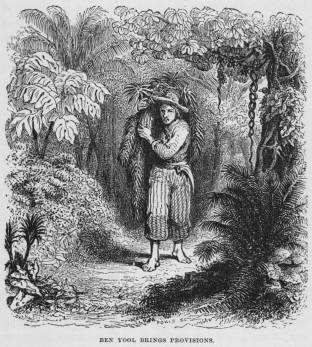
We roused up Mr Brand and the doctor. They carefully examined the provisions, and agreed that they were very good of their sort, so we set to, and made a very hearty breakfast. From the place where Ben found the food, Mr Brand was of opinion that it had been left there expressly for us, but whether by a friend or by our enemies, for the purpose of entrapping us, it was difficult to say.
The day, as it advanced, threatened to be very stormy. The clouds came driving across the sky, and a gale began to blow, such as is rarely seen in those latitudes. It gave us rest, however, for the natives are not fond of venturing out in such weather, and we had less fear of being attacked. During the night we were aroused by hearing a gun fired. We peered out seaward through the darkness; another gun was heard, and a flash was seen. It was evidently from a vessel in distress. It was just before daybreak. The dawn came and revealed to us a schooner, with all her canvas gone, drifting towards the breakers, which rolled in with terrific power, a quarter of a mile from the shore. We gazed at the vessel; we all knew her at a glance, even through the gloom. She was the pirate schooner. On she drove. In another instant she was among the foaming breakers. Her time had come at last. We could hear the shrieks and despairing cries of the wretched men on board. She struck very near the spot where the whaler had been lost. Over the reef she drove. We could see the people one after the other washed overboard, and engulfed by the foaming waters. To help them would have been impossible, even had we not had to consider our own safety. At last one man appeared in the clear water inside the breakers. He seemed to be swimming, though he advanced but slowly, and we saw that he was lashed to a piece of timber. At last he drifted on shore.
“I cannot see the poor wretch die without help, pirate though he may be,” exclaimed Cousin Silas, running down to the beach. I followed him. The log of timber and its freight reached the shore at the moment we got down to it. There was no look of recognition. We ran into the water, and cast loose the body; but our undertaking had been useless. A corpse lay before us; and though the features were distorted, we recognised them as those of Captain Bruno. We had just time to hurry back to our fort, when we saw a body of savages coming round a point at a little distance off.
The schooner had, in the meantime, beaten over the reef, and was drifting across the channel, when, as she got within a hundred yards of the beach, she went down, leaving a dozen or more of her crew floating on the surface. Most of them struck out boldly for the shore; but no sooner did they reach it, believing themselves safe, than the clubs of the savages put an end to their existence. In a short time not one remained alive of the whole pirate crew. It seemed strange that the savages had allowed so long a time to elapse without attacking us, nor could we in any way account for their conduct, unless under the supposition that they were afraid of our fire-arms. To show them that our weapons were in good order, and that we were likely to use them effectually, we every now and then, when we saw any of the natives near, fired a volley in the air.
When we had gone down on the beach, on the occasion of the wreck of the schooner, we observed a canoe thrown upon the shore. She was evidently one of those deserted by the savages when the whaler blew up. We agreed that, if we could get her repaired, she might prove the means of our escape. The first thing was to cut some paddles. This we had no great difficulty in doing, from the trees growing around us. Watching their opportunity, when no savages were near, Mr Brand and Ben went down to examine her. On their return they reported that she was perfectly sound, and required little or nothing done to her. It was a question with us, however, whether we should commit ourselves to the deep at once, and endeavour to reach some more hospitable island, or wait for the possibility of a ship passing that way, and going off to her.
We had scarcely consumed our provisions, when at daybreak one morning we observed a basket under the very tree where Ben had before discovered what he brought us. He again went down, and returned with a similar supply. We considered this matter, and could not believe that any treachery was intended, but, on the contrary, we began to hope that we had some secret friend among the savages. Who he was, and how he came to take an interest in us, was the question. Several days more passed away. Each alternate night provisions were left for us. At length I resolved to endeavour to discover our friend. My great object was that I might be able by this means to gain tidings of Jerry, and perhaps to rescue him from the hands of his captors, for I continued to hope that he had not been put to death. I explained my plan to Mr Brand. After some hesitation, he consented to allow me to adopt it. “I feel with you, Harry, that I could never bring myself to leave the island without Jerry,” he answered; “and probably the savages, should they catch you, would be less likely to injure you than any of us.”
That night, soon after it was dark, I crept down to the tree, and concealing myself among some bushes which grew near, waited the result. I felt very sleepy, and could at times scarcely keep myself awake. At last I heard footsteps, as if a person were cautiously approaching the tree. A man dressed, as far as I could distinguish, like a chief, with a turban on his head, deposited a basket in the usual spot. I sprang out and seized his hand. At first he seemed much surprised, if not alarmed; but, recognising me, he patted me on the head, and uttered some words in a low voice, which I could not understand, but their tone was mild and kind. Then he put out his hand, and I distinctly felt him make the sign of the cross on my brow, and then he made it on his own. I no longer had any doubt that he was a Christian. I longed to ask him about Jerry, but I found that he did not understand a word of English. It was so dark, also, that he could scarcely see my gestures. I tried every expedient to make him comprehend my meaning. I ran on, and then seized an imaginary person, and conducted him back to the fort. I raised my hands in a supplicating attitude. I shook his hands warmly, to show how grateful I should be if he granted my request. At last I began to hope that he understood me. He shook my hands and nodded, and then, assisting me to carry the basket close up to the fort, hurriedly left me.
This circumstance considerably raised the spirits of all the party, for we felt that we had a friend where we least expected to find one. If, however, we could but get back Jerry, we resolved to embark. Perhaps the Christian chief might help us. Had we been able to speak the language, our difficulties would have been much lessened. Here, again, we had another example of the beneficial results of missionary labours. How the chief had been brought to a knowledge of the truth we could not tell, but that his savage nature had been changed was evident. Perhaps there might be others like him on the island. How it was that we had remained so long unmolested was another puzzle. Perhaps it was owing to some superstitious custom of the natives, Mr Brand observed. Perhaps we were tabooed; or, as we had, as they might suppose, existed so long without food, they might look upon us as beings of a superior order, and be afraid to injure us. Our patience, meantime, was sorely tried. We were afraid also that the natives might discover our canoe, and carry it off.
As may be supposed, our eyes took many an anxious glance seaward, in hopes of being greeted by the sight of a vessel. Nor were they disappointed. A large ship was discovered one forenoon standing in for the land. How the sight made our hearts beat! The time had arrived for us to endeavour to make our escape—but could we go and leave Jerry?
“Yes; we may induce the captain to come and look for him,” said Cousin Silas.
“But suppose he will not,” observed the doctor.
“Then I, for one, will come back in the canoe, and not rest till I find him,” exclaimed Ben Yool. “They can only kill and eat me at the worst, and they’ll find I’m a precious tough morsel.”
“I’ll keep you company, Ben,” said I, taking his hand.
So it was agreed that we were to embark at once. Taking our rifles and muskets, the paddles in our hands, and some provisions in our pockets, we hurried down to the beach. We had got the canoe in the water, when a shout attracted our attention. Old Surley gave a bark of delight, and ran off. “That is Jerry’s voice,” I exclaimed, hurrying to meet him. At a distance were several men and boys in hot pursuit. Jerry was somewhat out of breath, so I took his hand and helped him along, without asking questions. He, Surley, and I, leaped into the canoe together; Mr Brand, Ben, and the doctor seized the paddles, and shoving her off into deep water, away we steered towards the passage through the reef. Scarcely had we got a couple of hundred yards off before the savages reached the shore. They instantly fitted their arrows to their bows; but I, seizing my rifle, made signs that if they let fly I would fire in return. They understood the hint, and ran off along the beach to a spot where a number of their canoes were hauled up. The leading one, with only three men in her, came dashing close after us through the surf. One held his bow ready to shoot, the rest had placed their weapons at the bottom. The other canoes contained more savages, and followed close after their leader. This made us redouble our efforts to escape. We darted through the passage just as a dozen canoes or more left the shore. We had a terribly short start of them, and they paddled nearly twice as fast as we could.
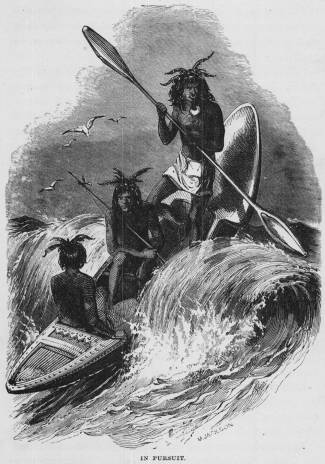
“Shall I fire and give notice to the ship?” I asked Mr Brand. I was sitting in the bow of the canoe facing forward.
“Yes, yes, Harry, fire,” he answered. “They will hear us on board by this time.” I took one of the muskets and fired in the air. Directly after, we saw the ship crowding more sail, and standing directly for us.
“I thought so all along, and now I’m certain of it,” exclaimed Ben, almost jumping up in his seat. “I know that starboard topmast studden-sail, and no mistake. She’s the Triton! Hurrah! hurrah!”
“You’re right, Ben,” said Mr Brand. “I felt sure also that she was the Triton, but still was afraid my hopes might have in some way have deceived me. But give way, give way, or the savages will be up to us before we are alongside her.” The caution was not unnecessary, for the canoes of the savages had already got within range of our rifles.
“Couldn’t you bring down a few of the niggers, sir?” asked Ben. “It will only serve them right, and mayhap will stop their way a little.”
“No, no; never shed blood as long as it can be avoided,” answered Cousin Silas. “These very savages who are now seeking our lives may ere long be shown the light of truth, and be converted and live. See, I believe they have already made us out on board the Triton. They are firing to frighten off the savages.”
As he spoke, three guns were fired in quick succession from the Triton. The noise and smoke, to which the savages were evidently unaccustomed, made them desist paddling. We redoubled our efforts, and shot ahead. After a little hesitation, the savages once more pressed on after us, but happily at that moment the ship again fired. Mr Brand at the same time seized the muskets and discharged them one after the other over the heads of our pursuers. Again they wavered, some even turned their canoes about, two or three only advanced slowly, the rest ceased paddling altogether. This gave us a great advantage, and without waiting to let Mr Brand reload the muskets, we paddled away with our hopes of escape much increased. Some minutes elapsed, when the courage of the savages returned, and fearing that we might altogether escape them, they all united in the pursuit. The breeze, however, freshened, the ship rapidly clove the waters, and before the canoes had regained the distance they had lost, we were alongside. Loud shouts of welcome broke from every quarter of the Triton as we clambered up her side.
I will not attempt to describe the meeting of Jerry and his father. Captain Frankland, indeed, received us all most kindly and heartily. For a long time he had given us up as lost, but still he had continued the search for us. The Dove had been captured by the American corvette, and soon afterwards he had fallen in with her. From the pirates on board the little schooner he discovered that we were on board the large one. He had pursued her for several months, till at length, passing our island, he had observed our flag-staff and our hut still standing. This was, fortunately, after our second visit, when we had altered the inscriptions on the trees. The gale which had wrecked the pirate had driven the Triton somewhat to the southward of her course for the Bonins, whither she was bound to look for us; and thus, by a wonderful coincidence, she appeared at the very moment her coming was of most importance to rescue us from slavery, if not, more probably, from a horrible death.
The savages, when they saw that we were safe on board the ship, finally ceased from the pursuit. Captain Frankland kept the ship steadily on her course, ordering five or six guns to be fired without shot over their heads, as a sign of the white man’s displeasure. After the first gun, the savages turned round their canoes, and, in terror and dismay, made the best of their way to the shore. The Triton was then steered for the coast of Japan.
It was not till some days afterwards that Jerry gave me an account of what had befallen him among the savages. “I was in a horrible fright when the savage dragged me off,” he said. “I thought that he was keeping me to kill at his leisure, just as a housewife does a pig or a turkey, when he wanted to eat me. I cannot even now describe the dreadful scenes I witnessed when the cannibal monsters cooked and devoured the poor fellows they had so treacherously slaughtered. What was my dismay, also, when a few days afterwards some more bodies of white men were brought in! I thought that they had killed you all; and it was only when I found that there were ten instead of five bodies, that I hoped I might have been mistaken.
“The man who had captured me treated me kindly, and fed me well. At first I thought he might have had his reasons (and very unsatisfactory they would have been to me) for doing the latter; but this idea I banished (as it was not a pleasant fine, and took away my appetite) when I found that he did not partake of the horrible banquets with his countrymen. He was constantly visited also in the evening by a chief, who evidently looked on them with disgust, and always looked at me most kindly, and spoke to me in the kindest tones, though I could not understand what he said. One evening, after he and my master had been talking some time, he got up and made the sign of the cross on my brow, and then on his own, and then on that of my master. Then I guessed that I must have fallen among Christians, and that this was the reason I was treated so kindly. I understood also by the signs he made that you all were well, and that he would do his best to protect you.
“One day he came and told me to follow him into the woods. My master’s hut was some way from the other habitations, so that we could go out without of necessity being observed. It was, however, necessary to be cautious. What was my delight when he took me to a height, and showing me a vessel in the distance, pointed to the fort, and signed to me to run and join you as fast as I could! You know all the rest.”
Jerry at different times afterwards gave me very interesting accounts of various things he had observed among the savages of the Fijis, but I have not now space to repeat them.
How delightful it was to find ourselves once more on board the fine steady old ship, with a well-disciplined crew, and kind, considerate officers! Our sufferings and trials had taught us to appreciate these advantages: and I believe both Jerry and I were grateful for our preservation, and for the blessings we now enjoyed.
We had a very quick and fine run till we were in the latitude of Loo-Choo. A gale then sprung up—rather unusual, I believe, at that season of the year. It lasted two days. When the weather cleared, we saw a huge, lumbering thing tumbling about at the distance of three or four miles from us. It looked, as Fleming the gunner remarked, “like a Martello tower adrift.”
“If you’d said she was one of those outlandish Chinese junk affairs, you’d have been nearer the truth,” observed Mr Pincott the carpenter, who, as of old, never lost an opportunity of taking up his friend. “By the way she rolls, I don’t think she’ll remain above water much longer.”
Captain Frankland thought the same, and making sail we stood towards her. By that time she was evidently settling down. The ship was hove-to, the boats were lowered, and, in spite of a good deal of sea which then was on, we ran alongside. A number of strange-looking figures in coloured silks and cottons, dressed more like women than men, crowded the side. Some leaped into the water in their fright; others we received into the boats, and conveyed them to the ship. Two trips had been made, when Mr Pincott, who was in the boat with me, said he did not think she would float till we came back. At that moment a person appeared at the stern of the vessel handsomely dressed. He was a fine-looking old gentleman. He must have seen his danger, and he seemed to be bidding his countrymen farewell. I could not bear the thought of leaving him; so I begged Mr Pincott to pull back, and signing him to descend by one of the rope-ladders hanging over the stern, we received him safely into the boat. Scarcely had we done so, when the junk gave a heavy lurch. “There she goes, poor thing!” exclaimed Pincott. “Well, she didn’t look as if she was made to swim. But pull away, my lads—pull away. We may be back in time to pick up some of the poor fellows.” It was heartrending to see the poor wretches struggling in the water, and holding out their hands imploringly to us, and yet not be able to help them. Many very soon sunk; others got hold of gratings and bits of wreck, and endeavoured to keep themselves afloat, but some of those monsters of the deep—the sharks—got in among them, and very soon committed horrible havoc among the survivors. The moment we were able to get the people we had in the boat up the ship’s side we returned to the scene of the catastrophe. We pulled about as rapidly as we could, hauling in all we could get hold of still swimming about, but some were drawn down even before our very eyes, and altogether a good many must have been lost.