"A Voyage round the World" (continued 7)
Reading edition
For some days the schooner stood on, happily meeting with no other vessel to plunder and destroy. We all the time were kept in anxious doubt as to what was to be our fate. We had another cause of anxiety, in observing that the crew were inclined to quarrel with each other. The cause of this we could not understand, but the fact was very evident. A party seemed to be formed against the captain, and it appeared to us that Silva was at the head of it. Of course this was only conjecture. He was certainly not on such good terms with the captain as he had been at first. He was not a man of a quarrelsome or ambitious disposition, and probably some of the rest of the crew put him forward as their chief, knowing that he would be the principal sufferer if their plans failed, and believing that they could easily get rid of him if at any time they found it convenient so to do. Now and then disputes arose to a high pitch. Knives would be drawn and pistols flashed. More than once matters were brought to extremities; wounds were given and received, and blood was spilt. It had the effect of cooling their tempers for a moment, but at the slightest provocation they again broke out.
One day two men were talking together, apparently on very good terms. One of them we saw pull a dice-box out of his pocket, with several gold and silver coins; the other likewise produced his money. They began to play—at first laughing in a friendly way at the various turns of their fortunes. Then the laughter ceased, and they grew more earnest and intent on the game. One looked very triumphant, as the gold lately owned by his antagonist began to swell his heap. At last the other had no money left. He produced a watch, a clasp-knife and several jewels, a golden crucifix (which he kissed before parting with), and a silver-mounted pistol. His teeth were firm set; his eyes began to roll. He played on. Again he lost; but he had nothing wherewith to pay. He turned his pockets inside out. The winner seemed still to be insisting on payment. A deadly pallor came over the countenance of the loser. He sprang to his feet; a sailor was passing, with a long knife stuck in his red sash; he snatched it from the man, and uttering an exclamation equivalent to “Have at you, then! take all I have to give!” plunged it up to the hilt in the body of the winner, who fell to the deck without a groan. The action brought all those on deck around him. “He insulted me,” he exclaimed; “he won all I had, and then asked for more.” The bystanders seemed to acquiesce in the justness and rightfulness of the action. They did not attempt to touch the murderer, but they lifted up the body of the man he had wounded. He was already quite dead. None of the officers attempted to interfere. The murderer searched in the pockets of his victim for the money and jewels, and counting out the coin, took possession of what had been his own. Again with blasphemous mockery he kissed the cross, evidently believing that he was doing a righteous action, and then sat down on a gun with folded arms, as if he had been an unconcerned spectator of the scene which was enacting. The rest of the dead man’s property the pirates distributed among themselves, and then lifting the body to the side of the vessel, without an expression of regret threw it into the sea.
The tragedy was over, but the countenance of the murdered man haunted us, while his murderer continued walking with an unconcerned look about the deck, as if his hands were perfectly innocent of blood.
“Jerry,” said I, “the sooner we are out of this, though even on a desert island, the better.”
“Oh yes, Harry; it is not safe to live with such wretches,” was the answer.
It would be better if men remembered at all times that it is not good to dwell with sinners.
Chapter Sixteen.
Our perilous voyage.
As we emerged from our cabin one morning, we found that the schooner was standing toward what appeared to be a fleet of vessels at anchor.
“Why, we shall soon be among a whole squadron of buccaneers!” exclaimed Jerry, in a tone of despair. “We shall be separated, Harry—turned into cabin boys, and never have a chance of escape. O dear! O dear! My poor father!—what will he do?”
“Why, Jerry, I am not quite so certain that those are vessels,” I remarked; “just observe them attentively. Hillo! they have disappeared! Stay, we shall soon rise to the top of the swell again. There they are! They are as steady as church steeples. Those are not the masts of vessels. They are cocoa-nut and palm-trees, depend on that. They are growing on one of those coral islands which abound in these latitudes. Watch again. On we go.” (Here I caught sight of the glittering, white, sandy beach.) “How the surf breaks on the reef outside it! How bright and clear it appears, rising out of the deep ocean! How green the ground looks under those tall trees, and how intensely blue the lagoon in the centre! It is a lovely-looking spot—quite a fairy land. I hope that we shall be put on shore there, though I would rather have a few hills and valleys to diversify the scene, if we are to remain there long.”
While we were talking we were rapidly approaching the coral island. The doctor joined us, and was watching it also. The schooner stood on, and we thought she was going to pass it. The doctor, though not less anxious to leave the vessel than we were, did not appear to agree with our wish to be set on shore there. “It is dreadfully hot there, without shelter from sun or wind. There is also but little variety of food; and green as the ground looks from hence, we should find nothing to be compared to a green lawn when once we set foot on it,” he remarked. Still Jerry and I were ready enough to run the risk, hoping that, at all events, we might soon find the means of getting away. When, however, we had abandoned all hopes of landing there, the schooner was once more hauled up close to the wind. We found that she had stood on to clear a reef. She stood in under the lee of the land, and hove-to close to where an opening appeared in the reef.
Our hearts beat quick, for now we felt certain that something or other was going to happen, though nobody had said anything to us. It seemed strange that we could have lived so long surrounded by our fellow-creatures, and yet so entirely alone. A boat was lowered. A cask of bread, and another of salted meat, and some hatchets, and a few old sails, and, indeed, more things than I can here enumerate, were put into her. The doctor was summoned into the captain’s cabin. He remained a short time, and when he re-appeared he looked happier than he had done for many days. Jerry and I were then ordered into the boat; the doctor, to our great satisfaction, followed. Old Surley, as may be supposed, would not consent willingly to be left behind, and, watching his opportunity, he sprang in after us, and, as if he thought he might be carried back again if perceived, immediately hid himself under the seats between our legs. We were delighted to have the old fellow, and trembled lest the pirates, among some of whom he was a favourite, might insist on keeping him. It was with great satisfaction, therefore, that we found the boat shoved off from the schooner’s side.
Four of the pirates formed the crew of the boat, and taking the oars, they pulled towards the shore. We did not leave the pirate ship with any regret, though few people would desire to be landed on a desert island in the middle of the Pacific. Tom Congo, the black cook, was the only person who wished us good-bye. He was evidently sorry to lose us. We had no means of showing our gratitude to him, except by a few hurried words. We saw his good-natured black visage grinning at us over the bulwarks, as we left the vessel’s side. Suddenly he started back. There was some violent disturbance on deck. Shouts, and cries, and pistol-shots were heard. The outbreak we had anticipated was taking place. There was a mutiny. Some of the crew had risen against the captain; there could be no doubt about that. Some of the men in the boat wanted to go back to join in the fray, but an old man among them shook his head and said, “No! Let the fools fight it out. When we go back we shall know which side to join.” The rest saw the worldly wisdom of the advice, and calming down their eagerness, they pulled on to the shore.
We quickly passed through the reef, and the boat grounded on the beach, which we found was composed of broken corals and shells, and rose some ten feet out of the water. Had it not been for the disturbance on board, the boat would probably have returned as soon as the stores intended for our use had been landed; but, as an excuse for remaining, the crew offered to carry them up to any place we might select under the trees where to pitch a tent. We selected one to leeward of a heap of coral, where, several trees also growing close together, some shelter might be obtained. Near it was a pure spring of water bubbling up through the hard rock, and flowing into a basin some five feet in diameter, but of its depth we could not judge. The water was so clear that, as we looked into it, it appeared but a shallow pool. Jerry, being very thirsty, stooped down to drink from it, and, baring his arm, intended to rest his hand at the bottom to support himself while he stooped over. Down he went on his knees, but he got more water than he had bargained for. Suddenly over head and heels he went, and was floundering about in the pool, which must have been nearly three feet deep. Sad as was our condition, the doctor and I could not help laughing heartily at his surprised countenance as he popped his head up again after his summerset, and we assisted to haul him out. Even the saturnine pirates joined in the laugh. As the sun was very hot, his clothes quickly again dried, and he was in no way the worse for his ducking.
Surley had not mended matters by jumping into the pool and swimming about in its cool waters. As soon as he was out, off he set scampering about the island, scaring the wild-fowl, whisking his tail, and barking with delight at finding himself free after his long imprisonment on board ship. I felt very much inclined to follow his example, and to run about after him shouting at the top of my voice. I restrained myself, however, as the state of affairs was too serious to allow me to indulge in any such exuberance of spirits.
We thanked the pirates, with as good a grace as we could command, for helping us to carry up the stores. “Oh, no need of thanks, mates,” was the answer. “You won’t find it very pleasant here, perhaps; but there’s many an honest fellow worse off than you are, and there are not many who come aboard us who get away as well as you have done.”
We had too much reason to believe this assertion true to hazard a reply. Perhaps Jerry’s tumble into the water had put them in good-humour; but whatever was the cause, they seemed inclined to help us, and volunteered to assist in cutting down some trees to build our hut, which the canvas would make tolerably comfortable. While so employed, however, they kept looking up constantly towards the schooner.
“I say, Tom, don’t you think that there is a chance of her making sail, and leaving us here?” observed one of them to the old pirate Tom Roguish.
“No fear of that, mate,” answered old Tom, shaking his head. “They know our value too well to do that. I’ve watched what has been going on for some time, and it’s my belief Silva’s party will find that they have made a mistake. The captain has been too wide awake to be taken by surprise, depend on that.”
“Hillo! what are they about now?” exclaimed another of the men. The schooner, which had stood still closer in towards the shore, had lowered another boat, at the same time firing a gun as a signal to recall the one which had brought us. We all ran down as fast as we could to the spot nearest to her, and we could see that several persons were being lowered into the boat.
“Well, good-bye, mates; a pleasant residence to you,” exclaimed old Tom, insisting on shaking hands with us; and then he and his companions stepped into the boat and shoved off from the shore. We were not sorry, however, to see their no very pleasant visages grow less and less distinct, till they were lost in the distance. They stopped rowing as they passed the other boat, and exchanging a few words, again pulled on. We anxiously watched the approach of the other boat, to ascertain what it contained. One of the chief mates was steering. Silva, also, to our surprise, was in the boat. His head was bent down, and, from his attitude, it appeared as if his hands were lashed behind him. But there were two other people. We looked, and looked again. “Why,” exclaimed Jerry, in a joyful tone, “it’s Mr Brand, and no other than Ben Yool! How fortunate! Now we shall go all right.” I at the same time, with no less surprise and satisfaction, recognised my kind cousin and old Ben. Mr McRitchie did not appear to be as surprised as we were. He all the time, we found, had known that they were on board, but had been directed not to mention it to us. He told us that, as far as he could make out, Silva had been the means of saving the lives of Cousin Silas and Ben, as he had saved ours, but that the pirates had kept them below, that they might not discover whereabout they were landed; and, for the same reason, had prevented them communicating with us. Silva had another reason also for consenting to this arrangement, for he was afraid that their appearance might excite the anger of the pirates, and that they might perhaps throw us all overboard together. Indeed, it was owing to a happy combination of circumstances that our lives had been spared by that gang of bloodthirsty and cruel desperadoes. Even now, we were not quite certain that they might not take it into their heads to shoot us all, and we longed to see them making sail and clear away. The provisions, however, they had left with us, showed that the intentions of some of them had been kinder than the conduct of the crew in general would have led us to expect.
The second boat now reached the beach. Silva was assisted out, apparently suffering much pain, and then Cousin Silas and Ben followed with their limbs at liberty. We ran forward to welcome them, which we did most warmly, while they seemed very well pleased to meet us. Poor Silva was left, wounded as he was, standing on the beach. Some more casks and several other things were landed from the boat, and then the crew, without addressing a word to any of us, shoved off as fast as they could, and pulled back to the schooner.
As soon as the pirates were gone, we went up to Silva and asked him what had occurred. His rage and indignation, added to the pain he was suffering, almost prevented him from speaking. “Partly because I did not like to see so much blood shed, and partly because the captain was jealous of me, he had, I discovered, resolved to get rid of me,” he replied, stamping on the ground. “I, however, was always on my guard. Many of the people liked me and trusted me, and I got information of all he intended to do. He, however, it seems, had his spies, who got into the confidence of some of my people, and the captain saw that we were very likely to become the strongest party. Some of his allies took the occasion of your being put on shore to accuse me of having favoured you for my own ends. Words quickly led to blows. My friends rallied round me, but some of those I could best trust were sent away in the boat with you. The captain’s party made a rush forward, and, wounded and bleeding, I was seized. They would have killed me at once, but my friends declared that if I was hurt they would blow up the vessel and all hands together. I doubt if they would have kept their word. However, the captain agreed to spare my life, and to put me on shore with you, if they would not create any further disturbance. This they very quickly agreed to, the cowards, and so, here am I, lately as free and independent as any of them, left to share the fate of those whose lives they considered it a great favour to have spared.”
“Well, Silva, we will try and make you as comfortable as we can,” said Cousin Silas, taking his arm. “We have a doctor to tend you, which you would not have had on board; and as we feel fully that through your influence our lives have been preserved, we will do our best to show our gratitude.” Cousin Silas said this as we were showing the path up to the spot where we had commenced our hut.
In one corner we quickly made a bed of leaves and dry grass. Over this we spread a piece of canvas, and thus constructed a very good bed, on which we placed Silva. Dr McRitchie having examined his wounds, washed them and bound them up; but he observed that he considered his case somewhat serious. As soon as this was done, we set to work to cut down some more trees, so as to increase the dimensions of our habitation. We were employed for two entire days in building our hut, for we agreed that, as we might have to remain a considerable time on the island, and as probably heavy gales might at times prevail, it would be wise to construct a habitation which could not easily be blown down. To do this, to every upright post we put another at a considerable angle, and then secured our canvas tightly down to it. We also beat heavy lumps of coral tight down round the thick ends of the posts, so that it was scarcely possible for the wind to drag them out of their holes. We had been considerately supplied by Silva with a saw, and hammer, and nails, and other carpenter’s tools; and he now most unexpectedly benefited by his kindness to us, as we were able to put a comfortable shelter over his head much more rapidly than we could otherwise have done. I need scarcely say that Cousin Silas took the lead in everything. Indeed, I suspect, without him we should have managed but badly. Whenever our spirits flagged, he restored them by his resignation and cheerfulness; and he reminded us that although we might think our fate a hard one, we should be most thankful that we had escaped with our lives from the hands of such bloodthirsty miscreants as Bruno and his associates.
So busy were we at first, that it was some time before we had an opportunity of inquiring how it was that the pirates had not murdered him and Ben, when they pulled alongside the schooner. “I believe that they were so astonished at seeing two strangers on their deck, not knowing where we had come from, that it did not occur to them to heave us overboard again. This gave time to Silva, who at once recognised us, to form a scheme for saving our lives. Going up to us, he welcomed us as old comrades, hinting that we had some mysterious powers which enabled us to go about over the ocean wherever we liked, seated on our cloaks, or in cocoa-nut shells for aught I know. The pirates on hearing this, received us in a very friendly way, and all of them swore that no harm should happen to us. However, when we were required to take the oaths of the fraternity, and steadily refused, some of them began to suspect that Silva had been deceiving them. Our punt alongside showed that at all events we had not come on board on our cloaks. However, as they had sworn no harm should come to us, they kept their word, with the intention of landing us, as they have done, on this or some other uninhabited island. After Silva had lost his authority, I suspect that our treatment would have been very different to what we found it at first.”
“Well, Mr Brand, we are so very glad that you and Ben have escaped. What should we have done without you?” exclaimed Jerry.
I could do no more than take his hand and wring it warmly.
“Now, tell us, what do you think we ought to do next?” added Jerry.
“Make ourselves as happy as we can, and collect everything which will serve us as food, in case we have to make a long sojourn here, which it is, I think, very probable we shall have to do,” replied Mr Brand. “A ship may come off here in a few days or weeks, but we must remember that perhaps months or years may pass before one is seen. I cannot say whereabouts we are, but I suspect that the pirates would not have left us in the usual track of vessels coming north round Cape Horn, or going east or west. The next thing we have to do is to strip the branches off the tallest palm on the island, and make it serve as a flag-staff. We’ll then make as large a flag as we can of our handkerchiefs and shirts, and any stuff which will be light enough to fly well.”
We very soon carried out this project, and all of us working away to join our handkerchiefs, we had by the next afternoon a big flag flying from what we called our mast-head.
“Why, we shall turn into regular Robinson Crusoes, if we stay here as long as you were saying we might have to do, Mr Brand,” observed Jerry, as we were working away at our flag-staff. “I cannot say, however, that I like the look of this island as much as I did that of Juan Fernandez. If we had our choice, we would rather be there, I should think.”
“Very likely; but as you see, Jerry, we have not our choice, we must make up our minds to be content where we are,” answered Mr Brand cheerfully. “Probably, if we were at Juan Fernandez, supposing it still uninhabited, we should be wishing to be on the mainland. Let us strive, therefore, wherever we are, or whatever happens to us, to be content. Depend on it, we were not placed here by our merciful and all-loving Maker without an object, though we may never discover it. I do not for a moment mean to say that we are to sit down idly and not to endeavour to improve our condition. We are sent into this world to struggle—that we may in a variety of ways be tried—that all our trials may tend to our improvement. What I wish to impress on you, my lads, is, that we should be contented in every condition in which we are placed; we should be thankful for every step we gain, while our chief aim in life is our religious and moral improvement. But remember, above all things, that we must always look beyond this world. This is not our abiding-place—this is not even our resting-place—there is no rest here. If we only strive for something in this world—however noble, however great the position—we shall altogether fall short, very short of the aim, the object of life.”
Mr Brand warmed with his subject, and much more he said of a similar nature, which I will not now repeat. Jerry and I listened very attentively, and old Ben Yool tried also to take in what he was saying. I think he succeeded, and, certainly, on all occasions after that he bore without a grumble all the hardships to which we were exposed. Poor Silva lay on his bed all this time, suffering much from his wounds, while Mr McRitchie, when he could leave his side, went off with his gun to explore the island, and to search for specimens of its natural history. There was, however, a good deal to be done before we could accompany him. First, we had to finish our house, and then to store within it all the provisions and articles which the pirates had left with us. The doctor had kept his gun, and we had ours, which had been brought from the Dove, given to us as we left the schooner. These fire-arms would have been of no use to us, had not Silva given us a keg of powder and a bag of shot. These treasures we resolved to husband with great care, as we knew that we might be placed in positions in which our very existence would depend on our having the means of killing game, or of defending ourselves against enemies.
“Before we do anything else, we should take an inventory of all we have,” answered Mr Brand. “We must calculate how long our provisions will hold out, in the first place, and not imitate the example of many savages, who eat up all they have got, and then starve.”
This advice was followed. We found that we had provisions for four or five months; but we hoped to make them last a much longer time, if necessary, by eating the birds which swarmed on the island. There were cocoa-nuts and some other fruits, and we hoped also to catch an abundance of fish, which are generally to be found about the reefs surrounding coral islands in the Pacific. Our labours being concluded, we all sat down together on the beach below our habitation, to talk over our prospects. Happy, indeed, was it for us all, that we had a man like Cousin Silas among us, to give us his advice, and to set an example of patience and hope, and faith in God’s merciful providence, and a cheerfulness which nothing could overcloud. Really, after talking with him for some time, I often felt that our lot was rather to be envied than dreaded, and that we were only doomed to undergo a somewhat prolonged picnic. This example and conversation had ultimately a great influence with the doctor, who had been inclined to repine and to become morose, looking with gloomy apprehension as to the future.
A week passed by, and we found ourselves perfectly settled in our new home. Silva was gaining strength and his wounds were healing, and we were all in excellent health. The doctor also had almost recovered his spirits. We began now to take a more extended survey of our island. We calculated that it was from ten to fifteen miles from one end to the other, or rather right across; and as it was nearly circular, with a large lagoon in the centre, we had to walk from thirty to forty miles to go round it. It was about a mile across in most places. The beach was formed of broken coral and shells, while the upper portion of the land consisted of the débris of coral, the dung of birds, and vegetable earth. Out of this composition grew tall cocoa-nut trees, and palms, and pandanus trees, besides a variety of shrubs.
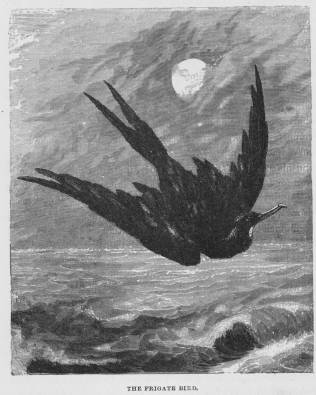
The birds had been partially driven away from the spot where we landed and had been working, but we found them in prodigious numbers a little way on. Cousin Silas insisted on our tying up old Surley, to prevent the unnecessary destruction which he dealt among them. Before committing any great slaughter among them, Cousin Silas advised us to kill only a few of each description, to ascertain which were the most palatable for present consumption, and which were likely to preserve best for future store. Sitting on nests roughly constructed of sticks among the shrubs, were a number of frigate birds (the Tachypetes Aquila). He is a magnificent fellow, allied in some respect to the cormorant, but with shorter legs, and having a forked tail. His plumage is a rich empurpled black, and the beak, both mandibles of which are curved at the tips, is red. His wings are of immense length, and his power of flight is wonderful. He can fish perfectly well for himself, but he is a most irreclaimable pirate, and likes to watch till other birds have seized their prey, and then he drops down upon them and carries it away. Sailors also call them men-of-war birds, but I think they ought to be called pirates. We looked into their nests, and found only one egg in each.
While sitting down taking our luncheon, we observed a snake crawling along out of the grass, and wriggling his way towards the sea. For what he went there I do not know. He had better have kept away. Just as he got below high-water mark, out darted from the crevice of a rock a huge crab, and seized him by the nape of the neck. The snake wriggled, and twisted, and tried to free himself in vain. Mr Crab held tight hold of him, and seemed resolved to eat him up. Poor Snakie tried to get his tail round a bit of rock, to keep himself out of the water; but Crabie pulled and hauled, and, in spite of all resistance, got him down to the very edge of the water, knowing that when once under it his struggles would very soon cease. Crabs have, however, to learn the lesson that there is many a slip between the catch and the feast. A frigate bird had from afar espied the combat, and, flying like a flash of lightning, downward he darted and seized the snake by the back. The voracious crab held on, not liking to lose his prey, till he found himself borne upwards from the ground, and in unpleasant propinquity to the frigate bird’s sharp beak. He must have felt that if he did not let go at once, he would be dashed to pieces; still, as a miser clutches his bags of gold, did Mr Crab the snake. Fortunately for him, the frigate bird had flown seaward, so that when he did let go, he fell into the water, and, probably, however his temper might have suffered, he was not much the worse for the ducking. Had he fallen on the rock, he would inevitably have had his shell broken, and would himself have become the prey of the pirate.
There were also sooty terns and gannets. It was interesting to watch the careful way in which the latter guarded their eggs, placed in holes on the ground. Wishing to make their offspring hardy, they do not build nests for them, I suppose; or, perhaps, the warmth of the rock assists the process of incubation.
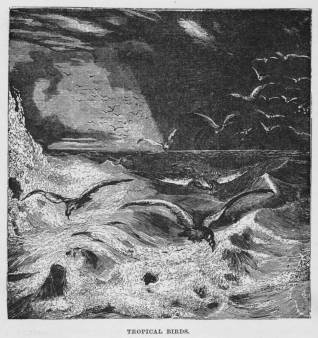
There were probably a greater number of tropic birds than of any others. They would not got out of our way as we walked along, allowing us to shove them over rather than move. We literally also took their eggs from under them, without their attempting to make any defence. This apathy, as we called it, we thought arose from stupidity, but the doctor examined one of them, and showed us how weak its legs were, while its feet were adapted only for swimming. Its wings, however, were very long and powerful. Therefore, had it been up in the air, or skimming along over the summit of the waves, it would probably have acted in a very different way. “Never judge of people till you know the sphere of life in which they have been accustomed to move,” remarked the doctor. “A really sensible, clever man, may appear very stupid and dull, just as these poor birds do, simply because he is out of his element.”
The tropic bird is a species of gull, about the size of a partridge. It has a red bill and legs. The feathers are white, tipped with black, and the back is variegated with curved lines of black. The tail consists of two long, straight, narrow feathers, almost of equal breadth during their whole length. Their flight is most graceful—they glide along with scarcely any perceptible motion of the wing. They return every night to roost on land. They live entirely on fish. The natives of the South Sea Islands ornament their persons with their feathers. We saw a number of snakes, but none of them attempted to bite us; and the doctor said from their appearance that he did not believe them to be of a venomous character. Whenever we went near the water among the rocks, we saw large fish darting about, of every colour and shape; huge, long eels gliding in and out between the rocks, and fierce, voracious sharks pursuing their prey.
There were a great variety of molluscs; indeed, the whole shore was composed of shells. We naturally thought that the shells were empty; but as we watched them, thousands of them began to move, each tenanted by a soldier-crab, and a whole army of them slowly advanced out of the sea and marched across the land, devouring all the insects they encountered in their progress. Now and then two of them would stop and have a fight over a beetle or a spider, when perhaps a third would step up and carry off the cause of dispute. We found the spiders’ webs stretching in every direction between the bushes. The spiders themselves were great, ugly, black fellows, very disagreeable to look at, and still more unpleasant when we found them crawling over our faces.
I wish that I could describe the variety of shrubs we found on the island. Many were evergreens. One, which the doctor called the suriana, emitted a peculiarly strong, though not unpleasant odour. We used to be very glad, when the rays of the sun came down fiercely on our heads, to take shelter under these trees, and to rest during our long journeys from one end of our dominion to the other.
We in a short time were acquainted with nearly every portion of the island. Our habitation was about ten miles from the entrance to the lagoon, so that in one direction we were able to travel twenty miles, when we arrived at the termination of that part of the circle; and by going the other way, ten miles brought us to the end of the other. The passage into the lagoon was probably the eighth of a mile broad.
One day Jerry and I set off, he taking the shorter distance and I the long way, that we might have the pleasure of looking at each other across the passage. I do not know that we had any better reason. Accompanied by old Surley, I set off by daybreak, as over such rough ground it was difficult to make good more than two miles an hour. It was therefore the evening when I got there. I looked eagerly across the channel. There stood Jerry, shouting and beckoning to me. I shouted to him, and made all sorts of signals expressive of my delight at seeing him.
After we had played these sorts of antics for some time, I began to consider that it would be rather tiresome to have to walk all the way back by myself, and that either I must go across to Jerry, or get him to come over to me. I was the best swimmer, so I resolved to go over to him. I made signs that I would do so, and he signified that he was very glad to hear it. Old Surley seemed as pleased as I was at seeing Jerry, and leaped and bounded about, barking every now and then, after his own fashion, to show his satisfaction. Two or three times he ran down to the water, as if he intended to plunge in and to swim across; and each time he came back whining and looking up in my face, as if he had thought it would be wiser not to venture in. I had good reason afterwards to admire the instinct which prompted him to refrain from doing what he evidently wished to do.
I had my gun with me, as well as some provisions, which, of course, I did not wish to wet; and so I had to consider how I could get them over dry. A raft was the only means, but I reflected that it might prove somewhat difficult to tow. Still, I did not like to be beat, so I made signs to Jerry what I was going to do. With a hatchet which I carried in my belt, and with which I had provided myself to make an arbour for the night, I soon cut down wood enough to form a raft which would carry all my things, including my clothes; and I had a line in my pocket strong enough to tow it along.
All was ready; I launched my raft, and was loading it with my property, when my eye caught sight of a shoal of fish darting up through the passage, followed by a black, triangular fin, which I quickly recognised as that of a huge shark. I saw the horrid monster overtake and gobble up some of the fugitives, and then quietly come back, as it appeared, to swim sentry at the entrance of the lagoon. Perhaps he knew that the fish would make an attempt to get out again the same way. Be that as it may, I felt no inclination to encounter the gentleman.
When Jerry at length discovered the cause of my hesitation, he made signs entreating me to go back rather than to endeavour to cross, as I proposed. Still, I did not like to be driven back, even by a shark. I made signs that I would make a raft for myself. There were plenty of materials, the work would not take long, and it would be a triumph to have overcome a difficulty. I thought the idea a very bright one; so I at once set to work to build a raft large enough to carry me across the channel. Jerry tried to make me understand something or other; but I was so absorbed with my own idea and the work on which I was engaged, that I could not make out the meaning he wished to convey. While I was working, old Surley looked on very attentively, as if he wanted to help me, and fully understood what I was about.
I had built the raft close down to the water; but even so, I had considerable difficulty in getting it afloat. I succeeded, however, in so doing at last, by means of a long piece of wood, which served me as a handspike. Just as I was going to step on it, I fortunately saw the branch of a tree floating by out to sea, at a rate which showed me that I might very possibly be carried away by the current before I could get across. I therefore converted my neckcloth and pocket-handkerchief into a tow-rope, and towed the raft inside the lagoon. I had made myself two strong paddles—one to serve in case the other should break. At last I reached a point where I thought I might embark with safety. Surley, who had before hesitated, now came and placed himself by me. I had put on my shirt again, but the rest of my things were on the small raft. I gave my raft a desperate shove, and away I went, paddling as hard as I could up the lagoon.
I thought that I had gone far enough, and was in a hurry to get across, so I began to direct my course athwart the current. At first I made great progress, and laughed and shouted at the idea of thus easily accomplishing my undertaking. When, however, I turned my head over my shoulder, I found to my dismay that I had not got so far from the shore whence I started as I had fancied, while I was still a long way from that on which Jerry stood, eager to welcome me. I plied my paddle with all my might; but I appeared to make very little progress, and the current was evidently carrying me rapidly down the passage. I looked seaward: I had ample cause for anxiety, if not for dismay. A long line of huge breakers was rolling in on an outer reef, while the passage between them was so narrow that I scarcely hoped that the raft could be carried through it; and if it was, where was I to go? Out to sea, to be starved to death! If, on the other hand, I was thrown among the breakers, I felt certain that I should soon become the prey of the hungry shark I had just seen swimming after the shoal of fish. These reflections gave strength to my arm, and made me paddle away even faster than before.
Jerry full well understood my clanger, and I saw him wringing his hands in his anxiety; yet he saw that he could do nothing to help me. I felt that I had been very foolish; and the poignancy of my regret was heightened when I remembered that I had placed myself in my present predicament without any necessity or an adequate object. I had little time, I own, to indulge in such reflections, for all my thoughts and feelings were soon engrossed with the danger which immediately threatened me. Jerry ran along the shore as I was carried by, in vain stretching out his arms as if he would help me. Old Surley sat still, only now and then uttering a low whine, as if well aware of our peril, but feeling that he was unable to render me aid. Now and then he looked into the water, as if he would like to swim ashore, which he might possibly have done; but then, perhaps, he remembered the shark he had seen, or he was unwilling to desert me. I truly believe that it was the latter cause made him remain so quiet by my side. I am certain, from the expression of his countenance and the turn of his head, that he was fully aware of our danger.
I paddled and paddled away with all my might, all the time facing the shore, and getting nearer to it, but at the same time gliding down seaward. I was about a hundred yards from the shore. I looked towards the angry breakers, and was not more than twice that distance from the mouth of the channel. In a small boat there would have been no danger, but I found my raft a very heavy thing to move. I put still greater force into my strokes. My paddle snapped in two. Jerry uttered a cry of despair, for he thought I must now inevitably be lost. I seized the spare paddle, and flourishing it above my head, began to ply it as I had done the first. I made some progress, but not sufficient, I feared, to attain my object. I was approaching the last point. Jerry ran out to the end of it, and rushed into the water up to his arm-pits, hoping to stop the raft. I shouted to him to go back; for at that moment I saw close to me the fin of a monster shark. The savage fish darted on towards him, and he was barely in time to escape his ravenous jaws by springing into shallow water. Had he caught hold of the raft, I saw that he would be lifted off his legs, and carried away with me. Still I hoped to get within his reach where he stood. But vain was the wish: I drifted past the point. What hope had I now of being preserved? I felt inclined to throw away my paddle, and to give myself up to despair. But I aroused myself. I bethought me how Cousin Silas would have behaved under similar circumstances. I prayed for strength and courage to Him who is alone able to give them to those in deep distress. He heard me, or I should not be alive to tell my tale. Again I seized my paddle, and plied it with all my might. Still I drifted towards the roaring breakers. I vividly pictured the horrid fate which awaited me. I scarcely dared look seaward. I kept my eye on the shore, paddling without intermission. Suddenly I felt the raft arrested in its progress towards the breakers. It was partly whirled round, and I found it gliding parallel with the shore. This encouraged me; hope once more revived. I directed the raft towards the shore. I saw Jerry waving his hands with joy; he was answered by a cheerful bark from Surley. I got nearer and nearer. Oh, how thankful I felt when I found the blade of my paddle grasped by Jerry, and was towed by him safely to the shore! Old Surley sprang off on to dry ground, and began leaping up and licking Jerry’s cheeks and hands, to show his gratitude. Jerry and I hauled up the raft, with its little tender, and landed my things; and then, overcome with fatigue and the revulsion of feeling which I experienced, I fainted. I very soon, however, recovered, and kneeling down, joined by Jerry, I returned my heartfelt thanks to Him whose arm I knew most certainly had saved me. Afterwards I dressed; and sitting down, we made a supper from some of the provisions we had brought with us.
We had lost so much time that it was impossible to get back to our companions that night; so we set to work to prepare a hut and bed for ourselves before we were overtaken by the darkness, which comes on so rapidly in those latitudes. We were not long in constructing a bower and in raising a platform, under and on which we might sleep secure from the attacks of the snakes and other crawling things which abounded; but night came down on us before our work was quite completed. However, free from all fear of savages or wild beasts, we lay down, and were soon asleep.
Chapter Seventeen.
Our residence on the Island.
Our journey back appeared very long, for I was weak and tired, and from the exertion I had undergone, every muscle in my body ached. We met Cousin Silas coming to look for us; for he had become anxious at not seeing Jerry return at all events, and feared something might have happened to us. Ben Yool had set off in the other direction to search for me. Therefore, instead of gaining a great deal of credit, as we expected, by the feat we had accomplished, we found that we had caused our friends no little trouble and anxiety. It was a lesson to me ever afterwards not to attempt to perform any useless undertaking simply because it might be difficult or dangerous. Many people have lost their lives by such folly.
Silva had by this time completely recovered his health, but his spirits were very uncertain. Sometimes he would sit for hours brooding over his past life, and the treatment he had received from his companions; then he would start up and walk about the beach, waving his arms, and calling down imprecations on their heads. At other times he was very quiet and sociable, and would talk rationally on any subject under discussion.
The lagoon swarmed with fish; but though very beautiful in appearance, our difficulty was to catch them. We could manage to make some coarse lines out of some rope-yarns which had been thrown into the boat with the canvas; we could cut rods from the younger trees which grew around; and there were plenty of projecting masses of rock on which we might sit and angle; but a very important portion of our gear was wanting—we had no fishing-hooks.
“Has any one a file?” asked Silva. We all examined our knives. I had one in my knife-handle, but it was broken, and I had neglected to get the blacksmith to put a new one in its place. We hunted eagerly in our box of tools. Nothing like a file could we discover.
“What is this?” exclaimed Jerry, pulling out a bag of nails from the bottom of a cask. “Here is something larger than a nail inside.” It proved to be part of a file.
“There is enough here to file through an iron bar, if properly used,” said Silva, examining it. “Hand me the nails; I will see what I can do.” Seating himself under the shade of a cocoa-nut tree near the hut, he began working away most assiduously. With a pair of pincers he twisted the nail into the shape of a hook, and very soon filed, out a barb, and some notches in the shank with which to secure the line. In the course of two or three hours he had produced a dozen capital hooks. “Now we may go fishing,” said he. “We may catch as many fish as we can want, but we should be the better of a canoe.”
“Or a raft, eh, Harry? Should you like to try another cruise on one?” asked Jerry.
I shuddered at the thought of the danger from which I had been preserved. However, as we all felt that our health would benefit by some fish diet, we soon had our gear fitted, and all hands, including the doctor, might be seen perched, like so many cormorants, at the end of all the projecting points in the neighbourhood. Jerry and I were near each other; the rest of the party were pulling in fish pretty quickly; and we had caught several very beautiful-looking fellows—a species of rock-fish—when Jerry sang out that he had got a bite of some big fish, and called to me to help him. Leaving my own rod, I ran round towards him.
“Quick, quick, Harry!” he sung out, holding on by his rod with all his might. “I shall be in! I shall be in!”
Still he would not let go his stick. I sprang forward, and was just in time to seize him by the leg, when over he went splash into the sea. At the same instant I caught sight of the malign countenance of a huge shark, which had undoubtedly caught the fish he had at first hooked. I exerted all my strength to haul him in; for the monster, instead of being intimidated by the splash, made a dash forward for the purpose of grabbing him. I almost shrieked with horror as I beheld the savage fish; but Jerry had just time, as I drew him up by the legs, to put his hand on a point of coral, and to throw back his head, though the shark’s snout almost touched his nose as he did so.
“Not a pleasant fellow to get a kiss from,” exclaimed Jerry, as he scrambled up the rock and shook off the water from his clothes. Then he added, in a more serious tone, “Oh, Harry, what an ungrateful wretch I am to be joking at such a moment, before I have expressed my gratitude to God who has preserved me, or thanked you for coming to my assistance.”
While on the island we had had more time than usual for reflection, and had profited also by the example and exhortations of Cousin Silas, so that we were both happily becoming much more serious and thoughtful than heretofore. Indeed, I have learned that what we consider misfortunes, if seen in their proper light, may become the cause of the greatest blessings.
Ben Yool had seen the accident from a distance, and now came hurrying up to us. He was inclined to scold Jerry for the fright he had given him. I believe truly that the old man loved us as much as if we had been his own sons, and would have been miserable had any accident happened to either of us.
On examining the fish we had caught, we found that, although very beautiful in appearance, few of them were likely to prove palatable to the taste. Some, Silva thought, were altogether poisonous; and those we cooked had very little flavour.
“If we had but a canoe we might go off into deeper water, and then we might catch a greater variety, and many fish very fit for food,” he remarked, eyeing as he spoke several trees which, he said, would make good canoes. One or more canoes we accordingly resolved to have; so at once we set to work to cut down a couple of trees. That operation our axes quickly accomplished. It did not take us long to fashion the outside. To scoop out the inside was more difficult. Our axes did the rougher portion, and then we heated stones and bits of iron, and burned out the remainder, scraping off the black part with our knives. In about a week we had a couple of small canoes completed, with seats across, and with three paddles in each. Silva took charge of one, Cousin Silas of the other. The doctor and I went with him, while Ben and Jerry accompanied Silva.
With no little satisfaction we launched our fleet into the lagoon. Both canoes swam very well, and off we paddled with great delight across the lagoon. How bright and clear were its waters! It was almost impossible to estimate their depth, we could so completely see down to the bottom. After pulling some time, we rested on our oars. As we looked over the side, how beautiful was the sight which met our view! It was like a fairy land. Coral rocks of the most fantastic shapes sprung up around. Caverns, and arches, and columns, and pinnacles appeared. Gorgeous and varied were the hues. There were white, and blue, and yellow corallines. Among them grew marine vegetables of every description. Here the delicate sea-green stem of the fucas twisted round a rock; and near it the ocean fan expanded its broad leaves. Every point was occupied by some feathery tuft of lovely tints, while from each cleft projected the feelers of some sea-anemone or zoophyte. Among the heights of the submarine landscape moved thousands of living beings, to which the doctor gave some learned names which I do not pretend to remember. Some he called chetodons. They were flat and of an oval form, of a rich silvery hue, and had blue stripes downwards. They swam in a perpendicular position, with one long, slender fin from the back curving upwards, and another from the opposite side curving downwards. Several came and looked at us, as if to inquire why we had visited their domains. Others of still more curious forms and tints were darting in and out among the rocks; and there were huge lobsters, and crabs, and crayfish, of various sorts, poking their long antenna? out of gloomy caverns; and sea-urchins, and star-fish, and the bêche-de-mer, lay scattered about; while huge clams opened wide their broad valves to catch their unwary prey.
While we were all looking over the side, what had hitherto appeared to be a huge piece of rock began to move, and the piercing, savage eyes, and cruel jaws of a vast shark approached the canoe. I felt a shudder run through my frame as I saw the monster darting out of his ambush. “Give way!” cried Cousin Silas; “he means mischief.” The doctor and I plied our paddles. The brute made a dash at mine, and almost bit it in two. Away we went as fast as we could towards the shore, pursued by him. We shouted as loud as we could and splashed our oars about, to frighten him away; but he seemed in no way disposed to be alarmed. Silva, hearing our shouts, now came paddling toward us. Jack Shark, however, seemed resolved to play us a trick if he could. Swimming off to a short distance, he darted back, clearly with the intention of upsetting the canoe. Cousin Silas turned her away from him just in time, and giving the gentleman a smart blow over the snout, made him think better of his intention. Silva coming up at the same moment, so distracted his attention that we reached the shore without his succeeding in doing us any material damage.
Sharks are generally quickly frightened by splashing and a noise, and I had never seen any so bold and ferocious as those we met with about this island. In a little time we got accustomed to them, and often have I seen them gliding in and out among our lines, far down in the depths of the lagoon, though they did not prevent us from catching as many fish as we required. Sometimes, however, as we were hauling up a fish, a shark would catch hold of it and deprive us of our prize. We never went out without catching a large quantity, so we had always a good supply of fresh fish—the rest we preserved. We had two ways of doing this. Some we cut open and dried in the sun; others we salted. We made some salt-pans by blocking up the outlets in the rocks when the water ran off at high tide, and by scraping others in the sand. We thus had a supply of salt for all our wants. Mr McRitchie also found in his chest some papers containing a variety of vegetable seed. We accordingly scraped a spot clear for a vegetable garden, and it was surprising how quickly many of them sprang up and became fit for food. Thus I may say that we were furnished with many of the necessaries of life.
We were somewhat scantily supplied with kitchen utensils; our saucepan, or boiling-pot, especially, had seen much service. Silva showed us how we might boil our fish without it. He collected a quantity of very fine grass, and set to work to plait a large basket. So neatly did he put it together, that, after he had soaked it in water, he filled it up to the brim and not a drop ran out. Then he put the fish in; and lighting a fire, heated a number of large stones. These, as soon as they were hot, he kept putting into the basket. As soon as he supposed that all their caloric had left them, he hooked them out with a forked stick. In this way, by keeping the water boiling by a constant supply of hot stones, he thoroughly cooked the fish. I should think anything which does not require much boiling might be cooked in the same way.
Thanks to the example set us by Mr Brand, we were never idle. Of course a good deal of our time was occupied in procuring provisions, as is generally the case with those living in a savage state. We had not made any excursion to a distance for some time, when one day Jerry, Ben, and I, set out to take a long walk. After proceeding for about two hours, we saw before us a bay, with a wide sandy beach. Ben put his hand on our shoulders and pointed eagerly at the bay. The shore was covered with a number of black spots.
“What are those?” I asked.
“Turtle,” he answered; “won’t we have a fine feast of, them!”
We approached the bay carefully, following Ben’s footsteps. There must have been a hundred fine, large, green turtle, basking in the sun before us—enough to make the mouth of an alderman water. Ben crept up to the nearest, a fine fat fellow, and catching him by the flapper turned him over on his back, where he lay helplessly kicking, but unable to stir. Jerry and I, watching how he did it, turned over several more, though our united strength only enabled us to do it. We had got over a dozen or more when we came to a big fellow who was too heavy for us. We had got him almost over, when down he came again on his belly, and, very naturally, not appreciating the honour of being turned into turtle-soup, began scuttling away as hard as he could towards the sea. As may have been discovered, neither Jerry nor I were fellows who ever liked to give in; so we held on to the turtle with all our might, every now and then lifting up one side in the hope of getting him over, when, in spite of his strength, we should have made him ours. We shouted to Ben to come and help us; but he was busily employed in turning the other turtles, which, disturbed by our noise, were moving away towards the sea. Our friend had got actually into the sea, and we still clung on though we were up to our middles in water. We thought that by sticking to him we might now more easily get him over. We did succeed in lifting him up a little way, but he dealt us such severe blows with his flapper that over we both went, getting our mouths full of sand and water, and, of course, wet to the skin. Ben now saw that it was time to come to our aid, lest the turtle should actually swim away with us. He rushed into the water; but just then our friend struck out with both his paddles, and darting away, we fell back head over heels, nor were sorry when Ben helped us to regain terra firma, with our arms and legs not a little bruised with the blows we had received.
We had no time to think of our hurts. “Come along,” shouted Ben, “we must turn a few more before they all go away.” We had succeeded, we found, in capturing nearly thirty. Leaving the poor brutes on their backs—and very uncomfortable they must have found themselves—we hurried back to get the canoes, that we might convey some of them without delay to our home. We found that each canoe could only carry three at a time, so that we had to make five or six trips to get them up to the house. We inclosed a place in the shade, where we put them, and kept them well supplied with wet sea-weed, so that we had hopes they would be preserved in good condition for a long time.
Each time we visited the bay, we found it crowded with turtle. We discovered that they assembled there to deposit their eggs. This they do in holes which they dig out with their flappers in the sand. They cover them up again with the same instruments, and leave them to be hatched by the sun. We had not thought about this, when one day, as we were pulling across the bay in our canoe, we remarked the great number of sharks, and dog-fish, and sting-rays swimming about. Presently, as we got close in with the shore, we saw a number of young turtle crawling out of the sand and making their way to the sea, expecting, of course, to enjoy a pleasant swim; instead of which, a very large number of the poor little innocents must have been gobbled up by the voracious monsters. It would seem as if none could escape, but I suppose that some manage to run the gauntlet and to get clear off into deep water.
We had now a supply of turtle sufficient to last us till the return of their brethren the next year, should we be kept on the island so long. We thought that very probably we might have to remain even longer than a year. Even four or five years might pass without a ship coming near us.
We had made steps up to the top of our flag-staff, and one of us never failed to climb up there every morning, noon, and evening, to take a look round to see if any sail was in sight. Sometimes we talked of building a canoe in which we might cross to some other island, or perhaps even reach the mainland of South America. This was Silva’s proposal. He had seen, he asserted, birds flying in that direction. Some did not even stop on our island; and this circumstance convinced him, he said, that land could not be far-off. Mr Brand did not approve of this proposal. He said that, without a compass, and without knowing the direction in which land was to be found, the experiment was too hazardous, in so frail a bark as we had it in our power to construct. Still Silva constantly harped on this subject, and seemed quite angry when nobody seemed inclined to make the attempt.
Weeks and months rolled on. Silva used to listen to what Mr Brand said to him, and he always behaved very well. Indeed, we had ceased to remember that he had been a pirate, and had joined in the most atrocious murders; still, I do not know that he was a changed man—I am afraid not; that is to say, I am afraid had a piratical vessel come off the island, he would not have refused to join her. One very hot day Jerry and I had accompanied him in an excursion along the shore, when suddenly he said that he should like to bathe. We walked on a little further, leaving him to undress, and then we agreed that the water looked very tempting, and that we would bathe also. We were by this time at some little distance from him. We were partly undressed when we saw that the tide was rising, so we carried our things higher up the beach.
“If it were not for those horrid sharks, I should like to have a good long swim,” exclaimed Jerry.
“But those sharks are quite sufficient reason why we should not attempt anything of the sort,” I remarked. “Here, I think, we are pretty safe; but we must keep our eyes about us, depend on that.” We were inside a reef where sharks were unable to come.
While we were speaking, we observed Silva walk slowly into the water, and we thought he was going to stoop down and swim off. First, he put a foot forward, then he placed the other near it, and seemed to be trying to lift them up; and then he put an arm down, and then another. We, not thinking of danger, ran into the water and swam about for some time, enjoying ourselves excessively. When we came out we looked for Silva; he was nowhere to be seen. What had become of him? We dressed as fast as we could, and ran along the beach to the spot where he had been. There were his clothes, but there was no other trace of him. We shouted, but we shouted in vain. Much alarmed, we ran back to the settlement, as we called our hut, to get Cousin Silas or Ben to accompany us in our search for him. Mr Brand had gone in an opposite direction, but, after waiting some time, Ben Yool came in. After he had heard our account he launched the canoe, and all three of us set off along the coast to the spot where Silva had last been seen. As we got near it we saw the doctor, and hailing him, told him what had occurred. Silva’s clothes showed us exactly where to look for him, though, believing that a shark had carried him off, we had little hopes of finding his body. As we were pulling in quite close to the shore, Ben exclaimed, “Why, there he is, poor fellow, moored head and stern! What can have got hold of him?” We called the doctor to come and see; and Jerry jumping on shore, gave up his place to him in the canoe. When the doctor, got over the spot, after a short examination he exclaimed, “Why, it is a monster cephalopod—a squid, a horrid polypus has got hold of him. Poor fellow, what a dreadful death to die! There can be no doubt how it happened. He must have stepped on the squid, which caught hold of him with its long and powerful tentaculas, and gradually infolding him in its dreadful embrace, dragged him under the water. What strength the creature must have! for Silva was a very strong man, and would not easily have given in.” Thus the doctor went on lecturing on the polypus over the dead body of our late companion—his love of natural history making him for the moment almost forget the horrors of the scene. How to rescue the body from the grasp of the monster was our next consideration. Returning on shore, we cut some long sticks, intending to attack him with them. Again we launched the canoe, but when we reached the spot the squid and the body of the pirate had disappeared.
This dreadful catastrophe had a great effect on me. Mr Brand also was very much grieved when we got back and told him of what had occurred. When one out of a small number, cut off as we were from the rest of our fellow-creatures, is taken away, the loss must always be much felt. It was many days before we recovered our spirits. When I thought of the sharks, and the dog-fish, and these still more horrid polypi, I could not help feeling as if we were on an enchanted island, surrounded by terrific monsters to prevent our escape.
As time wore on, even Mr Brand began to talk of the possibility of building a canoe in which we might endeavour to get away. One great difficulty seemed to be that of carrying a sufficient quantity of water and fuel with which to cook our food. Of provisions we had an ample supply. Jerry proposed filling all the cocoa-nuts we could collect with water. The idea did not seem a bad one; but the first thing to be done was to get our canoe built.
We all the time kept a constant look-out from our flag-staff head. One forenoon I was up there as usual, when I thought I saw a speck on the water. It grew larger and larger. I watched it eagerly, till I saw that it was a canoe with a large sail. It was approaching the island at a point a mile or so from the house. I hailed to say what I had seen, and advised my friends to get our arms ready, that we might be able to defend ourselves should the strangers come as enemies. Mr Brand told me to come down. He then went up, and, after watching the craft for some time, pronounced her to be a large double canoe, and probably full of people. On his coming down, a council of war was held. As we could not tell what sort of savages those on board the canoe might be, we agreed that it would be wise to be prepared, if necessary, to meet them as enemies. Accordingly, we put ourselves under Mr Brand’s orders. He took the musket, and Jerry and I were armed with our fowling-pieces—Ben and the doctor providing themselves with hatchets and knives and long pointed sticks. Thus prepared, we hastily advanced towards the spot for which the canoe was making. That we might not be seen, we kept ourselves under cover of the trees and shrubs, or ran along a path on the lagoon side of the island.
We reached a good place for concealment behind some rocks and thick bushes before the canoe came to land, so that we had plenty of time to examine her. She was, as Mr Brand had before discovered, a large double canoe—that is to say, there were two canoes secured side to side, and sharp at both ends. I afterwards had an opportunity of measuring her. Each canoe was upwards of thirty feet long, and of fully three feet beam; and as they were about two feet apart, with a platform between them, the whole structure was about nine feet across. Each was also between three and four feet deep, so that she had considerable hold in the water, and was able to carry a large supply of provisions. Each end was fitted for a rudder, so that she could sail either way without tacking. The canoes were completely decked over, thus affording a cabin to their crews, and the means of preserving their cargo from damage. This also enabled the craft to go through very heavy seas without foundering. This canoe, however, was only half the size of the large double canoes of the Fejee and Tonga islanders, which are often a hundred feet long, and proportionably deep and wide.
Meantime we were watching with deep interest the approach of the strangers, expecting any moment we might be called on to engage in deadly conflict with them, should they discover us and be inclined for war. Cousin Silas had, however, charged us on no account to commence hostilities till it was evident that they would not allow us to retain peaceable possession of our island. As they drew near they lowered their large mat sail, and took to their paddles. We held our breath with anxiety, for we could count nearly forty people on board the canoe. Besides the men, there were both women and children. The men were tall, fine-looking fellows; some had on turbans and cloaks, and all had wide kilts of native cloth, and the women were decently habited in petticoats. We observed among them spears, and bows and arrows, and two or three muskets, which they held up conspicuously above their heads. As they approached the shore they looked about, apparently to discover any signs of inhabitants. Perhaps their quick sight had shown them our hut and flag-staff. On they came. They passed the passage through the reef, and running the canoe on to the smooth sand, both men and women leaped out, and began to haul her up on the beach. Now was the time to appear before them, and to attack them if they gave signs of hostility; but just as we were going to rush out to take them by surprise, they had hauled up their canoe sufficiently high to prevent the possibility of her drifting away, and then one and all, climbing up the beach, fell down on their knees, lifting up their hands and bursting forth into a hymn of praise. There could be no doubt about it; the words were strange to our ears, but the tune was one well-known to us all. Then one—the eldest of the party—uttered a prayer in a deep and solemn voice, all the rest joining afterwards in a response. About that, also, there could be no doubt.
Savages though they might seem, they were evidently Christians, and though we might not be able to understand each other’s language, they would receive us in the bond of brotherhood. We all, I doubt not, felt ashamed of our previous suspicions; though, to be sure, the precautions we had taken were very right and just. At a sign from Cousin Silas, we advanced slowly from our ambush, and, kneeling down at a little distance from them, joined them in the tune of the last hymn they sang. They looked surprised, but no one moved till the hymn was over; and then they got up, and, advancing fearlessly towards us, we shook hands cordially all round.
On a nearer inspection, we saw by their emaciated looks and the battered condition of their canoe that they must have undergone much hardship. Perhaps they thought us rather a rough set for Englishmen, for our clothes were somewhat tattered, and Mr Brand’s and the doctor’s, and Ben’s beards, whiskers, and moustaches were of considerable length, and not a little tangled.
After some experiments, we found that one of the men could speak a little English, but we failed to get out of him an account of their history. We were, however, able to explain to them that, if they would accompany us, we would supply them with food, water, and shelter, of which they evidently stood much in need. We first assisted them in hauling their canoe still further up the beach, so that she could not drift off again at the top of high-water; and then we all commenced our journey to our house. Many of the poor creatures were very weak and ill; and it was interesting to see Ben carrying a baby in each arm, and helping along the mothers at the same time. We all did the same, but his way was more remarkable. He would talk to the poor women, and encourage him by his tone, if not by his words; and then he would kiss the children, and dance them, and sing, and whistle, and chirp to them, greatly to the delight of the little creatures, and, I have no doubt, to that of their mothers also.
When we reached our settlement, we made up beds for the most sickly-looking, and the doctor, examining them, administered some restoratives. While he was doing so, we got fires lighted, and putting all our pots, and pans, and cooking-baskets into requisition, we soon had fish frying and boiling, and turtle stewing, and bread-fruit and various roots baking; indeed, the eyes of the poor creatures glistened—as well they might—with the anticipated feast. The doctor, seeing their eagerness, warned us to take care that they did not eat too much at a time; and, to prevent their doing so, assisted in serving out a small share only to each. To the invalids and children he only gave at first a few spoonfuls of turtle-soup; but that had a great effect in reviving them. The people seemed to comprehend clearly the reason why we gave them only a small quantity. Hungry as they were, before any one would touch the food, one of the elders stood up and, spreading out his hands, uttered a grace over it, in which the rest joined, evidently with pious sincerity. I could not help thinking to myself, How differently do these poor Christian savages, as they may be called, act to what would be the case with many civilised Christians under similar circumstances! The prayers of these poor people are undoubtedly acceptable to the all-loving God, who bestows his bounteous gifts with so lavish a hand on us his unworthy creatures; but what can we say of the hurried, scarcely muttered ejaculations to which the master of many a house in civilised England gives vent, as if afraid, in the presence of his polished guests—miserable worms like himself—of uttering a word of thanksgiving to the great Dispenser of all the blessings bestowed on him? Should a bishop, or some high dignitary of the church, be present, then perhaps, in an ostentatious tone, he is requested to ask a blessing on the banquet; and grace for once is uttered in an audible voice. Far be it from me to say that this is always the case, but who can deny that it is too often so? My young friends, I have learned many things in my voyage round the world, and this matter among others from those missionary, taught savages. Grace being said, they quietly partook of the provisions set before them, and though the eyes of some of the younger ones wandered towards the pots and the fire, no one even asked for more than we gave them.
When they had eaten, we made signs for them to lie down and rest. This they did with the most perfect confidence, as if not the shade of any suspicion of treachery crossed their minds. Some were suffering from sores and ulcers, brought on by constant exposure and wet, and to these the doctor at once attended with evident solicitude; which, it was clear, completely won their hearts. We watched over them carefully while they slept, driving away the flies and insects which seemed disposed to settle on them; indeed, in every way, to the best of our power, we treated them as men should men, and not as so-called Christians too often treat their fellow-creatures. What we might have done had not Cousin Silas set us the example, I cannot say; I only know that we were, happily, much influenced by his conduct and exhortations. My long stay in that lone island had, I feel, a very beneficial effect with me. I had time to meditate, to reflect, to look into myself, to examine my own heart and feelings, which I might never have done had I been mixing with the bustling, thoughtless world. Again and again I must urge my young friends to examine themselves—to reflect constantly. Do not say that there is no time—make time. It is one of the most important works of your life. Do not let trivialities put it off. Nothing you can possibly gain by the neglect can recompense you, however important you may for the time think the work in which you are engaged.
The first thing the strangers did on waking was to sit up and sing a hymn, and then several of them pulled out of the pockets secured to their waists books, which we had no doubt were Bibles; others had hymn-books, or devotional books of some sort.
The next day two or three of the strongest made signs that they would like to go and look at their canoe; but the others seemed content to remain where they were—indeed, many of them could not have moved even had they wished it. Jerry and I accompanied our new friends to the canoe. They seemed satisfied when they saw that she was safe; and having procured a few articles from her, and among them several cooking utensils, they returned with us to the settlement. They made signs, as they examined the canoe, that she would require much repair before she was again fit to put to sea. She was, to our eyes, a wonderful structure. There was not a nail in her; all her planks were sewed together, and secured in the same way to the ribs. This made her very strong and elastic, and accounted for her being able to endure the rough seas to which she must have been exposed.
Several days passed away, and our guests showed that they were recovering from the effects of their voyage. All this time we could not tell from whence they had come, or where they were going. They tried to explain, but we could not understand them. They were coming from some Christian island, and they were probably going to one; or, perhaps, they were native missionaries anxious to carry the gospel of salvation to their benighted fellow-beings among the inhabitants of Polynesia. We soon came to the conclusion that some were missionaries, who had their wives and children with them. One was a chief, who was escorting them, and the rest were the seamen of the canoe. Mr Brand arrived at this conclusion.
“But, sir,” said Jerry, “I thought missionaries always wore black coats and white ties!”
“John the Baptist was a missionary, but his raiment was of camel’s hair, and his food locusts and wild honey,” was the answer. “A man may be a first-rate missionary who dresses in a fustian jacket and leather gaiters, or whose costume is not more elaborate than that of these poor people. A friend of mine told me that he has often, sitting hammer in hand on the roof of a cottage nailing on shingles, preached the gospel to a congregation who were as attentive as if he were in a high pulpit, and were habited in lawn sleeves.”
There was something in the manner and the grave and thoughtful countenances of the missionaries which enabled us to distinguish them from the rest, and the one who already spoke a few words in English quickly acquired more by which to explain himself.
When they grew strong enough to move about, they made signs that they would not longer consume our store of provisions, but would, if we would let them have our canoes go and fish for themselves. To this, of course, we gladly consented; and they never came back without offering us a portion of what they had caught. We saw that they were preparing to remain some time on the island. They built themselves huts near their big canoe, and also three small canoes for fishing. Whatever fish they caught which they did not wish to consume, they carefully cut in two and dried in the sun. They also discovered a plantation of gourds, some of which they dried to serve as jars for holding water. We also went on with our preparations for a voyage. When they discovered what we were about, they seemed much satisfied, and intimated that they hoped we would accompany them. We, in reply, assured them that we would be very glad to do so. They then took us to the big canoe, and showed us how carefully they were at work repairing her. Whenever any of the lacing which kept her together was in any way worn or chafed, they put in fresh with the greatest neatness, covering all the seams up with a sort of gum which they collected in the woods. In this we could not help them, but we assisted in curing a large supply of fish and birds, and in collecting roots, and filling the cocoa-nuts and gourds with water. When they saw that we had still a number of turtle alive, they seemed highly pleased, and signified that they would prove a very valuable and wholesome provision for the voyage.
Everything was at last ready. The canoe was brought round into the lagoon to load. We all assembled. One of the native missionaries offered up in his own tongue some earnest prayers for our safety, and thanksgiving for mercies bestowed. Mr Brand followed his example in English. Then all went on board—the women and children first; the missionaries went next, followed by the chief and the sailors; and we five Englishmen, with Surley, brought up the rear. Another hymn was sung, the canoe was cast loose, the seamen seized their paddles, and slowly, to the music of a hymn sung by all the natives, we paddled out of the lagoon. The sea was smooth, though there was a fresh breeze; the sail was hoisted, and away we glided at a rapid rate to the eastward.
Chapter Eighteen.
A Voyage in a South Sea canoe.
Once more we were on the boundless ocean, out of sight of land, the stars only as our guides, and the sagacity of the Polynesian chief and his followers to depend on. What made us feel most strange was our utter ignorance where we were going. From the quantity of provisions and water the natives had thought it necessary to provide, it was evident that we had a long voyage before us—perhaps many weeks might be occupied in performing it. We could scarcely hope not to experience a gale of wind even in the Pacific during that time, and how could we hope to weather it out in so frail a craft, especially deeply laden as we were?
When Jerry and I expressed our apprehensions, after we had been some days on board, and were beginning to get very tired of being cramped up, the answer of Cousin Silas rebuked us,—“Trust in Providence, my lads—on the arm of Him who has already preserved us from so many dangers. He would not have sent this canoe full of Christian men to us, unless for some good object.” Jerry and I felt that Cousin Silas spoke the truth, and we made no further complaints.
It was surprising how delicate and attentive the islanders were to us—I will not call them savages. They devoted the end of one of the canoes for our accommodation, and raised over it an awning with mats, that we might be shaded from the heat of the sun, which was at times excessive. They selected the most delicate and the best-dressed food for us, and always served us first. Their habits were cleanly, and they were always kind and courteous towards each other, as they were especially to us. Now, as all this was so different to what I had fancied the natural character of the inhabitants of the islands in this part of the Pacific, I could not but suppose that their Christianity had produced the change. Had I known that the immediate ancestors of these very people, and, indeed, some of the men on board, had been cannibals and savages of the worst description, I might have been still more astonished. Oh, it is a glorious thing to know what a mighty change pure, simple Christianity will work in the heart of man, vile and deformed as sin has made it! Cousin Silas often used to remark, that the world was a very useful book, if we could but read it aright; and, thanks to him, I learned many important lessons from it. No lesson was more important than that which taught me the great change which the doctrines of Christianity, under the influence of the Holy Spirit, produce on men of the most savage natures. It confirmed and strengthened my faith in the power of the gospel; and I wish that all my young friends would read the accounts which they may find of the labours of missionaries in those and other hitherto benighted regions, and they will, if I mistake not, find the same result produced on their hearts which I experienced in mine. However, I must continue my narrative.
We had brought with us our fishing-hooks and lines, and whenever the breeze was moderate, we used to throw them out, and seldom passed an hour without catching some fish. This afforded a pleasant and wholesome change to our diet, and economised our provisions. Our progress was slow, and we were unable to ascertain how long the voyage was likely to last. Hitherto we had enjoyed only the finest weather; the wind had always been favourable, and even the strongest breeze which had wafted us along had only covered the ocean with a brisk ripple.
I mentioned that one of the missionaries spoke a few words of English. So great was his desire to acquire a further knowledge of the language, that all day long he was engaged in learning it from one or other of us. He first obtained a large vocabulary of substantives. These he noted down in a pocket-book which he cherished with great care, and then he began upon verbs. These are more difficult to obtain, when neither master nor pupil understands the other’s language. However, by dint of various signs, he obtained a good number, of which he began very soon to make use. We got on talking by degrees, till we really did understand each other very fairly. By degrees we gleaned from him the following narrative:—
He and his companions belonged to an island in the neighbourhood of Otaheite, all the inhabitants of which, from the teaching of some missionaries, had embraced with joy the Christian faith. From living in a state of constant warfare, no one for a moment knowing if his life was safe from the assaults of his fellow-islanders, they had all become peaceable and contented, life and property being as secure as in any part of the world. The missionaries had taught them many useful arts, and had introduced into the island many vegetables, and a variety of fruits, with some few animals; so that they had now a constant and ample supply of all the necessaries of life.
Highly valuing all the blessings they enjoyed, they heard that there were some islands lying far away to the west, the inhabitants of which were still ignorant savages. Some of their people had occasionally visited them in trading-vessels, and some of their canoes had, it was said, formerly gone there occasionally. At all events, they believed that the inhabitants understood their language. If, then, some of their people had ventured so far for the sake of gain, much more did it behove them to go there for an object inestimably more important—the salvation of the souls of a number of their fellow-creatures. A daring chief undertook to head an expedition, and six native preachers volunteered to go and settle with their wives and families among the heathen islanders, and to convey to them faithfully the gospel of salvation.
Two large canoes were fitted out, strengthened for the voyage, and stored and provisioned. The whole population of the island assembled on the beach to bid their countrymen farewell, and to offer up their prayers for their safety. They knew somewhat of the dangers they must encounter, perhaps not all of them, but they had counted the cost, and had they been greater than those of which they did know, they would not have been deterred from the attempt. With a fair breeze the two canoes set sail, and glided on over the smooth sea, towards the far-distant group of islands. Day after day they sailed on; no land greeted their sight, but they believed that they were on the right course, and fearlessly committed themselves to the care of a merciful Providence. They knew that however they might be directed, it would be for the best.
For many days the two canoes kept together, and the crews encouraged each other; their voices raised in hymns of praise being wafted afar across the waters, as they joined in chorus, and sang alternately with each other. At length dark clouds were seen gathering in the horizon, light scud flew across the sky, the sea began to rise—the canoes laboured much—soon they were pitching violently into the quick-coming seas: still they were skilfully managed, and the wind allowed them to keep their course. Gradually, however, they drifted further and further apart. Night came on, but the tempest did not abate. Several of the people were kept continually bailing, for, in spite of all their care, the sea constantly broke over them, and from the straining of the canoe many a leak was formed. No one who endured them, could ever forget the horrors of that night. “Had we been as we once were,” continued the missionary, “we should have resigned ourselves to our fate, and perished; but we knew that it is the duty of Christians to strive to the last, trusting in the arm of Him who is all-powerful to save, and while prepared for death, never abandoning hope. The morning at length came. The other canoe was nowhere to be seen. In vain we stood up and strained our eyes on every side, as we rose to the top of a sea; not a sign of her could we perceive. Still we trusted that our friends might have been preserved. That day the gale blew as furiously as before; but in the evening it moderated, though the sky was covered with clouds, and we knew not whither we were drifting. For several days we drifted on, ignorant of our position. Every morning, when daylight returned, we looked out eagerly for our friends, but we never saw them again. We live in hope that they may have been preserved. All is for the best.