"A Voyage round the World" (continued 6)
Reading edition
“What can they be?” I exclaimed to Jerry.
“Sharks,” he answered, watching them. “Well, I should like to know how to tackle to with one of these monsters. I own that I shouldn’t much like to have to fight one of them with a suit of armour on, and a spear or battle-axe in my hand. I suspect even Saint George who killed the dragon would have found it somewhat a tough job, and yet these naked fellows make no difficulty about the matter.”
“It is just what a man has been used to,” I answered. “I daresay one of them would be very unhappy with a suit of armour on and a battle-axe.”
No surprise seemed to be created by the achievement, and the bold swimmers took their places among the rest on the rollers as if nothing had happened. When swimming out in this way, every man has a knife secured to his board. As soon as he sees a shark, he swims away a short distance. The shark approaches—he pretends to be very awkward. Keeping his eye on the monster, who begins to fancy he has got a feast prepared, he watches his time, and suddenly diving, sticks his sharp weapon with all his might in the under part of the monster. Sometimes the shark attempted to fly, but generally the blow is fatal, and he is towed in triumph on shore.
After spending a day at Kailua, the capital of the island, where there is a fort and a governor, and where several merchants reside to supply whalers with provisions, we embarked once more on board the schooner, and ran round the south of the island to a small harbour in the neighbourhood of Whyhohino, a chief missionary-station. We were received very kindly by the missionaries, and they procured us horses to enable us to accomplish one of the chief objects which had brought us to the place—a visit to the summit of the great volcano of Kilauea. They also found us two guides who were to accompany us to the crater, while two other men were to remain with the horses below. Mr Callard himself had his duties to attend to, so that he could not accompany us. Ben Yool had been left with the schooner, so our party consisted of Mr McRitchie, Cousin Silas, Jerry, and I, not forgetting old Surley. He always kept close to us, suspecting, perhaps, if the natives caught him, they might cook and eat him. We were well supplied with provisions, and with bottles of water, which we could replenish on the way. We travelled at first along the coast, and then struck inland, directing our course towards the lofty summit of the mountain, whence, even at that distance, we could see pillars of smoke ascending to the sky. It was getting dark when our guides told us that close at hand was a cavern in which we might pass the night sheltered from the weather. Torches of resinous wood were soon procured, and they led the way down a steep path, till we found ourselves at the entrance of an immense cavern formed in the lava. It was some hundred feet square, and from fifteen to twenty high. When lighted up by the torches, it had a very wild and picturesque appearance. The horses were tethered in one part, while we all went out and collected grass and fern leaves for our beds, and a good supply of fuel for our fire. Having cooked our supper, we sat round the fire, while one of the natives, who spoke English very well, told us some of the wonderful tales about Pele, the goddess of the burning mountain, and her numerous diabolical followers. Though our guides were now Christians, and professed to disbelieve all these fables, it was evident that their minds were considerably affected by them; so difficult is it to get rid of early associations. The cavern had become rather smoky, and Mr Brand had gone out to enjoy the cool air, when he called us to him. We looked towards the mountain, which rose in majestic grandeur before us, the summit crowned by wreaths of flame, which rose and fell as if impelled by some secret power within. After admiring it for some time, we returned to our bandit-looking abode for the night.
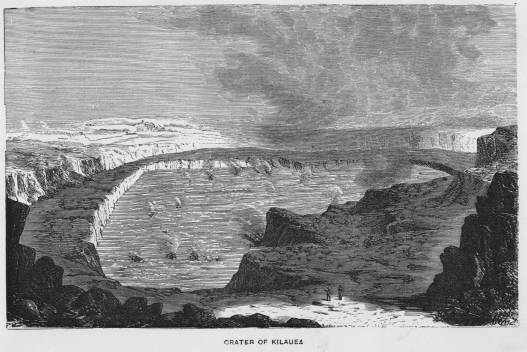
The next morning, leaving our horses, we set out on foot towards the crater. A mass of smoke alone rested on the summit of the mountain. The road was very rough, vegetation in many places destroyed, and in general we found ourselves passing over masses of lava, with deep crevices in some places and huge masses in others, while here and there the crust was so thin that it gave way beneath our feet. The heat was very great; but we found a red berry growing on a low bush, which was very refreshing. At length, after some hours of toil, we found ourselves standing on the summit of a cliff, while below us appeared a vast plain full of conical hills, and in the centre of it a mass of liquid lava like a wide lake of fire. It was what we had come to see—the crater of Kilauea. Below the cliff, inside the basin, was a ledge of considerable width of solid lava. We looked about for a path by which we could reach the plain. At last we found a steep bank where the cliff had given way. By this we now descended with the help of sticks, with which we had been provided. The descent was difficult and dangerous in the extreme, as the lava gave way before us, and huge masses went rolling and tumbling away, some in front and some behind us, as we slid down the steep bank. The appearance of the ground was such that we, with reason, hesitated on trusting ourselves to it. Old Surley, too, smelled at it, and examined it narrowly, as if very doubtful about running over it. Still, our guides assured us that other Englishmen had been there; and where others had been we knew that we could go. At last we reached the bottom, and walked on, with our staffs in hand feeling the way. More than once I felt the ground cracking under my feet. It was not hot, but it struck me—suppose it is only a crust, and one of us were to slip through into the boiling caldron beneath! I own that I more than once wished myself back again on cool and solid ground. To go through the ice is disagreeable enough, but to slip down under this black cake would be horrible indeed. Not five minutes after this idea had crossed my mind, I heard a cry. It was Jerry’s voice. I looked round—his head and shoulders only were appearing above the ground, and his arms stretched out wide on either side, while with his fingers he tried to dig into the lava, to prevent himself from slipping further.
“Oh, help me! help me!” he shrieked out; “I cannot find any rest for my feet, and shall sink into some horrible pit.”
“Stand back—stand back,” shouted Mr Brand, as the rest of us were running forward; “you will all be going in together. Stay, let me see first what I can do. Hold on, Jerry; don’t move, my boy,” he added. Then taking another pole from one of the guides, he laid himself along the ground; he gradually advanced, till he had placed a pole under each of Jerry’s arms. “Now, swing your legs up, and I will draw you away,” he cried out. Jerry did as he was told, and was dragged on to firm ground. The ground had given way just as if it had been a piece of egg-shell. Probably it had been formed by a sheet of lava flowing rapidly over some fissure without filling it up. Jerry was most thankful for his preservation, but he had too much spirit to wish to go back, and insisted on proceeding on to the borders of the liquid fiery lake. Before us, amidst the burning expanse, rose two lofty cones, one of them insulated, the other joined by a causeway to the ledge of lava. Besides these, a number of smaller cones were seen in various directions. The ground was also full of pools of burning sulphur, or other liquid matter, while huge black shapeless masses of lava lay scattered about in every direction, thrown out, undoubtedly, from the mouth of one of the large cones before us. On we pushed our way, notwithstanding, and at last we stood on the very brink of the lake of fire! I could not altogether divest myself of the idea that it might bubble over and destroy us. It was strange that no heat appeared to proceed from it, and yet the points of our sticks were instantly burned to cinders when we put them into it. After we had got accustomed to the strange scene, we agreed that we should like to mount to the top of the cone by the causeway. Off we set. We reached it, and began the hazardous ascent. There was an outer crust, which often gave way under our feet—still we pushed on. Our guides urged us to desist, saying that no one had ever ventured thus far and returned alive. Still they followed us. Up the cone they climbed. It was a strangely wild scene:—the fiery lake below us, around us; the vast masses of lava piled upon the plain; the high black cliffs on every side; the wild, hopeless desolation of the country beyond; and the numerous cones, each the mouth of a miniature volcano, sending forth smoke in every direction. We had nearly reached the summit of the cone, when a thick puff of sulphureous smoke almost drove us back headlong. A loud roar at the same time, louder than a thousand claps of thunder, saluted our ears.
“Fly! fly!” cried our guides; “the mountain is going to vomit forth its fiery breath.” Not a moment did we delay. Down the side of the cone we sprung—none of us looked back. Thicker and thicker came forth the smoke. Rivulets of lava began to flow, streaming down the cone into the lake below; some came towards the causeway, leaping down its sides. On we went, every instant dreading a fall through the thin crust. Ashes came forth and fell around us, and then huge masses of rock came down with loud splashes into the fiery plain. Some went even before us, and were buried deep in the ground over which we had to tread. The roar of the mountain continued. Down we sprung; a blow from a stone would have killed us—a false step would have sent us into the fiery pool, to the instant and utter annihilation of our mortal frames. I felt as if I could not cry out. An unspeakable dread and horror had seized me. At length the plain of lava was regained. No one was hurt; yet the danger was not past. Still the lava streamed forth. It might overflow the banks of the lake, for aught we could tell. Ashes and masses of rock fell in showers around us. We fled like Lot and his family, nor stopped till we reached the cliff. Then it was searched in vain for a way to mount to the summit. We did now look back to see if the lava was following us, but the glowing lake lay as calm as before. The outburst seemed to have subsided. Now and then a jet of lava and fire came forth, and a puff of smoke, but both soon ceased. At last, walking round under the cliff, we found a practicable way to the top. We were saved, and grateful for our escape, while our curiosity was amply satisfied. We were suffering much from thirst, when what was our surprise to come upon a pool of clear water, with reeds growing round it, though in the very neighbourhood of hot basins of sulphur, and of cones spouting forth wreaths of smoke! We expected to find the water hot, instead of which, it was deliciously cool and refreshing. On ascending the cliff, we found that it was too late to descend the mountain that night, so our guides led us to a hut built to afford accommodation for travellers. It stood overlooking the cones and the lake of fire, and never shall I forget the extraordinary appearance of that scene, as we watched it during the greater part of the night, or the magnificent spectacle which gladdened our eyes when the glorious sun rose from out of his ocean bed, and lighted up the distant snow-capped peak of the lofty Mouna Roa, which is 14,000 feet above the level of the sea.
We collected several specimens of sulphur and lava, and also a quantity of what the natives call the hair of Pele. Every bush around was covered with it. It is produced from the lava when first thrown up, and borne along by the air till it is spun into fine filaments several inches in length. It was of a dark olive colour, brittle, and semi-transparent. In our descent of the mountain we entered long galleries, the walls and roof hung with stalactites of lava of various colours, the appearance being very beautiful. They are formed by the lava hardening above, while it continues to flow away underneath—thus leaving a hollow in the centre. We might have spent many days in wandering about that strange, wild region, but we had seen enough to talk about ever afterwards. We got back safe to the station; and when there, we found that Mr Callard had resolved to remain some time on the island. He begged us, consequently, to take back the schooner to Honolulu, with directions for her to return for him in a fortnight. It seemed quite strange to us to be at sea again after the wonderful scenes we had witnessed, and Jerry declared that he was well content to find himself afloat with a whole skin on his body. The wind came round to the north-east, and we had to stretch away to the westward to lay a course for Honolulu. We were about thirty miles off the land when the wind fell light, and gradually a thick fog arose, in which we found ourselves completely shrouded. We still stood on, keeping as good a look-out as we could through the mist, lest we should run foul of any other vessel—not that such an event was likely to happen just then in the Pacific. When night, however, came on, the fog grew still thicker, and the darkness became so great that we literally could not see our hands held out at arm’s-length before us. Mr Brand had kept the middle watch, and then Jerry and I, with Ben Yool, went on deck, with some of the native crew, to take the morning watch. We glided slowly on over the dark waters, the breeze falling gradually, till it was almost a calm. Jerry and I were walking the deck together, talking of the strange sights we had lately seen, when, happening for a moment to be silent, a cry, or it might have been a shriek, struck my ears, as if wafted from a distance across the water.
“Did you hear it, Jerry?” I asked.
“Yes; did you? What can it be?” he answered. “Ah! there’s another—it cannot be fancy.”
“No; I heard it distinctly,” I remarked. “There is some mischief going forward, I fear. What is to be done?” Again that faint, wailing cry of distress reached our ears.
“You don’t believe in ghosts, do you?” said Jerry. “If there were such things, I should fancy that those cries were uttered by them, and nothing else.”
“Nonsense, Jerry,” said I, half vexed with him, for I saw that he was inclined to give way to superstition. “If those sounds are not the effect of fancy, they must proceed from some human beings in distress; but what can be the matter is more than I can say.” We found, on going forward, that Ben Yool had heard the cries, and was still listening, wondering what caused them. They had also reached the ears of the native seamen. They declared that they must be caused by the spirits of the storm roaming over the water, and that we should have a heavy gale before long. Again a shriek reached us, louder and more thrilling than before.
“Oh, this is dreadful!” I exclaimed. “There must be some foul mischief going on somewhere not far off. We must call up Mr Brand, and see what steps he will think fit to take.” I went and roused him up, and told him of the strange sounds we had heard. Both he and the doctor were soon on deck. At first he laughed at our description of the sounds we had heard; but after he had listened a little time, another long, deep-drawn wail came wafted across the ocean.
“That is the cry of some one in mortal fear or agony,” he remarked. “There is another!” It was a sharp, loud cry, or rather shriek.
“The calmness of the sea and the peculiar state of the atmosphere would enable a sound to travel from a long distance,” observed McRitchie. “It may come from a spot a mile, or even two miles off.”
“We must try and find out the direction, and go to the help of the poor people, whoever they are,” exclaimed Mr Brand.
“How is that to be done?” asked the doctor. “Our cockleshell of a boat will only hold three or four people, and the chances are that some ruffianly work is going on, and we shall only share the fate of the victims.”
“It must be done, though,” answered Cousin Silas. “I cannot stay quietly here when perhaps our appearance may prevent further mischief. I will go in the boat, and I daresay I shall have volunteers to accompany me.”
“In that case I will go with you, Brand,” said the doctor, who was as plucky as anybody. “I still say, however, that we should be wiser remaining where we are till daylight.”
“No, no, doctor,” returned Cousin Silas; “you are not a fighting-man. Your life is too valuable to be risked. You stay on board and look after the lads.”
“But we want to go with you, Mr Brand!” exclaimed Jerry and I together; “you won’t leave us behind?”
“I daresay, boys!” answered Cousin Silas. “What account should I have to give to the captain if either of you got knocked on the head and I escaped? You remain on board the schooner. It will be daylight soon; and if I do not return before then, you’ll be able to see where to pick me up.”
“If you resolves to go, why, d’ye see, sir, I goes with you,” said Ben Yool, stepping up. “One of these brown chaps says he’ll go, and that’s all you want. To my mind, if we can frighten the villains from going on with their murderous work, we may do some good; but as to forcing them to hold their hands, we couldn’t do it if we were even to lay the little Dove alongside them.”
Mr Brand thanked Ben for his promptness in offering to support him, and accepted his services; and arming themselves, they both, without further delay, accompanied by a tall, strong Sandwich islander, lowered the schooner’s dinghy into the water.
“What I’d advise, sir, is this,” said Ben: “Let us get as close up to where the cries come from as we can without being seen, and then let us hail the vessel, or raft, or whatever it may be, in gruff voices, and say that if they don’t knock off their murdering work, and let the people they are harming go free, we will blow them all up into the sky. If they don’t heed us, we’ll shriek and cry, and make all sorts of noises, as if a thousand demons were about to board them; and, as people who are about any bad work are certain to have bad consciences, they’ll fancy that the noises are ten times louder and worse than they are. If that does not succeed, we must try some other dodge; we shall hit off something or other, I daresay.”
While Ben was thus delivering himself, Mr Brand was loading his pistols. All things being ready, they stepped into the boat and shoved off. They were immediately lost to sight in the thick darkness which surrounded us. Their oars had been muffled; but we could hear the gentle lap of the oars in the water for long afterwards, showing to what a distance sound could travel, and that the scene of the outrage we had been listening to might be further off than we supposed. As Mr Brand had taken the bearings of the Dove, and proposed pulling directly to the south-west, whence the sounds came, and directly in the eye of the wind, such as there was, which had shifted to that quarter, we knew that he would have no great difficulty in getting aboard us again. Still we could not help feeling very anxious about him. The plan, however, proposed by Ben Yool struck us as likely to prove as effectual as any that could be conceived;—much more so than had the little Dove herself appeared; for, as she did not measure more than twenty tons, she was not calculated by her size to command respect, especially as she had no guns on board, and we had only our rifles. Scarcely had the boat left the side of the schooner when the shrieks were repeated. They seemed louder, or at all events more distinct. We could no longer have any doubt that they were uttered by human beings in distress. Old Surley thought so too. He kept running about the deck in a state of great agitation, and then stretched out his neck, and howled in reply to the cry which reached his ears. We kept slowly gliding on under all sail, keeping as close to the wind as we could, so as to beat up in the direction of the sound. It had been arranged that we were to go about every quarter of an hour, so that Mr Brand would know our whereabouts and on what tack he was likely to find us on his return. Our ears were kept open to catch any fresh sound, and our eyes were looking about us in all directions, in case a break in the mist should reveal any object to us; but an hour passed away, and no other cry was heard. There was a little more wind, and it had shifted a point or so to the westward, and perhaps that prevented sounds reaching us, we thought. Another hour crept by, but still Mr Brand did not return. We began to be anxious about him. We constantly went to the binnacle lamp to look at our watches. It wanted but a short time to daylight. The doctor, I saw by his manner, was seriously alarmed about the party, though he said nothing to us. We fancied that we heard a hail, and then a shout and a cry; but we could not quite agree about it. We kept pacing the deck anxiously, tacking as we had been directed by Mr Brand; and thus the night wore on, and dawn once more broke over the world of waters.
Chapter Fourteen.
Captured by pirates.
Daylight increased; and as the sun, like a vast ball of fire, rose slowly above the horizon, the mist lifted as if it had been a curtain from off the surface of the water, rolling away in huge wreaths of vapour before the breeze. The wind had once more hauled round to the southward, and then away to the westward, when, beneath an arch of clouds, we saw two vessels alongside each other. One was a schooner, a fine, rakish-looking craft; the other a large brig. The latter had her royals and top-gallant-sails flying loose, her topsails were on the caps, her courses were hauled up, her yards were braced here and there; indeed, she presented a picture of most complete confusion. Her appearance would too plainly have told us that something wrong had taken place, even had we not heard the cries in the night. In vain we looked round on every side for the dinghy; she was nowhere to be seen. We examined the vessels through a spy-glass we had with us. She was not visible alongside either of them. Again and again we swept the horizon, but not a speck could we discover that might be her. “What is to be done?” exclaimed Jerry in a tone of deep grief. I too felt very sorry for fear harm had happened to Cousin Silas; nor did I forget Ben and the Sandwich islander. “Hallo! hallo! Look there! what is happening now?” Jerry added. We looked. The schooner had parted a little distance from the brig, and the latter vessel, after rolling once or twice to starboard and port, seemed to dip her bows into the sea. We gazed earnestly with a sickening feeling. Her bowsprit did not rise again. Down, down she went, slowly and calmly, as if making a voluntary plunge to the depths of the ocean. The water closed over her decks, her lower masts disappeared, her topmasts followed, and the loose sails for a moment floated above the spot where she had been, and then sank also, drawn down by the halliards beneath the waters.
We felt almost stupified with horror. Combining the shrieks we had heard and the occurrence we had just witnessed, we could have no doubt that the schooner we saw before us was a pirate, and that her crew had, after murdering those on board the brig, sunk her, to destroy, as they might hope, all traces of their guilt. They had had in us, however, witnesses of the atrocity they had committed, when they thought no human being could be cognisant of the fact. What, however, had become of Mr Brand, and Ben, and the native? Had they been on board, we should probably have acted wisely in endeavouring to get away from the pirates, as they would undoubtedly, if they could catch us, and thought that we suspected what had occurred, treat us much in the same way that they had treated the crew of the brig. Still, how could we think for a moment of running away and deserting our friends—such a man, too, as Cousin Silas, who, we felt sure, would never have deserted us while the slightest hope remained of our being alive?
For some time after the brig had sunk, the schooner appeared to take no notice whatever of us, while we continued to draw nearer and nearer to her. We had an Englishman, Mr Stone, who acted as master of the Dove, and two other natives. Stone was a simple-minded, honest man. His principle was, if he received an order from a superior, to obey it. Therefore, as Mr Brand had directed him to continue beating up to windward till he returned on board, it never occurred to him to propose running away from our suspiciously dangerous neighbour. The natives held their tongues, but did not look happy. Mr McRitchie was the most agitated. He kept walking our little deck with hurried steps. We were drawing nearer and nearer to the big schooner. Suddenly he stopped and looked at us, the tears starting into his eyes. “My dear lads,” said he, “it is very, very sad to think of, but there can be no doubt, I greatly fear, that our friend and his followers have been murdered by yonder piratical villains. If they are still alive, (and what chance is there of it?) they will certainly not be allowed to return to us. We are, therefore, only sacrificing our own lives by allowing ourselves to fall into the power of the villains. While there is time, let us escape. Captain Stone, don’t you agree with me?”
“Well, sir, I cannot but say I do,” answered the captain. “If you order me, as I consider that the craft is under your charge, we’ll keep away at once, and make all sail to the northward. I feel that we ought to have done it as soon as we made out what that craft there was.”
The doctor hesitated still—a violent struggle was going on in his mind. He passed his hand across his brow. “Yes, it must be done. Keep her away, and make all sail,” he exclaimed.
Scarcely was the helm put up, and a large square-sail of light canvas the little schooner carried hoisted, when the stranger seemed to observe our presence. We had not run on for ten minutes when her head came slowly round towards us, her square-topsails were hoisted up, her foresail was rigged out, a square-sail was set, and after us she came like a greyhound in chase of a hare.
“What chance have we, do you think, of getting away from her, Mr Stone?” said Jerry, pointing to the big schooner, which was coming up hand over hand after us.
Stone, who was at the helm, looked over his shoulder at the stranger. “Why, none whatever, Mr Frankland,” he answered, after a minute’s deliberation.
“Then I do not see much use in running away,” observed Jerry. “If we are to be killed, let us be killed at once, and have it over.”
“No, sir; as Mr Callard says, it’s our duty to strive as long as we can. Our lives are in the hand of God. He may find means to enable us to escape, though we do not in our blindness see them. Perhaps it may fall a dead calm, and we may make use of our sweeps; or a squall may spring up and carry away the stranger’s masts; or another vessel may heave in sight, and she may think it wise to slip out of the way.”
“I see that you are right, Mr Stone,” answered Jerry. “But I wonder, if they do catch us, what they will do to us all?”
“Cut the throats of every mother’s son of us,” he answered, quite calmly. “I’ve often thought of death, and I am prepared to die, for I trust in One who is mighty to save my soul alive. Have you the same hope, young gentleman? I trust you have. It’s my duty as a fellow man to urge you to lay hold of it. There’s nothing else will save us, depend on that. From what I heard your officer, Mr Brand, say, I know on what he trusted, and I hope he has not failed to speak to you about the same matter.”
“Ay, he spoke to us in a way we ought never to have forgotten, once when we were drifting out to sea on the bottom of a boat, and we had little chance of being saved; and then he swam off, at the still greater risk of his own life, to save ours,” answered Jerry.
“I knew that he was just the man to do that sort of thing. He was a Christian man, too, I am certain of it. Well, it’s a great comfort to feel that of a man who you believe has just been taken out of the world,” observed the master. “I hope your man, Yool, was a trusting believer. I know our man was, poor fellow.”
Mr McRitchie had been listening, and seemed much affected at what had been said. The master spoke so confidently of Mr Brand’s death, and of the others, that we began ourselves to realise the melancholy fact. What, however, was likely to be our own fate? we had several times asked ourselves. What could we expect but to be instantly murdered? We anxiously scanned the horizon on every side. There was not a sign of a sail of any description. The wind remained steady. There was no prospect of a storm or a calm. The stranger was coming up after us with fearful speed. We were within range of her guns, but she did not fire—so we concluded that she had none on board. It was useless for us to attempt to do anything by fighting. Jerry and I talked about it, but we gave it up as a hopeless case. The stranger could quickly have settled the matter by running us down.
Mr Stone showed us that he did not boast in vain. He was calm and unmoved in spite of the dreadful danger which threatened us. Still holding the tiller in his hand, and keeping his eye on the sails, he knelt down and offered up an earnest prayer for our safety. We followed his example, as did the natives; and when we arose from our knees, I, for my part, felt that I was much better prepared than before to meet with resignation whatever might befall us; so, I have no doubt, did my companions.
The stranger had now got within musket-range, but still she did not fire. Those on board, of course, expected that in a few minutes more they would be up with us, and perhaps did not think us worth their powder.
“What chance have we now, Mr Stone?” asked the doctor, eyeing our big pursuer with a look of horror.
“None, sir, that I see,” was the answer; “but then, as I said, there may be means prepared which I don’t see, so we’ll hold on, if you please.”
After a minute or two the patience of the pirates appeared to have been exhausted. There was a report, and a musket-ball came whistling through our sails. Jerry and I bobbed our heads, for it felt so terribly near our ears. Jerry looked up indignantly. “I have a great mind to have a crack at them in return,” he exclaimed; and before any one saw what he was about, he had seized his rifle from the cabin, and sent a shot back at them in return.
“Oh, sir, there was no use doing that; you will only the more anger those wicked men,” said Captain Stone, quite calmly.
“No, no; let’s die game,” answered Jerry. “We may kill some of our enemies before they kill us.”
“We may kill some of our friends as likely,” replied the captain. “If we could prevent them injuring us, we might kill them; but as we cannot, we must patiently wait the result.”
The doctor seemed to agree with the captain, so Jerry refrained from again loading his rifle. The effect, however, of his single shot was most disastrous, for the pirates, supposing that we were about to show fight, brought several muskets forward, and opened a hot fire on us. As the bullets came rattling about our ears, I thought not one of us would escape. The two poor Sandwich islanders were brought to the deck, one directly after the other, desperately wounded. The matter was becoming very serious. I thought that we ought to lower our sails; so did the doctor, but Captain Stone begged us to keep all standing. “We can’t tell still, sir, but what we may escape. Hold on, hold on,” he cried out. “There is One who watches over us. If it is his will that we are to be destroyed, his will be done.” Scarcely had he uttered these words of true piety than he suddenly lifted up his arm, letting go the tiller, and fell to the deck. Jerry ran to the helm. I tried to lift him up, while the doctor knelt down by his side. “Hold on, hold on, I counsel you,” he whispered, raising his head. “They have done for me. Doctor, you cannot help me, I feel. It’s all right; we were doing our duty. We know in whom we trust. He is mighty to save our souls alive.” With these words he fell back, giving one look at our pursuer, and urging us by a sign to hold on our course. The doctor took his hand. After holding it for a minute, he shook his head. “He’s gone,” he remarked; “as brave a man as I ever met, and as true a Christian.”
Jerry meantime stood undauntedly at the helm. No sooner, however, had the captain fallen than the pirates, seeing what had occurred, ceased firing. They had now got so near, that, had they chosen, they might have picked every one of us off without difficulty. At last they came up almost abreast of us.
“Heave to, you young jackanapes, or we will sink you,” sung out a man from forward. The doctor was attending to one of the wounded natives, so they did not observe him, perhaps. Although the command was issued in a very uncomplimentary style, Jerry and I agreed that it would be useless to disobey it; so going about, while he stood at the helm, I ran forward and let fly the jib-sheet, while the foresail remained to windward.
“Send your boat aboard us,” shouted the same voice.
“We haven’t got one,” answered Jerry. “You know that well enough, I should think,” he added in a lower voice.
“Oh, we’ll send one, then,” replied the speaker.
During this time the big schooner was hove-to quite close to us. Presently some of the crew went aft, and a long gig was lowered from the schooner’s quarter, and a set of as ugly-looking ruffians as I ever cast eyes on got into her, and pulled towards us. From the specimen we had witnessed of their conduct, we could only expect to be cut down and thrown overboard as soon as they stepped on deck. The least unattractive was a man, apparently an officer, who sat in the stern-sheets. As he got near I could not help examining his countenance. He was a mulatto, with handsome, regular features. I felt certain that I had seen him before, and not long ago. He had on his head a large broad-brimmed straw hat, a gaily-coloured handkerchief, and a waistcoat of red silk, while his jacket was of the finest material. He wore a sash round his waist, and a dagger and a brace of silver-mounted pistols stuck into it. When he came alongside, he sprang lightly on to the deck of the schooner, and looked about him.
“Now, my lads, be prepared; show no fear,” said the doctor. “Remember that the worst they can do is to kill us, and they’ll gain nothing by that; so perhaps they will let us live.”
As we made not the slightest attempt at resistance, which would have been madness, even the pirates had no excuse for injuring us. All we did was to stand quietly at the after-part of the deck waiting what was next going to happen.
One of the other pirates soon proceeded without ceremony into the cabin, and the rest went forward down the fore-hatch.
The officer looked at me, and I looked at him. Old Surley, who at first had been very much inclined to fly at the strangers, growling fiercely, went up to him and quietly licked his hand. In spite of his clean-shaven face, his gay clothes, and well filled-out cheeks, I immediately recognised him as Manuel Silva, as he called himself—the man whom we had with so much risk saved from the wreck of the Spanish brig. “Yes, I remember you,” he whispered in his broken English; “but don’t let others know that. I’m not a man to forget kindness, that’s all.”
“Do you know anything of Mr Brand and the other men?” I asked eagerly. He made no reply; and immediately afterwards, assuming an air of authority, he ordered the doctor, Jerry, and me, to get into the boat.
The doctor entreated that he might be left to attend the two wounded Sandwich islanders. The men, when they came on deck, laughed at his request. “We have got wounded too, and shall want you to attend on them,” they answered; “if you are a doctor, you are welcome.” Still the doctor pleaded so hard for the poor men that at last they consented to take one of them; the other, indeed, was already beyond all hopes of recovery. We turned a last look at the body of poor Captain Stone.
“What is to be done with him?” asked Jerry.
“Never mind him, youngster,” answered one of the men; “we’ll soon dispose of him.”
Silva, leaving three men on board, ordered us to get into his boat to return with him to the big schooner. As we were shoving off, old Surley, who had been smelling about after the other men, gave a loud bark, as much as to say, “Don’t leave me behind,” and leaped in after us. Truly glad were we to have him, poor fellow. He might prove to us a friend in need.
We stepped on deck; the crew, we thought, eyed us with very sinister looks, but no one spoke to us till a man we took to be the captain stepped up to the gangway. “Who are you, and where do you come from, who go about prying into other people’s affairs?” he exclaimed in a gruff voice. He stamped with his feet as lift spoke, as if lashing himself up into a rage. He was a pale, long-faced man, with a large beard, and a very evil expression in his eye.
“We have no wish to pry into anybody’s affairs,” answered the doctor quietly. “We missed a boat with some of the people belonging to this schooner, and we thought they might be aboard your vessel.”
“I know nothing of the people you talk of; but as you have seen more than you ought, I suspect you’ll remain with us. We happen to want just such a schooner as yours, so say no more about it. You may think yourselves fortunate in not losing your lives. There’s no disguise about us, you see.”
Had we before felt any doubts on the subject, these remarks would have revealed to us too clearly the character of the people among whom we had fallen. I was thankful, indeed, that we were not immediately murdered. Why the desperadoes allowed us to live was a mystery. The doctor, they thought, would be useful to them; and perhaps, as Jerry remarked, they did not think us worth killing. The doctor, he, and I, stood together near the gangway, with Surley at our feet, waiting what was next to happen. Meantime the poor wounded Sandwich islander had been handed up, and placed on the deck forward.
The vessel on board which we found ourselves was a large, handsome craft, of fully a hundred and eighty tons; and, from her great beam, her taunt, raking masts, the broad white ribbon outside, and the peculiar paint and fittings on her deck, she was evidently American. There were a good many white men among her crew; but there were also many blacks and mulattoes, of every shade of brown and hue of olive or copper. Never had I seen people of so many nations and tribes brought together, while every one of them to my eyes appeared most villainous cut-throats.
We saw the boat go back to the Dove and deposit a couple of more hands aboard her, and then both vessels hauled their wind and stood away to the south-west. Just then some of the crew hailed the doctor:—“Here; your patient seems to be about to slip his cable. You’d better come and see what’s the matter.” We accompanied the doctor, and knelt down by the side of the wounded man, who was evidently dying. He took the doctor’s hand. “You kind to us, but you no help me now,” he whispered, with his failing breath. “If you once more see Mr Callard—my love to him—I die happy. I trust in Him he taught me to cling to. Once I was poor savage. He made me rich.” These were the poor Kanaka’s last words. A few years ago, and how differently would one of his countrymen have died! The doctor closed the eyes and arranged the limbs of the dead man, and threw a handkerchief which he took from his neck over his face. “There,” he said, “he’ll not give you any more trouble.” The men said not a word, but walked about as composedly as if nothing had happened, while we went back to our place near the gangway. Shortly afterwards, a man, who seemed to be an officer, went forward. “Heave that corpse overboard,” he exclaimed; “why do you let it remain there cumbering the deck?” The men looked at each other, and then, lifting up the body of the poor Kanaka, threw it, without form or ceremony, into the water. We looked astern. There it floated, with the arms spread out, and the face turned towards us, for the handkerchief had fallen off the head. Its lips seemed to move. I thought it was uttering a well-merited curse on the hateful craft we were on board. It seemed to be about to spring out of the water. I could not help crying out. I shrieked, I believe. Many of the pirates looked with horror. “Is he following us?” I cried. No. Down sunk the body from sight, as if dragged by some force from below. “Ah, a shark has got him!” said Silva, who had been looking on with the rest. Many of the ruffians shuddered, for they knew full well that such might any day be their own fate.
While this scene was enacting, a similar one was taking place on board the Dove. Her captors, having time to look about them, had taken up the bodies of poor Captain Stone and the other Kanaka, and, without shroud or a shot to their feet, had hove them overboard. They also were immediately attacked by the sharks. Jerry and I shuddered, as well we might. The doctor looked on with more composure. “It matters little whether sharks or animalculae first devour a body,” he observed. “One or other will inevitably swallow it before long, only the sharks make greater speed with the process. Happily there is an essence which neither one nor the other can destroy, which survives triumphant over death; so, lads, when you mourn the loss of a friend, think of him as living in that essence, not in the mortal frame you see torn to pieces or mouldering in decay.” A new light seemed to burst on me as the doctor said this. The idea aided me to get over the horror I had felt at seeing the fate of the missionary captain, and enabled me better to bear the first remark which the pirate leader deigned to make us: “Well, youngsters, if you don’t behave yourselves, you’ll come to that very quickly, let me tell you.”
“We have no wish to do otherwise than behave ourselves, sir,” answered Jerry in his politest way. “Perhaps you will tell us what you wish to have done?”
“To hold your tongue and be hanged,” answered the ruffian, turning aside; for Jerry’s coolness puzzled and enraged him.
The doctor was now summoned down below to look after some sick men, the mate, who called him, said; but, as Jerry whispered, he suspected they were sick from having swallowed more bullets than they liked. We two, in the meantime, sat ourselves down on a gun, with Surley at our feet. He put his nose between us, and looked anxiously up into our faces, as if to learn what it all meant. We were there allowed to remain unmolested, while the pirates went past us attending to the duty of the ship. On seeing the guns, we wondered that the schooner had not fired at us; but we concluded that they had coveted the Dove for their own objects, and had not wished to injure her. It was evidently from no compassion to us that they had not knocked her to pieces. No one interrupting us, Jerry and I began quietly to talk to each other.
“What can have become of Mr Brand, and Ben Yool, and the Kanaka?” said I. “Is it possible that they are aboard here all this time, do you think?”
“I am afraid not,” answered Jerry, shaking his head sorrowfully. “I think it’s much more likely that a shot was hove into the dinghy if they went alongside, and that they were sent to the bottom. My only hope is, that they missed their way and never came near this craft. If so, they may have been picked up by some vessel, or may find their way back to Owhyhee.”
“That last idea never occurred to me before. Oh, I hope it may be so! I wonder what the doctor thinks?” said I.
The doctor was absent for a long time. When he came back to us, he said that he could not give an opinion on the subject. He was very silent, and we thought that he looked more sad and thoughtful even than at first.
The day wore on. A black cook brought us some soup and a bowl of farinha, which, as we were very hungry, we were glad enough to eat; and at night, Silva told us that we three might occupy the small deck cabin which was vacant. We were glad enough to creep in there, and to forget our sorrows in sleep. For some time we slept as soundly as people who have undergone a great deal of mental excitement generally sleep, though the realities of the past mixed strangely with the visions of the night. The most prominent was the picture of the sinking ship which we had seen go down; but in addition I beheld the agonised countenances of the murdered crew—some imploring mercy, others battling for life, and others yielding hopelessly to their fate. Among them, to my greater horror, I thought I saw Mr Brand and Ben Yool. They were bravely struggling in the hands of the ruffians, as I am sure they would have done. Now one was up, now the other. The pirates tried to force them overboard, but they always again clambered up the side of the vessel. Their boat was sunk beneath them; still they fought on, clutching hold of ropes and the chain-plates—never for a moment losing heart. “That is the way to fight the battle of life against all enemies, spiritual and carnal,” said a voice. It was Cousin Silas who spoke. Then the pirates made another desperate attack on him and Ben, and they were forced back into the deep ocean.
I awoke with a loud cry. “What’s the matter? where are we?” asked Jerry, stretching out his arms. “O Harry, what dreadful dreams I have had! What is going to happen? Now I know. Oh dear! Oh dear! My poor father, how miserable he will be when he fancies I am lost!” When we told each other our dreams, we found that they had been very much of the same nature.
Our talking awoke the doctor. He was, I daresay, not less unhappy than we were, but he told us not to give way to unmanly fears, and scolded us for talking about our dreams. “It is a foolish and bad practice silly people are apt to indulge in. It makes them nervous, promotes superstition, and, worse than all, frequently causes them to doubt God’s superintending care and watchfulness. Your dreams have just been made up of what has occurred, and of what your imagination has conjured up. Just set to work and think and talk of how we may escape from our present position, and perhaps you may think and talk to good effect.” As soon as we got up, we took our place as we had done the previous day, as much out of the way of the rest of the people as possible.
We took the doctor’s advice, and did little else for some time than talk of how we might escape. The most feasible plan which occurred to us was to watch for an opportunity of deserting the ship whenever she might touch at any place for water. We agreed that it would be well to try and lull the suspicions of our captors, by pretending to be perfectly contented with our lot, and by making ourselves as much at home as possible.
“We’ll not seem to care about going on shore ourselves,” observed Jerry; “but after a time we’ll talk about old Surley not being accustomed to remain on board so long, and we’ll ask leave to take him a run on the beach; then he’ll run on, and we will run after him, till we get out of sight of the vessel, and then won’t we put our best legs foremost—that’s all. Surley will like the fun, and we will whistle him on; and if any of the pirates meet us, we can say we are running after him; and so we shall be, you know. We can hide away in some tree, or in a cavern, or somewhere or other till the ship sails, and then we must trust to what may turn up to get away from the place, wherever it may be.”
“The chances are that it may be a desert island, and one rarely or never visited by ships. If so, perhaps we may have to live on it for years without being able to escape from it,” I observed.
“Well, no matter if that is the case,” he answered; “anything is better than living among these cut-throats.”
“I agree with you,” said I; “but what is to become of the doctor? We must not leave him behind.”
“Certainly not,” said Jerry; “we will tell him what we propose, and I daresay he will find means to follow us. If he cannot, perhaps he will propose some plan which will be better than ours.”
We talked till we talked ourselves very hungry, and were not sorry when the black cook brought us a bowl of farinha for our breakfast. We should not have objected to a slice of cold beef or a piece of fish, but we agreed that it would be wiser to take what was offered to us, and appear thankful. The doctor was asked in to breakfast with the captain. He certainly would rather not have gone, but as nothing could be gained by refusing, and something might by accepting the invitation, he went. Tom Congo, the cook, did not forget old Surley, but, when the officers were below at breakfast, brought him a mess, which he gobbled up with no little satisfaction.
Silva appeared to take no notice of us; yet we could not but believe that it was owing to his intercession our lives had been spared, and that we were not ill-treated. It will be remembered that, after the story we heard of the escape of the convicts from Juan Fernandez, serious suspicions had been entertained of his character. We had now, from finding him associated with pirates, every reason to believe that our suspicions were correct. Still, pirate as he was, all the right feelings of our nature had not been blunted in him. While on board the Triton he had always behaved well, and he now showed us that he was grateful for the kindness he had received. Such was the opinion Jerry and I formed of him.
For three or four days things went on much in the same way as at first. We had our food brought us regularly by our friend the black cook, and were allowed to walk the deck as long as we liked, and to creep into our cabin at night. Nobody interfered with us. The people who acted as officers passed us by without notice, and the seamen did not take the trouble to exchange a word with us. At last Jerry and I agreed that it was time to try and make ourselves more at home, or we should not be able to carry into execution the plan we had proposed. Surley, too, seemed to think it very dull work sitting all day long with his nose resting on our knees. How to set about ingratiating ourselves with the fellows, was the difficulty. We generally talked over our plans when the doctor was away, as he was for a considerable time every day attending to the sick. We determined first to try and win over old Tom Congo, the black cook, as he seemed disposed to be friendly with us.
“I say, cook,” exclaimed Jerry, “you give us very good food to eat, but couldn’t you add a bit of meat now and then? Surley gets some, and we, who have been accustomed all our lives to it, would like to have it now.”
“Oh, oh, you hab some of Surley’s den,” answered Tom Congo, with a grin.
“You are too kind to wish to make us eat scraps and bits,” said Jerry; “we should just like a piece of beef or pork.”
Congo looked pleased; and though he would not promise to bring us any meat, we saw that he would. Now, we did not care so much about the meat, but we thought that, by asking him a favour which he could easily grant, we might gain his interest. It was a compliment to him, and made him feel as if he were our superior, for the time being at all events. The next day, at dinner time, he brought us a very nice piece of boiled beef and some potatoes. We consulted what we could give him in return. Our knives were too valuable to part with, but Jerry had a silver pencil-case, which he offered to him. Old Tom asked what it was for, and when told to write with, he grinned from ear to ear, observing that, as he could not write even his own name, it would be of no manner of use to him; but that he thanked us all the same.
The feeling that there were two people on board who were disposed to be friendly with us raised our spirits. We got up and began to chase Surley about the deck, making him run after a ball of spun-yarn till we got tired of the game. Then we walked up and down the deck till we got right aft, where we could catch a glance at the compass. We were steering about south-west and by south.
“Where are we going to, my friend?” said Jerry, addressing the man at the helm.
“Ask the captain; he’s likely to tell you, youngster.”
“Oh, no matter,” answered Jerry, carelessly, “I only asked for curiosity. If it’s to China, or round Cape Horn, or to California, it’s all the same to me.”
“You’re an independent little chap, at all events,” answered the man; “if you were one of us, you’d do well, I doubt not.”
“Oh, I’ve no objection to do well,” said Jerry; “just show me the way, and I’m your man.”
“I like your spirit, and I’ll say a word in your favour with the crew. I daresay you know something about navigation, which is more than most of the officers do; so, if you join us, it won’t be long before you are made an officer.”
“Thank you for your good opinion of me,” said Jerry; “but I’m not ambitious. I just want to do what I like, and if nobody interferes with me, I’m content.”
“You’re a merry little chap, at all events,” observed the pirate. “I like to see a fellow with some spirit in him, and I’ll keep you out of harm if I can.”
“Thank you,” said Jerry, making a dash after Surley’s tail; “I thought you looked as if you were a kind chap, and that made me speak to you.”
Thus by degrees we made ourselves at home among the crew. Before the evening we were chasing each other about the rigging. The men forward had a monkey, and we got hold of him, and made him ride upon Surley’s back. Neither animal liked it at first, but by coaxing them we managed to reconcile them to each other. Jacko would every now and then take it into his head to give old Surley a sly pinch on the ear or tail, and then the dog would turn round and endeavour to bite the monkey’s leg; but the latter was always too quick for him, and would either jump off, or leap up on his back as if he were going to dance there, or would catch hold of a rope overhead and swing himself up out of his way. It really was great fun, and often we almost forgot where we were and our sad fate. It made the pirates also think us light-hearted, merry fellows, and they gave themselves no further concern about watching us. Now, of course, it sounds very romantic and interesting to be on board a pirate vessel, among desperate cut-throats, to be going one does not know where; but the reality is very painful and trying, and, in spite of all we did in the day to keep up our spirits, Jerry and I often lay awake half the night, almost crying, and wondering what would become of us. It was not till we remembered what we had heard at home, and what Captain Frankland and Mr Brand had told us often—that in all difficulties and troubles we should put our trust in God—that we found any comfort. How much we now wished for a Bible, that we might read it to each other! We now saw more clearly than we had ever before done its inestimable value. There were several on board the Dove, but we were not likely to be able to get them.
The poor doctor was more to be pitied than we were. He grew thinner and thinner every day. Evidently he felt his captivity very much. His prospect of escaping was much smaller than ours, because he was of far greater use to the pirates than we were. We might have been of some service to them as navigators, but without our books and instruments we could do very little for them even in that respect.
Several more days went by in this way. The pirates now began to grow fidgety, and they were constantly going to the mast-head, and spent the day in looking out on every side round the horizon, in search of land or a vessel, we could not tell which. At last, one forenoon, one of the look-outs shouted from aloft, “A sail! a sail!”
“Where away?” asked the captain, who till that moment seemed to have been half asleep on deck. He sprang to his feet, and he, with every one on board, in an instant was full of life and animation.
“On the lee bow,” answered the man. “She is a large ship, standing to the southward.” The wind was from the westward.
Several of the officers and men hurried aloft to have a look at the stranger. When they came down they seemed highly satisfied.
“She’s a merchantman from California,” observed one. “She’ll have plenty of gold dust on board.”
“She’s the craft to suit us, then,” observed a second.
“She’s a heavy vessel, and the fellows aboard will fight for their gold,” remarked a third.
“Who cares? a little fighting will make the prize of more value,” cried another. “We’ll show them what they’ll get by resistance.”
The word was now passed along to clear the decks for action, and, with the men at their guns, we bore down on the stranger.
Chapter Fifteen.
Voyage in the pirate vessel.
The stranger saw our approach, and from the eager way in which we carried on sail, those on board must have had some suspicion of the character of the schooner. She was a fine large ship, and was evidently a fast craft, but still the schooner managed to overhaul her. As we had hitherto stood on under easy sail, the Dove was able to keep up with us, but now we left her far astern. Before we parted company, however, the captain signalised her where to meet him. I forgot to say that for some time we did not know the name of the pirate chief, but at last we heard him called Captain Bruno. Though this name had a foreign sound, he was, as I have before said, either an Englishman or an American. The schooner was called the Hawk, and she was not ill named.
As we drew near the ship we ran up English colours, while in return, up went at her peak the stars and stripes of the United States. On we stood. The ship, so Jerry and I concluded, did not suspect the character of the schooner, for she made no attempt to escape us, but appeared as if those on board expected a friendly greeting. I observed Captain Bruno very frequently turn his telescope towards the stranger, and examine her narrowly. The officers, too, began to talk to each other, and look suspiciously at her. I asked Mr McRitchie, who was near us, whether he thought the pirates would attack the ship and murder the crew, as we believed they had done that of the brig.
“I dread something terrible, but I have very little apprehension for the fate of the people on board the ship,” he answered, in a low tone. “In my opinion, the pirates will find that they have caught a tartar. Mark me—yonder craft is no merchantman, but a ship of war, either American or English, or perhaps Chilian. I should not be surprised to find that she is on the watch for our friends here. Scarcely do I know what to wish. If they fight at all, they will fight desperately, and we shall run as great a chance of being killed as they will—though, if they are captured, we may regain our liberty. If, on the other hand, they escape, our captivity will be prolonged.”
“But if yonder ship prove to be what you suppose, and the schooner is captured, perhaps we may be hung as pirates,” said Jerry. “How can we prove that we are honest people?”
“There will be but little difficulty about that,” answered Mr McRitchie. “The pirates themselves will acknowledge that we have been brought on board against our will, and the account we can give of ourselves is too circumstantial not to gain credit. At all events, we must hope for the best. But see, Captain Bruno at last suspects that something is wrong.”
We had by this time got almost within the ordinary range of a ship’s guns. Suddenly the captain sprang to the helm. “Haul aft the main and foresheets!” he sung out in a voice of thunder. “Brace up the yards! Down with the helm! Keep her as close as she’ll go!” The crew flew to obey these orders. They knew full well that their lives depended on their promptness. Already the schooner had approached too near the stranger. That she was a man-of-war, she no longer left us in doubt. Before the orders issued by Captain Bruno were executed, a line of ports were thrown open, and eight long guns were run out, threatening to send us to the bottom if we showed a disposition to quarrel, and aft at her peak flew the stars and stripes of the United States.
The pirates saw that they were caught through their own folly and greediness, but the captain showed himself to be a man of undaunted courage, and full of resources. “Hold on!” he sung out, before a sheet was hauled in. “We may lose our sticks if we attempt to run. I’ll try if I cannot deceive these clever fellows, and put them on a wrong scent.” The pirates seemed mightily pleased at the thought of playing their enemy a trick, and highly applauded the proposal of their captain. The schooner, therefore, stood steadily on, till she ran close down to the corvette. Then she hove-to, well to windward of the ship, however. A boat was lowered, and Captain Bruno, with four of the most quiet-looking of the crew, got into her, and pulled away for the ship. When we hove-to, the corvette did the same, an eighth of a mile to leeward of us. We watched the proceedings of the pirate with no little anxiety.
“If that fellow succeed in deceiving the captain of that ship, I shall acknowledge that impudence will sometimes carry the day,” observed Mr McRitchie.
“Couldn’t we contrive to make a signal to let the people of the man-of-war know that we are kept here in durance vile?” observed Jerry.
While he was speaking, I looked round, and saw two of the most ruffianly of the crew standing close to us, with pistols cocked in their hands, held quietly down by their sides. I hoped that our captors had not overheard what Jerry had said. I touched him as if by chance on the shoulder, and after his eye had glanced at the pistols he said nothing more about making signals to the corvette. Our position was every instant growing more and more critical. If the pirate captain was seized on board the man-of-war, it was impossible to say how his followers might wreak their vengeance on our heads. We watched him with no little interest, till he ascended with perfect coolness the side of the ship. Our anxiety still further increased, after he reached the deck and disappeared below. Minute after minute slowly passed by, still he did not return. The pirates with their pistols got up closer to us, and one, a most hideous black fellow, kept looking at us and then at his weapon, and grinning from ear to ear, as if he was mightily eager to put it to our heads and pull the trigger. We tried to look as unconcerned as possible, but I must own that I could not help every now and then turning round, to ascertain in what direction the muzzle of the pistol was pointed. The black and his companion looked so malicious, that I feared, whatever occurred, we should be the sufferers. If Captain Bruno escaped, we should still remain in captivity; or should he be suspected and detained, probably the pirates would revenge themselves on us. I was afraid of speaking, and almost of moving, lest, even should I lift an arm, it might be construed into the act of making a signal, and I might get a bullet sent through my head. The American corvette, with her spread of white canvas, looked very elegant and graceful as she lay hove-to, a short distance from us. I wished very much that I was out of the pirate, and safe on board her, even though the former might get free away without the punishment she deserved. But all such hopes, it appeared, were likely to prove vain. After the lapse of another ten minutes Captain Bruno himself appeared on deck. As he stood at the gangway, he shook hands cordially with some of the officers. He seemed to be exchanging some good joke with them, for he and they laughed heartily when he went down the side, and stepped into the boat. As he pulled back to the schooner, he waved his hand, and took off his hat with the most becoming courtesy. “Well,” thought I to myself, “certainly impudence will sometimes carry the day.”
He was soon again on board. “Make sail,” he said with a calm smile; “the corvette and we are going in search of a rascally pirate, which has committed all sorts of atrocities. I wonder whether we shall find her.” The joke seemed to tickle the fancies of all on deck, for a quiet chuckle was heard on every side. “Keep the rest of the people below,” he said to Silva; “it might surprise the crew of the man-of-war to see so many ugly fellows on board a quiet trader.” The order was strictly obeyed. A few only of the crew appeared on deck, and they were soon seen employed in the usual occupations of a merchantman. The wind was light, so the schooner began leisurely to set sail after sail, till every stitch of canvas she could carry was spread. The corvette did the same, and both vessels were soon going along under a cloud of canvas. The schooner, we saw, had the advantage. Gradually we were increasing our distance from the man-of-war. Captain Bruno chuckled audibly. Still, at times, he cast an anxious look astern.
Jerry and I were allowed to walk about the deck, and to observe what was going on. We remarked the captain watching the corvette. “Depend on it,” said Jerry, “he has been leaving some forged paper with the Americans, or playing them some trick which he is afraid will be found out.” I thought at first this must be Jerry’s fancy. We had no opportunity of asking Mr McRitchie’s opinion without being overheard. Away we glided over the smooth ocean. More and more we increased our distance from the corvette. The further ahead we got, the more Captain Bruno seemed pleased; and as I watched his countenance, I became convinced that Jerry’s surmises were correct. As we walked the deck and watched the captain, we agreed that if he dared he would like to wet the sails to make them hold more wind. An hour or so passed away, when suddenly the corvette yawed a little, a puff of white smoke appeared, with a sharp report, and a shot came flying over the water close to us. “Ah! have you found me out, my friends?” exclaimed Captain Bruno, leaping down from the taffrail. “All hands on deck! Swing up the long guns! We must try to wing this fellow before he contrives to clip our feathers.” In an instant everybody was alert: tackles were rove, and, in a short time, two long and very heavy guns, with their carriages, were hoisted up from the hold. The guns were quickly mounted and run out, and a brisk fire kept up at the corvette. She also continued to fire, but as to do so with effect she had to yaw each time, the schooner, which could fire her stern guns as fast as she could load them, had a considerable advantage. It was a game at long bowls, for the two vessels were already so far apart that it required very good gunnery to send a shot with anything like a correct aim. Silva seemed to be one of the best marksmen on board. Several times, when he fired, the shot went through the sails of the ship of war. The great object of the pirates was to cripple her, as was that of the Americans to bring down some of the schooner’s spars. Had the latter found out the trick sooner which had been played them by the pirate, the probabilities are that some of our rigging would have been cut through, and we should have been overtaken; now there appeared every chance that we should effect our escape. Still, several of the shot which came from the corvette struck us, or went through our sails; but the damage was instantly repaired. The crew had got up from below a store of spare ropes, and sails, and spars, so that even should we receive any severe injury, it could, we saw, be speedily put to rights. As I before said, our prospects of getting our throats cut, or our brains blown or knocked out, were pretty well balanced against those of our being made free, should the corvette come up with us; so we scarcely knew what to wish for. Every time a shot came near the vessel, the pirates cast such angry glances at us, as if we had had something to do with the matter, that we half expected some of them would let fly their pistols and put an end to our lives.
Hour after hour thus passed away. A stern chase is a long chase, as everybody knows, and so the Americans must have thought it. The wind continued much as at first for some time. This was all in favour of the schooner, which sailed in a light wind proportionably better than the corvette. Towards evening, however, clouds began to gather in the eastern horizon. The bank rose higher and higher in the sky. Now one mass darted forward—now another—and light bodies flew rapidly across the blue expanse overhead. First the surface of the ocean was crisped over with a sparkling ripple, and then wavelets appeared, and soon they increased to waves with frothy crests; and the schooner sprung forward, the canvas swelling, the braces tautening, and the masts and spars cracking with the additional strain put on them. For some time, though she still continued to fire, scarcely a shot from the man-of-war had come up to us, as we had still further increased our distance from her. She, however, now felt the advantage of the stronger breeze, and our pace became more equal. Still the breeze increased. The captain stood aft, his eye apparently watching earnestly every spar and rope aloft, to see how they stood the increasing strain. Away we now flew, the water hissing under our bows, and the spray leaping up on either side, and streaming over us in thick showers. The white canvas bulged, and tugged, and tugged, till I thought it would carry the masts away, and fly out of the bolt-ropes. Captain Bruno, however, gave no orders to take it in. He looked astern; the corvette was going along as fast as we were—perhaps faster. This was not an occasion for shortening sail. The crew seemed to have the same opinion. They were fighting with halters round their necks, every one full well knew; and though this consciousness may make men desperate when brought to bay, it will assuredly make them run away like arrant cowards if they have a possibility of escape.
The sea by this time had got up considerably, and the schooner began to pitch into it as she ran before the wind. The corvette at first came on rather more steadily, but she likewise soon began to feel the effects of the troubled water; and away we both went, plunging our bows into the sea as we dashed rapidly onward. I could not help feeling that the movements of both vessels showed that serious work was going on. The corvette, with her wide fields of canvas spread aloft, every sail bulging out to its utmost extent, looked as if intent on the pursuit; while the eager, hurried way in which the schooner struggled on amid the foaming waves, made it appear as if she were indued with consciousness, and was aware that her existence depended on her escaping her pursuer.
It was now blowing a perfect gale. Every instant, as I kept looking aloft, I expected to hear some dreadful crash, and to see the topmasts come tumbling down over our heads; but though the top-gallant-masts bent and writhed like fishing-rods with a heavy fish at the end of the line, they were too well set up by the rigging to yield, even with the enormous pressure put on them.
Captain Bruno called Silva to him again. They held a consultation for some minutes. They looked at the corvette, and then at their own sails. The result was, that some of the people were summoned aft, and once more the long guns were run out, and, watching their opportunity, as the stern of the vessel lifted, they opened fire on their pursuer. “If we could but knock away their fore-topmast with all that spread of canvas on it, we should very soon run her out of sight,” observed Silva, stooping down to take aim. He fired. The canvas stood as before; but, as far as we could judge, the shot had reached the man-of-war, and hands were seen going aloft to repair some damage which it had caused.
The pirates cheered when they saw that the shot had taken effect, “Hurrah! hurrah! Fire away again, Silva; fire away!” they shouted. Thus encouraged, he continued firing as fast as the guns could be loaded. Shot after shot was discharged. Still the pursuer came on as proudly and gallantly as before. Now and then a shot was fired from her bow chasers; but the difficulty of taking anything like an aim in such a sea was very great, and they generally flew excessively wide of their mark. Silva, indeed, after the first shot, had but little to boast of as a marksman. His anger seemed to rise. He looked with a fierce glance at our pursuer. Both the guns were loaded. He stooped down to one and fired; then, scarcely looking up to watch the result, he went to the other. The schooner was sinking into a sea; as she rose to the summit of the next, a shot left the muzzle of the gun. Away it winged its flight above the foaming ocean. Now the pirates cheered more lustily than ever. Good cause had they. As if by magic, the wide cloud of canvas which had lately towered above the deck of the corvette seemed dissolved in air. The race is not always to the swift, nor does Fortune always favour the best cause. The pirate’s shot had cut the corvette’s fore-topmast completely in two, and we could see it with its tangled mass of spars, and sails, and rigging hanging over the bows, and still further stopping the ship’s way.
“Now we may shorten sail,” sang out Captain Bruno. “Aloft, my lads; quick about it.” The men needed not to be told of the importance of haste. They flew aloft, and soon handed the top-gallant-sails, and took two reefs in the topsails. Relieved of the vast weight which had been pressing on her, and almost driving her over, the schooner now flew much more easily over the seas, and with scarcely diminished speed.
We kept watching the corvette. She, of course, could carry sail on her main-mast, but it took some time to clear away the wreck of the fore-topmast, and to set up the fore-stay, which had been carried away. This it was necessary to do before sail could be set on the main-topmast. All this work occupied some time, and enabled the schooner to get far ahead. Night, too, was coming on. The weather promised to be very thick. The pirate’s chance of escape was very considerable. Our hearts sank within us as we saw the prospect of our prolonged captivity. Proportionably the pirates were elated as they felt sure of escaping. On we flew; the sails of the corvette grew darker and darker, till a thin small pyramid alone was seen rising against the sky in the far horizon. Mr McRitchie, who had joined us on deck, heaved a deep sigh. To him captivity was even more galling than to us. Darkness came on, and the corvette was lost to sight.
It was a terrific night. The wind increased, and the sea got up more than ever—the thunder roared, and the lightning flashed; and as the schooner went plunging away through the foaming ocean, often I thought that she was about to sink down and never to rise again. The dark, stern features of the pirates were lighted up now and again, as they stood at their posts, by the lightning as it played around us; but, strange to say, they appear to have far more dreaded the anger of their fellow-men than they did the fury of the elements. Now and then, perhaps, conscience whispered in the ears of some one not totally deaf to its influence, that his last hour was approaching and that he must soon stand in the presence of an offended God, whose laws he had long systematically outraged; but, generally speaking, the consciences of that reckless crew had long since been put to sleep, never to awake till summoned, when hope should have fled, at the sound of the last trump. On every side those countenances—bold, fierce, God-defying—broke forth on me out of the darkness as the bright lightning gleamed across them. Each individual face of the dreadful picture is indelibly impressed on my memory. At length the doctor went to his berth, and Jerry and I followed him to the cabin and crept into ours—wet, hungry, and sorrowful. We slept—we had been so excited all day that we could not help that from very weariness; but my dreams, I know, were strangely troubled.
At last I awoke, and found that it was daylight. I sprang up, calling Jerry, and we went on deck to learn what had become of the corvette. She was nowhere to be seen. The wind had gone down very much, but it was still blowing fresh, and a heavy sea was running. The sky, however, was blue and clear, and the waters sparkled brightly as the beams of the rising sun glanced over them. The schooner had escaped all damage in the gale. Our spirits rose somewhat with the pure fresh air of morning, and very well pleased were we to devour a good breakfast, when our friend the black cook placed it before us on deck, in a couple of large basins, with heavy silver spoons to feed ourselves.
All day we were looking out in expectation of seeing the corvette again. Hour after hour passed, but she did not appear.
“She will not find us again, Jerry,” said I. “I wonder what the pirates will do with us?”
“Turn us into pirates somehow or other, I am afraid,” answered Jerry. “If we don’t pretend to be satisfied with our lot, perhaps they will get tired of us and will cut our throats, or throw us overboard, just to be rid of us.”
“That cannot, perhaps, he helped,” I replied. “But Jerry, I say, do not for a moment ever think of turning pirate, even if it were to save your life. Do right, whatever comes of it, is what Cousin Silas has often said to us—remember.”
“I was not quite serious,” answered Jerry. “But still, it we did, we should have a better chance of getting away.”
“That is the very thing that we should not do,” I replied. “Never do what is wrong that good may come of it. The pirates are not likely to ask us to join them; but if they do, all we have to say is that we would rather not. We need not go into the heroics about it, and show a vast amount of virtuous indignation, but just quietly and civilly refuse, and stick to it. Don’t fancy that we shall get away faster by doing what is wrong. As I said, let us do what is right, and trust all the rest to Providence.”
“I see of course you are right, Harry. I’ll try and heartily agree with you; but just now I was considering how we might deceive the pirates by pretending to join them, and I thought that I had got a first-rate plan in my head. But, Harry, from what you have been saying, I now understand that I was wrong.”
We took two or three turns on deck.
“I say, Harry,” exclaimed Jerry, suddenly, “I wonder what has become of the Dove?” So interested had we been with what concerned ourselves especially, that we had not till that moment thought about her.
“If she did not go to the bottom during the gale yesterday, perhaps the corvette got hold of her,” said I. “If the corvette did catch her, the people in charge of her are very likely to get their heads into a noose, for they will be puzzled to explain in a satisfactory way how she came into their possession.”
Captain Bruno seemed to care very little for the loss of the people in the little schooner. He swore and grumbled somewhat under the idea that she might have fallen into the power of the corvette, and seemed rather to wish that she might have gone to the bottom. However, as she was a capital sea-boat, it was possible she might have weathered the gale, in which case Jerry and I concluded that she would find her way to some rendezvous or other with the pirate. We hoped she might, for vague ideas ran through our minds that she might by some means or other enable us to make our escape from our captors. We could not tell how, but we thought that perhaps we might some night get on board her in some harbour, when the large schooner was refitting, and run off with her. Very slender hopes serve to buoy up people in circumstances like ours.
Three or four days passed away, and the pirates became pretty confident that the man-of-war was not likely again to fall in with them. As Jerry and I passed the compass, we carelessly cast a glance at it, and found that we were still steering a course to the southward. The pirates were now constantly on the alert. It was evident that they were on the watch for some vessel or some island. We considered that they were looking for a vessel, from the various directions in which they were looking out—north, south, east, and west; and sometimes we lay hove-to for hours together.
“I say, Harry, would it not be a joke if they were to fall in with the corvette again?” observed Jerry, when no one was near. “The Americans would not let us escape quite so easily as before.”
“The pirates will be too wary for that,” I answered. “But look! there is something in sight from the mast-head. There is ‘up helm.’ Away we go in chase of her, whatever she may be.”
There was a strong breeze from the north-west. Our course was about south-east. Mr McRitchie joined us in our walk on deck. He looked more grave and sad even than before. He had heard, we concluded, that the pirates were about to commit some fresh act of atrocity. They expected some fighting, at all events, we soon discovered; for the magazine was opened, powder and shot were got up, and all hands were busily employed in overhauling their arms, giving them an additional cleaning, and loading their pistols.
We did not venture aloft, but we looked out eagerly ahead to discover the vessel of which it was clear the pirates were in chase. First royals, then top-gallant-sails, and topsails slowly rose above the horizon. At last her courses appeared, and we could see the whole of her hull. She was a large barque, and there could be little doubt that the pirates were right in supposing her to be a merchantman. We had just done breakfast when she was first seen; it was almost sunset by the time her hull was completely seen.
Our appearance did not seem to have created any alarm on board, for she stood on steadily in her course to the southward. We followed like a blood-hound chasing its prey. The pirates were in high glee; they recognised the vessel as one which had been unloading in San Francisco when they had been there, and they seemed to have no doubt, from the number of people who appeared to be on board, seen through their glasses, that her passengers were gold-diggers, returning to their distant homes with their hard-earned gains—some obtained, undoubtedly, by honest, laborious industry—others, perhaps, by the many lawless means to which people will resort when excited by the lust of getting money.
As darkness settled down on the ocean, we could just see the vessel ahead. We kept on in her wake. As we much outsailed her, we quickly stole up after her, till we could make out the dark figures of her crew, as they stood on her deck, wondering, probably, what we could be. Not a shot was fired—no words were exchanged between the two vessels. “Perhaps the large vessel is prepared for the strife,” I thought to myself. “If so, the pirates may again find that they have caught a tartar; still, it is strange that no one on board takes notice of us.” We were still following in the wake of the stranger, but rapidly overhauling her. Jerry and I remained on deck to see what would happen. We had got close up on her quarter. Our helm was put to port, and this placed us on a line which enabled us to run up alongside. Not till our bows were almost up to the stranger’s quarter did any one hail us.
“What are you? what do you want?” asked some one, in a tone of surprise.
“We’ll show you,” replied Captain Bruno.
“Oh! is that your game?” exclaimed a person on board the stranger. “We thought so;—fire!”
The order was obeyed, and several shot came crashing into the bows of the schooner. The pirates were not slow in returning the compliment. Their fury was speedily worked up to the highest pitch. They laboured away at the guns, shouting and uttering terrific oaths, more like demons than men. We quickly ranged up alongside, keeping a little further off than we probably should otherwise have done, in the hope of crippling our opponent before attempting to board. The stranger had evidently many more people on board than the pirates had expected. They fought their guns well, and bravely too; but the further off we got the less effect had they, showing that they were handled by men without practice; while the pirates, on the other hand, seldom missed their aim. Thus fiercely engaged—the roar of the guns and the shrieks and cries of the combatants breaking the silence of night, while the flashes lighted up the darkness and revealed the hideous scene—we ran on in the same course as at first. The effect of the pirates’ practice with their guns soon began to tell on the stranger; spar after spar was shot away, and her lofty canvas came dropping down in torn shreds on deck. The pirates shouted with satisfaction and triumph as each fresh shot told on their opponent. We consequently had to shorten sail to keep abreast of her. Still, her shot sometimes searched out a pirate as he laboured at his gun, and several lay writhing in agony on the deck, while the voices of others were silenced for ever. At last down came the fore-mast of the barque, followed by her main-topmast. She was completely in the power of the pirates, for the schooner could sail round and round her, while her crew were unable to fight their guns, overwhelmed as they were with the wreck of the masts. The pirates cheered ferociously, and, keeping away, crossed the bows of the barque and fired a broadside right into them. Shrieks and cries arose from the deck of the stranger, but still no signal was made that she had given in. On the contrary, as soon as she could get the guns on the port-side to bear, she began firing away again on us. We tacked, and once more stood towards her, so as to rake her as we passed under her stern. For a minute there was an entire cessation of firing; none of her guns could be brought to bear on us, and the pirates were reserving their fire to pour it into her with more deadly effect. Dim and indistinct, we could just make out her hull and shattered rigging amid the gloom; and the pirates, believing that she would quickly be in their power, were calculating on the rich booty which would soon be theirs, when bright flames darted up from the midst of her—a roar like the loudest thunder deafened our ears—up, up flew spars, and rigging, and human forms, and pieces of burning plank—illuminating the dark ocean far and wide around; while the fire, which burned brightly, lighted up the countenances of the pirates as they stood watching the catastrophe they had caused. Some gleamed with anger, others with disappointed avarice; some few looked horrified, and a few were pale with terror, lest the same fate were about to be theirs. No attempt was made to save any of those who, escaping from the burning wreck, might be struggling in the waves. Jerry and I fancied that we could hear some shrieks and cries for help, but they were soon silenced, as the waters closed over the heads of those who were struggling, but struggling in vain. Uttering a fierce oath, Captain Bruno stamped on the deck, to give vent to his disappointment, and then ordering the helm once more to be put up, stood away on his course to the southward. Such are pirates, such they have always been, in spite of the veil of romance which has been thrown over their misdeeds.