A VOYAGE IN THE 'SUNBEAM'. (continued 9)
Reading edition
Our demands for breakfast were met at first with the reply that it was too late, and that we must wait till one o'clock tiffin; but a little persuasion induced the manager to find some cold meat, eggs, and lemonade. We afterwards drove out to one or two shops, but anything so hopeless as the stores here I never saw. Not a single curiosity could we find, not even a bird. We drove round the town, and out to the Governor's house; he was away, but we were most kindly received by Mrs. Anson and his daughter, and strongly recommended by them to make an expedition to the bungalow at the top of the hill. In about an hour and a half, always ascending, we reached the Governor's bungalow, situated in a charming spot, where the difference of 10° in the temperature, caused by being 1,500 feet higher up, is a great boon. After tiffin and a rest at the hotel, a carriage came to take us to the foot of the hill, about four miles from the town. We went first to a large Jesuit establishment, where some most benevolent old priests were teaching a large number of Malay boys reading, writing, and geography. Then we went a little further, and, in a small wooden house, under the cocoa trees, at last found some of the little humming birds for which the Malay Archipelago is famous. They glisten with a marvellous metallic lustre all over their bodies, instead of only in patches, as one sees upon those in South America and the West Indies. The drive was intensely tropical in character, until we reached the waterfall, where we left the carriage and got into chairs, each carried by six coolies. The scenery all about the waterfall is lovely, and a large stream of sparkling, cool, clear water tumbling over the rocks was most refreshing to look at. Many people who have business in Penang live up here, riding up and down morning and evening, for the sake of the cool, refreshing night air. One of the most curious things in vegetation which strikes our English eyes is the extraordinary abundance of the sensitive plant. It is interwoven with all the grass, and grows thickly in all the hedgerows. In the neatly kept turf, round the Government bungalow, its long, creeping, prickly stems, acacia-like leaves, and little fluffy mauve balls of flowers are so numerous, that, walking up and down the croquet lawn, it appears to be bowing before you, for the delicate plants are sensible of even an approaching footstep, and shut up and hide their tiny leaves among the grass long before you really reach them.
From the top of the hill you can see ninety miles in the clear atmosphere, far away across the Straits of Perak to the mainland. We could not stay long, and were carried down the hill backwards, as our bearers were afraid of our tumbling out of the chairs if we travelled forwards. The tropical vegetation is even more striking here, but, alas! it is already losing its novelty to us. Those were indeed pleasant days when everything was new and strange; it seems now almost as if years, not months, had gone past since we first entered these latitudes. We found the carriage waiting for us when we arrived at the bottom of the hill about seven o'clock, and it was not long before we reached the town.
The glowworms and fireflies were numerous. The natives were cooking their evening meal on the ground beneath the tall palm-trees as we passed, with the glare of the fires lighting up the picturesque huts, their dark figures relieved by their white and scarlet turbans and waist-cloth. The whole scene put us very much in mind of the old familiar pictures of India, the lithe figures of the natives looking like beautiful bronze statues, the rough country carts, drawn by buffaloes without harness, but dragging by their hump, and driven by black-skinned natives armed with a long goad. We went straight to the jetty, and found to our surprise that in the roads there was quite a breeze blowing, and a very strong tide running against it, which made the sea almost rough.
Mrs. and Miss Anson, Mr. Talbot, and other friends, dined with us. At eleven they landed, and we weighed anchor, and were soon gliding through the Straits of Malacca, shaping for Acheen Head, en route to Galle.
It seems strange that an important English settlement like Penang, where so many large steamers and ships are constantly calling, should be without lights or quarantine laws. We afterwards learned on shore that the local government had already surveyed and fixed a place for two leading lights. The reason why no health officers came off to us this morning was probably that, small-pox and cholera both being prevalent in the town, they thought that the fewer questions they asked, and the less they saw of incoming vessels, the better.
Friday, March 23rd.—A broiling day, everybody panting, parrots and parrakeets dying. We passed a large barque with every sail set, although it was a flat calm, which made us rejoice in the possession of steam-power. Several people on board are very unwell, and the engineer is really ill. It is depressing to speculate what would become of us if anything went wrong in the engine-room department, and if we should be reduced to sail-power alone in this region of calmness. At last even I know what it is to be too hot, and am quite knocked up with my short experience.
How the Journal was written View full size illustration.
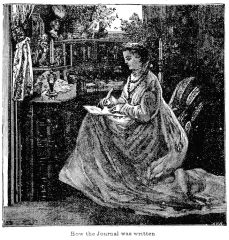
Saturday, March 24th.—Another flat calm. The after-forecastle, having been battened down and fumigated for the last seventy-two hours, was to-day opened, and its contents brought up on deck, some to be thrown overboard, and others to be washed with carbolic acid. I never saw such quantities of things as were turned out; they covered the whole deck, and it seemed as if their cubic capacity must be far greater than that of the place in which they had been stowed. Besides the beds and tables of eight men, there were forty-eight birds, four monkeys, two cockatoos, and a tortoise, besides Japanese cabinets and boxes of clothes, books, china, coral, shells, and all sorts of imaginable and unimaginable things. One poor tortoise had been killed and bleached white by the chlorine gas.
Sunday, March 25th.—Hotter than ever. It was quite impossible to have service either on deck or below. We always observe Sunday by showing a little extra attention to dress, and, as far as the gentlemen are concerned, a little more care in the matter of shaving. On other days I fear our toilets would hardly pass muster in civilised society. Tom set the example of leaving off collars, coats, and waistcoats; so shirts and trousers are now the order of the day. The children wear grass-cloth pinafores and very little else, no shoes or stockings, Manilla or Chinese slippers being worn by those who dislike bare feet. I find my Tahitian and Hawaiian dresses invaluable: they are really cool, loose, and comfortable, and I scarcely ever wear anything else.
We passed a large steamer about 7.30 a.m., and in the afternoon altered our course to speak the 'Middlesex,' of London, bound to the Channel for orders. We had quite a long conversation with the captain, and parted with mutual good wishes for a pleasant voyage. It was a lovely moonlight night, but very hot, though we found a delightful sleeping-place beneath the awning on deck.
Monday, March 26th.—The sun appeared to rise even fiercer and hotter than ever this morning. I have been very anxious for the last few days about Baby, who has been cutting some teeth and has suffered from a rash. Muriel has been bitten all over by mosquitoes, and Mabelle has also suffered from heat-rash. Just now every little ailment suggests small-pox to our minds.
About noon, when in latitude 6.25 North, and in longitude 88.25 East, we began to encounter a great deal of drift wood, many large trees, branches, plants, leaves, nautilus shells, back-bones of cuttlefish, and, in addition, large quantities of yellow spawn, evidently deposited by some fish of large size. The spawn appeared to be of a very solid, consistent character, like large yellow grapes, connected together in a sort of gelatinous mass. It formed a continuous wide yellow streak perhaps half a mile in length, and with the bits of wood and branches sticking up in its midst at intervals, it would not have required a very lively imagination to fashion it at a little distance into a sea serpent. Where does all this débris come from? was the question asked by everybody. Out of the Bay of Bengal probably, judging from the direction of the current. We wondered if it could possibly be the remains of some of the trees uprooted by the last great cyclone.
At 1.30 p.m. a man cried out from the rigging, 'Boat on the starboard bow!' a cry that produced great excitement immediately; our course was altered and telescopes and glasses brought to bear upon the object in question. Every one on board, except our old sailing master, said it was a native boat. Some even said that they could see a man on board waving something. Powell alone declared it to be the root of a palm from the Bay of Bengal, and he proved right. A very large root it was, with one single stem and a few leaves hanging down, which had exactly the appearance of broken masts, tattered sails, and torn rigging. We went close alongside to have a good look at it; the water was as clear as crystal, and beneath the surface were hundreds of beautifully coloured fish, greedily devouring something—I suppose small insects, or fish entangled among the roots.
Tuesday, March 27th.—It requires a great effort to do anything, except before sunrise or after sunset, owing to the intense heat; and when one is not feeling well it makes exertion still more difficult. At night the heat below is simply unbearable; the cabins are deserted, and all mattresses are brought up on deck.
CHAPTER XXV.
CEYLON.
Thus was this place A happy rural seat of various views, Groves whose rich trees wept odorous gums and balm, Others, whose fruit, burnish'd with golden rind, Hung amiable, Hesperian fables true.
Wednesday, March 28th.—At midnight the wind was slightly ahead, and we could distinctly smell the fragrant breezes and spicy odours of Ceylon. We made the eastern side of the island at daylight, and coasted along its palm-fringed shores all day. I had been very unwell for some days past, but this delightful indication of our near approach to the land seemed to do me good at once. If only the interior is as beautiful as what we can see from the deck of the yacht, my expectations will be fully realised, brilliant as they are.
As the sun set, the beauty of the scene from the deck of the yacht seemed to increase. We proceeded slowly, and at about nine o'clock were in the roads of Galle and could see the ships at anchor. Tom did not like to venture further in the dark without a pilot, and accordingly told the signal-man to make signals for one, but being impatient he sent up a rocket, besides burning blue lights, a mistake which had the effect of bringing the first officer of the P. and O. steamship 'Poonah' on board, who thought perhaps we had got aground or were in trouble of some sort. He also informed us that pilots never came off after dark, and kindly offered to show us a good anchorage for the night.
Thursday, March 29th.—The pilot came off early, and soon after six we dropped anchor in Galle harbour. The entrance is fine, and the bay one of the most beautiful in the world. The picturesque town, with its old buildings, and the white surf dashing in among the splendid cocoa-trees which grow down to the water's edge, combined to make up a charming picture. We went on board the 'Poonah' to breakfast as arranged, and afterwards all over the ship, which is in splendid order. Thence we went ashore to the Oriental Company's Hotel, a most comfortable building, with a large, shady verandah, which to-day was crowded by passengers from the 'Poonah.' At tiffin there was a great crowd, and we met some old friends. At three o'clock we returned to the yacht, to show her to the captain of the 'Poonah' and some of his friends, and an hour later we started in two carriages for a drive to Wockwalla, a hill commanding a splendid view. The drive was delightful, and the vegetation more beautiful than any we have seen since leaving Tahiti, but it would have been more enjoyable if we had not been so pestered by boys selling flowers and bunches of mace in various stages of development. It certainly is very pretty when the peach-like fruit is half open and shows the network of scarlet mace surrounding the brown nutmeg within. From Wockwalla the view is lovely, over paddy-fields, jungle, and virgin forest, up to the hills close by and to the mountains beyond. There is a small refreshment-room at the top of the hill, kept by a nice little mulatto woman and her husband. Here we drank lemonade, ate mangoes, and watched the sun gradually declining, but we were obliged to leave before it had set, as we wanted to visit the cinnamon gardens on our way back. The prettiest thing in the whole scene was the river running through the middle of the landscape, and the white-winged, scarlet-bodied cranes, disporting themselves along the banks among the dark green foliage and light green shoots of the crimson-tipped cinnamon-trees. We had a glorious drive home along the sea-shore under cocoa-nut trees, amongst which the fireflies flitted, and through which we could see the red and purple afterglow of the sunset. Ceylon is, as every one knows, celebrated for its real gems, and almost as much for the wonderful imitations offered for sale by the natives. Some are made in Birmingham and exported, but many are made here and in India, and are far better in appearance than ours, or even those of Paris. More than once in the course of our drive, half-naked Indians produced from their waist-cloths rubies, sapphires, and emeralds for which they asked from one to four thousand rupees, and gratefully took fourpence, after a long run with the carriage, and much vociferation and gesticulation. After table-d'hôte dinner at the hotel we went off to the yacht in a pilot boat; the buoys were all illuminated, and boats with four or five men in them, provided with torches, were in readiness to show us the right way out. By ten o'clock we were outside the harbour and on our way to Colombo.
Friday, March 30th.—It rained heavily during the night, and we were obliged to sleep in the deck-house instead of on deck. At daylight all was again bright and beautiful, and the cocoanut-clad coast of Ceylon looked most fascinating in the early morning light. About ten o'clock we dropped our anchor in the harbour at Colombo, which was crowded with shipping. 175,000 coolies have been landed here within the last two or three months; consequently labour is very cheap this year in the coffee plantations.
The instant we anchored we were of course surrounded by boats selling every possible commodity and curiosity, carved ebony, ivory, sandal-wood, and models of the curious boats in use here. These boats are very long and narrow, with an enormous outrigger and large sail, and when it is very rough, nearly the whole of the crew of the boat go out one by one, and sit on the outrigger to keep it in the water, from which springs the Cingalese saying, 'One man, two men, four men breeze.' The heat was intense, though there was a pleasant breeze under the awning on deck; we therefore amused ourselves by looking over the side and bargaining with the natives, until our letters, which we had sent for, arrived. About one o'clock we went ashore, encountering on our way some exceedingly dreadful smells, wafted from ships laden with guano, bones, and other odoriferous cargoes. The inner boat harbour is unsavoury and unwholesome to the last degree, and is just now crowded with many natives of various castes from the south of India.
Colombo is rather a European-looking town, with fine buildings and many open green spaces, where there were actually soldiers playing cricket, with great energy, under the fierce rays of the midday sun. We went at once to an hotel and rested; loitering after tiffin in the verandah, which was as usual crowded with sellers of all sorts of Indian things. Most of the day was spent in driving about, and having made our arrangements for an early start to-morrow, we then walked down to the harbour, getting drenched on our way by a tremendous thunderstorm.
Saturday, March 31st.—Up early, and after rather a scramble we went ashore at seven o'clock, just in time to start by the first train to Kandy. There was not much time to spare, and we therefore had to pay sovereigns for our tickets instead of changing them for rupees, thereby receiving only ten instead of eleven and a half, the current rate of exchange that day. It seemed rather sharp practice on the part of the railway company (alias the Government) to take sovereigns in at the window at ten rupees, and sell them at the door for eleven and a half, to speculators waiting ready and eager to clutch and sell them again at an infinitesimally small profit.
The line to Kandy is always described as one of the most beautiful railways in the world, and it certainly deserves the character. The first part of the journey is across jungle and through plains; then one goes climbing up and up, looking down on all the beauties of tropical vegetation, to distant mountains shimmering in the glare and haze of the burning sun. The carriages were well ventilated and provided with double roofs, and were really tolerably cool.
About nine o'clock we reached Ambepussa, and the scenery increased in beauty from this point. A couple of hours later we reached Peradeniya, the junction for Gampola. Here most of the passengers got out, bound for Neuera-ellia, the sanatorium of Ceylon, 7,000 feet above the sea. Soon after leaving the station, we passed the Satinwood Bridge. Here we had a glimpse of the botanical garden at Kandy, and soon afterwards reached the station. We were at once rushed at by two telegraph boys, each with a telegram of hospitable invitation, whilst a third friend met us with his carriage, and asked us to go at once to his house, a few miles out of Kandy. We hesitated to avail ourselves of his kind offer, as we were such a large party; but he insisted, and at once set off to make things ready for us, whilst we went to breakfast and rest at a noisy, dirty, and uncomfortable hotel. It was too hot to do anything except to sit in the verandah and watch planter after planter come in for an iced drink at the bar. The town is quite full for Easter, partly for the amusements and partly for the Church services; for on many of the coffee estates there is no church within a reasonable distance.
About four o'clock the carriage came round for us, and having despatched the luggage in a gharry, we drove round the lovely lake, and so out to Peradeniya, where our friend lives, close to the Botanic Gardens. Many of the huts and cottages by the roadside have 'small-pox' written upon them in large letters, in three languages, English, Sanscrit, and Cingalese, a very sensible precaution, for the natives are seldom vaccinated, and this terrible disease is a real scourge amongst them. Having reached the charming bungalow, it was a real luxury to lounge in a comfortable easy chair in a deep cool verandah, and to inhale the fragrance of the flowers, whilst lazily watching the setting of the sun. Directly it dipped below the horizon, glowworms and fireflies came out, bright and numerous as though the stars had come down to tread, or rather fly, a fairy dance among the branches of the tall palm-trees high overhead. Our rooms were most comfortable, and the baths delicious. After dinner we all adjourned once more to the verandah to watch the dancing fireflies, the lightning, and the heavy thunderclouds, and enjoy the cool evening breeze. You in England who have never been in the tropics cannot appreciate the intense delight of that sensation. Then we went to bed, and passed a most luxurious night of cool and comfortable sleep, not tossing restlessly about, as we had been doing for some time past.
Sunday, April 1st.—I awoke before daylight. Our bed faced the windows, which were wide open, without blinds, curtains, or shutters, and I lay and watched the light gradually creeping over the trees, landscape, and garden, and the sun rising glorious from behind the distant mountains, shining brightly into the garden, drawing out a thousand fresh fragrances from every leaf and flower.
By seven o'clock we found ourselves enjoying an early tea within the pretty bungalow in the centre of the Botanic Gardens, and thoroughly appreciating delicious fresh butter and cream, the first we have tasted for ages. We went for the most delightful stroll afterwards, and saw for the first time many botanical curiosities, and several familiar old friends growing in greater luxuriance than our eyes are even yet accustomed to. The groups of palms were most beautiful. I never saw anything finer than the tallipot-palm, and the areca, with the beetle-vine climbing round it; besides splendid specimens of the kitool or jaggery-palm. Then there was the palmyra, which to the inhabitant of the North of Ceylon is what the cocoa-nut is to the inhabitant of the South—food, clothing, and lodging. The pitcher-plants and the rare scarlet amherstia looked lovely, as did also the great groups of yellow and green stemmed bamboos. There were magnolias, shaddocks, hibiscus, the almost too fragrant yellow-flowered champac, sacred to Hindoo mythology; nutmeg and cinnamon trees, tea and coffee, and every other conceivable plant and tree, growing in the wildest luxuriance. Through the centre of the gardens flows the river Ambang Ganga, and the whole 140 acres are laid out so like an English park that, were it not for the unfamiliar foliage, you might fancy yourself at home.
We drove back to our host's to breakfast, and directly afterwards started in two carriages to go to church at Kandy. The church is a fine large building, lofty, and cool, and well ventilated. This being Easter Sunday, the building was lavishly decorated with palms and flowers. The service was well performed, and the singing was excellent. The sparrows flew in and out by the open doors and windows. One of the birds was building a nest in a corner, and during the service she added to it a marabout feather, a scrap of lace, and an end of pink riband. It will be a curious nest when finished, if she adds at this rate to her miscellaneous collection.
After church we walked to the Government House. Sir William Gregory is, unfortunately for us, away in Australia, and will not return till just after our departure. The entrance to it was gay with gorgeous scarlet lilies, brought over by some former Governor from South America. It is a very fine house, but unfinished. We wandered through the 'banquet halls deserted,' and then sat a little while in the broad cool airy verandah looking into the beautiful garden and on to the mountain beyond.
At half-past eleven it was time to leave this delightfully cool retired spot, and to drive to a very pleasant luncheon, served on a polished round walnut-wood table, without any tablecloth, a novel and pretty plan in so hot a climate. As soon as it became sufficiently cool we went on round the upper lake and to the hills above, whence we looked down upon Kandy, one of the most charmingly placed cities in the world. As we came back we stopped for a few minutes at the Court, a very fair specimen of florid Hindoo architecture, where the judges sit, and justice of all kinds is administered, and where the Prince of Wales held the installation of the Order of St. Michael and St. George during his visit. We also looked in at some of the bazaars, to examine the brass chatties and straw-work. Then came another delicious rest in the verandah among the flowers until it was time for dinner. Such flowers as they are! The Cape jessamines are in full beauty just now, and our host breaks off for us great branches laden with the fragrant bloom.
Monday, April 2nd.—Before breakfast I took a stroll all round the place, with our host, to look at his numerous pets, which include spotted deer, monkeys, and all sorts of other creatures. We also went to the stables, and saw first the horses, and the horsekeepers with their pretty Indian wives and children. Then we wandered down to the bamboo-fringed shores of the river, which rises in the mountains here, and flows right through the island to Trincomalee.
At eleven o'clock Tom and I said 'good-bye' to the rest of the party, and went by train to Gampola, to take the coach to Neuera-ellia, where we were to stay with an old friend. We went only a dozen miles in the train, and then were turned out into what is called a coach, but is really a very small rough wagonnette, capable of holding six people with tolerable comfort, but into which seven, eight, and even nine were crammed. By the time the vehicle was fully laden, we found there was positively no room for even the one box into which Tom's things and my own had all been packed; so we had to take out indispensable necessaries, and tie them up in a bundle like true sailors out for a holiday, leaving our box behind, in charge of the station-master, until our return. The first part of the drive was not very interesting, the road passing only through paddy-fields and endless tea and coffee plantations. We reached Pusillawa about two o'clock, where we found a rough and ready sort of breakfast awaiting us. Thence we had a steep climb through some of the finest coffee estates in Ceylon, belonging to the Rothschilds, until we reached Rangbodde. Here there was another delay of half an hour; but although we were anxious to get on, to arrive in time for dinner, it was impossible to regret stopping amidst this lovely scenery. The house which serves as a resting-place is a wretched affair, but the view from the verandah in front is superb. A large river falls headlong over the steep wall of rock, forming three splendid waterfalls, which, uniting and rushing under a fine one-arched bridge, complete this scene of beauty and grandeur.
We were due at Neuera-ellia at six, but we had only one pair of horses to drag our heavy load up the steep mountain road, and the poor creatures jibbed, kicked over the traces, broke them three times, and more than once were so near going over the edge of the precipice that I jumped out, and the other passengers, all gentlemen, walked the whole of that stage. The next was no better, the fresh pair of horses jibbing and kicking worse than ever. At last one kicked himself free of all the harness, and fell on his back in a deep ditch. If it had not been so tiresome, it really would have been very laughable, especially as everybody was more or less afraid of the poor horse's heels, and did not in the least know how to extricate him.
In this dilemma our hunting experiences came in usefully, for with the aid of a trace, instead of a stirrup leather, passed round his neck, half-a-dozen men managed to haul the horse on to his legs again; but the pitchy darkness rendered the repair of damages an exceedingly difficult task. The horses, moreover, even when once more in their proper position, declined to move, but the gentlemen pushed and the drivers flogged and shouted, and very slowly and with many stops we ultimately reached the end of that stage. Here we found a young horse, who had no idea at all of harness; so after a vain attempt to utilise his services, another was sent for, thus causing further delay.
It was now nine o'clock, and we were all utterly exhausted. We managed to procure from a cottage some new-laid eggs and cold spring water, and these eaten raw, with a little brandy from a hunting-flask, seemed to refresh us all. There was again a difficulty in starting, but, once fairly under way, the road was not so steep and the horses went better. I was now so tired, and had grown so accustomed to hairbreadth escapes, that, however near we went to the edge of the precipice, I did not feel capable of jumping out, but sat still and watched listlessly, wondering whether we should really go over or not. After many delays we reached Head-quarter House, where the warmth of the welcome our old friend gave us soon made us forget how tired we were. They had waited dinner until half-past seven, and had then given us up. There were blazing wood fires both in the drawing-room and in our bedroom, and in five minutes a most welcome dinner was put before us. Afterwards we could have stayed and chatted till midnight, but we were promptly sent off to bed, and desired to reserve the rest of our news until morning.
Tuesday, April 3rd.—A ten o'clock breakfast afforded us ample opportunity for a delicious rest and letter-writing beforehand. Afterwards we strolled round the garden, full of English flowers, roses, carnations, mignonette, and sweet peas. Tom and the gentlemen went for a walk, whilst we ladies rested and chatted and wrote letters.
After lunch we all started—a large party—to go to the athletic sports on the racecourse, where an impromptu sort of grand stand had been erected—literally a stand, for there were no seats. There were a great many people, and the regimental band played very well. To us it appeared a warm damp day, although the weather was much cooler than any we have felt lately. This is the week of the year, and everybody is here from all parts of the island. People who have been long resident in the tropics seem to find it very cold; for the men wore great-coats and ulsters, and many of the ladies velvet and sables, or sealskin jackets. On the way back from the sports we drove round to see something of the settlement; it cannot be called a town, for though there are a good many people and houses, no two are within half a mile of one another. There are two packs of hounds kept here, one to hunt the big elk, the other a pack of harriers. The land-leeches, which abound in this neighbourhood, are a great plague to horses, men, and hounds. It rained last night, and I was specially cautioned not to go on the grass or to pick flowers, as these horrid creatures fix on one's ankle or arm without the slightest warning. I have only seen one, I am thankful to say, and have escaped a bite; but everybody seems to dread and dislike them.
After dinner we went to a very pleasant ball, given by the Jinkhana Club, at the barracks. The room was prettily decorated with the racing jackets and caps of the riders in the races, and with scarlet wreaths of geranium and hibiscus mingled with lycopodium ferns and selaginella. We did not remain very late at the ball, as we had to make an early start next morning; but the drive home in the moonlight was almost as pleasant as any part of the entertainment.
Wednesday, April 4th.—We were called at four o'clock, and breakfasted at five, everybody appearing either in dressing-gowns or in habits to see us set off. They all tried to persuade us to stay for the meet of the hounds at the house to-day. Another ball to-night, and more races, and another ball to-morrow; but we are homeward bound, and must hurry on. It was a lovely morning, and we waited with great patience at the post-house for at least an hour and a half, and watched the hounds come out, meet, find, and hunt a hare up and down, and across the valley, with merry ringing notes that made us long to be on horseback.
We saw all the racehorses returning from their morning gallop, and were enlightened by the syces as to their names and respective owners. There were several people, a great deal of luggage, and, though last not least, Her Majesty's mails, all waiting, like us, for the coach. About a quarter to seven a message arrived, to the effect that the horses would not come up the hill, they had been jibbing for more than an hour, so would we kindly go down to the coach. A swarm of coolies immediately appeared from some mysterious hiding-place, and conveyed us all, bag and baggage, down the hill, and packed us into the coach. Even this concession on our part did not induce the horses to make up their minds to move for at least another quarter of an hour. Then we had to stop at the hotel to pick up somebody else; but at last we had fairly started, eleven people in all, some inside and some perched on a box behind. The horses were worse than ever, tired to death, poor things; and as one lady passenger was very nervous and insisted on walking up all the acclivities, we were obliged to make up our pace down the hills. The Pass looked lovely by daylight, and the wild flowers were splendid, especially the white datura and scarlet rhododendron trees, which were literally covered with bloom.
By daylight, the appearance of the horses was really pitiable in the extreme—worn-out, half-starved wretches, covered with wounds and sores from collars and harness, and with traces of injuries they inflict on themselves in their struggles to get free. When once we had seen their shoulders, we no longer wondered at their reluctance to start; it really made one quite sick to think even of the state they were in.
If some of the permanent officials were to devote a portion of their time to endeavours to introduce American coaches, and to ameliorate the condition of the horses on this road, they would indeed confer a boon on their countrymen. The coachman, who was as black as jet, and who wore very little clothing, was a curious specimen of his class, and appeared by no means skilled in his craft. He drove the whole way down the steep zigzag road with a loose rein; at every turn the horses went close to the precipice, but were turned in the very nick of time by a little black boy who jumped down from behind and pulled them round by their traces without touching the bridle. We stopped at Rangbodde to breakfast, and again at Pusillawa. This seemed a bad arrangement, for we were already late; it resulted in the poor horses having to be unmercifully flogged in order to enable us to catch the train at Gampola, failing which, the coach proprietors would have had to pay a very heavy penalty.
From Gampola we soon arrived at Peradeniya, where we met Mr. Freer, who was going down to Colombo. Tom had decided previously to go straight on, so as to have the yacht quite ready for an early start to-morrow. I in the meantime went to our former hosts for one night to pick up Mabelle and the waifs and strays of luggage.
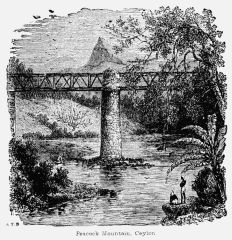
On my way from the station to the house, going over the Satinwood Bridge, from which there is a lovely view of the Peacock Mountain, I saw an Englishman whom we had observed before, washing stones in the bed of the river for gems. He has obtained some rubies and sapphires, though only of small size, and I suppose he will go on washing for ever, hoping to find something larger and more valuable. On one part of the coast of the island near Managgan the sands on the side of one of the rivers are formed of rubies, sapphires, garnets, and other precious stones washed down by the current, but they are all ground to pieces in the process, not one being left as big as a pin's head. The effect in the sunlight, when this sand is wet with the waves, is something dazzling, and proves that the accounts of my favourite Sindbad are not so fabulous as we prosaic mortals try to make out. The island must be rich in gems, for they seem to be picked up with hardly any trouble. At Neuera-ellia it is a favourite amusement for picnic parties to go out gem-hunting, and frequently they meet with very large and valuable stones by the riverside or near deserted pits, large garnets, cinnamon-stone, splendid cat's-eyes, amethysts, matura diamonds, moonstone, aquamarine, tourmaline rubies, and sapphires.
Peacock Mountain, Ceylon View full size illustration.
On my arrival at the house I found that Mabelle had just returned with some friends, who had kindly taken charge of her during our absence, and that a very old friend had arrived almost directly we left on Monday, and had departed early this morning to climb Adam's Peak, the ascent of which is a long and tedious affair, but it cannot be difficult, as thousands of aged and infirm pilgrims go every year to worship at the Buddhist or Mohammedan temples at the summit. The giant footprint has been reverenced alike by both religions from the earliest ages. Its existence is differently accounted for, however, by the two sects. The Buddhists say it is the footprint of Buddha, and that an account of its origin was written 300 or 400 years B.C. The Mohammedans say that it is the first step Adam took when driven out of Paradise. They do not quarrel about it, however, but live very happily close beside one another in their respective temples on the very small summit of the mountain. The iron chains, still used by the pilgrims and visitors to assist them up the last weary flight of steps, are said to have been placed there in the time of Alexander the Great, and are mentioned by successive historians.
After lunch I went to rest, thoroughly tired out with the hard work of the last two days, whilst the gentlemen went into Kandy, to see Buddha's tooth and a Brahmin temple.
Just before sunset we went to have a last look at those lovely Botanical Gardens. They were more beautiful than ever in the afternoon light, and I saw many things which had escaped my notice before. I have made acquaintance with the taste of all sorts of new fruits while here, more than in our former journey; but this is to be explained by the proximity of the Botanical Gardens. I expected to revel in fruit all through the tropics, but, except at Tahiti, we have not done so at all. There is one great merit in tropical fruit, which is, that however hot the sun may be, when plucked from the tree it is always icy cold; if left for a few minutes, however, it becomes as hot as the surrounding atmosphere, and the charm is gone.
On my return, when I went to dress for dinner, I found on my table a nasty-looking black beast about six inches long. It looked very formidable in the half-light, like a scorpion or centipede. It turned out, however, to be quite harmless, and a sort of millipede, and rather handsome, with jet-black rings, and hundreds of orange-coloured legs. There are a great many venomous snakes in Ceylon, but they always get out of the way as fast as they can, and never bite Europeans. All the roofs of the thatched bungalows swarm with rats, and in every house is kept a rat-snake, which kills and eats these rats. I more than once heard a great scuffle going on over my bedroom, which generally ended in a little squeak, indicating that the snake had killed, and was about to eat, his prey. One of the snakes came out one day in front of my window, and hung down two or three feet from the roof. If I had not been previously assured that he was perfectly harmless, it would have been rather an alarming apparition in the dark, and, even as it was, I must confess that for a moment I did feel rather frightened as I watched him spying about, darting his forked tongue in and out, and looking quite ready for a spring at my face.
Thursday, April 5th.—Another early start by the seven o'clock train to Colombo. We were very sorry to say good-bye to our kind host, and when we took our departure, we were quite laden with flowers, good wishes, and messages for mutual friends in England. It was rather a hot journey down, and the train seemed full, but the scenery was lovely. As we approached Colombo the heat became greater, and in the town itself it was almost insupportable.
We breakfasted at the hotel in the fort, where we were joined by Tom. There is one very curious thing about the hotels here. The sitting-rooms are all two stories high, with pointed raftered roofs. The bedrooms are only screened off from each other, and from the central room, by partitions eight or ten feet high, so that you can hear everything going on from end to end of the building. I am not at all sure that the larger amount of ventilation secured by this plan compensates for the extra amount of noise and want of privacy, especially when, as was the case to-day, there is a crying baby who refuses to be pacified in one of the rooms, a poor little girl ill with whooping cough in another, and some very noisy people, who are making themselves both unhappy and cross over some lost keys, in a third.
While we were at breakfast the crows were most amusing and impertinent. Every door and window was open, and they were perched on the top of the punkah, or on the iron crossbars supporting the roof, watching their opportunity to pounce down and carry off the bits left on our plates. They did not seem to mind the waiters a bit, and, with their heads cocked on one side, looked as droll and saucy as possible. People tell you all sorts of funny stories about them; but though they are very entertaining to watch, and apparently perfectly tame, it appears to be impossible to capture one alive.
By the time breakfast was over, we found that the 'Sunbeam' was already under way, and steaming about the anchorage; so it was not long before we were once more on board. Going out of harbour we passed a large steamer whose passengers and crew cheered us and waved their handkerchiefs until we were out of sight, and with that pleasant homely sound ringing in our ears we bade a last farewell to Colombo, and started on another stage of our homeward voyage. The heat was intense, and there was a roll outside which at once made me feel very uncomfortable. There was no wind all the afternoon, and the sun sank into the sea, glorious and golden, as we took our last look at the lovely island of Ceylon, the land of spice and fragrance and beauty.
CHAPTER XXVI.
TO ADEN.
Heaven speed the canvas, gallantly unfurled To furnish and accommodate a world, To give the Pole the produce of the sun, And knit the unsocial climates into one.
Friday, April 6th.—Our visit to Ceylon has been so delightful that I wish it could have been prolonged for a month, instead of lasting only a week; but in that case I should have preferred to select a cooler season of the year, when travelling is more practicable. A most interesting journey could be made through the centre of the island to see the ancient cities, temples, and tanks, over the road from Matelle to Nalandi Senadoora, to the curious rock temple at Dambool, near which is the fortified rock of Sigiri, and a few miles further are the vast ruins of Topari, or Ponamira, the mediæval capital of Ceylon. It is full of wonderful ruins, some of them among the oldest in the world. The Ranhol Dagoba, the Jayti Wana Rama, and the Galle Wihara and rock temple, carved out of the living rock, are alone worth a long journey to see. Then think of visiting Anajapoora, the city of rubies, the sacred capital of the kingdom of ruins, on whose splendours even the Chinese travellers of the early ages used to expatiate with fervour. From this point it would be easy to reach the peninsula of Jaffna, which has been peopled with Tammils for more than two thousand years. It is the country par excellence of gardens exquisitely kept, and skilfully irrigated on the old Moorish system. Here are grown all the ingredients for the making of curry, which are sent to all parts of this island and to Southern India. The most important crop of all, however, is tobacco, whose excellence is famed throughout India, and of which the Rajah of Travancore holds the monopoly.
Then one might go southward from Jaffna, past Aripo, and the Gulf of Calpentyn, until the curious reef of Adam's Bridge was reached, which almost connects Ceylon with India. People say it has been separated by some convulsion of nature in former days, and that the passage is gradually deepening; but recent examinations have shown that instead of being a remnant of the original rock by which Ceylon is supposed to have been once connected with the Indian continent, it is in reality a comparatively recent ridge of conglomerate and ironstone, covered with alluvial deposits carried by the current and heaped up at this particular point; whilst the gradual rising of the coast has contributed to give the reef its present altitude.
Balchus tells a most improbable story of fifteen Portuguese frigates escaping through the passage of Panupam, when pursued by some Dutch cruisers in 1557. Formerly the Straits were only thirty-five yards wide, with a maximum depth of six feet of water, but lately they have been widened and deepened by ten feet, and a little Government steamer frequently passes through on a tour round the island. At present a sailing ship going from Bombay to Madras has to make a curve of five thousand miles in order to weather the Maldives and Ceylon. It seems a long course for any vessel drawing over ten feet of water to be obliged to take.
In the centre of the channel there is a little island where a Dutch establishment for horse-breeding formerly stood, the original stud having been imported from Arabia. The horses were all turned into corrals and caught by means of lassos, and then conquered by domidores, exactly as they are at the present day in South America. Now the stud is dispersed, the buildings are in ruins, and all that remains is the Indian pagoda, where religious ceremonies, curious processions, and dances of nautch-girls occasionally take place and are attended by great crowds. To the southward again of Adam's Bridge is the celebrated Gulf of Manaar, from which the best pearls come.
This is an exceptionally good year for pearls, and the price of the shells went up many rupees per thousand in the first week. The pearl fishery can be reached in about eight hours by steam from Colombo, and it would have been delightful to have visited it, had time permitted. We were shown an oyster with some beautiful pearls in it, all found in the one shell. When a boat with pearls reaches the shore, the shells are divided into equal heaps, one-fourth going to the boat's crew, and three-fourths to the Government Inspector. They keep whichever heap he chooses to kick; so that, being uncertain which they will get for themselves, the boat's crew are sure to make a fair division. These heaps are then divided and sold by auction in thousands, and then subdivided again and again. Of course it is always a matter of speculation as to whether you get good pearls, bad pearls, or no pearls at all, though this last misfortune seldom happens.
The love of gambling is inherent in every Oriental mind, and the merest beggar with but a few pice in his wallet to buy his daily food will invest them in a small number of oyster-shells, hoping to find a pearl of great value; and, should he fail to do so, he contents himself with eating the oyster and hoping for better luck next time. The shells are generally left on the sand in carefully guarded heaps till they die and open, when the pearls are extracted, and the fish left to decay. Some of the oysters are taken in sealed-up sacks to Colombo, Kandy, and other inland places, in order to enable people to indulge their love of gambling and speculation, without the trouble of a journey to Manaar. Though called oysters, they are not the proper oyster, but a sort of avicula (Meleagrina margaritifera being the name given by Samarik), very different from the large mother-of-pearl shells in which the South Sea pearls are found.
I have not been able to keep my mind from running incessantly on Sir Emerson Tennent's delightful book on Ceylon, which describes places we have not ourselves visited, but which I wanted very much to see, and I have been so interested reading about them that I cannot help thinking other people will share my feelings. It seems wonderful that so much which is strange, beautiful, and interesting should be so easy of access from England, and yet that so few English travellers know comparatively anything of Ceylon, except Galle and Colombo, and perhaps Kandy and Trincomalee.
Saturday, April 7th.—To-day we passed close to the island of Minnikoy, between the groups of islands called the Laccadives and Maldives, some of which we saw dotting the horizon; and still further to the south stretches the Chagos Archipelago. It was very hot all day, with hardly a breath of air, and we have all returned to our former light and airy costumes: the gentlemen to their shirts and trousers, the children to their pinafores and nothing else, and I to my beloved Tahitian dresses.
Before we left England we could not make ourselves believe what we were told about heat in the tropics; so we started with very few windsails and without any punkahs or double awnings. It was all very well in the Atlantic or Pacific, but between Hongkong and Singapore the state of things became simply unbearable. The carpenter has rigged up a punkah, and the men have improvised some double awnings. At Colombo they made some windsails, so we are now better off than on our last hot voyage. It has been really hotter than ever to-day, but a pleasant breeze sprang up in the afternoon.
Sunday, April 8th.—A delightful fresh morning after a cool night. Everybody looks quite different, and we begin to hope we shall carry the north-east monsoon right across, which would be an exceptional piece of good fortune. We had service in the saloon at eleven o'clock and at four, and though there was an unusually full attendance it was cool and pleasant even without the punkah. The thermometer registers nearly the same as it did on Friday, when we were all dead with the heat. The apparently nice cool breeze that refreshes our heated bodies does not produce any corresponding effect on the glassy surface of the ocean; for we find to-day, as on previous occasions, that the temperature, both of the water and of the air, registered by the thermometer, does not by any means correspond with the effect on the human frame.
The two Chinese servants we shipped at Hongkong are a great success, as every one on board agrees. Even the old sailing master is obliged to confess that the two 'heathen Chinee' keep the mess rooms, ships' officers' and servants' berths much cleaner and more comfortable than his own sailors ever succeeded in doing. At Galle we shipped three black firemen, two from Bombay and one from Mozambique, a regular nigger, with his black woolly hair clipped into the shape of Prince of Wales feathers. Their names are Mahomet, Abraham, and Tom Dollar. They live in a little tent we have had pitched for them on deck, cook their own food, and do their work in the engine-room exceedingly well. In the intervals they are highly amused with the children's picture books. The picture of the durbar at Delhi delighted them, especially as they recognised the figures, and learned a little English through them. They can say a few words already, and have told me all about their wives and children at Mozambique and Bombay, and have shown me the presents they are taking home to them. They have been nearly a year on board the P. and O. steamship 'Poonah,' and appear to have saved nearly all their earnings. I do not suppose our own men could have stood the fearful heat below in the engine-room for many days together, so it was fortunate we met with these amiable salamanders.
Monday, April, 9th.—No wind. We passed through a large shoal of porpoises, and at dusk we saw the light of a distant ship. At all the places we have recently visited we have found excellent ice-making machines, and have been able to get a sufficient supply to last us from port to port, which has been a great comfort. The machine at Colombo unfortunately broke down the day before we left, so that in the very hottest part of our voyage we have had to do without our accustomed luxury; and very much we miss it, not only for cooling our drinks, but for keeping provisions, &c. As it is, a sheep killed overnight is not good for dinner next day; butter is just like oil, and to-day in opening a drawer my fingers touched a sticky mess; I looked and discovered six sticks of sealing wax running slowly about in a state resembling treacle.
Wednesday, April 11th.—Hotter than ever. We could see a steamer in the far distance. About sunset we passed through a shoal of flying-fish; the night was intensely hot, and everybody slept on deck.
Friday, April 13th.—At 6 a.m. we made the island of Sokotra, and about seven o'clock saw 'The Brothers,' two islands where large quantities of turtle and ambergris are found. Though generally uninhabited, they are sometimes visited by the natives for the purpose of collecting articles of commerce.
One of our large pigs took it into his head to jump overboard to-day. The helm was put round as quickly as possible, but the most anxious spying could not discover any trace of poor piggy's whereabouts; so we proceeded on our original course for a few minutes, when suddenly, to our great astonishment, we saw him alongside, having been nearly run down, but still gallantly swimming along. The dingy was lowered and two men sent in pursuit. They had, however, no easy task before them, for as soon as they approached, piggy swam away faster than they could row, and bit and fought most furiously when they tried to get him into the boat. It was a good half-hour's work before he was secured, yet when he arrived he did not appear to be in the least exhausted by his long swim, but bit and barked at everybody so furiously that he was condemned to death, to prevent the possibility of further accidents. It is quite clear from the foregoing incident that some pigs can swim, and swim very well too, without cutting their own throats in the process.
All the afternoon a large steamer had been gradually gaining on us. We exchanged signals and made out that she was the 'Calypso' (?) of Glasgow. About half-past five she altered her course and came alongside to speak us. The fore-deck was crowded with the crew. On the bridge were many of the officers; and sitting bolt upright on a stool, 'looking out forward' in the most amusing manner, was the captain's little Skye terrier. The stern was crowded with passengers, of every shade of colour. To our surprise a voice from among them shouted out 'Three cheers for Mr. Brassey!' which was responded to by ringing shouts from all on board, and taken up again by some of our own men. It was a very pleasant and unexpected greeting to hear in the middle of the Indian Ocean. The ship soon drew ahead again, but handkerchiefs and caps were waved till their owners faded away into the distance. Meeting and passing thousands of people as you at home do daily, you can hardly understand the excitement a little incident like this causes on board ship, where even a distant sail in these lonely oceans makes everybody leave his occupation and crowd to look at her. Soon after sunset we saw the island of Abd-al-Kuri, with its fantastic peaks, melting into orange, gold, and purple tints, beneath the gorgeous Arabian afterglow.
Saturday, April 14th.—We made Cape Rasalhir, formerly called Guardafui, about nine o'clock yesterday evening, and passing it during the night entered the Gulf of Aden. [21] All to-day we have been going along the Soumali coast. There is a good deal of trade carried on in native boats. Passing all these strange and comparatively unknown and little-visited islands and coasts, from which all sorts of things in daily use at home are brought, one dimly realises what commerce means and how necessary one part of the world is to the other.
Sunday, April 15th.—Still intensely hot. The usual services were held on deck at eleven and four o'clock. The land, both in Arabia and in Africa, could be seen the whole day, with precipitous mountains. In the afternoon we could make out the rock of Aden, and at sunset it stood grandly forth, looming in purple darkness against the crimson and blood-red sky, which gradually faded to tenderest tints of yellow and green, before it finally blazed forth into a radiant afterglow. At half-past eight a gun from the fort at Aden summoned us to show our colours, or rather lights. At nine o'clock we dropped our anchor in the roads; a boat came off with a bag of newspapers and to ask for orders in the morning. It was sent by the great Parsee merchants here, who undertake to supply us with coals, provisions, water, and everything we want, and spare us all trouble. For the last three or four days we have had a nice little breeze astern, and if we had not been in a hurry to cross the Indian Ocean before the south-west monsoon set in, we should certainly have been contented with four or five knots an hour under sail instead of eight and a half under steam. We have averaged over 200 miles a day under steam alone, ever since we left Penang, and have burnt only four tons of coal for every fifty miles.
Monday, April 16th.—At 1.30 a.m. I heard the signal gun fired, and shortly afterwards a great splash of boats and oars, and a vast chattering and shouting of tongues announced the arrival of a P. and O. steamer. She dropped her anchor just outside us, so we had the benefit of the noise all night. I got up at daylight and found the pilot just coming off. He took us to a buoy, a little closer in, and soon the business of coaling and watering commenced.
Soumali Indian, Aden View full size illustration.

We reached the shore about 7.30, and, landing at the pier, had our first near view of the natives, who are most curious-looking creatures. They have very black complexions, and long woolly hair, setting out like a mop all round, and generally dyed bright red, or yellow by the application of lime. Mr. Cowajee had sent his own private carriage to meet us. It was a comfortable open barouche, with a pair of nice horses, and two servants in Eastern liveries, green vests and full trousers, and red and orange turbans. We went first to his store, which seemed to be an emporium for every conceivable article. There was carved sandal-wood, and embroidered shawls from China, Surat, and Gujerat, work from India, English medicines, French lamps, Swiss clocks, German toys, Russian caviare, Greek lace, Havannah cigars, American hides and canned fruits, besides many other things. The feathers did not look very tempting; there was a great deal of feather and very little stem about most of them, and only a few were white, the majority being a pretty sort of brown and drab. But this general store is only a very small part of their business, for about 60,000 tons of coal pass through their hands every year.
We went on to the Hôtel de l'Europe, which was by no means in first-rate order, but allowances must be made for a new house. A delightful breeze was blowing in through the open windows, and although the thermometer registered 85° in the dining-room, it did not seem at all hot. The view over the bay is very pretty, and the scene on shore thoroughly Arabian, with the donkeys and camels patiently carrying their heavy loads, guided by the true Bedaween of the desert, and people of all tinges of complexion, from jet black to pale copper colour. A pair of tame ostriches, at least seven feet high, were strolling about the roadway, and a gazelle, some monkeys, parrots, and birds lived happily together beneath a broad verandah. After a little while we went for a drive to see the camp and town of Aden, which is four or five miles from the Point where everybody lands. On the way we met trains of heavily laden camels bringing in wood, water, grain, and fodder, for garrison consumption, and coffee and spices for exportation. After driving for about four miles we reached a gallery pierced through the rock, which admits you into the precincts of the fort. The entrance is very narrow, the sides precipitous, and the place apparently impregnable. We went all through the town, or rather towns, past the Arab village, the Sepoy barracks, and the European barracks, to the water tanks, stupendous works carved out of the solid rock, but until lately comparatively neglected, the residents depending entirely on distillation for their supply of water. There is a pretty little garden at the foot of the lowest tank, but the heat was intense in the bottom of the deep valley amongst the rocks, where every sun-ray seemed to be collected and reflected from the white glaring limestone, and every breath of air to be excluded. We saw a little more of the town and the market crowded with camels, the shops full of lion, leopard, and hyæna skins. We went to the officers' mess-house, visited the Protestant and Roman Catholic churches and the Mohammedan mosque, and then passing through two long tunnels, bored and blasted in the solid rock, we looked over the fortifications. Finally, we returned to the Point again by way of the Isthmus, and went to Government House, which gets a fresh breeze from every quarter. They say that to-day is hotter than usual, but it is never really very oppressive here unless there is an exceptionally hot wind blowing from the desert, but even that is partially cooled before it arrives. To us it appears delightful after our sultry voyage and the heat at Penang and Singapore.
We are all agreeably disappointed with Aden, and find that it is by no means the oven we expected; it is prettier too than I thought, the mountains and rocks are so peaked and pointed, and although the general effect is one of barrenness, still, if you look closely, every crack and crevice is full of something green. The soil, being of volcanic origin, is readily fertilised by moisture, and at once produces some kind of vegetation. This adds of course greatly to the effect of colour, which in the rocks themselves is extremely beautiful, especially at sunrise and sunset. The sea, too, is delightfully blue on one side of the peninsula, and pale green on the other, according to the wind, and the white surf curls and breaks on the sandy shore beyond the crisp waves.
We went back to the hotel a little before one, and found many friends had called during our absence. After superintending the children's dinner, I went with Tom to luncheon at Government House. It was very pleasant; General and Mrs. Schneider were more than kind, and the house felt deliciously cool and airy.
We are told that thirty miles inland the country is sometimes very beautiful. There are exquisitely green valleys, with a stream running through them, amongst peaks, and rocky mountains, which one rarely sees in the desert. Here the natives cultivate their crops of corn—such corn as it is too, reaching six feet above a man's head! All sorts of useful vegetables grow abundantly, besides roses, fruits, and fragrant flowers, large supplies of which are brought daily into Aden. About ten miles from the town there are acres of the most fertile garden ground, which is cultivated to supply the garrison with vegetables. Sometimes a party of seventy or eighty men, and ten or twenty Arab guides, goes out for three weeks or a month at a time surveying. The natives are much more friendly than they used to be a few years ago, when people were afraid even to ride outside the town. Now pleasant excursions lasting a few days may be made, especially as there is very fair shooting to be got. After luncheon I was shown some lovely feathers. The contrast between these and the steamer-feathers is ludicrous; the price, too, is proportionately cheaper, for the feathers are infinitely better. Long, white, full, and curly feathers can be bought for much less than you give for them in England. We drove down to the town, finished our business transactions, and then went in the 'Vestal's' steam launch on board the 'Gamma,' one of the new Chinese gunboats on her way out to China.
After afternoon tea we all adjourned to the 'Sunbeam,' where we found many other friends already arrived or arriving. We had only just time to look round before the sun set, and the short twilight was succeeded by the swift tropical darkness. All too soon good-bye had to be said; the anchor was raised, and we were actually drifting slowly along under our head canvas before our friends took their departure. It was a lovely evening, with a light fair breeze, and although there appeared hardly any wind, it was wonderful how swiftly we crept out of the harbour, and, as sail after sail was spread, how rapidly we glided past the land.
Our visit to Aden has been short but very agreeable; it is not by any means such a dreadful place as we had always fancied. Most of the people we have seen to-day seem rather to like it; there is good boating, excellent sea fishing, moderate shooting, and many rides and excursions. A vehicle of some sort is an absolute necessity, however, if you want to see anything of your friends, for the three divisions of the settlement are at least four miles apart, and the heat is far too great for driving or riding in the middle of the day, except on business. I cannot say, however, that we ourselves found it intolerably hot to-day.
CHAPTER XXVII.
TO SUEZ.
Round the decay Of that colossal wreck; boundless and bare The lone and level sands stretch far away.
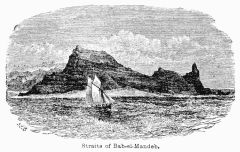
Tuesday, April 17th.—The breeze still continued and freshened, and we sailed along pleasantly before it, finding it a great relief to be rid of the thud and beat of the engine. There is no vibration, but the noise is unpleasant. About eleven o'clock we passed the island of Perim, a most desolate-looking place. I do not wonder that officers so much dislike being quartered there. It is an important position though, and is shortly to be strengthened, when water-tanks will be built, and attempts made to cultivate the soil. At present there does not appear to be a blade of vegetation, and on the side we passed, between the island and the coast of Arabia, nothing is to be seen but the little white lighthouse and the path leading up to it. On the southern side there is a very fair harbour and a moderate town. On the shore all round the island turtles are caught at the season when they land to deposit their eggs. To pass the island of Perim we sailed through the Straits of Bab-el-Mandeb, or 'Gate of Tears,' thus called on account of the numerous wrecks which took place there in former years. Once through the straits, we were fairly in the Red Sea. The colour of the Red Sea is certainly the bluest of ultramarines. In the afternoon the town of Mocha Yamen, celebrated alike for its breed of Arab horses and its coffee, was visible from the masthead. It is a large white town, full of cupolas and minarets, surrounded with green as far as irrigation extends, and looking like a pearl set in emeralds on the margin of the deep blue sea against a background of red and yellow sand-mountains. Later in the afternoon we passed Great and Little Hamish, where the P. and O. boat, 'Alma,' was wrecked some fifteen years ago, and during the night sailed by Jebel Zibayar and Tukar.
Straits of Bab-el-Mandeb View full size illustration.
Wednesday, April 18th.—In the morning, at daylight, we were off Jebel Teir, Mussawa Island, Annesley Bay lying 60 miles to the west. Our position was about 60 miles to the south-west of Mussawa Zoulia, where the expedition under Lord Napier of Magdala landed in 1867. At noon we had sailed 221 miles, a most unexpected run in the Red Sea. In the afternoon it fell calm, but the wind freshened again, and we went on sailing until after midnight.
Thursday, April 19th.—We commenced steaming at 1 a.m., stopped, however, at 5 a.m., and sailed all day. Yesterday we were surrounded by some beautiful blue birds, who hovered about us and settled at intervals on the masts and yards. During the night two were caught napping by the men, and in the course of to-day two more, hotly pursued by a hawk, took refuge on board and were also captured. One was given to me. It appears to be a very beautiful kind of jay, with feathers of the most brilliant shades of blue. The men have killed their birds for the sake of the skins, but I mean to try and keep mine alive. At Colombo several birds and two curiously starred tortoises were added to our collection; and we took on board at Aden a gazelle, a black cockatoo, and a green monkey.
We passed Souakim to-day, the port of Nubia. It is about 275 miles, or 25 days' camel-journey, from thence to Berber on the Nile. The road passes through Korib, and among fine red granite and black basalt mountains, 4,000 feet high. We left one of the firemen, Tom Dollar, behind at Aden by mistake, and only found out yesterday that we had done so. It appears that he has a brother living there, whom he was most anxious to go and see directly the anchor was let go, in the morning. Unfortunately, he did not speak to us on the subject. He had never been in anything but a regular steamer before, and could not believe it possible that the 'Sunbeam' could spread her wings and be off without any preliminary 'fire-worshipping,' I am very sorry for the poor man, as he has left all his clothes and the wages he had earned on board the P. and O. steamer behind him. We must send them back from Suez, and telegraph to some one to look out for him. The heat is intense, and we all sleep on deck at night; the sunrises and sunsets are magnificent.
Friday, April 20th.—A little hotter still; there is no wind at all, and we are obliged to steam. In the morning we passed to the southward of Jeddo, the port of Mecca. Unfortunately it was so hazy that we could not distinguish anything whatever of the town or country, only a line of mountains rearing their heads above the clouds. We had hoped to be at Suez early on Sunday, but now I fear we shall not arrive until Monday.
Saturday, April 21st.—Hotter and still hotter every day, says the thermometer, and so we say also. Everybody told us these would be our two hottest days, and certainly the prediction has been verified. We did not see a single ship all day, but in the afternoon passed Zambo, the port of Medina. A little before midnight we made the light on the Dædalus shoal on the starboard bow.
This being Muriel's fifth birthday, Mabelle and the doctor and the men have been arranging a surprise for her all day, and none of us were allowed to go on the port side of the deck, but after dinner we were taken to a hastily fitted-up theatre, very prettily decorated with flags and Japanese lanterns. On a throne covered with the Union Jack, Muriel was seated, the two pugs being on footstools on either side of her to represent lions couchant. Some of the men had blackened their faces, and gave us a really very excellent Christy Minstrel entertainment, in which undreamed-of talent came to light. It is very odd and interesting how one is perpetually finding out something new about the men. Some of the crew we thought the most unpromising when we started, have turned out among our best men, always ready and willing for everything, while others, who at first appeared the best, have not proved so good. Many we knew well beforehand. On the whole, however, we have very little cause to complain of our crew; all pull well together when they are kept up to their work and have plenty to do.
Sunday, April 22nd.—Clouds veiled the sunrise this morning, which was a welcome relief; still it was too hot for service in the saloon, and it was therefore held on deck. A light breeze sprang up ahead during its performance, which cooled and refreshed us immensely. About twelve o'clock we passed another pair of 'Brothers,' a couple of odd-looking rocks or islands, like tables, rising straight out of the sea; there is a beacon on the northernmost one. While we were at lunch, the breeze freshened so much that we were all glad to add some wraps to our light and airy costumes. A little later, a summer gale was blowing ahead, making some of us feel very uncomfortable and long for the halcyon days of the past, even with the accompaniment of the inevitable heat. Such is mankind, and womankind too for that matter, 'never blessed but always to be blessed.' The gale freshened, the screw was raised, the yacht pitched and rolled, and we were obliged to put her off her course and under sail before night fell. The spray came over the decks, and there was a strong wind dead ahead. We all felt cold and miserable, though the thermometer still registered 75°. The poor monkeys and parrots looked most wretched and unhappy, and had to be packed away as speedily as possible. Nine monkeys in an empty wine case seemed very happy and cuddled together for warmth, but the two larger and more aristocratic members of the party required a box to themselves. The gazelle had a little tent pitched for him specially in a sheltered corner, and the birds were all stowed away and battened over in the smoking fiddle. Dinner was rather a lame pretence, and it was not long before we all retired, and certainly no one wished to take his or her mattress on deck to-night. It is the first night I have slept in a bed on board the yacht for many weeks, and a very disturbed night it was, for the waves ran high, and we have lately been sailing so steadily over smooth seas, that we did not know what to make of this.
Monday, April 23rd.—The gale blew as hard as ever, and quite as dead ahead. About noon we made the island of Shaduan, or isle of Seals, so named by the ancients, when the sea and gulf abounded with seals. There are still a few occasionally to be seen to the northward by the fishermen, and their skins are brought to Suez for sale. We are making tacks backwards and forwards across the narrow sea, an exciting amusement for a yachtsman, as it requires constant attention. The sailing directions say that this sea is ill surveyed, except in the direct channel. There are many coral reefs and sunken rocks, and on whichever side you may happen to be wrecked, the natives are ready to rob, ill-treat, and kill you, or sell you as slaves in the interior. It was on two projecting coral reefs from the island of Shaduan, that the 'Carnatic' was wrecked in 1869. She ran ashore at four o'clock in the morning of the 13th of September, soon after having made the light on Rhas Garril. We were at Suez in October of the same year, and everybody was then full of the sad particulars of the wreck, the soldiers being especially useful in bringing in the passengers' luggage, which had been recovered from the Arabs. One of our firemen, Abraham, was on board the 'Carnatic' at the time of the disaster, and lost all his worldly goods (not many, I should think, judging by what he has brought on board here).
The sea was very rough and disagreeable all day. To us the temperature appears quite cool, indeed cold, though the thermometer still remains at 75°. Our friends at Aden, who prophesied that I should want my sealskin jacket before leaving the Gulf of Suez, were not so far wrong in their prognostications as I imagined at the time.
Tuesday, April 24th.—We are still beating to windward against a head gale, and by noon had made sixty-five miles to the good, right in the wind's eye—not a bad performance, considering that the gale was blowing with a force of nine or ten. It has the merit of novelty too, for I suppose that for years no sailing ships have been seen in the Gulf of Suez. The winds blow so steadily for months together, that for six months in the year you cannot get into the Red Sea, and for the other six months you cannot get out of it.
We passed the island of Rhas Garril, and soon afterwards a steamer went by, altering her course a good deal to inspect us. She evidently thought we were a broken-down steamer, and intended to come to our rescue. All yesterday and to-day we have been making flannel coats for the monkey, and covers for birdcages, and improvising shelters and snug corners for our pets. At night especially the wind is quite crisp. If this gale continues, it will be Thursday or Friday before we reach Suez; but it may possibly change to-night, and it looks now as if it were breaking.
Beating up the Red Sea View full size illustration.
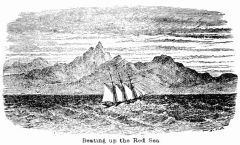
Wednesday, April 25th.—At last the gale has broken. There was not much wind when I went on deck at 4 a.m., and by seven o'clock it was so nearly calm, that the funnel could be raised and fires lighted, and we were soon steaming straight for our destination. We could not see Mount Sinai on account of the mist, but made out the place where the Israelites are said to have crossed the Red Sea, and by four o'clock the town of Suez lay right ahead. The shores are very barren, not a blade of grass nor a scrap of vegetation being visible. Nothing is to be seen save mountain peaks, rocks, stones, and sand. But even this barren scene has a special beauty of its own, particularly at sunrise and sunset. The shapes of mountain and rock are alike striking, the sharp shadows are lovely, and the contrast of reds, yellows, and browns, with the bright blue sea and crisp white waves, is very beautiful. Even when the sun has set, and the rich tints have faded away, the full moon adds another charm to the landscape.
This afternoon, as we were steaming up towards Suez, I had a chat with Mahomet, one of our Indian firemen, who was fringing a piece of muslin for a turban. I asked him if it was English. 'No, Missy; no English—Switzerland; English no good; all gum and sticky stuff; make fingers dirty; all wash out; leave nothing.' In the South Sea and Sandwich Islands, and in the Malay Peninsula, the natives make the same complaints as to the Manchester cottons. At Hongkong some of the large shops had fifty expensive English ships' compasses on hand; they were all quite unsaleable owing to the liquid having gone bad, in consequence of its not having been properly prepared. Some American compasses of the same quality were in good order and not in the least affected by the climate. It will be a bad day when the confidence in England's honesty as a nation throughout the world, and consequently her well-earned supremacy in commerce, have passed away. The burden, unfortunately, will not fall on the heads of the offenders alone, but, as usual, the innocent will suffer with and for the guilty.
After four o'clock we came near two steamers lying at anchor, and were shortly afterwards boarded by the captain of the port, the health officer, and sundry other functionaries. After a short delay we dropped anchor, and just as the sun was setting in 'purple and gold' behind the mountains of Arabia, we went ashore in the steam launch. We landed at the Canal Company's Office, in front of which there is a bust of Lieutenant Waghorn, the inaugurator of the overland route.
At the office, the 'Sunbeam' was entered on the Company's books, and arrangements were made with the chief pilot for to-morrow, while the children amused themselves by riding a pony up and down, and jumping over the little brooks, and I strolled about admiring the enormous growth of the vegetation since we were here last in 1869. We next steamed five miles further on to the town of Suez, and landed opposite the big hotel, which is more uncomfortable than ever. The rooms are dirty, and the cooking execrable.
There is nothing to see at Suez, but still we went for a ramble to see that nothing. We cleared our boxes and our letters, and then went on ankle deep in sand to the one European house, the railway station, the Arab quarter and the bazaars, where it is occasionally possible to pick up rather interesting little curiosities brought by the pilgrims from Mecca and Medina.
Thursday, April 26th.—Such a sunrise as this morning's you could only see in Arabia or Egypt. There is a peculiarity about desert colouring at sunrise and sunset that can never be seen anywhere else. We had sundry visitors during the early morning, and before ten o'clock we were in the Canal and steaming on at regulation speed. As the sun rose the heat became intense, 96° in the shade under double awnings. So far from there being a cool breeze to temper it, a hot wind blew from the desert, like the blast from a furnace. I stood on the bridge as long as I could bear the heat, to look at the strange desert view, which could be seen to great advantage in going through at the top of high water. Sand, sand everywhere; here a train of camels, there a few Arab tents, now a whole party shifting their place of abode; a group of women washing, or a drove of buffaloes in a small tributary stream. After going about eight miles we stopped at a gare (as the stopping-places are called) to allow three vessels to pass. One was a fine steamer belonging to the Ducal Line; the others were a Dutch and a German boat (one, the Friesland, has been since wrecked off Cape Finisterre, in December 1877). The cleanliness and general smartness of the former presented a great contrast to her companions, on which the passengers looked very hot and uncomfortable. The centre part of each vessel was crowded with a large number of Dutch or German boys, going out as soldiers to Acheen, who certainly did not appear to be enjoying their voyage.
We passed Chaloux and reached Ismailia just at nine o'clock, not without considerable effort on the part of the pilot. A steam launch came off from the shore, and we (children and all) landed at once; and, after a moonlight donkey ride, dined at the excellent Hôtel de Paris, kept by an old Frenchman. Table-d'hôte was over, but they gave us a capital little dinner by ourselves. The children and I, and some of the gentlemen, start to-morrow, overland viâ Cairo, to join the yacht at Alexandria, in order that they may see the Pyramids. It was a glorious night as we rowed off to the yacht under the bright beams of the full moon, and the air, too, was quite fresh and cool—a most refreshing change from the noontide heat.
The traffic on the Canal has increased during the last few years, and especially during the last few months; on an average four or five ships passed through every day. To-day they took 6,000l. at the Suez Office alone. They have an excellent plan of the Canal there, and little models of ships, which are arranged according to the telegrams constantly received, so that the chief officers at each end of the Canal know exactly where every ship is. Instant information is of course sent of any stoppage or any accident, but these occur comparatively seldom. Some time ago M. Lesseps bought a small canal partially stopped up leading from the Nile at Cairo to Ismailia. It has been widened and deepened, and was opened a few weeks ago with great ceremony and grand doings. Now any vessel not drawing more than fourteen feet can go direct from Suez or Port Said to Cairo. If we had had time, we might have done it in the yacht, and lain at anchor almost under the shadow of the Pyramids of Cheops. The special object of the new canal is to make Cairo and Ismailia Egyptian ports as well as Alexandria, thereby saving much land carriage and labour of shifting. Already several ships laden with grain, from Upper Egypt, have availed themselves of this new means of communication.
Friday, April 27th.—Another glorious sunrise. The pilot was on board at 5 a.m., and the Dhebash with fish, strawberries, and fresh vegetables. This is a beautiful climate, though there is scarcely any rain; only one very slight shower has occurred during the last three years at Suez, but the soil of the desert after the Nile overflow brings forth tenfold.
The 'Sunbeam' was to start at eight o'clock, as soon as a large vessel had passed up from Port Said. There are only certain places in the Canal where vessels can pass one another, so one ship is always obliged to wait for another. We landed at half-past seven. The sun was already blazing with a burning fury, and we found it very hot riding up to the hotel on donkeys. We had an excellent breakfast at the same comfortable hotel, paid a very moderate bill, and left by the eleven o'clock train for Cairo. We stopped at Zag-à-zig for an hour for luncheon in a nice cool dark room, and started again about three o'clock. The change in the face of the country since we were here eight years ago is something extraordinary. A vast desert of sand has been transformed into one large oasis of undulating fields of waving corn, where there used to be nothing but whirlwinds of sand. All this has been effected by irrigation. The wealth of Egypt ought greatly to increase. How the people managed to live before is a mystery. Now every field is full of labourers reaping and stacking the corn, women gleaning, and in some places the patient, ugly black buffaloes ploughing the stubble for fresh crops.
At half-past six we reached Cairo, and were conveyed in a large char-à-bancs to what was formerly Shepherd's Hotel, now partly rebuilt and much altered for the better. Even in that short drive we could see that the face of the capital of Egypt had altered as much as the country, though I am not sure that it is so greatly improved. After a refreshing dip in cool marble baths and a change of garments, we went down to the large table-d'hôte. Then we sat in the verandah looking on the street until we became tired of doing nothing, after which we started for a stroll in the Ezkebieh gardens close by. They are beautifully laid out for evening promenade; but although the flowers are lovely, and the turf, thanks to constant waterings, is deliciously green, all the large trees have been cut down. There is no seclusion, no shade, which seems a pity in a country where the greatest desire of life is shelter from the noonday heat. To-night both Arab and French bands were playing within the enclosure, and it was pleasant enough listening to Offenbach's music under the beams of the full moonlight. Few people appeared to appreciate it, however, for the gardens were nearly empty; but then the season is over, and every one has fled before the coming heat.
Saturday, April 28th.—We had settled to start at six o'clock this morning to visit the Pyramids, an excursion which had been for some little time eagerly looked forward to and talked about by the younger members of our party. The morning was cold and grey, a strong northerly wind was blowing, and the change from the weather which had prevailed but a few hours previously was altogether most striking and unexpected. We drove rapidly through the streets and the outskirts of the town, where old houses are being pulled down and new ones rapidly built up, and where a general air of new bricks and old rubbish pervades the scene. Then we crossed the Nile by a handsome iron bridge, and saw the Palace of Gezireh, where the Prince of Wales and his suite were lodged. We passed the railway extension works, and, to the great delight of the children, saw two elephants busily employed, one of which was being made to lie down to enable his mahout to dismount. Soon the little ones gave a shout of 'The Pyramids!' and there before us stood those grand monuments of a nameless founder, which for centuries have stood out in the sands of the desert, while the burning African sun and the glorious African moon have risen and set on their heavenward-pointing summits for countless days and nights. Even the earth has changed her position so much since they were erected that the pole star no longer sheds its light in a direct line through the central passages, as it did when first they were designed.
We drove along under avenues of now leafless trees to the foot of the hill on which the Pyramids are situated. Here everybody was turned out to walk except Muriel and me, and a tremendous tug the horses had to drag even us two up to the real foot of the Pyramids. On arriving we were at once surrounded by a crowd of Arabs. They are certainly a fine-looking lot of men, rather clamorous for backshish, and anxious to sell their curiosities, real or imitation. They were, however, good-natured, civil, and obliging, and amused me much during the hour I spent alone with them while the rest of the party were ascending and descending the Pyramids. Many could speak several languages quite fluently, and almost all of them took a good deal of interest in the war, and the prospects of success on either side; while many had a fair knowledge of the geography of Europe. While all the rest were on the top of the one large Pyramid, a man ran down from the summit and up to the top of the next smaller one (which is, however, more difficult to ascend) in 'eight minutes for a franc' This feat was repeated several times by different men, but it really occupied nearer ten minutes.
We ate some bread and wine, bought a few curiosities, and then drove back to the city, feeling very cold and shivery and regretting the wraps we had left behind. We reached the hotel just in time for twelve o'clock table-d'hôte breakfast, and, after an acceptable rest, sallied forth again, this time on donkeys, to see the bazaars and the sunset from the citadel. We went across squares and gardens and through wide streets, for, alas! Cairo is being rapidly Haussmannised. For the capitalist or resident, Cairo may be improved, but for the traveller, the artist, the lover of the picturesque, the quaint, and the beautiful, the place is ruined. Cairo as a beautiful and ancient oriental city has ceased to exist, and is being rapidly transformed into a bad imitation of modern Paris, only with bluer skies, a more brilliant sun, and a more serene climate than it is possible to find in Europe. Only a few narrow streets and old houses are still left, with carved wooden lattices, where you can yet dream that the 'Arabian Nights' are true.
We went to the gold and silver bazaar, and bought some quaint silver jewellery from Assouan, Soudan, and Abyssinia; then through the Turkish bazaar, the saddlery bazaars, past mosques and old houses, till at length we emerged into new squares and new streets, before climbing the hill to the citadel, the Viceroy's palace, and the splendid Mosque of Mehemet Ali, built of Egyptian alabaster. The view from the terrace is superb, over city, desert, river, palm-trees, and Pyramids. The sunset this evening was a disappointment; yellow, cold, and watery, a strong north wind bringing up all the sand from the desert. We returned to the hotel for dinner, and were all glad to go early to bed.