A VOYAGE IN THE 'SUNBEAM'. (continued 10)
Reading edition
Sunday, April 29th.—The children and I went to the English church, a semi-Gothic building, without a single window which could open. Though the church was nearly empty, the air felt like that of an exhausted receiver, and made one gasp. In the cool of the afternoon we drove through Roulai, where the museum stands, in a beautiful garden close by the riverside, amid flowers in full bloom.
After an early meal (hardly to be called dinner) we went to the station, just as all the people were going for a drive to Shoubrah in the smartest carriages and the prettiest toilets.
Our journey to Alexandria in the evening was cool and pleasant. A huge break met us, and we drove to Abbat's Hotel—considerably improved since our last visit in 1869.
Monday, April 30th.—Got up at 5 a.m. After a deliciously soft but very muddy bath, I went for a donkey ride before breakfast with Mabelle. Tom arrived from the yacht in time for twelve o'clock breakfast, and announced the voyage from Port Said to have been rough and unpleasant.
We called on the Consul, the Vice-Consul, and our old friend, Consul Burton of Trieste, Haj Abdullah. He has just returned from a journey through the ancient land of Midian, undertaken at the special request of the Viceroy. He describes the expedition as having been most successful; the climate is almost perfect from September to May; the land is well watered by little streams flowing through fertile valleys, and full of fragrant flowers and luscious fruits. The corn reaches above the camel-men's heads, which means a height of fourteen or fifteen feet. But the mineral wealth of the country is its most extraordinary feature. He found traces of gold in the sand of the river-beds, in spots pointed out to him by his fellow-pilgrims on the way to Mecca twenty years ago, to say nothing of tin, iron, &c. Perhaps the most interesting part of his discovery was the remains of eight ruined cities with traces in the dry river-beds of stone-crushing and gold-seeking apparatus, which must have been used centuries ago. He is writing a book on the subject, which you may perhaps see before you read this.
The Consul kindly sent a janissary with us to show us the Sultan's palace. It is large and bare of furniture; and the general style of decoration is like that of the palaces at Cherniga and Dolma Batscher. Thence we went to see Pompey's Pillar and Cleopatra's Needle, the dahabeas ready to go up the Nile, &c.; and returned to the hotel in time for dinner and a chat afterwards in the cool courtyard.
Tuesday, May 1st.—I wrote from 3 a.m. to 6.30 a.m., in order to send letters off by the French mail, and at seven Mabelle and I sallied forth on donkeys to visit the market. There was not much to see, however, everything being so crowded and jammed up, meat, fish, vegetables, and fruit, all close together. The crowd was amusing, as all the European householders had negroes or Arabs following them, laden with their purchases. We found some lovely flowers in a street near the market, and then we went on to the big gold and silver bazaar, and to the Turkish and Syrian bazaars, where we saw all the specialities of Constantinople, and Broussa, Damascus, and Jerusalem laid out before us. After breakfast, the antics of two enormous apes, who came round on a donkey, accompanied by a showman and a boy, amused the children much. They were hideously ugly, but the cleverest monkeys I ever saw. They went through a regular little play, quarrelled with one another; the man and the boy rode the ape, and made him kick; at last the ape was hurt, and lay fainting in the man's arms, limp and languid, just able to sip a little water; then he died, and dropped down stiff, with his eyes shut. His tail was pulled, his lips and eyelids were forced open, but he never winked an eyelid or moved a hair of his whiskers. He was thrown about from side to side, remaining perfectly motionless till, at a sign from his master, he jumped up as well as ever, shouldered his gun, and mounted his ass to take his departure. He was promptly ordered to dismount and ask for backshish, which he did, cap in hand. Some of the crowd round about not contributing to his master's satisfaction, the ape took a nasty venomous-looking little snake out of a bag which he carried over his shoulder, and threw it among the bystanders, to their great consternation.
At two o'clock we went to lunch with the Consul, and what a pleasant lunch it was, prepared by a French cook, and eaten in a cool, airy, and shady room free from flies, which were kept out by fine wire gauze placed in front of each well-shaded door and window! The table was one mass of the roses for which Alexandria is so famous. Everybody had wandered about the world more or less, everybody was in good spirits, and we laughed and chatted and talked sense or nonsense as the fancy took us, till it was time to go on board the yacht en masse, and receive some visitors at tea. A few had arrived before us, but the children and some others of the party were on board and had been doing the honours and showing them round. About 5.30 p.m. our last guests departed, and all was ready for a start; but, alas! we had to wait for an absent steward, who had gone in search of the always late linen, that plague of the poor yachtsman's life when he has a large party on board. The sun was sinking fast, the wind was blowing fresh and fair, and if we did not start soon it would be impossible to do so at all, and a night's work of more than 120 miles would be lost. At last the welcome boat was seen coming from the shore; we unmoored, and went ahead for about an hour. But the light gradually faded away; it became impossible to distinguish the beacon; the sand banks are numerous, and there are no lights. It was only endangering the ship and the lives of all on board to proceed; so the order was reluctantly given, 'Hard a-port.' Round she went in her own length almost, and very soon we let go the anchor just outside our old moorings, and spent the night, after all, in the harbour of Alexandria.
CHAPTER XXVIII.
'HOME.'
She comes, majestic with her swelling sails, The gallant bark along her watery way, Homeward she drives before the favouring gales. Now flitting at their length the streamers fly, And now they ripple with the ruffling breeze.
Wednesday, May 2nd.—Steam was up at five o'clock, the wind being still fair but light. Soon it dropped to a calm, and then went round and blew with great force exactly in the opposite direction, dead ahead. The fires had to be put out, for it was so rough we could do no good steaming against the gale. The screw kept racing round and shaking the vessel terribly. Of course I was very ill; but the maids did not mind, and the children rather enjoyed the tumbling about and the water on deck. We continued scudding along through the water, but not making much progress on our course.
HOMEWARD BOUND View full size illustration.
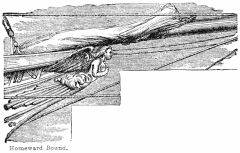
Thursday, May 3rd.—The wind kept on increasing, and at last blew quite a gale. We have gone a long way out of our course to the northward, ready for a favourable change, but we can scarcely make any way to the westward.
Friday, May 4th.—A repetition of yesterday—,
Beating, beating all the day, But never a bit ahead.
Saturday, May 5th.—A lull at last, and we are able to have the fires lighted and to steam on our course. We made the Island of Scarpanto in the morning. All the afternoon and evening we have been steaming along ten miles to the southward of Crete. Its outline was very beautiful, surmounted by the snow-capped mountains. I was up on deck just in time to behold the most lovely sunset, with exquisite rosy, purple, and crimson tints on sea and sky.
I have not quite got over my attack in Cairo yet, and for the last three days have been completely laid up with a various mixture of land illness and sea sickness. We stopped steaming late in the day, but fires were lighted again in the middle of the night, as the wind was still ahead. There was a discussion whether or not to go round the north side of the Island of Kandia, so as to have a glimpse of the British Fleet at anchor in Suda Bay, if they have already arrived there.
Sunday, May 6th, and Monday, May 7th.—Early in the morning the snowy mountains of Crete were still in sight. Service was held as usual at eleven, but it was too rough in the afternoon for it to be repeated.
Sail and steam, wind and calm, alternated with one another all day. Tom is anxious to sail every mile he can, and yet not to lose any unnecessary time, and finds it exceedingly difficult to combine these two objects.
Tuesday, May 8th.—A fine morning, with a cold strong head breeze. At noon we rejoiced to think that Malta was not more than a few miles ahead, or we should assuredly have failed to reach our port before nightfall. About three we closed in with the land about Marsa Scirocco and Delamara Point, and, after one or two tacks, rounded the Point of Ricasole, and leaving Port St. Elmo on our right, we swiftly glided into the grand harbour of Valetta. We have been here so often that it feels quite like reaching home. We soon found ourselves in our old quarters in the Dockyard Creek, and had scarcely moored before one of the officers came on board with the usual complimentary offers of assistance, whilst directly afterwards came an invitation to a farewell ball at the Palace, given to the Duke of Edinburgh. Our old boatman, Bubbly Joe, took us ashore to dinner, and we found everything looking as bright and cheerful and steep as it always does and always will do; not the least bit altered or modernised. The landlord of the Hôtel d'Angleterre was delighted to see us again, and so were his servants, who came flocking from all parts of the house, nearly pulling the children to pieces, and plying our own servants with questions in their anxiety to know all about us.
Faldetta, Malta View full size illustration.

We had to go back on board the yacht to dress, and then return for the ball, by which time I was so thoroughly tired, and had so bad a headache, that I could not enjoy it much, pleasant as it was. Very soon after supper we came away and had a charming row across the harbour to our snug quarters on board the 'Sunbeam.' These sudden bursts of dissipation on shore are a delightful change after days and weeks at sea.
Wednesday, May 9th.—I was up soon after sunrise and admired this often-abused creek as much as I always do. The stone houses, the carved and coloured verandahs of bright flowers, the water lapping the very door-steps, the gaily painted boats with their high prows at either end, the women in their black dresses and faldettas, and black-robed priests, all helped to carry the imagination over the Mediterranean and up the Adriatic to lovely Venice. At this hour in the morning there were not many English soldiers or sailors to spoil the illusion.
Malta is essentially a border-land—African by geographical configuration, European politically, and assuredly Asiatic in its language, its buildings, and in the manners and customs of the natives. We gave everybody on board a holiday, and the chance of a run ashore to-day to stretch their legs after their long sea voyage. Tom went on board the 'Sultan' to see the Duke of Edinburgh and his splendid ship. Whilst at breakfast I received an intimation that the Duke of Edinburgh wished to come and examine the yacht. His Royal Highness arrived soon afterwards, quite unattended, in a beautiful ten-oared barge, and paid us a long, visit, inspecting the yacht minutely and looking at all the pets. He took a great interest in our voyage and courses, as well as in the numerous curiosities, knowing at once from what place each had been procured. The Duke, who had taken very nearly the same cruise himself in the 'Galatea' a few years ago, inquired very kindly after all his old friends at Tahiti, Hilo, Honolulu, and many other places. The Duke is very kind to everybody here. He is much liked by his brother officers in the squadron, and both H.R.H. and the Duchess seem to have made themselves most popular here during the winter. The officers of the 'Sultan,' several of whom are old friends of ours, appear to think themselves fortunate indeed in having such a commanding officer, whilst on shore his approaching departure is universally regretted. Everybody seems full of their Royal Highnesses' winter ball, which must have been a most brilliant affair.
Armoury in the Governor's Palace, Valetta View full size illustration.
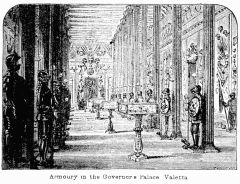
After the Duke's departure we went ashore again, called on various friends before luncheon, and went over the palace and through the armoury. Then we took a walk down the Strada Reale, the shopping street of Valetta, until it was time to go on board to receive some friends to tea. The shops are full of coral, lace, gold and silver filigree work, and a new sort of lace they make in Gozo, of white silk, in beautiful patterns. It has been manufactured only during the last few years, and varies much in quality and design. Some forty or fifty friends came on board and amused themselves looking at our curiosities and photographs until long past the dinner hour. We had to hurry on shore to dine, and go afterwards to the Opera Manoel. The new Grand Opera House is not to be opened until next October. It had been blowing fresh and strong from the westward all day, but to-night, as we rowed across the harbour, the breeze had dropped to a flat calm, and Tom is most anxious to be off at daybreak.
Thursday, May 10th.—I was up before sunrise. A fresh fair wind was blowing, and as soon as the children could be got ready we all went ashore to the market, which was crowded with people, and full of fish, meat, and all spring vegetables and fruit. We were to start at 6.30, so there was no time to lose, and laden with lovely bouquets of flowers we hastened on board; but it was nine o'clock, after all our haste, before we were fairly off, through some mistake about the bill of health.
Malta is certainly the most delightful place for yachting winter quarters, with its fine healthy harbour, charming society, very cheap living, and abundance of everything good. It is in proximity to many pleasant places, and most interesting excursions can easily be made to Sicily and Italy, or the coast of Africa. To-day we glided along the coast, past the strongly fortified little island of Consino, standing boldly out in mid-channel between Malta and Gozo. The Mediterranean appears to us a highway after the lonely oceans and seas we have been sailing over. Within one hour this morning, we saw more ships than in the whole of our passage from Valparaiso to Tahiti and Yokohama. Towards the evening we could see the island of Pantellaria in the distance. We retain a lively remembrance of it from having been becalmed just off it in the 'Albatross' for three weary days and nights. It was after this and a long series of other vexations and delays that Tom and I registered a vow never to go a long voyage again in a yacht without at least auxiliary steam power.
Friday, May 11th.—At 2.30 a.m. Pantellaria was abeam. At five the homeward-bound P. and O. steamer passed us quite close, and at six we met the outward-bound P. and O. steamer. At eight we passed Cape Bon and sailed across the mouth of the Bay of Tunis, in the centre of which is Goletta, the port of Tunis, the site of the ancient city of Carthage. Once we anchored close by that place for two or three days, and on that occasion I collected enough varieties of marble and mosaic from the old palaces to make some beautiful tables when we got home. In the afternoon and evening we made the Fratelli and the Sorelle Rocks, and still later the little Island of Galita. There were many steamers going in all directions, and it struck one very forcibly how much this little islet in mid-channel stands in need of a light.
Sunday, May 13th.—The wind was dead ahead, and the sea of that remarkably confused character for which the Mediterranean is famous. It seemed as if the wind of yesterday, the wind of to-morrow, and the wind of to-day, had all met and were bent on making a night of it. We had service at eleven and four. The chart, now a good old friend, for it has been used by us on so many Mediterranean voyages, showed that this is the fourth noontide we have spent within a radius of thirty miles of this particular spot; within a radius of sixty miles we have spent at least three weeks of our lives at various periods. This does not of course include voyages in steamers which are not recorded in the chart.
Monday, May 14th.—About breakfast time to-day we crossed the meridian of Greenwich; and this virtually completed our voyage round the world, our original point of departure having really been Rochester, which is a few minutes to the east of Greenwich. The wind changed in the middle of the day, and we passed through a large fleet of merchantmen hove-to under shelter of Cape de Gat, where they had collected, I suppose, from various ports in Spain and Italy.
Tuesday, May 15th.—This was a somewhat sad day, many of our pets dying from the effects of the cold wind or from accidents. The steward's mocking-bird from Siam, which talked like a Christian and followed him about like a dog, died of acute bronchitis early this morning; and his monkey, the most weird little creature, with the affectionate ways of a human friend, died in the afternoon, of inflammation and congestion of the lungs. Two other monkeys and several birds also expired in the course of the day.
This evening 'Beau Brummel,' the little pig I brought from Bow Island, in the South Pacific, died of a broken spine, as the doctor, who made a post-mortem examination in each case, discovered. A spar must have dropped upon poor piggy accidentally whilst he was running about on deck, though of course no one knew anything about it. I am very sorry; for though I must confess he was somewhat greedy and pig-like in his habits, he was extremely amusing in his ways. He ran about and went to sleep with the pugs, just like one of themselves. Besides, I do not think any one else in England could have boasted of a pig given to them by a South-Sea-Island chief. Probably 'Beau Brummel' was a lineal descendant of the pigs Captain Cook took out in the 'Endeavour.'
The bodies were all placed together in a neat little box and committed to the deep at sunset, a few tears being shed over the departed pets, especially by the children.
Tuesday, May 15th.—Cape de Gat was abeam early this morning. The wind fell light, but Tom hoped it would freshen again; otherwise, with steam we might easily have got into Gibraltar to-night. As it was, fires were not lighted until ten o'clock.
Wednesday, May 16th.—At 3 a.m. I was called to see the light on Europa Point, and stayed on deck to watch the day dawn and the rising of the sun. It was not, however, a very agreeable morning; the Levanter was blowing, the signal station was enveloped in mist, the tops of the mountains of Africa were scarcely discernible above the clouds, and Ceuta and Ape's Hill were invisible. Algeciras and San Roque gleamed white on the opposite shore of the bay, while the dear old Rock itself looked fresher and cleaner than usual, exhaling a most delicious perfume of flowers. As the sun rose, the twitterings of the birds in the Alameda sounded most homelike and delightful.
We had dropped our anchor inside the New Mole about 4.30, and before six the familiar sounds of English martial music could be heard from all the different barracks, as the regiments came marching down the hill and along the Alameda to the north front with all their baggage, military trains, tents, and ambulances, for a day's camping out. We were anxious to get on shore to see about coals, water, and provisions, but no health-boat came near us. About seven o'clock we started in despair, first to hail a policeman on shore (at a most respectful distance), to inquire where we could get pratique; then we procured it, and sent word back to the 'Sunbeam' that she was out of quarantine, and might hoist the yellow flag. We landed, went to the market, bought some lovely carnations stuck in a prickly-pear leaf to keep them fresh, and then went to the Hôtel Royal—kept by the landlord of the old Club House Hotel, where we had so often stayed—to order breakfast. Our old friends the servants greeted us at every step from the house-door to the coffee-room, and we were taken special care of by a waiter who remembered us. After breakfast we went to pay some visits. We thought we ought to go and look at the galleries and Signal Station, as one or two of our party had never been here before; so we started, some on foot and some on donkeys. All the way up the steep streets to the Moorish castle, girls met us, selling lovely scarlet carnations and yellow roses. The galleries have not changed in the least since our last visit, but our soldier-guide told us they were daily expecting some big guns to come out, and he gave us a minute explanation how they were to be mounted. It was a pleasant ride, neither too hot nor too cold. Every crevice and interstice between the rocks was full of wild flowers, looking bright and pretty, though somewhat insignificant after the gorgeous tropical blossoms our eyes have been lately accustomed to. The fog had cleared off, and the view was beautiful; ships lay in the bay below us from all parts, including a Portuguese gunboat. We saw also one of the two old eagles sitting near her nest in the accustomed place; this year she has only one young one. We did not see the monkeys, on account of the Levanter, but their number has increased to twenty-four, so that there is no immediate fear of their becoming extinct.
Tangier View full size illustration.
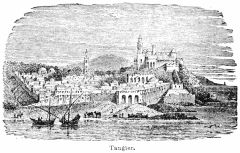
At half-past six p.m. we weighed anchor and steamed out of the anchorage inside the New Mole. In the straits the wind was fair, so the funnel was soon lowered, and the screw feathered, and we were racing along under sail alone. Off Tarifa we found quite a gale blowing, and the wind continued fresh and fair throughout the night.
Thursday, May 17th.—The strong fair wind dropped, and then came dead ahead, and off Cadiz we had to get up steam. There was a strong wind off the mountains near Cape Sagres, and while Tom was below and the men were busy reefing the sails, we nearly ran ashore. Luckily I noticed our danger and called Tom, who came up just in time to alter the helm, when the yacht went round like a top, though the shore was too close to be pleasant. It only shows how easily an accident may occur. Both our fishermen-mates could not bear to be idle, and always considered looking out an insignificant occupation, and so neglected that important duty to assist with the sails.
Off Cape St. Vincent it blew so hard that we were afraid we should be obliged to bring up in the bay of Sagres; but we found that it was only a land breeze, and that it was much smoother outside than we had expected.
Friday, May 18th.—Fresh breeze. We met many steamers going down the coast with all sail set. After passing Cape Espichel the wind increased to a northerly gale, against which it was impossible to proceed. We therefore put into Lisbon. The mountains at the mouth of the Tagus, the tower and church of Belem, and the noble river itself looked even more beautiful in the sunset than my recollection led me to expect. We soon landed and had an excellent dinner at the Hotel Braganza, where we had stayed before, and where we were at once recognised and cordially received by the same landlord and landlady we remembered in 1861.
After dinner we went for a walk. One of the things we saw during our stroll was the fine statue of Luiz de Camoens, specially interesting to us, as we had so recently seen the place where he passed many of the weary years of his exile. Rolling Motion Square was as giddy as ever. It was a curious fancy to pave it in such a way as to make it look like the waves of the sea, perpetually moving; and it must be a severe trial to the peripatetic powers of those who have not quite recovered their sea legs.
Saturday, May 19th.—We were off early; it was a lovely day, and we had a pleasant drive to Cintra. On our arrival we mounted donkeys and went to Peña, the beautiful palace of the ex-King Ferdinand, situated at the top of the mountains. It is an extraordinary-looking place, the different parts being built in every imaginable style of architecture, with exquisite carving and old tiles that would delight the heart of a connoisseur. One of the most prominent objects near the Palace of Peña is the statue of Vasco da Gama, nobly placed on a pedestal of natural rocks, piled on the summit of a mountain peak, and worthy of the adventurous traveller it is erected to commemorate. The gardens are full of camellias, roses, bougainvillea, &c. We lunched at the excellent hotel, and came to the conclusion that Cintra is the place, not only 'to spend a happy day,' but many happy months. It is always pleasant to revisit places of which you have agreeable reminiscences, and to find your expectations surpassed instead of disappointed.
Vasco da Gama View full size illustration.
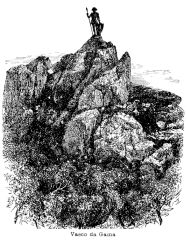
We had a hot drive back to Lisbon, and then went by tram to Belem, where we spent some time in the church and in wandering through its exquisite cloisters. The first stone was laid in 1500, and the name changed from Bairro de Restello to Belem or Bethlehem by Prince Henry of Portugal, the great promoter of maritime discovery in that century. It was built specially to commemorate the successful voyage of Vasco da Gama, who returned from the discovery of India in 1499.
Belem Cloister Gardens View full size illustration.
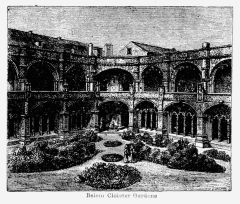
Tom met us with the yacht, and, we went on board with the intention of proceeding straight to sea. But after passing through the Canal del Norte a heavy gale obliged us to anchor in Cascaes Bay for the night, not far from a small schooner yacht with three ladies on board. It was rather rough, and we were very tired, or I think we should have ventured to pay them a visit, even at that late hour. It is absurd to stand upon ceremony when travelling; but I scarcely know what the strict etiquette would be on such an occasion—whether they, as first anchored in the bay, should call on us, or we on them, as probably the greater travellers and out longer at sea.
Sunday, May 20th.—Weighed at 5 a.m. There was a dense fog off Cape del Roca, and the steam-whistle, foghorns, and bell were constantly kept going, with lugubrious effect. We had service at eleven and 4.30. Passed the Burlings at 1.30. Heavy swell all day.
Monday, May 21st.—Rough and disagreeable. Off Viana at noon. Passed Oporto and Vigo in the course of the afternoon.
Tuesday, May 22nd.—If yesterday was bad, to-day was worse. We hove to for some time under the shelter of Cape Finisterre, then went on again for a short distance; but at 1.30 a.m. on the 23rd we were obliged to put round and wait for daylight.
Wednesday, 23rd, and Thursday, 24th.—In the course of the day the weather mended, though the sea still continued rough, and our course was really in the direction of America rather than England. In the evening of the 24th we were able to light fires, and, with the assistance of steam, to keep nearly on our proper course.
Saturday, May 26th.—Saw the first English land, the Start, at 2.30 a.m. Wind continued fresh and fair, but at noon dropped calm, and we had to steam through the Needles instead of sailing, as we had done on our way out. We reached Cowes about 3 p.m., and were immediately welcomed by several yachts, who dipped their ensigns and fired their guns. We landed, and were warmly greeted by many friends, and, after sending off telegrams and letters, re-embarked and proceeded towards Hastings. We were anxious to land by daylight, but this was not to be. So it turned out to be midnight before we reached Beachy Head and could discern the lights of Hastings shining in the distance. As we drew near to our anchorage we could see two boats coming swiftly towards us from the shore. The crews were members of the Royal Naval Artillery Volunteers, and as they came alongside they raised a shout of welcome. Hastings had been expecting us all the afternoon, and late as was the hour, 1.30 a.m., we were immediately surrounded by a fleet of boats, and many willing hands seized our heterogeneous cargo and multitudinous packages, and before daylight all had been safely landed on the pier. We committed ourselves to the care of the R.N.A.V., and landed in their boats, and at 4.30, proceeding to the Queen's Hotel, we had a joyous meeting with T.A.B. and Maud.
Our Welcome back off Hastings View full size illustration.
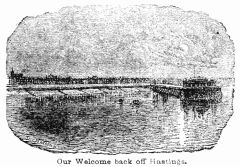
How can I describe the warm greetings that met us everywhere, or the crowd that surrounded us, not only when we landed, but as we came out of church; how, along the whole ten miles from Hastings to Battle, people were standing by the roadside and at their cottage doors to welcome us; how the Battle bell-ringers never stopped ringing except during service time; or how the warmest of welcomes ended our delightful year of travel and made us feel we were home at last, with thankful hearts for the providential care which had watched over us whithersoever we roamed?
I travell'd among unknown men, In lands beyond the sea, Nor, England! did I know till then What love I bore to thee.
Home at Last View full size illustration.
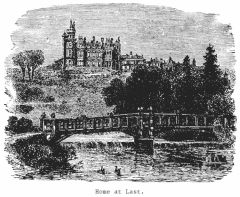
APPENDIX.
SUMMARY OF THE ENTIRE VOYAGE.
COMPILED FROM THE LOG-BOOK.
July 1876.
July Remarks Temp. of water Temp. of air Latitude Longitude Since previous noon
Course Distance Wind and weather
Steam Sail
6 Left Cowes, I. of W. F ° ... F ° ... ° ' ... ° ' ... Various ... ... ...
7 Arrived at Torbay at 8.30 a.m. ... ... ... ... " ... 113 ...
8 Left Torbay at noon ... ... ... ... " ... 8 ...
9 ... ... ... ... 48 45 N 4 46 W " 8 107 ...
10 ... ... ... ... 46 27 N 6 50 W " 99 62 ...
11 Cape Villano, 69 miles, at noon ... ... 44 16 N 9 10 W SW, ¾° W ... 164 ...
12 Madeira, 513; Torbay, 672 miles ... ... 40 29 N 11 1 W SW by S ... 227 ...
13 Madeira, 375 miles ... ... 38 24 N 12 21 W SW 98 36 NNE 26 c.
14 Madeira, 246 miles ... ... 36 36 N 13 58 W SW, ¼° W 40 90 SE 2
15 Porto Santo, 90 miles ... ... 34 25 N 15 35 W S, 33° W 29 123 NNE 2. Foggy
16 Arrived at Madeira (Funchal) at noon ... ... ... ... S, 31° W 79 57 NE 3
19 Left Madeira at 9.25 p.m. 72 ... ... ... ... ... ... ...
20 Tenerife, 163 miles 73 67 31 11 N 16 45 W S, 30° E 20 67 NE 3 to 5
21 Arrived at Puerto Orotava at 2.30 p.m. 70 69 28 38 N 16 42 W S, 2° E 144 15 ...
24 Left Puerto Orotava, Tenerife, at noon ... ... ... ... ... ... ... ...
25 ... ... 72 70 26 53 N 19 11 W ... 20 173 ...
26 ... ... 72 75 24 45 N 21 0 W S, 37° W ... 161 ...
27 ... ... 72 74 22 27 N 23 4 W S, 39° W ... 180 ...
28 ... ... 73 71 19 48 N 24 14 W S, 22° W ... 172 ...
29 ... ... 75 77 17 26 N 24 55 W S, 16° W ... 148 ...
30 Arrived at Tarafal Bay, St. Antonio, 9 a.m.; left 6 p.m. 75 75 ... ... Various 15 52 ...
31 ... ... 78 73 14 45 N 25 26 W ... 120 12 NE 3
Average temperature for the month 73.2° 72.33°
August 1876.
Aug. Remarks Temp. of water Temp. of air Latitude Longitude Since previous noon
Course Distance Wind and weather
Steam Sail
1 ... ... F ° 79 F ° 74 ° ' 11 59 N ° ' 25 9 W S, 5° E 159 13 Calm
2 ... ... 78 74 9 10 N 24 46 W S, 7° E 163 ... SW by W 2
3 ... ... 79 75 7 42 N 21 38 W S, 57° E 160 27 SSW 7
4 Sierra Leone, 289 miles 79 74 7 16 N 18 34 W S, 84° E ... 241 S to SSE 6-7
5 ... ... 79 75 5 48 N 20 30 W S, 53° W ... 139 S4
6 The warm Guinea and Equatorial currents extend to about 7° N, and the latter to about 5° S, of the Equator 79 74 3 58 N 22 6 W S, 42° W ... 156 S by E 5 to 6
7 ... ... 74 71 1 52 N 24 5 W S, 43° W ... 179 S 4 to 5
8 St. Paul's Rock, 250 miles. Crossed Equator at 10.30 a.m. 75 72.3 0 56 S 26 34 W S, 42° W ... 225 SE 6 to 7
9 ... ... 78 74 4 23 S 28 42 W S, 32° W ... 243 SSE, ESE 7
10 Pernambuco, 270 miles 78 73.8 7 35 S 30 19 W S, 24° W ... 211 SE 6
11 ... ... 77 71.5 10 11 S 32 26 W S, 39° W ... 200 SE 4 to 5
12 Bahia, 300 miles 74 71.3 13 1 S 33 51 W S, 28° W ... 196 SE 5
13 ... ... 74 71 15 42 S 35 51 W S, 37° W ... 202 SE by S 5
14 ... ... 74.3 70.7 17 25 S 37 31 W S, 43° W ... 141 NNE 4
15 ... ... 73 69.5 19 58 S 38 1 W S, 11° W ... 155 NEly 5
16 ... ... 66 67 22 37 S 40 39 W S, 45° W ... 225 NE 5
17 Arrived at Rio de Janeiro at 6.15 p.m 64.5 65 23 53 S 42 50 W ... 87 82 WSW 6 to 9
Average temperature for the month 75.3° 71.94°
September 1876.
Sept. Remarks Temp. of water Temp. of air Latitude Longitude Since previous noon
Course Distance Wind and weather
Steam Sail
5 Left Rio de Janeiro at 6 a.m. F ° ... F ° ... ° ' ... ° ' ... ... 36 ... SSW 2 to 3
6 ... ... 70 64 24 56 S 45 40 W ... 120 32 NE 5
7 ... ... 67 65 26 50 S 47 34 W ... ... 136 NE 8
8 ... ... 68 67 30 30 S 49 4 W S, 16 ° W ... 243 NE 8 to 9
9 Lobos, WSW, 160 miles 57 57.5 34 18 S 51 43 W S, 31 ° W ... 270 SW 4
10 ... ... 57 58 31 48 S 54 13 W S, 72 ° W 119 31 S by E 6 to 7
11 Arrived at Monte Video at 4.30 a.m. 60.3 60 ... ... ... 115 ... ...
12 Left Monte Video at 6 a.m. ... ... ... ... ... 119 ... NE 2 to 3
13 Arrived off Buenos Ayres at 10 p.m. ... ... ... ... ... ... ... ...
27 Left Buenos Ayres at 11.30 a.m. 62 60.3 ... ... ... ... ... ...
28 Rescued crew of 'Monkshaven' 53 57.5 36 57 S 55 44 W Various down R. Plate 119 50 WSW to NW 3, WNW 7 to 8
29 ... ... 51.3 57 38 50 S 57 5 W ... 83 53 ...
30 ... ... 52 51.5 41 00 S 59 50 W S, 40 ° W ... 196 NW by W 6
Average temperature for the month 59.7 ° 59.78 °
October 1876.
Oct. Remarks Temp. of water Temp. of air Latitude Longitude Since previous noon
Course Distance Wind and weather
Steam Sail
1 ... ... F ° 50.7 F ° 53 ° ' 43 10 S ° ' 62 28 W S, 45° W 103 64 NW by W 6
2 ... ... 49 51 45 33 S 64 0 W S, 39°W 139 31 SW 7 to 8
3 ... ... 46 49 48 31 S 65 9 W S, 15°W 65 116 W by S 6
4 ... ... 43.5 42.5 49 25 S 67 17 S ... 122 14 SE by S 6
5 Off Cape Virgin at noon. Arrived at Possession Bay at 7.45 p.m. 43.5 44 52 20 S 68 17 W ... 185 ... N by E4
6 Left Possesion Bay at 6 a.m. Arrived at Sandy Point at 2.30 p.m. ... ... 52 45 S 70 20 W ... 95 ... Light airs, SW6
8 Left Sandy Point at 6 a.m. Arrived at Borja Bay Straits of Magellan, at 6.30 p.m. 46 46.2 53 53 S 71 17 W Various 105 ... SE and E 3 to 4
9 Left Borja Bay at 6.30 a.m. Arrived at Otter Bay at 6.55 p.m. 45.8 45.8 52 22 S 73 40 W " 105 ... ...
10 Left Otter Bay at 5 a.m. Arrived at Puerto Bueno at 5.30 p.m. 49 48.7 51 0 S 74 12 W " 95 ... ...
11 Left Puerto Bueno at 5 a.m. Arrived at Port Grappler at 7 p.m. 49 50 49 26 S 74 20 W " 105 ... ...
12 Left Port Grappler at 5 a.m. 51 51 ... ... " 60 ... Calm and light southerly winds
13 ... ... 52 51.8 46 0 S 76 23 W " 150 25 NEly 5 to 3
14 ... ... 53.7 52.8 44 55 S 76 46 W N, 14°W ... 67 SW 2 to 3
15 ... ... 56 55 42 47 S 76 3 W N, 14°E 100 32 Calm, S by E 1-2
16 ... ... 57.8 57.5 39 52 S 74 42 W N, 20°E 152 37 S by E 2 to 3
17 ... ... 59 58.2 39 0 S 74 38 W N, 52°E 28 63 NW by W 4 to 5
18 Arrived at Lota, Chilli, at 9 a.m. ... ... ... ... Various 144 ... Calm & light airs
19 Left Lota at 2 p.m. 57 ... ... ... ... ... ... NW by W 6
20 Valparaiso, 195 miles 60.2 57.9 36 5 S 72 59 W ... ... 65 S by W 5 to 6
21 Arrived at Valparaiso at 4 p.m. ... ... 33 18 S 72 19 W ... ... 211 S by W 6
30 Left Valparaiso at 3 p.m. ... ... ... ... ... ... ... Light airs and calms
31 ... ... 62.1 61 32 34 S 72 58 W N, 73°W ... 81 NW by N 5
Average temperature for the month 51.7° 51.5°
November 1876.
Nov. Remarks Temp. of water Temp. of air Latitude Longitude Since previous noon
Noon 6 p.m. Noon 6 p.m. Course Distance Wind and weather
Steam Sail
1 In S. Pacific Ocean F ° 63.3 F ° ... F ° 61.2 F ° ... ° ' 31 30 S ° ' 72 55 W N, 64° W ... 112 W by N 3 to 4
2 Ditto Ditto 65.6 ... 62.3 ... 30 54 S 74 9 W N, 61° W ... 111 S 3
3 Ditto Ditto 67.3 ... 63.5 ... 29 11 S 76 15 W N, 46° W ... 151 SSE 6
4 Ditto Ditto 68.3 68.2 64.2 64 27 45 S 78 55 W N, 59° W ... 167 SE 3
5 Ditto Ditto 71.8 69.3 66 65.3 26 54 S 80 48 W N, 63° W ... 113 SE 3
6 Ditto Ditto 71.5 69.7 68 66 25 52 S 83 10 W N, 64° W ... 140 ESE 3
7 Ditto Ditto 71 70 68.8 66.3 24 47 S 85 51 W N, 66° W ... 163 NE by E 3
8 Ditto Ditto ... ... ... ... 23 47 S 86 58 W N, 46° W ... 107 NNW 2. Calms
9 Ditto Ditto 72 72.3 68 68.2 21 28 S 88 27 W N, 31° W 144 18 ESE 4
10 Ditto Ditto 72.3 72 74 69 19 12 S 89 48 W N, 29° W ... 166 E by S 6
11 Ditto Ditto 73 71.3 69.5 68.8 17 19 S 91 42 W N, 44° W ... 156 ESE 6
12 Ditto Ditto 73 72.3 71 70 16 53 S 94 43 W S, 82° W ... 178 ESE 4 to 6
13 Ditto Ditto 74.3 73.2 71 70.5 16 56 S 98 17 W S, 89° W ... 215 ESE 7
14 Ditto Ditto 73.5 73.8 71.3 71 17 6 S 102 11 W S, 87° W ... 217 E 6
15 Ditto Ditto 76 76 72.8 71.7 16 44 S 105 57 W N, 86° W ... 217 ENE 6
16 Ditto Ditto 77 75.8 73 73 17 0 S 109 16 W S, 85° W ... 199 ENE
17 Ditto Ditto 77.8 77.5 76.2 75.0 17 16 S 112 0 W S, 84° W ... 159 E to N 5
18 Ditto Ditto 79 77.8 75.2 73.5 16 18 S 114 52 W N, 70° W ... 173 E 5
19 Ditto Ditto 79 78.2 78 76 15 38 S 117 52 W N, 77° W ... 180 ...
20 Ditto Ditto 80.2 79.3 77 76.5 15 19 S 120 17 W N, 82° W ... 139 ENE 3
21 Ditto Ditto 80 79 78 76.3 15 25 S 122 18 W S, 87° W ... 121 ENE 3 to 4
22 Ditto Ditto 81 79.8 78.2 77 15 21 S 124 20 W N, 88° W ... 123 NE by E 3 to 4
23 Ditto Ditto 81.2 80.2 78 77 15 4 S 126 40 W N, 83° W ... 141 NE 3
24 Ditto Ditto 81 81 79.2 77 15 18 S 129 12 W S, 85° W ... 153 NNE 3
25 Ditto Ditto 81 80.2 78 77.8 15 27 S 132 12 W S, 86° W 160 21 E 2
26 Ditto Ditto 82.2 81.5 80.7 78.3 15 47 S 135 20 W ... 142 35 ESE 4
27 Ditto Ditto 81 80.5 79 78 16 54 S 138 9 W ... 156 32 ...
28 Stopped at Bow Island. Low Archipelago, for 3 hours 81.8 81.6 80 79.6 17 55 S 140 43 W S, 56° W 20 148 ESE 4 to 5
29 ... ... 81.7 81 79.5 77 18 41 S 143 7 W ... 10 152 SE 4 to 5
30 ... ... 81.3 81 80 79.3 18 20 S 145 57 W N, 79° W ... 162 NE 4 to 5
Average temperature for the month 76.3° 73.3°
December 1876.
Dec. Remarks Temp. of water Temp. of air Latitude Longitude Since previous noon
Noon 6 p.m. Noon 6 p.m. Course Distance Wind and weather
Steam Sail
1 Landed at Maitea at 10 a.m. Left at 3:30 p.m. F ° ... F ° ... F ° ... F ° ... ° ' 17 53 S ° ' 147 55 W W, ¼° N ... 139 NE 4 to 3
2 Arrived at Tahiti at 8 a.m. ... ... ... ... ... ... ... 17 98 NE to NW, 5 to a calm
8 Left Tahiti at 6 p.m. ... ... ... ... ... ... ... ... ... ...
9 ... ... 82.3 82 80 79 15 28 S 149 24 W ... 101 24 ENE and E 5
10 ... ... 82.5 82 80.3 79 13 31 S 149 45 W N, 10° W ... 124 NE by E 3 to 7
11 ... ... 83.3 82.5 81 79.2 11 0 S 150 3 W ... ... 155 NE and NE 5
12 ... ... 83.6 81 79.4 79 9 10 S 149 48 W N, 8° W ... 151 NE 4 to 5
13 ... ... 83 82 80.2 78.5 5 34 S 150 45 W N, 15° W ... 224 NE 5
14 Crossed Equator at 4.30 a.m. 81.5 80 80 77.8 2 12 S 152 18 W N, 24° W ... 221 NE 5
15 ... ... 81.5 81 80.7 79 1 10 N 152 3 W N, 4° E ... 203 NE by E 5, SE 6
16 ... ... 81.2 81 78.3 78 3 15 N 151 26 W N, 17° E 22 109 SE 5
17 To Hilo, 885 Miles 81.5 82.3 79.8 78.2 5 28 N 150 16 W N, 58° E 136 15 In Doldrums
18 ... ... 83 82 79.7 78 7 54 N 150 36 W , 11° W 48 105 NE 5 to 7
19 ... ... 81 80 77.5 77 10 22 N 152 37 W , 22° W ... 160 ...
20 ... ... 79.5 79 77.3 77 13 43 N 152 43 W N, 18° W ... 212 NE 7
21 ... ... 78.2 78 74 73.8 16 28 N 153 28 W N, 5° W 26 145 Lost NE Trades in heavy showers
22 Arrived at Hilo, Hawaii, at 3.30 p.m. 77.2 ... 74.5 ... 19 44 N 155 4 W N, 25° W 202 38 ...
26 Left Hilo at 5.15 p.m. ... 77.8 ... 74.3 ... ... ... ... ... ...
27 Arrived at Honolulu, Oahu, at 5.15 p.m. 78 ... 76 ... 20 42 N 157 20 W Various 200 ... ...
Average temperature for the month 80.1° 78.4°
January 1877.
Jan. Remarks Temp. of water Temp. of air Latitude Longitude Since previous noon
Noon 6 p.m. Noon 6 p.m. Course Distance Wind and weather
Steam Sail
3 Left Honolulu at 5 p.m. F ° ... F ° ... F ° ... F ° ... ° ' ... ° ' ... ... ... ... ENE 4
4 ... ... 78.2 77.8 78.1 76 20 10 N 159 50 W S, 59° W 65 70 E by S 6 to 8
5 ... ... 78 77.7 76.8 76.6 20 4 N 164 5 W W ... 240 SE by S 8
6 ... ... 79.3 78.1 78.5 77.8 20 3 N 168 53 W W ... 253 S by E 7 to 9
7 ... ... 79 77 74.2 74 19 31 N 169 35 W S, 60° W ... 120 N ½, W 9
8 ... ... 78.2 77.8 73.2 71.5 17 15 N 173 8 W S, 59° W ... 244 N by E 9
9 ... ... 79.8 78 74 71.7 16 44 N 177 15 W S, 82° W ... 240 E by S 2
10 ... ... 79.8 79.5 76 74.2 17 15 N 179 6 W N, 74° W 20 92 Calms
11 180° longitude ... ... ... ... ... ... ... ... ... ...
12 ... ... 80.2 80 77.8 75.5 17 16 N 178 28 E W 102 38 S by E 4
13 ... ... 80.3 79.8 78.2 75.2 17 19 N 176 29 E W ... 115 NE 3
14 To Yokohama, 2,700 miles 80 79.8 75.2 75 16 1 N 173 25 E S, 66° W 98 96 NNE 10
15 ... ... 80.2 80 73.8 73.5 16 2 N 168 15 E W ... 298 NE 9
16 ... ... 80.1 79.7 75 74.2 16 38 N 163 47 E N, 82° W ... 260 ENE 7
17 ... ... 79 78.2 76 75 17 3 N 159 37 E N, 84° W ... 240 ENE 6
18 ... ... 79.8 79 76 75.2 17 36 N 155 40 E N, 82° W ... 229 ENE 4
19 ... ... 79 78.4 77 75.2 18 16 N 153 11 E N, 74° W ... 148 NNE 2
20 ... ... 79.2 78 76 75 18 57 N 150 23 E N, 75° W 151 13 N by W 3
21 ... ... 78.2 77.2 73.5 72.3 19 36 N 147 19 E N, 77° W 128 50 N by W to NNW 4 to 5
22 ... ... 77.5 76.3 67.5 66 20 7 N 144 5 E N, 81° W ... 185 NNE 8 to 7
23 ... ... 71 70 62.5 61.5 21 52 N 141 39 E N, 52° W ... 172 NNE 5 to 3
24 ... ... 68.5 68 61.5 59.2 23 33 N 139 29 E N, 50° W ... 158 NE 7 to 6
25 ... ... 68 67.8 59 59 26 12 N 138 10 E N, 24° W ... 174 ESE 3
26 ... ... 65.5 64.5 61 59.5 29 23 N 137 33 E N, 10° W 100 94 W 9 to 10
27 ... ... 63.5 64.2 51.5 51 30 59 N 137 49 E N, 8 E ... 94 NWly 3 to 4
28 ... ... 64 63.2 48.2 46 32 40 N 138 35 E N, 21° E ... 108 W by N 7
29 Arrived at Yokohama at 3.30 p.m. 63 52 ... 41.2 ... ... Various 60 121 Gale
Average temperature for the month 76.8° 69.7°
February 1877.
Feb. Remarks Temp. of water Temp. of air Latitude Longitude Since previous noon
Noon 6 p.m. Noon 6 p.m. Course Distance Wind and weather
Steam Sail
2 Left Yokohama at 6.30 p.m. F ° ... F ° ... F ° ... F ° ... ° ' ... ° ' ... Various; steering along the South Coast of Japan ... ... ...
3 ... ... 53 52 41.2 41 ... ... 122 ... NW 3
4 Arrived at Kobe at 7 p.m. 58 46 40 35.5 ... ... 178 ... NNE 9
12 Left Kobe at 6 a.m. and returned at 2 p.m. ... ... ... ... ... ... 40 ... ...
15 Left Kobe at 4.30 a.m. and anchored at Ino Ura at 8.30 p.m. 46.1 45 33 32.5 ... ... 90 ... W 9
16 Left Ino Ura at 5 a.m. 49.5 50 39 37.5 ... ... 110 ... ...
17 Anchored off Isaki lighthouse at 4 a.m. Left the anchorage at 8.30 a.m. and arrived at Simoneseki at 11 a.m. ... ... ... ... ... ... ... 50 ... ...
19 Left Simoneseki at 8.30 a.m. 44.2 58 34 41.3 ... ... ... 40 ... ...
20 ... ... 64 61 51 46.5 31 16 N 131 54 E ... 64 127 NW by W 9 to 6
21 ... ... 69 67 60 59.5 29 7 N 129 49 E SW 183 ... Calm
22 ... ... 68.2 62 67 62 28 13 N 125 53 E WSW 13 208 ESE
23 ... ... 67.3 65.5 65.2 64.2 27 14 N 123 3 E S, 63° W ... 178 SE
24 ... ... 55 55 51.8 49 25 0 N 119 35 E ... 34 183 NE 7 to 10
25 ... ... 61 ... 56.5 ... 22 35 N 115 38 E ... ... 288 NE 10 to 6
26 Arrived at Hongkong at 8 a.m. ... ... ... ... ... ... ... 61 29 ...
Average temperature for the month 56.5° 48°
March 1877.
Mar. Remarks Temp. of water Temp. of air Latitude Longitude Since previous noon
Noon 6 p.m. Noon 6 p.m. Course Distance Wind and weather
Steam Sail
2 Left Hongkong at 7 a.m. Arrived at Macao at 1.30 p.m. Left at 6.30 p.m. F ° ... F ° 64.5 F ° ... F ° 64.3 ° ' ... ° ' ... ... 45 ... ...
8 ... ... 72.5 72.2 72.3 70 20 5 N 113 28 E ... 136 ... ...
9 ... ... 73.8 72 72 68 18 0 N 113 6 E S 48 79 E 3
10 ... ... 78 76.8 73 71.8 15 40 N 113 48 E SSE 20 128 NE 3
11 ... ... 78 78.2 75.5 74.3 13 45 N 112 1 E SW by W ... 155 NE 4
12 ... ... 79 78 76.4 76 11 29 N 110 32 E S, 35° W ... 170 NE 4
13 ... ... 77.7 77.5 78 75.7 9 34 N 108 33 E S, 46° W ... 171 NE 4
14 ... ... 78 77.7 77.6 76.3 7 34 N 107 3 E SW by S ... 150 NE 3 to 4
15 ... ... 79.5 79 78 77 4 46 N 106 16 E S by W, ½° W ... 176 NE 4
16 ... ... 80 80 78 76.3 2 51 N 104 43 E SW, ½° S ... 150 NE 3 to 4
17 Arrived at Singapore at 8 a.m. ... ... ... ... ... ... ... 63 72 NE 3 to 4
18 Left Singapore at 3 p.m. and arrived at Johore at 8 p.m. ... ... ... ... ... ... ... ... ... ...
19 Left Johore at 4 a.m. ... 83.2 ... 79.7 ... ... ... 36 ... Calms and light airs from NE
20 Arrived at Malacca at 8 a.m.; left at 11.30a.m. ... 83.2 ... 79.5 ... ... ... 130 ...
21 ... ... 88 ... 80.5 ... 4 4 N 100 30 E ... 170 ...
22 Arrived at Penang at 8 a.m. left at 10 p.m. ... ... ... ... ... ... ... 99 ...
23 ... ... 83.8 84.5 88.2 81 5 55 N 98 39 E ... 109 ... ...
24 ... ... 84.2 84 82 79 6 10 N 95 5 E ... 212 ... ...
25 ... ... 85 84 84.2 80 6 26 N 91 41 E ... 208 ... ...
26 ... ... 85.2 84 86 81.5 6 25 N 88 25 E ... 198 ... ...
27 ... ... 86 84.2 87 79 6 4 N 85 3 E ... 203 ... ...
28 ... ... 85.2 ... 83 ... 5 33 N 81 29 E ... 218 ... ...
29 Arrived at Point de Galle at 7 a.m. left at 9.30 p.m. ... ... ... ... ... ... ... 85 ... ...
30 Arrived at Colombo at 11 a.m. ... ... ... ... ... ... ... 90 ... ...
Average temperature for the month 79.4° 78.2°
April 1877.
April Remarks Temp. of water Temp. of air Latitude Longitude Since previous noon
Noon 6 p.m. Noon 6 p.m. Course Distance Wind and weather
Steam Sail
5 Left Colombo Ceylon, at 1.30 p.m. F ° ... F ° 85.5 F ° ... F ° 80.8 ° ' ... ° ' ... ... ... ... ...
6 ... ... 85.8 85 83 80.6 7 26 N 77 10 E N, 81° W 165 ... W 1
7 ... ... 86 85 81 78.3 7 31 N 74 7 E N, 88° W 190 ... N 2
8 ... ... 85.8 84.5 81.3 79 8 16 N 70 31 E W 216 ... N 4 to 3
9 ... ... 86 85 79 78 8 50 N 66 59 E W by N 213 ... Calm
10 ... ... 85 83.5 81 78.5 9 38 N 63 32 E N, 77° W 210 ... NE 1 to 2
11 ... ... 83.6 82.5 83 79 10 27 N 60 1 E ... 214 ... ENE 2
12 ... ... 83.8 82.6 82.2 79 11 14 N 56 30 E ... 213 ... ENE 3 to 4
13 ... ... 83.5 82.3 82.5 80 11 38 N 52 57 E N, 83° W 210 ... ...
14 ... ... 83.2 82 82.8 80 12 33 N 49 43 E ... 198 ... E 4
15 Arrived at Aden at 10p.m. 82.8 82 81 79 12 55 N 46 17 E N, 84° W 203 ... ...
16 Left Aden at 7 p.m. ... ... ... ... ... ... ... 80 ... ...
17 Off Island of Perim 82.8 82 83 81.7 ... ... ... ... 105 ...
18 ... ... 82 82.2 83.4 81.5 16 13 N 41 27 E ... ... 230 S 5
19 ... ... 82.5 82 84 83 18 13 N 40 7 E ... 29 116 ...
20 ... ... 83.5 82 84 83.6 20 39 N 38 30 E N, 33° W 149 22 Calms
21 ... ... 86.2 82.3 83.5 82.8 23 33 N 36 50 E N, 30° W 190 ... ...
22 ... ... 78.3 75 82 76 26 18 N 34 55 E ... 200 ... ...
23 ... ... 75.5 74 71.5 74.5 27 13 N 34 5 E NNW 80 ... ...
24 ... ... 71.3 70.2 71.5 74 28 16 N 33 16 E ... 89 27 ...
25 Arrived at Suez at 6 p.m. 70 ... 71.5 ... ... ... ... 22 51 ...
26 Left Suez at 9 a.m. Arrived at Ismailia at 7.15 p.m. 76.5 70 88 83.6 ... ... ... 50 ... ...
27 Left Ismailia at 8 a.m. Arrived at Port Said at 5.30 p.m. left at 9.30 p.m. 76.7 ... 90 ... ... ... Working to windward under steam and sail 50 ... ...
28 ... ... 66.3 64.2 66 64 ... ... 174 ... WNW 5
29 Arrived at Alexandria at 4.30 a.m. ... ... ... ... ... ... 117 ... WNW 9 to 7
Average temperature for the month 82.3 78
May 1877.
May Remarks Temp. of water Temp. of air Latitude Longitude Since previous noon
Noon 6 p.m. Noon 6 p.m. Course Distance Wind and weather
Steam Sail
2 Left Alexandria at 4.30 a.m F ° 68 F ° 65.2 F ° 70 F ° 64.5 ° ' ... ° ' ... WNW 28 2 Calm a.m.
3 ... ... 64 64 65.2 64.3 32 30 N 28 39 E N, 30° W 32 80 Fresh to strong NW winds
4 ... ... 63.8 63.5 64.2 64 34 35 N 28 48 E N, 3° E ... 146 NW 7
5 ... ... 65 64 66 64.2 34 48 N 27 13 E W, ½° S 63 61 NW 7&calms
6 ... ... 63 62.2 66.2 64 34 54 N 23 11 E W 125 75 ESE 7 & calms
7 ... ... 63.6 63 64.3 63.6 35 51 N 19 48 E N, 82° W 46 130 ESE 2
8 Arrived at Malta at 6 p.m. 64 63 64.5 66.2 35 57 N 15 12 E W 199 16 N 4 to 7
10 Left Malta at 8.15 a.m. 64 63 67 66.5 ... ... Various 20 5 S 2 to 1
11 ... ... 67 64 70 66 37 20 N 10 24 E ... 186 7 SE&calm
12 ... ... 64.5 64 69 68.5 37 32 N 6 32 E WNW 192 ... ...
13 ... ... 63 63 67 66 37 7 N 3 3 E S, 82° E 173 ... SW by W 5 to 6
14 ... ... 64 63.2 66.3 65 36 50 N 0 20 E W, ½° S 163 ... ...
15 ... ... 62 62.3 66.2 66 36 31 N 3 43 W W, ½° N 128 35 SE 5
16 Arrived at Gibraltar at 6:30 a.m. left at 7.30 p.m. ... ... ... ... ... ... ... 48 26 ...
17 ... ... 67 67 68.2 69 36 27 N 7 58 W Various 10 130 E 8; calm
18 Arrived at Lisbon at 6.30 p.m. 64 ... 63.8 ... 38 27 N 9 26 W ... 144 6 NNE 5
19 Left Lisbon at 5 p.m., and anchored off Fort St. Julien at 9.15 p.m. ... ... ... ... ... ... ... 40 ... NNE 7
20 Left anchorage at 5 a.m. 61.5 64 64 65 39 13 N 9 32 W ... 60 ... N 6
21 ... ... 60.8 59 61 63.5 41 36 N 9 7 W ... 145 ... ...
22 ... ... 56.5 57 55.5 56.3 43 13 N 10 8 W N, 22° W 54 86 NE 9
23 ... ... 58 57 57 56 45 5 N 11 0 W N, 16° W ... 120 NE 7 to 5
24 ... ... 56 55 55 54.3 46 40 N 8 41 W ... 149 9 NE 3 to 5
25 ... ... 55 ... 54 ... 48 42 N 6 5 W ... 160 ... NE 3 to 4
26 Arrived at Cowes at 1 p.m. ... ... ... ... ... ... ... 230 ... ...
27 Hastings 1.30 a.m.
Average temperature for the month 65° 65.1°
When we finally sailed from Cowes, on July 6, 1876, the list of persons on board the yacht was as follows:—
THOMAS BRASSEY, Esq., M.P. (Owner) Mrs. BRASSEY THOMAS ALLNUTT BRASSEY MABELLE ANNIE BRASSEY MURIEL AGNES BRASSEY MARIE ADELAIDE BRASSEY Hon. A.Y. BINGHAM F. HUBERT FREER, Esq. Commander JAMES BROWN, R.N. Captain SQUIRE T.S. LECKY, R.N.R. HENRY PERCY POTTER, Esq. (Surgeon)
ISAIAH POWELL, Sailing Master HENRY KINDRED, Boatswain JOHN RIDGE TEMPLEMAN, Carpenter CHARLES COOK, Signalman and Gunner JAMES ALLEN, Coxswain of the Gig JAMES WALFORD, Captain of the Hold JOHN FALE, Coxswain of the Cutter HENRY PARKER, Second Coxswain of the Gig WILLIAM SEBBORN, A.B. WALTER SEBBORN " TURNER ENNEW " WILLIAM MOULTON, A.B. ALBERT WISEMAN, " JOHN GREEN, " THOMAS TAYLOR " FREDERICK BUTT " HENRY TICHENER " THOMAS POWELL, Forecastle Cook WILLIAM COLE, Boy
ROBERT ROWBOTTOM, Engineer CHARLES McKECHNIE, 2nd ditto THOMAS KIRKHAM, Leading Fireman GEORGE BURREDGE, Fireman
GEORGE LESLIE, Steward WILLIAM AINSWORTH, Bedroom Steward FREDERICK PARSONS, Saloon Steward GEORGE BASSETT, 2nd ditto
WILLIAM PRYDE, Cook JOSEPH SOUTHGATE, Cook's Mate
EMMA ADAMS, Nurse HARRIET HOWE, Lady's Maid MARY PHILLIPS, Stewardess
The list of those who were temporarily on board the yacht during the voyage comprised the following persons:—
ARRIVALS. CREW OF 'MONKSHAVEN' (15) came on board the 'Sunbeam' Sept. 28. ARTHUR TURNER, one of the crew, remained on board the 'Sunbeam ' as an A.B. JOHN SEBBORN, from U.S. 'Ashuelot,' Hongkong. JOHN SHAW (Under-Cook), Hongkong. ISAAC AYAK, Hongkong. JOHN AHANG, Hongkong. MAHOMET. Fireman, Galle. ABRAHAM, Fireman. Galle. TOM DOLLAR, Fireman, Galle. Mr. and Mrs. WOODROFFE, Ismailia, (Total, 24.) DEPARTURES. T. ALLNUTT BRASSEY, Rio. CREW OF 'MONKSHAVEN' (14) placed on board the 'Ultimand', Oct. 5. Captain LECKY, Buenos Ayres. GEO. LESLIE, Ensenada. Captain BROWN, Honolulu. WM. PRYDE, Honolulu. JOHN FALE, Malacca. MAHOMET, Fireman, Suez. ABRAHAM, Fireman, Suez. TOM DOLLAR, Fireman, Aden. Mr. and Mrs. WOODROFFE, Port Said. (Total, 25.)
Note.—Many were the preparations to be made before starting on our voyage; the crew had to be selected, we had to decide whether all, any, or none of the children should be taken, what friends we should invite to accompany us, what stores and provisions we should take, and to select from our little fleet of boats those which seemed best suited for the various requirements of the voyage. The whole number comprised
The 'Gleam,' lifeboat cutter; The 'Glance,' large gig; The 'Ray,' light gig; The 'Trap' (to catch a sunbeam), steam launch; The 'Mote,' dingy; The 'Flash,' light outrigger.
Of these the 'Trap' and the 'Ray' had to be left behind.
LETTER
(From the Times of June 2, 1877).
To the Editor of the 'Times.'—Sir,—Believing it possible that some interest may attach to the voyage completed on May 27 by the arrival of the 'Sunbeam' at Cowes, I venture to offer to your readers a short narrative of our proceedings. The expedition is in some respects unprecedented; a circumnavigation of 35,400 miles has never before been made in the short period of 46 weeks, from which must be deducted 112 days of well-earned repose in harbour. We had, it is true, the advantage of steam, without which such a performance would have been an impossibility; but we travelled 20,517 miles under sail alone, and the consumption of coal has not exceeded 350 tons. The 'Sunbeam' sailed from Cowes on July 6, called at Torbay, Madeira, Teneriffe, and the Cape Verde, crossed the Line on August 8, and, carrying a favourable breeze in the south-east trades, without even a momentary lull, a distance of 2,500 miles, arrived at Rio Janeiro on August 17. Following the coasts of South America, we visited Montevideo, Buenos Ayres, and Ensenada, steamed through the Straits of Magellan and Smyth's Channel, and reached Valparaiso on October 21.
While on the coast of Patagonia it was our privilege to rescue a crew of 15 hands from the bark 'Monkshaven,' laden with an inflammable cargo of smelting coals, which had been on fire six days when we most providentially descried her signals of distress.
On October 30 we commenced our long and lonely voyage of 12,330 miles across the Pacific. We touched at Bow Island in the Low Archipelago, Maitea and Tahiti in the Society Islands, and Hawaii and Oahu in the Sandwich group. On January 21 we sighted Assumption in the Ladrones, and on the 29th arrived at Yokohama. While in Japan we were present at the opening of the railway from Osaka to Kioto by the Mikado, and subsequently cruised in the Inland Sea in severe winterly weather. At Simonoseki we found the people much agitated by the recent outbreak of the Satsuma clan. On February 19 we bade a reluctant farewell to Japan, and following the most direct route to England, visited in succession Hongkong, Canton, Macao, Singapore, Johore, Malacca, Penang, Galle, Colombo, Aden, Alexandria, Malta, Gibraltar, and Lisbon.
Having given the principal dates, the story of the voyage will be most rapidly completed by entering our successive passages in a tabular statement:
Miles
Steam Sail Total
Thames and English Channel 193 205 398
Torbay to Madeira 353 874 1,227
Madeira to Orotava (Teneriffe) 164 72 236
Orotava to Tarafal Bay (San Antonio, Cape Verde) 35 886 921
Tarafal Bay to Rio Janeiro 689 2,647 3,336
Rio to Monte Video and Buenos Ayres 509 712 1,221
Buenos Ayres to Possession Bay (Straits of Magellan) 816 524 1,340
In Straits of Magellan and Smyth's Channel 565 — 565
To Lota and Valparaiso 634 500 1,134
Valparaiso to Yokohama, calling at Hao in the Paumotu Group, Maitea and Tahiti in the Society Islands, and Hawaii and Oahu in the Sandwich Group 2,108 10,225 12,333
Yokohama to Kobe and Simonoseki, through the Inland Sea 653 — 653
Simonoseki to Hongkong 395 1,015 1,410
Hongkong to Singapore 312 1,251 1,563
Singapore to Point de Galle, calling at the Straits Settlements 1,668 — 1,668
Galle to Colombo and Aden 2,202 — 2,202
Aden to Suez 807 551 1,358
Suez to Alexandria 436 — 436
Alexandria to Cowes, touching at Malta, Gibraltar, and Lisbon 2,440 934 3,374
Total 14,979 20,396 35,375
Having sketched the voyage in outline, the following details may not be devoid of interest to readers with nautical tastes.
Every yachtsman should be a lover of sailing. In the cruise of the 'Sunbeam,' although expedition was an essential consideration, steam has been used almost exclusively in calms or in narrow waters, or when, as it has often happened, we have sailed at sunset after a hard day's work on board, intending to make an offing during the night and set sails in the morning.
Of the total distance of 15,000 knots under steam, 12,000 were traversed under those special circumstances which seem to justify even a yachtsman in availing himself of the unromantic but invaluable engine.
The best run under steam alone was 230 knots, and the most successful continuous performance was on the passage from Penang to Galle, in the week ending April 15, when the 'Sunbeam' steamed 1,451 knots, with a daily consumption of 4-¼ tons of coal.
The best runs under sail from noon to noon were 298 and 299 knots respectively. The first was on the passage from Honolulu to Yokohama, sailing along the 16th parallel of north latitude, and between 163 deg. and 168 deg. 15 min. east. The second was in the Formosa Channel.
The highest speed ever attained under sail was 15 knots in a squall in the North Pacific.
On 28 days the distance under sail alone has exceeded, and often considerably exceeded, 200 knots.
The best consecutive runs under sail only were:—
I. Week ending August 13, South Atlantic. In the south-east trades, wind a-beam, force 5—1,456 knots.
II. Week ending November 19, South Pacific, south-east trades, wind aft, force 5—1,360 knots.
III. Four days, January 15 to 18, North Pacific, north-east trades, wind on the quarter, force 5 to 9—1,027 knots. The average speed in this case was 107 knots an hour.
The following were the average speeds of the longer passages:—
Days At Sea Total Distance Distance Under Steam Daily Average
Miles Miles Miles
1 Cape Verde to Rio 18 3,336 689 185
2 Valpraiso and Yokahama 72 12,333 2,108 171
3 Simonoseki and Aden 37 6,391 4,577 187
The vessel which has carried us so rapidly and safely round the globe claims a brief description. She was designed by Mr. St. Clare Byrne, of Liverpool, and may be technically defined as a composite three-masted topsail-yard screw schooner. The engines, by Messrs. Laird, are of 70 nominal or 350 indicated horse-power, and developed a speed of 10.13 knots on the measured mile. The bunkers contain 80 tons of coal. The average daily consumption is four tons, and the speed eight knots in fine weather. The principal dimensions of the hull are;—Length for tonnage, 157 ft.; beam, extreme, 27 ft. 6 in.; displacement tonnage, 531 tons; area of midship section, 202 square feet.
With an addition of 20 ft. to the length, and more engine power, the 'Sunbeam' presents a type which might be found efficient for naval services in distant waters, where good sailing qualities are essential, and large ships are not required.
On looking back, and contrasting the anticipated difficulties with the actual experiences of the voyage, the ease and certainty with which every passage has been made are truly surprising. Our track has been for the most part within the Tropics. The storms off the Cape of Good Hope and Cape Horn have been avoided in the inland passages of the Straits of Magellan and the Suez Canal. We have encountered no continuous stormy weather, except during the four days preceding our arrival at Yokohama. We have suffered discomfort from heat and detention in calms, but storms have disturbed us seldom, and they have not lasted long.
Our experience of gales include a north-east gale off Cape Finisterre, on the outward voyage; a northerly gale between Rio and the River Plate, a westerly gale off the east coast of Patagonia, short but severe gales on each of the four days preceding our arrival at Yokohama, a severe gale from the north-west in the Inland Sea, a north-east gale in the Formosa Channel, a northerly gale in the Straits of Jubal, a westerly gale off Port Said, and an easterly gale on the south coast of Candia. On the passage homewards from Gibraltar we met strong northerly winds on the coast of Portugal, and a north-east gale off Cape Finisterre.
The navigation has presented few difficulties. All the coasts that we have visited have been surveyed. Lighthouses are now as numerous and efficient on the coasts of China and Japan as on the shores of Europe. Such is the perfection of the modern chronometer, that lunar observations, the only difficult work in ocean navigation, are no longer necessary; and the wind charts published by the Admiralty supply to the amateur navigator accumulated information and valuable hints for every stage of his voyage.
How infinitely easy is the task of the modern circumnavigator compared with the hazardous explorations of Magelhaens and Captain Cook, when the chronometer was an instrument of rude and untrustworthy quality, when there were no charts, and the roaring of the breakers in the dead of night was the mariner's first warning that a coral reef was near!
Our comprehensive and varied cruise has strengthened my former convictions that the disasters due to negligence bear a large proportion to the number of inevitable losses. Every coast is dangerous to the careless commander; but there are no frequented seas where, with the exercise of caution and reasonable skill, the dangers cannot be avoided. These remarks do not, of course, apply to cases of disaster from stress of weather. In fogs there must be delay, though not necessarily danger.
In these days of lamentation over the degeneracy of the British seaman, my experience may be accepted as a contribution to the mass of evidence on this vexed question. I have not been surrounded by such smart seamen as can only be found on a man-of-war, but I have no ground for general or serious complaint. Many of my crew have done their duty most faithfully. In emergencies everybody has risen to the occasion, and has done best when his skill or endurance was most severely tried—
'My mariners, Souls that have toiled and wrought and thought with me, That ever with a frolic welcome took The thunder and the sunshine.'
It is always in stormy weather that the good qualities of the British seaman are displayed to the greatest advantage. The difficulty is to keep up his interest and energies in long intervals of fine weather, when nothing occurs to rouse him to an effort, and the faculties of the seaman before the mast, no less than those of his officer, are benumbed by the monotony and isolation from mankind, which are the gravest drawbacks of a sailor's life. It is in these dull moments that men are tempted to drink and quarrel, that officers become tyrannical, and their crews insubordinate, or even mutinous. Lest it should be thought that my impressions of the average sailor are derived from an exceptional crew or picked men, I have only to add that the manning of the 'Sunbeam' was a family job. The sailing master was related by blood or marriage to the majority of his subordinates—fishermen from the coast of Essex, who had received their early training among the banks and shoals at the mouth of the Thames.
In this connection I tender my sincere tribute of praise to the officers of the Navy for their success in maintaining the efficiency and spirit of their crews through long commissions on foreign stations, much time being necessarily spent in harbour, in many cases in the most enervating climates. The discipline of the service seems to be admirable, and the seamen are reconciled to it by tradition, by early training, and perhaps by an instinctive perception of its necessity.
I am equally bound to commend the efficiency of our consular service in the remotest outposts of civilisation which we have visited; and evidences of good colonial administration are abundantly manifest in Hongkong, Singapore, Penang, Ceylon, and Aden, in the prosperity and contentment of the people.
It is scarcely necessary to observe, in conclusion, that experiences may be gathered in a voyage of circumnavigation which are not to be gleaned from Blue-books or from shorter cruises in European waters. A more vivid impression is formed of the sailor's daily life, of his privations at sea, and his temptations on shore. The services required of the Navy are more clearly appreciated after a visit to distant foreign stations.
Such a voyage is, indeed, a serious effort. It demands many laborious days and anxious nights of watching. For my safe return to 'those pale, those white-faced shores,' so welcome to the homeward-bound, accompanied, happily, by the adventurous little family who have taken part in the expedition, I am truly thankful.
I am, Sir, your obedient servant,
THOMAS BRASSEY.
COWES