Bertram Mitford (continued 4)
Reading edition
He, for answer, got out his pipe, slowly filled and lighted it, then sent a deliberate look upwards and around, as though the state of the weather occupied his sole consideration. At that moment my glance fell upon one face among the bystanders, and I could only just repress a start, for it was that of the English-speaking rascal whose kind intentions towards myself in the cattle-stealers’ den I had so violently and effectually frustrated. He, of course, had recognised me from the first, but now as our glances met, the glare of hate and menace upon his repulsive countenance deepened, and without taking his gaze from mine he said something to those who stood next him which caused them to regard me too with an expression the very reverse of benevolent. There was something uncomfortable in the way this fellow kept on turning up—the other day in Fort Lamport, now again here. I felt sure that he would lay himself out to be even with me for the rough treatment he had met with, though in the first instance he had brought it upon himself, and in the second—well, it was to save my own life.
Now at last the negotiations had come to an end; to our intense relief satisfactorily so. Kuliso had accepted the terms, only stipulating that a few unconsidered trifles, such as rolls of tobacco, blankets, etc., should be thrown in as basela, which was readily agreed to. Then there was great shaking of hands as the chief and some of his amapakati got up and accompanied us to where our horses were being held for us.
“Au! This is a new white man,” said Kuliso, with a grin, enclosing my hand within his sinewy grip. He was taller than me, and I am not short, and as he thus confronted me, and I took in the fine proportions and strong yet sinister countenance of this great muscular savage, it was with feelings of repulsion and distrust, for all the geniality he was striving to exhibit. For I had an instinctive idea we should similarly confront one another again, and that under inauspicious circumstances. But how strange and terrible those circumstances were destined to be, I had then little if any idea.
Chapter Twenty Three.
Good News—and some Bad.
“Here comes a fellow who looks as if he didn’t want to use his horse again for a day or two.” And Brian shaded his eyes to watch a moving speck rapidly approaching, but still at a considerable distance.
The hour was just before sunrise, a couple of mornings after our visit to Kuliso, and the two of us were standing on the stoep drinking our early cup of coffee.
“Why, it’s Revell,” he went on, as a look through the field-glasses revealed the identity of the horseman, now lost to sight, now reappearing round a bend of the hillside. “You can see the flaming halo around his face, even from here. By jingo! I hope there’s nothing wrong. He’s going at a hard gallop. Look, dad,” he called through the window. “Come out. Here’s Revell coming up the kloof at such a pace you’d think the joker whose name rhymes with his was after him.”
“Perhaps he’s bringing us some news,” was the answer. “Well, well! We ought to be ready for anything.”
The dogs charged forward with open-mouthed clamour to greet the advancing hoof-strokes, and in a few minutes the horseman dashed up to the stoep.
“News!” he shouted. “News for you!”
“Bad, I suppose?” said Septimus Matterson.
“No. Good. First-rate.”
Even while dismounting he had been fumbling in his pocket, and now held out a long blue envelope. I believed I could see the recipient’s fingers slightly tremble as he tore open this, but his voice was firm enough as he read out its contents, which set forward in terse official phraseology that in re The Queen versus George Matterson, the Solicitor-General, having examined the evidence, did not consider the facts such as to warrant a criminal prosecution, and that the said George Matterson had been released accordingly, and handed over to the care of his sister. The writer then had the honour to be the recipient’s obedient servant, John Shattuck, Resident Magistrate.
“Hip—hip—hooray!” whooped Revell, flourishing his hat in the air, a proceeding which caused his steed, which was standing, veldt-fashion, with merely the end of the bridle resting on the ground, to throw up its head and trot away down the kloof again, snorting vehemently, and the dogs to assail him with frantic energy of purpose which nearly bore disastrous fruit.
“You are a good chap to bring us the news, Revell,” said Brian. “Magtig, kerel! but you’ve ridden your horse to death!”
“Well, it was good enough, wasn’t it? Bliss Matterson was keen on letting you know at once, but couldn’t get hold of any one coming out this way, so I volunteered. I said I’d be the first to bring the news, and I have,” concluded this prince of good fellows quite delightedly.
“Now come inside and have some scoff,” said Brian. “I’ll send and have your gee looked after. You must have ridden all night.”
“So I did. What of it? You’d do as much for Miss Beryl, wouldn’t you? Man, but the nipper was jolly glad to get out of the tronk, I can tell you. Shattuck had no business ever to have put him in. He bust out howling when Miss Beryl went to fetch him.”
“Who did? Shattuck?” I said.
“Eh? Oh, shut up, Holt. Don’t you try to come the Trask,” was the chuckling retort. “By the way, Mr Matterson—what a blundering ass I am—here’s a brievje from Miss Beryl. Oh, and I brought out your post while I was about it.”
Beryl’s note was merely a repetition of the official intimation, and was coupled with a request that some one should come in to Fort Lamport as soon as possible to fetch them out. She judged it better to come home at once.
No one thought of taking notice at that moment of anything so trivial as the mere weekly post. The two or three letters for myself I put in my pocket, hardly glancing at the addresses. Business, of course, but not of urgent importance. On a day like this it could keep.
It was decided that Brian should start with the Cape cart soon after breakfast. He would be at Fort Lamport early in the afternoon, and could even come out nearly half way to-night, and if they did that, and slept at a friend’s farm, why, they would all be back by this time to-morrow.
To these arrangements I listened as in a trance. Beryl would be with us again. This time to-morrow! Why, it was hardly credible. It seemed a year since we had been without her. Not even until this time to-morrow would I wait, however, for already I was busy formulating a little scheme of my own for riding out at some perfectly ungodly hour of the early morning to meet them. Ah, now everything was coming right. It was like a story, by Jove it was; and now this time I would not let the grass grow under my feet. Why should I, indeed? Everything had gone well. Kuliso and his clan were satisfied with their compensation. George was liberated. The only thing to do was to try and forget the whole unfortunate affair all round. And, I hoped—very strongly hoped—I would soon be in a position to help one of them at any rate duly to forget it.
What an ultra-celestial gleam there was in the newly-risen sun, which had now just soared free of the further hills, deepening the cloudless blue into a richer depth! What a ring of joyousness in the varying bird notes, tossed from spray to spray and from tree to tree, over the wide free expanse! Even the distant voices of the farm Kafirs, and the bleat of the flocks, seemed to my wrought-up brain to take on a very gladsomeness of tone. By that time to-morrow Beryl would be home again, and even before then I should have seen her, sweet, fresh and radiant in the rose-glow of the early morning.
All this ran through my mind, and kept me silent; but there was no need to talk, for Revell was a host in himself in that line, and now he was launching forth by the hour, mostly as to the affair which had just met with so fortunate a conclusion, unflattering comments upon the laws of the Colony in general, and their administrator, Shattuck, in particular. Then, after an early breakfast, Brian inspanned, and with a few parting injunctions from his father, drove off.
Revell, naturally enough, was in no hurry to move on, and in my then mood his ceaseless, if harmless, chatter annoyed me. There was nothing particular to be done about the homestead, so I saddled up a horse for a ride round the veldt. I might get a shot at something, but that was a secondary consideration. I wanted to be alone and think.
Very rose-tinted was the reverie in which I was wrapped, as my steed paced on, over swelling rise or through bushed valley bottom. I went back over all the time I had spent in this happy home. I thought of her whose presence had brightened it, and called to mind all manner of little circumstances which now stood out in anything but a discouraging light. Why, even to-morrow might decide everything, given the opportunity, and that I would endeavour to make. And somehow or other I felt strangely buoyant as to the result.
For all the use I made of it I might as well have left my gun at home, yet it was for no lack of chances. A pair of vaal koorhaans rose almost beneath the horse’s feet—rare chance indeed at these wary and beautiful birds, themselves all too scarce in our locality—yet I merely watched them as they winged their way out of shot, uttering their querulous note. Further on, a duiker ram, slinking along not thirty yards distant, a shot I could not have missed, yet I let him go. Later again a large troop of guinea-fowl running for a prickly pear klompje, where, had I followed them up, I should have been sure of at least a brace. They too were left unmolested. The wild game of the veldt seemed to be under a kind of “truce of God.” As far as I was concerned, I felt disinclined to take life that day.
I had reached the spot where I had shot my first bush-buck ram, somewhat lower down in the Zwaart Kloof from the scene of the subsequent tragedy, and here it occurred to me that I would dismount and smoke a quiet pipe; in pursuance of which idea, feeling in my pocket for my pouch, my hand came in contact with the letters I had put there that morning, still unopened and totally forgotten. They were from England, but probably of no importance—possibly some further and tedious delay as to the transfer of my capital, but there was no such violent hurry about that.
The first mystified me, but very uncomfortably so. I believe my hand shook as I tore open the second, and then—and then—I could feel myself growing white and cold—everything was going round. A blow on the head could hardly have stunned me more. For, before I got half through the contents of that horrible communication, I realised the hideous fact. I was a ruined man. The solicitors to whom had been entrusted the transfer of my capital had defaulted for a huge amount, an amount beside which my little all was a mere sixpence, and every farthing of the said “little all” was in their hands. Beyond a few pounds in the bank at Fort Lamport, and the value of the few head of stock I had running on the place, I was penniless.
I stared at the hateful characters of the communication and shrank from reading it again. Yet I did so, and by its light the first I had opened stood explained. It was too explicit. The whole had vanished—vanished utterly. Not even a halfpenny in the pound would any composition afford.
What of the golden dream in which, but a moment ago it seemed, I had been enwrapped? What of the happy, healthful, independent life I had been mapping out? And, of course, what of Beryl?
All—all had vanished. No more thought of independence for me. As a man without means I must be at the beck and call of others, content that way merely to earn a livelihood. No more thought of love. That was a luxury as far beyond me now as a country seat or a town house. The rose-hued dream must disappear, dispelled by an irruption of dank and gloomy fog. I was practically a beggar.
Beryl was coming home to-morrow, but to me that meant nothing now. Yet how could I go through the anguish of dwelling beneath the same roof with her day after day, month after month, knowing that she was lost to me, for, of course, now I could never tell her. And then, as if to render the mockery more diabolically complete, a sort of consciousness came over me that had I spoken sooner she would have refused now to give me back my troth. She was of the stuff who would stand by a man through ill as well as through good. Well, it was too late now. The opportunity had gone—gone for ever.
Had this blow overtaken me earlier, or even now had I never known Beryl Matterson, it would have been bad enough. Now it had fallen with tenfold force—with a force that crushed. A wild eerie temptation came over me, as my glance rested upon the gun which stood against a boulder. This kloof had so recently witnessed one tragedy, why not another? There was nothing left in life, and in my then frame of mind I could imagine nothing worse in the hereafter than the veritable agony I was now undergoing. Indeed, so sharp was the temptation that I have a recollection of resolutely throwing all my cartridges over the krantz. Further, I remember walking with a sort of dazed stagger as I made my way over to where my horse had strayed some twenty yards, and was placidly cropping the grass, the bridle trailing on the ground.
Well, the situation had to be faced. I must pull myself together and make the best of it—which sounds an excellent, hard-headed, common sense, even cheery, way of looking at things, as a theory. At any rate, I kept repeating it over and over again to myself during that homeward ride and afterwards. But, alternating with it, in jangling refrain, was gloomy, hopeless, desperate fact—Ruined! Penniless! Beggared!
Chapter Twenty Four.
Turns of the Knife.
“Hullo, Kenrick. What’s the row?” sang out Brian, even before he had got down from the driving seat. “Man, but you do look sick.”
“He just does,” echoed Iris from the back, herself as yet hardly visible.
A stranger who had been seated beside Brian now got down.
“Mr Holt, isn’t it?” he said. “Glad to meet you. I’ve heard so much about you.”
The address was frank and friendly, the aspect of the speaker prepossessing. I strove to respond with suitable cordiality, and while doing so a resolve flashed lightning-like through my mind. I was giving myself away by dwelling too much on this direful change. Well, I would not.
“Oh, I’m all jolly,” I said, with forced carelessness. “Think I got a touch of the sun yesterday. All right again now.”
The while I was helping to extract the other occupants of the Cape cart—first Iris, then Beryl. Her quick, solicitous glance as we clasped hands was not lost on me, nor was the tact wherewith she refrained from adding her comments upon my personal appearance. Then George got himself out, looking very sobered and subdued, and quite different to the impudent mischievous pup of so short a while back.
“Where’s the dad?” said Brian, looking up from his outspanning. “He’s not seedy, too, is he?”
“Not a bit. He’s down in the further land. Ah, here he comes. By Jove, Brian, you’ve had rather a load,” I went on, as I helped in the extraction of numerous bundles, and in the casting loose of the luggage lashed on behind. I must be doing something, I felt; talking too, otherwise the contrast between this return as I had pictured it hardly twenty-four hours ago and as it now was, would have been too forcibly brought home. Then, even though others were by, I would have managed to convey to Beryl what a delight her return had brought to, at any rate, myself; now, we had met in ordinary conventional fashion, and she was chatting with the stranger, while I chaffed Iris and tried to cheer up that poor little devil, George.
The stranger aforesaid, whose name was Pentridge, was a well-set-up, good-looking fellow of about my own age, a man to whom under other circumstances I should have taken. But now it was easy to see that Beryl occupied nearly, if not quite, as large a preponderance in his thoughts as she did in mine. He was a doctor by profession, and an old acquaintance of the Mattersons, though they had not met for some time. Now, meeting him by chance in Fort Lamport, Beryl had invited him out to the farm.
Here was a new element in the situation for which I had not bargained. The said situation I had thought out again and again during the twenty-four hours which had intervened since my first hearing the abominable news, and notably during an almost sleepless night. I would not say anything about it yet; would take time to think it over more fully. Meanwhile I had found some comfort in the thought that things would be to all outward appearance as they had been. Beryl and I would be together as before; and did I, by any chance, cherish a wild vague hope that anything might happen to cut the knot of the whole difficulty? I believe I did.
But now the advent of this stranger upset all this. In him I saw a rival, and a potent one, for he was probably in a position to declare himself at any moment, while I must perforce lie low. Not only this, but there was that in the personality of the fellow which rendered him doubly dangerous, for he was one of those men to whom all women would naturally turn, some indeed with headlong resistless attraction; whereas I, Kenrick Holt—plain, common-place, plodding—knew myself to be endowed with no such attributes, and had anybody hinted to the contrary, should have laughed in their face.
Upon the resolve to keep my own counsel for the present followed another one, and this was to throw off the dead weight which the change in my fortunes had at first bound upon me, outwardly at any rate. Wherefore as we all shook down again into the ordinary routine of life, I avoided any appearance of aloofness and strove to bear myself as if there had been no change at all. But it involved a tremendous effort of will, amounting at times almost to physical anguish. For instance, if we were taking a collective walk or ride, and I had to witness the incidental pairing off together of Beryl and Pentridge, the bitter reflection that up till now it would have been her and myself would require some crushing down, it may safely be assumed; or in half a hundred incidents of everyday life he had a way of showing her little attentions, and that in a way which to me, at any rate, was unmistakable, though there was this about Pentridge, he never trod upon his own heels, so to say, with over-eagerness.
Still, my manner towards her must have undergone an unconscious change, for more than once Beryl would give me a strange look which I could not quite fathom. Sometimes, too, she would take on almost a coldness towards me, as different from her former free, unaffected cordiality as it could possibly be. Ah! a light suddenly dawned upon me. I was in the way, was becoming a nuisance to her. And acting upon this idea, I threw myself into the work of the place with tenfold energy. That would keep me out pretty well all day, and every day—but then, there was always the evening.
To me there was a humorous element underlying even this situation, and it spelt Trask. Trask’s disgust on finding Pentridge already in the field was quite comical. He could no longer monopolise the conversation, and when he started in to be funny, Pentridge, without seeming to do so, would invariably cap his would-be wit, and effectually turn it against himself. In short, to use a homely metaphor, Trask’s nose was put clean out of joint.
“Who the deuce is that bounder Pentridge, Holt?” he said to me one day when we were alone together.
“First, I don’t know. Second, he’s rather a good chap.”
“Eh? Rather a good chap? Man alive! I should have thought if any one would wish him to the devil it’d be you.”
“Well, I don’t. I like the chap,” I rejoined, shortly.
Trask fired off a long whistle.
“That’s good,” he said. “That’s good, coming from you of all people, Holt. Why he’s cutting you out all along the line.”
Then I fired off a speech.
“I won’t pretend to misunderstand you, Trask,” I said. “But that sort of remark is in the rottenest taste, in fact downright caddish. And look here. For a good while past you have laid yourself out to try and make me a butt for your stodgy wit. Well, I’ve had enough of that—more than enough. So chuck it. See? Chuck it.”
“Oh, all right, Holt. Keep your hair on, old man. How beastly ‘short’ you’ve got in these days. You usen’t to be.”
There was an insinuation here conveyed that did not tend to soothe me, but possibly it was unintentional. Trask had a way of climbing down if tackled direct, that disarmed resentment. To do him justice, I don’t think it was due to cowardice, but to a feeling that he had gone too far, and a natural shrinking on the part of a man not actually drunk or an idiot, from the possibility of being made to look foolish in a row of his own bringing on.
One wet and drizzling day George, who was riding round the place with me during one of my tours of inspection, burst forth with—
“Man, but that chap Pentridge is dead spoons on Beryl.”
“What are you talking about?” I said, rather roughly, not relishing the topic, yet not unwilling, curiously enough, that he should pursue it.
“Why, of course he is. Any fool could see that. Why, they’re always together, and then the way he looks, and the way he talks to her. I mean not what he says, but the way he says it. Of course they are spoons. But he’s a fine chap—hey, Kenrick?”
The young rascal, it will be observed, had made a big brother of me by that time.
“That’s a great yarn you’ve got hold of there, George,” I answered, “but I should advise you not to be too fond of spinning it around, because I’m pretty certain Beryl wouldn’t like it.”
“Oh, of course I wouldn’t say it to any one but you, Kenrick,” he answered, rather hurt. I had taken the youngster somewhat under my wing of late, and he was keen to accompany me on my rounds. It had been decided that he must on no account be allowed to go about alone; in fact, his father had been advised to send him right away out of the locality altogether, and was even then negotiating for a school for him in Port Elizabeth or Cape Town. It could not be too far, it was represented.
The boy’s inconsequent chatter had given another turn to the knife. He was a sharp youngster, and prone to get in everybody’s way. Probably he had seen or heard more between the two than we had, but as to this, of course, I should curtly have shut him up had he volunteered any such narrative to me.
“We’ll just look round by Jabavu’s flock, and then go home,” I said.
“Ja, let’s. It’s beastly cold, and I’ve had enough of it,” he answered, as if that decided the matter.
Cold it assuredly was. A thin penetrating drizzle was falling, and the hilltops over beyond the valley were hidden in mist. Dotting the slope in front, which looked indescribably dreary in the drawing-in afternoon, a spread of white specks and patches represented a thousand or so of sheep.
“Why, there are several Kafirs there with Jabavu,” said George. “Look, Kenrick. There are at least three of them—no, two—counting him.”
The herd, as we drew near, made a great show of rounding up his flock. The other two stood still, awaiting our arrival. They gave me sullen greeting.
“What do you do here, you two? Who are you?” I said in Kafir, which I could talk fairly well by that time. And hardly had I uttered the words when I recognised the big savage, Sibuko, and in the other the fellow who had announced his amiable intention of cutting my throat up there in the cattle-stealers’ cave. “You. What is your name?” I went on, pointing at this latter.
“Maqala.”
The fellow was staring at me with an expression of impudent menace. I didn’t relish his off-hand way of answering, and it was all I could do to restrain myself from laying my whip about his shoulders; but I remembered that we had had enough trouble of late, and it would be as well to avoid a fresh quarrel. So I said—
“Go, Maqala. Go, Sibuko. You have no business here. Go.”
They muttered something as they slouched their blankets around them, and strolled leisurely away. But for one moment, as their glances rested on the boy, the expression of their countenances was such that I thought it would be well if those school negotiations could be brought to a head as soon as possible. Anyhow, that they were here to-day for no good was as certain as that they were here at all.
“I wonder if they’ve been ‘slaag-ing,’” said George.
Evidently he was under no apprehension on the other head, which was as well.
“I don’t think so,” I answered, “but we can count and see.” So we called Jabavu, and having halted our horses a little way apart, made him drive the whole flock slowly between us. The count was correct.
The herd, who was one of Kuliso’s people, declared that these two had merely sat down for a while to have a chat. What harm could they do? he said. They were not even disturbing the game, for they had no dogs.
This was undeniable, but I had a very uncomfortable feeling on the subject of the encounter; and a conviction that these two scoundrels had joined hands through no mere chance, but were watching their opportunity for mischief, forced itself in upon my mind more and more; and as we rode home in the gathering dusk, I almost forgot my own troubles in thinking out what form such mischief might take, and how to guard against it.
A presentiment is a wholly arbitrary thing and subject to no laws of reasoning whatever. Such a presentiment was upon me then. I felt irresistibly that some danger hung over some or all of us, and that when we should be least on our guard. Well, the only way to defeat it was never to be off our guard.
Chapter Twenty Five.
Dumela’s defection.
“What do you think of this, Kenrick?” said Brian, as I went into the cattle kraal at milking time a couple of mornings after. “Here’s old Dumela saying he wants to leave.”
The old cattle-herd was squatted on his heels on the ground. Brian and his father were seated on a log listening to what he had to say. This was not much. His brother’s son had got into trouble at Gangelizwe’s “Great Place,” away beyond the Tsomo, and had involved his brother too. He must go and help them at once, taking with him the several head of cattle he had running on the farm. He was getting old, and thought he would not work any more.
“Why, he’s been with you close on twenty years, hasn’t he?” I said.
“Rather more,” answered Brian. “But that’s always the way with these chaps. The longer they’ve been with you the more keen they are on clearing out for a change: for I don’t swallow over-much of that brother’s son yarn. Well, he’ll have to go, I suppose—eh, dad?”
“Oh, yes.” Then it was put to Dumela that he was behaving shabbily in taking himself off at a moment’s notice after all these years, and that, too, just at a time when we were in need of a thoroughly trustworthy man to fill his position, after our friction with Kuliso. This he deprecatorily admitted. Still, if his relatives stood in need of him, what else could he do? And he was not leaving us entirely in the lurch, for he had found a man who was ready to take his place now at once, and who was a good man with cattle. In fact, he was over in his hut now.
“Well, we’d better see him, at any rate,” said Brian, and calling one of the boys, despatched him to Dumela’s hut to fetch the stranger. The boy reappeared in no time followed by—Maqala.
This fellow saluted us gravely, but showed no sign of ever having seen any of us before. I own his sudden appearance startled me. Was this part of the game, I wondered, and if so how on earth could it be that an old and faithful servant like Dumela could aid and abet any mischief that might be brewing against us? Yet having good reason to bear in mind this rascal’s excellent knowledge of English, I could utter no word of warning. It was, however, unnecessary, for Brian had recognised him at once as the man I had pointed out in the street at Fort Lamport.
“Why, that is one of Kuliso’s people,” he said. “You are a Tembu, Dumela; how then can you bring me a man of another tribe, and vouch for him as good?”
Dumela’s reply to this seemed lame, and deepened my suspicions more and more. Would it be well, I wondered, to engage Maqala, and thus have him more under our own observation? But Septimus Matterson cut the knot of the difficulty.
“I won’t have him,” he said. “I won’t have him at any price. I’ve seen him before, and I don’t want to see him again. He is one of the people who raided us that day, one of the foremost of them too. I wouldn’t trust him further than I could see him, so he may take himself off.”
There was no getting round the straight directness of this reply. Maqala said nothing. He just flung his blanket round him, and lounged away; but as he did so the look he turned on me was not a pleasant one. On me. I was conscious of a feeling of relief. I, then, was the object of his hostility. Whatever nefarious scheme he was hatching, I was the destined victim of it—I and not the boy. Well, that simplified the situation, for I was flattered to think I knew how to take care of myself. Yet, even then his implacability was not quite comprehensible, for Kafirs, as a rule, have a strong sense of justice and are not vindictive when they realise that they have deserved whatever punishment they may have got, and if this one did not deserve the somewhat rough treatment I had twice meted out to him, why I didn’t know who did. Physically he was a tall, lithe specimen of his race, rather light-coloured, and had an evil cast of countenance. The expression of that countenance now, as he darted that quick parting glance at me, reminded me of nothing so much as a roused snake.
Well, Dumela took himself off. He made no profuse apologies or extravagant expressions on the strength of thus terminating his twenty years’ service. He just bade us farewell, collected his two wives, his cattle, and such pay as was due to him, and went. We had to put on one of our farm boys in his place, and were to that extent short-handed, necessitating more general supervision, which, as Brian was obliged to be away from home on a matter of business, considerably tended to enlarge my own sphere of energy. But for this I was not sorry, as it took me more and more away from the house.
Sometimes Pentridge would accompany me on my rides abroad, and I was glad to have him, for he was always good company, and, liking the man for his own sake, I could not feel mean enough to hate him for being more fortunate than myself. On one such occasion—Beryl having laughingly but firmly ordered him out of the schoolroom where she was giving Iris, and now George, their morning lessons, and thus throwing him for refuge on me—he said something that set me thinking.
“D’you know, Holt, I’m beginning to feel beastly jealous of you.”
“So? And why?”
“Why, the way you seem to have captured every one here.”
“Didn’t know it.”
“But you have. Why, it’s ‘Holt says this’ and ‘Kenrick thinks that’ on all hands, till I believe if you weren’t such a good chap I’d rather dislike you.”
“‘You do me proud,’ Pentridge—unless, that is, you’re pulling my leg. Otherwise I hadn’t the faintest idea of anything of the kind, and don’t see why it should be so now.”
I believe I spoke with needless bitterness, but at the moment I could not help thinking how much greater reason I had for disliking him.
“Well, but it is. Good old Matterson isn’t effusive, as you know, and I’ve never heard him boom any one before. But he’s always booming you. That time the Kafirs made that raid on you, he swears you stood by him like a brick.”
“Well, I could hardly turn tail and run away, could I?”
“Not only that, but he said he was astonished at the judgment you showed on the occasion. And only this morning he was thanking his stars you were so good at bossing up things, now that he was seedy, and rheumatic, and Brian had to be away a lot.”
Here was some practical cause for self-satisfaction, I thought. In view of my utter ruin financially, it was gratifying to know that I was deemed worth my salt in any one line of livelihood. But I answered—
“Well, if you’ve put your hand to the plough it’s satisfactory to know that you’re driving a straight furrow.”
“Rather. Brian, too, is always booming you, and as for those two kids, why they don’t cheek you a bit.”
“Is that a sign of esteem?” I laughed, for the idea tickled me. Further, I admit a littleness—in the shape of an anxiety to hear whether Beryl had added her quota to the general testimonial, and if so on what terms. But, by accident or design, he forebore to gratify me.
“I should say so,” he rejoined. “Knowing their natural temperaments, it means that they must hold you in profound respect—especially George.”
“Poor little devil! He’s had the cheek considerably taken out of him of late,” I said. “He used to be rather an outrage.”
“So I should imagine. By the way, Holt, they were telling me about how you got Iris out of the sea that time at East London. It was—”
But whatever “it was” I didn’t want to hear.
“Stop there, Pentridge,” I said. “That’s a forbidden topic and one I’m completely sick of. It was mere child’s play to a fellow who is as thoroughly at home in the water as I am, so don’t talk about it.”
“Oh, all right, old chap,” he answered good-humouredly, and then he went on to tell me something about himself. He had been some years in a slow Dutch township on the border line between the Eastern and Western Province, and had come to Fort Lamport to try and set up a practice there if he could buy out the District Surgeon, who was old and inclined to be shaky. “Yes,” I thought somewhat bitterly, “and his reasons for coming to that particular place are not difficult to fathom.”
For it was obvious to my mind that things were coming to a head. He and Beryl were a great deal together, and more and more of an excellent understanding seemed to exist between them, and in the light of this it seemed equally obvious that, apart from the catastrophe which had overtaken myself, I had been indulging in false hopes before—living in a fool’s paradise, and I don’t know whether the discovery rendered the situation any better for me or not.
One day I came upon them out riding. I had been doing an exhaustive round of the place and struck the main road. The bush grew right down to this on each side, and as I gained it I could see two other riders approaching. Even then I would have withdrawn, not wishing to be the one too many, but they had seen me. Yet I had seen them a little before: had seen how happy they looked together, and, with a jealous pang, how well they looked together, how completely they seemed to match.
Beryl was looking lovely, the warm paleness of her face just suffused by the exercise, and the generous kiss of the free open air with just a sparkle of crisp keenness in it. She looked splendid in the saddle, too, as she always did, sitting her horse with the most perfect ease and grace—Meerkat, that very horse I had risked my life to recover and restore to her. Many a similar ride had we had together, she and I. And ah! how little I had appreciated it then, I found myself thinking; yet now to look back upon those times! But they would not bear looking back upon.
Pentridge seemed, I thought, ever so slightly put out as I joined them, yet he need not have, for whatever my failings I flattered myself I was not quite such a fool as Trask, and consequently knew when I was not wanted. Beryl, on the other hand, did not give even the most subtle indication of disturbance; but then, after all, women are much better actors than we are.
“Had a good ride?” I asked carelessly, dropping the bridle rein on the horse’s neck, and shielding a match with my hands to light a pipe.
“Er—yes. Jolly,” answered Pentridge. But Beryl said—
“I don’t think there’s much chance of anything going wrong on the place while you’re about, Kenrick. Why, you’re as good as ten policemen.”
“Don’t know if that’s to be taken as a compliment after the way I’ve heard some of you talk of that useful force,” I answered with a laugh.
“Why, of course it is. But you are really too good about it. You might take it easy now and then.”
“Oh, that’s all right,” I rejoined in would-be airy tone. “Best thing in the world for me. I enjoy it.”
Beryl’s large eyes, deep with one of those strange, unfathomable glances in which she sometimes indulged, were full on my face. I fancied Pentridge was making an effort not to fidget uneasily. Well, I was not going to be a marplot; and flattered myself there was nothing of the dog-in-the-manger about me, as I replied—
“Well, I shall have to leave you now. By the time I get to the vee-kraal it will be counting-in time. And the oftener Notuba’s sheep are counted, the better, in my opinion.”
I fancied that Pentridge’s face cleared, for he knew that the course I now proposed to pursue would take me away at right angles from their line of march, viz. the main road. But the same did not hold good of Beryl.
“I thought you were going to ride home with us,” she said; and if the tone was not one of genuine disappointment, why then she was even a better actress than I had at first reckoned her.
“I wish I could,” I answered. “But now Brian’s away, you know! You see it’s a matter I take a pride in.”
“Yes, I know you do,” she said; and there was that in her way of saying it that brought back all the old time.
“Well then, ‘duty calls,’” I rejoined, forcing a laugh. “So long. We shall meet again in the vast length of an hour or so.”
As I turned my horse and struck into the bush path I prided myself on my own acting powers. In point of fact, I had no intention of going to the vee-kraal—none whatever. There was no necessity to, seeing I had counted out there that same morning and had found the count correct. But ‘two’s company, three’s a crowd’ if a threadbare, is eke a wholesome axiom, and I did not choose, under the circumstances, to constitute the crowd. But it was time I broke off from them if I wanted to keep up my rôle; yet I could not help speculating as to what had transpired during that ride. Had anything? From their looks as I joined them, it might have. Or from Pentridge’s look when I branched off, it might yet be to come. But then in that case, why did Beryl so genuinely wish me to accompany them the rest of the way? Well, well. Time would show.
Chapter Twenty Six.
Opportunity?
“By the way, what have I done to you, Kenrick?”
We were walking together, Beryl and I, in the garden, just as we had walked on the evening of my arrival, only that now the shade had nearly vanished with the fall of leaves. We had not walked together thus alone since prior to the tragedy, but to-day it happened that Pentridge was out with Septimus Matterson, and as I had mentioned an intention of doing something to the garden, Beryl had joined me. We had walked on thus together, chatting about the piece of work I had in hand, when she suddenly faced round on me with the above query.
“Done to me?” I echoed rather blankly. “Done to me? What do you mean, Beryl?”
“Well, why have you avoided me so of late—rather markedly, too?”
Rather markedly? Great heaven! And here I had been priding myself all this while upon having played my part so well, above all so unobtrusively. And this was what it had amounted to—that I had avoided her “rather markedly.” But there was no trace of resentment, of temper, in her tone. It was merely that of one desiring information, and her great eyes were bent straight and searchingly upon my face.
What was I to say? I became conscious that I was staring stupidly at her, but if only she could have read my mind! Yet I could hardly read it myself. All sorts of whirling confused thoughts were chasing each other through it, as I looked at her standing there, sweet, and cool, and graceful, and wholly alluring, but—not for me, ah no! not for me. How could I tell her of the bitter upheaval of the last couple of weeks? How could I tell her the truth without telling her the whole truth? How could I tell her that I, a beggared pauper, had been striving to stifle and live down the love I had been on the point of declaring? It was too late for that, and, over and above, would not such a declaration now be simply a cheapening of myself; now that I had assured myself that, in any event, whatever love she had to give was not for me? What was I to say? I could not deny that I had avoided her. Her natural quick-wittedness and woman’s instinct were not to be set aside in any so light a fashion, yet I shrank from laying my own wounds bare.
“Why, don’t you see what a lot I’ve had to do, Beryl?” I said. “Rather more than usual of late. And you’ve had a visitor to entertain, too. Pentridge is a good chap, isn’t he?”
All this I rattled out airily, and in the most natural manner in the world, as I thought. But she was not taken in.
“You haven’t been yourself at all for some time, Kenrick,” she went on, “not since we came back, anyhow. I’m not the only one who has noticed it.”
“So? Who else has?” I asked laughingly.
“Well, Dr Pentridge for one. We were talking about you the other day, and he said you gave him the idea of a man who had something on his mind. He’s a doctor, you see.”
“Ho-ho! Quite so; and now he’s trying to capture a fee out of consulting hours,” I laughed. “Never mind, Beryl. We won’t call in Pentridge professionally just yet.”
I had a spade in my hand, and with it I set to work to clear away a slight obstruction in the furrow beneath the quince hedge; and while I did so I realised that my laugh did not ring true, that it no more imposed upon Beryl than it did upon myself.
“By the way,” I went on, “he’s coming to practice in Fort Lamport, he tells me. That’ll be handy if I want to put him in charge of my case.”
“Kenrick, will you stop joking and be serious,” she said. “First of all, answer my first question. Have I done or said anything to offend you?”
“Why, good heavens! of course not. How on earth could you?”
“That’s a weight off my mind, at any rate,” she answered with a little smile.
I stood and faced her.
“Look here, Beryl,” I said. “To prevent any misunderstanding I’ll tell you this much. I have something on my mind just now, but it relates to matters of business. I had some rather nasty news from England the day before you came back, and it has worried me a good bit. That’s all.”
But she shook her head.
“I doubt if that is all,” she said, and my pulses were set a-hammering as I wondered whether she was going to get the rest of it out of me too. “I believe it is worse than you are admitting. I don’t want to pry into your affairs, Kenrick, but you are like one of ourselves now, and I can’t bear to see you going about looking as you have been doing of late. And—and—you might do worse than consult father or Brian about it. They are both very shrewd in that line you know, and might be of use to you.”
“Well, it may come to that,” I answered. “But meanwhile, Beryl, what I have told you is between ourselves. You made me tell you, you know. Heaven knows I never intended to whine to you about my sordid grievances.”
“Kenrick, don’t,” she said, impulsively putting forth her hand to rest on mine. “‘Whine,’ indeed! That isn’t you anyway. Why, I am proud of your confidence, and sorry—oh, so sorry—for its cause. But you must cheer up. I have an instinct that everything will come right. It sometimes does, you know.”
Would it? I thought I knew better, but I had done enough grizzling already, so was not going to say so. And I thought with a certain bitterness that her sympathy, sweet as it was, was not of the nature I could have wished it to be. Even then the concern in her tone, the softening of her eyes, the touch of her hand as she stood facing me, scattered my resolution to the winds. She should know all, then and there—all—all.
“So you think that everything will come right, do you?” I said, pretending to do something with the spade so as not to be obliged to look at her.
“Yes. I have an instinct that way.”
“But if it can’t?”
“That is an ‘if’ in which my belief is somewhat feeble,” she answered confidently.
“Supposing I—er, supposing a man had lost all he had in the world, and that beyond all possibility of recovery—what then?”
“He might remedy the loss. Energy, some resourcefulness, and a great deal of common sense, constitute not a bad foundation for a fresh start—say in a country like this.”
The cool, practical, matter-of-fact tone of this reply fairly startled me—and then—Great Scott! the remarks that Pentridge had let fall during our conversation a day or two back, gratifying to myself in that they reflected the estimation in which I seemed to be held, flashed across my mind. Beryl’s words were spoken with a purpose—were meant to be taken home, and with the idea came another. Could I, without anything definite passing between us, turn the key of her mind as regarded herself?
“Yes, he might remedy the loss—after a time,” I said, still pretending to work with the spade—still not looking at her. “After a time. But what if that time were too late?”
“Could it ever be?”
“Why, yes. Because by that time what would have made success worth striving for might be no longer attainable; might have passed out of reach irrevocably and for ever.”
She did not answer. In the tensity of the silence the clink of my spade in the dry dusty furrow seemed to my wrought-up mind to sound as with a loud hammering. A network of sunlight, from the deep blue of an early winter sky, fell through the nearly denuded boughs upon the earth around, and the screech of crickets and the far-off melodious shout of a hoepoe hardly seemed to break the stillness. What would she answer? Or would she even understand? And as to this I almost hoped not, for here had I, under cover of this veiled talk, been saying to her in effect: “Beryl, I am a ruined man, a beggar, but—how would it be to throw away the best years of your life and wait for me on the off chance of my ever being able to rise substantially above that most unenviable position?”
“Of course I am only putting a case,” I appended with conscious lameness.
“Oh, of course,” she answered readily. “But, supposing—”
“Beryl! Beryl!” rang out a clear, child-voice, crescendo. “Oh, there you are. I thought she had gone to the garden, Dr Pentridge,” this last back over a shoulder, and Iris came tearing along the path, tossing back the wealth of her gold-brown hair. After her, in more leisurely fashion, came Pentridge.
He started on seeing me, so plainly, so unmistakably, that, keenly observant, I at once set up the theory within my own mind that he had come to find Beryl alone, with a purpose of course. The child could easily have been got rid of, but I—well, that was a different matter.
“Ha, Holt! Hard at it as usual?” he said, with rather a forced geniality.
“Not particularly hard. Only filling up an odd moment.”
He told us that he had just received letters by a messenger who had ridden out from Fort Lamport, letters relating to his pending negotiations, which would render it necessary for him to leave as soon as possible; in fact, that very afternoon if it could possibly be managed. He would have to go straight home from there, so supposed it would be a final good-bye, though we should all meet again soon—in fact, quite soon, he hoped.
I don’t know whether I did, and that for obvious reasons. However, it was manifest that he wanted to have a talk with Beryl, and he should have it, so far as I was concerned; to which end I started in on a battle of chaff with Iris, which kept her busy for a few minutes, then craftily manoeuvred her further down the kloof to look at and talk over a couple of bees’ nests we had been planning to take out. This was all right enough, but what does the little fiend do next but splutter out—
“Can you keep a secret, Kenrick? Because if so I’ll tell you one. Pentridge is awfully smashed on Beryl.”
“I should say Dr Pentridge if I was a little girl,” I formulated to the accompaniment of rather a ghastly grin. “Well, is that the secret? because if so I haven’t said I could keep one yet.”
“Ach! Well, you won’t say I said so, hey?”
“I won’t say anything at all about it, Iris,” I answered magisterially. “And little girls oughtn’t to think about such things.”
She opened her big blue eyes wide at the reproof. Then detecting the mirth—such as it was—depicted on my own face, she bestowed such a whole-souled pinch upon my brown and bared forearm, as caused me to sing out and stamp.
“You spiteful little cat. Wait till we get at those bees’ nests. You deserve to be jolly well stung.”
She pranced round me, chuckling maliciously.
“Ha-ha! That’s what you get for coming the solemn old school-baas over me,” she crowed. Then—“There, there. You’re not kwaat with me, are you?”
The insinuating little rogue. As if she didn’t know she could have done anything she liked to me!
We did not take out the bees’ nests that day. My mind was full of what had gone before, and I listened to the sunny child’s chatter, fearful lest her precocious eyes should see through my own secret—wondering, too, whether her interruption of us had been for good or the reverse. She had interrupted us at a critical juncture. What had Beryl been on the point of saying to me? What was she saying even then to that other? Had I let slip an opportunity? And yet—and yet I if so, how could I have seized such opportunity under the circumstances? Of course I could not.
But what she had or had not said to that other seemed likely to remain a mystery, and the same held good of what he had said to her, for neither by word or hint did Beryl let fall any inkling of the matter.
After Pentridge had gone, things seemed to shake down as usual, but for me a line was drawn, and the glowing, idyllic happiness of the last few months seemed shut back as though beyond an iron door.
One day when Septimus Matterson and I were alone together, something moved me to follow Beryl’s advice and tell him of my disaster—though I had hardly done so than I felt it was a more complete burning of my boats. He was very concerned, and said so.
“Don’t lose heart, though, Kenrick,” he said. “Many a man has had a bigger knock than that and has come out smiling. When do you say you will know beyond all doubt whether things are—as bad as you think?”
“Oh, in a month or two.”
“Well, we’ll talk over it again then. But—don’t lose heart. And remember this, Kenrick. You are as one of ourselves now, and if the worst comes to the worst, this place is always your home as long as you like to make it so.”
I mumbled out something that was meant to be appreciative, and then he began to talk about other things. He was rather put out because his plans on George’s account had fallen through. The schools he had been negotiating with delicately but firmly refused to take the boy.
“I’m coming round to the conclusion that there’s no necessity to send him away at all,” he ended up. “The thing has been settled and is now a thing of the past. I believe he’s as safe as you or I.”
To this what answer could I make, remembering that the speaker was nothing if not a man of sound judgment? Yet even the soundest of such may fall into an error—and then!
Chapter Twenty Seven.
“There were two Lives.”
“They are late—very late. They ought to be here by now,” murmured Beryl, more to herself than to me, as she came out on the stoep, where I was seated alone, admiring the splendid moonlight; “they” being her father and George, who had ridden over to Trask’s early in the afternoon about something, intending to be home by supper-time. Now it was nearly bedtime, and still there was no sign of them.
“Oh, they’ll turn up any minute now,” I said. “It’s not likely they’ll stay the night at Trask’s, I suppose?”
“Not in the least likely. But—I wish they’d come.”
Brian was away, Iris too; the latter staying with some people at Fort Lamport—so that Beryl and I were alone together. But as she dropped into one of the roomy cane chairs beside me, I could see that she had hardly an ear for half my conversation, and her face, clearly visible in the moonlight, wore a strangely anxious and troubled look. The slightest sound would start her up, listening intently. I watched her with amazement.
“Why, Beryl,” I said. “What on earth is the reason of all this anxiety? They—all of us—have been out as late as this before?”
“And I have never been as anxious as this before. Quite true. But, do you believe in instincts, in presentiments, Kenrick?”
“Well, in a way perhaps. But—I hardly know. They are generally to be traced to overwrought nerves, and that’s a complaint I should have thought would be the last for you to suffer from, Beryl.”
“Yes, it seems strange. All the more reason why my instinct in this case is a true one. I feel as if something terrible was about to happen—was happening—and I—we—can do nothing—nothing. Oh, I can’t sit still.”
She rose and paced the stoep up and down, then descended the steps and stood looking out into the night. This sort of thing is catching. And that Beryl, the courageous, the clear-headed, the strong-nerved, should be thus thrown off her balance, was inexplicable, more than mysterious. Something of a cold creep seemed to steal over my own nerves. The night was strangely still; warm too for the time of year, by rights it ought to have been sharp and frosty. Even the intermittent voices of nocturnal bird or insect were hushed, but every now and then the silence would be broken by the dismal moaning and stamping of a herd of cattle gathered round the slaughter place behind the waggon shed. But these impressions promptly gave way to the love which welled up within me a hundredfold as I gazed into the sweet troubled eyes, for I had joined her where she stood in front of the stoep.
“Dearest, don’t give way to these imaginings,” I urged. “They will grow upon you till you make yourself quite ill. What can there be to fear? Nothing.”
Great heavens! my secret was out. What had I said? And—how would Beryl take it?
The latter I was not destined to learn—at any rate not then. The dogs, which had been lying behind the house, uttering an occasional sleepy growl when the moaning, scuffling cattle became too noisy, now leaped up and charged wildly forward, uttering such a clamour as to have been heard for miles.
“Here they are, you see. I told you they’d be home directly,” I said. “And here they are.”
But the intense relief which momentarily had lighted up Beryl’s face faded, giving way to a look of deepened anxiety and disappointment.
“It is not them at all,” she murmured. “Listen!”
By the sound of their barking, the dogs must have gained the further gate. The clamour had ceased—suddenly, mysteriously. Yet, listening intently, we could detect no sound of voices nor yet of hoof strokes, both of which would have been audible a mile or more away in the calm stillness of the night. Yet, from an occasional “woof” or so, which they could not restrain, we could hear that the dogs were returning.
But their tumult broke forth again, though partially and momentarily. Someone was opening the inner gate.
An exclamation escaped Beryl, low, but intense. A dark figure came towards us.
“Why, it is Dumela!” she gasped.
“Inkosikazi,” began the old Kafir, whom we all thought considerably more than a hundred miles away at that moment, if we had thought of him at all, that is. “Inkosikazi. Where is your father? I would speak with him, now at once.”
“He is not here, Dumela. He will be, any moment, though.”
“Au! I thought not. I thought not,” was the muttered answer. “And Jojo (George)?”
“He is with his father,” said Beryl eagerly. “Why?”
The old man muttered something quickly to himself. Then aloud—
“They have not returned? That is well. Inkosikazi, take horse, and go and tell them the way home is dark to-night—dark, dark. Let them sleep where they are, and return beneath the sun.”
“Dark?” I interrupted, like an idiot. “Dark? Why it’s nearly full moon.”
Dumela glanced at me impatiently, eke somewhat contemptuously.
“Au!” he said. “I have not been away for nothing. Why did I leave here? Why did I fill up the ears of my father with a tale? Why did I take away my cattle and my wives? Because the ears of Kuliso are large”—meaning open—“but I wanted mine to be so, too. So I went no further than the further border of Kuliso’s location, giving out that I had a grievance against my father, whose milk and corn I had eaten for nearly the half of my lifetime; giving out, too, that I wanted it not to be known to those I had left, that I was dwelling beneath the shadow of Kuliso. Then the people of Kuliso feared not to talk within my hearing. Say, Inkosikazi, why has not your father—and mine—sent the boy away?”
Beryl’s face went ghastly white.
“Why, Dumela,” she said. “The compensation cattle have been paid, and Kuliso has assured us the unfortunate affair was settled. He is the chief. We have his word.”
“You have his word. But the fathers of the children have not the compensation cattle—no, not any of them. Kuliso’s hands are large. That which is poured into them does not overflow and fall out. The fathers of the children who were killed have no compensation, and—the boy was not punished. Justice—the white man’s justice—has not been done, they say. Why was he still kept here?”
Beryl’s face seemed cut out of stone. She made a step towards the old Kafir, and placed a hand on each shoulder. They were about the same height, and I saw her grasp tighten, on him, like a vice.
“Attend, Dumela. Are they in danger now, and where? Quick, do you hear? Quick.”
“Take the shortest way to the house of the Chatterer (Trask),” he answered, thus directly cornered. “Au! were there not two lives taken, two lives! And these are two lives.”
Almost flinging him from her, Beryl turned to me, and in her face, her tone, her gesture, was a very whirlwind of apprehension, of frenzied despair.
“Kenrick, what horses are in the stable?”
“Fortunately two—yours, Meerkat—and mine.”
“Saddle them up, quick. Get your revolver, and come.”
Not long did it take me to obey her behest, and indeed, no sooner had I done so than Beryl herself appeared at the stable door, equipped for our expedition.
Giving no further thought to old Dumela, we fared forth over the moonlit veldt.
“My presentiment was a true one after all, Kenrick,” remarked Beryl, as we rode side by side.
“That remains to be seen,” I said. “Old Dumela may have found a mare’s nest.”
“No. He would not have come here at this time of night like this without good reason. And all the time we were thanking him shabby and ungrateful he was serving us—watching over our interests, our safety.”
The short cut to Trask’s lay along the bottom of a network of intersecting kloofs, but the path would only allow of riding single file. Beryl and I had a sharp skirmish as to who should take the lead, but I claimed my right, and firmly stuck to it. If there was danger, mine was the right to discover it and meet it first, and that she recognised.
Heavens! the sickening, creeping mystery of that night ride—the weird, boding awe of it, as we took our way through the dark gloom of overhanging scrub, the sharp contrast of its blackness with the vivid glare of the full moon accentuated tenfold—the ghostly cliffs frowning down upon us, as from a scene in Dante.
Our way took us by the lower end of the Zwaart Kloof, the site of that other tragedy—the scene, too, of my fell and fatal discovery when all my castles in the air had melted away, when I had learned that I was ruined, and as we entered its bushy recesses a thrill of superstitious dread ran through me. It was an ill-omened spot—cursed and haunted with an overshadowing of woe. Surely—surely—not again were its shades destined to cover another tragedy—another outpouring of the cup of horror and of evil.
I had but lately avowed my disbelief in instincts, yet here I know not what instinct of dread and repulsion came upon me as we drew near the place, moving me to glance over my shoulder to catch a glimpse of the face of my companion, possibly with the intent to ascertain whether the same idea was moving her. But as I did so a sudden and violent start on the part of my horse came near unseating me. Shying, snorting, the brute swerved and backed; and coming thus into collision with Beryl’s steed it took both of us some moments to soothe and quiet the animals. But in that brief flash of time I had caught a glimpse of a Something lying on the ground, and my heart stood still within me and every drop of blood in my system seemed to turn to water.
There was no mistaking the nature of that Something. The inanimate human form is possessed of an eloquence all its own. Dark upon the shimmer of the moonlit earth this one lay, the white face staring upward to the sky, the face of poor little George Matterson. And the same instinctive conviction flashed through us both as we slid from our saddles, that it was a dead face.
Never, if I were to live a thousand years, could I forget the whirl of rage and horror and grief that convulsed me at that moment, turning me half-dazed. Beryl was beside the prostrate form, bending over it. No cry had escaped her, only a quick, half-stifled gasp. In a moment I was beside her, having taken the precaution to secure both our horses.
“Dead!” she uttered, having raised the head, with infinite tenderness of touch. “Dead. Murdered!”
I don’t know which feeling was uppermost within my mind at that moment—horror at the discovery, or awe of the strange, unnatural calmness wherewith she accepted the frightful and heartrending situation. I bent down over the poor remains. A noosed reim had been twisted round the neck, compressing it tightly. Not this, however, had been the cause of death. The grass around and beneath the body glistened with a dark wet stain. On the dead boy’s clothing above the heart was a clean cut from which blood was still welling. He had been stabbed—stabbed with an assegai.
We stood staring into each other’s faces, ashy white in the moonlight. It seemed as if our lips refused to frame the question that was in both our minds. Then, speaking in a harsh, gasping whisper, Beryl said—
“What of—father?”
Chapter Twenty Eight.
“Walk, Kuliso!”
“Two lives were taken, and these are two lives.”
The words of old Dumela were humming through my brain, as I bent over the dead boy in quest of spoor. Such was plain and abundant, and showed that he had not been slain here, but had been deposited after death on the spot where we had found him. But that we should find Septimus Matterson alive neither of us ever for a moment dared to hope.
There was no difficulty in following the spoor by that clear light. The savage murderers had left quite a broad path where they had dragged their victim. No word did we exchange, Beryl and I. It was significant that no thought of personal danger was in our minds, only a sickening apprehension of what we were, at any moment, likely to come upon, mingled with a fierce longing for revenge by reason of what we had already found. These midnight assassins might even now be lying in wait for us. Every bush might shelter a lurking foe, yet for our own safety we had no thought. More than once in the course of my experiences I have found myself in peril of my own life, but my feelings on such occasions have been nothing to the awful boding suspense of that search, through the still, unearthly midnight silence.
Suddenly our horses, which we had been leading as we followed the spoor, snorted, and rucked back, nearly wrenching the bridles from our grasp. Instinctively we both drew our revolvers; instinctively, too, we knew that it was not the living that had startled the animals, but the dead.
Our quest was at an end. Septimus Matterson lay in full view, there in the clear moonlight, but even before Beryl had rushed forward and thrown herself beside him, we knew that there was no more life here than in the poor little remains we had just left at no great distance away.
Yet, what had slain him? The attitude was calm and peaceful, for he lay on his side as though asleep. No trace of wound or blow was upon him, whereas the body of poor little George showed every mark of brutal violence, from the deadly stab to the agonised contortion of his face. But Septimus Matterson’s strong, fine features were placid and undisfigured. Then I remembered what Beryl had told me about her father’s life.
“He has not been killed,” I whispered. “His heart has failed.”
She nodded, but did not speak; and at that moment I could piece together the whole of this grisly tragedy which the silent midnight bush had witnessed: the fell carrying out of this grim vendetta which we ought all to have known about and guarded against before it was too late. The two had been waylaid and set upon suddenly when returning from Trask’s, and while George had been the main object of the vengeance of the murderers the sudden shock of the surprise had stricken his father dead through heart failure. That the body of the latter had suffered no violence after death might have been due to the respect in which he had been held while living, whereas the noosed ram which had been placed around the neck of the boy seemed to add a lurid significance to old Dumela’s words, “‘Justice—the white man’s justice—has not been done,’ they say.”
Beryl’s expression of countenance was unfathomable, as she knelt there supporting her dead father’s head, tenderly stroking back the hair from the forehead, wiping the cold, marble face with her white handkerchief. And I, as I stood there gazing down upon the man who had been to me as a father and a friend, and knew that we should never again hear his voice, never again see those kindly eyes light up with mirth or recognition, that his presence was removed from our midst for ever, I believe I should have broken down and burst out blubbering like a schoolboy but for what next occurred.
Beryl, having gently lowered the inanimate head, now rose. But no tears glistened in her eyes. They were dry and hard with the terrible intensity of the strain. No cry, no burst of agony escaped her breast; but as she stood there, her tall form drawn to its full height, the look upon her face was so awful, so blasting in its fury of hate and despair and menace, that even in that moment of grief and horror I almost recoiled from her. Heavens! Had her grief in its reaction merged itself into this intensity, this overmastering impulse of hate and revenge? If so, it seemed that her brain must give way.
“Come,” she said, moving to the side of her horse.
“But, can you leave him—them?” I urged.
Was it a laugh—blood-curdling, maniacal—or was it the snarl of a bereaved wild beast?
“We can leave them—now,” she said. “First—justice. The justice of revenge. Come.”
Gaining her saddle without my aid she led the way from that evil and accursed spot. But it was the opposite way to that by which we had come. She uttered no word. But the positions were reversed now. She led, and I followed—wondering.
We reached the high ridge at the head of the kloof, then descended into the valley wherein, much higher up, the house stood. This we left, and, crossing the valley, ascended by a steep track to a high “neck” which cleft the heights on the further side. We had by this time been riding for nearly an hour.
Now, as we halted to breathe our horses, and sat in our saddles, gazing forth upon the more open country beyond, before us the shadowy veldt, stretching away into moonlit dimness, was lit up here and there in the distance by twinkling points of light, over which hung a misty glow. These were the fires in the Ndhlambe location, whence, ever and again, in humming waves of sound, came a weird rhythmical chant, to a strange stamping accompaniment, varied by the howling of dogs or the faint shrill laughter of women. The savages were enjoying themselves in uproarious merrymaking.
No word had Beryl uttered all this time, but now she spoke, and the words which she did say fairly startled me, for they were of such import that I knew the chances were as fifty to one against either or both of us living to see the light of another day. She read off my thoughts as in a flash.
“Do not let me take you into this, Kenrick. After all, there is a risk. I can bring it off alone.”
“Do be just to me, dear,” I said gently, putting forth my hand till it rested on hers. “Do you think the idea of deserting you ever crossed my mind for the single fraction of an instant? It was of you I was thinking. Now listen. Leave this to me. I will do exactly what you have been planning—I alone. I will carry it out to the letter. Life is nothing to me—forgive me for speaking selfishly at such a time. Go back to—to them. I pledge you my word of honour and my life that I will do all you would have done. But you?—you must not embark in such an undertaking as this. Now—will you leave it to me?”
“No—a thousand times no. Kenrick, you are loyal and brave as few men are. Pardon my doubting you, or seeming to, for I never did so really.”
In spite of the grief and woe which had come upon us, of the desperate undertaking to which we were pledged, a thrill of genuine exaltation set my pulses tingling at her words, her tone. We were close together. Our horses, glad of even this temporary rest, were standing still. I was going into almost certain death—with her, and I would not have exchanged the situation for any other on earth. A wild, well-nigh uncontrollable impulse seized me. Her great eyes were turned full upon mine, and the pallid hardness of her face seemed to relax. Then the recollection of what had happened, of what we had just looked upon, came back and I mastered the impulse. Assuredly if there was a time for all things this was not a time for some things—yet I read a meaning into a strange weary sigh that escaped her, as she gave the word to resume our way.
The Ndhlambe huts, beehive-shaped, yellow-thatched, lay clustering in the moonlight, spreading over the veldt far and wide. Innumerable they seemed, and from the dark, mimosa-stockaded enclosures came now and then a bleat, or the trumpet-like sneeze of a goat, and the sweet night air was unfragrant with the mingled odour of kine and wood smoke, and the musty reek of ochre-smeared Kafir humanity.
Most of the merrymakers had departed to their own kraals, but here and there, in that of the chief, dark groups still stood around. These gazed, with muttered wonder, upon this strange apparition of two white people riding into their midst at such a time of night, and one of those whites a woman. Formidable, too, they looked, those astonished and staring savages, many of them tall, well-nigh gigantic of frame, and you could see the rolling white of their distended eyeballs as they stood and gazed.
“Where is Kuliso? Where is the chief?”
The tone was firm, clear, audible to all. The Kafirs looked at each other.
“Au! That is his house, Umlungase,” (white woman) and the speaker pointed to a large hut standing among a group. “But—it is night.”
“Request him to come forth. I would talk with him,” went on Beryl, speaking fluently in the vernacular, of which I, as I have before mentioned, had by this time picked up a very fair knowledge.
There was hesitation, muttered dissatisfaction, among the men, as we turned and headed straight for the hut they had pointed out, they following a short distance behind. The chief did not care to see visitors at such a time, was the not unnatural burden of their objections.
But just then two Kafirs emerged from one of the huts, and stood in front of us. One of them I recognised, and even were it otherwise the murmur of astonishment and profound deference which greeted his appearance would have been sufficient to identify him. The tall, fine form, the strong, bearded face, the lofty forehead with its air of command, I was not likely to forget. Now the expression of that face was divided between wonder and a scowl of resentment. Then Beryl spoke.
“I see you, Kuliso. What is the news, Kuliso?”
“Whau!” cried the chief, bringing his hand to his mouth in displeased amazement. “What is this? What does it mean?”
“This,” said Beryl, covering him with her revolver. “Walk, Kuliso. Walk in front of me.”
Then indeed the chief’s exclamation of amazement was emphatic, and was echoed by those gathered around. A command—addressed to him! To him—and by a woman! But that unerring revolver covered him, and the skill of this particular woman was known to him—was known to most of those present. There was no escape; and again that word—this time shorter and more crisp—
“Walk, Kuliso!”
The chief stared—stared at the deadly weapon—stared at the face behind it. Then he—walked.
I, too, looked at that face. The large eyes shone from its hard, deadly whiteness, with a fell and appalling stare. Could this be the face whose sunny, equable sweetness had captured my heart, and held it? Now it was as the face of a fiend—a ruthless, unswerving, vengeful fiend. Seeing it thus, I scarcely wondered that this great savage, the chief of a large section of a powerful tribe, should docilely obey its compelling force to the extent of walking forth alone, unarmed, from among his hundreds of turbulent followers, at the behest of one individual, and that individual a woman.
Then as we paced forth in this strange order of march, a spell seemed to have fallen upon all who beheld. Not a hand was raised, not a voice. It was as though they were bewitched. After the first gasp of wonder the silence was intense—awful. But it was not to last.
Chapter Twenty Nine.
Judge and Executioner.
No, it was not to last. Something seemed to break the spell—and that with the same magical suddenness wherewith it had come about. A roar of rage arose, terrible in its menace, thundering upon the stillness of the night. Many had run swiftly back to the huts, and now I could see them, and others, swarming forward, and in the moonlight the glint of assagais. They had returned to arm themselves.
It was a fearful moment. Every nerve within me thrilled, tingled, as revolver gripped, I half-turned my horse, to check, if possible, the onrushing mass. In a moment we should be cut to pieces. We were but two—two against hundreds. Nothing could save us. But Beryl, whose eyes were never removed for so much as a second from her august captive, whose weapon never deflected from straightly covering his form, cried out—
“The first spear thrown means the death of Kuliso!”
Her tones, clear and incisive, rose above the wild, bass hubbub of furious voices. A dead silence succeeded, even as before, and the forward rush became a foot’s pace. For they knew that she would keep her word.
Never shall I forget that scene, and assuredly it was one to stand forth in a man’s memory for the remainder of his life: the tall form of the savage chieftain stalking sullenly before that pitiless weapon; the resolute, ruthless figure of that beautiful yet terrific avenger of blood, sitting erect as she paced her horse forward with firm, controlling hand, and I, half turned in my saddle, with pistol pointed at the following-on crowd of exasperated barbarians.
This seemed effective, and they paused somewhat. Whether it was that they feared for Kuliso or themselves, or both, they forbore to rush us, and thus, with the crowd still following, but at a respectful distance, we gained the high “neck,” beyond which lay our own valley.
And now, behind us, a weird, low, long-drawn cry arose. It seemed to float along the midnight veldt, caught up, echoed forth, from point to point. Was it a rallying cry? If so the whole location would be aroused and upon us, and—what then? Yet at that moment my mind held but two thoughts—admiration for the intrepidity which had prompted and carried out this undertaking; the other the sense of a compelling force which was stronger than myself—that force, Beryl.
“Oh, keep straight on, Kuliso,” said the latter. “Do not stop, do not turn your head, or my bullet is certain to crash through the back of it. You know I never miss.”
The chief muttered savagely to himself, but he dared not disobey. Then he said—
“Has not our walk lasted long enough, Umlungase? Because, if so, I would prefer to return home.”
“There are two who will never return home, Kuliso. Soon there will be three,” came the answer.
“Hau! This is very dark talking—too dark. I know not what is meant.”
“You are a liar, Kuliso,” replied Beryl calmly. “A great chief of the House of Ndhlambe is a great liar. Ha! Do not stop. Again I warn you—do not stop.”
I thought that moment was Kuliso’s last. That terrible merciless look, which had temporarily frozen down, gleamed forth anew on Beryl’s face. I caught my breath. But again the instinct of self-preservation was stronger than his natural exasperation, and he stepped forward with renewed alacrity.
“We shall never get him in to Fort Lamport, or anything like as far,” I said, as the road thither lay but a short space in front of us. “He’ll be rescued, or give us the slip long before.”
“I don’t intend to take him to Fort Lamport, or anything like as far,” she answered shortly.
“But—where then?” I asked, thoroughly mystified.
“I am going to take him to look upon those he has murdered. Then I am going to shoot him dead—there, at the place where he has murdered them.”
I gasped.
“Great heavens, Beryl! you are never going to do anything so mad!”
“I am. What do you suppose I brought him all this way for—Be careful, Kuliso,” relapsing into Kafir. “My eyes are on you, although I’m talking. The bullet, too, is just as ready.”
To say that I was thunderstruck is to put it mildly. When I had agreed to our daring and desperate scheme, the arrest of the chief in the very thick of his own followers, I had never bargained for this. The idea was that by seizing him ourselves we could bring him to justice and thus prevent his escape, for if his said arrest were attempted in the ordinary way his followers would never give him up. They would resist any attempt to take him by force, as sure as such attempt were made. This would probably bring on a war, but not condign punishment upon Kuliso. I was filled with admiration for the promptitude and resolution with which she had forced him to accompany us, but that he was marching to his swift and certain doom had never entered my head—that Beryl had constituted herself his judge, jury and executioner, least of all. No, assuredly I had never bargained for this.
“Think better of it,” I urged. “Think better of it, and let us carry out our original plan and take him into the town.”
“It was never my original plan,” she answered, in the same low, monotonous tone. “Besides, to use your own words, we should never get him anything like as far. He’d be rescued or give us the slip long before. No. My original plan is the one I am going to carry out—Cross the road, Kuliso. That’s right. Keep straight on.”
“Beryl, you cannot do this thing yourself,” I urged earnestly. “We will manage to keep possession of him somehow, but—leave the rest to the hangman.”
“The hangman would never get him, in that case. The Government itself would find some pretext for letting him go, for fear of bringing on a war. Kenrick, you stood beside me when we found them—you, too, saw them. Have you so soon forgotten?”
“Forgotten? It would take more than a lifetime to forget that. Still, for your own sake do not do this. I believe you yourself will regret it afterwards. And then the law may call it murder. What then?”
“There isn’t a jury in the land that would convict me,” she said. “They would call it an act of justice. And it will be. I have thought it all out, you see.”
What was I to answer? She was very likely right in her surmise. I remembered Brian’s words, uttered the day after my arrival here—words to that very effect.
“Even then it will wear an ugly look,” I persisted. “We bring this man a considerable distance across country—the two of us—then shoot him in cold blood.”
“Has your blood cooled then, Kenrick?” she said. “Mine hasn’t, nor will it, until I see this murderer lying dead beside those he has killed.”
“Understand, I am not pleading for his life,” I went on, “only that you should not be his executioner. Besides, what if he is the wrong man? What if he should be speaking the truth after all when he says he knows nothing about it?”
“A chief is responsible for the acts of his followers, even under their own law. And he was not speaking the truth; he was lying. I know these people better than you do, Kenrick. If he knew nothing of—of—what has happened, do you think I could have frightened him into going with us? Not for a moment. He knew all about it, and encouraged it, if he did not actually instigate it. He is the principal murderer; afterwards I shall find out the others.”
“I was wrong in something I said just now,” she went on while I was thinking what next to urge. “I told you I had thought the matter all out. Well, I was wrong. There was one side of it that escaped me.”
“And that is?” I said eagerly, catching at a possible straw.
“Yourself.”
“Me?”
“Yes. I don’t want you to suffer for this in any way. You have helped me this far, Kenrick. Now go—and leave the rest to me. You are not supposed to know what I am about to do; and I’ll take care it shall never leak out that you did. Go back to the house and wait for me.”
“That’s so likely, isn’t it?” I answered. “Of course, under any circumstances I’d be sure to slink off and leave you in the middle of the veldt at night, surrounded by Kuliso’s cut-throats, watching an opportunity to revenge the death of their chief. That would be me all over, wouldn’t it?”
“If only I could see some way out of it—for you! Let me think.”
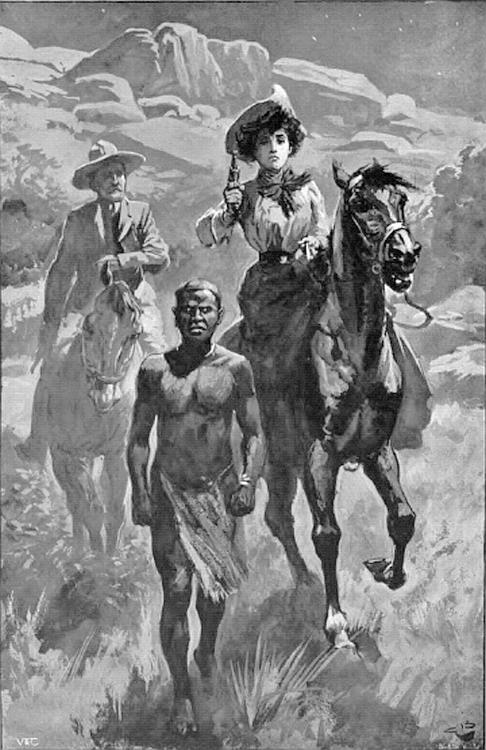
“No, Beryl. Don’t think. There’s nothing further to be said. Whatever this is we are in it together.”
It must not be supposed that during all this talk Beryl’s vigilance over her captive was relaxed for one single moment. Nor must it be supposed that I—that either of us—imagined that we were going to have things all our own way, and that Kuliso’s people had tamely left their chief to his fate.
We could not see them, but that they were keeping us under observation the whole way neither of us had a shadow of a doubt. But while keeping a sharp look-out, I was able to turn over the situation in my mind. If only Brian had been here. As it was, would he not hold me responsible for Beryl’s action, and any disastrous consequences which might ensue? Well, for that matter he could hardly do so, if only that he knew his sister well enough to know also that under the circumstances she would simply laugh at the advice or attempted control of anybody, and that had I discountenanced her project by refusing to accompany her she would simply have embarked on it alone, and then—putting the question on its lowest ground—what sort of figure should I have cut?
Now we were drawing near the fatal spot. We seemed to be moving in a dream—worse—a nightmare. The face of the murdered boy, swollen and ghastly, staring upward to the full broad moon, again seemed to come before my gaze—and that other face, calm, placid, as overtaken by death before a last moment of fleeting horror had had time to stamp it. My nerves were strung to the utmost tension. The Ndhlambe chief would now guess why he had been brought here, and that moment would be his last; for, thus rendered desperate, would he not make one last effort for life? All was still—still as death, save for the tread of the horses; yet momentarily I awaited the roar of the shot which should send Kuliso into that unseen world whither his victims had preceded him.
Then just what I had expected came to pass. Suddenly, and by a rapid, serpentine movement, the chief flung himself down, wriggling for the shade of a thick clump of bush we were passing, and simultaneously dark, sinuous forms started up in front, around us, seeming to spring from nowhere. Beryl’s pistol cracked, and then I saw a huge savage—naked, ochre-stained—poising a heavy knobkerrie for a throw. He could not, at that short distance, miss his mark—and that mark, Beryl. And he was behind her, and—she did not see him. It was all done in a second. I drove the spurs home, standing up in the stirrups to catch or ward off the murderous club as, with a whizz, it left his hand. I felt a sharp, fiery dig in the side, in my ears a jarring, roaring crash. My sight was scorched as with the blaze of a million fires, and then—blankness—oblivion!
Chapter Thirty.
“At Last!”
“Hush. Don’t talk yet. It’s too soon.”
A cool hand was laid upon my forehead, while another smoothed the pillows. Bending over me was the face that had been with me in the life for months—in imagination through all the unnameable horrors of my delirium. The large eyes were infinitely tender now, the serene face soft and pitiful.
“It was only my delirium then? It was not true, not real?”
But as I gasped out the question, for I was very weak, my glance lighted on the black heaviness of Beryl’s attire. Then I knew that it was true.
“Don’t talk any more or you will never get well. And you have got to get well.”
“And then you will leave me. I don’t want to get well.”
“I haven’t left you all these weeks, Kenrick, so am not likely to begin now,” she answered. “But if you don’t obey orders I will. So be quiet.”
This was irrefutable; besides, there was that in the sight of her, in her words, in her tones, which shed over me a kind of drowsy peace. I lay still, content to watch her as she sat by my bed doing some needlework, not forgetting every now and then, with watchful care, to brush away the flies that threatened to disturb me. Strange to say, I seemed to feel no curiosity as to the extent of my injuries, or as to what had happened, or even where I was. Her presence was all-sufficient, and soon I dropped off to sleep again.
I pass over the days of convalescence, the recollection of which is somewhat confused. Beryl was seldom absent from my bedside, and I retain a sort of consciousness of others stealing in to look at me. But on such occasions I feigned sleep. I didn’t want to see anybody else—anybody but her.
One morning I opened my eyes, feeling strangely well. The object of my unvarying first glance was not there. Her accustomed seat was occupied by Brian.
“Feel better, old chap?” he said, coming over to me. “That’s right. Pentridge said you’d take a sudden turn.”
“Pentridge? Oh, he’s been herding me then? But—Brian—where am I?” For almost for the first time I realised the strangeness of my surroundings.
“Why, you’re where you’ve been the last few weeks—at Fort Lamport—in the new cottage hospital. Pentridge wanted to turn out of his house, and put us all in there, but he’d only just got into it himself, and it’s all at sixes and sevens.”
The mention of Pentridge seemed to bring back all the old bitterness, and I lay still, not caring to talk any more. But Brian was not of the same mind.
“Do you know, Kenrick, again you have been a sort of Providence to us,” he said. “But for you, Beryl would have been killed stone dead—if you hadn’t stopped that kerrie. Nothing could have saved her. I saw it.”
“You saw it? No, I don’t quite follow.”
Then he told me what had happened. Old Dumela, fearful for our safety, had warned the neighbours, and had in process of doing so met Brian himself, returning home sooner than was expected. Further, by a piece of great good fortune, a patrol of Mounted Police was making its round, and, joining bands, they had come up in the very nick of time. There would have been nothing left of either of us a minute later, he declared. But that sudden move of mine had saved Beryl. I had received the weapon intended for her.