Bertram Mitford (continued 2)
Reading edition
“Nor am I now. After all, it’s nothing. These chaps can’t use their fists, you know.”
“How about their sticks?”
“Yes, that comes in. A smart Kafir with a couple of kerries is often a large contract—quickness is the great thing with either. Still, it’s unpleasant, and I don’t care about it. But you’ll hardly believe me when I tell you the necessity may not arise once in a year. Only, you can’t be defied on your own place. I told that chap to clear, and he answered point-blank that he wouldn’t. There was only one way of settling that difference of opinion, you see.”
And he turned to give an order to one of his Kafirs, calm, equable, as if nothing had happened.
“Have a smoke,” he went on, “or is it too early for you? Yes? Oh well, perhaps a fellow is better in moderation. Though I expect you’ll soon tumble into all our ways.” And he filled and lighted his pipe, while we chatted, but not for a moment did his attention slacken from what he was engaged upon, the superintending of the milking to wit.
It was a lovely cloudless morning, and there was something in the clear dry atmosphere that was exhilarating in the extreme. How would I take to this sort of life? I thought to myself. Already the old life seemed far away, and all behind. The charm of this new life—its freedom and glorious climate—were settling upon me; why should I not embark in it? I had the means, if I started carefully and modestly. I did not imagine for a moment there was a fortune in it, but neither was there in the branch of business in which my lines had hitherto been cast. And somehow, woven in with such meditations was already the image of Beryl Matterson; which was quite too absurd, remembering that twenty-four hours ago I had never seen her.
“Don’t you ever carry a six-shooter, Matterson?” I said, my mind reverting to the little difference of opinion I had just seen so effectually settled.
“Very seldom. You see, we are not outside the law here, and if I shot a fellow I should almost certainly find myself in a nasty awkward mess.”
“What—even in self-defence?”
“Even then. The English law is curiously wooden-headed on some points. The ‘sacredness of human life’ is one of them, especially with a judge or two we have here who will always go against a white man in favour of a Kafir; and if you were known to habitually carry arms it would go further against you still.”
“But what about your sister?”
“That’s different. There isn’t a jury on the frontier would convict a woman for shooting a Kafir, because they know perfectly well that such a thing couldn’t happen except in a case of the direst necessity. In fact, there are far too few women and girls who are able to take care of themselves, and they all ought to be.”
“I should very much think so,” I said, and the time was to come when these remarks were destined to recur to my mind with vivid clearness and weighty force.
“Hallo!” said Brian, “here’s the governor coming back.” And following his glance, I saw the white tent of a trap coming down the road from the opposite direction to that of our way the evening before. A minute or so more and it drew up opposite the kraals.
“Don’t say anything about what you’ve just seen, Holt,” he went on, as we made our way to the gate. “He doesn’t like that sort of thing, but for all that it’s sometimes inevitable.”
Of course I gave him the required assurance, and as we reached the gate the buggy pulled up, and there got out a strongly-built man of about fifty-five. He had a quiet-looking but determined face, which reminded me more of Beryl than of Brian, and a thick, full, brown beard, somewhat streaked with grey, and as Brian speedily introduced us his welcome of me was all that could be desired in the way of frank cordiality.
“I hope you will be able to make some stay with us, Mr Holt,” he said. “You have spent the night here, and, I take it, have seen what we have to offer you; but such as it is, you are very welcome.”
So this was Brian’s father! I confess he inspired in me more than a feeling of cordiality—for it was one of admiration. I knew men pretty well by that time, and was a bit of a cynic on the subject; but now I saw before me one whom I read as rather a unique specimen—a man who would say what he meant, and who would act as his judgment dictated, no matter what the whole world might think—a man whose word would be as his bond, even though it were to his own detriment; in short, in this frontier stock-farmer I saw a man who, no matter where he might be put down, or under what circumstances, would be a very tower of reliability: cool, intrepid, sound of judgment, come good, come ill. And in all my subsequent friendship with Septimus Matterson, I never had cause to swerve one hair’s breadth from my first impression—save in one instance only.
Now as two Kafirs came up to stand at the horses’ heads, somebody else jumped out of the buggy—a boy to wit, whom Mr Matterson promptly introduced as his youngest son. He was a boy of about fourteen, a good-looking boy, but with a roving mischievous look in his face; a boy, in short, to whom I did not take one bit. Equally readily I could see that he did not take to me.
“Just out from England, hey?” said this hopeful. “Man, but you’ll find it different here.”
Now this was hardly the form of address to be looked for from a youngster of his tender age to a man very considerably his senior; moreover, there was something patronising about it which prejudiced me against the speaker; in fact, I set him down at once as an unlicked cub. But of course I showed no sign of what I was thinking, and the work Brian had been superintending being at an end, we all went round to count the flocks—I don’t mean I bore any part in that operation, not then—and adjourned to the house for breakfast.
Chapter Nine.
Mainly Venatorial.
Beryl looked wholly fresh and delightful as she welcomed us, and it was hard to believe she had been up nearly three hours “seeing to things,” as Brian put it. There was a good deal of talk, of wholly local interest, with regard to the expeditions of both father and son, and the results thereof, but even it was by no means without interest to me, for, after all, it let me into so much of the inner life of these strange new surroundings. Presently the young hopeful, looking up from a large plateful of oatmeal porridge and milk, observed—
“I say, Brian, let’s go down to Zwaart Kloof this morning and try for a bushbuck ram.”
“Well, I don’t know. Yes. Perhaps Mr Holt would like to try his luck. What do you say, Holt?”
I said I’d like nothing better, but for the trifling drawback that I had no gun—being only a shipwrecked mariner who had come away with nothing but the clothes he stood up in. But this was speedily over-ruled. There were plenty of guns in the house. No difficulty about that.
“Can you shoot, Mr Holt?” said the youngster, planting both elbows on the table, and eyeing me with rather disdainful incredulity.
“Well, yes, I can shoot,” I said. “Moderately, that is.”
“But you’re out from England,” went on the cub, as though that settled the matter.
“George, you little ass, shut up, and go and tell them to saddle up Bles and Punch for us,” said Brian. “You can ride Jack.”
A volume of expostulation in favour of some other steed having been silenced by Brian in quiet and peremptory fashion, the hopeful went out.
“I’m afraid you’ll find George rather a spoilt boy, Mr Holt,” said Beryl. “He and Iris seem to get their own way more than they ought. They are the little ones, you see.”
Of course I rejoined that it was quite natural—reserving my own opinion. In the case of the little girl it was candid: in the other—well “boy” to me is apt to spell horror; but a spoilt boy, and just a boy of George Matterson’s age, well—to fit him, my vocabulary has never yet been able to invent an adequate superlative.
“You’d better have a shot gun, Holt,” said Brian, as we started. “I always use one in thick bush; it’s all close shooting.”
He handed me a double Number Twelve bore, of first-rate make and poise, and kept in first-rate order too, and some treble A cartridges.
“You won’t use all those. You’ll be lucky if you get two fair and square shots,” he remarked.
“Good luck, Mr Holt,” called out Beryl after us.
I began to feel nervous. I was only an ordinary shot, and of this form of sport was, of course, utterly without experience—and said as much.
“You only shoot tame pheasants in England, don’t you, Mr Holt?” said George, in a tone that made me wish I could turn him into one of the fowl aforesaid. Could it really be that this impudent young pup was Beryl’s brother—or Brian’s too, for the matter of that?
We cantered down the valley, then struck up a lateral spur, and rounding it came upon a deep kloof running far up into the hillside—its side black with dense bush, the boerboen and plumed euphorbia, and half a dozen other varieties whose names I didn’t know then.
“Here, Tiger, Ratels, get to heel!” cried Brian, apostrophising the rough-haired dogs which had followed, all excited, at our horses’ heels. “George, take Mr Holt on to the opening above the little krantz. You know where to post him. If he doesn’t get a shot there he won’t get one anywhere. Then come back to me.”
We made a bit of a circuit, and some twenty minutes later found ourselves in a little open space, surrounded on three sides by dense bush, while the fourth seemed to be the brink of a precipitous fall in the ground. Here I was carefully posted in the combined cover of an ant-heap and a small mimosa.
“That’s where they always break cover,” whispered George. “Man, but you mustn’t make a sound. Don’t move—don’t cough, even. So long.”
Left alone, my nerves were all athrill with excitement, and I believe my hand shook. A couple of spreuws perched upon an adjoining bush, melodiously whistling, then, become mysteriously aware of my presence, flashed off—a pair of green-blue streaks, their note changed to one of alarm. Would they scare the game and turn it back? I thought agonisingly. Heavens! what if I should shoot badly, and miss? What a fool I should look—and this was, in a way, my début!
The space the quarry would have to cross was about twenty yards. Could I stop it in that distance? No, I was sure I could not. I was feeling far too shaky, far too eager—a nervous condition invariably fatal, at any rate in my own case, to effective execution.
The silence settled down around me, broken only by the occasional note of a bird. Then I started. What was that? The yapping of a dog, then another, then a chorus of excited yelps; and as it drew rapidly nearer I realised that they were on the track of something.
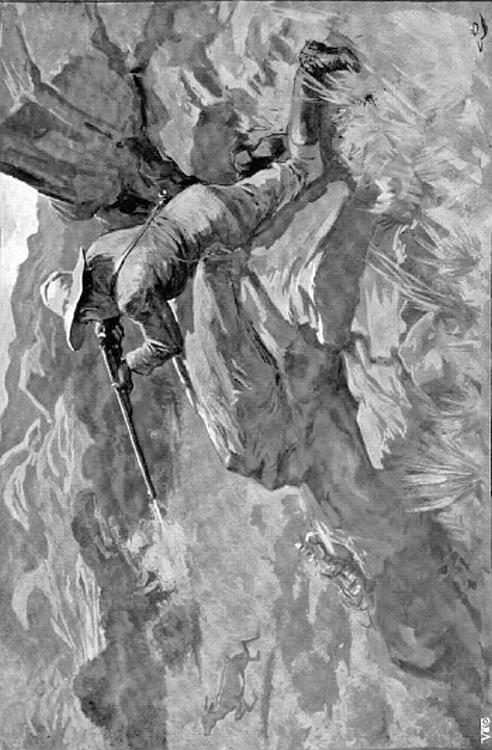
Exactly from the direction George had indicated, it came—a quick bounding rush. A noble antelope leapt out into the open. Its pointed, slightly spiral horns and dilated eye, the almost black hide with the white belly stripe, seemed photographed in my brain as I pressed the trigger, and—missed. Like a streak of dark lightning it shot across the open, and my left barrel spoke, a fraction of a second before it disappeared over the declivity. But in that fraction of a second I had seen the convulsive start, the unmistakable squirm, and could have hurrahed aloud.
I remained still, however, slipping in a couple of fresh cartridges. Another might come out. But it did not; instead, the dogs appeared hot foot on the scent, and close behind them George.
“Hallo, Mr Holt. Where’s the buck?” cried that youth, with a derisive grin. “Man, but we drove him right over you.”
“And I’ve driven him right over there,” pointing to the brow of the declivity.
“So it seems. Man! but you won’t get such a chance again in a hurry.”
“Well, Holt? No luck, eh?” said Brian, appearing on the scene.
“Well, it depends on whether you look at it from my point of view or the buck’s,” I said with designed coolness. “If the latter, you’re right.”
“Eh? Why—”
Something of a clamour beneath interrupted him: the fierce worrying of dogs, and the half bellow, half scream, of a bush-buck ram in the last fight for his life. We did not pause a moment then. Flinging themselves from their horses—mine had been left much higher up—they plunged down, I following, leaping from rock to rock. There lay my quarry, unable to rise save on his forelegs, yet savagely menacing with his pointed horns the three dogs which were leaping and snarling frantically around him.
“He’s done for—hit rather far back, though,” said Brian, calling off the dogs. “Put another shot into him, Holt—forward this time.”
I did, and the animal at once stiffened out, lifeless.
“Maagtig! but he’s a fine ram,” cried George, while congenially amusing himself by cutting the beast’s throat. “You didn’t hit him by accident, Mr Holt, hey?”
“Bad accident for the buck, anyway,” said Brian with a dry laugh. “Well done, Holt. I congratulate you. Thirteen-inch horns! We’ll have them done up for you as a trophy of your first bushbuck.”
I was secretly not a little pleased with myself, as the buck, having been cleaned, was loaded up behind my saddle, and we took our way homewards, for Brian declared that we might be all day and not get anything like so good a chance again, without beaters and with only three dogs. Moreover, it was rather out of season, and they had come out solely on my account. I, however, was amply content; indeed, I sneakingly thought it just as well not to spoil the effect of my first prowess by potential and subsequent misses.
Yes, I felt decidedly satisfied with myself and at peace with all the world, as we drew near the homestead an hour or so later, with my quarry strapped behind my saddle. I heeded not—was rather proud, in fact—of the widening patch of gore which the movement of the horse caused to gather upon my trouser leg during our progress. The “fellow just out from home,” the “raw Britisher,” had vindicated himself. Even that young rascal George seemed to treat me with a shade of newly-fledged respect, and the very intonations in the voices of a couple of Kaffirs hanging around, as we rode up, were intelligible to me as witnessing to my prowess. Beryl and her father, who were sitting on the stoep when we arrived, came out to meet us.
“Well done, Mr Holt!” said the former. “I’m so glad you’ve had some luck.”
“I think it was due to your last aspiration, Miss Matterson,” I answered, feeling with a satisfaction wholly uncalled for by the occasion that somehow or other I had gone up in her estimation.
“Got him just above the krantz in the Zwaart Kloof, did you?” commented her father. “That’s the place where you’ll nearly always get a chance. I suppose this is your first experience of this kind of sport; but I can tell you there’s many a man, not a bad shot either, who doesn’t fall into it just so soon. George, take the horses round—let’s see, keep Bles up though, I may want him later. And now we’ll go in to dinner.”
Throughout that welcome repast I was plying my host eagerly with questions as to the conditions of colonial life, and the vagaries of stock-farming in general; and wondering what a long while ago it seemed since I started for that fateful row at Whiddlecombe Regis, an unconscious voyage of discovery which should terminate in this.
“There are a sight too many Kafirs near us,” he said, in answer to one of my questions. “That’s the great drawback. They take too much toll of our stock, and besides, they have been getting restless lately. Some people set up a periodical scare, but I don’t believe in that sort of thing. As they are here we must rub along with them as best we can, and I must say they bother me less than they do—or seem to do—some others. But you never know what to expect with savages.”
“I suppose not,” I answered, thinking of the tussle I had witnessed that morning, and remembering the malignant and vengeful looks of the defeated barbarian as he slunk out by the cattle kraal. “But couldn’t they render the position—well, rather impossible for you, here, for instance, if they were to combine.”
“That’s just it—they can’t combine. But if you know how to take them, and not expect to find angels under a red blanket and a daub of root klip, you can pull with them as well as with anybody else. Only you must never for a moment let them imagine you’re afraid of them.”
I little thought then how near was the time when I should witness Septimus Matterson’s theory tested—and that severely. Yet that was to come, and it was only the beginning of a series of stirring events calling for readiness of resource and cool judgment and iron courage. The sun was shining now, the sky unclouded. Yet was the storm behind, gathering afar.
Chapter Ten.
Two Pacts.
It will be remembered that my first impressions as regarded Beryl Matterson savoured somewhat of disappointment. By the time I had dwelt a week beneath the same roof I could only marvel how such could have been the case. Now I had dwelt beneath it a month, and the prospect of life apart from her presence seemed not worth contemplating. To such a pass had things come.
What a time that had been—golden, idyllic! When I was not accompanying Brian or his father upon their rides or walks, on stock supervision or sport intent, I would inveigle Beryl forth on the plea of being put au courant with the flora and fauna of the country. Nor was the plea a fictitious one, for I had always had a leaning towards natural history, albeit precious little time or opportunity for indulging the same; but now, with such a companion, and such a taste in common! Ah, those long rides, the glorious sense of freedom and glowing enjoyment, the exhilaration of the atmosphere, the deep unclouded blue of the heavens, the rolling bush country—earth, air, foliage, all athrill with pulsating life, animal or insect life, never silent, never for a moment still—small wonder that those days should go by as in a very dream of Paradise!
But real life is not idyllic, only its episodes, and they but rarely; wherefore, fearing to outstay my welcome, I mooted the subject of moving on. Brian’s blank stare of amazement was something to behold.
“Why, Holt, you’ve only just begun to know us,” he said, “and it would be affectation to suppose you are not enjoying your stay, because any one could see that you are, even if you hadn’t said so yourself. You can’t leave us yet. You mustn’t think of it—must he, dad?”
“Certainly not,” declared Septimus Matterson with all his wonted decision. “Why, Iris would cry her eyes out. She’s quite fallen in love with you, Holt.”
For the little girl had returned home, and her seaside adventure—with me in the rôle of rescuing hero—had been made known. She had bound Brian to secrecy on the subject during her absence, lest her amusements should be restricted and herself placed under an irksome surveillance. Further than that he refused to be bound, nor did she herself desire it. On receipt of which tidings I really have the most confused recollection of what was said to me by each and all, or of the banalities I stuttered out as the nearest approach to a “suitable reply.” The only definite thing that lives in my memory is the physical agony I strove to repress what time Septimus Matterson’s iron grip enclosed my own far from delicate paw, while he declared that his house was henceforth as much my home as it was that of his own children, whenever and as long as I chose to make use of it—a declaration which went far to neutralise the excruciating experience which emphasised it, remembering that the said home was that of Beryl also. Even George was graciously pleased to approve of me, and in the result ceased to play me monkey tricks or to make me the butt of his covert impertinence.
“Man, Mr Holt, but that was fine!” he pronounced in reference to the episode. “Ja, I’d like to have been there! But I thought fellows from England couldn’t do anything of that sort.”
“Let it be a lesson to you then, George,” I said with dignity, “that ‘fellows from England’ are not necessarily asses.”
Then I felt foolish, for the remark savoured of a touch of complacent brag, and Beryl was a witness. But she seemed to read my inner confusion, and smiled reassuringly.
“There was Trask,” went on the imp; “when he first came out he couldn’t hit a house unless he was shut up inside it. He couldn’t sit a horse either. Ja, we used to have fun out of Trask.”
“I should say Mr Trask, George,” said Beryl.
The correction was received with a lordly contempt, as the young rascal went on—
“Can you sit a bucking horse, Mr Holt?”
“Did you ever hear what the man said when he was asked if he could open oysters, George?” I said.
“No. What?”
“I’ve never tried.”
He looked puzzled, then annoyed. Beryl and Iris broke into a peal of laughter.
“Don’t see where any joke comes in,” he grunted. “But why not have a try now, Mr Holt? There’s Bontebok up in the stable. He always bucks when you first get on him. I’ll go and tell Sixpence to saddle him up just now.”
“You’ll do nothing of the sort, George,” pronounced Iris decisively. “You’re a great deal too cheeky. I wonder Mr Holt stands it. Besides, we want him to go out with us.”
That dear little girl! I was fond of her already, but more than ever now that she had come to my rescue in that whole-hearted and tactful fashion. For I did not want to make an exhibition of myself and furnish forth a circus entertainment with Beryl for audience; and it would have been difficult, unaided, to have backed out of what was in effect a challenge, without jeopardising my reputation.
“Another time, George. Another time,” I answered loftily.
“Right you are; I’ll tell them to keep Bontebok up,” came the ready response. “He’ll be livelier in the morning.”
The young villain, you see, was not going to let me down so easily.
“But I may not be. Those circus tricks are all very well for an unfledged young monkey like you, George, but a middle-aged buffer isn’t always on for that sort of game.”
“Middle-aged buffer! That’s good,” jeered the young rascal. “Why, you and Brian were at school together.”
“Oh, George, will you scoot?” interrupted Iris, emphasising the injunction with a far from gentle push. “You’re getting such a bore, you know. Go and make yourself useful in some way, if you can. Get the air-gun and go and shoot some mouse birds. Brian and dad both want some tails to clean their pipes with.”
“Can’t. Dad’d object. It’s Sunday.”
“Well, anyhow—scoot. I don’t want you. So long.”
“I’m on for a swim in the dam,” was the answer. “I’ll go and rout out Brian.”
Iris, you see, ruled the house, including George. Including me, I might add; but for me her rule was light. She was almost more grateful to me for keeping my own counsel upon it than for getting her out of her perilous predicament. Anyhow, we were great friends, and she teased me with the same freedom and whole-heartedness that she teased Brian, who idolised her; but in her bright, pretty, engaging little ways there was none of the covert impudence that characterised Master George’s attempts at banter.
“I hear you are going to stay with us altogether, Mr Holt,” she broke out suddenly an hour later as we were resting, having gained the objective of our Sunday afternoon stroll—a beautiful spot deep down in a kloof, where a pile of rocks all festooned with maidenhair fern overhung a large water-hole, and on the lower side steep upsweeping slopes of foliage cut a sharp V of green and gold against the azure of an unclouded sky, while the varied call and whistle of birds kept up a continuous echo of melody. Whoever it was who gave rise to the saying that South African birds have no song is guilty of libel, for the varying and melodious cheeriness of the bird voices, at any rate in bush country, constitutes one of its greatest charms, and the very unfamiliarity of these is in effective keeping with the wildness of the surroundings.
“Well, for some little time, at any rate,” I answered.
“I’m glad. You’re rather a good chap, you know, Mr Holt.”
Beryl and I exchanged glances, she intensely amused, while I laughed outright.
“I didn’t know it, Iris; but am delighted to learn the fact on your indisputable authority,” I answered.
She flung a handful of grass sprays at me, which she had been absently plucking.
“Don’t use those beastly long words,” she said. “No, but really I am glad.”
The straight glance of the pretty blue eyes full upon my face expressed all a delightful child’s genuine liking. I own to having felt in my innermost self considerably moved thereby.
“I must take off my hat this time,” I said, suiting the action to the word with a sweep of mock elaboration. “Miss Matterson, will you second the resolution just proposed?” I added, turning to Beryl.
“Ah, why do you always say ‘Miss Matterson’?” interrupted Iris decisively. “It’s so stiff. Why don’t you say ‘Beryl’?”
“May I?” was the obvious rejoinder—indeed, the only possible one.
“Why not, Mr Holt? I’m sure if there is anybody whom we have every reason to look upon as one of ourselves it is you.” Yet with the words, frank and friendly as they were, ever so slight a colour had come into the sweet calm face. But before I could make any reply Iris emitted a loud whistle.
“Look at that, Beryl,” she cried derisively. “And then you call him ‘Mr Holt.’”
“The very thing I was going to remark upon,” I said.
“Very well, then,” said Beryl. “Then I won’t do it again.” This time the colour had disappeared, but I could have sworn I caught a momentary look in those soulful eyes that would have justified me, had I been alone, in throwing my hat in the air and hooraying, or executing any other frantic and maniacal manoeuvre indicative of delirious exaltation.
“Then it’s a bargain,” I said.
“Yes,” smiled Beryl.
Now what had given rise to that dear child’s original remark was a certain conversation that had been held that morning over at the kraals at counting-out time.
“Why don’t you make up your mind to stop out here altogether, Holt?” Brian had said, as, the job aforesaid over, we were leaning against a gate watching the flocks streaming away to their respective pasture grounds. “You seem to take to the life, too. Man, you’ll never feel at home in one of those beastly stuffy offices again after this, grinding away at figures. Why don’t you cut loose from it all, and fix up out here? You can do it. Don’t you think he ought, dad?”
“I think he might do worse,” was the answer. “As you say, he seems to take readily enough to it.”
With the words an idea had flashed into my brain, an idea that was as a veritable illumination.
“But before I could start on my own account I should want a precious deal more experience than I’ve got at present,” I said. “There are heaps of things I should have to learn.”
“Yes, you would have a good deal to learn,” said Septimus Matterson, shading a match with his hands as he lit his pipe.
“Look here, Mr Matterson,” I said, coming straight to the point. “Will you teach me—you and Brian? I am not a man of large means, but anything in the way of a premium that you may think fair, I shall be only too happy—er—er—that I am content to leave entirely to you,” I stuttered.
Septimus Matterson had lit his pipe now, and stood emitting puffs of smoke slowly, while a queer smile deepened upon his strong handsome face. Then he said—
“I don’t often swear, Holt, as I believe you’ll bear me out in saying. But in this case I’m going to make an exception. Premium be damned!”
At this Brian threw back his head and roared, while I, puzzled, grinned idiotically.
“What I mean is,” he went on, “in the first place it’s not likely I’d take any remuneration from you for giving me a helping hand. Even if you hadn’t saved my darling little girl’s life, as a friend of Brian’s you’re heartily welcome to any assistance I could give you. Wait a bit—” interrupting the protest I was trying to stammer forth. “In the next place, we don’t as a rule take premiums in this country for teaching a fellow to farm—the few who do are generally just the ones who can’t teach him anything at all. And, finally, every word I said to you the other day I meant. So if you’re inclined to stay on here and pick up your knowledge of the life and experience of the country by helping us, why this place is your home for just as long as ever you like to make it so.”
“Rather,” appended Brian in his quietly emphatic way. “Give us a fill, dad,” reaching out a hand for the paternal pouch.
I have but a confused idea of what I said in reply, probably something incoherent, as my way is when genuinely moved, possibly because that is a mental process I so seldom undergo. Anyhow, the matter was settled to the satisfaction of all parties, which was the main thing.
Chapter Eleven.
The Objectionable Trask.
Now as I sat there, that still and radiant afternoon, in the sylvan wildness of our shaded resting-place, whose cool gloom contrasted well with the golden warmth of the sunlight beyond, I was rather more disposed for silence than speech. I was thinking, and the subject matter of my thoughts was all unalloyed with any misgiving of foreboding that should tarnish its brightness. I was realising Beryl’s presence, and all that it meant to me. There she was, within a couple of yards of me, and the mere consciousness of this was all-sufficing. I was contrasting, too, this wondrous change which had come into my life—such a joy of living, such a new awakening to its possibilities. It seemed I was hardly the same man. I who had hitherto gone through life in a neutral-tinted sort of way, content to exist from day to day among neutral-tinted surroundings, with, as I thought hitherto, a happy immunity from all violent interests or emotions. And now, by an almost magical wave of a wizard wand, I had been transported to this fair land, to sunlight from gloom, to a golden awakening from a drab slumbrous acquiescence in a bovine state of existence, which supplied the physical wants, leaving all others untouched. And the magic which had wrought this upheaval—
“Well? A penny for your thoughts.”
I turned to the speaker. It was perhaps as well that the child was with us, or I don’t know what I might have been led into saying, probably prematurely, and would thus have tumbled down my own bright castles in the air.
“He’s thinking of his pipe,” said Iris mischievously. “Brian always gets into a brown study too when he’s plunged in smoke. Beryl, I think we must make him put it out.”
“Don’t be a little barbarian, Iris,” I answered, knocking the ashes out of the offending implement. “The fact is, I was thinking of what a blessed instrument of Providence was the prow of the Kittiwake when it knocked my sculling boat to matchwood in mid-Channel and brought me here. That was all.”
“Oh yes. You were thinking you’d like to be back in that smoky old London of yours, and how slow we all are,” retorted Iris. “Trask’s always crowding London down our throats. I hate the very sound of its name. It must be a beastly hole. I always ask him why he doesn’t go back there if he’s so fond of it.”
“I should say Mr Trask, Iris,” I said, with a sly glance at Beryl.
“Ach!” exclaimed the child disgustedly, throwing a handful of grass stalks at me.
After all, we were only enjoying a lazy Sunday afternoon, talking nonsense, as people will at such times—anyhow, indulging in no rational conversation worth chronicling. And Beryl and I would engage in a playful argument on some unimportant trifle, and Iris, with child-like restlessness, would wander about, now throwing a stone into a water-hole to scare a mud turtle floating with its head on the surface, or peer about from bush to bush trying to discover a bird’s nest; and at last as the afternoon wore on we started to retrace our steps homeward.
It will always linger in my memory, that peaceful, utterly uneventful stroll. The flaming wheel of the westering sun was drawing down to the farther ridge as we came in sight of the tree-embowered homestead, with a soft blue smoke-reek or two curling up into the still air. The bleat of the returning flocks was borne to us from the distance; and, approaching along a bush path which should converge with ours, came half a dozen Kafirs of both sexes, walking single file, the red ochre colouring their blankets and persons harmonising not uneffectively with the prevailing green of the surroundings, while the full tones of their melodious language—the deep bass of the males and the rich pleasing inflection of women’s voices as they conversed—added an additional note of completeness to the closing beauty of a typical African day. And within my mind was the all-pervading thought that this day was but the beginning of many such; that the next, and the morrow, and the day after, that would be brightened and illuminated by the same sweet companionship—even that of her who was now beside me; that each day’s occupation would be sweetened and hallowed by the thought that we were dwellers beneath the same roof—and then—and then—who could tell? Ah, it was one of those periods that come to some of us at a time in our lives when imagination is fresh, and heart and mind unseared by shattered illusions, and the corroding gall of latter days not even so much as suspected then.
“Hullo!” I exclaimed, catching sight of a third figure strolling beside Brian and his father, “Who’s that? Looks like Trask.”
“Yes, it is,” assented Beryl.
The appearance of the stranger seemed to mar the harmony of the situation to my mind. I did not like Trask. He was one of those men who, wherever they find themselves, never give any one a chance of forgetting their presence; no, not even for a moment. When Trask appeared at Gonya’s Kloof—which, by the way, was the name of the Mattersons’ farm—why, there was no possibility of overlooking the fact, for he simply monopolised the whole conversation. He was a man of about my own height and build, and three or four years my senior, on the strength of which, and of having about that amount of colonial experience, he chose to assume towards my humble self a good-humouredly contemptuous and patronising manner, which to me was insufferable. Not infrequently, too, he would try his hand at making me a butt for his exceedingly forced and laboured wit, which is a thing I don’t take. He was a neighbour of twelve miles or so, where he farmed—or was supposed to farm—his own place, and was reputed well off. To crown his other offences in my eyes, he was a bachelor, and was a precious deal too fond of coming over to Gonya’s Kloof on any or no pretext.
Turning from his greeting to the girls—a greeting to my mind dashed with a perfectly unwarrantable tone of familiarity—he opened on me.
“Ha, Holt, getting more into the way of things now, I suppose? You’ll soon know your way about. Things take a little getting into at first—ha-ha!”
This in a sort of bray, accompanied by a condescending expression.
Catching Brian’s eye, I discerned a killing twinkle therein.
“Why, Trask,” he said in his quiet way, “Holt’s got into the way of things about twice as quick as any imported man I ever knew.”
“Yes. Twice as quick,” repeated Beryl, in emphatic assent.
I fancy Trask didn’t like this—he looked as if he didn’t; but I did, though of course I made no sign either way. Now all this was petty, and by every rule I ought to have been superior to any such trivial annoyances. But bear in mind that I make no claim to be a hero; indeed, I propose in this narrative to set down my own weaknesses with a candid and impartial hand. And I intensely disliked Trask.
The latter proceeded to make himself at home. Of course he was going to stay the evening, equally of course when we sat down to table he must needs plant himself on the other side of Beryl, and the only thing that kept him from entirely monopolising her was that he could not bring himself to allow the attention of any one else in the room to stray for many moments from himself, and as usual the conversation consisted of Trask, with an occasional monosyllable of assent or dissent interjected elsewhere. So hidebound was the self-complacency of Trask that even George found it profitless to cheek him with any effect, although in justice to George I am bound to say he tried his level best.
“What stay are you making, Holt?” brought out Trask, by way of varying the conversation.
Now this sort of query propounded to a guest right in the eye of his entertainers has always struck me as the very acme of idiotic tactlessness, and about on a par with asking an acquaintance of twenty minutes’ standing whether he’s married. Yet nothing is more common to encounter than both forms of foolishness. But before I could frame an adequate reply Brian answered for me.
“He’s staying on altogether, Trask. We’re going to put him up to the ropes.”
“Eh? Altogether? What? Going to fix up in this country then?”
I nodded, for I could not speak. I had just caught Brian’s eye, and the expression therein was too much for my feelings. I should have exploded had I attempted speech, for the blank astonishment on Trask’s face was too comical. He looked about as happy under the announcement as though somebody had just begun to open fire upon him with shrapnel. But he said something about “the more the merrier,” which, I fear, was not a genuine expression of sentiment in the present instance.
“Pass the quince jam, please, Kenrick.”
Clear and unconcerned rose Iris’ voice. Every one stared, while Brian emitted a subdued whistle.
“Hullo, young woman, you’re getting on,” he said.
The little girl grinned with mischievous delight, showing two extremely pretty rows of white teeth.
“Oh, it’s all right,” she said. “We’ve arranged all that. He’s my big brother now, hey, Kenrick?”
“Why, certainly,” I confirmed gravely, but with more inward merriment over Trask’s expression of countenance. Indeed, the possible implication conveyed by the statement was calculated to evolve some sensation all round. Even Brian looked puzzled for a moment, but only for a moment.
“And when did you confer that supreme honour upon him, Iris?” he said.
“This afternoon. He’s much too good a chap to go on mistering him,” answered this impudent child, with a decisive nod of her pretty head. “Anyhow, we’re not going to do it, are we, Beryl?”
“I say, Iris, you’re making me blush like the mischief, you know,” I put in. “Well, it’s consoling to know that one’s trumpeter isn’t dead.”
“Ha-ha-ha! May I ask, Miss Matterson, whether you are included in this newly formed—ha—fraternity?” said Trask in his most asinine tones; but then he was always a tactless fool.
“Call it the Confraternity of the Shipwrecked Mariners,” said Brian, possibly in order to save Beryl the trouble of answering the idiotic question. And as though to render the diversion more complete still, something between an exclamation and a groan escaped from the master of the house at the other end of the table.
“Why, what is it, father?” cried Beryl, half starting up in alarm.
“Nothing, dear. Only this confounded rheumatism. Am all ache from head to foot. Sharper twinge than usual—couldn’t help singing out. Must have caught a chill on top of it.”
“Father, you must go to bed at once,” said Beryl decisively. “Brian and I will come and look after you.”
“Well, I think I will. Good-night everybody. Trask, you’ll excuse me.”
Septimus Matterson was, as he said, anything but well, and his early retirement rather put a damper on the evening from Trask’s point of view, especially as Beryl was out of the room looking after her father. Moreover, Trask prided himself on his capacity for singing comic songs, which he accompanied himself, and, to give the devil his due, uncommonly well. But under the circumstances there was no demand for this form of entertainment to-night, and it was rather earlier than usual when we found ourselves alone together, he and I, for he had needed no pressure to be induced to stay the night, and had been allotted a shakedown in the same room with me.
Now, Trask was one of those men—of whom there are plenty, and women too—who are entirely different when there is no gallery to play to; in a word, Trask alone with one was entirely different to Trask showing off before a crowd, and in fact might have been taken for an ordinarily decent fellow, before you became alive to a little trick he had of engaging you in what would seem at the time quite an interesting conversation or discussion, only to reproduce with variations any idea you might so have expressed, in order to turn you into ridicule when he should next get an audience. But I, who had already experienced this idiosyncrasy, confined conversation with its exploiter to the merest commonplace, wherefore conversation soon languished. Trask was asleep, and I was just drowsing off, when a tap at the door and Brian’s voice started me wide awake again.
“What’s the row? Anything wrong?” I said.
“Wrong? Yes, very much wrong,” was the answer, and striking a match he proceeded to light my candle.
Chapter Twelve.
Pursuit.
“The Kafirs have walked off the whole of the bonte span and three horses,” went on Brian.
“Is that all?” I said, intensely relieved.
“That all? Man alive! but those are our best trek oxen. A full span of sixteen. ‘That all’!”
“Oh, I don’t mean it that way. My first thought was that your father was worse. You know how seedy he was this evening.”
“I see!” was the answer. “No, he’s no worse—fast asleep, in fact. I wouldn’t disturb him about this, but—Holt, we must go after them at once.”
“Go after who?” interrupted Trask, sitting up and yawning, for we had been talking in a low tone and he had not awoke at once. “What’s the row, anyhow?”
Brian repeated what he had just been telling me. “The cheek of the brutes!” he went on. “Mind, this thing was done in broad daylight. I suppose they thought that as it was Sunday none of us would be about. Dumela came upon the fresh spoor as he was out looking after that sick cow down in the kloof by Aasvogel Krautz. They simply collected them, and swept off the lot. In broad daylight, too.”
“I’m your man, Matterson,” said Trask, briskly, having nearly got into his clothes. “I’ll take a hand in this game.”
“Thanks. I was going to ask you. George and Kleinbooi are getting up the horses now. We must start as soon as ever they are here.”
“What gees have the niggers taken, Brian?” I asked.
“Why, Beryl’s horse, Meerkat, for one, the bay colt, and the third’s uncertain.”
Beryl’s horse! Here was an additional incentive to the undertaking, I thought.
“Dumela spoored them easily to Sand Drift,” went on Brian, “and then it got too dark. If the old fool had come straight back at once and told us, we should have saved several hours; but not he. One of Stoffel Pexter’s people told him they’d seen three mounted Kafirs and two on foot go through just above the drift with a span of large bonte oxen. So we’d better go straight there and start on the spoor from there. One thing, we can’t miss it. It’s as broad as a waggon road.”
“Think they’ll show fight if we come up with them, Brian?” I said.
“Don’t know. We’ll take our guns in case of accidents. John Kafir has more respect for an armed crowd than for an unarmed one. Now—if you fellows are ready, we’ll lose no time getting under way. They are bringing up the horses now,” as a trampling was heard without. “Put a few extra cartridges in your pocket, Holt, while I find a shooter for Trask.”
I came out on the stoep and—from another door so did Beryl.
“It’s too bad to rout you out of bed to start off like this on a midnight foray,” she said.
The other two were inside, presumably arming. The fresh cool breaths of the midnight veldt, the circumstance of our projected undertaking, the knowledge that I was in a way rendering personal service to her who stood there, lent a curious dash of excitement and romance to the situation. The air was sharp, and the wrapper which she had thrown over her head framed and set forth the calm sweet face, and the lustrous eyes seemed to take on a softer expression in the starlight. I believe I nearly made a fool of myself then and there.
“Too bad?” I echoed. “Why, I would not have missed this for anything; especially as it holds out the additional attraction of being able to do something for you in particular.”
She looked puzzled. “For me in particular,” she repeated wonderingly. Then with the flash of a smile, “No, I give it up. Explain.”
“To recover your horse.”
“Who, Meerkat? Have they stolen him, then? Brian—” as the other two now reappeared, “you never told me that Meerkat was one of the horses that are gone.”
“Oh, hang it! I’ve let the cat out of the bag,” I said disgustedly. “I ought to kick myself.”
“Don’t do that. Bring back Meerkat instead,” said Beryl, in her sweet, even way.
Of course I pledged myself to do so or die in the attempt, and all the rest of it—but my protestations were ruthlessly broken in upon by Brian’s voice. Brian has a brisk, healthy decisiveness about him when carrying out any responsible matter, which seldom fails to secure attention, wherefore now his reminder that it was time to start was effectual in cutting my farewells rather short.
“Man, I wish I was going,” said George grumpily, as he watched us mount. “It’s a beastly shame I can’t.”
Nobody took any notice of this, but Trask must needs sing out—
“So long, Miss Matterson. We’ll bring back the spoil, never fear.”
“Oh, great Caesar!” said Brian. “Why don’t you blow a trumpet while you’re about it, Trask—or fire a few shots by way of letting the whole countryside know we’re on the move?”
Decidedly Brian was in a “commandeering” vein. But the reproof was deserved.
Yes, it was exciting, that midnight going forth—exciting and enjoyable, as we moved on through the gloom, now riding abreast and talking, though in a low tone, as to the chances that lay before us, now falling into single file as our way narrowed into a cattle track through the bush. A brief off-saddle, then on again, and just as the first suspicion of dawn appeared in the east we descended a steep rocky path into a river valley. A Dutch farmhouse, rough of aspect, stood on an open space beyond the drift, and hard by it a few tumble-down sheep kraals and two or three native huts.
“That’s all right,” said Brian, having satisfied himself as to the identity of three human figures engaged in converse in front of the house. “Revell has been able to come. I was afraid Dumela wouldn’t find him at home.”
We rode through the drift, which was very low at that time of year, and as we dismounted I saw before me a swarthy Dutchman—who was the Stoffel Pexter before alluded to; an Englishman, whose hair and beard simply flamed at you, so fiery and red were both—this was Revell; the third, a Kafir, being, in fact, old Dumela, our cattle herd.
“Daag, Matterson,” began Pexter. “Are you on the spoor of your oxen? One of my zwaartgoed told me he’d seen them go through last night, so they’ve got a good start. He says it isn’t Kuliso’s schepsels this time—more likely Mpandhlile’s.”
“Likely. But let’s have some coffee, Stoffel, for we’ve only half an hour to off-saddle—not a minute more,” returned Brian decisively. “Awful good of you to turn out, Revell. Hardly expected to find you at home.”
“Man, that’s nothing,” said the other, whom I had met before, and who albeit a bit rough was rather a good fellow. His weakness was an intense susceptibility as to the “warmth” of his summit, and he had been known to thrash more than one of his Kafirs to an unmerciful degree simply by reason of overhearing the use among them of his native name, “Ibomvu” (red). “Why, what’d we do in a country like this if we didn’t turn out and help each other? Eh, Holt?”
“That’s so,” I answered; and now we adjourned to the house where Stoffel Pexter’s vrouw had laid out cups of scalding hot coffee and koekjes. The worthy Boer was exceedingly cordial towards us, for the expedition we were on appealed more than anything to his sympathies, and to those of his class. The same thing might happen to himself at any time. The Kafirs were thieving, murdering dogs in his estimation, not a shade better than wild beasts—in short, our natural enemies. So he wished us every success; and further, pressed upon us a bag of biltong, which he thought might come in handy before we got back. And we thought so too.
We took up the spoor at the place where the stolen animals were seen to cross the river. It was indeed as broad as a waggon road, as Brian had predicted, even to a tyro such as myself, for the ground was studded with fresh hoof marks; but the marauders were evidently old hands at the game, for avoiding steep hills which might blow the animals, they had made use of a narrow cattle track winding along through a deep rugged ravine, but ever ascending. We, however, had managed to travel much faster, and very soon halted to blow the horses on the heights overlooking the river valley, where, like a toy house in the distance, we could see the dwelling we had recently left. Here we came up with Dumela, who had started on ahead, and had made the distance in most excellent time.
Now we commanded a new view of country. Before us unfolded a panorama of wide rolling plain and bushy kloof, stretching away to further heights—dark, forest-clad and beautiful—but, on our then errand, forbidding. At these Dumela gazed fixedly, as he said, in his roundabout native way—
“Only if they are strong enough to keep it do those who steal an ox flaunt its skin in everybody’s face. It is there you will find the oxen.”
“How do you know that, Dumela?” said the irrepressible Trask, in Dutch, when this had been translated to us. The Kafir grinned with, I thought, a touch of contempt, and which wholly amused Brian, as he muttered to himself—
“Some white people are like women—always asking things they ought to know.” But out loud he said: “Why should I deceive you? I have nothing to gain by the oxen being stolen. They are my master’s—that is, mine; for they were under my care.”
Dumela was to leave us here, but before he started upon his homeward way, he said to Brian, “Inkose, you will find what you seek, but whether you will obtain possession of it, I know not, for the people over yonder are numerous and fierce and reckless, and they love not the whites—wherefore keep your eyes open.”
“That’s the dickey part of the whole situation,” said Brian, as we moved forward. “If we come to blows and had a free hand, why we’d probably be all right. As it is, it’s like fighting with one hand tied behind you. There’s no actual war on—not yet—though if things go on much longer like this there soon will be. If we start shooting to kill—or even shooting at all—ten to one it means a Circuit Court trial; but if they cut all our throats, not one of them’ll be any the worse for it—for even if the right men were ever dropped upon, it would be ruled that they acted in self-defence, and that armed parties of farmers had no right raiding into native locations.”
“Quite right, Matterson,” assented Revell. “They’d jaw about taking the law into our own hands, and what did the Colony keep up an expensive Police Force for, and so on. Fat lot you’d see of your oxen by the time you put that machinery to work. Why, the Kafirs’d have scoffed the whole span long before and started out to rake in more.”
Now, all this was no more than the bare truth. The unrest and bold and predatory propensities of our turbulent neighbours of late had been the cause of a growing uneasiness on the frontier, and more than one armed collision between settlers and the natives had occurred—arising out of just such provocation as had brought us hither. One indeed, quite recently, had been something of a cause célèbre in that to the frantic indignation of the presiding judge a frontier jury had unhesitatingly and obstinately refused to convict certain individuals of their own class and colour who had used fire-arms with fatal effect, but beyond all doubt in defence of their own lives.
“We may find ourselves in a rotten tight place, or we may not,” pronounced Brian, when we had discussed the whole position fore and aft. “If we do we must use judgment, and on no account loose off a shot unless we are absolutely and unequivocally obliged. Is that understood, you fellows?”
“Certainly,” was the answer on the part of myself and Revell. But Trask was not so unanimous.
“Do you mean to say, Matterson, that I’m to let a nigger cut my throat before I pull trigger on him? Because if so, I’m lowed if I do, and that’s all about it,” he said.
There was a queer look in Brian’s face as he answered—
“I mean to say nothing so idiotic. But, all things considered, Trask, perhaps you’ll oblige me by going home, and leaving us three to straighten out this worry. Now do. We shall get on so much better that way.”
“What the very devil do you mean, Matterson?” blustered Trask.
“What I say—no more, no less. I’m bossing this undertaking. I’m obliged to you for volunteering, but if you think you’ve got a better plan than mine, why we shan’t get on. That’s all.”
“Oh, blazes, man. I didn’t mean that. I’ll do anything you like,” answered Trask, after a moment’s hesitation, during which all hands thought the row might end in blows. “I’m not going to turn tail and go back now—not much.”
“It’s no question of turning tail, but of using ordinary and sound judgment,” rejoined Brian. “We shall be glad enough of your help on those terms.”
“Oh, all right, old chap. Say no more about it,” conceded the other with a sort of bluff, would-be good-natured growl—and the difference thus patched up, we resumed our way.
But I, in my heart of hearts, most devoutly wished we were through with it, for in marching into the nest of fierce and truculent barbarians which was our objective, it seemed to me we were placing ourselves between the very sharp horns of a bad dilemma. In sheer savagery, and trusting in the immunity which a paternal Government would be sure to extend to them, the sportive barbarians aforesaid might incontinently massacre the lot of us, or, if in defending ourselves any of our enemies got hurt, why then under the laws of our country we might have to stand our trial for murder. But the third solution of the difficulty, that we should return with whole skins and clean hands, and that for which we had come out, viz., the recovered stock, seemed to me just then rather too good to be hoped for.
Chapter Thirteen.
Checked.
For some hours we held on without difficulty. It became very hot. The sun’s rays poured down into the close, shut-in kloofs as from the lens of a gigantic burning-glass; and the atmosphere was unmoved by a single puff of wind. The horses were in a bath of perspiration, and it became evident they must be off-saddled, wherefore a halt was called in a cool, shady place, where they could enjoy to the full a much-needed rest. It was a bushy secluded spot beneath an overhanging cliff, from whose face a whole cloud of spreuws flashed hither and thither, whistling in lively alarm, but, best of all, it contained a cool clear water-hole, albeit the liquid was slightly brackish.
“Tired, Holt?” asked Brian good-naturedly, as having knee-haltered the horses, we were discussing some supplies which had been brought in a saddle-bag. “Have a drop of grog.”
“To the first I answer ‘No,’ to the second, ‘Yes,’ emphatically!” I said, catching the flask which he chucked across to me. It was a roomy metal one, with considerable carrying capacity.
“Well, this sort of forced march on an African summer day isn’t a cool and invigorating promenade,” cut in Trask. “After you, Holt.”
We had a tot all round and a smoke. Then it became time to move on again. Once a check occurred, where the thieves had manifestly separated their spoil, but the device was only a blind, and soon solved by such experienced frontiersmen as Brian and Revell. Now and again we would sight a farmhouse, with its cultivated strip of mealie land, picturesquely nestling in some bushy hollow, but such we purposely avoided, for news travels on winged feet among Kafirs, and the arrival of an armed party at one of these homesteads would be extremely likely to be notified by any of the hangers-on there to their brethren of the marauding clans inhabiting the dark, frowning fastnesses which now began to rise not far in front. Nor was there any need to ask for information, for the spoor was as plain as plain could be, and soon, after leading us up a steep hillside, it suddenly left the bush, and, cresting the ridge, struck out into an open plain, where, a few hundred yards in front stood a large native kraal, the dark forms of whose inhabitants we could see moving about among the beehive-shaped huts. But the simultaneous yell and rush of a lot of curs promptly turned the attention of the said inhabitants upon us. It looked as if our appearance had been provocative of more than ordinary excitement.
“Don’t shoot, Trask,” said Brian warningly, observing that that worthy was aiming at a couple of large, mouthing curs whom he considered in rather too close proximity to his horse’s hocks. “Don’t shoot. We haven’t time to stop and have a row here.”
“Who is your headman?” he asked the half-dozen sullen, stalwart savages who had slouched forward to meet us.
“He is not here, Umlúngu,” was the ready reply.
“Who is he, not where is he?” repeated Brian.
“He is away,” again answered the man, a tall, grizzled Kafir with an evil expression of countenance.
“Now look,” said Brian forcibly. “When did those oxen and horses pass by here? The spoor is at your very doors. One of you must go with us and carry it on, or you are responsible equally with the thieves.”
By this time quite a number of Kafirs had come forth from among the huts by twos and threes, and were clustering around, a proportion armed with tough, heavy kerries, and their demeanour was sullen and unfriendly to a degree, as they muttered among themselves in their deep bass tones. Women, too, had raised their greasy, scantily-clad forms where they had been lolling against the huts basking in the sun with their round-headed, beady-eyed brats, and were gazing at us; the while discussing us with the freedom of their sex and in no flattering terms.
“Au! We know nothing about thieves, Umlúngu,” replied the spokesman. “If any oxen came by here they did not stay here. Why not follow them further if you have followed them so far? Why trouble us?” And a great jeering guffaw greeted the words.
“Good,” said Brian. “These oxen have been stolen, and we have traced them to the gates of your kraal. You will hear a great deal more about this.”
“Whau!” exclaimed the savage, turning his back upon us. “Go. Go and find your oxen.”
Again that insolent jeering laugh went up from the onlookers, and here an unpleasant discovery forced itself upon us. By accident or design, the crowd, which was now considerable, had closed round us on every side. A serried mass of dark, musky bodies, and grim—and it seemed threatening—faces walled us in, while requests for tobacco and other things were hurled at us in tones that savoured more of demand than petition. The aim of the savages was clear. They intended to delay our advance as long as possible. We had, rather foolishly, allowed ourselves to be led into a trap.
Then occurred the unexpected. A tall Kafir, in the forefront of the mob, pointing suddenly at Revell, ejaculated in great jeering tone—
“Hau! Ibomvu!”
And the shout ran through the whole crowd.
“Ibomvu!” roared the men. “Yau! Ibomvu!” shrilled the women in the background.
I have said something as to the effect produced upon our comrade by any allusion to his flaming poll. It seemed to drive him quite mad. It mattered not that it was uttered by one man or a thousand, the effect upon him was just the same, and this held good here. In less than a second he had put his horse straight at the original offender, and with a tough seacow-hide sjambok which dangled from his wrist was cutting into that astonished and ill-advised ruffian with the fury of a madman. On head and face and naked shoulders the terrible lash descended, and the lightning-like celerity of the attack was such as to leave neither time nor thought for resistance—the victim’s one idea—if he had even one—being to escape from that awful lash, while those around, appalled by the white, infuriated countenance, and the frenzied plunging of the horse, gave way, though not before several of them had tasted the infliction; for Revell cut impartially right and left as though he were hewing his way through with a sabre. And in effect this is just what he might have been doing, for the crowd on that side opened out in wildest confusion, of which we took advantage, and in less than a minute were a couple of hundred yards from the spot.
And now a terrific hubbub arose in our rear. A glance over our shoulders showed the crowd roaring forward on our track, while among others who had dived into the huts to arm, we could see the bright gleam of assegais.
“Face round,” cried Brian, “and aim, but for your lives don’t fire. If we can’t scare them to a halt we must turn and run. But—no shooting.”
We wrenched our horses round. The roaring, surging rush of oncoming savages poured forward, then stopped. Four gun barrels sending forth their contents into the thick of the mob would create awful havoc, and there were four more in reserve, for we each had double barrels. Besides, they knew we could gallop out of reach at no loss to ourselves. So they halted, brandishing sticks and assegais, and howling out every kind of taunting and abusive epithet.
“Ibomvu! Yau! Ibomvu!” yelled Revell, in return, making his sjambok whistle through the air as he flourished it round his head. “Come on, all of you, and taste this. I’ll cut the whole lot of you to thongs! I’ll show you how Ibomvu can burn!”
This speech, in Kafir, raised another roar of menace and defiance, but the savages were not inclined to accept the invitation therein embodied, wherefore we turned our horses’ heads, and proceeded leisurely onward.
“Go on, go on,” howled the mob after us. “Go and find your oxen! They—up yonder—will know how to talk with you.”
No further interruption occurred, and before us lay the tell-tale track, as clear as need be. At length the wooded heights rose immediately in front, and we halted for another short off-saddle.
“Now look here,” began Brian, throwing himself on the ground, and filling his pipe. “It’s evident these chaps don’t care whether we follow them or not, but I believe we shall come up with them this evening, and we shall have a little over three hours of daylight to do it in. The sort of treatment we met with just now is a good earnest of what we’ve got to expect. And there are only four of us.”
“Hooray for a row!” cried Trask.
“Yes, but we don’t want a row if it can possibly be avoided. We’re between the devil and the deep sea, which for present purposes may be taken to mean that none of us must fire a shot unless our lives depend upon it, and then, if possible, fire blank.”
This oration was interrupted, and that by a thud of approaching hoof strokes and a sound of deep voices and laughter. A track wound round the hillside lower down, and we saw about a score of mounted Kafirs sweep past, chattering and laughing at the top of their voices. It was clear that this gang was returning from a visit to some canteen, for the condition of more than one of their number was not a little precarious, swaying and lurching in their ragged saddles as they belaboured their wretched undersized steeds.
“All as drunk as pigs,” whispered Revell. “By George! That looks like Kuliso.”
A tall, finely-made man, clad in an ancient pair of trousers and a red blanket and wearing an ivory ring on his left arm rode at the head of the gang, evidently a chief, for he was rather more drunk than the rest, and seemed to occupy a greater share of attention.
“No, it isn’t,” returned Brian. “I don’t know who it is, though.” And in a trice the weird equestrians, their red blankets streaming behind them, were whirled out of sight, and having given them time to get further on their way, we resumed our own.
There was nothing in itself gloomy or forbidding in the series of densely-wooded heights which now rose in front of us. Peaceful solitude rather than lurking danger was the idea conveyed by that winding succession of deep valleys and lofty hills slumbering in the golden light of the waning afternoon, yet the network of rugged ravines we were about to penetrate had, in former times, been the scene of more than one bloody encounter wherein the advantages had all lain with the wild denizens of the place. Many a dark episode could those tangled glens have told, of patrols surprised and outnumbered in the thick bush, of brave men struck down by the assegai of the savage, or dragged off, wounded and disabled, to be put to a lingering death of torture. Even at that time the locality held an evil repute as the haunt of cattle thieves and desperate characters generally.
We crossed a kind of deep basin shut in on all sides by wooded hills, then through a narrow poort overhung by aloe-fringed krantzes widening out into just such another basin. In fact, we seemed to have got into a veritable labyrinth of such—and through my own mind, at any rate, passed the thought—How were we going to get out? Then the clamour of dogs in front, and we suddenly came upon a kraal.
“Straight on,” said Brian. “We can’t stop. No time to waste.”
The inhabitants gave us rather a sullen greeting, but made no demonstration, staring after us in lowering silence. And now the way became wilder and more rugged still, and the spoor, yet plain as ever, led us far down into a jungly glade, where the monkey ladders hung like trellis work from the twisted limbs of great yellow-wood trees, and here in the shaded gloom of the forest—for this was no mere scrub, but real forest—night seemed already to be drawing in.
“What’s this?” said Brian, turning in his saddle to look back, as a long shrill cry arose in the distance, from the direction of the kraal we had left behind us.
“I hope they are not raising the country on our heels.”
We paused and listened. The sound was repeated, far away behind us.
“Well, we must take our chance. ‘Push on’ is the word.”
For some time we rode on in silence, over the same sort of ground as I have already described. And now the sky was glowing with blades of golden effulgence, as the rays of the declining sun lengthened, touching for a moment the face of a great iron-bound krantz starting up, here and there, from the dark impenetrable bush. A pair of crimson-winged louris darted across our path, but otherwise sign of life was there none. Somehow we felt that we must be very close upon the marauders, who might number ten or a hundred. Every moment had become one of tense excitement and expectation.
Chapter Fourteen.
An Overhaul.
“Magtig!” exclaimed Revell, “I swear I smell something roasting.”
“S-s-s-h!” warned Brian, crouching low on his horse’s neck. “Dismount, every one.”
A few hundred yards beneath we now saw a kraal. It lay in a deep natural basin, walled in with rugged rocks and thick bush; but so shut in was it on all sides that this seemed the only way in or out. A curl of smoke rose into the still evening air, and the sound of several deep voices in conversation was plainly audible; and with it, the strong smell of roasting meat confirmed us in the certainty that we had at length reached the object of our quest; for Kafirs very rarely kill their own cattle, and this circumstance combined with the freshness of the spoor, left no further doubt in our minds.
And now, before we could formulate a plan, we heard a sound of trampling, and a number of oxen emerged from the thick bush beyond the kraal, urged forward by a single Kafir, who was driving them down to the gate of the thorn enclosure. There was no mistaking the large fine animals, white, but speckled all over with bluish black. It was Septimus Matterson’s fine span.
“Wait—wait—wait!” whispered Brian, his voice in a tremble with excitement. “Let the devils bring them in—they are driving them right into our hands—and when I give the word, up and at them. We must charge right bang into them if there are five or five hundred. Down—keep down, Trask; they’ll see your hat, man.”
With straining eyes we watched the savages—for three or four more had joined the single driver—as they urged the stolen beasts down to the gate and stood on each side to pass them in. The animals having been driven fast and far that day, were disposed to give no trouble, but entered the enclosure quietly, one with another.
“Fifteen! They’ve killed one—and, by Jove! they are going to kill another,” whispered Brian, as the Kafirs, shutting the kraal gate behind them, advanced towards one of the largest oxen with reims in their hands. “Now, are you all ready. We’ll capture the fellows inside. Don’t shout or anything but—up and at them!”
With a headlong rush we charged down upon the kraal, but the Kafirs had seen us. A loud warning cry, and several lithe dark forms bounded like cats over the fence, and half-running, half-creeping, made for the bush as fast as ever they could pelt, while three more who were seated round a fire, each with a beef bone in his fist, gnawing the meat off, flung it down among a heap of other relics of the feast, and started up to fly. Evidently they were unaware of the smallness of our force, or perhaps took us for a posse of Mounted Police.
“Look at that! Only look at that!” cried Revell, pointing to the fire, beside which lay the head and a remnant of the carcase of one of the stolen animals. And throwing all prudence to the winds, he up with his piece and let fly at one of the fleeing forms.
“Steady, steady!” warned Brian. “No shooting, mind! Trask, do you hear!”
Too late. Trask had already pressed the trigger, and more fortunate—or unfortunate—than Revell, who had missed, owing to the fidgeting of his horse, one of the fleeing Kafirs was seen to stumble and fall, then, rising with an effort, dragged himself into the welcome cover of the bush.
“First bird!” cried Trask, wild with excitement. “He’s dead. I saw him ‘tower.’”
“No, you didn’t. You didn’t see anything,” returned Brian meaningly. “None of us saw anything of the sort, see! You only shot to scare, and I told you not to do that unless you were driven to it.”
“That’s so,” said Revell, “we only shot to scare. Don’t be an idiot, Trask.”
“But—” began that obtuse worthy. “Oh—ah—um—yes, I see!” he broke off as the idea at last found lodgment in his thick skull.
Now all this had befallen in a very twinkling. The thieves had vanished as though into thin air—certainly into thick bush—and here we were, with fifteen out of the sixteen oxen composing the stolen span: better luck than might have fallen to our lot. But what about the stolen horses? And just then, as though in reply to my thoughts, I, who was taking no part in the foregoing wrangle, suddenly beheld two mounted figures dart away from some hiding place just the other side of the kraal. In a moment they were under cover of the bush and safe out of shot, but in that moment I had recognised the steed bestridden by the hindermost one. It was Meerkat—Beryl’s own particular and favourite horse—and it I had pledged myself to recover.
Shouting my discovery to the others, I was off on the track of the fugitives, like a whirlwind. In that moment I recognised that none followed me. I heard, moreover, Brian’s voice peremptorily ordering me back, but to it I turned a deaf ear, for still clearer seemed to sound Beryl’s voice urging me forward. “Bring back Meerkat,” had been her parting words to me. And now there the horse was—not so very far in front of me. Brian might shout himself voiceless: this time I would pay no attention to him. A mad gallop, a short exhilarating pursuit, I would knock off its back the greasy rascal who was riding it, and would bring back the horse—Beryl’s horse—in triumph. The idea was more than exhilarating.
Yes, but behind that lay its realisation, and this was not quite so easy. For the way was literally “dark and slippery.” Over staircase-like rocks, and rolling, slipping stones, it ran, now beneath the gloom of trees, now through lower scrub, whose boughs, flying back, more than once nearly swept me from the saddle. Listening intently, I could just catch the faint click of hoofs away in front, and with a sinking of heart I recognised that this sound seemed to be growing even more faint. The consciousness maddened me, and I spurred my faithful steed along that rugged way, plunging, floundering, but getting along somehow, in a manner not to be contemplated in cold blood.
If the path was damnable, the ascent was easy, luckily, though rugged. I gave no thought as to whether any of my comrades were following, or if I did it was only a jealous misgiving lest I should not be, the first to come up with the quarry. The thieves might escape, for all I cared; the other horse might not be recovered, but recapture Beryl’s I would. Then I awoke to the unpleasing realisation that dusk was giving way to darkness, the downright sheer darkness of night.
All the more reason for bringing the undertaking to a swift conclusion: wherefore I pommelled and spurred my hapless steed along with a ruthlessness of which at any other time I should be heartily ashamed. But here the end justified the means, and soon I was rewarded, for I heard the click of hoofs much nearer ahead now, and with it the smothered tone of a voice or two.
Of course it should have occurred to me, had I not been transformed into a born idiot for the time being, that I was acting the part of one. For here I was, a man who had been little more than a month in the country, about to rush into the midst of unknown odds, to attack single-handed how many I knew not of fierce and savage desperadoes, right in their own especial haunt, in the thick of their own wild fastnesses; for it was highly probable that those whom I pursued had joined, or been joined by, others in front. Yet if I gave the matter a thought it was only a passing one.
Now my steed pricked up its ears and began to whinny, recognising the close propinquity of its friends, and there sure enough, as the bush thinned out somewhat, I could see the two runaways barely that number of hundred yards ahead. Putting on a spurt I had halved the distance, when they halted. He who bestrode Beryl’s steed was an evil-looking savage with a string of blue beads about his neck, and an expression of contemptuous ferocity on his countenance as he faced round and awaited me, trying to conceal a long tapering assegai which he held ready to cast. But I rode straight for him, and when within thirty yards he launched the spear. Heavens! I could feel the draught created by the thing as it whizzed by my ear with almost the velocity of a bullet, and then I was upon him. But the fellow, who was quite a good horseman for a Kafir, managed to get hold of my bridle rein and, jerking it partly from my hand, hung back with it in such wise as to prevent my steed from ranging alongside of his. A mad, murderous temptation flashed through my mind to empty my shot barrel into his abominable carcase, but Brian’s emphatic warning still in my memory availed to stay my hand.
I hardly know what happened then, or how. Whether it was that my horse, violently tugging backwards, succeeded in jerking the rein free, or my adversary, seeing his opportunity, had purposely let go, but the sudden recoil caused my fool of an animal to lose his balance and go clean over, taking me with him, and lo! I was rolling ignominiously upon the ground, though, fortunately, not under him. I saw the grin on the face of my late enemy, heard his jeering guffaw, and then—something swooped down over my head and shoulders shutting out sight and air in a most horrible and nauseous suffocation, pinning my arms to my sides, which several hands securely bound there. A babel of deep jeering voices filled my ears, muffled as they were, and I was seized and violently hustled forward at a great pace over a rough and stony way, the vicious dig of an assegai in my thigh emphasising a volley of injunctions which I could not understand. What I could understand, however, was that was expected to walk, and to walk smartly, too, guided by the very ungentle hands which urged me forward.
Chapter Fifteen.
The Den of the Cattle Stealers.
To give an adequate idea of my thoughts and feelings at that moment, or during those that followed, would amount to a sheer impossibility. Truly I had distinguished myself. I had undertaken to recover the stolen steed in bold and doughty fashion, and had allowed myself to be drawn into the most transparent booby-trap ever devised for the deception of mortal idiot. Instead of returning in triumph, having fulfilled Beryl’s parting injunction, here was I, strapped up helplessly, my head and face swathed in a filthy greasy Kafir blanket, only able to breathe—and that with difficulty—through its unspeakably nauseous folds. Heavens! I wonder I was not sick. Kicked and punched too, and a butt for every kind of jeer and insult from these black ruffians, although of course I could not understand the burden of the latter. But where was it going to end?
Why had they not murdered me then and there? I thought. Could it be that they were taking me to some secure place where they might do it at their leisure, and hide away my body in some hole or cave where there was not the smallest chance of it ever being found, and so bearing witness against themselves? It looked like it—and the idea made my blood run cold with a very real and genuine fear.
All thoughts of rescue—of immediate rescue—I was forced to put aside; delayed rescue would be too late. My comrades would hardly succeed in spooring us in the dark, and it was quite dark now; moreover, they were but three, and judging from the varying voices of those who held me, the latter must be fairly numerous. No, the situation was hopeless—abjectly hopeless. Half-dead with fatigue and semi-suffocation, my mind a prey to the most acute humiliation and self-reproach, I stumbled on—how I did so I hardly know. At last I could bear it no longer. They might kill me if they liked, but not another step would I stir until that horrible suffocating gag was removed.
Something of this must have struck them too, for after a muttered consultation, they began fumbling at the cattle thongs with which I was bound, and lo; the filthy blanket was dragged off my head, and I sat drinking in the fresh night air in long draughts.
“No talk—no call out,” said a voice at my side. “You talk—you call out, then—so.”
It was not too dark to see the significant drawing of the hand across the speaker’s throat by which the injunction was emphasised. The latter I judged it advisable to obey—for the present at any rate.
In this way we kept on through the night; it seemed to me for hours. I could make out the loom of the heights against the star-gemmed sky, and noticed that it narrowed considerably as though we were threading a long defile. More than once I stumbled, and not having the use of my hands to save myself, fell flat on my face, to the brutal amusement of the ruffians in whose power I was. I deemed it inadvisable to look about me too much, but could make out quite a dozen forms in front of me, and that there were plenty behind, I gathered from the hum of muffled voices. Indeed, another sense than that of sight went to confirm any conjecture as to their numbers, for the sweet night air was constantly poisoned by a reek of rancid grease and musky, foetid humanity. But of the three horses I could now see no sign.
At last a brief halt was made, evidently at some known water-hole or spring, for soon one of them emerged from the bush bearing a great calabash, and the sound of the splashing liquid as it was poured into bowls was as very music to my ears. The long, rough, forced march; the dash and excitement which had preceded it, had done their work. I was simply parched with thirst, and said so.
Thereupon the English-speaking Kafir came towards me with a smaller bowl. He put it to my lips, but before I could reach it the brute withdrew it again and dashed the contents into my face.
“That all the water you get,” he laughed.
It was too much. Even the fear of immediate vengeance counted for nothing at that moment. My arms were secured but my legs were not. Throwing myself backward as I sat I let out with these in such wise as to plant both feet, with the force of a battering ram, right in the pit of the stomach of my jeering tormentor as he bent over me laughing. He rebounded like an indiarubber ball, rolled half a dozen yards, and lay writhing and groaning and gasping—while I, of course, made up my mind to instant death.
But to my surprise the other Kafirs seemed to think it the best joke in the world, for they burst out laughing immoderately, mocking and chaffing their damaged comrade, imitating him even, as he twisted and groaned in his agony. I remembered the saying that a crowd that laughs is not dangerous, and to that extent felt reassured. Yet, what when my victim should have recovered? That would be the time to look out for squalls.
Taking advantage of their good humour, I uttered the word “Manzi.” They stared; then one fellow got up and taking the calabash, shook it. Yes, there was still a little, and pouring it into a bowl brought it to me, letting me drink this time, he still shaking with laughter over the amusement I had just afforded them. Then we resumed our way.
This seemed to be along the steep side of a mountain, and judging from the increased freshness of the air we appeared to have gained a good altitude. Refreshed by my drink of water I was able to travel better, and I looked somewhat eagerly about, with an eye to possibilities, resolved, too, to keep one for any opportunity. On the one hand our way seemed overhung by cliffs; on the other, space. Finally the whole gang struck inward between what looked like narrowing rock walls, and came to a halt.
And now, as the fire which had been promptly started blazed up, I saw that our resting place was beneath a gigantic overhanging slab of rock, forming a sort of cave. Beyond this I could catch sight of a patch of stars with dark tree-tops waving gently against them; the while I was guided to the back of the recess, and bidden to sit down, an invitation I had no desire to dispute, after my late exertions. But they had, apparently, no idea of loosening the thongs, and my very superficial knowledge of their tongue did not rise to the point of requesting it. In sooth, I began to wish I had treated my erstwhile tormentor with a little less violence. I could have used him as a medium of conversation at any rate.
Now from some place of concealment was dragged forth a live sheep, tied by the legs; while one of the Kafirs was sharpening a butcher’s knife upon a slab of rock. Poor beast! Its condition appealed to me in that mine was exactly similar, and the probabilities were that its fate would be mine, with the difference that I should not be eaten afterwards; for it was there and then butchered, and the flaying and quartering being accomplished in a surprisingly short space of time, the entire carcase was disposed by relays upon the glowing fire, and indeed the hissing and sputtering, and the odours of the roast, filled my own nostrils with a grateful savour. I could do with a mutton chop or two, after the scanty fare and hard exertion of the recent twelve hours.
Soon the feasting began, and there was a great chewing, and cracking of bones. The while I sat and endeavoured calmly to size up the whole situation. And its accessories were about as wild and grim as the most startling annals of any romance. Here was I, helpless, in the power and at the mercy of a score or so of as cut-throat a set of naked and ochre-smeared savages, as such romance could picture; forcibly brought here to this probably unknown fastness of theirs, and for what? From motives of self-preservation alone they could not afford to restore me to liberty after having once been in this, which was probably one of their most secure retreats, and I was conscious of a dire and terrible sinking of heart. Yet there was no war between ourselves and these people. They would hardly, therefore, go such lengths as to kill me, and so raise the whole countryside upon them. But as against this came another thought. There is no declared war between society and the dangerous and criminal classes in London or New York or Paris, or any other great city. Yet he who should venture into the innermost haunts of these and place himself in their power would be extremely unlikely ever to be seen again by inquiring friends; and my case here was precisely similar.
Recognising that a well-fed man is likely to be in better humour than a fasting one, be he savage or civilised, I waited until these had nearly finished their repast before intimating by signs and such few words as I knew, that I should like some small share of it. They stared, laughed, then one took a strip of meat from the fire, and came over to me, holding it up in a sort of bob-cherry fashion. But I was not to be taken in so easily as that, and uttered the word for hot. At this they laughed harder than ever, and having waited long enough, I soon got outside the mutton, hunger overcoming my repugnance to being fed in so unappetising, not to say disgusting, a fashion. But the whole episode seemed to put them into high good humour, from which I had begun to augur great things, when an interruption occurred which was inauspicious in the extreme. This was caused by a new arrival, none other than the evil-looking rascal whom I had rendered temporarily hors de combat, and who, unable to keep up with the others owing to the pain he was suffering, had now overtaken them.
The first thing this fellow did was to seize a knife which was lying idle, and rush over to me, uttering a savage snarl, his repulsive countenance working hideously with vengeful ferocity. Instinctively I prepared to receive him in the same way as before, whereat he hesitated, and this I believed saved my life, for the others interfered and there was a great hubbub of voices, and a swaying to and fro of the crowd, as more got between him and me. I thought it would have ended in a free fight, but at length the fellow suffered himself to be persuaded, and subsided, growling, by the fire, to make a vehement onslaught upon such meat as still remained.
Having disposed of this he came over to me again. The other Kafirs were for the most part disposing themselves for sleep, while some had lighted pipes, and were puffing away contentedly, conversing in a deep-toned, subdued hum. Indeed, but for my perilous situation the scene was one of wild and vivid picturesqueness—the great overhanging rocks reflecting the glow of the fires or throwing out weird, uncouth silhouettes from moving figures; the red forms of the grouping savages, and the outlandish but not unpleasing tones of their strange tongue; the rolling eyeballs and the gleam of white teeth, as one or other of them opened his mouth in a yawn or a grin.
“What you doing here?” began the fellow.
“I didn’t come willingly, I was brought. And now suppose you let me go,” I answered.
“Let you go? Ha! See there.” And he pointed to something behind me.
I turned. A wide dark space hitherto unnoticed caught my gaze. A black patch it looked like. No, it was a hole, a jagged irregular hole or crevice.
“That hole deep—damn deep,” he went on. “Let you go? yes—down there. No find again. We cut your throat first, see—I do that—then throw you in. No find again. Ha!”
I believe I went pale, and I know my flesh crept all over at the prospect of this horrible fate. But I remembered Septimus Matterson’s dictum—more than once laid down—with regard to these people: “You must never let them imagine you’re afraid of them.” So I laughed as I answered—
“You daren’t do it. The police would hunt you down, and then the Government would hang every man jack of you.”
“Hang? Ha! Not it. We don’t care for no damn Government. To-morrow morning you go down hole.”
“Why wait till to-morrow?”
The ruffian chuckled.
“See better then. Leave no spoor. Light not good now—might forget something. Body found, perhaps we hang. No body found, then perhaps you not dead. Damn deep that hole. Ha!”
“You’ll hang all the same,” I said. “You will be spoored here, and there will be plenty of traces of what has become of me.”
“No trace. We cut your throat over the hole, then throw you in. Now you go to sleep. Morning soon come.”
Grinning hideously the fellow rolled his blanket round him and lay down. Most of the others were already asleep, but it was not likely I should follow their example or act upon the ironical suggestion of my tormentor. Was he but trying to frighten me, I tried to think? but then, a word here and there which I had caught, and certain significant glances on the part of my gaolers, seemed to bear out all he had said. They had every motive for getting rid of me, and in such wise as to leave no trace. And here were the means all ready to their hands.