Bertram Mitford (continued 3)
Reading edition
Chapter Sixteen.
A Dash for it.
Now I, Kenrick Holt, who do this tale unfold, am not by nature an especially intrepid animal, wherefore aught in the course of this narrative which might savour of “derring do” had better be set down to impulse, circumstance, or, generically, accident. Further, I have elsewhere undertaken not to spare my own weaknesses, which for present purposes may be taken to mean that the hideous assurance just conveyed to me had left me very badly scared indeed.
In palliation whereof consider the position. In all human certainty the morning light would see me as ruthlessly and as helplessly butchered as the miserable sheep which had just furnished these black cut-throats—and incidentally myself—with an evening meal. A ghastly and horrible fate, in sooth. It might remain shrouded in mystery, even as the ruffian had said, but that was a mere supplementary detail which could be of no subsequent interest to me.
Rescue? That could hardly be. Brian, at any rate, would not desert me. But he could hardly follow up the spoor in the dark; even if he did not credit me with sufficient bushcraft to find my way back to them by some other track, he would never be here in time, and if he was, why, there were twenty or more to one. No, that would be a broken reed to lean upon. Besides, it was more than probable that my late companions would have their own hands full.
The vindictive ruffian who had felt the weight of my foot squatted in front of me, grinning, and every now and then passing a hand across his throat by way of reminder. At last he too grew drowsy, and began to nod. Then he was quickly asleep.
Now I strove to pull myself together, and with an effort rallied my shaken nerves. What was to be done? Not many hours of the night could there be left. Could I free myself? My feet were not bound. Could I not rise and, stepping lightly through the sleeping forms, gain the outside and run for it? But this idea occurred only to be dismissed. Unaided and without the use of my hands I could hardly climb down from the place without meeting with a bad fall in the attempt. If I could but loosen the bonds!
As to this I had been tied up securely, yet not tightly or painfully, consequently felt little or no cramping sensation. Now after a few minutes of careful working I managed to get my right hand free of the lower coil of the thong. But no further could I get it because of a loop, and this held the wrist firmly. I strained and tugged till every muscle and joint seemed cracking, and my brain bursting, but—no yielding. Then I paused to rest, and think out some other plan.
The fire was now a heap of smouldering red ashes, so that the place was almost in darkness, which, though favouring my efforts, was all against me should these meet with success. Then I would want a little light, or was in danger of stumbling over one of the sleepers. Could I once free myself and avoid this, my chances were fair, for Kaffirs are heavy sleepers, and I might gain quite a good start.
But that English-speaking villain seemed possessed with a very demon of unrest, for just then he got up and went over to the fire, trying to blow it into a flame while he spread his black crooked claws over it for warmth. At last he returned to my proximity, and after a good look at me, he lay down again.
All this had taken some while, and it was a good deal longer before I could make even the smallest move; and meanwhile time—precious time—was creeping on. But during it I had been thinking, and thinking hard. In the right hand pocket of my shooting-coat was a knife—a very ordinary pocket-knife—which the rascals must have overlooked in their eagerness to possess themselves of my cartridges. I knew it was there still, for I could feel it. And my right hand, partially freed, could all but reach it.
I tugged and tugged. All to no purpose. The reim would not stretch a quarter of an inch further. Then it occurred to me that if I could not get my hand to my pocket, I might still get my pocket to my hand. The ground where I sat was rough and uneven, and by worming myself against a projection of rock I found I could do something in that direction. It was tedious work—tedious and difficult. Twice the knife slipped from my fingers, then at last I grasped it. Grasped it firmly. I was just proceeding to prize it open, when my abominable sentinel moved—stretched himself, snorted, and opened his smoke-filmed eyes. I lay quite still until the brute had subsided again. Then the knife was open.
It was not very sharp, and I had some difficulty in working through the tough raw hide, but none, incidentally, in slicing my fingers over the job; but for this I didn’t care. I was now practically free. The coils, cut through in several places, fell apart. Heavens! how the blood surged through my whole being as I realised that escape was within reach. But first of all I had got to make my way over those sleeping forms, and, worst of all, over, that of my restless sentinel.
Now I was ready to make the attempt. Drawing myself cautiously up I gently slid loose from the coil, and as I did so, the abominable ruffian, uttering a muffled exclamation, started up too. But that was all he did. Luckily I had practised a little in the boxing line, and now I let him have it, full, fair and square—a hard, smashing, knock-out blow under the jaw. It was delivered with battering-ram force, and laid him out, flat, inert and absolutely noiseless.
The hammering of my heart, with the exertion and excitement, seemed loud enough to awaken the other sleepers as I stepped, actually over some of them. One indeed moved, and I stood ready to administer the same curative to him if he showed sign of waking up, but he subsided again, and most of the others had their blankets over their heads. A moment more, a tense, trying moment, and I stood outside in the open air; and as I did so I noticed the first faint indication of dawn in the far eastern sky.
The declivity was rough and stony, and the faintest clink or dislodgment of a stone might be enough to rouse those within, wherefore it behoved me to tread carefully. But even now, though temporarily free, which way should I turn, for I had but the most rudimentary idea as to my bearings? However, acting on my best judgment, I struck a downward course, and then suddenly a horrible effluvium was wafted to my nostrils.
I was standing upon the brink of a hollow in the heart of the thick bush. The dawn was gradually lightening, and now, looking down into this, I could see that it was thickly strewn with innumerable bones—the bones of oxen and sheep. Two heads, unflayed and decomposed, stared up from the white mass, the great branching horns looking spectral and menacing in the uncertain light. Evidently this was the secret nest of a daring and organised gang of cattle stealers.
While I was debating which way to turn, a sound fell upon my ears which was as the first thrill of security, for it was the unmistakable whicker of a horse. That meant Brian, if not all three of my late companions, returned to search for me. Yet it would not do to make too sure, wherefore as I took my way downward in the direction of the sound I did so in silence, and soon had reason to bless my caution, for after a few minutes of walking there lay before me a small kraal.
It consisted of three huts, whose inmates were probably fast asleep, a thorn enclosure containing a few goats; but, best of all, tied to the gate-post, were two horses. And in these I recognised the horse I had been riding, and one of the stolen ones, by name Punch. To steal down to the spot was the work of very few minutes. Still no sign of life, not even a dog, luckily. Quickly I made my way to the horses. They seemed to recognise me, and whickered again. The goats, too, stampeded to the other side of the kraal. Would the noise waken those villains? Quickly I untied the reim which secured my own horse, and twisting a bight of it into his mouth by way of an impromptu bit, I cut through the reim that held the other and mounted—of course, barebacked.
Punch at once laid himself out to follow his companion, as I knew he would. But before I had gone a hundred paces I heard another whinny behind. Looking back I beheld two more horses tied to a tree, just beyond the kraal—and even at that distance I recognised Beryl’s favourite steed, Meerkat. They had been hidden by a projecting shoulder of bush until now.
Athrill with excitement, for the first time since my capture I began to enjoy the adventure. I would still redeem my pledge, and restore Meerkat, so lost not a moment in turning back to release the other two. But at the same time I saw something else. Following down upon the track of my flight came two or three dark forms, then more and more. My enemies had discovered my escape, and were hot foot in pursuit. I could afford to laugh at them now, well mounted as I was, but—how about Beryl’s horse? I should hardly have time to reach it before the savages would be upon me. It was simply a race as to who should get there first.
I have known few excitements in life to equal that moment. The stripe of running, leaping savages converging on my objective, the lithe, ochre-smeared forms flitting through the dark green of the bush, the gleam of assegais—and the closeness of the race. The ground was rough, and riding barebacked as I was, and with only an impromptu bridle, constituted a pretty severe test to my capabilities of horsemanship.
I was there. I leaped off my steed, cut the reim which held Meerkat, and twisting it into his mouth in the same way, mounted him—for I was determined to save him, even if all the others had to be sacrificed. Then I cut the reim which held the other horse, and with all three following me, I started back, just as the foremost Kafirs leaped from the cover barely thirty yards away.
Mounted as I was, the odds were by no means in my favour, for as I have said the ground was rough and, withal, the bush was thick. And now the whole crowd surged forward, uttering strident hisses and ear-splitting roars, intended to render my steed unmanageable and scatter the others—and indeed how I managed even to stick on, let alone steer through bush and over stones and shuts, I hardly know to this day. Something hit me—something hard and heavy—behind the shoulders, but without effect, the distance being too great. Twenty yards nearer and it would have knocked me headlong, for it was a hard iron-wood kerrie hurled by no unpractised hand, and as I pressed on, the three horses galloping on either side, neighing and capering, but always keeping abreast, the roars and whistles of the pursuing barbarians making the air hideous, I felt that I was in for a very lively time indeed. But the worst of it was that, thanks to the aforesaid roughness of the ground, they could travel nearly as fast as I could, and more than once I looked over my shoulder with something like despair as I saw how untiringly and persistently they kept up the pursuit. At this rate my mount would soon get blown, nor was I sure I was taking the right direction.
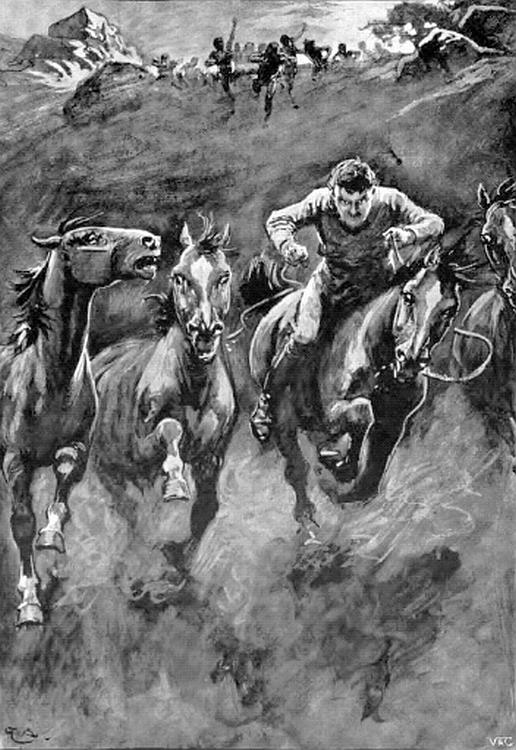
We were racing up a long stony slope, rather more clear of bush than hitherto. Poor Meerkat was not in hard condition, and I was beginning to regret not having stuck to my first mount. Then the bang of a gun away on my left front scattered all reflections to the winds.
“This way, Holt! This way!” sang out a voice, and at the same time bang went another shot.
As I proceeded to follow out Brian’s injunction I looked round, just in time to see a spurt of dust fly up very near in front of my pursuers, where the bullet had struck. These had halted, and as just then there was another bang, and another bullet fell rather nearer than the first, they evidently concluded it was too warm, and began to drop down into cover.
Brian was lying comfortably ensconced in a bush, inserting a fresh cartridge. “I only shot to scare,” he said, in his cool way, as I came up. “They’ll stop now.”
“Are you all alone?”
“Yes. Came back to look after you.”
“And jolly near too late you were, old chap, for if I hadn’t managed to slip my own cable, I’d have been lying at the bottom of an infernal hole at this moment, with my throat cut from ear to ear. That’s what was sticking out for me at daybreak.”
“So? Did you know those chaps were stalking you down when you started back for the two remaining horses?” he said.
“Rather. I raced them for it. You see, I promised to bring back Meerkat, and I’d got to do it. But—did you see that part of it?”
“Ja. Watched you all the time, but concluded that this was the best place to effect a diversion in your favour. Well, Holt—you won’t mind my saying so—but you’re no fool of an imported Britisher, and that’s a dead cert. I don’t expect Trask would have come out of things in that way.”
“Oh, yes he would,” I answered with cheerful magnanimity, for I was in secret hugely pleased with myself—not from any innate vanity, but because I should return to Gonya’s Kloof with enhanced prestige. And for certain reasons I could do with all the prestige I could capture, just then.
We had fallen back on where Brian had left his horse. “You can have my saddle as soon as we can get out of these kloofs,” he said. “I expect you’ll get sick of riding barebacked sooner than I shall. At present we needn’t lose any time. The other horses? Oh, they’ll follow us all right. Later on we can lead them.”
“This is a nice, peaceful country of yours, Brian,” I said, as we held on our way, for we saw no more of our late enemies. “If this sort of thing happens in time of profound peace, may I ask what it’s like in time of war?”
He laughed.
“You may have a chance of seeing for yourself. Well, you have had an adventure, so long”—for I had told him of the sort of night I had spent. “You shouldn’t have gone chevying on after those schepsels all by yourself. I kept shouting out to you to come back, and you wouldn’t. I thought you’d soon give it up, and we had our own hands pretty full. I started the other two off with the oxen, and came back to look for you. Thought I’d find you’d only been spending the night under a bush.”
Chapter Seventeen.
“Hand to the Labour—Heart and Hand.”
“Bring back Meerkat,” had been Beryl’s parting injunction, and I had fulfilled it to the letter. And as I restored her favourite horse, literally with my own hands—and none the worse for his enforced travels, though the other two returned with sore backs—I was conceited enough to think that the pleased light of welcome that came over Beryl’s sweet face was not entirely due to satisfaction at his recovery, and that approbation of his rescuer bore some small share therein.
“Well done, Kenrick,” sang out Iris, clapping her hands. “Man, but you’re no sort of a raw Britisher anyhow.” And I own that the dear child’s frank and homely form of approval fell gratefully upon my ears just then.
“You should have seen Revell sabreing them all right and left with a sjambok when they cheeked him at that kraal,” guffawed Trask. “Oh—h—”
The last in a subdued howl, evolved by the contact of Brian’s boot with the speaker’s shin, under the table. For in another moment Trask would have blundered out the whole story as a joke of the first water, in anticipation whereof Revell was beginning to redden furiously.
“He got us out of that in the nick of time,” struck in Brian with his wonted tact. “Pass on the grog, Trask. Help yourself first—thanks. Well, we’ve brought back the whole plunder, except one of the oxen, and Kenrick’s gun. The first they’ve scoffed, and the second we shan’t see again, I’m afraid. Eh, dad?”
“I’m afraid not. You’ve done well—very well. I never expected you’d recover so much. I’m very much obliged to you fellows for your help.”
Of course we all disclaimed any expression of thanks; but later on what does this prince of good fellows do but send for a first-rate gun to replace my missing piece. No, he would not listen to any protest. I had lost my own in recovering his property, therefore it was only fair he should make it good.
Later on, too, when Beryl heard the story of my own perilous and nerve-trying experience—(much of the detail of our expedition had, for obvious reasons, been kept from the children)—she said—
“Why did you do it? Why did you run such a terrible risk? I would sooner have lost all the horses in the world. Heavens! and you were so near being murdered! No, you ought not to have taken such a risk. Why, I should never have forgiven myself—never. It is too horrible.”
She was intensely moved. Her eyes softened strangely, and there was something of a quaver in her voice. And yet my first impressions had credited Beryl Matterson with a cold disposition! Had we been alone together now I don’t know what I might have said or done—or rather I believe I do know. As it was, I answered lightly—
“Oh, I don’t suppose it would have come to that. Probably they were only trying to scare me, and, by Jove! they succeeded, I’ll own to that. When it came to the point they’d likely have turned me adrift. Don’t you think so, Mr Matterson?”
“No, I don’t. They’d have killed you as sure as eggs,” was the decisive reply. “They’re a mighty schelm lot up Kameel Kloof way, and there has been more than one disappearance of white men during the last few years. But you can’t bring them to book. They swarm like red ants in that location, and no Kafir will ever give another away.”
In point of fact I was not ill-pleased with this decision, simply and solely because the peril I had come through would enhance my interest in the eyes of Beryl, especially as it had been incurred in her particular service.
Our return had been effected without incident or opposition, and to me there was a strong smack of the old border raiding kind of business as we brought back the recovered spoil, recovered by our own promptitude and dash. As for myself, I had undergone some experience of the noble savage in his own haunts, and began to feel quite a seasoned frontiersman. And yet barely three months ago I had been worrying along in the most approved mill-horse round in a City office. Heavens! what a change had come into my life.
Immediately on our return, all concerned in it had held a council of war, confined rigidly to the four of us. The fewer in the know the better, Brian had declared, wherefore he had not disclosed the whole facts of the case even to his father. One of the thieves had been shot, whether killed or disabled of course we had no idea. On that we must keep our own counsel, absolutely and strictly, and to make assurance doubly sure we must never so much as mention the matter again even among ourselves.
Incidentally the rest of us thought it just as well that Trask had accounted for him, because Trask was the weak link in the chain, whereas now that he was the one most concerned, self-preservation alone would keep him from giving away the affair under an impulse of senseless brag.
“You see,” pronounced Brian, “as long as we keep dark the Kafirs’ll keep dark, too. They’ll think nothing of one fellow getting hurt, because it’s quite in accordance with their laws and customs that some one should get hurt in a little affair of the kind. But if we start stirring up things—setting the police on to the track, and so forth—why then it’s likely the other business will crop up, and that’ll be more than awkward, for the schelm wasn’t even going for us, but running away. Running away, mind. There’s no doubt about it but that we—or rather, Holt—struck upon a regular nest of cattle-thieves; but we can do nothing further under the circumstances, nothing whatever. So mum’s the word, absolutely. Is that understood?”
All hands agreed to this, but none more emphatically than Trask, who, by the way, was a little less proud of his feat now that it was put in this new and exceedingly awkward light.
“Very well, then, that’s settled,” declared Brian, characteristically dismissing the affair from his mind.
After this things settled down at Gonya’s Kloof, ordinarily and without incident. And yet, to me, so radical was the change compared with all my former life, that every day seemed replete with incident, even what to the others was mere ordinary routine. I threw myself with zest into everything, and both Brian and his father declared after a month or two that if I went on at this rate I should know as much as they could teach me before I had been with them a year, and already knew a great deal more than Trask did after four: a pronouncement which was exceedingly gratifying to me.
I look back upon those days as among the very happiest of my life. Not that it was all picnicking by any means. There was plenty of work—hard, at times distasteful, even unpleasant. There were times when such meant rising in the dark, saddling up in the grey dawn, and spending the whole long day ranging the veldt in quest of strayed stock, and that beneath a steady, cold, incessant downpour, which soon defied mere waterproof, and would have extinguished the comforting pipe but for the over-sheltering hat brim. Or, substitute for the downpour a fierce sun, burning down upon hill and kloof, until one felt almost light-headed with the heat. Or the shearing, which meant a daily round from dawn till dark in a hot stuffy shed, redolent of grease and wool, and sheep, and musky, perspiring natives—and this running into weeks. But there was always something, and seldom indeed could one call any time actually and indisputably one’s own.
Does this sound hardly compatible with the statement I have made above? It need not; for however hard or arduous the work, I was happy in it. I felt that I was mastering the secret of a new walk in life, and to me a highly attractive and independent one. I was simply glowing with health, and in condition as hard as nails, for although the weather would now and again run into a trying extreme, on the whole the climate was gloriously healthy and exhilarating. Then, too, I was sharing in the only real home I had ever known—certainly the very happiest one I had ever seen. It mattered not how hard the day had been, there was always the evening, and we would sit restfully out on the stoep, smoking our pipes and chatting beneath the dark firmament aflame with stars, while the shrill bay of jackals ran weirdly along the distant hillside, and the ghostly whistle of plover circled dimly overhead and around, and the breaths of the night air were sweet with the distillation from flowering plant or shrub. Or, within the house Beryl would play for us, or sing a song or two in her sweet, natural, unaffected way. Or even the harmless squabbling of the two children would afford many a laugh.
“Tired, Kenrick?” said Septimus Matterson one such evening, after an unusually hard day of it. “Ha-ha! Stock-farming isn’t all picnicking and sport, is it?”
“Not much; but then I never expected it would be,” I answered. “I am only just healthily tired—just enough to thoroughly appreciate this prize comfortable chair.”
“Anyway, you’re looking just twice the man you were when you came. Isn’t he, Beryl?”
“Hardly that, father, or we should have to widen the front door,” she answered demurely. We all laughed.
“Man, Beryl. That reminds me of Trask, when he tries to be funny,” grunted that impudent pup, George.
“That reminds me that it’s high time you were in bed, George,” returned Beryl, equable and smiling. “So off you go there now, and sharp.”
Her word was law in matters of this kind, admitting of no appeal, so Master George slouched off accordingly, making a virtue of necessity by declaring he was beastly tired, and further had only stopped up to help amuse us; which final speech certainly carried that effect.
Beryl remained talking with us a little while longer, then she, too, went inside.
“What on earth I should do without my girl, Kenrick, I don’t know,” thereafter said her father. “Yet I suppose I shall have to some day.”
“Will you?” I said vacuously, for the words raised an uncomfortable twinge.
“Why, yes, I suppose so, in the ordinary way of things.”
“Oh! um—yes, ah! I suppose so,” I echoed idiotically, feeling devoutly thankful that the gloom of night concealed a stupid reddening which I could feel spreading over my asinine countenance, and wondering if the other detected the inconsequent inanity of the rejoinder begotten of an arrière-pensée. But I realised keenly the only side of the situation that would reconcile me to Beryl’s father having to do without her.
I had now had time to straighten out my affairs in England; and arrange for having my capital transferred to this country, though this could not be done yet, by reason of its investment requiring notice of withdrawal. I had caused such of my personal belongings as I needed—and such were not extensive—to be shipped out to me, also some money which I could touch, and this I promptly invested in live stock, under the advice of my most competent of instructors. So by now I reckoned myself fairly and squarely launched. By the way, the man whose boat had constituted the first step in my change of fortunes, having found out my identity, had put in a claim for compensation, but had been directed to wait. Now he too was paid in full, and so everybody was satisfied.
We were nearing midsummer, i.e. Christmas and the New Year, but the intensifying heat notwithstanding, the face of the veldt was smiling and green, for we had had a series of splendid rains. Such a season, it was pronounced, had not been known for years. Stock was fat and thriving, and there was little or no disease. Even our turbulent neighbours had quieted down, and were busy ploughing and sowing, with the result that there was an abnormal but welcome lull in cattle lifting and other maraudings along the border, whose white inhabitants were, for the nonce, content.
“It’s Kenrick who has brought us luck,” declared Iris, with a decisive nod of her pretty head, as we were metaphorically rubbing our hands over the existing state of things. “I’ve read somewhere that it’s always lucky to pick up a waif and stray.”
We shouted at this. Then Brian said—
“I rather think it was the waif and stray who picked you up, kleintje! What price swimming too far out, and the sharks, eh?”
“Nouw ja, that’s true,” she conceded. “But you see, he was bringing us luck even then. You couldn’t get on without me,” concluded Miss Impudence. Whereat we shouted again.
Chapter Eighteen.
Developments.
“Well, who’s for church to-day?” said Brian, one fine Sunday morning as we straggled in to breakfast. “There’s one, anyhow,” he appended, as Beryl appeared, clad in a riding habit. “Wouldn’t you rather drive, Beryl? It’s going to be hot.”
“No. I think I’ll ride,” she answered, busying herself with the cups and saucers. “Meerkat wants some exercise, he’s getting too lively even for me. Are you up to going, dad?”
“Make it rather a heavy load, won’t it? Still, George might ride. That’ll make three of us—quite enough load too, for that heavy cart.”
This was a suggestion which, overtly on the part of one of its hearers, privily on that of another, met with scant approval. On that of George because he preferred being driven, and the shade of the cart tilt, and a comfortable seat, to the trouble of jogging over ten miles of road in the sun, and on a possibly rough-going mount. On that of myself because I did not in the least want George on this occasion, nor anybody else. I wanted the ride alone with Beryl. In fact, I had more than half set up this arrangement when we had heard the day before that there would be church service at Stacey’s farm at the distance above stated, whither a parson had unexpectedly turned up.
“Well, I don’t think I shall go at all,” went on the last speaker. “I don’t feel much up to it.”
“You’re very wicked, dad,” chipped in Iris, with a shake of the head. “Why, it’s six weeks since last church Sunday.”
“Quite right, kitten,” laughed her father, reaching out a hand to stroke her bright sunny hair. “Never mind. You can behave twice as well as usual because I’m not there.”
“Well, I’ll stay with you.”
“No, no. I can’t allow that,” he laughed. “Not for a moment.”
In point of fact, the proposal had required some self-denial, for these occasions were highly popular with the children by reason of the outing involved, and the gathering at the other end, wherefore Miss Iris suffered herself to be over-ruled quite placidly. The said gatherings were of irregular occurrence; this scattered flock for that very reason being but little shepherded.
Septimus Matterson hardly ever talked about religion or its principles; he went one better—he practised them. For the young ones that sort of training was Beryl’s province, he reckoned; while as for Brian and myself, why, we were old enough to know our own minds in such matters and act accordingly. If we chose to attend the somewhat irregular ministrations at Stacey’s we could do so; if not, that was our own business.
To-day, especially, I very much did so choose. It was one of those heavenly mornings in late autumn which I don’t believe you can get outside South Africa—no, not even in Italy—for where else will you find a sky so deeply, so vividly blue; such a sunlight sweep of gold upon rolling seas of green foliage; or open grass veldt studded with delicate-fronded mimosa; such an atmosphere too, which, with no sharp touch in it, is warm and yet exhilarating at the same time. And the unending vistas opened up—the rise of hills, near and far, green-crested, or stately with a crown of bronze-faced cliff, glowing red gold in the generous sunlight; against a background of ever-vivid unbroken blue. Small wonder that on such a day, as Beryl and I cantered along, our spirits were at the highest.
“I don’t ride Meerkat half enough,” she said. “Look how lively he is.”
I did look, and the picture was worth it. The horse, holding high his stag-like head, deep-shouldered, delicate-limbed, yet full of fire and muscle, hardly restrainable in his sportive freshness, would have taken a good many women all they knew to manage. Yet this one sat him to perfection, firm, light in the saddle, swaying with his every movement as though for the time being part of the steed himself; graceful, smiling, snowing no sign of heat or effort, just a little glow of health and contentment flushing her cheeks. No, Beryl never looked better than on her favourite horse. To-day she looked splendid.
I had arranged this ride along with her for a purpose, and the readiness wherewith she had concurred in the arrangement might have meant nothing, but I preferred to think the contrary—that she understood my purpose and concurred in it. I had been here now some months, and we had seen each other daily, and the complete cordiality of our intercourse, with never a hitch, never a jar, so far from waning, had, if possible, increased. I had resolved to-day to bring matters to a head; yet in the—to me—complete happiness of this our ride together, I seemed to defer anything that might break the charm. I would leave it to our return ride. So we chatted on as usual, and gaily, about one thing and another, and then, even if I had wished it otherwise it was too late, for we could see the white tilts of Cape carts and buggies coming from different directions along road and veldt path—riders, too, like ourselves, but all converging upon the common objective. Then the increasing “whang-whang” of a bell, as we drew nearer to this, seemed to cause a general hurry up on the part of all within sight.
I off-saddled our horses and knee-haltered them, among others performing the same operation; Beryl the while having gone forward to greet the people of the place and other acquaintances, and these were many, for of course everybody knew everybody. Just as we were going in Trask bore down upon us.
“I say, Miss Matterson, and you, Holt. Come in front, will you, and help to make a choir. I’m rounding up as many as I can.”
“Not going to have Christmas over again, eh, Trask?” I said maliciously, the point of which being that Trask, who really did know something about music, and was ex officio organist, or to be more accurate, harmoniumist, had on the occasion referred to undertaken to launch out into anthems and carols and all sorts of things unknown to the multitude: such ambitious soarings, and the letting off of wholly extemporised and weird harmonic fireworks on the instrument, which he called “accompaniment” resulting in the silence, by relays, of the whole body of singers; though not before the latter had ingeniously if unconsciously blended the “Adeste fideles,” the “Old Hundredth,” “Coming through the Rye,” and other historic and popular melodies into one inspiring whole. It may be readily imagined that of this fiasco Trask did not quickly hear the end, wherefore he liked not my present reference.
“Oh, go to blazes, Holt,” he retorted pepperily. “I’d like to know what you’d have done in my place with such a lot of—of—” and here he was obliged to stop short, remembering that Beryl had been one of the offenders. She, catching my eye, was thoroughly enjoying the situation.
“All right, Mr Trask,” she answered. “We’ll do what we can. Only you mustn’t try and make us do what we can’t.”
The little plain, whitewashed building—which Stacey had erected on his farm, and was inordinately proud of, and fond of alluding to as “my church”—was nearly full, a thoroughly representative congregation of stock farmers, and their families. Many, like ourselves, had ridden over, and there was a sprinkling of habits among the feminine section of the gathering, eke a proportion of pretty faces. But, great Hercules! there was nothing here to come near Beryl. Looking round, I realised with a glow of pride that, compared with these, she was as a lily among daisies and—she was with me, standing by me, sitting by me, kneeling by me. It seemed—or I wanted it to seem—as though I had a kind of proprietary interest in her.
Frankly, I own to not being much of a church-goer; far indeed be it from me to cast a slight on those who are. It is sad, though a fact, but the process—especially in the morning—has a soporific effect. Yet here, in this little whitewashed building, with the blue sky glimpsed through the open windows, the hum of bees and the strange call of birds in the bush without, wafting in to mingle with the parson’s voice and the murmurs of the congregation, I did not feel drowsy in the least. The graceful habit-clad figure beside me, the profile at which I stole more than one side glance, the sweet true voice, the mere delight of listening to which constituted, I fear, the sole assistance on my part towards Trask’s choral aspirations—there was no room for boredom or drowsiness in such proximity; and if this be objected to as a substituting of the creature for the Creator, well, still in my blundering untheological mind I have an idea, which I couldn’t express intelligibly to save my life, that on this occasion the influence was something more than a mere earthly one. But let that pass.
After the service we streamed out into the sunlight, and tongues began to wag on all sides.
“Do persuade your brother to stay and have dinner with us, Miss Matterson,” said a voice on the other side of Beryl. “We can’t; and it’s much too long for poor little Iris to wait if he persists in taking her back at once. Of course you’ll stay—and Mr Holt.”
The speaker was one of the two girls who had made their appearance what time I had got Iris out of the sea at East London, and we had often laughed over it together, and the figure I must have cut. Then old Stacey came up and seconded the invite so heartily that Beryl gave way. But Brian was as adamant. He wanted to get back, for several reasons, he said. Beryl and I knew more than one of them at any rate. As a matter of fact, Brian was a bit of a misogynist. He detested fooling around among a pack of women, he used to say; and the Stacey girls he held in particular aversion, which was ungrateful of him, as they happened to cherish a scarcely disguised admiration for his unappreciative self. So George and poor little Iris were carried summarily off, greatly to the disgust of the latter.
We who remained made ourselves festive enough. Old Stacey, though somewhat shaky over his aspirates, was not half a bad old sort, and the girls showed to far the best advantage in their own home. They made themselves exceedingly pleasant to Beryl and myself, and if they had a way of bracketing us together, so to say, it was by no means displeasing to me, for I had got into a way myself of feeling a sort of proprietary right in her, when we were among other people. If she noticed this, assuredly she could not have resented it; at times I would even let myself think she unconsciously reciprocated it. She would often refer to me upon some debated matter, for instance, as if mine was the opinion which rendered it final.
We took leave of our entertainers a couple of hours before sundown, in great good humour with ourselves and all the world. A misgiving had at one time seized me lest Trask should inflict himself upon us, as at any rate part of our way lay together, but he had taken himself off much earlier—and now we were alone. Not a soul was in sight, not even a house. The undulation of the veldt, green and gold in the westering sun, stretching away on either side, was as if deserted by man. Not by animate Nature, though. A troop of monkeys skipped across our path, momentarily scaring our horses, and chattering at us from the tree-tops; and bird voices were never still. Several blue cranes were shambling along just off our way, and the incessant cooing of doves, near and far, blended melodiously with the fair and peaceful evening scene.
Yes, the happiness and peace of the day were upon me, as if this fair scene were an earnest of the happiness and peace which had filled my life of late. Was it a reflection of that which should continue to irradiate it? Alas and alas, could I but have foreseen! Yet what misgiving could strike me then, what foreboding that this day was the last—the very last day of happiness or peace for me, and indeed for others, for a long time to come?
“Well, Kenrick, and what is the subject of that very deep meditation?”
I started. I had forgotten how long I had been plunged in silence.
“You are,” I said.
“Me?”
Her eyes opened wide. There was the most delightfully alluring little smile, half demure, half mischievous, playing around her lips. Then, as I took in her whole sweet personality, as I looked at her and thought how the next few moments were to decide whether that sweet and gracious personality were to belong to me for the remainder of our lives, or not—my pulses were bounding and beating at such a rate that I wondered how I should get out even two consecutive and coherent words. Yet it must be done, now and here.
“Listen, Beryl,” I began. “There is something I want you to hear, and that you must hear. I—”
“Hullo! Hi, you good people! Hold on a bit and give us a chance to come up.”
And that infernal Trask came clattering upon our heels, having spotted us from the road which led from his place. Well, there was an end of everything. My opportunity was gone—for that day, at any rate; and I hold a superstition to the effect that opportunities have a way of not recurring.
“Thought I’d ride over and make an evening of it at your place, Miss Matterson,” he rattled on. “A man gets a bit hipped sometimes all by himself, you know. So glad I fell in with you like this.”
Beryl answered sweetly that so were we, and that they were always glad to see him, and so forth. While I—well, at that moment I could cheerfully have murdered Trask with my own hand.
Chapter Nineteen.
Concerning a Tragedy.
A shot rang out, faint and distant, upon the slumbrous morning air.
“There’s that young schelm George at work,” remarked Brian, raising himself on one elbow to listen.
“At play, rather,” I laughed.
“That’s it. He’s a jolly sight too fond of cutting school in favour of a buck-hunt. The governor spoils him far too much. I wouldn’t.”
George’s education at that time was effected through the agency of a farm-school about seven miles off, whither he rode over five days per week; in theory at least, for few indeed were the weeks out of which he did not contrive to filch one extra day—not to help us in any work, oh dear no, for he looked upon it as a distinct grievance to be required to do any such thing—but to amuse himself. To-day he had started for the Zwaart Kloof alone to try and sneak a bush-buck. But if the young rascal was at play, Brian and I were tolerably hard at work; had been rather, for we had spent the morning strengthening and repairing the bush fence of one of our enclosures; and chopping mimosa boughs and then beating them into place is a fairly muscular phase of manual labour on a hot day. Now we were pausing for a rest.
But if it was a hot day it was a lovely one—lovely and cloudless. A shimmer of heat lay upon the wide valley, and all the life of the veldt was astir—bird voices calling far and near, the melodious hoot of the hoepoe from the distance, the quaint, half-whistling, half-rasping dialogue of a pair of yellow thrushes hard by, or the bold cheery pipe of sheeny-winged spreuws flashing among the bush sprays. Insect sounds, too; the bass boom of some big beetle rising above the murmuring hum of bees, and the screech of innumerable crickets. In sooth, if our work was hard, it was set amid exquisite surroundings, and, as though no element of romance should be lacking, I thought to discern from time to time the flutter of a light dress about the homestead, nearly a mile distant beneath us, as though reminding myself, at any rate, that after labour came recreation, which to me spelt Beryl.
No opportunity had I found for renewing the subject so ruthlessly interrupted yesterday during our ride home, and now I was tormented by an uncomfortable misgiving as to whether Beryl was not purposely avoiding any such opportunity.
We got up from the grateful shade under which we had been resting, and, hatchet in hand, started in on another spell, and for nearly an hour were chopping and hauling, and banging the great mimosa boughs into place so that the thorns should interlace with those already laid down. Then Brian suggested we should go back to dinner, and return and finish up when it was cooler, but before we could put this plan into execution the trampling of hoofs was heard drawing rapidly near, at a pace that was out of the way reckless and unnecessary.
“That’s George,” said Brian, “but if he’s shot anything he hasn’t loaded it up. Hey! Hullo! What luck, George?”
The latter would have passed without seeing us. Now as he reined in and approached us we saw that the boy’s face was as white as death, and his eyes staring with the most awful look of horror and fear.
“Man, what’s wrong?” said Brian sharply, his own bronzed countenance turning a kind of whitey-brown. “Not shot yourself, have you?”
“No, not myself—not myself,” the boy managed to jerk out. And then he broke into a wild fit of sobbing.
Brian’s face grew still whiter.
“Is it somebody else, then? But you went out alone.”
“Yes—I—I—I w-went out alone.”
“George, pull yourself together, man. Whatever’s happened; we’re losing time. Don’t be an ass now. Tell us all about it.”
This he managed to do; and a woeful and dismaying tale it was that he spasmodically unfolded. Reft of its incoherencies—natural under the circumstances—this was the sum of it.
He had reached the Zwaart Kloof, and having left his horse was stealthily advancing to peer over the brink of a small krantz, beneath which a bush-buck was sometimes lying. This time, instead of a bush-buck there were a lot of Kafir boys larking about the kloof. He told them to clear out, but, seeing he couldn’t get at them immediately, they were cheeky and laughed at him. So he pointed his gun at them, calling out that he’d shoot the whole lot if they didn’t clear—intending, of course, only to frighten them—and then—how it happened he could not for the life of him tell—but the gun went off, the heavy charge of treble A simply raking the group. Two were killed outright, for they never moved, and two more lay wounded and screaming. The rest ran away, and he himself, reckoning that the best plan was to get help as soon as possible, had started for home as fast as his horse could carry him.
Such was the miserable story which the wretched boy managed to unfold, and meanwhile we were walking rapidly towards the house.
“Oh, I never meant to do anything but scare them, Brian—I swear before God I didn’t!” sobbed the poor little chap, in an agony of remorse.
“Of course you didn’t, George. We all know that. Here, give me the gun.”
“Take it—take it. I never want to touch a gun again in my life. Oh, what is to be done? What will the dad say?”
Septimus Matterson did not “say” much, but the expression of his face was as that of a man undergoing acute physical pain. Meanwhile Brian had been thinking out a plan, which was to proceed at once to the spot with two of the farm Kafirs, and see what could be done for the wounded boys. Beryl volunteered to accompany him, but this he vetoed with his wonted decisiveness.
“On no account, Beryl. You stay here—you’ll be far more useful that way. Now turn me out some bandages, and a flask of brandy.”
This was done in a moment, and he was ready to start.
“No, no, Kenrick,” he said, as I announced my intention of accompanying him. “You must stay here too. Don’t move from the house either. Do you hear? It’s hard to say what may happen, and you’ll be wanted. There’s no telling what trouble this affair may stir up. You understand?”
Then I did understand. The ominous significance of his tone sufficed for that. But all attempts to convince him that his place lay here too, were futile.
“Those who ran away will have obtained help from their own people by now,” I urged. But in vain.
The while Beryl was striving to reassure her young brother, and she had all her work cut out for her, for the poor boy’s remorse was dreadful to witness, and to do him justice no thought of potential pains and penalties hanging over his own head entered into this, which was actuated by sheer horror of having taken life—several lives, for all we could at present tell.
“It was pure accident, George, we all know that,” she said. “And you must do all you can in reparation. You will remember that, dear, won’t you, whatever happens.”
“Oh, they can hang me if they like. The sooner the better.”
“They won’t do that, at any rate. It was an accident.” And then Beryl went on to soothe and comfort the poor boy, and the sweet magnetism of her voice and words bore good effect.
This and more I overheard while discussing the situation with their father.
“This is a most awful and deplorable thing to have happened, Kenrick,” the latter was saying. “As soon as Brian comes back, and we know the extent of the damage, I shall have to send into Fort Lamport and notify the Resident Magistrate. The boy may even be sent for trial for manslaughter.”
“But the thing was a sheer accident. Surely they won’t hold a kid like that criminally responsible.”
“There’s no knowing what Shattuck’ll do or won’t do—he’s such an officious fool.”
“Yes, he’s all that,” I agreed, having an acid recollection of the demeanour of the official in question over such a trivial matter as signing a firearm permit.
“He has a ‘down’ on us farmers too, and will always favour a Kafir under the Masters and Servants Act if he gets a chance. It’s just the same in stock stealing cases. They ought to have put him into some Western Province magistracy. A man like that has no business on the frontier.”
“I blame myself mostly,” went on the speaker. “I ought never to have allowed a young feather-head like George to go out alone with a gun. The only thing is, I have always believed in boys learning to shoot as soon as possible in a country like this. Even girls ought to. Beryl can.”
“Rather,” I said. “Haven’t I seen evidence of that?”
Septimus Matterson was looking worn and ill, and very anxious. He had been ailing for some days past, and this deplorable eventuality had not exactly gone towards setting him up. I remembered Beryl’s remark about her father’s life not being a “good” one, from an insurance point of view, and felt more than anxious on his behalf.
“You are not looking at all well yourself,” I said. “Now, don’t let this affair get on your mind too much. It’ll all blow over, depend upon it.”
“Oh, I’m all right, Kenrick. Don’t you worry about me. I suppose Beryl has been filling you up with some of her coddling notions. She wants to coddle me, the dear girl—always telling me to take care of myself; and so on. I pretend to take it all in, of course. Hallo! Wait a minute—” he broke off.
He went outside, returning directly with a field-glass.
“Quite a lot of them,” he said, handing it to me after a look down the kloof. “We shall have trouble over this, Kenrick, apart from any cussedness Shattuck may spring on us. I wish Brian was back again.”
So did I, as I stood with the glass to my eyes. For a number of Kafirs were coming up the kloof, some mounted but most on foot—the latter coming along at a swinging trot to keep pace with the horsemen. And that there might be no doubt as to their hostile intent, I could see that all carried a couple of business-like kerries apiece, and not a few of them assegais as well.
“Hadn’t we better arm ourselves and barricade the house?” I suggested.
“No, no. We mustn’t seem afraid of them. Still, there’s no harm in dropping a revolver into our right hand pockets, in case of accidents. We’ll talk to them here.”
We went inside and quickly loaded a revolver apiece. At a word from her father Beryl got down her own pistol, loaded it, and tranquilly pocketed it. Poor little Iris was looking very scared, but was quite quiet.
“Keep these children entirely out of sight, Beryl,” enjoined her father, “and it’ll be no harm if you don’t show yourself during the indaba. There may be a lot of bluster and talking big; but it won’t come to anything worse, so don’t be scared, any of you.”
“I wish Brian were here, father,” said Beryl anxiously.
“So do I, but he isn’t. And if ever you’ve known of a situation in which Brian has proved unable to take care of himself, I haven’t. He’ll be all right.”
The dogs, which had been walking up and down outside, growling, now broke into such a clamour as to drown all speech, and charged furiously down upon the advancing Kafirs as the foremost came in sight round the bend of the cattle kraal, and would hardly be called off, even by their master’s most imperative tones, aided by two or three kerries shied at them by the newcomers, an act in itself significant of the ugly and dangerous mood which was upon our unwelcome visitors.
“Seems as if we’d got the whole of Kuliso’s location,” said Septimus Matterson, as we took in the crowd which was advancing upon us. The kloof indeed seemed black with Kafirs. Those who had horses dismounted as they came in sight of the house, and the whole body of them came straight on with a fellness of purpose that augured the worst.
It was a tense moment. Our unpleasantness with the people at the kraal on our way in pursuit of the stolen oxen was nothing to this for a situation. There must have been hundreds and hundreds of Kafirs here; hulking, ochre-smeared barbarians, some of gigantic stature, all with an expression of menace and determination and ferocity upon their savage faces. Others, too, were coming on in the distance to swell their numbers. My hand was closed round the butt of the revolver in my pocket. I looked at Septimus Matterson. He had not moved, and was still standing, calm and undismayed, confronting the furious and threatening rout.
Chapter Twenty.
A Fell Alternative.
“Halt!”
Septimus Matterson put forth his hand and uttered just the one word, and the effect was like fire applied to the train. A roar of menace and fury ran through the whole crowd. A forest of dark grisly hands seemed to tighten with murderous grip upon kerries, and assegais were shaken at us; but the injunction was obeyed. The foremost were about fifty paces from us, and others came swarming up in the background, forming an immense half circle.
“We have come for the boy. He must die. He has slain two of our sons—and they are of the House of Kuliso. He must die.”
Such was the promising manner in which negotiations were opened. Now I had been studying the Xosa tongue rather diligently since I had been at Gonya’s Kloof, and had acquired quite a smattering of it. Septimus Matterson, of course, spoke it perfectly.
“Were they of the house of the chief?” he said. “But where is Kuliso?”
“Bring out the boy,” they roared in response. “He must die. He has taken two lives, and he must die twice. Bring him out, Umlúngu, or it will be the worse for all of you.”
“Hear now, amadoda” came the reply, “the thing was an accident, entirely an accident, and for it I will make due and complete compensation according to your custom. Retire now and carry my word to Kuliso and his amapakati, for surely I see no man of any note here.”
This was indeed the case, and augured the worst. The wily chiefs could plead afterwards that any outrage that might occur was the work of an irresponsible mob. The latter, in no wise pacified, broke forth again.
“Compensation? Not so. Blood for blood. A life for a life—or rather for two lives. That is the word of the people. And the two lives were of the house of the chief. Bring out the boy. Bring him out.”
The wild hubbub of voices grew louder and louder, and the ferocious crowd closed in upon us nearer and nearer. Sticks were brandished, and I could see more than one ruffian handling his assegai all ready for a cast. It was a fearful moment. Our lives seemed to hang upon a hair—and worse, for were we struck down or assegaied, would these barbarians, in the fury of their blood lust, spare one living being within that house?
“Shall we get inside and shoot?” I said hurriedly and in a low tone, without turning my face from the enemy.
“No. We’d do no good that way. The bluster may wear itself out.”
“Attend, Umlúngu,” called out one great voice. “If the boy is not handed over to us immediately, we will take him. But first of all we will kill all here.”
“You will have to do that first, Sibuko,” was the stern reply, “and in doing it many of yourselves will die.”
Sibuko! I remembered the name, and now, looking at its wearer, I remembered him. It was the big Kafir to whom Brian had administered a well-deserved thrashing on the morning after my arrival, and now this ruffian was the leading spirit of the whole ferocious crew. We were indeed in a bad way. It was manifest that no white man could surrender his son into the power of these savages, even apart from their curiously significant promise that he should die “twice.” But—the way out?
“This is what shall be done,” went on Matterson. “The boy shall be sent into the town to be tried by the magistrate. The laws of the Government are there, and are for all. Kuliso cannot make his own laws, unless the Amandhlambe are prepared to make war upon the Government. When a white man kills another he is tried and punished for it. When a Kafir kills another the same happens. Both are punished by the same laws, the laws of the Government.”
I thought I observed a tendency among them to cool down at these words, but that ruffian Sibuko walked up and down, haranguing them and flourishing his kerrie, and in the result a number of them went round to the back of the house. Well, this did not distress us much. We thought that Beryl would know what to do in such an emergency.
“The boy!” they howled again. “Give him up to us, or we will kill you all and roast you in the flames of your burning house. Now, Umlúngu, bring out the boy.”
Septimus Matterson put up his hand. The clamour stilled.
“Listen,” he said, and his voice rang out loud and clear. “You shall not have the boy. We hold twelve lives here,” drawing his revolver and pointing it, an example I promptly followed. “Before you kill us twelve men shall die. You know me.”
The silence that followed upon the tumult was well-nigh alarming. The clamourous savages had imagined that they had two unarmed men to deal with, and now the sight of two business-like six-shooters pointed straight at them seemed to throw a different light on affairs. They were hundreds, it was true. But that twelve men, or near it, would certainly fall before they could reach us they fully realised, the point of which was that none of them wanted to constitute one of the twelve. I stole a sidelong look at Septimus Matterson, and thought to discover something of what had daunted them, for his face wore the aspect of the strong, quiet man thoroughly roused, and, more dangerous still, deadly cool through it all. At the same time came Beryl’s voice from the other side of the house, sharp and clear upon the silence, saying in their tongue—
“These two guns are heavily loaded with buckshot. I will pour all four barrels into the mass of you if you make a step forward. After that I still hold six lives.”
Looking back, I can hardly ever have gone through a more strained crisis of tense excitement than that moment afforded. The great crescent of ochre-smeared, infuriated savages seemed to shrink into itself, as though concentrating for a decisive rush, and indeed I don’t care to think what the next moment might have brought forth had not a diversion occurred.
Coming up the kloof at a swift canter were four mounted figures. Police? No. Three of them were Kafirs, the fourth a white man.
“Au! Namhlanje!” went up from the crowd, and heads were turned to watch the new arrivals.
Now “Namhlanje” was Brian’s native name, which, meaning “to-day,” had been bestowed upon him as characterising his quick decisive way of doing things, and when linked with it was uttered another name, Usivulele, I began to think the crisis was past, for the name was that of one of the Ndhlambe chiefs, whose influence was hardly inferior to that of Kuliso himself.
Hostilities were suspended pending the arrival of these, and, as they rode up, the threatening and tumultuous clamour was changed into deep-toned salutations addressed to the chief.
The latter was a well-built elderly man, with no insignia of chieftainship about him, not even the thick ivory armlet which he wore just above the left elbow, for several of his followers wore this adornment too. But the deference displayed towards him by this unruly mob, that told its own tale. For such is the prestige and authority of a tribal chief among the Amaxosa that if you have him on your side in any dispute with his subjects, why, the matter is settled. That now Usivulele was upon our side I had no doubt, seeing that Brian was riding with him. The other two were old men with grizzled heads, and were amapakati, or councillors. Way was at once made for the group, and a rush to hold their horses as they dismounted.
“I see a chief,” said Septimus Matterson in figurative greeting—he had already put away his revolver, and so had I, with a feeling of relief it would be impossible to exaggerate. “Now we can talk.”
“My heart is very sore over what has happened, my friend,” he went on. “Yet he who has done this thing is a child, and he has done it by accident. When a child does that for which a grown man would be killed, he is not killed because he is only a child. He is not killed, but he is punished. Is it not so?”
The three uttered a murmur of assent. Brian said nothing.
“Well, then, although this thing was an accident, and although the child is my own son, I do not propose to shield him from punishment. But it is not for me, and it is not for these here, to decide on what punishment he shall receive. It is for the law. Therefore I am going to send to Fort Lamport for the amapolise, and the boy will be taken to the magistrate there. After that we must leave him to the laws of the Government. Say. Is not that just and fair?”
“Ewa,” assented the three, and I observed that a like murmur went up from not a few in the listening crowd.
“Hau!” broke forth one voice. “What of our father, Kuliso? Those who are killed were of his house.”
The interruption had proceeded from Sibuko. The hulking ruffian, standing there in the forefront, his muscular frame smeared from head to foot with red ochre, a vengeful sneer upon his savage face as he significantly gripped his kerries, struck me as about as evil and formidable an impersonation of barbarism as it would be possible to present.
“Yes. What of our father, Kuliso?” echoed others. But Usivulele merely waved a hand, and there was silence as by magic.
“You all know me, amadoda,” went on Septimus Matterson. “Now I will write a letter to the magistrate, and two of your number shall carry it. By to-night the amapolise will be here.”
“Hau! The amapolise will be here. But will the boy be here?” said the abominable Sibuko, with his head craftily on one side.
“You can see for yourselves. Let some of you watch the house until the amapolise arrive.”
“But how do we know he is here now?” went on this persistent savage. “He may have been taken away quietly during all this time. Bring him out, and let us see him.”
“Ewa, ewa!” shouted several.
This would have been acceded to, when a sudden instinct of the impolicy of such a course flashed across my mind, and I take a sneaking pride in having supplemented judgment to so experienced and judicious a mind when for once that attribute seemed to fail.
“Don’t you do it,” I said hurriedly and in an undertone. “No point in making the boy too marked, under the circumstances. Show him to the chief only.”
“You’re right, Kenrick.” Then aloud: “The chief will satisfy you. He will come into my house and see the boy.”
While this was being done Brian quickly put me up to his own movements. There was no doubt about it but that two of the Kafir boys were dead. It was a most lamentable and unfortunate affair for everybody concerned. How had he fallen in with Usivulele? Ah, that was something of a piece of luck. He had got wind of a dangerous demonstration being organised, had seen the Kafirs swarming along the hillsides from different points, but all converging upon the same—our valley to wit. Only one way to counteract this had suggested itself, and accordingly he had ridden straight and hard for Usivulele’s kraal. He and his were on exceedingly friendly terms with that chief, and he had soon prevailed upon him to intervene.
“Well, Brian, if ever a man did the right thing at the right time, you did it then. A few minutes later would have been so many minutes too late.”
“I believe so,” he said. “I could see that things were looking as ugly as they could. Well, it’ll be all right now, at least as far as Kuliso’s people are concerned.”
Then Usivulele came forth again, and began haranguing the crowd. The whole thing was as had been said, he informed them, and they might now go home. The matter was in his hands now, and he would remain until the boy was handed over to the amopolise. This he himself would see done. Then he chose two men to carry the letter in to Fort Lamport, and the crowd began to break up. A few manifested a disposition to hang around and see the thing out, and this was not objected to, but the remainder scattered off in groups, or by twos and threes, and glad indeed we were to see the last of them.
It may be imagined what a gloom there was over us all during the remainder of that day. Beryl hardly appeared, and George not at all, and even poor little Iris had lost her sunny flow of spirits. We three men had hardly the heart for anything, and got through time chatting with the chief and his councillors, who, incidentally, were lavishly entertained. But it was not until late at night that a squad of Mounted Police arrived, under a sergeant, to take charge of the boy.
We were not sorry to learn either from the same source that a strong patrol would be working along this side of Kuliso’s location, for it was arranged that we should all start for Fort Lamport together at daybreak.
Chapter Twenty One.
In Court.
Shattuck, C.C. and R.M., was not a genial type of Civil servant, in that he was cold and short of manner, and always intensely official. Moreover, he was popularly credited with a strong native bias, which alone was sufficient to constitute him a round peg in a square hole, in a frontier magistracy such as Fort Lamport. Personally, he was a middle-aged man with a high bald forehead, and wearing a light full beard—would have been a good-looking one but for a normally acid expression of countenance.
Poor George stood limply in the dock, all the cheek taken out of him, as Brian and I had laughingly told him, as we tried all we knew to hearten him up just before he was placed there. Indeed, there were not wanting those who thought ill of the magistrate’s curt refusal of our attorney’s application to allow him to stand beside his father throughout the preliminary examination, on account of his youth.
“I cannot make such exceptions as that, Mr Pyle,” had been the answer. “Had it been the case of a native no such application would have been made.”
This, by the way, was the sort of remark which did not precisely tend to enhance Shattuck’s popularity.
The Courthouse was a dingy, stuffy little enclosure, and it was crowded to overflowing, the back part of the room, usually occupied by natives, being closely packed with dark faces and rolling eyeballs; but scattered among the townspeople was a large number of stock farmers, many of whom had travelled considerable distances in order to render the Mattersons a kind of moral support.
The first called was the District Surgeon, who made a post-mortem of the two bodies. The deceased, he deposed, were boys of about fifteen or sixteen, as far as he could judge. Then he proceeded to technical detail, such as the number of shot-wounds in each, when and where placed, and so forth. As to the other two who were wounded, he, the District Surgeon, could not say they were out of danger yet. Their injuries were undoubtedly severe.
Then followed, severally, the three or four boys who had been in the company of those shot, and at the time. These gave their version of the affair pretty much as George had given his. He had abused them for being there, they said, and ordered them away. They laughed at him, and he called out that if they did not go at once he would shoot them. He was pointing his gun at them at the time, and the next thing they knew was that it went off and four of them were lying on the ground. The remainder ran away.
The tale of each tallied, but Pyle, the attorney who was watching the case on behalf of George, after a bit of a wrangle with the Court interpreter as to the exact shade of meaning which the order to move on would or would not bear in the native vernacular, fastened upon two points in cross-examination. One was the distance between the slayer and slain, but there was no room for doubt here. He was on the top of the cliff while they were beneath it. But it was not a high one. How high? As high as the Court room?—Higher, perhaps twice as high. Obviously any one shooting at that short distance would be shooting to kill, not merely to frighten. Even a boy who was accustomed to firearms, like George was, and however careless, could be under no mistake on that head. This to dispose of any idea that he had intended merely to “pepper” the deceased without intent seriously to wound.
The other point upon which our attorney harped was the demeanour of the accused. Was he angry when he ordered them away?—Yes. He said they were spoiling his hunt. Did they seriously think he meant to shoot them when he threatened to?—Well, they didn’t know. But if anybody points a gun at you and you think he means to shoot you, you don’t stand still and laugh at him?—Whau! They hadn’t thought of it in that light. No, they supposed he had not intended to shoot. Then it had been an accident?—Yes, they supposed so.
All this was put by Pyle to the witnesses in due order, and they were unanimous in their answers. Pyle was radiant. During the slight commotion of finding the next witness he leaned back and whispered to us—
“He’ll be discharged. Even Shattuck can’t send him for trial on top of that admission.”
All the same, we were not quite so sure.
Then was led a good deal of Kafir evidence, that of parents and other relatives of the dead boys, but this dealt mainly with identification, and was of little or no value for or against our side. It was tediously drawn out too by reason of the interpreting, and was not completed by the time the Court adjourned for lunch.
“Buck up, old chap,” said Pyle, going over to poor George, who was not allowed to leave with us. “Buck up. You’ll be having it with your governor next grub time.”
“Thanks, Mr Pyle, but I don’t believe I shall,” was the doleful reply as he was taken into the chief constable’s room to devour some sandwiches which Beryl had sent him.
As we passed out of the dingy hall into the glare of the sunlight, the contrast was a relief. It was good to be out in the open air again, but the contrast was sharper as we thought of the poor boy we had just left. What if imprisonment, even for a comparatively short time, was before him?
The native end of the Courthouse had emptied out its malodorous crowd, but this was nothing to the number of those who had been unable to gain admission, for to-day the whole township seemed to grow Kafirs, who had come in from near and far by reason of the excitement of the case. Some were squatting around in groups, lustily discussing it; others lounging around the general stores; while others again were shaping a course for the nearest canteen. All had sticks, and not a few a pair of them.
“The sooner they pass a bye-law against carrying kerries in the streets the better,” said Brian, as we walked over to the hotel. “There are enough of these chaps here to-day to take the town if they made up their minds. Hullo!”
The last was evoked by the sound of a great voice haranguing one of the groups we were passing. Looking round, we recognised Sibuko.
This pestilent savage was squatting on his haunches, holding forth volubly, emphasising his points with a flourish of his kerrie in the air, or bringing it down with a whack on the ground. But to me he was of secondary interest beside a face in the group that caught my eye.
“Brian, twig that chap three doors off from Sibuko,” I said hurriedly. “That’s the one who was going to cut my throat in the cave that morning. By Jove! I wonder if he remembers the knock-out I gave him. I wouldn’t mind repeating it either.”
“Well, you can’t—not here and now. In the first place, there are too many of them; in the next, Shattuck would fine you about twenty pounds; and thirdly, we don’t want to stir up that stew over again.”
The hotel was pretty full, and the first person to catch my eye as we entered the dining-room, rather late, was that infernal Trask, who had calmly appropriated the seat next to Beryl, and which I had mentally marked out for myself. Moreover, he was in train of trying to be excessively funny, which was his way of keeping everybody’s spirits up.
“Hallo, Holt,” he sang out. “Got your seat, I’m afraid. We’d given you up. Plenty of room down there, old chap. By the way, how are things going?”
“Well, we think,” I answered curtly, moving to the vacant part at the far end of the room.
“Ha-ha! Holt seems a bit raggy to-day about something,” I distinctly heard Trask say. “What an uncertain tempered Johnny he is.”
But I did not hear Beryl’s reply, and—I should have liked to.
We had to hurry back to court again, and, the native evidence concluded, Brian was called to the witness-box. He deposed to George’s return home directly after the tragedy, and how he and I were the first to hear the boy’s account of the same, and from that, his first account, he had never swerved in any detail. Also how he himself had proceeded to the scene of the tragedy in the hope of being of some aid. Pyle then questioned him about the accused’s disposition. Was he inclined to be careless with firearms?
No, Brian didn’t think he was. All boys were more or less careless about most things. Whereat a titter ran through the crowd.
Was the accused of a mischievous disposition?
“Not more than most other boys of his age.” And at this the titter became a laugh, causing the magistrate, whose official soul was scandalised, to glance up sharply.
Was he of a passionate or vindictive disposition?
“Not in the least,” answered Brian decisively. “I am as convinced that the whole affair was a sheer accident—the thoughtless pointing of a gun at anybody I don’t defend—as I am that I stand here at this moment.”
A murmur of applause greeted this remark, and then Brian being done with, I was invited to take his place, but as all that was wanted from me was a mere confirmation of George’s first narrative of the affair, I soon got down again.
Septimus Matterson followed. He was very much affected, but gave his evidence in a sensible straightforward manner that was worthy of all praise. He told of the irruption of indignant natives on to his place, but without any rancour or ill-will. As for the accident, no one regretted and deplored it more than he did, unless it was his unfortunate son, and he fully intended, according to Kafir custom in the matter of homicide, to make liberal compensation to the relatives of the slain boys. As to which he would be glad if the magistrate would allow this to be made known by the interpreter for the satisfaction of the natives at the back of the court.
He had always lived on friendly terms with his Kafir neighbours, he went on when the hum of applause that greeted the last announcement had subsided, and hoped always to do so, in spite of this deplorable accident; several of their chiefs, too, were well known to and esteemed by him and his, and now in this case he had been the first to surrender up his own son to justice.
“That will do, Mr Matterson,” said Pyle hurriedly, seeing signs of an utter breakdown. And he beckoned him from the box.
Then he began a fervid appeal to the Bench. If all the testimony they had just listened to was worth a jot, he said, it was clear as clear could be that the case was not one of culpable homicide or of manslaughter, but of accidental death. The evidence of the native witnesses, fair and straightforward as, to their great credit, it had been, made this way, even more if possible than that of the relatives and friends of the accused. The only eyewitnesses of the tragedy, besides the accused, had frankly admitted when it was put fairly to them, that the lamentable and deplorable affair must have been an accident.
Then he went on to enlarge upon the terrible mental punishment this boy—this mere child—had already undergone, a consciousness which would last far into his after and maturer life, of what one act of carelessness had involved; and having expatiated thus and at some length, concluded by pathetically urging his worship to discharge the accused, and not to add further to his own sufferings and to those of his sorrowing relatives.
There was dead silence as the attorney ended this appeal. We, and indeed all in the room, took for granted that it would bear fruit, and that George’s discharge would follow. But we reckoned without Shattuck.
“As Mr Pyle has observed,” began the magistrate, “this is a painful and deplorable case. Even an accident may have its culpable features, rendering its perpetrator amenable to the law. Here two lives have been sacrificed owing to a most culpable piece of thoughtless bravado on the part of the accused, and I should not be doing my duty in summarily discharging him. It is a case for a judge and jury to decide, and the accused stands committed to the next Circuit Court here.”
Then the formality of asking him if he wished to make a statement being gone through, and having been duly cautioned, George, instructed by the attorney, repeated, “It was an accident,” and in a scrawling, shaky, schoolboy hand signed his statement.
Then Pyle applied that bail should be granted. There was plenty of substantial security available, he added. And at his words at least a dozen men stood up. But the next words that fell from the Bench were even a greater thunderbolt to us than the decision to commit.
“I cannot grant bail, Mr Pyle.”
“Not grant bail, your worship?”
“No. Not in a case of this nature.”
“But there’s no more substantial man in the district than the boy’s father, your worship.”
“I am far from denying it. But—I cannot grant bail.”
Quite an angry murmur ran through the audience at this. But the magistrate merely looked up.
“Several persons here are committing a very distinct contempt of court,” he observed coldly. “Remove the prisoner.”
The poor little chap kept up bravely till he was out of sight. Then he broke down and fairly howled.
To do Shattuck justice, his apparent hard-heartedness was not without motive, for on the rising of the Court—that is to say immediately, for there were no more cases that day—he asked us to step into his office.
“I am very grieved, Mr Matterson, over the course I have been obliged to take,” he began, stiffly and constrainedly, “but I fully believe I am serving your best interests in doing as I have done. If the boy were given back to you now, would not all the Kafirs around, and Kuliso’s people in particular, at once jump to the conclusion that justice had not been done, and that there was one law for the black and another for the white? In short, I believe his life would be in hourly danger. Their demonstration on your farm seems to point that way, doesn’t it? Well now, if they know he is here in prison—I am not going to have him put in an ordinary cell, by the way—they will be to that extent satisfied, and it will give any strong feelings time to die down a bit. The case is out of my hands now. The records will be forwarded immediately to the Solicitor-General, and of course it rests with him whether the matter goes any further.”
There was sound sense in this, and indeed the magistrate had shown a consideration we had not expected from him. So we parted good friends, and rather arriving at the conclusion that Shattuck was not such a bad sort of fellow after all.
Chapter Twenty Two.
Kuliso’s “Great Place.”
Gonya’s kloof seemed no longer the same place. The period of suspense following upon George’s committal told upon all of us, seeming to cast a gloom over everything, damping our spirits. Of myself especially did this hold good, for Beryl was no longer there. She and Iris had remained in Fort Lamport after the preliminary examination staying with friends, and we three men were alone.
What a difference it made! During the months I had already spent on the place, Beryl had never been absent for a single day, and now that presence which had rendered the hardest of toil sweet, and irradiated the norm of the daily round with a glow that seemed hardly of earth—to myself, that is—was now removed. Yet the sun shone just as brightly and the generous riches of Nature expanded around with the same fairness to eye and sense; but—to myself—all lay as beneath the shadow of a cloud.
Many times a day would I recall the keenness of the pang when she had told us of her intention to remain in the town for the present. The announcement was made in the presence of several persons, or there was no telling how I might have taken it. As it was, I have a confused recollection of turning on a vacuous grin, and hoping she would enjoy her stay; which was about as idiotic a rejoinder as even I could have been guilty of, considering that a state of anxious suspense would be the family portion for perhaps weeks to come. Well, she had removed her presence from among us, and to me it seemed that all the savour had gone out of life. And if this was so during a matter of days or weeks, what would it mean if extended throughout life?
This consideration had rather a maddening effect. Why had I not boldly tried my chances before, instead of shilly-shallying around until the opportunity had passed? Our acquaintance was no longer a thing of a day, and as for circumstances, others had started in life—or in a new line, which amounts to the same thing—under far fewer advantages, material, physical or prospective, than I enjoyed, and had made a good thing of it. That hideous and constitutional reticence of mine had stood in the way, I now saw; yet even then I had been on the point of putting matters to the test on the very day before the tragical event which seemed to have changed the whole course of our daily life, when that infernal Trask had blundered his obtrusive presence in upon us, according to his wont. Now it was too late. Obviously under present circumstances the time would be in the highest degree unfavourable.
I have a recollection, too, at that period, of going through sundry phases of insanity. For instance, I would sit for quite a long time, when in the company of others, and say nothing; the fact being that I was simply giving the rein to thought, of course only in the one direction. Of this phase I was cured, mainly through the agency of the abominable Trask, whose horse banter and innuendo at such times rendered it difficult to keep my hands off him. However, it had a tonic effect, in that it caused me to pull myself together. But I was much addicted to straying in the direction of various spots where Beryl and I had been alone together, and, letting imagination have free rein, would conjure up her sweet bright presence, so alluringly framed by the wild beauty of the surroundings, illumined by the sunlit glow of the cloudless heaven; would go over our conversations together, utterly trivial and unmomentous as such might have been. To half a hundred other and minor idiocies do I likewise plead guilty; but as I have reason to believe that my lot was by no means singular, and that most of us are fated to undergo a similar stage of imbecility at any rate once in our lives, such belief is fraught with some comfort.
Further, the parlous state into which I had mentally fallen affected my ordinary duties, and what had hitherto been performed with a wholehearted zest now became tedious and wearisome. That is the worst of physical labour, in that you can think throughout it all. Here my natural reticence, or caution perhaps, came to the rescue. I began to wonder whether Brian or his father saw through my state of mind. If so they gave no sign. But I must pull myself together; and did so.
I have not unfrequently had occasion to notice how rarely anybody is allowed in this life to suffer from a repletion of contentment over-long. Here was this household, including myself, leading a life which, in a modest way, left absolutely nothing to wish for: a life of healthful, congenial usefulness, yet, thanks to the characteristics of its individuals, not one of stagnation by any means. Then this blow had fallen—suddenly, as serious blows generally do. Even if matters ended at the best we could hope for, the occurrence would leave its mark, and things could not, at any rate for a long time, be just as before. We three men, left alone, realised a good deal of this. There was a gloom upon us, checking our usual free flow of conversation, as though we were each and all trying to avoid the topic uppermost in our minds, or at any rate in the minds of two of us.
One day we rode over to Kuliso’s “Great Place,” to arrange about the compensation to be delivered to the chief for the death of the children, according to native custom. It was a strange expedition, and one by no means free from danger; for apart from the bad reputation of Kuliso and his clan, there was again unrest on the border—unrest which was deepening day by day, so, although ostensibly unarmed, each of us had a loaded revolver in his right hand pocket. A strange expedition indeed, its object a barter over the price of human life; and if such failed, what about we three in the midst of hundreds, if not thousands, of brooding savages, in ugly and vindictive mood? But Septimus Matterson declared he had never been afraid of Kafirs, and did not intend to make a start in that line now. Yet I, for my part, as we took our way through the Ndhlambe location—with miles of kraals on either hand, studding the veldt far and wide, whose dusky denizens turned out at sight of us, following on our steps near and far to see what went on over at the Great Place—why, I found myself devoutly hoping we might be suffered to return as we had come.
The chief, Kuliso, was a tall, broad, finely built man in the prime of life, with, for a Kafir, quite a heavily bearded face. It was a strong face, too, with its lofty forehead and air of command, but it was a crafty and unreliable one. Around him squatted a dozen or so of much older men, grey-bearded and wizened—being, in fact, his amapakati, or councillors. All wore no other clothing than an ample blanket, stained red with ochre, carelessly draped around the body, and for adornment most of them, including the chief, had a splendid armlet of solid white ivory just above the left elbow. With an eye to artistic effect it occurred to me that the group, with their shrewd dark faces and unconscious grace of attitude, against the background of domed huts, and the increasing groups of Kafirs clustering up from all sides, their reddened frames in contrast against the green of the veldt and the yellow thatch of the huts, would have made no mean subject for the artist’s paint-brush.
But little scope was there for the indulgence of artistic imaginings, for the day was destined to be long and trying. Septimus Matterson, speaking fluently and at length, yes, even pathetically—for I had learned enough of the Xosa tongue by that time to be able to follow him, roughly, through most of his arguments to recognise that much—recapitulated all the sad circumstances. If these had brought sorrow to the House of Kuliso, he said, they had hardly brought less to his own house; and Brian and I, listening, were inclined to believe they had brought more. However, after some further roundabout talk, mostly of an apologetic nature—for savages never appreciate a direct coming to the point—he made them an offer, and one, even under the circumstances, and from their point of custom, of exceptional liberality.
But it was not appreciated, let alone jumped at. “The sense of the meeting”—to use a civilised and newspaper phrase—was nasty. The chief, who in actual fact cared no more for the lives that had been taken than had they been those of so many jackals, save that they represented a substantial addition to his own wealth under the current negotiations, held forth in unctuous strain upon the value of life, and the grief of the dead ones’ relatives, and so forth, his words being emphasised by deep-toned exclamations from the amapakati, which were echoed almost in a shout by the surrounding crowd. Thus encouraged, he concluded by demanding a payment which would have crippled the Mattersons—well-to-do as they were—seriously for many years.
“This is too much,” came the reply, clear and decided, and in the tone of a man who knew he was being grossly imposed upon. “I have other children besides this one who is now in the hands of the law. I cannot rob them, and I will not. Now take this or leave it, for it is all I will give.” And he doubled his original offer.
The jeering hoot that arose among the bystanders died away to silence, for the chief and the amapakati were consulting. It was a strange scene, this question of barter over human lives—a strange scene, and a weird one. Some hours had already been spent in the negotiations, and now the sky had become partly overcast, and in the background a great curtain of opaque inky cloud had arisen, against whose blackness jets of lightning were luridly playing, and ever and anon a heavy booming roll. Then in the silence a curious deep drumming sound was heard. All eyes were turned upward, as overhead flapped several large birds, and in the ungainly black shapes and long sabre-like beaks we recognised the brom-vogel, or large hornbill of South Africa, which, by the way, plays its part in native superstitions. On flapped the birds, slowly winging their way right over the kraal, their deep, heavy note mingling with the approaching thunder roll. Yes. It was a strange picture—the unearthly, boding stillness, the livid cloud lit up by lightning gleams, the tall red forms of the clustering barbarians, the upturned eyeballs, the awed hush as some murmured of witchcraft and omens, the chief and councillors grouped in earnest debate, and the background of yellow domes against a dark and angry sky. There was a tension about it that got upon my nerves, and I said as much to Brian.