Bread made with Yeast.
Reading edition
The principal improvement that has been made in the art of fabricating bread, consists in the substitution of yeast, (or the froth that rises to the surface during the fermentation of malt liquors,) instead of common flour dough, in a state of acescency, called leaven, to rise the bread dough, made of flour and water, before it is baked. This substance very materially improves the bread. Yeast makes the dough rise more effectually than ordinary leaven, and the bread thus produced is much lighter, and free from that sour taste which may often be perceived in bread raised with leaven; because too much has been added to the paste, or because the 89dough has been allowed to advance too far in the process of fermentation before it was baked.
The discovery of the application of yeast, to improve the panification of bread flour, was made and first secretly adopted by the bakers of Paris; but when the practice was discovered, the College of Physicians there, in 1688, declared it prejudicial to health, and it was not till after a long time that the bakers succeeded in convincing the people, that bread made with yeast was superior to bread made with sour dough or leaven.
The bread used in this metropolis and in most other large towns in England, is made of wheaten flour, water, yeast, and salt. The average proportion are two pints by weight, of water, to three of flour, but the proportions vary considerably with 90the diversity of climate, years, season, age, and grinding of the wheat. There are some kinds of wheat flour that require precisely three-fourths of their weight of water. That flour is always the best which combines with the greatest possible quantity of water. Bakers and pastry-cooks judge of the quality of flour from the characters of the dough. The best flour forms instantly by the addition of water a very gluey elastic paste, whereas bad flour produces a dough that cannot be elongated without breaking.
The flour, in this case, being seldom mixed up oftener than twice, that is, the yeast previously diluted with water, is added to a part of the flour, and well kneaded; in a short time, swells and rises in the baking trough, and is called by the bakers, 91setting the sponge. The remainder of the flour is afterwards added, with a sufficient quantity of warm water to make it into a stiff dough, and then allowed to ferment. It is of essential consequence that the whole of the yeast should be intimately mixed with the two-thirds of the quantity of the flour put into the kneading trough, in order that the fermentation of the dough may commence in every part of the mass at the same time. The dough is then covered up, and the water which is mixed with the yeast being warm, speedily extricates air in an elastic state, and as it is now by kneading, diffused through every part of the dough, every particle must become raised, and the viscidity of the mass retains it, when it is again well kneaded and made up into loaves, and put into the oven. The heat 92converts the water also into an elastic vapour, and the loaf swells more and more, till at last it is perfectly porous.
During the baking, a still greater quantity of gazeous matter is extricated by the increased heat; and as the crust of the bread becomes formed, the air is prevented from escaping, the water is dissipated, the loaf rendered somewhat dry and solid, and between every particle of bread there is a particle of air, as appears from the spongy appearance of the bread.
It is curious that new flour does not afford bread of so good a quality as that which has been kept some months. The flour of grain too, which has suffered incipient germination, is much inferior in the quality of bread prepared from it: and from this principally appears to arise the injury which wheat sustains from a wet 93harvest. Various methods have been employed to remedy the imperfections of bread from inferior flour, such as washing the grain with hot water if it is musty, proposed by Mr. Hatchet;[5] drying and heating it even to a certain extent; adding various substances, such as magnesia, &c. Some experiments on this subject have been given by Mr. E. Davy. See a Treatise on Adulterations of Food, Second Edition, p.137.
METHOD OF MAKING WHEATEN BREAD, AS PRACTISED BY THE LONDON BAKERS.
To make a sack of flour into bread, the baker pours the flour into the kneading trough, and sifts it through a fine wire sieve, which makes it lie very light, and 94serves to separate any impurities with which the flour may be mixed. Two ounces of alum are then dissolved in about a quart of boiling water, and the solution (technically called liquor,) is poured into the seasoning-tub. Four or five pounds of salt are likewise put into the tub, and a pailful of hot water. When this mixture has cooled to the temperature of about 84°, from three to four pints of yeast are added; the whole is mixed, strained through the seasoning sieve, emptied into a hole made in the mass of the flour, and mixed up with the requisite portion of it to the consistence of a thick batter. Some dry flour is then sprinkled over the top, and it is covered up with sacks or cloths. This operation is called setting quarter sponge.
In this situation it is left three or four hours. It gradually swells and breaks 95through the dry flour scattered on its surface. An additional quantity, (about one pailful,) of warm (liquor) water, in which one ounce of alum is dissolved, is now added, and the dough is made up into a paste as before; the whole is then covered up. In this situation it is left for four or five hours. This is called setting half sponge.
The whole is then intimately kneaded with more water, (about two pails full,) for upwards of an hour. The dough is cut into pieces with a knife, and penned to one side of the trough; some dry flour is sprinkled over it, and it is left to prove in this state for about four hours. It is then kneaded again for half an hour. The dough is now taken out of the trough, put on the lid, cut into pieces, and weighed, in order to furnish the requisite quantity for each loaf.
96The operation of moulding is peculiar, and can only be learnt by practice; it consists in cutting the mass of dough destined for a loaf, into two equal portions: they are kneaded either round or long, and one placed in a hollow made in the other, and the union is completed by a turn of the knuckles on the centre of the upper piece.
The loaves are left in the oven about two hours and a half, or three hours, when taken out of the oven, they are turned with their bottom side upwards to prevent them from splitting. They are then covered up with a blanket to cool slowly.
97
QUANTITY OF BREAD OBTAINABLE FROM A GIVEN QUANTITY OF WHEATEN FLOUR.
A sack of flour, weighing two hundred and eighty pounds, is made with five pounds of salt, and from three to four pints of yeast, into dough, with the requisite quantity of water, which varies according to the quality of the flour.
The older the flour, provided the wheat has been sound, and the flour well preserved, the greater will be the quantity of water required to convert it into a stiff dough, and the greater the produce of bread.
The quantity of flour for a quartern loaf is reckoned at an average, three pounds and a half, which produces, if the flour be of the best quality, five pounds avoirdupoise 98of dough. The quartern loaf produced from this quantity of flour weighs four pounds, five ounces and a half, and hence the dough loses, during baking, eleven ounces and a half.
The quantity of bread obtainable from the same quantity of flour is, however, much influenced by the manner in which the dough is fermented, and the skilful regulation of the heat employed for baking the bread.
A variation of temperature also makes a considerable difference to the baker’s profit or loss. In summer, a sack of flour will yield a quartern loaf more than in winter; and the sifting it, before it is wetted, if it does not make it produce more bread, certainly causes the loaves to be larger.
The loss of weight occasioned by the heat is proportional to the extent of the 99surface of the loaf, and to the length of time it remains in the oven. Hence the smaller the surface, or the nearer the figure of the loaf approaches to a globe, the smaller is the loss of weight sustained in baking; and the longer the loaf continues in the oven the greater is the loss.
A loaf that weighed just four pounds when taken out of the oven, after the usual baking, was put in again, and after ten minutes was found to have lost two ounces, and in ten minutes more it lost another ounce. The longer bread is kept the lighter it is, unless it be kept in a damp place, or wrapt round with a wet cloth, which is an excellent method of preserving bread fresh and free from mould, for a long time.
100
Home-made Wheaten Bread.
Take a bushel of wheaten flour, and put two third parts of it in one heap into a trough or tub; then dilute two pints of yeast with three or four pints of warm water, and add to this mixture from eight to ten ounces of salt. Make a hole in the middle of the heap of flour, pour the mixture of yeast, salt, and water into it, and knead the whole into an uniform stiff dough, with such an additional quantity of water as is requisite for that purpose, and suffer the dough to rise in a warm place.
When the dough has risen, and just begins again to subside, add to it gradually the remaining one third part of the flour; knead it again thoroughly, 101taking care to add gradually so much warm water as is sufficient to form the whole into a stiff tenaceous dough, and continue the kneading. At first the mass is very adhesive and clings to the fingers, but it becomes less so the longer the kneading is continued; and when the fist, on being withdrawn, leaves its perfect impression in the dough, none of it adhering to the fingers, the kneading may be discontinued. The dough may be then divided into loaf pieces, (of about 5lb. in weight). Knead each piece once more separately, and having made it up in the proper form, put it in a warm place, cover it up with a blanket to promote the last rising; and when this has taken place, put it into the oven. When the loaves are withdrawn they should be covered up with a blanket to cool as slowly as possible.
102
To make Pan Bread.
Mix up the flour, salt, and yeast, (See page 97), with the requisite portion of warm water, into a moderately stiff paste; but instead of causing part of the flour to ferment, (or setting the sponge), as stated in the preceding process, suffer the whole mass to rise at once. Then divide it into earthenware pans, or sheet iron moulds, and bake the loaves till nearly done, in a quick oven; at that time remove them out of the pans, or moulds, and set them on tins for a few minutes, in order that the crust may become brown, and when done wrap them up in flannel, and rasp them when cold.
Bread made in this manner is much 103more spongy or honeycombed, than bread made in the common way. It is essential that the dough be not so stiff, as when intended for common bread, moulded by the hand.
Brown Wheaten Bread.
Suppose a Winchester bushel of good wheat weighs fifty-nine pounds, let it be sent to the mill and ground; including the bran, the meal will weigh fifty-eight pounds, for not more than a pound will be lost in grinding.
Mix it up with water, yeast, and salt, like the dough of common bread, (See page 97); the mass, before it is put into the oven, will weigh about eighty-eight pounds.
Divide it into eighteen loaves, and put 104them into the oven; when thoroughly baked, and after they are drawn out and left two hours to cool, they will weigh seventy-four pounds and a half.
Mixed Wheaten Bread.
Take a peck of wheaten flour, the same quantity of oatmeal, and half a peck of boiled potatoes, skinned and mashed; let the mass be kneaded into a dough, with a proper quantity of yeast, salt, and warm milk; make the dough into loaves, and put them into the oven to bake.
The bread, thus prepared, rises well in the oven, is of a light brown colour, and by no means of an unpleasant flavour; it tastes so little of the oatmeal, as to be taken, by those who are unacquainted with its composition, 105for barley or rye bread. It is sufficiently moist, and, if put in a proper place, keeps well for a week.
Rolls, French Bread, Muffins and Crumpets.
The dough of which rolls are made by the generality of the London bakers, is suffered to prove, that is to rise more, than dough intended to be made into loaf-bread. It is, therefore, left in the kneading trough, whilst the loaves made of the same dough are in the oven. During this period it rises more, and the fermentation is further promoted, by placing the rolls, when moulded, in a warm place, to cause the dough to expand as much as possible. When this has taken place, they are put in 106the oven to be baked, which is effected in about twenty or thirty minutes. When taken out of the oven they are slightly brushed over with a buttered brush, which gives the top crust a shining appearance, they are then covered up with flannel to cool gradually.
I have witnessed at a baker’s, who has the reputation for making excellent rolls, forty-eight pounds of dough moulded into one hundred (penny) rolls; they weighed, when drawn out of the oven, twenty-six pounds.
The bread called in this metropolis French rolls, and French bread, is made precisely in the same manner, namely, from common bread dough, but of a less stiff consistence; they are suffered to rise to a greater extent than dough intended for loaf-bread.
107Some bakers make rolls and French bread of a superior kind, for private families, in the following manner:
Put a peck of flour into the kneading trough, and sift it through a wire sieve, then rub in three quarters of a pound of butter, and, when it is intimately blended with the flour, mix up with it two quarts of warm milk, a quarter of a pound of salt, and a pint of yeast; let these be mixed with the flour, and a sufficient quantity of warm water to knead it into a dough; suffer it to stand two hours to prove, and then mould it into rolls, which are to be placed on tins, and set for an hour near the fire or in the proving closet. They are then put into a brisk oven for about twenty minutes, and when drawn, the crust is rasped.
108The cakes, called in this metropolis, muffins and crumpets, are baked, not in an oven, but on a hot iron plate.
For muffins, wheaten flour is made with water, or milk, into a batter or dough. To a quarter of a peck of flour is usually added three quarters of a pint of yeast, four ounces of salt, and so much water (or milk) slightly warmed, as is sufficient to form a dough of rather a soft consistence. Small portions of the dough are then put into holes, previously made in a layer of flour, about two inches thick, placed on a board, and the whole is covered up with a blanket and suffered to stand near a fire, to cause the muffin dough to rise. When this has been effected, the small cakes will exhibit a semi-globular shape. They are then carefully transferred on the heated iron plate to be baked, and when the bottom 109of the muffin begins to acquire a brown colour, they are turned and baked on the opposite side.
Crumpets are made of a batter composed of flour, water (or milk), and a small quantity of yeast. To one pound of the best wheaten flour is usually added three table-spoonsful of yeast. A portion of the liquid paste, after having been suffered to rise, is poured on a heated iron plate, and quickly baked, like pancakes in a frying pan.
Barley Bread.
Barley, next to wheat, is the most profitable of the farinaceous grains, and when mixed with a small proportion of wheat flour, may be made into bread. Barley bread is not spongy, and feels heavier in the hand than wheaten bread.
110To remedy this defect in part, it is always best to set the sponge with wheat flour only, for barley flour does not readily ferment with yeast, and adding the barley flour, when the dough is intended to be made. Bread made in this way requires to be kept a longer time in the oven than wheaten bread, and the heat of the oven should also be somewhat greater; but barley bread is sometimes made without the addition of wheaten flour.
Suppose a bushel of barley to weigh fifty-two pounds and a half to be made into bread; let it be sent to the mill, and have the bran taken out, which, with what is lost in grinding and dressing, will probably reduce it to forty-four pounds. If the meal be kneaded into dough, with water, yeast, and salt, suffered to rise, and then divided into eight loaves, and 111thoroughly baked, they will weigh about sixty pounds, after drawn out of the oven, and left two hours to cool.
Barley bread is eaten by many of the farmers and labourers in husbandry, also by the miners in Devonshire and Cornwall.
Mixed Barley Bread.
Take four bushels of wheat ground to form one sort of flour, extracting only a very small quantity of the coarser bran.[6] Add to it three bushels and a half of barley flour, mix up the flour into a dough in the usual manner, with salt, yeast, and warm water, (See page 97), let it be divided into loaves, and put them into the oven made 112hotter than it would be for baking wheaten bread. Let them remain in the oven three hours and a half. In Yorkshire, bread made from a mixture of these grains is esteemed more wholesome to those who are used to it, than bread made from wheat alone.
Rye Bread.
Rye is a grain whose cultivation is not much encouraged in this kingdom, but in the northern parts of Europe it is in very extensive use as a nourishing food for mankind. When made into bread alone, it is of a dark brown colour, and sweetish taste, and if eat by people unaccustomed to its use, it is found to have a laxative effect. In some parts of this kingdom, a mixture of rye and wheat is reckoned an 113excellent bread. In Yorkshire, bread made from a mixture of these two grains is esteemed.
The following method of making household rye bread, has been recommended by the board of agriculture.[7]
Suppose a bushel of rye to weigh sixty pounds, add to it a fourth part, or fifteen pounds of rice; this when ground has only the broad bran taken out, which seldom exceeds four and a half or five pounds for that quantity; it is thus directed to be prepared for household rye bread.
Take fourteen pounds of the mixed flour, a sufficient quantity of yeast, salt, and warm water, and let it be made in a dough, and baked in the usual way. It 114will produce twenty-two pounds weight of bread, which is a surplus of three pounds and a half in fourteen pounds, over and above what is usually produced in the common process of converting household wheat flour into bread.
Turnip Bread.
A very good turnip bread may be made by the following process: Let the turnips be pared and boiled. When they are soft enough, for being mashed, the greater part of the water should be pressed out of them, and they should be mixed with an equal quantity in weight of wheat flour. The dough may then be made in the usual manner, with yeast, salt, and warm water. It will rise well in the trough, and after 115being kneaded, it may be formed into loaves, and put into the oven. It requires to be baked rather longer than ordinary bread, and when taken from the oven is equally light and white, rather sweeter, with a slight but not disagreeable taste of the turnip. After it has been allowed to stand twelve hours, this taste is scarcely perceptible, and the smell is totally lost, and after an interval of twenty-four hours, it cannot be known that it has turnips in its composition, although it has still a peculiar sweetish taste, but by no means unpalatable. It keeps for upwards of a week.
116
Rice Bread.
Rice, though one of the roughest and driest of farinaceous vegetables, is converted by the Americans into a very pleasant fermented bread. The process is as follows: The grain is first washed by pouring water upon it, then stirring it, and changing the water until it be sufficiently cleansed. The water is afterwards drawn off, and the rice, being sufficiently drained, is put, while yet damp, into a mortar, and beaten to powder; it is now completely dried, and passed through a common hair sieve. The flour, thus obtained, is generally kneaded with a small proportion of Indian corn meal, and boiled into a thickish consistence; or sometimes it is mixed with 117boiled potatoes, and a small quantity of leaven, or yeast, is added to the mass. When it has fermented, sufficiently, the dough is put into pans, and placed in an oven. The bread made by this process is light and wholesome, pleasing to the eye, and agreeable to the taste. But rice flour will make excellent bread, without the addition of either potatoes, or any kind of meal. Let a sufficient quantity of the flour be put into a kneading trough; and at the same time let a due proportion of water be boiled in a cauldron, into which throw a few handfuls of rice in grain, and boil it till it break. This forms a thick and viscous substance, which is poured upon the flour, and the whole kneaded with a mixture of salt and yeast; the dough is then covered with warm clothes, and left to rise. In the process of fermentation, 118this dough, firm at first, becomes liquid as soup, and seems quite incapable of being wrought by the hand. To obviate this inconvenience, the oven is heated while the dough is rising; and when it has attained a proper temperature, a tinned box is taken, furnished with a handle long enough to reach to the end of the oven; a little water is poured into this box, which is then filled with dough, and covered with cabbage leaves and a leaf of paper. The box is thus committed to the oven, and suddenly reversed. The heat of the oven prevents the dough from spreading, and keeps it in the form which the box has given it. This bread is both beautiful and good; but when it becomes a little stale, loses much of its excellence. It comes out of the oven of a fine yellow colour, like pastry which has yolks of eggs in it. Other 119methods of making rice bread are the following:
1. Boil a quarter of a pound of rice till it is quite soft; then put it on the back part of a sieve to drain, and when it is cool, mix it up with three quarters of a pound of wheaten flour, a spoonful of yeast, and two ounces of salt. Let it stand for three hours, then knead it well, and roll it in about a handful of wheaten flour, so as to make the outside dry enough to put it in the oven. About an hour and a quarter will bake it, and it will produce one pound fourteen ounces of very good white bread, but it should not be cut till it is two days old. Another way is the following:
2. Take half a peck of rice flour, and one peck of wheaten flour, mix them together and knead the dough up with a sufficient quantity of salt, yeast, and warm 120water, as stated in page 97. Suffer it to ferment, divide it into eight loaves, and bake them.
3. Take a peck of rice, boil it over night till it becomes soft, then put it in a pan, and the next morning it will be found to have swelled prodigiously. A peck of potatoes should now be boiled, skinned, and mashed into a fine pulp, and while hot, be well kneaded up with the rice, and a peck of wheaten flour; a sufficient quantity of yeast and salt must now be added, and the dough left in the kneading trough to prove or ferment; and when well risen it may be divided into loaves and baked in the usual way.
121
Potatoe Bread.
Potatoes, mixed in various quantities, with flour, make a wholesome, nutritive, and pleasant bread. Various methods are employed for preparing the potatoes.
1. Pare a peck of potatoes, put them into a proper quantity of water, and boil them till they are reduced to a pulp, then beat them up into a smooth mass with the water they boiled in, and knead the mass, with two pecks of wheaten flour, with a sufficient quantity of yeast and salt, into a dough; cover it up, and allow it to ferment like common wheaten bread, then make it up into loaves and bake them. Another method is the following:
2. Take twelve pounds of the most mealy 122sort of peeled potatoes, boil and press them through a fine wire sieve, in such a manner as to reduce the roots, as nearly as possible, to a state of dry flour. Mix it up with twenty pounds of wheaten flour; and of this mixture make, and set the dough in the same manner as if the whole were wheaten flour. See page 97.
3. Take three pounds of potatoes, boil, skin, and mash them, and whilst warm, bruise them with a spoon, and put them into a dish before the fire, to let the moisture evaporate, stirring them frequently, that no part grows hard; when dry, rub them as fine as possible and add nine pounds of wheaten flour, and with a sufficient quantity of yeast and salt, knead it up as other dough; lay it a little while before the fire to ferment, and then divide 123it into loaves and bake them in a very hot oven. Another method is the following:
4. Boil and peel the potatoes as for eating, reduce them without any water to a fine meal or stiff paste. Add to two parts by weight of the paste, one part of potatoe starch, and half a part of wheaten flour, and having added to it salt and yeast, suffer it to ferment; mould the dough into loaves, and bake them in the usual manner.
M. Parmentier found, from a variety of experiments, that good bread might be made from a mixture of raw potatoe-pulp and wheaten meal, with the addition of yeast and salt; and Dr. Darwin asserts, that if eight pounds of good raw potatoes be grated into cold water, and after stirring the mixture the starch be left to subside, 124and when collected, mixed with eight pounds of boiled potatoes, the mass will make as good bread as that from the best wheaten flour.
Potatoe Rolls.
Bruise four pounds of boiled and skinned potatoes, with as much milk as will just produce a mass, which readily may be squeezed through a cullender, add this mass to wheaten flour paste of a middling stiffness, obtained from six pounds of wheaten flour; put it before a fire to rise, make it into rolls, and bake them in a quick oven. The rolls thus made will be more porous and light than common rolls.
125
Apple Bread.
M. Duduit de Maizieres, a French officer of the king’s household, has invented and practised with great success, a method of making bread of common apples, very far superior to potatoe bread. After having boiled one third of peeled apples, he bruised them, while quite warm, into two-thirds of flour, including the proper quantity of yeast, and kneaded the whole without water, the juice of the fruit being quite sufficient. When this mixture had acquired the consistency of paste, he put it into a vessel, in which he allowed it to rise for about twelve hours. By this process he obtained a very excellent bread, full of eyes, and extremely palatable and light.
126
Domestic Oven for Baking Bread.
The figure on the title page exhibits a convenient culinary oven for families who bake their own bread. It is usually erected on one side of the kitchen fire-place, and heated by a flue that passes from the fire-grate under the bottom of the oven. Although this is in many respects a convenient and neat way of heating the oven, yet the manner of managing the fire renders it only economical in families where a large fire is always kept up in the kitchen-grate. In small families it is far more economical to heat the oven by means of a separate fire-place built underneath it. A fire-place six inches wide, nine inches long, and six inches deep, is sufficient to heat an 127oven eighteen inches wide, twenty-four inches long, and from twelve to fifteen inches high, which is a convenient size for the baking of bread. The grate should be placed at least twelve inches below the bottom of the oven when the fuel employed is pit-coal; and, in order to prevent the fire from operating with too much violence upon any part of the oven, the brick-work should be sloped outwards and upwards on every side, from the top of the burning fuel, to the ends and sides of the bottom of the oven, that the whole may be exposed to the direct rays of the fire. If the fire-place be built in this manner, and properly managed, it is almost incredible how small a quantity of fuel will answer for heating the oven, and keeping it hot. In this small fire-place there is always a very strong draft of air passing into it, and this 128circumstance, which is unavoidable, renders it necessary to keep the fire-place door constantly closed, and to leave but a small opening, for the passage of the air, through the ash-pit. If these precautions are neglected, the fuel will be consumed very rapidly, the bottom of the oven will be burnt, and the oven get chilled as soon as the fire-place ceases to be filled with burning fuel. In an oven of this description, I have baked two loaves, each weighing five pounds, and fifteen rolls weighing two pounds, by means of half a peck (ten pounds) of coal.
The figures on the plate facing the titlepage[See Note] exhibit an oven to be heated with pit-coal for baking bread, now generally employed in this metropolis.
The oven from which this design has been made, is eight feet wide, and seven deep. The fire-place, called by the bakers, the 129furnace, for heating the oven, is placed at the side, and enters the oven diagonally; it is furnished with a grate, ash holes, and iron door, similar to a common fire-place for heating a boiler, but having a partition to separate it from the oven, and to allow the fire to enter into the oven; it, therefore, forms a canal, by which the flame is directed into the oven. Over the fire-place or furnace is erected, and lets into the brick-work, a boiler furnished with a pipe, to supply warm water as occasion may require.
When the oven is required to be heated, the boiler is filled with water, and the fire being kindled in the furnace, the flame passes into the oven, and the smoke escapes into the chimney.
The sides of the oven are nearly straight, and turned as sharp as possible at the shoulder, for this form has been found 130better calculated to retain the heat than any other.
The flues to carry off the smoke is over the entrance door, as shown by the dotted line a of the figure here exhibited, exhibiting the plan of the oven.
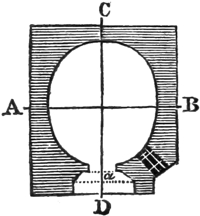
A piece of cast iron covers the space before the door of the oven, exactly level with its floor; the opening underneath is applied to no particular use, but is generally made a receptacle for coal.
Fig. 1, is an elevation of the oven. The mouth is closed with a cast iron door, 131in which is a small sight-hole with a slide valve. To heat the oven, the door is thrown back, and a blower is applied to the mouth, so contrived, as not only to cover the mouth of the oven completely, but to enclose also the throat of the chimney; by this contrivance the draft is quickly so much increased, that the oven becomes speedily heated, and if at anytime it is too hot, it is only necessary to throw open the door of the fire place, and to put up the blower for a few minutes; the current of cool air which is thus made to pass through it, soon lowers the heat to the temperature required. In the blower is also an opening of the same kind as that in the oven door, which may be opened and shut at pleasure; the course of the flue is described by the dotted lines at (b).
132Fig. 2, is the blower before mentioned for regulating the heat of the oven.
Fig. 3, is a transverse section from A to B on the plan, looking towards the opening, the fire-place entering the oven at c, the crown of the oven is turned with the bricks on end, and in building the oven instead of centering the arch, the whole space is filled with sand, which is well trod down and shaped to the shape which it is intended the crown of the oven shall be of. When the upper work is finished, the sand is dug out at the mouth of the oven.
Fig. 4, is a longitudinal section of the oven from C to D. In this sketch the situation of the flue is evident, and the sectional line of the blower, fig. 2, when in its place, is shown by the dotted line d, the open space a, under the oven, has been before spoken of.
133
Popular Errors concerning the Quality of Bread.
The great advantage of eating pure and genuine bread must be obvious. Every part of the wheat, which may be called flour, was not only intended to be eaten by man, but it really makes the best bread. The delusion, however, by which so many persons are misled to think that even the whole flour is not good enough, obliges them to pay much dearer for their bread than they need, to gratify a perverted and fanciful appetite. Had it not been for the custom of eating whiter bread than the whole of the flour can make, the miller and baker would not have employed their art to render the bread as white as possible, and to make the consumer pay for the artificial 134whiteness. The average quantity of flour, from an unvaried series of experiments, made from age to age, through the course of many hundred years, appears to be three-fourth parts in weight of the whole grain of wheat, taking all wheats together, being more in the finer sorts, and less in the coarser; and the bread made from this flour has always been deemed the standard of the food of bread corn. But, by insensible degrees, the manufacture of bread became separated into two distinct employments.
In consequence of this alteration, the baker, having no further connexion with the market for corn, became dependant solely on the mealman for supplying him with flour, who, not considering himself amenable to the then existing assize laws, made different kinds of flour, some extremely 135fine and white, while others were very coarse and unpalatable. These artificial whites, when made into bread, were so pleasing to the eye and taste, that, in the course of a few years, they got into such general use that the people refused any longer to purchase the bread made of the whole of the grain.
“Our forefathers[8] never refined so much: they never preyed so much on each other; nor, I presume, made so many laws necessary for their restraint, as we do.”
136“In looking back, for some hundred years, it appears that they adopted a certain plan, supposing that nature had given nothing in vain, and that every part of the wheat which may be called flour, was not only intended to be eaten by men, but that it really made the best bread, as that might be called the best, which is best adapted to general use, and in itself so fine, as to contain no parts of the coat, or husks of grain.”
“The inference which I mean to draw from what is premised, is to remind my fellow citizens of the unfortunate delusion of thinking that even the whole flour of the wheat is not good enough for them; that part of it must be taken away, and given to birds or beasts.”
“By this delusion, supposing a certain quantity of wheat appropriated to their use, 137(and this is the view they should see it in,) they lose one third part of the flour, and consequently have so much the less bread to supply their wants.”
“Is it not then monstrous to hear them complain? Is it not absurd to talk of poverty, and yet pay a seventh or eighth part more than they need, to gratify a fantastic appetite? Had it not been from the custom of eating whiter bread than the whole flour of the wheat will make, should we have thus imposed on ourselves? Would the miller or baker employ all his art to make the bread as white as possible, and oblige us to pay for this artificial whiteness? They tell the consumer, the whiter it is, the finer; and the finer, the more nutritive. Thus we become dupes so far as to overlook the essential good properties of genuine bread, made of all the 138flour of the wheat, and likewise the difference in the price.”
“We are taught to favour a gross delusion at the suggestion of interested persons, against our own substantial welfare. It is the interest of every one to be honest, and say nothing contrary to his real sentiments, as it is the duty of those who have knowledge, to inform such as are ignorant. Those who have never eaten bread of all the flour in a pure state, with the native taste of wheat, and the moisture which it preserves, can know nothing of the comparative excellence of it with respect to the whitened city bread which they have been accustomed to eat all their lives.”
“The dictates of the understanding will ever yield to the pleasures of the imagination: and the provident will be attentive to take the advantage of the extravagant. 139Thus it happens that the poor have been bewildered, and deprived of the object they sought.”
“The event depends on the good sense of masters and mistresses of families, and their right understanding of what they mean to eat, that is, of what parts of the wheat the bread they consume is made. If they are satisfied that the bread is more pure than what they used to eat, and sufficiently fine, we may presume, if they are in their right minds, they will prefer it for domestic use. Every family of fourteen or fifteen persons, consuming at the rate of one pound each, in a day, pays near 16s. a week: if they can save 2s. 6d. or 1s. 6d. it is an object: to a poor man who spends 5s. in bread, if he can save eight or ten pence, it may purchase two or three pounds of animal substance towards making one feast in a week.”
140“In regard to the patriotic miller, he does not pretend to consult our good in preference to his own; on the contrary, he reasons very deeply, as if it were best for us to live on the essence of a leg of mutton, brought within the compass of a pint, than feed on such porterly food as the mutton prepared in the ordinary way of roasting or boiling. He maintains, that the finer the bread, though the quantity be smaller, the more nutritive.”
The wheaten bread, of the London baker, is acknowledged to be whitened by a mixture of alum, which serves to keep the loaf in better shape, renders it the whiter, and causes it to imbibe the more water to increase the quantity of the bread. Thus he consults his interest, without regard to the consumer: the whiter it is, the more adulterated; and, 141as constant experience proves, such bread, after it is two days old, becomes dry and husky.”
“If bread, made in a private family, of the same flour as the baker uses, will not be so white, we must suppose that there is an art of whitening; and that this would be no secret, if it were not pernicious.”
“The bread recommended, made of all the flour of the wheat, retains all the good properties of bread; it is eatable at the distance of eight or ten days: is it not on this account the most eligible?”
“Take a loaf of the wheaten London bread, made by the baker in his usual way; let the same baker make another with all the flour of the wheat, without any attempt to whiten or otherwise adulterate it. Let him keep both in the same temperature of air, and produce a specimen of each at 142any reasonable distance of time, and it will be easily seen what the difference is. This arises not only from mixtures, but the peculiar manner of raising the sponge.”
“In regard to the difference of consuming new bread of the first day, and that which has been made for three, four, or five days, it is computed to be at least a fourth part. If our present wheaten bread cannot be eaten with pleasure beyond the second day, it is not wonderful to discover at last that we are lighting our candle at both ends.”
“That the vitiated bread agrees with some people, whether by the force of habit, or the mixtures it contains, is not disputed; but in general it is very hurtful.”
“Great numbers of our fellow-subjects eat their bread much coarser than the Londoners: are they weaker? they are 143generally stronger. Some part of the advantage must be carried to this account.”
“Let us have time to subdue our prejudices, and we shall find that bread of all the flour of the wheat, for the general use, is better both in quality and price than the present wheaten bread.”
“In regard to the London baker, ask him of what parts of the wheat his bread is made, and he frankly acknowledges he cannot tell; and how should he? He can buy only what is to be sold; and the quality is not ascertained with any such precision as to enable him to answer the question. He, poor man does the best he can, not to give a sweet wholesome aliment, but something which is white. He knows that bread made of a proper proportion of the wheat, not only differs in colour, but is moister at the end of eight 144days than his the third day; he likewise knows that it is sweeter, and has the native grateful flavour of the wheat, as the God of Nature hath given it, and not as it hath been adulterated.”
“If the parliament had required us to eat plum-cake, seed-cake, or sugar-cake, we should have known that plums, seed, and sugar, constituted the difference; but from the moment the law made distinctions in the division of the flour for three different kinds of bread for common use, we were exposed to the mercy of the miller to give the baker what he pleased, and call it by what name he pleased; we could only judge whether the bread pleased us or not. The miller and the baker divide and subdivide; and instead of flour for bread, and the bran that remained, according to ancient practice, whereby the beggar as 145well as the prince was pleased, bread became a mystery, and we no longer knew what we were eating.”
“Our misfortune, in regard to bread, is, that we eat it too fine; we decline the use of barley in bread, having hardly enough for beer. Oats and pease are rejected: at length we reject even wheaten flour,—unless we are supplied with the finest parts only!—What will befall us in the end?”
“Custom often makes a law more forcible than Law-givers, and we have now to contend with custom.—The first consideration should be, that the flour which represents three-fourths of the wheat, shall be really such, and brought to market in sacks, marked Standard: the value of it may be more easily ascertained, than that of which is made the wheaten bread we now eat.”
146“The baker may be a little the more reluctant to come into this salutary proposal, as knowing that if he is to decline the use of alum, flour that is in any degree musty, or made of wheat that has grown or vegetated before gathered in, as sometimes happens, he cannot work it up so advantageously in the bread now proposed to be made, as in the wheaten bread.—Be this as it may, as soon as the baker finds this standard flour is vendable in bread, he will buy it; and knowing what part of the wheat it ought to be, he will work it into bread with so much the more satisfaction; and being sensible that we mean to eat genuine bread, he will cease to whiten it by any hurtful art. We shall all understand what we eat, and the trade will be familiar to us; we shall be so much happier as we become so much the more honest, and more healthy than we were before. Such is the 147serious light in which I see the subject before me.”
“Every occupation hath its mystery; and the professors are gratified in thinking themselves wiser than the rest of the world in their own way. Every professed cook of the first rate can melt down a large ham into the contents of half a pint. The confectioner uses bitter almonds, which are poisonous; the oilman colours his pickles with copper, to render them green; and the baker uses alum to whiten his bread, and make his flour imbibe the more water, by which he makes the more bread out of the same quantity of flour. This, and other occasional mixtures of the flour of different grains, renders his bread husky, dry, and disagreeable the third day.—Are we the better for any such mysteries?”
148“Whether the wheat be all of one kind, or married, which is the phrase for mixing of wheats of different kinds, it will be easy for people of condition, by experiment, or by the comparison with genuine bread made in their families, to know whether justice be done; though we may easily discover that the baker for the public, is generally a better master of his trade than most housewives are. The mystery may be thus developed; our health and pleasure promoted; and our bread be as much cheaper than it is now, as the gain on the flour will make it, by using all that the wheat produces.”
“Every one may try by grinding and bolting his own grain, and baking his own bread, and the manufacturers of bread may find nearly as good account in bread of all the flour, which can be so easily ascertained; 149as they do in the wheaten, which is involved in difficulties.”
“The public have administered to their own delusion, their eyes are shut to their own advantage. If the wealthy will adopt the use of the bread in question, the labouring part of our fellow-subjects will certainly follow the example; and as to paupers, they will gladly comply.”
“Common sense, in all ages, has achieved wonders.”
Laws prohibiting the Adulteration of Bread and Bread Flour.
The adulteration of bread and bread flour is forbidden by law, as is obvious from the following acts of parliament:
150“No person shall put into any corn,[9] meal, or flour, which shall be ground, dressed, bolted, or manufactured for sale, any ingredient or mixture whatsoever, whereby the same may be adulterated, or shall sell any flour of one sort of grain as for the flour of another, but shall only sell the real genuine meal or flour of the grain the same shall import to be, under the penalty of five pounds for every such offence.”
“If any person have cause to suspect that any miller[10] who grinds, dresses, or bolts any grain for toll or reward, or manufactures any flour for sale, or that any baker mixes up with his flour any mixture or ingredient, not the genuine produce of the grain, so that the purity of the meal in any wise be adulterated, and reports the 151same on oath to a magistrate, then, in that case, such magistrate, or a peace-officer duly authorized by him, shall enter the premises of such suspected person, and search or examine whether such mixture or ingredient, not the genuine produce of the grain, is in the possession of such miller, mealman, or baker; and such meal and flour as shall be deemed to have been adulterated may be seized, together with the base mixtures; and if seized by a peace-officer, it is to be carried before a magistrate, but if seized by the magistrate, he may immediately dispose of it as he shall think fit. And the person on whose premises such mixture or ingredient shall be found, and adjudged to be intended to be used in adulterating the flour, shall forfeit a sum not exceeding ten pounds, and have his name, offence, and place of abode 152published in some newspaper that is printed or circulated near his place of abode, unless he shall make it appear, to the satisfaction of the magistrate, that the same was not lodged there with the intention of adulterating the flour, but for some other lawful purpose.”
“That if any person shall wilfully obstruct[11] or hinder any search being made for such mixtures as are designed to adulterate the meal or flour, or shall oppose their being carried away, such person shall forfeit a sum not exceeding five pounds, nor less than forty shillings.”
“And that the good design of these regulations may be more effectually accomplished, it shall be lawful for the several wardmote[12] inquests of the city of London, 153or any magistrate[13] or peace-officer authorized by a warrant from such magistrate, without the jurisdiction of the city of London, to enter into any bake-house or shop, at all seasonable times, to search for and weigh all the bread therein; and if any of the loaves are found wanting in the goodness of the stuff of which they should be made, or deficient in the due baking or working thereof, or shall be wanting in the weight, or shall not be truly marked, such persons may seize such bread; and, if a magistrate is not present, it shall be taken before one, who may dispose of it as he shall think fit.”
“That if any person shall wilfully[14] obstruct or hinder any such search, or prevent the carrying the same away, he shall, 154on conviction before a magistrate, be fined a sum not exceeding five pounds, nor less than twenty shillings.”
“That it shall be lawful for any magistrate[15], or peace-officer, authorised by a warrant, and accompanied by one or more master bakers, to enter, at seasonable times, any shop or bake-house within the city of London, or within ten miles of the Royal Exchange, to search and examine whether any alum, or other ingredients, shall have been mixed up with, or put into, any meal, flour, dough, or bread, in the possession of any such baker, and also to search for alum, or any other ingredients, which may be intended to be used for the purpose of adulterating the bread; and if, on enquiry, they find any alum, or other unlawful ingredients, or that any flour, 155meal, dough, or bread, contains any preparation of alum, such shall be immediately seized, and carried before some magistrate within whose jurisdiction the baker lives, and who shall dispose of it as he shall think fit. And if the magistrate is satisfied that such pernicious ingredients were put into the bread with the consent or privity of the baker, or if he acknowledges it himself, or one or two credible witnesses certify, on oath, that they know he uses alum, such baker shall forfeit any sum of money not exceeding twenty pounds, or be committed to, and kept at hard labour in, the house of correction, or some other prison, for six calendar months, unless he can prove, to the satisfaction of the magistrate, that the alum, or other ingredients, were designed for some lawful purpose. And further, the magistrate is expressly required to cause 156the offender’s name, place of abode, and offence, to be published in some newspaper which shall be printed or published in or near the city of London, or the liberties thereof.”
“That if any person or persons shall wilfully obstruct[16] or hinder such search or seizure, as above described, he or they shall, for every offence, forfeit and pay any sum not exceeding ten pounds, nor less than five, at the discretion of the magistrate before whom the offender or the offenders shall be convicted.”
“That where any baker[17] shall make a complaint before a magistrate, and make it appear that any offence he was charged with, and paid the penalty of, was occasioned 157by the wilful neglect or default of his journeyman, or other servant, the magistrate shall issue his warrant for apprehending the party, and if, on examining into the matter, it appears that such was the case, such journeyman, or other servant, shall be directed immediately to pay to his master a reasonable recompence in money, and, on non-payment thereof, he shall be committed to the house of correction, or some other prison, and kept to hard labour, for any time not exceeding one calendar month, unless payment be sooner made.”
“And, for the better and more easy recovery of the several penalties[18] incurred by disobedience to the several acts, all offences may be heard and determined in a 158summary way, by the Lord Mayor, or any other magistrate or magistrates, within their several jurisdictions, who shall summon the offenders before them, and if they do not appear, or offer a reasonable excuse, they may cause them to be apprehended; and when the matter is enquired into, and the party convicted, if he does not pay the penalty within twenty-four hours, such magistrate shall issue a warrant of distress and sale on the goods of the offender; and, should the goods of the party be removed into another jurisdiction, the magistrate thereof is to back the warrant, and the distress, if not redeemed within five days, is to be appraised and sold, and all expences thereby incurred are to be deducted thereout. And if the offender is possessed of no goods or chattels that can be seized, then he shall be committed to the house of 159correction, or some other prison, for one calendar month, unless payment be sooner made.”
“That if information[19], on oath, is offered to any magistrate, that any one within his jurisdiction is likely to offer or give material evidence in behalf of the prosecutor of any offender, and refuses voluntarily to come forward, such magistrate shall issue a summons to cause him to appear, and if he still refuses, to grant a warrant to compel his attendance, and then if he refuses to be examined, he may be committed to some public prison for fourteen days.”
That no certiorari[20], letters of advocation, or of suspension, shall be granted, to remove any conviction or other proceedings 160had therein; but if any person is punished, and he thinks himself aggrieved by the judgment of a magistrate, he may appeal to the next quarter sessions, and, in such case, the execution of the judgment shall be suspended, upon his entering into a recognisance, with two sufficient sureties, in double the sum such person shall be adjudged to forfeit, to prosecute the appeal, and abide the determination of the justices at the said quarter sessions; and if he makes good his appeal, he shall be discharged the conviction, and reasonable costs awarded him, which shall be paid by the person who lodged the information.”
“That no person shall be convicted[21] of any offence under these acts, unless the prosecution shall be commenced against 161him within fourteen days after the offence is committed, except in cases of perjury[22]; and no person who shall be prosecuted to conviction for any offence done or committed against these acts, shall be liable to be prosecuted for the same offence under any other law.”
“That all penalties, when recovered in pursuance of these regulations, shall be disposed of in the manner following: that is to say, one[23] moiety thereof to be paid to the informer, and the other moiety to the poor of the parish where such offence shall be committed; and, in case there is no informer, then the whole sum shall be given to the poor of the parish, or applied in such a way as the magistrate, in his discretion, shall think fit.”
162
Economical Application of Yeast.
It frequently happens, in the summer season, that the brewers, in order to render their beer less liable to spoil, use more hops than usual; the consequence of which is, that the yeast becomes very bitter, and gives a disagreeable flavour to the bread. To obviate this inconvenience, Mr. Stone has recommended the following method of raising a bushel of flour with only a tea-spoonful of yeast.
Suppose a bushel of flour be put it into the kneading trough, then take about three quarters of a pint of warm water, and one tea-spoonful of yeast. Stir it in till it is thoroughly mixed with the water; and make a hole in the middle of the flour, large 163enough to contain two gallons of water. Pour in the yeast and add some of the flour until it is a thick liquid paste; strew some of the dry flour over it, and let it stand an hour. Then take a quart more of warm water, and pour it in: in about an hour it will be seen that the small quantity of yeast has raised the mixture so, that it will break through the dry flour placed over it; and when the warm water has been added, take a stick and stir in more flour until it is as thick as before; then shake again some dry flour over it, and leave it for two hours more, the mass will rise and break through the dry flour again; you may then add three quarts or a gallon of water, and stir in the flour, and make it into a soft paste, taking care to cover it with dry flour again, and in about three or four hours more the dough may be mixed up, and 164covered up warm; and in four or five hours more it may be made up into loaves, and put in the oven; and in this manner may be produced as light a bread as though a pint of yeast had been used. It does not take above a quarter of an hour more than the usual way of baking, for there is no time lost but that of adding the water at three or four times. The author of this method assures us that he constantly bakes in this way. In the morning, about six or seven o’clock, he puts the flour in the trough, and mixes up the spoonful of yeast with the warm water; in an hour’s time he adds more flour, in two hours, again more, and about noon makes up the dough, and about six in the evening it is put into the oven: he has always good bread.
165
Economical Preparation of Yeast.
The following economical method of making yeast is recommended by Dr. Lettsom.
Thicken two quarts of water with four ounces of fine flour, boil it for half an hour, then sweeten it with three ounces of brown sugar; when almost cold, pour it with four spoonfuls of baker’s yeast into an earthen jug, deep enough for the fermentation to go on without running over; place it for a day near the fire, then pour off the thin liquor from the top, shake the remainder, and close it up for use, first straining it through a sieve. To preserve it sweet, set it in a cool cellar, or hang it some depth 166in a well. Keep always some of this to make the next quantity of yeast that is wanted. Mr. I. Kerby recommends the following method of obtaining yeast from potatoes.
Potatoe Yeast.
Boil potatoes of the mealy sort, till they are thoroughly soft, skin and mash them very smooth, and put as much hot water on them as will make a mash of the consistency of common beer yeast, but not thicker. Add to every pound of potatoes, two ounces of treacle, and when just warm, stir in for every pound of potatoes, two large spoonfuls of yeast. Keep it warm till it has done fermenting, and in twenty-four hours it will be fit for use. A pound of potatoes will make near a quart of yeast, which 167has been found to answer the purpose so well, as not to be able to distinguish the bread made with it, from bread made with brewer’s yeast.
Method of Preserving Yeast.
When yeast is plentiful, take a quantity and work it well with a whisk until it becomes thin; then procure a large wooden dish or platter, clean and dry, and with a soft brush lay a thin layer of yeast on the dish, and turn the top downwards to keep out the dust, but not the air, which is to dry it. When the first coat is dry, lay on another, and let that dry, and so continue till the quantity is sufficient; by this means it may soon be made two or three inches 168thick, when it may be preserved in dry tin canisters or stopped bottles, for a long time, good. When used for baking, cut a piece off and dissolve it in warm water, when it will be fit for use.
FINIS.
C. GREEN, LEICESTER STREET,
LEICESTER SQUARE.
169NOTICE.
The Public are respectfully informed, that a new Edition,
considerably enlarged (price 9s.), has lately been published,
OF
ACCUM’S
Treatise on Adulterations of Food,
AND CULINARY POISONS;
Exhibiting the fraudulent Sophistications of Bread, Beer, Wine,
Spirituous Liquors, Tea, Coffee, Cream, Confectionary,
Vinegar, Mustard, Pepper, Cheese, Olive Oil,
Pickles, and other Articles employed in
Domestic Economy; and Method
of detecting them.
(Copied from the British Review, No. XXIX. p. 171.)
Mr. Accum seems determined that even the outside of his book shall awaken our fears. The cover of our copy bears a death’s head emblazoned upon a pall, and, underneath, the motto “there is death in the pot.” The pall is supported by the point of a dart. Four other darts support the four corners of the device. Twelve serpents, with forked tongues and tails entwined, form a terrific wreath around; while the middle is occupied with a large cobweb, delineated with much attention to detail, in the centre of which a spider, full as large as a moderate sized hazel nut, and so frightful that more than one young lady of our acquaintance would think it necessary to scream at the sight of it, holds in its envenomed fangs an ill-fated fly, which is sinking under the loss of blood, and buzzing in the agonies of death.
We are by no means desirous to raise or maintain a popular clamour; but Mr. Accum certainly advances some weighty charges, and his work comes with an advantage in bearing a name not unknown to the scientific world. Of the adulterations specified, some are deleterious, and others merely fraudulent. Accordingly, we shall offer a few extracts, both from the original matter of Mr. Accum, and from his citations drawn from previous authors.
“Among the number of substances used in domestic economy which are now very generally found sophisticated, may be distinguished,—tea, coffee, bread, beer, wine, spirituous liquors, salad oil, pepper, vinegar, mustard, cream, and other articles of subsistence. Indeed it would be difficult to mention a single article of food which is not to be met with in an adulterated state. And there are some substances which are scarcely ever to be procured genuine.” (P. 3.)
170But we pass on from the general statements at the beginning of the work to particulars.
Water, by standing in leaden reservoirs, acquires a highly deleterious property.
In some particular cases, the consequences have been most fatal.
“‘A gentleman was the father of a numerous offspring, having had one and twenty children, of whom eight died young, and thirteen survived their parents. During their infancy, and indeed until they had quitted the place of their usual residence, they were all remarkably unhealthy, being particularly subject to disorders of the stomach and bowels. The father, during many years, was paralytic; the mother, for a long time was subject to cholics and bilious obstructions.’” (P. 78, 79.)
These effects were traced to a leaden pump, in the cylinder of which there were found several perforations, while the cistern “was reduced to the thinness of common brown paper, and was full of holes like a sieve.” (P. 79.)
We now come to the adulteration of wine; to many of our readers, probably, a far more interesting concern than that of water.
“All persons moderately conversant with the subject are aware, that a portion of alum is added to young and meagre red wines, for the purpose of brightening the colour; that Brazil-wood, or the husks of elderberries and bilberries, are employed to impart a deep rich purple tint to red port of a pale, feint colour; that gypsom is used to render cloudy white wines transparent; that an additional astringency is imparted to immature red wines by means of oak-wood sawdust, and the husks of filberts, and that a mixture of spoiled foreign and home-made wines is converted into the wretched compound frequently sold in this town by the name of genuine old Port.... A nutty flavour is produced by bitter almonds; fictitious Port wine is flavoured with a tincture drawn from the seeds of raisins, and the ingredients employed to form the bouquet of high-flavoured wines, are sweet brier, orris-root, clary, cherry-laurel-water, and elder flowers. The flavouring ingredients used by manufacturers, may all be purchased by those dealers in wine who are initiated in the mysteries of the trade. And even a manuscript receipt-book for preparing them, and the whole mystery of managing all sorts of wines, may be obtained on payment of a considerable fee.” (P. 95, 97.)
“The particular and separate department in this factitious wine-trade, called crusting, consists in lining the interior surface of empty wine bottles, in part, with a red crust of super-tartrate of potash, by suffering a saturated, hot solution of this salt, coloured with a decoction of Brazil-wood, to chrystallize within them.” (P. 101, 102.)
But the crusting is not confined to the bottle.
“A correspondent operation is performed on the wooden cask; the whole interior of which is stained artificially with a chrystalline crust of super-tartrate of potash, artfully affixed in a manner precisely similar to that before stated. Thus the wine-merchant, after bottling off a pipe of wine, is enabled to impose on the understanding of his customers, by taking to pieces the cask, and exhibiting the beautiful dark-coloured and fine chrystalline crust, as an indubitable proof of the age of the wine; a practice by no means uncommon to flatter 171the vanity of those who pride themselves in their acute discrimination of wines.” (P. 103, 104)
This our readers will excuse, for it is pleasing to read of impositions which are practised on the sagacious. But, says Mr. Accum,
“Several well-authenticated facts have convinced me, that the adulteration of wine with substances deleterious to health is certainly practised oftener than is, perhaps, suspected.” (P. 104, 105.)
Presently follows the story of the passengers by the coach, who dined at Newark. Half a bottle of port made them all ill, one dangerously. Part of the other half caused the death of an inhabitant of the place, on whom an inquest was held, and a verdict returned, of—Died by poison.
A gentleman having been taken severely ill on two successive days, after drinking each day a pint of Madeira from the same bottle, his apothecary ordered that it should be examined.
“‘The bottle happened to slip out of the hand of the servant, disclosed a row of shot wedged forcibly into the angular bent-up circumference of it. On examining the beads of shot, they crumbled into dust, the outer crust (defended by a coat of black lead with which the shot is glazed) being alone unacted on, whilst the remainder of the metal was dissolved. The wine, therefore, had become contaminated with lead and arsenic, the shot being a compound of these metals, which no doubt had produced the mischief.’” (P. 113, 114.)
For detecting the presence of lead or any other deleterious metal in wine, Mr. Accum recommends the wine test.
We now come to that part of the subject, which, as some persons have thought, is merely the business of ale-drinkers, and their brethren, the porter-drinkers.
“The fraud of imparting to porter and ale an intoxicating quality by narcotic substances, appears to have flourished during the period of the late French war. For, if we examine the importation lists of drugs, it will be noticed that the quantities of cocculus indicus imported in a given time prior to that period, will bear no comparison with the quantity imported in the same space of time during the war, although an additional duty was laid upon this commodity. Such has been the amount brought into this country in five years, that it far exceeds the quantity imported during twelve years anterior to the above epoch. The price of this drug has risen within these ten years from two shillings to seven shillings the pound.... It was at the period to which we have alluded that the preparation of an extract of cocculus indicus first appeared, as a new saleable commodity, in the price-currents of brewers’ druggists. It was at the same time also that a Mr. Jackson, of notorious memory, fell upon the idea of brewing beer from various drugs, without any malt and hops. This chemist did not turn brewer himself, but he struck out the more profitable trade of teaching his mystery to the brewers for a handsome fee. From that time forward, written directions and receipt books, for using the chemical preparations to be substituted for malt and hops, were respectively sold. And many adepts soon afterwards appeared every where to instruct brewers in the nefarious practice first pointed out by Mr. Jackson. From that time, also, the fraternity of brewers’ chemists took its rise. They made it their chief business to send
172travellers all over the country with lists and samples exhibiting the price and quality of the articles manufactured by them for the use of brewers only. Their trade spread far and wide, but it was amongst the country brewers chiefly that they found the most customers. And it is among them up to the present day, as I am assured by some of these operators, on whose veracity I can rely, that the greatest quantities of unlawful ingredients are sold.” (P. 157-160.)
Part of these evils the porter-drinkers bring upon themselves.
“One of the qualities of good porter, is, that it should bear a fine frothy head, as it is technically termed: because professed judges of this beverage, would not pronounce the liquor excellent, although it possessed all other good qualities of porter, without this requisite.—To impart to porter this property of frothing when poured from one vessel into another, or to produce what is also termed a cauliflower head, the mixture called beer-heading, composed of common green vitriol (sulphate of iron) alum and salt, is added. This addition to the beer is generally made by the publicans.” (P. 182, 183.) It is added in a note:—”’Alum gives likewise a smack of age to beer, and is penetrating to the palate.’—S. Child on Brewing, p. 18.” “The great London brewers, it appears, believe that the publicans alone adulterate the beer.” (P. 211.)
“Capsicum and grains of paradise, two highly acrid substances, are employed to give a pungent taste to weak insipid beer. Of late, a concentrated tincture of these articles, to be used for a similar purpose, and possessing a powerful effect, has appeared in the price-currents of brewers’ druggists. Ginger root, coriander seed, and orange peels, are employed as flavouring substances chiefly by the ale brewers.” (P. 184, 185.)
We find the following articles, in a list of illegal ingredients, seized at various breweries and brewers’ druggists.
“Multum, 84 lbs.; cocculus indicus, 12 lbs.; colouring, 4 galls; honey, about 180 lbs.; hartshorn shavings, 14 lbs.; Spanish juice, 46 lbs.; orange powder, 17 lbs.; ginger, 56 lbs.; grains of paradise, 44 lbs.; quassia, 10 lbs.; liquorice, 64 lbs.; carraway seeds, 40 lbs.; multum, 26 lbs.” “Capsicum, 88 lbs.; copperas, 310 lbs.; colouring and drugs, 84 lbs.; mixed drugs, 240 lbs.; coriander seed, 2 lbs.; beer colouring, 24 gallons.” (P. 186-189.) [The list which includes these articles is copied from the minutes of the committee of the House of Commons.]
Some of the substances above enumerated may be thought comparatively harmless. But others are absolutely poisonous.
“To increase the intoxicating quality of beer, the deleterious vegetable substance, called cocculus indicus, and the extract of this poisonous berry, technically called black extract, or by some, hard multum, are employed. Opium, tobacco, nux vomica, and extracts of poppies, have also been used.—This fraud constitutes by far the most censurable offence committed by unprincipled brewers. And it is a lamentable reflection to behold so great a number of brewers prosecuted, and convicted of this crime. Nor is it less deplorable to find the names of druggists, eminent in trade, implicated in the fraud, by selling the unlawful ingredients to brewers for fraudulent purposes.” (P. 205, 206.)
Then follows a list of thirty-four convictions of brewers, for receiving or using illegal ingredients.—We perfectly agree with the following observations.
“That a minute portion of an unwholesome ingredient, daily taken in beer, cannot fail to be productive of mischief, admits of no doubt: and there is reason to believe that a small quantity of a narcotic substance (and cocculus indicus is
173a powerful narcotic), daily taken into the stomach, together with an intoxicating liquor, is highly more efficacious than it would be without the liquor. The effect may be gradual; and a strong constitution, especially if it be assisted with constant and hard labour, may counteract the destructive consequences perhaps for many years. But it never fails to show its baneful effects at last.” (P. 209, 210.)
We now come to the business of another small portion of the community, namely, the tea-drinkers. Perhaps the following descriptions will assist them in forming a diagnosis.
“All the samples of spurious green tea (nineteen in number) which I have examined, were coloured with carbonate of copper, (a poisonous substance), and not by means of verdigrise, or copperas.” (P. 240.) “Mr. Twining asserts, that ‘the leaves of spurious tea are boiled in a copper, with copperas and sheep’s dung.’” (P. 240. Note.) “Tea rendered poisonous by carbonate of copper, speedily imparts to liquid ammonia, a fine sapphire blue tinge. It is only necessary to shake up in a stopped vial, for a few minutes, a tea-spoonful of the suspected leaves, with about two table-spoonsful of liquid ammonia, diluted with half its bulk of water. The supernatant liquid will exhibit a fine blue colour, if the minutest quantity of copper be present. Green tea, coloured with carbonate of copper, when thrown into water impregnated with sulphuretted hydrogen gas, immediately acquires a black colour. Genuine green tea, suffers no change from the action of these tests.” (P. 241.)
The following extracts may perhaps prove interesting to brandy-drinkers.
“‘It is a custom among retailing distillers, which I have not taken notice of in this directory, to put one third or one fourth part of proof molasses brandy, proportionably, to what rum they dispose of; which cannot be distinguished, but by an extraordinary palate, and does not at all lessen the body or proof of the goods; but makes them about two shillings a gallon cheaper; and must be well mixed and incorporated together in your retailing cask. But you should keep some of the best rum, not adulterated, to please your customers, whose judgment and palate must be humoured.—When you are to draw a sample of goods to show a person that has judgment in the proof, do not draw your goods into a phial to be tasted, or make experiment of the strength thereof that way, because the proof will not hold except the goods be exceedingly strong. But draw the pattern of goods either into a glass from the cock, to run very small, or rather draw off a small quantity into a little pewter pot, and pour it into your glass, extending your pot as high above the glass as you can without wasting it, which makes the goods carry a better head abundantly, than if the same goods were to be put and tried in a phial.—You must be so prudent as to make a distinction of the persons you have to deal with. What goods you sell to gentlemen for their own use, who require a great deal of attendance, and as much for time of payment, you must take a considerably greater price than of others; what goods you sell to persons where you believe there is a manifest, or at least some hazard of your money, you may safely sell for more than common profit; what goods you sell to the poor, especially medicinally, (as many of your goods are sanative), be as compassionate as the cases require.—All brandies, whether French, Spanish, or English, being proof goods, will admit of one pint of liquor‘ (water) ‘to each gallon, to be made up and incorporated therewith in your cask, for retail, or selling smaller quantities. And all persons that insist upon having proof goods, which not one in twenty understand, you must supply out of what goods are not so reduced, though at a higher price.’” (P. 267-270.)
174Some of the adulterations of spirituous liquors are exceedingly pernicious.
“Another method of fining spirituous liquors, consists in adding to it, first, a solution of sub-acetate of lead, and then a solution of alum. This practice is highly dangerous, because part of the sulphate of lead produced, remains dissolved in the liquor, which it thus renders poisonous.” (P. 284.) “The cordial called shrub frequently exhibits vestiges of copper.” (P. 285.)
Gloucester Cheese has been found contaminated with red lead. The article used in colouring cheese is anotto. In one instance, the anotto, being inferior, had been coloured with vermilion; and the vermilion adulterated by a druggist, (who little thought that it would ever enter into the composition of cheese,) with red lead. The account of the whole transaction as given by Mr. Accum, is worth reading, but too long to be extracted.
Cayenne pepper, “is sometimes adulterated with red lead, to prevent its becoming bleached on exposure to light.” (P. 305.) Pickles “are sometimes intentionally coloured by means of copper.” (P. 306.) “Mrs. E. Raffald directs, ‘to render pickles green, boil them with halfpence, or allow them to stand twenty-four hours in copper or brass pans.’” (P. 309.) “Vinegar is sometimes largely adulterated with sulphuric acid, to give it more acidity.” (P. 311.) “Red sugar drops are usually coloured with the inferior kind of vermilion. This pigment is generally adulterated with red lead. Other kinds of sweetmeats are sometimes rendered poisonous by being coloured with preparations of copper.” (P. 315, 316.) “The foreign conserves ... are frequently impregnated with copper.” (P. 317.) “Quantities” of catsup “are daily to be met with, which on a chemical examination, are found to abound with copper.” (P. 319.) “The quantity of copper which we have more than once detected in this sauce, used for seasoning, and which, on account of its cheapness, is much resorted to by people in the lower walks of life, has exceeded the proportion of lead to be met with in other articles employed in domestic economy.” (P. 320.) “The leaves of the cherry-laurel, prunus laurocerasus, a poisonous plant,” are used to flavour custards, blanc-mange, and other delicacies of the table. (P. 324.) An instance is given of the dangerous consequences of this practice. (P. 325, 326.) “The water distilled from cherry-laurel leaves is frequently mixed with brandy and other spirituous liquors.” (P. 327.) Several samples of anchovy sauce “have been found contaminated with lead.” (P. 328.) It is not unusual to employ, in preparing this sauce, “a certain quantity of Venetian red, added for 175the purpose of colouring it, which, if genuine, is an innocent colouring substance. But instances have occurred of this pigment having been adulterated with orange lead, which is nothing else than a better kind of minimum or red oxid of lead.” (P, 328, 329.) In lozenges, “the adulterating ingredient is usually pipe-clay, of which a liberal portion is substituted for sugar.” (P. 330.) Dr. T. Lloyd says, “‘I was informed,’” (at a respectable chemist’s shop in the city) “‘that there were two kinds of ginger lozenges kept for sale, the one at three-pence the once, and the other at six-pence; and that the article furnished to me by mistake was the cheaper commodity. The latter were distinguished by the epithet verum, they being composed of sugar and ginger only. But the former were manufactured partly of white Cornish clay, with a portion of sugar only, with ginger and Guinea pepper. I was likewise informed, that of Tolu lozenges, peppermint lozenges, and ginger pearls, and several other sorts or lozenges, two kinds were kept; that the reduced prices, as they were called, were manufactured for those very clever persons in their own conceit, who are fond of haggling, and insist on buying better bargains than other people, shutting their eyes to the defects of an article, so that they can enjoy the delight of getting it cheap: and, secondly, for those persons, who being but bad paymasters, yet as the manufacturer, for his own credit’s sake, cannot charge more than the usual price of the article, he thinks himself therefore authorized to adulterate it in value, to make up for the risk he runs, and the long credit he must give.’” (P. 332, 333.)
Well—there is then some honesty left in the world. What a pleasure it is to have to deal with a respectable man. But we return to the practices of the knaves.
Olive oil “is sometimes contaminated with lead.” (P. 334.) The dealers in this commodity assert that lead or pewter “prevents the oil from becoming rancid. And hence some retailers often suffer a pewter measure to remain immersed in the oil.” (P. 336.) “The beverage called soda water is frequently contaminated both with copper and lead.” (P. 351.) Mr. Johnston, of Greek Street, Soho, was the first who pointed out the danger to the public. “Many kinds of viands are frequently impregnated with copper, in consequence of the employment of cooking utensels made of that metal. By the use of such vessels in dressing food, we are daily liable to be poisoned.” (P. 352.) “Mr. Thiery, who wrote a thesis on the noxious quality of copper, 176observes that ‘our food receives its quantity of poison, in the kitchen by the use of copper pans and dishes. The brewer mingles poison in our beer, by boiling it in copper vessels. The sugar-baker employs copper pans. The pastry-cook bakes our tarts in copper moulds. The confectioner uses copper vessels. The oilman boils his pickles in copper or brass vessels, and verdigrise is plentifully formed by the action of the vinegar upon the metal.’” (P. 353, 354.) Moreover, “various kinds of food, used in domestic economy, are liable to become impregnated with lead.” (P. 359.)
Mr. Accum, speaking on the subject of Beer, says,
“It will be noticed that some of the sophistications are comparatively harmless, whilst others are affected by substances deleterious to health.” (P. 185.)
We think, however, that the candour of Mr. Accum leads him to make too much allowance for this consideration throughout. Surely, though many articles of food be not absolutely poisonous, a diet consisting of drugs and chemical compounds and articles never intended by nature to be eaten or drunk, articles for which, presented simple, the hungriest stomach would feel no appetite or inclination, cannot be wholesome. Brick and mortar are not poison; yet we cannot, like the dragon of Wantley, swallow a church, and pick our teeth with the steeple. Many can eat oysters, but few could manage the oyster-knife. Even the Welshman of King Arthur’s court, fond as he was of toasted cheese, would inevitably have been choked by the mouse that ran down his throat to eat it, had he not “pulled him out by the tail.”
We could give farther extracts; but must refer the reader to the work itself, which contains much interesting matter, besides what we have selected. THE MONEY THAT IS OFTEN LAID OUT IN THE PURCHASE OF COOKERY BOOKS, WHICH TEACH THE ART OF EXCITING DISEASE AND PAIN BY DUBIOUS COMBINATIONS AND CULINARY POISONS, MIGHT, WE THINK, BE MUCH BETTER EXPENDED UPON A BOOK LIKE THE PRESENT; EVERY PAGE OF WHICH GIVES WARNING OF SOME DANGER, OF WHICH WE OUGHT ALL TO BE AWARE.
177A
Treatise on Adulterated Provisions.
By FREDRICK ACCUM.
THERE IS DEATH IN THE POT.
II. KINGS—CHAP. VI. VERSE XI.
(From Blackwood’s Edinburgh Magazine, No. XXXV. Page 542.)
Mr. Accum, it appears, is one of those very good-natured friends, who is quite resolved not to allow us to be cheated and poisoned as our fathers were before us, and our children will be after us, without cackling to us of our danger, and opening our eyes to abysses of fraud and imposition, of the very existence of which we had until now the good fortune to be entirely ignorant. His book is a perfect death’s head, a memento mori, the perusal of any single chapter of which is enough to throw any man into the blue devils for a fortnight. Mr. Accum puts us something in mind of an officious blockhead, who, instead of comforting his dying friend, is continually jogging him on the elbow with such cheering assurances as the following. “I am sorry there is no hope; my dear fellow, you must kick the bucket soon. Your liver is diseased, your lungs gone, your bowels as impenetrable as marble, your legs swelled like door-posts, your face as yellow as a guinea, and the doctor just now assured me you could not live a week.”
Mr. Accum’s work is evidently written in the same spirit of dark and melancholy anticipation, which pervades Dr. Robison’s celebrated “Proofs of a Conspiracy, &c. against all the crowned heads of Europe.” The conspiracy disclosed by Mr. Accum is certainly of a still more dreadful nature, and is even more widely ramified than that which excited so much horror in the worthy professor. It is a conspiracy of brewers, bakers, grocers, wine-merchants, confectioners, apothecaries, and cooks, against the lives of all and every one of his majesty’s liege subjects. It is easy to see that Mr. Accum’s nerves are considerably agitated, that—
“Sad forebodings shake him as he writes.”
Not only at the festive board is he haunted by chimeras dire of danger—not only does he tremble over the tureen—and faint over the flesh-pot: but even in his chintz night-gown, and red morocco slippers, he is not secure. An imaginary sexton is continually jogging his elbow as he writes, a death’s head and cross bones rise on 178his library table; and at the end of his sofa he beholds a visionary tomb-stone of the best granite—
ON WHICH ARE INSCRIBED THE DREADFUL WORDS—
Hic Jacet, FREDRICK ACCUM, Operative Chemist, OLD COMPTON STREET, SOHO.
Since we read his book, our appetite has visibly decreased. At the Celtic club, yesterday, we dined almost entirely on roast beef; Mr. Oman’s London-particular Madeira lost all its relish, and we turned pale in the act of eating a custard, when we recollected the dreadful punishment inflicted on custard-eaters, in page 326 of the present work. We beg to assure our friends, therefore, that at the present moment they may invite us to dinner with the greatest impunity.—Our diet is at present quite similar to that of Parnel’s hermit,
“Our food the fruits, our drink the crystal well;”
though we trust a few days will recover us from our panic, and enable us to resume our former habits of life. Those of our friends, therefore, who have any intention of pasturing us, had better not lose the present opportunity of doing so. So favourable a combination of circumstances must have been quite unhoped for on their part, and most probably will never occur again.[24] V. S.
Since, by the publication of Mr. Accum’s book, an end has been for ever put to our former blessed state of ignorance, let us arm ourselves with philosophy, and boldly venture to look our danger in the face; or, as the poet beautifully expresses it, in language singularly applicable,
179“Come, Christopher, and leave all meaner things,
To low ambition and the pride of kings;
Let us, since life can little else supply;
Than just to swallow poison and to die;
Expatiate free o’er all this dreadful field,
Try what the brewer, what the baker yield;
Explore the druggists’ shop, the butchers’ stall;
Expose their roguery, and—damn them all!”
Pope.
Melancholy as the details are, there is something almost ludicrous, we think, in the very extent to which the deceptions are carried. So inextricably are we all immersed in this mighty labyrinth of fraud, that even the venders of poison themselves are forced, by a sort of retributive justice, to swallow it in their turn.—Thus the apothecary, who sells the poisonous ingredients to the brewer, chuckles over his roguery, and swallows his own drugs in his daily copious exhibitions of Brown stout. The brewer in his turn, is poisoned by the baker, the wine-merchant, and the grocer. And, whenever the baker’s stomach fails him, he meets his coup de grace in the adulterated drugs of his friend the apothecary, whose health he has been gradually contributing to undermine, by feeding him every morning on chalk and alum, in the shape of hot rolls.
Our readers will now, we think, be able to form a general idea of the perils to which they are exposed by every meal.
Mr. Accum’s details on the adulteration of wine are extremely ample, and so interesting, that we regret our limits prevent our making more copious extracts, and oblige us to refer our readers for farther information to the work itself.
Having thus laid open to our view the arcana of the cellar, Mr. Accum next treats us with an expose of the secrets of the brew-house. Verily, the wine-merchant and brewer are par nobile fratrum; and after the following disclosures, it will henceforth be a matter of the greatest indifference to us, whether we drink Perry or Champaigne, Hermitage or Brown stout. Latet anguis in poculo, there is disease and death in them all, and one is only preferable to the other, because it will poison us at about one-tenth of the expense.
“Malt liquors, and particularly porter, the favourite beverage of the inhabitants of London and of other large towns, is amongst those articles, in the manufacture of which the greatest frauds are frequently committed.
“The practice of adulterating beer appears to be of early date. To shew that they have augmented in our own days, we shall exhibit an abstract from documents laid lately before Parliament.
“Mr. Accum not only amply proves, that unwholesome ingredients are used by fraudulent brewers, and that very deleterious substances are also vended both to brewers and publicans for adulterating beer, but that the ingredients mixed up in the brewer’s enchanting cauldron are placed above all competition, even with the potent charms of Macbeth’s witches:
180‘Root of hemlock, digg’d i’ the dark,
* * * *
* * * *
For a charm of pow’rful trouble.
Like a hell-broth boil and bubble;
Double, double, toil and trouble,
Fire burn, and cauldron bubble.’
Mr. Accum very properly gives us a list of those miscreants who have been convicted of adulterating their porter with poisonous ingredients, and want of room alone prevents us from damning them to everlasting fame, by inserting their names along with that of the Rev. Sennacherib Terrot, in the imperishable pages of this miscellany.
Mr. Accum gives us a long dissertation on counterfeit tea, and another on spurious coffee; but as these are impositions by which we are little affected, we shall not allow them to detain us. The leaves of the sloe-thorn are substituted for the former, and roasted horse beans for the latter. These frauds, it appears, are carried to a very great extent.
We must now draw our extracts to a close; but we can assure our readers, that we have not yet introduced them to one tythe of the poisonous articles in common use, detected by Mr. Accum. We shall give the titles of a few to satisfy the curious:—Poisonous confectionary, poisonous pickles, poisonous cayenne pepper, poisonous custards, poisonous anchovy sauce, poisonous lozenges, poisonous lemon acid, poisonous mushrooms, poisonous ketchup, and poisonous soda water! Read this, and wonder how you live!