H Y G I E N E. (continued 4)
Reading edition
49. The pneumogastric nerve? The feelings aroused by it? The "vital knot?"
49. A portion of the medulla presides over the important function of respiration, and from it arises the pneumogastric nerve, so called because its branches serve both the lungs and stomach. The feelings of hunger, thirst, and the desire for air are aroused by means of this nerve. The wounding of the gray matter of the medulla, even of a small portion of it, near the origin of the pneumogastric nerve, at once stops the action of the lungs and causes death. In consequence of the importance of this part, it has been termed the "vital knot." We find, also, that its location within the skull is exceedingly well protected, it being quite beyond the reach of any ordinary form of harm from without.
50. The uses of the smaller gray masses at the base of the brain?
50. The Functions of the Cranial Ganglia.—The uses of the smaller gray masses lying at the base of the brain are not well ascertained; and, on account of their position, so remote from the surface, it would, at first, seem well-nigh impossible to study them. But, from the results following diseases in these parts, and from experiments upon inferior animals, they are becoming gradually better understood; and there is reason to believe that eventually the physiological office of each part will be clearly ascertained and defined. It is believed, however, but not absolutely proven, that the anterior masses, like the anterior roots of the spinal nerves and the anterior columns of the cord, are concerned in the production of motion; in fact, that they are the central organs of that function. The posterior gray masses are, on the contrary, supposed to be the seat of sensation.
51. Function of the cerebellum? When it is diseased?
51. The Function of the Cerebellum.—The function of the cerebellum, or "little brain," is the direction of the movements of the voluntary muscles. When this organ is the seat of disease or injury, it is usually observed that the person is unable to execute orderly and regular acts, but moves in a confused manner as if in a state of intoxication. Like the larger brain, or cerebrum, it appears to be devoid of feeling; but it takes no part in the operations of the mind.
52. Where is the seat of the mind? The subordination of the other organs? The gray matter?
52. The Function of the Cerebrum.—The cerebrum, or brain proper, is the seat of the mind; or, speaking more exactly, it is the material instrument by which the mind acts; and, as it occupies the highest position in the body, so it fulfils the loftiest uses. All the other organs are subordinate to it: the senses are its messengers, which bring it information from the outer world, and the organs of motion are its servants, which execute its commands. Here, as in the nervous apparatus of lower grade already considered, the gray matter is the element of power; and, in proportion as this substance increases in extent, and in proportion to the number of convolutions in the hemispheres, do the mental faculties expand.
53. What is stated of men in connection with the size of their brain? With the brains of other animals?
53. There have been a few, but only a few, men of distinguished ability whose brains have been comparatively small in size; the rule being that great men possess large brains. The relative weight of the brain of man, as compared with the weight of the body, does not, in all instances, exceed that of the inferior animals; the canary and other singing-birds have a greater relative amount of nervous matter than man; but man surpasses all other creatures in the size of the hemispheres of the cerebrum, and in the amount of gray substance which they contain.
54. Sensitiveness of the brain substance? The removal of a portion of the brain? State the remarkable case mentioned?
54. It is a singular fact that this cerebral substance is insensitive, and may be cut without causing pain. The removal of a considerable quantity of the brain has taken place, as the result of accident, without causing death, and without even affecting seriously the intellect. A remarkable case of injury of the brain is recorded, in which, from the accidental explosion of gunpowder used in blasting a rock, the "tamping-iron" was driven directly through the skull of a man. This iron rod, three feet and seven inches long, an inch and a quarter in diameter, and weighing more than thirteen pounds, entered the head below the ear and passed out at the top of the skull, carrying with it portions of the brain and fragments of bone. The man sustained the loss of sight on one side, but otherwise recovered his health and the use of his faculties. Moreover, disease has occurred, compromising a large portion of the brain, without impairing the faculties of the mind, when the disease was limited to one side only.
55. Thought, emotion, and will? What power do they give us?
55. Impressions conveyed to the hemispheres from the external world arouse the mental operations called thought, emotion, and the will. These are the godlike attributes which enable man to subjugate a world, and afterward cause him to "sigh for other worlds to conquer;" which enable him to acquaint himself with the properties of planets millions of miles distant from him, and which give him that creative power by which he builds and peoples the new worlds of poetry and art.
56. Are the brain and the mind identical?
56. All these mental acts, and many others, are developed through the action of the brain; not that the brain and the mind are the same, or that the brain secretes memory, imagination, or the ideas of truth and justice, as the stomach secretes the gastric juice. But rather, as the nerve of the eye, stimulated by the subtile waves of light, occasions the notion of color, so the brain, called into action by the mysterious influences of the immaterial soul, gives rise to all the intellectual, emotional, and voluntary activities of mankind.
57. What do we know of the cerebrum and its powers?
57. The cerebrum, according to our present knowledge of it, must be regarded as a single organ, which produces different results, according as it is acted upon by the immaterial mind in different ways. Recent investigations, however, seem to prove that the faculty of language is dependent upon a small part of the left hemisphere of the cerebrum, near the temple. At least, in almost every instance where this part is diseased, the patient can no longer express himself in speech and writing.
58. The reflex function of the organs within the skull? The reflex power of the medulla? Respiration?
58. The Reflex Action of the Brain.—The reflex function of the organs within the skull is very active and important. Like that of the cord, it protects the body by involuntary movements, it regulates the so-called vegetative acts, and it takes the place of the will in controlling the voluntary muscles, when the attention is turned in other directions. The reflex power of the medulla governs the acts of respiration, which are absolutely and continuously essential to life. Respiration is, as we have seen, partly under the influence of the will; but this is due in part to the fact that respiration is indirectly concerned in one of the animal functions, that of speech.
59. What else does reflex action occasion? Winking? Other examples?
59. Reflex action also occasions coughing and sneezing, whenever improper substances enter the air-passages. Winking is an act of the same sort, and serves both to shield the eyes from too great glare of light, and to preserve them by keeping the cornea moist. Looking at the sun or other strong light, causes sneezing by reflex action. Laughing, whether caused by tickling the feet or by some happy thought, and also sobbing, are reflex acts, taking place by means of the respiratory muscles.
60. Muscles called into play by certain reflex movements? The somnambulist?
60. Certain of the protective reflex movements call into play a large number of muscles, as in the balancing of the body when walking along a narrow ledge, or on a slippery pavement. The dodging motion of the recruit, when the first cannon ball passes over his head, is reflex and involuntary. The fact that these involuntary, reflex acts are performed with great precision, will explain why it is that accidents seldom befall the somnambulist, or sleep-walker, although he often ventures in most perilous places.
61. What is said of walking and other acts in connection with the office performed by the medulla and spinal cord?
61. Walking, sitting, and other acts of daily life, become automatic, or reflex, from habit: the mind is seldom directed to them, but delegates their control to the medulla and spinal cord. Thus a person in walking, may traverse several miles while absorbed in thought, or in argument with a companion, and yet be conscious of scarcely one in a thousand of the acts that have been necessary to carry his body from one point to another. By this admirable and beautiful provision, the mind is released from the charge of the ordinary mechanical acts of life, and may devote itself to the exercise of its nobler faculties. And it is worthy of notice, that the greater the use of these faculties, the more work does the reflex function assume and perform; and thus the employment of the one insures the improvement of the other.
QUESTIONS FOR TOPICAL REVIEW.
PAGE
1. State fully what is meant by the term vegetable function. 148
2. To what is man indebted for his position as the head of the animal creation? 148, 149
3. What can you state on the subject of special organs for separate functions? 149
4. Describe, as fully as you can, the structure of the nervous system. 149, 150
5. Describe the brain, its location, size, shape, and structure. 150, 152
6. Describe the brain proper, or cerebrum. 152, 153, 174
7. What connection is noticed between the cerebrum and mental power? 153, 172, 174
8. Describe the little brain, or cerebellum. 153, 154, 172
9. Describe the spinal cord. 154, 155, 156
10. What are the spinal nerves, and how are they arranged? 156, 157
11. What is the character and substance of their tissues? 157
12. State how the nerve-fibres perform their office, and give the illustration. 157, 158
13. Describe the sympathetic system of nerves. 158
14. State what is meant by the properties of nervous tissue, and give the illustration. 159, 160
15. Explain what is meant by the functions of the nerves, and give the illustration. 160, 161, 162
16. What is meant by a transient paralysis of a nerve? Give the illustration. 161, 162
17. What can you state of the rate of message-motion along a nerve? 162
18. What are the functions of the spinal cord? 162, 163, 164, 165
19. State what you can of the form of paralysis known as paraplegia. 163
20. What experiments, with results, upon the spinal cord are noted? 163, 164
21. Explain how injury of the cord may produce paralysis of motion in one leg, and at the same time a loss of sensation in the other. 164
22. Explain how, if the right hand be hurt, the left side of the brain is made to feel the pain. 165
23. Now, explain as fully as you can the direction of the fibres of the cord. 164, 165
24. What is understood by the reflex action of the cord? 165
25. What experiments are mentioned to prove this power of the cord? 165, 166
26. What are the uses of the reflex action of the cord? 167-170
27. What illustrations are mentioned to show such uses? 167-170
28. What is the medulla oblongata? 154, 170
29. What are the functions of the medulla oblongata? 170, 171
30. What can you state of the functions of the cranial ganglia? 171, 172
31. What are the functions of the cerebellum? 172
32. What is the function of the cerebrum? 172, 174
33. In what way does the size of the brain generally indicate the character of the man? 172, 173
34. What facts show that the gray substance of the brain is insensitive? 173
35. Upon what does the faculty of language seem to depend? 174
36. What has been observed in support of this statement? 174
37. Of what importance is the reflex action of the brain? 174, 175
38. In what ways is this importance made manifest? 174, 175
CHAPTER X.
The Special Senses.
The Production of Sensations—Variety of Sensations—General Sensibility—Pain and its Function—Special Sensation, Touch, Taste, Smell, Sight, and Hearing—The Hand, the Organ of Touch—The Sense of Touch—Delicacy of Touch—Sensation of Temperature and Weight—The Tongue the Organ of Taste—The Nerves of Taste—The Sense of Taste and its Relations with the other Senses—The Influence of Education on the Taste—The Nasal Cavities, or the organs of Smell—The Olfactory Nerve—The Uses of the Sense of Smell—The Sense of Sight—Light—The Optic Nerve—The Eyeball and its Coverings—The Function of the Iris—The Sclerotic, Choroid, and Retina—The Tears and their Function—The Movements of the Eyeball—The Function of Accommodation—The Sense of Hearing and Sound—The Ear, or the organ of Hearing—The External, Middle, and Internal Ear.
1. True centre of sensation? Place of the mind's impressions? What is it convenient to say? What further is stated?
1. Production of Sensations.—We have already seen that the true centre of sensation is some organ within the skull, probably among the gray masses at the base of the brain; but the mind never perceives impressions at that point; but, on the contrary, always refers them to the external organs of sensation. Hence, it is convenient to say, that those outer parts possess the property of sensibility. For instance, we say that we hear with the ear, taste with the tongue, and feel with the fingers. That this is not the exact truth is proven by the fact, that whenever the nerve connecting one of these organs with the brain is severed, it at once loses its capacity for sensation.
2. Consciousness? During sleep? In profound insensibility?
2. Consciousness, another faculty of the brain, is necessary to complete a sensation. During sleep, and in other unconscious states, the usual impressions are presented to the ear, the nose, and the skin, but they fail to excite sensations, because the nerve-centres are inactive. In profound insensibility, from chloroform or ether, a limb may be removed without occasioning the least feeling.
3. Sensibility in animals? In the earth-worm? In man?
3. Variety of Sensations.—All animals have some degree of sensibility. It is of course feeble and indistinct in the lower forms of life, but increases in power and variety as we ascend the scale. In the earth-worm, the nervous system is very simple, the sensibility being moderate and alike in all parts: hence, if its body be cut into two pieces, each piece will have the same degree of feeling as before. As we approach man, however, the sensations multiply and become more acute; the organs are more complex, and special parts are endowed with special gifts. These special organs cannot be separated from the rest of the body without the loss of the functions they are designed to exercise.
4. The lowest form of sensation? The highest? Sensations, how modified? What further can you state as to habitual impressions?
4. The lowest form of sensation, that of simple contact, is possessed by the lowest of the animal creation. The highest forms are those by which we are enabled to know the properties of external objects, such as shape, size, sound, and color. A variety of means of communicating with the outer world is the necessary possession of a high intelligence. Sensations are modified by use. They become more acute and powerful by moderate exercise; or, they are dulled by undue excitement. The former is shown by the acute hearing of the Indian, by the sharp sight of the sailor, and by the delicate touch of the blind. The latter is exemplified by the impaired hearing of the boiler-maker, and the depraved taste of him who uses pungent condiments with his food. Again, impressions habitually presented may not be consciously felt; as is the case with the rumbling of carriages in a neighboring street, or the regular ticking of a clock. All sensations become less vivid with the advance of age, especially hearing and vision.
5. General sensibility? What have we seen as regards the brain? Of what other structures is the same true?
5. General Sensibility.—There is a property possessed by nearly all parts of the human body which we call general sensibility. We have recently seen that the brain is wholly insensitive, and may be cut or pinched without pain. The same is true of the nails, hair, the scarf-skin or external covering of the body, and a few other structures. In these parts no nerves are found. On the other hand, the sensibility of the true skin, and of mucous membranes, as of the eye and nose, is exquisite, these organs having a large supply of sensory nerve-fibres. The bones and tendons have less of these fibres, and are only moderately sensitive.
6. The cause of sensibility? Painful part in a surgical operation? Benumbing the surface? How done by ether?
6. The sensibility of any part of the body, then, depends upon the number of nerves present; and, as a rule, the nervous supply is proportional to the importance of the part, and to its liability to injury. When, therefore, a surgical operation is performed, the most painful part of it is the incision through the skin; the muscles, cartilage, and bone being comparatively without sensation. Hence, if we could benumb the surface, certain of the lesser operations might be undergone without great inconvenience. This is, in fact, very successfully accomplished by means of the cold produced by throwing a spray of ether, or of some other rapidly evaporating liquid, upon the part to be cut.
7. Tickling? Internal sensations? The nerves of general sensibility?
7. Tickling is a modification of general sensibility. At first, it excites a pleasurable sensation, but this soon passes into pain. It is only present in those parts where the sense of touch is feeble. But all impressions are not received from without: there are, also, certain internal sensations, as they are called, which depend upon the condition of the internal organs, such as appetite, hunger, thirst, the sense of satisfaction after taking food, dizziness when looking down from some lofty position, lassitude, drowsiness, fatigue, and other feelings of comfort or discomfort. General sensibility, whether of the internal or external organs of the body, chiefly depends upon the sensory fibres of the spinal nerve. The face, however, is supplied by the sensory cranial nerves. The sympathetic system has a low grade of feeling in health; but disease in the parts served by it arouses an intense degree of pain.
8. Connection between pain and sensibility?
8. The Sensation of Pain.—What then is pain? Is it identical with ordinary sensibility? There seems to be some necessary connection between the two feelings, for they take place through the same channels, and they are alike intense in the same situations. But sensibility habitually contributes to our sources of pleasure, the very opposite of pain; hence, these feelings cannot be identical.
9. Explain the difference between pain and sensibility.
9. Pain must, therefore, be a modification of the general sensibility, which follows an excessive degree of excitement of the nerves; there being a natural limit to the amount of stimulation which they will sustain. So long as this limit is observed, the part excited may be said to be simply sensitive; but when it is exceeded, the impression becomes painful. This difference between sensibility and pain is well shown by the effects of sunlight upon the eye. The indirect illumination of the sun arouses only the former feeling, and is indispensable to our comfort and existence; while the direct ray received into the eye occasions great pain.
10. Dread of pain? How may its value be appreciated? Example.
10. The Uses of Pain.—The dread of pain is a valuable monitor to the body. It puts us on our guard in the presence of danger; teaches moderation in the use of our powers; indicates the approach of disease; and calls attention to it when present. The word disease, in fact, according to its original use, had reference simply to the pain, or want of ease, which commonly attends disordered health. When we observe the serious mishaps which occur when sensibility and pain are absent, we cannot fail to appreciate its value. For example, a paralytic in taking a foot-bath, forgets to test its temperature, and putting his limbs into water while it is too hot, is severely scalded without knowing it.
11. The case of the traveller? Grain of sand? The sun and child?
11. A traveller, overcome by cold and fatigue, lies down and falls asleep near a large fire, and when he is aroused in the morning, it is discovered that one of his feet has been insensibly destroyed. A grain of sand, lodging in an insensitive eye, may cause inflammation and even the loss of sight. If intense light were not painful to the eye, many a child would innocently gaze upon the glories of the sun to the ruin of his sight.
12. Mission of pain? Painful impressions compared with those of pleasure?
12. Pain is, indeed, a present evil, but its relations with the future prove its mission merciful. Painful impressions cannot be recollected from past experience; and they cannot be called into existence by the fancy. Considered in the light of results, pain has a use above that of pleasure; for while the immoderate pursuit of the latter leads to harm, the tendency of pain is to restrict the hurtful courses of life, and in this manner to protect the body.
13. What does Magendie say of the relation of pain to pleasure?
13. The relations of pain to pleasure are thus described by the eminent physiologist, Magendie:—"By these sensations Nature induces us to concur in the order which she has established among organized beings. Though it may appear like sophistry to say that pain is the shadow of pleasure, yet it is certain that those who have exhausted the ordinary sources of pleasure have recourse to the causes of pain, and gratify themselves by their effects. Do we not see in all large cities, that men who are debauched and depraved find agreeable sensations, where others experience only intolerable pain?"
14. The law of Nature as regards painful sensations among animals?
14. As to painful sensation among the inferior animals, the plan of Nature seems to be, that the higher the intelligence of the creature, and the more complete its power of defence, the more acute is its sensibility. We infer, therefore, that animals low in the scale of existence, and helpless, are not very liable to suffer pain.
15. The sensation of contact and pain? Special sensations of man? How regarded?
15. Special Sensation.—The sensations of simple contact and pain are felt by nearly all parts of the system, whether external or internal, and are the necessary consequence of the general sensibility; but, so far as the objects which surround us are concerned, these impressions are vague and passive in character, and inform the mind of none of the properties or powers of these objects. Besides these feelings, therefore, man is endowed with certain special sensations, which are positive and distinct in character, and which he can call into exercise at will, and employ in the pursuit of knowledge. For reasons relating to the original constitution of the body, these sensations are to be regarded as modifications of the general sensibility already alluded to, constructed with special reference to the different forces of Nature, of which we have any knowledge, such as heat, motion, gravity, sunlight, and the like.
16. What are the special senses? Special organs for them?
16. These distinct and active faculties are termed the special senses, and are five in number, viz., Touch, Taste, Smell, Sight, and Hearing. For the exercise of these senses, special organs are furnished, such as the hand, the tongue, the nose, the eye, and the ear. The manner in which the nerves of special sense terminate, varies in the case of each organ, so that each is adapted to one set of sensations alone, and is incapable of perceiving any other. Thus the nerve of hearing is excited by the undulations of sound, and not by those of light, while the reverse is true of the nerve of sight; and the nerve of smell can appreciate neither of them, being capable only of taking cognizance of the odorous properties of bodies.
17. What is said in relation to one more than the five senses?
17. By some writers six senses are accorded to man; the additional one being either the sense of temperature, for as we shall presently see this is not the same as touch; or according to others, the muscular sense by which we are enabled to estimate the weights of bodies. The latter also differs in some respects from the sense of touch.
18. The sense of touch, how prevalent? What is said of the hand?
18. Organs of Touch.—The sense of touch is possessed by nearly all portions of the general surface of the body, but it finds its highest development in the hands. The human hand is properly regarded as the model organ of touch. The minute structure of the skin fits it admirably for this form of sensation: the cuticle, or scarf-skin, is fine and flexible, while the cutis, or true skin, contains multitudes of nerve-filaments, arranged in rows of papillæ, or cone-like projections, about one-hundredth of an inch in length. It is estimated that there are 20,000 of these papillæ in a square inch of the palmar surface of the hand. Now, although the nerves of the cutis are the instruments by which impressions are received and transmitted to the brain, yet the cuticle is essential to the sensation of touch. This is shown by the fact that whenever the true skin is laid bare, as by a burn or blister, the only feeling that it experiences from contact is one of pain, not that of touch.
19. Office of the cuticle? Tips of the fingers? The fingers with thumb?
19. The office of the cuticle is thus made evident: it is to shield the nerve filaments from direct contact with external objects. At the tips of the fingers, where touch is most delicate, the skin rests upon a cushion of elastic material, and receives firmness and permanence of shape by means of the nail placed upon the less sensitive side. Besides these favorable conditions, the form of the arm is such, and its motions are so easy and varied, that we are able to apply the test of touch in a great number of directions. The slender, tapering fingers, with their pliant joints, together with the strong opposable thumb, enable the hand to mold itself upon and grasp a great variety of objects; so that great as are the delicacy and grace of the hand, it is not wanting in the elements of power.
20. What special importance is attributed to the hand?
20. Its beauty and adaptation to the wants of man have made the hand an attractive theme for philosophers. They do not, however, always agree in their conclusions. One has the opinion that man has acquired his intelligence and achieved his place as "lord of creation," because he has this organ. Buffon, in effect, declares that with fingers twice as numerous and twice as long, we would become proportionally wiser; but Galen long ago took a more reasonable view, when he taught that "man is the wisest of animals, not because he possesses the hand; but because he is the wisest and understands its use, the hand has been given to him; for his mind, not his hand has taught him the arts." Another has well said, that "no one can study carefully the human hand and fail to be convinced of the existence of the Deity."
21. The simplicity of touch? What does it teach us?
21. The Sense of Touch.—Touch is the simplest of the senses. It is that which the child first calls into exercise in solving the early problems of existence; and it is that which is in the most constant use throughout life. We are brought by the touch into the most intimate relations with external objects, and by it we learn the greater number, if not the most important, of the properties of these objects; such as size, figure, solidity, motion, and smoothness or roughness of surface.
22. Importance of the sense of touch to the development of the other senses?
22. The sense of touch assists the other senses, especially that of sight, giving foundation and reality to their perceptions. Without it, the impressions received by the eye would be as vague and unreal as the figures that float through our dreams. A boy who had been blind from birth, at the age of twelve years received sight by means of a surgical operation: at first, he was unable to distinguish between a globe and a circular card, of the same color, before he had touched them. After that, he at once recognized the difference in their form. He knew the peculiarities of a dog and a cat by feeling, but not by sight, until one day, happening to take up the cat, he recognized the connection of the two sorts of impressions, those of touch and sight; and then, putting the cat down, he said: "So, puss, I shall know you next time."
Fig. 45.
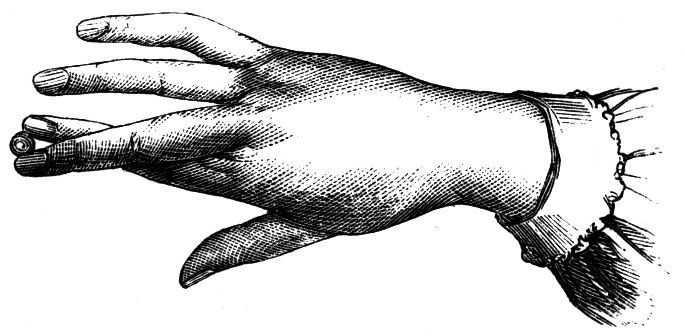
23. Liability of touch to err? Describe the illustration.
23. Touch is considered the least liable to error of all the senses; yet, if that part of the skin by which the sense is exercised is removed from its customary position, a false impression may be created in the mind. This is well illustrated by an experiment, which dates from the time of Aristotle. If we cross the middle finger behind the forefinger, and then roll a marble, or some small object, upon the tips of the fingers (see Fig. 45), the impression will be that two marbles are felt. If the fingers, thus transposed, be applied to the end of the tongue, two tongues will be felt. When the nose is accidentally destroyed, the surgeon sometimes performs an operation for the purpose of forming a new one, by transplanting a partially removed piece of the skin of the forehead upon the injured part: then, if the new nose be touched or pinched, the feeling is referred to the forehead. This fact illustrates one important truth, that the nerves will re-unite after they have been cut, and feeling will be restored: if it were otherwise, a succession of slight cuts upon the fingers would seriously impair their tactile sensibility.
24. The delicacy of touch? Experiments with a pair of compasses?
24. The Delicacy of Touch.—Although the hand is the proper organ of this sense, yet it is exercised by various parts of the body, their degree of sensibility being proportional to the number of papillæ they contain. The varying degrees of tactile delicacy of the different parts of the surface have been measured, in an ingenious manner, by means of a pair of compasses, tipped with small pieces of cork. The two points of the compasses are touched at the same moment to the skin, the eyes being closed, and it is found that, in sensitive parts, the distance between the points may be quite slight, and yet each be plainly felt; while, in less sensitive parts, the points of the compasses are felt as a single point, although they are separated one or two inches.
25. Further experiments and results?
25. At the tips of the fingers, the distance between the points being one-twentieth of an inch, a double impression is felt. The distance must be twice as great, for the palm; four times as great, for the lips; and, on the forehead, it must be twenty times greater. At the middle of the back, where the touch is least acute, the points must be separated more than two inches before they can be separately felt. Therefore, the sense of touch in the fingers is said to be fifty times more delicate than upon the posterior surface of the body.
26. Exquisite delicacy of touch? The same among the blind?
26. Exquisite delicacy of touch is attained by practice. This is shown in many of the lighter and more graceful employments of daily life. Without it, the skill of the painter, sculptor, and musician would be rude indeed. By training, also, the physician acquires the tactus eruditus, or discriminating touch; but among the blind, delicacy of touch is most remarkable, and it here finds its highest value; for its possession, in a measure, compensates the loss of sight by enabling them to read, by means of raised letters, to work with certain tools, and even to play upon musical instruments. A person born without sight, and without hearing or voice, may, by the education of the touch, be rescued from apparent imbecility, and be taught not only to read and write, but even to perform household and other useful labors.
27. Rival candidates for the sixth sense? Give the two reasons on the subject.
27. Sensations of Temperature and Weight.—Each of these sensations has been described by the physiologists as a special sense, and they are rival candidates, so to speak, for the position and title of the sixth sense. In the sensation of temperature, or the thermal sense, touch bears a part, but the two feelings appear to be distinct. In proof of this, we observe, firstly, that they are not alike intense in the same situations; as, for example, the skin of the face and elbow, where the sense of touch is feeble, is very sensitive to impressions of heat and cold. Secondly, the ability to recognize temperature may be lost by paralysis, while the sensibility of touch remains unaffected. When the skin comes in contact with a very hot substance, the sensation felt is that of pain, not of touch. In like manner, a very cold substance causes pain, not the feeling of cold. So that a red-hot iron, and solid carbonic acid (the temperature of which is 108° below zero), feel alike; and each, if pressed slightly, will produce a blister.
28. The muscular sense? State what is said to illustrate the subject.
28. The muscular sense, by some considered distinct from touch, gives rise to the sensations of weight, and other forms of external resistance. That this feeling exists, is shown by the following simple experiment. If the hand be placed flat upon a table, and a somewhat heavy weight be put into it, touch alone is exercised and a feeling of pressure results; but if the hand be raised, a certain amount of muscular effort must be put forth, and thus the sensation of weight is recognized. Through the muscular sense, precision of effort is rendered possible; for by it we learn to adjust the force exerted to the weight of the object to be lifted, moved, or carried. Without it, all our movements would necessarily become ill-regulated and spasmodic. In cases of disease, where the sensibility of the lower limbs is lost, while power of motion remains, the patient is able to stand erect so long as he can see his limbs; but just as soon as his eyes are closed, he begins to waver, and will fall unless supported.
29. The organ of taste? The tongue? Its powers of motion?
29. The Organ of Taste.—The tongue is the special organ of the sense of taste; but the back part of the mouth also possesses this faculty. The tongue is a muscular organ, the muscles composing it being so numerous and interwoven as to give it the freedom and variety of motion which it possesses. It can curve itself upward or downward; it can extend or contract itself; and, with its point, can sweep the cavity of the mouth, in all directions, in the search for scattered particles of food.
30. Peculiarities of the tongue? Uses of the papillæ?
30. The upper surface of the tongue is peculiar, being marked by the presence of innumerable papillæ, some of which are of microscopic size, resembling those that abound in the fingers, and in other parts of the body that have the sense of touch. Others are much larger, and give to the tongue its roughness of feeling and appearance. Through the medium of these papillæ, the tongue receives impressions of touch and temperature, as well as taste: indeed, its extremity is fully as delicate, in respect to tactile sensations, as the tips of the fingers themselves. It can recognize the two points of the compasses when separated not more than one-twenty-fourth of an inch; the back of it is much less sensitive to touch, while at the same time it is more highly sensitive to impressions of taste.
31. Resemblance to the parts of the tongue? Powers and functions of the parts?
31. Each lateral half of the tongue resembles the other in structure, and each receives the same number of nerves—three. One of these regulates motion, the other two are nerves of special sense. One of the latter supplies the front half of the tongue, and is called the gustatory nerve. This is a branch of the great cranial nerve, called the "fifth pair," which ramifies in all parts of the face. The back of the tongue is endowed with the power of taste through a nerve known as the glosso-pharyngeal, because it is distributed both to the tongue and throat. This difference in the nervous supply of the tongue becomes significant, when we learn, as we shall presently, that each part of it perceives a different class of flavors.
32. Taste? What are the requisites to taste?
32. The Sense of Taste.—Taste is the special sense by means of which we discover the savors, or flavoring properties of the substances, which come in contact with the tongue. Mere contact with the surface of the tongue, however, is not sufficient, but contact with the extremities of the nerves of taste within the papillæ is required. In order that the substance to be tasted may penetrate the cells covering the nerves, it must either be liquid in form, or readily soluble in the watery secretion of the mouth, the saliva. The tongue must be moist also. If the substance be insoluble, as glass or sand, or the tongue dry, the sense of taste is not awakened. In sickness, when the tongue is heavily coated, the taste is very defective, or, as is frequently expressed, "nothing tastes aright."
33. Portions of the tongue endowed with taste? Where else does the sense lodge? What is stated in respect to sweet and bitter flavors? Reflex effects mentioned?
33. All portions of the tongue are not alike endowed with the sense of taste, that function being limited to the posterior third, and to the margin and tip of this organ. The soft palate, also, possesses the sense of taste; hence, an article that has an agreeable flavor may very properly be spoken of as palatable, as is often done. All parts of the tongue do not perceive equally well the same flavors. Thus, the front extremity and margin, which is the portion supplied by the "fifth pair" of nerves, perceives more acutely sweet and sour tastes; but the base of the tongue, supplied by the glosso-pharyngeal nerve, is especially sensitive to salt and bitter substances. The nerve of the front part of the tongue, as before stated, is in active sympathy with those of the face, while the relations of the other nerve are chiefly with the throat and stomach; so that when an intensely sour taste is perceived, the countenance is involuntarily distorted, and is said to wear an acid expression. On the other hand, a very bitter taste affects certain internal organs, and occasions a sensation of nausea, or sickness of the stomach.
34. What is stated of the relations of taste with other senses?
34. Relations of Taste with other Senses.—Taste is not a simple sense. Certain other sensations, as those of touch, temperature, smell, and pain, are blended and confused with it; and certain so-called tastes are really sensations of another kind. Thus an astringent taste, like that of alum, is more properly an astringent feeling, and results from an impression made upon the nerves of touch, that ramify in the tongue. In like manner, the qualities known as smooth, oily, watery, and mealy tastes, are dependent upon these same nerves of touch. A burning or pungent taste is a sensation of pain, having its seat in the tongue and throat. A cooling taste, like that of mint, pertains to that modification of touch called the sense of temperature.
35. Its dependence on smell? on sight?
35. Taste is largely dependent upon the sense of smell. A considerable number of substances, like vanilla, coffee, and garlic, which appear to possess a strong and distinct flavor, have in reality a powerful odor, but only a feeble taste. When the sense of smell is interfered with by holding the nose, it becomes difficult to distinguish between substances of this class. The same effect is frequently observed when smell is blunted during an ordinary cold in the head. Sight also contributes to taste. With the eyes closed, food appears comparatively insipid; and a person smoking tobacco in the dark is unable to determine by the taste whether his cigar is lighted or not. Accordingly, it is not a bad plan to close the nose and shut the eyes when about to swallow some disagreeable medicine.
36. The chief use of the sense of taste? The position of its organs? The rule as regards wholesome and unwholesome food? Remarks respecting the rule?
36. Influence of Education on the Taste.—The chief use of the sense of taste appears to be to act as a guide in the selection of proper food. Hence its organs are properly placed at the entrance of the digestive canal. As a general rule, those articles which gratify the taste are wholesome; while the opposite is true of those which impress it disagreeably. This statement is more exact in reference to the early years of life than to later years, when, by reason of mischievous habits, the sense of taste has become dulled or perverted. The desires of a child are simple; he is fully satisfied with plain and wholesome articles of diet, and must usually "learn to like" those which have a strongly marked flavor. Accordingly, it is far easier at this age to encourage the preference for plain food, and thus establish healthful habits, than later in life to uproot habits of indulgence in stimulating substances, after their ill effects begin to manifest themselves.
37. Diversity in tastes of men? How shown? The education of the sense of taste?
37. The tastes of men present the most singular diversities, partly the result of necessity and partly of habit or education. The Esquimaux like the rank smell of whale oil, which is a kind of food admirably suited to the requirements of their icy climate; and travellers who go from our climate to theirs are not slow to develop a liking for the same articles that the natives themselves enjoy. The sense of taste is rendered very acute by education, as is shown in an especial manner by those who become professional "tasters" of tea and wine.
38. Location of the sense of smell? The nose? "Roof of the mouth?"
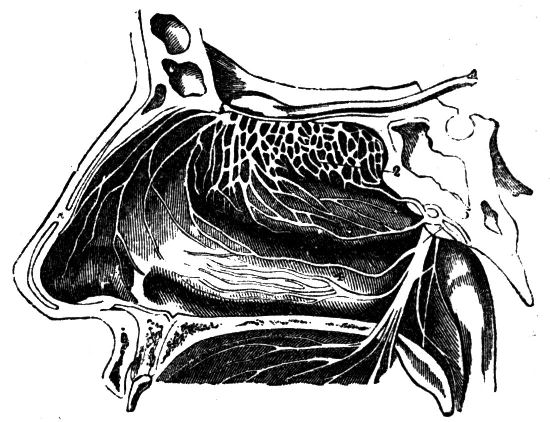
38. The Sense of Smell—the Nasal Cavities.—The sense of smell is located in the delicate mucous membrane which lines the interior of the nose. That prominent feature of the face, the nose, which is merely the front boundary of the true nasal organ, is composed partly of bone and partly of cartilage. The upper part of it is united with the skull by means of a few small bones; to which circumstance is due its permanence of shape. The lower portion, or tip of the nose, contains several thin pieces of cartilage, which render it flexible and better able to resist the effects of blows and pressure. Behind the nose we find quite a spacious chamber, separated from the mouth by the hard palate, forming the "roof of the mouth," and by the soft palate (see Fig. 46); and divided into two cavities by a central partition running from before backward.
39. Cavities of the nose? Obstruction of the passage of air through them?
39. These nasal cavities, constituting the true beginning of the air-passages, extend from the nose backward to the upper opening of the throat, and rise as high as the junction of the nose with the forehead. The inner wall of each cavity is straight and smooth; but from the outer wall there jut into each cavity three small scroll-like bones. The structure of these bones is very light, and hence they have been called the "spongy" bones of the nose. In this manner, while the extent of surface is greatly increased by the formation of these winding passages, the cavities are rendered extremely narrow; so much so, in fact, that a moderate swelling of the mucous membrane which lines them, as from a cold, is sufficient to obstruct the passage of air through them.
Fig. 46.—Section of the Right Nasal Cavity.
40. The special nerve of smell? Its location?
40. The Nerve of Smell.—The internal surface of the nasal passages is covered by a delicate and sensitive mucous membrane. Its surface is quite extensive, following as it does, all the inequalities produced by the curved spongy bones of the nose. The upper portion of it alone is the seat of smell, since that part alone receives branches from the "first pair" of cranial nerves, or the olfactory nerve, which is the special nerve of smell (see Fig. 43). In Fig. 46 is shown the distribution of this nerve, in the form of an intricate network upon the two upper spongy bones. The nerve itself (1) does not issue from the skull, but rests upon a thin bone which separates it from the cavity of the nose; and the branches which proceed from it pass through this bone by means of numerous small openings. The engraving represents the outer surface of the right nasal cavity; the three wave-like inequalities, upon which the nervous network is spread out, are due to the spongy bones. The left cavity is supplied in the same manner.
41. Branches of the "fifth pair" of nerves? Nasal mucus? Birds?
41. The nerves which ramify over the lower part of the membrane, and which endow it with sensibility to touch and pain, are branches of the "fifth pair" of nerves. An irritation applied to the parts where this nerve is distributed occasions sneezing, that is, a spasmodic contraction of the diaphragm; the object of which is the expulsion of the irritating cause. The manner in which the olfactory nerve-fibres terminate is peculiar. Unlike the extremities of other nerves, which are covered in by a greater or less thickness of tissue, these come directly to the surface of the mucous membrane, and thus come into very close contact with the odorous particles that are carried along by the respired air. The surface is at all times kept in a moist condition by an abundant flow of nasal mucus; otherwise it would become dry, hard, and insensitive from the continual passage of air to and fro in breathing. Birds, which respire more actively than men, have a special gland, for secreting a lubricating fluid, located in the air-passages of the head.
42. Smell? Touch? Taste? Design of smell? Invisible and gaseous particles? The extreme fineness of the particles? Musk? In other cases?
42. The Uses of the Sense of Smell.—Smell is the special sense which enables us to appreciate odors. Touch, as we have seen, is largely concerned with solid bodies; and taste, with fluids, or with solids in solution. Smell, on the other hand, is designed to afford us information in reference to substances in a volatile or gaseous form. Invisible and subtile particles emanate from odorous bodies, and are brought by the respired air in contact with the terminal filaments of the olfactory nerve, upon which an agreeable or disagreeable impression is produced. The fineness of the particles that constitute odors is often so extreme, that they elude all attempts to measure or weigh them. A piece of musk, for instance, may be kept for several years, constantly emitting perfume, without any appreciable loss of weight. In other cases, a loss of substance is perceptible, such as the essential oils, which enter into the composition of the ordinary perfumes.
43. Aid given by smell? The highest use of the sense? Explain the manner.
43. Smell, like taste, aids us in the choice of proper food, leading us to reject such articles as have a rank or putrid odor, and which are, as a rule, unfit to be eaten. The highest usefulness of this sense, however, consists in the protection it affords to the organs of respiration. Stationed at the gateways of the air-passages, it examines the current of air as it enters, and warns us of the presence of noxious gases, and of other and generally invisible enemies to health. Not all dangerous vapors are offensive, but almost all offensive vapors are unfit to be breathed. A number of small stiff hairs grow from the margin of the nostrils to prevent the entrance of dust and other atmospheric impurities, which would be alike injurious to the olfactory mucous membrane and to the lungs. The benevolent design of the Maker of our bodies may be observed in all parts of their mechanism; but, probably, in none is it more clearly displayed than in connection with the sense of smell.
44. Sense of smell in the inferior animals? How, and in what cases, illustrated?
44. The sense of smell is developed in a remarkable degree in certain of the inferior animals, and is especially acute in reference to the peculiar emanations that appear to characterize the different animals. The lion and other carnivorous beasts scent their prey from a great distance; and the fox-hound is able to track the fox through thickets and over open country for many miles; while the timid, helpless herbivora, such as the deer and sheep, find in the sense of smell a means of protection against their natural enemies, of whose approach they are in this manner warned. By training this sense in the dog, and making it subservient to his use, man is able to hunt with success certain shy and very fleet animals, which otherwise he could but seldom approach. Among men, individuals differ greatly in respect to the development of this sense; and especially in certain savage tribes it is found to be extremely delicate. Humboldt states that the natives of Peru can, by this sense, distinguish in the dark between persons of different races.
45. What is sight? What information does it furnish? Composite visual sensations?
45. The Sense of Sight.—Sight, or Vision, is the special sense by means of which we appreciate the color, form, size, distance, and other physical properties of the objects of external nature. Primarily, this sense furnishes us with information concerning the different shades of color and the different degrees of brightness: these are the simple sensations of sight, such as the yellowness and glitter of a gold coin. In addition to these, there are composite visual sensations, produced by the joint action of the other senses and by the use of the memory and judgment; such as, in the case of the coin, its roundness, solidity, size, its distance and direction from us. So that many of our sensations, commonly considered as due to sight, are in reality the results of intellectual processes which take place instantaneously and unconsciously.
46. Comparison between sight and hearing? Relative capacity of deaf and blind?
46. This faculty not only has value in the practical every-day affairs of life, but it contributes so largely to the culture of the intellect and to our higher forms of pleasure, that some writers are disposed to rate it as the first and most valuable of the senses. Others, however, maintain that the sense of hearing does not yield in importance to that of sight; and they cite in support of their position the fact that the blind are commonly cheerful and gay, while the deaf are inclined to be morose and melancholy. In respect to the relative capacity for receiving education in the deaf and blind, it is found that the former learn more quickly, but their attainments are not profound; while the blind acquire more slowly, but are able to study more thoroughly.
47. Sight, unlike the other senses? In the case of the stars?
47. Light.—The Optic Nerve.—Unlike the senses previously considered—touch, taste, and smell—sight does not bring us into immediate contact with the bodies that are examined; but, by it, we perceive the existence and qualities of objects that are at a greater or less distance from us. In the case of the stars, the distance is incalculable, while the book we read is removed but a few inches. Light is the agent which gives to this sense its wide range. The nature of this mysterious force is not known, and it is not here to be discussed; since its study belongs more properly to the province of natural philosophy.
48. The undulatory theory of light? What does the theory suppose?
48. It is sufficient, in this connection, to state that the theory of light now generally accepted, and which best explains the facts of optics, is that known as the undulatory theory. This theory supposes that there exists an intangible, elastic medium, which fills all space, and penetrates all transparent substances, and which is thrown into exceedingly rapid undulations or waves, by the sun and every other luminous body; the undulations being propagated with extreme rapidity, and moving not less than 186,000 miles in a second.
49. The sensation of light? Optic nerve?
49. These waves are thought to produce in the eye the sensation of light, in the same manner as the sonorous vibrations of the air produce in the ear the sensation of sound. That part of the eye which is sensitive to these waves is the expansion of the optic nerve. It is sensitive to no other impression than that of light, and it is the only nerve which is acted upon by this agent. The optic nerve, also called the "second pair" of cranial nerves, is the means of communication between the eye and the brain.
50. The two nerves constituting the pair of nerves?
50. The two nerves constituting the pair, arise from ganglia lying at the base of the cerebrum, one of them on each side; from which points they advance to the eyes, being united together in the middle of their course in the form of the letter X (Fig. 43—2). By this union the two eyes are enabled to act harmoniously, and in some respects to serve as a double organ. And by reason of this same intimate nervous communication, when serious disease affects one eye, the fellow-eye is extremely liable to become the seat of sympathetic inflammation; and this, if neglected, almost certainly results in hopeless blindness.
51. Why is the eye called the "window of the soul?" Why, the subject of enthusiastic study?
51. The Organ of Sight.—The Eye.—The proximity of the eye to the brain, and the important part it performs in giving expression to the emotions, have given it the name of "the window of the soul." The exceeding beauty of its external parts, and the high value of its function, have long made this organ the subject of enthusiastic study. It is chiefly within the last twenty years, however, that this study has been successful and fruitful of practical results. Several ingenious instruments have been invented for the examination of the eye in health and disease, and new operations have been devised for the relief of blindness and of impaired vision. As a result, it is now a well-marked fact that, in civilized lands, the number of those who suffer from loss of sight is proportionally much less than in countries where science is less known and cultivated.
52. The most obvious fact? The consequence? The next thing noticed? Its range of view? Of what does the organ of vision consist?
52. The most obvious fact in respect to the apparatus of sight is that there are two eyes, which may either act together as one, and be fixed upon one object, or one eye may be used independently of the other. In consequence of this arrangement the loss of one eye does not necessitate blindness, and, in fact, it not infrequently happens that the sight of one eye may be long impaired or lost before the fact is discovered. We next notice that it is placed at the most elevated part of the body, in front, and near the brain. It also commands a wide range of view, being itself moved with great rapidity, and being further aided by the free motion of the head and neck. The organ of vision consists essentially of two parts: the optical instrument itself—the eyeball—and its enveloping parts, or the case in which the instrument is kept free from harm. The latter, which are external, and which we shall first consider, are chiefly the Orbits, the Eyelids, and the apparatus for the Tears.
53. The protection of the eyeball against injury? The overhanging brow? The opening for the optic nerve?
53. The Orbits.—The eyeball, which is a delicate organ, is well defended against external injury within the orbits or bony sockets of the head. These are deep conical hollows, bounded in part by the bones of the skull, and in part by those of the nose and cheek. The orbit juts out beyond the most exposed portion of the eyeball, as may be seen by laying a book over the eye, when it will be found that no part of the eyeball, unless it be very prominent, will be touched by the book; so that the only direction in which an injury is liable to be received is immediately in front of the eye. The overhanging brow is itself covered by a layer of thick skin, studded with short, stout hairs, which are so bent as to prevent the perspiration from running into the eye and obscuring vision. Through a hole in the bottom of the orbit, the nerve of sight passes outward from the brain. The orbit also contains a considerable amount of a fatty tissue, upon which, as upon an elastic cushion, the eye rests.
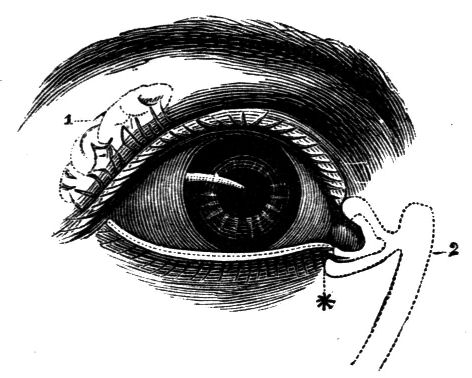
Fig. 47.—Front View of Right Eye.
(Natural Size.)
1. The Lachrymal, or tear gland, lying beneath the upper eyelid.
2. The Nasal Duct is shown by the dotted line. The * marks the orifice in the lower lid.
The central black spot is the pupil; surrounding it is the iris; and the triangular white spaces are the visible portion of the sclerotic.
54. What are the eyelids? The upper lid? The lower one? The mucous membrane of the eye?
54. The Eyelids.—The eyelids are two movable curtains, or folds, which, when shut, cover the front part of the orbit, and hide the eye from view. The upper lid is the larger, has a curved margin, and moves freely, while the lower lid is comparatively short and straight, and has but a slight degree of motion (Fig. 47). Skin covers the exterior of the lids, while a fine mucous membrane lines their inner surface, and is likewise spread out over the entire front of the eyeball. This membrane, which is called the Conjunctiva, is highly sensitive, and thus plays an important part in protecting the eye against the lodgment of sand, ashes, chaff, and other foreign particles that are blown about in the air. This sensitive membrane will not endure the presence of these particles. If any find access, it causes a constant winking, a flow of tears, and other signs of irritation, until it is removed.
55. The eyelashes? The little points within the line of the lashes? Of what use are these glands?
55. The long, silky eyelashes, which garnish the edges of the lids, act like a sieve to prevent the entry of dust and the like; and together with the lids, they regulate the amount of light which is permitted to enter the eye, so that it is shielded from a sudden flood or glare of light. The little points seen in the figure just within the line of the lashes, especially on the lower lid, represent the mouths of numerous little sebaceous glands (Fig. 48, D,D), such as are always found in the neighborhood of hairs. These glands supply a thick, oily material which greases the edges of the lids and prevents their adhering together, and likewise prevents the overflow of the tears upon the cheek.
56. The location of the lachrymal gland? The use of the gland?
56. The Lachrymal Fluid, or the Tears.—Just within the outer part of the bony arch of the brow, where the bone may be felt to be sharper than in other positions, is lodged a little organ called the lachrymal gland, the situation of which is indicated in Fig. 47, 1. This is the gland whence flows the watery secretion, commonly called the tears, which is designed to perform an exceedingly important duty in lubricating the lids, and in keeping the exposed surface of the eyeball moist and transparent. For, without this or some similar liquid, the front of the eye would speedily become dry and lustreless, like that of a fish which has been removed from the water: the simple exposure of the eye to the air would then suffice to destroy vision.
57. When does the secretion of the tears occur? The secretion not used for the eye? Location of the nasal duct? Its use? The overflow of tears in old people?
57. This secretion of the tears takes place at all times, during the night as well as the day; but it is seldom noticed, except when under the influence of some strong mental emotion, whether of sorrow or happiness, it is poured forth in excess, so as to overflow the lids. Strong light or a rapid breeze will, among many other causes, excite the flow of the tears. That portion of this secretion which is not used in moistening the eye is carried off into the nose by a canal situated near the inner angle of the eye, called the nasal duct. This duct is shown in Fig. 47, 2, and is connected with each lid by delicate tubes, which are indicated by dotted lines in the figure; the asterisk marks the little opening in the lower lid, by which the tears enter the nasal duct. By gently turning the inner part of that lid downward, and looking in a mirror, this small "lachrymal point" may be seen in your own eye. In old people, these points become everted, and do not conduct the tears to the nasal cavity, so that they are inconvenienced by an overflow of tears upon the face.
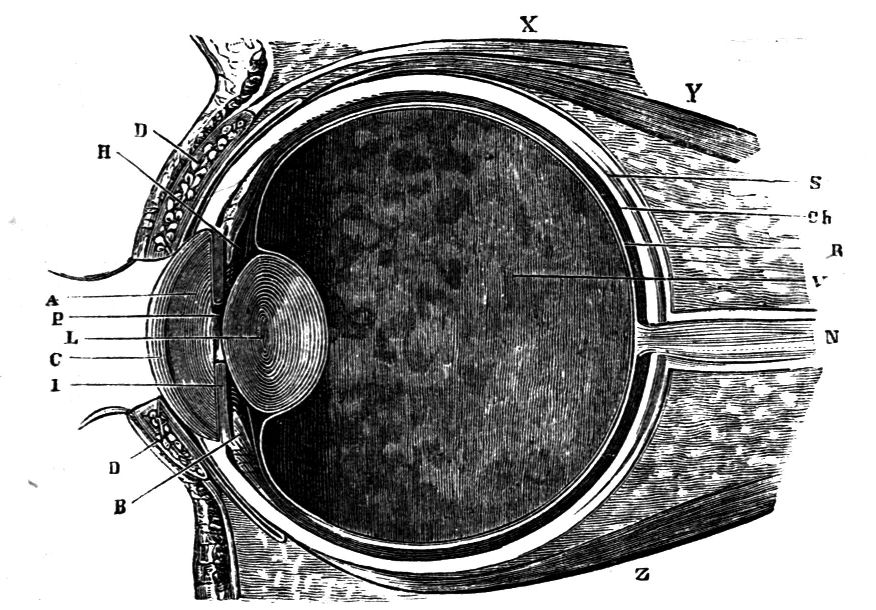
Fig. 48.—Vertical Section of the Eye.
(Enlarged.)
C, The Cornea. A, The Aqueous Humor. I, The Iris. P, The Pupil. L, The Crystalline Lens. H, The Ligament of the Lens. B, The Ciliary Process. V, The Cavity containing the Vitreous Humor. S, The Sclerotic. Ch, The Choroid. R, The Retina. N, The Optic Nerve. DD, The Eyelids. X, The Levator Muscle of the Upper Lid. Y, The Upper Straight Muscle of the Eye. Z, The Lower Straight Muscle.
58. The watery fluid passing over the eyeball? Design of the arrangement? Winking?
58. Thus we observe that the gland which forms the tears is placed at the outer part of the eye, while their means of exit is at the inner angle of the eye; which fact renders it necessary that this watery fluid shall pass over the surface of the eyeball before it can escape. This arrangement cannot be accidental, but evinces design, for it thus secures the perfect lubrication of the surface of the eye, and cleanses it from the smaller particles of dust which may enter it, in spite of the vigilance of the lids and lashes. The act of winking, which is generally unconsciously performed, and which takes place six or more times in a minute, assists this passage of the tears across the eye, and is especially frequent when the secretion is most abundant.
59. Describe the shape of the eyeball. Its structure.
59. The Eyeball.—The remarkable optical instrument called the eyeball, or the globe of the eye, upon which sight depends, is, as the name indicates, spherical in shape. It is not a perfect sphere, since the front part projects somewhat beyond the rest, and at the posterior part the optic nerve (Fig. 48, N) is united to it, resembling the junction of the stem with a fruit. In its long diameter, that is, the horizontal or from side to side, it measures a little more than an inch; in other directions it is rather less than an inch. In structure, the ball of the eye is firm, and its tense round contour may in part be felt by pressing the fingers over the closed lids.
60. Of what is the eyeball composed? State how.
60. The eyeball is composed chiefly of three internal, transparent media, called humors; and three investing coats, or tunics. The former are the aqueous humor, Fig. 48, A, the crystalline lens L, and the vitreous humor V. Of these the lens alone is solid. The three coats of the eyeball are called the sclerotic S, the choroid CH, and the retina R. This arrangement exists in respect to five-sixths of the globe of the eye, but in the anterior one-sixth, these coats are replaced by the cornea C, which is thin and transparent, so that the rays of light pass freely through it, as through a clear window-pane.
61. The shape of the cornea? Its structure? The "white of the eye?"
61. In shape, the cornea is circular and prominent, resembling a miniature watch-glass, about 1/25 of an inch thick. In structure, it resembles horn (as the name signifies), or the nail of the finger, and is destitute of blood-vessels. The Sclerotic (from scleros, hard) is composed of dense, white fibrous tissue, and gives to the eyeball its firmness of figure and its white color; in front, it constitutes the part commonly called "the white of the eye." It is one of the strongest tissues in the body; it possesses very few vessels, and is not very sensitive. It affords protection to the extremely delicate interior parts of the eye; and the little muscles which effect its movements are inserted into the sclerotic a short distance behind the cornea (see Fig. 48, Y, Z). It is perforated posteriorly to admit the optic nerve.
62. The second or middle coat of the eyeball? Its dark color?
62. The Choroid is the second or middle coat of the eyeball, and lies closely attached to the inner surface of the sclerotic. Unlike the latter tunic, its structure is soft and tender, it is dark in color, and possesses a great abundance of blood-vessels. Its dark color is due to a layer of dark brown or chocolate-colored cells spread out over its inner surface. This dark layer serves to absorb the rays of light after they have traversed the transparent structures in front of it; if the rays were reflected from side to side within the eye, instead of being thus absorbed, confused vision would result from the multitude of images which would be impressed upon the optic nerve.
63. Similar mechanism in microscopes? The albinos? White rabbits?
63. This mechanism has been unconsciously imitated by the opticians, who, when they make a microscope or telescope, take care that the interior of its tube shall be coated with a thick layer of black paint or lamp-black; for without it, a clear delineation of the object to be viewed is impossible. The albinos, in whom these dark cells of the choroid are wanting, have imperfect vision, especially in the daytime and in strong lights. The dark cells are also wanting in white rabbits, and other animals that have red or pink eyes; their vision appears to be imperfect in the presence of a bright light.
64. What is the iris? Its construction? How is the size of the pupil regulated?
64. The Iris.—Continuous with the choroid, in the front part of the globe of the eye, is a thin, circular curtain, which occasions the brown, blue, or gray color of the eye in different individuals. On account of the varieties of its color, this membrane has received the name Iris, which is the Greek word for "rainbow" (see Fig. 48, I). A front view of it is shown in Fig. 47. The iris is pierced in its centre by a round opening, called the pupil (P), which is constantly varying in size. In olden times it was spoken of as the "apple of the eye." The hinder surface of the iris, except in albinos, has a layer of dark coloring matter resembling that of the choroid. The iris is a muscular organ, and contains two distinct sets of fibres; one of which is circular, while the other radiates outward from the pupil. The action of these sets of fibres regulates the size of the pupil; for when the circular set acts, the pupil contracts, and when the other set acts, the opening expands. Their action is involuntary, and depends on the reflex system of nerves, which causes the contraction of the pupil when a strong light falls upon the eye, and its expansion when the illumination is feeble.
65. The admission of light to the eye? The action of the iris under different circumstances? The lustre of the eye, how affected in youth and old age?
65. The iris, accordingly, serves a very useful purpose in regulating the admission of light to the eye. It, however, does not act instantaneously; and hence, when we pass quickly from a dark room into the bright sunlight, the vision is at first confused by the glare of light, but as soon as the pupil contracts, the ability to see becomes perfect. On the other hand, when we enter a dark apartment, such as a cellar, for a short time we can see nothing clearly; but as soon as the pupil expands and admits more light, we are enabled to distinguish the surrounding objects. Animals of the cat species, and others which prowl around after nightfall, are enabled to see in the dark by having the iris very dilatable. The size of the pupil affects the lustre of the eye. When it is large, as it usually is during youth, the eye appears clear and brilliant; while in old age the pupil is small and the eye is dull. The brilliancy of the eye is in part, at least, dependent upon the reflection of light from the front surface of the crystalline lens.
66. Means used to increase the beauty of the eye? The injurious consequences?
66. Certain poisonous vegetables have the property of causing the pupil to dilate, and have been used in small doses to increase the beauty of the eye. One of these drugs has been so largely used by the ladies for this purpose, that it has received the name belladonna, from the Italian words meaning "beautiful lady." This hazardous practice has resulted more than once in the death of the person desiring thus to increase her personal attraction. The common English name for belladonna is "deadly nightshade." (In the diagram on page 214 the shape and relations of the iris are more accurately shown than in the figure referred to above.)
67. What part does the retina constitute? How formed? Its texture? Color? Sensitiveness?
67. The Retina constitutes the third and inner coat of the globe of the eye. This, the important part of the eye that is sensitive to light, is a kind of nervous membrane, formed by the expansion of the ultimate filaments of the optic nerve. Its texture is soft, smooth, and very thin; it is translucent and of an opaline, or grayish-white color. It is sensitive to light alone; and if any form of mechanical irritation be applied to it, the sensations of touch and pain are not experienced, but flashes of fire, sparks, and other luminous appearances are perceived. Thus an electric shock given to the eye-ball occasions a flash of light; and a sudden fall, or a blow upon the eye, is often apparently accompanied by the vision of "stars."
68. Specific energy of the optic nerve? Trial in Germany?
68. These phenomena are due to what is termed the "specific energy" of the optic nerve, which nerve, in common with the other nerves of special sense, obeys a general law of nature, which requires that, whenever one of these nerves is stimulated, it shall respond with the sensation peculiar to itself. These flashes of retinal light have no power to illuminate external objects, although the opposite of this statement has been maintained. On the occasion of a remarkable trial in Germany, it was claimed by a person who had been severely assaulted on a very dark night, that the flashes of light caused by repeated blows upon the head enabled him to see with sufficient distinctness to recognize his assailant. But the evidence of scientific men entirely refuted this claim, by pronouncing that the eye, under the circumstances named, was incapacitated for vision. Too intense light occasions a feeling of pain, but it is of a peculiar kind, and is termed "dazzling."
Fig. 49.
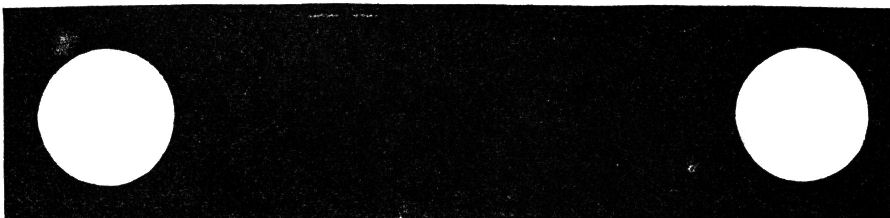
69. Sensitiveness of all parts of the retina? Experiment to prove the existence of the "blind spot."
69. All parts of the retina are not equally sensitive, and singularly enough, the point of entry of the nerve of sight, in the back part of the eyeball, is entirely insensible to light, and is called the "blind spot." The existence of this point may be proven by a simple experiment. Hold the accompanying figure, on page 207, directly in front of and parallel with the eyes. Close the left eye, and fix the sight steadily on the left-hand circle; then, by gradually varying the distance of the figure from the eye, at a certain distance (about six inches), the right-hand circle will disappear, but nearer or further than that, it will be plainly seen. The other eye may be also tried, with a similar result: if the gaze be directed to the right-hand circle, the left one will seem to disappear. The experiment may be repeated by using two black buttons on the marble top of a bureau, or on some other white surface. The blind spot does not practically interfere with vision, since the eye is seldom fixed immovably on an object, and the insensitive parts of the two eyes can never be directed upon the same object at the same time.
70. Duration of impressions upon the retina? How illustrated?
70. Impressions made upon the retina are not at once lost, but persist a measurable length of time, and then gradually fade away. Thus, a bright light or color, gazed at intently, cannot be immediately dismissed from sight by closing or turning away the eyes. A stick lighted at one end, if whirled around rapidly in the dark, presents the appearance of an unbroken luminous ring; and the spokes of a rapidly revolving carriage-wheel seem to be merged into a plane surface. If an object move too rapidly to produce this sort of lasting impression, it is invisible, as in the case of a cannon-ball passing through the air in front of us.
71. What further illustration? Winking, why it is not noticed. Ease with which the retina is fatigued or deprived of sensibility? How shown?
71. If a card, painted with two primary colors—as red and yellow—be made to rotate swiftly, the eye perceives neither of them distinctly; but the card appears painted with their secondary color—orange. The average duration of retinal images is estimated at one-eighth of a second; and it is because they thus endure, that the act of winking, which takes place so frequently, but so quickly, is not noticed and does not interrupt the vision. The retina is easily fatigued or deprived of its sensibility. After looking steadfastly at a bright light, or at a white object on a black ground, a dark spot, corresponding in shape to the bright object, presents itself in whatever direction we look. This spot passes away as the retina resumes its activity.
72. How further shown? How is the result accounted for? "Color-blindness?"
72. If a bright color be gazed at intently, and the eyes then be turned to a white surface, a spot will appear; but its color will be the complement of that of the object. Fix the eye upon a red wafer upon a white ground, and on removing the wafer a greenish spot of the same shape takes its place. This result happens because a certain portion of the retina has exhausted its power to perceive the red ray, and perceives only its complementary ray, which is green. The color thus substituted by the exhausted retina is called a physiological or accidental color. In some persons the retina is incapable of distinguishing different colors, when they are said to be affected with "color-blindness." Thus, red and green may appear alike, and then a cherry-tree, full of ripe fruit, will seem of the same color in every part. Railroad accidents have occurred because the engineer of the train, who was color-blind, has mistaken the color of a signal.
73. The location of the crystalline lens? How supported? Its color and texture? Shape? Size?
73. The Crystalline Lens.—Across the front of the eye, just behind the iris, is situated the Crystalline lens, enclosed within its own capsule. It is supported in its place partly by a delicate circular ligament, and partly by the pressure of adjacent structures. It is colorless and perfectly transparent, and has a firm but elastic texture. In shape it is doubly convex, and may be rudely compared to a small lemon-drop. The front face of the lens is flatter than the other, and is in contact with the iris near its pupillary margin, as is represented in the diagram on page 214. It is only one-fourth of an inch thick.
74. Cataract? Aqueous humor? Vitreous humor?
74. When this little body becomes opaque, and no longer affords free passage to the rays of light, as often happens with the advance of age, an affection termed "cataract" is produced. Between the crystalline lens and the cornea is a small space which contains the aqueous humor (see Fig. 48, A). This humor consists of five or six drops of a clear, colorless liquid very much like water, as its name implies. That part of the globe of the eye lying behind the lens is occupied by the vitreous humor, so called from its fancied resemblance to melted glass (Fig. 48, V). This humor is a transparent, jelly-like mass, enclosed within an exceedingly thin membrane. It lies very closely applied to the retina, or nervous membrane of the eye, and constitutes fully two-thirds of the bulk of the eyeball.
Fig. 50.—The Retinal Image.
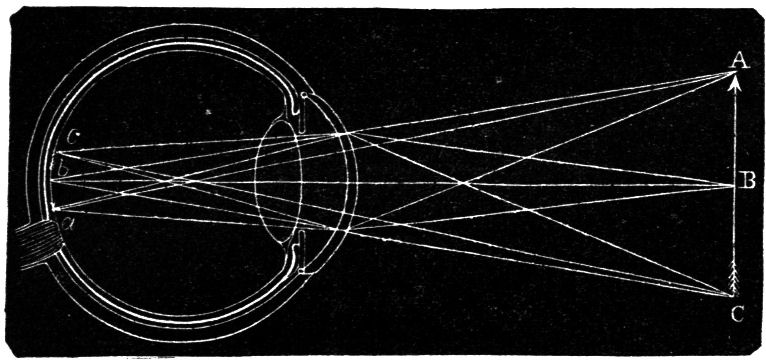
75. What is a lens and its focus? The miniature image, how produced?
75. The Uses of the Crystalline Lens.—A convex lens has the property of converging the rays of light which pass through it; and the point at which it causes them to meet is termed its focus. If a lens of this description, such as a magnifying or burning-glass, be held in front of an open window, in such a position as to allow its focus to fall upon a piece of paper, it will be found to depict upon the paper a miniature image of the scene outside of the window. It will be further noticed that the image is inverted, or upside down, and that the paper at the place upon which the image is thrown is much brighter than any other part.
76. How are figures painted upon the retina? How proved?
76. Now all the transparent structures of the eye, but especially the crystalline lens, operate upon its posterior part, or retina, as the convex lens acts upon the paper; that is, they paint upon the retina a bright inverted miniature of the objects that appear in front of the eye (Fig. 50). That this actually takes place may be proved by experiment. If the eyeball of a white rabbit, the walls of which are transparent, be examined while a lighted candle is held before the cornea, an image of the candle-flame may be seen upon the retina.
77. What can be said in respect to the form and structure of the crystalline lens?
77. The form and structure of the crystalline lens endow it with a remarkable degree of refractive power, and enable it to converge all the rays of light that enter it through the pupil, to a focus exactly at the surface of the retina. When this lens is removed from the eye, as is frequently done for the cure of cataract, it is found that the rays of light then have their focus three-eighths of an inch behind the retina; that the image is four times larger than in the healthy eye, that it is less brilliant, and that its outline is very indistinct. From this we learn that one of the uses of the crystalline lens is to make the retinal image bright and sharply-defined, at the same time that it reduces its size. Indeed, the small size of the image is a great advantage, as it enables the limited surface of the retina to receive, at a glance, impressions from a considerable field of vision.
78. How is the inverted image upon the retina presented in its true position to the mind?
78. As the image upon the retina is inverted, how does the mind perceive the object in its true, erect position? Many explanations have been advanced, but the simplest and most satisfactory appears to be found in the fact that the retina observes no difference, so to speak, between the right and left or the upper and lower positions of objects. In fact, the mind is never conscious of the formation of a retinal image, and until instructed, has no knowledge that it exists. Consequently, our knowledge of the relative location of external objects must be obtained from some other source than the retina. The probable source of this knowledge is the habitual comparison of those objects with the position of our own bodies: thus, to see an elevated object, we know we must raise the head and eyes; and to see one at our right hand, we must turn the head and eyes to the right.
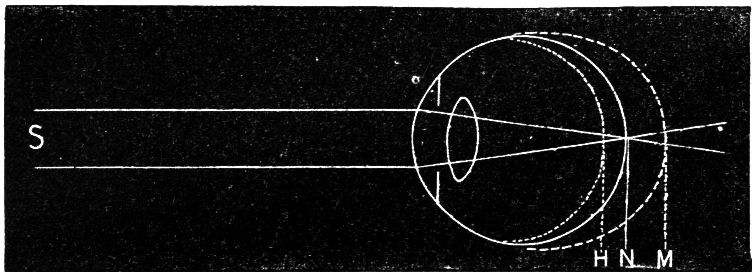
Fig. 51.—The Different Shapes of the Globe of the Eye.
N, The Natural Eye. M, The Short-sighted Eye. H, The Long-sighted Eye. S, Parallel Rays from the Sun.
79. The uniform perfection of the eye? Examples? The most common imperfection?
79. Long-sight or Hyperopia, and Short-sight or Myopia.—The eye is not in all cases perfectly formed. For example, persons may from birth have the cornea too prominent or too flat, or the lens may be too thick or too thin. In either of these conditions sight will be more or less defective from the first, and the defect will not tend to disappear as life advances. The most common imperfection, however, is in the shape of the globe; which may be short (Fig. 51, H), as compared with the natural eye, N, or it may be too long, M.
80. How is "long-sight" explained? "Short-sight?"
80. When the globe is short, objects can only be clearly seen that are at a distance, and the condition of the vision is known as "long-sight," or hyperopia. It will be observed, by reference to Fig. 51, that the focus of the rays of light would fall behind the retina of this eye. When the globe is too long, objects can only be clearly seen that are very near to the eye; and the condition resulting from this defect is termed "short-sight," or myopia. The focus of the rays of light is, in this case, formed in the interior of the eye in front of the retina.
81. Long-sight, how common? With what must it not be confounded? Kind of glasses for short-sight? Why? Squint?
81. Long-sight, or hyperopia, is common among schoolchildren, nearly as much so as short-sight, and must not be confounded with the defect known as the "far sight" of old people; although in both affections the sight is improved by the use of convex glasses. Children not infrequently discover that they see much better when they chance to put on the spectacles of old persons. For the relief of short-sight, concave glasses should be employed; as they so scatter the rays of light as to bring the focus to the retina, and thus cause the vision of remote objects to become at once distinct. That form of "squint," in which the eyes are turned inward, is generally dependent upon long-sight, while that rarer form, when they turn outward, is due to short-sight.
82. What is stated in connection with the opera-glass? Experiment with pencil and distant object?
82. The Function of Accommodation.—If, after looking through an opera-glass at a very distant object, it is desired to view another nearer at hand, it will be found impossible to obtain a clear vision of the second object unless the adjustment of the instrument is altered; which is effected by means of the screw. If an object, like the end of a pencil, be held near the eye, in a line with another object at the other side of the room, or out of the window, and the eye be fixed first upon one and then upon the other, it will be found that when the pencil is clearly seen, the further object is indistinct; and when the latter is seen clearly, the pencil appears indistinct; and that it is impossible to see both clearly at the same time. Accordingly, the eye must have the capacity of adjusting itself to distances, which is in some manner comparable to the action of the screw of the opera-glass.
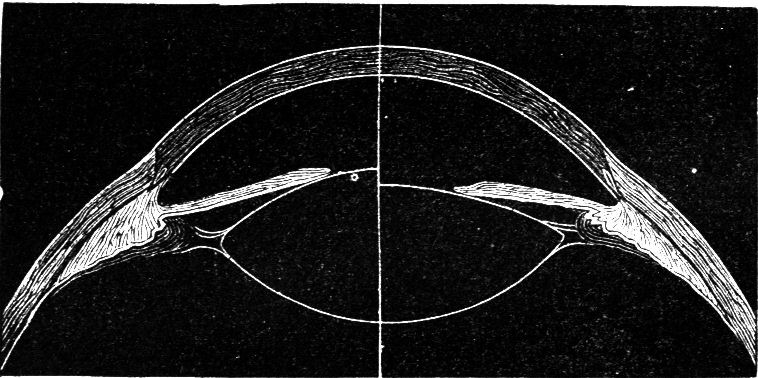
Fig. 52.—The Function of Accommodation.
The right half of the diagram shows the eye at rest. The left half shows the lens accommodated for near vision.
83. Function of accommodation? In what does it consist? How is the function explained?
83. This, which has been called the function of accommodation, is one of the most admirable of all the powers of the eye, and is exercised by the crystalline lens. It consists essentially in a change in the curvature of the front surface of the lens, partly through its own elasticity, and partly through the action of the ciliary muscle. When the eye is at rest, that is, when accommodated for a distant object, the lens is flatter and its curvature diminished (see Fig. 52); but when strongly accommodated for near vision the lens becomes thicker, its curvature increases, and the image on the retina is made more sharp and distinct. Since a strong light is not required in viewing near objects, the pupil contracts, as is shown in the left-hand half of the diagram.
84. Change of sight with the approach of old age? Explain the change?
84. Old-sight, or Presbyopia.—But this marvellously beautiful mechanism becomes worn with use; or, more strictly speaking, the lens, like other structures of the body, becomes harder with the approach of old age. The material composing the lens becomes less elastic, the power to increase its curvature is gradually lost, and as a consequence, the person is obliged to hold the book further away when reading, and to seek a stronger light. In a word, the function of accommodation begins to fail, and is about the first evidence that marks the decline of life. By looking at the last preceding diagram, and remembering that the increased curvature of the lens cannot take place, it will be at once understood why old-sight is benefitted in near vision by the convex lens, such as the spectacles of old people contain. It acts as a substitute for the deficiency of the crystalline lens.
85. Hearing or audition? What is sound? How propagated commonly? Stone thrown in water?
85. The Sense of Hearing.—Sound.—Hearing, or audition, is the special sense by means of which we are made acquainted with sound. What is sound? It is an impression made upon the organs of hearing, by the vibrations of elastic bodies. This impression is commonly propagated by means of the air, which is thrown into delicate undulations, in all directions from the vibrating substance. When a stone is thrown into smooth water, a wave of circular form is set in motion, from the point where the stone struck, which constantly increases in size and diminishes in force, as it advances.
86. Sound-wave in the atmosphere? Its shape? Rate of motion? Sound, in water, air, and solid bodies?
86. Somewhat resembling this, is the undulation, or sound-wave, which is imparted by a sonorous vibration to the surrounding atmosphere. Its shape, however, is spherical, rather than circular, since it radiates upward, downward, and obliquely as well as horizontally, like the wave in water. The rate of motion of this spherical wave of air is about 1050 feet per second, or one mile in five seconds. In water, sound travels four times as fast as in air, and still more rapidly through solid bodies; along an iron rod, its velocity is equal to two miles per second.
87. The earth as a conductor of sound? To what has the western Indian been taught? Solid substances as conductors? As regards sound, in what respect is air necessary? Sound in a vacuum?
87. The earth, likewise, is a good conductor of sound. It is said that the Indian of our western prairies can, by listening at the surface of the ground, hear the advance of a troop of cavalry, while they are still out of sight, and can even discriminate between their tread and that of a herd of buffaloes. Solid substances also convey sounds with greater power than air. If the ear be pressed against one end of a long beam, the scratching of a pin at the other extremity may be distinctly heard, which will not be at all audible when the ear is removed from the beam. Although air is not the best medium for conveying sound, it is necessary for its production. Sound cannot be produced in a vacuum, as is shown by ringing a bell in the exhausted receiver of an air-pump, for it is then entirely inaudible. But let the air be readmitted gradually, then the tones become more and more distinct, and when the receiver is again full of air, they will be as clear as usual.
88. All sonorous bodies do not vibrate with the same degree of rapidity, and upon this fact depends the pitch of the sounds that they respectively produce. The more frequent the number of vibrations within a given time, the higher will be the pitch; and the fewer their number, the lower or graver will it be. Now, the rate of the successive vibrations of different notes has been measured, and it has thus been found that if they are less than sixteen in a second, no sound is audible; while if they exceed 60,000 per second the sound is very faint, and is painful to the ear. The extreme limit of the capacity of the human ear may be considered as included between these points; but the sounds which we ordinarily hear are embraced between 100 and 3,000 vibrations per second.
89. The ear, which is the proper organ of hearing, is the most complicated of all the structures that are employed in the reception of external impressions. The parts of which it is composed are numerous, and some of them are extremely small and delicate. Nearly all these parts are located in an irregularly shaped cavity hollowed out in the temporal, or "temple," bone of each side of the head. That part of the bone in which the auditory cavity is placed has the densest structure of all bones of the body, and has therefore been called the "petrous," or rocky part of the temporal bone. In studying the ear, it is necessary to consider it as divided into three portions, which are called, from their relative positions, the external ear, the middle ear, and the internal ear. (In the diagram, Fig. 53, A, the first is not shaded, the second is lightly shaded, and the last has a dark background.)
90. Of what does the external portion of the organ of hearing consist? Describe the portal of that organ known as the ear. Its use?
90. The External Ear.—The external portion of the organ of hearing, designated in Fig. 53, A, includes, first, that outer part (a), which is commonly spoken of as "the ear," but which in fact is only the portal of that organ; and, secondly, the auditory canal (b). The former consists of a flat flexible piece of cartilage, projecting slightly from the side of the head, attached to it by ligaments, and supplied with a few weak muscles. Its surface is uneven, and curiously curved, and from its resemblance to a shell, it has been called the concha. It probably serves to collect sounds, and to give them an inward direction; although its removal is said not to impair the acuteness of hearing more than a few days.
91. The ear in the animals of delicate hearing? Rabbit? Fishes?
91. In those animals whose hearing is more delicate than that of man, the corresponding organ is of greater importance, it being larger and supplied with muscles of greater power, so that it serves as a natural kind of ear-trumpet, which is easily movable in the direction of any sound that attracts the attention of the animal. Bold, predaceous animals generally have the concavity of this organ directed forward, while in timorous animals, like the rabbit, it is directed backward. Fishes have no outer ear, but sounds are transmitted directly through the solid bones of the head, to the internal organ of hearing.