H Y G I E N E. (continued 3)
Reading edition
42. Show what time is required for a given portion of blood to travel once around the body.
42. Rapidity of the Circulation.—That the blood moves with great rapidity is evident from the almost instant effects of certain poisons, as prussic acid, which act through the blood. Experiments upon the horse, dog, and other inferior animals, have been made to measure its velocity. If a substance, which is capable of a distinct chemical reaction (as potassium ferrocyanide, or barium nitrate), be introduced into a vein of a horse on one side, and blood be taken from a distant vein on the other side, its presence may be detected at the end of twenty or thirty-two seconds. In man, the blood moves with greater speed, and the circuit is completed in twenty-four seconds.
43. Time required for all the blood to circulate completely around?
43. What length of time is required for all the blood of the body to make a complete round of the circulation? This question cannot be answered with absolute accuracy, since the amount of the blood is subject to continual variations. But, if we assume this to be one-eighth of the weight of the body, about eighteen pounds, it will be sufficiently correct for our purpose. Now to complete the circuit, this blood must pass once through the left ventricle, the capacity of which is two ounces. Accordingly, we find that, under ordinary circumstances, all the blood makes one complete rotation every two minutes; passing successively through the heart, the capillaries of the lungs, the arteries, the capillaries of the extremities, and through the veins.
44. What is meant by assimilation? What can you say of its use, etc.? Time?
44. Assimilation.—The crowning act of the circulation, the furnishing of supplies to the different parts of the body, is effected by means of the capillaries. The organs have been wasted by use; the blood has been enriched by the products of digestion. Here, within the meshes of the capillary network, the needy tissues and the needed nutriment are brought together. By some mysterious chemistry, each tissue selects and withdraws from the blood the materials it requires, and converts them into a substance like itself. This conversion of lifeless food into living tissue is called assimilation. The process probably takes place at all times, but the period especially favorable for it is during sleep. Then the circulation is slower, and more regular, and most of the functions are at rest. The body is then like some trusty ship, which after a long voyage is "hauled up for repairs."
45. What is stated of the injuries to the blood-vessels?
45. Injuries to the Blood-vessels.—It is important to be able to discriminate between an artery and a vein, in the case of a wound, and if we remember the physiology of the circulation we may readily do so. For, as we have already seen, hæmorrhage from an artery is much more dangerous than that from a vein. The latter tends to cease spontaneously after a short time. The arterial blood flows away from the heart with considerable force, in jets; its color being bright scarlet. The venous blood flows toward the heart from that side of the wound furthest from the heart; its stream being continuous and sluggish; its color dark. In an injury to an artery, pressure should be made between the heart and the wound; and in the case of a vein that persistently bleeds, it should be made upon the vessel beyond its point of injury.
QUESTIONS FOR TOPICAL REVIEW.
PAGE
1. In what organisms is the so-called circulatory fluid found? 101
2. How is it designated in the different organisms? 101
3. What can you state of the importance of blood to the body? 101, 105
4. Of its great abundance, color, and composition? 101, 102, 107
5. Describe the corpuscles of the human blood. 102, 103, 104
6. What is said of them in comparison with those of the lower animals? 103
7. Of the importance of sometimes detecting human from other blood? 103
8. What means have we of detecting blood in spots or stains? 103, 104
9. What is meant by coagulation of the blood? 104
10. What wisdom is there in the law of the blood's coagulation? 104, 105
11. How is this wisdom made manifest? 105
12. In what cases is the aid of the surgeon required? 105
13. What are the two great uses of the blood? 105
14. Through what mediums is the blood provided with new material and relieved of the old material? 105
15. What do you understand by the operation called transfusion? 106
16. What cases of transfusion are reported of the lower animals? 106
17. What can you state of transfusion as practised upon man? 106
18. What further can you say on the subject? 106, 107
19. What changes take place in the color of the blood in its journey through the system? 107
20. State all you can in relation to the circulation of the blood. 107
21. All, in relation to the size, shape, and location of the heart. 107, 109
22. How is the loss of power in the heart movements obviated? 109
23. Give a description of the formation of the heart. 109, 110, 111
24. What can you state of the ventricles and auricles of the heart? 110
25. Describe the action of the heart. 111
26. What special vitality does the tissue of the heart possess? 111
27. State all you can on the subject. 111
28. Describe the course of the blood through the cavities of the heart. 112
29. Describe the mechanism that regulates the heart-currents. 112
30. How do you account for the two heart-sounds at the front of the chest? 112
31. State what you can of the frequency of the heart's action. 112, 113
32. Of the activity of the heart. 113, 114
33. What do you understand by the arteries? 114, 115
34. State what you can of the arteries and the arterial system. 114, 115
35. What do you understand by the pulse? 115, 116
36. In what part of the body may the pulse be felt? 116
37. What further can you state of the pulse? 116, 117
38. What are the veins? 117
39. Where do they exist, and how are they formed? 117
40. Describe the valves of the veins and their uses. 117
41. Now give a full description of the construction of the veins. 117
42. What further can you state of the veins? 117, 118
43. What do you understand by the capillaries? 118, 119
44. What service do the capillaries perform? 118, 119, 121
45. Describe the circulation of the blood in the region of the heart. 118, 119
46. What can you state of the rapidity of the blood's circulation? 120
47. Of the process known as assimilation? 121
48. Of injuries to the blood-vessels? 121
CHAPTER VIII.
RESPIRATION.
The Objects of Respiration—The Lungs—The Air-Passages—The Movements of Respiration—Expiration and Inspiration—The Frequency of Respiration—Capacity of the Lungs—The Air we breathe—Changes in the Air from Respiration—Changes in the Blood—Interchange of Gases in the Lungs—Comparison between Arterial and Venous Blood—Respiratory Labor—Impurities of the Air—Dust—Carbonic Acid—Effects of Impure Air—Nature's Provision for Purifying the Air—Ventilation—Animal Heat—Spontaneous Combustion.
1. Difference between the two sets of capillaries? Change effected by respiration or breathing?
1. The Object of Respiration.—In one set of capillaries, or hair-like vessels, the blood is impoverished for the support of the different members and organs of the body. In another capillary system the blood is refreshed and again made fit to sustain life. The former belongs to the greater or systemic circulation; the latter to the lesser or pulmonary, so called from pulmo, the lungs, in which organs it is situated. The blood, as sent from the right side of the heart to the lungs, is venous, dark, impure, and of a nature unfit to circulate again through the tissues. But, when the blood returns from the lungs to the left side of the heart, it has become arterial, bright, pure, and no longer hurtful to the tissues. This marvellous purifying change is effected by means of the very familiar act of respiration, or breathing.
2. What are the lungs? How many lungs are there? Lung-substance? Its properties? The pleura?
2. The Lungs.—The lungs are the special organs of respiration. There are two of them, one on each side of the chest, which cavity they, with the heart, almost wholly occupy. The lung-substance is soft, elastic, and sponge-like. Under pressure of the finger, it crepitates, or crackles, and floats when thrown into water; these properties being due to the presence of air in the minute air-cells of the lungs. To facilitate the movements necessary to these organs, each of them is provided with a double covering of an exceedingly smooth and delicate membrane, called the pleura. One layer of the pleura is attached to the walls of the chest, and the other to the lungs; and they glide, one upon the other, with utmost freedom. Like the membrane which envelops the heart, the pleura secretes its own lubricating fluid, in quantities sufficient to keep it always moist.
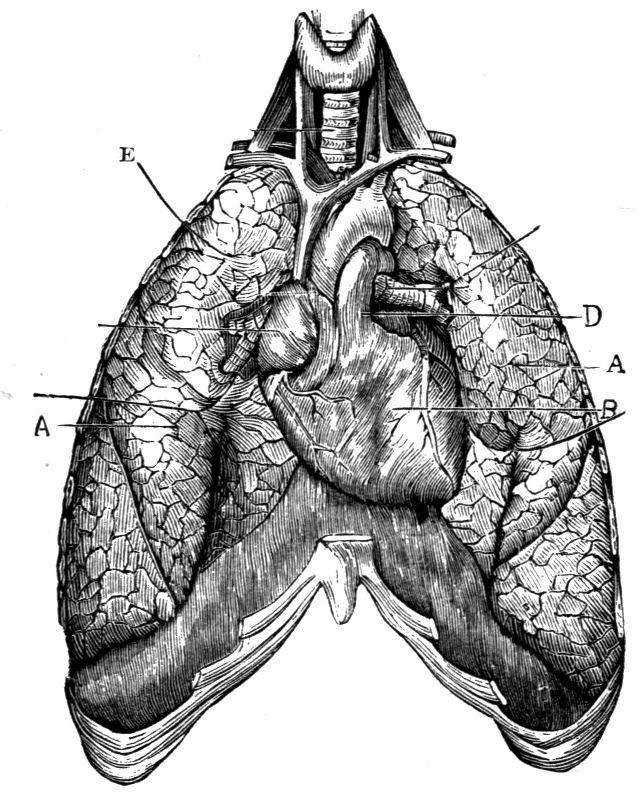
Fig. 34.—Organs of the Chest.
A, Lungs. B, Heart. D, Pulmonary Artery. E, Trachea.
Fig. 36.—Diagram and Section of the Air-cells.
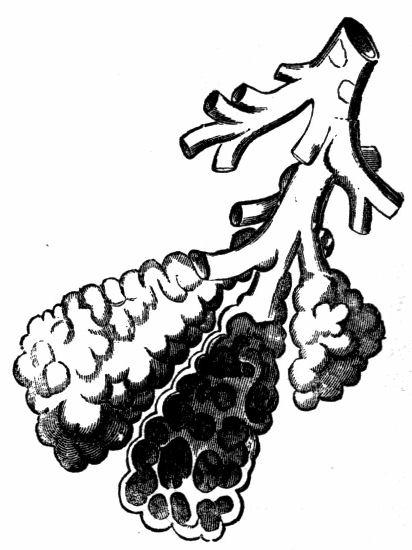
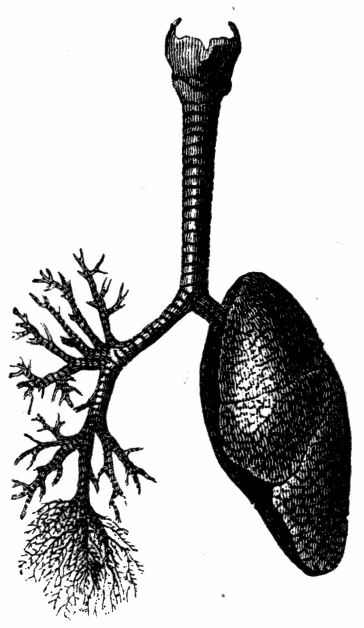
Fig. 35.—Larynx, Trachea, and Bronchial Tubes.
3. Communication of the lungs with the external air? Bronchial tubes?
3. The Air-Passages. —The lungs communicate with the external air by means of certain air-tubes, the longest of which, the trachea, or windpipe, runs along the front of the neck (Fig. 34, E, and 35). Within the chest this tube divides into two branches, one entering each lung; these in turn give rise to numerous branches, or bronchial tubes, as they are called, which gradually diminish in size until they are about one-twenty-fifth of an inch in diameter. Each of these terminates in a cluster of little pouches, or "air-cells," having very thin walls, and covered with a capillary network, the most intricate in the body (Fig. 36).
4. Office of the bronchial tubes? What further can you state of them?
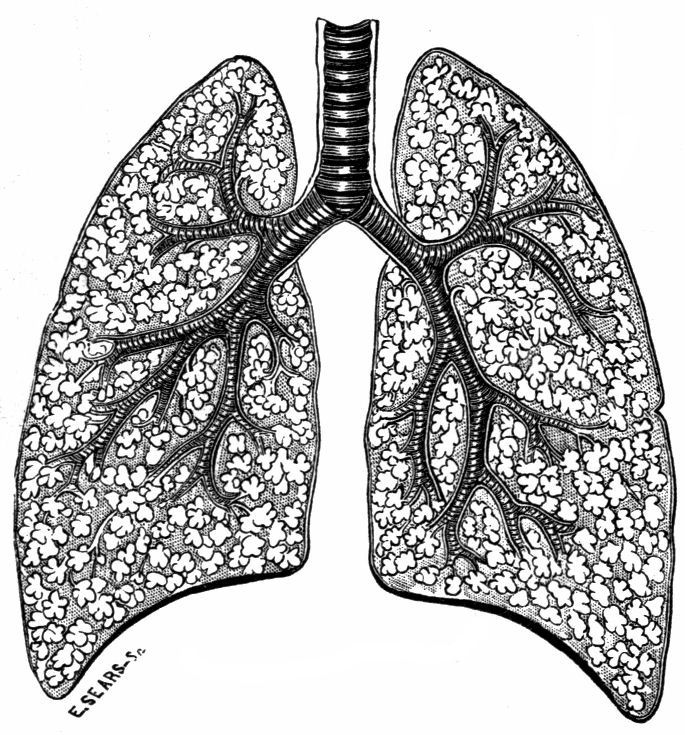
4. These tubes are somewhat flexible, sufficiently so to bend when the parts move in which they are situated; but they are greatly strengthened by bands or rings of cartilage which keep the passages always open; otherwise there would be a constantly-recurring tendency to collapse after every breath. The lung-substance essentially consists of these bronchial tubes and terminal air-cells, with the blood-vessels ramifying about them (Fig. 37). At the top of the trachea is the larynx, a sort of box of cartilage, across which are stretched the vocal cords. Here the voice is produced chiefly by the passage of the respired air over these cords, causing them to vibrate.
Fig. 37.—Section of the Lungs.
5. The epiglottis? When it does not close in time, what is the consequence?
5. Over the opening of the larynx is found the epiglottis, which fits like the lid of a box at the entrance to the lungs, and closes during the act of swallowing, so that food and drink shall pass backward to the œsophagus, or gullet (Fig. 38). Occasionally it does not close in time, and some substance intrudes within the larynx, when we at once discover, by a choking sensation, that "something has gone the wrong way," and, by coughing, we attempt to expel the unwelcome intruder. The epiglottis is one of the many safeguards furnished by nature for our security and comfort, and is planned and put in place long before these organs are brought into actual use in breathing and in taking food.
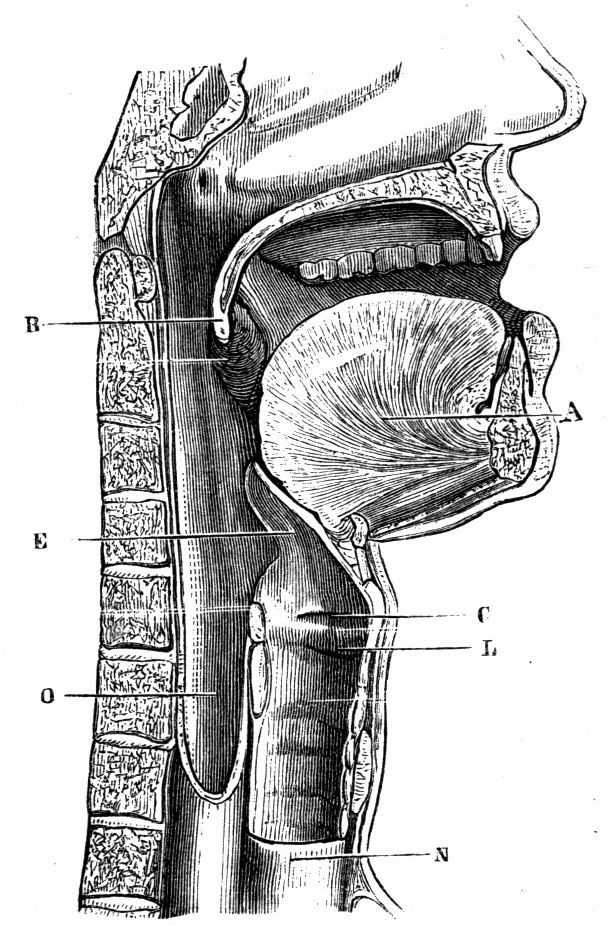
Fig. 38.—Section of Mouth and Throat.
A, The Tongue. B, The Uvula C, Vocal Cord. E, Epiglottis. L, Larynx. N, Trachea. O, Œsophagus.
6. Lining of the air-passages? Ciliated cells? Their uses? The three diseases of the lungs?
Fig. 39.—Ciliated Cells.
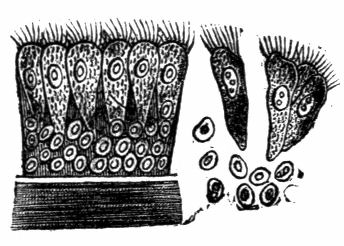
6. The air-passages are lined through nearly their whole extent with mucous membrane, which maintains these parts in a constantly moist condition. This membrane has a peculiar kind of cells upon its outer surface. If examined under a powerful microscope, we may see, even for a considerable time after their removal from the body, that these cells have minute hair-like processes in motion, which wave like a field of grain under the influence of a breeze (Fig. 39). This is a truly beautiful sight; and since it is found that these little cilia, as they are called, always produce currents in one direction, from within outward, it is probable that they serve a useful purpose in catching and carrying away from the lungs dust and other small particles drawn in with the breath (Fig. 39). The three diseases which more commonly affect the lungs, as the result of exposure, are pneumonia, or inflammation of the lungs, implicating principally the air-cells; bronchitis, an inflammation of the large bronchial tubes; and pleurisy, an inflammation of the investing membrane of the lungs, or pleura. Among the young, an affection of the trachea takes place, known as croup.
7. The act of breathing? Extension of the chest by breathing?
7. The Movements of Respiration.—The act of breathing has two parts—(1), inspiration, or drawing air into the lungs, and (2), expiration, or expelling it from the lungs again. In inspiration, the chest extends in its length, breadth, and height, or width. We can prove that this is the case as regards the two latter, by observing the effect of a deep breath. The ribs are elevated by means of numerous muscles, some of which occupy the entire spaces between those bones. But the increase in length, or vertically, is not so apparent, as it is caused by a muscle within the body called the diaphragm, it being the thin partition which separates the chest from the abdomen, rising like a dome within the chest. (Fig. 16).
8. Contraction of the diaphragm? Power of the diaphragm? Effects of extending the walls of the chest? The habit of taking frequent and deep inspirations?
8. With every inspiration, the diaphragm contracts, and in so doing, approaches more nearly a plane, or horizontal, surface, and thus enlarges the capacity of the chest. Laughing, sobbing, hiccoughing, and sneezing are caused by the spasmodic or sudden contraction of the diaphragm. The special power of this muscle is important in securing endurance, or "long wind," as it is commonly expressed; which may be obtained mainly by practice. It is possessed in a marked degree by the mountaineer, the oarsman, and the trained singer. As the walls of the chest extend, the lungs expand, and the air rushes in to fill them. This constitutes an inspiration. The habit of taking frequent and deep inspirations, in the erect position, with the shoulders thrown back, tends greatly to increase the capacity and power of the organs of respiration.
9. Expiration? The mechanism of expiration?
9. Expiration is a less powerful act than inspiration. The diaphragm relaxes its contraction, and ascends in the form of a dome; the ribs descend and contract the chest; while the lungs themselves, being elastic, assist to drive out the air. The latter passes out through the same channels by which it entered. At the end of each expiration there is a pause, or period of repose, lasting about as long as the period of action.
10. Frequency of respiration? Effect of hurried action of the heart?
10. Frequency of Respiration.—It is usually estimated that we breathe once during every four beats of the heart, or about eighteen times in a minute. There is, of course, a close relation between the heart and lungs, and whatever modifies the pulse, in like manner affects the breathing. When the action of the heart is hurried, a larger amount of blood is sent to the lungs, and, as the consequence, they must act more rapidly. Occasionally, the heart beats so very forcibly that the lungs cannot keep pace with it, and then we experience a peculiar sense of distress from the want of air. This takes place when we run until we are "out of breath." At the end of every fifth or sixth breath, the inspiration is generally longer than usual, the effect being to change more completely the air of the lungs.
11. Respiration controlled by the will? Advantage of the knowledge to us?
11. Although, as a general rule, the work of respiration goes on unconsciously and without exertion on our part, it is nevertheless under the control of the will. We can increase or diminish the frequency of its acts at pleasure, and we can "hold the breath," or arrest it altogether for a short time. From twenty to thirty seconds is ordinarily the longest period in which the breath can be held; but if we first expel all the impure air from the lungs, by taking several very deep inspirations, the time may be extended to one and a half or even two minutes. This should be remembered, and acted upon, before passing through a burning building, or any place where the air is very foul. The arrest of the respiration may be still further prolonged by training and habit; thus it is said, the pearl-fishers of India can remain three or four minutes under water without being compelled to breathe.
12. Capacity of the lungs? Time required to renovate the air in the lungs? In tranquil respiration? Importance of the provision?
12. Capacity of the Lungs.—The lungs are not filled and emptied by each respiration. For while their full capacity, in the adult, is three hundred and twenty cubic inches, or more than a gallon, the ordinary breathing air is only one-sixteenth part of that volume, or twenty cubic inches, being two-thirds of a pint. Accordingly, a complete renovation, or rotation, of the air of the lungs does not take place more frequently than about once in a minute; and by the gradual introduction of the external air, its temperature is considerably elevated before it reaches the delicate pulmonary capillaries. In tranquil respiration, less than two-thirds of the breathing power is called into exercise, leaving a reserve capacity of about one hundred and twenty cubic inches, equivalent to three and one half pints. This provision is indispensable to the continuation of life; otherwise, a slight embarrassment of respiration, by an ordinary cold, for instance, would suffice to cut off the necessary air, and the spark of life would be speedily extinguished.
13. The atmosphere? How high or deep? How essential to life? Marine life in perfectly pure water and air?
13. The Air we breathe.—The earth is enveloped on all sides by an invisible fluid, called the atmosphere. It forms a vast and shoreless ocean of air, forty-five miles deep, encircling and pervading all objects on the earth's surface, which is absolutely essential for the preservation of all vegetable and animal life,—in the sea, as well as on the land and in the air. At the bottom, or in the lower strata of this aerial ocean, we move and have our being. Perfectly pure water will not support marine life, for a fish may be drowned in water from which the air has been exhausted, just as certainly as a mouse, or any other land animal, will perish if put deeply into the water for a length of time. The cause is the same in both cases: the animal is deprived of the requisite amount of air. It is also stated, that if the water-supply of the plant be deprived of air, its vital processes are at once checked.
14. Composition of the air? Properties of the two gases?
14. The air is not a simple element, as the ancients supposed, but is formed by the mingling of two gases, known to the chemist as oxygen and nitrogen, in the proportion of one part of the former to four parts of the latter. These gases are very unlike, being almost opposite in their properties: nitrogen is weak, inert, and cannot support life; while oxygen is powerful, and incessantly active; and is the essential element which gives to the atmosphere its power to support life and combustion. The discovery of this fact was made by the French chemist, Lavoisier, in 1778.
15. Air once breathed? An animal in it? A candle? Analysis of expired air? Change in volume?
15. Changes in the Air from Respiration.—Air that has been once breathed is no longer fit for respiration. An animal confined within it will sooner or later die; so too, a lighted candle placed in it will be at once extinguished. If we collect a quantity of expired air and analyze it, we shall find that its composition is not the same as that of the inspired air. When the air entered the lungs it was rich in oxygen; now it contains twenty-five per cent. less of that gas. Its volume, however, remains nearly the same; its loss being replaced by another and very different gas, which the lungs exhaled, called carbonic acid, or, as the chemist terms it, carbon dioxide.
16. What else has the expired air gained? When and where noticed?
16. The expired air has also gained moisture. This is noticed when we breathe upon a mirror, or the window-pane, the surface being tarnished by the condensation of the watery vapor exhaled by the lungs. In cold weather, this causes the fine cloud which is seen issuing from the nostrils or mouth with each expiration, and contributes in forming the feathery crystals of ice which decorate our window-panes on a winter's morning.
17. Nature of the watery vapor? Its effects upon animals?
17. This watery vapor contains a variable quantity of animal matter, the exact nature of which is unknown; but when collected it speedily putrefies and becomes highly offensive. From the effects, upon small animals, of confinement in their own exhalations, having at the same time an abundant supply of fresh air, it is believed that the organic matters thrown off by the lungs and skin are direct and active poisons; and that to such emanations from the body, more than to any other cause, are due the depressing and even fatal results which follow the crowding of large numbers of persons into places of limited capacity.
18. Give some of the instances furnished by history.
18. History furnishes many painful instances of the ill effects of overcrowding. In 1756, of one hundred and forty-six Englishmen imprisoned in the Black Hole of Calcutta, only twenty-three, at the end of eight hours, survived. After the battle of Austerlitz, three hundred prisoners were crowded into a cavern, where, in a few hours, two-thirds of their number died. On board a steam-ship, during a stormy night, one hundred and fifty passengers were confined in a small cabin, but when morning came, only eighty remained alive.
19. Change in the blood from blue to red. Upon what does the change depend? How shown?
19. Changes in the Blood from Respiration.—The most striking change which the blood undergoes by its passage through the lungs, is the change of color from a dark blue to bright red. That this change is dependent upon respiration has been fully proved by experiment. If the trachea, or windpipe, of a living animal be so compressed as to exclude the air from the lungs, the blood in the arteries will gradually grow darker, until its color is the same as that of the venous blood. When the pressure is removed the blood speedily resumes its bright hue. Again, if the animal be made to breathe an atmosphere containing more oxygen than atmospheric air, the color changes from scarlet to vermilion, and becomes even brighter than arterial blood. This change of color is not of itself a very important matter, but it indicates a most important change of composition.
20. What does the air lose and gain by respiration? What, the blood? Air as food?
20. The air, as we have seen, by respiration loses oxygen and gains carbonic acid: the blood, on the contrary, gains oxygen and loses carbonic acid. The oxygen is the food of the blood corpuscles; while the articles we eat and drink belong more particularly to the plasma of the blood. The air, then, it is plain, is a sort of food, and we should undoubtedly so regard it, if it were not for the fact that we require it constantly, instead of taking it at stated intervals, as is the case with our articles of diet. Again, as the demand of the system for food is expressed by the sensation of hunger, so the demand for air is marked by a painful sensation called suffocation.
21. Moist animal membranes? How shown with the bladder?
21. Interchange of Gases in the Lungs.—As the air and the blood are not in contact, they being separated from each other by the walls of the air-cells and of the blood-vessels, how can the two gases, oxygen and carbonic acid, exchange places? Moist animal membranes have a property which enables them to transmit gases through their substance, although they are impervious to liquids. This may be beautifully shown by suspending a bladder containing dark blood in a jar of oxygen. At the end of a few hours the oxygen will have disappeared, the blood will be brighter in color, and carbonic acid will be found in the jar.
22. Gaseous diffusion? If oxygen be not received? If carbonic acid be retained?
22. If this interchange takes place outside of the body, how much more perfectly must it take place within, where it is favored by many additional circumstances! The walls of the vessels and the air-cells offer no obstacle to this process, which is known as gaseous diffusion. Both parts of the process are alike of vital importance. If oxygen be not received, the organs cease to act; and if carbonic acid be retained in the blood, its action is that of a poison; unconsciousness, convulsions, and death following.
23. Difference in the appearance and composition of the blood? Temperature of the blood? The blood while passing through the lungs? The consequence?
23. Difference between Arterial and Venous Blood.—The following table presents the essential points of difference in the appearance and composition of the blood, before and after its passage through the lungs:—
Venous Blood. Arterial Blood.
Color, Dark blue, Scarlet.
Oxygen, 8 per cent., 18 per cent.
Carbonic Acid, 15 to 20 per cent., 6 per cent., or less.
Water, More, Less.
The temperature of the blood varies considerably; but the arterial stream is generally warmer than the venous. The blood imparts heat to the air while passing through the lungs, and consequently the contents of the right side of the heart has a higher temperature than the contents on the left side.
24. What do we learn by means of the spectroscope? "Carriers of oxygen?" Blue blood in the system?
24. By means of the spectroscope, we learn that the change of color in the blood has its seat in the corpuscles; and that, according as they retain oxygen, or release it, they present the spectrum of arterial or venous blood. There evidently exists, on the part of these little bodies, an affinity for this gas, and hence they have been called "carriers of oxygen." It was long ago thought that blue blood was a trait peculiar to persons of princely and royal descent, and boastful allusions to the "sang azure" of kings and nobles are quite often met with. Physiology, however, informs us that blue blood flows in the veins of the low as well as the high, and that so far from its presence indicating a mark of purity, it, in reality, represents the waste and decay of the system.
25. The amount of air that passes in and out of the lungs?
25. Amount of Respiratory Labor.—During ordinary calm respiration, we breathe eighteen times in a minute; and twenty cubic inches of air pass in and out of the lungs with every breath. This is equivalent to the use of three hundred and sixty cubic inches, or more than ten pints of air each minute. From this we calculate that the quantity of air which hourly traverses the lungs is about thirteen cubic feet, or seventy-eight gallons; and daily, not less than three hundred cubic feet, an amount nearly equal to the contents of sixty barrels.
26. Air absorbed in its transit through the lungs? The loss? Carbonic acid exhaled? Effect of excitement or exertion? What estimate?
26. Of this large volume of air five per cent. is absorbed in its transit through the lungs. The loss thus sustained is almost wholly of oxygen, and amounts to fifteen cubic feet daily. The quantity of carbonic acid exhaled by the lungs during the day is somewhat less, being twelve cubic feet. Under the influence of excitement or exertion, the breathing becomes more frequent and more profound; and then the internal respiratory work increases proportionately, and may even be double that of the above estimate. It has been estimated that in drawing a full breath, a man exerts a muscular force equal to raising two hundred pounds placed upon the chest.
27. Importance of the oxygen in the atmosphere? Injurious character of gases?
27. Impurities of the Air.—The oxygen in the atmosphere is of such prime importance, and its proportion is so nicely adjusted to the wants of man, that any gas or volatile substance which supplants it must be regarded as a hurtful impurity. All gases, however, are not alike injurious. Some, if inhaled, are necessarily fatal; arsenuretted hydrogen being one of these, a single bubble of which destroyed the life of its discoverer, Gehlen. Others are not directly dangerous, but by taking the place of oxygen, and excluding it from the lungs, they become so. Into this latter class we place carbonic acid.
28. Pungency of gases? The inference? Our safeguard?
28. Most of the actively poisonous gases have a pungent or offensive odor; and, as may be inferred, most repugnant odors indicate the presence of substances unfit for respiration. Accordingly, as we cannot see or taste these impurities, the sense of smell is our principal safeguard against them; and we recognize the design which has planted this sense, like a sentinel at the proper entrance of the air-passages, the nostrils, to give us warning of approaching harm. Take, as an example, the ordinary illuminating gas of cities, from which so many accidents happen. How many more deaths would it cause if, when a leak occurs, we were not able to discover the escape of the gas by means of its disagreeable odor.
29. The air of rooms in which fever-sick persons are confined?
29. Organic matters exist in increased measure in the expired breath of sick persons, and impart to it, at times, a putrid odor. This is especially true in diseases which, like typhus and scarlet fever, are referable to a blood poison. In such cases the breath is one of the means by which nature seeks to expel the offending material from the system. Hence, those who visit or administer to fever-sick persons should obey the oft-repeated direction, "not to take the breath of the sick." At such times, if ever, fresh air is demanded, not alone for the sick, but as well for those who are in attendance.
30. Animalcula in the water? Dust in the air?
30. Dust in the Air.—Attention has lately been directed to the dust, or haze, that marks the ray of sunshine across a shaded room. Just as, many years ago, it was discovered that myriads of animalcula infested much of the water we drank, so now the microscope reveals "the gay motes that dance along a sunbeam" to be, in part, composed of multitudes of animal and vegetable forms of a very low grade, the germs of fermentation and putrefaction, and the probable sources of disease.
31. The best air filter? The remarks of Prof. Tyndall?
31. It is found that the best filter by which to separate this floating dust from the air is cotton wool, although a handkerchief will imperfectly answer the same purpose. In a lecture on this subject by Prof. Tyndall, he remarks that, "by breathing through a cotton wool respirator, the noxious air of the sick room is restored to practical purity. Thus filtered, attendants may breathe the air unharmed. In all probability, the protection of the lungs will be the protection of the whole system. For it is exceedingly probable that the germs which lodge in the air-passages are those which sow epidemic disease in the body. If this be so, then disease can certainly be warded off by filters of cotton wool. By this means, so far as the germs are concerned, the air of the highest Alps may be brought into the chamber of the invalid."
32. Carbonic acid in volcanic regions? In Java? At Lake Avernus? In mines?
32. Carbonic Acid in the Air.—We have already spoken of this gas as an exhalation from the lungs, and a source of impurity; but it exists naturally in the atmosphere in the proportion of one half part per thousand. In volcanic regions it is poured forth in enormous quantities from fissures in the earth's surface. Being heavier than air, it sometimes settles into caves and depressions in the surface. It is stated that in the island of Java, there is a place called the "Valley of Poison," where the ground is covered with the bones of birds, tigers, and other wild animals, which were suffocated by carbonic acid while passing. The Lake Avernus, the fabled entrance to the infernal regions, was, as its name implies, bird-less, because the birds, while flying over it, were poisoned by the gas and fell dead into its waters. In mines, carbonic acid forms the dreaded choke-damp, while carburetted hydrogen is the fire-damp.
33. In the open air? Amount of carbonic acid exhaled by a man? A gas-burner? A room fire? From furnaces?
33. In the open air, men seldom suffer from carbonic acid, for, as we shall see presently, nature provides for its rapid distribution, and even turns it to profitable use. But its ill effects are painfully evident in the abodes of men, in which it is liable to collect as the waste product of respiration and of that combustion which is necessary for lighting and warming our homes. A man exhales, during repose, not less than one-half cubic foot of carbonic acid per hour. One gas-burner liberates five cubic feet in the same time, and spoils about as much air as ten men. A fire burning in a grate or stove emits some gaseous impurity, and at the same time abstracts from the air as much oxygen as twelve men would consume in the same period, thus increasing the relative amount of carbonic acid in the air. From furnaces, as ordinarily constructed, this gas, with other products of combustion, is constantly leaking and vitiating the air of tightly-closed apartments.
34. Effects of inhaling carbonic acid alone? In small quantities?
34. Effects of Impure Air.—Carbonic acid, in its pure form, is irrespirable, causing rapid death by suffocation. Air containing forty parts per thousand of this gas (the composition of the expired breath) extinguishes a lighted candle, and is fatal to birds; when containing one hundred parts, it no longer yields oxygen to man and other warm-blooded animals; and is of course at once fatal to them. In smaller quantities, this gas causes headache, labored respiration, palpitation, unconsciousness, and convulsions.
35. Effects of the air in crowded and badly ventilated rooms?
35. In crowded and badly ventilated apartments, where the atmosphere relatively contains from six to ten times the natural amount of carbonic acid, the contaminated air causes dulness, drowsiness, and faintness; the dark, impure blood circulating through the brain, oppressing that organ and causing it to act like a blunted tool. This is a condition not uncommon in our schools, churches, court-rooms, and the like, the places of all others where it is desirable that the mind should be alert and free to act; but, unhappily, an unseen physiological cause is at work, dispensing weariness and stupor over juries, audience, and pupils.
36. A cause of consumption? How was the fact illustrated?
36. Another unmistakable result of living in and breathing foul air is found in certain diseases of the lungs, especially consumption. For many years the barracks of the British army were constructed without any regard to ventilation; and during those years the statistics showed that consumption was the cause of a very large proportion of deaths. At last the government began to improve the condition of the buildings, giving larger space and air-supply; and as a consequence, the mortality from consumption has diminished more than one-third.
37. How, in the case of the lower animals? Tendency of certain occupations?
37. The lower animals confined in the impure atmosphere of menageries, contract the same diseases as man. Those brought from a tropical climate, and requiring artificial warmth, generally die of consumption. In the Zoological gardens of Paris, this disease affected nearly all monkeys, until care was taken to introduce fresh air by ventilation; and then it almost wholly disappeared. The tendency of certain occupations to shorten life is well known; disease being occasioned by the fumes and dust which arise from the material employed, in addition to the unhealthful condition of the workshop or factory where many hours are passed daily.
38. Give the fact as set forth in the table.
38. The following table shows the comparative amount of carbonic acid in the air under different conditions and the effects sometimes produced:—
Proportion of Carbonic Acid. In 1000 parts of Air.
Air of country. .4
" " city. .5
In hospital, well ventilated. .6
In school, church, etc., fairly ventilated. 1.2 to 2.5
In court-house, factory, etc., without ventilation. 4. to 40.
In bedroom, before being aired. 4.5
In bedroom, after being aired. 1.5
Constantly breathed, causing ill health. 2.
Occasionally breathed, causing discomfort. 3.
Occasionally breathed, causing distress. 10.
Expired air. 40.
Air no longer yielding oxygen 100.
39. What can you state of the diffusive power of gases? The added influence of the winds?
39. Nature's Provision for Purifying the Air.—We have seen that carbonic acid is heavier than air, and is poisonous. Why, then, does it not sink upon and overwhelm mankind with a silent, invisible wave of death? Among the gases there is a more potent force than gravity, which forever precludes such a tragedy. It is known as the diffusive power of gases. It acts according to a definite law, and with a resistless energy compelling these gases, when in contact, to mingle until they are thoroughly diffused. The added influence of the winds is useful, by insuring more rapid changes in the air; air in motion being perfectly wholesome. The rains also wash the air.
40. How is the constant purity of the air secured? Explain the process?
40. We have seen that the whole animal creation is constantly abstracting oxygen from the atmosphere, and as constantly adding to it vast volumes of a gas injurious alike to all, even in small quantities. How, then, does the air retain, unchanged, its life-giving properties? The constant purity of the air is secured by means of the vegetable creation. Carbonic acid is the food of the plants, and oxygen is its waste product. The leaves are its lungs, and under the stimulus of sunlight a vegetable respiration is set in motion, the effects of which are just the reverse of the function we have been considering. Thus nature purifies the air, and at the same time builds up beautiful and useful forms of life from elements of decay.
41. What process occurs in the sea? How is the fact illustrated?
41. In the sea, as in the air, the same circle of changes is observed. Marine animals consume oxygen and give off carbonic acid; while marine plants consume carbonic acid and liberate oxygen. Taking advantage of this fact, we may so arrange aquaria with fishes and sea-plants, in their proper combinations, so that each supplies the needs of the other, and the water requires seldom to be renewed. This affords us, on a small scale, an illustration of the mutual dependence of the two great kingdoms of nature; as well as of those compensating changes which are taking place on such a grand scale in the world about us.
42. Character of the external air? Of the air in our dwellings? What becomes imperative? Imperfect ventilation of our dwellings?
42. Ventilation.—Since the external atmosphere, as provided by nature, is always pure, and since the air in our dwellings and other buildings is almost always impure, it becomes imperative that there should be a free communication from the one to the other. This we aim to accomplish by ventilation. As our houses are ordinarily constructed, the theory of ventilation, "to make the internal as pure as the external air," is seldom carried out. Doors, windows, and flues, the natural means of replenishing the air, are too often closed, almost hermetically, against the precious element. Special means, or special attention, must therefore be used to secure even a fair supply of fresh air. This is still more true of those places of public resort, where many persons are crowded together.
43. What hints are given for the ventilation of our dwellings?
43. If there are two openings in a room, one as a vent for foul air, and the other an inlet for atmospheric air, and if the openings be large, in proportion to the number of air consumers, the principal object will be attained. Thus, a door and window, each opening into the outer air, will ordinarily ventilate a small apartment; or a window alone will answer, if it be open both above and below, and the open space at each end be not less than one inch for each occupant of the room, when the window is about a yard wide. The direction of the current is generally from below upward, since the foul, heated air tends to rise; but this is not essential. Its rate need not be rapid; a "draught," or perceptible current, is never necessary to good ventilation. The temperature of the air admitted may be warm or cold. It is thought by many that if the air is cold, it is pure; but this is an error, since cold air will receive and retain the same impurities as warm air.
44. State what Florence Nightingale says about inhaling night air?
44. Shall we open our bedrooms to the night air? Florence Nightingale says, in effect, that night air is the only air that we can then breathe. "The choice is between pure air without and impure air within. Most people prefer the latter,—an unaccountable choice. An open window, most nights in the year, can hurt no one. In great cities, night air is the best and purest to be had in twenty-four hours. I could better understand, in towns, shutting the windows during the day than during the night."
45. Warmth of the bird as compared with that of the air? Of the fish and the water? Heat in animals and plants? How illustrated with the thermometer?
45. Animal Heat.—Intimately connected with respiration is the production of animal heat, or the power of maintaining the temperature of the body above that of the medium in which the creature moves; thus, the bird is warmer than the air, and the fish than the water. This elevation of temperature is a result of the various chemical changes which are constantly taking place in the system. Although common to all animals, in a greater or less degree, heat is not peculiar to them; since plants also generate it, especially at the time of sprouting and flowering. If a thermometer be placed in a cluster of geranium flowers, it will indicate a temperature several degrees above that of the surrounding air.
46. Amount of heat in animals, how apportioned? As regards the birds? Frogs, and other sluggish animals? Arrangement made by zoologists?
46. Among animals great differences are noticed in this respect, but the degree of heat produced is always proportional to the activity of respiration and the amount of oxygen consumed. Accordingly, the birds, whose habits are extremely active, and whose breathing capacity is the greatest, have uniformly the highest temperature. Sluggish animals, on the contrary, as frogs, lizards, and snakes, have little need for oxygen, and have incompletely developed lungs; these animals are cold to the touch, that is, they have relatively a lower temperature than man, and their positive temperature is but little above that of the external air. Accordingly, zoologists have so arranged the animal kingdom that warm-blooded animals, including man, the birds, and the quadrupeds, are classified together; while the cold-blooded animals, such as the fish, tortoise, frog, and all that have no vertebral column, are classed by themselves.
47. State what is said respecting the temperature of the human body.
47. The temperature of the human body is about 100° Fahrenheit, and remains about the same through winter and summer, in the tropics as well as in the frozen regions of the north. It may change temporarily within the range of about twelve degrees; but any considerable, or long-continued elevation or diminution of the bodily heat is certain to result disastrously.
48. Ability of man to adapt himself to different climates? In what does the power to resist cold consist? What is said about warm clothing?
48. Man is able to adapt himself to all extremes of climate; and, in fact, by means of clothing, shelter, and food, is able to create for himself an artificial climate where-ever he choses to reside. The power to resist cold consists chiefly in preventing the heat which is generated by the vital processes of the body from being lost by radiation. Warm clothing, such as we wear in winter, has, in reality, the same temperature as that which is worn in summer; but, by reason of being thick and porous, it is a bad conductor of heat, and thus prevents the escape of that produced by the body. If woollen fabrics were intrinsically warm, no one would wrap a piece of flannel, or blanket, around a block of ice to prevent its melting in summer.
49. Men in an atmosphere above the boiling-point? In foundries and glass works?
49. The faculty of generating heat explains how it is that we are enabled to resist the effects of cold; but how does the body withstand a temperature higher than its own? Men have been known to remain several minutes in an atmosphere heated above the boiling-point of water, and yet the temperature of their own bodies was not greatly elevated. Those who labor in foundries and glass-works are habitually subjected to very high degrees of temperature, but they do not suffer in health more than those engaged in many other occupations.
50. The regulation of the temperature of the body. Give the explanation.
50. The regulation of the temperature of the body is effected by means of perspiration, and by its evaporation. So long as the skin acts freely and the air freely absorbs the moisture, the heat of the body does not increase, for whenever evaporation takes place, it is attended by the abstraction of heat—that is, the part becomes relatively colder. This may be tested by moistening some part of the surface with cologne, ether, or other volatile liquid, and then causing it to evaporate rapidly by fanning. The principle that evaporation produces cold has been ingeniously and practically employed, in the manufacture of ice, by means of freezing machines.
51, 52. State what is said of spontaneous combustion.
51. Spontaneous Combustion.—Is it possible that the temperature of the living body can be so increased, that its tissues will burn spontaneously? From time to time, cases have been reported in which, by some mysterious means, considerable portions of the human body have been consumed, apparently by fire, the victim being found dead, or incapable of explaining the occurrence. Hence, the theory has been current that, under certain conditions, the tissues of the body might become self-ignited; and the fact that this so-called spontaneous combustion has ordinarily taken place in those who had been addicted to the use of alcoholic drinks, has given a color of probability to the opinion. It has been supposed that the flesh of these unfortunate persons becoming saturated with the inflammable properties of the alcohol thus taken into the system, took fire upon being exposed to a flame, as of a lighted candle, or, indeed, without any external cause. But, whether this be possible or not, one thing is certain, this strange kind of combustion has never been actually witnessed by any one competent to give a satisfactory account of it.
52. The results that have been observed may be satisfactorily explained by the accidental ignition of the clothes, or other articles near the body, and by the supposition that the individual was at the time too much stupefied by intoxication, to notice the source of danger, and provide for his safety. The highest temperature that has been observed in the body, about 112° Fahrenheit, is too low to ignite the vapor of alcohol; much less will it cause the burning of animal tissues. It is undoubtedly true that when the tissues are filled with alcohol, combustion will more easily take place than when the body is in a normal state; but, under any condition, the combustion of the body requires a higher degree of heat than can be generated by the body itself, or the mere proximity of a lighted candle, or any cause of a similar character.
QUESTIONS FOR TOPICAL REVIEW.
PAGE
1. What is the object of respiration? 123
2. What are the special organs of respiration? 123
3. In what organs does a change in the blood take place? 123
4. What is the nature of the change? 123, 133
5. Where are the lungs situated, and what is the character of the substance of which they are composed? 123, 125
6. Describe the facilities provided for the lung movements. 124
7. Describe the trachea, or windpipe. 124, 125, 127, 128
8. Describe the bronchial tubes, and their uses. 125, 126
9. What can you state in relation to the epiglottis? 126, 127
10. What are the cilia and what use do they probably serve? 128
11. How may the lungs be affected by not being properly protected? 128
12. Describe the movements necessary to the act of perfect respiration. 128, 129
13. What is the diaphragm, and what is its office? 128, 129
14. How may the organs of respiration be so improved as to increase their capacity and power? 129, 137
15. What is stated in relation to the frequency of respiration? 129, 130
16. To what extent may the act of respiration be subjected to our wills? 130
17. What may be said to be the capacity of the lungs? 130, 131
18. How long does it take every particle of air in the lungs to be expelled and new air to take its place? 130
19. What would be the consequences, if the entire capacity of the lungs were constantly used? 130, 131
20. What would be the consequences to a fish put into water from which the air had been completely exhausted? Why? 131
21. What is the air, and what are its parts? 131, 136, 138
22. What is the character of the air that has been just breathed? 132
23. Why is it that such air is not fit for respiration? 132, 139
24. What are the effects, as recorded in notable cases, of confinement in places the air of which has been breathed "over and over?" 133
25. What can you state of changes in the blood from respiration? 133
26. What of the air, as an article of food? 133, 134
27. What, on the subject of interchange of gases in the lungs? 134
28. Explain the difference between arterial and venous blood. 134, 135
29. Explain, if you can, the cause of the difference. 135
30. State what you can in relation to blue blood. 135
31. In relation to the amount of labor exerted in respiration. 135, 136
32. In relation to the deleterious properties of different gases. 136, 137
33. In relation to the dust that floats in the air. 137, 138
34. What are the properties of carbonic acid gas? 132, 138, 141
35. In what places is carbonic acid gas commonly found? 132, 138, 139
36. Describe the effects of carbonic acid gas. 132, 138, 139, 141
37. What are the general effects of breathing any impure atmosphere? 139, 140
38. What are Nature's provisions for purifying the air? 141, 142
39. What hints and directions are given on the subject of ventilation? 142, 143
40. How does the temperature of the body compare with the medium in which it lives? 143
41. How is temperature of the body regulated and sustained? 143, 144, 145
42. State what you can on the subject of spontaneous combustion. 145, 146
CHAPTER IX.
The Nervous System.
Animal and Vegetative Functions—Sensation, Motion, and Volition—The Structure of the Nervous System—The White and Gray Substances—The Brain—Its Convolutions—The Cerebellum—The Spinal Cord and its System of Nerves—The Anterior and Posterior Roots—The Sympathetic System of Nerves—The Properties of Nervous Tissue—Excitability of Nervous Tissues—The Functions of the Spinal Nerves and Cord—The Direction of the Fibres of the Cord—Reflex Activity, and its Uses—The Functions of the Medulla Oblongata and the Cranial Ganglia—The Reflex Action of the Brain.
1. What processes are known as the vegetative functions? Why so called? What properties and functions does the plant possess? Their object?
1. Animal Functions.—The vital processes which we have been considering, in the three previous chapters, of digestion, circulation, and respiration—belong to the class of functions known as vegetative functions. That is, they are common to vegetables as well as animals; for the plant, like the animal, can originate nothing, not even the smallest particle of matter; and yet it grows, blossoms, and bears fruit, by reason of obtaining and digesting the nutriment which the air and soil provide. The plant has its circulatory fluid and channels, by which the nutriment is distributed to all its parts. It has, also, a curious apparatus in its foliage, by which it abstracts from the air those gaseous elements so necessary to its support; and thus it accomplishes vegetable respiration. These vegetative functions have their beginning and end within the organism of the plant; and their object is the preservation of the plant itself, as well as of the entire species.
2. What second set of powers has the animal? What functions are mentioned? The advantage they give?
2. The animal, in addition to these vegetative functions, has another set of powers, by the use of which he becomes conscious of a world external to himself, and brings himself into active relations with it. By means of the vegetative processes, his life and species are maintained; while, by means of certain animal functions, he feels, acts, and thinks. These functions, among which are sensation, motion, and volition, not only distinguish the animal from the plant, but, in proportion to their development, elevate one creature above another; and it is by virtue of his pre-eminent endowment, in these respects, that man holds his position at the head of the animal creation.
3. Animals whose structure is simple? As we approach man? Dependence of the animal functions of man?
3. Among animals whose structure is very simple, the hydra, or fresh-water polyp, being an example, no special organs are empowered to perform separate functions; but every part is endowed alike, so that if the animal be cut into pieces, each portion has all the properties of the entire original; and, if the circumstances be favorable, each of the pieces will soon become a complete hydra. As we approach man, in the scale of beings, we find that the organs multiply, and the functions become more complete. The function of motion, the instruments of which—the muscles and bones—have been considered in former chapters, and all the other animal functions of man, depend upon the set of organs known as the nervous system.
4. The nervous tissues, of what composed? When examined by the aid of the microscope? The white substance? The gray substance?
4. The Nervous System.—The intimate structure of this system differs from any tissue which we have before examined. It is composed of a soft, pulpy substance, which, early in life, is almost fluid, but which gradually hardens with the growth of the body. When examined under the microscope, it is found to be composed of two distinct elements:—(1) the white substance, composing the larger proportion of the nervous organs of the body, which is formed of delicate cylindrical filaments, about 1/6000 of an inch in diameter, termed the nerve-fibres; and (2) the gray substance, composed of grayish-red, or ashen-colored cells, of various sizes, generally possessing one or more off-shoots, which are continuous with the nerve-fibres just mentioned.
5. Nervous centres and ganglia? Nerves? What do they serve? Cerebro-spinal system?
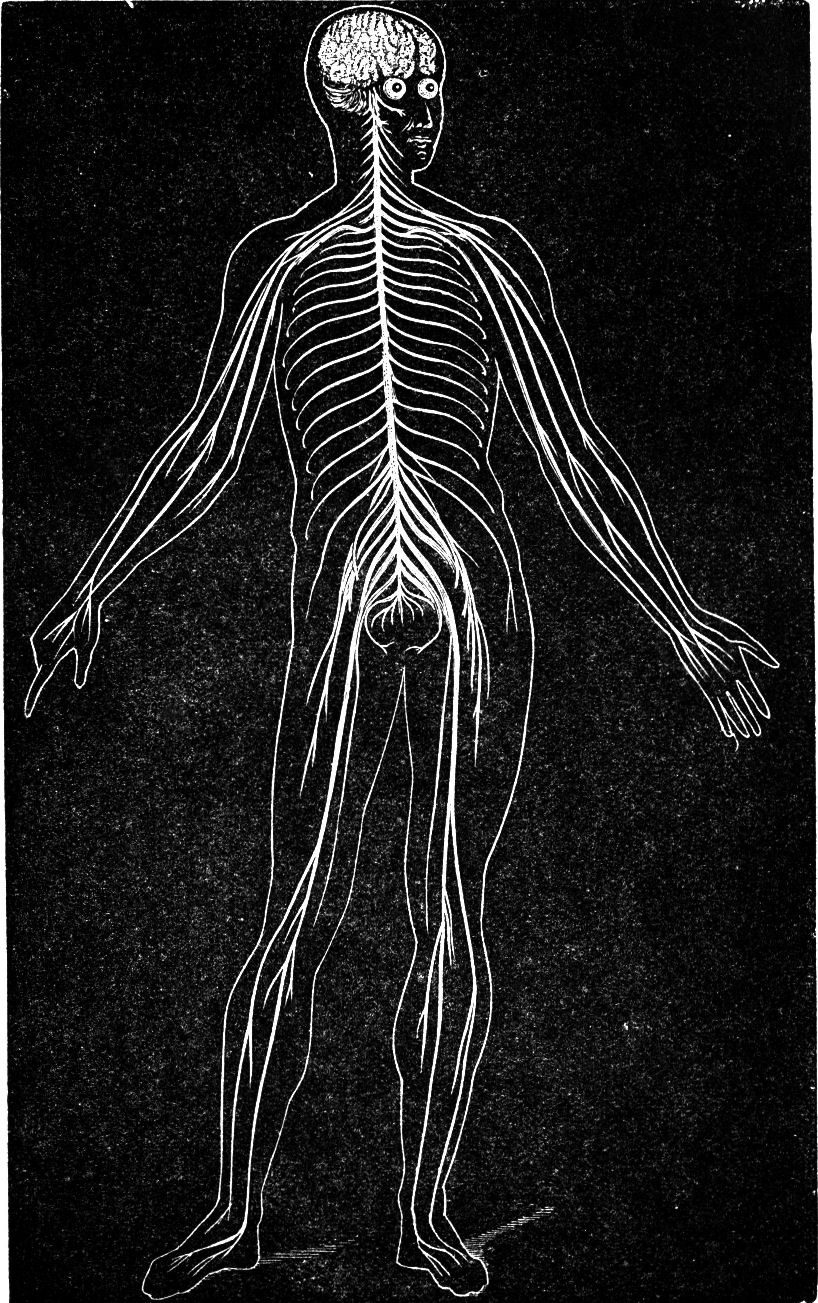
5. The gray, cellular substance constitutes the larger portion of those important masses, which bear the name of nervous centres and ganglia (from ganglion, a knot), and in which all the nerve-fibres unite. These white nerve-fibres are found combined together in long and dense cords, called nerves (from neuron, a cord), which serve to connect the nervous centres with each other, and to place them in communication with all the other parts of the body which have sensibility or power of motion. That part of the nervous system which is concerned in the animal functions, comprises the brain, the spinal cord, and the nerves which are derived therefrom; these are, together, called the cerebro-spinal system (Fig. 40); while that other set of organs, which presides over, and regulates the vegetative functions, is called the sympathetic system of nerves.
6. Location of the brain? Its weight? Its shape? Of what it consists? What organs at the base?
6. The Brain.—The brain is the great volume of nervous tissue that is lodged within the skull. It is the largest and most complex of the nervous centres, its weight, in the adult, being about fifty ounces, or one-fortieth of that of the whole body. The shape of the brain is oval, or egg-shaped, with one extremity larger than the other, which is placed posteriorly in the skull, to the concavity of which it very closely conforms. The brain consists chiefly of two parts; the cerebrum, or brain proper, and the cerebellum, or "little brain." In addition to these, there are several smaller organs at the base, among which is the commencement or expansion of the spinal cord, termed the medulla oblongata, or oblong marrow.
Fig. 40.—The Cerebro-Spinal System.
7. The tissue of the brain? What, therefore, is required? Blows on the head? Membranes of the brain? Blood sent to the brain?
7. The tissue of the brain is soft and easily altered in shape by pressure; it therefore requires to be placed in a well-protected position, such as is afforded by the skull, or cranium, which is strong without being cumbrous. In the course of an ordinary lifetime, this bony box sustains many blows, with little inconvenience; while, if they fell directly upon the brain, they would at once, and completely, disorganize that structure. Within the skull, the brain is enveloped by certain membranes, which at once protect it from friction, and furnish it with a supply of nutrient vessels; they are called the arachnoid, or "spider's web," the dura mater and the pia mater, or the "tough" and "delicate coverings." The supply of blood sent to the brain is very liberal, amounting to one-fifth of all that the entire body possesses. The brain of man is heavier than that of any other animal, except the elephant and whale.
8. Size of the brain proper? How divided? The exterior of the hemispheres? The interior?
8. The Cerebrum.—The brain proper, or cerebrum, is the largest of the intracranial organs, and occupies the entire upper and front portion of the skull. It is almost completely bisected, by a fissure, or cleft, running through it lengthwise, into two equal parts called hemispheres. The exterior of these hemispheres is gray in color, consisting chiefly of nerve-cells, arranged so as to form a layer of gray matter one-fifth of an inch in thickness, and is abundantly supplied with blood-vessels. The interior of the brain, however, is composed almost wholly of white substance, or nerve-fibres.
9. The surface of the cerebrum, how marked? The gray matter of the surface? Extent of the entire brain surface? Source of nervous power? What further?
9. The surface of the cerebrum is divided by a considerable number of tortuous and irregular furrows, about an inch deep, into "convolutions," as shown in Fig. 41. Into these furrows the gray matter of the surface is extended, and, in this manner, its quantity is vastly increased. The extent of the entire surface of the brain, with the convolutions unfolded, is computed to be equal to four square feet; and yet it is easily enclosed within the narrow limits of the skull. When it is stated that the gray matter is the true source of nervous power, it becomes evident that this arrangement has an important bearing on the mental capacity of the individual. And it is noticed that in children, before the mind is brought into vigorous use, these markings or furrows on the surface are comparatively shallow and indistinct; the same fact is true of the brain in the less civilized races of mankind and in the lower animals. It is also noticeable, that among animals, those are the most capable of being educated which have the best development of the cerebrum.
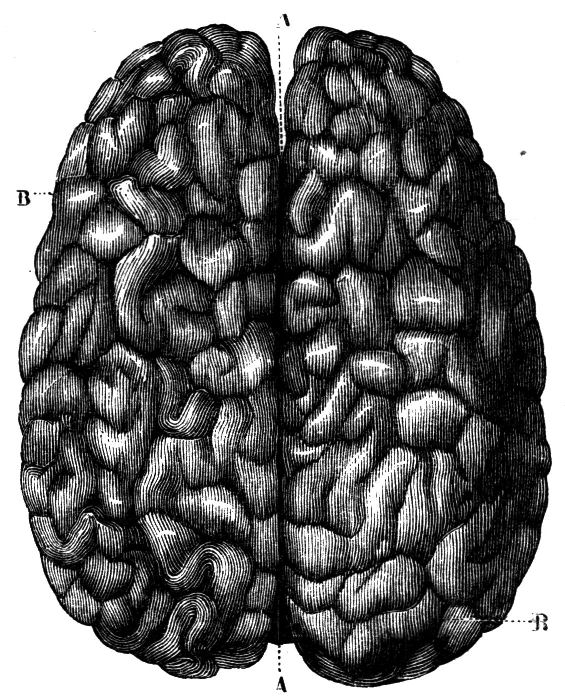
Fig. 41.—Upper Surface of the Cerebrum.
A, Longitudinal Fissure. B, The Hemispheres.
10. Location of the "little brain?" How divided? Its surface and interior? Its subdivisions? Its size?
10. The Cerebellum.—The "little brain" is placed beneath the posterior part of the cerebrum, and, like the latter, is divided into hemispheres. Like it, also, the surface of the cerebellum is composed of gray matter, and its interior is chiefly white matter. It has, however, no convolutions, but is subdivided by many crescentic, parallel ridges, which, sending down gray matter deeply into the white, central portion, gives the latter a somewhat branched appearance. This peculiar appearance has been called the arbor vitæ, or the "tree of life," from the fact that when a section of the organ is made, it bears some resemblance to the trunk and branches of a tree (Fig. 42, F). In size, this cerebellum, or "little brain," is less than one-eighth of the cerebrum.
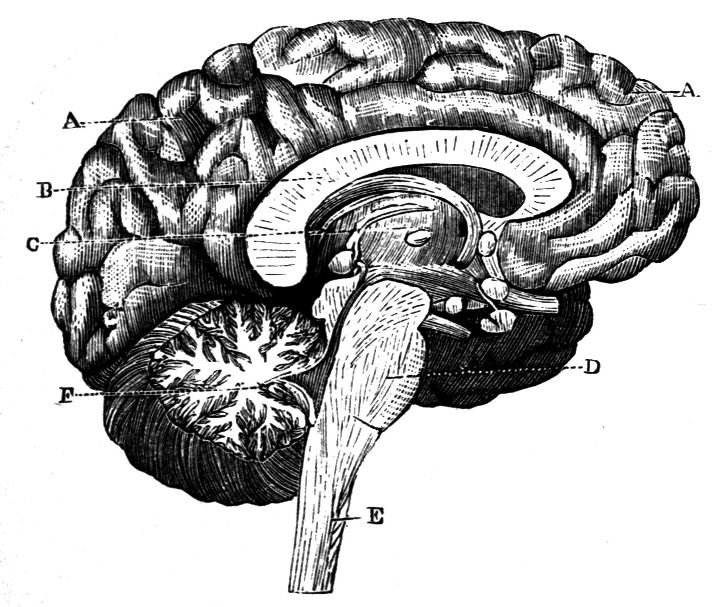
Fig. 42.—Vertical Section of the Brain.
A, Left Hemisphere of Cerebrum. B, Corpus Callosum. C, Optic Thalamus. D, The Pons Varolii. E, Upper extremity of the Spinal Cord. F, The Arbor Vitæ.
11. Medulla oblongata? Cranial nerves? Their shape and position?
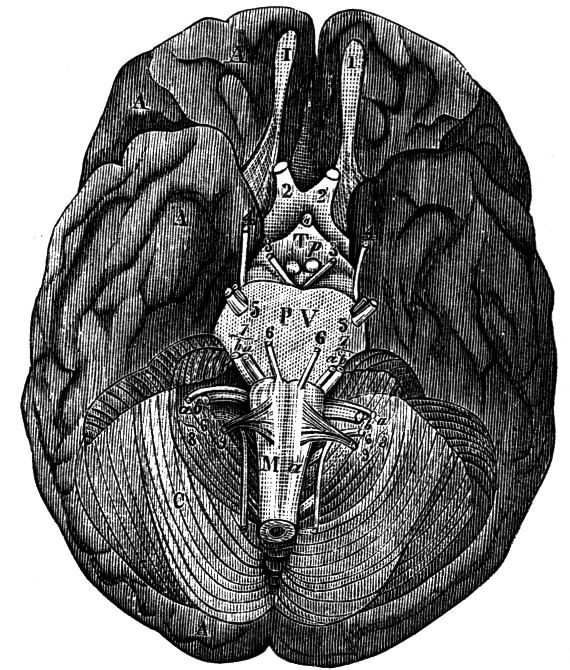
11. From the under surface of the cerebrum, and from the front margin of the cerebellum, fibres collect together to form the medulla oblongata (Fig. 43, MA), which, on issuing from the skull, enters the spinal column, and then becomes known as the spinal cord. From the base of the brain, and from the sides of the medulla originate, also, the cranial nerves, of which there are twelve pairs. These nerves are round cords of glistening white appearance, and, like the arteries, generally lie remote from the surface of the body, and are well protected from injury.
Fig. 43.—The Base of the Brain.
12. The spinal cord? Of what composed? How divided? Each half?
12. The Spinal Cord.—The spinal cord, or "marrow," is a cylindrical mass of soft nervous tissue, which occupies a chamber, or tunnel, fashioned for it in the spinal column (Fig. 44). It is composed of the same substances as the brain; but the arrangement is exactly reversed, the white matter encompassing or surrounding the gray matter instead of being encompassed by it. The amount of the white substance is also greatly in excess of the other material. A vertical fissure partly separates the cord into two lateral halves, and each half is composed of two separate bundles of fibres, which are named the anterior and posterior columns.
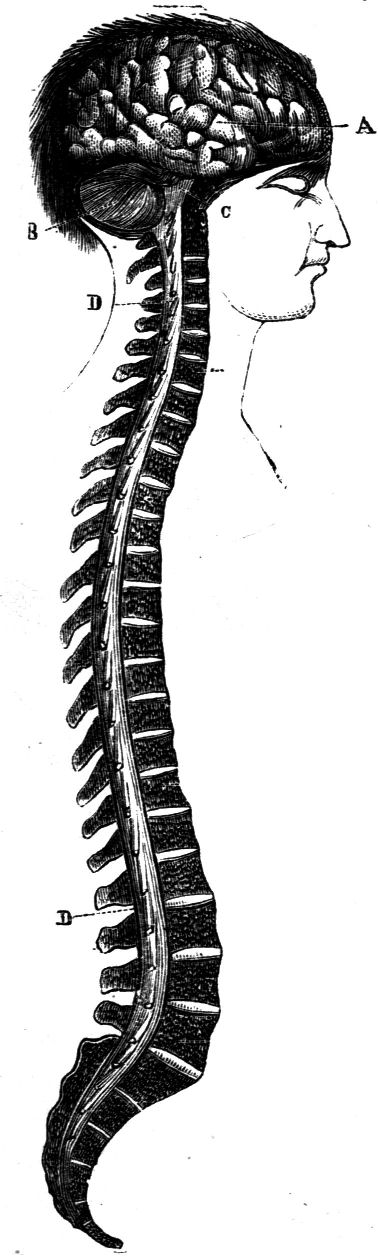
Fig. 44.
A, Cerebrum. B, Cerebellum. D, D, Spinal Cord.
13. Uses of these columns? Importance of this part of the nervous system? How protected?
13. These columns have entirely different uses, and each of them unites with a different portion of the nerves which have their origin in the spinal cord. The importance of this part of the nervous system is apparent from the extreme care taken to protect it from external injury. For, while a very slight disturbance of its structure suffices to disarm it of its power, yet so staunch is its bony enclosure, that only by very severe injuries is it put in peril. The three membranes that cover the brain are continued downward so as to envelope and still further shield this delicate organism.
14. The spinal nerves? The posterior root? The nerves, how arranged? Their office?
14. The Spinal Nerves.—The spinal nerves, thirty-one pairs in number, spring from each side of the cord by two roots, an anterior and a posterior root, which have the same functions as the columns bearing similar names. The posterior root is distinguished by possessing a ganglion of gray matter, and by a somewhat larger size. The successive points of departure, or the off-shooting of these nerves, occur at short and nearly regular intervals along the course of the spinal cord. Soon after leaving these points, the anterior and posterior roots unite to form the trunk of a nerve, which is distributed, by means of branches, to the various organs of that part of the body which this nerve is designed to serve. The spinal nerves supply chiefly the muscles of the trunk and limbs and the external surface of the body.
15. The nerve tissue? Its character? Course of each nerve fibre?
15. The tissue composing the nerves is entirely of the white variety, or, in other words, the nerve-fibres; the same as we have observed forming a part of the brain. But the nerves, instead of being soft and pulpy, as in the case of the brain, are dense in structure, being hardened and strengthened by means of a fibrous tissue which surrounds each of these delicate fibres, and binds them together in glistening, silvery bundles. Delicate and minutely fine as are these nerve-fibres, it is probable that each of them pursues an unbroken, isolated course, from its origin, in the brain or elsewhere, to that particular point which it is intended to serve. For, although their extremities are often only a hair's breadth distant from each other, the impression which any one of them communicates is perfectly distinct, and is referred to the exact point whence it came.
16. How may we illustrate the fact? The fibre connecting the brain with a point in the foot?
16. This may be illustrated in a simple manner, thus: if two fingers be pressed closely together, and the point of a pin be carried lightly across from one to the other, the eyes may be closed, and yet we can easily note the precise instant when the pin passes from one finger to the other. If the nerve-fibres were less independent, and if it were necessary that they should blend with and support each other, all accuracy of perception would be lost, and all information thus afforded would be pointless and confused. These silvery threads must, therefore, be spun out with an infinite degree of nicety. Imagine, for instance, the fibre which connects the brain with some point on the foot,—its length cannot be less than one hundred thousand times greater than its diameter; and yet it performs its work with as much precision as fibres that are comparatively much stronger and less exposed.
17. The sympathetic system of nerves? Of what does it consist?
17. The Sympathetic System.—The sympathetic system of nerves remains to be described. It consists of a double chain of ganglia, situated on each side of the spinal column, and extending through the cavities of the trunk, and along the neck into the head. These ganglia are made up for the most part of small collections of gray nerve-cells, and are the nerve-centres of this system. From these, numerous small nerves are derived, which connect the ganglia together, send out branches to the cranial and spinal nerves, and form networks in the vicinity of the stomach and other large organs. A considerable portion of them also follows the distribution of the large and small blood-vessels, in which the muscular tunic appears. Branches also ascend into the head, and supply the muscles of the eye and ear, and other organs of sense.
18. Association of the various regions of the body? If one member suffers? Blushing?
18. In this manner, the various regions of the body are associated with each other by a nervous apparatus, which is only indirectly connected with the brain and spinal cord; and thus it is arranged that the most widely separated organs of the body are brought into close and active sympathy with each other, so that, "if one member suffers, all the other members suffer with it." From this fact, the name sympathetic system, or the great sympathetic nerve, has been given to the complicated apparatus we have briefly described. Blushing and pallor are caused by mental emotions, as modesty and fear, which produce opposite conditions of the capillaries of the face by means of these sympathetic nerves.
19. Properties of nervous tissue? Office of the gray substance? Of the white? The nervous centres? White fibres?
19. The Properties of Nervous Tissue.—We have seen that in all parts of this system, there are only two forms of nervous tissue; namely, the gray substance and the white substance, so called from their difference of color as seen by the naked eye; or the nerve-cell, and the nerve-fibre, so called from their microscopic appearance. Now these two tissues are not commonly mingled together, but either form separate organs, or distinct parts of the same organs. This leads us to the conclusion that their respective uses are distinct. And this proves to be the simple fact; wherever we find the gray substance, we must look upon it as performing an active part in the system, that is, it originates nervous impulses; the white matter, on the contrary, is a passive agent, and serves merely as a conductor of nervous influences. Accordingly, the nervous centres, composed so largely of the gray cells, are the great centres of power, and the white fibres are simply the instruments by which the former communicate with the near and distant regions of the body under their control.
20. What comparison is made between the brain and the nation's capitol? The vital property, excitability? What example is given?
20. We may compare the brain, then, to the capital, or seat of government, while the various ganglia, including the gray matter of the cord, like so many subordinate official posts, are invested with authority over the outlying provinces; and the nerves, with the white matter of the cord, are the highways over which messages go and return between these provinces and the local or central governments. But both forms of nervous tissue possess the same vital property, called excitability; by which term is meant, that when a nerve-cell or fibre is stimulated by some external agent, it is capable of receiving an impression and of being by it excited into activity. A ray of light, for example, falling upon one extremity of a fibre in the eye, excites it throughout its whole length; and its other extremity, within the brain, communicating with a nerve-cell, the latter, in its turn, is excited, and the sensation of sight is produced.
21. Change in the nervous tissues? Nerve force and electricity?
21. What sort of change takes place in the nervous tissue when its excitability is aroused, is not known; certainly none is visible. On this account, it has been thought by some, that the nerve-fibre acts after the manner of a telegraph wire; that is, it transmits its messages without undergoing any material change of form. But, though the comparison is a convenient one, it is far from being strictly applicable; and the notion that nerve-force is identical with electricity has been fully proved to be incorrect.
22. Functions of the nerves? In the case of the nerve of a living animal? Of the human body?
22. The Functions of the Nerves.—The nerves are the instruments of the two grand functions of the nervous system, Sensation and Motion. They are not the true centres of either function, but they are the conductors of influences which occasion both. If the nerve in a limb of a living animal be laid bare, and irritated by pinching, galvanizing, or the like, two results follow, namely: the animal experiences a sensation, that of pain, in the part to which the nerve is distributed, and the limb is thrown into convulsive action. When a nerve in a human body is cut by accident, or destroyed by disease, the part in which it ramifies loses both sensation and power of motion; or, in other words, it is paralyzed. We accordingly say that the nerves have a twofold use, a sensory and motor function.
23. If an exposed nerve be divided? What is proved? The course of the sensory set of fibres? Of the motor set? To what are they likened?
23. If a nerve that has been exposed be divided, and the inner end, or that still in connection with the nerve-centres, be irritated, sensation is produced, but no movement takes place. But if the outer end, or that still connected with the limb, be irritated, then no pain is felt, but muscular contractions are produced. Thus we prove that there are two distinct sets of fibres in the nerves; one of which, the sensory fibres, conduct toward the brain, and another, the motor fibres, conduct to the muscles. The former may be said to begin in the skin and other organs, and end in the brain; while the latter begin in the nervous centres and end in the muscles. They are like a double line of telegraph wires, one for inquiries, the other for responses.
24. The two roots of the spinal nerves? What has been found? Difference of the two sorts of fibres? Result of their union?
24. We have already spoken of the two roots of the spinal nerves, called from their points of origin in the spinal cord, the anterior and posterior roots. These have been separately cut and irritated in the living animal, and it has been found that the posterior root contains only sensory fibres, and the anterior root has only motor fibres. So that the nerves of a limb may be injured in such a way that it will retain power of motion and yet lose sensation; or the reverse condition, feeling without motion, may exist. Between these two sorts of fibres, no difference of structure can be found; and where they have joined to form a nerve it is impossible to distinguish one sort from the other.
25. Transient paralysis? When such is the case with the leg? What other fact is observed?
25. Occasionally a nerve is so compressed as to be temporarily unable to perform its functions: a transient paralysis then takes place. This is the case when the leg or arm "gets asleep," as it is expressed. When such is the condition with the leg, and the person suddenly attempts to walk, he is liable to fall, inasmuch as the motor fibres cannot convey orders to the muscles of the limb. Another fact is observed: there is no sensation in this nerve at the point of its compression; but the whole limb is numb, and tingling sensations are felt in the foot, the point from which the sensory fibres arise.
26. What does this illustrate? Sensation? The feeling after a limb has been amputated? Striking of the "funny bone?"
26. This illustrates the manner in which the brain interprets all injuries of the trunk of a nerve. Sensation or pain is not felt at the point of injury, but is referred to the outer extremities of the nerve, where impressions are habitually received. This is the reason why, after a limb has been amputated by the surgeon, the patient appears to suffer pain in the member that has been severed from the body; while some form of irritation at the end of the nerve in the wound, or stump, is the real source of his distress. Again, when the "funny-bone"—that is, the ulnar nerve at the elbow,—is accidentally struck, the tingling sensations thus produced are referred to the outer side of the hand and the little finger, the parts to which that nerve is distributed.
27. The spinal nerves, and two from the brain? Of the remainder? Difference in the nerves? How accounted for? The rate of conduction along a nerve? As compared with electricity?
27. All the spinal nerves, and two from the brain, are concerned in both sensation and motion. Of the remainder of the cranial nerves, some are exclusively motor, others exclusively sensory; and still others convey, not ordinary sensations, but special impressions, such as sight, hearing, and smell, which we have yet to consider. However much the functions of the nerves seem to vary, there is but little difference discoverable in the nerves themselves, when examined under the microscope. Whatever difference exists must be accounted for in consequence of the nerves communicating with different portions of the gray matter of the brain. The rate of motion of a message, to or from the brain along a nerve, has been measured by experiment upon the lower animals, and estimated in the case of man at about two hundred feet per second. As compared with that of electricity, this is a very slow rate, but, in respect to the size of the human body, it is practically instantaneous.
28. Functions of the anterior and posterior columns of the cord? If the cord be divided?
28. The Functions of the Spinal Cord.—As the anterior and posterior roots of the spinal nerves have separate functions, so the anterior and posterior columns of the cord are distinct in function. The former are concerned in the production of motion, the latter in sensation. If the cord be divided, as before in the case of the nerve, it is found that the parts below the point of injury are deprived of sensation and of the power of voluntary motion on both sides of the body, a form of paralysis which is called paraplegia.
29. Paraplegia? Result and danger to life? When the injury occurs in the neck?
29. This form of disease, paraplegia, is sometimes seen among men, generally as the result of a fall, or some other severe accident, by which the bones of the spine are broken, and the cord is crushed, or pierced by fragments of bone. The parts which are supplied by nerves from the cord above the point of injury are as sensitive and mobile as before. The results are similar, whether the division happens at a higher or lower portion of the spinal cord; but the danger to life increases proportionally as the injury approaches the brain. When it occurs in the neck, the muscles of inspiration are paralyzed, since they are supplied by nerves issuing from that region; and as a result of this paralysis, the lungs are unable to act, and life is speedily brought to a close.
30. Experiment of cutting the spinal cord of an animal? What inference is drawn?
30. When the spinal cord of an animal has been cut, in experiment, it may be irritated in a manner similar to that alluded to when considering the nerves. If, then, the upper cut surface be excited, it is found that pain, referable to the parts below the cut, is produced; but when the lower cut surface is irritated, no feeling is manifested. So we conclude that in respect to sensation, the spinal cord is not its true centre, but that it is merely a conductor, and is therefore the great sensory nerve of the body. When the lower surface of the cut is irritated, the muscles of the parts below the section are violently contracted. Hence, we conclude that, in respect to the movements ordered by the will, the spinal cord is not their source; but that it acts only as a conductor, and is, accordingly, the great motor nerve of the body.
31. What singular fact is noticed? What does the result show?
31. Direction of the Fibres of the Cord.—If one lateral half of the spinal cord be cut, or injured, a very singular fact is observed. All voluntary power over the muscles of the corresponding half of the body is lost, but the sensibility of that side remains undiminished. This result seems to show that the motor fibres of the cord pursue a direct course, while its sensory fibres are bent from their course. And this has been proved to be the fact; for immediately after the posterior roots—the conductors of sensory impressions—join the posterior columns, they enter the gray matter of the cord, and passing over, ascend to the brain on the opposite side. Accordingly, the sensory fibres from the right and left sides interlace each other in the gray matter; this arrangement has been termed the decussation, or crossing of these fibres. This condition serves to explain how a disease or injury of the cord may cause a paralysis of motion in one leg, and a loss of sensation in the other.
32. Direction of the anterior or motor columns? In the cord itself? In the medulla oblongata? The decussation?
32. The direction of the anterior, or motor columns of the cord, is downward from the brain. In the cord itself, the course of the motor fibres is for the most part, a direct one; but in the medulla oblongata, or upper extremity of the cord, and therefore early in their career, these fibres decussate, or cross from side to side in a mass; and not separately, as in the case of the posterior fibres just mentioned. This arrangement is termed the decussation of the anterior columns of the medulla.
33. Result of the double interlacing of fibres? Where is the seat of pain when the right hand is hurt? The moving of the foot? Loss of sensation in one side of the body?
33. From this double interlacing of fibres results a crossed action between the original and terminal extremity of all nerve-fibres which pass through the medulla; namely, those of all the spinal nerves. Consequently, if the right hand be hurt, the left side of the brain feels the pain; and if the left foot move, it is the right hemisphere which dictates its movement. For the same reason, when a loss of sensation and power of motion affecting the right side of the body alone is observed, the physiologist understands that the brain has been invaded by disease upon its left side. This affection is termed hemiplegia, or the "half-stroke." The full-stroke, which often follows the rupture of a blood-vessel in the brain, is commonly called paralysis.
34. What other important use has the cord? What is the activity denominated?
34. The Reflex Action of the Cord.—We have already considered the cord as the great motor and sensory nerve of the body, but it has another and extremely important use. By virtue of the gray matter, which occupies its central portion, it plays the part of an independent nerve centre. The spinal cord not only conducts some impressions to the brain, but it also arrests others; and, as it is expressed, "reflects" them into movements by its own power. This mode of nervous activity is denominated the Reflex Action of the cord.
35. Example of the fowl? Centipede? Frog? What do they prove?
35. A familiar example of this power of the cord is found in the violent movements which agitate a fowl after its head has been cut off. The cold-blooded animals also exhibit reflex movements in an astonishing degree. A decapitated centipede will run rapidly forward, and will seemingly strive to overturn, or else climb over obstacles placed in its way. A frog similarly mutilated will sustain its headless body upon its feet, in the standing posture, just as it might do if it were still alive. If pushed over, it will regain its feet; and if the feet are irritated, it will jump forward. There can be no doubt that, in the lower animals, movements may take place which are completely divorced from the will, sensation, and consciousness; for in those animals, as well as in man, these faculties have their principal seat within the brain.
36. What is necessary in most cases to awaken reflex movements? In the case of the fowl? Convulsions which follow decapitation?
36. An irritation is necessary, in most instances, to awaken reflex movements. In the case of the decapitated fowl, its muscles are excited to convulsive action by reason of its being thrown upon the hard ground and roughly handled. Let it be treated differently, and the convulsions will not take place: let it be laid gently upon soft cotton, and the body will remain comparatively quiet. It may comfort some people to know that the convulsions which follow decapitation are not attended with pain; nor are they a necessary part of the "act of death," as some suppose.
37. Actions in the human body distinct from voluntary efforts?
37. In the human body, likewise, actions are excited that are entirely distinct from the ordinary voluntary efforts. It is not permissible, desirable, nor even necessary to decapitate a man that the body may be disconnected from his brain, in order to test the effect of irritation upon the spinal cord; although the bodies of beheaded criminals have been experimented upon, and caused to move by powerful galvanic batteries. The resort to such means of experiment is rendered unnecessary by the occurrence of certain deplorable cases of disease and injury, which effectually sever all communication between the brain and a large part of the body.
38. Reflex action after injury of the cord? Why not due to the muscles?
38. Thus, the cord may be so far injured, as the result of accident, as to terminate all sensation and voluntary motion in the lower half of the body, the patient seemingly becoming lifeless and powerless from the waist downward. And yet, by tickling or pinching either foot, the leg of the same side may be made to jerk, or even to kick with considerable force; but, unless the patient is observing his limbs, he is wholly unconscious of these movements, which are, therefore, performed independently of the brain. And they are in nowise due to the muscles of the limb; for, if the cord itself becomes diseased below the point of injury, the muscles cease to contract.
39. What are the requisites for the production of this form of nervous action?
39. For the production of this form of nervous action three things are requisite—(1) a nerve to conduct messages from the surface of the body, one of that variety formerly described as sensory, but which are now incapable of awakening sensation; (2) a portion of uninjured spinal cord which shall reflect or convert impressions into impulses; and (3) a motor nerve to conduct impulses outward to the muscles. The power of the cord to enforce reflex acts resides in the gray matter, into which the reflex nerves enter and from which they depart, by means of their posterior and anterior roots respectively.
40. Why do we not readily recognize the reflex activity of the cord in our own bodies? How best studied in others? Example?
40. The Uses of the Reflex Action.—The reflex activity of the cord is exhibited in the healthy body in many ways, but since it is never accompanied with sensation, we do not readily recognize it in our own bodies. Reflex movements are best studied in the cases of other persons, when the conditions enable us to distinguish between acts that are consciously, and those that are unconsciously performed. For example, if the foot of a person soundly asleep be tickled or pinched, it will be quickly withdrawn from the irritation.
41. Similar movements? Arm of a person? Melted wax or heated coin on the hand?
41. Similar movements may be observed in cases where the consciousness and sensation are temporarily obliterated by disease, or by means of narcotic poisons. If the arm of a person who has been rendered insensible by chloroform, be raised, and then allowed to fall, it will be noticed that the limb does not drop instantly, like a lifeless member, but a certain amount of rigidity remains in its muscles, which resists or breaks the force of its descent. Again, when a substance like melted sealing-wax, or a heated coin, falls upon the hand, the limb is snatched away at once, even before the feeling of pain has been recognized by the brain. When jolted in a rapidly moving car, we involuntarily step forward or backward, so as to preserve the centre of gravity of the body.
42. Result of healthful reflex activity? When may the reflex energy be deficient?
42. These and similar acts are executed by the same mechanism as that previously described in the case of paralysis from an injury of the spinal cord. The muscles thus called into play, are those which are ordinarily under the sway of the will, but which in these cases act through this reflex action of the cord, altogether independently of the will. A healthful reflex activity produces an elasticity, or "tone," of the voluntary muscular system, which, in a great measure, explains the existence in the young and vigorous of a feeling of buoyancy and reserve power. Its possessor is restlessly active, and it may appropriately be said of him, "he rejoiceth as a strong man to run a race." But this reflex energy may be deficient. This is true when the blood is poor and wanting in its solid ingredients, or the circulation is feeble; the muscles, then, are flabby and weak, and the person himself is said to be "nerveless," or indisposed to exertion. Shivering from cold, and trembling from fear, may, in part, be referred to a temporary loss of tone, resulting from a powerful impression upon the brain.
43. Excess of this activity in disease? Hydrophobia, etc.? The difference in severity of the convulsions?
43. An excess of this activity may also be observed in disease. In this condition, the excitability of the cord is unnaturally aroused, and frequent and violent movements of the limbs and body, called convulsions, are the result. The convulsions of young children, and the nervous agitation of chorea, or St. Vitus's dance, are reflex in character; as are also the symptoms attending poisoning by strychnine, and those terrible diseases, tetanus, or "locked jaw," and hydrophobia. The severity of the convulsions is not the same in all cases of these disorders; but, in those last mentioned the most violent spasmodic movements are provoked by the slightest form of irritation—such as the sound of pouring water, the sight of any glittering object, the glancing of a mirror, the contact of cool air, or even the touch of the bedclothes.
44. Another variety of reflex motions? What are they? What is stated of the mind in connection with these movements?
44. Another variety of reflex motions takes place in certain involuntary muscles, and over these the cord exercises supreme control. They are principally those movements which aid the performance of digestion and nutrition, the valve-action of the pylorus, and other movements of the stomach and intestines. In these movements the mind shares no part. And it is well that this is so; for since the mind is largely occupied with affairs external to the body, it acts irregularly, becomes fatigued, and needs frequent rest. The spinal cord, on the contrary, is well fitted for the form of work on which depends the growth and support of the body, as it acts uniformly, and with a machine-like regularity.
45. Consciousness in these operations? Physical wants?
45. These operations are not accompanied by consciousness; for, as a general rule, the attention is only called to them when they become disordered. Many a person does not know where his stomach is situated, until he discovers its position by reason of a feeling of distress within it, produced by giving that organ improper work to perform. In this manner the higher and nobler faculties of the mind are liberated from the simply routine duties of the body; and we are thus left to direct the attention, the reason, and the will to the accomplishment of the great ends of our existence. If it were otherwise, we could only find time to attend to our ordinary physical wants.
46. How many objects may the reflex activity be said to have? State the first. The second. The third.
46. The objects of the reflex activity of the cord are threefold. In the first place, it acts as the protector of man, in his unconscious moments. It is his unseen guardian, always ready to act, never growing weary, and never requiring sleep. Nor does its faithful action wholly cease with the cessation of life in other parts. In the second place, it is the regulator of numerous involuntary motions that are necessary to the nutrition of the body. Here its actions are entirely independent of the brain, and are performed in a secret and automatic manner. And, thirdly, it acts as a substitute, and regulates involuntary movements in the muscles usually under the influence of the will. It thus takes the place of the higher faculties in performing habitual acts, and permits them to extend their operations more and more beyond the body and its material wants.
47. How does the medulla oblongata resemble the cord?
47. The Functions of the Medulla Oblongata.—The prolongation of the spinal cord, within the skull, has been previously spoken of as the medulla oblongata. It resembles the cord, in being composed of both white and gray matter, and in conducting sensory and motor influences. It likewise gives rise to certain nerves, which are here called cranial nerves (from cranium, the skull). All except two of these important nerves spring from the medulla, or the parts immediately adjoining it; the exceptions are the two nerves taking part in the special senses of sight and smell, which nerves have their origin at the base of the cerebrum.
48. What final fact is observed in the crossing of the motor columns?
48. The decussation, or crossing of the motor columns, has been previously described, when treating of the direction of the nerve-fibres of the cord; and the singular fact has been alluded to, that when one side of the brain is injured, its effects are limited to the opposite side of the body. One more fact remains to be observed in this connection, namely, this crossed action does not usually take place in the cranial nerves. Accordingly, when apoplexy, or the rupture of a blood-vessel, occurs in the right hemisphere of the cerebrum, the left side of the body is paralyzed, but the right side of the face is affected; this is because that part of the body is supplied by the cranial nerves.