Chapter VI
Reading edition
INSTRUMENTS FOR ASCERTAINING TEMPERATURE.
53. Temperature is the energy with which heat affects our sensation of feeling.
Bodies are said to possess the same temperature, when the amounts of heat which they respectively contain act outwardly with the same intensity of transfer or absorption, producing in the one case the sensation of warmth, in the other that of coldness. Instruments used for the determination and estimation of temperatures are called Thermometers.
Experience proves that the same body always occupies the same space at the same temperature; and that for every increase or decrease of its temperature, it undergoes a definite dilatation or contraction of its volume. Provided, then, a body suffers no loss of substance or peculiar change of its constituent elements or atoms, while manifesting changes of temperature it will likewise exhibit alterations in volume; the latter may, therefore, be taken as exponents of the former. The expansion and contraction of bodies are adopted as arbitrary measures of changes of temperature; and any substance will serve for a thermometer in which these changes of volume are sensible, and can be rendered measureable.
54. Thermometric Substances.—Thermometers for meteorological and domestic purposes are constructed with liquids, and generally either mercury or alcohol, because their alterations of volume for the same change of temperature are greater than those of solids; while being more manageable, they are preferred to gases. Mercury is of all substances the best adapted for thermometric purposes, as it maintains the liquid state through a great alteration of heat, has a more equable co-efficient of expansion than any other fluid, and is peculiarly sensitive to changes of temperature. The temperature of solidification of mercury, according to Fahrenheit’s scale of temperature, is -40°; and its temperature of ebullition is about 600°. Sulphuric ether, nitric acid, oil of sassafras, and other limpid fluids, have been employed for thermometers.
55. Description of the Thermometer.—The ordinary thermometer consists of a glass tube of very fine bore, having a bulb of thin glass at one extremity, and closed at the other. The bulb and part of the tube contains mercury; the rest of the tube is a vacuum, and affords space for the expansion of the liquid. This arrangement renders very perceptible the alterations in volume of the mercury due to changes of temperature. It is true, the glass expands and contracts also; but only by about one-twentieth of the extent of the mercury. Regarding the bulb, then, as unalterable in size, all the changes in the bulk of the fluid must take place in the tube, and be exhibited by the expansion and contraction of the column, which variations are made to measure changes of temperature.
56. STANDARD THERMOMETER.
Fig. 36

The peculiarities in the construction of thermometers will be best understood by describing the manufacture of a Standard Thermometer, which is one of the most accurate make, and the scale of which is divided independently of any comparison with another thermometer. Fig. 36 is an illustration of such an instrument, on a silvered brass scale.
Selection of Tube.—In selecting the glass tube, much care is requisite to ascertain that its bore is perfectly uniform throughout. As received from the glass-house, the tubes are generally, in their interior, portions of very elongated cones, so that the bore is wider at one end than at the other. With due care, however, a proper length of tube can be selected, in which there is no appreciable difference of bore. This is ascertained by introducing into the tube a length of mercury of about a half or a third of an inch, and accurately measuring it in various positions in the tube. To accomplish this, the workman blows a bulb at one end of the tube, and heats the bulb a little to drive out some of the air. Then, placing the open end in mercury, upon cooling the elasticity of the enclosed air diminishes, and the superior pressure of the atmosphere drives in some mercury. The workman stops the process so soon as he judges sufficient mercury has entered. By cooling or heating the bulb, as necessary, the mercury is made to pass from one end of the tube to the other. Should the length of this portion of mercury alter in various parts of the bore, the tube must be rejected. If it is, as nearly as possible, one uniform length, the tube is set aside for filling.
The bulb is never blown by the breath, but by an elastic caoutchouc ball containing air, so that the introduction of moisture is avoided. The spherical form is to be preferred; for it is best adapted to resist the varying pressure of the atmosphere. The bulbs should not be too large, or the mercury will take some time to indicate sudden changes of temperature. Cylindrical bulbs are sometimes desirable, as they offer larger surfaces to the mercury, and enable thermometers to be made more sensitive.
The mercury, with which the bulb is to be filled, should be quite pure, and freed from moisture and air by recent boiling.
Filling the Tube.—The filling is effected by heating the bulb with the flame of a spirit-lamp, while the open end is embedded in mercury. Upon allowing the bulb to cool, the atmospheric pressure drives some mercury into it; and the process of heating and cooling is thus continued until sufficient mercury is introduced. The mercury is next boiled in the tube, to expel any air or moisture that may be present. In order to close the tube and exclude all air, the artist ascertains that the tube contains the requisite quantity of mercury; then, by holding the bulb over the spirit flame, he causes the mercury to fill the whole of the tube, and dexterously removing it from the source of heat, he, at the same instant, closes it with the flame of a blow-pipe. If any air remain in the tube, it is easily detected; for if the instrument be inverted, the mercury will fall to the extremity of the tube, if there is a perfect vacuum, unless the tube be so finely capillary that its attraction for the mercury is sufficient to overcome the force of gravity, in which case the mercury will retain its position in every situation of the instrument. If, however, the mercury fall and does not reach quite to the extremity of the bore, some air is present, which must be removed.
The Graduation.—The thermometer is now prepared for graduation, the first part of which process is the determination of two fixed points. These are given by the temperatures of melting ice and of the vapour of boiling water. Melting ice has always the same temperature in every place and under all circumstances; provided only that the water from which the ice is congealed is free from salts. The temperature of the vapour of boiling water depends upon the pressure of the atmosphere, but is always constant for the same pressure.
The fixed point corresponding to the temperature of melting ice is called the freezing point. It is obtained by keeping the bulb and the part of the tube occupied by mercury immersed in melting ice, until the mercury contracts to a certain point, where it remains stationary. This position of the end of the mercury is then marked upon the tube.
The boiling point is not so easily determined, for the barometer must be consulted about the same time. The boiling apparatus is generally constructed of copper. It consists of a cylindrical boiler, heated from the base by a spirit lamp or charcoal fire. An open tube two or three inches in diameter and of suitable length enters the top of the boiler. This tube is enveloped by another fixed to the top of the boiler but not opening into it, and so that the two tubes are about an inch apart. The object of the outer tube is to protect the inner tube from the cold temperature of the air. The outer tube has an opening at the top for the admission of the thermometer, and a hole near the bottom for the escape of steam through a spout. When the water is made to boil, the steam rises in the inner tube, fills the space between the tubes, and escapes at the spout. The thermometer is then passed down into the inner cylinder, and held securely from the top by means of a piece of caoutchouc. The tubes or cylinders should be of sufficient length to prevent the thermometer entering the water. This is necessary because the temperature of boiling water is influenced by any substance which it holds in chemical solution; and, moreover, its temperature increases with the depth, owing to the pressure of the upper stratum. The thermometer being thus surrounded with steam, the mercury rises in the tube. As it does so, the tube should be depressed so as always to keep the top of the mercury just perceptible. When the temperature of the vapour is attained, the mercury ceases to rise, and remains stationary. The position of the end of the mercury is now marked upon the tube, and the “boiling-point” is obtained.
57. Methods of ascertaining the exact Boiling Temperature.—The normal boiling temperature of water all nations have tacitly agreed to fix under a normal barometric pressure of 29·922 inches of mercury, having the temperature of melting ice, in the latitude of 45°, and at the sea-level. If the atmospheric pressure at the time or place of graduating a thermometer does not equal this, the boiling temperature will be higher or lower according as the pressure is greater or less. Hence a reading must be taken from a reliable barometer, which must also be corrected for errors and temperature, and reduced for latitude, in order to compare the actual atmospheric pressure at the time with the assumed normal pressure. Tables of vapour tension, as they are termed, have been computed from accurate experimental investigations and theory,—giving the temperatures of the vapour of water for all probable pressures; Regnault’s, the most recent, is considered the most accurate; and his investigations are based upon the standard pressure given above, and are for the same latitude. His Table, therefore, will give the temperature on the thermometric scale corresponding to the pressure.
The Commissioners appointed by the British Government to construct standard weights and measures, decided that the normal boiling-point, 212°, on the thermometer should represent the temperature of steam generated under an atmospheric pressure equal in inches of mercury, at the temperature of freezing water, to 29·922 + (cos. 2 latitude × ·0766) + (·00000179 × height in feet above the sea-level). Hence, at London, lat. 51°30´ N., we deduce 29·905 as the barometric pressure representing the normal boiling point of water,—the trifling correction due to height being neglected. If then, in the latitude of London, the barometric pressure, at the time of fixing the boiling point, be not 29·905 inches, that point will be higher or lower, according to the difference of the pressure from the normal. Near the sea-level about 0·59 inch of such difference is equivalent to 1° Fahrenheit in the boiling point.
Suppose, then, the atmospheric pressure at London to be 30·785 inches, the following calculation gives the corresponding boiling temperature for Fahrenheit’s scale:—
Observedpressure 30·785
Normal" 29·905
Difference ·880
As 0·59 is to 0·88, so is 1° to 1°·5.
That is, the water boils at 1°·5 above its normal temperature; so that, in this case, the normal temperature to be placed on the scale, viz. 212°, must be 1°·5 lower than the mark made on the tube at the height at which the mercury stood under the influence of the boiling water.
The temperature of the vapour of boiling water may be found, at any time and place, as follows:—Multiply the atmospheric pressure by the factor due to the latitude, given in the annexed Table V., and with the result seek the temperature in Table VI.
Table V. Table VI.
Latitude. Factor. Temperature of Vapour. Tension. Temperature of Vapour. Tension.
Degrees. Degrees. Inches. Degrees. Inches.
0 0·99735 179 14·934 197 22·036
5 0·99739 180 15·271 198 22·501
10 0·99751 181 15·614 199 22·974
15 0·99770 182 15·963 200 23·456
20 0·99797 183 16·318 201 23·946
25 0·99830 184 16·680 202 24·445
30 0·99868 185 17·049 203 24·952
35 0·99910 186 17·425 204 25·468
40 0·99954 187 17·808 205 25·993
45 1·00000 188 18·197 206 26·527
50 1·00046 189 18·594 207 27·070
55 1·00090 190 18·998 208 27·623
60 1·00132 191 19·409 209 28·185
65 1·00170 192 19·828 210 28·756
70 1·00203 193 20·254 211 29·335
75 1·00230 194 20·688 212 29·922
80 1·00249 195 21·129 213 30·515
196 21·578 214 31·115
How to use the Tables.—When the temperature is known to decimals of a degree, take out the tension for the degree, and multiply the difference between it and the next tension by the decimals of the temperature, and add the product to the tension, for the degree.
Required the tension corresponding to 197°·84.
°
197 =22·036 ·465 × ·84=·391
198 =22·501 197°=22·036
Difference ·465 197·84=22·427
When the tension is given, take the difference between it and the next less tension in the Table, and divide this difference by the difference between the next less and next greater tensions. The quotient will be the decimals to add to the degree opposite the next less tension.
Thus, for 23·214 inches, required the temperature.
Given 23·214 Nextgreater 23·456
22·974 Nextless 22·974
·240 Difference ·482
And ·240 = ·5
·482
Temperature opposite next less 199·0
Temperature required 199·5
A similar method of interpolation in taking out numerical quantities is applicable to almost all tables; and should be practised with all those given in this work.
Example.—Thus, in Liverpool, lat. 53° 30´ N., the barometer reading 29·876 inches, its attached thermometer 55°, and the correction of the instrument being + ·015 (including index error, capillarity and capacity), what temperature should be assigned for the boiling point marked on the thermometer?
Observed barometer 29·876
Correction + ·015
29·891
Correction for temperature - ·074
Reduced reading 29·817
Factor from Table V. 1·00077
208719
208719
29817
Equivalent for lat. 45° 29·83995909
In Table VI., 29·84 gives temperature 211°·86.
58. Displacement of the Freezing Point.—Either the prolonged effect of the atmospheric pressure upon the thin glass of the bulbs of thermometers, or the gradual restoration of the equilibrium of the particles of the glass after having been greatly disturbed by the operation of boiling the mercury, seems to be the cause of the freezing points of standard thermometers reading from a few tenths to a degree higher in the course of some years, as has been repeatedly observed. To obviate this small error, it is our practice to place the tubes aside for about six months before fixing the freezing point, in order to give time for the glass to regain its former state of aggregation. The making of accurate thermometers is a task attended with many difficulties, the principal one being the liability of the zero or freezing point varying constantly, so much so, that a thermometer that is perfectly correct to-day, if immersed in boiling water, will be no longer accurate; at least, it will take some time before it again settles into its normal state. Then, again, if a thermometer is recently blown, filled, and graduated immediately, or, at least, before some months have elapsed, though every care may have been taken with the production of the instrument, it will require some correction; so that the instrument, however carefully made, should from time to time be plunged into finely-pounded ice, in order to verify the freezing point.
59. The Scale.—The two fixed points having been determined, it is necessary to apply the scale. The thermometers in general use in the United Kingdom, the British Colonies, and North America are constructed with Fahrenheit’s scale. Fahrenheit was a philosophical instrument maker of Amsterdam, who, about the year 1724, invented the scale which has given his name to the thermometer. The freezing point is marked 32°, the boiling point 212°, so that the intermediate space is divided into 180 equal parts, called degrees. “The principle which dictated this peculiar division of the scale is as follows:—When the instrument stood at the greatest cold of Iceland, or 0 degree, it was computed to contain 11124 equal parts of quicksilver, which, when plunged in melting snow, expanded to 11156 parts; hence the intermediate space was divided into 32 equal portions, and 32 was taken as the freezing point of water: when the thermometer was plunged in boiling water, the quicksilver was expanded to 11336; and therefore 212° was marked as the boiling point of that fluid. In practice, Fahrenheit determined the divisions of his scale from two fixed points, the freezing and boiling of water. The theory of the division, if we may so speak, was derived from the lowest cold observed in Iceland, and the expansions of a given portion of mercury” (Professor Trail).
The divisions of the scale can be carried beyond the fixed points, if requisite, by equal graduations. Fahrenheit’s scale is very convenient in some respects. The meteorological observer is seldom troubled with negative signs, as the zero of the scale is much below freezing. Again, the divisions are more numerous, and consequently smaller, than on other scales in use; and the further subdivision into tenths of degrees, seems to give all the minuteness usually required.
Celcius, a Swede, in 1742, proposed zero for the freezing point, and 100 for the boiling point, all temperatures below zero being distinguishable by the sign (—) minus. This scale is known as the centigrade, and is in use in France, Sweden, and the southern part of Europe. It has the advantage of the decimal notation, with the embarrassment of the negative sign.
Reaumur, a Frenchman, proposed zero for the freezing point, and 80° for the boiling point, an arrangement inferior to the centigrade. It is, however, in use in Spain, Switzerland, and Germany.
It is merely a simple arithmetical operation to change the indications of any one of these scales into the equivalents on the others. To facilitate such conversions, tables are convenient, when a large number of observations are under discussion; and they can be easily formed or obtained.
In the absence of such tables, the following formulæ will insure accuracy of method, and save thinking, when occasional conversions are wanted to be made:—F. stands for Fahrenheit, C. for Centigrade, and R. for Reaumur.
Given. Required. Solution.
F. C. = (F.-32) 5⁄9
F. R. = (F.-32) 4⁄9
C. F. = 9⁄5 C. + 32
C. R. = 4⁄5 C.
R. F. = 9⁄5 R. + 32
R. C. = 5⁄4 R.
Example.—Convert 25° of Fahrenheit’s scale into the corresponding temperature on the Centigrade scale.
HereC. = (25 - 32) 5⁄9
C. = -35= -3·9
9
or nearly 4° below zero of the Centigrade scale. The algebraical sign must be carefully attended-to in the calculations.
60. The method of testing Thermometers for meteorological purposes is very simple. Such thermometers are seldom required to read above 120°. In these the freezing point having been determined, the divisions of the scale are ascertained by careful comparisons, with a standard thermometer, in water of the requisite temperature. “For the freezing point, the bulbs, and a considerable portion of the tubes of the thermometers, are immersed in pounded ice. For the higher temperatures, the thermometers are placed in a cylindrical glass vessel containing water of the required heat: the scales of the thermometers intended to be tested, together with the Standard with which they are to be compared, are read through the glass. In this way the scale readings may be tested at any required degree of temperature, and the usual practice is to test them at every ten degrees from 32° to 92° of Fahrenheit.”—FitzRoy.
61. Porcelain Scale Plates.—Thermometer scales of brass, wood, or ivory, either by atmospheric influence or dipping in sea-water, are very liable to become soiled and discoloured, so much so that after a very little time the divisions are rendered nearly invisible. To obviate this inconvenience, Messrs. Negretti and Zambra were the first to introduce into extensive use thermometer and barometer scale-plates made of porcelain, having the divisions and figures engraved thereon by means of fluoric acid, and permanently burnt-in and blackened, so as always to present a clear legible scale. That these scales have been found superior to all others, may be inferred from the fact that all the thermometers now supplied to the various government departments are provided with such scales.
They can be adapted to replace any of the old forms of brass or zinc scales, the divisions and figures of which have become obliterated or indistinct.
62. Enamelled Tubes.—Nearly all thermometer tubes are now made with enamelled backs. This contrivance of enamelling the backs of the tubes enables the makers to use finer threads of mercury than had before been found practicable; for were it not for the great contrast between the dark thread of mercury and the white enamel on the glass, many of the thermometers now in use would be positively illegible. The enamelling of thermometers is an invention of Messrs. Negretti and Zambra. It is necessary to state this, as many persons, from interested motives, are anxious to ignore to whom the credit of the invention is due.
63. Thermometers of extreme Sensitiveness.—Thermometers for delicate experiments are no novelty. Thermometers have been made with very delicate bulbs to contain a very small quantity of mercury. Such instruments have also been made with spiral or coiled tubular bulbs, but the thickness of glass required to keep these coils or spirals in shape, and in fact to prevent their falling to pieces, served to nullify the effect sought to be produced, viz. instantaneous action; and where a small thin bulb was employed, the indicating column was generally so fine that it was positively invisible except by the aid of a powerful lens. Messrs. Negretti and Zambra have now introduced a new form of thermometer, which combines sensitiveness and quickness of action, together with a good visible column. The bulb of this thermometer is of the gridiron form. Care has been taken in constructing the bulb, so that the objections attending spirals and other forms have been overcome; for whilst the reservoir or bulb is made of glass so thin that it is only by a spirit lamp and not a glass blower’s blowpipe that it can be formed, yet it is still so rigid (owing to its peculiar configuration) that no variations in its indications can be detected, whether it be held in a horizontal, vertical, or oblique position, nor will any error be detected if it be stood on its own bulb. They have made thermometers with bulbs or reservoirs formed of about nine inches of excessively thin cylindrical glass, whose outer diameter is not more than a twentieth of an inch; so that, owing to the large surface presented, the indications are positively instantaneous. This form of thermometer was constructed expressly to meet the requirements of scientific balloon ascents, to enable thermometrical readings to be taken at the precise elevation. It was contemplated to procure a metallic thermometer, but on the production of this perfect instrument the idea was abandoned.
64. VARIETIES OF THERMOMETERS.
Fig. 37 is an illustration of boxwood scale thermometers for general use and common purposes.
Fig. 38, Negretti and Zambra’s Travelling Thermometer; it is fixed in a plated metal (silver or otherwise) case, similar to a pencil-case, and has the scale divided upon its stem.
Fig. 39, Thermometer mounted on a slab of glass, upon which the scale is etched, the back being either oak, mahogany, or ebony.
Fig. 40, Portable Thermometer, in a bronzed brass or German silver revolving case.
Fig. 41, Pocket Thermometer, on ivory or metallic scale, in morocco or papier-mâché case.
Fig. 37. Fig. 38. Fig. 39. Fig. 40. Fig. 41.
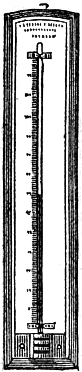

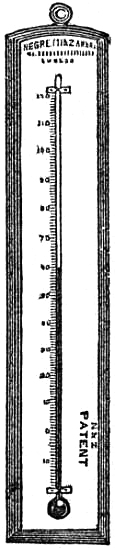

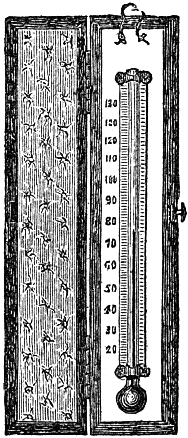
Fig. 42, an Ornamental Drawing-room Thermometer, on ebony or ivory stand, with glass shade.
Fig. 43, representation of highly carved or engine-turned design for thermometer mounts, in ivory or wood, for the drawing-room. Some have the addition of a sundial or compass at the top; they may also be formed for a watch-stand.
Fig. 44, Bath Thermometer, having a float to admit of its being kept in the water.
Fig. 42. Fig. 43. Fig. 44.
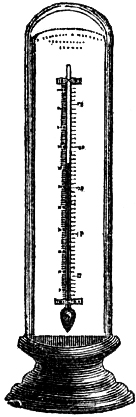
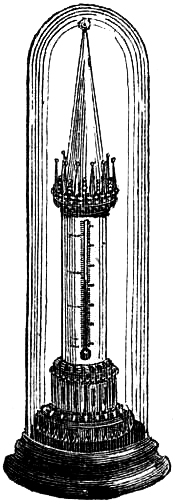
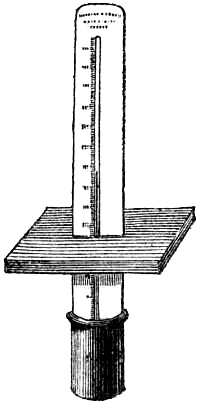
Fig. 45, Thermometer with ivory scale in glass cylinder, mounted on oak bracket with metal top, for out-door use; as at a window.
Fig. 46, Thermometer for the window, on patent porcelain or glass scale, with oak bracket and convenient brass supports, for placing the instrument at any angle.
Fig. 47, Chemical Thermometer, on boxwood scale, jointed near the bulb on a brass hinge, ranging from 300° to 600°.
Fig. 48, Chemical Thermometer, for acids, graduated on its own stem, suitable for insertion in the tubulure of retorts; they are also made insulated in glass cylinder to protect the graduated stem; ranging from 0° to 600°.
Fig. 45. Fig. 46. Fig. 47. Fig. 48. Fig. 49. Fig. 50.
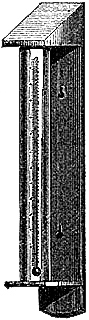
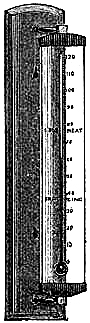



65. Superheated Steam Thermometer.—The great advantage gained by the use of superheated steam in marine and other steam-engines being now generally admitted by engineers, reliable thermometers, reading to 600° at least, are of the utmost importance. To meet this want, Messrs. Negretti and Zambra have constructed for the purpose a substantial form of thermometer, on their patent porcelain scales, in strong and convenient metal mountings, with perforated protection to the bulb. The scales cannot be deteriorated by steam, heat, oil, or dirt; and an occasional wiping will be all that is necessary to keep the divisions and figures clean and visible for any length of time; while careful calibration of the thermometer tubes ensures the most accurate indications attainable. These thermometers are illustrated by figs. 49 & 50. A similar, but cheaper, construction is given to thermometers to be used with hot air, or hot water, apparatus.
66. Thermometer for Sugar Boiling is protected by a metallic frame; and is usually from three to four feet long, the graduations being confined to a space of about twelve inches at the upper part of the instrument, allowing the bulb and greater part of the tube to be immersed in the boiling sugar. The graduations extend to 270° or further. An index is sometimes attached to the scale, which may be set to any degree of heat required to be maintained.
67. EARTH THERMOMETER.
The Earth Thermometer is for ascertaining the temperature of the soil at various depths. It is protected by a brass frame, pointed and strengthened at the end to facilitate insertion into the ground, as in fig. 51.
Fig. 51.

Utility of a Knowledge of the Temperature of the Soil.—The temperature of the soil is an important element in the consideration of climate, as it concerns the vegetable kingdom.
Dr. Daubeny, in his Lectures on Climate, gives the following statement with respect to some temperatures which have been observed just beneath the earth’s surface, in different parts of the globe:—
Country. Temperature. Authority.
Tropics, often 162-184° Humboldt.
Egypt 133-144 Edwards & Colin.
Orinoco In white sand, 140 Humboldt.
Chili 113-118, among dry grass Boussingault.
Cape of Good Hope 150, under the soil of a bulb garden Herschell.
Bermuda 142, thermometer barely covered in earth Emmet.
China Water of the fields, 113; adjacent sand, much higher; blackened sides of the boat at midday, 142-150 Meyer.
France 118-122, and in one instance 127 Arago.
“The importance of this to vegetation may be estimated by the following considerations:—
“It is known that every plant requires a certain amount of heat, varying in the case of each species, for the renewal of its growth, at the commencement of the season.
“Now when this degree of heat has spurred into activity those parts that are above ground, and caused them to elaborate the sap, it is necessary that the subterranean portions should at the same time be excited by the heat of the ground to absorb the materials which are to supply the plant with nourishment. Unless the latter function is provided for, the aerial portions of the plant will languish from want of food to assimilate. Indeed, it is even advisable that the roots should take the start of the leaves, in order to have in readiness a store of food for the latter to draw upon.” In another place the professor remarks:—“It has been calculated by Mr. Raikes, from experiments made at Chat Moss, that the temperature of the soil when drained averages 10° more than it does when undrained; and this is not surprising, when we find that 1 lb. of water evaporated from 1,000 lbs. of soil will depress the whole by 10°, owing to the latent heat which it absorbs in its conversion into vapour.”
68. MARINE THERMOMETER.
Fig. 52.

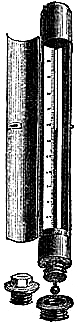
This instrument is a special construction to meet the requirements of navigation. It consists of a carefully constructed thermometer divided on its stem to degrees, which are sufficiently large to admit of subdivision into tenths of degrees by estimation, and ranging from 0° to 130°. The scale is porcelain, having the degrees etched upon it, and burnt-in a permanent black. The instrument is made to slide into a japanned metallic case, for handy use and protection. It is therefore adapted for almost any ordinary purpose; and cannot be injuriously affected by any chemical action arising from air or sea-water. A set of these thermometers consists of six, carefully packed in a neat box; two having japanned metallic cases (fig. 52), the others being designed for use without the case, or to replace a breakage.
This thermometer is employed in the Royal Navy, and for the observations made at sea for the Board of Trade.
The thermometer is now considered a necessary instrument on board ship. Not only is it of invaluable utility in connection with the barometer as a guide to the weather, but its indications are of service in showing the presence of a warm or cold current in the sea; many of the great oceanic currents being characterised by the warmth or coldness of their waters. In seas visited by icebergs, the habitual use of the thermometer would indicate their proximity, as the water is rendered colder for some distance around by the thawing of huge masses of ice. The water over a shoal in the sea is generally colder than the surface-water of the surrounding ocean; which may result from the cold water being brought to the surface by the current of water encountering the shoal. With this fact navigators are well acquainted; and therefore a fall in the sea-water thermometer may forebode that shallow water is at hand. It has been ascertained that fish inhabit regions of the oceans and seas having the peculiar temperature suitable to their habits. The better and firmer sort of fish are found where cold waters exist. Those taken in warmer belts or streams of water, even in the same latitude, are far inferior in condition, and less approved by the palate. The fish of the Mediterranean, a warm sea, are generally poor and scarce. Fish taken in the cold waters between the American shore and the Gulf Stream are much esteemed; while in and on the other side of the stream they are said to be tasteless, and of no flavour. Between the coasts of China and the warm waters of the Japanese current, the seas abound with excellent fish; but in the warm waters of the current and beyond, they are never seen in such shoals.
In fact, it is clearly ascertained that fishes are adapted to climates, like birds and beasts. It has been even affirmed, after careful investigation, that herrings, which abound in the British Seas, and form a most important branch of our fisheries, can only be found in a temperature varying from 54° to 58°. Hence the thermometer, if brought into use by the fishermen, would guide them to the spots where they may with the best chance cast their nets on dark nights, when other indications are not perceptible.
This thermometer in its metallic case is perfectly suited for dipping overboard, or placing in a bucket of water just taken from the sea, to ascertain its temperature.